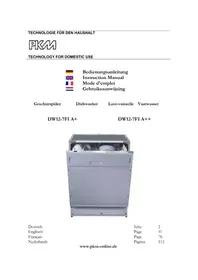
DW127FIA++ - Dishwasher PKM - Free user manual and instructions
Find the device manual for free DW127FIA++ PKM in PDF.



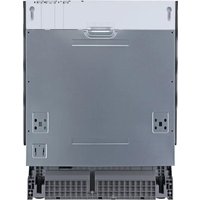
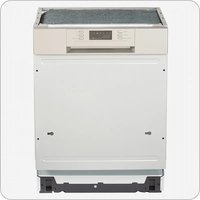
| Product type | Built-in dishwasher |
| Brand | PKM |
| Model | DW127FIA++ |
| Capacity | 12 place settings |
| Energy class | A++ |
| Energy consumption (standard cycle) | 0,925 kWh |
| Water consumption (standard cycle) | 13 L |
| Dimensions (H x W x D) | 82,0 - 87,0 x 59,6 x 57,5 cm |
| Net / gross weight | 42,0 / 48,0 kg |
| Power supply | 220-240 V ~ 50 Hz, 1850 W |
| Wash programs | Intensive, Eco, Delicate, Crystal, Quick, Pre-wash, 60 min, 3 in 1 |
| Delayed start | 1 to 24 hours |
| Display | LED |
| Child safety | Yes, key lock |
| Water softener | Yes, adjustable |
| Filter system | Coarse filter, flat filter, micro filter |
| Wash arms | 2 rotating arms |
| Baskets | 2 baskets, adjustable upper basket |
| Interior material | Stainless steel |
| Noise level | 49 dB(A) |
Frequently Asked Questions - DW127FIA++ PKM
User questions about DW127FIA++ PKM
0 question about this device. Answer the ones you know or ask your own.
Ask a new question about this device
Download the instructions for your Dishwasher in PDF format for free! Find your manual DW127FIA++ - PKM and take your electronic device back in hand. On this page are published all the documents necessary for the use of your device. DW127FIA++ by PKM.
USER MANUAL DW127FIA++ PKM
Dear customer! We would like to thank you for purchasing a product from our wide range of domestic appliances. Read the complete instruction manual before you operate the appliance for the first time. Retain this instruction manual in a safe place for future reference. If you transfer the appliance to a third party, also hand over this instruction manual.
INDEX
- Safety instructions 41
- Appliance and control panel 54
5.Use of the dish racks 60 - Cleaning and maintenance 68
- Technical data 73
-
Guarantee conditions 75
-
Installation 45
- Before the first use 55
6.Use of the programmes 63 - Trouble shooting 70
- Waste management 74
EU - Conformity Declaration
The EU Conformity Declarations concerning the products, which are described in this instruction manual, are available.
The relevant documents can be requested from the final retailer by the competent authorities.
The figures in this instruction manual may differ in some details from the current design of your appliance. Nevertheless follow the instructions in such a case. Delivery without content.
Any modifications, which do not influence the functions of the appliance, shall remain reserved by the manufacturer. Please dispose of the packing with respect to your current local and municipal regulations.
The appliance you have purchased may be an enhanced version of the unit this manual was printed for. Nevertheless, the functions and operating conditions are identical. This manual is therefore still valid.
Technical modifications as well as misprints shall remain reserved.
1
SAFETY INSTRUCTIONS
1
Read the safety instructions carefully before you operate the appliance for the first time. All information included in those pages serve for the protection of the operator. If you ignore the safety instructions, you will endanger your health and life.
DANGER! indicates a hazardous situation which, if ignored, will result in death or serious injury.
WARNING! indicates a hazardous situation which, if ignored, could result in death or serious injury.
CAUTION! indicates a hazardous NOTICE! indicates possible damage to situation which, if not avoided, may the appliance. result in minor or moderate injury.
Store this manual in a safe place so you can use it whenever it is needed. Strictly observe the instructions to avoid damage to persons and property.
Check the technical periphery of the appliance! Do all wires and connections to the appliance work properly? Or are they time-worn and do not match the technical requirements of the appliance? A check-up of existing and newly-made connections must be done by an authorized professional. All connections and energy-leading components (incl. wires inside a wall) must be checked by a qualified professional. All modifications to the electrical mains to enable the installation of the appliance must be performed by a qualified professional.
The appliance is intended for private use only.
The appliance is intended for cleaning dishes and cookware in a private household only.
The appliance is intended for indoor-use only.
The appliance is not intended to be operated for commercial purposes, during camping and in public transport.
Operate the appliance in accordance with its intended use only.
Do not allow anybody who is not familiar with this instruction manual to operate the appliance.
This appliance may be operated by children aged from 8 years and above as well as by persons with reduced physical, sensory and mental capabilities or lack of experience and knowledge if they are supervised or have been instructed concerning the safe use of the appliance and do comprehend the hazards involved. Children must not play with the appliance. Cleaning and user-maintenance must not be carried out by children unless they are supervised.
DANGER!
- Do not connect the appliance to the mains if the appliance itself or the power cord or the plug are visibly damaged.
- Never try to repair the appliance yourself. If the appliance does not operate properly, please contact the aftersales service. Original spare parts should be used only.
- When the power cord is damaged, it must be replaced by the manufacturer or an authorized aftersales service or a qualified professional only.
WARNING!
- Under certain conditions hydrogen is generated in a hot-water system, which has not been used within a fortnight or longer. Hydrogen is explosive. If you
have not operated the hot-water system within such a period of time, open all hot-water taps and let the water flow for several minutes to release the hydrogen. During this period do not smoke and do not use any open flames or naked light, because hydrogen is flammable.
- While unpacking, the packaging materials (polythene bags, polystyrene pieces, etc.) should be kept away from children. CHOKING HAZARD.
- Do not connect the appliance to the electric supply unless all packaging and transit protectors have been removed.
- Operate the appliance with 220 240V / 50Hz AC only. All connections and energy-leading components must be replaced by an authorized professional. Any repairs should be carried out by an authorized aftersales service
- Do not use a socket board or a multi socket when connecting the appliance to the mains.
- A dedicated and properly grounded socket (250V/10A) meeting the data of the plug is required to minimize any kind of hazard.
- Check that the power cord is not placed under the appliance or damaged when moving the appliance.
- The technical data of your energy supplier must meet the data on the model plate of the appliance.
- Your domestic circuit must be equipped with an automatic circuit breaker.
- Do not modify the appliance.
- Turn off the power before you install the appliance and before you connect it to the mains. RISK OF FATAL ELECTRIC SHOCK!
- Disconnect the appliance from the mains before you clean or maintain it.
- Dishwasher-detergents are very alkaline and so they are extremely dangerous when swallowed. Skin and eyes should not come in contact with dishwasher-detergents. Always keep such detergents out of reach of children.
- Keep dishwasher-detergents and additives away from children. Keep children away from the appliance when its door is open as some detergent may be still in the appliance.
- When all indicators on the control panel flicker, the appliance malfunctions. Disconnect the appliance from the mains and the water-supply immediately in such a case.
- Do not operate the appliance without the filters installed.
- Children must never play with the appliance.
- Never operate the appliance unattended.
CAUTION!
- While the appliance is operating it is dangerous to open its door as hot water may spurt out.
-
When a rinse cycle has been completed, wait a few minutes before opening the door as hot vapour may escape.
-
When a rinse cycle has been completed, wait at least 20 minutes before cleaning the interior of the appliance so the heating elements can cool down.
- Do not touch the heating elements during operation or immediately after operation. RISK OF BURNS!
- Do not place any heavy items on the open door as the appliance can tilt forwards.
- When you load the dishwasher:
a. check that sharp-edged items will not damage the door seals.
b. check that items do not project through the bases of the racks.
c. place sharp knives with the handle at the top or horizontally to avoid injuries.
- Do not leave the door open so that no one can trip on it.
NOTICE
- The spray arms may be equipped with a transport protection. Remove the transport protection before installing the appliance.
- Only use a water softener (= dishwasher salt) which is suitable for dishwashers. The water hardness depends on your place of residence. Hard water in a dishwasher generates deposits of minerals and salts on your dishes and in the appliance. The water softener removes minerals and salts from the water.
- Use a rinse aid which is suitable for a dishwasher only. Never use other chemical substances, e.g. a dishwasher cleaner or liquid cleaners; otherwise you will damage the appliance.
- Only use a detergent and additives which are suitable for dishwashers. Do not use soap, washing agents, hand wash detergents etc.
- When you move the appliance, hold it at its base and lift it carefully. Keep the appliance in an upright position.
- Never use the door for moving the appliance as you will damage the hinges.
- The appliance must be transported and installed by at least two persons.
- When you unpack the appliance, you should take note of the position of every part of the interior accessories in case you have to repack and transport it at a later point of time.
- The connection to the water supply should be carried out by a qualified professional.
- Do not operate the appliance unless all components are installed properly.
- Do not stand or lean on the racks or the door.
- Plastic-made items must not touch the heating elements.
- Only wash dishwasher-proof plastic-made items in the appliance. Such items are labelled by their manufacturer.
- After each rinse cycle check that the water-softener container is empty.
- Never use cleaning sprays to clean the door as they can damage the lock and electric components.

Unpacking and Positioning
- Unpack the appliance carefully. Completely remove the transport-protection. Be very careful and do not use any aggressive or abrasive detergents to remove residuals of the transport-protection.
- The spray arms may be equipped with a transport protection. Remove the transport protection before installing the appliance.
- Install the appliance in a dry and well-ventilated place.
- Install the appliance on a level, dry and solid floor. Check the correct installation with a bubble level.
- Connect the appliance to the mains properly.
- The nameplate is inside the appliance or at the back.

Water inlet / drainage installation
- he water inlet and drainage installation must be carried out by a qualified professional.
- Use brand-new hoses and connector kids only.
- We recommend to secure the water supply with a back pressure valve.

Installation
1. Before installation
Installation of the condensation strip.
- You must install the condensation strip on the bottom side of the worktop to protect it from the water vapor released by the appliance. The condensation strip deflects the water vapor from the worktop.
- You will find the condensation strip inside your appliance.
- Clean the bottom side of the worktop properly before you install the condensation strip.
- Remove the protective foil from the adhesive surface of the condensation strip.
- Stick the condensation strip on the bottom side of the worktop.
- Improper installation of the condensation strip may cause damage to the worktop.
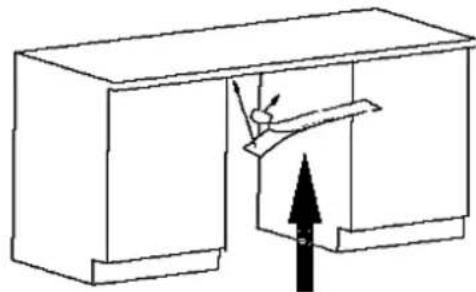
Condensation strip
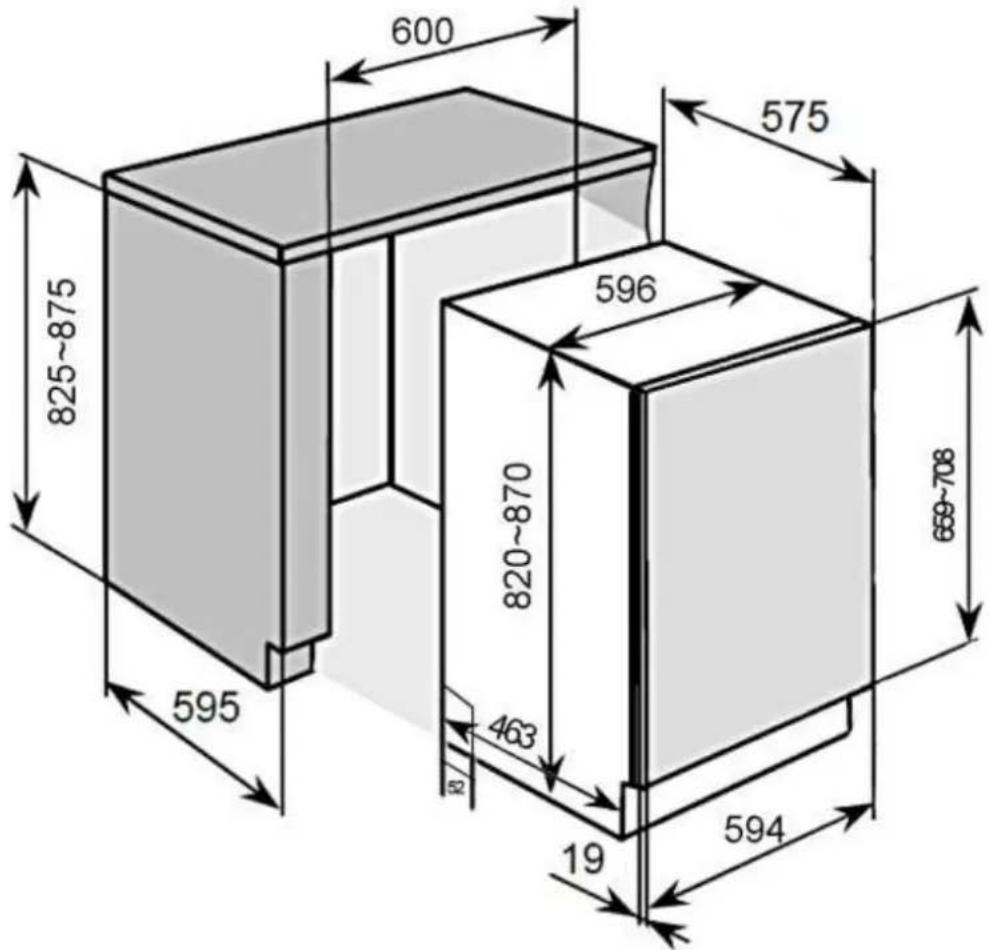
Required space for the appliance: look at the following figures. The back of the appliance must face the wall. The appliance must be equipped with an inlet and outlet hose, which can be installed on the left or right.
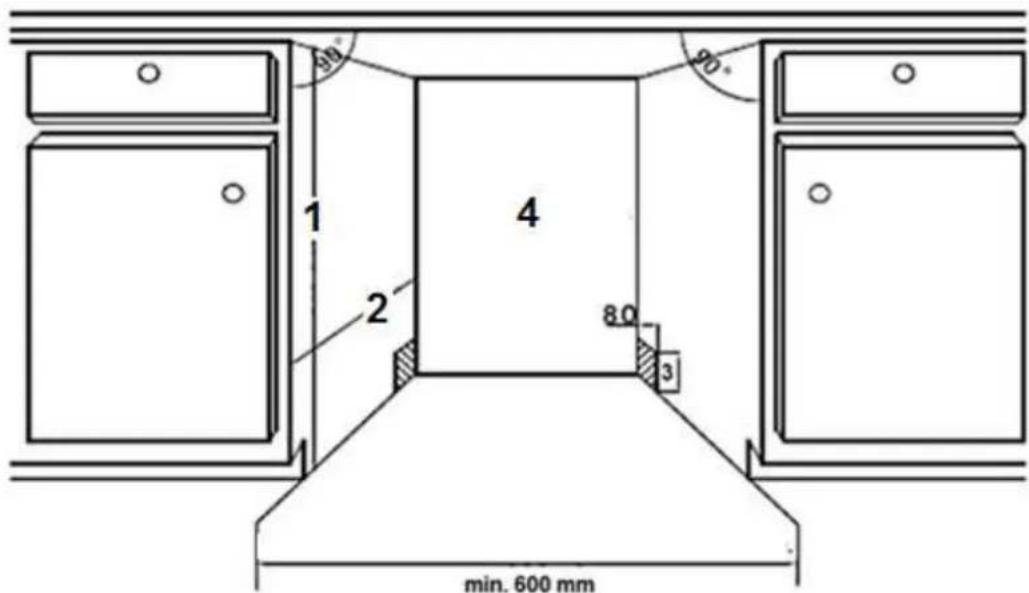
Install the appliance.
1 815-840 mm
2 min. 598 mm
3 100mm
4 Connections for power cable, water inlet, water outlet
- Minimum required space when opening the door.
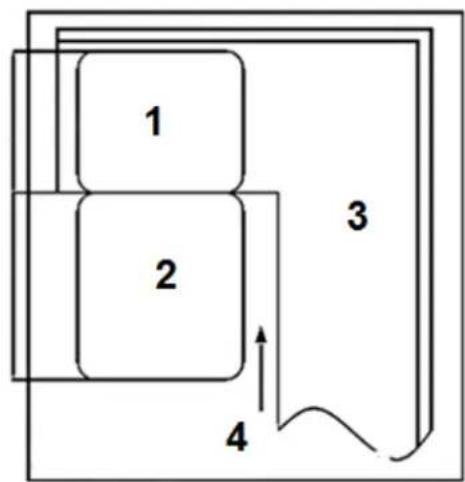
1 Dishwasher
2 Door of dishwasher
3 Cabinet
4 Minimum distance for opening the door is 50mm
3. Dimensions of the front decoration-panel
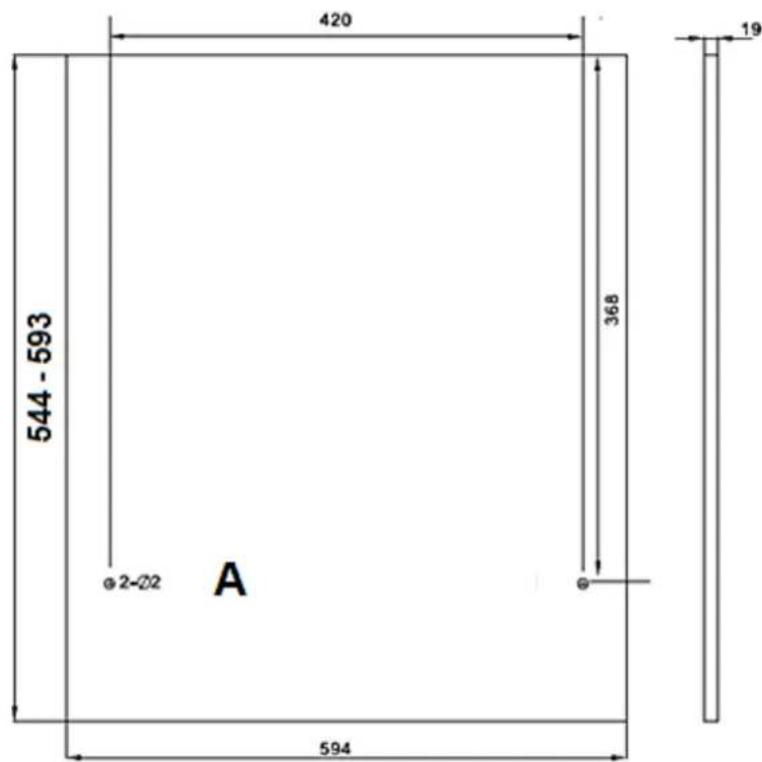
A: hole/10 mm depth.
4. Fixing of the front decoration-panel
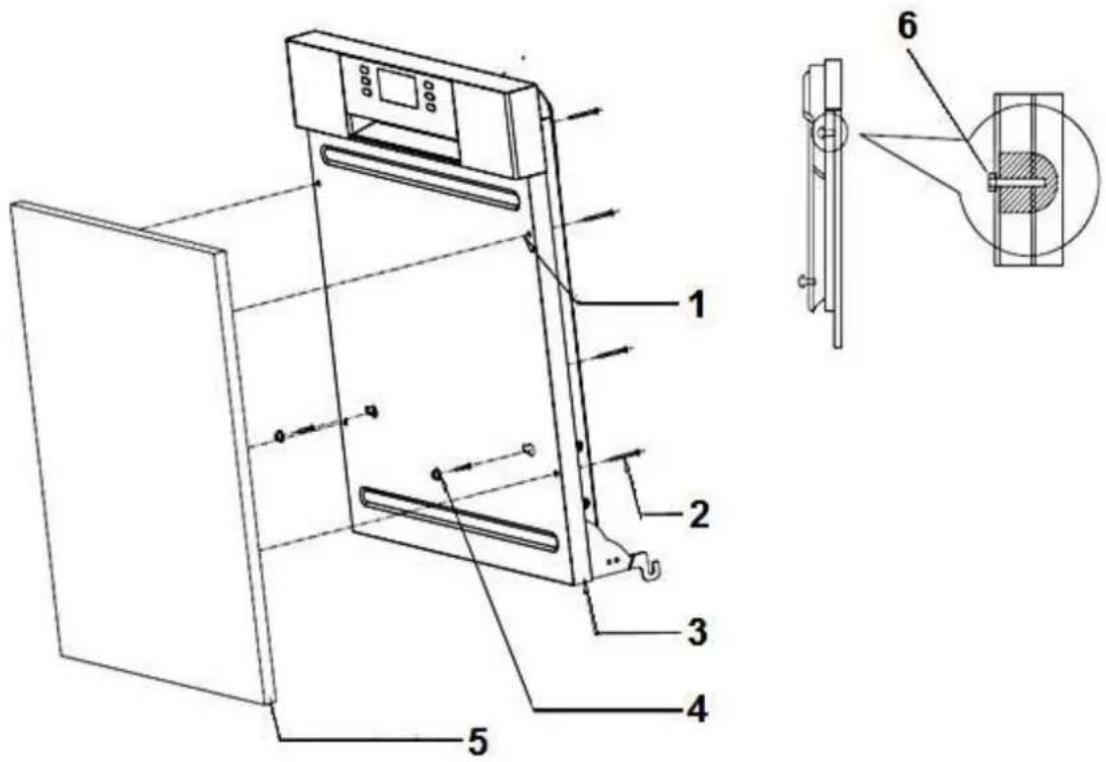
1 4 pcs. 442mm woodscrews
2 1.) Remove 2 pcs. 410
2.) 4 pcs. 442 woodscrews
3 Door of the appliance
4 T-shape plug
5 Decoration panel
6 4 pcs. 442 woodscrews
5. Adjusting of the tension of the door-spring
After having installed the decoration-panel, try to open and close the door to check its balance and to decide if it can remain in its installation-condition. When the door is balanced improperly, turn the screws in clockwise and anti-clockwise direction for proper adjustment (or let the balance adjust by an experienced person).
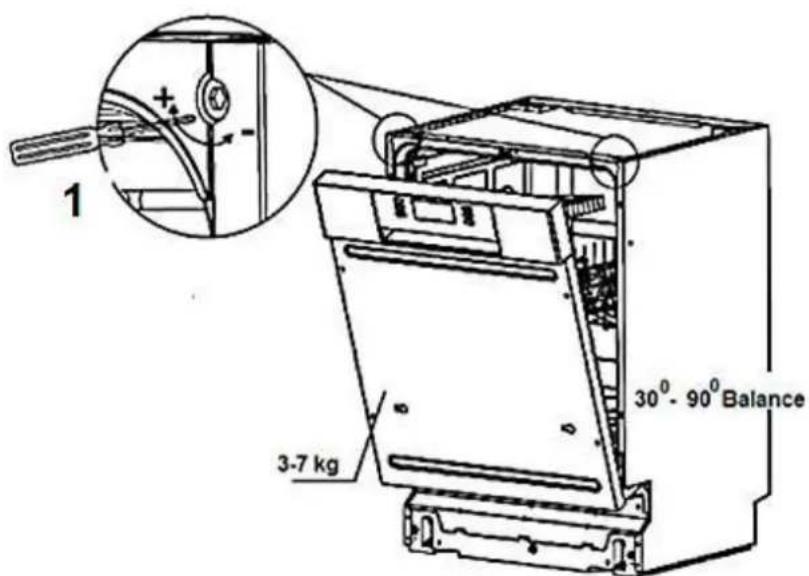
1: hexagon screwdriver
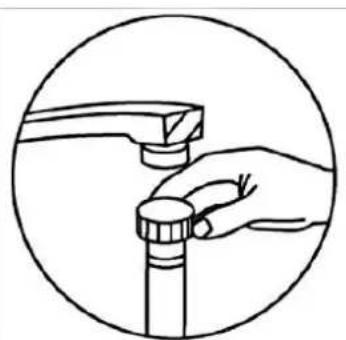
- Installation of the water inlet hose(for cold water
Connect the inlet hose to a connector with a 3/4 inch thread firmly and securely. When the hoses are new or were not used for an extended period of time, let the water flow until the hose is clear of any contamination.
NOTICE! Otherwise the water inlet may be blocked and the appliance will be damaged.
7. Water outlet hose installation
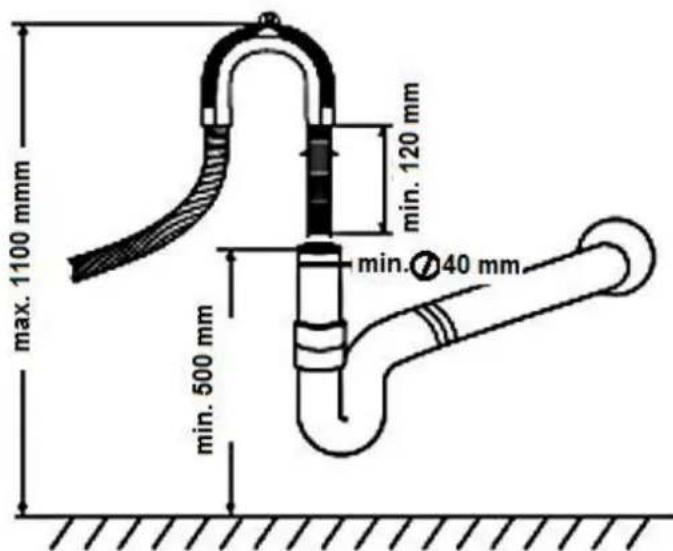
Fit the drainage hose of your appliance to the drainage pipe without bending.
If the length of the hose is not sufficient, apply to your authorized service for an extension made from the same material as the original hose. Remember that the length of the hose (including extension) should not exceed 4 meters.
If the drainage hose is longer the 4m the dishes will not be cleaned properly. Check that the connection does not leak. Fix the outlet hose with a hose-holder.
8. Raised level installation
Partially and fully integrated appliances can be installed at a raised level when connected properly. A collar enables the bending of the drain hose. There is a holding device on the collar to fix the collar. The drain hose must have a height of min. 40 cm at the top of the collar. Look at the drawing below for the connection options A, B and C.
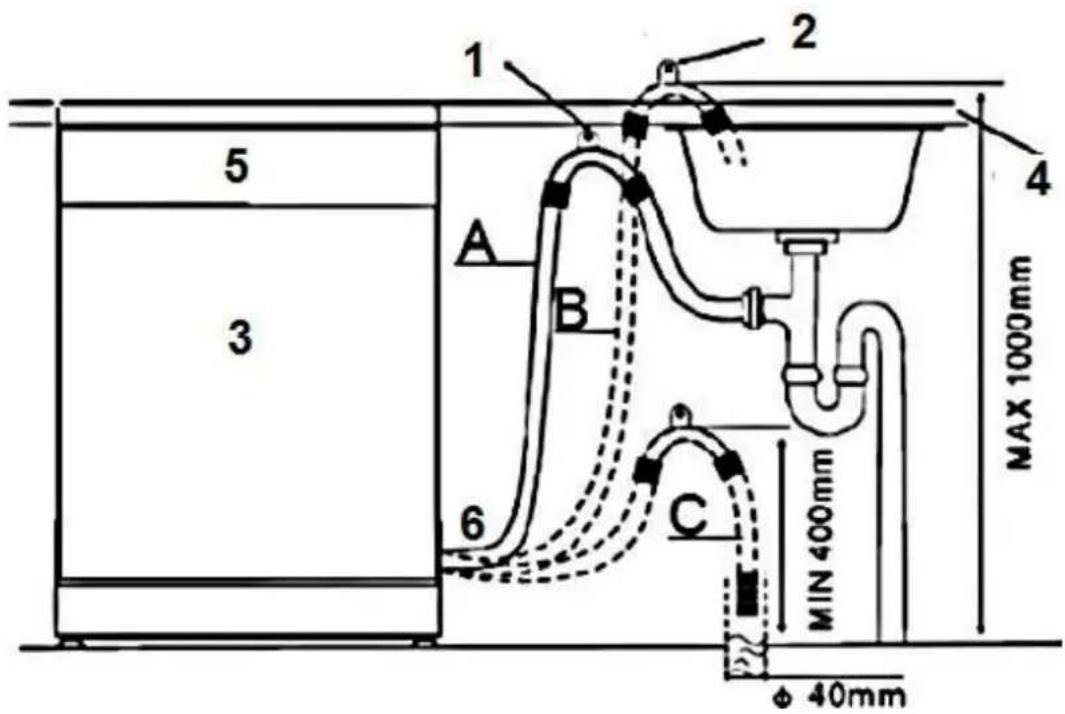
| 1 | Hang the drain hose hook on the counter |
| 2 | Drain hose hook |
| 3 | The top of the hose must be at a height between 40 and 100 cm. The free end of the hose must not be immersed in water. |
| 4 | Counter |
| 5 | Front |
| 6 | Drain pipe |
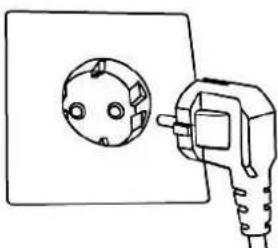
9. Electrical connection
You need a properly grounded and dedicated safety socket relevant to the plug (250V/10A).
WARNING Otherwise serious accidents may occur or your appliance may be damaged.
Proper levelling
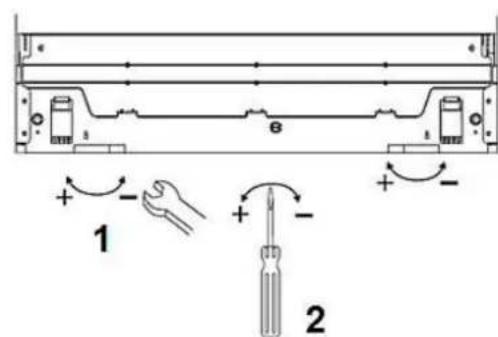
1 Adjust front feet
2 adjust back feet
The maximum permissible inclination angle under the entire appliance is 2irc . Adjust the appliance with its feet horizontally. Check with a water level.
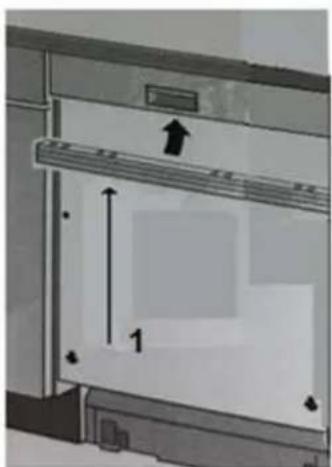
10. Installation of the skirting board
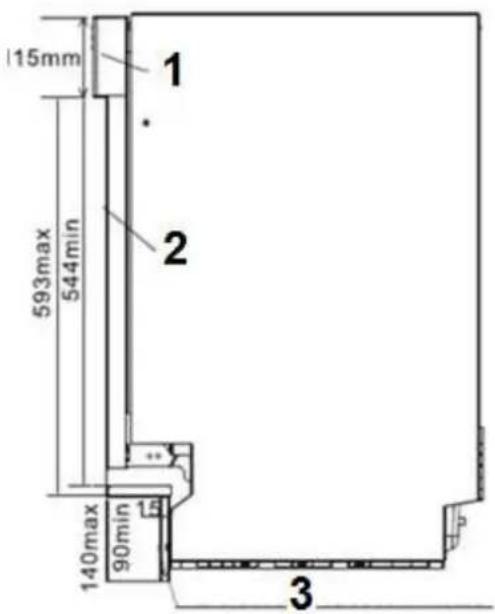
1 control panel
2 decoration panel
3 skirting board
Benchmarks
| Serial number | decoration panel | Skirting board |
| 1 | 593 mm | 85 mm |
| 2 | 583 mm | 95 mm |
| 3 | 573 mm | 105 mm |
| 4 | 563 mm | 115 mm |
| 5 | 553 mm | 125 mm |
| 6 | 543 mm | 135 mm |
The required height of the skirting board should meet your standard of aesthetics as well as it should enable the door to open/close properly. You find the relevant benchmarks on the schedule above.
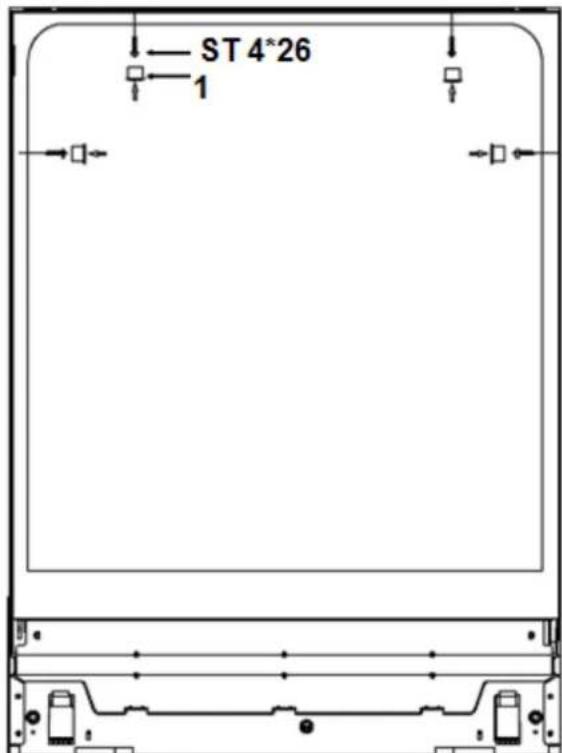
11. Fixing of the appliance
a. Fix the appliance on the built-in unit by turning the screws.
b. Press the 4 plugs into the holes (look at figure).
c. Use woodscrews ST 426 (self-tapping screws) for the left and right as well as for the 4 top holes.
1: plug
12. Fixing the top spacer
The top spacer has got several layers. Customize the height of the spacer by removing the relevant number of layers from the bottom side of the spacer. Use the click-mechanism for selecting the proper number of layers.
1: spacer
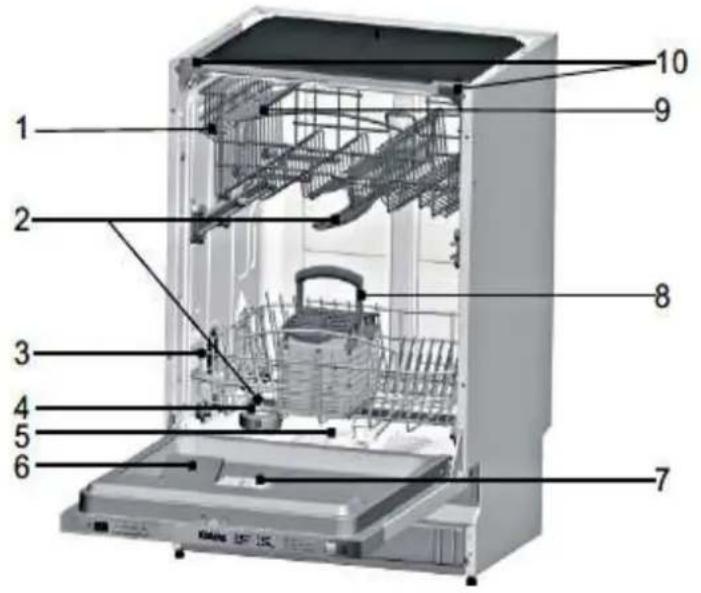
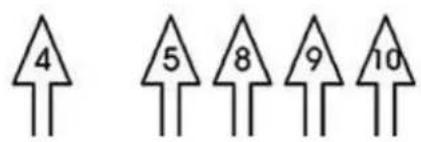
- Upper basket
- Spray arm
- Lower basket
- Water softener
- Filters
- Detergent dispenser
- Rinsc aid dispenser
- Cutlery basket
- Cup holder
- Adjustment device

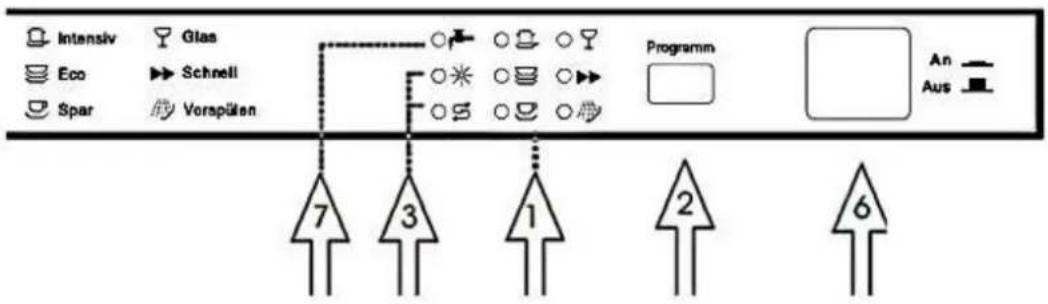
- Programme indicators
Display the selected programme. - Programme selection button.
Press to select a programme. First pressing activates the Eco-programme. Multiple pressings activate your desired programme.
3. Water softener and rinse aid indicator
The indicators will go on when you must refill the relevant containers.
4. Display
Displays the time delay, error codes or remaining operation time of a programme.
5. Time delay
You can set a delayed programme start up to 24 hours (depending on model). Press the delay-button to set the desired time. Multiple pressing increase the value.
6. on/0ff
To switch the appliance on/off.
7. Water supply control-indicator
The indicator will light if the water supply is in improper condition (e.g. shut water tap, kinked hose etc).
8. Child lock
To activate press the child lock-button for 3 seconds. The relevant indicator will light after a short period of time.
9. 60-minutes-programme
Daily wash within 60 minutes.
10. 3in1-programme
Use this additional function in combination with programmes such as eco, light or intensive

Set a programme (1) + close the door (2) = the appliance is ready for operation (3).
4
BEFORE THE FIRST USE
4
Before you start operating the appliance, check that
- the appliance is positioned and levelled properly.
- the inlet valve is opened.
- the connections of the hoses do not leak.
- the appliance is plugged in properly.
- the power is switched on.
- the hoses are not knotted.
- you have removed the complete packaging material..
Before you operate the appliance for the first time:
A) Adjust the water softener.
B) Pour 500ml water into the container of the water softener and pour in the water softener (= dishwasher salt).
C) Pour in the rinse aid.
D) Select a washing programme.

A. Water softener
You must fill in the water-softener manually; please use the water-softener filler hole. Open the lid and pour approx. 2kg of water-softener into the container; then close the lid properly.

B. Filling of the water softener container
The water softener container is beneath the lower dish rack.
Only use a water softener (= dishwasher salt) which is suitable for dishwashers. Other water softeners and salts, especially table salt, will damage the water softener container.
The manufacturer shall not guarantee against and is not liable for any damage caused by an unsuitable water softener.
Fill the container only shortly before you start a programme, otherwise spilled residuals of the water softener may remain in the appliance and cause corrosion.
The control light on the control panel goes off after the first programme.
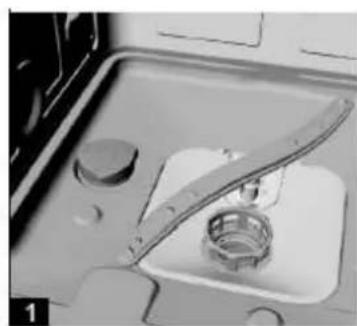
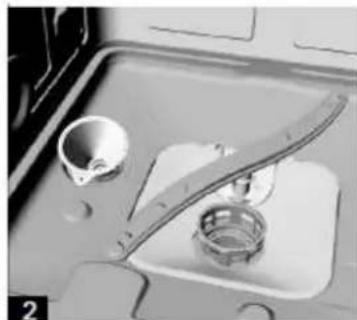
- Remove the lower dish-rack and the lid of the water softener container.
- When you fill the container for the first time, pour approx. 500 ml water into the container.
- Put the equipped funnel in the opening and pour approx. 2kg water softener (=dishwasher salt) in the container.
-
Close the lid carefully.
-
The control light for the hardness of water usually goes off after 2-6 days.

C. Filling of the rinse aid container
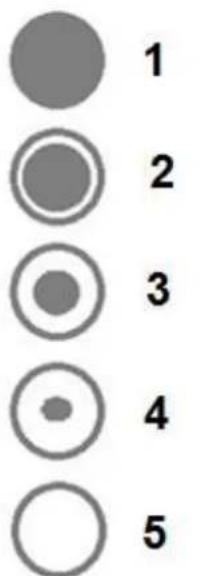
1 Full
3 50%
5 Empty
2 75%
4 25% ; rcfill!
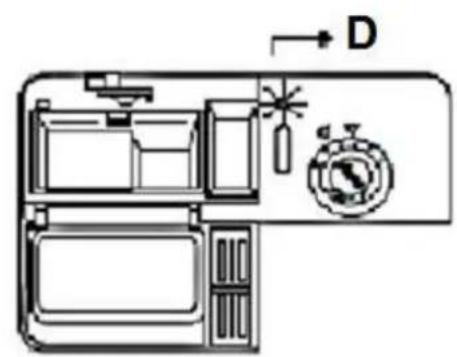
D Display device
- When the rinse aid indicator is not on, the colour of the display device "D" indicates the needed quantity of rinse aid.
Dark spot = container filled to capacity.
The smaller the spot the emptier the container. The container should be filled not less than 25% .
Rinse aid container
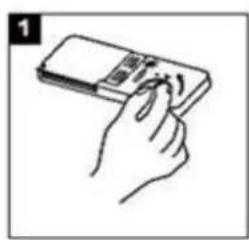
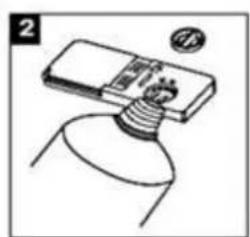
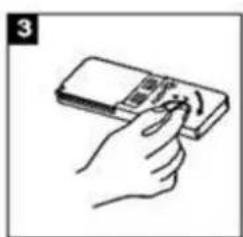
- Turn the lid towards the open-arrow (lcf) and take it off.
- Pour the rinse aid in the container. Do not overfill.
- Put the lid back adjusted to the open-arrow and turn it towards the closed-arrow (right).
The rinse aid is added automatically during operation and supports the spot-free and perfect drying of the dishes. Your appliance is designed for using rinse aid.
The rinse aid container is inside the appliance near the dishwasher detergent container.
Max. capacity of the container: approx 140ml
Do not overfill the container; otherwise severe foam formation may occur.
Do not forget to close the lid after refilling.
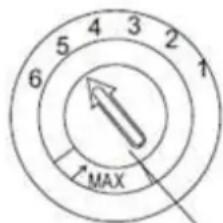
Rotary knob
Setting of the rinse aid dispenser
Start with position 4.
Select position 5 when stains have occurred or the drying is not satisfying.
Select position 6 if these problems occur again.
The factory adjustment is position 5.
- If water drops or scale marks are on your dishes after washing, increase the amount of rinse aid.
- If whitish stripes are on glasses or bluish film is on the cutlery after washing, decrease the amount of rinse aid.

D. Dishwasher detergent
Dishwasher detergents are divided into 2 groups due to their chemical composition:
conventional, alkaline detergents with caustic components.
low-alkaline concentrated detergents with natural enzymes.
"Normal" programmes combined with concentrated detergents prevent pollution and are also good for your dishes. Such programmes support the washing effect of the enzymes. Therefore, "normal" programmes combined with concentrated detergents are as effective as "intensive" programmes.
There are 3 kinds of dishwasher detergents:
- with phosphate and chlorine.
- with phosphate / without chlorine
- without phosphate / without chlorine
Most recent powdered dishwasher detergents usually do not contain any phosphate so they do not soften the water. In such a case add a water softener dishwasher
salt) even if the hardness of water is e.g. 6dH. Otherwise white spots may occur on your dishes and glasses.
Dishwasher detergents without chlorine only bleach slightly, so they do not remove tough stains. In such a case select a programme with a higher temperature.
Dishwasher tabs
Dishwasher tabs of different manufacturers may need different periods of time for washing your dishes. So some kinds of tabs cannot be used when operating a short programme. Always select long lasting programmes to clean your dishes completely.
The detergent container
You must fill the container matching the information of the programme schedule.
Use detergents which are suitable for dishwashers only.
Always keep your detergent dry.
Fill the container just before starting a programme.
The detergent and rinse aid consumption of your appliance is lower than the consumption of conventional appliances. In general you need 1 tablespoon of detergent for a normal programme.
You must increase the amount of detergent if your dishes are heavily soiled.
Filling of the container
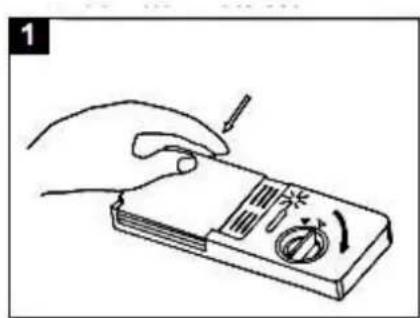
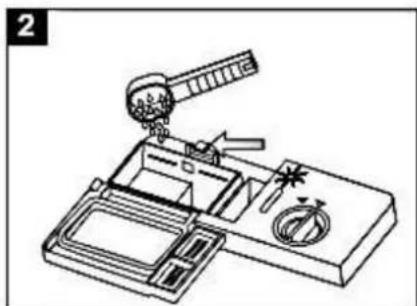
- When the lid is closed, press the open-button.
- Fill the container just before starting a programme. Use detergents which are suitable for dishwashers only.
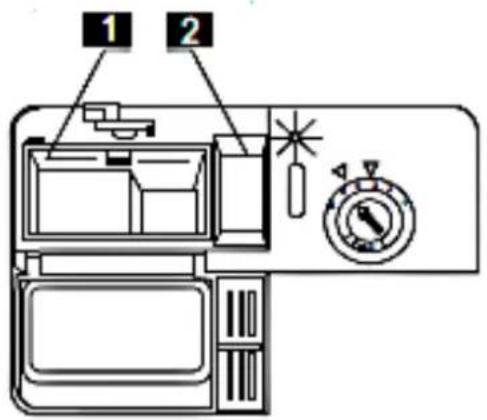
Pour the detergent in the container. The marks indicate the dose levels (look at figure below). If your dishes are heavily soiled, pour an additive dose of detergent in the pre-wash section.
-
Detergent main-wash. MIN equal to approx. 20g
-
Detergent pre-wash; equal to approx. 5g
Note the manufacturer's dosage instructions on the packaging of your dishwasher detergent.
Close the lid and press until it locks.
5
USE OF THE DISH RACKS
5
Observe the instructions given in this chapter to reach the best performance of your appliance. The features and design of the racks depend on model.

Before and after filling the racks
- Remove residuals of food from the dishes.
- You do not need to rinse the dishes under flowing water.
- Fill the racks as follows:
a. Objects such as cups, glasses, pots and pans upside down.
b. Curved objects and objects with recesses in a slanted position, so the water can drain off.
c. Arrange the dishes safely and tightly in the rack so they cannot tip over.
d. The dishes must not block the rotating spray arms.
e. Do not put very small objects in the appliance as they may easily drop out of the racks.
- After washing empty the lower rack first; so remaining water cannot drop from the upper rack into the lower one.

Adjusting of the upper rack
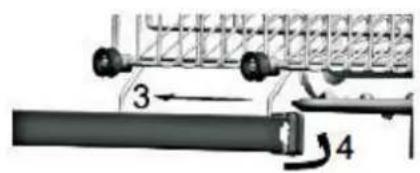
You can adjust the position of the upper dish rack to provide more room for large objects either in the lower or the upper rack. You adjust the upper rack by placing the relevant wheel-set in the rail. Put long items on the shelf so they will not impede the rotating spray arms. You can fold back the shelf if need be.
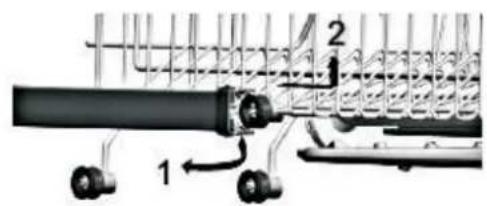

Loading of the upper rack
The upper dish rack is intended for delicate and light dishes such as glasses, cups, saucers, small platters and bowls and small, flat pans. When you have filled the rack, the dishes must not be moved by the sprayed water (spray arms).
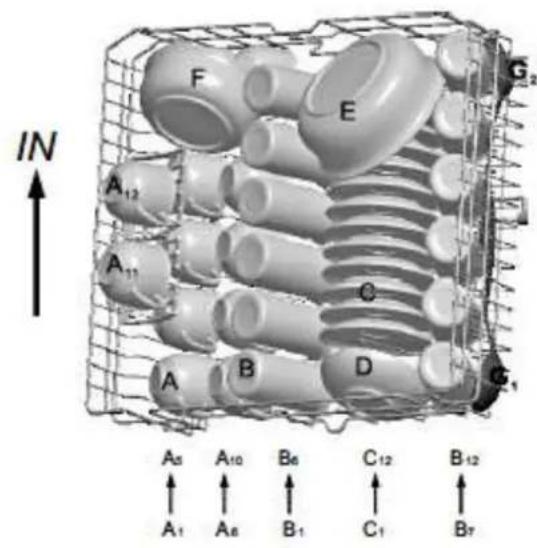
| Type | Dishes |
| A | cup |
| B | glass |
| C | saucer |
| D | bowl |
| E | bowl |
| F | bowl |
| G | spoon |

Loading of the lower rack
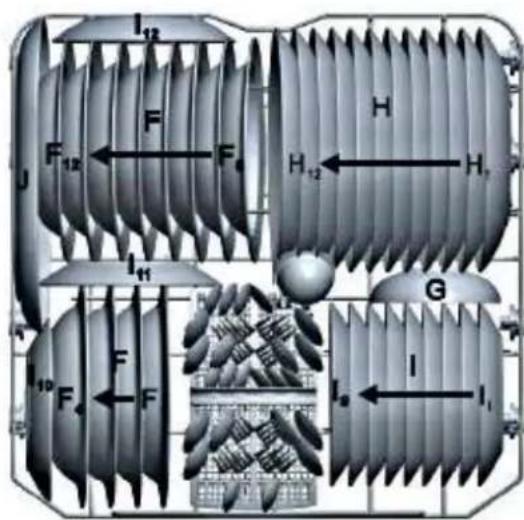
| Type | Dishes |
| F | Soup plate |
| G | Serving bowl |
| H | Dinner plate |
| I | Dessert plate |
| J | Oval plate |
The lower dish rack is intended for objects which are hard to clean such as pots, pans, lids, platters and bowls. Place platters and lids at the sides of the rack and do not block the rotating spray arms. Place pots and bowls upside down.

Cutlery basket
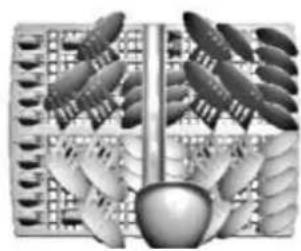
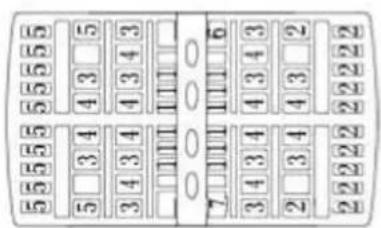
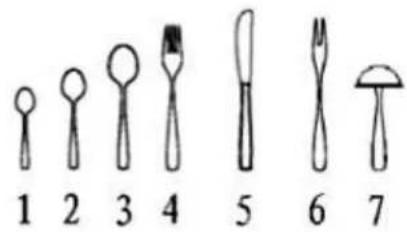
| Type | Cutlery | Type | Cutlery |
| 1 | Tea/Coffee spoons | 5 | Knives |
| 2 | Dessert spoons | 6 | Serving forks |
| 3 | Soup spoons | 7 | Serving spoons |
| 4 | Forks |
Place the cutlery (except sharp knives) with the handles at the bottom. Place long objects vertically and safely in the appliance so they do not block the spray arms.

The following objects are not suitable to be washed in a dishwasher.
- Cutlery with handles made of wood, horn, china, or mother-of-pearl.
- Not heat-resistant objects.
- Cutlery with glued components, which are not heat-resistant.
- Objects with components of synthetic resin.
- Objects made of copper and/or tin.
- Objects made of leaded crystal.
- Objects made of steel which show signs of rust or are lightly corrosive.
- Any object made of wood.
- Objects made of synthetic fibres.
- Objects soiled by cigarette ashes, wax, lacquers and paints.

The following objects are partially suitable to be washed in a dishwasher.
- Some glass types may become dead or cloudy after a large number of programmes.
- Objects made of silver or aluminium may decolourise.
- Glazed motifs may dull when often washed in a dishwasher.

Instructions for loading the dishwasher
Remove any remnants of food from the dishes.
Soak burnt food on pots and pans.
Cutlery and dishes must never block the rotating spray arms.
Place cups, glasses and pots upside down.
The dishes must not touch or cover each other.
Glasses must not touch each other.
Place big dishes and dishes which are difficult to clean in the lower rack.
Place small and delicate dishes such as glasses or cups in the upper rack.

Damage to glasses and dishes
| Possible causes | Recommended solution |
| Type of the glasses/dishes or their production method. | Use dishwasher-proof glasses and dishes only. |
| The chemical composition of your detergent. | Use a mild dishwasher detergent. The manufacturer of the detergent provides information about its chemical properties. |
| Temperature of the water and duration of the programme. | Select a programme with a lower temperature and duration. |
6
USE OF THE PROGRAMMES
6
DW12-7FI A+
| Programme | Information | Description | Detergen t PW/MW | Duration- consumption Min./kWh/L |
| Intensive | Extremely dirty dishes. | Pre-wash Main-wash(60°) Rinse Hot-rinse 1/2 Drying | 5/25 g or 3in1 | 168/1.30/14 |
| Eco* | For normally soiled dishes. Standard- programme for daily use. | Pre-wash Main-wash (46°) Hot-rinse Drying | 5/25 g or 3in1 | 153/1.03/14 |
| Light | For delicate items, which are sensitive to high temperatures (clean immediately after usec). | Pre-wash Main-wash (450) Rinse Drying | 5/25 g or 3in1 | 123/0.85/11 |
| Crystal | For slightly soiled dishes (plates, glasses, bowls slightly soiled pans). | Main-wash (400) Rinse Hot-rinse Drying | 5/20 g | 126/0.80/11 |
| Rapid | For lightly soiled dishes without drying. | Main-wash(400) Hot-rinse | 15 g | 37/0.50/7 |
| Pre-rinse | For rinsing dishes to clean them at a later point of time. | Pre-rinsc | - | 8/0.01/4 |
| 60 min | For daily cleaning of slightly and normally soiled dishes/pans. | Hot-rinse 1/2 Main wash (600) Drying | 5/20g | 60/0.95/10 |
DW12-7FI A++
| Programme | Information | Description | Detergent PW/MW | Duration-consumption Min./kWh/L |
| Intensive | Extremely dirty dishes. | Pre-wash Main-wash(60°) Hot-rinse 1/2 Rinse Drying | 5/25 g or 3in1 | 180/1.30/16 |
| Eco* | For normally soiled dishes. Standard-programme for daily use. | Pre-wash Main-wash (46°) Hot-rinse Drying | 5/25 g or 3in1 | 172/0.92/11 |
| Light | For delicate items, which are sensitive to high temperatures (clean immediately after use). | Pre-wash Main-wash (45°) Rinse Hot rinse Drying | 5/25 g or 3in1 | 137/0.85/14 |
| Crystal | For slightly soiled dishes (plates, glasses, bowls slightly soiled pans). | Main-wash (40°) Rinse Hot-rinse Drying | 5/20 g | 124/0.80/9 |
| Rapid | For lightly soiled dishes without drying. | Main-wash(40°) Hot-rinse | 15 g | 39/0.50/7 |
| Pre-rinse | For rinsing dishes to clean them at a later point of time. | Pre-rinse | - | 11/0.01/4 |
| 60 min | For daily cleaning of slightly and normally soiled dishes/pans. | Hot-rinse 1/2 Main wash (60°) Drying | 5/20g | 60/0.95/10 |
*: EN 50242 Standard-test-programme subject to following conditions:
Load: 12 place settings, lower rack in low position, rinse aid setting 5 (or 4 when dispenser has 4 levels).

Starting of a programme
- Fill the lower rack first.
- Pour the dishwasher detergent and the water softener (=dishwasher salt) in the relevant containers.
- During operation the appliance must be supplied with water ( full water pressure).
- Close the door properly while pressing gently. When the door closes properly you will hear a light KLICK.
- Press the PROGRAM button to select a programme.
- Press the OFF button when the programme has ended. Open the door.

How to change a programme

You can only change a programme when it has run a short period of time. Otherwise the detergent has dissolved and the dishwasher has been drained. In such a case you must refill the detergent container.
- Open the door and press the current programme selection for at least 3 seconds.
- Set the new programme.
- Close the door.
When you open the door while the appliance is operating, the appliance will stop operating. The display indicates the code E1. When you close the door again, the appliance will start operating after 10 seconds.
The 6 control lights indicate the status of the appliance.
a) All lights are off = stand-by mode.
b) One light is on = the relevant programme is running.
c) One light flashes = Pause - mode.

How to use 3in1 tabs
- 3in1 detergents contain a combination of detergent, rinse aid and water softener.
- The 3in1-programme is an additional function and can be operated in combination with one of the following 3 programmes only: intensive, eco or light.
- Check that the water hardness of your water supply meets the information given on the packaging of the 3in1 detergent.
- Strictly observe the instructions of the manufacturer of the 3in1 detergent.
- If a problem occurs when using a 3in1 product for the first time, contact the info-hotline of the manufacturer of the 3in1 product.
- When using a 3in1 product, the indicators for the rinse aid and water softener are not longer useful. It may be helpful to set the water hardness to the smallest possible value.
How to select the 3in1 programme
- Press the ON/OFF button and select the 3in1 programme by pressing the 3in1 button until the 3in1 indicator flashes.
- The 3in1 programme is available after you pressed the 3in1 button and the 3in1 indicator is on.
How to cancel the 3in1 programme
- Follow the instructions in HOW TO CHANGE A PROGRAMME. If you want to operate the appliance with a standard detergent system again, then proceed as follows:
a. Fill the water softener and the rinse aid container.
b. Set the water hardness to the highest possible value and let the appliance operate for 3 normal wash-cycles without load.

Later addition of dishes
You can put dishes later in the appliance unless the detergent container has opened.
- Open the door slightly to stop operation.
- You can open the door completely after the rotating spray arms stopped operation.
- Now you can add dishes.
- When you close the door, the appliance starts operating after 10 seconds.

End of a programme
When the display indicates "-" and the acoustic signal sounds 6 times, the programme has ended.
- Switch off the appliance (ON/OFF button).
- Turn off the water.
- CAUTION! Wait a few minutes before you open the door as hot damp may escape.
- Wait approx. 15 minutes before you take out the dishes. The dishes are still hot and will break easily.
-
It is normal that the appliance is wet inside.
-
WARNING! Disconnect the appliance from the mains before you clean or maintain it.
- Always keep the appliance clean so that unpleasant odours do not occur.
- Take off all rings and bracelets before cleaning or maintaining the appliance; otherwise you will damage the surface of the appliance.

Filter system
The filter system protects the pump against remnants of food and other objects. These remnants can clog the filters after a while. The filter system comprises a coarse filter, a flat filter and a micro filter.
Check the status of the filters after each programme.
When you remove the coarse filter, you can remove all filters of the system. Remove any remnants and clean the filters with flowing water.
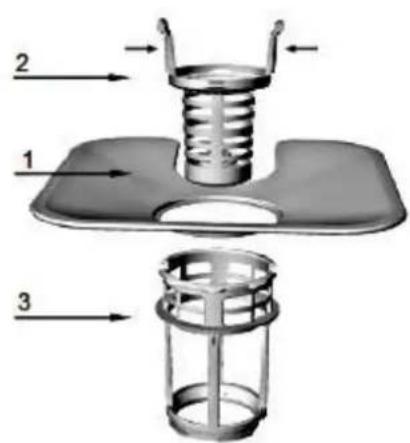
- The flat filter catches remnants by a special nozzle on the bottom of the spray arm.
- The coarse filter catches remnants such as bones and glass which may clog the drain. To remove the remnants press the upper pins and take out the coarse filter.
- The micro filter catches remnants in the drain so they cannot soil the dishes again.
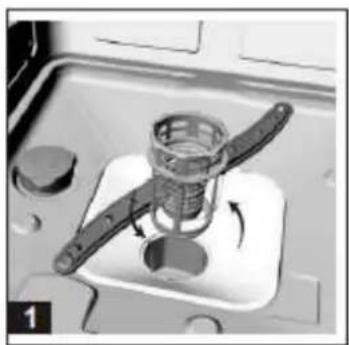
- Turn the micro filter anticlockwise and remove it.
- Take out the flat filter.
- To install the filters proceed in reverse order.
We recommend to clean the entire filter system once a week.
Remove bigger remnants after each programme.
Clean the coarse and micro filter with a washing-up brush.
Do not knock against the filters as you will damage them. Your appliance will not work properly if the filters are damaged.
Always install the filters properly.
Improperly installed filters may damage the appliance and dishes.

Spray arms
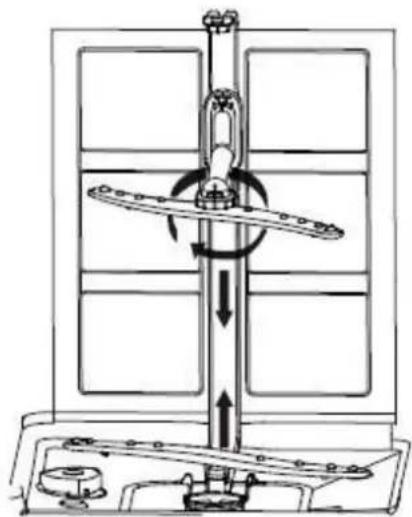
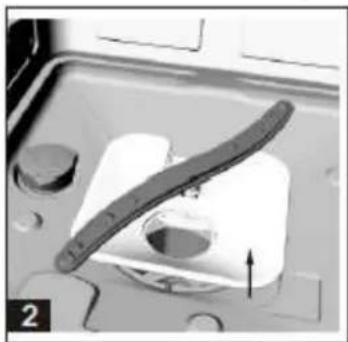
Clean the spray arms regularly as chemicals and minerals may clog the nozzles and bearings.
To remove the spray arm screw off the nut (anticlockwise). Take off the washer at the top of the spray arm. Now remove the spray arm.
Clean the spray arm with warm soapy water and the nozzles with a soft brush.
Rinse the spray arm with flowing water and reinstall it.

Control panel and appliance
Clean the control panel with a soft damp cloth and dry it carefully.
Clean the exterior of the appliance with a suitable polish.
- Never use sharp-edged items, scouring pads, scouring agents, paper towels or other abrasive and aggressive detergents to clean any component of the appliance.

Door
Clean the sides of the door with a warm damp cloth.
Clean the exterior surface with a suitable polish.
- Never use sharp-edged items, scouring pads, scouring agents, paper towels or other abrasive and aggressive detergents to clean the door of the appliance.
Clean the door seals with a damp sponge; otherwise remnants of food may generate unpleasant odours.
NOTICE! Never clean the door with a cleaner spray as you may damage the lock and the electrical components.

Frost protection
If your appliance is situated in an unheated place during winter, consult a qualified technician to carry out the following measures4.
- Disconnect the appliance from the mains.
- Turn off the water supply and disconnect the water inlet pipe from the water valve.
- Remove any water from the water inlet pipe and the valve.
- Connect the water inlet pipe with the valve again.
- Remove the filters. Remove any water from the drain.

Decommissioning
- When you do not operate the appliance for a certain period of time, e.g. during holidays/vacancies, let a programme run (empty appliance) before.
- Disconnect the plug und turn off the water supply of the appliance.
- Leave the door slightly ajar to protect the seals and to avoid the generation of unpleasant odours.
8
TROUBLE SHOOTING
8
WARNING! Disconnect the appliance from the mains before you clean or maintain it.
ERROR
POSSIBLE CAUSES
MEASURES
Appliance does not work at all.
- The fuse in the fuse box is tripped.
- Check the fuse box.
- The appliance is not supplied with energy.
- Check that the appliance is supplied with energy / the door is closed properly / the plug is in the socket.
- Low water pressure.
- Check the water supply.
Drain pump works permanently.
Overflow.
The appliance identifies an overflow. In such a case it activates the drain pump and deactivates the circulation pump.
| Noise. | |
| 1. Some noise is normal. | 1. The detergent container has opened. |
| 2. Dishes are placed improperly. Small objects dropped out of the racks. | 2. Check the position of the dishes. |
| 3. Motor hums. | 3. Appliance was not used regularly. Even if you do not use the appliance regularly, let it operate once a week. |
| Foam in the appliance. | |
| Unsuitable detergent. | Use dishwasher detergent only. |
| Spilled rinse aid. | Open the door and wait until the foam has evaporated. Pour approx. 4 litres of water in the appliance. Close the door and select the pre-wash programme. Repeat procedure if need be. |
| Stained interior. | |
| Detergent contains colorants. | Use colorant-free detergents. |
| Dishes are not clean. | |
| 1. Unsuitable programme. | 1. Select a stronger programme. |
| 2. Dishes are placed improperly. | 2. Check the position of the dishes. The dishes must not block the spray arms. |
| Spots and film on glasses and cutlery. | |
| Extremely hard water. | To remove spots from glassware: |
| Very low temperature of the water supply. | 1. Remove all metal-made objects. |
| Appliance is overfilled. | 2. Do not use a detergent. |
| Dishes are placed improperly. | 3. Select the longest programme. |
| Old or wet pulvered detergent. | 4. Start the programme. After 18-22 minutes the main-wash cycle begins. |
| Rinse aid container is empty. | 5. Open the door pour 2 cups of white vinegar in the appliance (bottom). |
| Improper detergent dosage. | 6. Close the door and let the complete programme run. If this measures fail, repeat the procedure but use 1/4 cup (60 ml) of citric acid crystals instead of the vinegar. |
| Cloudiness on glassware. | |
| Soft water in combination with too much detergent. | If you have soft water, use less detergent. Select a short programme for glassware. |
| Yellow or brown film on inner surfaces. | |
| 1. Tea or coffee stains. | Clean with a solution of 1/2 cup of bleach and 3 cups of warm water. Clean by hand. |
| 2. Iron deposits in the water. | |
| 2. You need a special filter. Contact a local water installation company. | |
| White film on inner surfaces. | |
| Minerals in hard water. | Clean the interior with a soft sponge and dishwasher detergent. Wear rubber gloves! Use dishwasher detergent only to avoid formation of foam. |
| The cover of the detergent container does not close. | |
| Setting is not OFF. | Select setting OFF and push the door latch to the left. |
| Some detergent is left in the container. | |
| Dishes block the container of the detergent. | Place the dishes properly.. |
| Steam. | |
| Normal. | There is some steam coming through the vent near the door latch during drying and water draining. |
| Black or grey marks on the dishes. | |
| Aluminium-made objects touched the dishes. | Clean the marks with a mild abrasive cleaner by hand. |
| Water remains on the bottom of the appliance. | |
| Normal. | A small amount of clean water around the outlet keeps the water seal functioning. |
| Appliance leaks. | |
| 1. Overfilled rinse aid container / spilled rinse aid. | 1. Wipe up the rinse aid. 2. Level the appliance. |
| 2. The appliance is not levelled. | |
If the appliance shows a malfunction not noted on the schedule above or if you have checked all items on the above schedule but the problem still exists, please contact a service department.

Error codes
| Code | Meaning | Possible causes |
| E 1 | Door opened. | Door open during operation. |
| E 2 | Water inlet. | Water inlet malfunction. |
| E 3 | Water drainage. | Water drainage malfunction. |
| E 4 | Temperature sensor. | Temperature sensor malfunction. |
| E 5 | Overflow/leakage | Overflow/leakage has occurred. |
| E 6 | Water leakage. | Water leakage has occurred. |
| E 7 | Heating element. | Heating element malfunction. |
If overflow occurs, turn off the main water supply before calling a service. If there is water in the base pan because of an overfill or small leak, remove the water before restarting the dishwasher.
9
TECHNICAL DATA
9
DW12-7FI A+
| Type | Dishwasher, fully integrated |
| Control | Electronic |
| Capacity | 12 dishes |
| Energy efficiency class | A+ |
| Drying efficiency class | A |
| Energy consumption standard programme* | 1.03 kW/h |
| Annual energy consumption** | 289.00 kW/h |
| Water consumption/standard programme* | 14.00 l |
| Annual water consumption*** | 3920 l |
| Noise emission dB(A) re 1 pW | 49 dB(A) |
| Power | 1850 W |
| Cleaning tccpmaturcs in °C | 40°/45°/50°/60° |
| Energy consumption when switched off | 0.10 W |
| Energy consumption when not switched off | 0.90 W |
| Duration standard-programme | 153 minutes |
| Interior | Stainless steel |
| Heating elements | Hidden |
| Programmcs | Intensive/Light/Eco/Quick/Pre-rinse/60-Min./Glass/3in1 |
| Start delay | 1-24 hours |
| LED-display | ✓ |
| Control panel | Electronic keys |
| Spray levels | 2 |
| Racks | 2 |
| Cup holder/cutlery basket | 4*inged 1 |
| Adjustable feet | 2*front/1*back |
| Colour | White with stainless steel panel |
| Child lock | ✓ |
| Water softener function | ✓ |
| Detergent-amount regulation function | ✓ |
| Overflow protection | ✓ |
Dimensions appliance H*W*D in cm 82.00-87.00*59.60*57.50
Weight net/gross in kg 37.00 43.00
Different data DW12-7F IA++
| Energy efficiency class | A++ |
| Energy consumption/standard programme | 0.925 kW/h |
| Annual energy consumption** | 259.00 kW/h |
| Water consumption/standard programme* | 13.00 l |
| Annual water consumption*** | 3680 l |
| Energy consumption when not switched off | 0.49 W |
| Weight net/gross in kg | 42.00/48.00 |
: Standard-programme is suitable for cleaning normally soiled dishes and most efficient concerning the combined energy and water consumption.
: Based on 280 standard cleaning cycles. The actual energy consumption depends on the type of use of the appliance.
**: Based on 280 standard cleaning cycles. The actual water consumption depends on the type of use of the appliance.
10
WASTE MANAGEMENT
10
- While unpacking, the packaging materials (polythene bags, polystyrene pieces, etc.) should be kept away from children. CHOKING HAZARD!
- Old and unused appliances must be send for disposal to the responsible recycling centre. Never expose to open flames.
- Before you dispose of an old appliance, render it inoperative. Unplug the appliance and cut off the entire power cord. Dispose of the power cord and the plug immediately. Remove the door completely so children are not able to get into the appliance as this endangers their lives!
- Dispos of any paper and cardboard into the corresponding containers.
- Dispose of any plastics into the corresponding containers.
- If suitable containers are not available at your residential area, dispose of these materials at a suitable municipal collection point for waste-recycling.
- Receive more detailed information from your retailer or your municipal facilities.

Materials marked with this symbol are Please contact your local recyclable. authorities to receive further information.

11
GUARANTEE CONDITIONS
11
for large electric appliances PKM GmbH & Co.KG,Neuer Wall 2,47441 Moers
This appliance includes a 24-month guarantee for the consumer given by the manufacturer, dated from the day of purchase, referring to its flawless material-components and its faultless fabrication.
The consumer is accredited with both the ducs of the guarantee given by the manufacturer and the vendor's guarantees. These are not restricted to the manufacturer's guarantee.
Any guarantee claim has to be made immediately after the detection and within
24 months after the delivery to the first ultimate vendee. The guarantee claim has to be verified by the vendee by submitting a proof of purchase including the date of purchase and/or the date of delivery.
The guarantee does not establish any entitlement to withdraw from the purchase contract or for a price reduction. Replaced components or exchanged appliances demise to us as our property.
The guarantee claim does not cover:
- fragile components as plastic, glass or bulbs;
- minor modifications of the PKM-products concerning their authorized condition if they do not influence the utility value of the product;
- damage caused by handling errors or false operation;
- damage caused by aggressive environmental conditions, chemicals, detergents;
- damage caused by non-professional installation and haulage;
- damage caused by non common household use;
- damages which have been caused outside the appliance by a PKM-product unless a liability is forced by legal regulations.
The validity of the guarantee will be terminated if:
- the prescriptions of the installation and operation of the appliance are not observed.
- the appliance is repaired by a non-professional.
- the appliance is damaged by the vendor, the installer or a third party.
- the installation or the start-up is performed inappropriately.
- the maintenance is inadequately or incorrectly performed.
- the appliance is not used for its intended purpose.
- the appliance is damaged by force majeur or natural disasters, including, but with not being limited to fires or explosions.
The guarantee claims neither extend the guarantee period nor initiate a new guarantee period. The geographical scope of the guarantee is limited with respect to appliances, which are purchased and used in Germany, Austria, Belgium, Luxembourg and the Netherlands.
Aftersales service information on the leaflet inside this instruction manual.
Subject to alterations
Sous reserve de modification

- INDEX
- EU - Conformity Declaration
- 1
- SAFETY INSTRUCTIONS
- DANGER!
- WARNING!
- CAUTION!
- NOTICE
- Unpacking and Positioning
- Water inlet / drainage installation
- Installation
- Before installation
- Dimensions of the front decoration-panel
- Fixing of the front decoration-panel
- Adjusting of the tension of the door-spring
- Water outlet hose installation
- Raised level installation
- Electrical connection
- Proper levelling
- Installation of the skirting board
- Fixing of the appliance
- Fixing the top spacer
- Water softener and rinse aid indicator
- Display
- Time delay
- on/0ff
- Water supply control-indicator
- Child lock
- 60-minutes-programme
- 3in1-programme
- 4
- BEFORE THE FIRST USE
- Before you start operating the appliance, check that
- Before you operate the appliance for the first time:
- Water softener
- Filling of the water softener container
- The water softener container is beneath the lower dish rack.
- Filling of the rinse aid container
- Rinse aid container
- Setting of the rinse aid dispenser
- Dishwasher detergent
- Dishwasher detergents are divided into 2 groups due to their chemical composition:
- There are 3 kinds of dishwasher detergents:
- Dishwasher tabs
- The detergent container
- Filling of the container
- 5
- USE OF THE DISH RACKS
- Before and after filling the racks
- Adjusting of the upper rack
- Loading of the upper rack
- Loading of the lower rack
- Cutlery basket
- Instructions for loading the dishwasher
- Damage to glasses and dishes
- USE OF THE PROGRAMMES
- Starting of a programme
- How to change a programme
- How to use 3in1 tabs
- How to select the 3in1 programme
- How to cancel the 3in1 programme
- Later addition of dishes
- End of a programme
- Filter system
- Spray arms
- Control panel and appliance
- Door
- Frost protection
- Decommissioning
- TROUBLE SHOOTING
- ERROR
- POSSIBLE CAUSES
- MEASURES
- Appliance does not work at all.
- Drain pump works permanently.
- Error codes
- TECHNICAL DATA
- 10
- WASTE MANAGEMENT
- 11
- GUARANTEE CONDITIONS
- The guarantee claim does not cover:
- The validity of the guarantee will be terminated if:
Brand : PKM
Model : DW127FIA++
Category : Dishwasher