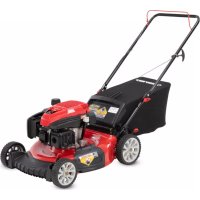
USER MANUAL TB115 TROY-BILT
Before setting up and operating your new engine, please locate the model plate and record the information in the provided area to the right. You can locate the model plate by standing at the operator's position and looking at the rear or right side of the engine. This information will be necessary, should you seek technical support via our web site, Customer Support Department, or with a local authorized service dealer.
Model Number
Serial Number
WARNING
Read and follow all safety rules and instructions in this manual before attempting to operate.
Failure to comply with these instructions may result in personal injury - SAVE THESE INSTRUCTIONS.
WARNING
CALIFORNIA PROPOSITION 65
Engine exhaust, some of its constituents, and certain vehicle components contain or emit chemicals known to State of California to cause cancer and birth defects or other reproductive harm.
NOTE: This Operator's Manual covers several models. Features may vary by model. Not all features in this manual are applicable to all models and the model depicted may differ from yours.
WARNING

This symbol points out important safety instructions which, if not followed, could endanger the personal safety and/or property of yourself and others. Read and follow all instructions in this manual before attempting to operate. Failure to comply with these instructions may result in personal injury. When you see this symbol, HEED ITS WARNING!
DANGER
This engine was built to be operated according to the safe operation practices in this manual. As with any type of power equipment, carelessness or error on the part of the operator can result in serious injury. Failure to observe the following safety instructions could result in serious injury or death.
TRAINING
- Read, understand and follow all warnings and instructions on the engine and the equipment, and in the operator's manuals before attempting to install and/or operate. Keep this manual in a safe place for future and regular reference and for ordering replacement parts.
- Be familiar with all controls and their proper operation. Know how to stop the engine and disengage them quickly.
- Never allow children under 14 years of age to operate the equipment. Children 14 and over should read and understand the warnings and instructions both on the product and in the manuals and be trained and supervised by an adult.
- Never allow adults to operate the equipment without proper instruction.
- Keep the area of operation clear of all persons, particularly small children and pets. Stop the engine if anyone enters the area.
PREPARATION
- Wear sturdy, rough-soled work shoes and close fitting slacks and shirts. Loose fitting clothes or jewelry can be caught in the moving parts. Never operate the equipment in bare feet or sandals.
- Disengage all powered clutch and drive control levers on the equipment before starting the engine.
- Never leave the engine running while unattended.
- Never attempt to make any adjustments while the engine is running, except where specifically recommended in the operator's manual(s).
SAFE HANDLING OF GASOLINE:
To avoid personal injury or property damage, use extreme care in handling gasoline. Gasoline is extremely flammable and the vapors are explosive. Serious personal injury can occur when gasoline is spilled on yourself and/or your clothes which can ignite. Wash your skin and change clothes immediately.
- When adding fuel, turn engine OFF and let engine cool at least 5 minutes before removing the fuel cap.
- Fill fuel tank outdoors or in well ventilated area.
- Use only an approved fuel container.
- Never fill containers inside a vehicle or on a truck or trailer bed with a plastic liner. Always place containers on the ground away from your vehicle before filling.
- If possible, remove equipment from the truck or trailer and refuel it on the ground. If this is not possible, then refuel equipment on a trailer with a portable container, rather than from a fuel pump dispenser nozzle.
- Keep the nozzle in contact with the rim of the fuel tank or container opening at all times until fueling is complete. Do not use a nozzle lock-open device.
- Do not overfill fuel tank. Fill tank to full as indicated by the fuel level indicator installed inside the fuel tank to allow space for fuel expansion. On some models, a fuel level indicator may NOT be present, in this instance, fill the tank no more than 1/2 inch below the bottom of the filler neck to allow space for fuel expansion.
- Replace fuel cap and tighten securely.
- If fuel is spilled, wipe it off the engine and the equipment. Move equipment to another area and wait 5 minutes before starting the engine.
- To reduce fire hazards, keep the engine and equipment free of grass, leaves or other debris build up. Clean up oil or fuel spillage and remove any fuel-soaked debris.
- Keep fuel away from sparks, open flames, pilot lights, heat, and other ignition sources.
SAFE OPERATION PRACTICES
- Never fuel equipment indoors because flammable vapors will accumulate in the area.
- Extinguish all cigarettes, cigars, pipes, and other sources of ignition.
- Check fuel line, tank, cap, and fittings frequently for cracks or leaks. Replace if necessary.
OPERATION
-
When starting the engine, make sure spark plug, muffler, and fuel cap are in place.
-
Do not crank engine with spark plug removed.
-
If fuel is spilled, wipe it off the engine and the equipment. Move equipment to another area and wait 5 minutes before starting the engine.
-
Allow engine and muffler to cool before touching.
-
Keep small children away from hot or running engines. They are unaware of the dangers and can suffer burns from the engine and muffler.
-
Remove any accumulated debris from the engine cylinder and muffler areas.
-
Operate equipment with all shields and guards in place.
-
Keep hands and feet away from rotating parts.
-
Wear sturdy, rough-soled work shoes and close-fitting slacks and shirts. Loose fitting clothes, jewelry and long hair can be caught in moving parts. Shirts and pants that cover the arms and legs and steel-toed shoes are recommended.
-
When starting the engine with the recoil starter, pull handle slowly until resistance is felt, then pull rapidly, repeat if necessary.
-
Remove all equipment engine loads before starting engine.
-
Direct coupled equipment components such as, but not limited to blades, impellers, pulleys, sprockets, etc., must be securely attached.
-
Keep the engine and equipment in safe working condition.
-
Allow the engine to cool at least 5 minutes before storing equipment. Never tamper with safety devices. Check their proper operation regularly.
-
Check bolts and screws for proper tightness at frequent intervals to keep the engine and equipment in safe working condition. Visually inspect them for any damage.
-
Before cleaning, repairing or inspecting; stop the engine and make certain all moving parts have stopped. Disconnect the spark plug wire and ground it against the engine to prevent unintended starting.
-
Do not change the engine governor settings or over-speed the engine. The governor controls the maximum safe operating speed of the engine.
-
Maintain and replace safety and instruction labels as necessary.
- Always refer to the operator's manuals for important details if the equipment is to be stored for an extended period of time.
- If the fuel tank has to be drained, do this outdoors.
- Observe proper disposal laws and regulations for fuel, oil, etc. to protect the environment.
DO NOT MODIFY ENGINE
To avoid serious injury or death, do not modify engine in any way. Tampering with the governor setting can lead to a runaway engine and cause it to operate at unsafe speeds. Never tamper with factory setting of engine governor.
NOTICE REGARDING EMISSIONS
Engines which are certified to comply with California and federal EPA emission regulations for SORE (Small Off Road Equipment) are certified to operate on regular unleaded gasoline, and may include the following emission control systems: Engine Modification (EM), Oxidizing Catalyst (OC), Secondary Air Injection (SAI) and Three Way Catalyst (TWC) if so equipped.
INTENDED USE:
The engine models listed on the cover of this manual are specifically designed and intended for use on designated outdoor power equipment only. The engine models listed also have been approved for use as replacement engines for products such as mowers, edgers and wheeled string trimmers. These engines are not approved for use in other applications. Engines used in non-approved applications or subjected to any modifications or misuse will void the engine warranty.

WARNING
Failure to use an engine as intended and as instructed may lead to property damage, personal injury or death.
ENGINE REPLACEMENT:
Please check your equipment specifications for important specific engine information, such as engine size (cc), type of shaft (horizontal or vertical) crank shaft dimensions, mounting bolt pattern, engine speed (rpm), oil capacity, fuel tank size, controls (throttle/choke), starting (recoil or electric), shut down capabilities, accessory wiring needs and other emission related specifications.
SAFE OPERATION PRACTICES
SPARK ARRESTOR

WARNING
Any equipment equipped with an internal combustion engine should not be used on or near any unimproved forest-covered, brush covered or grass-covered land unless the engine's exhaust system is equipped with a spark arrestor meeting applicable local or state laws (if any).
If a spark arrestor is used, it should be maintained in effective working order by the operator. In the State of California the above is required by law (Section 4442 of the California Public Resources Code). Other states may have similar laws. Federal laws apply on federal lands. A spark arrestor for the muffler is available through your nearest engine authorized service dealer or contact the service department, P.O. Box 361131 Cleveland, Ohio 44136-0019.
SAFETY SYMBOLS
This page depicts and describes safety symbols that may appear on the engine. Read, understand, and follow all warnings and instructions on the engine and equipment, along with the operator's manuals before attempting to install and/or operate.
| Symbol Description |
 | WARNING – READ THE OPERATOR’S MANUAL(S)Read, understand and follow all the safety rules and instructions in the manual(s) and on the equipment before attempting to operate. Failure to comply with this information may result in personal injury or death. Keep the manual(s) in a safe location for future and regular reference. |
 | DANGER — CARBON MONOXIDENever run an engine indoors or in a poorly ventilated area. Engine exhaust contains carbon monoxide, an odorless and deadly gas. |
 | DANGER — ELECTRICAL SHOCKDo not use the engine’s electric starter in the rain. |
 | WARNING—GASOLINE IS FLAMMABLEAllow the engine to cool at least 5 minutes before refueling. |
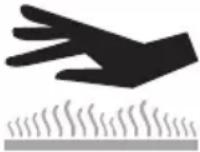 | WARNING— AVOID BURN INJURYThe muffler and engine become very hot and can cause serious burn injuries.Do not touch. Allow the equipment to cool for at least 5 minutes before storing or attempting any service. |

WARNING
Your Responsibility—Restrict the use of the equipment to persons who read, understand and follow all warnings and instructions on the engine and the equipment, and in the operator's manuals. - SAVE THESE INSTRUCTIONS!
SET-UP
Fuel & Oil
NOTE: The engine is shipped without fuel or oil in the engine. Running the engine with insufficient oil can cause serious engine damage and void the engine warranty.
WARNING
Always keep hands and feet clear of equipment moving parts. Do not use a pressurized starting fluid. Vapors are flammable.
OIL RECOMMENDATIONS
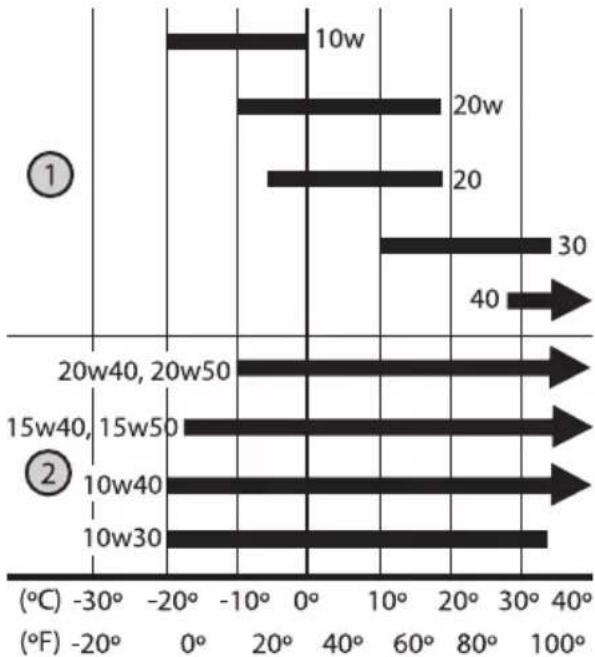
Before starting engine, fill with motor oil, capacity is 600 ml/20 oz. Refer to viscosity chart in Figure 1 for oil recommendations. Do not over-fill. Use a 4-stroke, or an equivalent high detergent, premium quality motor oil certified to meet or exceed U.S. automobile manufacturer's requirements for service classification of a minimum level SJ (higher letter ratings are acceptable such as SL and SM grades). Motor oil will display this designation on the container.
SAE 10W-30 is recommended for general, all temperature use. If single viscosity oil is used, select the appropriate viscosity for the average temperature in your area from the chart below.
bar
| Temperature Range | Wind Speed (w) | Wind Speed (m/s) | Temperature Range (°C) | Temperature Range (°F) |
| :--- | :--- | :--- | :--- | :--- |
| 10w | 10 | 10 | -30 | -20 |
| 20w | 20 | 20 | -20 | -10 |
| 20 | 20 | 20 | -10 | 0 |
| 30 | 30 | 30 | 0 | 10 |
| 40 | 40 | 40 | 10 | 20 |
| 20w40, 20w50 | | | | 20 |
| 15w40, 15w50 | | | | 15 |
| 10w40 | | | | 10 |
| 10w30 | | | | 30 |
| 10w30 | | | | 40 |
The chart displays a single bar chart with two rows labeled '①' and '②'. The values for the bars are explicitly labeled as '10w', '20w', '30w', and '40w'. The right arrow indicates direction from top to bottom.
Figure 1
- Single Viscosity
- Multi Viscosity
CAUTION
Do not use non-detergent oil or 2-stroke engine oil. It could shorten the engine's service life.
NOTE: A 5w30 synthetic oil may be used to improve start ability for cold weather (temperatures below 40 °F).
CHECKING OIL LEVEL/ADDING OIL
IMPORTANT: Be sure to check the oil while on a level surface with the engine off.
To avoid engine damage, it is important to:
NOTE: Do not overfill. Overfilling with oil may cause smoking, hard starting, spark plug fouling, or oil saturation of air cleaner.
NOTE: To change the oil on your engine, see Oil Change on page 10.
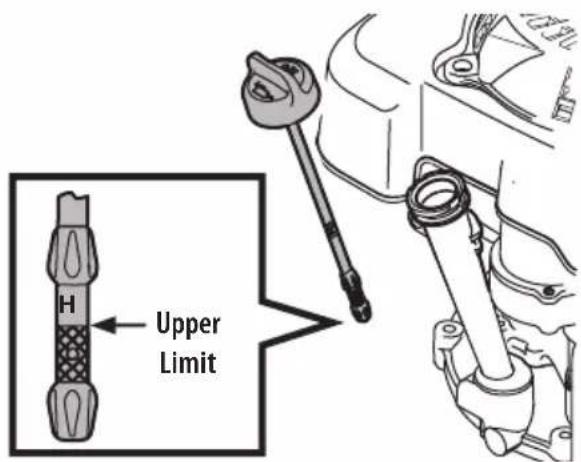
Figure 2
FUEL REQUIREMENTS
CAUTION
Operating the engine with E15 or E85 fuel, an oil/gasoline mixture, dirty gasoline, or gasoline over 30 days old without fuel stabilizing additive may result in damage to your engine's carburetor. Subsequent damage would not be covered under the manufacturer's warranty.
Use automotive gasoline (unleaded or low leaded to minimize combustion chamber deposits) with a minimum of 87 octane. Gasoline with up to 10% ethanol (E10) or 15% MTBE (Methyl Tertiary Butyl Ether) can be used. Never use an oil/gasoline mixture or dirty gasoline. Avoid getting dirt, dust, or water in the fuel tank. DO NOT use E15 or E85 gasoline.
WARNING
Gasoline is extremely flammable and is explosive under certain conditions.
- Refuel in a well-ventilated area with the engine off and allowed to cool. Do not smoke or allow flames or sparks in the area where the engine is refueled or where gasoline is stored.
- Do not overfill the fuel tank. After refueling, make sure the fuel cap is closed properly and securely.
- If fuel is spilled, wipe it off the engine and the equipment. Move equipment to another area and wait 5 minutes before starting the engine.
- Avoid repeated or prolonged contact with skin or breathing of vapor.
ADDING FUEL
WARNING
An adult should fuel this engine. NEVER allow children to refuel the engine. Gasoline (fuel) vapors are highly flammable and can explode. Fuel vapors can spread and be ignited by a spark or flame many feet away from engine. To prevent injury or death from fuel fires, follow these instructions:
NOTE: Some engines may not have the fuel cap installed for shipping purposes. To install, remove and discard the fuel tank dust cap labeled "Discard". Remove the bubble wrap packaging from around the fuel cap and tighten securely.
- DO NOT use leaded fuel.
- Fuel must be fresh and clean. NEVER use fuel left over from last season or stored for long periods.
- NEVER mix oil with fuel.
- DO NOT use fuel containing Methanol (Wood Alcohol).
- Fill fuel tank outdoors or in well ventilated area.
NOTE: Before refueling, allow engine to cool for at least 5 minutes.
- Clean area around the fuel fill cap and remove the fuel cap.
- Use an approved red GASOLINE container, add fuel slowly, being careful to avoid spilling. DO NOT overfill fuel tank.
- Fill tank to full as indicated by the fuel level indicator inside the fuel tank if equipped or to no more than 1/2 inch below the bottom of the fill neck to allow space for fuel expansion.
- Replace the fuel cap and tighten securely. Wipe up spilled fuel before starting engine. If fuel is spilled DO NOT start engine. Move machine away from area of spillage. Avoid creating any source of ignition until fuel vapors are gone.
- Be sure fuel shut-off valve, if present, is in the "ON" position.
OPERATION
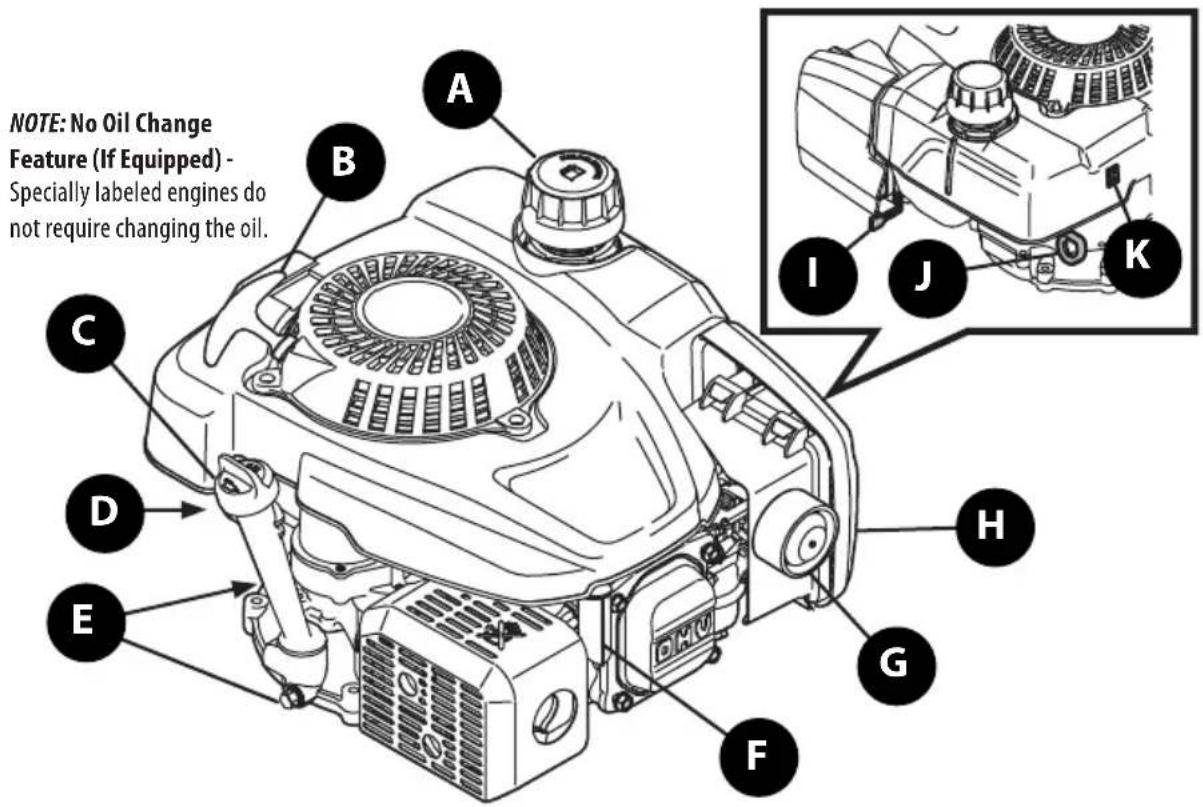
Figure 3
Features
A. FUEL CAP
Remove the fuel cap to add fuel.
NOTE: Some engines may not have the fuel cap installed for shipping purposes. To install, remove and discard the fuel tank dust cap labeled "Discard". Remove the bubble wrap packaging from around the fuel cap and tighten securely.
B. RECOIL STARTER HANDLE
Pull the recoil starter handle to start the engine.
C. OIL FILL CAP
Remove the oil fill cap to check the oil level and add oil (short dipstick shown).
D. MODEL PLATE
The model plate provides the model number and serial number of the engine. Record this information in the area provided on the cover of this manual. This information will be necessary for proper technical support.
E. OIL DRAIN PLUG
Removing the oil drain plug will drain the oil from the engine. The engine is equipped with a side drain.
NOTE: Select engines are equipped with an oil drain plug located on the rear of the engine.
F. SPARK PLUG
Refer Spark Plug Service on page 11.
G. PRIMER (IF EQUIPPED)
Pressing the primer forces fuel directly into the engine's carburetor to aid in starting the engine.
H. AIR CLEANER
Refer to Air Filter Service on page 11.
I. FUEL SHUT-OFF VALVE (IF EQUIPPED)
If equipped, controls the flow of fuel between fuel tank and carburetor, used for transport/storage.
J. CHOKE (IF EQUIPPED)
Activating the choke closes the choke plate on the carburetor and aids in starting the engine.
K. ENGINE SWITCH (IF EQUIPPED)
The engine switch is located on rear of the engine. Turn the switch "ON" when starting the engine and turn it to "OFF" to shut it down.
L. NO OIL CHANGE FEATURE (NOT SHOWN) (IF EQUIPPED)
Select engines include a no oil change feature. For engines labeled with a no oil change features, add oil as instructed in the set-up section. Check the oil level as instructed in the Maintenance section and add oil as necessary.

OPERATION
Pre-Operation Check
The engine is shipped without fuel or oil in the engine. See the Set-Up section of this manual for instructions on adding oil and fuel.
Determine The Starting System
Before starting the engine, you must determine the type of starting system that is on your engine. Your engine will have one of the following types:
- Auto-Choke With Recoil or Electric Start System: This features an automatic choke that does not have a manual choke or primer.
• Primer System: This features a primer on the engine.
• Auto-Choke with Drive Control and Recoil or Electric
Start System: This features an automatic choke and a recoil or electric start.
- Manual Choke System: This features a choke on the engine and no primer. Choke systems located on the engine will feature an engine switch and may also feature a fuel shut-off valve.
To start your engine, follow the instructions for your type of starting system.
NOTE: Equipment may have remote controls. See the equipment operator's manual for location and operation of remote controls.
Starting the Engine

WARNING
Always keep hands and feet clear of equipment moving parts. Do not use a pressurized starting fluid. Vapors are flammable.
AUTO-CHOKE WITH RECOIL OR ELECTRIC START SYSTEM
- Electric Start Units Only - Insert plastic electric starter push key into starter housing located on the right side of upper handle until it snaps in place (Figure 4).
- Standing behind the mower, pull the blade control handle back against the upper handle (Figure 4).
- Perform one of the following:
- Recoil Start: While holding the blade control handle and upper handle together firmly, pull the recoil starter handle lightly until resistance is felt, then pull rapidly to overcome compression, prevent kickback, and start the engine. Repeat if necessary.
IMPORTANT: Do not allow the recoil starter handle to snap back against the rope guide. Return it gently to prevent damage to the starter.
• Electric Start (If Equipped): Push the electric starter push key to start the engine (Figure 4).
NOTE: Electric starter is equipped with an internal circuit breaker. If unit fails to start when starter button is depressed, wait one minute for breaker to reset, then attempt to start again.
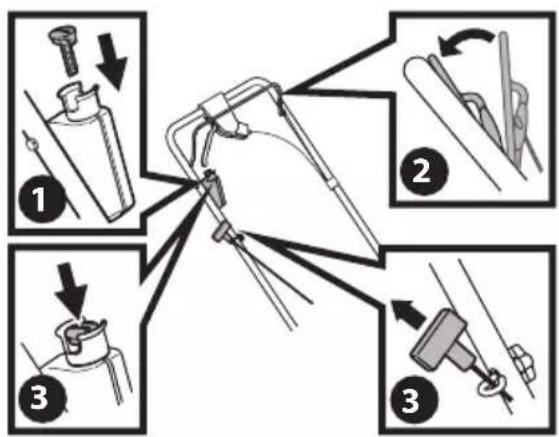
Figure 4
PRIMER SYSTEM
- Push primer 3 times. Wait about two seconds between each push (Figure 5). In temperatures below 50^ F, prime 5 times. After the engine is warmed up, one prime may be needed for all temperatures.
- Standing behind the mower, squeeze and hold the blade control against upper handle.
- Pull the recoil starter handle lightly until resistance is felt, then pull rapidly to overcome compression, prevent kickback, and start the engine (Figure 5). Repeat if necessary.
IMPORTANT: Do not allow the recoil starter handle to snap back against the rope guide. If engine does not start, it may be necessary to re-prime the engine.
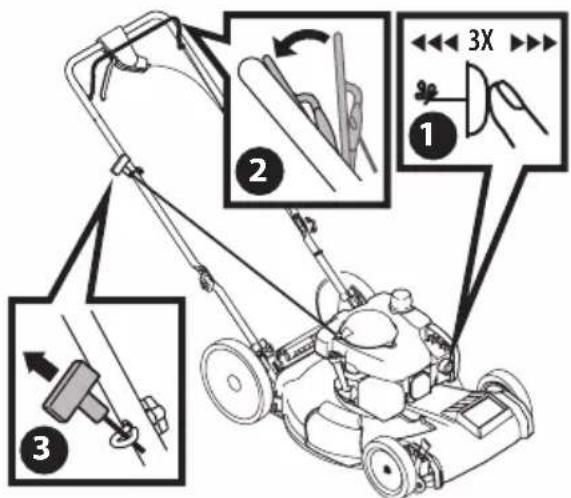
Figure 5
OPERATION
AUTO-CHOKE WITH DRIVE CONTROL AND RECOIL OR ELECTRIC START SYSTEM
-
Electric Start units only - Insert plastic electric starter push key into starter housing located on the right side of upper handle until it snaps in place.
-
Standing behind the mower, pull the blade control back against the drive control (Figure 6).
-
Perform one of the following:
- Recoil Start: While holding the blade and drive controls together firmly, pull the recoil starter handle lightly until resistance is felt, then pull rapidly to overcome compression, prevent kickback, and start the engine. Repeat if necessary (Figure 6).
IMPORTANT: Do not allow the recoil starter handle to snap back against the rope guide. Return it gently to prevent damage to the starter.
• Electric Start (If Equipped): Push the electric starter push key to start the engine (Figure 6).
NOTE: Electric starter is equipped with an internal circuit breaker. If unit fails to start when starter button is depressed, wait one minute for breaker to reset, then attempt to start again.
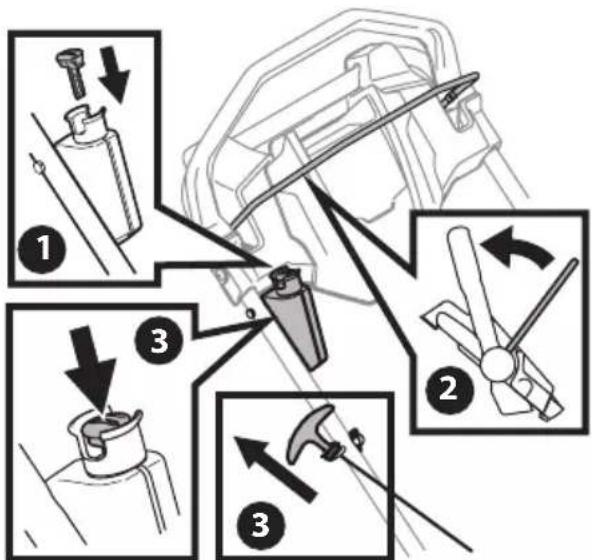
Figure 6
MANUAL CHOKE SYSTEM
- If equipped, ensure the fuel shut-off valve (a) is in the "ON" position (Figure 7).
- Pull out the choke knob (b) located on the engine.
NOTE: Use of the choke may not be necessary if the engine is warm or the air temperature is high.
- Press engine switch (c) to "ON".
- Pull the recoil starter handle lightly until resistance is felt, then pull rapidly to overcome compression, prevent kickback and start engine. If engine does not start after ten seconds of repeated pulls, wait 5 minutes and repeat.
IMPORTANT: Do not allow the recoil starter handle to snap back against the rope guide. Return it gently to prevent damage to the starter.
- When engine warms up, push in the choke knob.
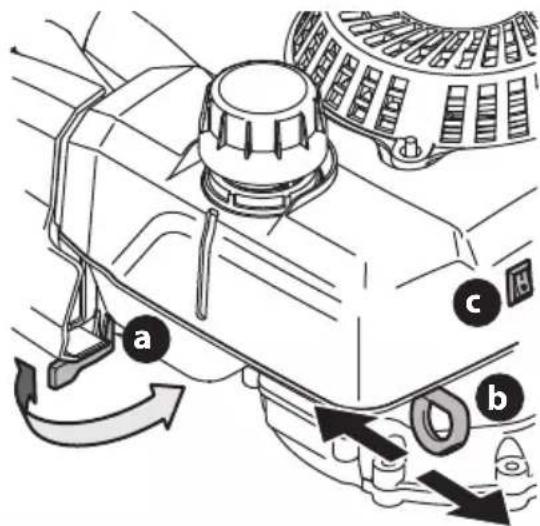
Figure 7
Stopping Engine
- Release blade control or turn off the engine switch (if equipped).
- (Electric Start units only) Remove Electric Starter Push Key if mower is to be left unattended, stored, or serviced. To remove key, grasp the key's top push button and pull it straight up and out. Keep key in a safe place out of the reach of children.
SERVICE AND MAINTENANCE
WARNING
Shut off the engine before performing any maintenance. To prevent accidental start-up, remove safety key (if equipped), disconnect the spark plug wire and ground against the engine.
General Recommendations
If engine must be tipped to transport equipment, inspect or remove grass, keep spark plug side of engine up. Transporting or tipping engine spark plug down may cause smoking, hard starting, spark plug fouling, or oil saturation of air cleaner.
Periodic inspection and adjustment of the engine is essential to maintaining engine performance and service life.
Required service intervals and maintenance are described in the table below. Follow the hourly or calendar intervals as listed. More frequent service is required when operating in adverse conditions.
WARNING
If the engine has been running, the muffler will be very hot. Allow engine and muffler to cool before performing any maintenance.
Maintenance Schedule
| Service | First 5 Hours | Each Use or Every 5 Hrs. | Every Season or 25 Hours | Every Season or 50 Hours | Every Season or 100 Hours | Service Dates |
| Check Engine Oil Level | | √ | | | | |
| Change Engine Oil * | √ | | | √ | | |
| Check Air Cleaner | | √ | | | | |
| Service Air Cleaner ** | | | | | √ | |
| Check Spark Plug | | | √ | | | |
| Replace Spark Plug | | | | | √ | |
| Clean Engine Shroud | | √ | | | | |
| Clean around muffler | | √ | | | | |
| Replace Fuel Filter | | | | | √ | |
* Every season or 25 hours if operating under heavy load or high ambient temperature.
** Service more frequently when used in dusty areas.
Oil Service
- Check oil level regularly.
- Be sure correct oil level is maintained. Check every five hours or daily before starting engine. See Checking Oil Level/Adding Oil on page 5.
Oil Change
WARNING
Before tipping engine or equipment to drain oil, drain fuel from tank by running engine until fuel tank is empty.
IMPORTANT: Be sure to check engine on a level surface with the engine stopped. Drain the oil while the engine is still warm to assure rapid and complete draining.
- Remove all fuel from tank by running engine until it stops from lack of fuel.
SERVICE AND MAINTENANCE
- Remove oil drain plug (a) and allow oil to drain into a suitable container (Figure 8).
NOTE: Select engines are equipped with an oil drain located on the rear of the engine.
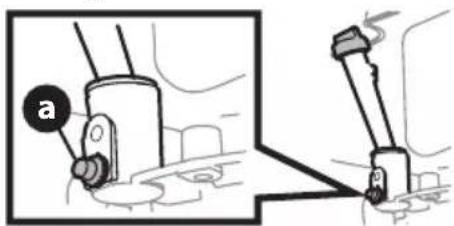
Figure 8
- Reinstall the drain plug and tighten it securely.
- Refill with the recommended oil and check the oil level. See Oil Recommendations and Checking Oil Level/Adding Oil on page 5.
- Reinstall the oil fill cap securely.
IMPORTANT: Used motor oil may cause skin cancer if repeatedly left in contact with the skin for prolonged periods. Although this is unlikely unless you handle used oil on a daily basis, it is still advisable to thoroughly wash your hands with soap and water as soon as possible after handling used oil.
NOTE: Please dispose of used engine oil in a manner that is compatible with the environment. We suggest you take it in a sealed container to your local service station or auto parts store for recycling. Do not throw it in the trash or pour it on the ground.
Air Filter Service
WARNING
Never use gasoline or low flash point solvents for cleaning the air filter element. A fire or explosion could result.
Paper filters cannot be cleaned and must be replaced once a year or every 100 operating hours; more often if used in extremely dusty conditions.
IMPORTANT: Never run the engine without the air filter. Rapid engine wear will result.
- Press down on the tabs (a) securing the air filter cover (b). Pull back and remove the cover (Figure 9).
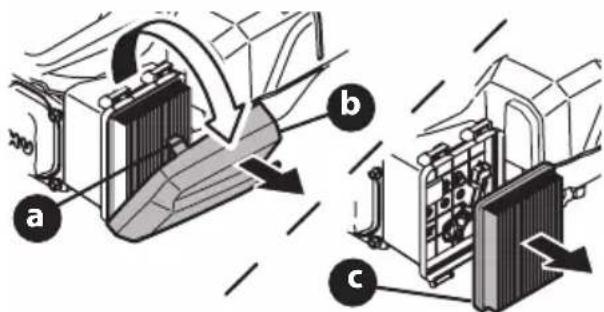
Figure 9
- Remove the paper element (c). To loosen debris, gently tap the filter on a hard surface. If the filter is excessively dirty or damaged, replace with a new filter.
- Insert the cover's bottom tabs into slots in bottom of base.
- Tilt the cover up into place and secure with tabs.
Spark Plug Service
WARNING
If the engine has been running, the muffler will be very hot. Allow engine and muffler to cool before performing any maintenance.
WARNING
DO NOT check for spark with spark plug removed. DO NOT crank engine with spark plug removed.
To ensure proper engine operation, the spark plug must be properly gapped and free of deposits.
- Remove the spark plug boot (a) and use a spark plug wrench to remove the spark plug (b) (Figure 10).
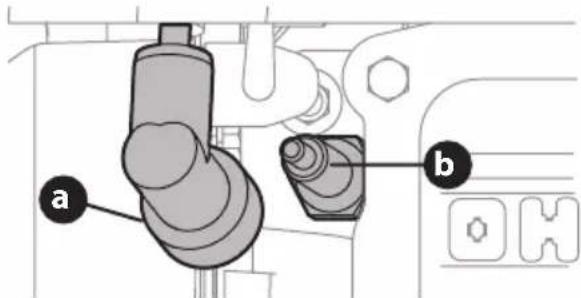
Figure 10
- Visually inspect the spark plug. Discard the spark plug if there is apparent wear, or if the insulator is cracked or chipped. Clean the spark plug with a wire brush if it is to be reused.
- Measure the plug gap with a feeler gauge. Correct as necessary by bending side electrode (c) (Figure 11). The gap should be set to 0.030 in (0.76mm).
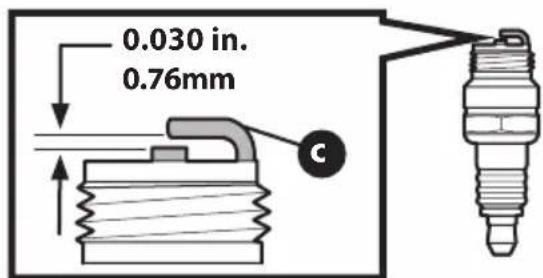
Figure 11
SERVICE AND MAINTENANCE
- Check that the spark plug washer is in good condition and thread the spark plug in by hand to prevent cross-threading.
- After the spark plug is seated, tighten with a spark plug wrench to compress the washer.
NOTE: When installing a new spark plug, tighten 1/2 turn after the spark plug seats to compress the washer. When reinstalling a used spark plug, tighten 1/8-1/4 turn after the spark plug seats to compress the washer.
IMPORTANT: The spark plug must be securely tightened. An improperly tightened spark plug can become very hot and may damage the engine.
Fuel Filter Service
The fuel filter cannot be cleaned and must be replaced once a year or every 100 operating hours; more often if run with old gasoline.
- Remove all fuel from fuel tank by running engine until it stops from lack of fuel.
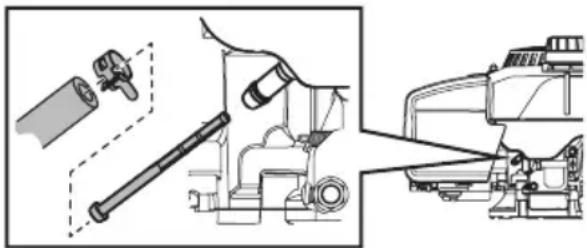
- Remove hose clamp from fuel line and remove fuel line from tank outlet (Figure 12).
natural_image
Technical illustration of a mechanical assembly with exploded view and close-up detail (no text or symbols)
Figure 12
- Pull out old fuel filter from tank outlet. Replace when dirty or damaged.
- Grasp new fuel filter from shouldered end and insert it completely to the shoulder into the fuel tank outlet (Figure 12).
- Replace fuel line and hose clamp.
Clean Engine
If the engine has been running, allow it to cool for at least half an hour before cleaning. Periodically remove dirt build-up from engine. Clean finger guard and around muffler. Clean with a brush or compressed air.
IMPORTANT: Do not spray engine with water to clean because water could contaminate fuel. Using a garden hose or pressure washing equipment can also force water into the air cleaner or muffler opening. Water in the air cleaner will soak the paper element, and water that passes through the element or muffler can enter the cylinder, causing damage.

WARNING
Accumulation of debris around muffler could cause a fire. Inspect and clean before every use.
Storage
CAUTION
Failure to use a fuel stabilizing additive or completely run the engine until it's out of fuel before off-season storage may result in damage to your engine's carburetor. Subsequent damage would not be covered under the manufacturer's warranty.
Fuel that will be stored longer than 30 days needs to be pre-treated upon purchase with fuel stabilizer to prevent gum and varnish from forming in the engines fuel and intake system. Improper fuel storage can result in hard starting, no starting, stalling and poor performance. If the fuel in your engine deteriorates during storage, you may need to have the carburetor, and other fuel system components, serviced or replaced.
- Remove all fuel from fuel tank by running engine until it stops from lack of fuel.
WARNING
Never leave engine unattended while running.
- Change oil. See Oil Change on page 10.
- Remove spark plug and pour about 1/2 an ounce of engine oil into cylinder. Replace spark plug and crank slowly to distribute oil.
- Clean debris from around engine, under finger guard, and under, around and behind muffler. Touch up any damaged paint, and coat other areas that may rust with a light film of oil.
- Store in a clean, dry and well ventilated area away from any appliance that operates with a flame or pilot light, such as a furnace, water heater, or clothes dryer. Also avoid any area with a spark producing electric motor, or where power tools are operated.
- If possible, also avoid storage areas with high humidity, because that promotes rust and corrosion.
- Keep the engine level in storage. Tilting can cause fuel or oil leakage.
Removing From Storage
- Check your engine as described in Pre-Operation Check on page 8.
- If the fuel was drained during storage preparation, fill the fuel tank with fresh fuel. If you keep a container of gasoline for refueling, make certain it contains only fresh fuel.
Gasoline oxidizes and deteriorates over time, causing hard starting.
- If the cylinder was coated with oil during storage preparation, the engine will smoke briefly at startup. This is normal.
TROUBLESHOOTING
| Problem Cause | Remedy | |
| Engine Fails to start | 1. Blade control disengaged (lawn mower only).2. Spark plug boot disconnected.3. Fuel tank empty or stale fuel.4. Fuel shut-off valve closed (if equipped).5. Engine not primed (if equipped with primer).6. Faulty spark plug.7. Reduced fuel flow/Blocked fuel filter.8. Engine flooded.9. Engine not choked (if equipped with choke). | 1. Engage blade control.2. Connect wire to spark boot.3. Fill tank with clean, fresh gasoline.4. Turn on fuel shut-off valve.5. Prime engine as instructed in the Operation section.6. Clean, adjust gap, or replace.7. Replace fuel filter as instructed in the Maintenance section.8. Wait a few minutes to restart, but do not prime.9. Choke engine. |
| Engine fails to start with electric starter (Electric Start Units Only) | 1. Electric starter push key not fully inserted.2. Battery not charged.3. Circuit breaker tripped. | 1. Insert electric starter push key into starter housing until it snaps into place.2. Charge battery. See Service section of equipment Operator's Manual.3. Debris may be blocking blade operation. Stop engine, remove electric starter push key, and disconnect spark plug boot. Verify grass or other debris are not obstructing the blade. Carefully clean out debris if necessary. Reattach spark plug boot and reinsert electric starter push key. Wait one minute after tripping for circuit breaker to automatically self-reset then reattempt start. |
| Engine runs erratic 1. Spark | plug boot loose.2. Reduced fuel flow/Blocked fuel filter.3. Vent in gas cap plugged (if equipped).4. Water or dirt in fuel system.5. Dirty air cleaner.6. Unit running with CHOKE (if equipped) applied. | 1. Connect and tighten spark plug boot.2. Replace fuel filter as instructed in the Service and Maintenance section.3. Clear vent.4. If necessary use fuel siphon to drain fuel tank. Refill with fresh fuel.5. Refer to Service and Maintenance section.6. Push CHOKE knob in. |
| Engine overheats 1. Engine | oil level low.2. Air flow restricted. | 1. Fill crankcase with proper oil.2. Clean area around and on top of engine. |
| Occasional skips (hesitates) at high speed | 1. Spark plug gap too close. 1. Adjust gap to .030". | |
| Idles poorly 1. Spark plug fouled, faulty, or gap too wide.2. Dirty air cleaner. | 1. Reset gap to .030" or replace spark plug.2. Refer to Service and Maintenance section. | |
| Engine stalls with full tank | 1. Carbon filter in fuel cap is dirty or blocked (if equipped). | 1. Replace fuel cap. |
REPLACEMENT PARTS
| Part Part Number and Description |
 | 951-14437 Spark Plug |
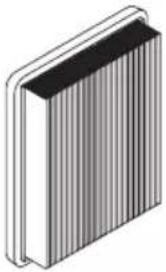 | 751-15245 Air Cleaner |
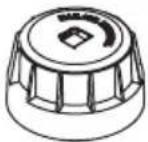 | 751-15255 Fuel Cap Assembly |
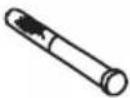 | 951-12296 Fuel Filter |

THE EZ START PROMISE
PROVISIONS OF YOUR LIMITED WARRANTY
In addition to the other terms and conditions of the Limited Warranty applicable to your new mower, MTD LLC ("MTD") hereby warrants that your mower's engine will start on the first or second attempt by an able-bodied adult (subject to the limitations described below) for the duration of the manufacturer's limited warranty applicable to your product. If the engine on your mower fails to conform to this limited warranty, MTD will cover the cost of parts and labor associated with any adjustments and/or repairs necessary to return your engine to its warranted condition. In order to make a claim under these provisions of your warranty, you must bring the product and proof of purchase to an authorized MTD service provider. In many cases, the retailer who sold you your mower is not equipped to provide warranty service, so please locate the authorized service dealer nearest you by either calling the phone number provided in your Operators Manual or looking up an authorized service dealer on-line at www.mtdproducts.com.
ITEMS AND CONDITIONS NOT COVERED
The EZ Start Promise does not cover and/or apply to the following:
- Cost of regular maintenance service or parts, such as filters, fuel, lubricants, oil changes, spark plugs, air filter, blade sharpening, worn blades, cable/linkage adjustments, or brake and clutch adjustments
- Transportation costs to and from an authorized MTD service provider
- Any engine used for commercial, rental, institutional, governmental, or non-residential applications
- Any product or part that has been altered or misused or required replacement or repair due to misuse, accidents, or lack of proper maintenance
• Repairs necessary due to improper battery care, electrical supply irregularities, or failure to properly prepare the mower prior to any period of non-use over three months
- Pickup and/or delivery charges
-
Operational misuse, neglect, accidents, unauthorized repairs or attempted repairs of the engine or its components by anyone other than an authorized MTD service provider.
-
Repairs or adjustments to correct starting difficulties due to any of the following: failure to follow proper maintenance procedures — rotary mower blade striking an object — contaminants in the fuel system — improper fuel or fuel/oil mixture (consult your Operator's Manual if in doubt) — failure to drain the fuel system prior to any period of non-use over three months.
- Any starting problem which results from the use of inappropriate fuels, lubricants, or additives.
- Special conditions or circumstances that normally require more than two pulls to start, specifically: 1) First start-up following your initial purchase, 2) first time starts after extended period(s) of non-use over one month or seasonal storage, 3) cool temperature starts such as those found in early spring and late autumn, and 4) difficult starting that results from the operator's failure to follow the proper starting procedures identified in the Operator's Manual. If you are having difficulty starting your unit, please check the Operator's Manual to ensure that you are using the correct starting procedures. This can save an unnecessary visit to a Service Dealer.
OWNER RESPONSIBILITIES
You must maintain your mower (including its engine) by following the maintenance procedures and starting instructions described in the Operator's Manual. Such routine maintenance, whether performed by a dealer or by you, is at your expense. In addition, please retain your proof of purchase and service receipts as these may be required to validate a claim.
GENERAL CONDITIONS
An authorized MTD service provider using approved replacement parts must perform all repairs covered by the EZ Start Promise. Repair by an MTD authorized service dealer is your sole remedy under this warranty. MTD is not liable for indirect, incidental, or consequential damages in connection with the use of the products covered by these warranties, including any cost or expense of providing substitute equipment or service during reasonable periods of malfunction or non-use pending completion of repairs under this warranty.
Some states do not allow exclusions of incidental or consequential damages, or limitations on how long an implied warranty lasts, so certain exclusions and limitations may not apply to you.
Manual del Operador
G. CEBADOR (SI SE INCLUYE)
Figura 4
SISTEMA DE CEBADOR
Figura 5
FUNCIONAMIENTO
Figura 6
SISTEMA DE ESTRANGULADOR MANUAL
Figura 7
Detención del Motor
Figura 9
natural_image
Technical illustration of a mechanical assembly with exploded view and close-up view (no text or symbols)
Figura 12
Espagnol (Spanish) Page 16
Français (French)Page......Page 31
Figure 4
SYSTÈME D'AMORÇAGE
Figure 5
UTILISATION
SYSTÈME D'ÉTRANGLEUR AUTOMATIQUE AVEC COMMANDE D'ENTRAÎNEMENT ET LANCEUR OU AVEC DÉMARREUR ÉLECTRIQUE
Figure 6
SYSTÈME D'ÉTRANGLEUR MANUEL
Figure 7
Arrêt du moteur
Figure 9
natural_image
Technical illustration of a mechanical assembly with exploded view and close-up view (no text or symbols)
Figure 12