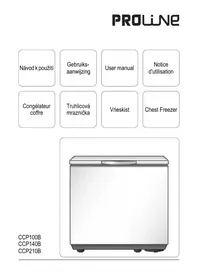
CCP140B - Refrigerator PROLINE - Free user manual and instructions
Find the device manual for free CCP140B PROLINE in PDF.

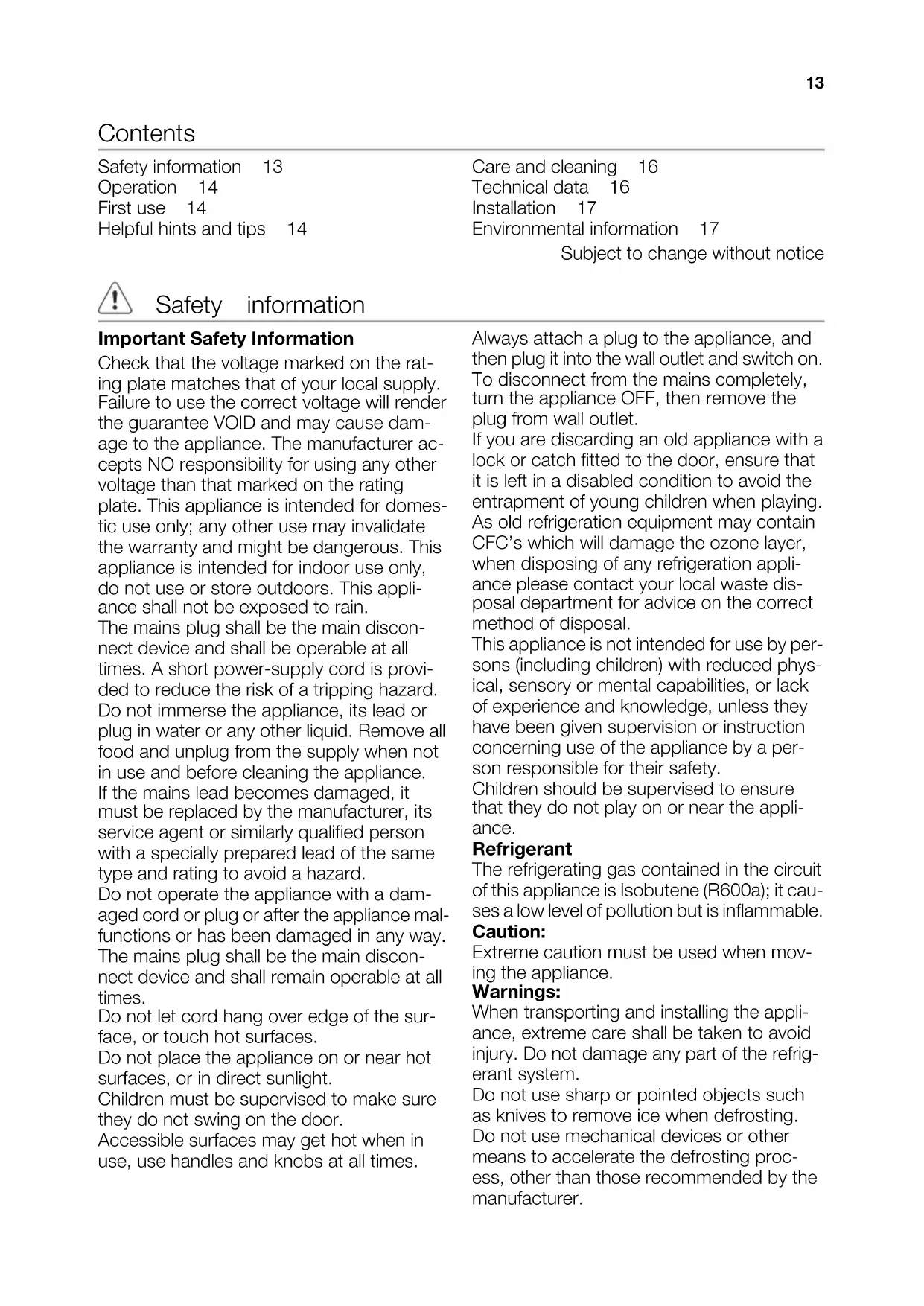


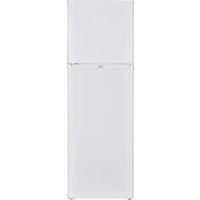
| Product type | Chest freezer |
| Model | CCP140B |
| Brand | Proline |
| Net volume | 140 litres |
| Height | 868 mm |
| Width | 595 mm |
| Depth | 665 mm |
| Weight | 35 kg |
| Supply voltage | 230 V |
| Nominal power | 84 W |
| Energy consumption | 0.781 kWh/24h |
| Climate class | SN-T (10°C to 43°C) |
| Freezing capacity | 13 kg/24h |
| Temperature rise time | 25 hours |
| Refrigerant | Isobutane (R600a) |
| Defrosting | Manual (to be performed when frost layer exceeds 3 mm) |
| Number of stars | 4 stars |
| Installation | Clearance of 5 cm at the back and sides |
| Maintenance | Interior cleaning with warm soapy water; dust the compressor |
| Safety | Mandatory earthed socket; do not use with damaged cable |
Frequently Asked Questions - CCP140B PROLINE
User questions about CCP140B PROLINE
0 question about this device. Answer the ones you know or ask your own.
Ask a new question about this device
Download the instructions for your Refrigerator in PDF format for free! Find your manual CCP140B - PROLINE and take your electronic device back in hand. On this page are published all the documents necessary for the use of your device. CCP140B by PROLINE.
USER MANUAL CCP140B PROLINE
natural_image
Illustration of a white kitchen appliance with a lid and wheels (no text or symbols)Obsah
It is recommended that the inside of the appliance can be cleaned using lukewarm water and some neutral soap.
natural_image
Symbol of a trash bin with crossed diagonal lines indicating no waste or discharge (no text or labels)natural_image
Symbol of a trash bin crossed with no text or numbers, representing environmental protection (no text present)Helpful hints and tips 14
Care and cleaning 16
Technical data 16
Installation 17
Environmental information 17
Subject to change without notice

Safety information
Important Safety Information
Check that the voltage marked on the rating plate matches that of your local supply. Failure to use the correct voltage will render the guarantee VOID and may cause damage to the appliance. The manufacturer accepts NO responsibility for using any other voltage than that marked on the rating plate. This appliance is intended for domestic use only; any other use may invalidate the warranty and might be dangerous. This appliance is intended for indoor use only, do not use or store outdoors. This appliance shall not be exposed to rain.
The mains plug shall be the main disconnect device and shall be operable at all times. A short power-supply cord is provided to reduce the risk of a tripping hazard. Do not immerse the appliance, its lead or plug in water or any other liquid. Remove all food and unplug from the supply when not in use and before cleaning the appliance. If the mains lead becomes damaged, it must be replaced by the manufacturer, its service agent or similarly qualified person with a specially prepared lead of the same type and rating to avoid a hazard.
Do not operate the appliance with a damaged cord or plug or after the appliance malfunctions or has been damaged in any way.
The mains plug shall be the main disconnect device and shall remain operable at all times.
Do not let cord hang over edge of the surface, or touch hot surfaces.
Do not place the appliance on or near hot surfaces, or in direct sunlight.
Children must be supervised to make sure they do not swing on the door.
Accessible surfaces may get hot when in use, use handles and knobs at all times.
Always attach a plug to the appliance, and then plug it into the wall outlet and switch on. To disconnect from the mains completely, turn the appliance OFF, then remove the plug from wall outlet.
If you are discarding an old appliance with a lock or catch fitted to the door, ensure that it is left in a disabled condition to avoid the entrapment of young children when playing. As old refrigeration equipment may contain CFC's which will damage the ozone layer, when disposing of any refrigeration appliance please contact your local waste disposal department for advice on the correct method of disposal.
This appliance is not intended for use by persons (including children) with reduced physical, sensory or mental capabilities, or lack of experience and knowledge, unless they have been given supervision or instruction concerning use of the appliance by a person responsible for their safety.
Children should be supervised to ensure that they do not play on or near the appliance.
Refrigerant
The refrigerating gas contained in the circuit of this appliance is Isobutene (R600a); it causes a low level of pollution but is inflammable.
Caution:
Extreme caution must be used when moving the appliance.
Warnings:
When transporting and installing the appliance, extreme care shall be taken to avoid injury. Do not damage any part of the refrigerant system.
Do not use sharp or pointed objects such as knives to remove ice when defrosting.
Do not use mechanical devices or other means to accelerate the defrosting process, other than those recommended by the manufacturer.
Do not use electrical appliances inside the food storage compartments of the appliance, unless they are of the type recommended by the manufacturer.
If the appliance is installed in a carpeted area, do not let the carpet block the ventilation holes in the base of the unit, adjust the levelling feet after a few hours to compensate for carpet movement.
Keep ventilation openings, in the appliance enclosure or the built in structure clear of obstructions.
Operation
Switching on
Insert the plug into the wall socket.
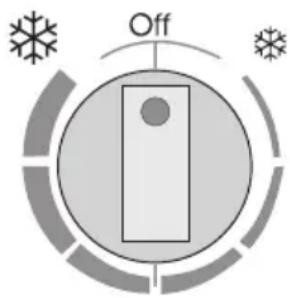
Turn the Temperature regulator clockwise.
Switching off
To turn off the appliance, turn the Temperature regulator to the OFF position.
Temperature regulation
The temperature is automatically regulated. To operate the appliance, proceed as follows:
- turn the Temperature regulator towards to obtain the minimum coldness.
- turn the Temperature regulator towards ✝ to obtain the maximum coldness.
i A medium setting is generally the most suitable.
However, the exact setting should be chosen keeping in mind that the temperature inside the appliance depends on:
- room temperature
• how often the lid is opened
• the quantity of food stored
• the location of the appliance.
First use
Cleaning the interior
Before using the appliance for the first time, wash the interior and all internal accessories with lukewarm water and some neutral soap so as to remove the typical smell of a brand-new product, then dry thoroughly.
Important! Do not use detergents or abrasive powders, as these will damage the finish.
Helpful hints and tips
Gurgling, Whooshing
These noises are caused by circulation of refrigerant in the cooling system. It has become more pronounced since the introduction of CFC free gases. This is not a fault and will not affect the performance of your freezer.
Humming, purring or pulsating
This is the compressor motor working, as it pumps the refrigerant around the system.
Shopping for frozen foods
Your Freezer is 4 star. When you are buying frozen food, look at the Storage Guidelines on the packaging. You will be able to store each item of frozen food for the period shown against the 4 star rating. This is usually the period stated as ‘Best Before’, on the front of the packaging.
Check the freezer temperature
Check the temperature of the frozen food cabinet in the shop where you buy your frozen foods. It should show a temperature lower than -18 °C.
Choose packs carefully
Take a quick look at the frozen food package and make sure it is in perfect condition.
Purchase frozen food last
Always buy frozen products last on your visit to the supermarket.
Keep frozen foods together
When you are going around the supermarket and when you are travelling home, if you
keep all the frozen foods together they will help to keep each other cold.
Store food straight away
Don't buy frozen food unless you can freeze it straight away. Special insulated bags can be bought from most supermarkets and hardware shops. These keep frozen food cold for longer.
Freezing fresh food
See the technical data sheet at the rear of this booklet for the maximum permissible amount in kilograms of fresh food that can be frozen in any 24-hour period with a room temperature of 25 °C . Never freeze more than the maximum permissible. Set the temperature control to maximum 24 hours before introducing the fresh food. The compressor will work continuously whilst on the maximum setting. Return the thermostat knob to the mid position after a further 24 hours. It is not necessary to use this setting when introducing ready frozen food.
Making ice cubes
Pour water into the ice cube tray(Not supplied) until it is two thirds full and place into the freezer. Ice cubes form in approximately 2 to 3 hours. The ice cubes can be easily removed by twisting the ice cube tray or running it under cold water for a short time.
To thaw frozen foods
- Cover food loosely.
- Thaw at room temperature. Don't forget that thawing in a warm area encourages the growth of bacteria.
- Always make sure there are no ice crystals in the food before cooking, particularly with meat. These crystals indicate that the food is not fully thawed. They result in lower temperatures when cooking. Lower cooking temperatures may not destroy bacteria.
- Cook food as soon as possible after thawing.
- Drain off and throw away any liquid lost during thawing.
Thawing frozen vegetables
For some foods, thawing before cooking is unnecessary. Vegetables and pasta can be added directly to boiling water or steam cooked. Frozen sauces and soups can be put into a saucepan and heated gently until thawed.
Oven thawing frozen foods
Many microwaves and ovens have thaw settings. To avoid bacterial build up, only use these if you intend to cook the food immediately afterwards.
Safety tips
Never re-freeze anything that has thawed out unless you cook it again, to kill off harmful bacteria. Never re-freeze thawed shellfish.
Freezing fresh food (tips)
Use quality food and handle it as little as possible. Freeze food in small quantities, it freezes faster, takes less time to thaw and enables you to eat it in the quantity you need. First, estimate the amount of food you will be freezing. Use the Thermostat knob to make your freezer colder (about -25°C), it will therefore freeze quicker and keep in the goodness. However you should use it sparingly to conserve energy.
Prolonged off periods
If the refrigerator is not in use for a long period of time, proceed as follows: Disconnect the refrigerator from the main supply by removing the plug from the socket. Clean and dry the inside as instructed under the heading of cleaning and maintenance. Leave the door open to prevent any unpleasant smells from building up while the appliance is not in use.
Important! If the cabinet will be kept on, ask somebody to check it once in a while to prevent the food inside from spoiling in case of a power failure.
If there is a power failure for a short time keep the door closed check the contents of the refrigerator every so often.
Power failure
If there is a power failure for a short time less than 12 hours keep the door closed. Frozen food should not be affected if the failure lasts for less than 12 hours.
Extra protection can be given by covering the appliance with two or three thick blankets.
If a long power failure is anticipated, try to get the foodstuff into another appliance or cold store, if possible.
If the power cut is longer than 12 hrs then check the content of the freezer.
If the food has defrosted, cook and refreeze the food or it should be eaten immediately. Never refreeze food that as been defrosted.
Care and cleaning
Cleaning and maintenance
Before any cleaning or maintenance is carried out you must disconnect the appliance from the mains supply by removing the plug, never remove the plug by pulling on the mains cord. Remove the plug by pulling on the plug itself.
It is recommended that the inside of the appliance can be cleaned using lukewarm water and some neutral soap.
Do not use detergents, abrasive powders, highly perfumed cleaning products, wax polishes or cleaning products containing bleach or alcohol.
External Cleaning, wash the outer cabinet with warm soapy water.
Do NOT use abrasive products. There are sharp edges on the underside of the product so care should be taken when cleaning. Once or twice a year dust the compressor at the back of the appliance, with a brush or Vacuum cleaner, as an accumulation of dust will affect the performance of the appliance and Cause excessive electricity consumption.
Warning! The refrigerating system must not be damaged at any time.
Defrosting the freezer
The freezer will need defrosting periodically (when the frost is more than 3mm thick).
Turn the temperature control to "MIN" and unplug from the mains socket.
Hold the plug itself. Do not remove the plug by pulling on the mains cord.
Remove all the frozen food and wrap in thick blankets to retain the cold or move it to another freezer.
Leave the freezer door open with a absorbent cloth inside to soak up water as the frost melts.
When the freezer is fully defrosted, clean the inside (see the section on cleaning and maintenance). Then close the door and connect to the mains, now set the thermostat knob to your required setting (usually the mid position setting).
Leave the freezer running for approximately 4 hours before re-introducing the frozen food.
Technical data
| CCP100B CCP140B CCP210B | ||||
| Volume (gross) Litre | 105 142 213 | |||
| Volume (net) Litre | 102 140 210 | |||
| Height mm | 850 868 868 | |||
| Width mm | 550 595 795 | |||
| Depth mm | 593 665 665 | |||
| Weight Kg | 27 35 39 | |||
| Rising Time hours | 26 25 28 | |||
| Energy Consumption | kWh/24h | 0,570 | 0,781 | 0,657 |
| Freezing Capacity | kg/24h | 12 | 13 | 14 |
| Rated Power | Watt | 60 | 84 | 80 |
| Voltage | Volts | 230 | 230 | 230 |
| Climatic Class | SN-T | SN-T | SN-T | |
Further technical information are situated in the rating plate on the external right side of the appliance.
Installation
Positioning

Warning! If you are discarding an old appliance that has a lock or catch on the lid, you must ensure that it is made unusable to prevent young children being trapped inside.
Important! The appliance shall have the plug accessible after installation.
This appliance can be installed in a dry, well ventilated indoor (garage or cellar), but for optimum performance install this appliance at a location where the ambient temperature corresponds to the climate class indicated on the rating plate of the appliance:
| Climate class | Ambient temperature |
| SN +10°C to + 32°C | |
| N +16°C to + 32°C | |
| ST +16°C to + 38°C | |
| T +16°C to + 43°C |
Electrical connection
Before plugging in, ensure that the voltage and frequency shown on the rating plate correspond to your domestic power supply.
Environmental information
Important disposal instructions
natural_image
Symbol of a trash bin crossed with diagonal lines, representing no waste or discharge (no text or labels)As a responsible retailer we care about the environment. As such we urge you to follow the correct disposal procedure for your product and packaging materials.
This will help conserve natural recourses and ensure that it is recycled in a manner that protects health and the environment. You must dispose of this product and its packaging according to local laws and reg-
The appliance must be earthed. The power supply cable plug is provided with a contact for this purpose. If the domestic power supply socket is not earthed, connect the appliance to a separate earth in compliance with current regulations, consulting a qualified electrician.
The manufacturer declines all responsibility if the above safety precautions are not observed.
This appliance complies with the E.E.C. Directives.
Ventilation requirements
- Put the freezer in horizontal position on a firm surface. The cabinet must be on all four feet.
- Make sure that the clearance between the appliance and rear wall is 5 cm.
- Make sure that the clearance between the appliance and the sides is 5 cm.
The airflow behind the appliance must be sufficient.
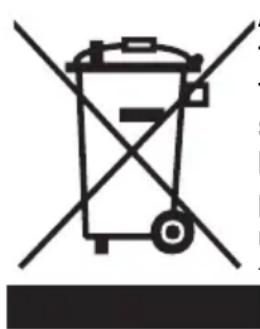
ulations. Because this product contains electronic components, the product and its accessories must be disposed of separately from household waste when the product reaches its end of life.
Contact your local authority to learn about disposal and recycling.
The product and if applicable, its batteries should be taken to your local collection point for recycling. Some collection points accept products free of charge.
If something doesn't seem to work
If there is something about your appliance which you do not understand and you live in the UK you can phone our help line during normal office hours on: 0844 8009595
Calls are charged at standard rates.
We apologise for any inconvenience caused by minor inconsistencies in these instructions, which may occur as a result of product improvement and development.
KESA U.K HU1 3AU 14 / 12 / 2008
Sommaire
natural_image
Symbol of a trash bin with crossed diagonal lines indicating no waste or discharge (no text or labels)natural_image
Symbol of a trash bin crossed with a diagonal line, no text or numbers presentnatural_image
Symbol of a trash bin with crossed lines indicating no waste or discharge (no text or labels)natural_image
Symbol of a trash bin crossed with a diagonal line, no text or numbers presentnatural_image
Symbol of a trash bin with crossed lines indicating no waste or discharge (no text or labels)natural_image
Symbol of a trash bin with crossed lines indicating no waste or discharge (no text or labels)
- Obsah
- Safety information
- Important Safety Information
- Refrigerant
- Caution:
- Warnings:
- Operation
- Switching on
- Switching off
- Temperature regulation
- First use
- Cleaning the interior
- Helpful hints and tips
- Gurgling, Whooshing
- Humming, purring or pulsating
- Shopping for frozen foods
- Check the freezer temperature
- Choose packs carefully
- Purchase frozen food last
- Keep frozen foods together
- Store food straight away
- Freezing fresh food
- Making ice cubes
- To thaw frozen foods
- Thawing frozen vegetables
- Oven thawing frozen foods
- Safety tips
- Freezing fresh food (tips)
- Prolonged off periods
- Power failure
- Care and cleaning
- Cleaning and maintenance
- Defrosting the freezer
- Installation
- Positioning
- Electrical connection
- Environmental information
- Important disposal instructions
- Ventilation requirements
- If something doesn't seem to work
- Calls are charged at standard rates.
- Sommaire
Brand : PROLINE
Model : CCP140B
Category : Refrigerator