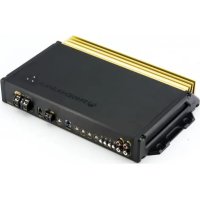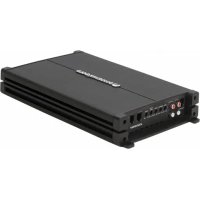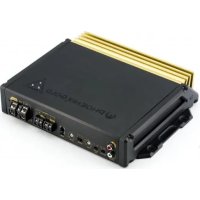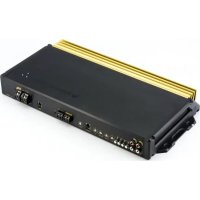
SD200.2 - Receiver PHOENIX GOLD - Free user manual and instructions
Find the device manual for free SD200.2 PHOENIX GOLD in PDF.

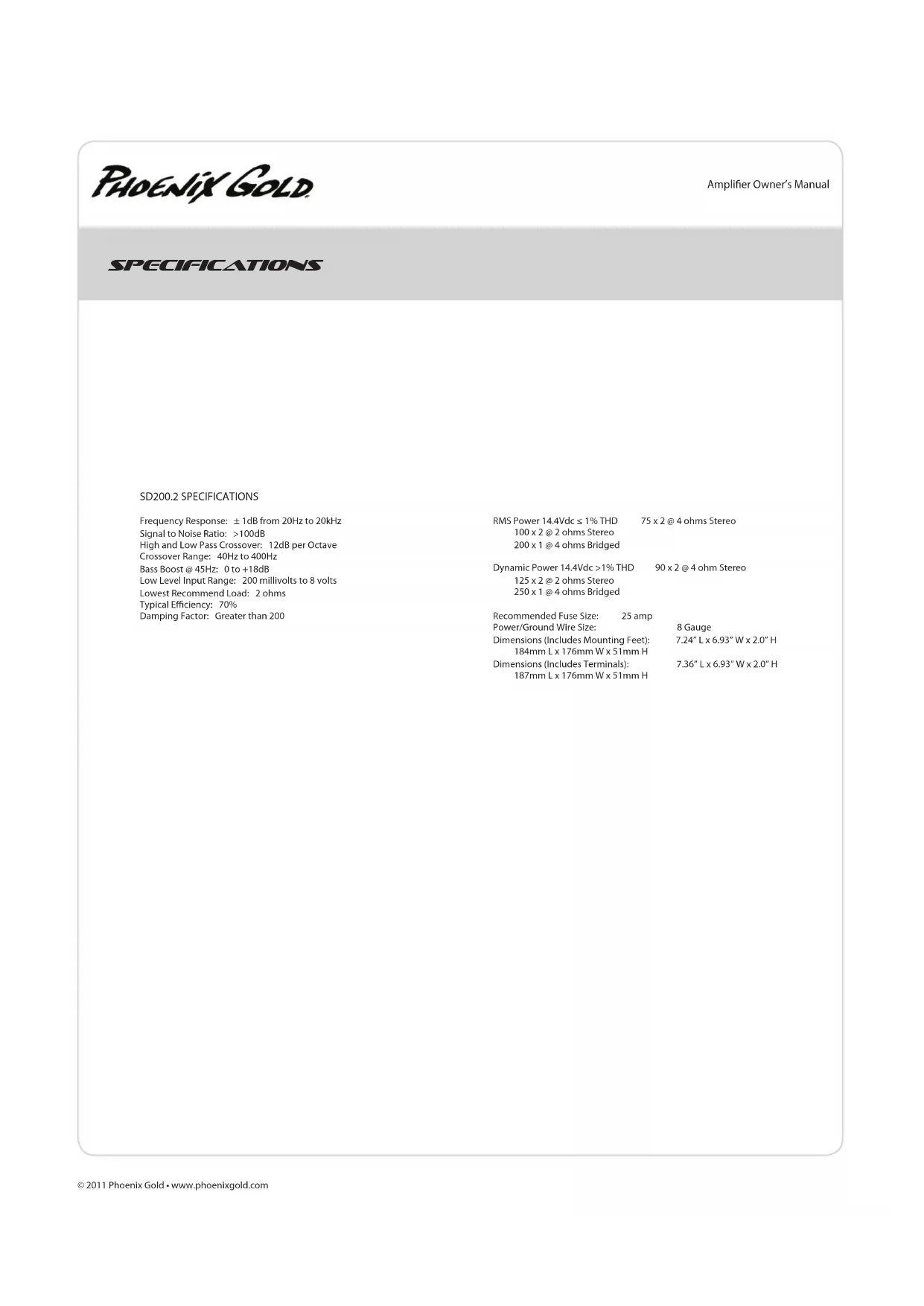

User questions about SD200.2 PHOENIX GOLD
0 question about this device. Answer the ones you know or ask your own.
Ask a new question about this device
Download the instructions for your Receiver in PDF format for free! Find your manual SD200.2 - PHOENIX GOLD and take your electronic device back in hand. On this page are published all the documents necessary for the use of your device. SD200.2 by PHOENIX GOLD.
USER MANUAL SD200.2 PHOENIX GOLD
High Efficiency Full Range Class D Topology
- Compact Size for Easy Installation
High and Low Pass Crossovers
- Robust Unregulated Power Supply
Surface Mount Component Technology
Panel Mounted RCAs
- Direct Insert Power and Speaker Terminals
Audio Precision Quality Control Verification
High Temperature Plexiglass cover
RMD-Remote Monitoring Display Port
Frequency Response: ±1dB from 20Hz to 20kHz
Signal to Noise Ratio: >100dB
High and Low Pass Crossover: 12dB per Octave
Crossover Range: 40Hz to 400Hz
Bass Boost @ 45Hz: 0 to +18dB
Low Level Input Range: 200 millivolts to 8 volts
Lowest Recommend Load: 2 ohms
Typical Efficiency: 70%
Damping Factor: Greater than 200
RMS Power 14.4Vdc ≤ 1% THD
100x2@2ohms Stereo
200x1 @ 4 ohms Bridged
75 x 2 @ 4 ohms Stereo
Dynamic Power 14.4Vdc >1% THD
125 × 2@2ohms Stereo
250x1@4ohmsBridged
90x2@4ohm Stereo
Recommended Fuse Size: 25 amp
Power/Ground Wire Size:
8 Gauge
Dimensions (Includes Mounting Feet):
184mm L x 176mm W x 51mm H
7.24^ × 6.93^ × 2.0^
Dimensions (Includes Terminals):
187mm L x 176mm W x 51mm H
7.36" L x 6.93"W x 2.0"H
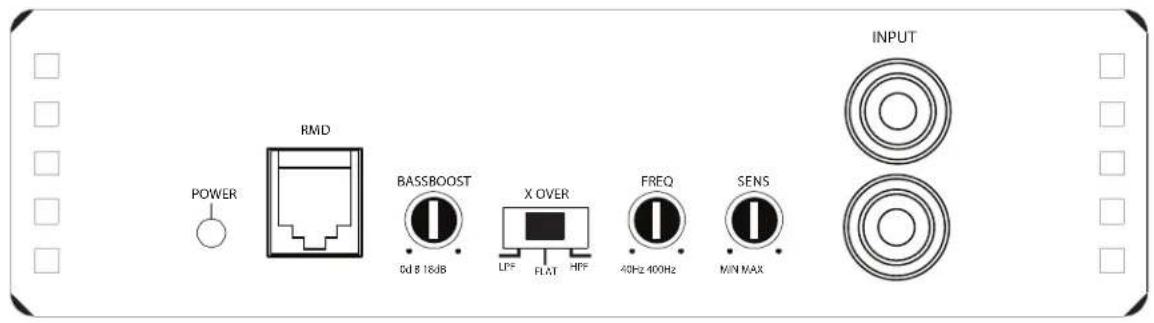
INPUTS
Connect preamp signal cables from headunit to these inputs.
CROSSOVER FREQUENCY
Controls the crossover point for the speaker outputs.
REMOTE MONITORING DISPLAY (RMD)
Connect optional RMD Voltage Display to this port.
BASS BOOST
Variable bass boost from 0 to +18dB @ 45Hz.
SENS
Used to reach maximum amplifier power with a wide variety of headunits.
X-OVER CONFIG
FLAT: Crossovers are turned off
HPF: High pass crossover is o
LPF: Low pass crossover is on
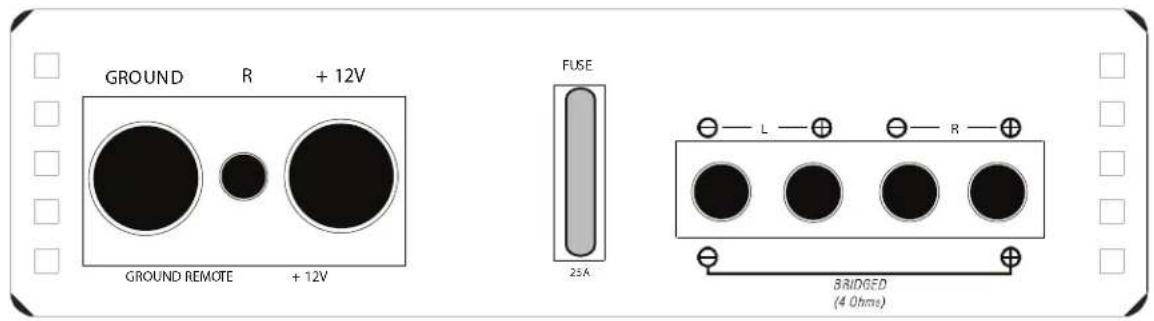
+12V
This must be connected to the fused positive terminal (+12V) of the car's battery. The fuse must be located within 18 inches of the battery.
REMOTE
This must be connected to switched +12V , usually a trigger wire coming from the head unit or ignition.
GROUND
This must be connected to the negative terminal of the car's battery or bolted to a clean, unpainted part of the chassis of the vehicle.
SPEAKER OUTPUTS
Used to connect the amplifier to speakers. SD200.2 minimum impedance is 4 ohms bridged or 2 ohms stereo. Use Right + and Left - to bridge the channels.
NOTE: Visible through the plexiglass cover, a single blue power LED is located in the lower corner of all SD amplifiers.
SYSTEM TUNING
- Install all system fuses.
- Set the amplifier's input sensitivity controls to their minimum positions (full counterclockwise).
- Set all amplifier crossover switches according to your system's design.
- Make preliminary adjustments to the crossover frequency, usually 80Hz is good starting point for high and low pass. It may be necessary to fine tune the crossover frequency later for the best overall sound quality.
- If using a Remote Subwoofer Level Control, set it to maximum (full clockwise).
- Turn the headunit on with the volume set to minimum.
- Visually check the amplifier's has turned on by the power LED.
- Check the condition of all other components to make sure they are powered up.
- Set the headunit's tone controls, balance, and fader to the center (flat) position. Turn off any loudness or other signal processing features.
- Set the volume control of the headunit for maximum undistorted output (on most headunits this will be approximately 7/8 of maximum volume). Use a very clear and dynamic recording.
- Turn up the sensitivity or input level control on the amplifier until the speakers reach maximum undistorted output.
-
Repeat sensitivity level adjustments for all other amplifiers.
-
Reduce the headunit's volume to a comfortable level.
- Listen to various musical selections to check overall system balance. Compare front to rear, midbass to midrange, etc. If one speaker set is too loud compared to another, then its level must be lowered to blend correctly with the other speakers.
Note: For subwoofoers controlled by the Remote level control, keep the level setting from step 11 or 12. Use the control to blend subwoofoers with the rest of the system. The correct subwoofer volume will change depending on road noise and differences in recordings.
- Fine tune crossover frequencies to achieve the smoothest possible blending of each speaker set.
- Adjust the Bass Equalization Controls on the amplifier, headunit or processor upstream if necessary to increase output.
Note: Use these controls sparingly. Every 3dB of boost requires double the power at 45Hz . If your subwoofer system requires a lot of boost to sound good, there may be a problem. Look for out-of-phase woofers, a leaking subwoofer box, or incorrect box size.
17. With all levels set correctly, the system will reach overall maximum undistorted output at the volume level set in step 10.
TROUBLESHOOTING
OVERVOLTAGE WARNING - If the voltage is above 14.4V across the +12V and ground terminal this will cause the amplifier to go into protection mode. The result is no audio output from one or more channels. Voltage must between 11.5V to 14.4V for the amplifier to operate correctly.
No power: Check voltage at the amplifier with a DMM (volt meter), +12v and R (with head unit on) the voltage should register between 11.5V and 14.4V when using the attached ground lead of the amplifier. Check fuse at amplifier and at the battery. Use a meter to verify connection from one end of the fuse to the other, breaks may not always be visible. If the fuse is blown, check the power wire and also the amplifier for a short. If the short is in the amplifier itself, see your Phoenix Gold dealer. If no short is present, replace the fuse.
Power without sound: Turn the amplifier off and check all input and output signal cables and power connections. Check the speakers for shorts with a DMM (volt meter) or by connecting them to another audio source. After making sure everything is correct, turn the amplifier on again.
Power without sound and the PROTECT LED is lit: The red PROTECT LED lights when the amplifier shuts down for either thermal or over-current protection. A high internal amplifier operating temperature will trigger thermal shutdown; after it cools about 5^ , the amplifier will restart. A shorted speaker lead or operation into unusually low impedance loads will trigger over-current shutdown; cycle power at the amplifier R terminal to restore operation. Check for shorted speaker wiring or damaged speakers or crossover systems if over-current shutdown occurs.
No sound from one or more channels: Check for overvoltage on +12V and ground terminals. Check the balance control in the head unit. Check speaker connections. Check signal input connection.
Very low output: Check your head unit's fader control or the amplifier's input sensitivity level. Make sure subsonic frequency control is not set too high and LP frequency control is not set too low at the same time.
Frequent amplifier shutdown with automatic recovery: This indicates chronic amplifier thermal shutdown because of operation at consistently high internal temperatures. High operating temperature can be caused by inadequate ventilation. Make sure you are not running a lower than recommend impedance. Also check for damaged speakers or passive crossover systems. Finally, chronic thermal shutdown may result from otherwise normal operation of the amplifier at elevated output power levels, which can be resolved by providing additional amplifier cooling, installing a higher-power amplifier, or reducing amplifier output level.
"Motor Boating"- the power indicator going off repeatedly when the audio system is on: Check the amplifier's connection to the battery. Check battery voltage. If low, recharge or replace the battery. Check all ground connections.
CHARACTERISTIQUES SD200.2:
Charge minimale recommandee: 2 ohms
Efficacité type: 70%
200 x 1 @ 4 ohms Bridged
Puissance Dynamique 14.4Vdc >1% THD 90 x 2 @ 4 ohms Stereo
125x2@2ohms Stereo
250 x 1 @ 4 ohms Bridged
Taille de fusible:
25 amp
calibre 8.
7.24" L x 6.93"W x 2.0"H
184mm L x 176mm W x 51mm H
Dimensions (Compend termaux):
187mmL×176mmW×51mmH
7.36"×6.93"W×2.0"H
SD200.2
2 CHANNEL POWER AMPLIFIER
ENTREE
A Division of AAMP of America™
13190 56th Court
Clearwater, Florida 33760
P:888-22
info@phoenixgold.com
www.phoenixgold.com
© 2011 AAMP of Florida, Inc.
Designed and Engineered in the USA
LIMITED WARRANTY ON AMPLIFIERS
Phoenix Gold warrants this product to be free of defects in materials and workmanship for a period of one (1) year from the original date of purchase. This warranty is not transferable and applies only to the original purchaser from an authorized Phoenix Gold dealer in the United States of America only. Should service be necessary under this warranty for any reason due to manufacturing defect or malfunction, Phoenix Gold will (at its discretion), repair or replace the defective product with new or remanufactured product at no charge. Damage caused by the following is not covered under warranty: accident, misuse, abuse, product modification or neglect, failure to follow installation instructions, unauthorized repair attempts, misrepresentations by the seller. This warranty does not cover incidental or consequential damages and does not cover the cost of removing or reinstalling the unit(s). Cosmetic damage due to accident or normal wear and tear is not covered under warranty.
INTERNATIONAL WARRANTY:
Products purchased outside the United States of America are covered only by that country's Authorized Phoenix Gold reseller and not by Phoenix Gold. Consumers needing service or warranty information for these products must contact that country's reseller for information.