X2 700 - Battery charger Hitec - Free user manual and instructions
Find the device manual for free X2 700 Hitec in PDF.


User questions about X2 700 Hitec
0 question about this device. Answer the ones you know or ask your own.
Ask a new question about this device
Download the instructions for your Battery charger in PDF format for free! Find your manual X2 700 - Hitec and take your electronic device back in hand. On this page are published all the documents necessary for the use of your device. X2 700 by Hitec.
USER MANUAL X2 700 Hitec
Hochleistungs Profi Balance LADER / ENTLADER multicharger X2700 Seven Hundred
HiTEC
text_image
HiTEC multicharger X2 760 microcontroller RATT/PROD STOP DC 11.39V SOSUPTI 875843215 Balance Port USB TWO SwitchMultiplex/HiTEC Service:
+49 (0) 7252 - 5 80 93 33
natural_image
Two pairs of black and gray cables with connectors, no visible text or symbols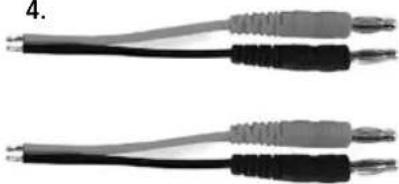
natural_image
Two pairs of black and gray cables with connectors, no text or symbols visible
natural_image
Two black plastic clips with metal contacts, shown from different angles (no text or symbols visible)natural_image
Coiled black electrical cable with two terminal connectors, labeled # 118 331 Ladekabel XT 60 (no other text or symbols visible)3. Eigenschaften
natural_image
Close-up of a network cable connector with connectors and cables, no visible text or symbolsflowchart
graph TD
    A["PROGRAM SELECT SYSTEM SET->"] --> B["INC"]
    B --> C["Rest Time CHG>DCHG 10Min"]
    C --> D["DEC INC"]
    D --> E["Safety Timer ON 120Min"]
    E --> F["DEC INC"]
    F --> G["Capacity Cut-Off ON 5000mAh"]
    G --> H["DEC INC"]
    H --> I["Key Beep Buzzer ON ON"]
    I --> J["DEC INC"]
    J --> K["DEC INC"]
    K --> L["DEC INC"]
text_image
1 End Voltage 12.6V(3S) 2 IN Power Voltage 12.56V 3 Int. Temp 28C 4 Safety Time ON 200min 5 Capacity Cut-Off ON 5000mAh 6 C1: 4.12 C2: 4.09V C3: 4.09 C4: 4.10VCongratulations on your purchase of the HiTEC X2-700 Multi-Charger. You are now the owner of a compact multi chemistry battery charger with battery management and integral Lithium battery balancing features.
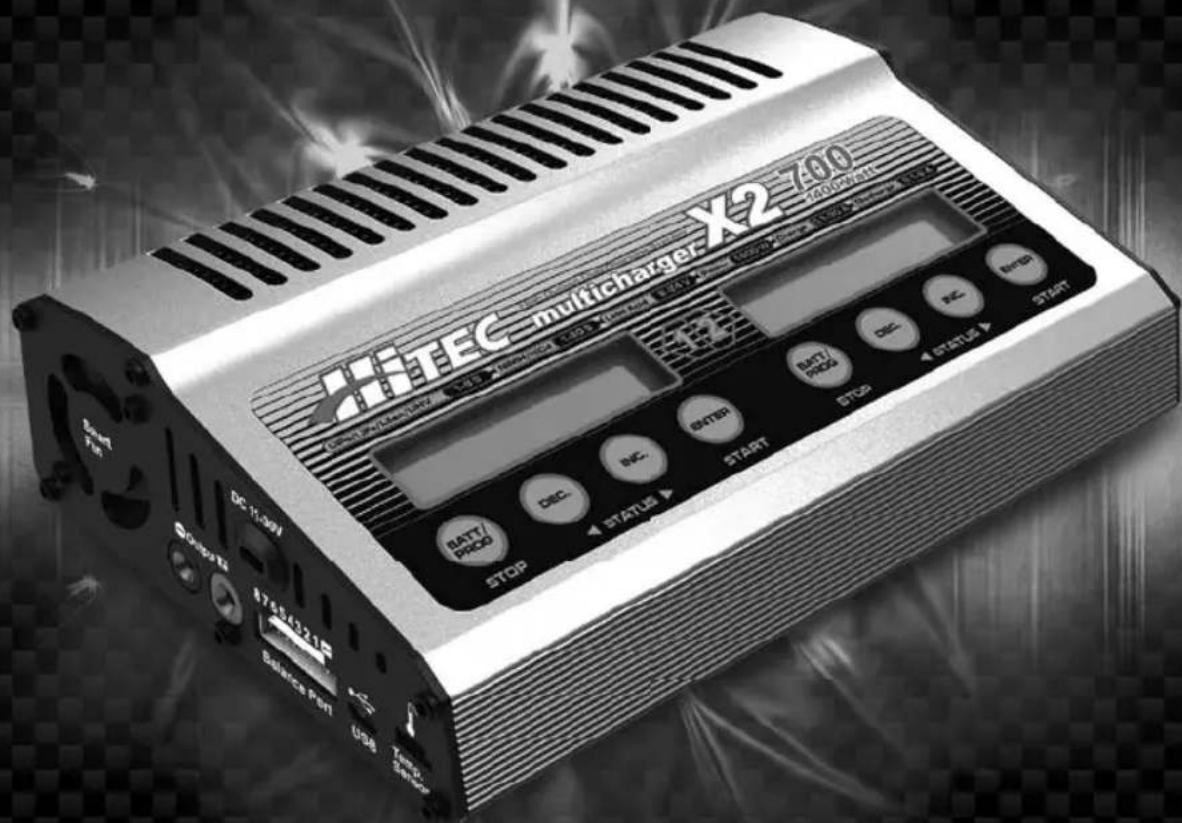
The X2-700 features two totally independent and identical 700 watts charging circuits for a total power of 1400 watts. As a result, it can simultaneously charge or discharge up to 2 separate battery packs.
The X2-700 can be attached to a 12 volt car battery. With the include connector you connect it to a 11-30 V DC power supply with a minimum amperage rating of 60 amps.
The HiTEC X2-700 is simple to use, but the operation of a sophisticated automatic charger such as the X2-700 does require some knowledge and education by the user.
This instruction manual is designed to ensure that you can quickly become familiar with the charger's functions and capabilities. It is important that you read this instruction manual in its entirety before attempting to use your new X2-700 charger.
1.1. Warnings and Safety Information

Failure to follow these important safety notes or the instruction manual can result in severe injury, property damage or loss of life.
- Please read this entire instruction manual completely and attentively before using this product, as it covers a wide range of information on operation and safety.
- Never leave the charger unattended when it is connected to its power supply. If any malfunction is found, terminate the process at once and refer to the instruction manual.
• The charger and the battery should be put on a heat-resistant, non-fl ammable and non-conductive surface. Never place them on a car seat, carpet or other fl ammable surface. Keep all fl ammable volatile materials away from the operating area. - Keep the charger away from dust, moisture, water, excessive heat, direct sunlight and vibration.
• Make sure you know the specifications of the battery you are charging or discharging to ensure it meets the requirements of this charger. If the program is set up incorrectly, the battery and charger may be damaged. Fire or explosion can occur due to overcharging.
- To avoid short circuiting between the charge lead, always connect the charge cable to the charger first, then connect the battery. Reverse the sequence when disconnecting.
- The maximum allowable input voltage is 30 Volts DC when using an external DC power source.
Never attempt to charge or discharge the following types of batteries:
- A battery pack which consists of different types of cells (including different manufacturers)
• A battery that is already fully charged or just slightly discharged
• Non-rechargeable batteries (they pose an explosion hazard) - Batteries that require a different charge technique from NiCd, NiMH, LiPo or gel cell (Pb, lead-acid battery)
• A faulty or damaged battery
- A battery fitted with an integral charge circuit or a protection circuit
- Batteries installed in a device or which are electrically linked to other components
- Batteries that are not expressly stated by the manufacturer to be suitable for the currents the charger delivers during the charge process
Before you start charging or discharging your batteries consider the following:
- Did you select the appropriate program suitable for the type of battery you are charging?
• Did you set up adequate current for charging or discharging?
1.1. Warnings and Safety Information
- Have you checked the battery voltage? Lithium battery packs can be wired in parallel and in series, i.e. a 2-cell pack can be 3.7V (in parallel) or 7.4V (in series).
- Have you checked that all connections are firm and secure? Make sure there are no intermittent contacts at any point in the circuit.
Standard Battery Parameters
| Nominal Voltage (V) | Max. Charge Voltage | Storage Voltage | Allowable Fast Charge | Min. Discharge Voltage | |
| LiPo 3.7 V/cell 4.2 V/cell 3.8 V/cell | ≤1C 3.0 V/cell | ≥ | |||
| Lilon 3.6 V/cell 4.1 V/cell 3.7 V/cell | ≤1C 2.5 V/cell | ≥ | |||
| LiFe 3.3 V/cell 3.6 V/cell 3.3 V/cell | ≤4C 2.0 V/cell | ≥ | |||
| NiCd 1.2 V/cell 1.5 V/cell n/a | 1C-2C | ≥0.85 V/cell | |||
| NiMH | 1.2 V/cell | 1.5 V/cell | n/a | 1C-2C | ≥1.0 V/cell |
| Pb | 2.0 V/cell | 2.46 V/cell | n/a | ≤0.4C | ≥1.75 V/cell |
| LiHV | 3.8 V/cell | 4.35 V/cell | 3.9 V/cell | ≤1C 3.0 V/cell | ≥ |
Charging
During the charge process, a specific quantity of electrical energy is fed into the battery. The charge quantity is calculated by multiplying charge current by charge time. The maximum permissible charge current varies depending on the battery type or its performance, and can be found in the information provided by the battery manufacturer. Only batteries that are expressly stated to be capable of quick charge should be charged at rates higher than the standard charge current.
Connect the battery to the terminal of the charger. Red is positive and black is negative. In the event there is any significant resistance in the battery cable and/or connector, the charger will not be able to properly detect the resistance of the battery pack resulting in an error. It is essential in order for the charger to operate properly that the battery charge leads should be of adequate quality for the size of the battery.
Always refer to the manual by the battery manufacturer pertaining to charging methods. Operate according to their recommended charging current and charging time. Lithium batteries, in particular, should be charged strictly according to the manufacturer's instruction.
Pay close attention to the connection of lithium batteries. Do not attempt to disassemble the battery pack.
Please take note that lithium battery packs can be wired in parallel and in series. In the parallel connection, the battery's capacity is calculated by multiplying the single battery's capacity by the number of cells, bearing in mind that total voltage stays the same. If the voltage is imbalanced, it may cause a fi re or explosion. Lithium batteries are always recommended to be charge in series.
Discharging
The main purpose of discharging a battery is to clean the residual capacity of the battery or to reduce the battery's voltage to a defined level. It is even more critical that close attention be paid to the discharging process as failure to properly monitor the process can destroy your battery. The fi nal discharge voltage should be set correctly to avoid deep discharging. Some rechargeable batteries have a memory effect. If they are partly used and recharged before the
complete charge/discharge cycle is accomplished, they remember this and will only use that part of their capacity next time. It is generally known that NiCd and NiMH batteries suffer from this memory effect.
GB
Discharging Lithium Batteries
Lithium batteries cannot be discharged to a voltage lower than the minimum voltage for the cell type. Doing so will result in a rapid loss of capacity and/or total failure. While the X2-700 monitors each individual cell during the discharge process the discharging cutoff is based on the total pack voltage.
Generally, lithium batteries don't need to be discharged and it is not recommended that you discharge them. If you do choose to discharge your lithium batteries make sure to pay attention to the minimum voltage setting as well as the individual cell voltage.

This charger was designed and approved exclusively for use with the types of batteries stated in this instruction manual. MULTIPLEX Modellsport GmbH accepts no liability of any kind if the charger is used for any purpose other than that stated. Since we are unable to assure that the user will properly follow the supplied instructions and have no control over one's proper use or maintenance of the device, we are obligated to deny any and all claims of liability for loss, damage or injury which are incurred due to improper use and operation of this product. Unless otherwise prescribed by law, the limit of our liability shall not exceed the invoice value of the charger.
1.2. Guarantee and Limitation of Liability
MULTIPLEX Modellsport GmbH & Co.KG does not assume any liability for loss, damage or costs which arise through the improper use and operation of our products, or which are connected with such operation in any way. As far as is legally permissible, the obligation of MULTIPLEX Modellsport GmbH & Co.KG to provide compensation for damages, on whatever legal basis, is limited to the invoice amount of the quantity of MULTIPLEX Modellsport GmbH & Co.KG goods that were directly affected by whatever incident gave rise to the damage. This does not apply if MULTIPLEX Modellsport GmbH & Co.KG is obliged to accept unlimited liability in accordance with mandatory law for deliberate or gross negligence.
Our products are covered by the currently valid statutory guarantee regulations. If you wish to make a claim under guarantee, please contact the model shop where you purchased the product.
The guarantee does not cover malfunctions caused by the following:
- Improper Operation
- Maintenance that was performed incorrectly, late or not at all, or performed by a non-authorized body
- Incorrect connections
• Use of non-original MULTIPLEX accessories - Modifi cations / repairs that were not carried out by MULTIPLEX or a MULTIPLEX Service Centre
• Accidental or deliberate damage
• Faults due to normal wear and tear
• Operation outside the technical specifications or in connection with components from other manufacturers.
1.3. CE Conformity Declaration
This device has been assessed and approved in accordance with European harmonised directives. This means that you possess a product whose design and construction fulfil the protective aims of the European Community designed to ensure the safe operation of equipment.
1.4. Disposal Notes
Electrical equipment marked with the cancelled waste bin symbol must not be discarded in the standard household waste; instead it should be taken to a suitable specialist disposal system.
In the countries of the EU (European Union) electrical equipment must not be discarded via the normal domestic refuse system (WEEE - Waste of Electrical and Electronic Equipment, Directive 2002/96/EG).
You can take unwanted equipment to your nearest local authority waste collection point or recycling centre. There the equipment will be disposed of correctly and at no cost to you.
By returning your unwanted equipment you can make an important contribution to the protection of the environment!
2. Package Contents
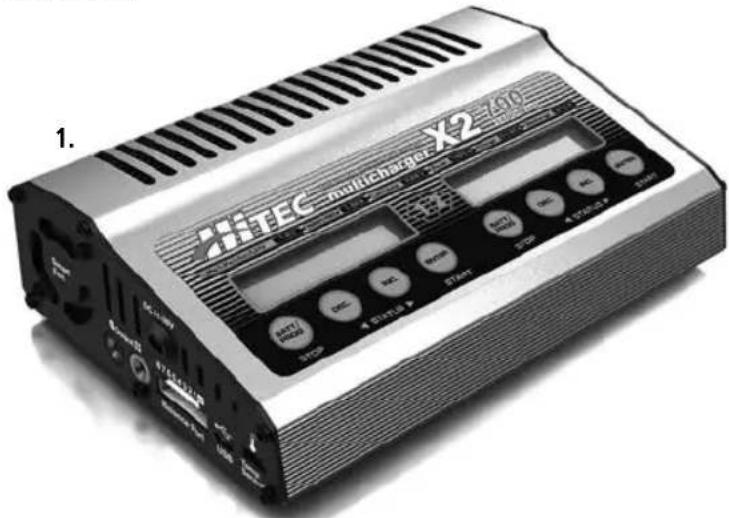
- 1x Multicharger X2 700
- 2x Charger lead XT-60
-
Croco clamps
-
2x Charger lead Uni
- 2x 8S Universal Balancer Board (XH/EH/PQ/HP/FP/MPX)
text_image
1. HITEC multicharge X2 400 INT 3000 DC DC DC START START + 1000Ω + 100Ω + 100Ω + 100Ω + 100Ω + 100Ω + 100Ω + 100Ω + 100Ω + 100Ω + 100Ω + 100Ω + 100Ω + 100Ω + 100Ω + 10G + 10G + 10G + 10G + 10G + 10G + 10G + 10G + 10G + 10G + 10G + 10G + 10G + 10G + 10G + 10G + 10G + 5G + 5G + 5G + 5G + 5G + 5G + 5G + 5G + 5G + 5G + 5G + 5G + 5G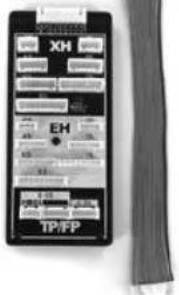
text_image
XH EH TP/FP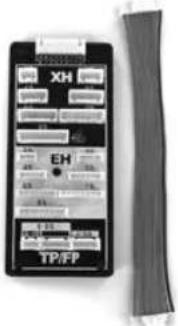
text_image
XH EH TP/FP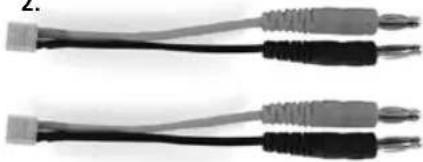
natural_image
Two pairs of connected audio cables with gray and black bands (no text or symbols visible)
natural_image
Black plastic clamp tool with no visible text or symbols
natural_image
Black plastic clamp tool with handle and circular head (no text or symbols visible)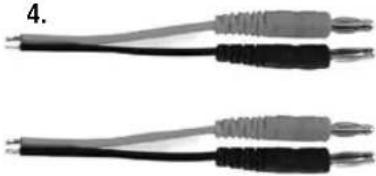
natural_image
Two pairs of black and gray cables with connectors, no text or symbols visible2.1. Specifications
| Power Source 12 Volt Car Battery or | 11-30 Volts DC 60 AMP Power Supply |
| Operating Voltage Range 11-30 Volts DC | |
| Charge Power 700 watts per Channel (1400 watts total) | |
| Charge Current 0.1-30 Amps | |
| Discharger Power 30 watts per channel | |
| Discharge Current 0.1-5.0 Amps | |
| Current Drain for Balancing Lithium 800 mA per Cell | |
| Cell Count 2-8 LiPo/Lilon/LiFe/LiHV cells | 1-20 NiCd/NiMH cells1-12 Lead-Acid cells (2V-24V) |
| Dimensions 8.9"x 6.7"x 2.6" | |
| Net Weight 3.4 lbs. |
2.2. Charger Layout
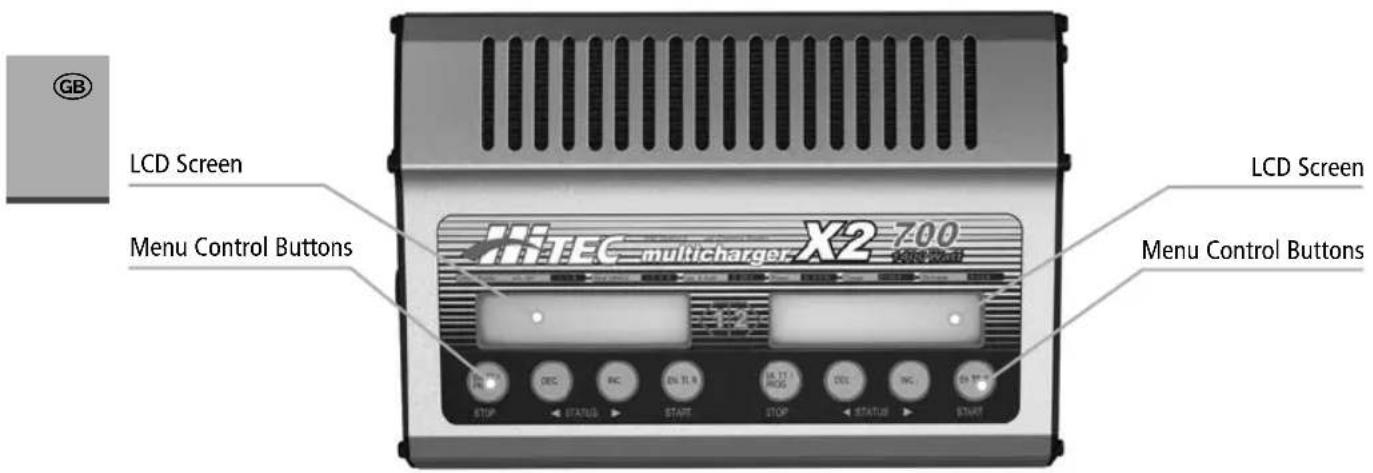
text_image
LCD Screen Menu Control Buttons HiTEC multicharger X2 700 LCD Screen Menu Control Buttons STOP DEC INC EN 11.9 MUT PROG DEL INC EN 8.9 STOP STATUS START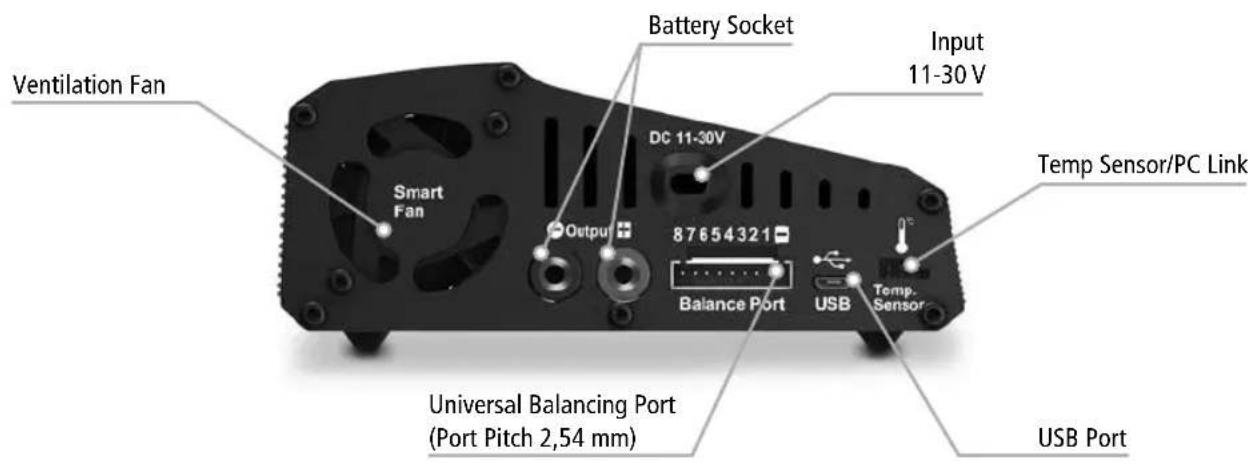
text_image
Ventilation Fan Battery Socket DC 11-30V Input 11-30 V Temp Sensor/PC Link Smart Fan Output 87654321 Balance Port USB Temp. Sensor Universal Balancing Port (Port Pitch 2,54 mm) USB Port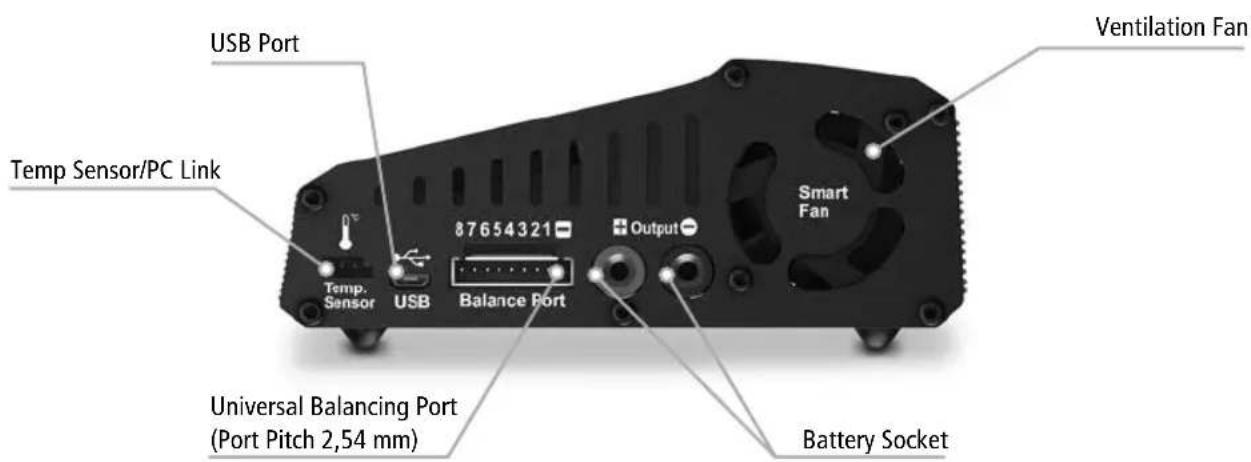
text_image
USB Port Temp Sensor/PC Link 87654321 Output Ventilation Fan Smart Fan Temp. Sensor USB Balance Port Universal Balancing Port (Port Pitch 2,54 mm) Battery Socket2.3. Recommended Accessories
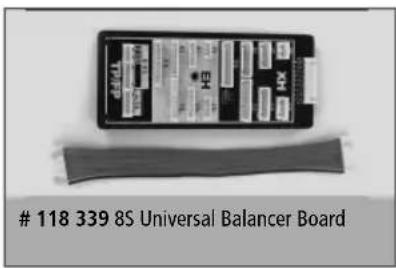
text_image
118 339 8S Universal Balancer Board
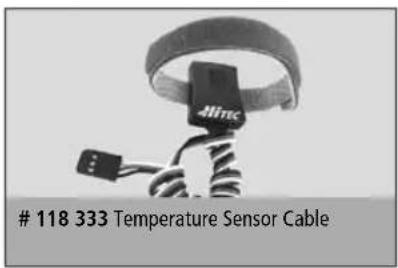
text_image
118 333 Temperature Sensor Cable
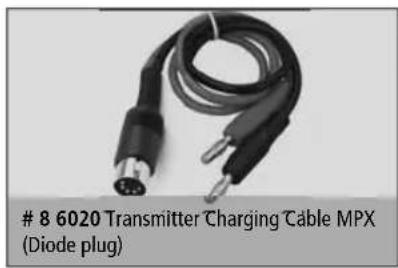
text_image
8 6020 Transmitter Charging Cable MPX
(Diode plug)
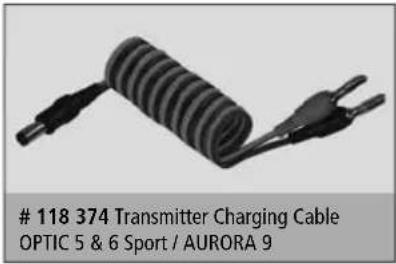
text_image
118 374 Transmitter Charging Cable
OPTIC 5 & 6 Sport / AURORA 9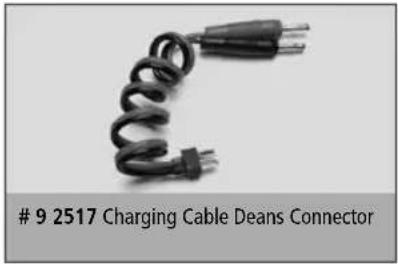
text_image
9 2517 Charging Cable Deans Connector
text_image
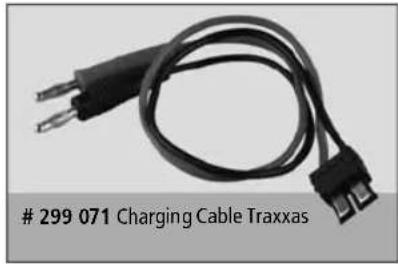
299 071 Charging Cable Traxxas
text_image
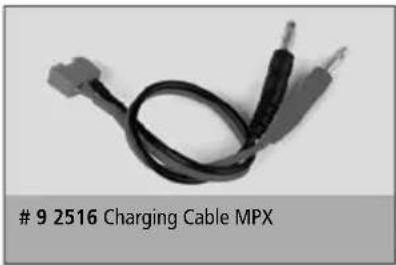
9 2516 Charging Cable MPX
natural_image
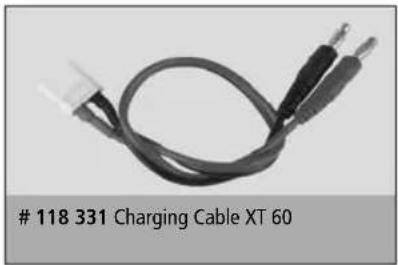
Coiled black cable with two connectors, labeled # 118 331 Charging Cable XT 60 (no other text or symbols visible)3. Special Features
The HiTEC X2-700 allows you to charge up to two different batteries simultaneously. The charger will automatically charge all 2 batteries at a time to their maximum capacity. Additionally the batteries being charged do not need to have the same configuration or the same chemistry. Therefore you can connect any one of a NiMH/NiCd/LiPo/LiFe/LiHV/Lilon battery into any of the charging ports. This eliminates the time consuming efforts of charging all your batteries separately.
Optimized Operating Software
The software in X2-700 automatically controls the current rate during the charging or discharging process. This feature can prevent the user from overcharging their batteries which could lead to damage or injury. If the charger detects a malfunction, the circuit automatically disconnects and an alarm will sound. The operating functions of the X2-700
are controlled through a two-way communication link in order to maintain maximum safety with minimal errors. All of these functions and settings are easily configured by the user.
Internal Independent Lithium Battery Balancers
Each channel of the X2-700 employs an individual-cell voltage balancer eliminating the need for an external balancer for balance charging.
Monitors Individual Cells During Battery Discharging
During the process of discharging, the X2-700 can monitor and display each cell of lithium type batteries individually. If the voltage of any single cell is abnormal, an error message will display and the discharge process will automatically end.
3. Special Features
Charges Most Popular Lithium Batteries
The X2-700 is compatible with the four most common Lithium chemistry batteries, Lilon, LiPo, LiHV and LiFe.
Multiple Lithium Battery Charge Modes
The X2-700's programming allows for Fast Charge, Balance Charge or Storage Charge Modes for LiPo, LiHV, Lilon and LiFe batteries.
Fast Charge Mode: Reduces charging time, but does not balance the cells, this mode only charges the battery to approximately 90% capacity.
Balance Charge Mode: Monitors individual cell voltage, keeping the cells within an acceptable voltage range and charges the pack to peak capacity.
Storage Charge Mode: Used for long-term battery storage. Adjusts the voltage level so the battery will not be damaged during long term storage.
Delta Peak Technology for Maximum Safety
The automatic charge termination program utilizes Delta-Peak voltage detection. When the battery's voltage exceeds the threshold, the charge process is terminated automatically.
Automatic Charging Current Limit
The maximum charge rate can be manually set when charging NiCd or NiMH batteries. The X2-700 will auto-detect when the batteries are fully charged and shut off, even with low impedance NiMH packs.
Capacity and Processing Time Limit
The charging capacity is calculated as the charging current multiplied by time. If the charging capacity exceeds the maximum limit set by the user, the process will terminate automatically. Additionally the user can set the maximum amount of charging time. If the charging time exceeds this limit, the process will terminate automatically.
Temperature Threshold\*
The battery's internal chemical reaction causes the temperature of the battery to rise during the charging process. If the temperature exceeds the limit, the charging process will automatically terminate.
* This function is available by connecting an optional temperature probe, which is not included in our package.
10 User Customizable Presets per Port
Each port of the X2-700 features 10 individually customizable presets so the user can store the charge and discharge parameters for any particular battery type. These presets can be recalled for the desired battery type without the need for any additional programming.
Cyclic Charging/Discharging
Batteries can be set to automatically Charge/Discharge or Discharge/Charge up to a maximum of 5 cycles.
PC Based Analysis Using USB Communication\*
The HiTEC X2-700 offers a PC-based program which can analyze the characteristics of the battery via a USB port. It shows a graph of voltage, current and capacity curves. It also displays the individual voltage of each cell in the lithium battery pack.
* Using optional PC-LINK USB Adapter (sold separately) and software that can be downloaded from wwwMultiplex-rc.de.
Synchronous Mode
When charging two same batteries, both charging channels can be set by channel one.
Battery Internal Resistance Meter
The user can check each cell's internal resistance.
4. Powering the Charger
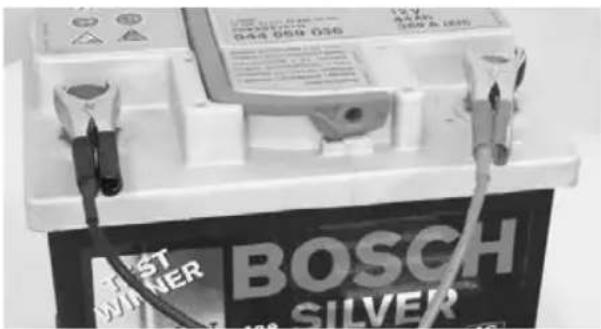
The HiTEC X2-700 charger can also be powered by a 12 V DC car battery using the included large terminal clips with matching 4 mm female bullet connectors or it can be connected directly to a DC power supply.
When connecting to a battery or power supply it is critically important that you use either a fully charged 12 volt car battery or a high quality DC power supply that has a voltage range between 11 to 30 volts DC and a minimum current rating of 60 amps.
text_image
BOSCH SILVER 044 056 056 12V 3.000 359 A 100V

Failure to use proper input power can result in unreliable performance and may damage the charger.
4.1. Connecting the Battery

Before connecting a battery, it is absolutely essential to check that you have set the parameters correctly. If the settings are incorrect, you can damage the battery and create a dangerous situation that could result in serious damage or injury. To avoid creating a short circuit between the banana plugs always connect the charge leads to the charger first, and then to the battery. Reverse the sequence when disconnecting the pack.
4.2. Connecting the Balancer Socket
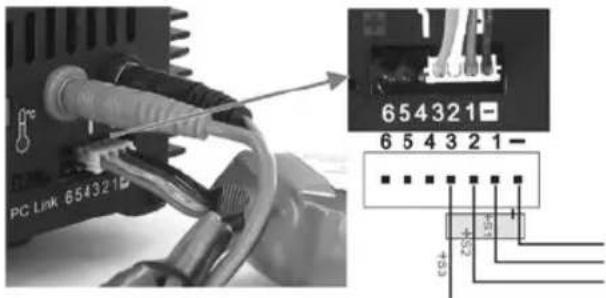
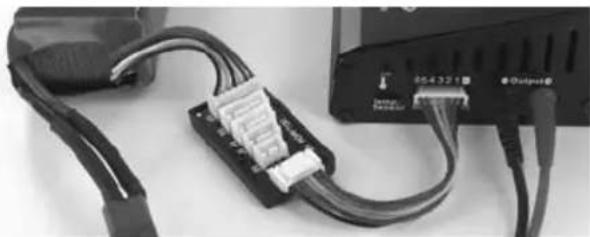
These pictures show the correct way to connect your battery to the HiTEC X2-700 for charging in the balance mode. The balance socket attached to the battery must be connected to the charger with the black wire aligned with the negative marking.
text_image
PC Link 654321 654321 6 5 4 3 2 1 - 25+ 35-
If your battery's balancer socket does not fit in the socket make sure to use the proper adapter board for you battery type.
natural_image
Close-up of a black cable with white connectors and connectors, connected to an electronic device labeled '804321' (no readable text beyond label)5. Program Flow Chart
GB
flowchart
graph TD
    A["PROGRAM SELECT LiPo BATT"] --> B["PROGRAM SELECT LiPo BATT"]
    B --> C["PROGRAM SELECT LiPo BATT"]
    C --> D["PROGRAM SELECT LiPo BATT"]
    D --> E["PROGRAM SELECT LiPo BATT"]
    E --> F["PROGRAM SELECT LiPo BATT"]
    F --> G["PROGRAM SELECT LiPo BATT"]
    G --> H["PROGRAM SELECT LiPo BATT"]
    H --> I["PROGRAM SELECT LiPo BATT"]
    I --> J["PROGRAM SELECT LiPo BATT"]
    J --> K["PROGRAM SELECT LiPo BATT"]
    K --> L["PROGRAM SELECT LiPo BATT"]
    L --> M["PROGRAM SELECT LiPo BATT"]
    M --> N["PROGRAM SELECT LiPo BATT"]
    N --> O["PROGRAM SELECT LiPo BATT"]
    O --> P["PROGRAM SELECT LiPo BATT"]
    P --> Q["PROGRAM SELECT LiPo BATT"]
    Q --> R["PROGRAM SELECT LiPo BATT"]
    R --> S["PROGRAM SELECT LiPo BATT"]
    S --> T["PROGRAM SELECT LiPo BATT"]
    T --> U["PROGRAM SELECT LiPo BATT"]
    U --> V["PROGRAM SELECT LiPo BATT"]
    V --> W["PROGRAM SELECT LiPo BATT"]
    W --> X["PROGRAM SELECT LiPo BATT"]
    X --> Y["PROGRAM SELECT LiPo BATT"]
    Y --> Z["PROGRAM SELECT LiPo BATT"]
    Z --> AA["PROGRAM SELECT LiPo BATT"]
    AA --> AB["PROGRAM SELECT LiPo BATT"]
    AB --> AC["PROGRAM SELECT LiPo BATT"]
    AC --> AD["PROGRAM SELECT LiPo BATT"]
    AD --> AE["PROGRAM SELECT LiPo BATT"]
    AE --> AF["PROGRAM SELECT LiPo BATT"]
    AF --> AG["PROGRAM SELECT LiPo BATT"]
    AG --> AH["PROGRAM SELECT LiPo BATT"]
    AH --> AI["PROGRAM SELECT LiPo BATT"]
    AI --> AJ["PROGRAM SELECT LiPo BATT"]
    AJ --> AK["PROGRAM SELECT LiPo BATT"]
    AK --> AL["PROGRAM SELECT LiPo BATT"]
    AL --> AM["PROGRAM SELECT LiPo BATT"]
    AM --> AN["PROGRAM SELECT LiPo BATT"]
    AN --> AO["PROGRAM SELECT LiPo BATT"]
    AO --> AP["PROGRAM SELECT LiPo BATT"]
    AP --> AQ["PROGRAM SELECT LiPo BATT"]
    AQ --> AR["PROGRAM SELECT LiPo BATT"]
    AR --> AS["PROGRAM SELECT LiPo BATT"]
    AS --> AT["PROGRAM SELECT LiPo BATT"]
    AT --> AU["PROGRAM SELECT LiPo BATT"]
    AU --> AV["PROGRAM SELECT LiPo BATT"]
    AV --> AW["PROGRAM SELECT LiPo BATT"]
    AW --> AX["PROGRAM SELECT LiPo BATT"]
    AX --> AY["PROGRAM SELECT LiPo BATT"]
    AY --> AZ["PROGRAM SELECT LiPo BATT"]
    AZ --> BA["PROGRAM SELECT LiPo BATT"]
    BA --> BB["PROGRAM SELECT LiPo BATT"]
    BB --> BC["PROGRAM SELECT LiPo BATT"]
    BC --> BD["PROGRAM SELECT LiPo BATT"]
    BD --> BE["PROGRAM SELECT LiPo BATT"]
    BE --> BF["PROGRAM SELECT LiPo BATT"]
    BF --> BG["PROGRAM SELECT LiPo BATT"]
    BG --> BH["PROGRAM SELECT LiPo BATT"]
    BH --> BI["PROGRAM SELECT LiPo BATT"]
    BI --> BJ["PROGRAM SELECT LiPo BATT"]
    BJ --> BK["PROGRAM SELECT LiPo BATT"]
    BK --> BL["PROGRAM SELECT LiPo BATT"]
    BL --> BM["PROGRAM SELECT LiPo BATT"]
    BM --> BN["PROGRAM SELECT LiPo BATT"]
    BN --> BO["PROGRAM SELECT LiPo BATT"]
    BO --> BP["BATT/PROGRAM BATT RESISTANCE"]
    BP --> BP1["1: 5mΩ 2: 3mΩ 3: 4mΩ 4: 3mΩ"]
    BP1 --> BP2["5: 4mΩ 6: 3mΩ"]
    BP2 --> BP3["Rest Time CHG>DCHG 10Min"]
    BP3 --> BP4["SAFETY TIMER ON 120Min"]
    BP4 --> BP5["Capacity Cut-Off ON 500mAh"]
    BP5 --> BP6["Key Beep ON Buzzer ON"]
    BP6 --> BP7["Ext. Temp 0C Int. Temp 37C"]
    BP7 --> BP8["VERSION 1.00"]
    BP8 --> BP9["Max Power Set 700W"]
    BP9 --> BP10["LOAD FACTORY SET ENTER"]
    BP10 --> BP11["Synchron Enable? OFF"]
    BP11 --> BP12["Synchron Enable? OFF"]
    BP12 --> BP13["BATT MEMORY [1"] ENTER SET]
    BP13 --> BP14["BATT MEMORY [1"] ENTER SET]
    BP14 --> BP15["BATT MEMORY [1"] ENTER SET]
    BP15 --> BP16["BATT MEMORY [1"] ENTER SET]
    BP16 --> BP17["BATT MEMORY [1"] ENTER SET]
    BP17 --> BP18["BATT MEMORY [1"] ENTER SET]
    BP18 --> BP19["BATT MEMORY [1"] ENTER SET]
    BP19 --> BP20["BATT MEMORY [1"] ENTER SET]
    BP20 --> BP21["BATT MEMORY [1"] ENTER SET]
    BP21 --> BP22["BATT MEMORY [1"] ENTER SET]
    BP22 --> BP23["BATT MEMORY [1"] ENTER SET]
    BP23 --> BP24["BATT MEMORY [1"] ENTER SET]
    BP24 --> BP25["BATT MEMORY [1"] ENTER SET]
    BP25 --> BP26["BATT MEMORY [1"] ENTER SET]
    BP26 --> BP27["BATT MEMORY [1"] ENTER SET]
    BP27 --> BP28["BATT MEMORY [1"] ENTER SET]
    BP28 --> BP29["BATT MEMORY [1"] ENTER SET]
    BP29 --> BP30["BATT MEMORY [1"] ENTER SET]
    BP30 --> BP31["BATT MEMORY [1"] ENTER SET]
    BP31 --> BP32["BATT MEMORY [1"] ENTER SET]
    BP32 --> BP33["BATT MEMORY [1"] ENTER SET]
    BP33 --> BP34["BATT MEMORY [1"] ENTER SET]
    BP34 --> BP35["BATT MEMORY [1"] ENTER SET]
    BP35 --> BP36["BATT MEMORY [1"] ENTER SET]
    BP36 --> BP37["BATT MEMORY [1"] ENTER SET]
    BP37 --> BP38["BATT MEMORY [1"] ENTER SET]
    BP38 --> BP39["BATT MEMORY [1"] ENTER SET]
    BP39 --> BP40["BATT MEMORY [1"] ENTER SET]
    BP40 --> BP41["BATT MEMORY [1"] ENTER SET]
    BP41 --> BP42["BATT MEMORY [1"] ENTER SET]
    BP42 --> BP43["BATT MEMORY [1"] ENTER SET]
    BP43 --> BP44["BATT MEMORY [1"] ENTER SET]
    BP44 --> BP45["BATT MEMORY [1"] ENTER SET]
    BP45 --> BP46["BATT MEMORY [1"] ENTER SET]
    BP46 --> BP47["BATT MEMORY [1"] ENTER SET]
    BP47 --> BP48["BATT MEMORY [1"] ENTER SET]
    BP48 --> BP49["BATT MEMORY [1"] ENTER SET]
    BP49 --> BP50["BATT MEMORY [1"] ENTER SET]
    BP50 --> BP51["BATT MEMORY [1"] ENTER SET]
    BP51 --> BP52["BATT MEMORY [1"] ENTER SET]
    BP52 --> BP53["BATT MEMORY [1"] ENTER SET]
    BP53 --> BP54["BATT MEMORY [1"] ENTER SET]
    BP54 --> BP55["BATT MEMORY [1"] ENTER SET]
    BP55 --> BP56["BATT MEMORY [1"] ENTER SET]
    BP56 --> BP57["BATT MEMORY [1"] ENTER SET]
    BP57 --> BP58["BATT MEMORY [1"] ENTER SET]
    BP58 --> BP59["BATT MEMORY [1"] ENTER SET]
    BP59 --> BP60["BATT MEMORY [1"] ENTER SET]
    BP60 --> BP61["BATT MEMORY [1"] ENTER SET]
    BP61 --> BP62["BATT MEMORY [1"] ENTER SET]
    BP62 --> BP63["BATT MEMORY [1"] ENTER SET]
    BP63 --> BP64["BATT MEMORY [1"] ENTER SET]
    BP64 --> BP65["BATT MEMORY [1"] ENTER SET]
    BP65 --> BP66["BATT MEMORY [1"] ENTER SET]
    BP66 --> BP67["BATT MEMORY [1"] ENTER SET]
    BP67 --> BP68["BATT MEMORY [1"] ENTER SET]
    BP68 --> BP69["BATT MEMORY [1"] ENTER SET]
    BP69 --> BP70["BATT MEMORY [1"] ENTER SET]
    NPB(BATH MEMORY) & NPB(BATH SUMMARY) & NPB(BATH SUMMARY) & NPB(BATH SUMMARY) & NPB(BATH SUMMARY) & NPB(BATH SUMMARY) & NPB(BATH SUMMARY) & NPB(BATH SUMMARY) & NPB(BATH SUMMARY) & NPB(BATH SUMMARY) & NPB(BATH SUMMARY) & NPB(BATH SUMMARY) & NPB(BATH SUMMARY) & NPB(BATH SUMMARY) & NPB(BATH SUMMARY) & NPB(BATH SUMMARY) / NPB(BATH SUMMARY) / NPB(BATH SUMMARY) / NPB(BATH SUMMARY) / NPB(BATH SUMMARY) / NPB(BATH SUMMARY) / NPB(BATH SUMMARY) / NPB(BATH SUMMARY) / NPB(BATH SUMMARY) / NPB(BATH SUMMARY) / NPB(BATH SUMMARY) / NPB(BATH SUMMARY) / NPB(BATH SUMMARY) / NPB(BATH SUMMARY) / NPB(BATH SUMMARY) / NPNIMH_BATTT
6. Default User Preferences Setup
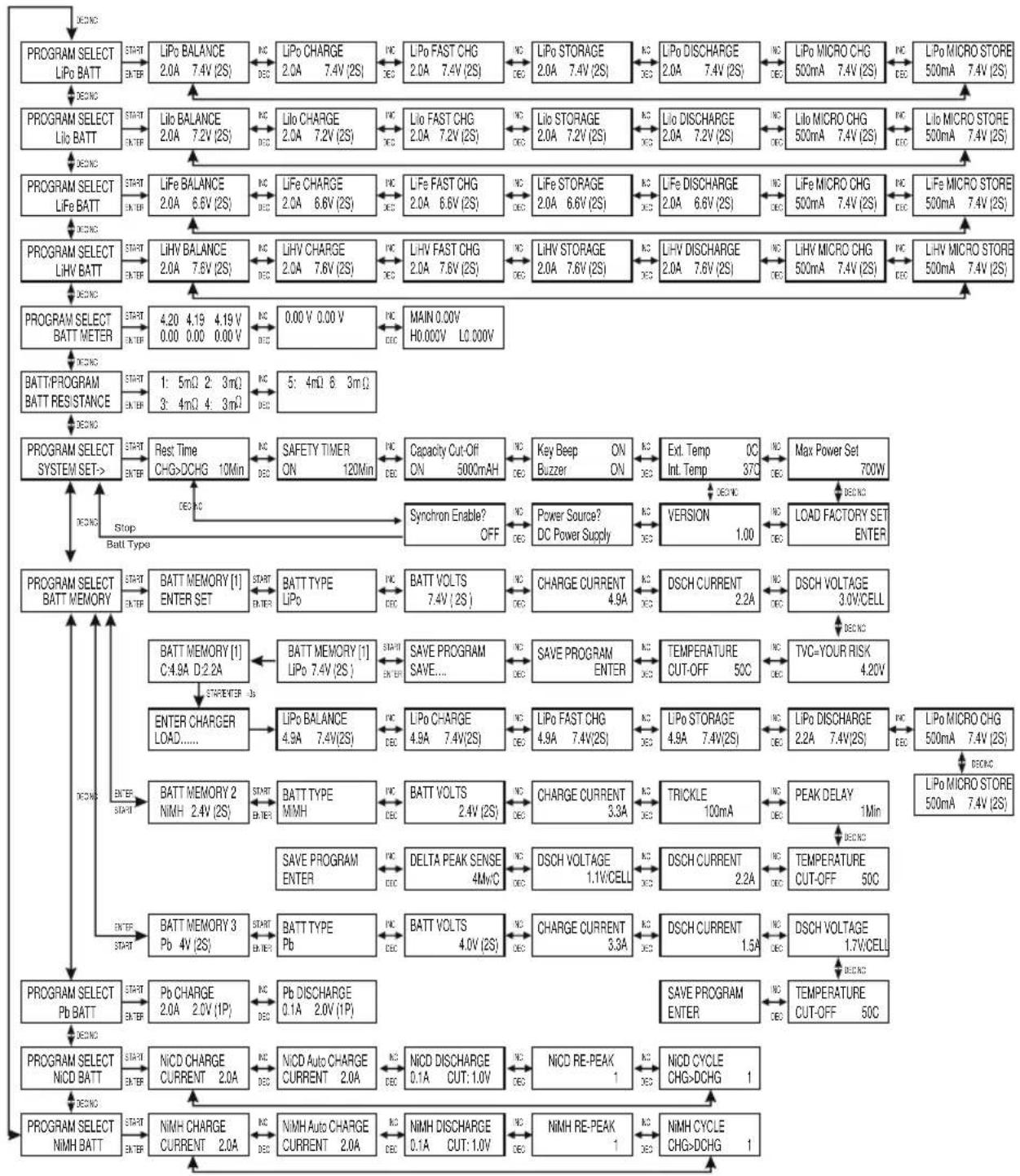
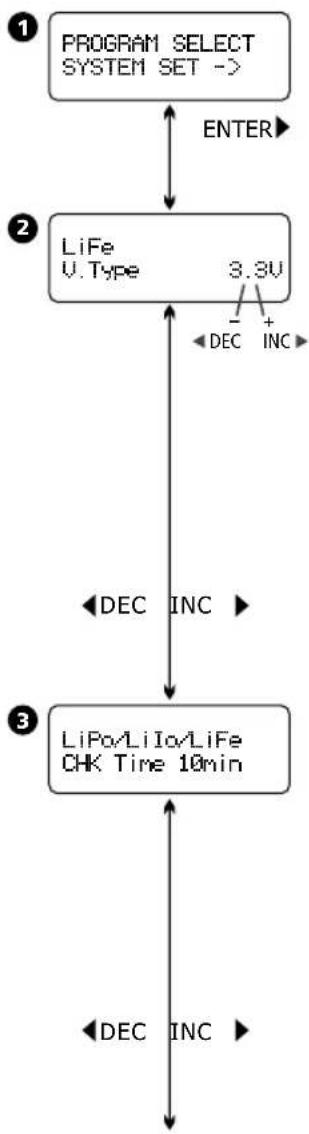
When powered on for the first time the X2-700 will load a set of default parameters most commonly used by most users. The screen displays the information in the following sequence. The user can customize the parameters on each screen to suit their own preferences.
To change the parameter values in the program, press the „START/ENTER“ key to choose the parameter you want to change. Once the parameter is blinking you can change the value with the „INC“ (up/forward) or „DEC“ (down/back) keys. The value will be stored by pressing the „START/ENTER“ key once and the blinking stops.

Warning! Do not connect a battery to the charger before setting up the default user preferences.
flowchart
graph TD
    A["PROGRAM SELECT SYSTEM SET ->"] --> B["LiFe U. Type 3.3V"]
    B --> C["LiPo/LiIo/LiFe CHK Time 10min"]
    C --> D["DEC INC"]
    D --> E["DEC INC"]
    E --> F["ENTER"]
1 Main User Setup Screen
The first screen displayed is the Lithium battery set-up screen, you can press „ENTER“ to bypass this screen and go to the next user setup screen, or you can set the default Lithium battery type before moving on.
② The Lithium Battery Select Screen
Here you can choose one of the four kinds of Lithium batteries supported by the X4 AC Plus, LiFe (3.3 V), Lilon (3.6 V), LiPo (3.7 V) or LiHV (3.8 V). If you plan to use one type of Lithium chemistry battery you can set the default here.

Warning! Make sure when you connect your battery that you have selected the proper type of battery before you begin charging your battery. Once you have established the desired settings press „START/ENTER“ to confirm the setting then press „INC“ to move on to the next parameter.
3 LiPo/Lilon/LiFe/LiHV Check Time
To avoid an erroneous setting by the user the X4 AC Plus will automatically detect the cell count of a Lithium battery at the beginning of the charge or discharge process. To prevent an overdischarged battery from being detected incorrectly, resulting in an error, you can set a time limit for the processor to verify the cell count. The default setting is 10 minutes which is typically enough time to properly detect the cell count. It is not recommended that you change this setting as setting to long of a "Check Time" can produce dangerous results. Once you have established the desired settings press „START/ENTER“ to confirm the setting then press „INC“ to move on to the next parameter.
6. Default User Preferences Setup
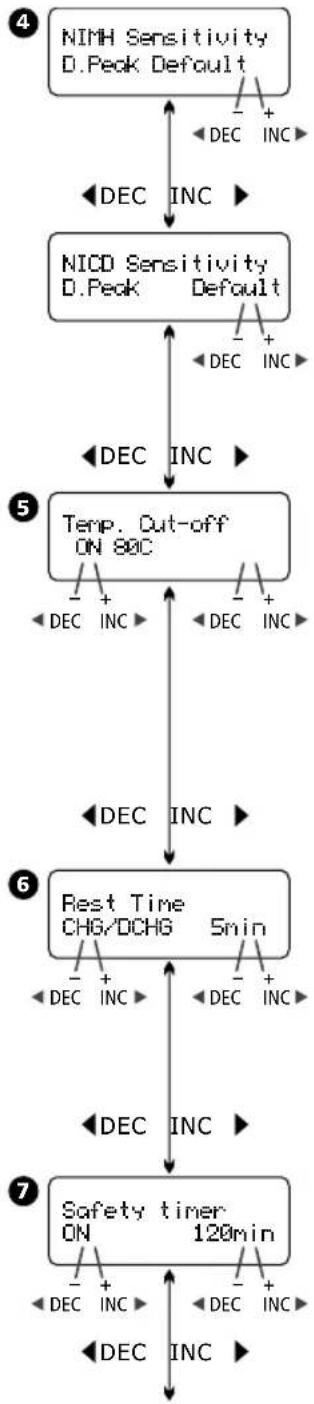
flowchart
graph TD
    A["NIMH Sensitivity D.Peak Default"] -->|DEC INC| B["NICD Sensitivity D.Peak Default"]
    B -->|DEC INC| C["Temp. Cut-off ON 80C"]
    C -->|DEC INC| D["Rest Time CHG/DCHG 5min"]
    D -->|DEC INC| E["Safety timer ON 120min"]
    E -->|DEC INC| F["End"]
4 NiMH and NiCd Delta Peak Sensitivity Setting
This feature sets the cutoff voltage for the automatic charge termination of a NiMH and NiCd battery pack. The setting can range from 3 to 15 mV per cell, the default is 4 mV for NiCd and NiMH, the parameters are set individually for NiCd and NiMH batteries. If the cutoff voltage is too high, there is a danger of overcharging the battery, if it is too low there is a possibility of premature charge termination. Refer to the battery manufacturer's specifications to determine the proper setting. Once you have established the desired settings press „START/ENTER“ to confirm the setting then press „INC“ to move on to the next parameter.
5 Temperature Cutoff Setting
You can choose whether or not you want to use the automatic temperature cut off when using the optional temperature sensors. When turned on you can set the maximum temperature at which the charger should allow the battery to reach during charging. Once a battery reaches this temperature, the charge or discharge process will be terminated to protect the battery. Once you have established the desired settings press „START/ENTER“ to confirm the setting then press „INC“ to move on to the next parameter.
6 Waste Time Setting
When charge/discharge cycling a battery the battery will become warm. You can set a time delay ranging from 0 to 60 minutes after each charge/discharge process to allow the battery to cool down before starting the next charge/discharge cycle. Once you have established the desired settings press „START/ENTER“ to confirm the setting then press „INC“ to move on to the next parameter.
7 Safety Timer Setting
When the charge process starts, the integrated safety timer runs simultaneously. If an error occurs or the charge termination circuit cannot detect if the battery is fully charged, this setting will terminate the charge process to prevent overcharging. Use the following Safety Timer Calculation to determine the proper setting.
Safety Timer Setting Calculation
To determine the correct safety time setting when charging NiCd or NiMH batteries, divide the capacity by the current, and then divide the result by 11.9.
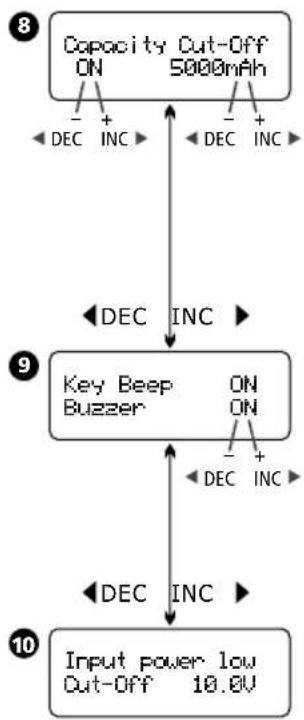
flowchart
graph TD
    A["Capacity Cut-Off ON 5000mAh"] -->|DEC INC| B["Key Beep Buzzer ON ON"]
    A -->|-| C["Input power low Out-Off 10.0V"]
    B -->|DEC INC| D["Output Power Low"]
    style A fill:#f9f,stroke:#333
    style B fill:#ccf,stroke:#333
    style C fill:#cfc,stroke:#333
    style D fill:#fcc,stroke:#333
Set the results of this calculation as the number of minutes for the safety timer setting. If the charger stops at this time threshold, about 140% of the capacity will have been fed into the battery.
Example:
2000 mAh 2.0 A (2000/2.0=1000)/11.9 = 84 minutes.
8 Capacity Cutoff Setting
The charging software allows the user to create a maximum charge capacity protection setting. If the delta-peak voltage is not properly detected or the safety timer times out, the charge process will stop automatically when the battery reaches the set maximum charge capacity set by the user. Once you have established the desired settings press „START/ENTER“ to confirm the setting then press „INC“ to move on to the next parameter.
9 Sound Settings (Key and Buzzer Mute)
A beep sounds to confi rm the every time the user presses a button, additionally a sound is emitted during the operation of the charger to confi rm a different mode change. These functions can be switched on or off. Once you have established the desired settings press „START/ENTER“ to confi rm the setting then press „INC“ to move on to the next parameter.
10 Low Input Voltage Setting
This function monitors the input voltage of the DC power source used to power the charger. If the voltage is lower than the user setting, the program will end forcibly to protect the input source. Once you have established the desired settings press „START/ENTER“ to confirm the setting. You have now set the initial user settings. You can repeat this procedure for the other Channels.
7. Charging Lithium Chemistry Type Batteries
GB
This program is only suitable for charging or discharging Lithium chemistry batteries. The X2-700 was designed to only charge four kinds of Lithium batteries: LiFe, Lilon, LiPo and LiHV. It is very important that you determine the type of battery you are charging and set the charging parameters correctly.
It is important that the nominal voltage, fi nal voltage and battery capacity be properly set for desired operation. Please refer to the following information regarding the different types of Lithium chemistry batteries.
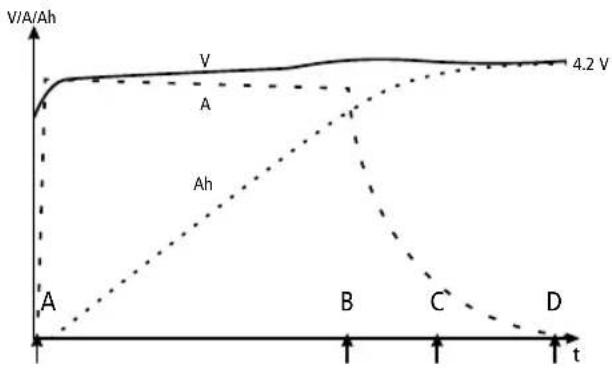
A Lithium-Polymer battery is charged at a constant current until it reaches the fi nal charge voltage of 4.2 V per cell (B). After this point the voltage is kept at a constant level, and the residual charge takes the form of a declining current curve (C) until the cut-off point (D) is reached. Charge current = C/10. At this point you can disconnect the battery from the charger, as it is ready for use.
The final voltage of charge process is also very important; it should be precisely matched with the charged voltage of the battery. They are 4.35 V for LiHV, 4.2 V for LiPo, 4.1 V for Lilon and 3.6 V for LiFe.
The charge current and the nominal voltage for the cell count on the charge program must always be set correctly for the battery that is being charged. Refer to the chart on page 30 for standard lithium battery parameters.
line
| t | V | A | Ah | | ---- | ----- | ----- | ----- | | 0 | 0 | 0 | 0 | | A | 4.2 | 4.2 | 0 | | B | 4.2 | 4.2 | 0 | | C | 4.2 | 4.2 | 0 | | D | 4.2 | 4.2 | 0 |
When you want to change the settings, press the „START/ENTER“ key to make it blink, then use the „DEC“ or „INC“ key to change the setting. Then press the „START/ENTER“ key again to store the setting.
flowchart
graph TD
    A["LiPo 2.0A"] -->|+/-| B["Battery type stop"]
    C["CHARGE 11.1V(3S)"] -->|+/-| D["Battery type stop"]
    E["R: 3SER CONFIRM(ENTER)"] -->|Start Enter >3 seconds| D
    F["Li3s 1.2A 12.59U CHS 022: 48 00682"] -->|Start Enter| G["Battery Voltage"]
    H["Number of Cells"] --> F
    I["Charging Time"] --> F
    J["Charging Current"] --> F
    K["Charged Capacity"] --> F
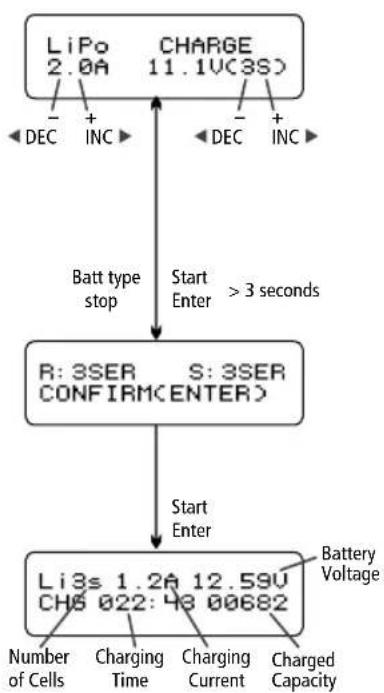
Charging Lithium Battery in the Charge Mode
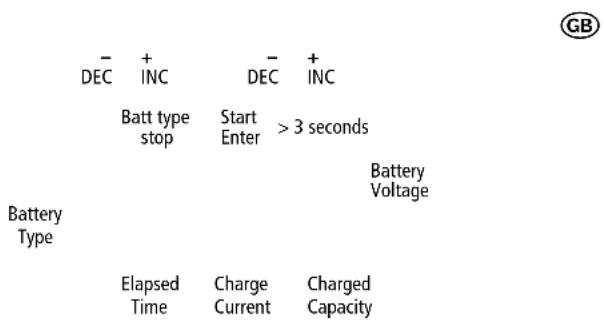
These methods for charging LiPo/LiHV/Lilon/LiFe batteries without a balance lead. The first line on the left side of this screen shows the type of battery chosen. The second line shows the user set current on the left and the user set voltage on the rights. After setting the current and voltage, press the „START/ENTER“ key for more than 3 seconds to start the process.
The next display shows the number of cells you set up as „R“ and the number of cells the processor detects as „S“. If both numbers are identical, you can start charging by pressing the „START/ENTER“ button. If not, press the „BATT TYPE/STOP“ button to go back to the previous screen to carefully check the number of cells of the battery pack before proceeding.
This next screen shows the real-time status during the charge process. Press the „BATT TYPE/STOP“ key once to stop the charge process.
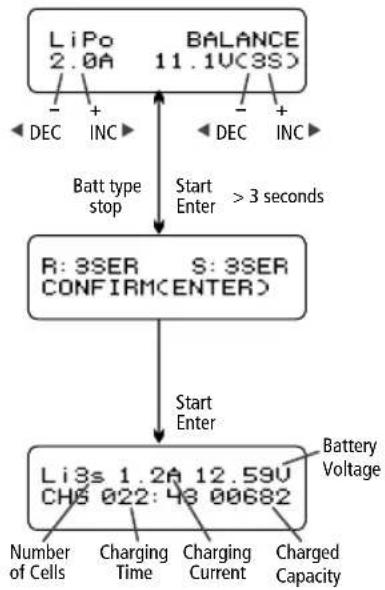
Charging Lithium Battery in Balance Mode
This function is for balancing the voltage of Lithium-polymer battery cells individually while charging. In the balance mode, the battery needs to have a balance lead to connect to the balance port at the right side of the charger and the battery's power leads to the output of the charger.
flowchart
graph TD
    A["LiPo 2.0A"] -->|Batt type stop| B["R: 3SER CONFIRM(ENTER)"]
    C["BALANCE 11.1V(3S)"] -->|Start Enter >3 seconds| B
    D["Li3s 1.2A 12.59U CHS 022:43 00682"] -->|Start Enter| B
    B --> E["Battery Voltage"]
    style A fill:#f9f,stroke:#333
    style C fill:#f9f,stroke:#333
    style D fill:#f9f,stroke:#333
    style B fill:#ccf,stroke:#333
    style E fill:#cff,stroke:#333
Charging in this mode is different from the normal modes because the built-in processor monitors the voltage of each individual cell and controls the input current fed into each cell in order to equalize the voltage.
The first line on the left side of this screen shows the type of battery chosen. The second line shows the user set current on the left and the user set voltage on the right. After setting the current and voltage, press the „START/ENTER“ key for more than 3 seconds to start the process.
The next display shows the number of cells you set up as „R“ and the number of cells the processor detects as „S“. If both numbers are identical, you can start charging by pressing the „START/ENTER“ button. If not, press the „BATT TYPE/STOP“ button to go back to the previous screen to carefully check the number of cells of the battery pack before proceeding.
This next screen shows the real-time status during the charge process. Press the „BATT TYPE/STOP“ key once to stop the charge process.
flowchart
graph TD
    A["LiPo 2.0A"] -->|+| B["FAST CHG 11.1V(3S)"]
    B -->|+| C["Dec"]
    B -->|-| D["Batt type stop"]
    C -->|+| E["DEC"]
    D -->|Start Enter >3 seconds| F["R: 3SER CONFIRM(ENTER)"]
    E --> F
    F -->|Start Enter| G["Li3s 1.2A 12.59U CHS 022: 48 00682"]
    G --> H["Number of Cells"]
    G --> I["Charging Time"]
    G --> J["Charging Current"]
    G --> K["Charged Capacity"]
    L["Battery Voltage"] --> G
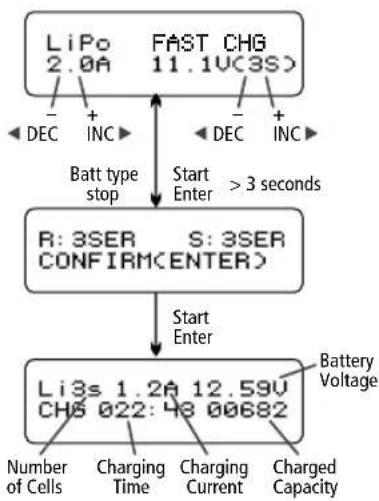
When charging lithium chemistry batteries in the fast charge mode the charging current will become lower towards the end of the charge cycle. In fast mode the charging capacity is slightly lower than in normal charge mode, but charging time is reduced.
Charging Lithium Batteries in Fast Mode
The first line on the left side of this screen shows the type of battery chosen. The second line shows the user set current on the left and the user set voltage on the rights. After setting the current and voltage, press the „START/ENTER“ key for more than 3 seconds to start the process.
The next display shows the number of cells you set up as "R" and the number of cells the processor detects as "S". If both numbers are identical, you can start charging by pressing the „START/ENTER" button. If not, press the „BATT TYPE/STOP" button to go back to the previous screen to carefully check the number of cells of the battery pack before proceeding.
This next screen shows the real-time status during the charge process. Press the „BATT TYPE/STOP“ key once to stop the charge process.
7. Charging Lithium Chemistry Type Batteries

During the discharge process the X2-700's microprocessor monitors the voltage of each cell during the Storage Mode or Discharge process. If the voltage of any cell is abnormal, the charger will display an error message and immediately terminate the program. Before disconnecting the battery review the error message then press the „INC“ button to display which cell is.
flowchart
graph TD
    A["LiPo 1.0A STORAGE 11.1V(3S)"] -->|Batt type stop| B["Battery Voltage"]
    C["Li3S 1.0A 12.59V STO 022:48 00682"] -->|Start Enter >3 seconds| B
    D["Number of Cells"] --> B
    E["Elapsed Time"] --> B
    F["Charge or Discharge Current"] --> B
    G["Supplied Capacity"] --> B
    H["DEC"] --> A
    I["INC"] --> A
    J["DEC"] --> C
    K["INC"] --> C
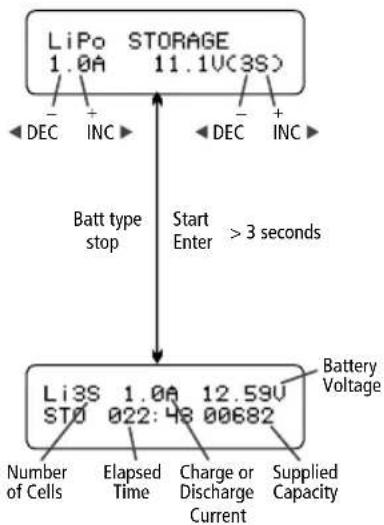
Charging Lithium Batteries in the Storage Mode
The Storage Mode function is for charging/discharging batteries that will not be used immediately or that will be stored for a period of time. The program is designed for charging or discharging batteries to a specific voltage level depending on the type of battery (Lilon = 3.75 V, LiPo = 3.85 V, LiHV = 3.4 V and LiFe = 3.3 V). The program will begin to discharge if the original state of the battery exceeds the voltage level for storage.
On the first screen, you can set up the current and voltage of the battery pack. Charging and discharging will bring the batteries to the storage level.
The next screen shows the real-time status of the charge or discharge process. Press the „BATT TYPE/STOP“ key once to stop the charging process.
7.1. Discharging Lithium Chemistry Type Batteries

Warning! Lithium batteries cannot be discharged to a voltage lower than the minimum voltage for the cell type. Doing so will result in a rapid loss of capacity and/or total failure. While the X2-700 monitors each individual cell during the discharge process the discharging cutoff is based on the total pack voltage therefore it is important to watch the discharge process closely to make sure a cell does not fall below the minimum voltage. Generally, lithium batteries don't need to be discharged and it is not recommended that you discharge them. If you do choose to discharge your lithium batteries it is recommended that you cycle them using the Storage Mode charging to cycle the batteries.
flowchart
graph TD
    A["LiPo 10A"] -->|+| B["DISCHARGE 11.1V(3S)"]
    B -->|+| C["Li3S 0.4A 12.59V DSC 022:43 00682"]
    C -->|Start Enter| B
    C -->|>3 seconds| D["Battery Voltage"]
    D --> E["Discharge Current"]
    D --> F["Discharged Capacity"]
    G["Number of Cells"] --> C
    H["Elapsed Time"] --> C
    I["DEC"] --> B
    J["INC"] --> B
    K["Start"] --> B
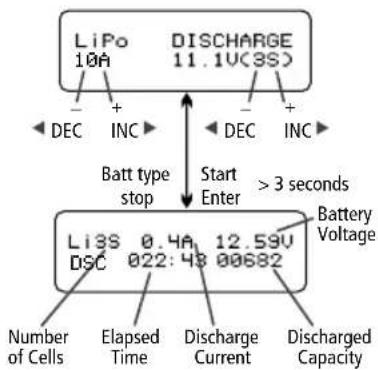
The setting of the discharge current on the left cannot exceed 1C, and the setting on the right cannot be under the voltage recommended by the manufacturer to avoid deep discharging. Press the „START/ENTER“ key for more than 3 seconds to start discharging.
This shows the real-time status of discharging; you can press the „BATT TYPE/STOP“ key to stop discharging.
7.2. Error Message Display
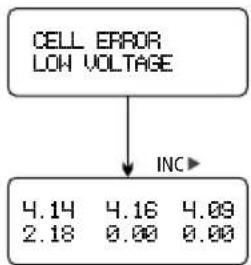
The first screen shows that the processor detected the voltage of one on the cells is too low.
The second screen shows the 4th cell was damaged. If the cell is disconnected or not present the reading of the voltage will be zero.
flowchart
graph TD
    A["CELL ERROR LOW VOLTAGE"] --> B["INC"]
    B --> C["4.14 4.16 4.09\n2.18 0.00 0.00"]
GB
8. Charging NiCd or NiMH Batteries
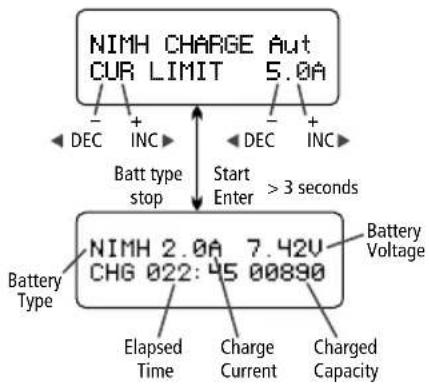
There are two methods of charging NiCd and NiMH batteries: Manual or Auto Mode. When in the NiMH or NiCd Program Select screen you can change modes by pressing the „START/ENTER“ key until the current fi eld begins fl ashing then press „INC“ and „DEC“ simultaneously to switch between Auto and Manual Mode using the charge current you set up. In the „auto mode“, you should set the upper limit of the charge current to avoid damage caused by excessive charge current. This is especially important for low quality batteries that have low resistance and capacity. In the „manual mode“ the charger will only charge at the current you set.
This program is for charging NiCd/NiMH batteries typically used in an R/C model application. Press the „START/ENTER“ key until the parameter you want to change begins to blink then use the „INC“ or „DEC“ keys to change the value. Press the „START/ENTER“ key to store the setting.
This screen shows the real-time status of charging. You can press the „BATT TYPE/STOP“ key to stop the charge process.
Note the following charger/discharge specifications for NiCd and NiMH Batteries:
• Nominal Voltage Level: 1.2 V per cell
- Allowable Fast Charge Current: 1C-2C (depends on performance of cell)
• Discharge Voltage Cut Off Level NiCd: 0.85 V per cell
• Discharge Voltage Cut Off Level NiMH: 1.0 V per cell
text_image
NIMH CHARGE Aut CUR LIMIT 5.0A ← DEC + ← DEC + Batt type stop Start >3 seconds Enter > NIMH 2.0A 7.42V CHG 022: 45 00890 Battery Voltage Battery Type Elapsed Time Charge Current Charged Capacity8.1. Discharging NiCd or NiMH Batteries
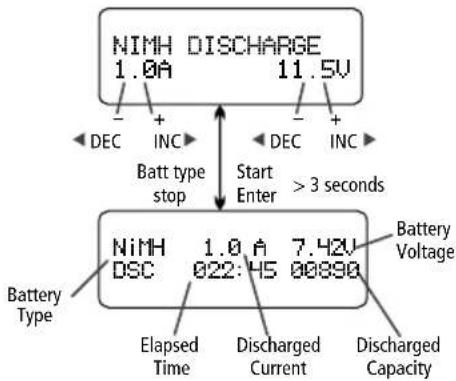
Set the discharge current on the left and the voltage cutoff on the right by pressing the „START/ENTER“ key for more than 3 seconds to start the program. Discharge current can be set from 0.1-5.0 A and voltage cutoff from 0.1-25.0 V.
This screen indicates the discharging state. You can press the „START/ENTER“ key to alter the discharge current. Press the „START/ENTER“ key again to store the setting. Press the „BATT TYPE/STOP“ key to stop discharging. The charger will emit a sound to indicate the end of the discharge process.
flowchart
graph TD
    A["NIMH DISCHARGE 1.0A 11.5V"] -->|Δ DEC +| B["Batt type stop"]
    A -->|Δ INC +| C["Start Enter >3 seconds"]
    A -->|Δ INC -| D["Battery Voltage"]
    E["NiMH DSC 1.0A 7.42V 022:45 00890"] --> F["Battery Type"]
    G["Elapsed Time"] --> H["Discharged Current"]
    I["Discharged Capacity"] --> J["Discharged Capacity"]
8.2. Charge/Discharge Cycling of NiCd/NiMH Batteries
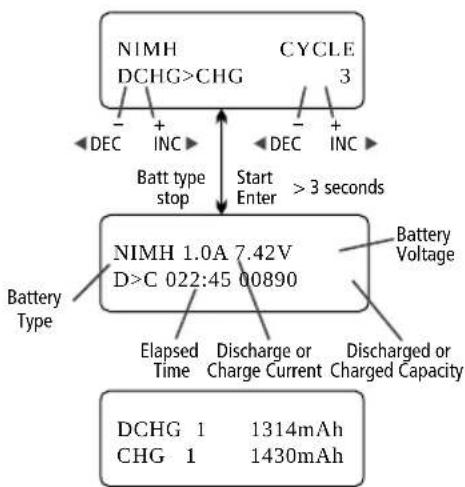
Set the cycle sequence on the left and the number of cycles on the right. The battery can be cycled 1-5 times.
Press the „BATT TYPE/STOP“ key to stop the program then press the „START/ENTER“ key to alter the charge or discharge current. A sound will indicate the end of the program.
When the charger approaches the end of the program cycle, you can view the capacity of the battery being charged or discharged. Use the „INC“ or „DEC“ keys to scroll through the results of each cycle.
flowchart
graph TD
    A["NIMH 1.0A 7.42V D>C 022:45 00890"] --> B["Battery Type"]
    A --> C["Battery Voltage"]
    A --> D["Discharged or Charged Capacity"]
    A --> E["DCHG 1 1314mAh CHG 1 1430mAh"]
    A --> F["Start Enter >3 seconds"]
    A --> G["Batt type stop"]
    G --> H["DEC + INC"]
    G --> I["DEC + INC"]
    A --> J["CYCLE 3"]
9. Charging/Discharging Lead-Acid (Pb) Batteries
This program is only suitable for charging a lead-acid (PB) type battery with a nominal voltage range of 2 to 24 volts. Lead acid (Pb) batteries can only deliver current lower in comparison to their capacity. The same restriction applies to the charging process. Consequently, the optimum charge current for lead acid (Pb) batteries is only 1/10 of its rated capacity. You cannot fast charge lead acid (Pb) batteries. Please refer to the following specification regarding charging and discharging lead acid (Pb) batteries.
• Nominal Voltage Level: 2.0 V per cell
• Maximum Charge Voltage: 2.46 V per cell
- Allowable Charge Current: 0.4 C or less
• Discharge Voltage Cut Off Level: 1.75 V or higher per cell

Due to the chemistry characteristic of a Pb battery, the cut-off point may be difficult to detect at times. We recommend you use the CAPACITY CUT-OFF feature to protect the battery. Refer to the Default User Preferences Setup section of this manual to set up this feature.
Professional Balance Charger, Discharger
9.1. Charging Lead Acid (Pb) Batteries
Set the charge current on the left and the nominal voltage on the right. Charge current can be set from 0.1-6.0 A. The voltage must match the battery being charged. Press the „START/ENTER“ key for more than 3 seconds to start charging.
The screen will display the real-time charging status. Press the „START/ENTER“ key to alter the charge current. Press the „START/ENTER“ key again to store the parameter settings you set. Press the „BATT TYPE/STOP“ key to end the program.
9.2. Discharging Lead Acid (Pb) Batteries
Set up the discharge current on the left and the nominal voltage on the right. The discharge current can be set from 0.1-5.0 A. The voltage should match the battery being charged. Press the „START/ENTER“ key for more than 3 seconds to start discharging.
The screen displays the real-time discharging status. Press the „START/ENTER“ key to alter the discharge current. Press the „START/ENTER“ key again to store the parameter value you set. Press the „BATT TYPE/STOP“ key to end the program.
10. Synchronous Mode
When charging two same batteries, both charging channels can be set by channel one. ON/OFF Process:
Press „INC/DEC“ to choose.
Press „START“ to enter the System Setting, then press „INC/DEC“ to choose.
Press „START“, ON/OFF will blink, Then press „INC/DEC“ to choose ON or OFF. Press „START“ again to confi rm. Press „STOP“ to exit program setting, Press „INC/DEC“ to choose the battery type, both channels will be charging at the same time with same charging info.
Hochleistungs Profi Balance LADER / ENTLADER
text_image
- + - + DEC INC DEC INC Batt type Start > 3 seconds stop Enter Battery Battery Voltage Battery Type Elapsed Charge Charged Time Current Capacity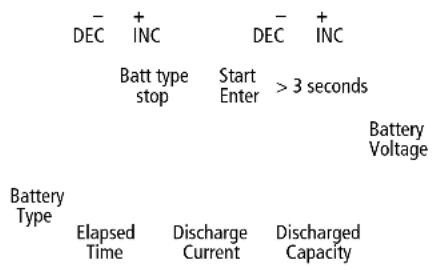
text_image
- + - + DEC INC DEC INC Batt type Start > 3 seconds stop Enter Battery Battery Voltage Battery Type Elapsed Discharge Discharged Time Current CapacityPROGRAM SELECT SYSTEM SETUP
Synchron enable? ON/OFF
11. Battery Resistance Meter
GB
flowchart
graph TD
    A["BATT/PROGRAM BATT RESISTANCE"] -->|Start Enter| B["1: 5mΩ 2: 4mΩ\n3: 3mΩ 4: 4mΩ"]
    B -->|INC▶| C["5: 3mΩ 6: 4mΩ"]
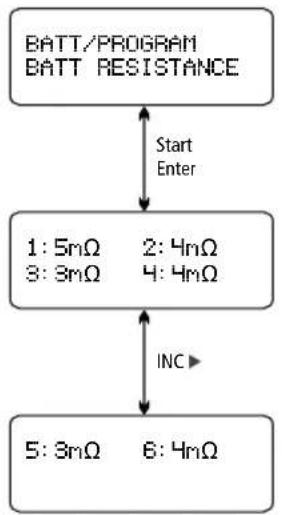
The user can check each cell's resistance. Please connect the battery to the charger main battery lead to battery socket and balance wires to balance socket.
Press the „START/ENTER“ to enter the Lithium Battery Resistance program.
The screen indicate each cell's resistance.
12. Battery Storage
For your convenience, the X2-700 has a data storage and load program that can store up to ten preset battery charge or discharge confi gurations per channel. You can recall these settings when charging or discharging without having to setup the program again.
To get to the save data screen press the „BATT. TYPE/STOP" button until you see the Save Data screen. Press the „START/ENTER" key to modify the menu, and use the „INC" or „DEC" to change the parameters.
13. Save Data Program
flowchart
graph TD
    A["[ BATT MEMORY 1 "] ENTER SET ->] --> B["Start/Enter"]
    B --> C["SAVE [01"] NiMH 14.4V 3000mAh]
    C --> D["Voltage Data Number Capacity"]
    C --> E["Type of Battery"]
    D --> F["Start/Enter > 3 seconds Batt Type Stop"]
    F --> G["NiMH CHARGE AT* CUR LIMIT 5.0A"]
    G --> H["DEC + INC"]
    G --> I["DEC + INC"]
    H --> J["NiMH DICHCARGE* 1.0A 11.0V"]
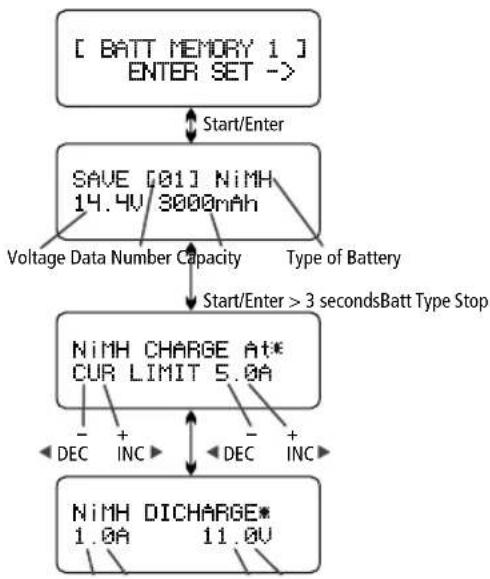
Setting of the parameters in the first screen will not affect the charge and discharge process. It is only for identifying the specification of the battery you will create a preset for.
In this example it is a NiMH battery pack with 12 cells and a capacity of 3000mAh. When you have completed this process press and hold the „START/ENTER“ key for 3 seconds to enter the charge/discharge setup screen.
Set up the charge current in the manual mode, or the current limit in the auto mode. Press the „INC“ and „DEC“ key simultaneously to make the current fi eld blink to switch the charge mode.
Set up the discharge current and cutoff voltage.
13. Save Data Program
flowchart
graph TD
    A["NIMH CYCLE\nDCHG > CHG"] --> B["INCDEC INCDEC\nStart/Enter > 3 seconds"]
    B --> C["SAVE PROGRAM\nSAVE"]
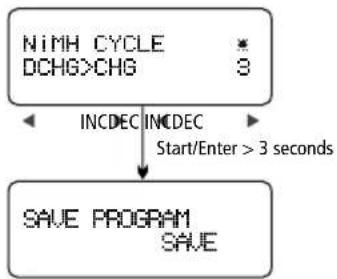
Set up the charge/ discharge sequence and cycle number.
Once you have completed the setup procedures press and hold the „START/ENTER“ key for 3 seconds to save the data.
GB
13.1. Load Data Program
flowchart
graph TD
    A["[ BATT MEMORY 1 "] NiMH 14.4V] -->|Start/Enter| B["LOAD [01"] NiMH 14.4V 3000mAh]
    B -->|Start/Enter > 3 seconds| C["ENTER CHARGER LOAD"]
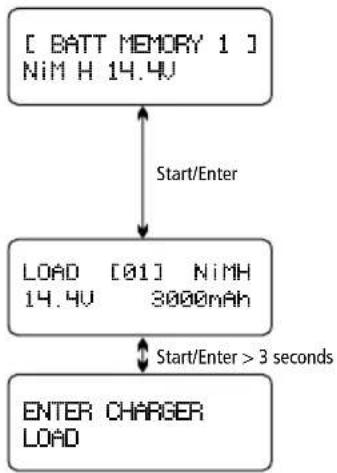
This program is designed to load the data stored in the "save data" program. To get to the save data screen press the „BATT. TYPE/ STOP" button until you see the Load Data screen. Press the „START/ENTER" key to make the data fi eld blink and press the „INC" or „DEC" keys for at least 3 seconds to load the data.
Choose the data number you want to call back. The data you want to call back will be displayed.
Load the data.
14. Warning and Error Messages
The X2-700 incorporates a variety of systems to verify the various charge/discharge processes and the overall state of the electronics.
In case of an error, the charger will emit an audible alarm and the screen will display the cause of the error. See the following description of the errors and their possible causes.
1 REVERSE POLARITY
2 CONNECTION BREAK
3 CONNECT ERROR CHECK MAIN PORT
4 BALANCE CONNECT ERROR
5 DC IN TOO LOW
6 DC IN TOO HIGH
7 CELL ERROR LOW VOLTAGE
8 CELL ERROR HIGH VOLTAGE
9 CELL NUMBER INCORRECT
10 INT. TEMP. TOO HI
11 EXT. TEMP. TOO HI
12 OVER CHARGE CAPACITY LIMIT
13 CELL ERROR VOLTAGE-INVALID
14 OVER TIME LIMIT
15 BATTERY WAS FULL
① Incorrect polarity connected.
② Battery connection is interrupted.
③ The battery connection is wrong.
4 The balance connection is wrong.
⑤ Input voltage less than 11 V.
⑥ Input voltage higher than 30 V.
⑦ Voltage of one cell in the battery pack is too low.
8 Voltage of one cell in the battery pack is too high.
9 The cell number is wrong.
10 The internal temperature of the unit goes too high.
11 The external temperature of the battery goes too high.
12 The battery capacity is higher than the maximum capacity which the user set.
13 Voltage of one cell in the battery pack is invalid.
14 The charging time is longer than the maximum charging time which the user set.
15 The battery voltage is higher than the maximum voltage which the user set when charging in balance mode.
- Maximum Circuit Power Chart (per Output)
The amount of charge current feeding the battery is automatically limited to a maximum of 700 Watts per channel. The maximum discharge power is approximately 25 watts per watts per channel and is limited by charger's internal thermal sensor for maximum discharge current.
If the internal temperature reaches more than 80° C (176° F), the chargers processes will automatically stop and the „INT. TEMP. TOO HI“ will show on the LCD. To avoid overheating your charger and causing damage please refer to the following chart for the maximum charging/discharging current.
Professional Balance Charger, Discharger

Notes
GB
Table des matières
natural_image
Close-up of a network device with USB cable and connector (no visible text or symbols)flowchart
graph TD
    A["PROGRAM SELECT SYSTEM SET->"] --> B["INC"]
    B --> C["Rest Time CHG>DCHG 10Min"]
    C --> D["DEC INC"]
    D --> E["Safety Timer ON 120Min"]
    E --> F["DEC INC"]
    F --> G["Capacity Cut-Off ON 5000mAh"]
    G --> H["DEC INC"]
    H --> I["Key Beep Buzzer ON ON"]
    I --> J["DEC INC"]
    J --> K["Dec INC"]
flowchart
graph TD
    A["CELL ERROR LOW VOLTAGE"] --> B["INC"]
    C["4.14 4.16 4.09\n2.18 0.00 0.00"] --> D
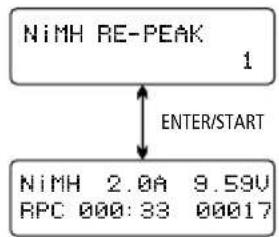
9.3. Charge multi-peak (re-peak) des batteries NiXX
9.3. Charge multi-peak (re-peak) des batteries NiXX
flowchart
graph TD
    A["NiMH RE-PEAK\n1"] --> B["ENTER/START"]
    B --> C["NiMH 2.0A\nRPC 000:33\n9.59U\n00017"]
flowchart
graph TD
    A["[BATT MEMORY 1"] ENTER SET] --> B["Start Enter >3 Seconds"]
    B --> C["BATT TYPE LiPo"]
    C --> D["DEC INC ▶"]
    D --> E["BATT VOLTS 7.4V(2S)"]
    E --> F["DEC INC ▶ INCDEC"]
    F --> G["CCHARGE CURRENT 4.9A"]
text_image
1 End Voltage 12.6V(3S) 2 IN Power Voltage 12.56V 3 Int. Temp 28C 4 Safety Time ON 200min 5 Capacity Cut-Off ON 5000mAh 6 C1: 4.12 C2: 4.09V C3: 4.09 C4: 4.10V75015 Bretten-Gölshausen – Germany
www.multiplex-rc.de


