Santo K 988005E - Refrigerator AEG-ELECTROLUX - Free user manual and instructions
Find the device manual for free Santo K 988005E AEG-ELECTROLUX in PDF.



| Product type | Refrigerator |
| Brand | AEG-Electrolux |
| Model | Santo K 988005E |
| Climate class | SN (+10 to +32 °C), N (+16 to +32 °C), ST (+18 to +38 °C), T (+18 to +43 °C) |
| Supply voltage | 220-240 V ~ 50 Hz |
| Refrigerant | Isobutane (R600a), flammable |
| Installation type | Integrable (version i) or panel-ready (version E) |
| Interior lighting | Bulb 220-240 V, max. 15 W |
| Defrost | Automatic for the refrigerator compartment |
| Temperature setting | From 1 (warmest) to 6 (coldest), position 0 = off |
| Number of shelves | Several adjustable glass and/or wire shelves |
| Bottle holder | Present on some models, with removable support |
| Humidity control | Present on some models, adjustable by sliding lever |
| Variable box | Present on some models, laterally movable |
| Capacity of the refrigerator compartment | Not specified in the instructions |
| Materials | Recyclable plastics (PE, PS) and cardboard |
| Child safety | Locking possible when the appliance is off |
| Cleaning | Warm water and mild detergent, avoid abrasive products |
| Dimensions (H x W x D) | Not specified in the instructions |
| Weight | Not specified in the instructions |
Frequently Asked Questions - Santo K 988005E AEG-ELECTROLUX
User questions about Santo K 988005E AEG-ELECTROLUX
0 question about this device. Answer the ones you know or ask your own.
Ask a new question about this device
Download the instructions for your Refrigerator in PDF format for free! Find your manual Santo K 988005E - AEG-ELECTROLUX and take your electronic device back in hand. On this page are published all the documents necessary for the use of your device. Santo K 988005E by AEG-ELECTROLUX.
USER MANUAL Santo K 988005E AEG-ELECTROLUX
6 = Obst-/Gemüseschalen
7 = Abstellflächen
natural_image
Technical line drawing of a mechanical component with an arrow indicating rotation (no text or symbols)
natural_image
Illustration of a hand inserting a black arrow into a rack, indicating a mechanical or electrical component (no text or symbols present)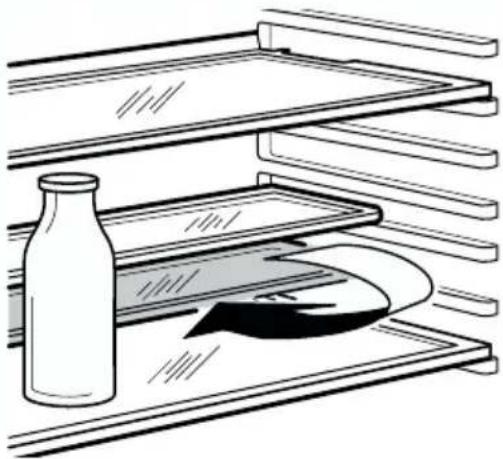
natural_image
Illustration of a shelf with a bottle and paper inside, no text or symbols presentVariable Innentür
natural_image
Illustration of a glass bottle with a cap, partially enclosed by a rectangular container (no text or symbols visible)natural_image
Simple line drawing of a washing machine with two chambers and a side panel, no text or symbols present.natural_image
Diagram of a storage cabinet with two bottles and an arrow indicating flow or movement (no text or symbols)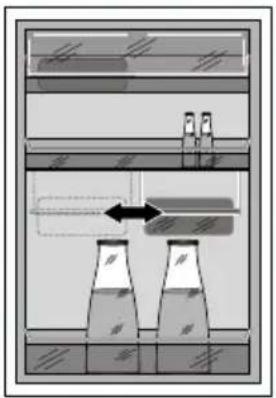
natural_image
Diagram of a laboratory filtration setup with two beakers and a container, showing liquid levels (no text or labels)natural_image
Technical line drawing of a multi-level mechanical assembly with no visible text or symbolsRichtig lagern
natural_image
Diagram of a refrigerator interior showing a double屉 with a downward arrow indicating the floor level (no text or symbols present)natural_image
Technical line drawing of a mechanical component with a tool inserted, showing no text or symbolsBetriebsgeräusche
Thank you for choosing one of our high-quality products.
With this appliance you will experience the perfect combination of functional design and cutting edge technology.
Convince yourself that our appliances are engineered to deliver the best performance and control - indeed we are setting the highest standards of excellence.
In addition to this you find environmental and energy saving aspects as an integral part of our products.
To ensure optimal and regular performance of your appliance please read this instruction manual carefully. It will enable you to navigate all processes perfectly and most efficiently.
To refer to this manual any time you need to, we recommend you to keep it in a safe place. And please pass it to any future owner of the appliance.
We wish you much joy with your new appliance.
The following symbols are used in this manual

Important information concerning your personal safety and information on how to avoid damaging the appliance

General information and tips

Environmental information
Contents
Important Safety Instructions 24
Disposal....26
Appliance Packaging Information....26
Disposal of old Appliances 26
Remove transport safeguard 27
Installation 27
Installation Location....27
Your refrigerator needs ventilation. 28
Installation....29
Electrical connection 29
Description of the appliance....30
View of the appliance....30
Prior to Initial Start-Up. 31
Starting up and temperature regulation .... 31
Switching off the appliance 32
Interior Accessories 33
Storage shelves 33
Moisture regulation 34
Variable storage box ....34
Correct storage....35
Defrosting....35
The fridge defrosts automatically .... 35
Cleaning and Care 36
Energy Saving Tips....36
Correcting Malfunctions....37
Changing the light bulb....38
Noises during Operation 39
Regulations, Standards, Guidelines. 39
Customer Service 40
Technical Terminology 41

Important Safety Instructions
These warnings are provided in the interests of your safety. Ensure you fully understand them before installing or using the appliance. Your safety is of paramount importance. If you are unsure about the meaning of these warnings contact the Customer Care Department for assistance.
Intended use
- The refrigerator is intended for use in the home. It is suitable for the cooling food. If the appliance is used for purposes other than those intended or used incorrectly, no liability can be accepted by the manufacturer for any damage that may be caused.
• Alterations or changes to the refrigerator are not permitted for reasons of safety. - If you use the refrigerator in a commercial application or for purposes other than the cooling of foods, the manufacturer accepts no liability for any damages which may occur.
Prior to initial start-up
- Check the appliance for transport damage. Under no circumstance should a damaged appliance be plugged in. In the event of damage, please contact your supplier.
- Ensure that the appliance does not stand on the electrical supply cable. Important: if the supply cable is damaged, it must be replaced by a special cord or assembly available from the manufacturer or its Customer Service.
Refrigerant
The refrigerant isobutane (R600a) is contained within the refrigerant circuit of the appliance, a natural gas with a high level of environmental compatibility, which is nevertheless flammable.
- Warning – During transportation and installation of the appliance, be certain that none of the components of the refrigerant circuit become damaged.
- If the refrigerant circuit should become damaged:
- avoid open flames and sources of ignition;
- thoroughly ventilate the room in which the appliance is situated.
Safety of children
- Packaging (e.g. wraps, polystyrene) can be dangerous for children. There is a risk of suffocation! Keep packaging material away from children!
- Please make old appliances unusable prior to disposal. Pull out the mains plug, cut off the mains cable, break or remove spring or bolt catches, if fitted. By doing this you ensure that children cannot lock themselves in the appliance when playing (there is risk of suffocation!) or get themselves into other dangerous situations.
- Often children cannot recognise the hazards present in household appliances. It is therefore important that you ensure adequate supervision and never let children play with the appliance!
Daily Operation
- Containers with flammable gases or liquids can leak at low temperatures. There is a risk of an explosion! Do not store any containers with flammable materials such as spray cans, fire extinguisher refill cartridges etc in the refrigerator/freezer.
- Warning - Do not operate any electrical appliances in the refrigerator and/or freezer (e.g. electric ice cream makers, mixers etc.).
- Warning - In order not to impair the function of the appliance, never cover or obstruct the ventilation openings.
- Warning - Do not damage the cooling circuit.
- Before cleaning the appliance, always switch off the appliance and unplug it, or disconnect from the electricity supply.
- When unplugging always pull the plug from the mains socket, do not pull on the cable.
In case of malfunction
- If a malfunction occurs on the appliance, please look first in the "What to do if ..." section of these instructions. If the information given there does not help, please do not perform any further repairs yourself.
- This product should be serviced by an authorised engineer and only genuine spare parts should be used.
- Under no circumstances should you attempt to repair the appliance yourself. Repairs carried out by inexperienced persons may cause injury or serious malfunctioning. Contact your local Customer care department.
Disposal
Appliance Packaging Information
All materials are environmentally sound! They can be disposed of or burned at an incinerating plant without danger.
About the materials: The plastics can be recycled and are identified as follows:
PE< for polyethylene, e.g. the outer covering and the bags in the interior.
PS< for polystyrene foam, e.g. the pads, which are all free of chloro-fluorocarbon.
The carton parts are made from recycled paper and should be disposed of at a waste-paper recycling collection location.
Disposal of old Appliances
For environmental reasons, refrigeration appliances must be disposed of properly. This applies to your old appliance, and - at the end of its service life - for your new appliance as well.

Warning! Before disposing of old appliances make them inoperable. Remove plug from mains, sever the power cable, remove or destroy any snap or latch closures. This ensures that playing children do not lock themselves inside the appliance (danger of suffocation!) or place themselves into other life-endangering situations.
Disposal:
- The appliance may not be disposed of with domestic waste or bulky refuse.
- The refrigerant circuit, especially the heat exchanger at the back of the appliance, must not be damaged.
- The symbol on the product or on its packaging indicates that this product may not be treated as household waste. Instead it shall be handed over to the applicable collection point for the recycling of electrical and electronic equipment. By ensuring this product is disposed of correctly, you will help prevent potential negative consequences for the environment and human health, which could otherwise be caused by inappropriate waste handling of this product. For more detailed information about recycling of this product, please contact your local city office, your household waste disposal service or the shop where you purchased the product.
Remove transport packaging
The appliance and the interior fittings are protected for transport.
- Pull off the adhesive tape on the left and right side of the door.
- Remove all adhesive tape and packing pieces from the interior of the appliance.
Installation
Installation Location
The appliance should be set up in a well ventilated, dry room.
Energy use and efficient performance of the appliance is affected by the ambient temperature.
The appliance should therefore
- not be exposed to direct sunlight;
- not be installed next to radiators, cookers or other sources of heat;
- only be installed at a location whose ambient temperature corresponds to the climate classification, for which the appliance is designed.
The climate classification can be found on the rating plate, which is located at the left on the inside of the appliance.
The following table shows which ambient temperature is correct for each climate classification:
| Climate classification for an ambient temperature of | |
| SN +10 to +32 °C | |
| N +16 to +32 °C | |
| ST +18 to +38 °C | |
| T +18 to +43 °C | |
Installation directly under a hob is not allowed. The temperatures of the hob, which in part are quite high, may damage the appliance. If a hob is installed near the appliance, the corresponding installation and safety instructions must be adhered to. Considering the numerous installation conditions which are possible, there is no way of providing detailed information here.
It is necessary to avoid overheating of the refrigerator by maintaining adequate distances from heat sources and by the use of a suitable thermal insulation plate. Proper ventilation of the appliance must also be ensured.
Your refrigerator needs ventilation
Integratable models (i-appliances)
The integrated door of the furniture cabinet largely seals the installation recess. i-appliances must therefore be provided with ventilation by having an opening in the furniture plinth. The warmed air must be able to be exhausted upwards through the air shaft on the furniture back.
The ventilation cross-sections should be at least 200 cm ^4 .
Important note! In order not to impair the function of the appliance, never cover or obstruct the ventilation openings.
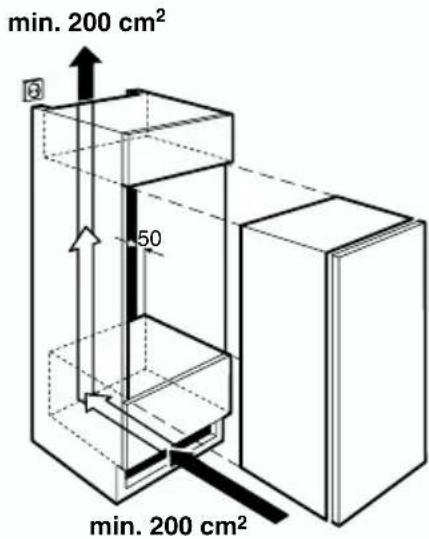
Models fitted for matching front panel (E-appliances)
Installation option 1 (optimum):
Optimum ventilation of E-appliances is ensured through fresh air being able to enter both under the appliance as well as through an opening in the furniture plinth. The warmed air must be able to be exhausted upwards through the air shaft (min. 200 cm ^2 ) on the furniture back.
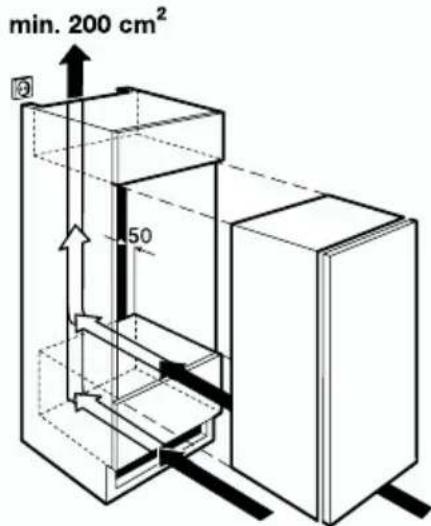
Installation option 2:
Operation of E-appliances is possible even without a ventilation opening in the furniture plinth. The fresh air able to enter under the appliance is sufficient for ventilation. The function and life of the appliance are not impaired. The warmed air must be able to be exhausted upwards through the air shaft (min. 200 cm ^2 ) on the furniture back. If the appliance is ventilated without a plinth opening, however, the energy consumption may differ from that specified in the brochure.
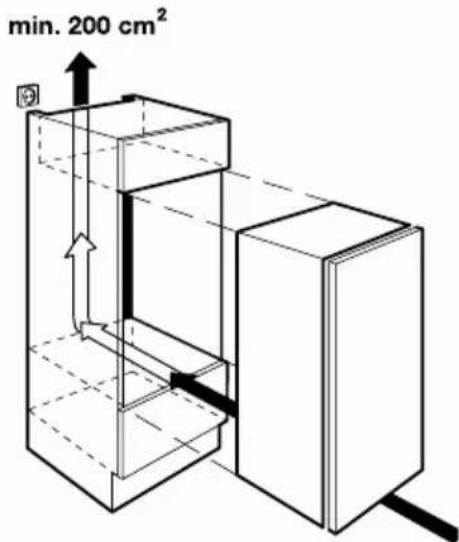
Important note! In order not to impair the function of the appliance, never cover or obstruct the ventilation openings.
Installation
See installation instructions supplied.
Please check whether, after installing your appliance and especially after rehingeing the door, the door seal seals right round. An untight door seal may lead to heavy frosting and thereby to a higher power consumption (see also "What to do if...").
Electrical connection
A correctly installed, earthed socket is required for the electrical supply. The supply must have a fuse rating of at least 10 Amps. If the socket is not accessible once the appliance is built in, the electrical installation must include suitable means of isolating the appliance from the mains (e.g. a fused spur).

Before initial start-up, refer to the appliance rating plate to ascertain if supply voltage and current values correspond with those of the mains at the installation location.
e.q.: AC 220 ... 240 V 50 Hz or
220 ... 240 V \~50 Hz
(i.e. 220 to 240 volts alternating current, 50 Hertz)
The rating plate is inside the appliance on the left.
The mains cable may only be changed by a qualified electrician or
competent person. If your appliance needs repairing, please contact your local Customer Care Department.
Description of the appliance
View of the appliance
(various models)
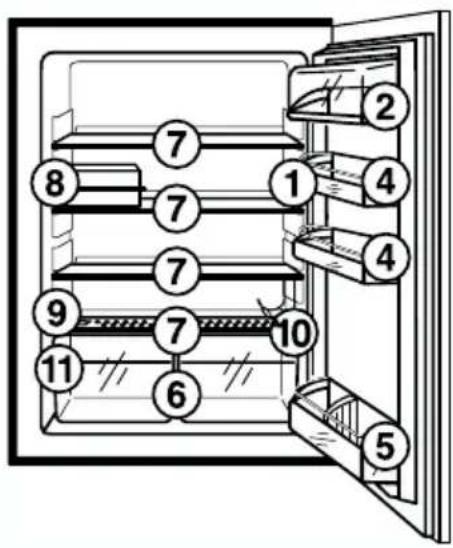
1 = Temperature regulator and interior lighting
2 = Butter and cheese compartment with lid
3 = Variable storage box (not included with all models, design differs depending on the model)
4 = Door storage compartment
5 = Bottle compartment
Bottle holder (not on all models)
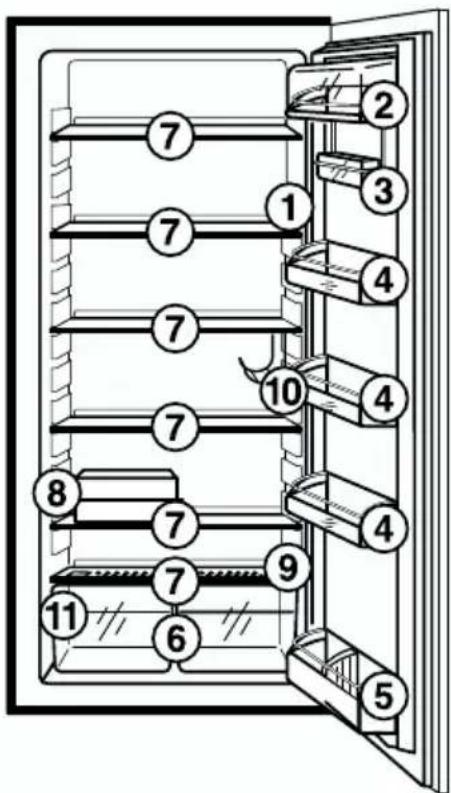
6 = Fruit and vegetable bins
7 = Shelves
8 = General purpose box (not included with all models)
9 = Moisture regulation (not on all models)
10 = Bottle / Can holder (not on all models)
11 = Rating plate
Prior to Initial Start-Up

Please clean the appliance interior and all accessories prior to initial start-up (see section: "Cleaning and Care").
Starting up and temperature regulation
Important! Only use the appliance when built-in!
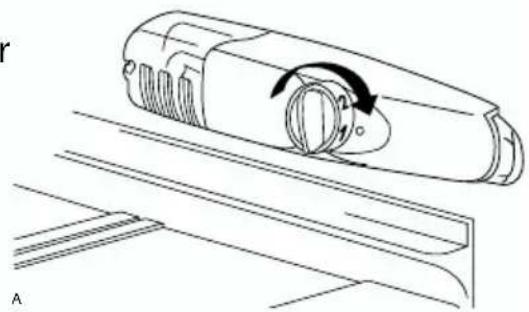
The temperature regulator is in the refrigerator compartment on the upper right. It is also the ON/OFF-switch.
Position „0“ = Refrigeration off
Position „1“ = Warmest interior temperature
Position „6“ = Coldest interior temperature
natural_image
Technical line drawing of a mechanical component with an arrow indicating rotation, no text or symbols present-
Plug the mains plug into the mains socket.
-
Set the required temperature by turning the temperature regulator. The inside light goes on. The compressor starts and then runs automatically.
Note: When the setting is changed, the compressor does not start immediately if automatic defrosting is currently taking place.

Goods to be refrigerated can be loaded immediately after switching on, because the storage temperature in the refrigerator is quickly reached.

Note: From a food science point of view, +5 °C should be considered cold enough as a storage temperature.
The following effects are of significance in respect of the interior temperature:
- Ambient temperature;
- Quantity and temperature of the food stored;
- Frequency with which the door is opened and how long it is left open.
- A defect in the appliance.
The temperature regulator setting may therefore need to be adjusted to suit the specific conditions.
Recommended settings:
Examples:
| Ambient temperature Temperature controller position | |
| Approx. 10°C Range up to 1 | |
| Approx. 16°C | Range about 2 |
| Approx. 25°C Range about 2 | |
| Approx. 32°C 2 to 3 | |
| Approx. 38°C 1 to 2 | |
- If you want a higher or lower temperature, turn the temperature regulator to a warmer or cooler setting respectively.
Important!
High ambient temperatures (e.g. on hot summer days) and a cold setting on the temperature regulator (position"5" to "6") can cause the compressor to run continuously.
Reason: when the ambient temperature is high, the compressor must run continuously to maintain the low temperature in the appliance. The fridge will not be able to defrost since automatic defrosting of the fridge is only possible when the compressor is not running (see also "Defrosting" section). The result is the build up of a thick layer of frost on the fridge rear wall.
If this happens, turn the temperature regulator back to a warmer setting (position "4" to "5"). At this setting the compressor will be switched on and off as usual and automatic defrosting recommenced.
Switching off the appliance
- To switch off the appliance, turn the temperature regulator to position "0". The inside light goes out.
If the appliance is not going to be used for an extended period:
-
Switch off the appliance by turning the temperature regulator to position "0". The inside light goes out.
-
Remove the mains plug or switch off or disconnect from the electricity supply.
-
Clean thoroughly (see section: "Cleaning and Maintenance").
-
Leave the door open to avoid the build up of odours.
Interior Accessories
Storage Shelves/Storage Racks
Depending on the model, your appliance is equipped with either glass storage shelves or storage racks. The glass shelf above the fruit and vegetable compartment must always remain in this position so that fruit and vegetables stay fresh longer.
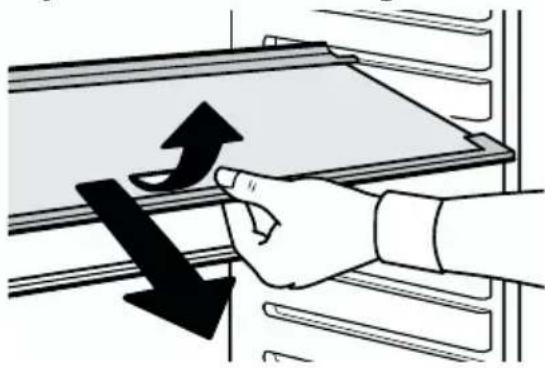
The remaining storage shelves can be adjusted to various heights:
-
Pull the storage shelf forward until it can be tipped up or down and removed.
-
To insert at a different height use the same procedure in reverse.
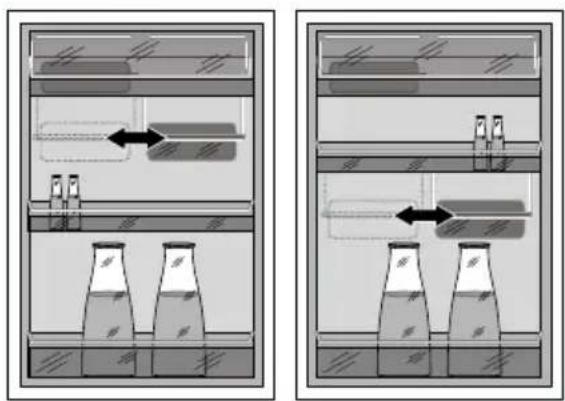
Adjustment for tall goods (not for all models):
Remove the front half of the two-part vario glass storage shelf and insert it at a different level. Space is thus gained for storage of tall goods on the underlying storage shelf.
natural_image
Illustration of a hand pressing down on a kitchen appliance with a black arrow indicating motion (no text or symbols)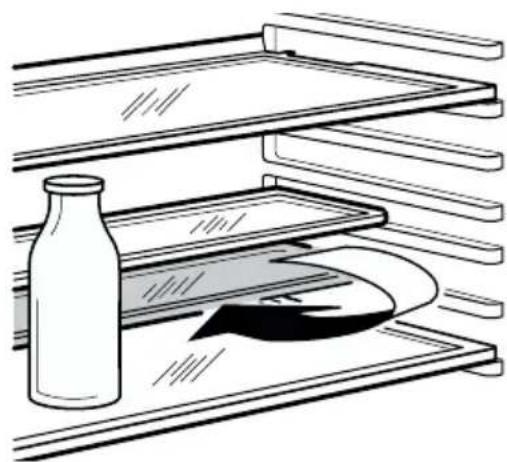
natural_image
Illustration of a shelf with a bottle and a lid, no text or symbols presentVariable Inner Door
The door compartments can be pulled up and removed, and inserted at other positions as needed.
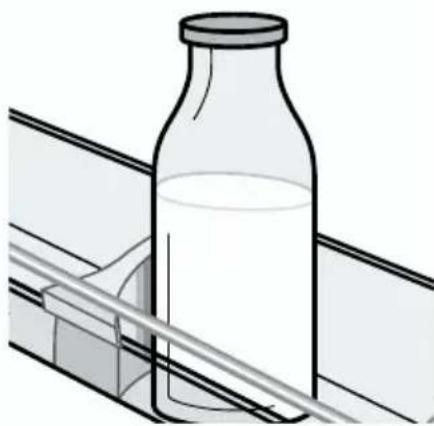
Bottle Holder
(not on all models)
On some models there is a bottle holder in the bottle compartment. This is used to prevent individual bottles from falling over and can be slid sideways.
natural_image
Illustration of a glass bottle with a lid placed on a conveyor belt, no text or symbols presentMoisture regulation (not on all models)
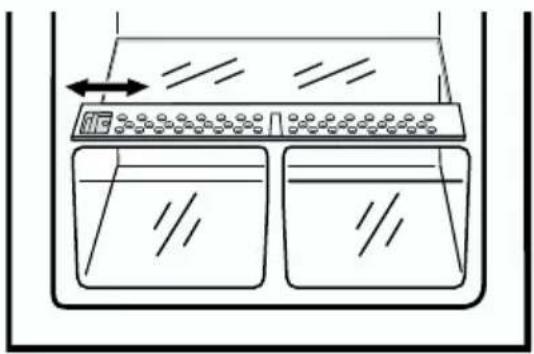
On some models, there is an adjustable air grille in front of the shelf above the fruit and vegetable compartments.
The opening in the ventilation slots can be steplessly adjusted with a slider.
Slider in right position: Ventilation slots opened.
natural_image
Simple line drawing of a washing machine with two chambers and a digital display (no text or symbols)Slider in left position: Ventilation slots closed.
With the ventilation slots open, the stronger air circulation results in a lower air moisture content in the fruit and vegetable compartments.
When the ventilation slots are closed, the natural moisture content of the food in the fruit and vegetable compartments is preserved for longer.
Variable Storage Box
(not on all models, design differs depending on the model)
Some models are equipped with a variable storage box which is fitted under a door shelf compartment and can be slid sideways.
The box can be inserted under every door shelf compartment.
-
To change, lift the shelf compartment with the box upwards and out of the holders in the door and remove the retaining bracket out of the guide under the shelf compartment.
-
Please do the same in reverse to insert the shelf at a different height.
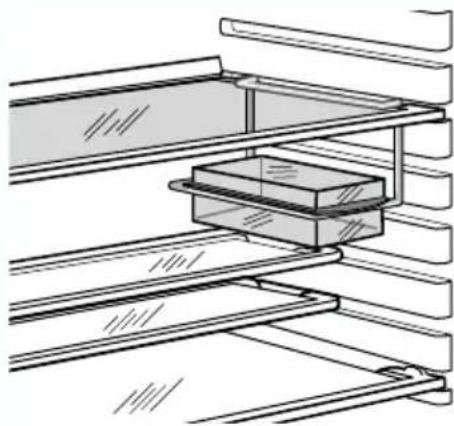
The variable box can be hung from a storage shelf in the refrigerator compartment:
natural_image
Two schematic diagrams of a laboratory apparatus with bottles and containers, showing internal components and directional arrows (no text or labels)- Pull the storage shelf forward until it can be tipped up or down and removed.
- Hang the retaining bracket on the taper on the storage shelf and slide the storage shelf back into the guides.
natural_image
Technical line drawing of a multi-level shelving unit with a rectangular box on one level (no text or symbols)Correct Storage
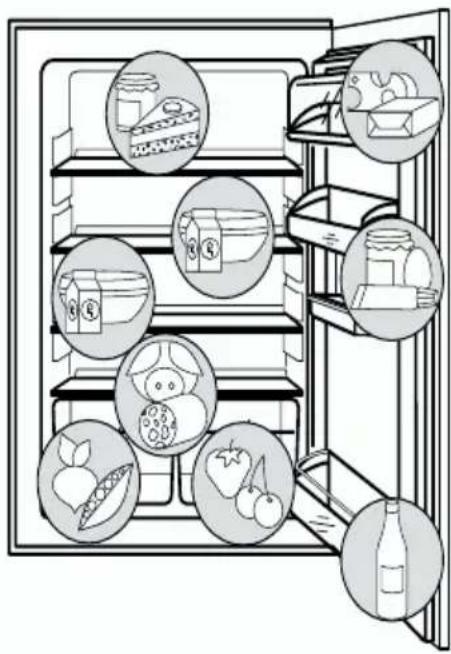
For physical reasons, there are different temperature regions in the fridge.
The coldest region is on the lowest storage shelf.
Warmer regions are the top storage shelf, the vegetable basket and the storage compartments on the door.
The arrangement example shows at which places in the refrigerator suitable temperatures for various types of foods exist.
Tip: Food in the fridge should always be covered or packaged, to prevent drying and tainting of other food.
The following are suited for packaging:
- Polyethylene airtight bags and wraps;
- Plastic containers with lids;
- Special plastic covers with elastic;
- aluminium foil.
Defrosting
The fridge defrosts automatically
The rear wall of the fridge covers with frost when the compressor is running, and defrosts when the compressor is off.
The water from the thawing frost is collected in the drain channel on the rear of the fridge, feed through the drain hole into the collector on the compressor, and then evaporated.
The water drainage hole must be cleaned regularly (see the section "Cleaning and Maintenance").
Cleaning and Care
For hygienic reasons the appliance interior, including interior accessories, should be cleaned regularly.

Warning!
- The appliance may not be connected to the mains during cleaning. Danger of electrical shock! Before cleaning switch the appliance off and remove the plug from the mains, or switch off or turn out the circuit breaker or fuse.
- Never clean the appliance with a steam cleaner. Moisture could accumulate in electrical components, danger of electrical shock! Hot vapours can lead to the damage of plastic parts.
- The appliance must be dry before it is placed back into service.
Important!
- Ethereal oils and organic solvents can attack plastic parts, e.g.
- lemon juice or the juice from orange peel;
- butyric acid;
- cleansers which contain acetic acid.
Do not allow such substances to come into contact with appliance parts. - Do not use any abrasive cleansers.

-
Remove the food from the refrigerator. Store it in a cool place, well covered.
-
Remove the mains plug or switch off or disconnect from the electricity supply.
-
Remove frost from time to time with a soft plastic scraper, e.g. a pastry scraper. Under no circumstances use hard or pointed objects to remove frost.
-
Clean the appliance and the interior accessories with a cloth and lukewarm water. Commercially available dish washing detergents may also be used.
-
After cleaning wipe with fresh water and rub dry.
-
Regularly unblock the condensation water drainage hole in the rear wall of the refrigeration chamber with the aid of the green strip inserted into the drainage hole.
-
After everything is dry place appliance back into service.

natural_image
Interior view of a refrigerator with a double-down arrow indicating a drop or direction (no text or symbols present)
Energy Saving Tips
- Do not install the appliance near boilers, radiators or other sources of heat. High ambient temperatures cause longer, more frequent operation of the compressor.
- Ensure sufficient air circulation and exhaust at the appliance base and at the back wall of the appliance. Never cover air vent openings.
- Do not place warm foods into the appliance. Allow warm foods to cool first.
- Only leave door open as long as necessary.
- Do not set temperature any colder than necessary.
What to do if ...
Correcting Malfunctions
A malfunction may be caused by only a minor fault that you can rectify yourself using the following instructions. Do not perform any other work on the appliance if the following information does not provide assistance in your specific case.

Important! Repairs to refrigerators/freezers may only be performed by competent service engineers. Improper repairs can give rise to significant hazards for the user. If your appliance needs repairing, please contact your specialist dealer or our local Customer Service.
| Symptom Possible Cause Remedy | ||
| Appliance does not work. | Appliance is not switched on. | Switch on the appliance. |
| Mains plug is not plugged in or is loose. | Insert mains plug. | |
| Fuse has blown or is defective | Check fuse, replace if necessary. | |
| Socket is defective. | Mains malfunctions are to be corrected by an electrician. | |
| Appliance cools too much. | Temperature is set too cold. | Turn the temperature regulator to a warmer setting temporarily. |
| Symptom Possible Cause Remedy | ||
| The food is too warm. | Temperature is not properly adjusted. | Please look in the "Starting up and temperature regulation" section. |
| Door was open for an extended period. | Open the door only as long as necessary. | |
| A large quantity of warm food was placed in the appliance within the last 24 hours. | Turn the temperature regulator to a colder setting temporarily. | |
| The appliance is near a heat source. | Please look in the "Installation location" section. | |
| Interior lighting does not work. | Light bulb is defective. | Please look in the "Changing the Light Bulb" sections. |
| Heavy build up of frost, possibly also on the door seal. | Door seal is not air tight (possibly after reversing the door). | Carefully warm the leaking sections of the door seal with a hair dryer (on a cool setting). At the same time shape the warmed door seal by hand such that it sits correctly. |
| The compressor does not start immediately after changing the temperature setting. | This normal, no error has occurred. | The compressor starts after a period of time. |
| Water on the floor or on storage shelves. | Water drain hole is blocked. | See the "Cleaning and Care" section. |
Changing the light bulb

Warning! There is a risk of electric shocks! Before changing the light bulb, switch off the appliance and unplug it, or pull the fuse or the circuit breaker.
Light bulb data: 220-240 V, max. 15 W

-
To switch off the appliance, turn the temperature regulator to position "0".
-
Unplug the mains plug.
-
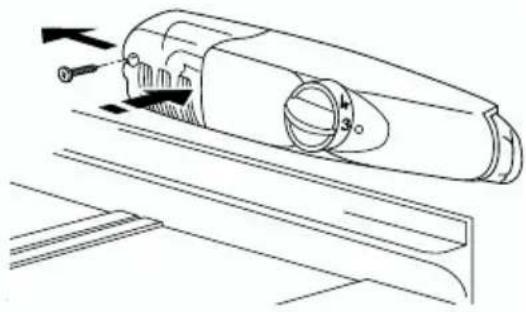
To change the light bulb, undo the cross head screw and remove the light bulb cover.
-
Change the defective light bulb.
-
Refit the light bulb cover and the cross head screw.
-
Put the refrigerator back into operation.
natural_image
Technical line drawing of a mechanical component with no visible text or symbolsNoises during Operation
The following noises are characteristic of refrigeration appliances:
- Clicks
Whenever the compressor switches on or off, a click can be heard. - Humming
As soon as the compressor is in operation, you can hear it humming.
When refrigerant flows into thin tubes, you can hear bubbling or splashing noises. Even after the compressor has been switched off, this noise can be heard for a short time.
Regulations, Standards, Guidelines
This appliance was designed for household use and was manufactured in accordance with the appropriate standards. The necessary measures in accordance with appliance safety legislation regulations (GSG), accident prevention regulations for refrigeration appliances (VBG 20) and the regulations of the German Society of Electrical Engineers (VDE) were observed in the manufacture of this appliance.
The refrigerant circuit has been checked for leaks.
CE This appliance is in accordance with the following EU guidelines: - 73/23/EWG dated 19 February 1973 - low voltage guidelines. - 89/336/EWG dated 3 May 1989 (including guideline change notice 92/31/EWG) - EMV guideline - 94/2/EG dated 21.01.1994 - Directive on Energy Labelling - 96/57 EG dated 3.9.1996 - Energy Efficiency Requirements of Household Electric Refrigerators, Freezers and Combinations Thereof.
Customer Service
If you cannot find the remedy for a malfunction in these operating instructions, please contact your dealer or our customer service department.
Addresses and telephone numbers are listed in the accompanying booklet "Guarantee Conditions/Customer Service Locations".
Selective ordering of replacement parts can save unnecessary travel and costs. For this reason always provide the following appliance information:
- Model Name
- Model Number (PNC)
- Serial Number (S-No.)

natural_image
Grid of uniform gray squares with no text or symbolsThis information can be found on the serial plate in the interior at the left of the appliance. We recommend that you enter this information here, so that it is handy if needed.
Note: The customer bears the costs of unjustified customer service calls even during the guarantee period.
Technical Terminology
- Refrigerant Liquids that can be used to a generate a cooling effect are known as refrigerants. They have a relatively low boiling-point, indeed so low, that the warmth from the food stored in the fridge or freezer can cause the refrigerant to boil and vaporise.
- Refrigerant Circuit Closed circulation system that contains the refrigerant. The refrigerant circuit comprises primarily of an evaporator, a compressor, a condenser and pipe work.
- Evaporator The refrigerant is evaporated in the evaporator. Similar to all other liquids, refrigerant requires heat to evaporate. This heat is removed from the interior of the appliance, as a result the interior is cooled. The evaporator is therefore located inside the appliance or placed in foam immediately behind the inner wall and thus not visible.
- Compressor The compressor looks like a small drum. It is driven by a built-in electric motor and is mounted on the base of the appliance at the rear. The task of the compressor is to draw in vaporised refrigerant from the evaporator, to compress it, and to pass it on to the condenser.
- Condenser
The condenser normally has the form of a grid. The refrigerant compressed in the compressor is liquefied in the condenser. During this process, heat is released to the surrounding air at the surface of the condenser. The condenser is mounted on the base of the appliance.
Chère cliente, cher client
tous les modèles)
11 = Plaque signalétique
natural_image
Technical line drawing of a mechanical component with rotational arrow indicating motion (no text or symbols)natural_image
Illustration of a hand pressing down on a tray with an upward arrow and downward arrow (no text or symbols)natural_image
Illustration of a shelf with a bottle and a tray, no text or symbols presentnatural_image
Illustration of a glass bottle with a lid placed on a surface next to a rod, no text or symbols present.natural_image
Simple line drawing of a washing machine with two chambers and a top panel (no text or symbols)natural_image
Illustration of a storage cabinet with liquid and two bottles on shelves, no text or symbols present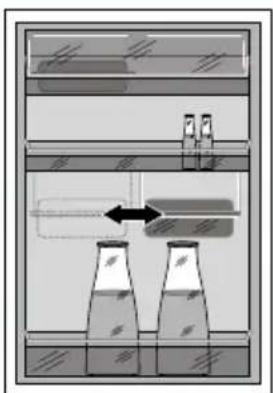
natural_image
Diagram of a storage or filtration setup with two bottles and a container, no text or symbols presentnatural_image
Technical line drawing of a multi-level mechanical assembly with no visible text or symbolsRangement correct
natural_image
Line drawing of a refrigerator interior with a downward arrow indicating storage or clearance (no text or symbols)
natural_image
Technical line drawing of a mechanical device with labeled parts (no text or symbols present)6 = Fruit-/groenteladen
7 = Legvlakken
natural_image
Technical line drawing of a mechanical component with rotational arrow indicating motion (no text or symbols)natural_image
Illustration of a hand pressing down on a kitchen appliance with a black directional arrow (no text or symbols)natural_image
Illustration of a shelf with a bottle and a circular object, no text or symbols presentVariabele binnendeur
natural_image
Illustration of a glass bottle with a lid placed on a conveyor belt, no text or symbols present.natural_image
Simple line drawing of a washing machine with two side compartments and a control panel (no text or symbols)natural_image
Diagram of a storage cabinet with two flasks and an arrow indicating flow direction (no text or symbols)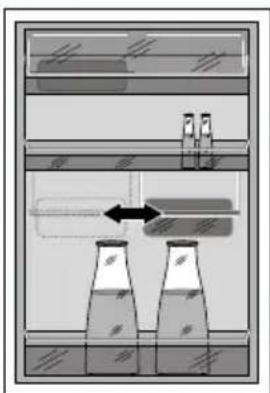
natural_image
Diagram of a storage or filtration setup with two bottles and a container, no text or symbols presentnatural_image
Technical line drawing of a multi-level storage shelf with a rectangular box on one side (no text or symbols)Juist bewaren
Ontdooien
natural_image
Diagram of a refrigerator interior showing a double屉 with a downward arrow indicating the interior space (no text or symbols present)
Tips om energie te besparen
natural_image
Technical line drawing of a mechanical component with no visible text or symbolsSubject to change without notice
- Variable Innentür
- Richtig lagern
- Betriebsgeräusche
- Contents
- Important Safety Instructions
- Intended use
- Prior to initial start-up
- Refrigerant
- Safety of children
- Daily Operation
- In case of malfunction
- Disposal
- Appliance Packaging Information
- Disposal of old Appliances
- Disposal:
- Remove transport packaging
- Installation
- Installation Location
- Your refrigerator needs ventilation
- Integratable models (i-appliances)
- Models fitted for matching front panel (E-appliances)
- Electrical connection
- Description of the appliance
- View of the appliance
- Starting up and temperature regulation
- Recommended settings:
- Important!
- Switching off the appliance
- Interior Accessories
- Storage Shelves/Storage Racks
- Variable Inner Door
- Bottle Holder
- Moisture regulation (not on all models)
- Variable Storage Box
- Correct Storage
- Defrosting
- The fridge defrosts automatically
- Cleaning and Care
- Warning!
- Energy Saving Tips
- What to do if ...
- Correcting Malfunctions
- Changing the light bulb
- Noises during Operation
- Regulations, Standards, Guidelines
- Customer Service
- Technical Terminology
- Chère cliente, cher client
- Rangement correct
- Variabele binnendeur
- Juist bewaren
- Ontdooien
- Tips om energie te besparen
Brand : AEG-ELECTROLUX
Model : Santo K 988005E
Category : Refrigerator