MIB60 - Pan M-SYSTEM - Free user manual and instructions
Find the device manual for free MIB60 M-SYSTEM in PDF.



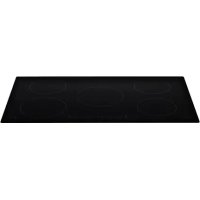
| Product type | Induction hob |
| Brand | M-System |
| Model | MIB60 |
| Number of cooking zones | 4 |
| Total power | 7400 W |
| Electrical supply | 230 V~ / 400 V~, 50 Hz (depending on connection) |
| Recessed dimensions (W x D) | 560 x 490 mm |
| Appliance dimensions (W x D) | 596 x 526 mm |
| Surface material | Ceramic glass |
| Controls | Touch controls |
| Power per cooking zone | Front left 2300 W (Ø210 mm), Rear left 1400 W (Ø145 mm), Rear right 2300 W (Ø180 mm), Front right 1400 W (Ø160 mm) |
| Power levels | 1 to 9 + P (maximum power) |
| Functions | Pan detection, control panel lock, residual heat indicator, automatic safety shut-off, fan cooling |
| Safety | Pan absence detection, automatic shut-off in case of overheating, lock |
| Maintenance | Clean with soapy water or special ceramic glass cleaner, do not use abrasives |
| Repairability | Repair exclusively by an approved professional |
| Spare parts | Contact after-sales service |
| Protection class | Y |
| Supplied accessories | Adhesive sealing gasket |
| Additional information | 48-page manual available in several languages |
Frequently Asked Questions - MIB60 M-SYSTEM
User questions about MIB60 M-SYSTEM
0 question about this device. Answer the ones you know or ask your own.
Ask a new question about this device
Download the instructions for your Pan in PDF format for free! Find your manual MIB60 - M-SYSTEM and take your electronic device back in hand. On this page are published all the documents necessary for the use of your device. MIB60 by M-SYSTEM.
USER MANUAL MIB60 M-SYSTEM
BESCHRIJVING VAN HET APPARAAT
F Foutmelding Defect functioning kookzone
H Restwarmte De kookzone is warm
L Vergrendeling Tafel is beevilidg
Thank you for having chosen our induction ceramic hob.
In order to make the best use of your appliance, we would advise you to read carefully the following notes and to keep them for a later consulting.
SUMMARY
Safety 15
Precautions before using 15
Using the appliance 15
Cleaning 15
Precautions not to damage the appliance 15
Precautions in case of appliance failure 16
Other protections 16
Description of the appliance 16
Technical data 16
Control panel 17
Use of the appliance 17
Sensitive touches 17
Display 17
Residual heat indicator 17
Ventilation 18
Starting-up and appliance management 18
Before the first use 18
Induction principle 18
Starting-up 18
Pan detection 19
Residual heat indication 19
Control panel locking 19
Cooking advices 19
Pan quality 19
Pan dimension 20
Examples of cooking power setting 20
Maintenance and cleaning 20
What to do in case of a problem 21
Environment preservation 22
Installation instructions 23
Electrical connection 24
Precautions before using
- Unpack all the materials.
- The installation and connecting of the appliance have to be done by approved specialists. The manufacturer can not be responsible for damage caused by building-in or connecting errors.
- To be used, the appliance must be well-equipped and installed in a kitchen unit and an adapted and approved work surface.
- This domestic appliance is exclusively for the cooking of food, to the exclusion of any other domestic, commercial or industrial use.
- Remove all labels and self-adhesives from the ceramic glass.
- Do not change or alter the appliance.
- The cooking plate can not be used as freestanding or as working surface.
- The appliance must be grounded and connected conforming to local standards.
- Do not use any extension cable to connect it.
- The appliance can not be used above a dishwasher or a tumble-dryer: steam may damage the electronic appliances.
Using the appliance
- Switch the heating zones off after using.
- Keep an eye on the cooking using grease or oils: that may quickly ignite.
- Be careful not to burn yourself while or after using the appliance.
Children must not manipulate the appliance. - Make sure no cable of any fixed or moving appliance contacts with the glass or the hot saucepan.
- Magnetically objects (credit cards, floppy disks, calculators) should not be placed near to the engaged appliance.
- Do not place any metallic object except heating containers. In case of untimely engaging or residual heat, this one may heat, melt or even burn.
- Never cover the appliance with a cloth or a protection sheet. This is supposed to become very hot and catch fire.
Cleaning
- Switch the appliance off before cleaning.
- Let it cool completely.
- Do not ever use any steam-driven or pressure appliance.
- Do not use any object that may scratch the ceramic glass.
Precautions not to damage the appliance
- Raw pan bottoms or damaged saucepans (not enamelled cast iron pots,) may damage the ceramic glass.
- Sand or other abrasive materials may damage ceramic glass.
- Avoid dropping objects, even little ones, on the vitroceramic.
- Do not hit the edges of the glass with saucepans.
- Make sure that the ventilation of the appliance works according to the manufacturer's instructions.
-
Do not put or leave empty saucepans on the vitroceramic hobs.
-
Sugar, synthetic materials or aluminium sheets must not contact with the heating zones. These may cause breaks or other alterations of the vitroceramic glass by cooling: switch on the appliance and take them immediately out of the hot heating zone (be careful: do not burn yourself).
- Never place any hot container over the control panel.
- If a drawer is situated under the embedded appliance, make sure the space between the content of the drawer and the inferior part of the appliance is large enough (2cm). This is essential to guaranty a correct ventilation.
- Never put any inflammable object (ex. sprays) into the drawer situated under the vitroceramic hob. The eventuals cutlery drawers must be resistant to heat.
Precautions in case of appliance failure
- If a defect is noticed, switch on the appliance and turn off the electrical supplying.
- If the ceramic glass is cracked or fissured, you must unplug the appliance and contact the after sales service.
- Reparing have to be done by specialists. Do not open the appliance by yourself.
Other protections
- Note sure that the container pan is always centred on the cooking zone. The bottom of the pan must has to cover as much as possible the cooking zone.
- For the users of pacemaker, the magnetic field could influence its operating. We recommend to get information to the retailer or of the doctor.
- Do not to use aluminium or synthetic material containers: they could melt on still hot cooking zones.
- The worn appliances contain certain noble metals. Apply to the local government about the possibilities of recycling.

DO NOT USE INTERMEDIATE REMOVABLE ACCESSORIES TO HEAT PANS WHICH ARE NOT ADAPTED TO INDUCTION. RISKS OF BURNS AND DETERIORATION OF THE HOB.

DESCRIPTION OF THE APPLIANCE
Technical data
| Type Total | Power | Heating zone location | Nominal Power * | Diameter |
| 4 zones | 7400W | Front left | 2300W | 210 mm |
| Rear left | 1400 W | 145 mm | ||
| Rear right | 2300 W | 180 mm | ||
| Front right | 1400 W | 160 mm |
- The given power may change according to the dimensions and material of the pan
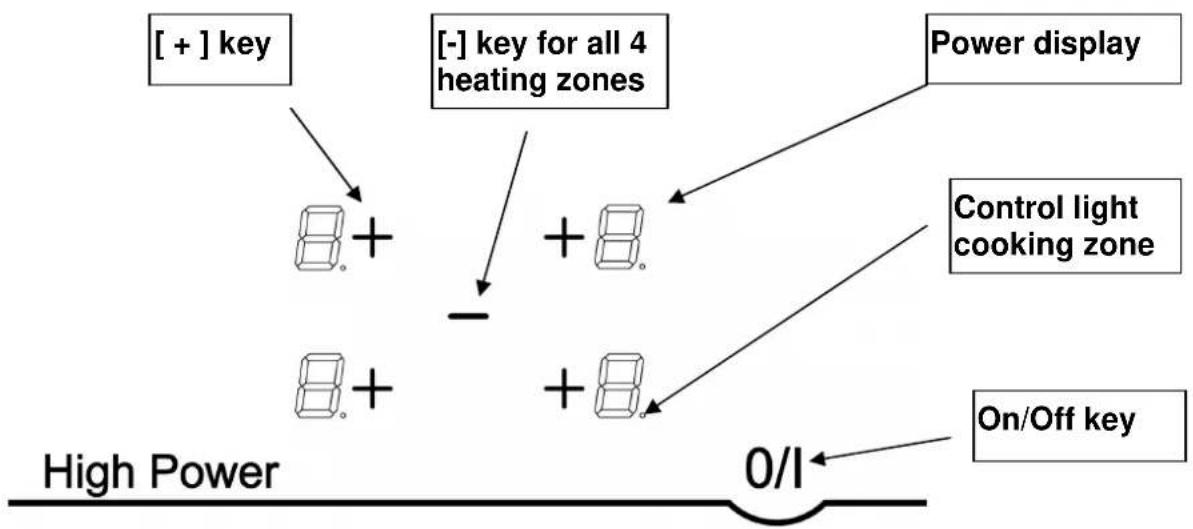
Control panel
USE OF THE APPLIANCE
Sensitive touches
Your ceramic hob is equipped with electronic controls with sensitive touch keys. When your finger touches the key, the corresponding command is activated. This activation is validated by a control light, a letter or a number in the display and/or a "beep" sound. Touch only one key on the same time.
Display
| Display | Designation | Function |
| 0 | Zero | The heating zone is activated |
| 1...9 | Power level | Selection of the cooking level |
| U | Pan detection | No pan or inadequate pan |
| E | Error message | Electronic failure |
| F | Error message | Heating zone failure |
| H | Residual heat | The heating zone is hot |
Residual heat indicator
After using a cooking zone an indicator in the form [H] will warn you that the surface temperature is high. You should avoid touching this zone. There is a risk of getting burnt. The residual heat can be used to save energy.
Ventilation
The cooling system is fully automatic. The cooling fan starts with a low speed when the calories brought out by the electronic system reach a certain level. The ventilation starts his high speed when the hob is intensively used. The cooling fan reduces his speed and stops automatically when the electronic circuit is cooled enough.
STARTING-UP AND APPLIANCE MANAGEMENT
Before the first use
Clean your hob with a damp cloth, and then dry the surface thoroughly. Do not use detergent which risks causing blue-tinted colour on the glass surface.
Induction principle
An induction coil is located under each heating zone. When it is engaged, it produces a variable electromagnetic field which produces inductive currents in the ferromagnetic bottom plate of the pan. The result is a heating-up of the pan located on the heating zone.
Of course the pan has to be adapted :
- All ferromagnetics pans are recommended (please verify it thanks a little magnet): cast iron and steel pans, enamelled pans, stainless-steel pans with ferromagnetic bottoms...
- Are excluded : cupper, pure stainless-steel, aluminium, glass, wood, ceramic, stoneware,...
The induction heating zone adapts automatically the size of the pan. With a too small diameter the pans doesn't work. This diameter is varying in function of the heating zone diameter. If the pan is not adapted to the induction hob the display will show [U].
Starting-up
To turn off the hob press first the [0/1] key, then the heating zone [+] :
- Start-up/ switch off the hob:
| Action | Control panel | Display | Control light |
| To start : | |||
| Touch the key | touch the key [ 0/1 ] | [ 0 ] | switch on |
| To stop : | |||
| Touch the key | touch the key [ 0/1 ] | nothing or [ H ] | switch off |
- Start-up/ switch off a heating zone :
| Action | Control panel | Display | |
| Increase power | touch key [+] | [1] to [9] | |
| Decrease power | touch key [-] | [9] to [1] | |
| Stop | touch simultaneous [+] and [-] | [0] or [H] | |
Pan detection
The pan detection ensures a perfect safety.
The induction doesn't work :
- If there is no pan on the heating zone or if this pan is not adapted to the induction. In this case it is impossible to increase the power and the display shows [] . This symbol disappears when a pan is put on the heating zone.
- If the pan is removed from the heating zone the operation is stopped. The display shows [U]. The symbol [U] disappears when the pan is put back to the heating zone. The cooking continues with the power level setted before.
Residual heat indication
After the switch off of a heating zone or the complete stop of the hob, the heating zones are still hot and indicates [H] on the display.
The symbol [H] disappears when the heating zones may be touched without danger.
As far as the residual heat indicators are on light, don't touch the heating zones and don't put any heat sensitive object on them. There are risks of burn and fire.
Control panel locking
To avoid modifying a setting of cooking zones, in particular with within the framework of cleaning the control panel can be locked (with exception to the On/Off key [ 0/1 ]).
- Locking :
| Action | Control panel | Display |
| Start | Press on key [0/I] | [0] or [H] on 4 displays |
| Hob locking | Touch simultaneously [ - ] and [ + ]at front right * No modification | |
| Press on key [+] | [L] on 4 displays |
- Unlocking :
| Action | Control panel | Display |
| Start | Press on key [ 0/1 ] | [L] on 4 displays |
| In the 5 seconds after start : | ||
| Unlocking the hob | Touch simultaneously [ - ] and [ + ]at front right * | [0] or [H] on 4 displays |
| Press on key [ - ] | No light on the displays | |
COOKING ADVICES
Pan quality
Adapted materials: steel, enamelled steel, cast iron, ferromagnetique stainless-steel, aluminium with ferromagnetique bottom.
Not adapted materials: aluminium and stainless-steel without ferromagnetique bottom, cupper, brass, glass, ceramic, porcelain.
The manufacturers specify if their products are compatible induction.
To check if pans are compatibles :
- Put a little water in a pan placed on an induction heating zone set at level [ 9 ]. This water must heat in a few seconds.
- A magnet stucks on the bottom of the pan.
Certain pans can make noise when they are placed on an induction cooking zone. These noise doesn't mean any failure on the appliance and doesn't influence the cooking operating.
Pan dimension
The cooking zones are, until a certain limit, automatically adapted to the diameter of the pan. However the bottom of this pan must have a minimum of diameter according to the corresponding cooking zone.
To obtain the best efficiency of your hob, please place the pan well in the center of the cooking zone.
Examples of cooking power setting
(the values below are indicative)
| 1 to 2 Melting | Reheating | Sauces, butter, chocolate, gelatine Dishes prepared beforehand |
| 2 to 3 Simmering | Defrosting | Rice, pudding, sugar syrup Dried vegetables, fish, frozen products |
| 3 to 4 Steam Vegetables, fish, meat | ||
| 4 to 5 | Water | Steamed potatoes, soups, pasta, fresh vegetables |
| 6 to 7 Medium cooking | Simmering | Meat, lever, eggs, sausages Goulash, roulade, tripe |
| 7 to 8 Cooking | Potatoes, fritters, wafers | |
| 9 Frying, roosting | Boiling water | Steaks, omelettes, fried dishes Water |
| P Frying, roosting | Boiling water | scallops, steaks Boiling significant quantities of water |
MAINTENANCE AND CLEANING
Do not clean the hob if the glass is hot: risk of burn.
Remove light marks with a damp cloth with washing up liquid diluted in a little water. Then rinse with cold water and dry the surface thoroughly.
Highly corrosive or abrasive detergents and cleaning equipment likely to cause scratches must be absolutely avoided.
Ensure that the bottom of pans is dry and clean. Ensure that there are no grains of dust on your ceramic hob or on the bottom of the pan. Sliding rough saucepans will scratch the surface.
Spillages of sugar, jam, jelly, etc. must be removed immediately. You will thus prevent the surface being damaged.
The symbol [E4] displays:
The hob must be configured according to the following procedure.
I) Warning : before starting all pots must be removed from the cooktop.
II) Disconnect the cooktop from the main supply: remove fuse or disconnect circuit breaker.
III) Connect the cooktop to the main supply : replace the fuse or connect the circuit breaker.
IV) Procedure: You must provide yourself with a ferromagnetic bottom container 16 cm minimum diameter.
-
start within 2 minutes after the connection to the main supply
-
do not use the [O/I] key.
V) How to cancel the existing configuration :
1) Push on key [-] and keep your finger on the key
![M-SYSTEM MIB60 - The symbol [E4] displays: - 1](/content/2026/02/381631/images/94431ec4bc3f31fc099e48d74eca947f68fce773533281f22bb37466a11985d4.jpg)
2) With a finger from the other hand: activate anticlockwise successively and quickly all other existing
[ + ] keys. Start with the front right cooking zone and move anti-clockwise (a -> b -> c -> d). A double
"beep" sound will inform you of a bad manipulation and you will have to restart from point 1.
![M-SYSTEM MIB60 - The symbol [E4] displays: - 2](/content/2026/02/381631/images/e2ba649d50fea72e69c36150580ee0fdacd339b5ffe7c410e6eb0b7bd0b433a0.jpg)
3) Take your fingers off the touches and re-touch and hold down [ - ] for a few seconds, until blinking [ E ] appears.
4) Wait until [E] becomes permanent.
5) The [E] will be transformed automatically into [C]. The configuration has been done.
Note: Cooktops with 3 heating zones : Start the procedure with the rear right [ + ] key (b) ( the front right zone doesn't exist...)
VI) How to configure the hob?
1) Use a suitable induction pot with a minimum diameter size of 16cm.
2) Select the heating zone by pushing the corresponding [+ ] key.
3) Put the pot on the corresponding heating zone.
4) Wait until [ C ] converts to [-]. The zone is configured
5) Use the same procedure for each other heating zone which displays [ C ]
6) The configuration is made if all zones are detected and if nothing is displayed. Use only 1 pot to configure the hob.
Never put two or more pots on the heating zones during the configuration.
- If [ E 4 ] display persists call the After-sales Service
The hob or the cooking zone doesn't start-up :
The hob is badly connected on the electrical network.
- The protection fuse cut-off
- The looking function is activated
The sensitive keys are covered of grease or water.
An object is put on a key.
The symbol [U] displays:
There is no pan on the cooking zone.
The pan is not compatible with induction.
- The bottom diameter of the pan is too small.
The symbol [F] displays :
- You cannot use this cooking zone anymore.
- Call the After-sales Service.
The symbol [E] displays:
- The electronic system is defective.
- Disconnect and replug the hob.
- Call the After-sales Service.
One or all cooking zones cut-off :
- The safety system functioned
- You forgot to cut-off the cooking zone for a long time.
One or more sensitive keys are covered.
The pan is empty and its bottom overheated.
Continuous ventilation after cutting-off the hob :
- This is not a failure, the fan continuous to protect the electronic device.
The fan cooling stops automatically.
The automatic cooking system « go and stop » doesn't start-up :
- The cooking zone is still hot [H]
The highest power level is set [9]
The cooking level was engaged with [-] - The packaging materials is ecological and can be recycled.
- The worn hob has to be eliminated in conformity with the rules are enforce in your place of residence.
ENVIRONMENT PRESERVATION
- The materials of packing are ecological and recyclable.
- The electronic appliances are composed of recyclable, and sometimes harmful materials for the environment, but necessary to the good running and the safety of the appliance
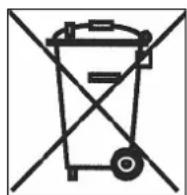
- Don't throw your appliance with the household refuses
- Get in touch with the waste collection center of your commune that is adapted to the recycling of the household appliances.
The installation comes under the exclusive responsibility of specialists.
The installer is held to respect the legislation and the standards enforce in his home country.
Fitting - installing:
| Appliance | Worktop Cut-out (mm) | Glass Cut-out (if “flushline” integration) | |||
| Width x Depth | W | D | T | Radius | |
| MIB-60 560 x 490 596 | 526 | 5 1 | 1 | ||
- The piece of furniture or the support in which the hob is to be fitted, as well as the edges of furniture, the laminate coatings and the glue used to fix them, must be able to resist temperatures of up to 100^ .
The mural rods of edge must be heat-resisting. - The hobs are classified as "Y" class for heat protection. Ideally the hob should be installed with plenty of space on either side. There may be a wall at the rear and tall units or a wall at one side. On the other side, however, no unit or divider must stand higher than the hob.
- Ensure that there is a distance of 50~mm between the hob and the wall or sides.
- Materials which are often used to make worktops expand on contact with water. To protect the cut out edge, apply a coat of varnish or special sealant. Particular care must be given to applying the adhesive joint supplied with the hob to prevent any leakage into the supporting furniture. This gasket guaranties a correct seal when used in conjunction with smooth work top surfaces.
- Not to install the hob to the top of a not ventilated oven or a dishwasher.
- To guarantee under the bottom of the hob casing a space of 20mm to ensure a good air circulation of the electronic device.
- To guarantee between the work top and the top of the drawer or oven a space of 5mm to allow the exit of the air flow.
- If a drawer is placed under the work, avoid to put into this drawer flammable objects (for example : sprays) or not heat-resistant objects.
- The safety gap between the hob and the cooker hood placed above must respect the indications of the hood manufacturer. In case of absence of instructions respect a distance minimum of 760~mm .
- The connection cord should be subjected, after bulting, with no mechanical constraint, such for example of the fact of the drawer.
- The installation of the hob in non stationary sites (for example : boat ) should be undertaken by specialists.
How to stick the gasket:
The gasket supplied with the hob avoids all infiltration of liquids in the cabinet. His installation has to be done carelessly, in conformity of the following drawing.
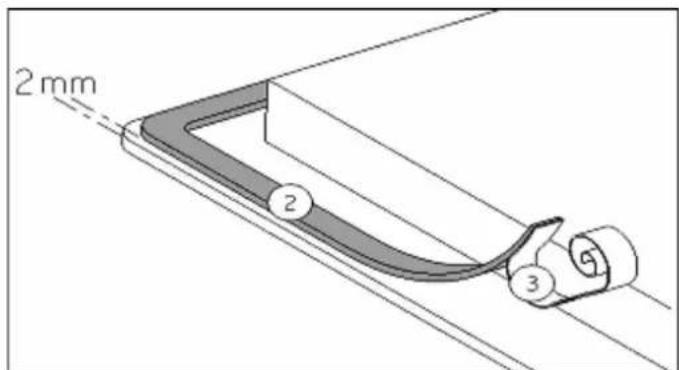
Stick the gasket (2) two millimeters from the external edge of the glass, after removing the protection sheet (3).
ELECTRICAL CONNECTION
The installation of this appliance and the connection to the electrical network should be entrusted only to an electrician perfectly to the fact of the normative regulations and which respects them scrupulously.
Protection against the parts under tension must be ensured after the bulting-in.
The data of connection necessary are on the stickers place on the hob casing near the connection box.
The connection to the main must be made using an earthed plug or via an omnipolar circuit breaking device with a contact opening of at least 3mm .
The electrical circuit must be separated from the network by adapted devices, for example : circuit breakers, fuses or contactors.
| Mains | Connection | Cable diameter | Cable | Protection calibre |
| 230V~1P 50Hz | 1 Phase + N | 3 x 2.5 mm² | H 05 VV - F H 05 RR - F | 25 A* |
| 400V~2P 50Hz | 2 Phases + N | 4 x 1.5 mm² | H 05 VV - F H 05 RR - F | 16 A* |
(^*) calculated with the simultaneous factor following standard TN 60 335-2-6/1990
Caution!
This appliance has only to be connected to a network 230V 50Hz Connect always the earth wire.
Respect the connection diagram.
The connection box is located underneath at the back of the hob casing. To open the cover use a medium screwdriver. Place it in the slits and open the cover.
Connection of the hob
The ceramic hob can be connected in different ways:
Monophase 230V 1P + N
Biphas 400V\~2P+N
Setting up the configurations:
For the various kinds of connection, use the brass bridges which are in the box next the terminal
Monophase 230V 1P + N
Put the 1^st bridge between terminal 1 and 2, the 2^nd between 3 and 4.
Attach the earth to the terminal "earth", the neutral N to terminal 3 or 4, the Phase L to one of the terminals 1 or 2.
Biphas 400V\~2P+N
Put a bridge between terminal 3 and 4.
Attach the earth to the terminal "earth", the neutral N to terminal 3 or 4, the Phase L1 to the terminals 1 and the Phase L2 to the terminal 2.
Caution! ensure that you :
-
correctly attach the wires and the bridges.
-
tighten the screws properly.
Before making the connection, we strongly advise you to locate the phase(s), neutral and earth on the mains. If you have any doubts, call your electrician.
Note: the bridges between terminals 3-4 and between terminals 1-2 were installed during the factory check.
We cannot be held responsible for any incident resulting from incorrect connection or which could arise from the use of an appliance which has not been earthed or has been equipped with a faulty earth connection.
Chere cliente, cher client,
Touches sensitives 29
Affichage 29
Detection de recipient 30
Appuyer ensemble [-] et [+]

- BESCHRIJVING VAN HET APPARAAT
- SUMMARY
- Precautions before using
- Using the appliance
- Cleaning
- Precautions not to damage the appliance
- Precautions in case of appliance failure
- Other protections
- DESCRIPTION OF THE APPLIANCE
- Technical data
- Control panel
- USE OF THE APPLIANCE
- Sensitive touches
- Display
- Residual heat indicator
- Ventilation
- STARTING-UP AND APPLIANCE MANAGEMENT
- Before the first use
- Induction principle
- Starting-up
- Pan detection
- Residual heat indication
- Control panel locking
- - Locking :
- - Unlocking :
- COOKING ADVICES
- Pan quality
- Pan dimension
- Examples of cooking power setting
- MAINTENANCE AND CLEANING
- The symbol [E4] displays:
- The hob or the cooking zone doesn't start-up :
- The symbol [U] displays:
- The symbol [F] displays :
- The symbol [E] displays:
- One or all cooking zones cut-off :
- Continuous ventilation after cutting-off the hob :
- The automatic cooking system « go and stop » doesn't start-up :
- ENVIRONMENT PRESERVATION
- How to stick the gasket:
- ELECTRICAL CONNECTION
- Caution!
- Connection of the hob
- Chere cliente, cher client,
Brand : M-SYSTEM
Model : MIB60
Category : Pan