
MCGW30IX - Cooker M-SYSTEM - Free user manual and instructions
Find the device manual for free MCGW30IX M-SYSTEM in PDF.



| Product type | Built-in gas hob (domino) |
| Brand | M-System |
| Model | MCGW30IX |
| Number of burners | 2 (1 semi-rapid SR 1.75 kW, 1 rapid R 3.00 kW) or 1 triple crown TC 3.50 kW depending on configuration |
| Power supply | Gas (G20/G25 20/25 mbar or G30/G31 28-30/37 mbar) and electric 230 V ~ 50 Hz for ignition |
| Dimensions (W x D) | 510 x 288 mm (approx.) |
| Worktop thickness | 20 to 40 mm |
| Weight | Approx. 8 kg |
| Safety system | Safety thermocouple (gas shut-off if flame extinguished) |
| Ignition | Built-in electronic (push button or integrated in knobs) |
| Material | Enamel, stainless steel (parts) |
| Appliance class | Class 3 (built-in) |
| Protection rating | IPX4 (estimate) |
| Cleaning and maintenance | Soft cloth with soapy water, avoid abrasive products, chlorine detergents and metal sponges |
| Available spare parts | Injectors, burners, grates, knobs, seals |
| Reparability | Interventions reserved for qualified technician (after-sales service) |
| Warranty | According to manufacturer's conditions (not specified in the manual) |
| Intended use | Cooking food only (room heating prohibited) |
| Installation | Recessed in heat-resistant furniture, depth 600 mm, minimum distance 650 mm above |
| Gas connection | Threaded connection G 1/2", flexible stainless steel hose max length 2 m |
| Electrical connection | 230 V ~ 50 Hz, cable 3 x 0.75 mm² type H05V2V2-F, mandatory earthing |
Frequently Asked Questions - MCGW30IX M-SYSTEM
User questions about MCGW30IX M-SYSTEM
0 question about this device. Answer the ones you know or ask your own.
Ask a new question about this device
Download the instructions for your Cooker in PDF format for free! Find your manual MCGW30IX - M-SYSTEM and take your electronic device back in hand. On this page are published all the documents necessary for the use of your device. MCGW30IX by M-SYSTEM.
USER MANUAL MCGW30IX M-SYSTEM
Instruction for the use Installation advice
| Nederlands | Gebruiksaanwijzing en installatievoorschriften | Bladzijde 3 |
| Deutsch | Gebrauchsanweisung Installationsanleitung | Seite 25 |
| Français | Mode d'emploi - Conseils pour l'installation | Page 47 |
| Español | Instrucciones de uso - Consejos para la instalación | Página 69 |
| English | Instruction for the use - Installation advice | Page 91 |
Geachte Klant,
natural_image
Simple diagram with a circle and a star above it, labeled 'Afb. 2.2' at the bottom (no text or symbols within the diagram itself)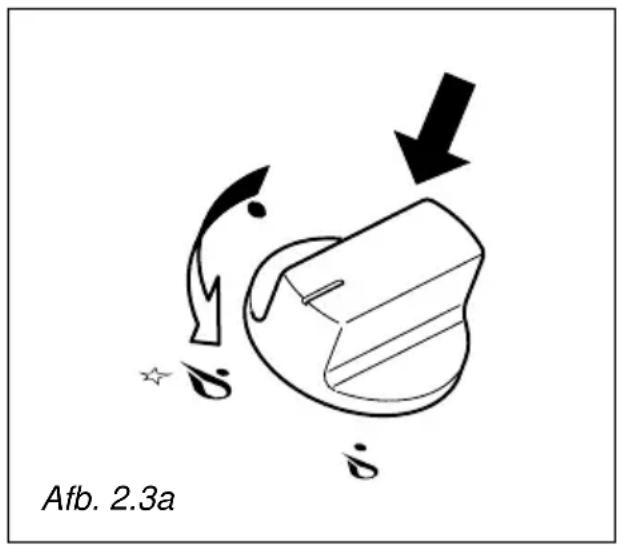
ONSTEKING VAN DE BRANDERS MET VEILIGHEIDSVENTIEL
natural_image
Line drawing of a cooking pot on a stove (no text or symbols)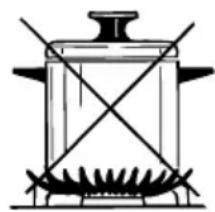
natural_image
Simple line drawing of a cooking pot with crossed panes (no text or symbols)Afb. 2.4
natural_image
Technical line drawing of a gas stove or pressure vessel (no text or symbols)GOED
natural_image
Line drawing of a mechanical device with a central shaft and two arms extending upward (no text or symbols)Afb. 2.5b
ALGEMENE RAAD
natural_image
Mechanical assembly diagram showing a rotating component with a curved arrow indicating motion (no text or symbols)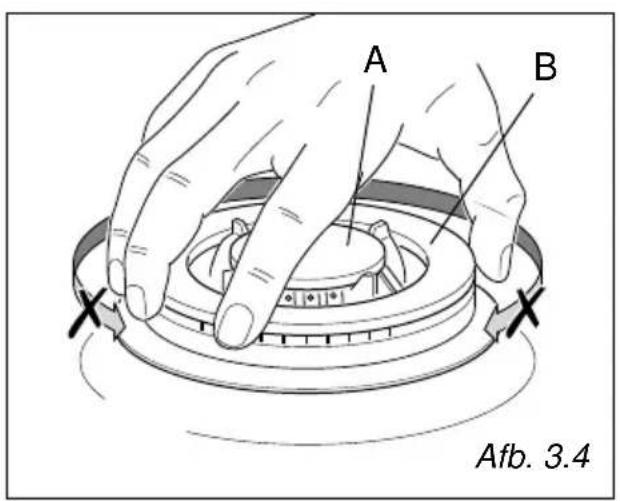
natural_image
Line drawing of a hand using a wrench to adjust a mechanical component (no text or symbols present)VERVANGING SPROEIERS VAN DE BRANDERS
natural_image
Technical line drawing of a screwdriver with a base mount, labeled 'Afb. 5.6' (no other text or symbols)DE GASKRANEN SMEREN
natural_image
Simple diagram with a circle and a star above it, labeled 'Abb. 2.2' (no text or symbols within the diagram itself)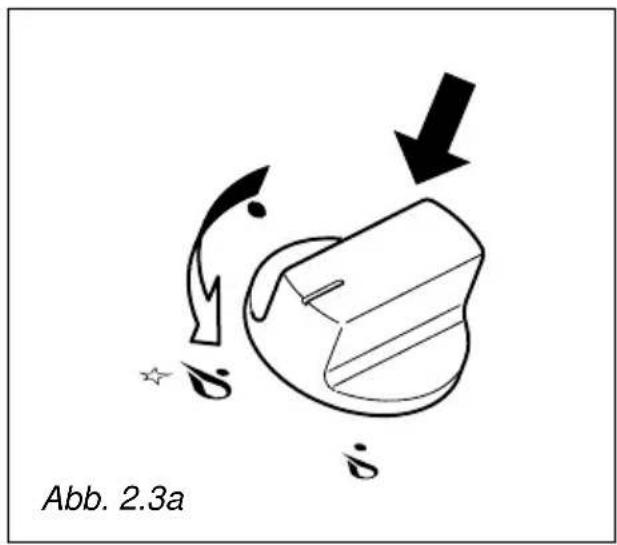
natural_image
Line drawing of a cooking pot on a stove (no text or symbols)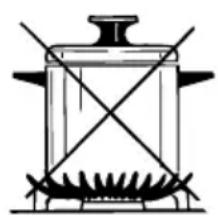
natural_image
Simple line drawing of a cooking pot with crossed panes and a side dish (no text or symbols)Abb. 2.4
natural_image
Mechanical assembly diagram showing a rotating component with a curved arrow indicating motion, labeled 'Abb. 3.3' (no text or symbols on the diagram itself)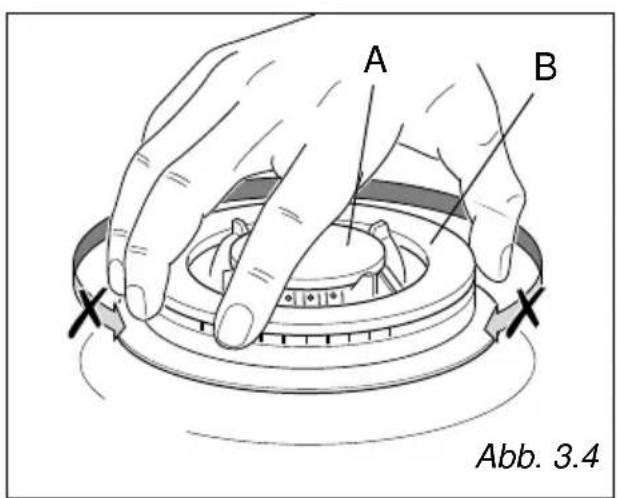
natural_image
Three-step diagram showing a mechanical component with cross marks, no text or symbols presentnatural_image
Line drawing of a hand using a wrench to adjust a gas stove burner (no text or symbols present)AUSTAUSCH DER DÜSEN
natural_image
Technical line drawing of a screwdriver with a base mount, labeled Abb. 5.6 (no text or symbols on the diagram itself)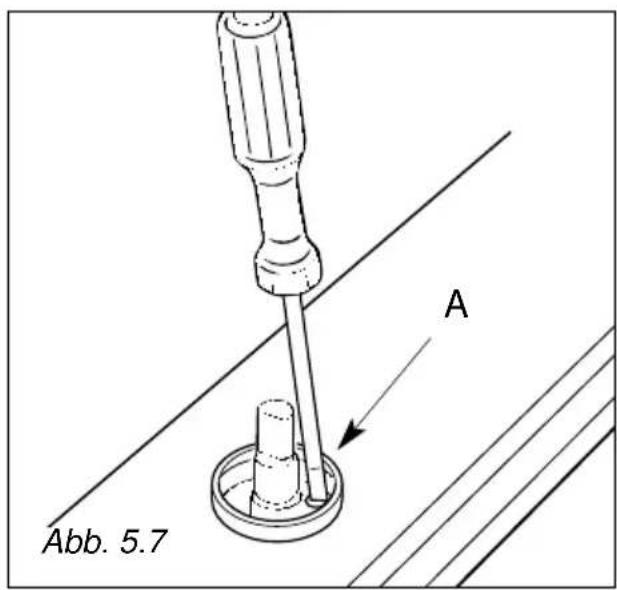
natural_image
Simple diagram of a circle with vertical division and symbols (no text or labels)Fig. 2.1a
IMPORTANT :
natural_image
Simple diagram of a circle with vertical division and two downward arrows, no text or symbols present.Fig. 2.1b
ALLUMAGE DES BRULEURS
natural_image
Simple diagram with a circle and a star above it, labeled 'Fig. 2.2' (no text or symbols on the diagram itself)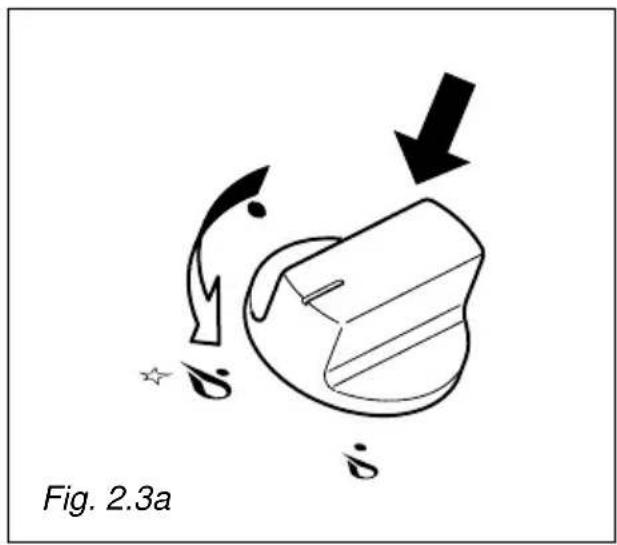
natural_image
Diagram showing a mechanical component with arrows indicating motion, labeled Fig. 2.3a (no text or symbols on the diagram itself)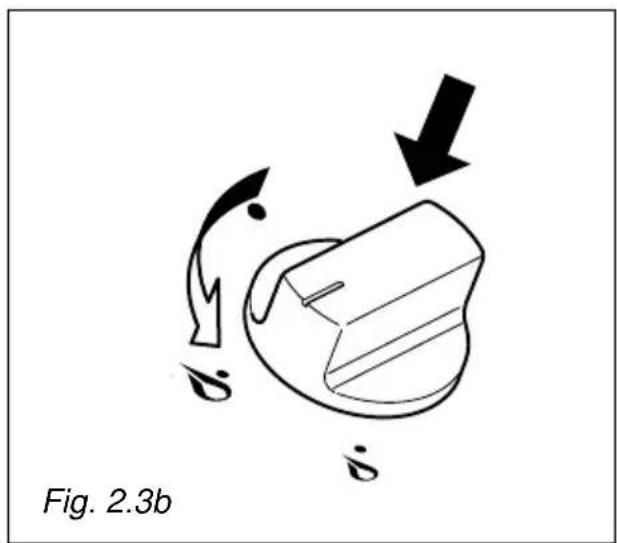
natural_image
Diagram of a mechanical component with arrows indicating motion, labeled Fig. 2.3b (no text or symbols on the diagram itself)ALLUMAGE DES BRULEURS AVEC SYSTEME DE SECURITE
natural_image
Line drawing of a cooking pot with a lid and side handles, placed on a gas stove (no text or symbols)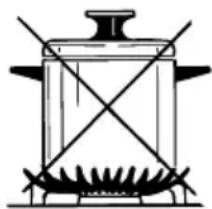
natural_image
Simple line drawing of a cooking pot with stirrer (no text or symbols)Fig. 2.4
natural_image
Mechanical assembly diagram showing a rotating component with a curved arrow indicating motion (no text or symbols)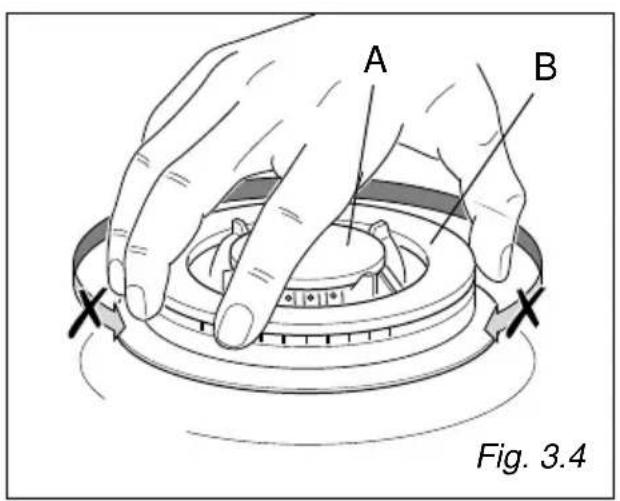
natural_image
Three-step diagram showing a mechanical component with cross marks, no text or symbols presentEVACUATION DES PRODUITS DE COMBUSTION
√ 1 ecrou "A"
√ 1 raccord coudé "C"
√ joint "F"
√ 1 ecrou "A"
√ 1 raccord coudé "C"
√ joint "F"
√ 1 raccord conique "G"
natural_image
Illustration of a hand using a wrench to adjust a component on a metal shelf (no text or symbols)ADAPTATION AUX DIFFERENTS TYPES DE GAZ
natural_image
Technical line drawing of a mechanical component with labeled part 'J' and directional arrow, no readable text or symbols beyond labelFR BE
TABLEAU DES INJECTEURS - Cat: II 2E+ 3+
natural_image
Technical line drawing of a screwdriver with a base mount, labeled Fig. 5.6 (no text or symbols on the diagram itself)LUBRIFICATION DES ROBINETS DE GAZ
natural_image
Simple diagram with a circle and star above it, labeled Fig. 2.2 (no text or symbols on the diagram itself)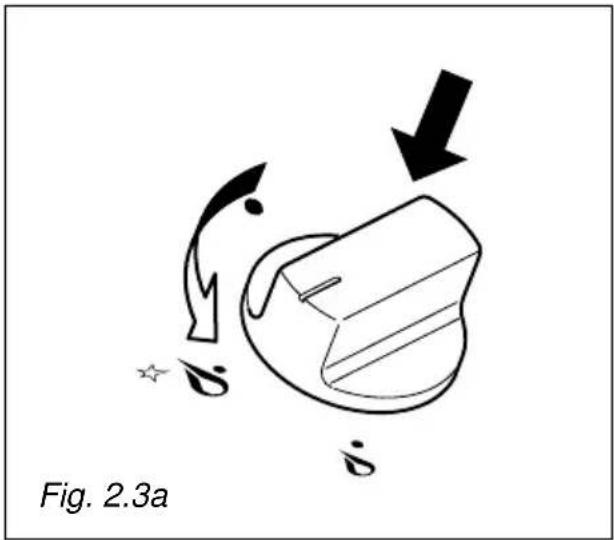
natural_image
Diagram showing a mechanical component with arrows indicating motion, labeled Fig. 2.3a (no text or symbols on the diagram itself)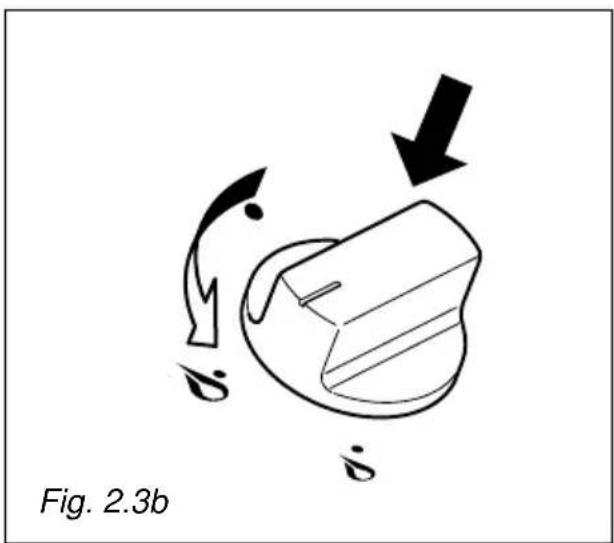
natural_image
Diagram of a mechanical component with arrows indicating motion, labeled Fig. 2.3b (no text or symbols on the diagram itself)natural_image
Line drawing of a cooking pot on a stove (no text or symbols)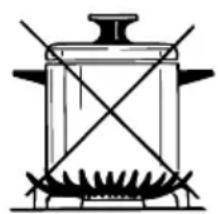
natural_image
Simple line drawing of a cooking pot with panes and a chimney, no text or symbols presentFig. 2.4
natural_image
Illustration of a gas stove with cooling fan and handle (no text or symbols)INCORRECTO
natural_image
Diagram showing two hands holding a bowl over a table with crossed black lines (no text or symbols)Fig. 2.5a
natural_image
Technical line drawing of a gas stove or pressure vessel (no text or symbols)CORRECTO
natural_image
Line drawing of a laboratory apparatus with a curved tube and two handles (no text or symbols)Fig. 2.5b
CONSEJOS GENERALES
Fig. 3.2
natural_image
Mechanical assembly diagram showing a rotating component with a curved arrow indicating motion (no text or symbols)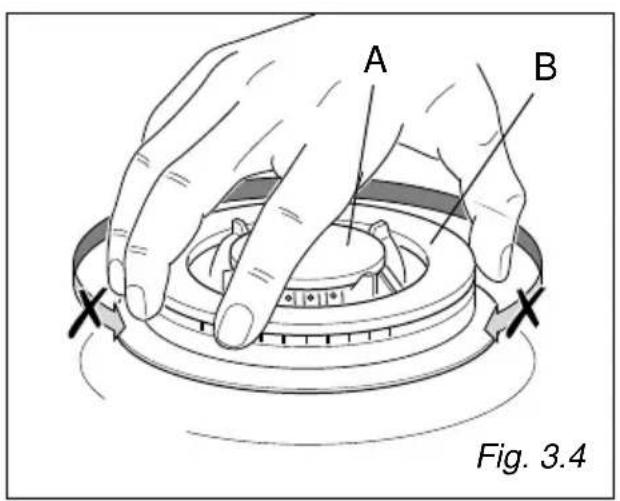
natural_image
Three-step diagram showing a mechanical component with cross marks, no text or symbols presentnatural_image
Line drawing of a hand using a wrench to adjust a component on a metal shelf (no text or symbols)natural_image
Technical line drawing of a mechanical component with labeled part 'J' and directional arrow, no readable text or symbols beyond labelES
TABLA DE INYECTORES - Cat: II 2H 3+
| QUEMADOR | PORTADA NOMINAL [kW] | PORTADA REDUC. [kW] | G30/G31 28-30/37 mbar | G20 20 mbar |
| ∅ inyectores [1/100 mm] | ∅ inyectores [1/100 mm] | |||
| Semirrápido (SR 1,75 0) | 45 65 97 (Z) | |||
| Rápido (R) 3,00 0,75 85 | 115 (Y) | |||
| Superquemador (TC) | 3,50 1,50 95 135 (T) |
natural_image
Technical line drawing of a screwdriver with a circular base, mounted on a diagonal surface (no text or symbols)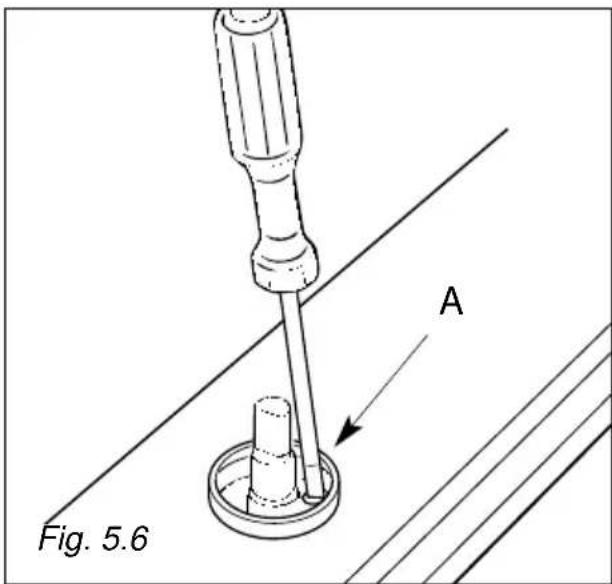
Thank you for having purchased and given your preference to our product.
The safety precautions and recommendations given below are for your own safety and that of others. They will also provide a means by which to make full use of the features offered by your appliance.
Please keep this booklet carefully. It may be useful in future, either to yourself or to others if doubts should arise relating to its operation.
This appliance must be used only for the task it has explicitly been designed for, that is for cooking foodstuffs. Any other form of usage is to be considered as inappropriate and therefore dangerous.
The manufacturer declines all responsibility in the event of damage caused by improper, incorrect or unreasonable use of the appliance.
DECLARATION OF CE CONFORMITY
- This cooking hob has been designed to be used only for cooking. Any other use (such as heating a room) is improper and dangerous.
- This cooking hob has been designed, constructed, and marketed in compliance with:
-Safety requirements of the "Gas" Directive 90/396/EEC;
-Safety requirements of EEC Directive "Low voltage" 73/23;
-Safety requirements of EEC Directive "EMC" 89/336;
-Requirements of EEC Directive 93/68.
CE
These instructions are only valid for the countries indicated by the symbols on the cover of the instruction booklet and on the appliance itself.
IMPORTANT PRECAUTIONS AND RECOMMENDATIONS
√ After having unpacked the appliance, check to ensure that it is not damaged. If you have any doubts, do not use it and consult your supplier or a professionally qualified technician.
√ Packing elements (i.e. plastic bags, polystyrene foam, nails, packing straps, etc.) should not be left around within easy reach of children, as these may cause serious injuries.
√ The packaging material is recyclable and is marked with the recycling symbol ⬆.
√ Do not attempt to modify the technical characteristics of the appliance as this may become dangerous to use.
√ The manufacturer cannot be considered responsible for damage caused by unreasonable, incorrect or rash use of the appliance.
√ If you should decide not to use this appliance any longer (or decide to substitute an older model), before disposing of it, it is recommended that it be made inoperative in an appropriate manner in accordance to health and environmental protection regulations, ensuring in particular that all potentially hazardous parts be made harmless, especially in relation to children who could play with old appliances.
√ The appliance should be installed and all the gas/electrical connections made by a qualified engineer in compliance with local regulations in force and following the manufacturer's instructions
IMPORTANT PRECAUTIONS AND RECOMMENDATIONS FOR USE OF ELECTRICAL APPLIANCES
Use of any electrical appliance implies the necessity to follow a series of fundamental rules. In particular:
√ Never touch the appliance with wet hands or feet;
√ do not operate the appliance barefooted;
√ do not allow children or disabled people to use the appliance without your supervision.
The manufacturer cannot be held responsible for any damages caused by improper, incorrect or unreasonable use of the appliance.
TIPS FOR THE USER
√ During and after use of the cook-top, certain parts will become very hot. Do not touch hot parts.
√ Keep children away from the cooking hob when it is in use.
√ After use, ensure that the knobs are in position • (off), and close the main gas delivery valve or the gas cylinder valve.
√ In case of difficulty in the gas taps operation, call Service.
√ Before any cleaning or maintenance, switch off the electricity to the cooktop.
Risk of fire!
√ Do not leave inflammable material on the cooktop.
√ Make sure that the electrical cables of other appliances installed near-by cannot come into contact with the cooktop.
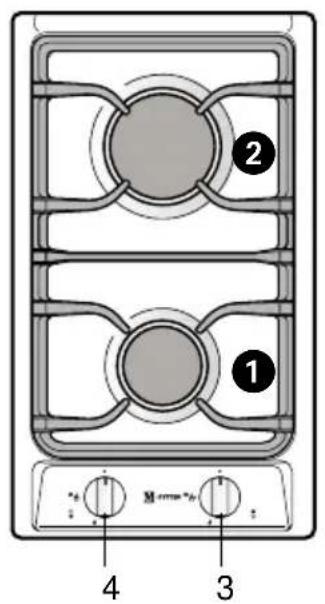
Fig. 1.1a
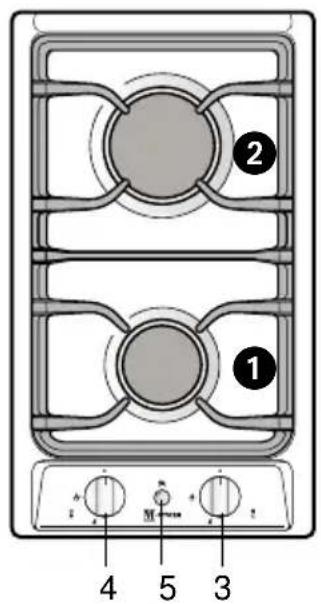
(*)
Fig. 1.1b
"2 GAS" COOKING HOB - with or without safety device - The appliance has class 3
COOKING POINTS
- Semirapid burner (SR) - 1,75 kW
- Rapid burner (R) - 3,00 kW
CONTROL PANEL DESCRIPTION
- Burner 2 (R) control knob
- Burner 1 (SR) control knob
(*) 5. Electric gas-lighting device. If the device is not installed, the appliance may be provided with:
- a gas-lighter incorporated in the knob ( symbol beside flame - maximum aperture or max ga flow)
- no gas-lighter (no symbol beside the knob)
NOTE:
If the appliance has a safety valve system fitted (beside every burner is a T-shaped probe, as in Fig. 3.1 - not to be confused with the S-shaped electrode of the gas-lighter), the flow of gas will be stopped if and when the flame should accidentally go out.
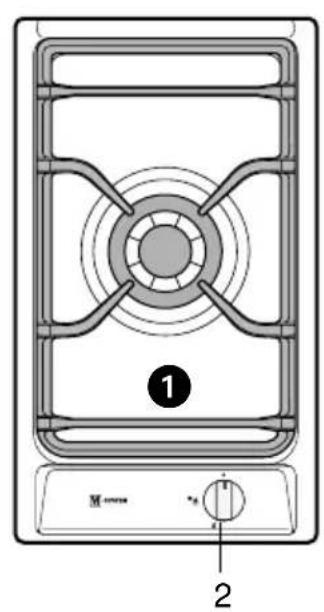
Fig. 1.2a
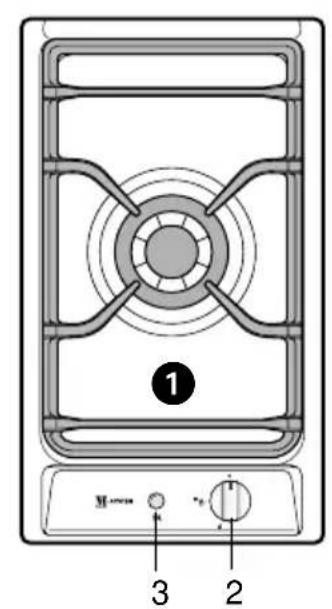
Fig. 1.2b
(*)
"1 GAS triple ring burner" COOKING HOB
- with or without safety device -
The appliance has class 3
COOKING POINT
- Triple ring burner - 3,50 kW
CONTROL PANEL DESCRIPTION
- Triple ring burner control knob
(*) 3. Electric gas-lighting device. If the device is not installed, the appliance may be provided with:
- a gas-lighter incorporated in the knob (★ symbol beside flame - ⚡ maximum aperture or max ga flow)
- no gas-lighter (no symbol beside the knob)
NOTE:
If the appliance has a safety valve system fitted (beside every burner is a T-shaped probe, as in Fig. 3.1 - not to be confused with the S-shaped electrode of the gas-lighter), the flow of gas will be stopped if and when the flame should accidentally go out.
GAS BURNERS
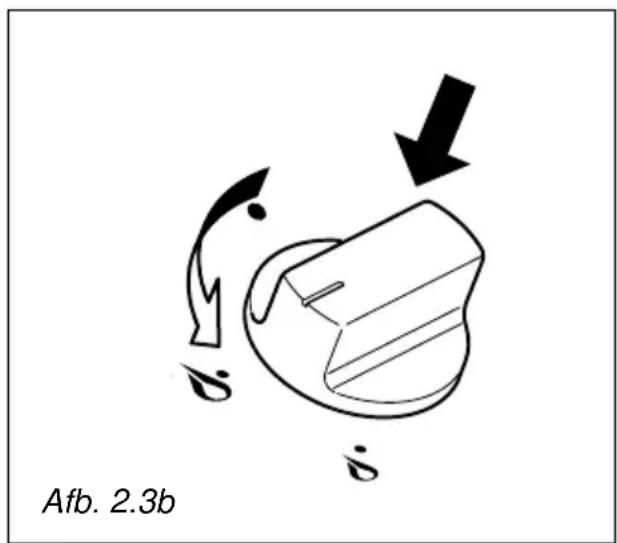
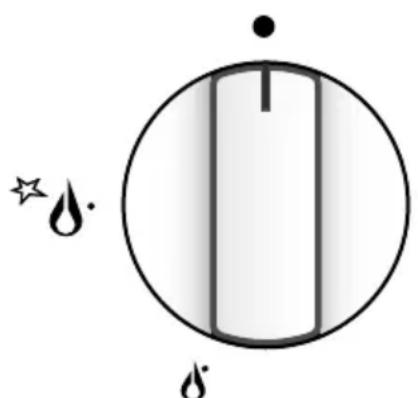
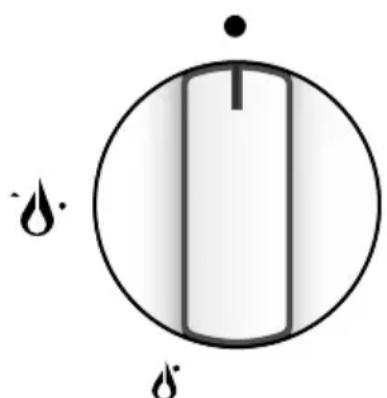
Gas flow to the burners is adjusted by turning the knobs illustrated in fig. 2.1a - 2.1b which control the gas valves.
Turning the knob so that the indicator line points to the symbols printed on the panel achieves the following functions:
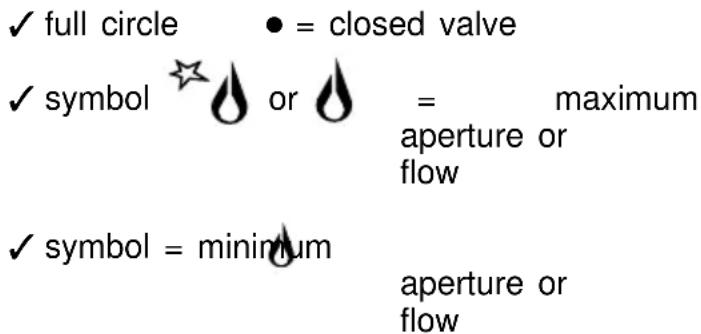
√ To reduce the gas flow to minimum, rotate the knob further anti-clockwise to point the indicator towards the small flame symbol.
√ The maximum aperture position permits rapid boiling of liquids, whereas the minimum aperture position allows slower warming of food or maintaining boiling conditions of liquids.
√ Other intermediate operating adjustments can be achieved by positioning the indicator between the maximum and minimum aperture positions, and never between the maximum aperture and closed positions.
natural_image
Simple diagram with a circle, vertical bar, and symbols (no readable text or labels)Fig. 2.1a
CAUTION:
If the burner is accidentally extinguished, turn the gas off at the control knob and wait at least 1 minute before attempting to relight.
CAUTION:
Gas hobs produce heat and humidity in the environment in which they are installed.
Ensure that the cooking area is well ventilated by opening the natural ventilation grilles or by installing an extractor hood connected to an outlet duct.
CAUTION:
If the hob is used for a prolonged time it may be necessary to provide further ventilation by opening a window or by increasing the suction power of the extractor hood (if fitted).
Caution!
the cooking hob becomes very hot during operation.
Keep children well out of reach.
natural_image
Simple diagram of a circle with vertical division and two droplets below, no text or symbols present.Fig. 2.1b
Models without electric ignition
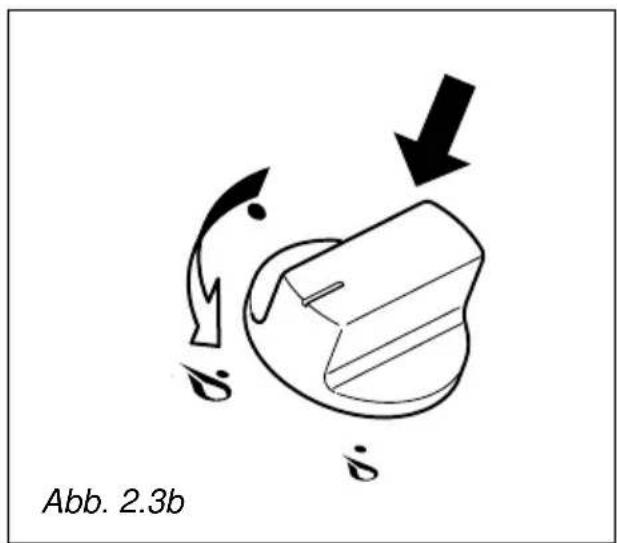
To light one of the gas burners, hold a flame (e.g. a match) close to the top part of the burner, push in and turn the relative knob (fig. 2.1b) in an anti-clockwise direction (fig. 2.3b), pointing the knob indicator towards the large flame symbol ⚠ (i.e. max. gas flow).
Models fitted with electric spark lighter button
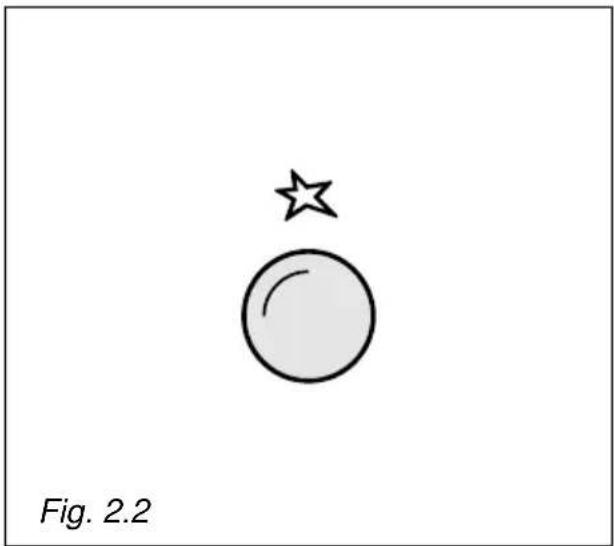
On these cooker tops, to light one of the burners you have to push in and turn the relative knob (figs. 2.1b - 2.3b) to the maximum aperture position (large flame symbol 🌐 and press the electric lighter button (fig. 2.2) until the flame has been lit.
Adjust the gas valve to the desired position.
Models fitted with electric lighter incorporated into the burner knobs
The electric ignition is incorporated in the knobs ( symbol beside the symbol - max. heat/max. gas flow) (fig. 2.1a).
To light one of the gas burners, push in and turn the relative knob to the maximum aperture position (large flame symbol) and hold the knob in until the flame has been lit.
The sparks produced by the lighter situated inside the relative burner will light the flame.
In case of black-out, bring a lighted match close to the burner.
In the event that the local gas supply conditions makes it difficult to light the burner in maximum aperture position, try again with the knob in minimum position.
natural_image
Simple diagram with a circle and star above it, labeled Fig. 2.2 (no text or symbols on the diagram itself)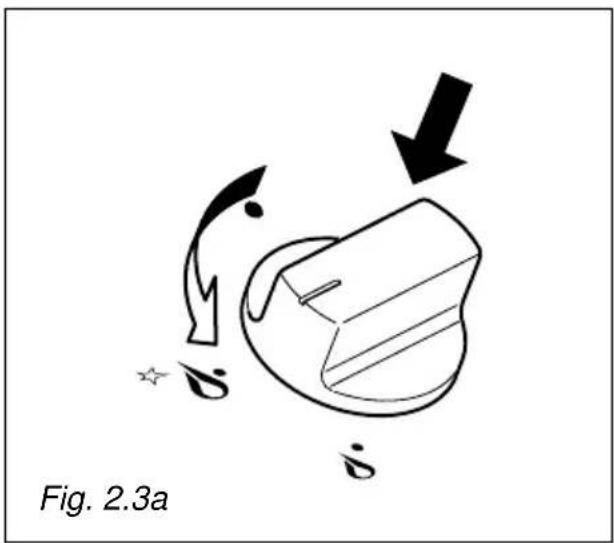
natural_image
Diagram of a mechanical component with arrows indicating motion, labeled Fig. 2.3a (no text or symbols on the diagram itself)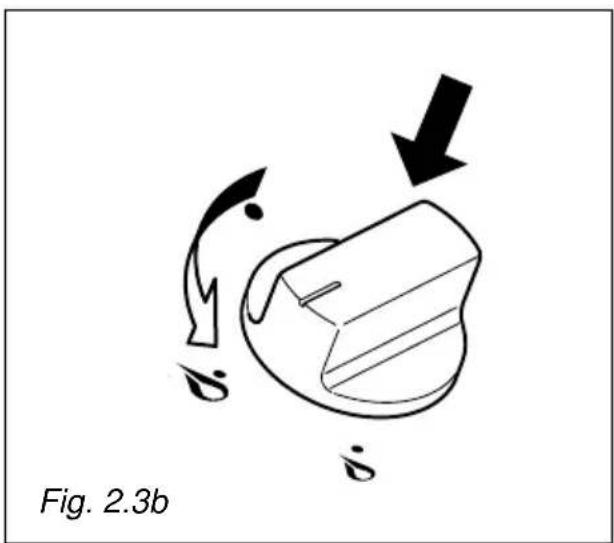
natural_image
Diagram of a mechanical component with arrows indicating motion, labeled Fig. 2.3b (no text or symbols on the diagram itself)LIGHTING GAS BURNERS FITTED WITH SAFETY VALVE DEVICE
In order to light the burner, you must:
1 - Turn the knob in an anti-clockwise direction up to the maximum aperture, push in and hold the knob;
In models with the gas lighter incorporated in the knob, this will light the gas. If there is no mains electrical supply, bring a lighted match close to the burner.
For models with push-button lighting only: push the gas-lighter button.
In case of black-out, bring a lighted match close to the burner.
2 – Wait about ten seconds after the gas lighting before releasing the knob (starting time for the valve).
3 - Adjust the gas valve to the desired position.
If the burner flame should go out for some reason, the safety valve will automatically stop the gas flow.
To re-light the burner, return the knob to the closed ● position, wait for at least 1 minute and then repeat the lighting procedure.
If your local gas supply makes it difficult to light the burner with the knob set to maximum, set the knob to minimum and repeat the operation.
CHOICE OF BURNER
On the control panel, near every knob, there is a diagram that indicates which burner is controlled by that knob.
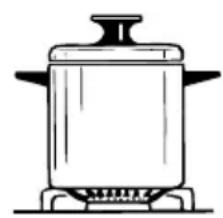
The suitable burner must be chosen according to the diameter and the capacity used.
As an indication, the burners and the pots must be used in the following way:
| DIAMETERS OF PANS WHICH MAY BE USED ON THE HOBS |
| BURNERS MINIMUM MAX. |
| Semirapid 12 cm 22 cm |
| Rapid 22 cm 26 cm |
| Triple-ring 24 cm 28 cm |
| Maximum diameter for woks: 36 cm |
| do not use pans with concave or convex bases |
natural_image
Line drawing of a cooking pot on a gas stove (no text or symbols)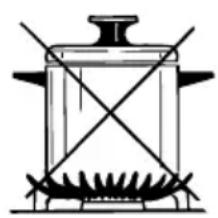
natural_image
Simple line drawing of a cooking pot with crossed panes and a side dish (no text or symbols)Fig. 2.4
It is important that the diameter of the pots or pans suitably match the heating potential of the burners in order not to jeopardise the efficiency of the burners, bringing about a waste of gas fuel.
A small diameter pot or pan placed on a large burner does not necessarily mean that boiling conditions are reached quicker.
Only used flat bottomed pans.
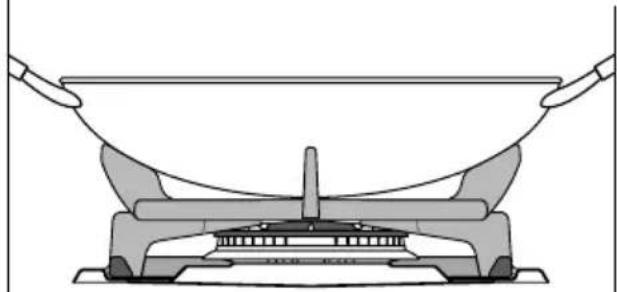
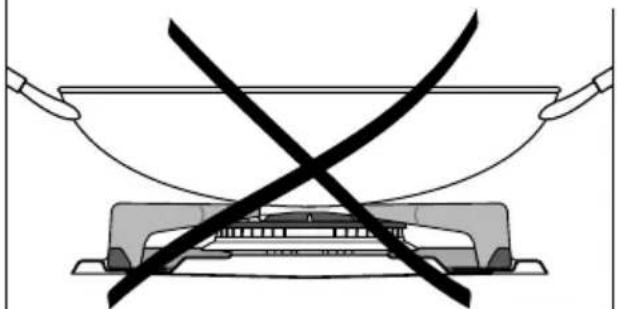
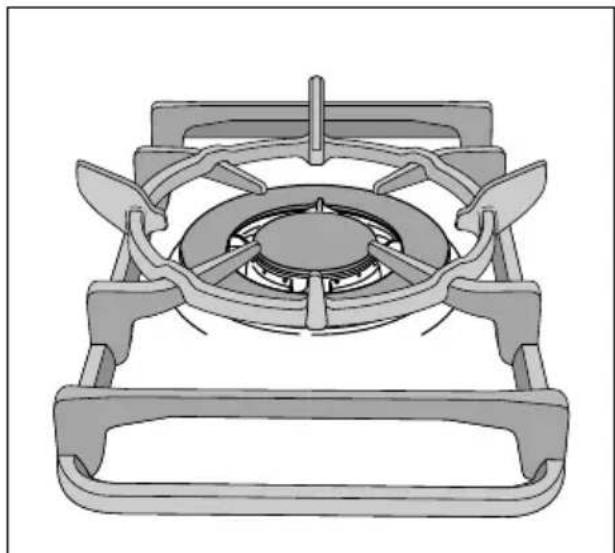
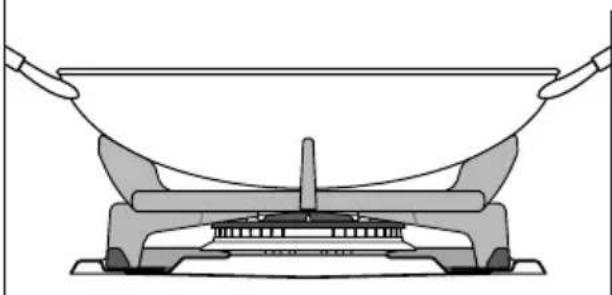
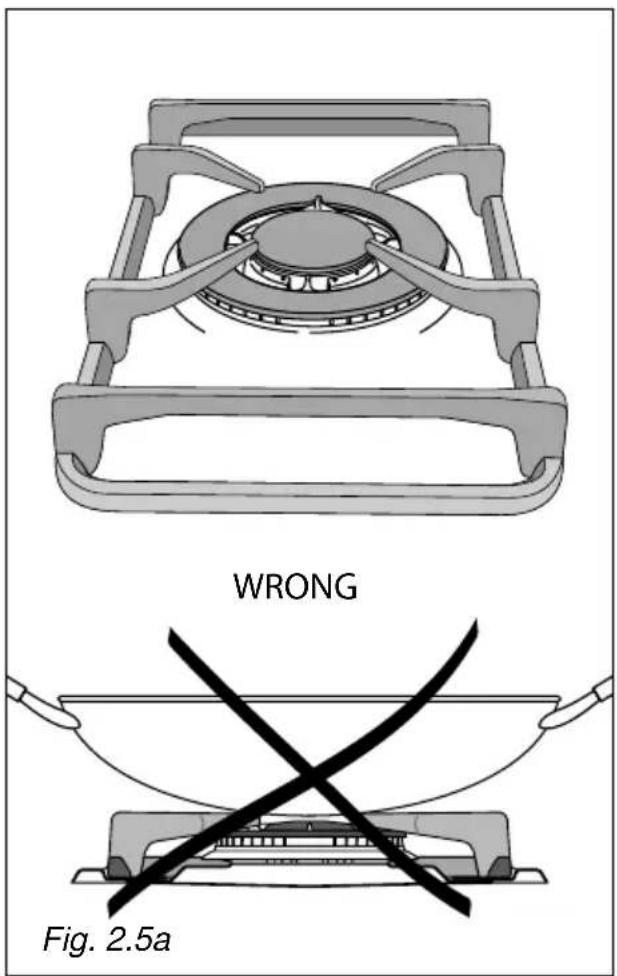
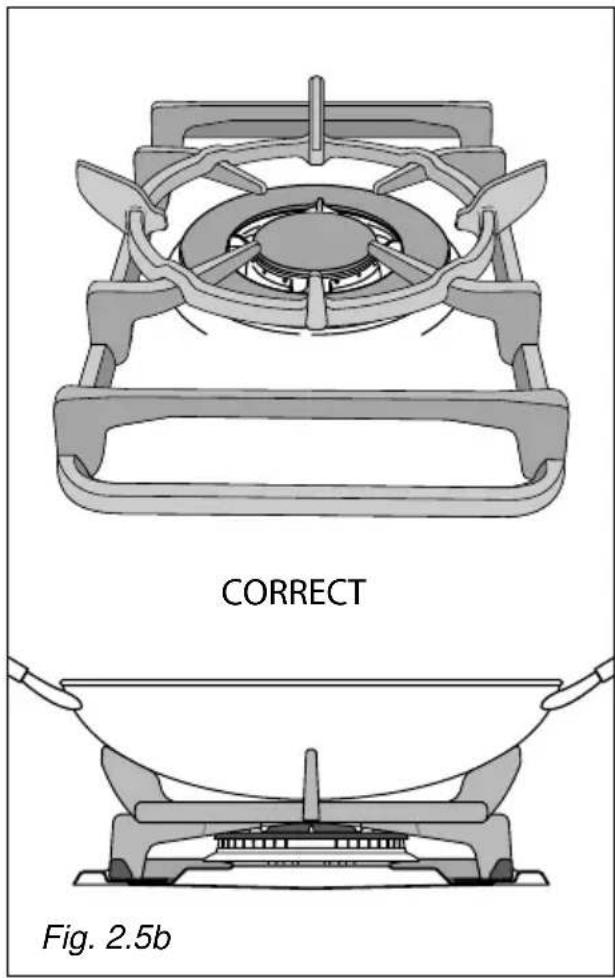
SPECIAL WOK GRILLE - optional (Fig. 2.5a - 2.5b)
This special grille for woks should be placed over the pan-rest for the triple ring burner.
Warning:
√ Using woks without this special grille may cause the burner to malfunction.
√ Do not use the grille for ordinary, flat-bottomed saucepans.
GENERAL ADVICE
√ Before you begin cleaning you must ensure that the hob is switched off.
It is advisable to clean when the appliance is cold and especially when cleaning the enamelled parts.
√ All enamelled surfaces have to be washed with soapy water or some other non-abrasive product with a sponge and are to be dried preferably with a soft cloth.
√ Avoid leaving alkaline or acid substances (lemon juice, vinegar etc.) on the surfaces.
ENAMELLED PARTS
√ All the enamelled parts must be cleaned with a sponge and soapy water only or other non-abrasive products.
√ Dry preferably with a chamois leather. If acid substances such as lemon juice, tomato conserve, vinegar etc. are left on the enamel for a long time they will etch it, making it opaque.
STAINLESS STEEL ELEMENTS
√ Stainless steel parts must be rinsed with water and dried with a soft and clean cloth or with a chamois leather.
√ For persistent dirt, use specific non-abrasive products available commercially or a little hot vinegar.
√ Note: regular use could cause discolouring around the burners, because of the high flame temperature.
CONTROL KNOB
√ The control knobs may be removed for cleaning but care should be taken not to damage the seal.
GAS TAPS
√ Periodic lubrication of the gas taps must be carried out by specialist personnel only.
√ In the event of operating faults in the gas taps, call the Service Department.
BURNERS AND GRIDS
√ These parts can be removed and cleaned with appropriate products.
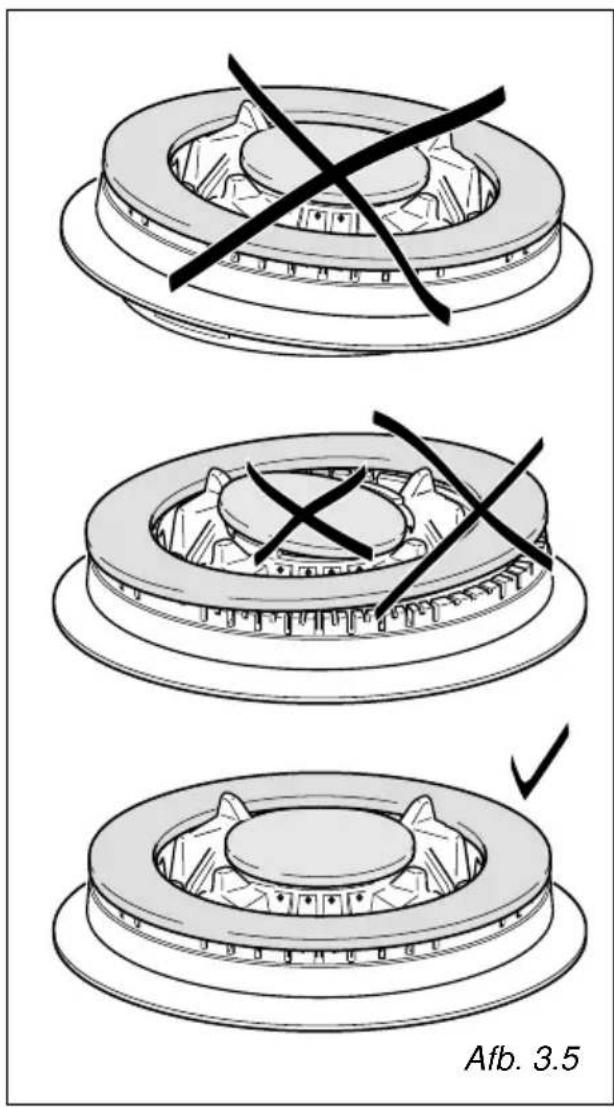
√ After cleaning, the burners and their flame spreaders must be well dried and correctly replaced.
√ It is very important to check that the burner flame spreader and the cap have been correctly positioned. Failure to do so can cause serious problems.
√ In the models with safety device, check that the probe next to each burner is always clean to ensure correct operation of the safety valves.
√ In appliances with electric ignition keep the electrode clean so that the sparks always strike.
√ Note: To avoid damage to the electric ignition do not use it when the burners are not in place.
CORRECT REPLACEMENT OF THE BURNERS
It is very important to check that the burner flame spreader “F” and the cap “C” have been correctly positioned (see figs. 3.1 and 3.2).
Failure to do so can cause serious problems.
In appliances with electric ignition check that the electrode "S" (fig. 3.1) is always clean to ensure trouble-free sparking.
In the models with safety device, check that the probe “T” (fig. 3.1) next to each burner is always clean to ensure correct operation of the safety valves.
Both the probe and ignition plug must be very carefully cleaned.
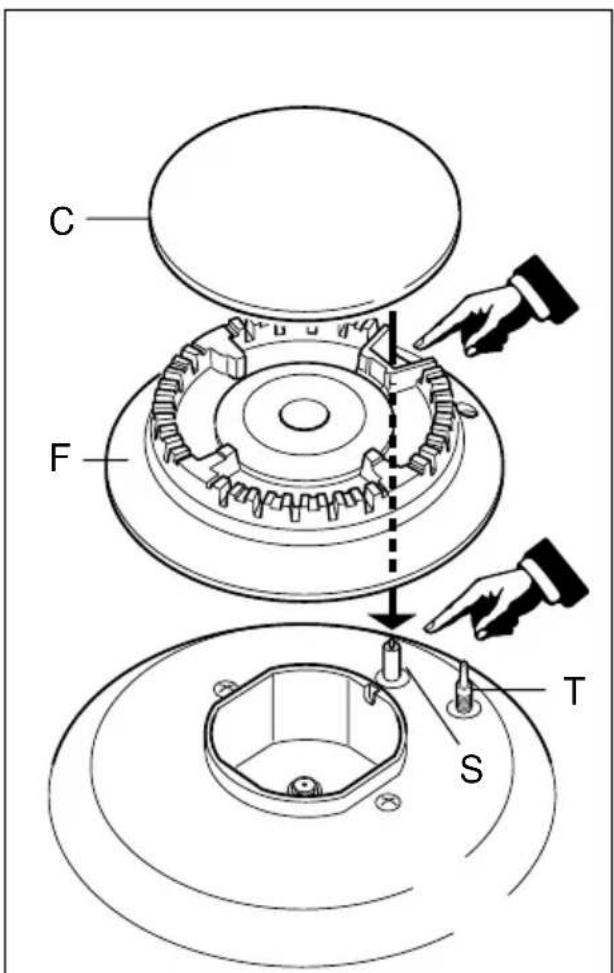
Fig. 3.1
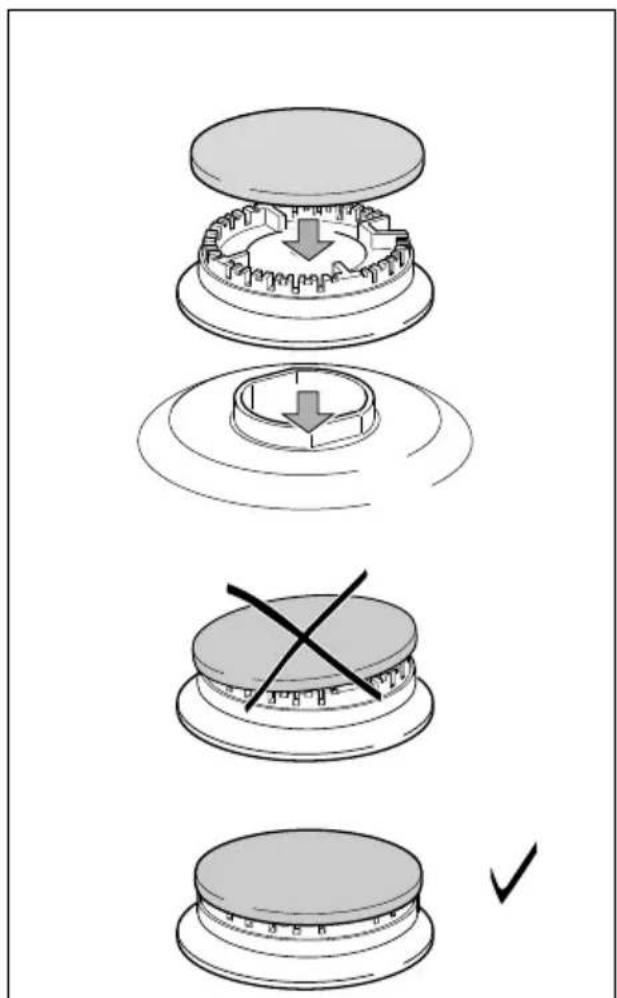
Fig. 3.2
CORRECT POSITION OF TRIPLE RING BURNER
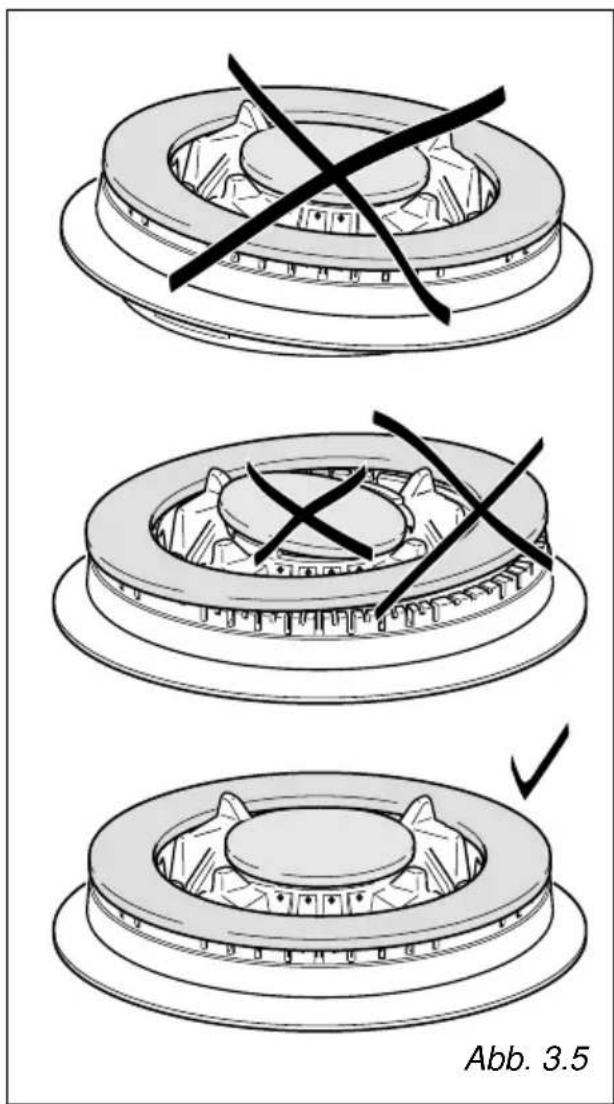
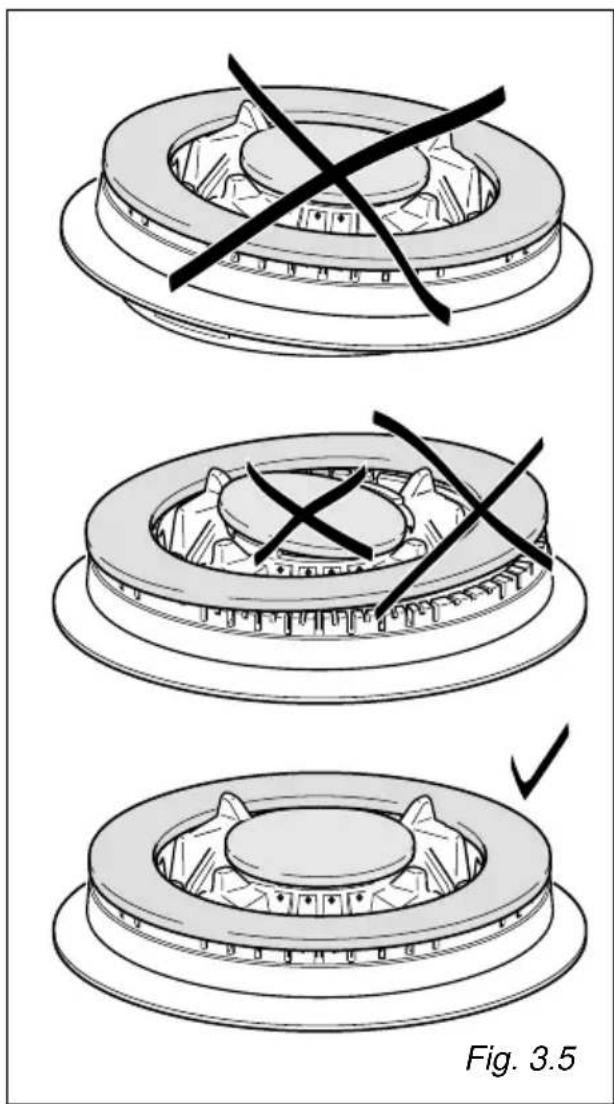
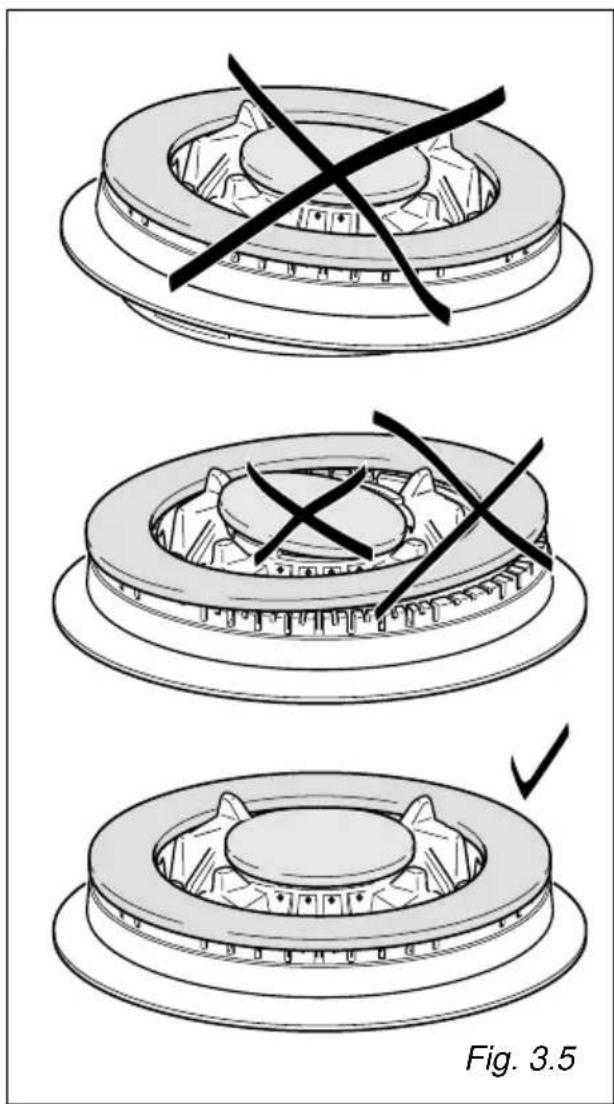
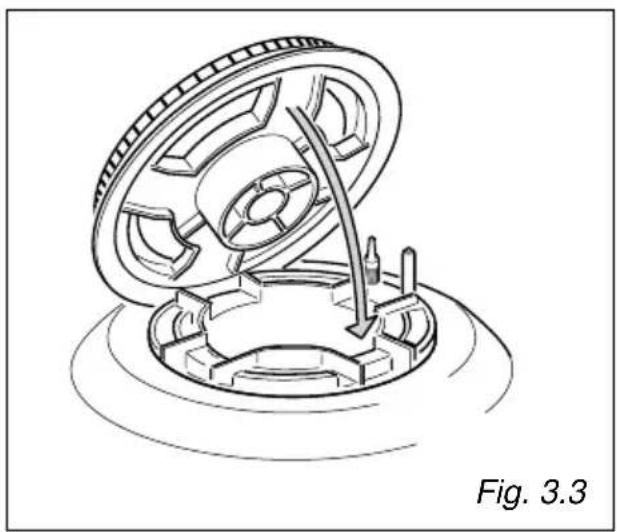
The triple ring burner must be correctly positioned (see fig. 3.3); the burner rib must be fitted in its housing as shown by the arrow.
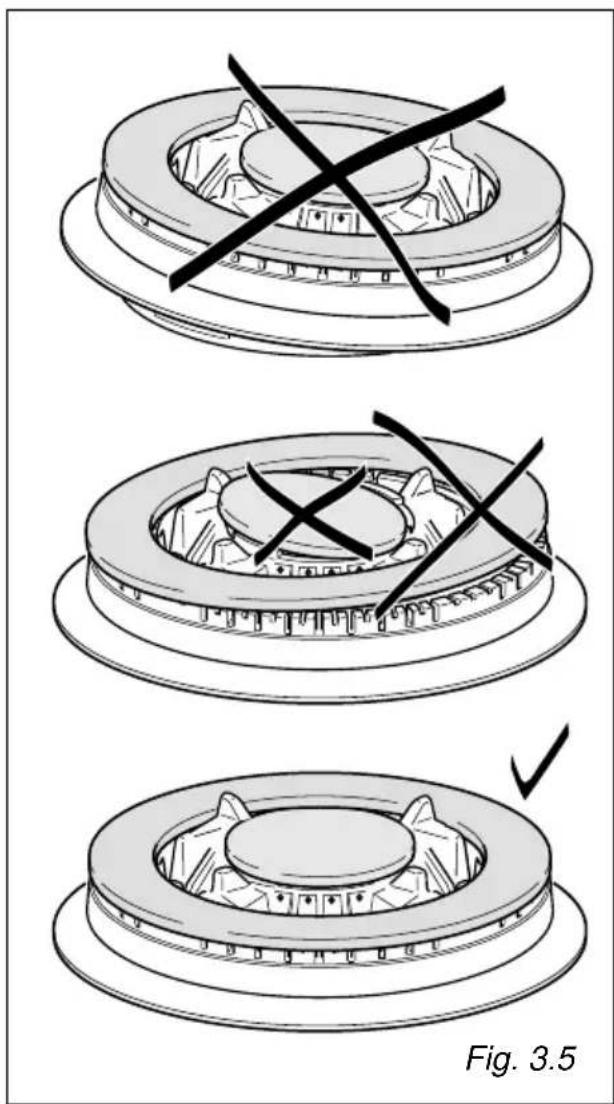
Then position the cap A and the ring B (fig. 3.4 - 3.5). The burner correctly positioned must not rotate (fig. 3.4).
natural_image
Mechanical assembly diagram showing a rotating component with a curved arrow indicating motion, labeled 'Fig. 3.3' (no text or symbols on the diagram itself)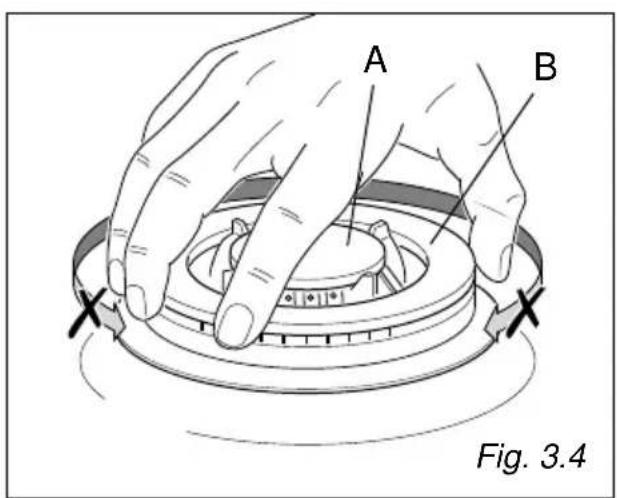
natural_image
Three-step diagram showing a mechanical component with cross marks, no text or symbols presentInstallation advice
IMPORTANT
√ The appliance should be installed by a QUALIFIED INSTALLATION TECHNICIAN. Failure to comply with this condition will render the guarantee invalid.
√ The appliance must be installed in compliance with regulations in force in your country and in observation of the manufacturer's instructions.
√ Always unplug the appliance before carrying out any maintenance operations or repairs.
√ The appliance must be housed in heat-resistant units.
√ These tops are designed to be embedded into kitchen fixtures measuring 600 mm in depth.
√ The walls of the units must not be higher than work top and must be capable of resisting temperatures of 105 °C above room temperature.
√ Do not install the appliance near inflammable materials (eg. curtains).
TECHNICAL INFORMATION FOR THE INSTALLER
Before installing the cooktop, remove the protective film.
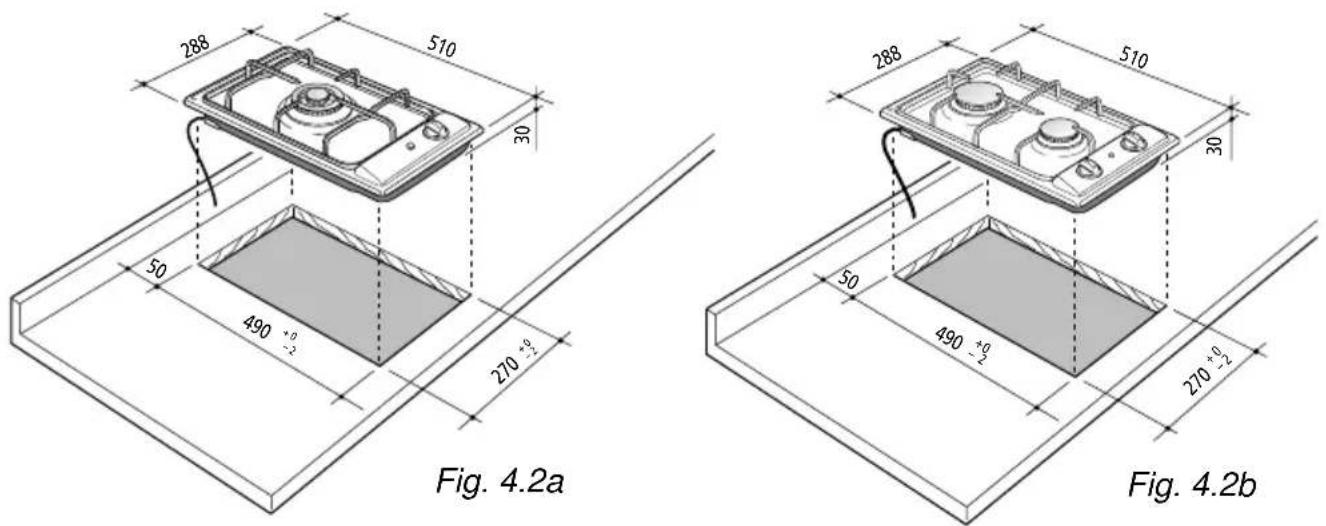
This cooktop can be built into a working surface 20 to 40 mm thick and 600 mm deep.
In order to install the cooker top into the kitchen fixture, a hole with the dimensions shown in figs. 4.2a - 4.2b has to be made, keeping in consideration the following:
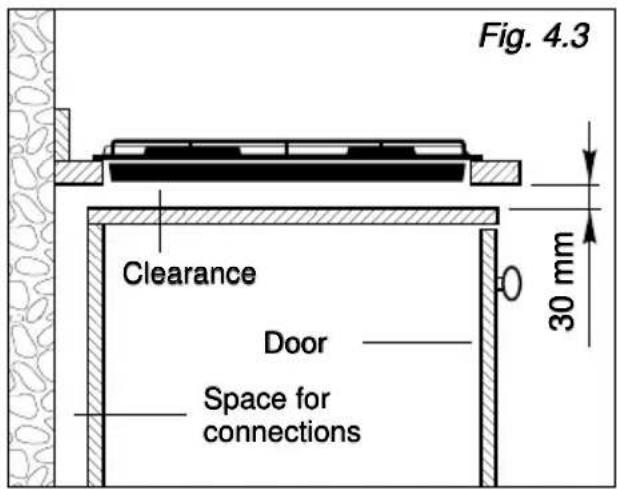
– within the fixture, between the bottom side of the cooker top and the upper surface of any other appliance or internal shelf there must be a clearance of at least 30 mm;
- the cooker top must be kept no less than 100 mm away from any side wall;
- the cooker top must be kept at a distance of no less than 50 mm from the rear wall.
- there must be a distance of at least 650 mm between the hob and any wall cupboard or extractor hood positioned immediately above (see fig. 4.1)
- the coatings of the walls of the unit or appliances near the cooktop must be heat resistant ("Y" protection against heating in compliance with standards EN 60335-2-6).
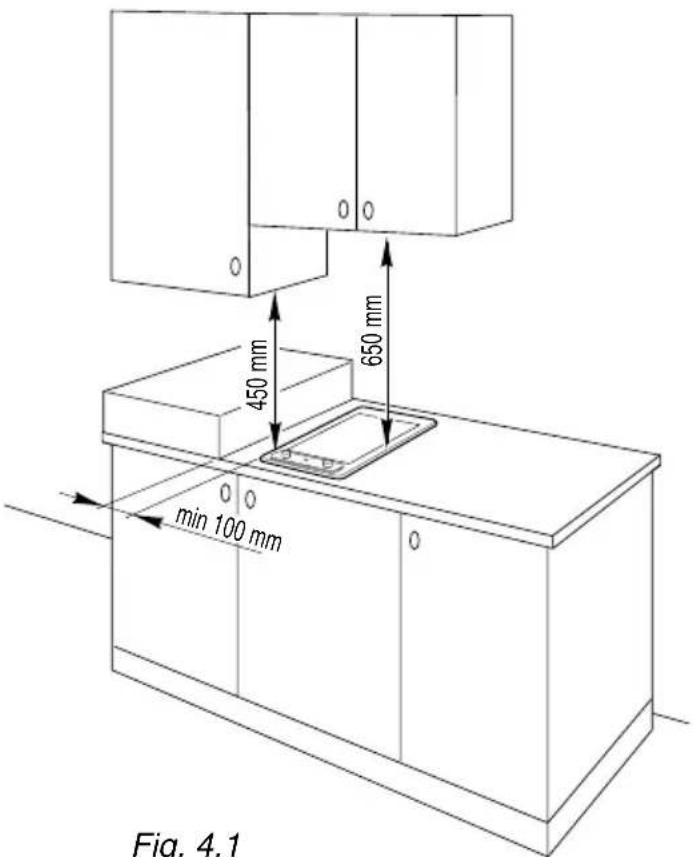
Fig. 4.1
INSTALLATION IN KITCHEN CABINET WITH DOOR (fig. 4.3)
It is recommended that a 30 mm clearance be left between the cooker top and the fixture surface beneath it (fig. 4.3).
FASTENING THE COOKTOP
(fig. 4.4)
Each cooktop is supplied with a set of tabs and screws to fasten it on units with a working surface from 2 to 4 cm deep.
The kit includes 4 tabs "A" and 4 self-threading screws "B".
√ Cut the unit.
√ Stretch gasket "C" over the edge of the hole made, being careful to overlay the junction edges.
√ Turn the cooktop over and put tabs "A" into the mountings; only tighten screws "B" a few turns.
Make sure that the tabs are mounted correctly as shown in the figure.
√ Put the cooktop into the hole cut into the unit and position it correctly.
√ Put tabs "A" into place and tighten screws "B" until the cooktop is completely secured.
√ Using a sharp tool cut off the part of gasket "C" which protrudes from the cooktop.
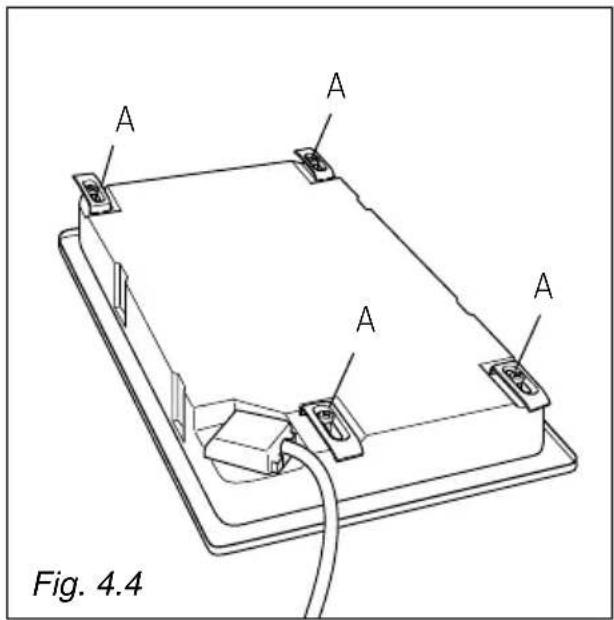
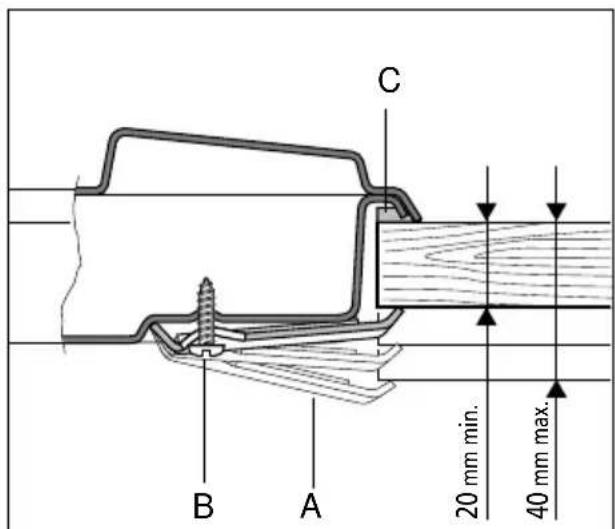
Fig. 4.5
The room where the gas appliance is to be installed must have a natural flow of air so that the gas can burn (in compliance with the current laws in force).
The flow of air must come directly from one or more openings made in the outside walls with a free area of at least 100 cm ^2 .
If the appliance does not have a no-flame safety device this opening must have an area of at least 200 cm ^4 .
The openings should be near the floor and preferably on the side opposite the exhaust for combustion products and must be so made that they cannot be blocked from either the outside or the outside.
When these openings cannot be made, the necessary air can come from an adjacent room which is ventilated as required, as long as it is not a bedroom or a danger area (in compliance with the current laws in force).
In this case, the kitchen door must allow the passage of the air.
Installation technicians must comply to current laws in force concerning ventilation and the evacuation of exhaust gases.
Intensive and prolonged use may require extra ventilation, e.g. opening a window, or more efficient ventilation increasing the mechanical suction power if this is fitted.
DISCHARGING PRODUCTS OF COMBUSTION
Extractor hoods connected directly to the outside must be provided, to allow the products of combustion in the gas appliance to be discharged (fig. 4.6).
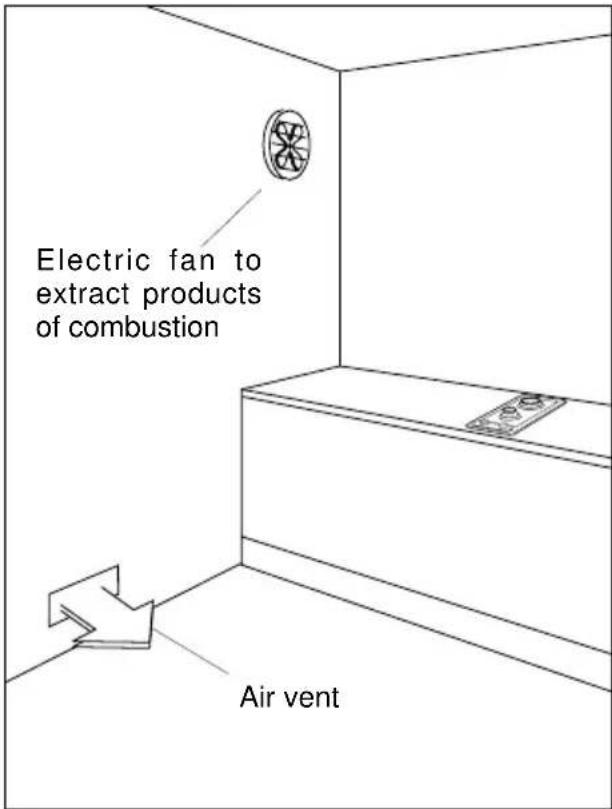
If this is not possible, an electric fan may be used, attached to the external wall or the window; the fan should have a capacity to circulate air at an hourly rate of 3-5 times the total volume of the kitchen (fig. 4.7).
The fan can only be installed if the room has suitable vents to allow air to enter, as described under the heading "Choosing suitable surroundings" (in compliance with the current laws in force).
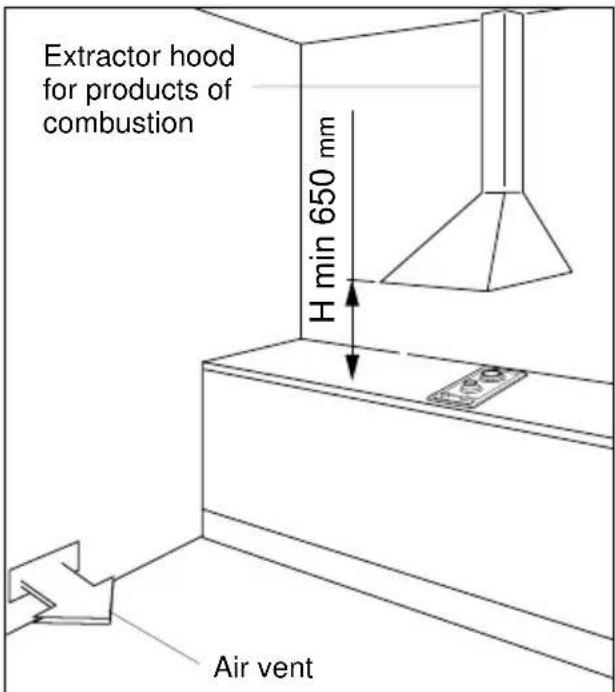
Fig. 4.6 Fig. 4.7
Cat: II 2L 3B/P

Cat: II 2H3+
Cat: II 2E+3+
GAS CONNECTION
Connection to the gas main must be performed by a qualified technician, in compliance with the current laws in force.
The cooktop is set up and calibrated to work with the gas indicated on the rating plate affixed to the appliance and on this instruction booklet.
The gas supply system must conform to the local regulations in force.
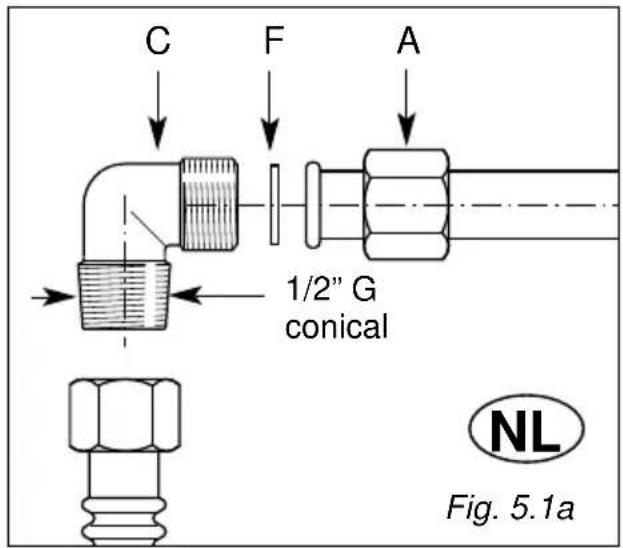
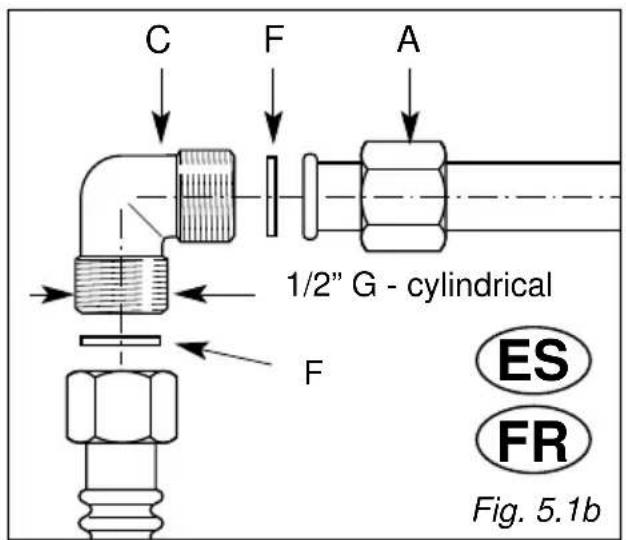
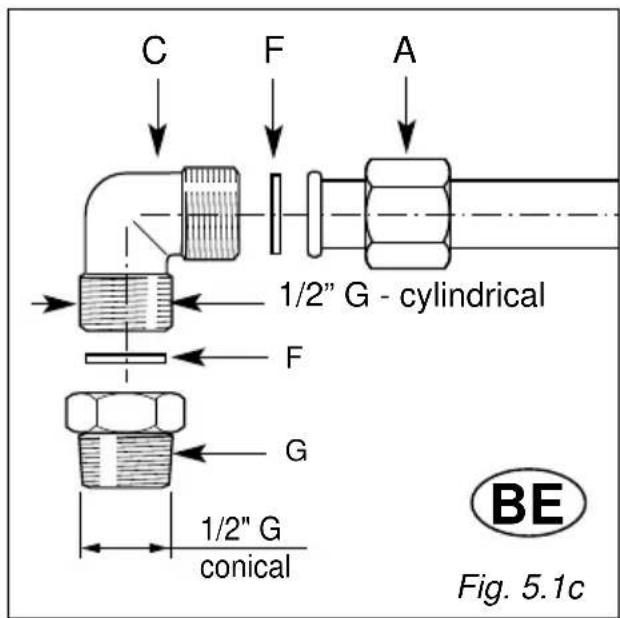
To conned the cooktop to the gas mains or cylinder use a flexible stainless steel hose with continuous wall conforming to local regulations. Use gasket F for the cylindrical elbow connection.
The flexible metal tubes must be at most 2 m long.
Attention: If a flexible stainless steel hose is used, it must be so installed that it cannot come into contact with a movable part of the unit and is not obstructed and so that its whole length can be inspected.
The cooktop connection is made up as follows:
√ 1 nut "A"
√ union elbow "C":
- cylindrical - for Spain and France
- conical - for Holland
√ gaskets "F"
√ conical adapter "G" for Belgium only
natural_image
Illustration of a wrench turning a screwdriver into a mechanical component (no text or symbols)IMPORTANT
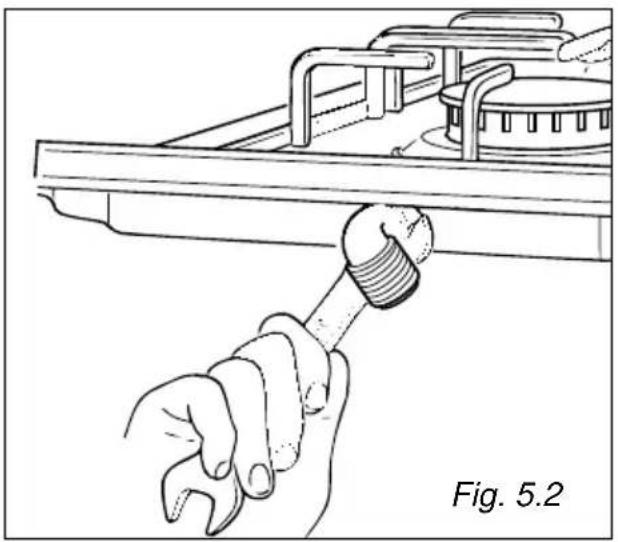
√ Never attempt to turn the fitting C without having first slackened off the relative lock nut (fig. 5.2).
√ The seal F (fig. 5.1a - 5.1b - 5.1c) is the element that guarantees the seal in the pipe-ramp connector.
It is recommended that it be replaced whenever it shows even the slightest deformation or imperfection.
√ After connecting to the mains, check that the couplings are correctly sealed, using soapy solution, but never a naked flame.
GAS MAINTENANCE
ADAPTING THE APPLIANCE TO FUNCTION WITH DIFFERENT TYPES OF GAS
If a different gas from that one indicated on the label is used, you need to adapt the cooktop to this new situation.
If the injectors are not supplied they can be obtained from the "Service Centre".
Select the injectors to be replaced according to the table on next page.
The nozzle diameters, expressed in hundredths of a millimetre, are marked on the body of each injector.
OPERATIONS TO BE PER- FORMED WHEN SUBSTITUT- ING THE INJECTORS
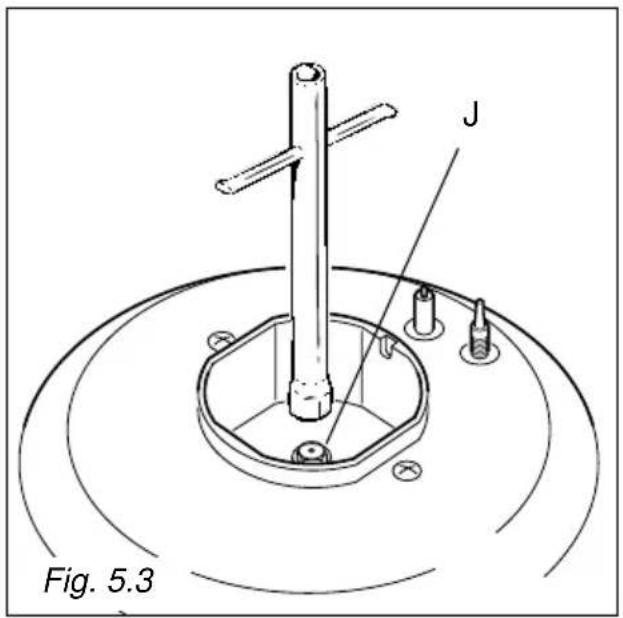
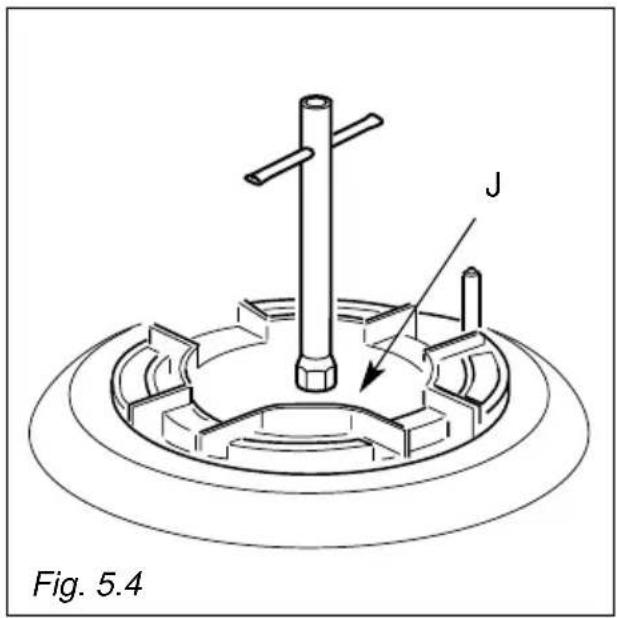
√ Remove the pan-supports, the burner covers and the knobs;
√ Using a wrench substitute the injectors "J" (Fig. 5.3 - 5.4) with those ones suitable for the type of gas for which it is to be used.
The burners are conceived in such a way so as not to require the adjustment of the primary air.
natural_image
Technical line drawing of a mechanical component with labeled part 'J' and directional arrow, no readable text or symbols beyond labelNL
TABLE FOR THE CHOICE OF THE INJECTORS - Cat: II 2L 3B/P
| BURNERS | Nominal power [kW] | Reduced power [kW] | G30/G31 30/30 mbar | G25 25 mbar |
| ∅ injector [1/100 mm] | ∅ injector [1/100 mm] | |||
| Semirapid (SR) 1,75 0,45 65 94 (Y) | ||||
| Rapid (R) 3,00 0,75 85 121 (F2) | ||||
| Triple-ring (TC) 3,50 1,50 95 138 (F3) |
ES
TABLE FOR THE CHOICE OF THE INJECTORS - Cat: II 2H 3+
| BURNERS | Nominal power [kW] | Reduced power [kW] | G30/G31 28-30/37 mbar | G20 20 mbar |
| ∅ injector [1/100 mm] | ∅ injector [1/100 mm] | |||
| Semirapid (SR) 1,75 0,45 65 97 (Z) | ||||
| Rapid (R) 3,00 0,75 85 115 (Y) | ||||
| Triple-ring (TC) 3,50 1,50 95 135 (T) |
FR
BE
TABLE FOR THE CHOICE OF THE INJECTORS - Cat: II 2E+3+
| BURNERS | Nominal power [kW] | Reduced power [kW] | G30/G31 28-30/37 mbar | G20/G25 20/25 mbar |
| ∅ injector [1/100 mm] | ∅ injector [1/100 mm] | |||
| Semirapid (SR) 1,75 0,45 65 97 (Z) | ||||
| Rapid (R) 3,00 0,75 85 115 (Y) | ||||
| Triple-ring (TC) 3,50 1,50 95 135 (T) |
| AIR VENT NECESSARY FOR GAS COMBUSTION = (2 m3/hxkW) | |
| BURNERS | Air vent necessary [m3/hr] |
| Semirapid (SR) 3,50 | |
| Rapid (R) 6,00 | |
| Triple-ring (TC) 7,00 | |
REGULATING THE BURNER MINIMUM SETTING
When switching from one type of gas to another, the minimum flow rate must also be correct: the flame should not go out even when passing suddenly from maximum to minimum flame.
To regulate the flame follow the instructions below:
– Light the burner.
- Set the cock valve to minimum.
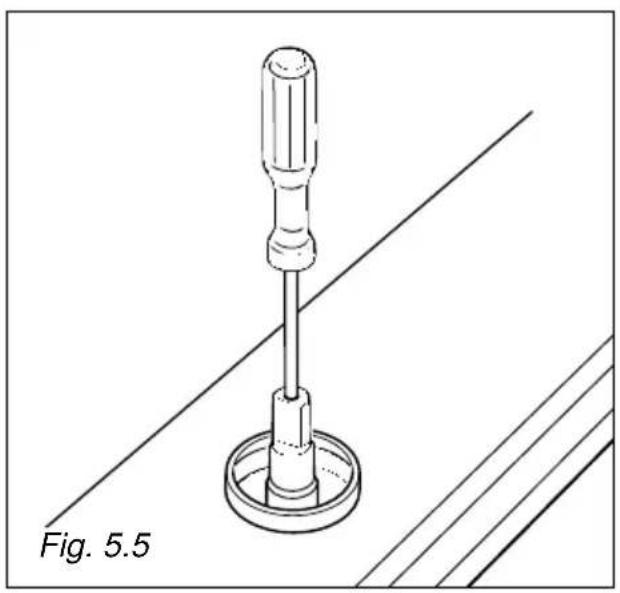
On gas valves provided with adjustment screw in the centre of the shaft (fig. 5.5):
- Using a screwdriver with max. diameter 3 mm, turn the screw inside the tap until the correct setting is obtained.
On gas valves provided with adjustment screw on the valve body (fig. 5.6):
- Turn the screw "A" to the correct setting with a screwdriver.
- In the models with ignition incorporated in the knob access to screw "A" is through a hole in the microswitch.
For G 30/G 31 gas, tighten the adjustment screw completely.
LUBRICATING THE GAS TAPS
If one of the gas taps becomes hard to turn, dismantle it, thoroughly clean with petrol and apply special high-temperature grease.
Warning!
These operations must be performed by a specialised engineer.
natural_image
Technical line drawing of a screwdriver with a base mount, labeled Fig. 5.5 (no text or symbols on the diagram itself)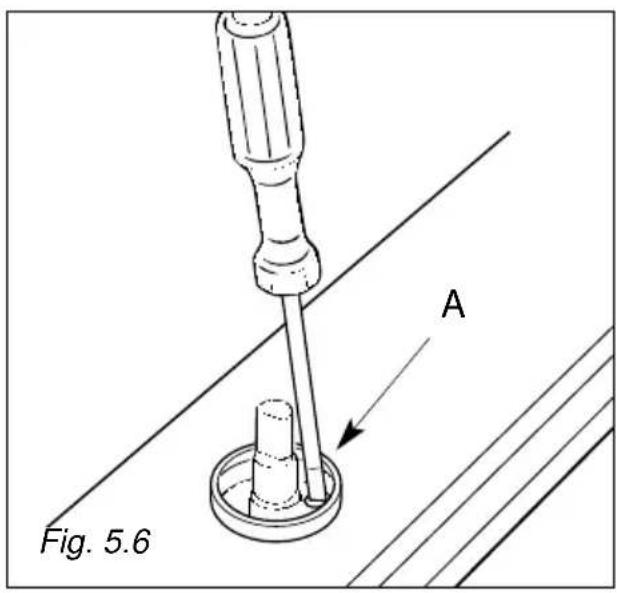
IMPORTANT:
Installation has to be carried out according to the instructions provided by the manufacturer.
Incorrect installation might cause harm and damage to people, animals or objects, for which the manufacturer accepts no responsibility.
DETAILS
√ Connection to the electric power supply must be carried out by a qualified technician and following the appropriate safety regulations;
√ Before carrying out the connection to the power supply, the voltage rating of the appliance (stamped on the appliance identification plate) must be checked for correspondence to the available mains supply voltage, and the mains electric wiring should be capable of handling the hob's power rating (also indicated on the identification plate);
√ The hob is supplied without a power supply plug and therefore if you are not connecting directly to the mains, a standardized plug suitable for the load must be fitted.
√ The power point must be connected to a suitable earth wiring, in conformity to current safety regulations.
√ It is possible to connect the appliance directly to the mains supply by means of a heavy duty switch with 3 mm minimum distance between the contacts.
√ The power supply cord must not touch against any hot surfaces and must be placed so that its temperature does not exceed 75^ C at any point along its length.
√ After having installed the appliance, the power switch or power plug must always be in a accessible position.
N.B. For connections to the mains power supply, never use adapters, reductions or multiple power points as these may overheat and catch fire.
In the event that installation should require modifications to the mains supply wiring system or if the power plug is not suitable for the type of power point available, it is recommended that a qualified technician be called to carry out substitution.
The technician will also have to verify that the cross-section of the electric cables on the power point match the appliance's power rating.
Before carrying out any work on the electrical section of the appliance, it must be disconnected from the mains.
If the power supply cable is damaged it must be substituted by a suitable cable available in the after sales service.
Connection to a good earth wiring system is absolutely essential.
The manufacturer accepts no responsibility for any inconvenience caused by failure to comply with this rule.
REPLACING THE POWER SUPPLY CABLE
Use the same type of power supply cable.
This cable must be connected to the terminal block following the diagram in fig. 6.1.
FEEDER SPECIAL CABLE SECTION Type "HO5V2V2-F"
resistance to temperatures of 90°C
230 VAC 50 Hz 3 x 0,75 mm²
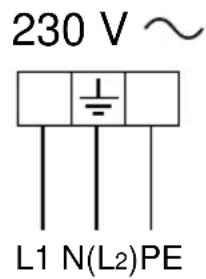
Fig. 6.1
Descriptions and illustrations in this booklet are given as simply indicative. The manufacturer reserves the right, considering the characteristics of the models described here, at any time and without notice, to make eventual necessary modifications for their construction or for commercial needs.
M-SYSTEM
1102624 - β3

- Geachte Klant,
- ONSTEKING VAN DE BRANDERS MET VEILIGHEIDSVENTIEL
- ALGEMENE RAAD
- VERVANGING SPROEIERS VAN DE BRANDERS
- DE GASKRANEN SMEREN
- AUSTAUSCH DER DÜSEN
- IMPORTANT :
- ALLUMAGE DES BRULEURS
- ALLUMAGE DES BRULEURS AVEC SYSTEME DE SECURITE
- EVACUATION DES PRODUITS DE COMBUSTION
- ADAPTATION AUX DIFFERENTS TYPES DE GAZ
- FR BE
- TABLEAU DES INJECTEURS - Cat: II 2E+ 3+
- LUBRIFICATION DES ROBINETS DE GAZ
- CONSEJOS GENERALES
- ES
- DECLARATION OF CE CONFORMITY
- IMPORTANT PRECAUTIONS AND RECOMMENDATIONS
- IMPORTANT PRECAUTIONS AND RECOMMENDATIONS FOR USE OF ELECTRICAL APPLIANCES
- TIPS FOR THE USER
- Risk of fire!
- "2 GAS" COOKING HOB - with or without safety device - The appliance has class 3
- COOKING POINTS
- CONTROL PANEL DESCRIPTION
- NOTE:
- "1 GAS triple ring burner" COOKING HOB
- COOKING POINT
- GAS BURNERS
- CAUTION:
- Caution!
- Models without electric ignition
- Models fitted with electric spark lighter button
- Models fitted with electric lighter incorporated into the burner knobs
- LIGHTING GAS BURNERS FITTED WITH SAFETY VALVE DEVICE
- CHOICE OF BURNER
- SPECIAL WOK GRILLE - optional (Fig. 2.5a - 2.5b)
- Warning:
- GENERAL ADVICE
- ENAMELLED PARTS
- STAINLESS STEEL ELEMENTS
- CONTROL KNOB
- GAS TAPS
- BURNERS AND GRIDS
- CORRECT REPLACEMENT OF THE BURNERS
- CORRECT POSITION OF TRIPLE RING BURNER
- Installation advice
- IMPORTANT
- TECHNICAL INFORMATION FOR THE INSTALLER
- INSTALLATION IN KITCHEN CABINET WITH DOOR (fig. 4.3)
- FASTENING THE COOKTOP
- DISCHARGING PRODUCTS OF COMBUSTION
- GAS CONNECTION
- The gas supply system must conform to the local regulations in force.
- GAS MAINTENANCE
- ADAPTING THE APPLIANCE TO FUNCTION WITH DIFFERENT TYPES OF GAS
- If the injectors are not supplied they can be obtained from the "Service Centre".
- OPERATIONS TO BE PER- FORMED WHEN SUBSTITUT- ING THE INJECTORS
- NL
- FR
- BE
- REGULATING THE BURNER MINIMUM SETTING
- LUBRICATING THE GAS TAPS
- Warning!
- IMPORTANT:
- DETAILS
- N.B. For connections to the mains power supply, never use adapters, reductions or multiple power points as these may overheat and catch fire.
- REPLACING THE POWER SUPPLY CABLE
- FEEDER SPECIAL CABLE SECTION Type "HO5V2V2-F"
- M-SYSTEM
Brand : M-SYSTEM
Model : MCGW30IX
Category : Cooker