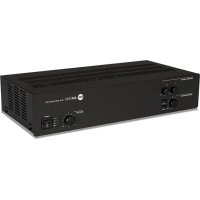
AM2080 - Receiver RCF - Free user manual and instructions
Find the device manual for free AM2080 RCF in PDF.



| Product type | Mixer/amplifier (amplified receiver) |
| Brand | RCF |
| Model | AM2080 |
| Dimensions (W × H × D) | 442 × 88 × 230 mm (2U 19" rack) |
| Net weight | 3.8 kg |
| Mains power | 115-230 V / 50-60 Hz (selectable) |
| Power consumption | 160 W |
| Output power (RMS) | 80 W |
| Frequency response | 50 Hz - 16 kHz |
| Signal-to-noise ratio (channels 1 and 2) | 60 dB |
| Signal-to-noise ratio (auxiliary inputs) | 80 dB |
| Total harmonic distortion (1 kHz, rated power) | < 0.3 % |
| Auxiliary input equalizer | Bass: -9/+6 dB at 100 Hz; Treble: -14/+8 dB at 10 kHz |
| High-pass filter (channels 1 and 2) | 150 Hz (switchable) |
| Microphone input sensitivity (channels 1 and 2) | -62 dBu (max -25 dBu) / 10 kΩ |
| Line input sensitivity (channels 1 and 2) | -29 dBu (max +11 dBu) / 10 kΩ |
| Auxiliary input sensitivity | -18 to +20 dBu / 20 kΩ (adjustable) |
| Phantom power | 30 V / 18 mA (switchable per channel) |
| Protections | Overload, short-circuit, thermal |
| Audio inputs | 2 microphone/line channels (XLR and screw terminals), 2 auxiliary RCA, 1 RJ45 for BM3001 microphone |
| Speaker outputs | Line 100 V / 70 V or low impedance 4 Ω min (single selection) |
| Auxiliary outputs | PRE OUT (RCA), MUSIC ON HOLD (RCA) |
| Special functions | VOX, gradual priority, chime, mix mode |
| Maintenance and cleaning | Clean with a dry cloth; do not use solvents, alcohol, or benzene. |
| Safety | Do not open the device; unplug before maintenance; do not expose to moisture or rain. |
Frequently Asked Questions - AM2080 RCF
User questions about AM2080 RCF
0 question about this device. Answer the ones you know or ask your own.
Ask a new question about this device
Download the instructions for your Receiver in PDF format for free! Find your manual AM2080 - RCF and take your electronic device back in hand. On this page are published all the documents necessary for the use of your device. AM2080 by RCF.
USER MANUAL AM2080 RCF
SAFETY PRECAUTIONS page 16
DESCRIPTION
FRONT PANEL page 18
REAR PANEL page 20
OPERATION page 23
MIX'MODE page 23
GRADUATED PRIORITY'MODE page 23
RCF BM 3001 PAGING MICROPHONE (NOT INCLUDED) page 23
LOUDSPEAKER CONNECTION page 24
POWER SUPPLY VOLTAGE CHANGE page 25
SPECIFICATIONS page 26
EXAMPLE OF CONNECTIONS
INDEX
USCITA BASSA IMPEDENZA (4 Ω)
Before connecting and using this product, please read this instruction manual carefully and keep it on hand for future reference.
The manual is to be considered an integral part of this product and must accompany it when it changes ownership as a reference for correct installation and use as well as for the safety precautions.
RCF S.p.A. will not assume any responsibility for the incorrect installation and / or use of this product.

WARNING: To prevent the risk of fire or electric shock, never expose this product to rain or humidity.
SAFETY PRECAUTIONS
- All the precautions, in particular the safety ones, must be read with special attention, as they provide important information.
2. POWER SUPPLY FROM MAINS
a. The mains voltage is sufficiently high to involve a risk of electrocution; therefore, never install or connect this product with the power supply switched on.
b. Before powering up, make sure that all the connections have been made correctly and the voltage of your mains corresponds to the voltage shown on the rating plate on the unit, if not, please contact your RCF dealer.
c. The metallic parts of the unit are earthed by means of the power cable. An apparatus with CLASS I construction shall be connected to a mains socket outlet with a protective earthing connection.
d. Protect the power cable from damage; make sure it is positioned in a way that it cannot be stepped on or crushed by objects.
e. To prevent the risk of electric shock, never open the product: there are no parts inside that the user needs to access. Appliance coupler is used to disconnect device from MAIN power. This device shall remain readily accessible after the installation.
-
Make sure that no objects or liquids can get into this product, as this may cause a short circuit. This apparatus shall not be exposed to dripping or splashing. No objects filled with liquid, such as vases, shall be placed on this apparatus. No naked sources (such as lighted candles) should be placed on this apparatus.
-
Never attempt to carry out any operations, modifications or repairs that are not expressly described in this manual.
Contact your authorized service centre or qualified personnel should any of the following occur:
The product does not function (or functions in an anomalous way).
The power supply cable has been damaged.
- Objects or liquids have got in the unit.
The product has been subject to a heavy impact.
- If this product is not used for a long period, disconnect the power cable.
- If this product begins emitting any strange odours or smoke, switch it off immediately and disconnect the power supply cable.
-
The terminals marked with the symbol are HAZARDOUS LIVE and their connection is to be made by an INSTRUCTED PERSON or the use of ready-made cables is required.
-
Do not connect this product to any equipment or accessories not foreseen.
For suspended installation, only use the dedicated anchoring points and do not try to hang this product by using elements that are unsuitable or not specific for this purpose.
Also check the suitability of the support surface to which the product is anchored (wall, ceiling, structure, etc.), and the components used for attachment (screw anchors, screws, brackets not supplied by RCF etc.), which must guarantee the security of the system / installation over time, also considering, for example, the mechanical vibrations normally generated by transducers.
To prevent the risk of falling equipment, do not stack multiple units of this product unless this possibility is specified in the user manual.
- RCF S.p.A. strongly recommends this product is only installed by professional qualified installers (or specialised firms) who can ensure correct installation and certify it according to the regulations in force.
The entire audio system must comply with the current standards and regulations regarding electrical systems.
- Supports and trolleys
The equipment should be only used on trolleys or supports, where necessary, that are recommended by the manufacturer. The equipment / support / trolley assembly must be moved with extreme caution. Sudden stops, excessive pushing force and uneven floors may cause the assembly to overturn.
-
There are numerous mechanical and electrical factors to be considered when installing a professional audio system (in addition to those which are strictly acoustic, such as sound pressure, angles of coverage, frequency response, etc.).
-
Hearing loss
Exposure to high sound levels can cause permanent hearing loss. The acoustic pressure level that leads to hearing loss is different from person to person and depends on the duration of exposure. To prevent potentially dangerous exposure to high levels of acoustic pressure, anyone who is exposed to these levels should use adequate protection devices.
When a transducer capable of producing high sound levels is being used, it is therefore necessary to wear ear plugs or protective earphones.
See the technical specifications in loudspeaker instruction manuals to know their maximum sound pressure levels.
IMPORTANT NOTES
To prevent the occurrence of noise on microphone / line signal cables, use screened cables only and avoid putting them close to:
- Equipment that produces high-intensity electromagnetic fields (for example, high power transformers)
- Mains cables
- Loudspeaker lines.
OPERATING PRECAUTIONS
- Do not obstruct the ventilation grilles of the unit. Situate this product far from any heat sources and always ensure adequate air circulation around the ventilation grilles.
- Do not overload this product for a long time.
- Never force the control elements (keys, knobs, etc.).
- Do not use solvents, alcohol, benzene or other volatile substances for cleaning the external parts of this product.
RCF S.p.A. thanks you for purchasing this product, which has been designed to guarantee reliability and high performances.
DESCRIPTION
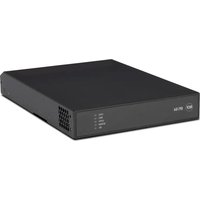
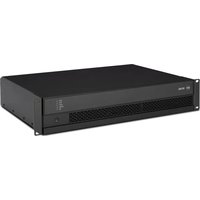
AM 2080 is a 80 W mixer-amplifier, with 2 mic-line audio inputs on removable connectors (the first input also has an XLR socket) and 2 aux inputs for music sources (e.g. CD players, tuners, etc.). The inputs 2 also has an RJ 45 port for quick connection of an RCF BM 3001 paging microphone (through CAT5 cable).
The amplifier output is available either for low impedance loudspeakers (min. 4 Ω) or 100 - 70 V constant voltage line (for loudspeakers having 100 - 70 V transformers).
The input 1 has a signal detection circuit ('VOX') providing automatic priority operation.
The inputs 1 and 2 can access the priority through an external command (connected to either the removable connector or the RJ 45 port).
A 'MUSIC ON HOLD' aux output allows to send the music (the AUX INPUT A signal) to additional amplifiers, mixers, phone systems ('music on hold' function), etc..
A 'PRE OUT' aux output is useful to send the signal (the same routed to the internal amplifier) to additional amplifiers.
The 2 mic-line inputs have a high-pass filter (with a common on/off dip-switch) that are useful to improve speech intelligibility.
The 2 aux inputs have independent tone controls (common for both aux inputs).
Front panel LEDs indicate the device state (ON, PROT), priority circuit enabled (PRIOR) and the signal level / peak (SIG/PK).
FRONT PANEL
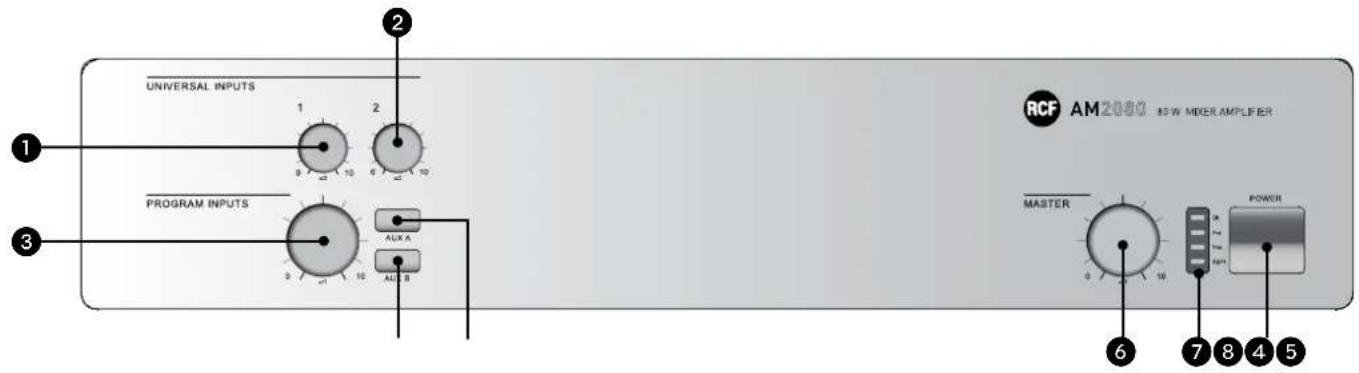
1 Channel 1 - mic-line input volume control
2 Channel 2 - mic-line input volume control
AUX INPUT volume control Note: turn counterclockwise (to 0) if aux inputs are not used.
AUX A button (with LED)
It turns on (LED is lit) the AUX INPUT A
(it's signal is sent to the internal amplifier and PRE OUT).
If activated, the AUX INPUT B signal will be muted (the AUX B button LED will turn off).
The AUX INPUT A signal is always sent to the MUSIC ON HOLD output (that is not affected by volume control and the AUX A/B buttons).
AUX B button (with LED)
It turns on (LED is lit) the AUX INPUT B
(it signal is sent to the internal amplifier and PRE OUT).
If activated, the AUX INPUT A signal will not be sent to the internal amplifier (the AUX A button LED will turn off).
6 Internal amplifier MASTER volume control
Note: the audio outputs having RCA connectors (MUSIC ON HOLD and PRE OUT) are not affected by the MASTER volume control.
7 LEDs
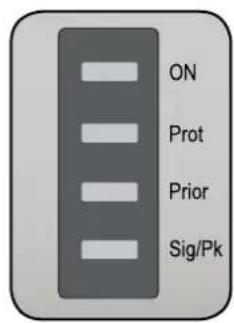
ON green: the device is switched on
PROT red: overload protection
orange: thermal protection
PRIOR yellow: the input 1 and 2 priority function is enabled through the dip-switch 3 (see 21)
Note: it does NOT indicate the priority activation in progress.
SIG/PK green: the signal level is higher than -15 dB
green + red: the signal level is in the 0 ÷ +2 dB range
red (peak): the signal level is equal or higher than +3 dB
0dB = signal level that allows to get the amplifier maximum power.
The internal 'limiter' circuit helps to avoid the amplifier overloading, yet it is advisable to reduce the MASTER volume (or a single channel volume where a too high signal is present) when the SIG/PK LED is continuously indicating red.
Main POWER switch (0 = off; 1 = on)
i
i
REAR PANEL
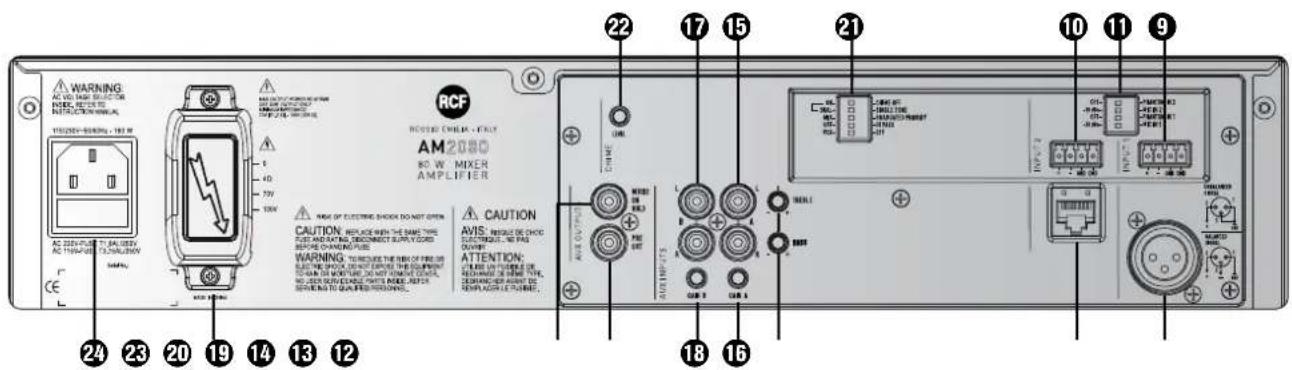
Channel 1 balanced audio input (removable connector):
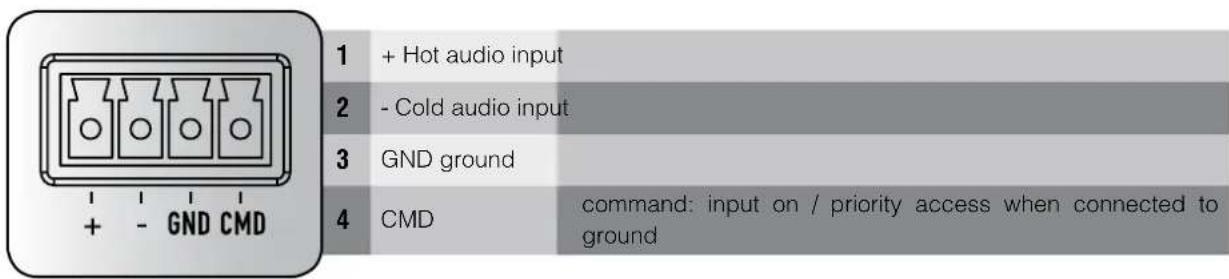
IMPORTANT: it is necessary to either link the CMD pin to ground of the respective removable connector or use the VOX function to open the audio input 1 (even when using the XLR plug for the audio signal).
10 Channel 2 balanced audio input (removable connector).
See 9 (channel 1 balanced audio input) for its connection.
IMPORTANT: it is necessary to either link the CMD pin to ground of the respective removable connector or use the RJ 45 port priority command to open the audio input 2.
MIC-LINE input setting (channels 1 and 2) through 4 dip-switches:
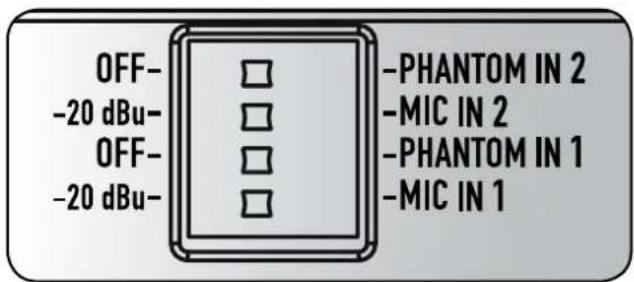
| 1 | OFF - PHANTOM (IN 2) | OFF: channel 2 input phantom power is off. | PHANTOM 2: channel 2 input phantom power is on. |
| 2 | -20 dBu - MIC (IN 2) | -20 dBu: channel 2 input sensitivity set to LINE (-20 dBu). | MIC 2: channel 2 input sensitivity set to MIC. |
| 3 | OFF - PHANTOM (IN 1) | OFF: channel 1 input phantom power is off. | PHANTOM 1: channel 1 input phantom power is on. |
| 4 | -20 dBu - MIC (IN 1) | -20 dBu: channel 1 input sensitivity set to LINE (-20 dBu). | MIC 1: channel 1 input sensitivity set to MIC. |
Examples of dip-switch settings:
| DIP 1/3 DIP 2/4 MODE USE (EXAMPLES) | |||
| OFF - 20 dBu LINE Audio source having a - 20 dBu output | |||
| OFF MIC MIC Dynamic microphones | |||
| PHANTOM | - 20 dBu | LINE with PHANTOM | BM 3001 paging microphone |
| PHANTOM | MIC | MIC with PHANTOM | Electret microphones |
12 Channel no.1 XLR input:
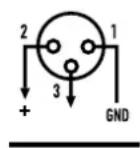
BALANCED CONNECTION +
hot
cold
GND
ground
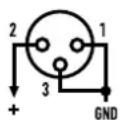
UNBALANCED CONNECTION
IMPORTANT: it is necessary to either link the CMD pin to ground of the respective removable connector or use the VOX function to open the audio input 1.
Do NOT use an unbalanced connection when the 'Phantom' power supply is switched on.

13 Channel 2 balanced audio input RJ 45 port
(for example, useful to connect a BM 3001 paging microphone).
Note: when a BM 3001 paging microphone is connected, it is necessary to set the dip-switches
1 and 2 to the 'LINE with PHANTOM' mode (see 11).
The BM 3001 paging microphone shall be set to 'LOCAL'.
Cable with RJ 45 plug:
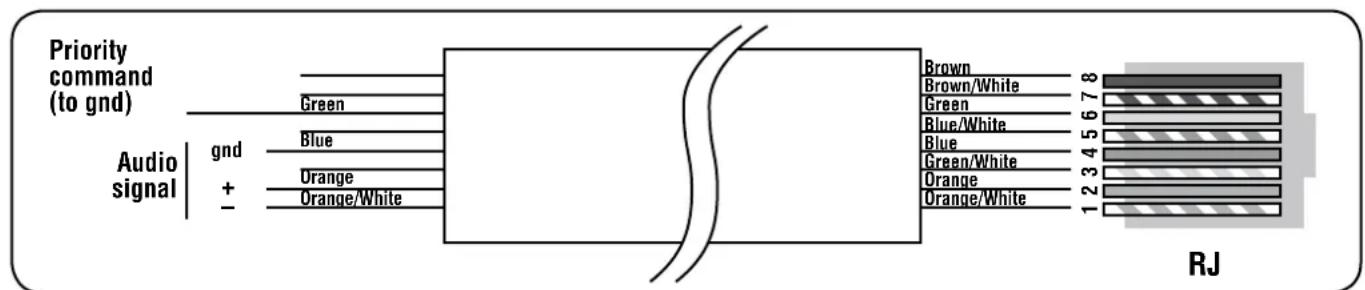
IMPORTANT: it is necessary to use the RJ 45 port priority command to open the audio input 2. (for instance, through the BM 3001 paging microphone push-button).
Although each mic-line input has 2 different connectors, these cannot be used to mix differ signals; only one audio source can be connected.
14 AUX INPUT (A and B) TREBLE and BASS controls.
15 AUX INPUT A with dual RCA connector.
The two channels of the stereo source connected to the AUX INPUT A are summed internally (to get a mono signal); the same for the stereo source connected to the AUX INPUT B.
16 AUX INPUT A GAIN control.
16 AUX INPUT B with dual RCA connector.
18 AUX INPUT B GAIN control.
PRE OUT audio output (with RCA connector) that sends the same signal routed to the internal amplifier (signal that can be either a single source with priority or the mix of all the channels 1, 2 and the selected AUX INPUT)..
Use PRE OUT to connect additional external amplifiers.
20 MUSIC ON HOLD audio output (with RCA connector) that sends a mono signal of the source connected to the AUX INPUT A.
The MUSIC ON HOLD output is not affected by any volume control nor selector and (if an external music source has been connected to the AUX INPUT A) can be used for the connection to a telephone system (in order to have the 'music on hold' function).
25 dip-switches for settings:
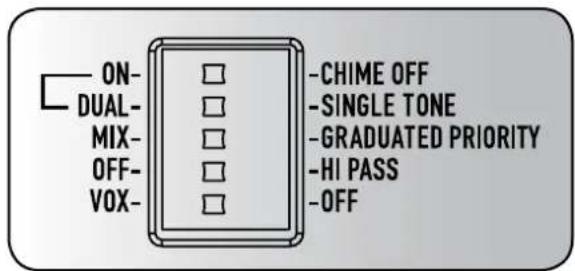
| 1 ON - CHIME OFF | ON: the chime is enabled and played once immediately after a priority command activation. | CHIME OFF: the chime is disabled. | |
| 2 | DUAL - SINGLE TONE | DUAL: 2 tone chime. SINGLE TONE: single tone chime. | |
| 3 | MIX - GR. PRIORITY | MIX: the priority function is disabled. All inputs are mixed and sent to the amplifier (even if a priority command is in progress). | GRADUATED PRIORITY: graduated priority mode (read the ‘Operation’ section). |
| 4 | OFF - HI PASS | OFF: the audio high pass filters of the inputs 1 and 2 are not inserted (flat frequency response). | HI PASS: the audio high pass filters of the inputs 1 and 2 are inserted. |
| 5 | VOX - OFF | VOX: the channel 1 VOX function is on (the channel 1 is automatically open when a signal is detected on its input). | OFF: the channel 1 VOX function is off. |
2 CHIME LEVEL (a trimmer adjustable by using a small screwdriver).
Amplifier output (max. 80 W) to loudspeakers, available as:
100/70V constant voltage line
Low impedance (min. 4 Ω).
Use 1 output only (read the section 'Loudspeaker connection').
24 Mains connector with fuse
Before connecting the power supply cable, verify that the apparatus voltage (230 or 115 V ac) corresponds to the available mains supply.
Note: the fuse type is marked on the rear panel (below the mains connector).
OPERATION
'VOX' is an internal circuit that automatically opens the channel 1 and takes priority (if enable through the dip-switch 3, see 21) when a signal is detected on its input.
'MIX' MODE
The priority function is disabled. All signals (channel 1-2, if open, and the selected AUX INPUT) are always present, mixed together and sent to the internal amplifier.
The music volume (coming from a CD / MP3 player, a tuner, etc.) depends on the aux input volume control on the front panel (see 3) and also the respective GAIN control setting (see 16 and 18) on the rear panel.
'GRADUATED PRIORITY' MODE
Audio inputs are managed according to graduated priority levels:
- (highest) channel 1
- channel 2
- the selected AUX IN.
If a priority command is present (or VOX), only the signal of the channel with the highest priority level is sent to the internal amplifier (and PRE OUT), while the other inputs (with lower priority level) are momentary muted (until the priority command is removed).
RCF BM 3001 PAGING MICROPHONE (NOT INCLUDED)
The channel 2 has an RJ 45 port, to which a BM 3001 paging microphone can be connected (note: it is necessary to set the dip-switches 1 and 2 to the 'LINE with PHANTOM' mode; see 11). The BM 3001 paging microphone shall be set to 'LOCAL'.
LOUDSPEAKER CONNECTION
Use 1 output only, DO NOT MIX 100/70 V and 4 Ω CONNECTIONS!
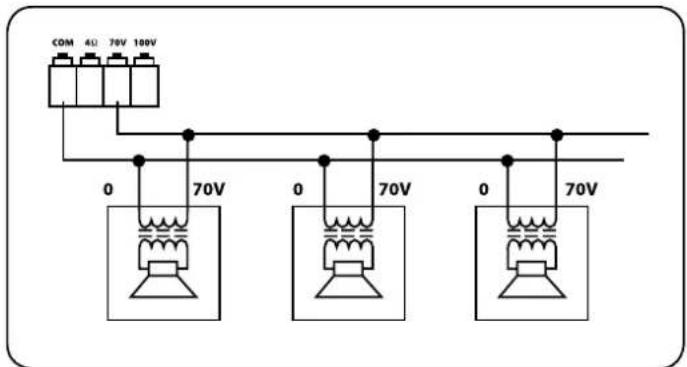
100/70VCONSTANT VOLTAGE OUTPUTS
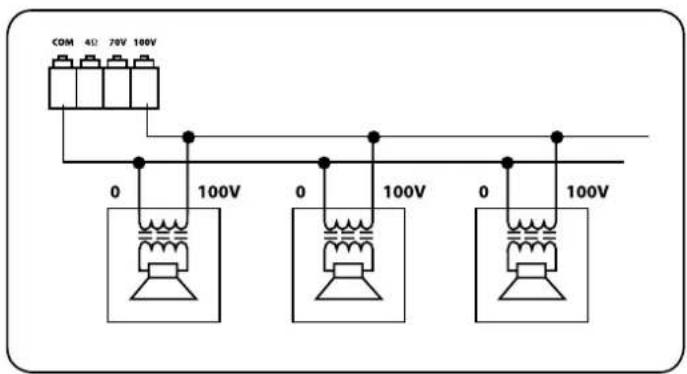
Each loudspeaker shall have a line transformer with the input voltage equal to the line voltage (100/70 V).
The loudspeaker total power shall not be higher than the amplifier maximum power.
LOW IMPEDANCE OUTPUT (4 Ω)
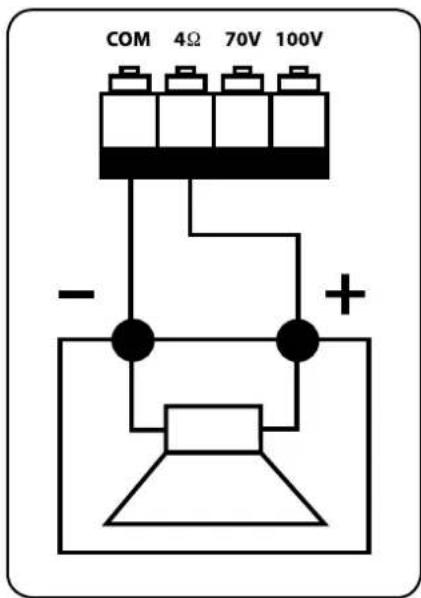
- The loudspeaker total impedance shall not be lower than 4 . Note: a total impedance equal to 4 allows the amplifier maximum power delivery. A higher impedance leads to a reduction of the power delivered by the amplifier (e.g. 8 : approx. 12 power, 16 : approx. 14 power). An impedance lower than 4 overloads the amplifier.
- Loudspeaker models shall be chosen by considering the max. power (80 W) that the amplifier can deliver.
- Loudspeaker line should be as short as possible; long cables may need large wire cross-sections.
- Do not use, at the same time, both the low impedance output (4 Ω) and the constant voltage output (100V or 70V), as this overloads the amplifier.
POWER SUPPLY VOLTAGE CHANGE
IMPORTANT: This manual section is for qualified personnel only.
The following instructions are to be ignored by users.
Make sure the device is not connected to the mains (unplug the power supply cable).
Remove the lid.
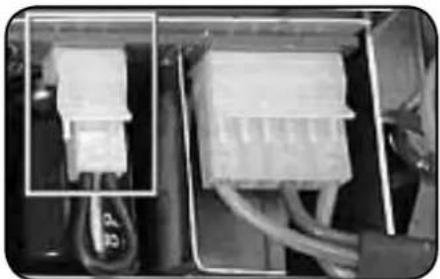
Find the 230 / 115V voltage change connector (in the picture, it is highlighted by a square):
According to the PCB indication, if the mains voltage is 230V , set the connector to the 230V position, if the mains voltage is 115V , set the connector to the 115V position.
Refit the device lid.
Before connecting the device to the mains, make sure that the fuse (inside the IEC power supply connector of the rear panel, see 24) is the correct current rating for the mains voltages (read the fuse indication below the connector).
SPECIFICATIONS
AMPLIFIER
Output (RMS) power 80 W
Frequency response 50 Hz ÷ 16 kHz
SIGNAL / NOISE RATIO
- Channels 1, 2 60 dB
-Aux inputs 80 dB
Distortion (at 1 kHz, nominal power) < 0.3%
AUX INPUT TONE CONTROLS
- Bass -9÷+6dB@100Hz
- Treble -14÷+8dB@10kHz
High-pass filter (channels 1, 2) 150 Hz
Input sensitivity / impedance
- Channels 1-2, MIC Balanced, -62 dBu (max - 25 dBu) / 10 kO
- Channels 1-2, LINE Balanced, -29 dBu (max +11 dBu) / 10 kΩ
-Aux inputs Adjustable- 18÷ +20 dBu/20kΩ
Phantom power voltage / current 30 V/18 mA
LOUDSPEAKER OUTPUTS
Low impedance 4Ω
Constant voltage 70 V (63 Ω) / 100 V (125 Ω)
PROTECTIONS
Amplifier Overload, short circuit, thermal
Power supply fuses
GENERIC
Operating voltage 115-230V/50-60Hz
Power (consumption) 160 W
Dimensions (w, h, d) 442 mm, 88 mm, 230 mm (2U 19" rack)
Net weight 3.8 kg
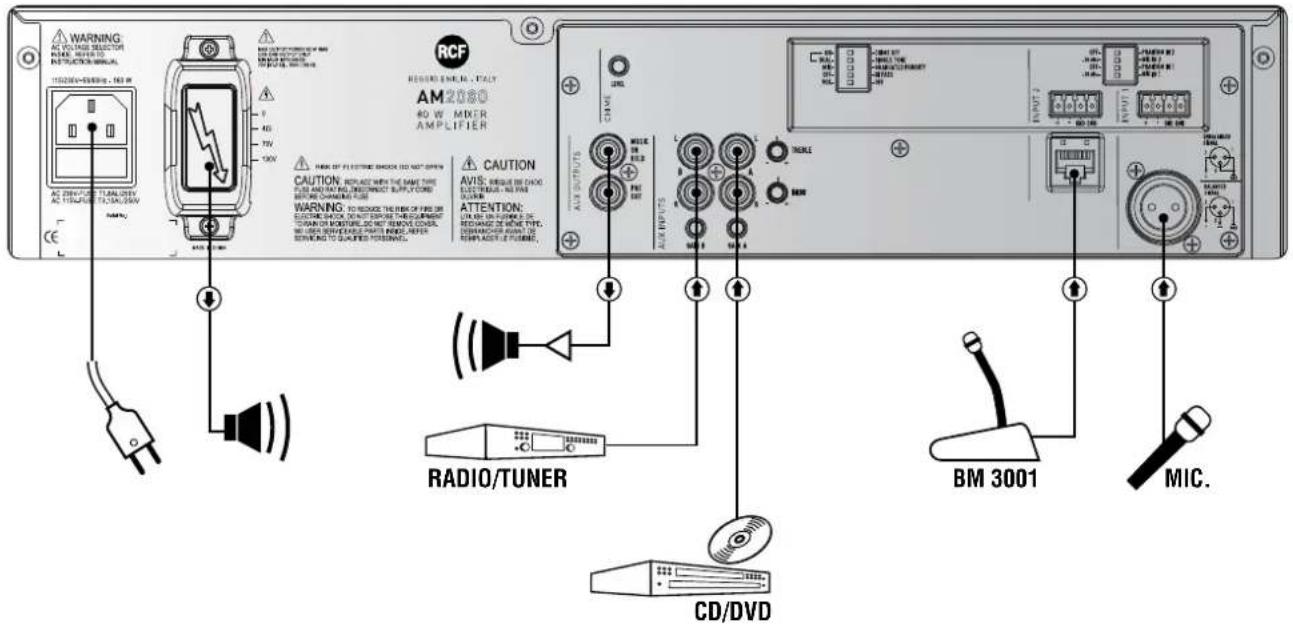
EXAMPLE OF CONNECTIONS
IMPORTANT
Voltage constant 70 V (63 Ω) / 100 V (125 Ω)
PROTECTIONS
Except possible errors and omissions.
RCF S.p.A. reserves the right to make odifications without prior notice.

- INDEX
- USCITA BASSA IMPEDENZA (4 Ω)
- SAFETY PRECAUTIONS
- POWER SUPPLY FROM MAINS
- IMPORTANT NOTES
- OPERATING PRECAUTIONS
- RCF S.p.A. thanks you for purchasing this product, which has been designed to guarantee reliability and high performances.
- DESCRIPTION
- FRONT PANEL
- REAR PANEL
- OPERATION
- 'MIX' MODE
- 'GRADUATED PRIORITY' MODE
- RCF BM 3001 PAGING MICROPHONE (NOT INCLUDED)
- LOUDSPEAKER CONNECTION
- LOW IMPEDANCE OUTPUT (4 Ω)
- POWER SUPPLY VOLTAGE CHANGE
- SPECIFICATIONS
- AMPLIFIER
- SIGNAL / NOISE RATIO
- AUX INPUT TONE CONTROLS
- Input sensitivity / impedance
- LOUDSPEAKER OUTPUTS
- PROTECTIONS
- GENERIC
- EXAMPLE OF CONNECTIONS
- IMPORTANT
Brand : RCF
Model : AM2080
Category : Receiver