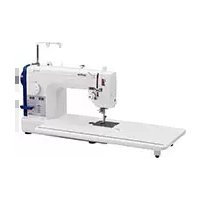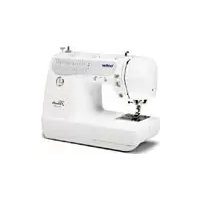
PS3100 - Sewing machine BROTHER - Free user manual and instructions
Find the device manual for free PS3100 BROTHER in PDF.


User questions about PS3100 BROTHER
0 question about this device. Answer the ones you know or ask your own.
Ask a new question about this device
Download the instructions for your Sewing machine in PDF format for free! Find your manual PS3100 - BROTHER and take your electronic device back in hand. On this page are published all the documents necessary for the use of your device. PS3100 by BROTHER.
USER MANUAL PS3100 BROTHER
natural_image
Blue line drawing of a sewing machine needle and foot (no text or symbols)
natural_image
Blue line drawing of a mechanical component or bracket (no text or symbols)
natural_image
Blue line drawing of a sewing machine needle and base (no text or symbols)Instruction Manual Manual de instrucciones Manuel d'instructions
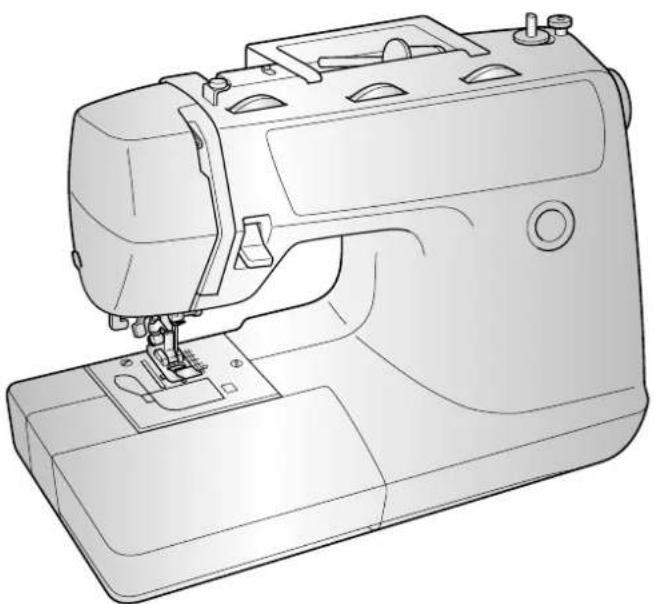
natural_image
Line drawing of a sewing machine (no text or symbols present)"IMPORTANT SAFETY INSTRUCTIONS"
When using this machine, basic safety precautions should always be taken, including the following:
"Read all instructions before using."
DANGER — To reduce the risk of electric shock:
- The machine should never be left unattended when plugged in. Always unplug this machine from the electrical outlet immediately after using and before cleaning.
- Always unplug before changing the light bulb. Replace bulb with same type rated 15 watts.
WARNING — To reduce the risk of burns, fire, electric shock, or injury to persons:
- Do not allow this machine to be used as a toy. Close attention is necessary when the machine is used by or near children.
- Use this machine only for its intended use as described in this manual. Use only accessories recommended by the manufacturer as contained in this manual.
- Never operate this machine if it has a damaged cord or plug, if it is not working properly, if it has been dropped or damaged, or dropped into water. Return the machine to the nearest authorized retailer or service center for examination, repair, electrical or mechanical adjustment.
- Never operate the machine with any air openings blocked. Keep ventilation openings of the machine and foot control free from the accumulation of lint, dust, and loose cloth.
- Never drop or insert any object into any opening.
- Do not use outdoors.
- Do not operate where aerosol (spray) products are being used or where oxygen is being administered.
- To disconnect, turn the main switch to the symbol "O" position which represents off, then remove plug from outlet.
- Do not unplug by pulling on cord. To unplug, grasp the plug, not the cord.
- Keep fingers away from all moving parts. Special care is required around the machine needle.
- Always use the proper needle plate. The wrong plate can cause the needle to break.
- Do not use bent needles.
- Do not pull or push fabric while stitching. It may deflect the needle causing it to break.
- Switch the machine to the symbol "O" position when making any adjustments in the needle area, such as threading needle, changing needle, threading bobbin, or changing the presser foot, and the like.
- Always unplug the machine from the electrical outlet when removing covers, lubricating, or when making any of the user service adjustments mentioned in the instruction manual.
- The machine is not intended for use by young children or infirm persons without supervision.
- Young children should be supervised to ensure that do not play with this machine.
"SAVE THESE INSTRUCTIONS" "This machine is intended for household use."
"IMPORTANTES INSTRUCCIONES DE SEGURIDAD"
If this machine is fitted with a 3 pin non-rewireable BS plug then please read the following.
IMPORTANT (in the United Kingdom)
Main supply (AC 230/240V\~, 50Hz)
DO NOT cut off the main plug from equipment. If the plug fitted is not suitable for the power point in your home or the cable is too short to reach a power point, then obtain an appropriate safety approved extension lead or consult your retailer.
BE SURE to replace the fuse only with an identical approved type, as originally fitted and to replace the fuse cover.
If none the less the main plug is cut off be sure to remove the fuse and dispose of the plug immediately, to avoid a possible shock hazard by inadvertent connection to the main supply.
IMPORTANT (in the other countries)
If the available socket outlet is not suitable for the plug supplied with this equipment, it should be cut off and an appropriate three pin plug fitted. With alternative plugs an approved fuse must be fitted in the plug.
NOTE: The plug severed from the main leads must be destroyed as a plug with bared flexible cords is hazardous if engaged in a live socket outlet. In the event of replacing the plug fuse, use a fuse approved by ASTA to BS 1362, i.e. carrying the mark, rating as marked on plug.
Always replace the fuse cover. Never use plugs with the fuse cover omitted.
WARNING: DO NOT CONNECT EITHER WIRE TO THE EARTH TERMINAL WHICH IS MARKED WITH THE LETTER 'E', BY THE EARTH SYMBOL 12 OR COLOURED GREEN OR YELLOW.
The wires in this main lead are coloured in accordance with the following code:
Blue Neutral
Brown Live
As the colours of the wiring in the main lead of this appliance may not correspond with the coloured markings identifying the terminals in your plug, proceed as follows:
The wire which is coloured blue must be connected to the terminal which is marked with the letter 'N' or coloured black or blue.
The wire which is coloured brown must be connected to the terminal which is marked with the letter 'L' or coloured red or brown.
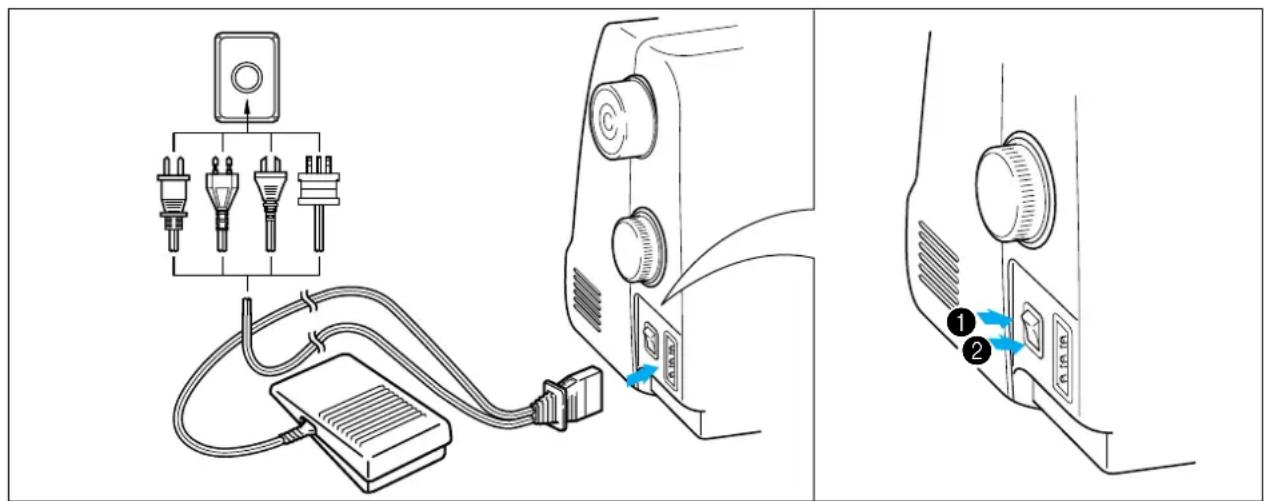
Connecting Plugs and Main Power / Sewing Light Switch
text_image
Diagram showing cable connection to a device with labeled components and directional arrows indicating connection steps.- Connect the power cord or three-prong plug into the machine.
- Connect the electrical supply plug into a wall outlet.
- When leaving the machine unattended, the main switch of the machine should be switched off or the plug must be removed from the socket outlet.
Turn ON or OFF the switch for the main power and sew-light.
①Turn ON
②Turn OFF
- When servicing the machine, or when removing covers or changing bulbs, the machine or the electrical set must unplugged.
PLEASE READ BEFORE USING THIS MACHINE
For safe operation
-
Be sure to keep your eye on the needle while sewing. Do not touch the handwheel, thread take-up, needle, or other moving parts.
-
Remember to turn off the power switch and unplug the cord when:
• Operation is completed
- Replacing or removing the needle or any other parts
• A power failure occurs during use
- Maintaining the machine
• Leaving the machine unattended.
-
Do not store anything on the foot controller.
-
Plug the machine directly into the wall. Do not use extension cords.
For a longer service life
- When storing this machine, avoid direct sunlight and high humidity locations. Do not use or store the machine near a space heater, iron, halogen lamp, or other hot objects.
- Use only neutral soaps or detergents to clean the case. Benzene, thinner, and scouring powders can damage the case and machine, and should never be used.
- Do not drop or hit the machine.
- Always consult the operation manual when replacing or installing any assemblies, the presser feet, needle, or other parts to assure correct installation.
For repair or adjustment
In the event a malfunction occurs or adjustment is required, first follow the troubleshooting table in the back of the operation manual to inspect and adjust the machine yourself. If the problem persists, please consult your local authorized retailer.
LEA ESTE MANUAL ANTES DE USAR ESTA MÁQUINA
KNOWING YOUR SEWING MACHINE
PRINCIPAL PARTS 1
ACCESSORIES 3
OPERATING YOUR SEWING MACHINE .... 5
Connecting Plugs 5
Main Power/Sewing Light Switch 7
Foot Controller 8
Checking the Needle 9
Replacing the Needle 9
Changing the Presser Foot 11
Flat Bed Attachment 11
VARIOUS CONTROLS 12
Pattern Selection Dial 12
Recommended Widths and Lengths for Stitches ... 13
Stitch Length Dial 16
Stitch Width Dial 17
Reverse Sewing Lever 17
Feed Dog Position Switch 18
Converting to Free-arm Style 18
Wide table.... 19
THREADING THE MACHINE 21
Winding the Bobbin 21
Lower Threading.... 23
Upper Threading.... 25
Using Needle Threader 27
Manually Drawing Up Lower Thread 29
Twin Needle Sewing 30
Thread Tension 32
FABRIC/THREAD/NEEDLE COMBINATIONS 33
STRAIGHT AND ZIGZAG STITCHING
PLEASE READ BEFORE SEWING 34
Straight Stitching 35
Zigzag Stitching 37
BUILT-IN STITCHES
Blind Hem Stitching 38
Shell Tuck Stitching 39
Elastic Stitching 40
Double Action Stitching 41
Scallop Stitching 42
Decorative Stitching.... 43
Patchwork 44
Overedge Stitching 45
Feather Stitching 46
Triple Zigzag Stretch Stitching.... 46
BUTTONHOLE AND BUTTON SEWING
Making a Buttonhole 47
Odd-shaped buttons that do not fit into
the button holder plate 49
Buttonhole Fine Adjustment 51
Button Sewing 54
USING ATTACHMENTS AND APPLICATIONS
Zipper Insertion.... 55
Gathering 55
Appliqués 57
Using the Free-motion Quilting Foot.... 58
Monogramming, Embroidering and Quilting ..... 60
Darning 62
Using the Walking Foot 63
Using the 1/4-Inch Quilting Foot 65
Using the Quilting Guide.... 67
MAINTENANCE
Changing the Light Bulb 68
Cleaning 69
Performance Check List 71
Repacking the Machine 77
INDEX
CONTENIDO
CONOZCA SU MÁQUINA DE COSER
ELEMENTOS PRINCIPALES 2
ACCESORIOS 4
Patchwork (Assemblage) 44
text_image
Technical diagram of a sewing machine with numbered parts for identification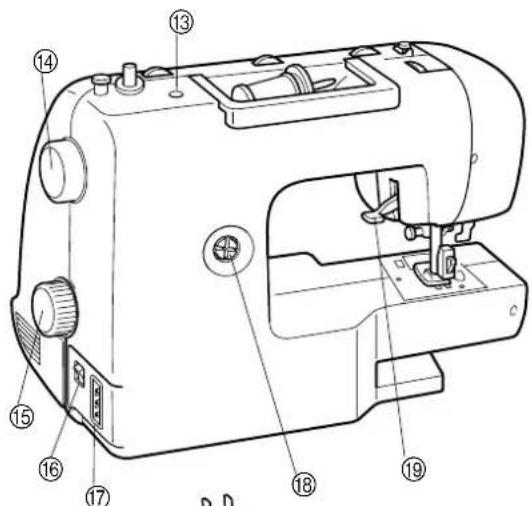
text_image
Technical diagram of a sewing machine with numbered parts for identification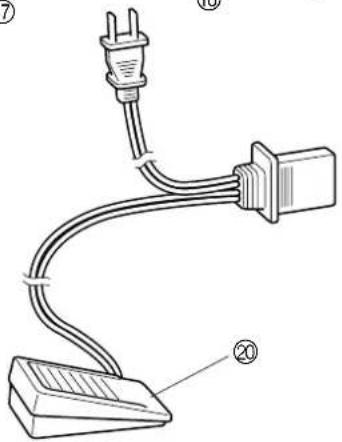
natural_image
Diagram of a cable with two connectors and a power plug, labeled with numbers ⑦ and ②0 (no text or symbols on the diagram itself)PRINCIPAL PARTS
①BOBBIN WINDER (Page 21)
Winds the thread onto the bobbin to be used for the lower thread.
②STITCH LENGTH DIAL (Page 12, 16)
Controls the length of the stitches.
③SPOOL PIN AND SPOOL CAP (Page 21, 25)
④STITCH WIDTH DIAL (Page 17)
Controls the stitch width.
⑤UPPER TENSION CONTROL DIAL (Page 32)
Controls the tension of the upper thread.
⑥BUTTONHOLE LEVER (Page 47)
⑦NEEDLE THREADER (Page 27)
⑧FLAT BED ATTACHMENT WITH ACCESSORY COMPARTMENT (Page 11, 18)
⑨ZIGZAG PRESSER FOOT (Page 3, 11)
⑩ REVERSE SEWING LEVER (Page 17)
Push for stitching in the reverse direction.
⑪FEED DOG POSITION SWITCH (Page 18)
⑫PATTERN INDICATION WINDOW (Page 12)
Shows the stitch number selected.
⑬HOLE FOR VERTICAL SPOOL PIN (Page 31)
Used to hold a second spool of thread for twin needle sewing.
⑭HANDWHEEL
⑮PATTERN SELECTION DIAL (Page 12)
Turn in either direction to select the desired stitch.
⑯MAIN POWER/SEWING LIGHT SWITCH (Page 7)
Turn ON/OFF the main power/sewing light switch.
Insert the foot controller plug for operation and connect the machine to the power supply.
⑱ BUTTONHOLE FINE ADJUSTMENT SCREW (Page 51)
⑲PRESSER FOOT LEVER (Page 25)
⑳FOOT CONTROLLER (Page 8)
Used to control sewing speed/start and stop.
ELEMENTOS PRINCIPALES
natural_image
Technical line drawing of a mechanical component with no visible text or symbols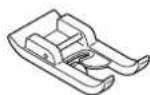
⑦130012-054 ⑧130013-154
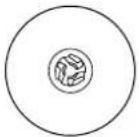

⑨X59476-021 ⑩130920-021
natural_image
Simple line drawing of a knife with a handle and ribbed base (no text or symbols)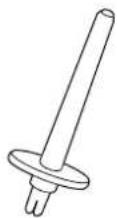
⑪X55467-021
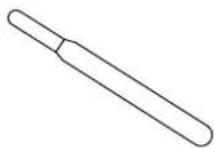
⑫X54243-051

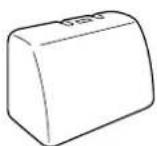
⑬X52769-656
⑭XC6272-023
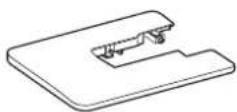
⑮SA140 F033N:XC2214-002
⑯SA129 F005N:XC1948-002
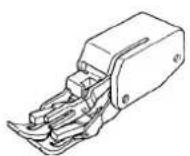
⑰SA125 F001N:XC1944-002
⑱SA132 F016N:XC2215-002
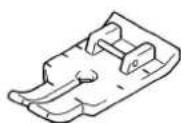
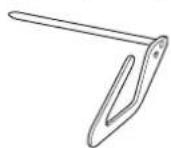
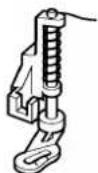
ACCESSORIES
①Zipper Foot (1 pc.)
②Bobbin (3 pcs.)
③Needle Pack
④Twin Needle (1 pc.)
⑤Buttonhole Foot (1 pc.)
⑥Satin Stitch Foot (1 pc.)
⑦Spool Cap (Large) (1 pc.)
⑧Spool Cap (Small) (1 pc.)
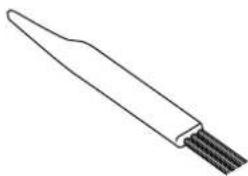
⑨Cleaning Brush (1 pc.)
⑩Extra Spool Pin (1 pc.)
⑪ Screwdriver (1 pc.)
⑫Seam Ripper (1 pc.)
⑬Hard Case (1 pc.)
⑭Wide table(1 pc.)
⑮ Walking Foot
⑯Free-motion Quilting Foot
⑰1/4-Inch Quilting Foot
⑱Quilting guide
Zigzag Presser Foot is on machine.
NOTE (For U.S.A. only):
Foot Controller: Model KD-1902
Part Code: XC7359-021 (110/120V Area)
This foot controller can be used for Model PS-3700.
Many of the above accessories are stored in the flat bed attachment. These accessories have been designed to help complete most sewing tasks.
ACCESORIOS
①Pata de cremalleras (1 pza)
②Canilla (3 pzas)
③Paquete de agujas
④Aguja doble (1 pza)
⑤Prensatelas para ojales (1 pza)
⑥Prénsatela para puntada de realce (1 pza)
⑦Tope para carretes (grande) (1 pza)
⑧Tope para carretes (pequeño) (1 pza)
⑨Cepillo (1 pza)
⑩Porta carretes extra (1 pza)
⑪Destornillador (1 pza)
⑫Cortador para abrir costuras (1 pza)
⑬Caja rígida (1 pza)
⑭Tabla ancha (1 pza)
⑮Pie caminante
⑯Prensatelas libre
⑰Prensatela para pespunte 1/4
⑱Guía de acolchados
text_image
Diagram showing connections between a device with three plug-in switches and a power connector, alongside a device labeled in Chinese.OPERATING YOUR SEWING MACHINE
Connecting Plugs
- Connect the power cord plug into the machine.
- Connect the power supply plug into a wall outlet.
CAUTION
- When leaving the machine unattended, the main switch of the machine should be switched off or the plug must be removed from the socket-outlet.
- When servicing the machine, or when removing covers or changing bulbs, the machine or the electrical set must be unplugged.
- For U.S.A. only
This appliance has a polarized plug (one blade wider than the other). To reduce the risk of electric shock, this plug is intended to fit in a polarized outlet only one way. If the plug does not fit fully in the outlet, reverse the plug.
If it still does not fit, contact a qualified electrician to install the proper outlet. Do not modify the plug in any way.

WARNING
- Use only regular household electricity for the power source. Using other power sources may result in fire, electric shock, or damage to the machine.
-
Turn off the main power and remove the plug in the following circumstances:
-
When you are away from the machine
- After using the machine
- When the power fails during use
- When the machine does not operate correctly due to a bad connection or a disconnection
- During electrical storms

CAUTION
- Do not use extension cords or multi-plug adapters with many other appliances plugged in to them. Fire or electric shock may result.
- Do not touch the plug with wet hands. Electric shock may result.
- When unplugging the machine, always turn off the main power first. Always grasp the plug to remove it from the outlet. Pulling on the cord may damage the cord, or lead to fire or electric shock.
- Do not allow the power cord to be cut, damaged, modified, forcefully bent, pulled, twisted, or bundled. Do not place heavy objects on the cord. Do not subject the cord to heat. These things may damage the cord and cause fire or electric shock. If the cord or plug is damaged, take the machine to your authorized retailer for repairs before continuing use.
- Unplug the power cord if the machine is not to be used for a long period of time. Otherwise a fire may result.
text_image
Diagram showing a door switch mechanism with labeled parts and directional arrows indicating movement or force.Main Power/Sewing Light Switch
This switch turns the main power/sewing light on or off.
①Turn ON (toward the "I" mark)
②Turn OFF (toward the "O" mark)
Interruptor principal/luz de cosido
natural_image
Illustration of a foot pressing a blue foot on a blue foam base, with a blue arrow indicating force direction (no text or symbols)Foot Controller
When the foot controller is depressed lightly, the machine will run at a low speed. When the pressure on the foot controller is increased, the machine's speed will increase. When pressure on the foot controller is released, the machine will stop. Care should be taken that nothing is placed on the foot controller when the machine is not in use.
①Foot controller
CAUTION
Do not allow fabric pieces and dust to collect in the foot controller. Doing so could cause a fire or an electric shock.
NOTE (For U.S.A. only):
Foot Controller: Model KD-1902
This foot controller can be used for Model PS-3700.
Pedal
text_image
Diagram showing four types of boat hull designs with cross and circle symbols indicating different orientations or orientations.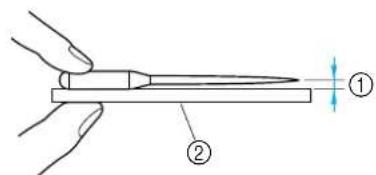
text_image
Diagram showing a hand holding a tool with labeled parts ① and ②, indicating a measurement or alignment step.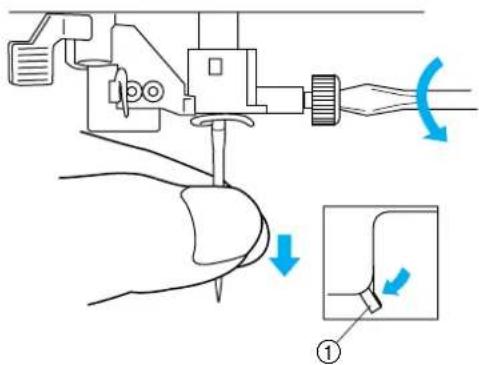
text_image
Technical diagram showing a sewing machine tool with a close-up of the base component, labeled with Chinese text and blue directional arrows.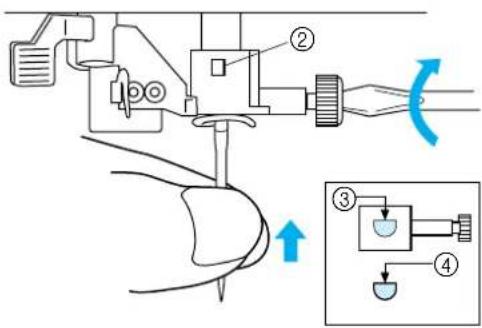
text_image
Technical diagram showing mechanical assembly with labeled components and directional arrows, including a zoomed-in inset of a component.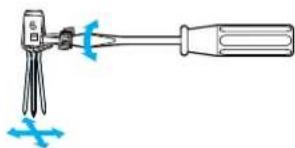
natural_image
Diagram of a screwdriver with a tripod-mounted sensor and blue directional arrows indicating motion (no text or symbols)Checking the Needle
The sewing needle must always be straight and sharp for smooth sewing.
To Check the Needle Correctly:
To check the needle, place the flat side of the needle on a flat surface. Check the needle from the top and the sides. Throw away any bent needles.
①Parallel space
②Level surface (bobbin cover, glass, etc.)
* Place a level surface under the needle.
Replacing the Needle
CAUTION
- Turn the main power switch to OFF before changing the needle. If the main power is left on and foot controller is stepped on, the machine will start and injury may result.
- Use only sewing machine needles for home use. Other needles may bend or break and cause injury.
-
Never sew with a bent needle. A bent needle will easily break and cause injury.
-
Remove the power supply plug from the outlet.
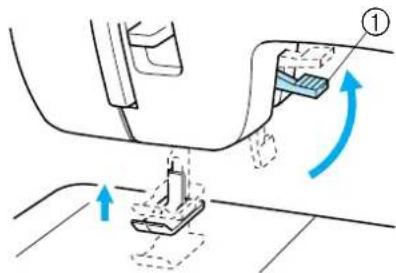
- Raise the needle bar to its highest position.
- Lower the presser foot.
- Remove the needle by loosening the needle clamp screw.
①Presser foot lever
CAUTION
Do not loosen or tighten the needle clamp screw with a strong force, otherwise it may be damaged.
- With the flat side of the needle facing the back, insert the new needle all the way to the top of the needle stopper (viewing window) in the needle clamp. Use a screwdriver to securely tighten the needle clamp screw.
②Needle stopper
③Hole for setting needle
④Flat side of needle
CAUTION
Be sure to push in the needle until it touches the stopper, and securely tighten the needle clamp screw with a screw-driver. If the needle is not completely inserted or the needle clamp screw is loose, the needle may break or the machine may be damaged.
natural_image
Illustration of a sewing machine being adjusted for size, showing hand positioning and base positioning (no text or symbols)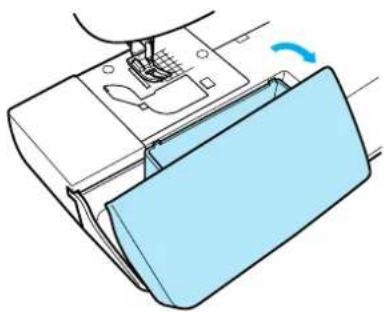
natural_image
Diagram of a sewing machine's base with a hand inserting a slot into the top panel, showing no text or symbols.Changing the Presser Foot
CAUTION
• Always turn off the power before changing the presser foot. If the power is on and foot controller is stepped on, the machine will start and may cause injury.
• Always use the correct presser foot for the selected stitch pattern. If the wrong presser foot is used, the needle may strike the presser foot and bend or break, and may cause injury.
- Only use presser feet for this machine. Using other presser feet may lead to accident or injury.
It may be necessary to change the presser foot according to your sewing needs.
SNAP-ON TYPE
- Raise the needle to its highest position by turning the handwheel toward you (counter clockwise) and raise the presser foot lever.
- Release the foot by raising the lever located at the back of the holder.
- Place a different presser foot on the needle plate so that the bar on the presser foot is in line with the slot on the shank.
- Lower the presser foot lever and fix the presser foot onto the shank. If the presser foot is in the correct location, the bar should snap in.
Flat Bed Attachment
Many of the accessories are stored in a compartment under the flat bed attachment cover, which can be opened by flipping it toward you.
Changement de pied-de-biche
ATTENTION
text_image
Technical diagram showing mechanical component with labeled parts and a close-up of a dial indicator scale.DISTINTOS MANDOS
Pattern Selection Dial
CAUTION
When you use the Pattern Selection Dial to select a pattern, turn the handwheel to the front (counter-clockwise) by hand to set the needle in the highest position before selecting the pattern. If the needle is in the down position when the Pattern Selection Dial is turned, the needle, presser foot, or fabric may be damaged.
To select a stitch, simply turn the Pattern Selection Dial, located on the right side of the machine. The Pattern Selection Dial may be turned in either direction between 1 and 19 (or for stretch stitches between 20 and 37).
The number of the selected stitch will appear in the pattern indication window.
The following page shows the recommended range of stitch length and width.
①Pattern selection dial
②Pattern indication window
The stitches that are available depend on the Stitch Length Dial setting. If the Stitch Length Dial is set between 0 and 4.5, any of the stitches in the top row can be selected. If the Stitch Length Dial is set to SS, any of the stitches in the bottom row can be selected.
③Stitch length dial
NOTE:
Since the Pattern Selection Dial is not a continuous dial, it cannot be turned directly from the last stitch to the first one or from the first stitch to the last one. To select the first stitch when the last one is displayed or to select the last stitch when the first one is displayed, turn the Pattern Selection Dial in the opposite direction until the desired stitch is displayed.
DESCRIPTIF DES DIFFERENTES COMMANDES
Recommended Widths and Lengths for Stitches
| PATTERN | STITCH NAME | RECOMMENDED WIDTH SETTING (inch) | RECOMMENDED LENGTH SETTING (inch) | INSTRUCTION MANUAL PAGE |
| 1-STEP AUTOMATIC 4-7 F-1.5 BUTTONHOLE (1/8-3/16) (1/64-1/16) | 47 | |||
| STRAIGHT STITCH (Center position) (1/16-3/16) | 3.5 | 1-4.5 | 35 | |
| ZIGZAG STITCH | 0-6.5 F-4.5(0-1/4) (1/64-3/16) | 37 | ||
| BLIND HEM STITCH | 3-6.5 F-2(1/8-1/4) (1/64-1/16) | 38 | ||
| SHELL TUCK STITCH | 3-6.5 F-3(1/8-1/4) (1/64-1/8) | 39 | ||
| ELASTIC STITCH | 3-6.5 F-2.5(1/8-1/4) (1/64-3/32) | 40 | ||
| STRETCH BLIND HEM STITCH | 3-6.5 F-1.5(1/8-1/4) (1/64-1/16) | 38 | ||
| SCALLOP STITCH | 3-6.5 F-1.5(1/8-1/4) (1/64-1/16) | 42 | ||
| DOUBLE ACTION STITCH BRIDGING STITCH RAMPART STITCH | 3-6.5 F-3(1/8-1/4) (1/64-1/8) | 41 | ||
| ELASTIC SHELL TUCK STITCH | 3-6.5 F-3(1/8-1/4) (1/64-1/8) | 45 | ||
| BEAD STITCH ARROWHEAD STITCH 3-6.5 F-1 PARALLELOGRAM STITCH (1/8-1/4) (1/64-1/16) | 43 | |||
| LIGHTNING STITCH SQUARE STITCH DECORATIVE STITCH | 6.5 F-1(1/4) | (1/64-1/16) | 43 | |
| TRIPLE STRETCH STITCH (Center position) | 3.5 | SS Fixed2.5 (3/32) | 35 | |
| TRIPLE ZIGZAG STRETCH STITCH | 3-6.5(1/8-1/4) 2.5 (3/32) | SS Fixed | 46 | |
| ELASTIC OVERLOCK STITCH | 3-6.5(1/8-1/4) 2.5 (3/32) | SS Fixed | 45 | |
| ELASTIC OVERLOCK STITCH | 3-6.5(1/8-1/4) 2.5 (3/32) | SS Fixed | 45 | |
| FEATHER STITCH | 3-6.5(1/8-1/4) 2.5 (3/32) | SS Fixed | 46 | |
| COMB STITCH | 3-6.5(1/8-1/4) 2.5 (3/32) | SS Fixed | 45 | |
| DECORATIVE STITCH | 6.5(1/4) | SS Fixed2.5 (3/32) | 43 | |
| FAGOTING STITCH | 3-6.5(1/8-1/4) 2.5 (3/32) | SS Fixed | 44 | |
| DECORATIVE STITCH | 3-6.5(1/8-1/4) 2.5 (3/32) | SS Fixed | 43 | |
| DECORATIVE HEM STITCH | 3-6.5(1/8-1/4) 2.5 (3/32) | SS Fixed | 41 | |
| DECORATIVE STITCH | 6.5(1/4) | SS Fixed2.5 (3/32) | 43 | |
| LINK STITCH | 3-6.5(1/8-1/4) 2.5 (3/32) | SS Fixed | 44 |
text_image
Diagram of a car dashboard with labeled parts and a blue circular indicator on the dashboard handle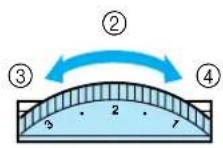
Depending on your selected stitch, you may need to adjust the stitch length for best results.
The numbers marked on the Stitch Length Dial represent the length of the stitch in millimeters (mm).
THE HIGHER THE NUMBER, THE LONGER THE STITCH.
The "0" setting does not feed the material. This is used for sewing on a button.
The "F" area is used for making a Satin Stitch (a dense zigzag stitch) which can be used in making buttonholes and decorative stitches. The position needed for making the Satin Stitch varies according to the material and thread being used. To determine the exact dial position, you should first test the stitch and length settings on a scrap of fabric to observe the feeding of the material.
①Stitch length dial
②Length
③Fine → SS
④Coarse
CAUTION
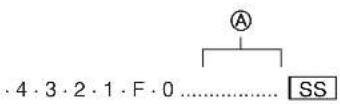
Do not set the Stitch Length Dial in the range shown by Ⓐ. If the machine is started while the dial is set in the range shown by Ⓐ, the fabric will not feed correctly and the fabric or machine may be damaged.
Turn the dial to the left past "0" into the SS position. The SS length is preset for the best stretch stitch performance.
CAUTION
If the stitches get bunched together, lengthen the stitch length and continue sewing. Do not continue sewing without lengthening the stitch length, otherwise the needle may break and cause injury.
text_image
Diagram of a washing machine handle with labeled component and blue motion indicator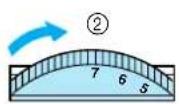
natural_image
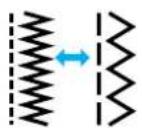
Line drawing of a sewing machine needle being adjusted, showing the blade and base (no text or symbols)Depending on the stitch selected, you may need to adjust the stitch width.
The numbers marked on the dial represent the stitch width. THE HIGHER THE NUMBER, THE WIDER THE STITCH.
①Stitch width dial
CAUTION
Do not adjust the stitch width while the needle is in the fabric. Otherwise, the needle or fabric may be damaged.
NOTE:
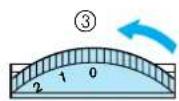
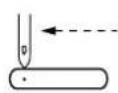
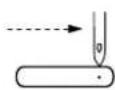
When you choose the Straight Stitch or the Triple Stretch Stitch you can change the needle position from left to right.
②Turn the stitch width dial toward the "7" setting for left needle position.
③Turn the stitch width dial toward the "0" setting for right needle position.
Reverse Sewing Lever
Reverse sewing is used for back tacking and reinforcing seams.
To sew in reverse, push the Reverse Sewing Lever down as far as possible and hold in that position while pressing lightly on the foot pedal. To sew forward, release the Reverse Sewing Lever. The machine will then sew forward.
①Reverse sewing lever
text_image
Technical diagram showing sewing process steps with numbered instructions and component labelsFeed Dog Position Switch
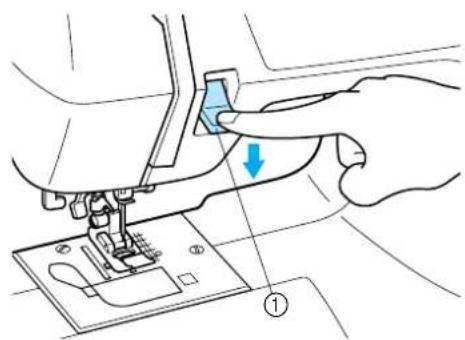
Use the Feed Dog Position Switch to raise or lower the feed dogs according to the job that is being done. When monogramming, embroidering, darning or sewing on buttons, the feed dogs should be lowered. (The garment will not be fed.)
NOTE:
When raising or lowering the feed dogs, move the Feed Dog Position Switch as far as possible to the appropriate side. Since the feed dogs can not be raised using the Feed Dog Position Switch immediately after they are lowered, move the switch to the Up Position, turn the handwheel toward you once and the feed dogs will move into the raised position.
①Feed dog position switch
②Down position
③Up position
Converting to Free-arm Style
Free-arm sewing is convenient for sewing tubular and hard-to-reach areas on a garment. To change your machine to the free-arm style, simply slide out the flat bed attachment to the left.
①Slide the flat bed attachment to the left.
①Flat bed attachment
- Open up the legs at the bottom of the wide table. Pull out the four legs until they snap into place.
- Pull the flat bed attachment off to the left.
- Install the wide table.
① Keeping the wide table level, fully slide it into place.
②Turn the screw at the bottom of the legs to adjust their height.
-
When you are finished using the wide table, remove it. While slightly lifting up the front of the wide table on the right side, pull off the table to the left. Snap all four legs into storage position.
-
Install the flat bed attachment back in its original position.
NOTE:
Do not install or remove the wide table with force, otherwise the mounting hook may be damaged.

CAUTION
- Do not move the sewing machine while the wide table is attached, otherwise damage or injuries may occur.
- Do not use the wide table for other purposes such as an ironing board. This can cause damage and injury.
- Do not move the sewing machine while the wide table is attached, otherwise damage or injuries may occur.
- Do not use the wide table for other purposes such as an ironing board. This can cause damage and injury.
Tabla ancha
natural_image
Line drawing of a device with a hand pulling a cable or wire, showing internal components and wiring (no text or symbols)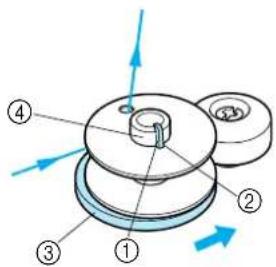
text_image
Technical diagram of a mechanical component with numbered parts and directional arrows indicating motion or force vectors.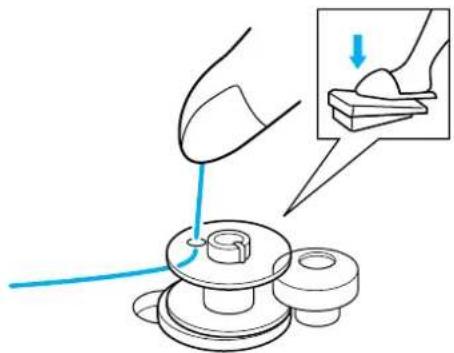
text_image
Diagram illustrating a mechanical or electrical component with a blue wire being inserted, accompanied by an inset showing a hand holding a small object.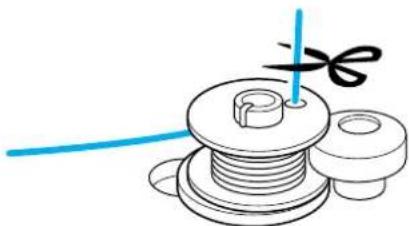
natural_image
Illustration of a mechanical component with a blue wire and a black bow, no text or symbols present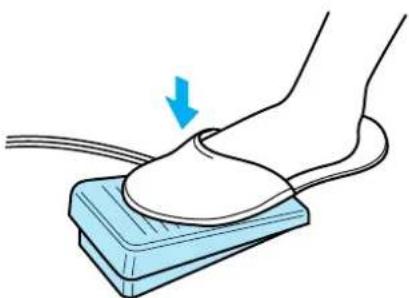
natural_image
Illustration of a foot pressing down on a blue foam roller with a blue arrow indicating force (no text or symbols)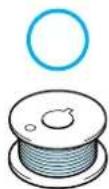
①

②
THREADING THE MACHINE
Winding the Bobbin
CAUTION
- If the thread spool and/or spool cap are set incorrectly, the thread may tangle on the spool pin.
-
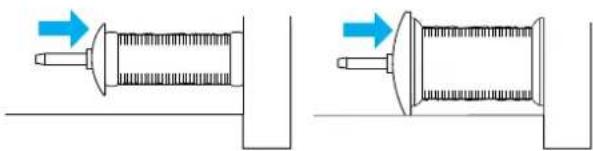
Use the spool cap (large, medium, or small) that is closest in size to the thread spool. If a spool cap smaller than the thread spool is used, the thread may become caught in the slit on the end of the spool.
-
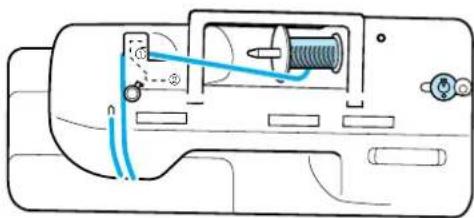
Place the spool of thread on the horizontal spool pin and firmly hold it with a spool cap so that the spool of thread will not turn. Pass the thread through the thread guide as shown following the dotted line on the top of the machine.
CAUTION
Use only bobbins recommended by the manufacturer of this machine (see page 3). Using other bobbins may result in damage or injury.
- Pass the end of the thread through the hole on the bobbin from the inside. Place the bobbin onto the bobbin winder shaft and slide the bobbin winder shaft to the right. Turn the bobbin clockwise, by hand, until the spring on the shaft slides into the groove of the bobbin.
①Spring on the shaft
②Groove of the bobbin
③Bobbin winder seat
④Bobbin winder shaft
- While holding the end of the thread, gently depress the foot controller to wind the thread around the bobbin a few times. Then stop the machine.
Trim the excess thread above the bobbin.
- Press down on the foot controller to start.
- After the machine stops automatically when the bobbin is full, take your foot off of the foot controller.
CAUTION
When removing the bobbin, do not pull on the bobbin winder seat. Doing so could loosen or remove the bobbin winder seat, resulting in damage to the machine.
6. Cut the thread, slide the bobbin winder shaft to the left and remove the bobbin.
NOTE:
The needle bar does not move when the bobbin winding shaft is slid to the right.
Immediately after winding the bobbin, it is normal to hear the sound of the clutch engaging when beginning to sew or manually turning the handwheel.
CAUTION
Be sure to follow the process described. If the thread is not cut completely, and the bobbin is wound, when the thread runs low it may tangle around the bobbin and cause the needle to break.
CAUTION
Setting the bobbin improperly may cause the thread tension to loosen, breaking the needle and resulting in injury.
①Wound evenly
②Wound poorly
text_image
Diagram showing a hand pressing a component on a surface, labeled with parts ① and ②, and a blue arrow indicating direction.B
natural_image
Illustration of hands using a tool to adjust a circular component with blue arrows indicating motion (no text or symbols)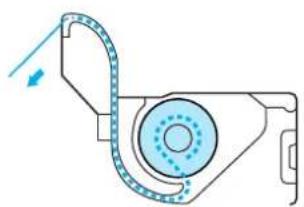
natural_image
Diagram of a mechanical device with a rotating shaft and circular component (no text or symbols)C
text_image
Diagram showing a hand pressing a component with labeled parts ① and ②, indicating a process or assembly step.Lower Threading

CAUTION
Setting the bobbin improperly may cause the thread tension to loosen, breaking the needle and resulting in injury.
①Wound evenly
②Wound poorly

CAUTION
Be sure to turn off the power. If you accidentally press on the foot controller and the machine begins to operate, injury could result.
-
Raise the needle to its highest position by turning the handwheel toward you (counterclockwise) and raise the presser foot lever.
-
Slide the bobbin cover latch to the right and open the cover. (Fig. A)
①Slide bobbin cover latch
②Cover
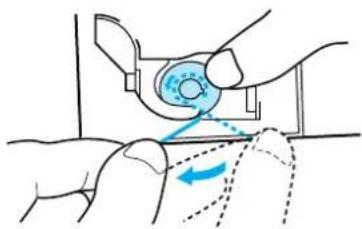
- Insert bobbin and pass thread through the bobbin thread path, then pull the thread forward to cut. (Fig. B)

CAUTION
Be sure the bobbin is set so the thread unrolls in the correct direction. If the thread unrolls in the wrong direction, it may cause the thread tension to be incorrect or the needle to break.
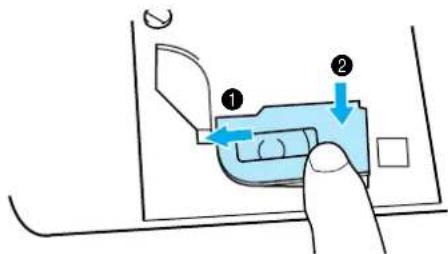
- Replace the bobbin cover. (Fig. C) Place the left tab in place (see arrow 1 at left), then press lightly on the right side (see arrow 2 at left) until the cover clicks into place.
* You can begin sewing immediately without drawing up the bobbin thread.
Enhebrado inferior
PRECAUCIÓN
text_image
Technical diagram of a sewing machine with numbered parts and blue motion arrows indicating movement or forceA
text_image
Technical diagram showing a sewing machine with blue directional arrows indicating motion or movement, labeled with number ①.B
natural_image
Two mechanical diagrams showing a shaft and spring assembly with blue arrows indicating direction (no text or symbols)C
natural_image
Diagram of a device interior with blue cables and connectors (no text or symbols)D
text_image
Diagram showing fluid flow through a pipe with labeled component and directional arrowsE
text_image
Technical diagram of a sewing machine with labeled parts and a blue tool line indicating assembly or maintenance.Upper Threading
- Raise the presser foot using the Presser Foot Lever. (Fig. A)
- Raise the needle to its highest position by turning the handwheel toward you (counterclockwise). (This step will raise the thread take-up into the correct position for threading.)
①Presser foot lever
- Place a spool of thread on the horizontal spool pin with the thread coming from the bottom front of the spool. Press a spool cap onto the spool pin to hold the thread spool firmly in place. (Fig. B)
The thread end should come from the bottom front of the spool.

CAUTION
- If the thread spool and/or spool cap are set incorrectly, the thread may tangle on the spool pin and cause the needle to break.
- Use the spool cap (large, medium, or small) that is closest in size to the thread spool. If a spool cap smaller than the thread spool is used, the thread may become caught in the slit on the end of the spool and cause the needle to break.

CAUTION
Be sure to thread the machine properly. Improper threading can cause the thread to tangle and break the needle, leading to injury.
- Pass thread through upper thread path. (Fig. C)
-
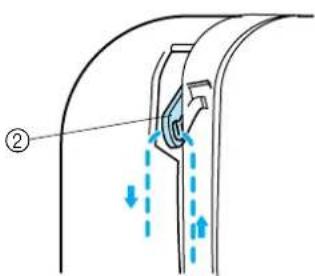
Make sure to guide the thread through the thread take-up lever from the right to the left. (Fig. D)
②Thread take-up lever -
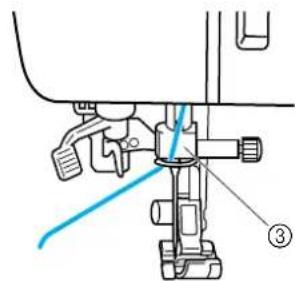
Place thread behind the guide on the needle clamp above the needle (Fig. E) through the opening on the right of the guide.
③Needle clamp
NOTE:
If the thread take-up lever is lowered, the upper thread can not be placed in the thread take-up lever correctly. Be sure to raise the Presser Foot Lever and the thread take-up before threading the upper thread.
Incorrectly feeding the thread may cause sewing problems.
Enhebrado superior
text_image
Technical diagram showing a sewing machine needle and its internal mechanism with numbered parts and directional arrows indicating motion.B
natural_image
Line drawing of a sewing machine needle stitching a fabric, with blue arrows indicating fabric direction (no text or symbols)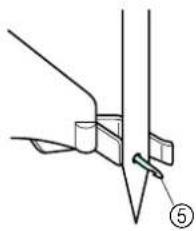
text_image
Diagram showing a mechanical or laboratory setup with labeled component ⑤, likely illustrating a procedure or measurement.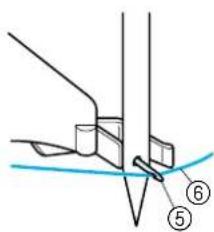
text_image
Technical diagram showing a mechanical or electrical component with labeled parts ⑤ and ⑥C
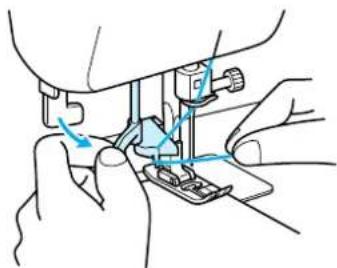
natural_image
Line drawing of hands operating a sewing machine with blue arrows indicating motion (no text or symbols)D
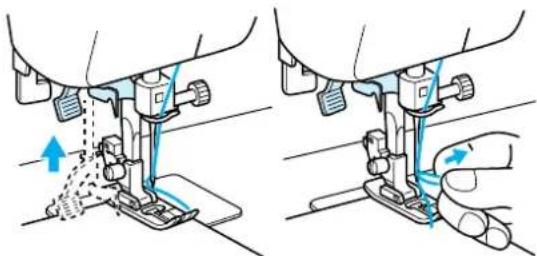
natural_image
Two-step illustration of a sewing machine needle and foot, showing the mechanism with no text or symbols.Using Needle Threader
Turn power switch to "O".
- Lower the presser foot lever.
- Turn the handwheel toward you (counter-clockwise) to raise the needle to the highest position.
CAUTION
When using the needle threader, be sure the needle is in the highest position. Otherwise, the hook may be damaged.
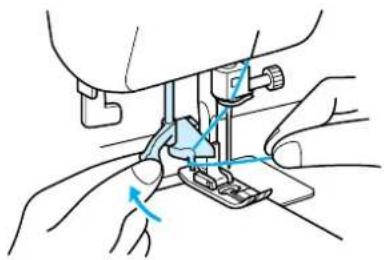
- While lowering the needle threader lever, hook the thread onto the guide. (Fig. A)
①Needle
②Needle threader lever
③Guide
- Pull down the needle threader lever as much as possible, then rotate the lever toward the back of the machine (away from you). Make sure that the hook passes through the eye of the needle catching the thread. (Fig. B)
- Hold the thread in front of the needle in order to make sure that the hook catches the thread.
①Needle
②Needle threader lever
③Guide
④Hook holder
- While lightly holding the thread, rotate the needle threader lever toward the front of the machine (toward you). (Fig. C) The hook will pull the thread through the needle eye.
⑤Hook
⑥Thread
- Raise the needle threader lever and pull out about 5 cm (2") of thread through the needle toward the back of the sewing machine. (Fig. D)

CAUTION
The needle threader can only be used with home sewing machine needles size 75/11-100/16. Check the table on page 33 for appropriate needle and thread combinations. Note that, if you are using transparent nylon mono-filament thread, only needles in the range of 90/14-100/16 can be used.

CAUTION
The needle threader can not be used to thread the needle when you are using decorative threads or specialty needles like the twin needle and wing needle. When using those types of threads or needles, thread the eye of the needle manually from front to back. Make sure the main power switch is OFF when threading the needle manually.
Uso del enhebrador
Desenchufar la máquina, interruptor principale a "O".
text_image
Technical diagram showing sewing process steps with labeled instructions for handling and finishing a machine.Manually Drawing Up Lower Thread
When sewing gathers or darts, the lower thread can be manually drawn up so that it will have some excess.
-
Pass the thread along the bobbin thread path in the direction of the arrow, and leave it there without cutting it.
• The bobbin cover should still be removed. -
While lightly holding the end of the upper thread, slowly turn the handwheel to the front (counter-clockwise) once by hand to lower and then raise the needle.
-
Pull on the upper thread to draw up the lower thread.
-
Pull out about 10 cm (4") of both threads and place them toward the back of the machine under the presser foot.
①Upper thread
②Lower thread
natural_image
Line drawing of a stylus with two sharp blades, no text or symbols presentTwin Needle Sewing
Your machine is designed for twin needle sewing, which allows you to sew with two top threads. You can use the same color or two different colors of thread for making decorative stitches. Any of the patterns, except the buttonhole pattern, can be sewn with the twin needle. When using the Straight Stitch, the Stitch Width Dial should be set so that the needle is in the center position (between 3 and 4). However, when other patterns are used, set the Stitch Width Dial between 0 and 5. See page 17 for details on adjusting the Stitch Width Dial.
CAUTION
- Use only twin needles made for this machine (part code X57521-021). Other needles could break, resulting in damage.
- When sewing with the twin needle, be sure the Stitch Width Dial is not set above 5 since this may cause the needle to hit the needle plate and break.
- Do not sew with bent needles. The needle could break and cause injury.
- When using the twin needle, be sure to use zigzag presser foot only.
INSERTING THE TWIN NEEDLE
Insert in the same way a single needle is inserted (refer to page 9). The flat side of the needle should face toward the back and the rounded side should face toward you.
PARA INTRODUCIR LA AGUJA DOBLE
natural_image
Pure diagram of a cylindrical mechanical component with internal structure and dashed line indicating bottom (no text or symbols)B
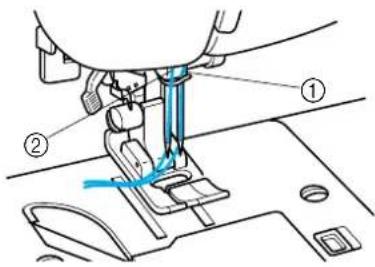
text_image
Technical diagram of a sewing machine with labeled parts, showing needle insertion and base positioning.Place the vertical spool pin in the hole found on top of the machine near the horizontal spool pin. Place the second spool of thread onto the vertical spool pin as shown in fig. A.
TWIN NEEDLE THREADING
Each needle should be threaded separately.
- Threading the Right Needle
Follow the same instructions for single needle threading using the thread from the spool on the extra spool pin. See page 25 for threading details.
- Threading the Left Needle
Thread the left needle in the same manner that the right needle was threaded, but do not pass the thread through the thread guide above the needle before passing it through the eye of the left needle as shown in fig. B.
①Right needle thread passes through this guide.
②Left needle thread passes in front of this guide.
CAUTION
The needle threader can not be used. Thread the twin needle by hand, from front to back. Using the needle threader may result in damage to the machine.
POUR PLACER UN PORTE-BOBINE SUPPLEMENTAIRE
text_image
Diagram illustrating a mechanical assembly with numbered components and a curved scale showing measurement range from 5 to 3 units.B
text_image
Diagram illustrating a mechanical or electrical component with numbered parts and a corresponding schematic showing a curved arc labeled 5~4~3.C
text_image
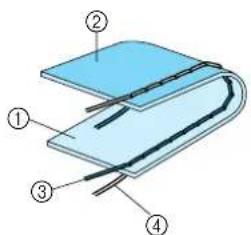
Diagram of a layered electronic device with numbered components labeled ① to ④Thread tension will affect the quality of your stitches. It may need to be adjusted when you change fabric or thread type.
NOTE:
It is recommended that a test sample be made on a fabric scrap before sewing on your project.
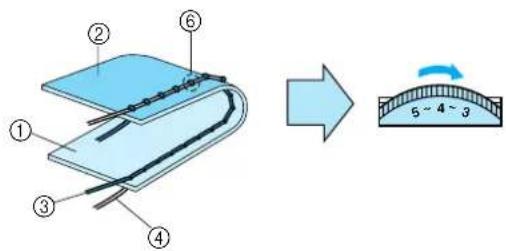
Possible misadjustments and their results. Upper tension is too tight. (Fig. A)
Locks appear on the surface of the fabric.
Decrease the tension by turning the Upper Tension Control Dial to a lower number.
Upper tension is too loose. (Fig. B)
Locks appear on the reverse side of the fabric.
Increase the tension by turning the Upper Tension Control Dial to a higher number.
CORRECT TENSION (Fig. C)
Correct tension is important since too much or too little tension will weaken your seams or cause puckers on your fabric.
①Surface
②Reverse side
③Upper thread
④Lower thread
⑤Locks appear on surface of fabric
⑥Locks appear on reverse side of fabric
Tension des fils
| Fabric | Thread | Size of needle | ||
| Type | Size | |||
| Medium weight fabric | Broadcloth | Cotton | 60 - 80 | 75/11 - 90/14 |
| Taffeta | Synthetic mercerized | 60 - 80 | ||
| Flannel, Gabardine | Silk or silk finished | 50 | ||
| Lightweight fabric | Lawn, Batiste | Cotton | 60 | 65/9 - 75/11 |
| Georgette | Synthetic mercerized | 60 | ||
| Challis, Satin | Silk | 50 | ||
| Heavyweight fabric | Denim | Cotton | 30 - 50 | 90/14 - 100/16 |
| Corduroy | Synthetic mercerized | 50 | ||
| Tweed | Silk | 50 | ||
| Stretch fabric | Jersey | Thread for knits | 50 - 60 | Ball point needle (golden colored)75/11 - 90/14 |
| Tricot | ||||
| For top stitching | Synthetic mercerized | 30 | 90/14 - 100/16 | |
| Silk | 30 | |||
NOTE:
- For transparent nylon thread, always use needle 90/14 - 100/16.
- The same thread is usually used for the bobbin thread and upper threading.

CAUTION
Be sure to follow the needle, thread, and fabric combinations listed in the table. Using an improper combination, especially a heavyweight fabric (i.e., denim) with a small needle (i.e., 65/9 - 75/11), may cause the needle to bend or break, and lead to injury. Also, the seam may be uneven, the fabric may pucker, or the machine may skip stitches.
- To avoid injury, pay special attention to the needle while the machine is in operation. Keep your hands away from moving parts while the machine is in operation.
- Do not stretch or pull the fabric during sewing. Doing so may lead to injury.
- Do not use bent or broken needles. Doing so may lead to injury.
• Take care that the needle does not strike basting pins or other objects during sewing. Otherwise, the needle may break and cause injury.
• If stitches become bunched, lengthen the stitch length setting before continuing sewing. Otherwise, the needle may break and cause injury.
• Always use the correct presser foot. If the wrong presser foot is used, the needle may strike the presser foot and bend or break, resulting in injury. - When you turn the handwheel by hand, always turn it to the front (counter-clockwise). Turning it the other way may cause the thread to tangle, and result in damage to the needle or fabric or injury.
LEA ESTO POR FAVOR ANTES DE COSER
PRECAUCIÓN
natural_image
Technical line drawing of a sewing machine needle and foot (no text or symbols)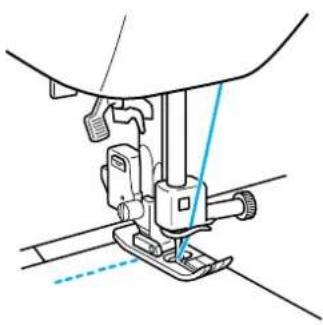
natural_image
Technical line drawing of a sewing machine needle and foot (no text or symbols)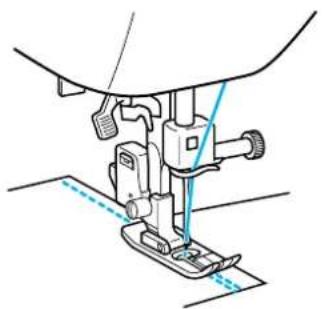
natural_image
Line drawing of a sewing machine needle and foot (no text or symbols)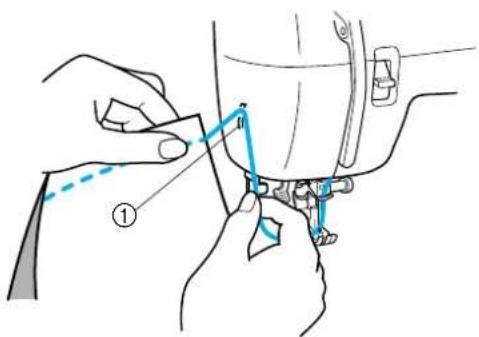
text_image
Technical diagram showing hands operating a mechanical component with labeled parts and a blue arrow indicating directionStraight Stitching
| Pattern Stitch Length Stitch Width | ||
| (Straight Stitch) 1-4.5 | 3.5 | |
| (Triple Stretch Stitch) | SS | |
STARTING SEWING
- Raise the needle to its highest position and lift the presser foot lever before changing the stitch selection, stitch length or stitch width.
- Turn the Pattern Selection Dial to show Straight Stitch or Triple Stretch Stitch in the Pattern Indication Window.
- Pull the upper thread toward the back of the presser foot.
- Place the fabric under the presser foot and position the needle 1 cm (3/8") from the edge of the fabric.
- Lower the presser foot.
- To backtrack, push down the Reverse Sewing Lever as far as possible, then step down on the foot controller to start reverse sewing.
- Release the Reverse Sewing Lever and start sewing in the forward direction by applying pressure to the foot controller.
* Reverse sewing is used for locking the end of seams and where reinforcement is needed.
CAUTION
Be sure the needle does not strike a basting pin, or any other objects, during sewing. The thread could tangle or the needle could break, causing injury.
CHANGING SEWING DIRECTION
- Stop the machine at the point where you wish to change direction with the needle still in the fabric.
- Raise the presser foot and turn the fabric to line up its new direction using the needle as a turning point.
- Lower the presser foot and start sewing in the new direction.
FINISHING SEWING
Reverse stitching is used to lock the threads at the end of the seam or wherever reinforcement is needed.
- Stitch to the end of the seam and stop.
- Push the Reverse Sewing Lever and stitch backwards for 1 cm (3/8") from the end of the fabric.
REMOVING THE MATERIAL FROM THE MACHINE
- Stop the machine. Raise the needle to its highest position and make sure that the thread take-up lever is also in its highest position.
- Lift the presser foot and pull the fabric out gently to the left side.
- Cut both threads with the thread cutter located on the left side of the machine.
①Thread cutter
- To prepare the machine for the next seam, pull about 10 cm (4") of thread under the presser foot toward the back of the machine.
TOP STITCHING AND STRETCH MATERIALS
Straight Stitch is used for top stitching and sewing lightweight fabrics.
Triple Stretch Stitch is used for stretch fabrics.
Puntadas rectas
natural_image
Line drawing of a sewing machine needle stitching on a pair of hands (no text or symbols)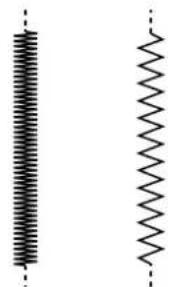
natural_image
Two vertical spring symbols with dashed lines indicating measurement or alignment (no text or labels)Zigzag Stitching
| Pattern Stitch Length Stitch Width | |
| (Zigzag Stitch) F-4.5 0-6.5 |
ZIGZAG STITCH
Select the Zigzag Stitch using the Pattern Selection Dial. Then, select the Stitch Length and the Stitch Width.
It is recommended to sew using the Straight Stitch at the beginning and end of the Zigzag Stitches.
(This acts as a reinforcement stitch.)
SATIN STITCH
When the Zigzag Stitch length is set in the "F" range, it produces a Satin Stitch (a dense Zigzag Stitch). The Satin Stitch can be used for making decorative stitches. Select the Zigzag Stitch, then set the stitch length in the "F" range and set the desired stitch width.
When sewing a satin stitch, use a slightly loose upper thread tension to produce more beautiful stitches.
NOTE:
Raise the needle to its highest position and lift the presser foot lever before changing the stitch selection, stitch length or stitch width.
Puntadas zigzag
| Modelo de puntada | Largo de puntada | Ancho de puntada |
| (Puntada zigzag) F-4,5 0-6,5 |
PUNTADA ZIGZAG
natural_image
Line drawing of a sewing machine needle stitching a pair of hands (no text or symbols)Blind Hem Stitching
| Pattern Stitch Length Stitch Width | ||
| (Blind Hem Stitch) F-2 | 3-6.5 | |
| (Stretch Blind Hem Stitch) F-1.5 | ||
The Blind Hem Stitch is used to finish the edge of a project like the hem of a pair of pants without the stitch showing. Use the Blind Hem Stitch for any non-stretch fabrics and the Stretch Blind Hem Stitch for stretch fabrics.
- Both the threads should be the same color as the fabric.
- Fold back the fabric to the desired location of the hem as shown in fig. A. Then, fold the edge of the fabric as in fig. B. Leave a 6 mm (15/64") overlap at the edge.
- Set the Pattern Selection Dial to Blind Hem Stitch or Stretch Blind Hem Stitch and set the stitch length and width.
- Sew on the fold as in fig. C.
- When the fabric is unfolded you will have a Blind Stitch hem as shown in fig. D.
①Right side of fabric
②Wrong side of fabric
NOTE:
The Stretch Blind Hem Stitch is useful for stretch fabrics.
Puntadas invisibles
| Modelo de puntada | Largo de puntada | Ancho de puntada |
| (Puntada invisible) F-2 | 3-6,5 | |
| (Puntada invisible elástica) | F-1,5 |
natural_image
Line drawing of a sewing machine needle stitching circular components (no text or symbols)Puntada ondas
| Modelo de puntada | Largo de puntada | Ancho de puntada |
| ≥ (Puntada ondas) F-3 3-6,5 |
Shell Tuck Stitching
| Pattern Stitch Length Stitch Width | |
| ≥slant (Shell Tuck Stitch) F-3 3-6.5 |
The Shell Tuck Stitch can be used to sew a picot (lace like) edge on a lightweight fabric.
- Set the Pattern Selection, stitch length and stitch width dials to sew a Shell Tuck Stitch.
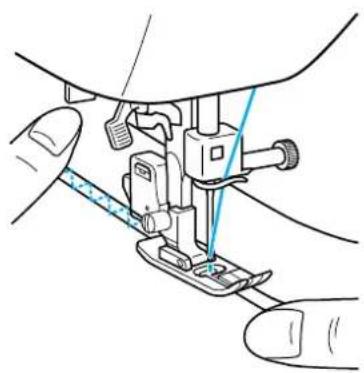
- Sew the fabric on the bias, placing it under the presser foot so that the straight stitches are sewn on the seamline and the zigzag stitches are sewn slightly over the folded edge.
- This stitch requires a tighter thread tension than normal.
- Sew at a slow speed.
Point picot
natural_image
Pure geometric L-shape diagram with no text, numbers, or symbolsB
natural_image
Line drawing of a sewing machine needle being adjusted, showing the needle and handle (no text or symbols)C
natural_image
Line drawing of a sewing machine needle and foot (no text or symbols)Puntada elástica
| Pattern Stitch Length Stitch Width | |
| (Elastic Stitch) F-2.5 3-6.5 |
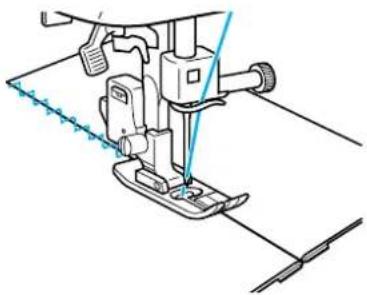
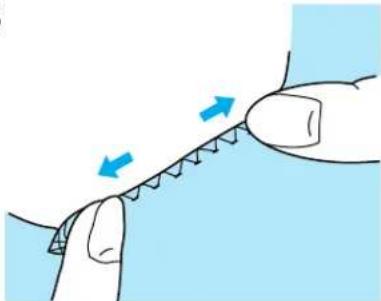
The Elastic Stitch can be used for 3 functions: mending, sewing elastic or joining fabric. Each is explained below.
Set the Pattern Selection, stitch length and stitch width dials to sew an Elastic Stitch.
MENDING
- Place the reinforcement fabric under area to be mended.
- Following the line of the tear, sew using the Elastic Stitch as illustrated in fig. A.
SEWING ELASTIC
- Place the elastic on the fabric.
- As you sew, stretch the elastic both in the front and behind the presser foot as shown in fig. B.
JOINING FABRIC
The Elastic Stitch can be used to join two pieces of fabric together and is very effective when sewing knitted fabrics. When nylon thread is used, the stitch will not be visible.
- Place the edge of the two pieces of fabric together and center them under the presser foot.
- Sew them together using the Elastic Stitch taking care to keep the two fabric edges close together as shown in fig. C.
Point élastique
flowchart
graph TD
    A["Step 1: Folded structure with multiple rectangular blocks"] --> B["Step 2: Folded structure with blue arrows indicating rotation"]
    B --> C["Step 3: Folded structure with blue arrows indicating folding"]
    C --> D["Step 4: Folded structure with blue arrows indicating wavy pattern"]
    D --> E["Final state: Grid pattern with wavy lines"]
Double Action Stitching
| Pattern Stitch Length Stitch Width | ||
| (Double Action Stitch) | ||
| (Bridging Stitch) F-3 3-6.5 | ||
| (Rampart Stitch) | ||
| (Decorative Hem Stitch) | SS | 3-6.5 |
These stitches are used for joining two pieces of fabric, for example, when making patchwork.
- Join pieces of fabric together with a straight stitch (see page 35) and press seams open.
- Set the Pattern Selection, stitch length and stitch width dials to sew Double Action Stitch, Bridging Stitch, etc.
- Place the fabric right side up and center the seam line when sewing.
Point renforcé
natural_image
Line drawing of a sewing machine needle stitching fabric, with no text or symbols presentScallop Stitching
| Pattern Stitch Length Stitch Width | ||
| (Scallop Stitch) F-1.5 3-6 | 5 | |
This machine automatically produces a Scallop Stitch which may be used as a decorative edging.
- Set the Pattern Selection, stitch length and stitch width dials to sew a Scallop Stitch.
- Sew the Scallop Stitch along the edge of the material.
- If desired, trim around the scallop with scissors to create a scalloped edge. Be careful not to cut the thread.
* If you use the Satin Stitch Foot, it is easy to see the fabric and to produce beautiful stitches.
Puntada festón
natural_image
Two-step illustration of a sewing machine needle stitching on fabric, showing thread and seam details (no text or symbols)Puntadas decorativas
Decorative Stitching
| Pattern Stitch Length Stitch Width | ||
| (Bead Stitch) | ||
| (Arrowhead Stitch) | ||
| (Parallelogram Stitch) | ||
| (Triangle Stitch) F-1 | ||
| (Lighting Stitch) | ||
| (Square Stitch) 6.5 | ||
| (Decorative Stitch) | ||
| (Decorative Stitch) 3-6.5 | SS | |
| (Decorative Stitch) | ||
These stitches can be used for making decorative top stitching and for smocking.
Set the Pattern Selection, stitch length and stitch width dials to sew a Bead Stitch, Triangle Stitch, etc.
* If you use the Satin Stitch Foot, it is easy to see the fabric and to produce beautiful stitches.
Points décoratifs
| Pattern Stitch Length Stitch Width | ||
| (Fagoting Stitch) | SS | 3-6.5 |
| (Link Stitch) | ||
These stitches are used to join two pieces of fabric while leaving a space between their edges.
- Fold over the edges of the two pieces of fabric for the hem and baste the edges to a thin piece of paper leaving a small space between them.
- Set the Pattern Selection, stitch length and stitch width dials to sew a Fagoting Stitch or Link Stitch.
- Stitch along the edge, pulling both threads slightly when beginning to sew.
- Use thicker than normal threads for sewing.
- After sewing, remove the basting and the paper. Finish by tying knots on the reverse side at the beginning and the end of the seams.
①First needle drop
Patchwork
Patchwork (Assemblage)
natural_image
Line drawing of a sewing machine needle stitching a fabric (no text or symbols)B
natural_image
Illustration of a finger pressing down on a piece of fabric with two blue arrows indicating direction (no text or symbols)C
natural_image
Technical line drawing of a sewing machine needle and foot (no text or symbols)| Pattern Stitch Length | F-3 | 3-6.5 |
| (Elastic Shell Tuck Stitch) | ||
| (Elastic Overlock Stitch)* | SS | |
| (Elastic Overlock Stitch) | ||
| (Comb Stitch) |
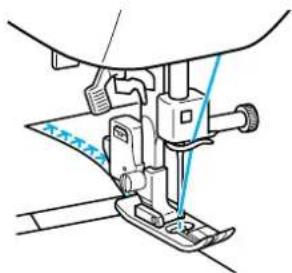
These stitches are used to join together seams and finish them in one operation. The Elastic Overlock Stitches are useful when sewing stretch materials.
- Set the Pattern Selection, stitch length and stitch width dials to sew a Comb Stitch, either Elastic Overlock Stitch, or Elastic Shell Tuck Stitch.
- Position the fabric under the presser foot so that the seamline (or arrowhead point) is approximately 3 mm (1/8") to the left of the center of the presser foot. This stitch works best with a seam allowance of approximately 6.5 mm (1/4") as this allows the right (zigzag) side of the stitch to overlock the cut edge of the fabric as shown in fig. A.
- If the seam allowance is wider than the stitch pattern, trim away any excess fabric after stitching.
A finished Elastic Overlock Stitch is shown in fig. B.
* When sewing the Elastic Overlock Stitch, position the fabric so that its edge is on the left of the needle. (See fig. C)
Overlock élastique
natural_image
Simple line drawing of scissors cutting a curved blade with blue zigzag pattern (no text or symbols)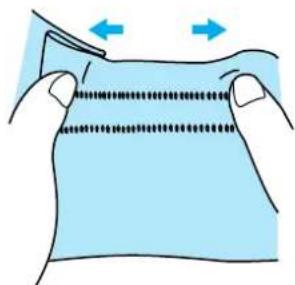
natural_image
Illustration of hands holding a folded paper with dotted lines indicating measurement or alignment (no text or symbols)Puntada pluma
| Modelo de puntada | Largo de puntada | Ancho de puntada |
| (Puntada pluma) | SS | 3-6,5 |
| Pattern Stitch Length Stitch Width | ||
| (Feather Stitch) | SS | 3-6.5 |
Use the Feather Stitch as a decorative top stitch or when hemming blankets, tablecloths or draperies or when embroidering.
- Set the Pattern Selection, stitch length and stitch width dials to sew a Feather Stitch.
- Place the fabric right side up and sew 1 cm (3/8") from the edge of the fabric.
- Trim close to the stitching. This stitch will prevent the fabric from unravelling.
Triple Zigzag Stretch Stitching
| Pattern Stitch Length Stitch Width | ||
| ( Triple Zigzag Stretch Stitch) | SS | 3-6.5 |
This stitch can be used to sew heavyweight stretch fabrics wherever a Zigzag Stitch could be used. The Triple Zigzag Stretch Stitch can also be used as a decorative top stitch.
Set the Pattern Selection, stitch length and stitch width dials to sew a Triple Zigzag Stretch Stitch.
Point plume
text_image
Technical diagram of a sewing machine with labeled parts and blue motion lines indicating movementB

text_image
Technical diagram showing a mechanical assembly with labeled parts and a hand holding a tool, including numbered annotations.C
text_image
Technical diagram of a sewing machine needle with labeled parts and motion indicatorD
text_image
Technical diagram of a mechanical device with labeled components and directional arrowsE
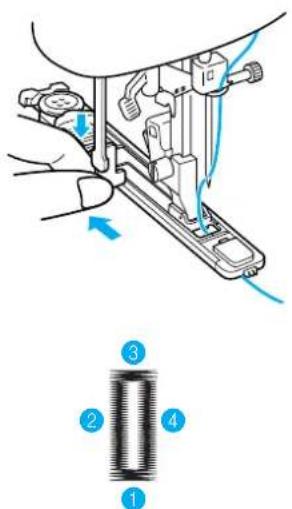
text_image
Technical diagram showing a sewing machine needle insertion mechanism with labeled parts 1 to 4 and directional arrows indicating movement.Making a Buttonhole
| Pattern Stitch Length Stitch Width Foot | |||
| F-1.5 4-7 Buttonhole Foot | |||
One-step buttonhole-making is a simple process that provides reliable results.
- It is recommended to practice making a buttonhole on a scrap piece of fabric before attempting it on the actual garment.
- When making buttonholes on soft fabrics, place a stabilizer material on the underside of the fabric.
MAKING A BUTTONHOLE
- Using tailor's chalk, mark the position of the buttonhole on the fabric.
- Set the Pattern Selection, stitch length and stitch width dials to sew a buttonhole.
NOTE:
Set the Stitch Width Dial to "7" for a buttonhole with an actual width of 5 mm or to "4" for a 3-mm-width buttonhole.
- Attach the buttonhole foot, pull open the button holder and insert a button. (See fig. A)
* The size of the buttonhole is determined by the button inserted into the button holder. - Align the red line on the presser foot with the mark on the fabric, then lower the Presser Foot Lever. Be sure to pass the thread under the presser foot and pull it toward you. (See fig. B)
①Button holder
②Mark on fabric
③Line on presser foot
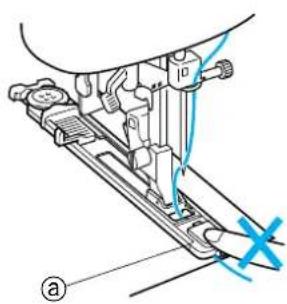
NOTE:
Do not lower the Presser Foot Lever while pushing in the area of the presser foot marked @ in fig. C. Otherwise the buttonhole will not be sewn with the correct size.
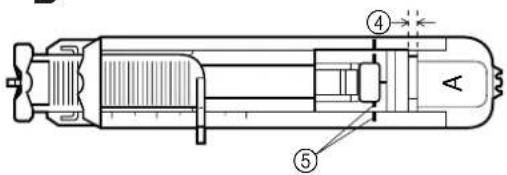
④Do not close this gap.(Fig. D)
⑤Align the lines on the presser foot.
- Pull down the buttonhole lever to its lowest position, then lightly push it toward the back of the machine. (See fig. E)
- Hold the upper thread and step down on the foot controller to begin sewing.

CAUTION
Pulling the thread too strongly may bend or break the needle, and lead to injury.
- Stitches ①, ②, ③ and ④ are automatically sewn, then the machine will stop.
Para coser ojales
text_image
Technical diagram of a mechanical device with labeled parts and dimensional annotationsOdd-shaped buttons that do not fit into the button holder plate
Add the button diameter to its thickness, then set the buttonhole presser foot scale to this measurement. The distance in the scale between two lines of the same length is 0.5 cm (3/16").
Example:
For a button with a diameter of 1.5 cm (9/16") and a thickness of 1 cm (3/8"), the scale should be set at 2.5 cm (1").
①Thickness [1 cm (3/8")]
②Diameter [1.5 cm (9/16")]
③Button holder plate
④Scale
⑤Diameter + thickness [2.5 cm (1")]
⑥0.5 cm (3/16")
natural_image
Illustration of a hand holding a syringe with a blue liquid level, no text or symbols presentPARA COMPLETAR LAS PUNTADAS Y CORTAR EL OJAL
- To secure the stitching, turn the material 90 degrees counterclockwise and sew Straight Stitches to the end of the front bar tack of the buttonhole.
- Remove the material from the machine. It is recommended that pins be placed across both ends of the buttonhole as protection against cutting the stitches.
- Cut an opening in the middle of the buttonhole with a seam ripper tool. Be careful not to cut through any stitches.
CAUTION
When using the seam ripper to open the buttonhole, do not put your hand or finger in the path of the ripper. The ripper may slip and cause injury.
COMMENT ARRETER LA COUTURE ET OUVRIR LA BOU- TONNIERE
text_image
Technical diagram of a sewing machine with numbered parts labeled ⑥, ⑦, and ⑧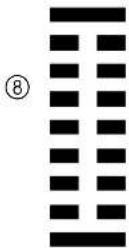


Buttonhole Fine Adjustment
If the stitching on the two sides of the buttonhole do not appear uniform, the following adjustments can be made.
- Set the Stitch Length Dial at "F-1.5" and stitch the right side of the buttonhole on a scrap of fabric while observing how the material is fed.
- If the right side of the buttonhole is too coarse or fine, adjust the feeding of the material with the Stitch Length Dial.
①Right side of buttonhole
②Stitch length dial
③Shorter
④Longer
⑤Adjusted stitch
- After obtaining a satisfactory feeding on the right side, stitch the left side of the buttonhole and observe the feeding.
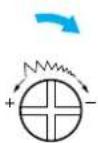
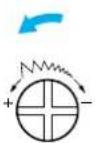
- If the left side is too coarse or fine compared to the right side, adjust the buttonhole fine adjustment screw as described below.
If the left side is too coarse, turn the screw with the enclosed large screwdriver in the - direction.
If the left side is too fine, turn the screw with the enclosed large screwdriver in the + direction.
This adjustment allows both sides of the buttonhole to appear uniform.
⑥Stitch length dial
⑦Buttonhole fine adjusting screw
⑧Left side of buttonhole
⑨Adjusted stitch
When the buttonhole is not sewn correctly:
There are two different procedures for correcting buttonhole sewing, depending on which part of the buttonhole is not sewn correctly.
Correction Procedure 1 (See fig. A)
- Raise the Presser Foot Lever and needle, then remove the fabric, upper thread and lower thread.
- Pull the buttonhole lever slightly toward you.
- Sew about 10 stitches with no fabric, upper thread, or lower thread in the machine.
- Place the fabric under the presser foot, and set the upper and lower thread again, then lightly push the buttonhole lever toward the back of the machine and sew the buttonhole from the beginning.
Correction Procedure 2 (See fig. B)
- Raise the Presser Foot Lever, then remove the fabric and all of the sewn thread.
- Place the fabric under the presser foot again, then lightly push the buttonhole lever toward the back of the machine and sew the buttonhole from the beginning.
NOTE:
When you are finished sewing all buttonholes be sure to raise the buttonhole lever.
If the buttonhole lever is pushed toward the back of the machine while sewing any stitch other than a buttonhole, the buttonhole feed will be used and the stitch will not be sewn correctly.
If the buttonhole lever is accidentally pushed when you are sewing a stitch other than a buttonhole, remove the fabric and thread from the machine, raise the buttonhole lever, and sew about 20 stitches. Then sew the intended stitch.
natural_image
Line drawings of a sewing machine and a foot with a blue thread, plus a circular target (no text or symbols)Costura de botones
| Modelo de Largo de Ancho de puntada puntada puntada | Prensatelas | |
| (Puntada zigzag) | 0 | Menos de 6,5 |
| Pattern Stitch Length Stitch Width Foot | |||
| (Zigzag Stitch) | 0 Less than 6.5 | Zigzag Presser Foot | |
- Measure the distance between the holes and set the appropriate stitch width using the Stitch Width Dial. For example, if the distance between the holes is 3 mm, set the stitch width to 3.
- Change the foot to the Zigzag presser foot.
- Lower the feed dogs by setting the Feed Dog Position Switch to the Down Position as shown on page 18.
- Place a button between the foot and the fabric and make sure that the needle enters the holes without hitting the button. If it hits see Step 1.
- At a slow speed, sew approximately 10 stitches.
- Remove the material from the machine. Cut the upper and lower threads and tie both threads at the back of the material.
CAUTION
Make sure the needle does not strike the button during sewing. The needle may break, leading to injury.
text_image
Technical diagram of a mechanical device with numbered parts labeled ①, ②, and ③.B
natural_image
Line drawing of a sewing machine needle and foot, showing measurement setup (no text or symbols)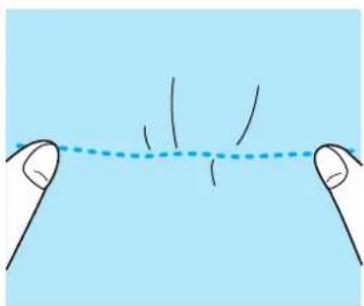
natural_image
Simple line drawing of two hands holding a horizontal dashed line with curved lines, against a light blue background (no text or symbols)Zipper Insertion
| Pattern Stitch Length Stitch | Width Foot | ||
| (Straight Stitch) | 2-3 3.5 (center) Zipper Foot | ||
The zipper foot is used to sew various types of zippers and can easily be positioned to the right or left side of the needle.
When sewing the right side of the zipper, attach the shank to the left pin of the zipper foot. When sewing the left side of the zipper, attach the shank to the right pin of the zipper foot. (See fig. A)
①Zipper foot
②Right pin for sewing the left side of the zipper
③Left pin for sewing the right side of the zipper
- Set the Pattern Selection Dial to Straight Stitch. Set the Stitch Length between 2 and 3. Set the Stitch Width 3.5 (center).
- Lower the presser foot lever and fix either the left or right pin of the zipper foot onto the shank.
- Fold the edge of the material 2 cm (3/4") and place the zipper under the folded portion.
- Lower the needle into the notch located either on the left or right side of the zipper foot.

CAUTION
Turn the handwheel to make sure the needle does not strike the presser foot. If another stitch is selected, the needle will strike the presser foot, causing the needle to break, possibly leading to injury.
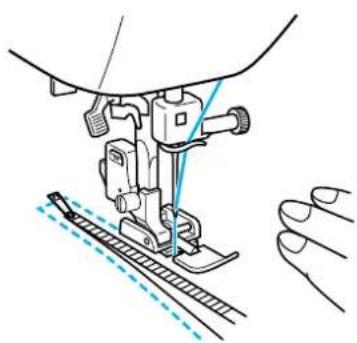
- Sew from the bottom of the zipper toward the top on both sides. The needle should be positioned on the zipper side of the foot for best results. (See fig. B)
- To sew the opposite side of the zipper, release the foot by pressing the button located at the back of the presser foot holder, install the zipper foot on the other side of the zipper and continue sewing using the other side notch.

CAUTION
Make sure the needle does not strike the zipper during sewing. If the needle strikes the zipper, the needle may break, leading to injury.
Gathering
| Pattern Stitch Length | |
| (Straight Stitch) 4 | |
- Set the Pattern Selection Dial to Straight Stitch and the stitch length to 4.
- Loosen the tension of the upper thread so that the lower thread lies on the underside of the material.
- Sew a single row or multiple rows of Straight Stitch.
- Pull the lower thread(s) to gather the material.
natural_image
Line drawing of a sewing machine needle stitching a blue fabric (no text or symbols)
natural_image
Simple blue tulip-shaped outline with dotted texture (no text or symbols)Aplicaciones
| Modelo de puntada Largo | de puntada |
| (Puntada zigzag) F-2 |
| Pattern Stitch Length | |
| _k (Zigzag Stitch) F-2 | |
An appliqué is created by cutting a contrasting piece of fabric into a shape to be used as a decoration on a garment or project.
- Baste the cut design to the fabric in the location where desired.
- Carefully sew around the edge of the cutout design with a Zigzag Stitch in the fine stitch length.
- Cut away the surplus fabric outside of the stitching.
- Remove the basting, if necessary.
NOTE:
Make reinforcing Straight Stitches at the beginning and the end of the stitching to secure.
CAUTION
Be careful that the needle does not strike a basting pin during sewing. Striking a pin can cause the needle to break, resulting in injury.
Appliques
text_image
Diagram showing mechanical assembly with labeled parts and rotation arrow, likely illustrating a valve or adjustment mechanism.B
text_image
Technical diagram of a mechanical device with labeled parts and directional arrow indicating rotation or movementC
text_image
Diagram illustrating sewing technique with labeled parts and directional arrows indicating movementUsing the Free-motion Quilting Foot
| Pattern Stitch Length Stitch Width Feed Dog | |
| (Straight Stitch) | Any 3.5 (center) Down position |
The Free-motion Quilting Foot is useful for darning, monogramming and freemotion machine quilting.
- Remove the power supply plug from the outlet.
- Raise the needle and the presser foot.
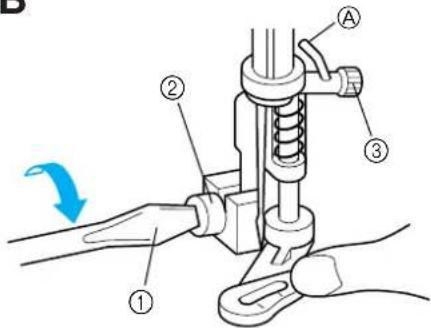
- Loosen the presser foot screw to remove the presser foot holder. (See fig. A)
- Attach the quilting foot, making sure that part indicated by Ⓐ in the illustration is above the needle clamp screw, then lower the Presser Foot Lever and tighten the presser foot screw.
* Be sure that the needle clamp screw is firmly tightened. (See fig. B)
①Use a screwdriver.
②Presser Foot Screw
③Needle Clamp Screw

CAUTION
- Be careful not to touch the needle when attaching the free-motion quilting foot, otherwise injury may result.
- Use the screwdriver to tighten the presser foot holder screw securely. If the screw is loose, the needle may strike the presser foot and cause injury.
-
Be sure to turn the handwheel toward the front of the machine to check that the needle does not strike the presser foot. If the needle strikes the presser foot, injury may result.
-
Lower the feed dogs by setting the Feed Dog Position Switch to the Down Position as shown on page 18.
- Set the Pattern Selection Dial to Straight Stitch.
* Before starting to sew, draw the quilting design on the fabric.
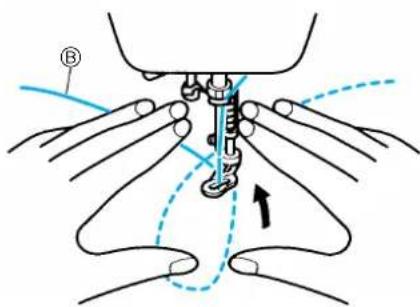
- Use both hands to keep the fabric firmly stretched and move the fabric to sew over the drawn design. (See fig. C)
⑧Quilting design (Line)
natural_image
Illustration of a sewing machine needle stitching a curved pipe with blue spray (no text or symbols)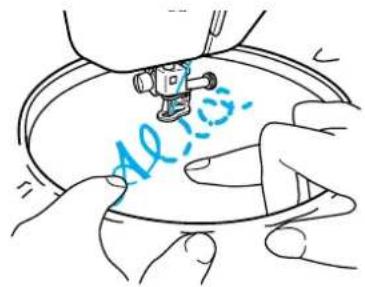
text_image
Aero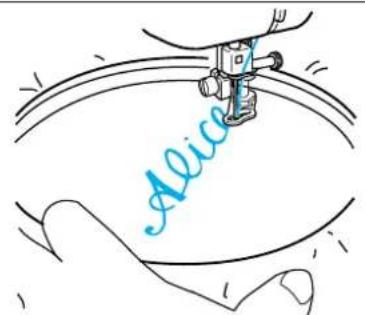
text_image
Aeice
text_image
Alice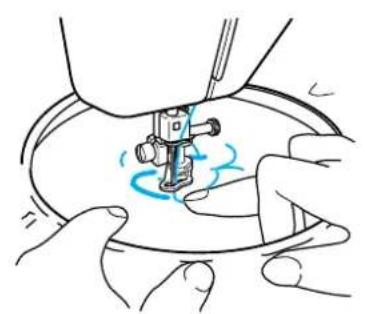
natural_image
Illustration of a robotic device being held by hands, showing motion and vibration (no text or symbols)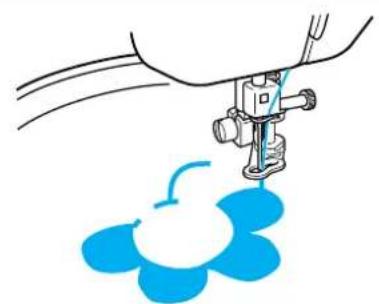
natural_image
Illustration of a sewing machine needle stitching a blue flower shape (no text or symbols)Monogramming, Embroidering and Quilting
| Pattern | Stitch Length | Stitch Width | Foot Feed Dog | |
| (Zigzag Stitch) | Any Any | Free-motion quilting foot | Down Position | |
PREPARING FOR MONOGRAMMING, EMBROIDERING, AND QUILTING
- Lower the feed dogs by setting the Feed Dog Position Switch to the Down Position as shown on page 18.
- Set the Pattern Selection Dial to the appropriate stitch setting for the project.
- Draw the lettering (for monogramming) or design (for embroidering and quilting) on the surface of the fabric.
- Stretch the fabric between embroidery hoops as firmly as possible with the underside of the fabric on the bottom of the inside hoop.
- Remove the presser foot and presser foot holder. Attach the free-motion quilting foot (see page 58).
- Place the work under the needle and lower the presser foot lever.
- Pull the lower thread up through the work at the starting position by turning the handwheel and make a few holding stitches.
- Grip the hoop with the thumb and forefingers of both hands while pressing the fabric with the middle and third fingers and supporting the outside of the hoop with your smaller fingers.
MONOGRAMMING
- Select the Zigzag Stitch and a width of 3-5.
- Sew, moving the hoop slowly along the lettering at a constant speed.
- Secure with a few straight stitches at the end of the last letter.
EMBROIDERING
- Select the Straight Stitch and a width of 3.5(center).
- Stitch the outline of the design by moving the embroidery hoop.
- Fill in the design alternating from the outline of the design to the inside and from the inside to the edge of the outline until the design is completely filled in. Keep the stitching close together.
- Secure with a few Straight Stitches at the end of the design.
FREE-MOTION QUILTING
- Select the Straight Stitch and a width of 3.5(center).
- Sandwich a piece of quilt batting between 2 pieces of fabric.
- Sew, moving the layers slowly and consistently in a decorative motion to quilt the layers together.
- Secure with a few Straight Stitches at the end of the stitching.
NOTE:
A long stitch is made by moving the embroidery hoop rapidly and a short stitch is made by moving it slowly.
natural_image
Technical line drawing of a sewing machine needle stitching a blue dotted pattern (no text or symbols)Darning
| Pattern Stitch Length Foot Feed Dog | |||
| (Straight Stitch) | Any Down | Position quifing foot | |
- Lower the feed dogs by setting the Feed Dog Position Switch to the Down Position as shown on page 18.
- Set the Pattern Selection Dial to Straight Stitch. Set the stitch width to 3.5 (center).
- Place the fabric to be darned under the presser foot together with a stabilizer on the under side for reinforcement.
- Lower the presser foot lever.
- Pull the lower thread up through the fabric at the starting position by turning the handwheel and making a few stitches to tie off the beginning of stitching.
- Begin sewing alternating between slowly moving the work away from you and pulling it toward you.
- Repeat this motion until the portion to be darned is filled with parallel lines of stitching.
NOTE:
Be sure to lower the presser foot lever before sewing.
Zurcido
text_image
Technical diagram of a mechanical device with numbered components labeled ① and ②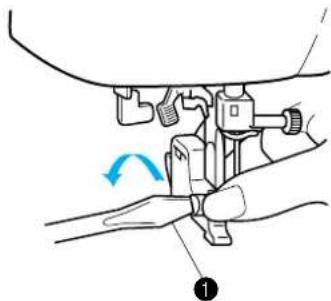
text_image
Diagram showing a mechanical assembly with labeled parts and an arrow indicating rotation or movement.B
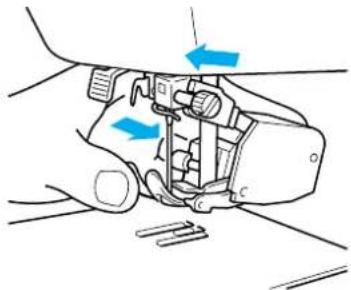
natural_image
Illustration of a hand holding a mechanical device with blue arrows indicating motion or force direction (no text or symbols)C
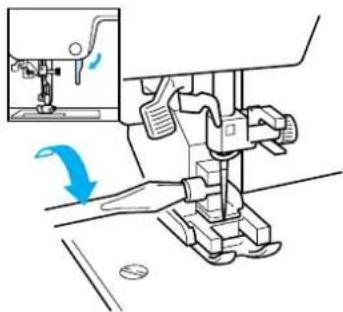
natural_image
Diagram of a sewing machine needle insertion into a slot, showing the mechanism and base (no text or symbols present)Using the Walking Foot
| Pattern Stitch Length Stitch Width | ||
| (Straight Stitch) | 3-4 | |
| (Zigzag Stitch) 0-6.5 | ||
This foot is very useful for sewing materials such as vinyl cloth, synthetic leather, thin leather, etc. These materials are difficult to feed when sewing. The walking foot prevents such materials from crumpling, slipping or sticking between presser foot and material due to even feeding of upper and lower materials.
NOTE:
Use this foot only for straight sewing and zigzag stitching. Do not use other patterns.
- Remove the power supply plug from the outlet.
- Raise the needle and the presser foot.
- Loosen the presser foot holder screw to remove the presser foot holder. (See fig. A)
- Attach the forked section of the connecting lever to the needle clamp, install the walking foot to the presser bar. (See fig. B)
- Lower the presser foot lever and then tighten the presser bar holder fixing screw. (See fig. C)
①Forked part of operation lever
②Presser bar holder
① Use a screwdriver

CAUTION
- Use the screwdriver to tighten the screw securely. If the screw is loose, the needle may strike the presser foot and cause injury.
- Be sure to turn the handwheel toward the front of the machine to check that the needle does not strike the presser foot. If the needle strikes the presser foot, injury may result.
- Be careful not to touch the needle when attaching the walking foot, otherwise injury may result.
CAUTION
When sewing with the walking foot, sew at medium to low speeds.
text_image
Technical diagram showing a structural assembly with labeled components 6 and 7, likely for engineering or mechanical design.Using the 1/4-Inch Quilting Foot
| Pattern Stitch Length | Stitch Width | |
| (Straight Stitch) 2-2.5 3.5 | (center) |
The 1/4-Inch Quilting Foot is used to sew fixed seam allowance 6.5 mm (1/4") when piecing together a quilt. (See fig. A)
-
Set the Pattern Selection Dial to Straight Stitch. Set the Stitch Length between 2 and 2.5. Set the Stitch Width 3.5 (center).
-
Change the foot to the 1/4-Inch Quilting Foot.
①Seam allowance (1/4", 6.5mm)
- Position the presser foot over the fabric and sew as shown in fig. B and C.
- Achieving an accurate seam allowance. (See fig. B)
②Beginning of stitching.
③Align this mark with edge of fabric.
④End of stitching
⑤Align this mark with edge of fabric.
- Quickly stitch together a quilt. (See fig. C)
⑥Top of fabric.
⑦Seam (1/8", 3.2mm)
text_image
Technical diagram showing three stages of a sewing machine: top view, front view, and side view with labeled parts.Using the Quilting Guide
Use the quilting guide to sew parallel stitches that are equally spaced.
- Insert the stem of the quilter into the hole at the rear of the walking foot or presser foot holder.
①Walking foot
②Presser foot holder
- Adjust the stem of the quilter so that the quilt guide aligns with the seam that has already been sewn.
natural_image
Diagram of a mechanical device with a screw and directional arrows indicating motion (no text or symbols)B
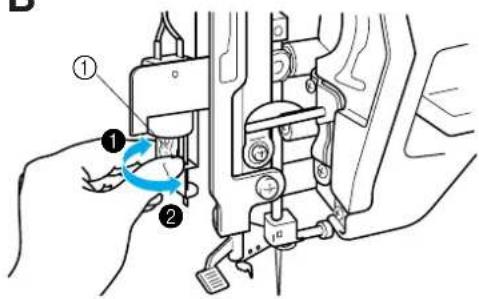
text_image
Technical diagram showing mechanical assembly with numbered components and a blue circular arrow indicating rotation or adjustment.C
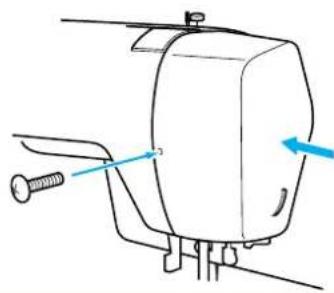
natural_image
Technical line drawing of a mechanical component with no visible text or symbolsChanging the Light Bulb
CAUTION
-
Turn off the main power switch and unplug the machine before changing the light bulb. If the main power switch is on when the light bulb is changed, an electric shock may result. If the machine is on and foot controller is pressed, injuries may result.
• To avoid burns, give the light bulb time to cool before changing it. -
Remove the power supply plug from the outlet.
- Loosen the screw on the back of sewing machine as shown in fig. A.
- Remove the light cover from the machine as illustrated in fig. A.
- Replace the sewing light bulb. (See fig. B)
①Bulb
①Loosen
② Tighten
- Reattach the light cover and fasten the screw as shown in fig. C.
text_image
Technical diagram showing a mechanical assembly with labeled parts and directional arrow indicating rotation or movement.B
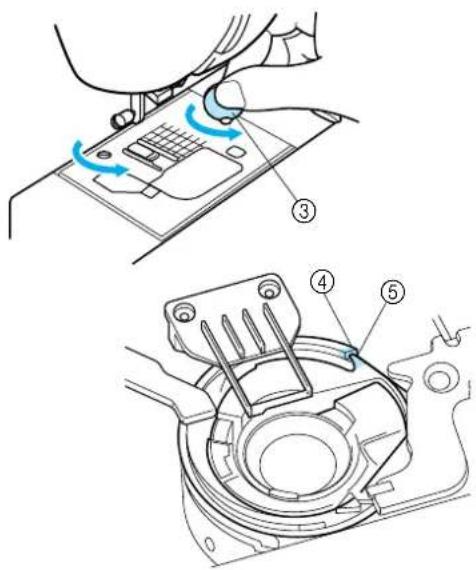
text_image
Technical diagram showing mechanical assembly steps with numbered components and directional arrows indicating motionC
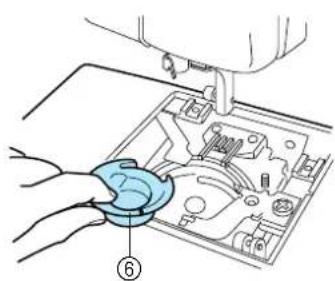
natural_image
Illustration of hands using a sewing machine to adjust or install electronic components on a circuit board (no text or symbols visible)D
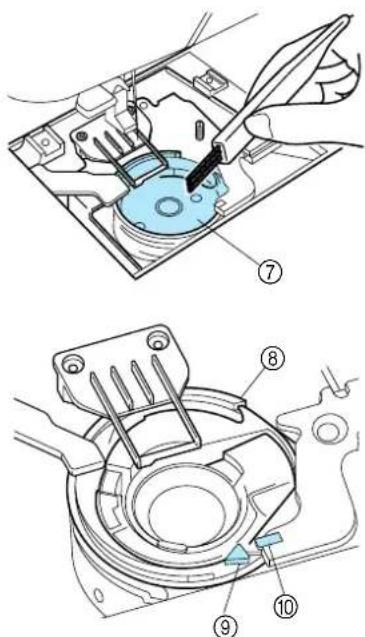
text_image
Technical diagram showing mechanical assembly steps with numbered componentsCleaning

CAUTION
Be sure to unplug the machine before cleaning it. Otherwise, electric shock or injury may result.
- Remove the power supply plug from the outlet.
- Raise the needle and the presser foot.
- Loosen the presser foot screw and the needle clamp screw to remove the presser foot holder and the needle. (See fig. A)
- Remove the needle plate using a coin to remove the screws. (See fig. B)
①Needle clamp screw
③Presser foot holder screw
③Use a coin or screwdriver.
- Turn the handwheel toward you until the notch of shuttle aligns with the shelf of race as shown in the illustration.
④Notch of shuttle race
⑤Shelf of race
CAUTION
Be sure to turn the handwheel towards the front of the machine. Turning the handwheel in the other direction may damage the machine.
- Remove the race. (See fig. C)
- Clean out lint and dust.
* Use soft fabric to clean the race. DO NOT OIL the race or shuttle. (See fig. D)
⑥Race
⑦Shuttle
* DO NOT OIL.

CAUTION
- Do not use a damaged race or shuttle. Otherwise, the thread may tangle and cause a poor finish, or the needle may break. You can get the proper parts from your authorized retailer.
-
Be sure to insert the race in the correct position. Otherwise, the needle may break.
-
Assemble the race first then the needle plate.
When installing the race, be sure that the notch of shuttle is in the same position that it was when the shuttle hook was removed and that the shelf on the race aligns with the spring. Install the needle plate with the opening for the bobbin in the front. Position and tighten the needle plate screws (the reverse of its removal procedure).
⑧Notch of shuttle
⑨Shelf
⑩Spring
Limpieza
PRECAUCIÓN
Performance Check List
Whenever sewing difficulties are encountered, review the section in this instruction manual that details the operation you are performing to make sure you are correctly using the machine. If the problem continues, the following check list may help you to improve the operation. If you still have difficulties, contact your nearest authorized service center.

text_image
MAINTENANCE MANTENIMIENTO ENTRETIEN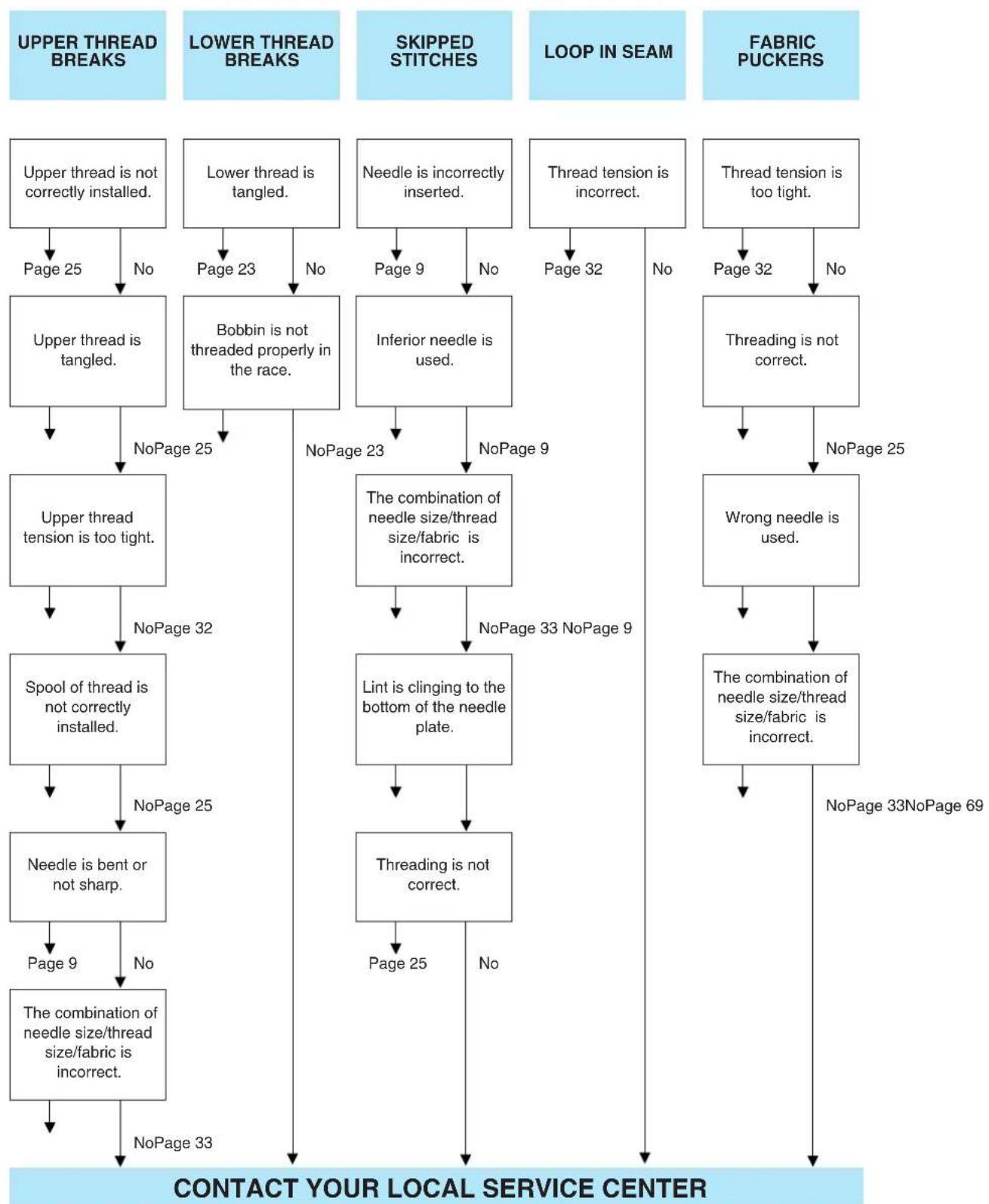
flowchart
graph TD
    A["UPPER THREAD BREAKS"] --> B["Upper thread is not correctly installed."]
    C["LOWER THREAD BREAKS"] --> D["Lower thread is tangled."]
    E["SKIPPED STITCHES"] --> F["Needle is incorrectly inserted."]
    G["LOOP IN SEAM"] --> H["Thread tension is incorrect."]
    I["FABRIC PUCKERS"] --> J["Thread tension is too tight."]
    B --> K["Upper thread is tangled."]
    D --> L["Bobbin is not threaded properly in the race."]
    F --> M["Inferior needle is used."]
    H --> N["Thread tension is not correct."]
    J --> O["Thread tension is too tight."]
    K --> P["Upper thread tension is too tight."]
    L --> Q["The combination of needle size/thread size/fabric is incorrect."]
    M --> R["Wrong needle is used."]
    P --> S["Upper thread tension is too tight."]
    Q --> T["Lint is clinging to the bottom of the needle plate."]
    R --> U["The combination of needle size/thread size/fabric is incorrect."]
    S --> V["NoPage 33 NoPage 69"]
    T --> W["Lint is clinging to the bottom of the needle plate."]
    U --> X["NoPage 33 NoPage 69"]
    W --> Y["NoPage 25 NoPage 33"]
    X --> Z["NoPage 25 NoPage 33"]
    Y --> AA["NoPage 25 NoPage 33"]
    Z --> AB["NoPage 25 NoPage 33"]
    AA --> AC["NoPage 25 NoPage 33"]
    AB --> AD["Contact YOUR LOCAL SERVICE CENTER"]
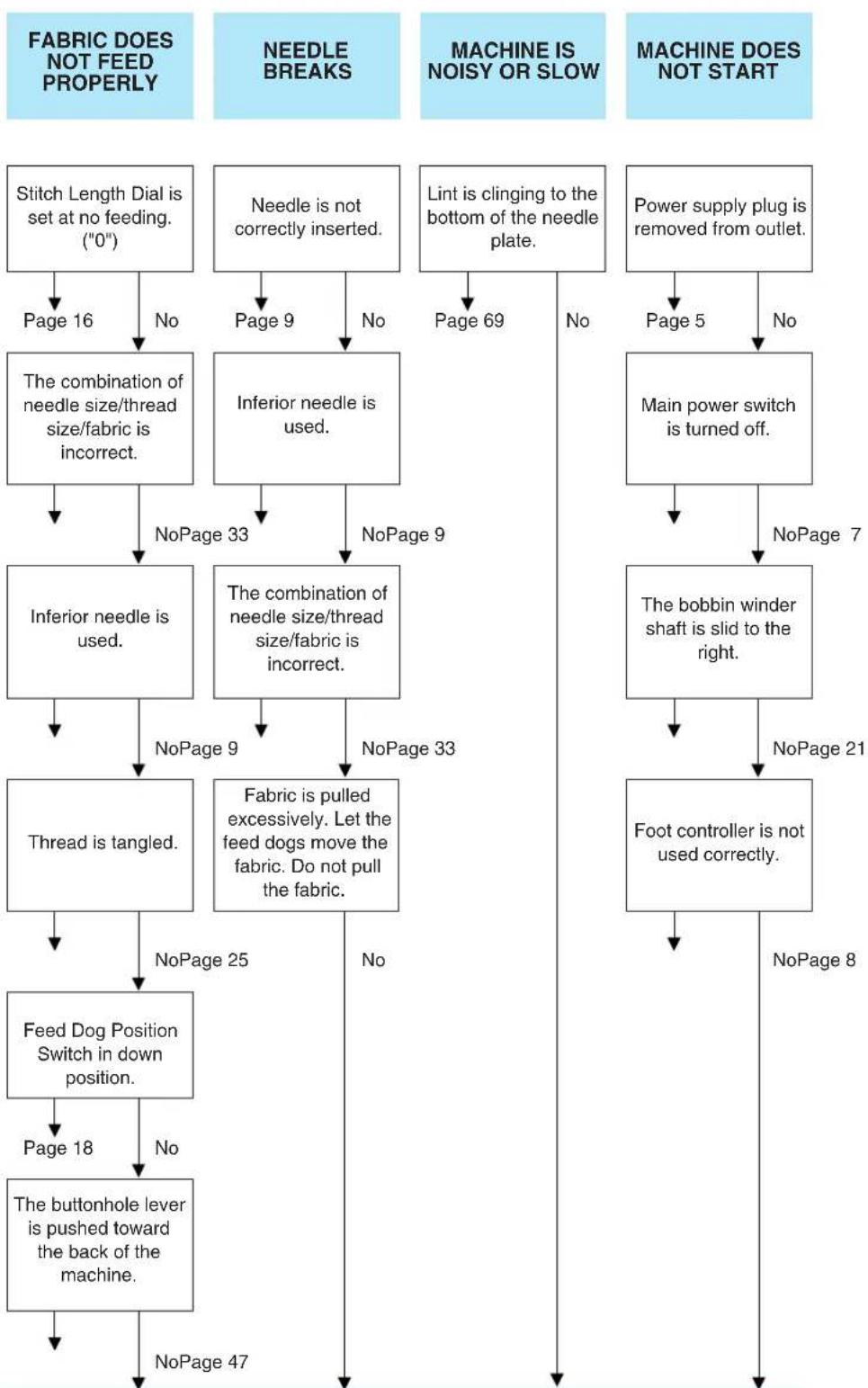
flowchart
graph TD
    A["FABRIC DOES NOT FEED PROPERLY"] --> B["Stitch Length Dial is set at no feeding. ("0")"]
    B --> C["Page 16"]
    B --> D["No"]
    E["NEEDLE BREAKS"] --> F["Needle is not correctly inserted."]
    F --> G["Page 9"]
    F --> H["No"]
    I["MACHINE IS NOISY OR SLOW"] --> J["Lint is clinging to the bottom of the needle plate."]
    J --> K["Page 69"]
    J --> L["No"]
    M["MACHINE DOES NOT START"] --> N["Power supply plug is removed from outlet."]
    N --> O["Page 5"]
    N --> P["No"]
    Q["The combination of needle size/thread size/fabric is incorrect."] --> R["NoPage 33"]
    Q --> S["NoPage 9"]
    T["Inferior needle is used."] --> U["The combination of needle size/thread size/fabric is incorrect."]
    U --> V["NoPage 9"]
    U --> W["NoPage 33"]
    X["Inferior needle is used."] --> Y["Thread is tangled."]
    Y --> Z["NoPage 25"]
    Y --> AA["No"]
    AB["Fabric is pulled excessively. Let the feed dogs move the fabric. Do not pull the fabric."] --> AC["Feed Dog Position Switch in down position."]
    AC --> AD["Page 18"]
    AC --> AE["No"]
    AF["The buttonhole lever is pushed toward the back of the machine."] --> AG["NoPage 47"]
    AH["The bobbin winder shaft is slid to the right."] --> AI["Foot controller is not used correctly."]
    AI --> AJ["NoPage 8"]
    AI --> AK["NoPage 21"]
flowchart
graph TD
    A["Disassembly of 3D parts"] --> B["Processing Unit"]
    B --> C["Packaging Box"]
    C --> D["Final Box"]
Repacking the Machine
Keep the carton and packing materials for future use. It may become necessary to reship the machine. Improper packing or improper packing material could result in damage during shipping. Instructions for repacking the machine are illustrated.
IMPORTANT
This packing material is designed to prevent damage in transit. Save this packing material in the event it is needed to transport this machine.
Buttonhole Fine Adjustment Screw 51
Buttonhole Lever 47
C
Changing Light Bulb 68
Changing the Presser Foot 11
Checking the Needle 9
Cleaning 69
Comb Stitch.... 45
Connecting Plugs 5
D
Darning....62
Decorative Hem Stitch 41
Decorative Stitch 43
Double Action Stitch 41
E
Elastic Overlock Stitch 45
Elastic Shell Tuck Stitch 45
Elastic Stitch....40
Embroidering 60
F
Fabric/Thread/Needle Combinations 33
Fagoting Stitch 44
Feather Stitch 46
Feed Dog Position Switch 18
Flat Bed Attachment with Accessory Compartment 11, 18
Foot Controller 8
Free-arm sewing 18
Free-motion Quilting Foot 3,58,60,62
G
Gathering 55
H
Hole for Vertical Spool Pin 31
L
Lightning Stitch.... 43
Link Stitch.... 44
Lower Threading 23
M
Main Power/Sewing Light Switch 7
Manually Drawing Up Lower Thread 29
Monogramming 60
Page
N
Needle
Inspection 9
Replacement 9
Needle Threader 27
0
Overedge Stitching 45
P
Parallelogram Stitch 43
Patchwork 44
Pattern Indication Window 12
Pattern Selection Dial.... 12
Performance Check List 71
Presser Foot Lever.... 1,25
Principal Parts .... 1
Q
Quilting 60
R
Race 69
Rampart Stitch 41
Repacking the Machine....77
Reverse Sewing Lever 17
S
Satin Stitch Foot 3, 37, 42, 43, 58
Scallop Stitch 42
Sewing Light
Light Bulb Replacement .... 68
Switch .... 7
Shell Tuck Stitch 39
Shuttle 69
Spool Pin and Spool Cap 21, 25
Square Stitch....43
Stitch Length Dial 12, 16
Stitch Width Dial 17
Straight Stitch 35, 55, 58
Stretch Blind Hem Stitch 38
T
Thread Tension 32
Triangle Stitch 43
Triple Stretch Stitch 35
Triple Zigzag Stretch Stitch 46
Twin Needle Sewing 30
U
Upper Tension Control Dial 32
Upper Threading 25
Using Needle Threader 27
W
Walking Foot 3,63
Wide table 3,19
Winding the Bobbin 21
Z
Zigzag Presser Foot 3,11
Zigzag Stitch 37, 54, 57, 60
Zipper Foot 3,55
Zipper Insertion 55
Página
A
Accesorios 4
Acolchado 61
Aguja
Cambio 10
Verificación 10
Patchwork (Assemblage) 44
Pied quilting 1/4" 4,66
Pied quilting en mouvement libre .... 4, 59, 61, 62