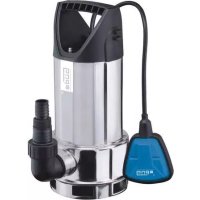
GS 1101 PI - Water pump Güde - Free user manual and instructions
Find the device manual for free GS 1101 PI Güde in PDF.


| Product type | Drainage pump for dirty water |
| Brand | Güde |
| Model | GS 1101 PI |
| Power supply | 230 V / 50 Hz |
| Motor power P1 | 1100 W |
| Maximum flow rate | 16000 l/h |
| Maximum delivery head | 9,5 m |
| Maximum submersion depth | 8 m |
| Hose connection | 1 1/2" |
| Protection type | IPX8 |
| Maximum water temperature | 35 °C |
| Maximum particle size | 35 mm |
| Cable length | 10 m (type H07RNF) |
| Float switch | Automatic, adjustable |
| Thermal protection | Built-in thermal fuse |
| Application | Clear water and dirty water |
| Package contents | Transport handle, connection, power cable, bracket, neck, float switch, pump body |
| Warranty | 12 months (industrial use) / 24 months (consumer) |
| Cleaning | Rinse with clear water after each use |
| Storage | Frost-free, pump emptied |
Frequently Asked Questions - GS 1101 PI Güde
User questions about GS 1101 PI Güde
0 question about this device. Answer the ones you know or ask your own.
Ask a new question about this device
Download the instructions for your Water pump in PDF format for free! Find your manual GS 1101 PI - Güde and take your electronic device back in hand. On this page are published all the documents necessary for the use of your device. GS 1101 PI by Güde.
USER MANUAL GS 1101 PI Güde
Translation of original operating instructions
DIRTY-WATER SUBMERSIBLE PUMP
Francais FR 11
| GB Please read carefully the following Operating Instructions before putting the appliance into operation | |||
| A.V. 2 Any reprints, even partial, are subject to approval. Technical changes reserved. Illustrative pictures! Translation of original operating instructions. | |||
| GB Do you have any technical questions? Any claim? Do you need any spare parts or operating instructions? We will quickly help you and without needless bureaucracy at our home page www.guide.com in the Service part. Please help us be able to help you. In order to be able to identify your appliance in case of claim, we need the serial No., Order No. and year of production. All this data can be found on the type label. Please enter the data below for future reference. Serial No.: Order No.: Year of production: | |||
| Tel.: +49 (0) 79 04 / 700-360 | Fax: +49 (0) 79 04 / 700-51999 | E-Mail: support@ts.guide.com | |
Marking:
Product safety:
| CE | |
| Product corresponds to appropriate norms of the European Community |
Prohibitions:
| Staying in the transportation medium prohibited | Access to children prohibited |
| >35°C | |
| Cable bullying / transport prohibited | Transportation medium of max. 35 °C |
Warning:
| 3 | 4 |
| Warning against dangerous electric voltage | Warning against automatic starting |
Commands:
| Read the Operating Instructions |
Environment protection:
| PAP | |
| Dispose the waste professionally in order not to pollute the environment. | Packing cardboard material may be delivered to collecting centres for recycling. |
| Any damaged or disposed electric or electronic devices must be delivered to appropriate collection centres. |
Package:
| J | II |
| Protect against humidity This side up | |
Appliance
GS 1101 PI
Permanent use. Cable RNF 10 m long. Float automatics
Areas of Use: To pump/pump out water - clean and dirt from sewers, tanks etc.
Supply includes (pic. A)
- Carrying handle
- Pump connection
- Electric cable
- Foot
- Connecting neck of the pump
- Floating switch
- Pump cover/body
Guarantee
A warranty period of 12 months applies to commercial use and 24 months apply to private use and commences on the day of purchase of the device.
Warranty applies exclusively to failures due to defective material or workmanship. An original sale slip with indication of date of sale must be presented in case of claiming for the warranty rights.
Warranty does not cover unprofessional use such as device overload, violent use, damage caused by third party or foreign materials, failure to comply with operations and assembly manual, and normal wear and tear.
General safety instructions
The Operating Instructions need to be read thoroughly before first use of the appliance. If there are any doubts concerning appliance connection and handling, please contact the producer (service department).
TO ENSURE HIGH SAFETY LEVEL, FOLLOW CAREFULLY THE FOLLOWING INSTRUCTIONS:

Attention: Operation is only allowed with a safety check against stray current (max. stray current of 30mA according to VDE regulation, part 702). Please ask your technician.
Attention: The pump must not in any case run without fillings. The pump must work fully plunged in liquid.
- The user is responsible to third parties if pump (dumping stations, etc.) is used.
- Operate it only on connections with a safety switch against stray current (FI)!
-
Before putting into operation, a qualified electrician must check whether electric safety measures required are in place.
Electric connection to a socket. -
Check the voltage. Technical data given on the type label must correspond with electric network voltage.
- If the pump is used in ponds, wells, etc. and appropriate pumping stations, standards valid for pumps in the given country must unconditionally be observed.
- Pumps used outdoors (e.g. in ponds, etc.) must be equipped with a H07RNF type rubber connecting cable, according to DIN 57282 or DIN 57245 standards.
- If the pump is in operation, neither people nor animals can be present or plunged in the pumped liquid (e.g. pools, cellars, etc.).
- The temperature of the drained liquid must not exceed +35°C . If an extension cable is used, it must solely be out of rubber, H07RNF type, according to DIN 57282 or DIN 57245 standards. Never touch, lift or carry with a cable a pump connected to network. It is necessary to make sure the connecting socket was not near water and humidity and the plug was protected against humidity.
- Before putting the pump into operation, check whether the electric cable and/or socket are not damaged.
- Before any work on the pump, pull the plug out of the socket.
- If the pump is inbuilt in a floor outlet, the floor outlet must subsequently be covered to ensure inviolability of passers-by.
- Connection of the discharge pipe needs to be ensured with a hose clip (pic. F).
- Keep the max. plunge depth (see the technical data). To prevent damage (such as flooded rooms, etc.) as a result of faulty pump operation (failure or fault) the owner (user) is obliged to take reasonable safety measures (alarm assembly, spare pump, etc.). At sandy or muddy soils, it is necessary to let the pump run hanging on a rope or chains or put the pump on a reasonable support to prevent suction part falling.
- If the pump is faulty, the repair needs to be solely executed by an authorised service centre. Only original spare parts can be used.
-
Let us refer to the fact we do not assume any responsibility - according to standards in force - for damage eventually caused by our appliances in the below-mentioned cases:
-
Unprofessional repairs executed by unauthorised service centres;
- Use in conflict with the designed purpose, or failure to observe the use as designed;
- Pump overload with a continuous run;
- Damage as a result of icing or any other fault caused by climatic influences;
Identical regulations apply for accessory parts.
At any damage of the power supply cable of the appliance, please unconditionally contact the electrician. Under no circumstances, execute any repair with your hands.
This appliance is not designed to be used by persons (including children) with any bodily, sensory or mental restriction. Also persons with a lack of experience or knowledge of the appliance are not allowed to work with the appliance.
- Never let unauthorised and unattended persons, especially children, get near the appliance. Always keep children and unauthorised persons out of reach of the appliance.
The pump is not suitable for long-term operation (e.g. as a circulation pump in ponds or brooks). The service life gets shorter accordingly if the pump is used in this manner. In such
a case, use a switching clock and ensure sufficiently long breaks between the operating cycles.
The pump must not be connected to the existing water supply system as equipment increasing the pressure.
The pump is not suitable as a long-term, automatic safety against overflow of tanks and wells or for control of underground water in cellars.
Do not leave the pump unattended to prevent damage as a result of any faulty function. Always disconnect the pump from network if not used.
The producer does not guarantee for any damage caused by unqualified installation or unprofessional operation of the pump.
The equipment must be regularly inspected and its faultless condition needs to be checked.
Before each putting into operation, the pump must be visually inspected for any damage (especially on the power supply cable and plug). Using a damaged pump is strictly prohibited.
Connecting cable for drowned pumps
The drowned pumps are equipped with a 10-m H07RNF cable, depending on the type.
According to the valid regulation, drowned pumps with a connecting cable length of less than 10m can only be used indoors for water drainage from cellars.
Therefore the cable length and type need to be considered at purchasing.
Thermal fuse
A probe automatically switching the pump off when specific temperature is exceeded and on when the pump has cooled down is assembled inside the electric motor. That manifold increases the pump service life and prevents electric motor burn-out.
Procedure:
The pump is put into operation when the plug is inserted in appropriate socket and the floating switch is in the required position (see the Instructions). If the pump is lifted or transported, it is done with an assembled handle and not with the connecting cable. If the pump is being plunged, a rope, chain, etc. fastened to the handle need to be used if necessary.
At muddy, sandy or siliceous soil the pump must be hung on a rope or chain or put on a suitable wide baseplate to be able to work plunged. Sand and other abrasive solids reduce the service life of hydraulic parts and seal of the pump and therefore they need to be prevented. In frost conditions, the pump must be removed from the pumped liquid. It is necessary to absolutely make sure the pump is not exposed to a risk of frost. The pump must be emptied and stored at a place protected against frost.
Attention! Important information for the customer It is recommended to plunge or put the pump sideways in the liquid. The body air cushion can thus be released and the pump starts immediately working. The pump can subsequently be stood straight.
Attention! Important information for the customer To ensure long service life of the pump seal, we recommend rinsing the pump with clean water in regular intervals.
Automatic float
The float will automatically put the pump into operation when the liquid level goes up or down. If the float cable is extended or shortened, based on its support point, it will switch the pump on or off due to the minimum or maximum height required. The float cable is fixed to the pump handle with a suitable pressure holder. Please check whether the float is moving freely at pump operation. The pump must always be rinsed with clean water when used in very dirty water. The switching on and off heights can differ.
Thermal fuse/engine protection circuit-breaker
The drowned pump is equipped with an engine protection circuit-breaker. If the engine is overheated, the engine protection circuit-breaker will automatically switch the pump off. Cooling time is app. 25 minutes, the pump subsequently switches on. If the engine protection circuit-breaker switches on, it is absolutely necessary to identify the cause and remove it (see also the "Failure searching"). The given data cannot be used for "family style" repairs as it requires specific professional knowledge. You must contact the customer service department at any failures.
Residual risks and protective measures
Electric residual risks:
| Threat | Description | Protective measure(s) |
| Direct electric contact | Electric shock | Safety switch against FI stray current |
| Indirect electric contact | Electric shock through medium | Safety switch against FI stray current |
Disposal
Instructions for disposal arise from icons placed on the appliance or its package. The description of individual meanings can be found in the "Marking on appliance".
Requirements for operating staff
The operating staff must carefully read the Operating Instructions before using the appliance.
Qualification
Apart from the detailed instructions by a professional, no special qualification is necessary for appliance using.
Minimum age
Persons over 16 years of age can only work on the appliance. An exception includes youngsters trained in order to reach knowledge under supervision of the trainer during occupational education.
Training
Using the appliance only requires corresponding training by a professional or the Operating Instructions. No special training is necessary.
Technical data
| GS 1101 PI | |
| Voltage/Frequency 230 V / 50 Hz | |
| Motor capacity P1 1100 W | |
| Maximum delivered quantity 16000 l/h | |
| Maximum head of delivery 9,5 m | |
| Maximum immersion 8 m | |
| Hose connection 1 1/2 ″ | |
| Protection class IPX8 | |
| Water temperature 35 °C | |
| Granulation 35 mm | |
| Max. suction 6,4 kg | |
| Weight ca 94633 |
Transport and storage

At winter storing, it is necessary to make sure there is water in the appliance as the frost could damage the
Safety instructions for first putting into operation

Attention: The pump must not run without fillings.
The user is responsible to third parties if pump (pumping station, etc.) is used.
To be operated on connections with a safety switch against stray current (RCD) only!
Before putting into operation, a competent electrician must check whether electric safety devices are in place.
Electric connection to a socket.
Check the voltage. Technical data given on the type label must correspond with electric network voltage.
If the pump is used in ponds, wells, etc. and appropriate pumping stations, standards valid for pumps in the given country must unconditionally be observed.
Electric pumps used outdoors (e.g. in ponds, etc.) must be equipped with a H07RNF type rubber connecting cable, according to DIN 57282 or DIN 57245 standards.

If the pump is in operation, neither people nor animals can be present or plunged in the pumped liquid (e.g. pools, cellars, etc.).
The temperature of the drained liquid must not exceed +35°C . If an extension cable is used, it must solely be out of rubber, H07RNF type, according to DIN 57282 or DIN 57245 standards.

Never touch, lift or carry with a cable a pump connected to network (pic. E)
It is necessary to make sure the connecting socket was not near water and humidity and the plug was protected against humidity.
Before putting the pump into operation, check whether the electric cable and/or socket are not damaged.
Before any work on the pump, pull the plug out of the socket.
Instructions step by step
- Connect the water hose to appropriate pump outlet (see the Assembly and first putting into operation).
Fix the rope, chain, etc. to the pump handle and place it to the right place. - Put the pump "sideways" (pic. D) to the pumped medium. Make sure the floating switch is in the operating position.
Plug in the pump. - Rinse the pump with clean water after work finishing.
Floating switch positions (pic. B + C)
The operating or shutdown point of the pump can be set with various floating switch positions. In pic. B you can see the float cable without any fixation change with full switch radius. The figure 1 is the working position and figure 0 the shutdown position.
Due to appropriate fixation of the float cable, possible on the pump handle, the switch radius can be reduced when there is no sufficient space or at a corresponding level control. The figure 1 in pic. C is the working position and figure 0 the shutdown position.
Failures - causes - removal
(problem): Engine does not start
cause):
- No system voltage
- Restricted pump wheel
- Floating switch in shutdown position
(measures):
- Check the voltage
- Inspect the pump wheel for foreign objects
- Check the water level (pic.B/C)
(problem): Pump does not suck
(cause):
- Pump without water
- Water level too low
- Restricted pump wheel
(measures):
- Let the air bubbles release (pic. D)
- Switch the pump off, water level must go up.
- Remove the obstruction
(problem): Insufficient amount of water pumped
(cause):
- Dirty tube filter
- Water level quickly going down
- Maximum head of delivery exceeded
- Transport guide broken
(measures):
- Clean the tube filter
- Ensure sufficient inflow
- Check the transport path length
- Check the transport guide
(problem): Thermal detector switching the pump
off
(cause):
- Dirty tube filter
- Water temperature too high
- Pump running continuously at maximum pressure.
(measures):
- Clean the tube filter and let the pump cool down
- Reduce the water temperature
- Make more breaks
Inspections and maintenance
Except for the below-described cases, the pump must be delivered to the customer service department for any repairs. Sand and other abrasive solids cause premature wear and pump power reduction. Works on the pump electric equipment can explicitly be executed by the customer service department only (that also applies for the electric cable and float). The drowned sludge pumps are virtually maintenance-free. Oilless bearings. Occasional filter support cleaning is enough, no other maintenance is necessary. Original spare parts must only be used in any case.
To ensure long service life of the pump seal, we recommend rinsing the pump with clean water in regular intervals.
Safety instructions for inspections and maintenance
It is always necessary to interrupt feeding (plug pulled out of socket) and make sure the pump is not going to start before any pump maintenance. Only a regularly maintained and treated appliance can serve as a satisfactory aid. Insufficient maintenance and care can lead to unforeseen accidents and injuries.
Inspection and maintenance plan
| Time interval Description Any other | details | |
| As needed Cleaning and rinsing out | ||
Beveiling against oververhitting
Beveiling against overbelasting/thermische motorschakelaar
Manuale step by step
IpeHn3BbPbWAHeTo Ha BCaKaBA pa60Ta No NmNaTa n3BaDeTe UeNCeNa OT UeNCeJIHATA KyTna.
YnbTbAHe CTbnKa Cnei CTbnKa
- PnCbEeMHETe MapKya 3a BOda KbM cbOTBTHINI3BOH Na NOMnata (BnK MoHTaN IpbBoHaayAnHO npCKaHe B DeiCTBNE).
Bbke, cnHxkp n noo6. 3akpenete KbM dpbKkata Ha nomnata N NOCTaBeTe TOBa npabUNHO HA MRCTO.
IocTaBeTe NOMnata Pecn. cNoKTe, "HaKnOHeHo" (kapt. D) B nIOMNBAHATA cpea/MeiynM. BHIMabaTte 3a TOBa, Ye BKNIOBbTaTeNa HAp nonPaBbKa ce Hamnpa B pa60THo NIOXKeHne.
BknHoyete nomnata KbM mpekata.
Cnei npiklouBaHe Ha pa6ota n3nakHete nomnata c ynta Boda.
IonoXeHnHa nonNaBbYHn BKnIOuBaTeJ (kapT. B + C)
ToKaTa Ha BkNIOUBaHe pecn. Ha N3KIOUBaHe Ha NOMNaTa MOKe Da Ce HAcTPOB Ba3NJH Neu NONOKeHn Ha BkNIOUBaTeHa NoNNaBbKa. Ha Kapr. B BnKDaTe NnonaBbHn Ka6e 6e3 npomHa Ha fKnCupaHc To C TbJIbe BKNIOUBaAa PaDnyc. LInPpTa 1 npu ToBa e paOBoTHo NOIOXeHne, UINpPa 0 noIOXeHne Ha N3KIOUBaHe.
BnaOdapeHne Ha cBoTeHToΦnKnpaHae H aonNaBbYHnKa6en, KoETo e Bb 3MOxHO HaApbXkTaHa nOMnata, BKNUOBAuNpaDyC npn HeoCTnr Ha MRCTO nPi n CbOBeTHa peryaNHa HbNO ToMe da Ce noHNKn. LcPpTa1 Ha Kapr. C Tyk cbIo o paBOTHo noONKeHne, UnpPaTa O nonOKeHne Ha n3KnIOUbaHe.
Pobpei-npnuHH-OTcpaHbAhe
( npo6nem): (npuynha):
Motopa He ce 3aBnKBa
- JIINCBa HAnpeXeHne HaMpexKaTa 2. BLOKIpaHO KOnEno Ha NOMnata
- BkIIOUbaTeNa nAnIaBbKa B noIOKeHHe Ha n3KIOUBaHe
(B3eTa Mpa):
- PpOBepeTe HAnpeKeHneTo
- PperneaTe KoneNoTo Ha nomnata ot TneHa ToKa Ha YxdoPoOn npedMeTn
- PpOBepeTe HnBTo Ha BOnaTa (KapT.B/C)
( npo6neM): (npuynna):
Nomnata He 3acMykBa
- NOMn a 6e3 B0da
- Пекално НИСКО ИВО на BODaTа
- 3aDpBcTeHо KОЛно Ha NOMnata
(B3eTa MЯрka):
- OctaBeTe Da ce ocBo6oJaT Bb3dyuHHTe MEXyPn (Kapr.D)
- N3KJIUyTe NOMnATA, HNBOTo Ha BOJaTa TpI6Ba Da ce NobuHn.
- OTePahete 3aPbCTBaHETO
( npo6JIem) (npuHna):
HeOCTaTbUHo KOJIuYeCTBO H3NOMnBaHa Boga
- 3ambpceh 3acMykBaKoW
- HNBOTo Ha BOdaTa 6bp3o cna
- MakcimamHaTata pahcnopTbBnCOUHa e npeMnHaTa
- П electунвае В ТрансорТа.THCTanaua
(B3eTa MЯрka):
- NocTeTe 3acMyKbaunn KOW
- OcnrypeTe DocTaTbUeH npTuTOK
- Поверете дьнхинata ha TpaHCnOptHTo Tpace
- Поверете Траснорт haTа nHCTaJaun
( npo6JIem): (npuHnHa):
TOnJIiHHHnI DaTuKN3KnHouBa NOMnata
- 3ambpcehen 3acMykBaau KOU
- IpekaIeHO BncoKa TemnpaTypa Ha BOdaTa
- POMnata pa6oTn nocToaHNo npu MaKcMaJHo HaJIraHe.
(B3eTa MЯрka):
- NocCTeTe 3acMyKbaunia KOW HOCTabETe NOMnTa Da H3CTnHe.
- TOnHHKeTe TemnepaTypata Ha BOdaTa
- PpaBte no-ecTo nay3n
Ppernei n noDpBxka
Cn3KIOUeHHe HaOny OnNCaHNTe Cnyau nOMnata Tpa6Ba Bcnyau Ha peMOHT Da ce 13npaTH B KInHeNTCK N cepBN3.
PbKn DpyrnaBnHa BeueCTBa PmNnHBat
PpexDeBPemHeHO H3HOCAHe H NoHNKeHHe HA MoOHCtTa
Ha NOMnTa. Pa6oTa Ha eNeKTPnuCecko YctPoCTBO Ha NOMnTA MOnke Da n3BbPUSA H3KNIOCHTEJHO Camo KInEHTCKn cepBN3 (TOBA Baxn I 3a eNeKTPnuCeckna Ka6eI n NonlaBka).
PiTAnAunTe NOMn 3a ytaKn npakTuCheck ca 6e3
NoDpBkKa. JarePeTIce Ce cMa3BaT cam. DoctaTuHO e
pePiOnuHNO noocTbAe Ha OcKbHa NaHnTba, dpyra
NoDpBkKa He e Heo6XoDMa. Pa3peSeHo e BbB BCEkn
cUYau Da ce H3NON3BaT cam OpIRNHANH pe3epBNu acTH.
3a da 6bde rapaHTnpaH dIbIb crpok Ha xepMeTNUHOCTTa Ha NOMnata, npenOpByBaMe B peOBHN HHTepBaJIOn OT BpeMe Da ce N3PJaKHe C YnCTa BOda.
Hnctpykun 3a 6e3onacnoct 3 npereyn noopbck
IpeiN3BbPwBaHe Ha KaKaBaTo n Da 6nNo NoDpBxKHa NOMnTa e Heo6XoIMo BnHar n Da ce IpeKbChe 3axpaHbAeTo (da ce 3BaDi NcEcbJa OT cenCeHnata KyTm) n da ce y6eNiTe, Che NOpMaTa Hma Da ce BKIOuN. Camo peoBHO NODbpXaH n OcCyXbaH yPeJ MoKe da 6bJe 3aOBoNBAIo NOMarano. HeoCTaTbUHa NOpDbXkN i Prnka Morat Da doBeDaT Do HeoayKaBHa N 3lonOnyKn n HapaHbAHn.
Планнапргелди nodapbЖka
| Иntервал ot Врeme | Описанne | Еbvent. дугни detайни |
| Стоpeд Нужди-te | Да се поочи и nizллakнe |
F

EC-DECLARATION OF CONFORMITY
We, hereby declare the conception and construction of the below mentioned appliances correspond - at the type of construction being launched - to appropriate basic safety and hygienic requirements of EC Directives. In case of any change to the appliance not discussed with us the Declaration expires.
DECLARATION CE DE CONFORMITE
PROHLASENI O SHODE EU
- MARKING
- APPLIANCE
- GS 1101 PI
- SUPPLY INCLUDES (PIC. A)
- GUARANTEE
- GENERAL SAFETY INSTRUCTIONS
- TO ENSURE HIGH SAFETY LEVEL, FOLLOW CAREFULLY THE FOLLOWING INSTRUCTIONS
- ATTENTION: THE PUMP MUST NOT IN ANY CASE RUN WITHOUT FILLINGS. THE PUMP MUST WORK FULLY PLUNGED IN LIQUID
- IDENTICAL REGULATIONS APPLY FOR ACCESSORY PARTS
- CONNECTING CABLE FOR DROWNED PUMPS
- THERMAL FUSE
- PROCEDURE
- AUTOMATIC FLOAT
- THERMAL FUSE/ENGINE PROTECTION CIRCUIT-BREAKER
- RESIDUAL RISKS AND PROTECTIVE MEASURES
- DISPOSAL
- REQUIREMENTS FOR OPERATING STAFF
- QUALIFICATION
- MINIMUM AGE
- TRAINING
- TRANSPORT AND STORAGE
- SAFETY INSTRUCTIONS FOR FIRST PUTTING INTO OPERATION
- INSTRUCTIONS STEP BY STEP
- FLOATING SWITCH POSITIONS (PIC. B + C)
- FAILURES - CAUSES - REMOVAL
- (PROBLEM): ENGINE DOES NOT START
- (PROBLEM): PUMP DOES NOT SUCK
- (PROBLEM): INSUFFICIENT AMOUNT OF WATER PUMPED
- (PROBLEM): THERMAL DETECTOR SWITCHING THE PUMP
- INSPECTIONS AND MAINTENANCE
- SAFETY INSTRUCTIONS FOR INSPECTIONS AND MAINTENANCE
- INSPECTION AND MAINTENANCE PLAN
- BEVEILING AGAINST OVERVERHITTING
- BEVEILING AGAINST OVERBELASTING/THERMISCHE MOTORSCHAKELAAR
- MANUALE STEP BY STEP
- YNBTBAHE CTBNKA CNEI CTBNKA
- IONOXEHNHA NONNABBYHN BKNIOUBATEJ (KAPT. B + C)
- POBPEI-NPNUHH-OTCPAHBAHE
- MOTOPA HE CE 3ABNKBA
- NOMNATA HE 3ACMYKBA
- (B3ETA MЯРKA)
- ( NPO6JIEM) (NPUHNA)
- HEOCTATBUHO KOJIUYECTBO H3NOMNBAHA BOGA
- ( NPO6JIEM): (NPUHNHA)
- TONJIIHHHNI DATUKN3KNHOUBA NOMNATA
- PPERNEI N NODPBXKA
- HNCTPYKUN 3A 6E3ONACNOCT 3 NPEREYN NOOPBCK
- EC-DECLARATION OF CONFORMITY
- DECLARATION CE DE CONFORMITE
- PROHLASENI O SHODE EU
Brand : Güde
Model : GS 1101 PI
Category : Water pump