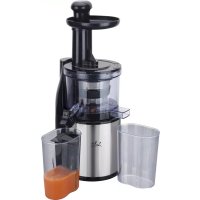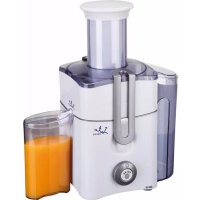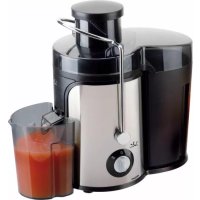
LI585 - Juicer JATA - Free user manual and instructions
Find the device manual for free LI585 JATA in PDF.



User questions about LI585 JATA
0 question about this device. Answer the ones you know or ask your own.
Ask a new question about this device
Download the instructions for your Juicer in PDF format for free! Find your manual LI585 - JATA and take your electronic device back in hand. On this page are published all the documents necessary for the use of your device. LI585 by JATA.
USER MANUAL LI585 JATA
text_image
ata electroINSTRUCCIONES DE USO
INSTRUÇÕES DE UTILIZAÇÃO • INSTRUCTIONS OF USE
INSTRUCTIONS D'USAGE • ISTRUZIONI PER L'USO
BEDIENUNGSANLEITUNG
LICUADORA INOX
text_image
Exploded view diagram of a coffee maker with numbered parts for identification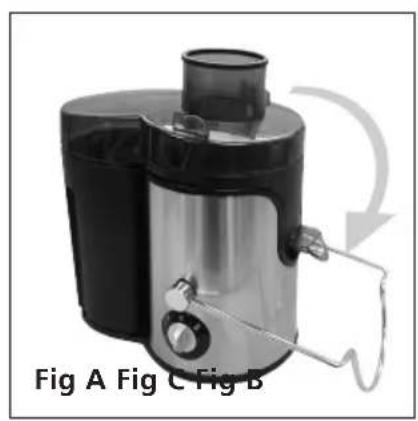
natural_image
Black and silver juice maker with a curved arrow indicating rotation (no text or symbols on the device itself)
natural_image
Exterior view of a modern stainless steel coffee maker with a curved arrow indicating rotation (no text or symbols visible)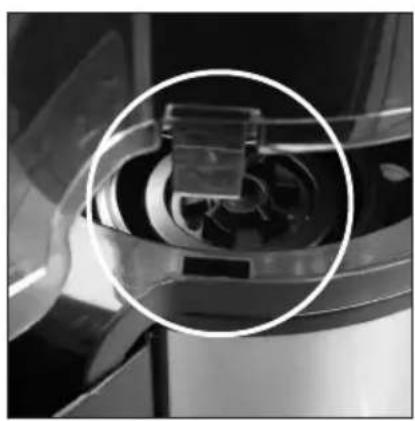
natural_image
Close-up of a mechanical component with a magnified circular detail (no visible text or symbols)DATOS TÉCNICOS • DADOS TECNICOS • TECHNICAL DATA
MOD. LI585 230V.\~ 50 Hz. 400 W.
- Pusher.
- Feeder tube.
3.Lid.
4.Filter.
5.Separating unit. - Anti-drip spout.
- Lid locking handle.
- Pulp container.
9.Speed selector.
10.Main body. - Juice container with lid.
PRINCIPAUX COMPOSANTS
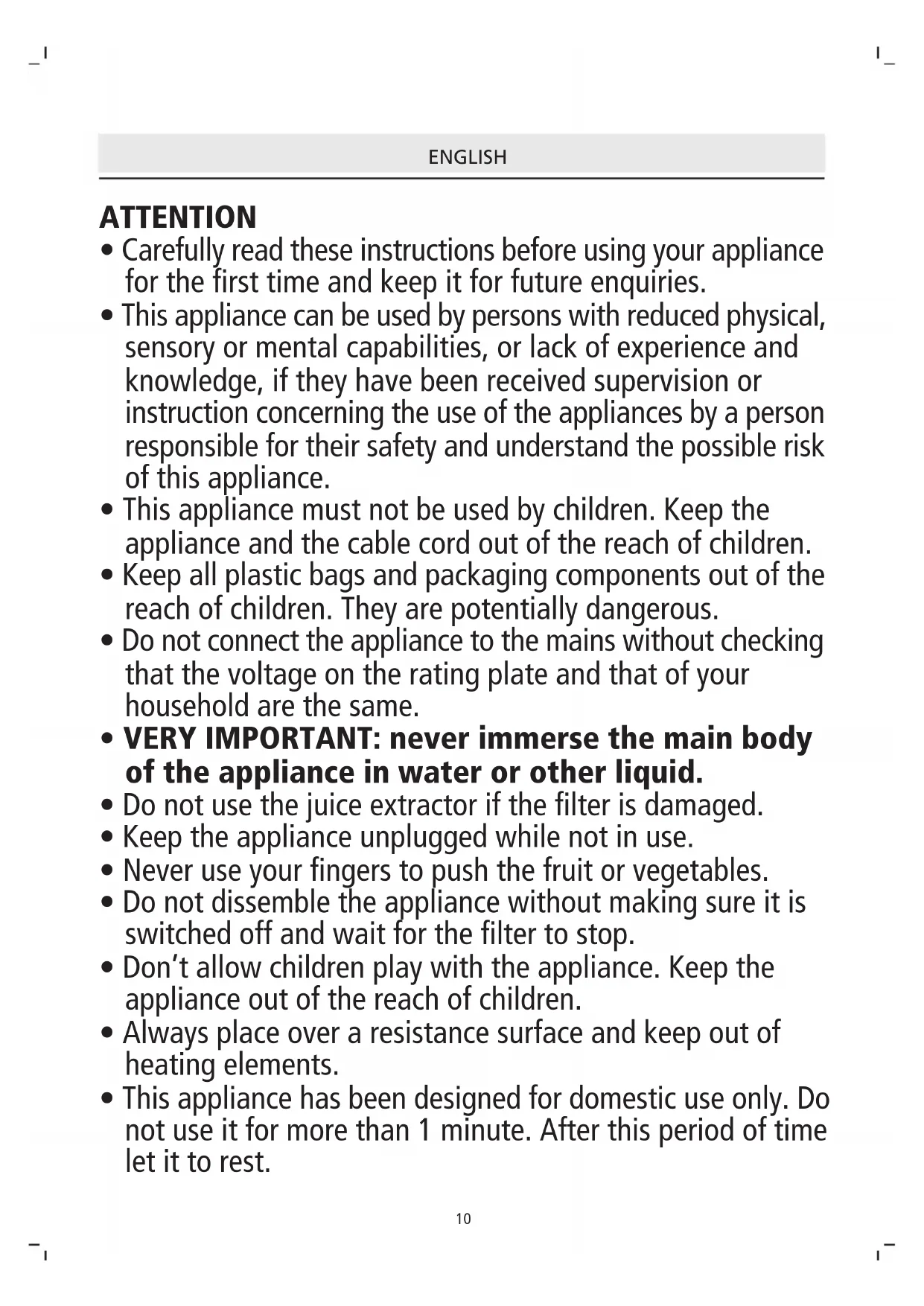
- Carefully read these instructions before using your appliance for the first time and keep it for future enquiries.
- This appliance can be used by persons with reduced physical, sensory or mental capabilities, or lack of experience and knowledge, if they have been received supervision or instruction concerning the use of the appliances by a person responsible for their safety and understand the possible risk of this appliance.
- This appliance must not be used by children. Keep the appliance and the cable cord out of the reach of children.
- Keep all plastic bags and packaging components out of the reach of children. They are potentially dangerous.
- Do not connect the appliance to the mains without checking that the voltage on the rating plate and that of your household are the same.
- VERY IMPORTANT: never immerse the main body of the appliance in water or other liquid.
- Do not use the juice extractor if the filter is damaged.
- Keep the appliance unplugged while not in use.
- Never use your fingers to push the fruit or vegetables.
- Do not dissemble the appliance without making sure it is switched off and wait for the filter to stop.
- Don’t allow children play with the appliance. Keep the appliance out of the reach of children.
- Always place over a resistance surface and keep out of heating elements.
- This appliance has been designed for domestic use only. Do not use it for more than 1 minute. After this period of time let it to rest.
WARNING: The appliance has a security system that disconnects it automatically if it was overheated. If this happens, unplug it from the mains and wait for 30 minutes before reconnecting it again.
- Always disconnect it from the mains when you do not use it and before assembling / disassembling or when cleaning.
- To unplug, pull from the plug, never from the cable.
- If the cable were to deteriorate it must be changed by an Authorised Service Centre.
BEFORE ITS FRIST USE
- Clean and dry all the pieces of the juice extractor, except the main body (10). If necessary, clean it with a slightly dampened cloth.
To disassemble the appliance
- Hold the lid (3) and turn the handle (7) rightwards (Fig. A).
- Remove the lid (3) and take out the filter (4), the separating unit (5) and the pulp collector (8).
To assemble the appliance
- Place the separating unit (5) over the main body (10).
- Fit the filter (4).
ATTENTION: Before switching on the appliance make sure the filter is correctly inserted in its place by pushing firmly.
- Tilt a little bit the pulp container (8) to place them in its place.
- Place the lid (3). Doing this operation be sure that the flange of the lid fits properly in the gap of the separator (Fig. B).
- Keep pressed the lid (3) and turn it the handle to the Leith until the handle is fixed in the gaps of the lid (Fig. C).
- Press the spout (6) to lower it. Otherwise the juice will spill on the main body.
PREPARING THE FRUITS AND VEGETABLES
- Clean all the fruit and vegetables you are going to use. If necessary, you may cut them up into small pieces to help you put them through the food opening.
You must bear in mind:
- The stone must be taken out of peaches, cherries, apricots, plumbs, etc.
- Oranges, lemons, kiwis, tangerines, melons, etc. must be peeled.
- The pips of melons, cucumbers, water melons must be taken out.
- Spinach, fresh kale, tomatoes, onions, peppers, parsley, carrots and similar foods, need no special preparation.
- It is not possible to obtain any juice from bananas, avocados, aubergines, etc.
INSTRUCTIONS OF USE
- Plug the appliance into the mains and turn the speed selector (9) to the selected position (I or II). Put the fruit or vegetables in the feed tube (2) and press them with the pusher (1) making coincide the marks with the groove of the pusher.
- Remember: never use your fingers and bear in mind that when putting food into the appliance the motor must always be running.
- Once the juice has been obtained place the speed selector (9) on off position (0) and switch off the appliance from the mains. Lift up the spout (6) so that juice does not drip.
- It is advisable to consume the natural juices immediately after they are made. This way, neither the flavour nor the vitamins are lost.
- If you wish to keep them for some hours we recommend you add lemon juice to them.
- The following table shows the calories and nutritional values of the most common fruit and vegetables.
TABLE WITH THE CORRESPONDING CALORIC AND NUTRITION VALUES
| Fruit and vegetables | Calories per 100 gr. | Vitamins | Minerals and other elements |
| Apricot | 47 | A,B1,B2,PP,C | Iron, Calcium |
| Strawberry | 36 | B,C | Calcium, Iron, Phosphorous, Magnesium |
| Kiwi | 55 | C | Phosphorous, Iron |
| Lemon | 35 | C | Potassium |
| Tangerine | 51 | C,A | Minerals, Calcium, Phosphorous, Iron |
| Apple | 57 | B1,B2 | Potassium |
| Peach | 50 | A,B1,B2,PP,C | Calcium, Iron |
| Melon | 40 | A,B | Potassium, Phosphorous, Magnesium |
| Orange | 45 | C | Potassium |
| Cucumber | 13 | A,B,C | Sulphur, Magnesium |
| Pear | 60 | A,B1,B2,PP,C | Calcium, Magnesium, Phosphorous, Potassium |
| Pineapple | 51 | C | Potassium |
| Grapefruit | 35 | A,B,C | Potassium, Magnesium |
| Water melon | 0 | ---- | Diuretic Properties |
| Grape | 77 | A,B1,B2 | Potassium, Magnesium, Calcium |
| Tomato | 22 | C | Phosphorous, Iron |
| Carrot | 41 | A,B,C | Phosphorous, Calcium, Magnesium |
MAINTENANCE AND CLEANING
- Before you proceed to cleaning it, ensure the appliance is unplugged and the motor is not running.
- Take out the lid (3), the filter (4), the separating unit (5) and the pulp collector (8) to proceed with the cleaning.
- All the components except the main body (10) may be cleaned with water and if necessary you may use a liquid detergent.
- Never clean them in the dishwasher.
- Do not use chemical or abrasive products, such as metallic scourers, which may deteriorate the surfaces of the appliance.
- The main body of the appliance may be cleaned with a slightly dampened cloth.
- It is important to clean the appliance as soon as you have finished, to avoid the pigments of some fruits or vegetables staining the plastic.
ENVIRONMENT PROTECTION
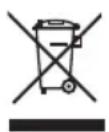
- Dispose the appliance according to the local garbage regulations.
- Never throw it away to the rubbish. So you will help to the improvement of the environment.
ATTENTION
text_image
Jata electroCONDIÇÕES DE GARANTIA - 20 DIAS \*
GARANTIA GERAL (2 ANOS) - GARANTIA TOTAL
In the rest of countries, the holder of the guarantee will enjoy all the rights that his legislation in force concedes.