ManualGo.com
HRZ176AAS - Fridge HAIER - Free user manual and instructions
Find the device manual for free HRZ176AAS HAIER in PDF.

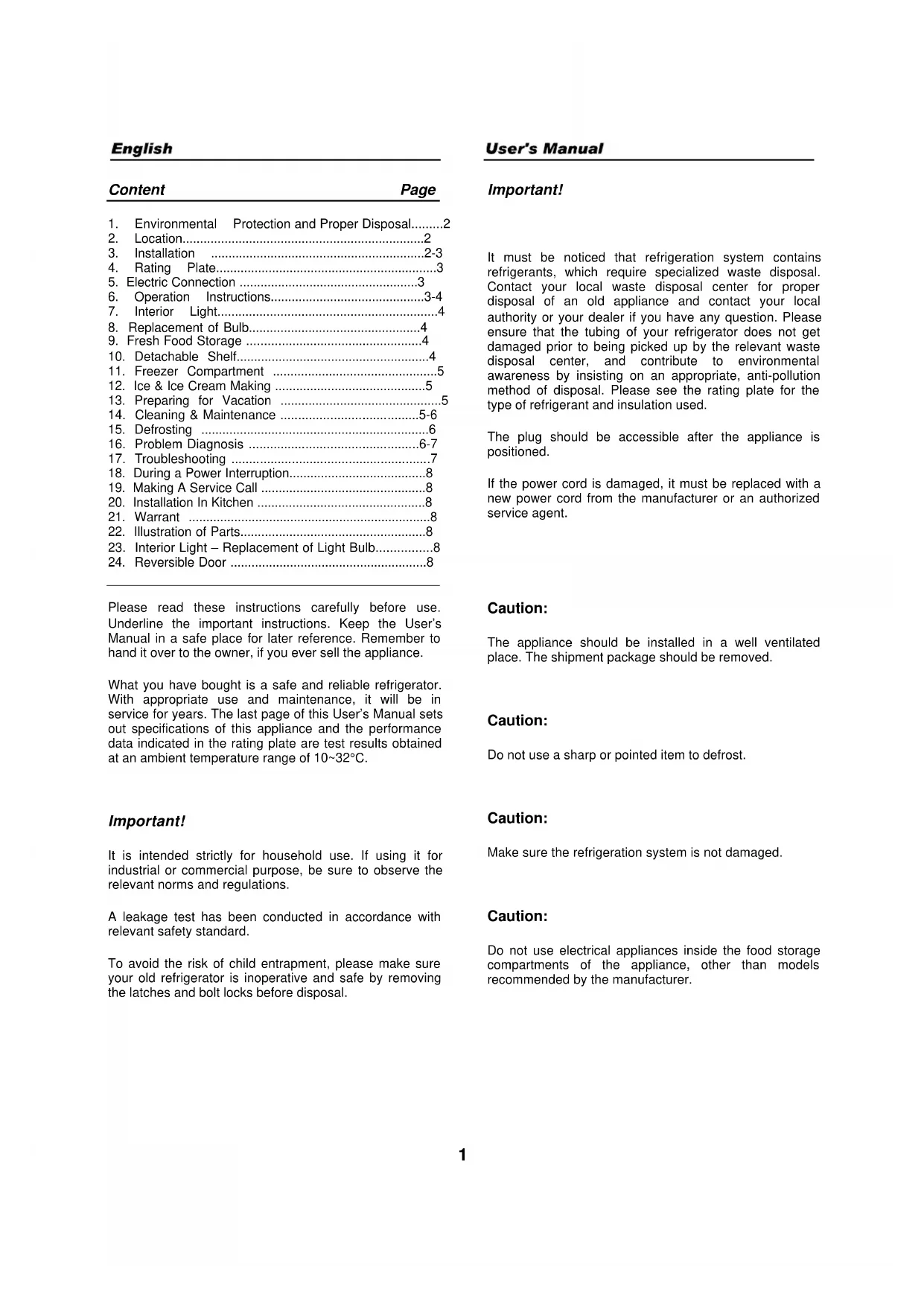


Download the instructions for your Fridge in PDF format for free! Find your manual HRZ176AAS - HAIER and take your electronic device back in hand. On this page are published all the documents necessary for the use of your device. HRZ176AAS by HAIER.
USER MANUAL HRZ176AAS HAIER
European Safety Certificate Compliance Declaration The manufacturer assumes full responsibility for the compliance of products manufactured with relevant safety, health and environmental protection requirements set out in European Directives. Test reports are available for verification upon request. The manufacturer will present the quality certificate or manufacture license to a refrigerator dealer if so required. Furthermore, the manufacturer declares that all parts intended to be in contact with fresh food as described in this User’s Manual are free of toxic substances.
1. Environmental Protection and Proper Disposal.........2
Please read these instructions carefully before use. Underline the important instructions. Keep the User’s Manual in a safe place for later reference. Remember to hand it over to the owner, if you ever sell the appliance. What you have bought is a safe and reliable refrigerator. With appropriate use and maintenance, it will be in service for years. The last page of this User’s Manual sets out specifications of this appliance and the performance data indicated in the rating plate are test results obtained at an ambient temperature range of 10~32°C. Important! It is intended strictly for household use. If using it for industrial or commercial purpose, be sure to observe the relevant norms and regulations. A leakage test has been conducted in accordance with relevant safety standard. To avoid the risk of child entrapment, please make sure your old refrigerator is inoperative and safe by removing the latches and bolt locks before disposal. Important! It must be noticed that refrigeration system contains refrigerants, which require specialized waste disposal. Contact your local waste disposal center for proper disposal of an old appliance and contact your local authority or your dealer if you have any question. Please ensure that the tubing of your refrigerator does not get damaged prior to being picked up by the relevant waste disposal center, and contribute to environmental awareness by insisting on an appropriate, anti-pollution method of disposal. Please see the rating plate for the type of refrigerant and insulation used. The plug should be accessible after the appliance is positioned. If the power cord is damaged, it must be replaced with a new power cord from the manufacturer or an authorized service agent.
Caution: The appliance should be installed in a well ventilated place. The shipment package should be removed. Caution: Do not use a sharp or pointed item to defrost. Caution: Make sure the refrigeration system is not damaged. Caution: Do not use electrical appliances inside the food storage compartments of the appliance, other than models recommended by the manufacturer.2 This User’s Manual is applicable to a variety of models and there may be slight changes in certain aspects from model to model.
1. Environmental Protection and
Proper Disposal Package materials The appliance is packaged in a way to prevent damages during transportation. Recyclable materials are used. The packing box is made of corrugated board / cardboard (mainly from recycled paper). y Polystyrene parts (CFC-free foamed polystyrene) y Linings and polyethylene bags y Polypropylene straps All these valuable materials may be taken to a waste collecting center and used again after adequate recycling. All waste materials should be disposed properly.
Make sure the refrigerator is kept upright during handling. If an inclination is required, it should not exceed 45 degrees. Otherwise the appliance may get damaged resulting not only in compromised refrigeration performance. To avoid product damage or personal injury, the refrigerator should be unpacked by two persons after it is located in a previously selected position. Before installation, make sure the refrigerator has no visible exterior damage. When handling the refrigerator, do not lift it by holding the worktop, to prevent any damage to the refrigerator. Do not start up a refrigerator that is damaged.
Check the refrigerator carefully for: y Damaged package due to inappropriate handling during transportation y Damage in the exterior y Damage in power cord / plug Any doubt, please contact Customer Service for a thorough checkup of the appliance. Take necessary measures to prevent leakage of refrigerant at the start-up of refrigerator that may result in environmental pollution.
a) Remove all package materials. b) Remove items in the refrigerator. c) Make sure to remove film and tape on the cabinet and the door. d) Remove polystyrene chips (if any) around the refrigerator. e) Take out accessories and literature in the refrigerator. f) Clean the inside of the refrigerator with lukewarm water and vinegar and then dry it with a soft cloth. g) Use the spanners supplied to adjust the leveling leg to ensure the refrigerator is stable.
Do not use detergents, sharp or pointed instruments or soda-based cleansers to clean the refrigerator. y Before installation, make sure the refrigeration system is free of any damage. y The refrigerator should be used for its intended purpose only. y The refrigerator should be positioned on the solid and even floor to ensure refrigerant circulation and refrigerating performance. y If possible, position the refrigerator in a cool and dry well ventilated room. y Do not expose the refrigerator to direct sunshine and make sure the ambient temperature is not extremely high. y Keep the refrigerator from a heat source, such as heating system, oven or cookers. Otherwise the compressor will operate more frequently resulting in extra power consumption.
If the refrigerator will be placed near a heat source, it is recommended to install a thermal barrier between the refrigerator and the heat source (asbestos is prohibited) or maintain adequate space between the refrigerator and the heat source as follows: Cooker or electric stove 3 cm Radiator or oven 30 cm Another refrigerator 2 cm
Do not place any radiating apparatus, such as microwave oven or roaster, on top of the refrigerator. Make sure the air vent is not obstructed. Never unplug the refrigerator by pulling on the power cord. Always grip the plug firmly and pull it straight out from the outlet.3 Warning! After the refrigerator is positioned, allow it to stand still for at least 2 hours before starting it up to ensure stable refrigerant circulation and faultless operation. Before starting up the refrigerator, make sure the inner compartment is dry (especially corners).
Danger! Depending on the chemical composition, the refrigerant may be flammable. The leak-proofness of refrigerant circulation system is test proven. Unauthorized intervention of the refrigerant circulation system may cause fire. Make sure the refrigerant circulation system and the peripheral parts of compressor are not affected. Any intervention of the refrigerating system should be conducted only by professional personnel.
Warning! Refrigerant getting into eyes can cause serious injury. In this case, rinse the eyes under running water and consult an ophthalmologist without delay.
The refrigerator should be used within an appropriate range of room temperature by its climate type. The range of room temperature for a specific climate type should be observed. See the rating plate for the climate type of your appliance. Climate type Room temperature
A rating plate is found on the side panels or rear panel of the refrigerator, indicating important technical data.
5. Electric Connection
The refrigerator should use a properly grounded outlet which should be checked by a qualified electrician. The refrigerator should always be plugged into its own individual electrical outlet which has a voltage rating and a fuse rating in conformity with the rating plate. In case of nonconformity, consult the local service center or the dealer immediately. The refrigerator should not be connected with a converter (such as solar cell) Do not use an extension cord.
6. Operation instructions
a) Power on the refrigerator (or power off), and select temperature settings y Temperature regulator (thermostat) y Temperature regulator is used to power on/off the refrigerator, and select temperature settings. b). Startup Turn the temperature regulator clockwise to startup the refrigerator. (Turn to restricted position at most, or you may break the temperature regulator). Compressor starts operation, till interior temperature satisfies the settings. c). Setting temperature Turn temperature regulator counterclockwise to the lowest setting=lightest cooling; (Turn the regulator counterclockwise to the most will power off the refrigerator, compressor will stop)4 Turn temperature regulator counterclockwise to the highest setting=coldest setting; Temperature setting should conform to the following conditions: y Ambient temperature; y Quantity of food stored; y Door openings;
Through observation, you’ll soon learn how to select an appropriate temperature setting. Appropriate temperature setting is very important for food storing. Microbes can get food spoiled very quickly, unless there growth is sprouted by low temperature environment. It is recommended to set the temperature to 5°C or lower which may effectively eliminate food spoiling process by microbes.
d). Stopping Turn temperature regulator counterclockwise to the most. The compressor should stop by then. Unplug from wall outlet.
7. Interior light (Not applicable to
some models) You can find a lamp switch in all models which are equipped with interior light. When the refrigerator is startup, lamp will come up upon door opening, and go off when door is closed. The lamp comes with a protective lampshade. Maximum power of the bulb is 15watts, E14 socket incorporated. Bulb replacement should be carried out according to instructions included with appendix.
8. Bulb replacement:
Unplug or cut off fusing. Remove lampshade. Remove the lampshade as per illustrations of section 23 on the last page. Replace lampshade. Replace the lampshade as per illustrations of section 23 on the last page. Never use bulbs larger than 15watts. Voltage for the bulb must comply requirements listed in the rating plate.
9. Recommended location for
various food (From top to bottom) 1). Door: a). Butter, cheese; b). Eggs; c). Bottled or caned food, spices; d). Big bottles or cans;
2). Refrigerator compartment: a). Jelly; b). Bread, sweets, cooked meat; c). Sausages, meat; d). Fruit, vegetable, salad.
In some models, shelves and glass shelves can be detachable to accommodate objects of different size. Remove food from the shelf to be detached. Remove the shelf, insert it into another groove on the inner wall, down to the end. NOTE! 1 When storing food which will easily go off-taste, appropriate wrapping must be applied. 2 Fruits, vegetables, salad can stay unwrapped in the crisper. 3 Reusable plastic film, aluminum film and glass containers are suitable for packing food. 4 Never let food package get in contact with the rear wall of the refrigerator, as they may be frozen and stick to the rear wall. 5 Allow hot food and drinks to cool down completely before adding them to the refrigerator. 6 Warm air can enter the refrigerator when the door(s) is opened. To save energy, keep down door openings. 7 Never store explosive materials in the refrigerator (such as pressure sensitive sprayers), as they may explode. 8 Never store edible oil on door bins, as this may result in stress cracks on the door’s plastic panels. 9 High spirit content drinks should be stored at low temperature area only, secure sealant must be ensured.5
11. Freezer compartment (not
available in some models, only for refrigerators with 4-star marking) 3-star or 4-star freezer are suitable for storing deep frozen food (already frozen before added to the freezer), storing fresh food for a short period (2-3 weeks) by freezing it, or making ice, ice cream and water ice. Recommended expiration date of food must be observed. Freezer can be used to produce ice cubes. 1 Temperature within the freezer can be adjusted by setting temperature regulator. For fresh food and food which needs to be stored for a long period, -18°C or below is recommended, as microbes can barely survive under this temperature. Once temperature is higher than -10°C, microbes will start to cause spoiling of food, and storage period of food will be effectively reduced. If you need to freeze food which is already partly or totally thawed, please cook it before adding it to the freezer again. The high temperature of cooking process can eliminate most microbes. 2 The higher the temperature regulator is set, the lower the temperature within the freezer will be. 3 Normally, when food requires only short period of storage, select a medium setting. 4 Normally, when food requires a long period of storage, select a high setting.
NOTE! y Never add caned or bottled carbon dioxide drinks to the freezer, as carbon dioxide may expand when under freezing, and lead to explosion hazard. y Bottled food which needs immediate cooling should be stored in the freezer for no more than one hour before they’re taken out, otherwise bottles may burst. y Ice cream or water ice should be allowed several minutes before using, as lips and tongue may get frostbite (chap may occur in skin). Meanwhile, avoid touching inner walls of freezer with wet hands. IMPORTANT! y Food to be added to freezer must be well wrapped. y Observe expiration date of frozen food. y Only fresh food in high quality is suitable for freezing storage. y Food stored in freezer should be properly sized. y Weight of a single package of frozen food should not exceed 2 kg. y Please use reusable plastic film, aluminum film for packing food, or put food in containers. y Food packages should not entrap too much air inside. y Use bungee, clip, rope or freezing-resistant tape for sealing of food package. y Film welding device can be used to seal the plastic packages. y Place the wide side of food package downward to obtain a faster freezing process. y Wipe the packages dry before adding them to the freezer, as they may stick together when frozen. y If you need to freeze food which is already partly or totally thawed, please cook it before adding it to the freezer again. y Don’t use food which is already expired, as they may cause poisoning.
12. Making ice cubes, ice cream
and water ice (not available in some models, only for refrigerators with 4-star marking) Making ice cubes: y Add water to ice tray to 3/4 of its volume, place it at the bottom area of the freezer. When ice cubes are ready, flush the ice tray with running water, then, you can easily take out the ice cubes. Making ice cream: y Remove separators of the ice tray. Please note the creamier your ice cream is, the longer it will take to make it. When ice cream is ready, flush the ice tray with running water, then, you can easily take out the ice cream.
13. Preparing for Vacation
For long vacation or absence, unplug the refrigerator and clean the refrigerator as described in “Cleaning and Maintenance”. Leave the doors open to prevent formation of mildew or odor.
14. Cleaning and Maintenance
Unplug or disconnect the appliance before cleaning.6 Keep the outside clean. Use furniture polisher or finishing conditioner to clean the outside regularly (do not use these cleaners to clean the inside). Wipe the door gasket with a cloth lightly dampened with lukewarm water. No detergent is allowed. Never use oil or grease to clean the door gasket. Clean the inside regularly. y Clean the refrigerator compartment on a monthly basis and clean the freezer compartment after a defrost cycle. y Take out foods from refrigerator and freezer compartments and kept these foods in a cool place. y Remove all detachable parts. y Interior parts are not suitable to be washed in a dishwasher. Wash them manually using lukewarm water and some dish detergent. Do not use concentrated detergent, abrasive agents and chemicals such as acids. Mild dish detergent is recommended. Steam cleaners are dangerous and strictly prohibited. Wash the inner compartment with lukewarm clean water and dry with a soft cloth. It is absolutely dry after waiting for 3-4 minutes. Do not destroy or remove the rating plate of the refrigerator. It could be needed for after-sales service or relevant processes. Make sure water doesn’t get into electric parts in the refrigerator. If a heat exchanger, i.e. condenser, is mounted on the back of refrigerator, dust and lint should be removed regularly to enable efficient heat dissipation and avoid excessive power consumption. Use a soft brush or a duster to clean the outside of heat exchanger. The defrost water drains away through the gutter. The drain hole should be cleaned regularly by use of a swab or similar instrument. Make sure water doesn’t run down the drain hole during cleaning. Otherwise water may spill or splash on the ground due to evaporation.
a) Refrigerator compartment The rear wall of inner compartment may get frosted when the compressor (refrigerating unit) is operating. The refrigerator has automatic defrosting and the defrost water runs down the gutter and through a drain hole to a tray where it evaporates. b) Freezer compartment (if applicable) The freezer compartment, intended for storage of frozen food, doesn’t have automatic defrosting. The freezer compartment should be defrosted regularly. Defrost the freezer compartment whenever the thickness of ice layer reaches 5cm. Unplug the refrigerator before defrosting. Take out foods from the freezer compartment and kept these foods in a cool place. Use an ice scraper to remove the ice. To speed up the process, place a bowl of hot water in the freezer compartment. Clean and reload the freezer compartment after defrosting. POTENTIAL SAFETY HAZARD! Do not use electrical devices such as hair dryer, electrical fan, steam cleaner, defrost spray or open fire (such as candle) to defrost the freezer compartment. The plastic parts of inner compartment may get melted and any spark or open fire may cause fire in presence of explosive gas. Never use a steam cleaner to defrost the freezer compartment – danger of electric shock!) Cautions! Wrap up the frozen foods with newspaper or blanket. y Kept these foods in a cool place before the defrosting process is finished. y Keep the door of freezer compartment open. y Ice and frost form on the surface of evaporator during operation. A thick layer of ice or frost acts as heat insulation and hinders thermal conduction. y Defrost the freezer compartment in the shortest time possible to avoid thawing of frozen foods. y Wipe off defrost water from time to time with sponge. y Place a container of hot water (do not use boiling water) near the door of freezer compartment to speed up the defrosting process. y Dry and freezer compartment and place the frozen food back. y Reconnect the refrigerator after defrosting. y Start up the refrigerator by adjusting the temperature control knob. y Close the door of freezer compartment.
The latest manufacture techniques and state-of-the-art refrigeration and freezing technology are adopted to ensure safe and reliable operation of your appliance. In doubt of fault, make sure to check first as described below before making a service call:7 Things to be noted: The compressor (also known as refrigerating unit) doesn’t operate all the time without stop. The compressor is controlled by the automatic temperature regulator represented by a temperature dial. When the interior temperature exceeds the preset temperature, the compressor starts automatically and when the interior temperature falls below the present temperature, the compressor stops automatically. It’s normal that compressor makes noise during operation. The noise comes from the motor. The flow of refrigerant through the refrigerating system may make a gurgling noise. These noises don’t mean a fault of the refrigerator. The exterior surface may be wet when it’s cold and the ambient temperature is low. It’s normal and the exterior surface will become dry as the ambient temperature rises. If the reasons of such phenomena can’t be identified and solved, please consult the service center.
a) Problem: Refrigerator does not operate (does not work) Please check: y Is the power cord in good condition? Is the refrigerator properly plugged in the outlet? y Is there a power interruption? (Use a small appliance to check out, e.g. agitator or hair dryer) y Is the refrigerator started up? (The temperature dial should not be set at “0”.) y Is the fuse broken? Or in poor contact? b) Problem: The inner compartment is not cool enough; the compressor cycles on and off frequently; Please check: y The refrigerator/freezer compartment should stand still for at least 2 hours after installation to stabilize the refrigerant circulation system. See “Start-up”. If it doesn’t work, unplug the refrigerator and tilt the refrigerator to one side for a while or place it on an inclined plane and then place it to the original position. Connect the refrigerator after 2 hours. Keep the door(s) closed for 12 hours. y Is the door properly closed? If so, the door gasket should press on the external cabinet securely and evenly. Test: It should be difficult to pull out a piece of paper caught up between the door gasket and the external cabinet. If the paper slips away easily, consult the service center. y If there is thick ice in the freezer compartment. (See “Cleaning and Maintenance”) y Is the refrigerator exposed to direct sunshine or near a heat source (oven, radiator, etc.)? What to do: Do not expose the refrigerator to direct sunshine; keep the refrigerator away from any heat source; install a thermal barrier between the refrigerator and the heat source (see “Location”). y Is the inner compartment overloaded? y Is the room well ventilated? Is the air vent obstructed? Is the heat exchanger (condenser) on the back covered by dust? c) The temperature of refrigerator compartment is too low Please check: y Is the temperature regulator properly set? y Is the door of freezer compartment properly closed? y Is there a lot of fresh food (more than 1kg) in the freezer compartment? (If the freezer compartment operates for long periods, the temperature of refrigerator compartment falls accordingly.) d) The freezer compartment is too warm and frozen foods are thawed y Is the ambient temperature too low? (If so, the refrigerating unit will malfunction, resulting in higher temperatures in the freezer compartment.) What to do: Raise the ambient temperature. e) There is thick ice in the freezer compartment. Please check: y Is the door of freezer compartment properly closed? y If some food gets frozen to the inner walls, try to remove it with a blunt instrument such as a spoon handle. y Defrost and clean the freezer compartment (see “Defrosting”). A thick ice layer will impede refrigeration performance and increase power consumption. f) Interior light is off. Please check: y Is the lamp switch functioning properly? y If the lamp switch is in good condition, the light bulb should be replaced (see “Replacement of Light Bulb”) g) Unusual noise Please check: y Is the refrigerator solidly positioned? Is the refrigerator rubbing against other furniture or items? Is there anything stuck between the back of refrigerator and the wall? y Move the items in contact with the refrigerator out of way and keep adequate space between the refrigerator and the surroundings. y Is the movable parts securely retained in place? y Are bottles or containers in the inner compartment rubbing against each other? Note! It’s normal that there is noise of refrigerant flowing through the refrigerating system. It’s normal that moisture forms around the door handle in summer. Dry with a soft cloth. The refrigerator is not user-serviceable and do not attempt to intervene with the normal operation of the appliance.8
18. During a Power Interruption
There is no need to take out the frozen foods in the freezer compartment if the power interruption lasts no more than 2 hours. Otherwise, take out the foods after 2 hours.
19. Making A Service Call
Servicing and repair should be conducted by authorized professional personnel. The manufacturer is not responsible for the risk of damages or injuries due to failure to comply with this provision and the warranty will be voided. The warranty and the list of service centers indicate the authorized after-sales service providers for your appliance. Please consult your dealer if the there is no service center in your neighborhood. For faults or problems caused due to improper use or breach of the instructions contained herein, the costs and expenses incurred in servicing and repair should be born by the user and the dealer is not responsible for such costs and expenses. In order to receive prompt assistance, the following information is necessary: y Type and model of refrigerator (see the rating plate) y Date of purchase. y Name and address of the dealer. y Description of fault / problem.
20. Installation in Kitchen
If you want to place the refrigerator in the kitchen, you should consult the relevant instructions prescribed in the installation manual of other types of refrigerator.
The terms and conditions as well as the period of warranty are indicated in the Letter of Warranty enclosed hereto. The dealer will brief you of the same upon purchase. The manufacturer reserves the right to improve the design, construction and technology from time to time without further notice.
Light Bulb Replacement of light bulb (As shown in Fig D, Sec.22): Unplug the refrigerator. a. Press downward the lampshade as illustrated. b. Remove the lampshade. c. Replace the light bulb (230V, 15W). d. Reinstall the lampshade.
The door swing can be reversed with this refrigerator. Take the following steps to reverse the door swing: a. Tilt the refrigerator a little and remove the screw of leveling leg and then the bottom hinge. Lift the refrigerator door off. Note: In order to prevent damage of refrigerator, do not hold the edge of worktop with force. b. Remove the top hinge and place it in the hole of top hinge shaft on the other side of cabinet. Fasten the hinge. c. Install the door. d. Tilt the refrigerator again and fasten the bottom hinge, screw and leveling leg.1 Table des matières Page