ManualGo.com
KS 9799 - Freezer SEVERIN - Free user manual and instructions
Find the device manual for free KS 9799 SEVERIN in PDF.

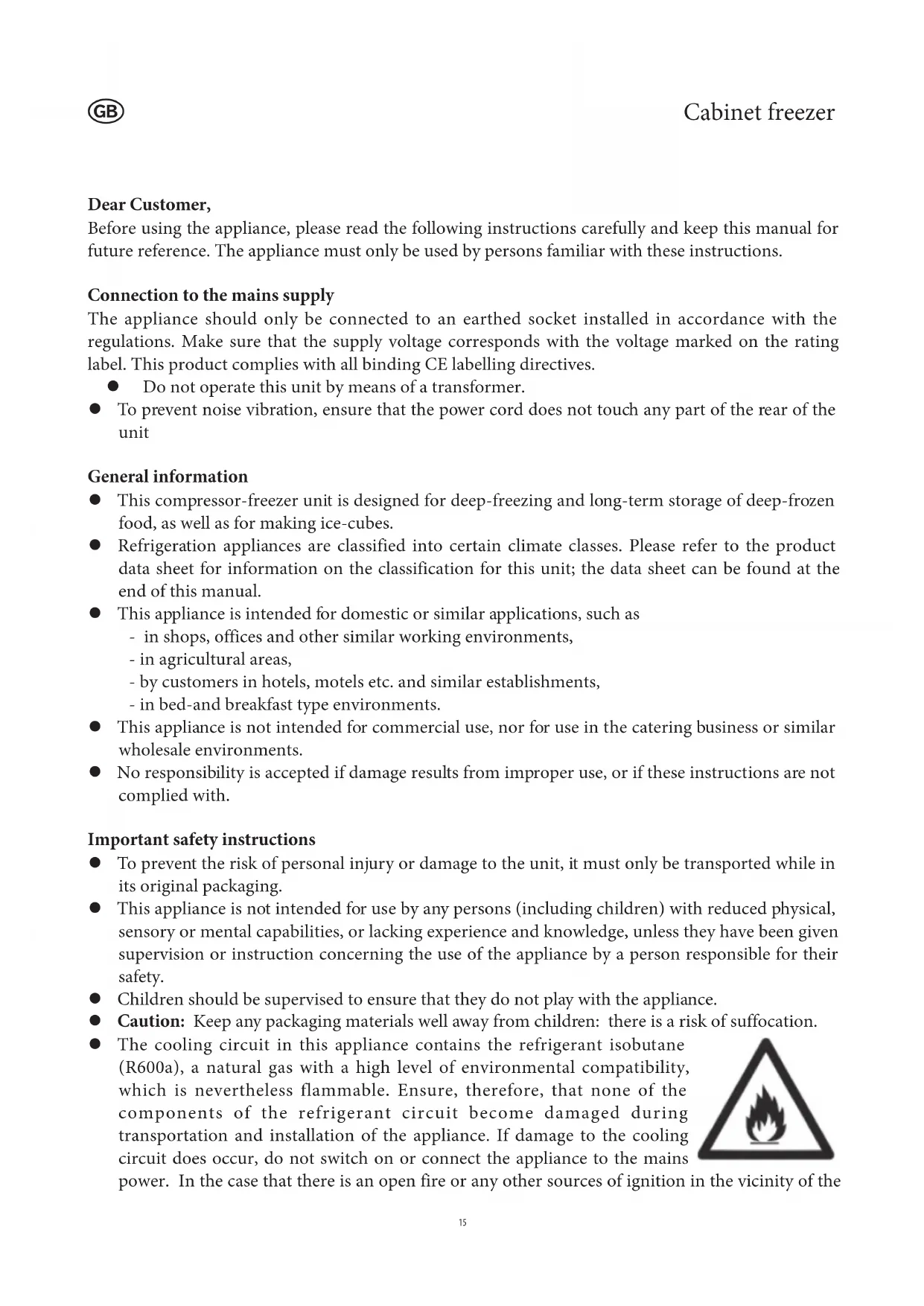


Download the instructions for your Freezer in PDF format for free! Find your manual KS 9799 - SEVERIN and take your electronic device back in hand. On this page are published all the documents necessary for the use of your device. KS 9799 by SEVERIN.
USER MANUAL KS 9799 SEVERIN
Instructions for use
15refrigerant gas, make sure it is removed immediately from this area and that the room is then thoroughly ventilated.
Warning: Do not damage the cooling circuit. Any escaping refrigerant causes damage to the
eyes; there is also a danger of the gas igniting.
Warning: Keep ventilation openings, in the appliance enclosure or in the built-in structure,
clear of obstruction. Sufficient ventilation must be ensured at all times.
Warning: Do not use any external device (e.g.; heaters or heating fans) to accelerate de-frosting;
follow only the methods recommended in this manual. The ice removed from the unit during de-frosting is not suitable for human consumption.
Warning: Do not operate any electrical appliances (e.g. ice makers) inside the storage
compartment that are not specifically permitted in these instructions. Before it is connected to the mains power, the unit must be thoroughly checked for transport damage, including its power cord. In the event of any such damage being found, the appliance must not be connected to the mains. The power cord should be regularly examined for any signs of damage. In the event of such damage being found, the appliance must no longer be used. To avoid the risk of fire, do not place any thermo-electric appliances on top of the unit. Do not place liquid containers on top of the unit, to prevent any leaking or escaping liquid damaging the electrical insulation. This unit is designed for storing food only. Alcoholic substances may be stored only in properly sealed containers and in upright positions. This appliance is not designed for the storage of explosive substances such as aerosol cans with a flammable propellant. Do not store any glass bottles containing carbonated or other freezable liquids in the unit: such bottles may burst during the freezing process. To avoid the risk of food poisoning, do not consume food after its storage time has expired. Thawed foods must not be frozen a second time. Do not lean or put undue weight on the shelves, compartments, door etc. Protect the inside of the refrigerator at all times from open flames and any other sources of ignition. Remove the plug from the wall socket - in case of any malfunction, - before de-frosting, - during cleaning, - before maintenance or repair work is carried out. When removing the plug from the wall socket, never pull on the power cord; always grip the plug itself. In order to comply with safety regulations and to avoid hazards, any repairs or modifications to this unit must be carried out by our authorised service personnel, including the replacement of the power cord. If the unit is not used for an extended period of time, we recommend keeping the door open. If the unit is sold, handed over to a third party or disposed of at a suitable recycling facility, attention must be drawn to the presence of the insulation agent ‘cyclopenthane’ as well as to the refrigerant R600a. We reserve the right to introduce technical modifications. 16Familiarisation
Before using for the first time Ensure that the following accessories are included with the appliance: 2 spacer elements 2 screw covers 1 ice-cube tray 1 large covering panel 1 small cover plate – Remove any exterior and interior packaging materials completely, including the adhesive strips. – The packaging materials must be properly disposed of. – Remove the red transport securing device (A); this is for transport purposes only and can be disposed of.
3. Mains connection indicator (green)
4. High-temperature alarm (red)
5. Rapid-freeze drawers
8. Compressor– Fit the covering panel (provided) below the cabinet door.
– Fit the two enclosed spacer elements (1) into the corresponding guide slots on the rear (2). – Before it is connected to the mains, the unit must be thoroughly checked for transport damage, including its power cord. – Clean the unit as described in the section De-frosting and cleaning. – For positioning, we recommend that you tilt the unit slightly backwards. In this way, the transport rollers can be used to move it to its intended place of installation. – The unit should only be transported in its vertical position; do not tilt any more than 30°. – Once the unit has been positioned, wait for about 30 minutes before it is connected to the mains. – If the unit has been tilted more than 30° during transport, allow it to stand upright for at least 4 hours before it is connected to the mains. – When the unit is first switched on, a slight 'new' smell may be noticed. However, this will disappear once the cooling process has begun. Installation The appliance should be set up in a well-ventilated, dry room. It should be operated in conditions where the relative humidity is no more than 70 %. The product data sheet at the end of this manual contains details of the ambient temperature range suitable for this appliance. Do not use the appliance outdoors. Ensure that the plug is accessible and can be removed from the wall socket at any time. Do not expose the appliance to direct sunlight, and do not position it next to any heat sources (radiators, cookers etc). If this cannot be avoided, however, suitable insulation must be in installed between the heat source and the unit. The unit must not be installed inside a cabinet, nor directly below a hanging cupboard, shelf or similar object. In the case of uneven floors, the adjustable feet on the unit can be used to compensate and ensure optimum stability. 18Reversible door If required, the door may be reversed, i.e. from right-hinged (default installation) to left-hinged. To avoid the risk of personal injury or damage to the unit, two people are needed to reverse the door.
Warning: Always disconnect the unit from the mains before any maintenance or repair work is
carried out. Before you get started, please note the following: Always ensure that the correct number of washers is used on all hinge bolts and screws. So that the doors can close tightly against the frame, take the utmost care that they are properly aligned during re-assembly. – Open the freezer door. – Remove the four covers C from the housing and inside of the door – Replace the covers and their extensions, turned through 180°, on the opposite side. – Unscrew the hinge bolt on the inside of the door in the area C/6. Caution: Support the door. – Take off the freezer door. – Take out the fixing screws and remove the upper bracket 6. Note the small plastic plate underneath the bracket. – Turn the bracket 6 including the small plastic plate through 180° and replace it on the other side of the cabinet freezer, using the two screw holes adjacent to each other. – Remove the lower panel 1. – Take out the fixing screws and remove the bracket 2 with its hinge bolt. – Unscrew the hinge bolt, together with the washers, from the bracket, and fit it into the
If the cabinet freezer is installed with its side against a wall, ensure a minimum clearance of 60 mm with the wall; this is to ensure that the freezer door can open sufficiently wide to slide out the drawers. The heated air around the rear of the unit must be able to circulate freely. Therefore, ensure that the air circulation behind the unit is not obstructed. Caution: Ensure at all times that the rear ventilation openings around the top cover are not obstructed. Set-up dimensions Ventilationcorresponding opening on the opposite side of the bracket. – Remove the bracket 7 and replace it with the holding bracket 2 with its hinge bolt. – Now install the holding bracket 7 in the previous position of the bracket 2. – Place the freezer door onto the hinge bolt on holding bracket 2. Caution: Support the door. – Re-insert the hinge bolt of the bracket 6 into the freezer door. – Fit the four covers C over the bracket and the openings. – Take out the cover 10 from the lower panel 1 and replace it on the opposite side. – Replace the panel 1 on the appliance. – Remove the screw covering caps a and the sealing plugs b. – Take out the screws holding the door handle. Fit the handle on the opposite side, using the fixing screws to secure it. Push the sealing plugs into the now empty openings in the door and replace the covering caps on the screw heads. If the unit has been tilted to more than 30°, wait for about 4 hours before re-connecting it to the mains. Temperature control The unit is re-activated by connecting it to the mains. It is only switched off completely when the plug is removed from the wall socket. The temperature in the refrigerator cabinet can be adjusted by setting the temperature control. Turning the control clockwise will decrease the temperature, while turning it anti-clockwise will 20increase it. The medium settings are usually most suitable for home use. We recommend using a thermometer to check the actual temperature inside the cabinet and make adjustments as necessary. Following a power interruption, or if the unit has been switched off on purpose, it may take 3 to 5 minutes before it switches on again. In position ‘0’, the cooling function is switched off, though the appliance is still connected to the mains. 'S' Rapid-freeze mode indicator (orange) Once the rapid-freeze mode is activated, the orange light comes on. Mains connection indicator (green) With the unit connected to the mains, the green light is permanently on. High-temperature alarm indicator (red) This light comes on if the internal temperature raises above 9° C. Freezer door To ensure that frozen food will not de-frost prematurely, the door to the cabinet freezer should be kept closed at all times. This will also prevent an undue build-up of ice and frost. Ensure, therefore, that the door is only opened briefly to place food in the freezer or to remove it. Freezing and storing food – The temperature inside the cabinet freezer depends mainly on the ambient temperature, the temperature control setting and the amount of food stored. – The cabinet freezer is designed for deep-freezing and long-term storage of frozen food, and for making ice cubes. – To take advantage of the cabinet’s maximum capacity, the drawers may be removed. – The rapid-freeze drawers inside the freezer cabinet carry the symbol
– To ensure that nutritious elements such as vitamins are not lost, fresh food should be deep- frozen right through as quickly as possible. To that effect, the prepared food should be placed into the rapid-freeze drawers, properly spaced in one or two rows. – Avoid contact with food that has already been frozen. – Caution: Do not exceed the maximum freezing capacity per day. The product data sheet at the end of this manual contains details of the maximum daily freezing capacity. – Set the temperature control to rapid-freeze mode 'S' to accelerate the freezing process. Caution: The rapid-freeze mode does not switch of automatically but must be switched off manually. While the rapid-freeze mode is active, the compressor remains on. Note: To prevent damage to the compressor, the unit should not be left in rapid-freeze mode continuously for more than three days. – To ensure sufficient distribution of cold air, keep a minimum distance of
2.5 cm between the vapouriser assembly and the tray containing the food
to be frozen. – The time required to freeze food may be shortened by dividing it into 21smaller portions. – Suitable packaging materials for frozen food are transparent (i.e. non-coloured) plastic wrap or bags, or aluminium foil. The packaging materials should be well aired before use; check that the package is air-tight before freezing the food. We strongly recommend that you label every item stored in the freezer with all relevant information such as type of food, freezing date and use-by date. – Do not attempt to deep-freeze carbonated beverages, warm food or any kind of bottled liquids. Use-by dates for frozen food are specified (in months) in the table below. Do not exceed these storage times. However, always observe the manufacturer’s use-by dates for the frozen food. – If the unit remains switched off for an extended period (eg during a power failure), the door should be kept closed; this will help to maintain the lowest possible temperature in the cabinet. The product data sheet at the end of this manual contains detailed information of the maximum safe storage time in case of malfunction. Even a slight rise in the inside temperature will shorten the storage life of the food. Making ice cubes A special ice-cube tray is provided for making ice cubes. Fill the tray ¾ full with drinking water and place it in the freezer compartment. The ice cubes are easier to remove from the tray if the tray is left standing at room temperature for 5 minutes. De-frosting and cleaning After a certain period of operation and depending on several factors (e.g. how often the door has been opened), a layer of ice will form on the evaporators located below the drawers and on the drawer fronts themselves. Once the build-up of ice has reached a thickness of 3 to 5 mm, the unit must be de-frosted. The build-up of ice increases the power consumption of the appliance. The cabinet freezer should be thoroughly cleaned at least twice a year. – Always remove the plug from the wall socket before the unit is defrosted. – Remove all food from the freezer cabinet, wrap it in newspaper and store it in a cool place to keep the temperature down. Note that, even with a slight increase in temperature, the storage life will be shortened and the food should be used as soon as possible. – Take off the covering panel. 22– Pull out the drain channel from the freezer cabinet, turn it 180° and secure it (see diagram). Place a suitable container underneath the channel outlet. – Leave the freezer door open. – To accelerate defrosting, one or several containers with hot (but not boiling) water may be placed inside the freezer. – Do not pour water over or inside the unit – Warning: Do not use any external device or other means (e.g. heaters or heating fans) to accelerate de-frosting. – For frequent cleaning we recommend the use of warm water with some mild detergent. Any accessories should be cleaned separately with soapy water. Do not put them in a dishwasher. – Do not use abrasives or harsh cleaning solutions or any cleaning agents that contain alcohol. – After cleaning, thoroughly clean all surfaces again with fresh water before wiping them completely dry. – Slide the drain channel back in and replace the covering panel. – When re-inserting the plug into the wall socket ensure that you have dry hands. – Turn the temperature control to its maximum setting. After 24 hours, the temperature control can be returned to its normal setting. – Take care not to remove or damage the rating plate inside the cabinet during cleaning. – To save energy, the condenser and the compressor (at the rear) should be cleaned carefully at least twice a year with a hand-brush or a vacuum cleaner. Trouble-shooting Certain typical sounds can be heard when the appliance is switched on. These sounds are: – caused by the electrical motor within the compressor assembly; during compressor start-up the sound level will be slightly higher for a limited period of time. – caused by the cooling agent flowing through the circuit. The following table lists possible malfunctions and their probable causes and solutions. In the event of operational problems, check first whether a solution can be found using this table. If the problem persists, disconnect the appliance from the mains power and contact our Customer Service Department. Problem Possible cause and solution The appliance is not working at all. – There is a power failure – The main fuse has blown. – The temperature control is set to ‘0‘. – The fuse in the wall socket (if applicable) has blown. This can be checked by connecting another electrical device to the socket and checking for function. 23The temperature inside the freezer cabinet is not low enough. – Too much food has been stored in the appliance. – The doors are not properly closed. – There is too much dust on the condenser. – Insufficient ventilation: the unit is too close to a wall or other structure or object. – The temperature control is set too low. The normal operating sound changes or becomes louder. – Check for proper positioning (uneven floor?). – Are any adjacent objects affected by the running of the cooling unit (i.e. causing them to vibrate?) – Are there any objects on top of the unit which might be vibrating? Transporting the appliance To prevent damage to the unit during transport, ensure that all accessories and components inside and around the appliance are securely fastened. The unit must only be transported in its vertical position; do not tilt any more than 30°. Once the unit has been positioned, wait for about 30 minutes before it is connected to the mains. If the unit has been tilted more than 30° during transport, allow it to stand in an upright position for at least 4 hours before it is connected to the mains. Disposal This appliance has been manufactured from recyclable materials. After removing the plug from the wall socket, the unit should be rendered unusable by cutting off the power cord before disposing of it through special waste collection points in accordance with local regulations. The refrigerant and the chemical agent in the insulation foam must be disposed of through a competent agency. Take special care not to damage the cooling circuit before the unit is handed over for such disposal. Guarantee This product is guaranteed against defects in materials and workmanship for a period of two years from the date of purchase. Under this guarantee the manufacturer undertakes to repair or replace any parts found to be defective, providing the product is returned to one of our authorised service centres. This guarantee is only valid if the appliance has been used in accordance with the instructions, and provided that it has not been modified, repaired or interfered with by any unauthorised person, or damaged through misuse. This guarantee naturally does not cover wear and tear, nor breakables such as glass and ceramic items, bulbs etc. This guarantee does not affect your statutory rights, nor any legal rights you may have as a consumer under applicable national legislation governing the purchase of goods. If the product fails to operate and needs to be returned, pack it carefully, enclosing your name and address and the reason for return. If within the guarantee period, please also provide the guarantee card and proof of purchase. Information needed by the Customer Service Department Should repairs to the appliance become necessary, please contact our Customer Service Department, providing a detailed fault description and quoting the model number KS ... on the rating plate of the appliance (see picture). This information will help us to handle your request efficiently. 24In case of any malfunction or other problem, please contact our Customer Services Department. The address can be found in the appendix to this manual. Product data sheet Art. no. KS 9799 Product category Freezer Energy efficiency classification A++ Energy consumption in kWh/year 193 The actual consumption depends on the pattern of use and the location of the appliance Usable refrigerator capacity (litres) --- Usable capacity - Freezer unit (litres) 196 Frost-free : freezer unit no Frost-free : refrigeration unit --- Safe storage time in case of malfunction, hrs 20 Freezing capacity, kg/24h 20 Climate classification N-T Ambient temperature range, °C 16-43°C Noise emission 41 dB(a) Dimensions (H x W x D) in mm 1450 x 600 x 650 Weight (kg) 53 Electrical specifications See rating plate 25Congélateur armoire Chère cliente, Cher client, Avant d’utiliser cet appareil, veuillez lire soigneusement les instructions suivantes et conserver ce manuel pour future référence. L’appareil doit être utilisé exclusivement par des personnes familiarisées avec les présentes instructions. Branchement au secteur Cet appareil doit être branché sur une prise de terre installée selon les normes en vigueur. Assurez- vous que la tension d’alimentation correspond à la tension indiquée sur la plaque signalétique de l’appareil. Ce produit est conforme à toutes les directives relatives au marquage “CE”. Ne pas brancher cet appareil sur un transformateur. Pour éviter tout bruit de vibration, vérifiez que le cordon ne touche aucune partie à l’arrière du congélateur. Informations générales Cet appareil de congélation avec compresseur est destiné à la congélation et à la conservation longue durée des aliments surgelés, ainsi qu’à la fabrication de glaçons. Les appareils de réfrigération sont classés par classes climatiques. Veuillez vous référer à la fiche technique pour connaître la classe climatique de cet appareil ; celle-ci se trouve à la fin de ce manuel. Cet appareil est destiné à une utilisation domestique ou similaire, telle que - dans des bureaux et autres locaux commerciaux, - dans des zones agricoles, - par la clientèle dans les hôtels, motels et établissements similaires, - et dans des maisons d’hôtes. Cet appareil n’est conçu ni pour un usage commercial ni pour un usage dans la restauration ou environnements similaires. Nous déclinons toute responsabilité en cas de dommages éventuels subis par cet appareil, résultant d’une utilisation incorrecte ou du non-respect de ce mode d’emploi. Importantes consignes de sécurité Pour prévenir tout risque de blessure corporelle ou de dommage au congélateur, l’appareil doit être transporté uniquement dans son emballage d’origine. Cet appareil ne doit pas être utilisé par une personne (y compris un enfant) souffrant d’une déficience physique, sensorielle ou mentale, ou manquant d’expérience ou de connaissances, sauf si cette personne a été formée à l’utilisation de l’appareil par une personne responsable de sa sécurité, ou est surveillée par celle-ci. Les enfants doivent être surveillés afin qu’ils ne jouent pas avec l’appareil. Attention : Tenez les enfants à l’écart des emballages, qui représentent un risque potentiel, par exemple, de suffocation. Le réfrigérant contenu dans le circuit de refroidissement de cet appareil est l’isobutane (R600a), un gaz naturel non polluant, mais qui est, cependant, inflammable. Par conséquent, évitez d’endommager les composants du système de refroidissement pendant le transport et l’installation de l’appareil. Si, toutefois, le circuit de refroidissement s’avère endommagé, ne pas mettre