Geos 11065 - Barbecue LANDMANN - Free user manual and instructions
Find the device manual for free Geos 11065 LANDMANN in PDF.



User questions about Geos 11065 LANDMANN
0 question about this device. Answer the ones you know or ask your own.
Ask a new question about this device
Download the instructions for your Barbecue in PDF format for free! Find your manual Geos 11065 - LANDMANN and take your electronic device back in hand. On this page are published all the documents necessary for the use of your device. Geos 11065 by LANDMANN.
USER MANUAL Geos 11065 LANDMANN
Unit 8 Blackstone Road, Stukley Meadows Huntingdon, PE29 6EF
United Kingdom Hslline 44 0871231196 Monnns Touayd Dm to Ene 56doue to 4
e-mail:scuulrbslandmail.com.InternetWww.cundmnd.co.uk
France
LANDOMANN France S.A.S.U.
2.7ue la lase 1-85500 Monrtonillon
1
0
La proghieme di rivaolgardi allufficido tadesco.
LANDMANN* Hugana Kff.
Almaskort u. 4, H 2220 Vocds
T 36-555070,F44-36-24-354912
HtoCnTcK806-16.30Partck 806-16.30
Poland
LANDMANNPolska 8089
Kuiemnitz 13b.59-400 Javor,Polka
Tol. 48 75 8702451,Fx 48 76 8702388
Pomeda 2006-08-00 18:45, p#eR 98 9:00 68 13:30
LANOMANN SKANIRAVCA AE 1000706583234
1.0000000000000000000000000000000000000000000000
Mard#E## 08:00-15:00
e-mail: jemununfandrnnn, intemet: www.jandrnnn
LANDMANN Norga AS
Sandstueilen 60 A.N 1184 Oslo, Norway
Toll:47-23-165010,Fax:47-23-165011
Mardd 0308:16:00
LANOMANN* Danmark 45
Kastimevej 10,OK-2670Greve,Danmark
(2)《证券时报》、《中国证券报》、《上海证券报》和巨潮资讯网(http://www.cninfo.com.cn)
e-mail:info@bocichina.com;https://www.landmann.dk
LIMONAN® England Pty.
Lalukula 4 P 156042
Tol.358-9-47 70 93-0,Fax 358-9-47 70 93 50
Maaanai-Paerjant8-30-1630
e-mail:landmann@landmann.fi, internet www.landmanm.
#
LANDMANN
geos
Montage- und Betriebsanleitung
Assembly and operating manual
Instructions de montage et de service
Istruzioni di montaggio e per l'uso
Le non-respect this preacriptions de on
indicators out runs as foreignmin
Wollhae nce he hshes c
pondants des pioenues instrustre, aueut ine eneae neae eae
Correct usage 13
Incorrect usage. 13
Warranty 13
Safety instructions 13
Definition of instructions used. 13
General safety precautions. 14
Residual risks 14
Operation 16
Starting up the barbecue 16
Using the ground spike 17
Switching off the barbecue 17
Cleaning 17
Storage 18
Environmental information and disposal measures. 18
Specifications 18
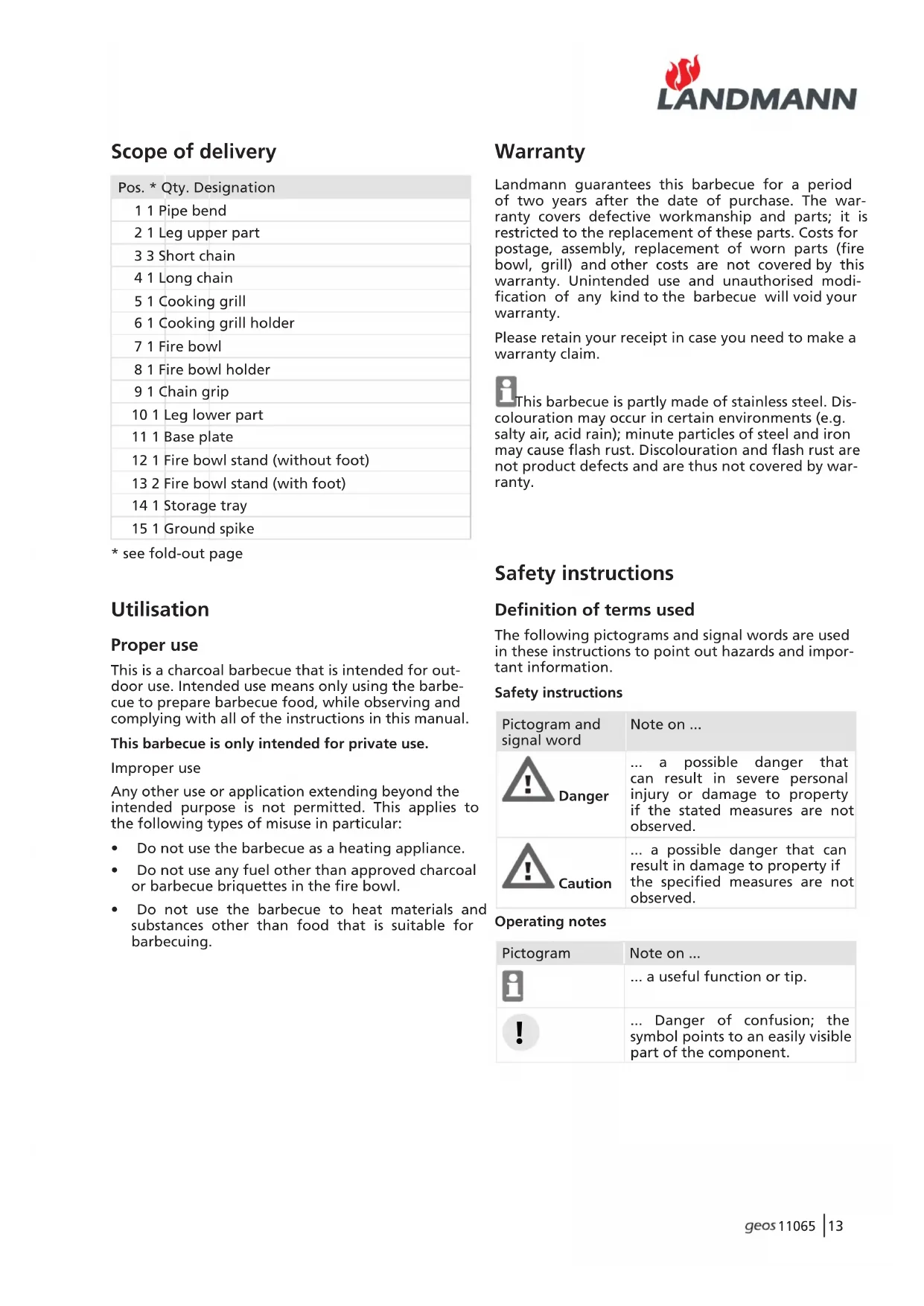
Scope of delivery
| Pos. * Qty. Designation |
| 1 1 Pipe bend |
| 2 1 Leg upper part |
| 3 3 Short chain |
| 4 1 Long chain |
| 5 1 Cooking grill |
| 6 1 Cooking grill holder |
| 7 1 Fire bowl |
| 8 1 Fire bowl holder |
| 9 1 Chain grip |
| 10 1 Leg lower part |
| 11 1 Base plate |
| 12 1 Fire bowl stand (without foot) |
| 13 2 Fire bowl stand (with foot) |
| 14 1 Storage tray |
| 15 1 Ground spike |
- see fold-out page
Utilisation
Proper use
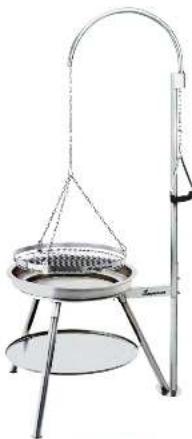
This is a charcoal barbecue that is intended for outdoor use. Intended use means only using the barbecue to prepare barbecue food, while observing and complying with all of the instructions in this manual.
This barbecue is only intended for private use.
Improper use
Any other use or application extending beyond the intended purpose is not permitted. This applies to the following types of misuse in particular:
- Do not use the barbecue as a heating appliance.
- Do not use any fuel other than approved charcoal or barbecue briquettes in the fire bowl.
- Do not use the barbecue to heat materials and substances other than food that is suitable for barbecuing.
Warranty
Landmann guarantees this barbecue for a period of two years after the date of purchase. The warranty covers defective workmanship and parts; it is restricted to the replacement of these parts. Costs for postage, assembly, replacement of worn parts (fire bowl, grill) and other costs are not covered by this warranty. Unintended use and unauthorised modification of any kind to the barbecue will void your warranty.
Please retain your receipt in case you need to make a warranty claim.
This barbecue is partly made of stainless steel. Discolouration may occur in certain environments (e.g. salty air, acid rain); minute particles of steel and iron may cause flash rust. Discolouration and flash rust are not product defects and are thus not covered by warranty.
Safety instructions
Definition of terms used
The following pictograms and signal words are used in these instructions to point out hazards and important information.
Safety instructions
Operating notes
| Pictogram and signal word | Note on ... |
| Danger | ... a possible danger that can result in severe personal injury or damage to property if the stated measures are not observed. |
| Caution | ... a possible danger that can result in damage to property if the specified measures are not observed. |
| Pictogram | Note on ... |
| ... a useful function or tip. | |
| ! | ... Danger of confusion; the symbol points to an easily visible part of the component. |
General Safety Precautions
Failure to observe the following basic safety measures can cause severe injury to persons and substantial damage to property:
- Use the barbecue exclusively for the intended purpose.
- Never use the barbecue despite obvious damage.
- Never modify the barbecue's technology. Use only original spare parts from LANDMANN.
- Only use accessories that are approved for this barbecue (if in doubt, contact customer service).
- Only use the barbecue outdoors and ensure that the area is well-ventilated.
- Never leave the barbecue unattended when in use. Take particular care to ensure that children and persons with physical or mental disabilities keep well away from the barbecue. They may not be able to identify the dangers correctly.
Always wear barbecue mittens when using the barbecue. - Small parts may be lethal if swallowed. Note that there is a danger of suffocation if the respiratory tract is covered by packing foil.
- Do not place heavy loads on the barbecue. In particular, observe the maximum weight loads in the Technical Specifications.
Residual risks

Danger: explosive deflagration
Accelerants like petrol, spirits and other similar liquid accelerants are extremely dangerous, as they burn in an explosive way when ignited.
This is particularly true if such accelerants are sprayed or poured onto hot fuel, as this can cause a flashback in the fuel container.
If hot charcoal or briquettes are extinguished with water, it creates an explosive deflagration as the water evaporates instantly.
Possible consequences:
- Sever injury to persons or damage to property, especially burns
Safety measures:
- Only use the barbecue outdoors and ensure that the area is well-ventilated.
- Only ignite fuel (barbecue charcoal or barbecue briquettes) with approved firefighters (EN 1860-3) and always observe the safety instructions for the firefighter when doing so.
- Do not lean over the barbecue when igniting the fuel.
- Never use water to extinguish hot charcoal or briquettes.

Danger: carbon monoxide poisoning
Carbon monoxide is produced through the incomplete combustion of carbonaceous material such as charcoal or briquettes.
Lack of air circulation increases the concentration of the toxic gas. Open windows or doors do not offer any security. As the combustion gases are not extracted directly via flue systems when using charcoal barbecues indoors, there is a risk of severe poisoning because the gas spreads silently throughout the room.
Carbon monoxide is odourless, colourless and non-irritating. Therefore, it does not trigger any warning effect in humans.
The gas is lighter than air and it can accumulate easily in the surrounding environment through oxygen displacement. It is absorbed via the lungs swiftly and silently.
Possible consequences:
- Severe or fatal injury due to carbon monoxide poisoning.
Safety measures:
- Only use the barbecue outdoors and ensure the area is well-ventilated.

Danger: burns and fire
During operation some parts of the barbecue can become very hot, particularly those that are close to the fire bowl. If a gust of wind enters the fire bowl, it can cause flying sparks and/or the formation of flames.
Possible consequences:
- Severe burns from touching hot parts.
- Fire or smoldering fire if flammable materials or substances are near the barbecue.
Safety measures prior to using the barbecue:
When setting up the barbecue, make sure that
there are not, and will not be, any flammable materials or substances nearby. The minimum distance to flammable materials or substances is 5m and the minimum distance to flame-resistant materials or substances, e.g. house walls, is at least 1m .
- the barbecue is protected from the wind.
- the barbecue is positioned firmly on a sufficiently large surface area. It must not be moved during operation.
Safety measures while barbecuing:
- Wear protective barbecue gloves.
- Never leave the barbecue unattended. Take particular care to ensure that children and pets are kept away from the barbecue.
Safety measures after using the barbecue:
Monitor the barbecue until it has cooled down - only then should you clean it.
Assembly
Here are a few tips to help you assemble your barbecue quickly and successfully:
- Check that no parts are missing by carefully placing all of the individual parts in some free space (subject to minor technical changes).
- If, despite careful factory checks, a component should be missing, please contact our customer service department (see last page). We will immediately attend to your request.
- To assemble the barbecue you need a medium sized screwdriver.
- Only use tools that are intact and suitable for the job at hand. Worn or unsuitable tools will not allow you to tighten the bolts sufficiently, but will damage them to the extent that they can no longer be turned.
- Always fit all connecting elements (screws, nuts, bolts, etc.) as shown in the illustrations. If you misplace a connecting element, replace it with an appropriate part. Only by doing this can you ensure that the construction is strong and safe.
- Be sure to follow the instructions in the specified order!
Even if you are not experienced at DIY, assembly does not generally take longer than one hour.
The illustrations showing the assembly steps are at the end of this manual.
Operation
Starting up the barbecue

Caution:
Please note the maximum permitted capacity of the barbecue with regard to charcoal and briquettes (see 'Technical specifications'). If the barbecue is overfilled it can result in damage.
Only use approved barbecue lighters (such as Landmann solid firelighters); never use petrol, spirits or other substances that are subject to deflagration when ignited.
Only place barbecue charcoal or briquettes in the fire bowl. We recommend using quality products from Landmann.
-
Check to ensure that ....
-
there are not, and will not be, any flammable materials or substances nearby. The minimum distance to flammable materials or substances is 5m and the minimum distance to flame-resistant materials or substances, e.g. house walls, is at least 1m .
the barbecue is protected from the wind.
the barbecue is positioned firmly on a sufficiently large surface area. It must not be moved during operation.
the barbecue is fully assembled and has no apparent faults. -
Place barbecue charcoal or briquettes in the fire bowl.
- Ignite the charcoal or briquettes with an approved firelighter for barbecues. Observe the safety instructions for the firelighter.

The first time you use the barbecue, heat for some 20 minutes without food to harden the firebowl's food-safe (like with any oven).
4. When the charcoal or briquettes are completely covered with a layer of ash, distribute them evenly in the fire bowl by using a suitable metal utensil (e.g. fire rake).
5. You can now put your grillables on the barbecue. Always wear barbecue mittens or gloves that protect your hands against the heat.
Using the ground spike

Caution:
Open fire is not permitted in some areas. Observe local regulations.
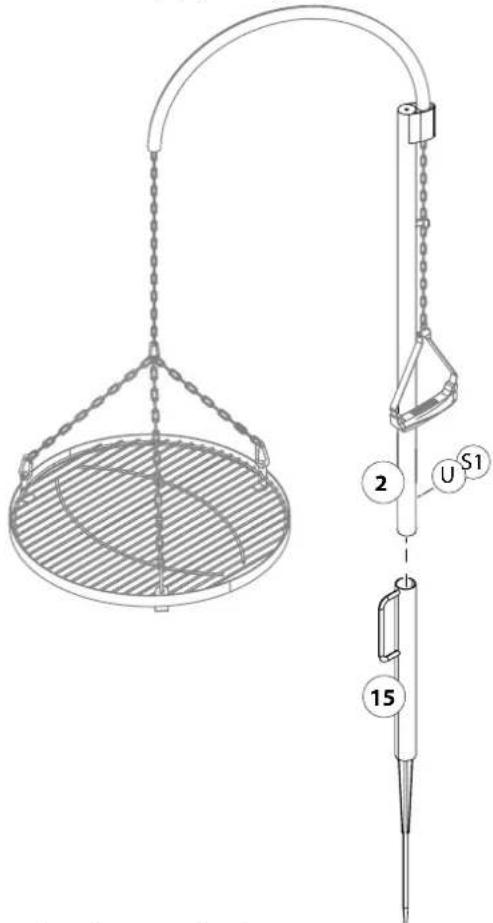
The ground spike (15) supplied with the barbecue means that you can use the barbecue over a camp fire. Follow these steps:
- Push the ground spike (15) into the ground.
Make sure the ground spike is firmly anchored in the ground and secured against falling over.
- Remove the wing nut (S1) and the washer (U) and remove the upper part of the stand (2).
- Now place the upper part of the stand (2) on the ground spike (15).
- Secure the connection using the wing nut (S1) and the washer (U) (see Figure).
Using the ground spike
Switching off the barbecue
-
Plan ahead before barbecuing. Only use the fuel you need to prepare your food.
After you finish cooking your food, or if you want to interrupt the process:
Do not leave the barbecue unattended while the fuel is still hot. -
Never pour water onto the hot embers, as it will cause the water to evaporate in an explosive manner.
-
Never dispose of hot embers. Leave them in the barbecue until they have cooled down.
Cleaning

Danger: Risk of burning when cleaning barbecue
Some parts of the barbecue can become very hot. For this reason, always allow the barbecue to cool down before cleaning. Never use water to cool down a hot barbecue. Wear protective gloves.
To make sure that you have many years of enjoyment with your barbecue you should always clean it after use - after making sure that all the parts have cooled down - with detergent, a brush and a cloth. In case of stubborn dirt, or to refresh the surfaces, you can use a domestic stainless steel cleaner.
Never use abrasive cleaners, steel wool or other base metal objects as this will provoke flash rust and discolouration!
- Check the stability of the barbecue. Only use the barbecue if it is safely anchored and never overload the cooking grill with food to avoid the barbecue falling over.
Storage
The barbecue can be stored in a space-saving way after use.
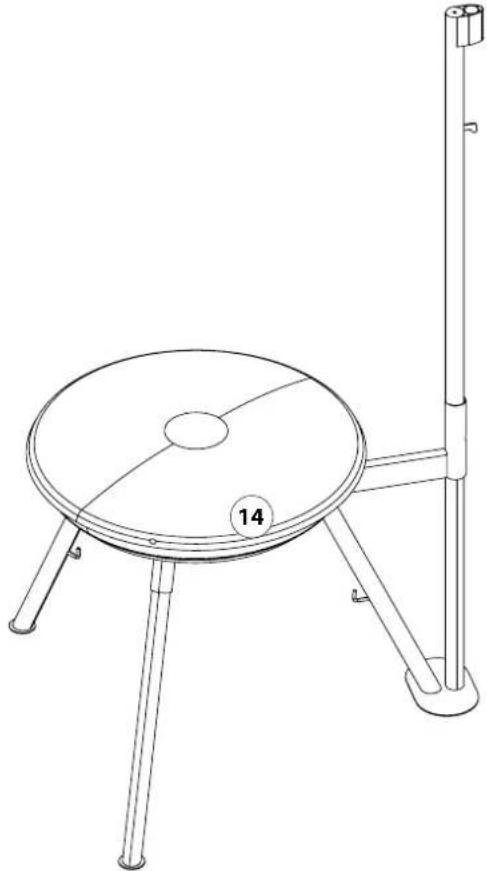
To do so, allow the fire bowl to cool down, clean the fire bowl, and place the following parts in it.
Pipe bend (1) with chain (3, 4) and chain grip (9)
Cooking grill (5)
Cooking grill holder (6)
You can then use the base plate (14) as a cover.
Storage
To avoid discolouration and flash rust due to environmental influences, we recommend storing the barbecue in a weather-protected place, or covering the barbecue with a protective hood.
Environmental information and disposal measures
Pay attention to cleanliness when handling the barbecue.
To dispose of the barbecue properly, disassemble it into its individual parts. Recycle the metal and plastic components.
Observe the local regulations.
Specifications
Barbecue
| Appliance category EN 1860-1 | |
| Dimensions (W x H x D) approx. 880 x 1850 x 840 mm | |
| Cooking area approx. Ø 525 mm | |
| Weight 15.64 kg | |
| Fuel fill quantity max. 3 kg | |
| Load weight of the cooking grill | max. 5.5 kg* |
- When using the barbecue with the ground spike (15) the maximum load weight may be lower depending on the ground characteristics.
FR
Sommaire
Furniture 20
Utilisation 20