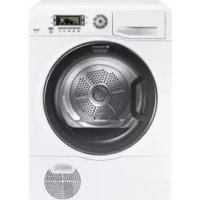
TCD 93B 6HZ1 - Washing machine HOTPOINT-ARISTON - Free user manual and instructions
Find the device manual for free TCD 93B 6HZ1 HOTPOINT-ARISTON in PDF.


| Product type | Condenser tumble dryer |
| Maximum load capacity (cotton) | 9 kg |
| Load capacity (synthetics) | 3 kg |
| Approximate dimensions (H x W x D) | 85 x 60 x 60 cm |
| Approximate weight | 45 kg |
| Power supply | 220-240 V ~ 50 Hz |
| Maximum power | 2500 W |
| Main programs | Cotton, Synthetics, Wool, Delicate Baby, Anti-Allergy, Plush, Easy Ironing, Refresh |
| Options | Delayed start, Wrinkle removal (before/after), High temperature, Buzzer, Extra delicate, Quick drying |
| Display | Digital with program indicators, drying level, remaining time, maintenance messages |
| Safety device | Child lock (key lock) |
| Maintenance - Lint filter | Mandatory cleaning after each cycle |
| Maintenance - Water tank | Mandatory emptying after each cycle |
| Maintenance - Condenser | Monthly cleaning recommended |
| Possible drainage | Yes, via drain hose (optional) |
| Anti-allergy certification | Yes (Allergy UK) |
| Energy consumption (class) | Not specified in the manual |
| Noise level | Not specified |
Frequently Asked Questions - TCD 93B 6HZ1 HOTPOINT-ARISTON
User questions about TCD 93B 6HZ1 HOTPOINT-ARISTON
0 question about this device. Answer the ones you know or ask your own.
Ask a new question about this device
Download the instructions for your Washing machine in PDF format for free! Find your manual TCD 93B 6HZ1 - HOTPOINT-ARISTON and take your electronic device back in hand. On this page are published all the documents necessary for the use of your device. TCD 93B 6HZ1 by HOTPOINT-ARISTON.
USER MANUAL TCD 93B 6HZ1 HOTPOINT-ARISTON
First time you turn on your dryer you must select your preferred language see page 6
Contents
Important information, 2-3
Installation, 4
Where to put your dryer
Ventilation
Water drain
Electrical connection
Before you start using your dryer
Dryer description, 5
The features
Control panel
The Display, 6-8
Start and programmes, 8-11
Choosing a programme
Special programmes
Programme option modifiers
Table of programmes
The controls
Laundry, 12-13
Sorting your laundry
Wash care labels
Special clothing items
Drying times
Warnings and Suggestions, 14
General safety
Saving energy and respecting the environment
Maintenance and Care, 15
Switching off the electricity
Cleaning the filter after each cycle
Check the drum after each cycle
Empty the water container after each cycle
Cleaning the condenser unit
Cleaning the dryer
Troubleshooting, 16
Service, 17
Disposal
! Keep this instruction booklet on hand in order to refer to it when necessary. Take it with you when you move, and should you sell this appliance or pass it on to another party, make sure that this booklet is supplied along with the dryer so that the new owner may be informed about warnings and suggestions on how the appliance works. ! Read these instructions carefully; the following pages contain important information on installation and suggestions on how the appliance works.

This symbol reminds you to read this booklet.

text_image
Hotpoint ARISTONGB
Important Information
GB
For your Condenser dryer to operate efficiently, you must follow the regular maintenance schedule shown below:
Fluff Filter...
! You MUST clean the fluff filter after EVERY drying cycle.
STEP 1.
Open the door of your dryer.
natural_image
Close-up of a white washing machine with visible internal blades and ventilation slots (no text or symbols)STEP 2.
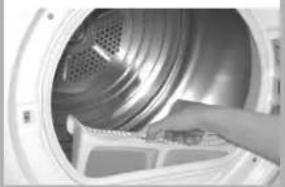
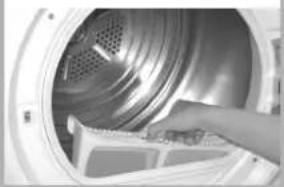
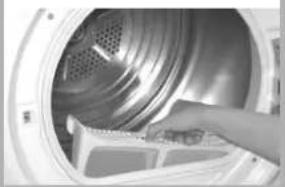
Remove the filter.
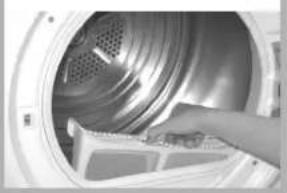
natural_image
Close-up of a hand opening a large industrial machine component (no visible text or symbols)STEP 3.
Open the filter and clean any fluff deposits from the filter mesh.
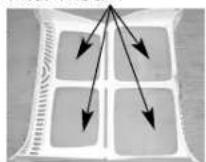
STEP 4.
Refit the filter - NEVER run the dryer without the filter in position.
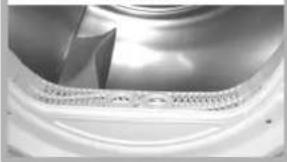
natural_image
Close-up of a metallic mechanical component with a triangular cutout, possibly part of a tool or part (no visible text or symbols)! Failure to clean the filter after EVERY drying cycle will affect the drying performance of your machine. - It will take longer to dry and as a result will use more electricity during drying.
Water Container...
! You MUST empty the water container after EVERY drying cycle.
STEP 1.
Pull the water container towards you and remove it fully from the dryer.
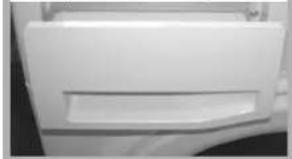
natural_image
Close-up of a white plastic door or vent with a recessed opening, no visible text or symbolsSTEP 2.
Remove either the small or large cap and empty the water from the container.
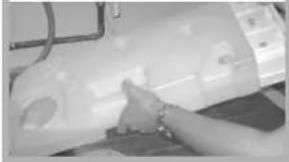
natural_image
Close-up of a hand interacting with a white cylindrical device (no visible text or symbols)STEP 3.
Refit the water container, ensuring that it is pushed fully back into position.
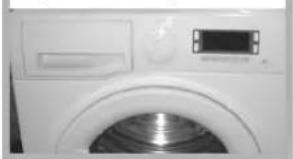
natural_image
Close-up of a white washing machine with a digital display on top (no visible text or symbols)! The 'Empty Water'
message reminds you to empty the water container at the end of each programme.
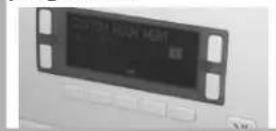
! Failure to empty the water container will result in:
- The machine will stop heating (so the load may still be wet at the end of the drying cycle).
- The 'Empty Water' message will tell you that the water container is full.
Priming the Water Collection System
When your dryer is new, the water container will not collect water until the system is primed... this will take 1 or 2 drying cycles. Once primed it will collect water during every drying cycle.
Condenser Unit...
! You MUST clean the fluff from the condenser EVERY month.
STEP 1.
Open the condenser cover - hold the handle and pull towards you.
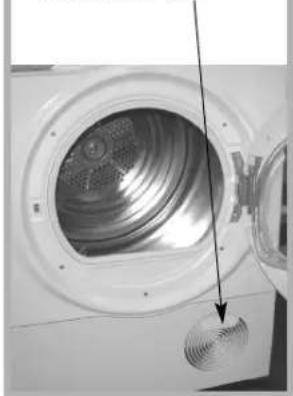
natural_image
Close-up of a white washing machine with a metallic grille and ventilation duct, showing a hand pointing to a small fan or vent (no text or symbols visible)STEP 2.
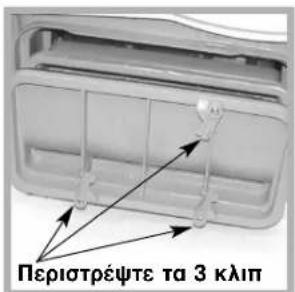
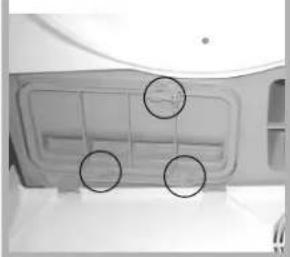
Remove the condenser by rotating the 3 clips then pulling the condenser towards you.
(There may be some water in the tubes, this is normal).
natural_image
Interior view of a vehicle air vent with three circled areas (no text or symbols visible)STEP 3.
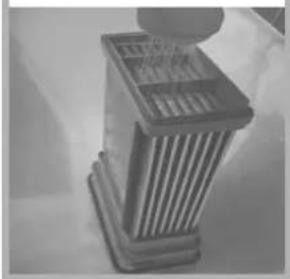
Flush the condenser, from the rear with water, to remove any fluff deposits.
natural_image
Exterior view of a modern office building (no signage)STEP 4.
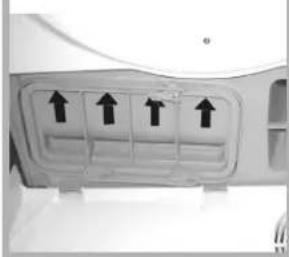
Refit the condenser unit - ensure that the unit is pushed in fully, all 3 clips are re-secured and the positioning arrows on the front of the condenser are pointing upwards.
natural_image
Close-up of a car air vent with four upward arrows indicating airflow direction (no text or symbols)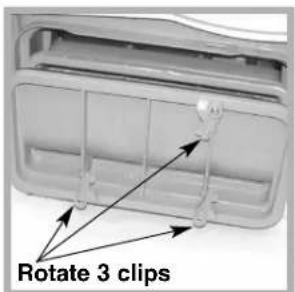
text_image
Rotate 3 clips- Check that:
- The positioning arrows are pointing upwards.
- The 3 clips are re-secured back into their 'lock' position.
! Failure to clean the condenser could cause premature failure of your dryer.
GB
Where to put your dryer
- Place your dryer at a distance from gas ranges, stoves, heaters, or cook tops because flames can damage the appliance.
text_image
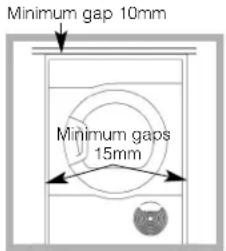
Minimum gap 10mm Minimum gaps 15mm- If you are going to install the appliance under a work counter, be sure to leave a 10mm space between the top and any other objects on or above the machine and a 15mm space between the sides and lateral furnishings or walls.
This is to ensure proper air circulation.
Ventilation
When the dryer is in use, there has to be adequate ventilation. Make sure you put your dryer in an environment that is not damp and has proper air circulation throughout. Airflow around the dryer is essential to condense the water produced during the washing, the dryer will not operate efficiently in an enclosed space or cupboard.
! If using the dryer in a small or cold room some condensation could be experienced.
! We do not recommend that the dryer is installed in a cupboard but the dryer must never be installed behind a lockable door, a sliding door or a door with a hinge on the opposite side to that of the dryer door.
Water drain
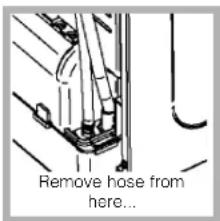
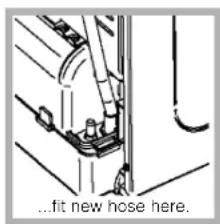
If your dryer is installed next to a drain the water can be plumbed into this drain. This does away with the need to empty the water container. If the dryer is stacked onto or installed next to a washing machine it can share the same drain. The height of the drain must be less than 3' (1m) from the bottom of the dryer.
text_image
Remove hose from here...Remove hose from position shown (see diagram).
natural_image
Technical line drawing of a mechanical assembly with no visible text or symbolsFit a suitable length of hose to the new location shown (see diagram).
! Make sure that the hose is not squashed or kinked when the dryer is in its final location.
Electrical connections
Make sure of the following before you insert the plug into the electrical socket:
• The socket must be grounded.
- The socket must be able to sustain the machines maximum power, which is indicated on the rating label (see Dryer Description).
- Power voltage must be within the values indicated on the rating label (see Dryer Description).
- The socket must be compatible with the dryers plug. Should this not be the case, replace the plug or the socket.
! The dryer must not be installed outdoors, even if the space is sheltered. It can be very dangerous if it is exposed to rain or storms.
! Once installed, the dryers electrical wire and plug must be within easy reach.
! Do not use extension cords.
! The power cord must not be bent or squashed.
! The power supply cord should be checked periodically and replaced by a cord specially prepared for this dryer and fitted only by authorised technicians (see Service). New or longer power cords are supplied at an extra charge by authorised dealers.
! The manufacturer denies any responsibility should any of these rules not be followed.
! If in doubt about any of the above consult a qualified electrician.
Before you start using your dryer
Once you have installed your dryer and before you use it, clean the inside of the drum to remove any dust that could have accumulated during transport.
The features
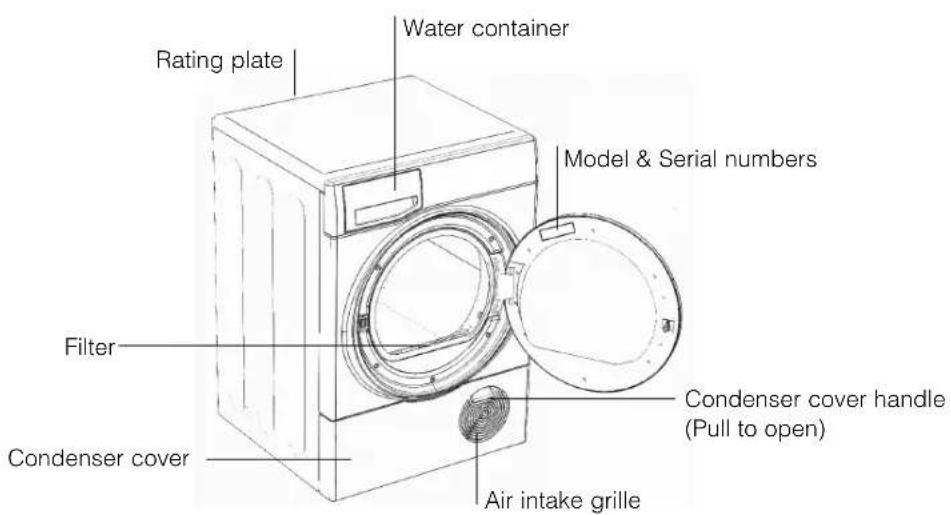
text_image
Rating plate Water container Model & Serial numbers Filter Condenser cover Condenser cover handle (Pull to open) Air intake grilleControl panel
text_image
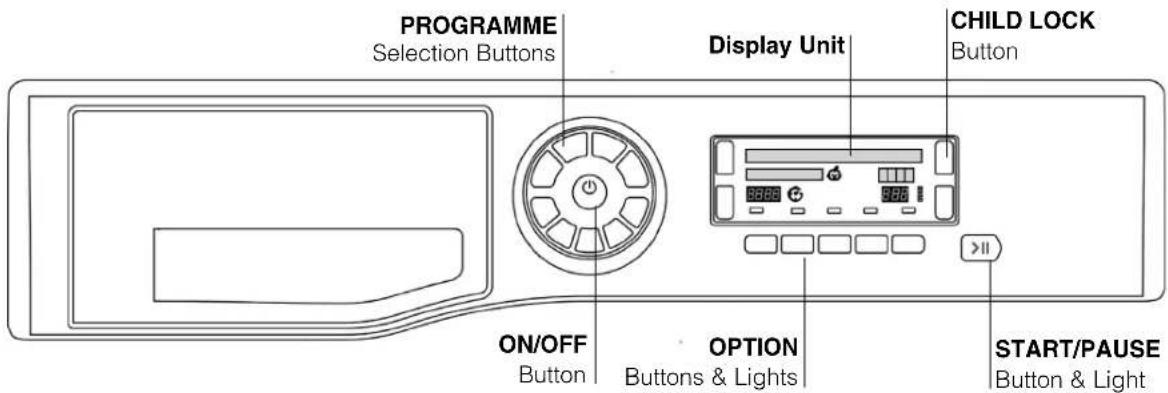
PROGRAMME Selection Buttons Display Unit CHILD LOCK Button ON/OFF Button OPTION Buttons & Lights START/PAUSE Button & LightThe ON/OFF button ⏻: If the dryer is running and this button is pressed, the dryer is turned off. Press again, the dryer reactivates.
The PROGRAMME selection buttons set the programme: press the button corresponding to the programme you want to select (see Start and Programmes).
The OPTION buttons/indicators: these buttons select available options for your selected programme (see The Controls). The indicators on the display unit next to the bottom buttons light to show that the option has been selected.
The START/PAUSE button/light >II starts a selected programme. When you press this button there will be one beep and the display will show PAUSED. When a programme is running, holding this button in pauses the programme and stops the dryer. The light is green when the programme is running, flashing amber if the programme has been paused or
flashing green if on standby waiting to start a programme (see Start and Programmes).
Note: This light also flashes amber during the Heat & Enjoy programme and during the Post Care phase of a programme.
The Display Unit gives warnings and information about the programme selected and its progress (see next page).
The CHILD LOCK button/icon 📋: Press and hold this button after selecting your programme and any options, this prevents the programme settings from being changed, the display will briefly show LOCKED. When the icon is lit, the other buttons are disabled. Hold the button to cancel and the icon will go out, the display will briefly show UNLOCKED.
Note: This tumble dryer, in compliance with new energy saving regulations, is fitted with an automatic standby system which is enabled after about 30 minutes if no activity is detected. Press the ON-OFF button briefly and wait for the dryer to reactivate.
GB
Selecting your language
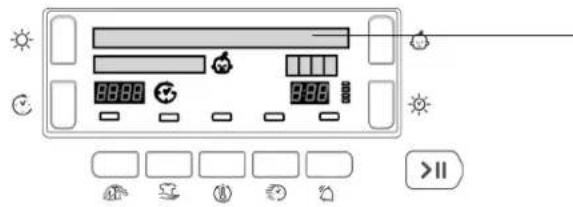
The first time you turn on your dryer you should select your preferred language from the available list.
text_image
Weather interface display panel with sun, wind, and weather icons and status indicatorsTo change: the language current selection must flash, on the first line of the display.
- Press and hold all 3 buttons: 🙏 Child Lock, 🚫 Timed Dry and 🌿 Dryness Level for 5 seconds.
- Press the 🎨Child Lock or the 🎨Fimed Dry button to scroll up or down through the list.
- When your required language is flashing on the top line of the display, pressing the ⚙ Dryness Level button will select your choice.
Understanding the display
Programme selection and display
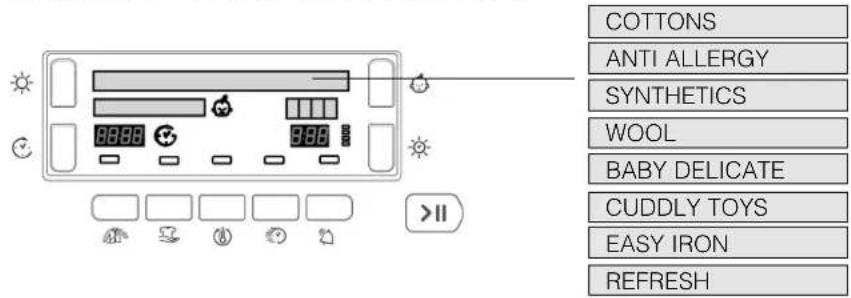
The selected programme is shown on the first line of the display when you select the corresponding button, this message is shown while the programme is running.
text_image
COTTONS ANTI ALLERGY SYNTHETICS WOOL BABY DELICATE CUDDLY TOYS EASY IRON REFRESHMy Cycle When you select the My Cycle button the Display will show your selected programme with 'M' before its name, ie. [M COTTONS] (see Start and Programmes).
Dryness levels
During programme selection for an automatic programme that has different dryness levels available (see Programmes Table).
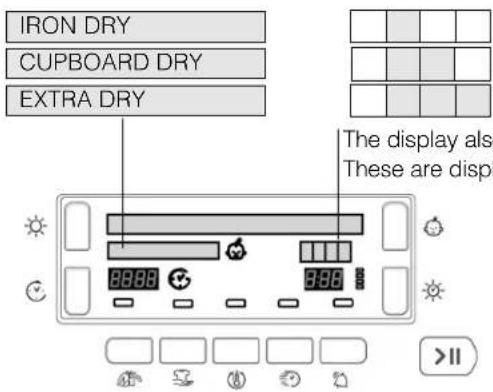
The second line of the display shows the dryness level you require, for each press of the ✿Dryness Level button the next option from the list below is selected and displayed.
text_image
IRON DRY CUPBOARD DRY EXTRA DRY The display als These are dispIron Dry: Dries your clothes ready for ironing.
Cupboard Dry: Dries your clothes ready for putting away.
Extra Dry: Dries your clothes ready for wearing.
The display also shows: one, two or three blocks, depending on your selection. These are displayed during the programmes progress.
Programme progress
The second line of the display shows the status of the programme as it progresses: (long messages scroll across the line)

text_image
PRE CARE (Dry COOL TUMBLE END OF CYCLE, POST CARE PHASE END OF CYCLE, EMPTY THE WATER BOTTLE (if option Crease Care available and selected) (if option Crease Care available and selected)GB
Timed drying
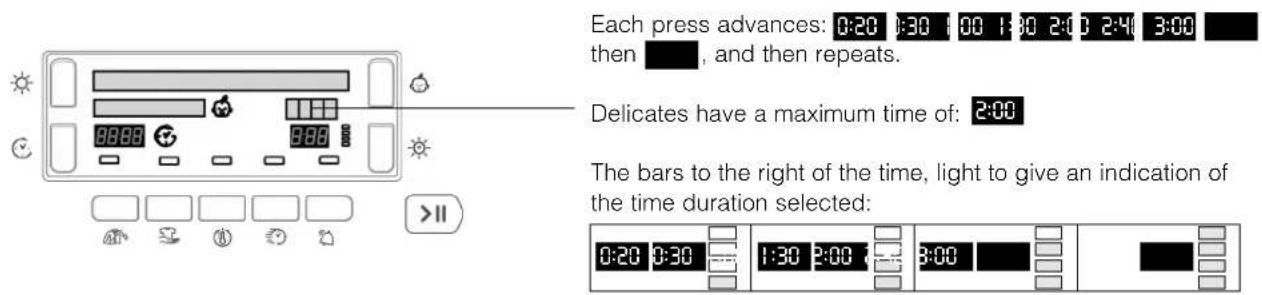
After selecting a programme that has a Timed Dry option, press the ✿ Timed button and the display will increment the selected time, each time you press and release the button (see Start and Programmes).
text_image
Each press advances: 0:20 1:30 1:00 1:30 2:00 2:40 3:00 then , and then repeats. Delicates have a maximum time of: 2:00 The bars to the right of the time, light to give an indication of the time duration selected: 0:20 0:30 1:30 2:00 3:00The selected time remains displayed after the programme starts.
Delay and Time to End
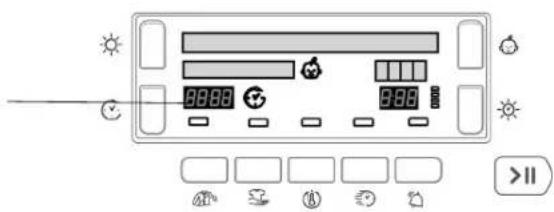
Some programmes can have a delated start (see Start and Programmes). Press the Ⓧ Delay button and the icon flashes.
Each press of the Delay button ☑ advances the delay setting in 1 hour increments, from: IH to , then OFF and then after a couple of seconds cancels the delay.
The delay time is shown on the display next to the Delay button.
The display counts down the minutes of the delay period after the Start/Pause button >II is pressed. The second line of the display shows STARTED
text_image
Diagram of a smart home control panel with status indicators and function buttonsAfter the delay period finishes (or for all of the programme if delay not selected): The estimated Time to End of the programme for automatic programmes or the actual time remaining during the Timed programme is shown in this part of the display.
GB
Warnings
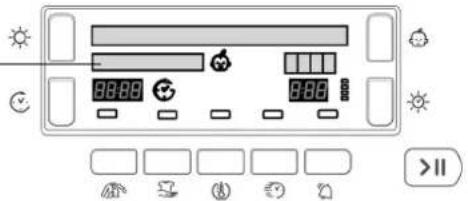
The second line of the display also gives warnings and reminders: (reminders occur at the end of the programme)
END OF CYCLE, EMPTY THE WATER BOTTLE
- Reminder that the water container should be emptied every time you use the dryer (see Maintenance).
EMPTY WATER BOTTLE
- Indicates that the water container is full. The message will take a few seconds to go out after replacing the empty water container; the dryer must be running for this to happen (see The Controls). Note: If the water container fills and this message is displayed, the heat is turned off and your clothes will not dry.
text_image
8:88 8:86 >IICLEAN CONDENSER
- This message indicates that you must clean the Condenser unit (see Maintenance) and will occur at intervals depending how much you have used the dryer. When you finish the next programme the message is cancelled.
CLEAN FILTER
- Reminds you to clean the Filter every time you use the dryer (see Maintenance).
Start and Programmes
Choosing a programme
- Plug the dryer into the electrical socket.
- Sort your laundry according to fabric type (see Laundry).
- Open the door and make sure the filter is clean and in place and the water container is empty and in place (see Maintenance).
- Load the machine and make sure items are not in the way of the door seal. Close the door.
- If the Display is not lit: Press the ON/OFF button ⏻
- Press the Programmes Selection button that corresponds with the type of fabric being dried by checking the Programmes Table (see Programmes) as well as the indications for each type of fabric (see Laundry).
- If the M button is selected; steps 7, 8 and 9 are not required (see below).
- Choose Timed Drying or Dryness Levels option:
-
If Timed Drying press and release the Timed button until the required time is displayed.
or - To change from default dryness setting, press and release the ⚙ Dryness Levels button until required level is indicated.
! See Programmes Table, for more details. -
Set a delay time and other options if necessary (see The Display).
- If you wish the buzzer to sound at the end of the programme, press the 📋 SOUND button.
- Press the Start/Pause button >II to begin. The display will show the estimated time to end. During the drying programme, you can check on your laundry and take out items that are dry while others continue drying. When you close the door again, press the Start/Pause button >II in order to resume drying.
- During the last few minutes of Drying Programmes, before the programme is completed, the final COOL TUMBLE phase is entered (fabrics are cooled), this phase should always be allowed to complete.
- The SOUND (if option selected) will warn you when the programme is complete and the Display shows END OF CYCLE, POST CARE PHASE. Open the door, take the laundry out, clean the filter and replace it. Empty the Water Container and replace it (see Maintenance). If the Crease Care option has been selected and you do not remove the laundry immediately, the dryer will tumble occasionally for 10 hours or until you open the door.
- Unplug the dryer.
My Cycle button:
First time you press this button the second line of the display will show PRESS AND HOLD TO STORE
After selecting your favorite programme and options you can save these settings by pressing and holding in the My Cycle button for at least 5 seconds, the buzzer will then beep and the second line of the display shows MY CYCLE The next time you need this programme press the M button, then the Start/Pause button >II and this programme will run. If you wish, you can change your stored favorite, by selecting a new programme and/or options and press and hold in the M button (as above).
Special Programmes
Easy Iron Programme
'Easy Iron' is a short 10 minute programme (8 minutes of heat followed by a 2 minute cool tumble period) which fluffs the fibres of clothing that have been left in the same position/location for an extended period of time. The cycle relaxes the fibres and makes them easier to iron and fold.
! 'Easy Iron' is not a drying programme and should not be used for wet articles of clothing.
For best results: 1. Do not load more than the maximum capacity. These numbers refer to the dry weight:
Fabric Maximum load
Cotton and Cotton mixtures 2.5kg
Synthetics 2kg
Denim 2kg
- Unload the dryer immediately after the end of the programme, hang, fold or iron the articles and put them away in the closet. Should this not be possible repeat the programme.
The 'Easy Iron' effect varies from one fabric to the next. It works well on traditional fabrics like Cotton or Cotton mix, and less well on acrylic fibres and on materials such as Tencel®.
Wool Programme
- This is a programme for tumble dryer safe garments marked with the symbol
• It can be used for load sizes up to 1kg (approximately 3 sweaters).
• We recommend that garments are turned inside out before drying. - This programme will take about 60 minutes, but may take longer depending on the size and density of the load and the spin speed used in your washer.
- Loads dried using this programme are usually ready to wear, but on some heavier garments the edges may be slightly damp. Allow these to dry naturally as over-drying could damage garments.
! Unlike other materials, the mechanism of wool shrinkage is irreversible; i.e. it will not stretch back to original size and shape.
! This programme is not suitable for Acrylic garments.
Baby Delicate Programme
- This is a programme for drying your baby's small delicate items of clothing and bedding (Cotton and Chenille) and for drying your delicate clothes.
• DO NOT dry items such as bibs and nappy pants with plastic coverings.
• It can be used for load sizes up to 2kg. - This programme will take about 60 minutes, but may take longer depending on the size and density of the load and the spin speed used in your washer.
- Loads dried using this programme are usually ready to wear, but on some heavier garments the edges may be slightly damp. If this is the case, try turning items inside out and running the programme again for a short period.
Anti Allergy Programme
This programme has the 'Seal of Approval' endorsement from Allergy UK, which reflects the effective reduction and elimination of allergens from the clothes with the special Anti Allergy cycle. With this programme, thanks to the achievement of constant temperature for an extended period of time, the effects of the most common allergens (including House Mites and Pollen) are neutralised. Can be used on a wet load to dry and treat, or on a dry load just to treat your laundry. Maximum load is 9kg for a wet load and 4kg for a dry load.
Cuddly Toy Programme
With this programme you can remove dust easier and wash the cuddly toys more often because the drying time is very much reduced compared to drying in the open air. It is a delicate drying cycle that dries at low temperature and with soft mechanical action to maintain at best the original look and shine of the fur.
Note: For allergy protection, just freeze cuddly toys for 24 hours then wash and dry them. Repeat every 6 weeks. Before drying remove accessories such as clothes, collars or sound boxes and protect plastic eyes with masking tape after drying them with a cloth.
The programme time will vary dependant on the exact make up of the load.
The maximum load should not exceed 2.5kg and no individual item should be greater than 600g.
Programme option modifiers
Extra Care
This anti-ageing function for Cottons and Synthetics helps to maintain the brightness of your laundry for a long time thanks to the use of the right drum rotation (reduced in the last part of the cycle) and the correct drying temperature Note: It cannot be used with the 'Extra Dry' and 'Cupboard Dry' dryness levels.
Quick Dry
This programme is for small loads up to 1kg Note: can only be used with the 'Cupboard Dry' setting. Your drying time is very much reduced with a huge time saving up to 53% on cottons (with high heat option) and 50% on synthetics (with low heat option).
Heat & Enjoy
This programme helps to heat towels & bathrobes for a warm sensation after a bath or shower. It is also useful for warming clothes before dressing during winter. The cycle heats clothes to 37°C (Body Temperature) and runs at this temperature for a maximum of 4 hours or until you stop the cycle by opening the door. Maximum load 3kg. To select this programme press the Refresh programme button and then select the High Heat option.
Note: During this programme the Start/Pause light flashes Amber and the display shows END OF CYCLE, POST CARE PHASE.
GB
Programmes Table
! If the Display is not lit; Press the ON/OFF button ⏻ and then select programme.
ESSENTIALS
| Programme | What it does... How to | set it... Notes/Options available: | |
| Cottons | Dries your Cotton clothes. | 1. Press thebutton.2. Choose Timed Dry or Automatic Dryness Level option.- If Timed Dry, see next page, or...- To change from default dryness setting press and release Dryness Levels button until the required level is displayed.3. Select any Options if required.4. Press the Start/Pause button >II. | Sound, Delay Timer,Crease Care, High HeatExtra Care, Quick DryDryness options:Automatic Dryness LevelsRON DRYCUPBOARD DRYEXTRA DRY: default |
| Anti Allergy | Anti Allergy treatment for your clothes. | 1. Press thebutton.2. Select any Options if required.3. Press the Start/Pause button >II. | Sound, Delay Timer,Crease CareAn Automatic programme |
| Synthetics | Dries your Synthetic clothes on High Heat. | 1. Press thebutton.2. Choose Timed Dry or Automatic Dryness Level option.- If Timed Dry, see next page, or...- To change from default dryness setting press and release Dryness Levels button until the required level is displayed.3. Select any Options if required.4. Press the Start/Pause button >II. | Sound, Delay Timer,Crease Care, Extra Care,Quick DryDryness options:Automatic Dryness LevelsIRON DRYCUPBOARD DRYEXTRA DRY: default |
EXCLUSIVES
| Programme | What it does... How to | set it... | Notes/Options available: |
| My Cycle | See previous details. | 1. Press the M button.2. Press the Start/Pause button >II. | Depends on your chosen programme |
| Wool | Dries your Woollen clothes, (see previous page). | 1. Press thebutton.2. Choose Timed Dry if required.Otherwise default is Automatic.3. Select Sound option if required.4. Press the Start/Pause button >II. | SoundTimed 0:20 orThe default is Automatic. |
| Baby Delicates | Dries your clothes on Low heat setting, ready to be worn. | 1. Press thebutton.2. If Timed Dryprogramme required (see Timed, next page).Otherwise default is Automatic.3. Select any Options, if required.4. Press the Start/Pause button >II. | Sound, Delay Timer,Crease CareThe default is Automatic. |
EXTRA
| Programme | What it does... How to | set it... Notes/Options available: | |
| Cuddly Toys | Dries your cuddly toys. | 1. Press the 📁button.2. Select any Options, if required.3. Press the Start/Pause button >|| | Sound,Delay Timer |
| Easy Iron | Brief programme (approximately 10 minutes) that softens fibres of clothing that is ready for ironing. | 1. Press the 📁button.2. Select Sound option if required.3. Press the Start/Pause button >|| | Sound! This is not a drying programme (see previous page). |
| Refresh | 20-minute programme that airs your clothes with cool air. Use also to cool warm clothes. | 1. Press the 📁button.2. Select Sound option if required.3. Press the Start/Pause button >|| | Sound• Heat & Enjoy: Select High Heat for this cycle (see Programme option modifiers). |
*Where appropriate: Quick Dry is only available with the Cupboard Dry Dryness Level and Extra Care is only available with the Iron Dry Dryness Level (see Programme option modifiers).
Timed Dry programmes table: First select a programme (see Programmes Table).
| Timed Drying(0:20, 0:30,1:00, 1:30, 2:00,2:40 or 3:00Hours:Minutes) | Always use Timed Dryingfor loads less than 1kg, orif you prefer a different dryness result.The heat settings available depend on the programme selected.Use on low heat setting for Acrylics and delicate materials (see Laundry). | 1. Press and release the ✅ button until the display shows the required selection. Each press advances 0:20, 0:30, 1:00, 1:30, 2:00,2:40, 3:00 then □ and then repeats.Delicates have maximum time of 2:00When □□ is displayed, Automatic Dryness Level option is available if you change your mind.2. Select any Options if required.3. Press the Start button >II. | Options available:Sound, Delay Timer,Crease Care, High HeatConsult suggested drying times (see Laundry).The last 10 minutes of these programmes is the Cool Tumble phase. |
The Controls
! Warning, after pressing the Start/Pause button >II, the programme cannot be changed.
To change a selected programme, press the Start/Pause button >II, the light flashes Amber to indicate the programme is paused. Select the new programme and any options required, the light will then flash green. Press the Start/Pause button >II again and the new programme will start.
- Option buttons
These buttons are used to customise the selected programme to your requirements. A programme must have been selected, by pressing a programme selection button, before an option can be selected. Not all options are available for all programmes (see Programmes Table). If an option is not available and you press the button, the buzzer will beep 3 times. If the option is available the indicator, on the display unit above the bottom buttons, lights to show that the option has been selected.
Time Delay (Delay Timer)
The start of some programmes (see The Display and Programmes tables) can be delayed for up to 24 hours. Ensure the water container is emptied before setting a delayed start.
Crease Care
The pre-care option is only available if a delayed start has been selected. It tumbles the clothes occasionally during the delayed period to help prevent creases developing.
The post-care option occasionally tumbles the clothes after end of the drying and cool tumble cycles to prevent creases developing, should you not be available to remove the load immediately the programme is complete. Note: The Start/Pause light flashes Amber during this phase.
Selecting this option enables both the pre and post care functions if appropriate.
High Heat
Allows Low Heat to be selected on some programmes. When the light above this button is on High Heat is selected. Not all programmes allow you to change this setting. When High Heat is selected with the Refresh programme this selects the Heat & Enjoy cycle.
Sound
Available on all programmes and allows the buzzer to give a signal at the end of the drying cycle, to remind you that the clothes are ready to be removed.
• TIME DISPLAY 88:88
The display shows either the amount of time delay remaining or an indication of the amount of time left for a drying programme (see The Display).
The delay or time to end is displayed in hours and minutes and counts down each minute.
When timed programmes are selected the time displayed throughout the cycle is the actual time remaining.
When an Automatic programme is selected, the time displayed is an estimate of the time remaining. When the programme is selected the display shows the time required to dry a full load, after around 10 minutes the controller calculates a better estimate of the cycle time.
The colons between the hours and minutes in the display flash to show that the time is counting down.
The display also shows if there is a problem with your dryer, if this occurs the display will show F followed by a fault code number (see Troubleshooting).
• Empty Water Container
(If you have plumbed your dryer to a drain this icon can be ignored, as there is no need to empty the water container). Messages are displayed to reminds you to empty the water container (see The Display).
If the water container fills during a programme, the heater turns off and the dryer does a period of Cool Tumble.
After this it stops and a message tells you to EMPTY THE WATER CONTAINER.
You must empty the water container and restart the dryer or the clothes will not dry. After re-starting the dryer the message will take a few seconds to go out.
To avoid this always empty the water container each time you use the dryer (see Maintenance).
- Door Opening
Opening the door during a programme will stop the dryer and have the following effects:
Note: The Start/Pause light flashes Amber during the Heat & Enjoy programme and during the Post Care phase of a programme.
• The display shows PAUSED.
- During a delay phase the delay will continue to count down. The Start/Pause button must be pressed to resume the delay programme.
The display will change to show current status.
- During the drying part of the programme, the colons on the display stop flashing to show that the time has stopped counting down.
The Start/Pause button must be pressed to resume the programme. The display will change to show the current status, the colons flash and count down continues.
- During the Post Care phase, the programme ends. Pressing the Start/Pause button will restart a new programme from the beginning.
- Note
If you have a power cut, switch off the power or remove the plug. When power is restored, press the Start/Pause button and the programme will resume.
GB
Sorting your laundry
- Check symbols on clothing labels to make sure that the articles can be tumble dried.
- Sort laundry by fabric type.
• Empty pockets and check buttons. - Close zippers and hooks and tie loose belts and strings.
- Wring out each item in order to eliminate as much excess water as possible.
! Do not load dripping wet clothes into the dryer.
Maximum load size
Do not load more than maximum capacity.
These numbers refer to dry weight:
Natural fibres: 9kg max (20lb)
Synthetic fibres: 3kg max (6.6lb)
! DO NOT overload the dryer as this could result in reduced drying performance.
Typical weights
Note: 1kg = 1000g (1lb = 16oz)
| Clothes | |
| Blouse Cotton 150g (5oz)Other 100g (3oz) | |
| Dress Cotton 500g (1lb 2oz)Other 350g (12oz) | |
| Jeans 700g (1lb 6oz) | |
| 10 nappies 1000g (2lb 3oz) | |
| Shirt | Cotton 300g (10oz)Other 200g (7oz) |
| T-Shirt | 125g (4oz) |
| Household Items | |
| Duvet cover (Double) | Cotton 1500g (3lb 5oz)Other 1000g (2lb 3oz) |
| Large Tablecloth | 700g (1lb 6oz) |
| Small Tablecloth | 250g (9oz) |
| Tea Towel | 100g (3oz) |
| Bath Towel | 700g (1lb 6oz) |
| Hand Towel | 350g (12oz) |
| Double Sheet | 500g (1lb 2oz) |
| Single Sheet | 350g (12oz) |
At the end of a drying cycle, cottons could still be damp if you grouped cottons and synthetics together. If this happens simply give them an additional short period of drying.
- Note: The last 10 minutes of any time set is the Cool Tumble, so allow for this when setting the time, as this period will not dry your laundry.
Wash Care Labels
Look at the labels on your garments, especially when tumble drying for the first time. The following symbols are the most common:

text_image
May be tumble dried Do not tumble dry Tumble dry at high heat setting Tumble dry at low heat settingItems not suitable for tumble drying
- Articles that containing rubber or rubber-like materials or plastic film (pillows, cushions, or PVC rainwear), any other flammable articles or objects that contain flammable substances (towels soiled with hair spray).
• Glass fibres (certain types of draperies) - Items which have been dry cleaned
- Items with the ITCL Code ☒ (see Special clothing items). These can be cleaned with special at-home dry cleaning products. Follow instructions carefully.
- Large bulky items (quilts, sleeping bags, pillows, cushions, large bedspreads etc). These expand when drying and would prevent airflow through the dryer.
Special clothing items
Blankets and Bedspreads: acrylic items (Acilan, Courtelle, Orion, Dralon) must be dried with special care on LOW heat setting. Avoid drying for a long period of time.
Pleated or creased garments: read the manufacturer's drying instructions on the garment.
Starched articles: do not dry these with non-starched items. Make sure that as much of the starch solution is removed from the load as possible before placing it in the dryer. Do not over-dry: the starch will become powdery and leave your clothing limp, which defeats the purpose of starch.
Drying times
Times are approximate and can vary depending upon:
- Amount of water retained in clothes after spin cycle: towels and delicates retain a lot of water.
- Fabrics: items that are the same type of fabric but different textures and thicknesses may not have the same drying time.
-
Quantity of laundry: single items or small loads may take longer to dry.
-
Dryness: If you are going to iron some of your clothes, they can be taken out while still a bit damp. Others can be left longer if you need them to be completely dry.
- Heat setting.
- Room temperature: if the room where the dryer is located is cold, it will take longer for the dryer to dry your clothes.
- Bulk: some bulky items can be tumble dried with care. We suggest that you remove these items several times, shake them out, and return them to the dryer until finished.
! Do not over-dry your clothes.
All fabrics contain a little natural moisture, which keeps them soft and fluffy.
The table (see below) presents APPROXIMATE drying times in Hours : Minutes, as you see them on the display, the times are also shown in Minutes only for reference.
The times given are for Cupboard Dry Automatic programmes.
Timed Dry settings are also shown, to help you choose a suitable time option.
Weights refer to dry garments.
| Cottons | 1 kg | 2 kg | 3 kg | 4 kg | 5 kg | 6 kg | 7 kg | 8 kg | 9 kg | |
| High Heat | Automatic duration | 0:30 - 0:40 | 0:40 - 0:55 | 0:55 - 1:10 | 1:10 - 1:20 | 1:20 - 1:30 | 1:35 - 2:00 | 2:00 - 2:20 | 2:00 - 2:40 | 2:30 - 2:50 |
| Automatic minutes | 30 - 40 | 40 - 55 | 55 - 70 | 70 - 80 | 80 - 90 | 95 - 120 | 120 - 140 | 130 - 160 | 140 - 170 | |
| Timed Dry setting | 0:30 | 1:00 | 1:00 or 1:30 | 1:30 | 1:30 | 1:30 or 2:00 | 2:00 or 2:40 | 2:00 or 2:40 | 2:40 or 3:00 | |
| Drying times 800-1000 rpm in washing machine. | ||||||||||
| Synthetics | 1 kg | 2 kg | 3 kg | |||||||
| High Heat | Automatic duration | 0:40 - 0:50 | 0:50 - 1:10 | 1:10 - 1:30 | ||||||
| Automatic minutes | 40 - 50 | 50 - 70 | 70 - 90 | |||||||
| Timed Dry setting | 1:00 | 1:00 | 1:00 or 1:30 | |||||||
| Drying times on reduced spin in washing machine. | ||||||||||
| Delicates (Acrylics) | 1 kg | 2 kg | ||||||||
| Low Heat | Automatic duration | Timed Dry only | Timed Dry only | |||||||
| Timed Dry setting | 0:30 1:00 | |||||||||
| Drying times on reduced spin in washing machine. | ||||||||||
GB
! The appliance has been designed and built according to international safety standards.
These warnings are given for safety reasons and must be followed carefully.
General safety
- This tumble dryer is not intended for use by persons (including children) with reduced physical, sensory or mental capabilities, or lack of experience and knowledge, unless they have been given supervision or instruction concerning use of the appliance by a person responsible for their safety.
- This tumble dryer has been designed for home, and not professional use.
- Do not touch the appliance while barefoot or with wet hands or feet.
- Unplug the machine by pulling on the plug, not the cord.
- Children must not be in proximity of the dryer when in use. After using the dryer, turn it off and unplug it. Keep the door closed to make sure that children do not use it as a toy.
- Children should be supervised to ensure that they do not play with the dryer.
- The appliance must be installed correctly and have proper ventilation. The air intake at the front of the dryer should never be obstructed (see Installation).
- Never use the dryer on carpeting where the pile height would prevent air from entering the dryer from the base.
- Check to see if the dryer is empty before loading it.
- The back of the dryer could become very hot. Never touch it while in use.
- Do not use the dryer unless the filter, water container and condenser are securely in place (see Maintenance).
- Do not overload the dryer (see Laundry for maximum loads).
- Do not load items that are dripping wet.
- Carefully check all instructions on clothing labels (see Laundry).
- Do not tumble dry large, very bulky items.
- Do not tumble dry acrylic fibres at high temperatures.
- Complete each programme with its Cool Tumble Phase.
- Do not turn off the dryer when there are still warm items inside.
- Clean the filter after each use (see Maintenance).
- Empty the water container after each use (see Maintenance).
- Clean the condenser unit at regular intervals (see Maintenance).
- Do not allow lint to collect around the dryer.
- Never climb on top of the dryer. It could result in damage.
- Always follow electrical standards and requirements (see Installation).
- Always buy original spare parts and accessories (see Service).
To minimise the risk of fire in your tumble dryer, the following should be observed:
- Tumble dry items only if they have been washed with detergent and water, rinsed and been through the spin cycle. It is a fire hazard to dry items that HAVE NOT been washed with water.
- Do not dry garments that have been treated with chemical products.
- Do not tumble dry items that have been spotted or soaked with vegetable or cooking oils, this constitutes a fire hazard. Oil-affected items can ignite spontaneously, especially when exposed to heat sources such as a tumble dryer. The items become warm, causing an oxidisation reaction with the oil, Oxidisation creates heat. If the heat cannot escape, items can become hot enough to catch fire. Piling, stacking or storing oil-effected items can prevent heat from escaping and so create a fire hazard. If it is unavoidable that fabrics containing vegetable or cooking oil or those that have been contaminated with hair care products be placed in a tumble dryer they should first be washed with extra detergent - this will reduce, but not eliminate the hazard. The cool tumble phase should be used to reduce the temperature of the items. They should not be removed from the dryer and piled or stacked while hot.
- Do not tumble dry items that have previously been cleaned in or washed in, soaked in or soiled with petrol/gasoline, dry cleaning solvents or other flammable or explosive substances. Highly flammable substances commonly used in domestic environments including cooking oil, acetone, denatured alcohol, kerosene, spot removers, turpentine, waxes and wax removers. Ensure these items have been washed in hot water with an extra amount of detergent before being dried in the tumble dryer.
- Do not tumble dry items containing foam rubber (also known as latex foam), or similarly textured rubber like materials. Foam rubber materials can, when heated, produce fire by spontaneous combustion.
- Fabric softener or similar products should not be used in a tumble dryer to eliminate the effects of static electricity unless the practice is specifically recommended by the manufacturer of the fabric softener product.
- Do not tumble dry undergarments that contain metal reinforcements eg. bras with metal reinforcing wires. Damage to the tumble dryer can result if the metal reinforcements come loose during drying.
- Do not tumble dry rubber, plastic articles such as shower caps or babies waterproof covers, polythene or paper.
- Do not tumble dry rubber backed articles, clothes fitted with foam rubber pads, pillows, galoshes and rubber coated tennis shoes.
- Remove all objects from pockets, especially lighters (risk of explosion).
! WARNING: Never stop the dryer before the end of the drying cycle unless all items are quickly removed and spread out so that the heat is dissipated.
Saving energy and respecting the environment
- Wring out items to eliminate excess water before tumble drying (if you use a washing machine first, select a high spin cycle). Doing this will save time and energy during drying.
- Always dry full loads - you save energy: single items or small loads take longer to dry.
- Clean the filter after each use to contain energy consumption costs (see Maintenance).
Switching off the electricity
! Unplug your dryer when not using it, when cleaning it and during all maintenance operations.
Clean the filter after each cycle
The filter is an important part of your dryer: it accumulates lint and fluff that is formed while drying. When finished drying, clean the filter by rinsing it under running water or with your vacuum cleaner. Should the filter become clogged up, the airflow inside the dryer will be seriously compromised: drying times lengthen and you will consume more energy. It may also damage your dryer.
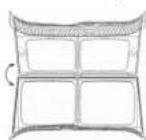
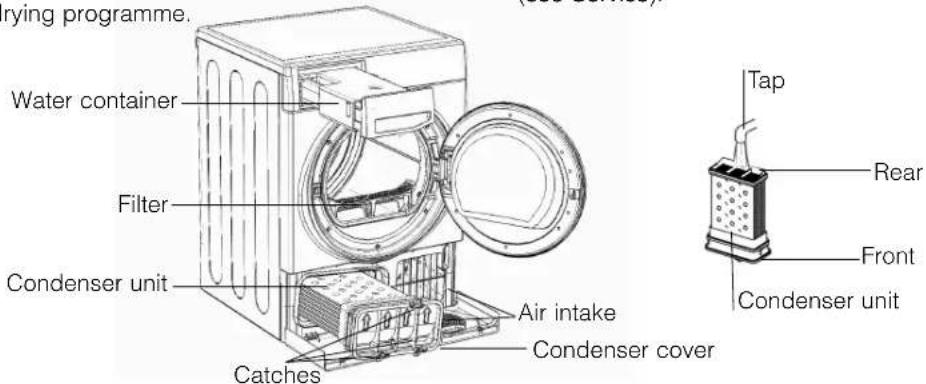
The filter is found in front of the dryer trim (see diagram). Removing the filter:
- Pull the plastic grip of the filter upwards (see diagram).
-
Open the filter and clean the lint from the inside.
-
Replace it correctly. Ensure the filter is fully located flush into the tumble dryer trim.
-
Remove any lint that has built up on the inside of the door and around the door seal.
! Do not use the dryer without replacing the filter.
Check the drum after each cycle
Turn the drum manually in order to remove small items (handkerchiefs) that could have been left behind.
Empty the water container after each cycle
Pull the container out of the dryer and remove either the small or large cap and empty it into a sink or other suitable drain. Refit the cap and replace the container securely.
! Always check and empty the container before you start a new drying programme.
Cleaning the drum
! Do not use abrasives, steel wool or stainless steel cleaning agents to clean the drum.
A coloured film may start to appear on the stainless steel drum, this may be caused by a combination of water and, or cleaning agents such as fabric conditioner from the wash. This coloured film will not affect the dryer performance.
Cleaning the condenser unit
Periodically (every month) remove the condenser unit and clean any build up of fluff from between the plates by rinsing it under the tap with cold water.
This should be done with cold water from the rear of the condenser.
Removing the condenser:
-
Unplug the dryer and open the door.
-
Pull open the condenser cover (see diagram). Release the three catches by turning 90° counterclockwise then pull on the grip and remove from the dryer.
-
Clean the surface of the seals and replace, making sure that the catches have been secured.
Cleaning the dryer
- External parts in metal or plastic and rubber parts can be cleaned with a damp cloth.
- Periodically (every 6 months) vacuum the front air intake grille, to remove any build up of fluff, lint or dust. Also to remove accumulation of fluff from the front of the condenser and filter areas, clean occasionally with a vacuum cleaner.
! Do not use solvents or abrasives.
! Your dryer uses special bearing components which do not need lubrication.
! Have your dryer checked regularly by authorised technicians to ensure electrical and mechanical safety (see Service).
text_image
rying programme. Water container Filter Condenser unit Catches Air intake Condenser cover Tap Rear Front Condenser unitGB
One day your dryer seems not to be working. Before you call your Service Centre (see Service), go through the following troubleshooting suggestions:
Problem:
| The tumble dryer won't start. | · The plug is not plugged into the socket, or not making contact.· There has been a power failure.· The fuse has blown. Try to plug another appliance into the socket.· You are using an extension cord? Try to plug the dryer's power cord directly into the socket.· The door is not closed securely?· The programme has not been set properly (see Start and Programmes).· The Start/Pause button has not been pressed (see Start and Programmes). |
| Drying cycle will not begin. | · You have set a delayed time (see Start and Programmes). |
| Its taking a long time to dry. | · The filter has not been cleaned (see Maintenance).· The water container needs emptying? The empty water message is displayed? (see Maintenance).· The condenser needs cleaning? (see Maintenance).· The temperature setting is not ideal for the type of fabric you are drying (see Start and Programmes, and see Laundry).· The correct drying time has not been selected for the load (see Laundry).· The air intake grille is obstructed (see Installation, and see Maintenance).· The items were too wet (see Laundry).· The dryer was overloaded (see Laundry). |
| Empty water message is displayed but the dryer has only been running for a short period. | · The water container was probably not emptied at the start of the programme. Do not wait for the empty water signal, always check and empty the container before starting a new drying programme (see Maintenance). |
| Empty water message is displayed and the water container is not full. | · This is normal, the: END OF CYCLE, EMPTY THE WATER BOTTLE message is shown as a reminder to empty the container (see The Display and Start and Programmes). |
| Programme finishes and clothes are damper than expected. | ! For safety the dryer has a maximum programme time of 4 hours. If an automatic programme has not sensed the required final moisture in this time the dryer will complete the programme and stop. Check the above points and run the programme again, if the results are still damp, contact the Service Centre (see Service). |
| The display shows a fault code F followed by one or two numbers. | · If the display shows F10 or F15:- Turn off and remove the plug. Clean the filter and the condenser (see Maintenance). Then replace the plug, turn on and start another programme. If F10 or F15 is still displayed contact the Service Centre (see Service).· If any other number is shown: Note down the code and contact the Service Centre (see Service). |
| The display briefly shows DEMO ON every 6 seconds. | · The dryer is in 'Demo' mode. Press and hold both the On/Off and Start/Pause buttons for 3 seconds. The display will show DEMO OFF for 3 seconds and then the dryer will resume normal operation. |
Before calling the Service Centre:
- Use the troubleshooting guide to see if you can solve the problem yourself (see Troubleshooting).
- If not, turn off the dryer and call the Service Centre closest to you.
What to tell the Service Centre:
• name, address and post code.
- telephone number.
- the type of problem.
• the date of purchase.
• the appliance model (Mod.).
• the serial number (S/N).
This information can be found on the data label inside the door of the machine.
Spare Parts
This dryer is a complex machine. Repairing it yourself or having a non-authorised person try to repair it could cause harm to one or more persons, could damage the machine and could invalidate the spare parts warranty.
Call an authorised technician if you experience problems while using the machine.
Recycling and Disposal Information

As part of our continued commitment to helping the environment, we reserve the right to use quality recycled components to keep down customer costs and minimise material wastage.
- Disposing of the packaging material: follow local regulations, so the packaging can be recycled.
- To minimise risk of injury to children, remove the door and plug - then cut off mains cable, flush with the appliance. Dispose of these parts separately to ensure that the appliance can no longer be plugged into a mains socket.
Disposal of old electrical appliances
The European Directive 2002/96/EC on Waste Electrical and Electronic Equipment (WEEE), requires that old household electrical appliances must not be disposed of in the normal unsorted municipal waste stream. Old appliances must be collected separately in order to optimise the recovery and recycling of the materials they contain and reduce the impact on human health and the environment.

The crossed out “wheeled bin” symbol on the product reminds you of your obligation, that when you dispose of the appliance it must be separately collected.
Consumers should contact their local authority or retailer for information concerning the correct disposal of their old appliance.
Comparative Programmes
- Programmes recommended for comparative test to EN61121
| Programme Programme (EN61121) | to select Load size Heat Setting Dryness Option | ||||
| Dry Cotton COTTONS | 9 kg High CUPBOARD DRY | ||||
| Iron Dry Cotton COTTONS | 9 kg High IRON DRY | ||||
| Easy-care textile SYNTHETICS | 3 kg Low | CUPBOARD DRY | |||
! Note: This is not a full list of programme options (see Start and Programmes).
CE This appliance conforms to the following EC Directives:
- 2006/95/EC (Low Voltage Equipment)
- 89/336/EEC, 92/31/EEC and 93/68/EEC (Electromagnetic Compatibility)
text_image
Hotpoint ARISTONnatural_image
Interior view of a washing machine with visible vent and door (no text or symbols)ETAPE 2.
Sortez le filtre.
natural_image
Close-up of a hand opening a large stainless steel washing machine (no visible text or symbols)ETAPE 3.
natural_image
Close-up of a hand interacting with a white cylindrical device (no visible text or symbols)ETAPE 3.
natural_image
Close-up of a white industrial fan with ventilation grille and ventilation duct, partially removed by a black arrow pointing to a small component (no text or symbols visible)ETAPE 2.
natural_image
Interior view of a vehicle air vent with three circled areas (no text or symbols visible)ETAPE 3.
natural_image
Stacked plastic waste bins with slats, no visible text or symbolsETAPE 4.
natural_image
Close-up of a white plastic panel with four upward-pointing arrows indicating flow or movement (no text or symbols)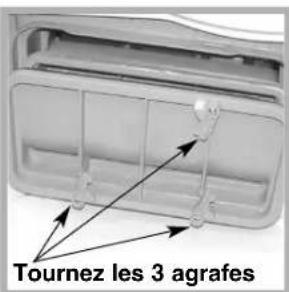
text_image
Tournez les 3 agrafes• Vérifiez:
text_image
Weather and weather control panel interface with sun, wind, solar, and calendar iconstext_image
Control panel interface with digital displays and function icons, including sun, play, and timer buttonsSéchage minuté
text_image
Diagram of a solar panel with indicator lights, battery, and status indicators for thermal and humidity monitoring.text_image
Weather control panel interface with sun, moon, and digital displays showing 8:38 and 8:38 time indicatorsNETTOYAGE CONDENSEUR
Textile Charge maximum
text_image
Hotpoint ARISTON
natural_image
Close-up of a white washing machine with visible vent and door (no text or symbols)PASO 2.
Extraiga el filtro.
natural_image
Close-up of a hand opening a large metallic washing machine (no visible text or symbols)PASO 3.
natural_image
Close-up of a white plastic or paper container with a slotted lid (no visible text or symbols)PASO 2.
natural_image
Close-up of a hand pressing down on a white car interior (no visible text or symbols)PASO 3.
natural_image
Close-up of a white industrial air vent with a metallic grille and a curved ventilation grille, showing a downward arrow pointing to the outlet (no text or symbols visible)PASO 2.
natural_image
Interior view of a vehicle air vent with three circular annotations highlighting specific zones (no text or symbols present)PASO 3.
natural_image
Exterior view of a modern office building (no signage)PASO 4.
natural_image
Close-up of a white plastic panel with four upward-pointing arrows, no text or symbols visible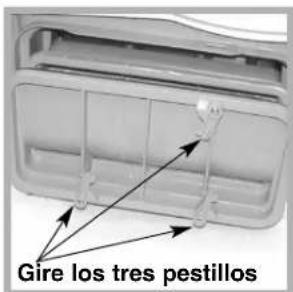
text_image
Weather and weather control panel interface with icons for sun, wind, solar, and temperature readingstext_image
Diagram of a solar panel interface with status indicators and control buttonstext_image
Weather control panel interface with sun, clock, and directional indicatorstext_image
Hotpoint ARISTONnatural_image
Close-up of a white washing machine with metallic blades and ventilation grille (no visible text or symbols)PASSO 2.
Retire o filtro.
natural_image
Close-up of a hand opening a large stainless steel washing machine (no visible text or symbols)PASSO 3.
natural_image
Close-up of a white electronic device casing with a flat panel and ventilation slots (no visible text or symbols)PASSO 2.
natural_image
Close-up of a hand interacting with a white cylindrical device (no visible text or symbols)PASSO 3.
natural_image
Close-up of a white washing machine with a metallic grille and ventilation duct, showing a circular component inserted into the air (no text or symbols visible)PASSO 2.
natural_image
Interior view of a vehicle air vent with three circled areas highlighting the vent (no text or symbols visible)PASSO 3.
natural_image
Exterior view of a modern office building (no signage)PASSO 4.
natural_image
Close-up of a white plastic panel with four black arrows pointing upward, indicating directional flow or movement (no text or symbols)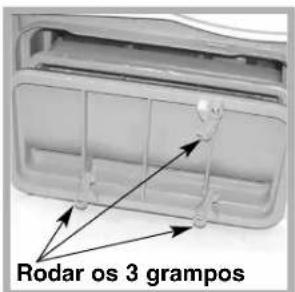
text_image
Rodar os 3 grampostext_image
Weather and weather control panel interface with sun, wind, solar, and directional indicatorstext_image
Weather control panel interface with sun, battery, and display indicatorstext_image
Weather control panel interface with sun, battery, and display indicatorsLIMPAR O CONDENSADOR
text_image
Hotpoint ARISTONGR
natural_image
Close-up of a white washing machine with metallic ventilation slots and a closed lid (no visible text or symbols)BHMA 2
natural_image
Close-up of a hand opening a large industrial machine with cooling fan (no visible text or symbols)BHMA 3
natural_image
Close-up of a hand pressing down on a white cylindrical object (no visible text or symbols)BHMA 3
natural_image
Close-up of a white washing machine with a metallic grille and ventilation duct, showing a downward arrow pointing to a textured surface (no text or symbols visible)BHMA 2
natural_image
Interior view of a vehicle air vent with three circular annotations highlighting the vent slots (no text or symbols present)BHMA 3
natural_image
Exterior view of a modern office building (no signage)BHMA 4
natural_image
Close-up of a white plastic panel with four black arrows pointing upward (no text or symbols visible)