
ERC 38810 WS - Wine cellar ELECTROLUX - Free user manual and instructions
Find the device manual for free ERC 38810 WS ELECTROLUX in PDF.
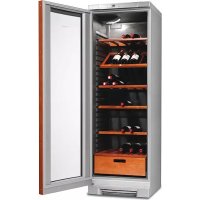




| Product type | Wine cellar |
| Brand | Electrolux |
| Model | ERC 38810 WS |
| Total capacity | 361 liters |
| Dimensions (H x W x D) | 1800 x 595 x 623 mm |
| Power supply | 230 V, 10 A |
| Climate class | SN (10-32°C), N (16-32°C), ST (18-38°C), T (18-43°C) |
| Adjustable temperature range | +6°C to +17°C |
| Temperature display | Digital, with +/- button adjustment |
| Interior lighting | Yes, automatic shutdown after 5 minutes |
| Defrosting | Automatic |
| Shelf type | Adjustable (flat or tilted) |
| Reversible door | Yes (can change direction of opening) |
| Handle | Included and movable |
| Open door alarm | Yes (triggers after 5 minutes) |
| Cooling system | Compressor |
| Refrigerant | CFC-free, environmentally friendly |
| Bulb type | E14, max 25 W |
| Cleaning | Soft cloth, warm water and dish soap |
| Repairability | Some issues can be resolved by the user (see troubleshooting) |
| Recyclable materials | Yes (packaging and appliance) |
Frequently Asked Questions - ERC 38810 WS ELECTROLUX
User questions about ERC 38810 WS ELECTROLUX
0 question about this device. Answer the ones you know or ask your own.
Ask a new question about this device
Download the instructions for your Wine cellar in PDF format for free! Find your manual ERC 38810 WS - ELECTROLUX and take your electronic device back in hand. On this page are published all the documents necessary for the use of your device. ERC 38810 WS by ELECTROLUX.
USER MANUAL ERC 38810 WS ELECTROLUX
Thank you for choosing a first-class product from Electrolux, which hopefully will provide you with lots of pleasure in the future. The Electrolux ambition is to offer a wide variety of quality products that make your life more comfortable. You find some examples on the cover in this manual. Please take a few minutes to study this manual so that you can take advantage of the benefits of your new machine. We promise that it will provide a superior User Experience delivering Ease-of-Mind. Good luck!
Safety instructions
Your new Wine cooler may have other functions compared to your previous one.
This appliance is not intended for use by persons (including children) with reduced physical, sensory or mental capabilities, or lack of experience and knowledge, unless they have been given supervision or instruction concerning use of the appliance by a person responsible for their safety.
Carefully read these instructions to learn how the appliance works and how to care for it. Keep the instruction booklet. It will come in handy if you later sell the cabinet or give it to somebody else.
These warnings are provided in the interest of your safety. Ensure that you understand them all before installing or using the appliance. Your safety is of paramount importance. If you are unsure about any of the meanings or warnings, contact the Customer Care Department.
For the User
- The cabinet is intended for keeping beverages in a normal household as explained in this instruction booklet.
- Do not keep explosive gases or liquids in the refrigerator. They may explode and cause injury and material damage.
- Do not let sharp objects come into contact with the refrigerating system on the back of and inside the cabinet. If the refrigerating system is punctured, the cabinet will be damaged and foodstuff inside may spoil.
- The cabinet is heavy. The edges and projecting parts of the cabinet may be sharp. Be careful when moving the cabinet and always use gloves.
Child Safety
- Pay attention so that small children do not gain access to the operating controls or the inside of the cabinet.

WARNING
Keep ventilation openings, in the appliance enclosure or in the built-in structure, clear of obstruction.

WARNING
Do not use mechanical devices or other means to accelerate the defrosting process, other than those recommended by the manufacturer.

WARNING
Do not damage the refrigerant circuit.

WARNING
Do not use electrical appliances inside the food storage compartments of the appliance, unless they are of the type recommended by the manufacturer.
Scrapping old appliances
The symbol on the product or on its packaging indicates that this product may not be treated as household waste. Instead it should be taken to the appropriate collection point for the recycling of electrical and electronic equipment. By ensuring this product is disposed of correctly, you will help prevent potential negative consequences for the environment and human health, which could otherwise be caused by inappropriate waste handling of this product. For more detailed information about recycling of this product, please contact your local council, your household waste disposal service or the shop where you purchased the product.
The following symbols are used in this manual:

Important information concerning your personal safety and information on how to avoid damaging the appliance
General information and tips
Environmental information
Contents
Safety instructions 4.
Scrapping old cabinets 5. . . . . . . .
Contents 6.
Use 7....
Control Panel 7....
To start the wine cooler and set the correct temperature 7.....
Temperature inside the wine cooler . 8
Wine Placement Storage tips .... 8
Measuring the temperature ..... 9
Switching off 9
Alarms and other features ..... 9
Lighting 9
Cabinet interior 9
HINT AND TIPS 9
Saving energy 9.
Food Storage 10.
Protect the environment ..... 10
MAINTENANCE AND CLEANING .. 10
Removing the ventilation grille .... 10
Cleaning 10.....
To change the lamp 11
Defrosting the wine cooler ..... 11
When the appliance is not in use . . 11
SOMETHING NOT WORKING .... 12
TECHNICAL SPECIFICATION .... 13
INSTALLATION 14
Electrical cord 14.....
Unpacking 14
Remove the transport supports ... 14
Cleaning 14.....
Electrical connection 14
Installing the cabinet 15
Door reversal... 16
USE
Position and clean the cabinet as explained in the section "Installation". Check that the drain hose at the rear of the cabinet discharges into the drip tray.
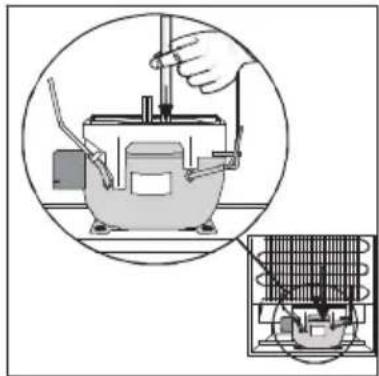

Before inserting the power plug into the outlet and switching on the cabinet for the first time, leave it standing upright for about 2 hours. Otherwise the compressor may sustain damage. This time will allow the oil sufficient time to return to the compressor.
Control Panel
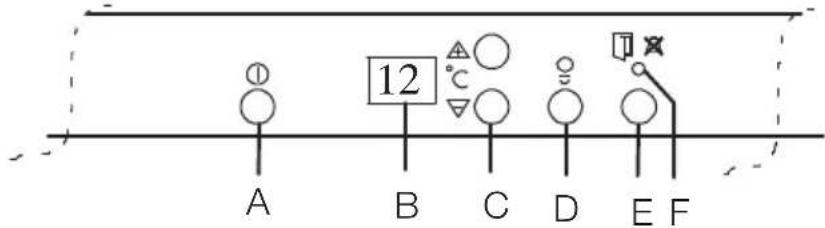
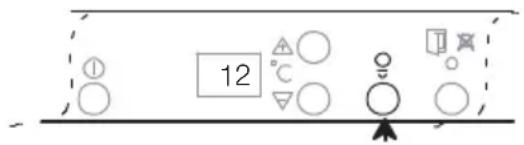
A. Wine cooler power switch Switches the wine cooler on and off.
B. Temperature display Shows the average temperature in the middle of the wine cooler.
C. Temperature adjustment buttons/thermostat Used to set the temperature.
D. Lighting
E. Alarm shut-off button Used to turn the audible alarm off.
F. Red warning lamp Flashes when the alarm in the cabinet has been triggered.
To start the wine cooler and set the correct temperature
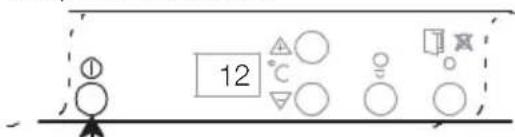
Switching on: Switch on the wine cooler by pressing the power switch.
Setting the temperature Press the buttons until the desired temperature flashes in the temperature display. (The temperature can be set
between +6°C and +15°C.) "+" raises the temperature. "-" lowers the temperature.
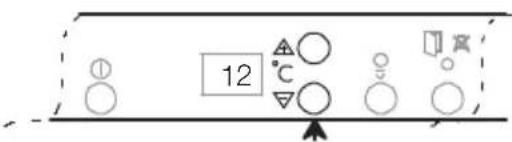
Once set, the temperature display shows the current temperature inside the cabinet.
NOTE: The controllable area is limited by a room temperature of 17°C or below.
Allow the cabinet to run for a period of 24 hours whenever the temperature setting is changed. This will allow the temperature to stabilise inside the cabinet.
It is not necessary to reset the temperature when the cabinet is switched on after it has been out of use. The thermostat recalls the previously set temperature.
Temperature inside the wine cooler
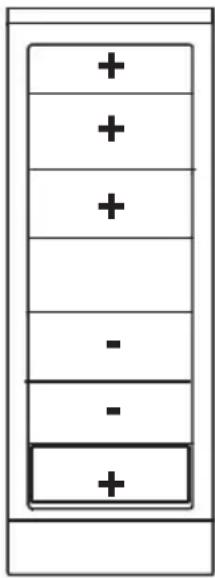
NOTE: The pictures show the coldest and warmest places inside the fridge. (+warm, -cold)
Wine Placement Storage tips
The amount of time to store wine depends on its maturity, type of grape, alcohol content, and dissolved fructose and tannins. When purchasing your wine, find out whether it is mature or if it will improve over time.
In the lower part of the cooler. Cold air prolongs the time to maturity. Accordingly, store old and mature wine as well as wine you would like to store for a long time in the lower portion of the cooler. The lower part should also be used to store wine that is to be served cold.
In the upper part of the cooler. In the upper part, store wine that you want to let mature further, wines that are served at a warmer temperature, and those wines you intend to consume relatively soon.
Store the bottles lying down so that the corks do not dry out.
Store the wine in the dark. The cooler doors are made with double-paned glass with a dark coating. This will protect the wine against light damage if the cooler is placed in a well-lit area.
Avoid turning on the light in the cooler too often or for too long. The wine should be stored in the dark.
Handle the bottles with care, so that the wine is not agitated.
Heed any advice and recommendations given at the time of purchase or in the professional literature concerning the wine's quality, durability and optimal storage temperature.
Recommended storage temperatures:
- For white wines: +10 to +12°C - For rosé wines and light red wines: +12 to +16°C - For champagne and sparkling wines: +6 to +8°C
If you stack several bottles on top of one another, make sure they don't touch the cabinet's cooling plate.
Measuring the temperature
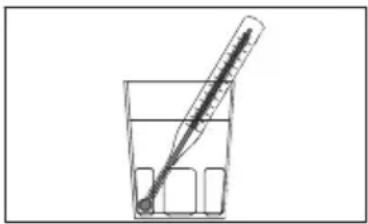
If the temperature is measured using a standard, single thermometer, this should be put in a glass of water centrally placed inside the cabinet. This will reflect the temperature inside the food products. Do not place the thermometer hanging directly on the shelf.
Switching off
Switch off the cabinet by passing the power switch.
Keep the button pressed for approx. 1 second.

Power to the cabinet is completely interrupted only when the power plug is disconnected.
Alarms and other features
Door open alarm
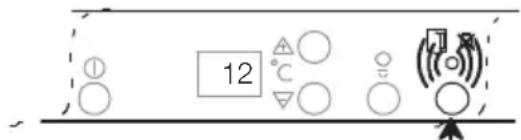
If the fridge door remains open for more than 5 minutes, the red warning lamp starts flashing and an audible alarm sounds.
To switch off the alarm:
Press the "alarm shut-off button". The red warning lamp goes out when the door is closed.
Lighting
The cooler lighting may be turned on with the door closed. This makes it
easy to survey the contents of the cooler without opening the door. The cooler lighting should normally be off, so that the wine is not unduly exposed to light. The lighting turns off automatically after about 5 minutes.
Cabinet interior
The shelves may be placed flat or at an angle.
Angle the shelf by placing the front pegs in a lower set of tracks. You can store already opened bottles on the shelf in this position.
HINTS AND TIPS
Saving energy
- Pay careful attention to where the cabinet is placed. See the section "Installation". When installed correctly, the cabinet will consume less energy.
- Try to avoid keeping the door open for long periods, or opening the door too frequently as warm air will enter the cabinet, and cause the compressor to switch on unnecessarily often.
- Ensure there are no obstructions preventing the door from closing properly.
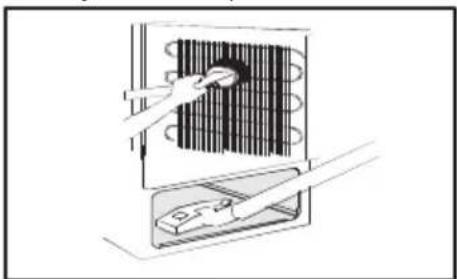
- It is advisable to periodically clean the refrigeration system at the back of the appliance with a duster or vacuum cleaner.
- Make sure the door gasket is complete and always clean.
Food storage
• To obtain the best results from your appliance, neither hot foods nor liquids which may evaporate should be placed in the larder compartment. - Avoid buying frozen food if you cannot store it straight away. The use of an insulated container is advisable. When you arrive home, place the frozen food in the freezer immediately. - Ensure that food placed in the freezer is dated and labelled and used in date order to ensure that food is consumed at its best. Remove suspect food from your refrigerator and clean, refer to cleaning and maintenance.
Protect the environment
- Hand over the cabinet packaging and discarded fridges and freezers to a recycling station. Contact your local city office or your closest dealer for more information.
- When cleaning the cabinet, use a mild washing-up detergent.
- Follow the advice in the section "Saving energy".
- The door gasket and coolant used in this cabinet will not harm the ozone layer.
- All parts in the packaging can be recycled.
- The cabinet has been designed for easy dismantling and subsequent recycling.
MAINTENANCE and CLEANING
Removing the ventilation grille
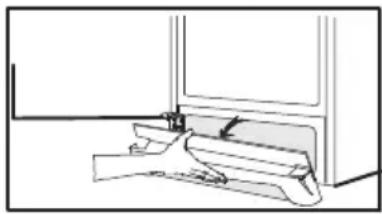
The ventilation grille can be removed, e.g. to wash the grille.
Make sure the door is open when removing the ventilation grille. Unsnap the upper edge of the grille by pulling outward/downward. Then pull the grille straight out to completely remove it.
Cleaning
Clean the cabinet at regular intervals. Disconnect the appliance from electricity supply.
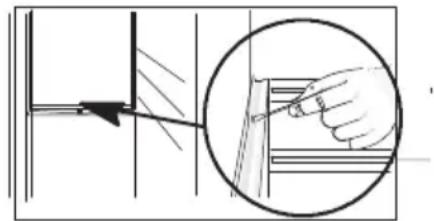
Clean out the drip channel inside the wine cooler at regular intervals and ensure that the drip channel is clear at all times. If blocked, carefully clear using a piece of flexible curtain wire inserted into the drain outlet to remove the blockage.
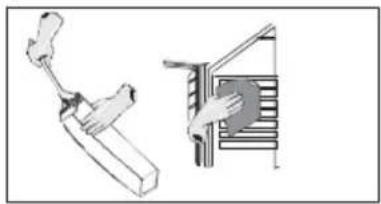
Clean the inside and accessories with warm water and bicarbonate of soda (5ml to 0.5 litre water). Rinse and dry thoroughly.
Regularly check the door seals and wipe clean to ensure they are clean and free from debris.
Clean off the interior wooden details with a moist rag and mild kitchen soap. Do not soak the wood.
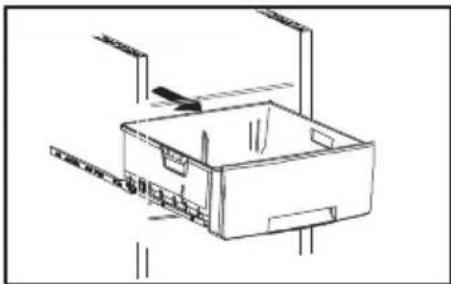
Drawer.
Pull out drawer.
Lift it over the locks in back on the sliding guides. Tip drawer downwards and pull it out.
Clean.
Assemble in reverse order.
Wash the outer cabinet with warm soapy water. Remove the ventilation grille (see the section "Removing the ventilation grille") and vacuum-clean under the cabinet. Once or twice a year dust the condenser (black grille) and the compressor at the back of the appliance, with a brush or vacuum cleaner, as an accumulation of dust will affect the performance of the appliance and cause excessive electricity consumption.

When moving the cabinet, lift it by the front edge to avoid scratching the floor.
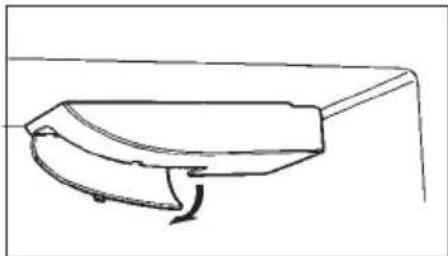
To change the lamp
Before replacing the light bulb, disconnect the power plug from the outlet.
Fold the grille backward by unsnapping the front edge.
Use a bulb of the same type, E14 socket, maximum rating of 25W.
Defrosting the wine cooler
The wine cooler is defrosted automatically every time the compressor stops. Frost formation can be prevented by:
· not putting warm foodstuff inside the cabinet.
Avoid frequently opening the door or keeping it open too long.
When the appliance is not in use
Disconnect the appliance from the electricity supply.
If the cabinet is to be kept on, ask somebody to check it once in a while to prevent the food inside from spoiling in case of a power failure.
Empty all foods and clean the appliance, leaving the doors ajar to prevent unpleasant smells.
SOMETHING NOT WORKING
Before contacting your local Service Force Centre, check the following points:
| ProblemPossiblecause/Remedy | |
| ”” isdisplayedinthe temperaturedisplay. | Aerrorhasoccurredinmeasuring the temperature.Callyourservicerepresentative. (Thecoolingsystemwillcontinuetokeep foodproductscold,buttemperature adjustmentwillnotbepossible.) |
| Itistoowarminsidethewine cooler. | Setalowertemperature.Makesurethatthedooriscompletelyclosed andthattheinsulatingstripiscompleteand clean. |
| Itistoowarminsidethewine cooler. | Setalowertemperature.Makesurethatthedooriscompletelyclosed andthattheinsulatingstripiscompleteand clean. |
| Itistoocoldinsidethewine cooler. | Setawarmertemperature. |
| Thereiswateronthecooling plateinsidethewinecooler. | Thisisnormal.Duringautomaticdefrosting, frostthawsonthecoolingplate. |
| Waterisrunninginsidethe winecooler. | Cleanthewaterdrainanddrainholeinside thewinecoolerusinge.g.cottonswabsora bottlecleanerbrush.Somefoodproductscouldhavebeenplaced neartherearoftheapplianceprevetungthe waterfromrunningintothedrain. |
| Water comes out on the floor. | Place the drain hose at the back of the cabinetabovethedrainbowl.Seethe chapter"Beforeusingthecabinetthefirst time". |
| Thecabinetdoesnotoperate atall.Coolingorinteriorlight doesnotoperate.Noindicator lampslight. | Thecabinetisnotswitchedon.Powerdoesnotreachthecabinet.(Try connectinganotherelectricaldevicetothe poweroutlet.)The fuse has blown.Thepowerplugisnotproperlyconnected. |
| Thecompressoroperates continuously. | Setawarmertemperature.Makesurethatthedooriscompletelyclosed andthattheinsulatingstripiscompleteand clean. |
| Soundlevelincabinetistoo high. | Therefrigeratingsystemwillalwaysproduce somesounds.Apulsingsoundisheardwhen coolantispumpedinsidethecoolingpipes.Atickingsoundfromthermostatcanbe heardwhenthecompressorswitchesonand off.Thesoundlevelvariesdependingonthe operationofthecabinet.Ifyoufeelthesoundlevelisincorrect:Makesurethepipesatthebackofthe cabinetdonottoucheachother.Carefully bendthemiftheydo.Ifthecushionspacers(betweenthecabinet wallandpipes)comeloose,putthembackin placeagain.Carefullyfollowtheinstructionsinthechapter "Installingthecabinet". |
TECHNICAL SPECIFICATION
| ModelERC38810WS | |
| NetcapacityRefrigeratorl361 | |
| Dimensionmm | |
| Height1800 | |
| Width595 | |
| Depth | 623 |
INSTALLATION
Electrical cord
Do not remove the power cord by pulling on its lead, particularly when the product is being pulled out of its niche.
- Damage to the cord may cause a short-circuit, fire and/or electric shock. - In the event of damage to the appliance's main cable, only an authorised service company recommended by the manufacturer or a similarly qualified person may adjust it in order to avoid shock hazard for the user.
Unpacking
Unpack the cabinet and check that it is in good condition and free of any transport damage. Notify the dealer immediately of any damage. Hand the packaging over for recycling. For more information, contact your local council or the dealer.

Do not allow children to play with the packaging. The plastic film can cause suffocation.
Remove the transport supports.
Remove the tape and the transport supports from
the door sides.
Remove the transport support on the glass shelf by pushing the support forward along the edge of the
shelf until it stops. Take hold of the rear edge of the glass shelf and pull the shelf and transport support forward
until the shelf tilts and the transport support can be removed.
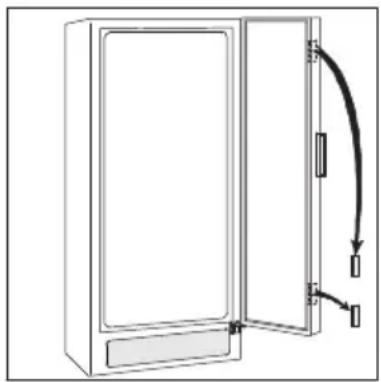
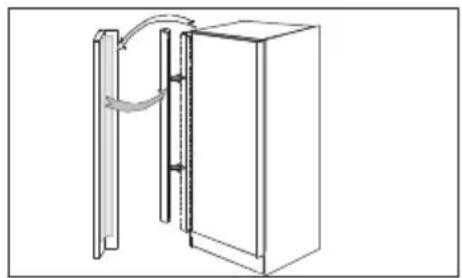
Mounting the handle
The handle is included in the packaging material of the cabinet. Secure the handle.
Cleaning
Wash the inside of the cabinet using lukewarm water, a mild washing-up detergent, and a soft cloth. Clean off the interior wooden details with a moist rag and mild kitchen soap. Do not soak the wood.
Electrical connection
Connect the cabinet to a grounded electrical outlet.
Voltage: 230V.
Fuse: 10A.
Refer to the rating plate on the left inside the cabinet.
Installing the cabinet
Make sure that the power plug is not squashed or damaged by the back of the product.
- A damaged power plug may overheat and cause a fire.
Do not place heavy articles or the product itself on the power cord.
- There is a risk of a short circuit and fire.
If the power plug socket is loose, do not insert the power plug.
- There is a risk of electric shock or fire.
To obtain the best performance from the cabinet, ensure:
- The cabinet is placed in a dry, cool place and is not exposed to direct sunlight.
- The cabinet is not placed close to a source of heat, e.g. a cooker or dishwasher.
- The cabinet is level. The cabinet should not lean against any wall. If necessary, adjust the feet using the adjustment spanners supplied.
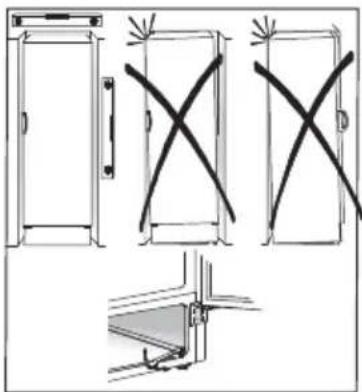
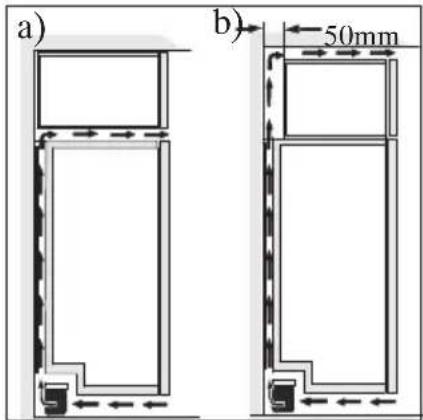
- There is good air circulation around the cabinet and that the air channels below and behind the cabinet are not blocked. The ventilation space above the cabinet must be at least 4 cm.
The ventilation space can either be a) directly above the cabinet, or
b) behind and above the top cupboard. In this case, the space behind the cupboard must be at least 50 mm deep.
Cabinet is placed at a location where the ambient temperature corresponds to the climate classification*, for which the appliance is designed.
*See on the rating plate on the inside of the appliance.
The following table shows which ambient temperature is correct for each climate classification.
| Climate classification | foranambient temperatureof |
| SN | +10°Cto+32°C |
| N | +16°Cto+32°C |
| ST | +18°Cto+38°C |
| T | +18°Cto+43°C |
Check that the drain hose at the rear of the cabinet discharges into the drip tray.
If the cabinet is placed in a corner and the side with the hinges is facing the wall, the distance between the wall and the cabinet must be at least 230 mm to allow the door to open enough so that the shelves can be removed.
The power plug must be accessible after installation of the cabinet.
Door Reversal
- Close the cabinet and remove the plug from the electrical socket.
- Remove the ventilation grille. There is a part on the grille that can be removed. Remove and reposition it on the other side.
- Put the cabinet on a wooden board when it is laid down. Later, when raising the cabinet, it will be easier to grip under the cabinet thanks to the board.
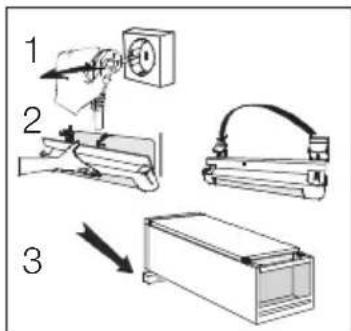
- On the upper part of the cabinet. Put the hinge pin on the other side. On the lower part of the cabinet. Unscrew the hinge. Move the hinge pin and plastic cover. Secure the hinge on the other side.
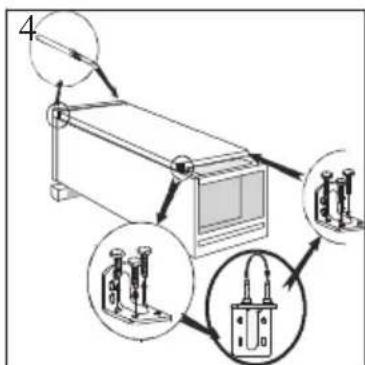
Remove any play in the door by adjusting the height of the lower hinge
with the supplied spanner. Secure with the lock-nut.
Raise the cabinet and replace the ventilation grille.
5. Move the handle. Unscrew the handle and secure it to the other side. Press the supplied plastic plugs into the holes to which the handle was previously fitted.
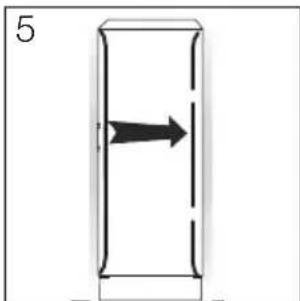
Put the cabinet in position. Check that the appliance is level. See the section "Positioning the cabinet".

Switching off
Cleaning
Drawer

Defrosting - wine cooler
Attaching the handles
Cleaning

Switching off
Cleaning
Drawer
Remove the drawer.

When moving the compartment, lift it by the front edge to avoid scratching the floor.
Replacing the bulb
Replace the grid on the front edge.
Mounting the handle
Switching off
Cleaning
Tray


- SAFETY INSTRUCTIONS
- FOR THE USER
- CHILD SAFETY
- WARNING
- SCRAPPING OLD APPLIANCES
- CONTENTS
- USE
- CONTROL PANEL
- TO START THE WINE COOLER AND SET THE CORRECT TEMPERATURE
- TEMPERATURE INSIDE THE WINE COOLER
- WINE PLACEMENT STORAGE TIPS
- MEASURING THE TEMPERATURE
- SWITCHING OFF
- ALARMS AND OTHER FEATURES
- DOOR OPEN ALARM
- LIGHTING
- CABINET INTERIOR
- HINTS AND TIPS
- SAVING ENERGY
- FOOD STORAGE
- PROTECT THE ENVIRONMENT
- MAINTENANCE AND CLEANING
- REMOVING THE VENTILATION GRILLE
- CLEANING
- DRAWER
- TO CHANGE THE LAMP
- DEFROSTING THE WINE COOLER
- SOMETHING NOT WORKING
- INSTALLATION
- ELECTRICAL CORD
- UNPACKING
- REMOVE THE TRANSPORT SUPPORTS
- MOUNTING THE HANDLE
- ELECTRICAL CONNECTION
- DOOR REVERSAL
- DEFROSTING - WINE COOLER
- ATTACHING THE HANDLES
- REPLACING THE BULB
- TRAY
Brand : ELECTROLUX
Model : ERC 38810 WS
Category : Wine cellar