
Stitch - Musical instrument LEXIBOOK - Free user manual and instructions
Find the device manual for free Stitch LEXIBOOK in PDF.



| Product Type | Ukulele |
| Brand | LEXIBOOK |
| Model | Stitch |
| Number of Strings | 4 (nylon) |
| Number of Frets | 12 |
| Body Material | Laminated Wood |
| Neck Material | Wood |
| Weight (estimated) | Approximately 0.5 kg |
| Power | None (acoustic instrument) |
| Tuning | Manual via tuning pegs (G, C, E, A) |
| Tuning Methods | Piano, tuning fork, electronic tuner |
| Playing Positions | Sitting or standing |
| Playing Techniques | Strumming and plucking |
| Included Accessories | 1 ukulele, 1 user manual |
| Cleaning | Soft dry cloth |
| Safety | Not suitable for children under 3 years (choking hazard due to small parts) |
| Warranty | 2 years |
| After-sales service | savcomfr@lexibook.com |
| Reference | K230series |
| Designed in | Europe |
| Made in | China |
Frequently Asked Questions - Stitch LEXIBOOK
User questions about Stitch LEXIBOOK
0 question about this device. Answer the ones you know or ask your own.
Ask a new question about this device
Download the instructions for your Musical instrument in PDF format for free! Find your manual Stitch - LEXIBOOK and take your electronic device back in hand. On this page are published all the documents necessary for the use of your device. Stitch by LEXIBOOK.
USER MANUAL Stitch LEXIBOOK
Discover your ukulele
Discover your new guitar and become familiar with the different parts of your instrument by studying the diagram on the first page of the booklet.
-
Head
-
Strings (x4)
-
Frets (x12)
-
Handle
-
Saddle
-
Key/Note
-
Case
-
Soundboard
-
Head nut
-
Ease1
-
Resonance box
-
Keys (x4)
Your ukulele has 4 (nylon) strings: these four strings represent these notes respectively: G, C, E and A (G, C, E and A for English notation).
When unpacking, make sure the following parts are included:
1 x Ukulele / 1 x User Manual
WARNING: Packaging materials such as plastic film, adhesive tape, labels and metal fasteners are not part of this product and must be removed for safety reasons before use by a child. use by children.
Tuning your ukulele
Before you start playing, tune your ukulele to avoid any false notes!
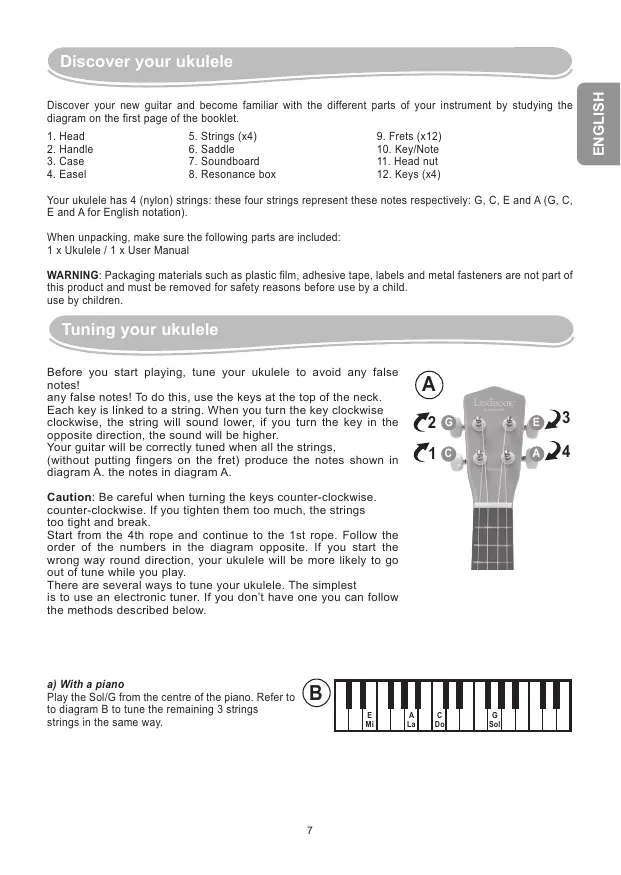
any false notes! To do this, use the keys at the top of the neck. Each key is linked to a string. When you turn the key clockwise clockwise, the string will sound lower, if you turn the key in the opposite direction, the sound will be higher.
Your guitar will be correctly tuned when all the strings, (without putting fingers on the fret) produce the notes shown in diagram A. the notes in diagram A.
Caution: Be careful when turning the keys counter-clockwise. counter-clockwise. If you tighten them too much, the strings too tight and break.
Start from the 4th rope and continue to the 1st rope. Follow the order of the numbers in the diagram opposite. If you start the wrong way round direction, your ukulele will be more likely to go out of tune while you play.
There are several ways to tune your ukulele. The simplest is to use an electronic tuner. If you don't have one you can follow the methods described below.
a) With a piano
Play the Sol/G from the centre of the piano. Refer to diagram B to tune the remaining 3 strings strings in the same way.


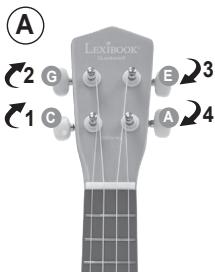
b) By ear, with a reference string (see diagram C)
Start by tuning the 1st string (G/G) of your ukulele using :
- A piano: adjust the string until it sounds like the 21st white key on a standard piano keyboard.
-
A tuning fork (G/392Hz): adjust the string until it sounds like the tuning fork.
-
Press the 7th fret of the 2nd string. Adjust this string so that sound like the 1st string (C/Do). See A.
- Press the 3rd fret of the 3rd string. Adjust this string so that sound like the 1st string (E/Mi). See D.
- Press the 10th fret of the 4th string. Adjust this string = so that it sounds like the 1st string (G/La). See G
How to hold your ukelele
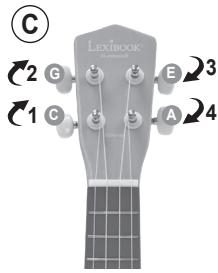
In general, for both right- and left-handed players, the ukulele is held as follows: left hand on the neck and right hand on the body.
left hand on the neck and right hand on the body. It is possible to hold your ukulele like a left-hander (right hand on the neck and left hand on the body), but you must have the saddle modified in order to reverse the strings. In both cases, hold the instrument by the arm you use to strum the strings strings and hold the back of the ukulele against your body.
There are several ways to hold your ukulele. The most important thing is that you feel comfortable.
For example, you can sit down and put the ukulele on your leg.
2 You can also choose to stand with the ukulele at chest height.
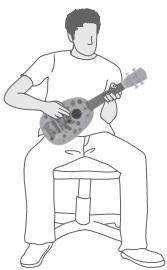
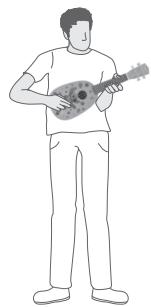
When you play the ukulele, put one hand on the neck (2) and the other on the body (3).
Your left hand
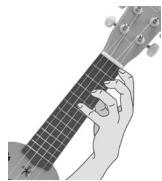
The fingers of your left hand are used to press the strings and select notes. It is therefore important that you position your left hand correctly so that you have enough strength in your fingers. Place your thumb flat under the neck, then curl your other fingers around the front of the neck. Hollow out your hand so that your fingers hang over the strings like pliers. This allows you to press down on the strings with more force.
When you're just starting out, your fingers aren't used to pressing hard on the strings. the tips of your fingers. Don't worry, this is normal! Keep your fingernails short so that when you play. To move your hand easily along the neck, lift your elbow slightly away from your body.
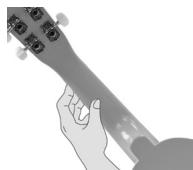
Thumb position
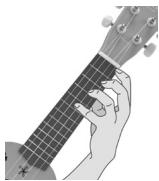
Position of the other fingers
Your right hand
Place your right hand on the strings over the soundhole (8). Use your right hand to strum.
How to strum the strings
With a slight flick of your wrist, run your right hand quickly over the strings. Each stroke corresponds to a beat.
Scrape the strings with your thumb or the nail of your index finger. Scrape from the 4th string to the 1st string (thinnest string / bottom string).
A few basic chords
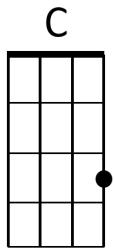
Practise playing a few simple chords. The diagrams below show the neck of your ukulele. The vertical lines correspond to the frets. Each finger is assigned a number. With the fingers of your left hand, press the strings taking into account the numbers that correspond to those associated with your fingers. You can play the notes on the different frets of the strings.
Notes :
- To play better and get good pressure on the strings, keep the fingernails of your left hand short.
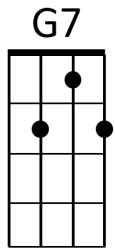
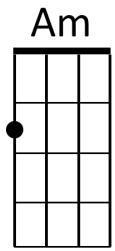
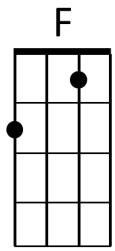
Maintenance and warranty
Clean the appliance by wiping it with a dust cloth as you would a piece of furniture. Clean and plastic parts with care.
Note: Please keep this manual as it contains important information. This product is covered by our 2-year guarantee. To make a claim under the guarantee or for after-sales service, you should with proof of purchase. Our guarantee covers defects in material or assembly faults attributable to the manufacturer, excluding any damage caused by non-compliance with the instructions for use or any untimely intervention on the product (such as disassembly, exposure to heat or humidity, etc.).
We recommend that you keep the packaging for future reference. As part of our ongoing the colours and details of the product shown on the packaging.
WARNING: Not suitable for children under 3 years of age. Risk of suffocation due to due to small parts.
References: K230series
Lexibook UK
PO Box 423
UMBERLEIGH
EX32 2JW
United Kingdom

For all after-sales enquiries or complaints, please contact savcomfr@lexibook.com.
Designed and developed in Europe - Made in China
Follow us
@LexibookCom


Como tocar as cordas
Referentie : K230series
At laere guitaren at kende
Laer din nye guitar og de forskellige dele af instrumentet at kende ved at studere diagrammet pa den Forste side i不同程度
Placing of de andre fingre
Vase pravá ruka
Reference: K230series
©LEXIBOOK®
LEXIBOOK S.A.
6 Avenue des Andes
Bathroom 11
91940 Les Ulis, Franciarszag
www.lexibook.com

- Discover your ukulele
- Tuning your ukulele
- a) With a piano
- b) By ear, with a reference string (see diagram C)
- How to hold your ukelele
- Your left hand
- Your right hand
- How to strum the strings
- A few basic chords
- Notes :
- Maintenance and warranty
- Lexibook UK
- Follow us
- Como tocar as cordas
- At laere guitaren at kende
- Vase pravá ruka
Brand : LEXIBOOK
Model : Stitch
Category : Musical instrument