USER MANUAL DWF4812SL DARTY
INFORMATION SUR LE PRODUIT
https://eprel.ec.europa.eu/screen/product/dishwashers2019/430924
https://eprel.ec.europa.eu/screen/product/dishwashers2019/430926
MISE AU REBUT


IMPORTANT SAFETY INSTRUCTIONS
PLEASE READ THE FOLLOWING SAFETY WARNINGS AND THE INSTRUCTIONS CAREFULLY BEFORE USING THE APPLIANCE AND KEEP FOR FUTURE REFERENCE.
Warnings
This appliance is intended to be used in household and similar applications.
such as:
- staff kitchen areas in shops, offices and other working environments;
-farm houses;
- by clients in hotels, motels and other residential type environments;
- bed and breakfast type environments.
- If the supply cord is damaged, it must be replaced by the manufacturer, its service agent or similarly qualified persons in order to avoid a hazard.
- This appliance can be used by children aged from 8 years and above and persons with reduced physical, sensory or mental capabilities or lack of experience and knowledge if they have been given supervision or instruction concerning use of the appliance in a safe way and understand the hazards involved. Children shall not play with the appliance.
Cleaning and user maintenance shall not be made by children without supervision.
- Regarding the instructions for the method and frequency of cleaning, refer to the section "Cleaning and Maintenance" in pages 55-58.
The openings must not be obstructed by a carpet.
- The new hose-sets supplied with the appliance are to be used; old hose-sets should not be reused.
- The maximum number of place settings to be washed by this dishwasher is 12 place settings.
The door should not be left in the open position since this could present a tripping hazard.
- Regarding the detailed instructions on how to load the dishwasher, refer to the section "Loading the dishwasher" in pages 42-43.
- WARNING: Knives and other utensils with sharp points must be loaded in the basket with their points down or placed in a horizontal position.
The minimum permissible inlet water pressure is 0.04MPa . The maximum permissible inlet water pressure is 1MPa .
- The plug must be remained easily accessible after installation of the appliance.
Safety Precautions
- Installation and repair can only be carried out by a qualified technician.
This appliance is for indoor household use only.
- To protect against the risk of electrical shock, do not immerse the appliance, cord or plug in water or any other liquid.
- Turn off and unplug the appliance before cleaning and performing maintenance.
- Do not sit on, or stand on the door or dish rack of the dishwasher.
- Do not operate your dishwasher unless all enclosure panels are properly in place.
-
Carefully open the door when the dishwasher is operating because there might be a risk of water squirting out.
-
Do not place any heavy object on or stand on the door when it is open. The appliance could tip forward.
-
Some dishwasher detergents are strongly alkaline. They can be extremely dangerous if swallowed. Avoid contact with the skin and eyes and keep children away from the dishwasher when the door is open.
-
Do not wash plastic items unless they are marked "dishwasher safe" or the equivalent.
-
Use only detergent and rinse agents recommended for use in an automatic dishwasher.
-
Never use soap, laundry detergent, or hand washing detergent in your dishwasher.
-
The door should not be left open, since this could increase the risk of tripping.
-
Do not tamper with controls.
Earthing Instructions:
- This appliance must be earthed. In the event of amalfunction or breakdown, earthing will reduce the risk of an electric shock by providing a path of least resistance of electric current. This appliance is equipped with an earthing conductor plug.
- The plug must be plugged into an appropriate outlet that is installed and earthed in accordance with all local codes and ordinances.
- Improper connection of the equipment-earthing conductor can result in the risk of an electric shock.
- Check with a qualified electrician or service representative if you are in doubt whether the appliance is properly grounded.
- Do not modify the plug provided with the appliance. If it does not fit the outlet, have a proper outlet installed by a qualified electrician.
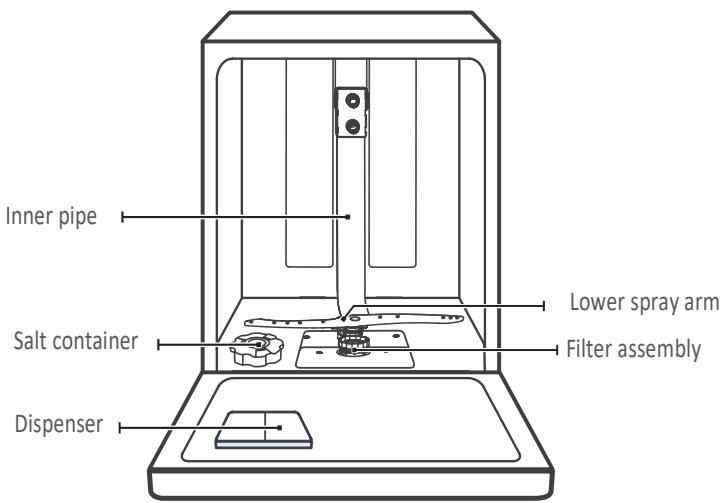
PRODUCT OVERVIEW
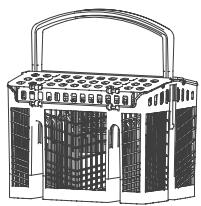
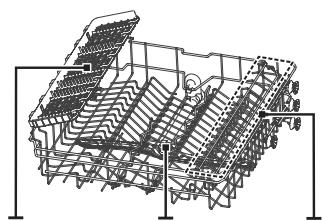
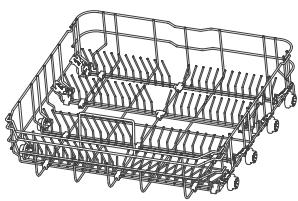
Cutlery basket
Upper basket
Lower basket
Control Panel
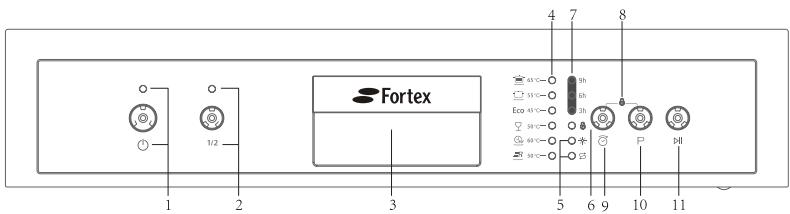
- Power On/Off button and indicator light
2.1/2 Half load function button and indicator light
- Door handle
- Program indicator lights
| 65°C | 55°C | Eco 45°C | 50°C | 90° 60°C | 50°C |
| Intensive | Universal | Eco | Glass | 90 minutes | Rapid wash |
- Rinse aid indicator light Salt indicator light
- Child lock indicator light
- Delay hour indicator lights
- Child lock buttons
- Delay button
- P Program button
- Start/Pause button
BEFORE INSTALLING YOUR DISHWASHER
Before connecting your dishwasher to the power supply, check that the voltage stated on the rating label of your appliance corresponds to the voltage in your home. The appliance must be grounded. The manufacturer is not responsible for damages that may occur as a result of usage without grounding.
WARNING: Disconnect electrical power before installing your dishwasher.
INSTALLATION INSTRUCTIONS
Your dishwasher can be installed in various locations in your kitchen as long as there is space and accessibility to connect your dishwasher to the water/ drainage and electrical supply.
Do not connect an extension lead to the appliance to avoid potential safety hazards.
Cold Water Connection
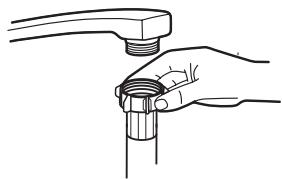
The installation of the hose should be done by professionals. Connect the supplied water supply hose to a threaded 3 / 4'' connector and make
sure that it is fastened tightly in place.
If the water pipes are new or have not been used for an extended period of time, let the water run to make sure that the water is clear. This precaution is needed to avoid the risk of the water inlet to be blocked and damage the appliance.
Connection of the Drain Hose
Insert the drain hose into a drain pipe with a minimum diameter of 4cm , or let it run into the sink, making sure to avoid bending or crimping it. The height of drain pipe must be less than 1000mm . The free end of the hose must not be immersed in water to avoid the back flow of it.
Please securely fix the drain hose in either position A or position B. The installation of the hose should be done by professionals.
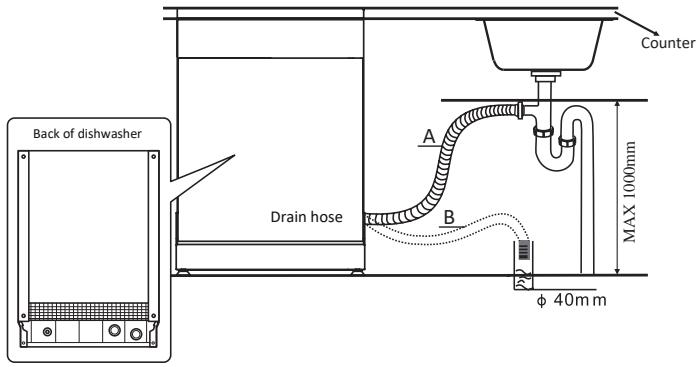
If leaks are detected, immediately shut the water supply and check the hose connections fully. Re-tighten the connections if necessary.
If for any reason you are unable to stop the leak yourself, please seek advice from a qualified plumber.
Electrical Connection
The installation of electrical equipment should be done by professionals.
- Do not use an extension cord or an adapter plug with this appliance.
- Do not, under any circumstances, cut or remove the earthing connection from the power cord.
Ensure the voltage and frequency of the dishwasher correspond to those indicated on the rating plate. Only insert the plug into an electrical socket which is earthed properly. If the electrical socket to which the appliance must be connected is not appropriate for the plug, replace the socket, rather than using a adaptors or the like as they could cause overheating and burns.
Ensure that proper earthing exists before use.
Levelling
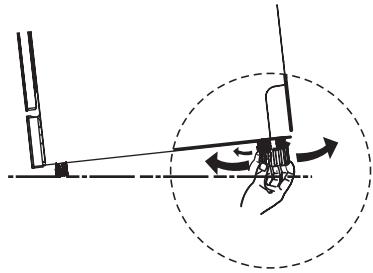
Place the dishwasher on an even, stable surface.
It is very important that the dishwasher is perfectly levelled in order to avoid the dishwasher to malfunction. You can level the dishwasher by adjusting the base feet.
BEFORE LOADING THE BASKETS
- Remove coarse food remains, e.g. bones, which may clog the filter or damage the wash pump.
- Soak any pots or pans with burnt-on food remains on the bottom then load them into the basket.
WARNING:
- Make sure that the dishes are securely in place so that they cannot tip over or obstruct the rotation of the spray arms during the washing cycle.
- Containers such as cups, bowls, glasses and pots should always be loaded with the opening facing downwards and with any cavities at an angle, to allow the water to drain out.
- Do not stack dishes.
- Do not place glasses too close together because they may knock against each other and break.
- Load large items which are most difficult to clean into the lower basket.
- Make sure that the items being washed are dishwasher-safe.
Items which are not dishwasher-safe:
Wooden dishes, pots or pans
- Handcrafted items
- Plastic dishes (except when marked dishwasher-safe)
Dishes and objects in copper, tin, zinc or brass
Aluminium dishes
-Silverware
Glass and crystal
- Decorated items
LOADING THE DISHWASHER
Loading the Upper and Lower Baskets
- The upper basket is designed to hold delicate and light items such as glasses, cups, saucers, serving bowls and shallow pans.
- The lower basket is designed to take saucepans, lids, plates, salad bowls, cutlery etc.
- Serving dishes and large lids should be arranged around the edge of the basket, ensuring that the upper spray arm can turn freely.
- Arrange items so that water can reach all surfaces.
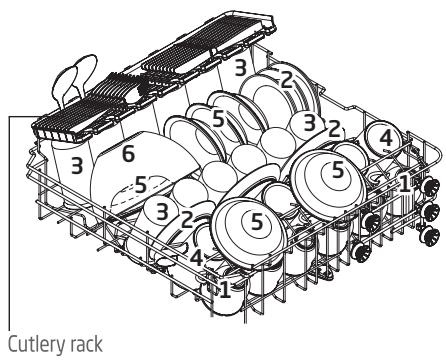
Upper basket
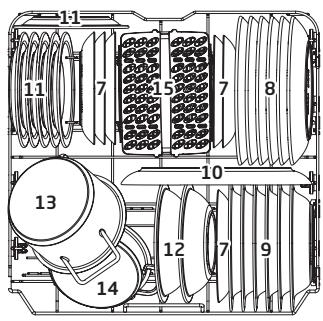
Lower basket
- Cups
- Saucers
3.lasses
- Mugs
- Dessert bowls
- Glass bowl
- Dessert plates
-
Dinner plates
-
Soup plates
- Oval platter
- Melamine dessert plates
- Melamine bowls
- Small pot
- Oven pot
- Cutlery basket
Loading the Cutlery Rack and Basket
Please place the light weight flatwares on the cutlery rack. The total weight is less than 1.5kg .
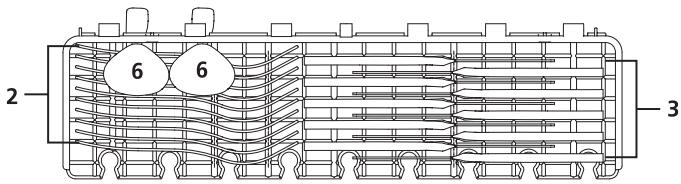
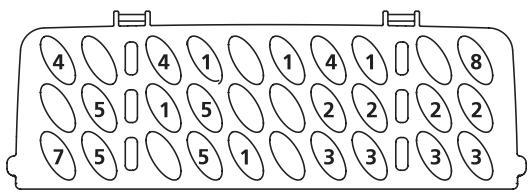
Cultery Basket
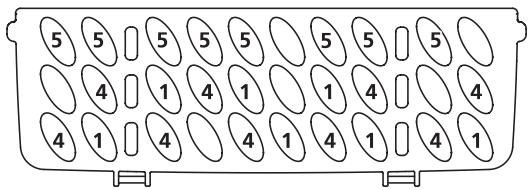
1
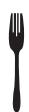
2
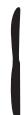
3

4

5
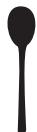
6
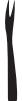
7

(
- Soup spoons
- Forks
- Knives
-
Teaspoons
-
Dessert spoons
- Serving spoons
- Serving forks
- Gravy ladles
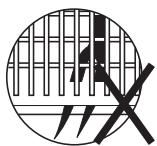
Do not let any item extend through the bottom.
Always load sharp utensils with the sharp point down!
ADJUSTING THE UPPER BASKET
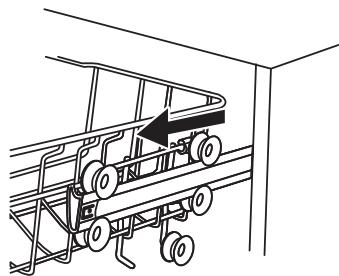
1. Pull out the upper basket.
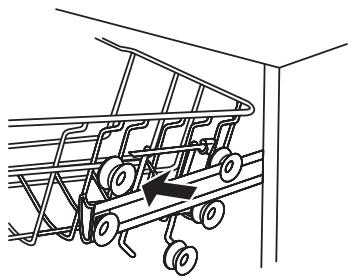
2. Remove the upper basket.
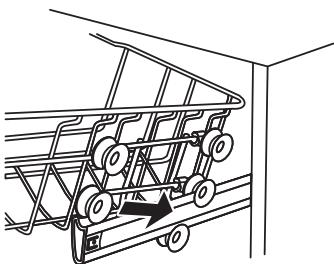
3. Re-attach the upper basket to upper or lower rollers
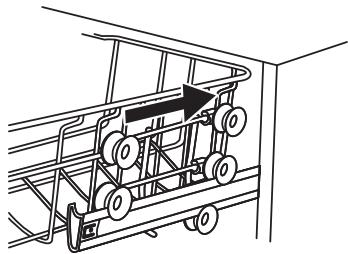
4. Push in the upper basket.
FOLDING THE CUP RACK
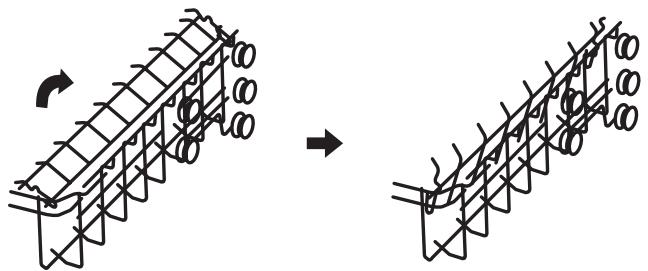
To make room for taller items in the upper basket, raise the cup rack upwards. You can then lean the tall glasses against it. You can also remove it when it is not required for use.
FOLDING SPIKES
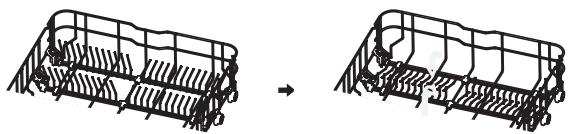
The spikes of the lower basket are used to hold plates and a platter. They can be folded down to make more room for large items.
USING THE WATER SOFTENER
The hardness of the water varies from place to place. If hard water is used in the dishwasher, deposits will be formed on the utensils. This appliance is equipped with a water softener which uses a salt specifically designed to eliminate the minerals from the water.
CAUTION:
- Only use salt specially formulated for domestic dishwashers.
- Do not use table salt as it contains insoluble substances which may damage the water softening system.
- Fill the salt container before starting the washing program. In this way, the excess saline solution will be immediately removed by the water; the prolonged presence of salt water inside the tank may lead to corrosion.
Adjusting the salt consumption
- After the dishwasher is switched on, enter the status of adjusting the salt consumption by holding down P until the indicator lights 60°C and 50°C illuminate.
- Repeatedly press P to adjust the setting to suit the water hardness.
- Press to validate settings.
| WATER HARDNESS | Indicator light(s)
illuminated | Salt consumption
(gram / cycle) |
| °dH | °fH | °Clarke | Mmol/l |
| 0-5 | 0-9 | 0-6 | 0-0.94 | 50°C | 0 |
| 6-11 | 10-20 | 7-14 | 1.0-2.0 | 60°C | 9 |
| 12-17 | 21-30 | 15-21 | 2.1-3.0 | 60°C 50°C | 12 |
| 18-22 | 31-40 | 22-28 | 3.1-4.0 | 50°C | 20 |
| 23-34 | 41-60 | 29-42 | 4.1-6.0 | 50°C 50°C | 30 |
| 35-55 | 61-98 | 43-69 | 6.1-9.8 | 50°C 60°C | 60 |
NOTE:
1°dH=1.25°Clarke=1.78°fH=0.178mmol/l
^ : German degree
^ fH: French degree
^ Clarke: British degree
Filling with salt
The salt container must be refilled when the salt warning light illuminates.
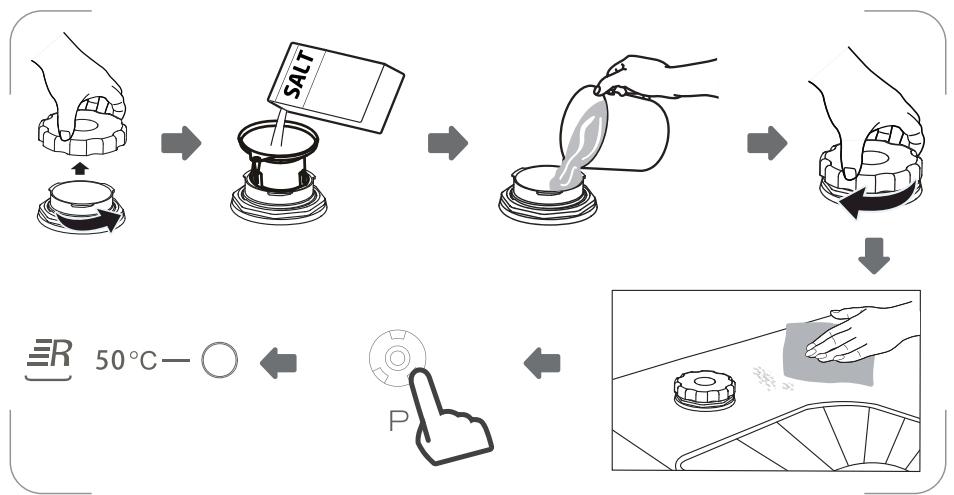
- Remove the lower basket and unscrew the cap from the salt container.
- Place the end of the funnel (supplied) into the hole and pour in about 1.5kg dishwasher salt.
- Fill the salt container to its maximum limit with water. It is normal for small amount of water to come out of the salt container.
- Screw back the cap tightly.
NOTE: Depending on how well the salt dissolves, the salt warning light may still be on even though the salt container is filled.
USING THE RINSE AND DETERGENT DISPENSERS
Function of the rinse aid
The rinse aid is released during the final rinse to prevent water from forming droplets on your dishes, which can leave spots and streaks. It also improves drying by allowing water to roll off the dishes.
WARNING! Only use branded rinse aid for dishwasher. Never fill the rinse aid dispenser with any other substances (e.g. Dishwasher cleaning agent, liquid detergent). This would damage the appliance.
Function of the detergent
The chemical ingredients that compose the detergent are necessary to remove, crush and dispense all dirt out of the dishwasher.
WARNING!
Use only detergent specifically made for dishwasher use. Keep your detergent fresh and dry.
Do not put powdered detergent into the dispenser until you are ready to wash dishes.
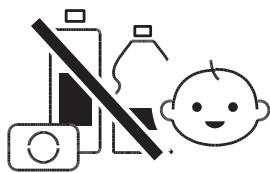
- Dishwasher detergent is corrosive! Keep it out of the reach of children.
Filling the rinse aid dispenser
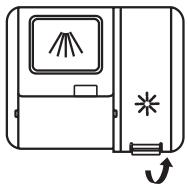
- Remove the rinse aid dispenser cap by lifting up the tab.
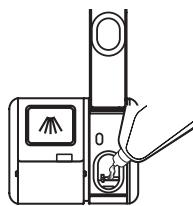
- Pour the rinse aid into the dispenser, being careful not to overfill.
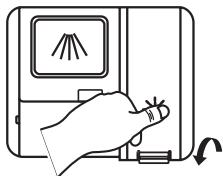
- Close the cap.
Adjusting the rinse aid dispenser
To achieve a better drying performance with limited rinse aid, the dishwasher is designed to adjust the consumption by user. Follow the below steps:
- Power on the dishwasher.
- Within 60 seconds after powering on the dishwasher, press and hold P for about 5 seconds and then press to enter the setting mode.
The rinse aid indicator light will flash.
- Repeatedly press Pto select the proper setting.
- The setting will be confirmed if there is no operationg in about 5 seconds.
| Rinse aid level | Indicator light(s) illuminated |
| d1 | 50°C |
| d2 | 60°C |
| d3 | 60°C+50°C |
| d4 | 50°C |
| d5 | 50°C+50°C |
Filling the detergent dispenser
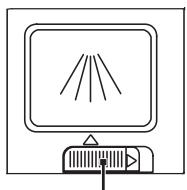
1. Slide the control to the right to open the detergent cap
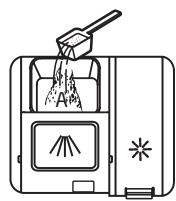
2. Add the detergent into the compartment.
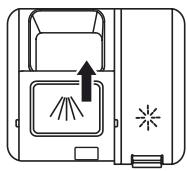
3. Close the cap by sliding it to the front and pressing it down.
WASHING PROGRAMS
| Program | Type of Dishes | Cycle Description | Detergent Pre/Main | Program duration (min) | Energy (kWh) | Water Consumption (L) | Rinse aid needed? |
| 65°C | For heavily soiled crockery with or without dried-on food | Pre-wash(50°C) Wash(65°C) Rinse Rinse Rinse(65°C) Drying | 4/16g (1 or 2 pieces) | 205 | 1.621 | 17.8 | Yes |
| 55°C | For normally soiled crockery | Pre-wash(45°C) Wash(55°C) Rinse Rinse(65°C) Drying | 4/16g (1 or 2 pieces)02 | 175 | 1.302 | 14.3 | Yes |
| Eco 45°C (*EN 60436) | Standard cycle for normally soiled loads such as pots, plates,glasses and lightly soiled pans | Wash(45°C) Rinse Rinse(60°C) Drying | 4/16g (1 or 2 pieces) | 220 | 0.923 | 11 | Yes |
| 50°C | For lightly Soiled crockery and glass | Pre-wash Wash(50°C) Rinse Rinse(65°C) Drying | 4/16g (1 or 2 pieces) | 120 | 1.100 | 14.3 | Yes |
| 90°, 60°C | For lightly Soiled crockery and glass | Wash(60°C) Rinse Rinse(65°C) Drying | 20g (1 piece) | 90 | 1.350 | 11.7 | Yes |
| 50°C | A shorter washfor lightly soiled loads that do not need drying | Wash(50°C) Rinse Rinse(45°C) | 20g | 30 | 0.751 | 11.2 | No |
NOTE:
EN 60436: This program is the test cycle. The information for comparability test is in accordance with EN 60436.
The eco programme is suitable to clean normally soiled tableware, that for this use, it is the most efficient programme in terms of its combined energy and water consumption, and that it is used to assess compliance with the EU ecodesign legislation.
-
Loading the household dishwasher up to the capacity indicated by the manufacturer will contribute to energy and water savings.
-
Manual pre-rinsing of tableware items leads to increased water and energy consumption and is not recommended.
-
Washing tableware in a household dishwasher usually consumes less energy and water in the use phase than hand dishwashing when the household dishwasher is used according to the manufacturer's instructions.
The values given for programmes other than the eco programme are indicative only.
STARTING A WASH CYCLE
- Turn the water tap on.
- Open the dishwasher door.
-
Check the filters.
-
Ensure that they are clean and properly positioned. See the section
Cleaning and Maintenance.
- Check that there is rinse aid and salt.
-
Load the dishes.
-
Ensure that the spray arms can rotate freely.
-
Add the required amount of detergent into the dispenser according to the
Washing Program chart.
- Close the dishwasher door securely.
- Press to switch on the dishwasher.
The power indicator light will illuminate.
- Repeatedly press P to select the desired washing program.
The corresponding programme indicator light will illuminate.
Delay Timer:
You can start the dishwasher cycle 3 hours, 6 hours or 9 hours later.
Press! and then repeatedly press to preset a time. The selected delay hour indicator light will illuminate.
-
If you want to perform a half load wash, press and the corresponding indicator light will illuminate.
-
When you have about or less than 6 place setting dishware to wash, you can choose this function to save energy and water.
This function can only be used with Intensive, Universal, ECO, Glass and 90 min.
- Press to start washing.
The programme indicator light will flash.
- If delay timer is set, the selected delay hour indicator light will flash.
After the delay time has elapsed the appliance will automatically operate.
- After the program has ended, the diswasher will buzz and stop.
- Wait for 15 minutes before you open the dishwasher door in order to avoid burns.
- Unload the dishes.
WARNING!
- The washing cycle will not start if the dishwasher door is left open or not properly closed.
- Do not open the door when the dishwasher is working since hot water may be ejected, which could cause scalding.
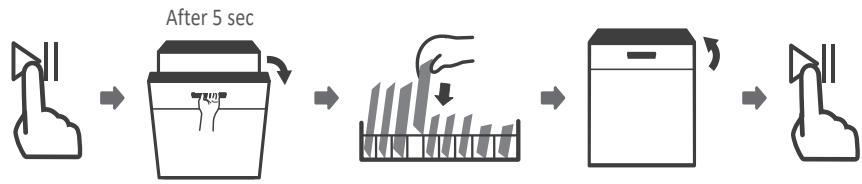
A forgotten dish can be added any time before the detergent dispenser opens. If this is the case, follow the instructions below:
- Press to pause.
- Wait for 5 seconds then open the door.
- Add the forgotten dishes.
- Close the door.
- Press .The cycle will start from the point at which it was interrupted.
Changing the program in progress

A wash cycle can only be changed if it has been running for a short time otherwise, the detergent may have already been released and the dishwasher may have already drained the wash water. If this is the case, the dishwasher needs to be reset and
the detergent dispenser must be refilled. To reset the dishwasher, follow the instructions below:
- Press to pause.
- Press and hold P for more than 3 seconds – the program will cancel. You will hear a beep.
- Repeateldy press P to select a new program.
The new number of the selected program will illuminate.
- Press to start the program.
Childlock function
The child lock function of your dishwasher prevents accidental program changes and stops children playing with the controls while the appliance is running.
To activate the function, press and P hold and simultaneously until two short beeps are heard. The lock indicator light will illuminate.
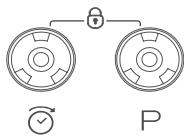
To deactivate the function, press and hold the two buttons simultaneously until a beep is heard. The lock indicator light will go out.
CLEANING AND MAINTENANCE
Always switch off and unplug the appliance before cleaning.
- To avoid penetration of water into the door lock and electrical components, do not use a spray cleaner of any kind.
- Never use abrasive cleaners or scouring pads on the outer surfaces because they may scratch the finish.
Your dishwasher cleans by spraying a mixture of clean water and detergent (underpressure) against the soiled surface of dishes. The water is pumped through a rotating spray arm, drained through a filter removing food and soiled particles and pumped back through the spray arm. Soiled water is pumped out and replaced with clean water at the end of each cycle (the number of times depends on the cycle being used).
NOTE:
Hard water conditions will adversely affect wash ability performance of your dishwasher.
Hard water conditions will also contribute to "Lime"
(white film substance) deposits and/or"Scaling" on the stainless steel surface of the dishwasher tub and heater element located in the sump underneath the removable filter screen.
To minimise these conditions, it is recommended to periodically operate/ rinse the inside of the dishwasher (empty) using 1 cup of white vinegar (at least once a week).
Cleaning the door and the door seal
Clean the door seals regularly with a soft damp cloth to remove food deposits. When the dishwasher is being loaded, food and drink residues may drip onto the sides of the dishwasher door. These surfaces are outside the wash cabinet and are not accessed by water from the spray arms.
Any deposits should be wiped off before the door is closed.
Cleaning the control panel
If cleaning is required, the control panel should be wiped with a soft damp cloth only.
Cleaning the filtering system
The filtering system in the base of the wash cabinet retains coarse debris from the washing cycle. The collected coarse debris may cause the filters to clog. Check the condition of the filters regularly and clean them if necessary under running water.
Follow the steps below to clean the filters in the wash cabinet.
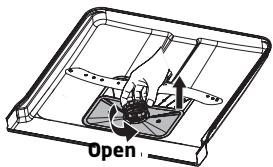
1. Hold the coarse filter and rotate it anticlockwise to unlock the filter. Lift the filter upwards and out of the dishwasher.
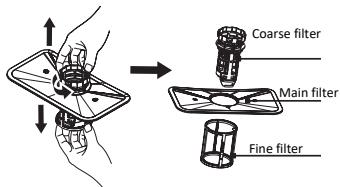
2. Pull the fine filter off the filter assembly. Detach the coarse filter from the main filter by gently squeezing the tabs at the top and pulling it away.
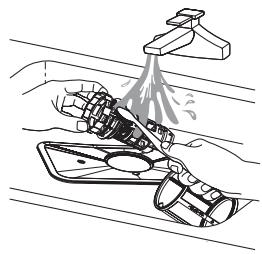
3. Rinse the filters under running water.
For a more thorough clean, use a soft cleaning brush.
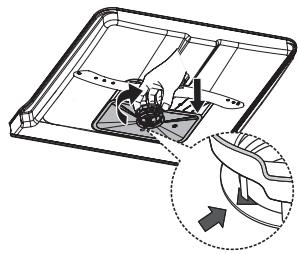
4. Reassemble the filters, replace the filter insert, and rotate clockwise to the close arrow.
WARNING!
. Do not over tighten the filters. Put the filters back in sequence securely, otherwise coarse debris could get into the system and cause a blockage.
- Never use the dishwasher without filters in place. Improper replacement
of the filters may reduce the performance level of the appliance and damage dishes and utensils.
Cleaning the spray arms
It is necessary to clean the spray arms regularly, otherwise hard water chemicals will clog the spray arm jets and bearings. To clean the spray arms, follow the instructions below:
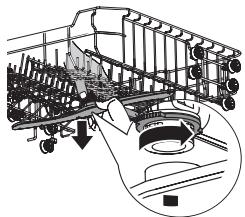
1. To remove the upper spray arm, hold the nut in the centre still and rotate the spray arm anticlockwise to remove it
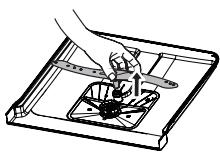
2. To remove the lower spray arm, pull out the spray arm upward.
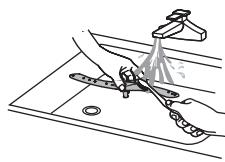
3. Wash the arms in warm soapy Water using a soft brush. Replace them after rinsing them thoroughly.
Frost precaution
Please take frost protection measures on the dishwasher in winter.
Every time after washing cycles, please operate as follows:
- Cut off the electrical power to the dishwasher at the supply source.
- Turn off the water supply and disconnect the water inlet pipe from the water valve.
- Drain the water from the inlet pipe and water valve (Use a pan to gather the water).
- Reconnect the water inlet pipe to the water valve.
- Remove the filter at the bottom of the tub and use a sponge to soak up water in the sump.
After every wash
After every wash, turn off the water supply to the appliance and leave the door slightly open so that moisture and odors are not trapped inside.
No solvents or abrasive cleaning
To clean the exterior and rubber parts of the dishwasher, do not use solvents or abrasive cleaning products. Only use a cloth with warm soapy water.
To remove spots or stains from the surface of the interior, use a cloth dampened with water and a little vinegar, or a cleaning product made specifically for dishwashers.
When not in use for a long time
It is recommend that you run a wash cycle with the dishwasher empty and then remove the plug from the mains socket, turn off the water supply and leave the door of the appliance slightly open. This will help the door seals to last longer and prevent odors from forming within the appliance.
Moving the appliance
If the appliance must be moved, try to keep it in the vertical position. If absolutely necessary, it can be positioned on its back.
Cleaning the seals
One of the factors that cause odours to form in the dishwasher is food that remains trapped in the seals. Periodic cleaning with a damp sponge will prevent this from occurring.
TROUBLESHOOTING
Before Calling For Service
Reviewing the charts on the following pages may save you from calling for service.
| Problem | Possible Causes | Possible Solution |
| Dishwasher will not start. | Fuse blown, or their cuit breaker tripped | Replace fuse or reset circuit breaker.
Remove any other appliance sharing the same circuit with the dishwasher. |
| Power supply is not turned on. | Make sure the dishwasher is turned on and the door is closed securely.
Make sure the power cord is properly plugged into the wall socket. |
| The door has not been properly closed. | Close the door securely. |
| Water not pumped from dishwasher | Kink in drain hose | Check drain hose |
| Filter clogged | Check the filters (see “Cleaning the Filtering System”). |
| Kitchen sink clogged | Check kitchen sink to make sure it is draining well. If kitchen sink is not draining, you may ask a plumber to check it. |
| Suds in the tub | Improper detergent | Use only the detergent special for dishwasher to avoid suds. If this occurs, open the door and let the sudseva porate. Add 1 gallon of cold water to the bottom of the dishwasher. Close the dishwasher door, then select any cycle. Initially, the dishwasher will drain out the water. Open the door after draining stage is complete and check if the suds have disappeared. Repeat if necessary. |
| Spilled rinse aid | Always wipe up rinse aid spills immediately. |
| Stained tub interior | Detergent with colourant maybe used. | Make sure that the detergent has no colourant. |
| White film on inside surface | Hard water minerals | To clean the interior, use a damp sponge with dishwasher detergent and wear rubber gloves. Never use any other cleaner than dishwasher detergent otherwise it may cause foaming or suds. |
| There are rust A program stains on cutlery. dishwasher | The affected items are not corrosion resistant. | Avoid washing items that are not corrosion resistant in the dishwasher. |
| mis not run after adding salt. Traces of salt have gotten into the wash cycle. | Always run a wash program without any crockery after adding salt. |
| The cap of the salt container is loose. | Check the cap is secure. |
| The dishwasher is noisy. | Dishes are rattling against each other.
The spray arms are knocking against the dishes. | Refer to “Loading the Dishwasher” to rearrange the dishes. |
| The dishes are not clean. | The dishes have not been arrange dproperly. | Refer to “Loading the Dishwasher”. |
| The washing program selectedis too gentle. | Select a more intensive program.Refer to “Washing Programs”. |
| Not enough detergent has been used or it is unsuitable. | Use more detergent or change the detergent. |
| The spray arms are clogged. | Rearrange the items so that the sprayarms can rotate freely. |
| The filters are not clean or not in the correct position. | Clean and/or position the filters correctly. |
| Cloudiness on glassware | Combination of softwater and too much detergent | Use less detergent if you have soft water and select a shorter cycle to wash the glassware and to get them clean. |
| White spots appear on dishes and glasses | Hard water area can cause limescale deposits. | Add more detergent. |
| The dishes are not quite dry. | Improper loading | Refer to “Loading the Dishwasher”. |
| The rinse aid has run out or too little is being used. | Increase or refill the amount of rinse aid. |
| Wrong program has been selected. | Choose a program with long washing time. |
Error messages
When some malfunctions occur, the corresponding indicator light will flash
quickly to warn you.
| Indicator light flashing quickly | Meanings | Possible Causes |
| 50°C | Longer inlet time. | Tap is not opened, or water inlet is restricted, or water pressure is too low. |
| 60°C + 50°C | Not reaching required temperature | Malfunction of heating element |
| 50°C | Overflow | Some dishwasher parts are leaking. |
WARNING! If overflow occurs, turn off th main water supply before calling service.
SPECIFICATIONS
| Rated voltage / frequency | 220-240V~ 50Hz |
| Rated power | 1760-2100 W |
| Water pressure | 0.04 –1 MPa |
PRODUCT INFORMATION SHEET
| Supplier's name or trade mark: CAFOM DISTRIBUTION | FORTEX |
| Supplier's address: 9 RUE JACQUARD 93310 LE PRE ST GERV AIS FRANCE |
| Model identifier: DWF4812WH, DWF4812SL |
| General product parameters: |
| Parameter | Value | Parameter | Value | |
| Rated capacity(1)(ps) | 12 | Dimensions in cm | Height | 85 |
| Width | 60 |
| Depth | 60 |
| EEI (1) | 55.9 | Energy efficiency class(1) | E |
| Cleaning performance index(1) | 1.125 | Drying performance index(1) | 1.065 |
| Energy consumption in kWh [per cycle], based on the eco programme using cold water fill. Actual energyconsumption will depend on how the appliance is used. | 0.923 | Water consumption in litres [per cycle], based on the eco programme. Actual water consumption will depend on how the appliance is used and on the hardness of the water. | 11 |
| Programme duration (1) (h:min) | 3:40 | Type | [free-standing] |
| Airborne acoustical noise emissions (1) (dB(A) re 1 pW) | 48 | Airborne acoustical noise emission class (1) | C |
| Off-mode (W) | 0.49 | Standby mode (W) | N/A |
| Delay start (W) (if applicable) | 1.00 | Delay start (W) (if applicable) | N/A |
| Minimum duration of the guarantee offered by the supplier: 2 years |
| Additional information: |
| Weblink to the supplier's website, where the information in point 6 of Annex II to Commission Regulation (EU) 2019/2022 is found: www.cafom.com |
(1) for the eco programme.
To find the model information in the product database
Click the link
https://eprel.ec.europa.eu/screen/product/dishwashers2019/430924
https://eprel.ec.europa.eu/screen/product/dishwashers2019/430926
DISPOSAL
As a responsible retailer we care about the environment. As such we urge you to follow the correct disposal procedure for the appliance and packaging materials. This will help conserve natural resources and ensure that it is recycled in a manner that protects health and the environment.
You must dispose of this appliance and its packaging according to local laws and regulations.
Because this appliance contains electronic components, the appliance and its accessories must be disposed of separately from household waste when the appliance reaches its end of life.
Contact your local authority to learn about disposal and recycling.
The appliance should be taken to your local collection point for recycling.
Some collection points accept appliance free of charge.
We apologize for any inconvenience caused by minor inconsistencies in these instructions, which may occur as a result of product improvement and development.
| CAFOM DISTRIBUTION
9 RUE JACQUARD 93310 LE PRE ST
GERVAIS, FRANCE |
| Déclaration UE de Conformité N°86202202
EU Declaration of Conformity
EU- Conformiteitsverklaring
Déclaración UE de Conformidad
Déclaração UE de Conformidade |
| Description du produit - | LAVE-VAISSELLE |
| Product Description:
Productbeschrijving:
Descripción del producto:
Descrição do produits: | DISHWASHER |
| Marque - Brand /Merk /Marca: | Fortex |
| Référence commerciale - | DWF4812WH DWF4812SL |
| Model number:
/Modelnummer /Numero de modelos /
Numero do modelos: | |
| L'objet de la déclaration spécifique ci-dessus est conforme à la législation d'harmonisation de l'Union applicable :
The object of the declaration described above is in conformity with the relevant Union harmonisation legislation:
Het hierboven beschreiben voorwerp is in overeenstemming met de desbeteffende harmonisatiewetgeving van de Unie:
El objeto de la declaración descripta anteriorsmente es conforme con la legislación de armonizacion pertinente de la Unión:
O objeto da declaração acima descripto está em conformidade com a legislacao de harmonização da União aplicável: |
Reference number
2014/30/EU
2014/35/EU
2009/125/EC
2011/65/EU & (EU) 2015/863
Title
EMC Directive (EMC)
Low Voltage Directive (LVD)
Eco design requirements for energy-related products (ErP)
RoHS
EMC:
EN 55014-1:2017+A11:2020
EN 55014-2:2015
EN IEC 61000-3-2: 2019
EN 61000-3-3:2013+A1:2019
LVD :
EN 60335-1:2012+A11:2014+A13:2017+A1:2019+A14:2019+A2:201+A15:2021
EN 60335-2-5:2015+A11:2019+A1:2020
EN 62233:2008
ErP:
(EU) 2019/2017
(EU) 2019/2022
(EU) 2021/340
(EU) 2021/341
EN 60436:2020
EN 50564:2011
This declaration of conformity is drawn up under the sole responsibility of the manufacturer.
The person responsible for this declaration is:
Fonction - Position: Market Manager Export
Place, Date / Lieu :