
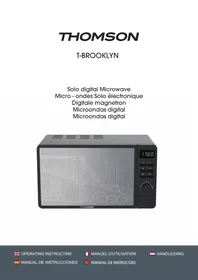
TCBI34BK - Microwave THOMSON - Free user manual and instructions
Find the device manual for free TCBI34BK THOMSON in PDF.
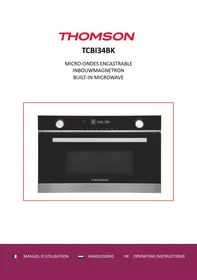



| Product type | Built-in microwave |
| Brand | Thomson |
| Model | TCBI34BK |
| Microwave power | 900 W |
| Grill power | 1100 W |
| Convection power | 2300 W |
| External dimensions (H x W x D) | 382 x 595 x 492 mm |
| Cavity dimensions (H x W x D) | 216 x 406 x 390 mm |
| Weight | 25.2 kg |
| Power supply | 230 V ~ 50 Hz |
| Microwave frequency | 2450 MHz |
| Functions | Microwave, Grill, Convection, Combination, Defrost, Auto menu |
| Control type | Rotary knobs and buttons |
| Display | LED |
| Child safety | Yes, lock |
| Turntable | Yes, glass |
| Grill rack included | Yes |
| Cleaning | Damp cloth, no steam cleaner |
| Installation | Built-in, 60 cm cabinet, min height 85 cm from floor |
Frequently Asked Questions - TCBI34BK THOMSON
User questions about TCBI34BK THOMSON
0 question about this device. Answer the ones you know or ask your own.
Ask a new question about this device
Download the instructions for your Microwave in PDF format for free! Find your manual TCBI34BK - THOMSON and take your electronic device back in hand. On this page are published all the documents necessary for the use of your device. TCBI34BK by THOMSON.
USER MANUAL TCBI34BK THOMSON
| Affichage | Micro-ondes | Gril | Convection |
| C01 | ● | ● | |
| C02 | ● | ● | |
| C03 | ● | ● | |
| C04 | ● | ● | ● |
Hotline Darty France
This product has been manufactured and sold under the responsibility of
THOMSON, and the THOMSON logo are trademarks used under license by
Etablissements Darty et Fils (S.A.S) – further information at www.thomson-brand.com.
All other products, services, companies, trademarks, trade or product names and logos referenced herein are the property of their respective owners.
IMPORTANT SAFETY INSTRUCTIONS READ CAREFULLY AND KEEP FOR FUTURE REFERENCE
WARNING
-
This appliance is intended to be used in household and similar applications such as:
-
staff kitchen areas in shops, offices and other working environments;
-farm houses; - by clients in hotels, motels and other residential type environments;
-
bed and breakfast type environments.
-
This appliance can be used by children ages from 8 years and above and persons with reduced physical, sensory or mental capabilities or lack of experience and knowledge if they have been given supervision or instruction concerning use of the appliance in a safe way and understand the hazards involved.
Children shall not play with the appliance.
Cleaning and user maintenance shall not be made by children without supervision.
- Keep the appliance and its cord out of reach of children less than 8 years.
- If the supply cord is damaged, it must be replaced by the manufacturer, its service agent or similarly qualified persons in order to avoid a hazard.
- WARNING: If the door or door seals are damaged, the oven must not be operated until it has been repaired by a competent person.
- WARNING: It is hazardous for anyone other than a competent person to carry out any service or repair operation that involves the removal of a cover which gives protection against exposure to microwave energy.
- WARNING: Liquids and other foods must not be heated in sealed containers since they are liable to explode.
EN
- WARNING: When the appliance is operated in the combination mode, children should only use the oven under adult supervision due to the temperatures generated.
- Keep a minimum free space 5 mm above the top surface of the oven.
- Only use utensils that are suitable for use in microwave ovens.
- When heating food in plastic or paper containers, keep an eye on the oven due to the possibility of ignition.
- The microwave oven is intended for heating food and beverages. Drying of food or clothing and heating of warming pads, slippers, sponges, damp cloth and similar may lead to risk of injury, ignition or fire.
- If smoke is emitted, switch off or unplug the appliance and keep the door closed in order to stifle any flames.
- Microwave heating of beverages can result in delayed eruptive boiling; therefore care must be taken when handling the container.
- The contents of feeding bottles and baby food jars shall be stirred or shaken and the temperature checked before consumption, in order to avoid burns.
- Eggs in their shell and whole hard-boiled eggs should not be heated in microwave ovens since they may explode, even after microwave heating has ended.
- Regarding the instructions of the details for cleaning the door seals, cavities, adjacent parts and the surfaces in contact with food, refer to the section "CLEANING AND MAINTENANCE" on pages 18-19 of the manual.
- The oven should be cleaned regularly and any food deposits removed.
-
Failure to maintain the oven in a clean condition could lead to deterioration of the surface that could adversely affect the life of the appliance and possibly result in a hazardous situation.
-
The microwave oven is intended to be built-in.
- The appliance must not be installed behind a decorative door in order to avoid overheating.
- This appliance is Group 2 Class B equipment.
Group 2 equipment: group 2 contains all ISM RF equipment in which radio-frequency energy in the frequency range 9kHz to 400GHz is intentionally generated and used or only used locally, in the form of electromagnetic radiation, inductive and/or capacitive coupling, for the treatment of material, for inspection/analysis purposes, or for transfer of electromagnetic energy.
Class B equipment is equipment suitable for use in locations in residential environments and in establishments directly connected to a low voltage power supply network which supplies buildings used for domestic purposes.
- After each cooking cycle, the cooling fan will continue to run for a while to ensure quick cooling and safe operation of the oven.
Metallic containers for food and beverages are not allowed during microwave cooking. - The appliance shall not be cleaned with a steam cleaner.
- The appliance is not intended to be operated by means of an external timer or separate remote-control system.
- The temperature of accessible surfaces may be high when the appliance is operating.
-
The door or the outer surface may get hot when the appliance is operating.
-
Caution: Hot Surface. The surfaces are liable to get hot during use.
EN
- Do not place the appliance in or near hot gas or electric burner, or permit to touch a heated oven or mini oven.
- During use the appliance becomes hot. Care should be taken to avoid touching heating elements inside the oven.
- WARNING: The appliance and its accessible parts become hot during use. Care should be taken to avoid touching heating elements.
Children less than 8 years of age shall be kept away unless continuously supervised.
- Do not use harsh abrasive cleaners or sharp metal scrapers to clean the oven door glass since they can scratch the surface which may result in shattering of the glass.
- A steam cleaner is not to be used.
- Care should be taken not to displace the turntable when removing containers from the appliance.
- The appliance must not be installed equal or higher than 900 mm above the floor.
- Regarding the instructions for the all necessary spaces with dimensions, the method of fixing and how the appliance is to be fixed to its support, refer to the section "INSTALLATION".
- The plug must be remained easily accessible after installation of the appliance.
- The appliance must be operated with any cabinet door open.
PRECAUTIONS TO AVOID POSSIBLE EXPOSURE TO EXCESSIVE MICROWAVE ENERGY
- Do not attempt to operate this oven with the door open since open-door operation can result in harmful exposure to microwave energy. It is important not to defeat or tamper with the safety interlocks.
- Do not place any object between the oven front face and the door or allow soil or cleaner residue to accumulate on sealing surfaces.
- Do not operate the oven if it is damaged. It is very important that the oven door closes properly and that there is no damage to the:
a) door (bent),
b) hinges and latches (broken or loosened),
c) door seals and sealing surfaces.
-
The oven should not be adjusted or repaired by anyone except qualified service personnel.
-
When you will not use the microwave oven for a long period of time, please disconnect it from the supply mains, to do this you must remove the plug from the supply outlet.
- The plug shall be the main disconnection device and shall remain accessible at all times.
- The microwave oven cannot be operated with the door open due to the safety interlocks built into the door mechanism which switch off the cooking functions when the door is opened. Operating the microwave oven with the door open could result in harmful exposure to microwave energy. It is important not to tamper with the door mechanism.
- Do not let water or any other liquid enter the oven through the ventilation slots.
- Do not place any object between the oven front face and the door or allow soil or cleaner residue to accumulate on sealing surfaces.
- Avoid using straight-sided containers with narrow necks.
- Stir any liquid before placing the container back into the microwave oven half way through the heating time.
- After heating, always allow standing time, stir or shake the contents and carefully check the temperatures before consumption.
COOKING UTENSILS
Utensils should be checked to ensure that they are suitable for use in the microwave oven.
Materials you can use in microwave oven
| Utensils | Remarks |
| Browning dish | Follow manufacturer's instructions. The bottom of browning dish must be at least 5mm above the turntable. Incorrect usage may cause the turntable to break. |
| Dinnerware | Microwave-safe only. Follow manufacturer's instructions. Do not use cracked or chipped dishes. |
| Glass jars | Always remove lid. Use only to heat food until it's warm. Most glass jars are not heat resistant and may break. |
| Glassware | Heat-resistant oven glassware only. Make sure there is no metallic trim. Do not use cracked or chipped dishes. |
| Oven cooking bags | Follow manufacturer's instructions. Do not close with metal tie. Make slits to allow steam to escape. |
| Paper plates and cups | Use for short-term cooking/warming only. Do not leave oven unattended while cooking. |
| Paper towels | Use to cover food for reheating and absorbing fat. Use with supervision for a short-term cooking only. |
| Parchment paper | Use as a cover to prevent splattering or a wrap for steaming. |
| Plastic | Microwave-safe only. Follow the manufacturer's instructions. Should be labelled “Microwave Safe”. Some plastic containers soften, as the food inside gets hot. “Boiling bags” and tightly closed plastic bags should be slit, pierced or vented as directed by package. |
| Plastic wrap | Microwave-safe only. Use to cover food during cooking to retain moisture. Do not allow plastic wrap to touch food. |
| Thermometers | Microwave-safe only (meat and candy thermometers). |
| Wax paper | Use as a cover to prevent splattering and retain moisture. |
Materials to be avoided in microwave oven
| Utensils | Remarks |
| Aluminum tray | May cause arcing. Transfer food into microwave-safe dish. |
| Food carton | May cause arcing. Transfer food into microwave-safe dish. |
| Metal or metal-trimmed utensils | Metal shields the food from microwave energy. Metal trim may cause arcing. |
| Metal twist ties | May cause arcing and could cause a fire in the oven. |
| Paper bags | May cause a fire in the oven. |
| Plastic foam | Plastic foam may melt or contaminate the liquid inside when exposed to high temperature. |
| Wood | Wood will dry out when used in the microwave oven and may split or crack. |
NOTES:
- Care should be taken when removing utensils or the glass turntable, as they may become hot during cooking.
- Only use a thermometer that is designed for use in the microwave oven.
- Ensure the turntable is in place when you operate the oven.
OVEN OVERVIEW
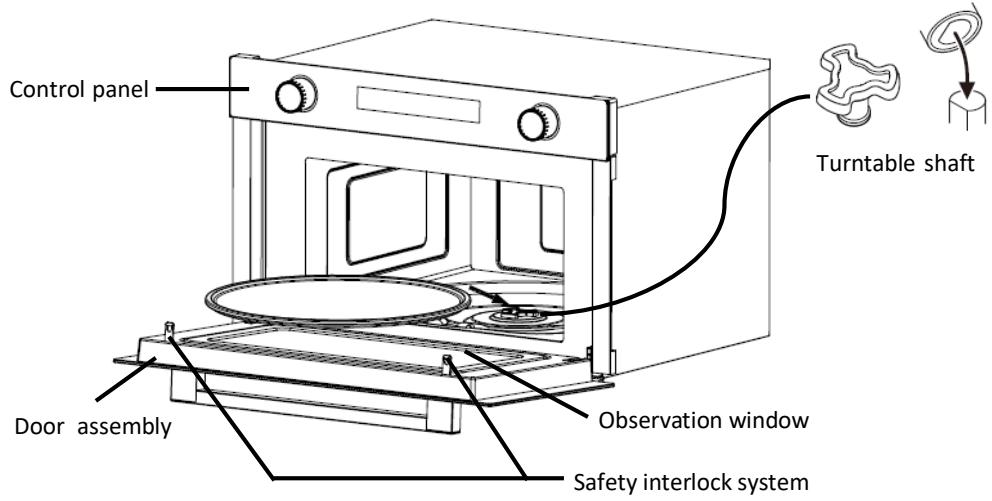
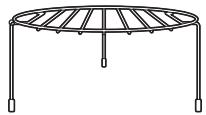
Grill rack
Do not place this grill rack in the oven when using the microwave function.
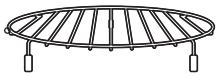

- Never place the glass tray upside down. The glass tray should never be restricted and it should rotate freely.
- Both glass tray and turntable ring must always be used during cooking.
- All food and containers of food must always be placed on the glass tray for cooking.
- If glass tray or turntable ring cracks or breaks, stop using your microwave oven and contact your nearest authorized service centre.
urntable ring
INSTALLATION
Preparation
Remove all packing material and accessories. Examine the oven for any damage such as dents or broken door. Do not install the microwave oven if it is damaged.
Cabinet: Remove any protective film found on the microwave oven cabinet surface
Do not remove the light brown Mica cover that is attached to the inside of the oven cavity to protect the magnetron.
- This oven is intended for built-in use only. It is not intended for counter-top use or for use inside a cupboard.
- The appliance can be installed in a 60cm wide wall-mounted cupboard (at least 55cm deep and 85cm off the floor).
- The appliance is fitted with a plug and must only be connected to a properly installed earthed socket.
- The mains voltage must correspond to the voltage specified on the rating label.
- Adapters, multi-way strips and extension leads must not be used. Overloading can result in a risk of fire.
- Place the oven as far away from radios and TV as possible.
Operation of microwave oven may cause interference to your radio or TV reception. - WARNING: Do not install the oven over a range cooktop or other heat-producing appliance. If installed near or over a heat source, the oven could be damaged and the warranty would be void.
Build-in furniture
The build-in cabinet must not have a rear wall behind the appliance and must have a minimum installation height of 850 mm . Do not cover ventilation slots and air intake points.
The cabinet into which the oven fitted must be heat-resistant up to 95°C .
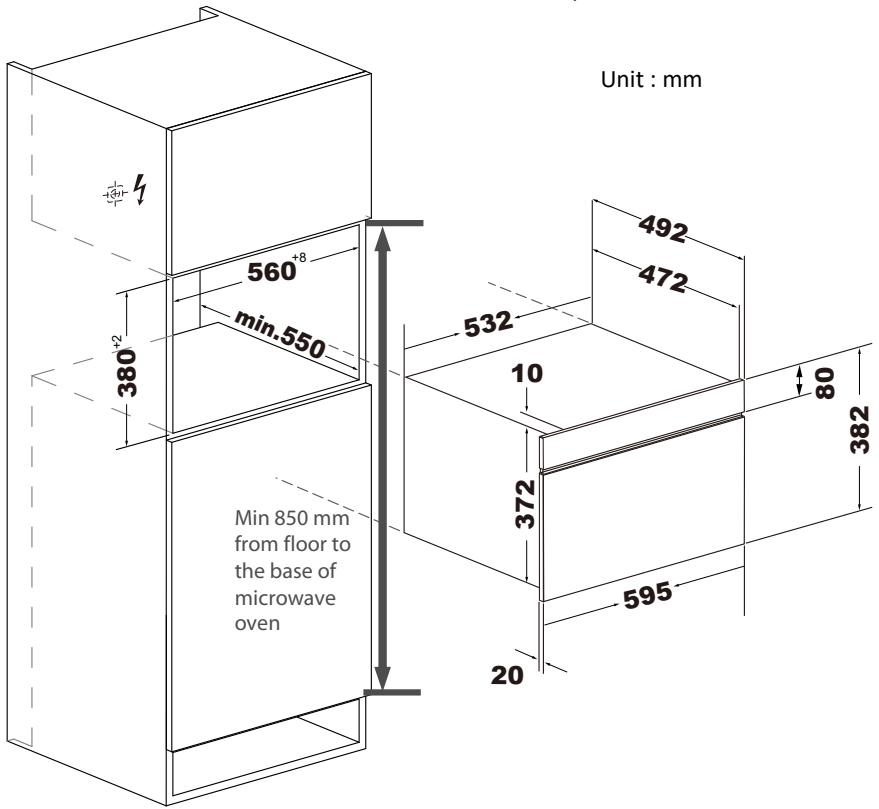
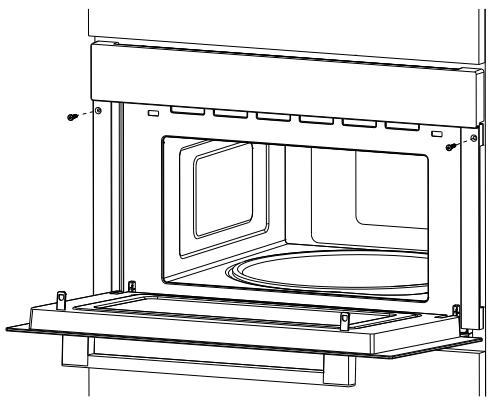
Carefully push the oven into the cabinet, making sure that it is in the centre. Do not trap or kink the power cord.
Open the door and secure the oven to the cabinet using the screws.
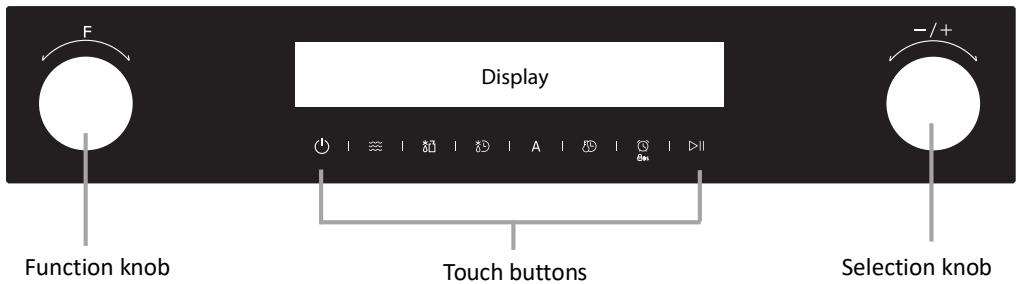
CONTROL PANEL

Power (Pressing it once can return to standby mode during the setting and cooking process.)

Microwave cooking

Defrosting by Weight

Defrosting by time

Auto menu

Clock/Time/Temp./Watt./Weight

Kitchen timer/Child lock 3S

Start/Pause
OPERATION
Setting the Clock
- Press F to set the clock in 24-hour cycle.
The hour digits will flash. - Turn the right knob to adjust the hour digits, the input hour should be a 24-hour time value.
- Press L , the minute digits will flash.
- Turn the right knob to adjust the minute digits.
- Press to confirm the setting.
Kitchen Timer
You can use your microwave oven as a kitchen timer.
NOTE: The kitchen timer does not start or stop the microwave oven.

- Press A35 . The display will show "00:00".
- Turn the right knob to enter the correct time.

- Press to confirm setting.
4.When the set time has elapsed, the oven will beep.
Microwave Cooking
- In standby state, press 串串串串串串
- The display will show "900W", "01:00".
- Turn the right knob to adjust the cooking time from 5 seconds (00:05) to 90 minutes (90:00).
- Repeatedly press to select a microwave power level (900W, 700W, 500W, 300W or 100W).
- Press to start cooking.
NOTE: The cooking time range of the 900W microwave power is 00:05-30:00 minutes.
Grill Cooking
- Turn the left knob until the display shows "G01".
- Turn the right knob to adjust the cooking time from 5 seconds (00:05) to 90 minutes (01:30hr).
- Press to start cooking.
NOTE: After half of the set grill time, the oven will beep to remind you to turn the food over in order to have a better effect of grilling food. After food is turned over, close the oven door then press | | to continue cooking. If no operation, it will continue working.
Combination Cooking
This function allows you to combine microwave, grill and convection cooking on four different settings.
- Turn the left knob to select the desired combination mode: C01, C02, C03 or C04.
- Turn the right knob to adjust the cooking time from 5 seconds (00:05) to 90 minutes (01:30hr).
- Press to start cooking.
| Display | Microwave | Grill | Convection |
| C01 | ● | ● | |
| C02 | ● | ● | |
| C03 | ● | ● | |
| C04 | ● | ● | ● |
Convection Cooking
The convection cooking can let you cook the food as a traditional oven. Microwave is not used. It is recommended that you should preheat the oven to the appropriate temperature before placing the food in the oven.
During convection cooking, hot air is circulated throughout the oven cavity to brown and make crisp foods quickly and evenly. This oven can be programmed for ten different cooking temperatures (130°C ~ 220°C).
Convection with preheat
- Turn the left knob until the display shows "160°C".
- Turn the right knob to select the cooking temperature.
-
Press to start preheating.
-
When the preheating temperature is reached, the oven will sound. The preheat icon will be displayed.
-
Open the door and then put the food into the oven. Close the door.
- Turn the right knob to set the cooking time.
- Press to start cooking.
Convection without preheat
- Turn the left knob until the display shows "160°C".
-
Turn the right knob to select the cooking temperature.
-
Press F and the display will show "00:00".
- Turn the right knob to set the cooking time from 5 seconds (00:05) to 90 minutes (01:30hr).
(Press L again to switch to temperature setting if you want.)
- Press to start cooking.
Defrosting by Weight
You can use the oven to defrost food based on the weight selected. The defrosting time and power level are automatically set once the weight is entered. The frozen food weight ranges from 0,10 kg to 2,00 kg.
- Press Δ once. The display will show "0,10kg".
- Repeatedly press or turn the right knob to select the desired food weight.
- Press | to start defrosting.
NOTE: During defrosting, the oven will beep to remind you to turn the food over. After food is turned over, close the oven door then press | | to continue defrosting. If there is no operation, it will continue working.
Defrosting by Time
You can also choose to defrost food by entering the defrost time yourself.
- Press *Δ . The display will show "01:00".
- Turn the right knob to select the desired defrosting time from 5 seconds (00:05) to 90 minutes (01:30hr).
- Press to start defrosting.
NOTE: During defrosting, the oven will beep to remind you to turn the food over. After food is turned over, close the oven door then press | | to continue defrosting. If there is no operation, it will continue working.
Child Lock
The child lock prevents the oven from being operated unintentionally or by unsupervised children.
To set the child lock, press and hold for about 3 seconds. A long beep will sound and the symbol will appear on the display. In the lock state, all buttons are disabled.
To cancel the child lock, press and hold for about 3 seconds. A long beep will sound and the symbol will disappear from the display.
Auto Cook
- In standby state, press A . The display will show "P01".
- Repeatedly press A or turn the right knob to select the desired menu from the table below.
- Press L
- Turn the right knob to select the food weight.
- Press to start cooking.
| Menu | Weight | Display | Power |
| P01 Potato | 1 (about 230 g) | 1 | 900W |
| 2 (about 460 g) | 2 | ||
| 3 (about 690 g) | 3 | ||
| P02 Meat | 150 g | 0,15 kg | 900W |
| 300 g | 0,30 kg | ||
| 450 g | 0,45 kg | ||
| 600 g | 0,60 kg | ||
| P03 Fish | 150 g | 0,15 kg | 700W |
| 250 g | 0,25 kg | ||
| 350 g | 0,35 kg | ||
| 450 g | 0,45 kg | ||
| 650 g | 0,65 kg | ||
| P04 Vegetable | 150 g | 0,15 kg | 900W |
| 350 g | 0,35 kg | ||
| 500 g | 0,50 kg | ||
| P05 Beverage | 1 cup (240 ml) | 1 | 900W |
| 2 cups (480 ml) | 2 | ||
| 3 cups (720 ml) | 3 | ||
| P06 Pasta | 50 (with 450 ml cold water) | 0,05 kg | 700W |
| 100 (with 800 ml cold water) | 0,10 kg | ||
| 150 (with 1200 ml cold water) | 0,15 kg | ||
| P07 Popcorn | 100 g | 0,10 kg | 900W |
| P08 Pizza | 200 g | 0,20 kg | Convection 210°C |
| 300 g | 0,30 kg | ||
| 400 g | 0,40 kg | ||
| P09 Cake | 475 g | 0,47 kg | Preheat at 180°C |
| P10 Chicken | 1100 g | 1,10 kg | Convection with preheat 220°C |
| P11 Chocolate chip cookies | 210 g | 0,21 kg | Preheat at 180°C |
NOTE:
- Peel the potatoes and cut them into equal-sized pieces before cooking.
- When you select the chicken menu, do not put chicken in the oven first and please follow steps below.
a. Press for the oven to preheat to 220°C .
b. When the temperature inside the oven has been reached, the oven will beep.
c. Open the door and put chicken in the oven.
d. Close the door and press to start cooking.
Foods
Forbidden foods
If you choose a cooking method using microwaves, you should never:
- Attempt to fry food - it is impossible to control the temperature of the oil and other fats-fire-risk.
- Attempt to cook or warm up eggs in their shells, hard-boiled eggs with or without their shells or snails - they may explode.
- Attempt to cook food in an intact shell (e.g. chestnuts) or hard skin (tomatoes, potatoes, sausages) - always make a slit.
Food temperatures
The action of microwaves is such that only the food is heated. The container may, therefore, remain cold or cool while the food that it contains is burning hot.
To avoid any risk of burning, always stir before serving and check the temperature carefully before serving - especially to children.
Shake feeding bottles well and try a few drops on the back of your wrist to check the temperature.
Preparing food for cooking
Before warming feeding bottles and small pots, remove teats and covers.
Remember to cover the food in order to:
- avoid any splashing of the oven cavity,
- retain sufficient moisture for cooking.
Heating liquids
When heating liquids, a sudden overflow may occur when you take the container to remove it from the appliance. In fact, when the temperature reaches boiling point, steam tends to remain trapped in the liquid until it is disturbed.
To avoid this superheating effect and the consequent risk of scalding, always place a plastic spoon in the liquid to be heated.
A container can easily be tested for microwave "transparency":
Place the empty container on the turntable together with a glass of water and run the oven for one minute at maximum power.
After one minute:
- if the container is cold, it is "transparent" and can be used for microwave cooking.
- if the container is warm or hot it is absorbent and must not be used for microwave cooking.
CLEANING AND MAINTENANCE
Before any cleaning or maintenance operation, disconnect the microwave oven from the mains supply and allow it to cool to room temperature.
General Advice
Frequent cleaning prevents the formation of smoke and bad odours during cooking and also sparking in the oven cavity and around the door seal.
Do not let food deposits or grease accumulate inside the oven cavity or on the door seal.
Make sure that the waveguide cover is kept clean at all times. Should food deposits or grease be allowed to accumulate on the cover, sparking will occur and may damage your oven invalidating the warranty.
Oven Door
Remove any food deposits and grease between the door seal and oven cavity using a damp cloth, it is important to keep this area clean at all times.
Interior Walls
Remove any grease splashes from the oven cavity walls with a damp cloth.
The door seal and oven cavity have to be particularly well cleaned to ensure the door will close properly and to avoid sparking between the oven cavity and door assembly.
Do not use abrasive products such as scouring pads which will damage the surfaces of the oven cavity and door.
Outer Surfaces
To clean the outside surface, use a damp cloth.
Avoid using abrasive products such as scouring pads that may damage the cosmetic surfaces. Make sure water does not seep into the ventilation slots.
Accessories should be washed in warm soapy water by hand.
CAUTION:
Some waveguide covers can be easily damaged, take care when cleaning.
Do not wash accessories in a dishwasher.
Cleaning surfaces that come into contact with food
For hygiene safety the glass tray should be cleaned regularly as it may come into contact with food.
It should be cleaned with warm soapy water and dried thoroughly.
If the inside of the oven cavity and door seal are not kept perfectly clean, there is a danger of damage due to sparking inside the oven cavity invalidating the warranty. Never scrape the oven cavity walls with sharp objects.
SPECIFICATIONS
| Rated voltage and frequency | 230V~ 50Hz | |
| Rated input power | (Microwave) | 1450W |
| (Grill) | 1100W | |
| (Convection) | 2300W | |
| Rated output power (Microwave) | 900W | |
| Microwave frequency | 2450MHz | |
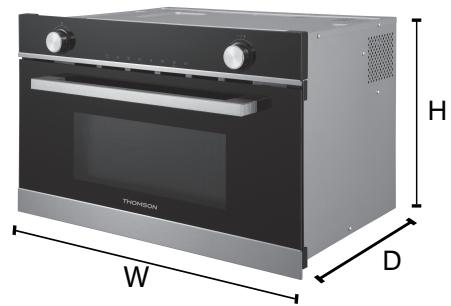
| Dimensions (outer dimensions) | (H) 382 x (W) 595 x (D) 492 mm |
| Dimensions (cavity / inner dimensions) | (H) 216 x (W) 406 x (D) 390 mm |
| Weight (approx.) | 25.2 kg |
TROUBLESHOOTING
| Normal Phenomena | |
| Microwave oven interfering TV reception | Radio and TV reception may be affected when the microwave oven is operating. It is similar to the interference of small electrical appliances, like mixer, vacuum cleaner and electric fan. It is normal. |
| Dim oven light | During low power microwave cooking, the oven light may become dim. It is normal. |
| Steam accumulating on door, hot air out of vents | During cooking, steam may come out of food. Most of steam will escape from the vents. But some of them may accumulate on positions like the oven door. It is normal. |
| Oven operated accidentally with no food in. | It is forbidden to operate the appliance without any food inside. Failure to do so can cause damage to the interior of the oven. |
| Problem | Possible Cause | Solution |
| Oven cannot be operated. | Power cord not plugged in tightly. | Unplug the appliance then plug it in again after 10 seconds. |
| There is something wrong with the mains socket. | Test the mains socket by plugging another appliance in. | |
| Oven does not heat up. | Door not closed well. | Close door well. |
| Glass tray makes noise when microwave oven operates. | Dirty roller and oven bottom. | Refer to ‘CLEANING AND MAINTENANCE’ to clean dirty parts. |
| Glass tray is not positioned properly. | Position the glass tray properly. |
DISPOSAL
As a responsible retailer we care about the environment. As such we urge you to follow the correct disposal procedure for the appliance and packaging materials. This will help conserve natural resources and ensure that it is recycled in a manner that protects health and the environment.
You must dispose of this appliance and its packaging according to local laws and regulations. Because this appliance contains electronic components, the appliance and its accessories must be disposed of separately from household waste when the appliance reaches its end of life.
Contact your local authority to learn about disposal and recycling.
The appliance should be taken to your local collection point for recycling. Some collection points accept appliance free of charge.
We apologize for any inconvenience caused by minor inconsistencies in these instructions, which may occur as a result of product improvement and development.
- HOTLINE DARTY FRANCE
- IMPORTANT SAFETY INSTRUCTIONS READ CAREFULLY AND KEEP FOR FUTURE REFERENCE
- WARNING
- EN
- PRECAUTIONS TO AVOID POSSIBLE EXPOSURE TO EXCESSIVE MICROWAVE ENERGY
- COOKING UTENSILS
- NOTES
- OVEN OVERVIEW
- INSTALLATION
- PREPARATION
- BUILD-IN FURNITURE
- OPERATION
- SETTING THE CLOCK
- KITCHEN TIMER
- MICROWAVE COOKING
- GRILL COOKING
- COMBINATION COOKING
- CONVECTION COOKING
- CONVECTION WITH PREHEAT
- CONVECTION WITHOUT PREHEAT
- DEFROSTING BY WEIGHT
- DEFROSTING BY TIME
- CHILD LOCK
- AUTO COOK
- NOTE
- FOODS
- FORBIDDEN FOODS
- FOOD TEMPERATURES
- PREPARING FOOD FOR COOKING
- HEATING LIQUIDS
- CLEANING AND MAINTENANCE
- GENERAL ADVICE
- OVEN DOOR
- INTERIOR WALLS
- OUTER SURFACES
- CAUTION
- CLEANING SURFACES THAT COME INTO CONTACT WITH FOOD
- SPECIFICATIONS
- TROUBLESHOOTING
- DISPOSAL
Brand : THOMSON
Model : TCBI34BK
Category : Microwave