DMPL0140SW - 942 150 332 - Hob ELECTROLUX - Free user manual and instructions
Find the device manual for free DMPL0140SW - 942 150 332 ELECTROLUX in PDF.


| Product type | Integrated extractor hood (cooktop extraction system) |
| Brand | ELECTROLUX |
| Model | DMPL0140SW (942 150 332) |
| Power supply | 230 V / 50 Hz, 221 W max |
| Motor power | 221 W |
| Number of speeds | 2 (50% and 100%) |
| Delayed shut-off function | Yes, 15 minutes |
| Lighting | Integrated LED, automatic activation when opened |
| Control type | Touch |
| Grease filter | Metal filter (multifunction), dishwasher-safe (2 times per week) |
| Charcoal filter | Optional (type AKFLL80), can be regenerated in the oven at 200°C every 2-3 months |
| Collection tray capacity | 0.5 liter |
| Extraction mode | External exhaust or recirculation (depending on installation) |
| Safety | Electronic lock in cleaning mode, protection against gas backflow |
| Installation | Must be carried out by a qualified professional |
| Included accessories | Metal filter, collection tray, mounting kit |
Frequently Asked Questions - DMPL0140SW - 942 150 332 ELECTROLUX
User questions about DMPL0140SW - 942 150 332 ELECTROLUX
0 question about this device. Answer the ones you know or ask your own.
Ask a new question about this device
Download the instructions for your Hob in PDF format for free! Find your manual DMPL0140SW - 942 150 332 - ELECTROLUX and take your electronic device back in hand. On this page are published all the documents necessary for the use of your device. DMPL0140SW - 942 150 332 by ELECTROLUX.
USER MANUAL DMPL0140SW - 942 150 332 ELECTROLUX
These operating and installation instructions contain important information which must be observed in order to ensure the safe and reliable operation of the DMPL0140SW extractor hood. Please store them in a safe place for future reference. These operating instructions apply to several versions of the appliance. They may contain descriptions of certain features not found on your model. The DMPL0140SW extractor hood must not be used by persons (incl. children) with impaired physical or mental capabilities or persons who lack experience and/or knowledge of how to use it. Children must be supervised to ensure that they do not play with the appliance.
Intended use
The DMPL0140SW extractor hood may only be used to extract kitchen vapours from cooking appliances in private households. Any other use will be deemed to be improper. Improper use of the hood may pose a danger to persons and objects.
Installation
The device may only be installed and connected by an authorised technician observing all relevant regulations of the power supply companies and the building regulations of the federal states. During installation, observe the relevant instructions! Damaged appliances may not be put into operation. Defective parts must be replaced with genuine ELECTROLUX parts. Repairs should only be carried out by authorised technical staff.
Danger of intoxication!
If the DMPL0140SW extractor hood is operated in extraction mode at the same time as other room-air-dependent fire appliances (e.g., wood, gas, oil or coal-fired appliances) in the same room, lethal combustion gases may be directed back into the room due to the resulting negative pressure. For this reason, you
must ensure a sufficient air supply at all times! The negative pressure in the room must not exceed 4 Pa (0.04 mbar).
Fire hazard!
The DMPL0140SW extractor hood must never be operated without the grease filter and must not be left unattended. Filters that are overfilled with grease can pose a fire hazard! Never leave the extractor hood unattended when deepfrying! Remember to clean out the filters regularly. The use of gas cookers and flambéing are forbidden with the extractor hood.
Preparing for use
The extractor hood model complies with the relevant safety regulations for kitchen appliances in private households. The requirements regarding the installation location are described in the user documentation supplied with the appliance. If you have any doubts as to whether your intended installation location meets the requirements, please contact our service department.
Transport, unpacking, installation
Condensation may occur if the appliance is brought into the installation site from a cold environment. Please wait until the appliance has adjusted to the temperature and is completely dry before operating it. The acclimatization period depends on the temperature difference and the type and design of the appliance. However, it should be at least 12 hours.
Connecting the power supply
Check that the rated voltage indicated on the appliance matches the mains voltage in your area. Connection to the incorrect voltage will damage or destroy the appliance.
Before switching on the appliance, check that all cables and lines are properly fitted and undamaged. Make sure in particular that the cables are not kinked,
that they are not pulled too tightly around corners and that no objects are resting on them. Also make sure that all plug connections are securely inserted. Faulty shielding or wiring poses a health hazard (electric shock) and can destroy other appliances. Appliances with mains plugs are fitted with a safety-tested mains cable for the respective country of use and may only be connected to a correctly earthed safety socket. Otherwise, there is a risk of electric shock. Make sure that the socket on the appliance or the domestic safety socket is easily accessible so that the mains cable can be unplugged from the socket in an emergency or during servicing and maintenance work.
Risk of electric shock!
Do not clean the hood with a steam cleaner or water pressure cleaner. The hood must be disconnected from the power supply prior to cleaning.
Design
From an aesthetic perspective, the extractor hood may differ from the diagrams in these operating instructions. However, the operating instructions, maintenance, cleaning and installation are always the same.
General method of operation
The new DMPL0140SW recess ventilator from ELECTROLUX features a vapour opening located in the centre between the oven's two hot plates.
Below the vapour opening, the top of which is covered by a permeable grid, is an extraction duct, which is connected to an exhaust fan via an exhaust air channel system, which extracts the vapours which arise during cooking through the grid away from the hot plate.
The model offers effective extraction with simple handling and is available in the "internal motor exhaust air", "internal motor recirculating air" and "external motor" fan versions.
Product description
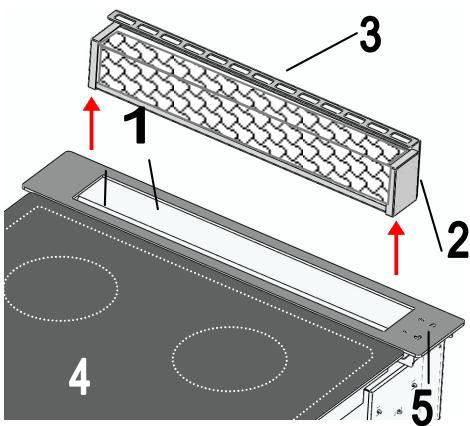
1 Recess extractor / ambient light
2 Metal filter
3 Filter handle
4 Hob (see separate instructions)
5 Control element
Operation
The hood is operated via touch controls (some pressure required). The opening of the vent (extraction opening) is controlled manually. When the vent is moved downwards, the electronics are connected to the electricity supply. The integrated electromagnet is activated and keeps the vent down.
The indirect LED illumination is switched on automatically.
The closing of the vent is controlled electrically by pressing the vent symbol. Once the vent is closed, the hood no longer consumes any energy. (0 watt standby)
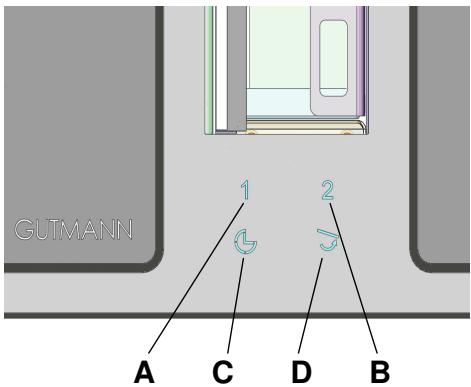
A Setting 1
When this symbol is pressed, the fan runs at 50% .
B Setting 2
When this symbol is pressed, the fan runs at full speed.
C After-run
When this symbol is pressed, the after-run is activated. The motor switches from setting 2 back to setting 1 and switches off automatically after 15 minutes.
D Closing the vent
When this symbol is pressed, the electricity supply to the hood is disconnected and the vent closes automatically.
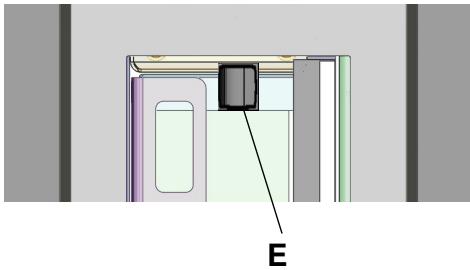
E LED illumination
When the vent is opened, the LED illumination switches on automatically. This can be switched off at any time using a separate switch.
Cleaning and care
Cleaning the surfaces
Danger due to electric shock! Disconnect the extractor hood from the power supply by pulling the plug out of the socket or by switching off the fuse. During cleaning, make sure that no water penetrates the device or comes into contact with the electronic components.
Timely cleaning of the surface saves the later laborious removal of stubborn contamination. Only use conventional detergents or universal cleaning agents for cleaning suitable for stainless steel/ aluminium. Never use abrasive cleaning agents or steel wool. After cleaning the hood, treat the stainless steel surfaces with a stainless steel care product.
These grease deposits occur for physical reasons and are not due to a malfunction of the hood. Please clean here regularly to avoid severe soiling.
Note: Do not use alcohol (spirits) on plastic surfaces, as dull spots may result.
Metal filter
Removing the filter
Fire hazard! Grease residues decrease the extractor's performance and increase the fire hazard. The metal filter must be cleaned regularly to prevent a fire hazard. The grease filters must be cleaned twice a week.
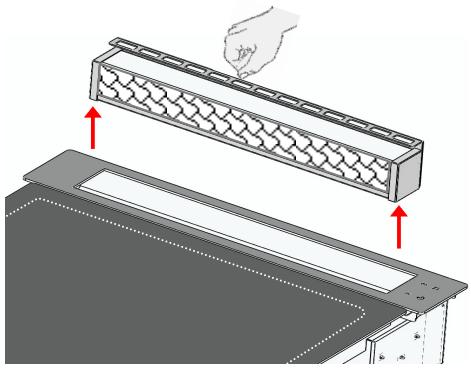
Cleaning the grease filter
The metal filter is best cleaned in the dishwasher or with a mild dishwashing agent. The manufacturer accepts no liability whatsoever for any discolouration caused by the use of aggressive dishwashing agents. Temperatures exceeding 55 degrees must be avoided in all cases.
Caution: Do not use multiphase cleaning agents. Do not clean the filter in an industrial washing machine. Cleaning with aggressive agents such as petrol, acetone, trichlorethylene, etc., will destroy the filters!
Activated carbon filter
Regenerative activated carbon filters
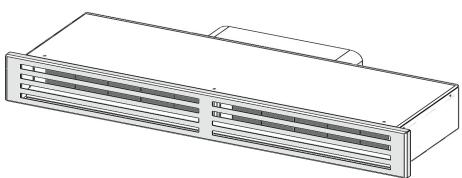
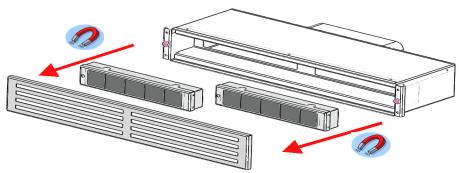
The activated carbon filters are behind the extraction grid and can be removed by simply pulling them forwards.
The activated carbon filters can be regenerated in a preheated oven (200^) ; the process takes 2 hours.
Note! Risk of burning!
- Do no regenerate the activated carbon filters in a microwave oven.
- The oven's pyrolysis function must never be used to regenerate the activated carbon filter.
- The activated carbon filters must be cleaned with a damp cloth before their regeneration.
The activated carbon filters must only be taken out of the oven once they have cooled down.
Regenerating the filters in the oven may cause unpleasant smells in the oven! The frequency at which the activated carbon filter honeycomb needs to be regenerated depends on the intensity of the cooking. Nevertheless, the activated carbon filters should always be regenerated every 2-3 months. Moreover, the activated carbon filter must be cleaned with a damp cloth every 2-3 months.
Faults
Please contact our service department immediately in the following cases:
- If the extractor hood creates unusual noises and you are unable to detect any faults after checking the extraction air line.
- If you discover, for example, by hearing strange noises, that the motor is faulty or defective.
- If the switches are not working properly.
- If the vent of the ventilation slit does not open or close properly.
Disposal

Packaging
The packaging for the extractor hood is recyclable. Cardboard and polyethylene film (PE) are used as packaging materials. These materials must be disposed of in an environmentally compatible manner in accordance with local regulations.
Extractor hood
Your local authority will also be happy to advise you on the environmentally sound disposal of old household appliances.
Environmental information
All models manufactured by
ELECTROLUX are identified in accordance with European Directive 2002/96/EC on waste electrical and electronic equipment (WEEE). This directive specifies the framework for the EU-wide return and disposal of used appliances. Please ask your dealer for information about current disposal methods.
We reserve the right to make technical changes.