
ALLEGRO COMBI - Coffee machine SEB - Free user manual and instructions
Find the device manual for free ALLEGRO COMBI SEB in PDF.



| Product type | Espresso and filter coffee maker |
| Brand | SEB |
| Model | ALLEGRO COMBI |
| Dimensions (approx.) | 30 x 25 x 35 cm |
| Weight (approx.) | 3 kg |
| Power supply | 220-240 V ~ 50/60 Hz |
| Power (approx.) | 1000 W |
| Filter coffee reservoir capacity | 1.2 L (approx. 10 cups) |
| Espresso boiler capacity | 300 ml max (2-4 cups) |
| Main functions | Espresso, cappuccino, filter coffee with "Stop and Serve" function |
| Heating system | Pressurized boiler for espresso, hot plate for filter coffee |
| Pressure (approx.) | 15 bars |
| Steam wand | Swivel steam wand for frothing milk |
| Portafilter | Espresso portafilter with basket for 2 or 4 cups |
| Filter coffee filter | Swivel filter holder with No. 4 paper filter |
| Safety | Anti-pressure device, automatic shut-off, safety lid |
| Materials | Plastic body, non-stick hot plate, glass carafe |
| Maintenance and cleaning | Removable parts dishwasher safe (except boiler); regular descaling recommended |
| Spare parts and repairability | Some consumable parts (filter, gasket) available at SEB authorized centers |
| General information | Household use only; ensure use in accordance with safety instructions |
Frequently Asked Questions - ALLEGRO COMBI SEB
User questions about ALLEGRO COMBI SEB
0 question about this device. Answer the ones you know or ask your own.
Ask a new question about this device
Download the instructions for your Coffee machine in PDF format for free! Find your manual ALLEGRO COMBI - SEB and take your electronic device back in hand. On this page are published all the documents necessary for the use of your device. ALLEGRO COMBI by SEB.
USER MANUAL ALLEGRO COMBI SEB
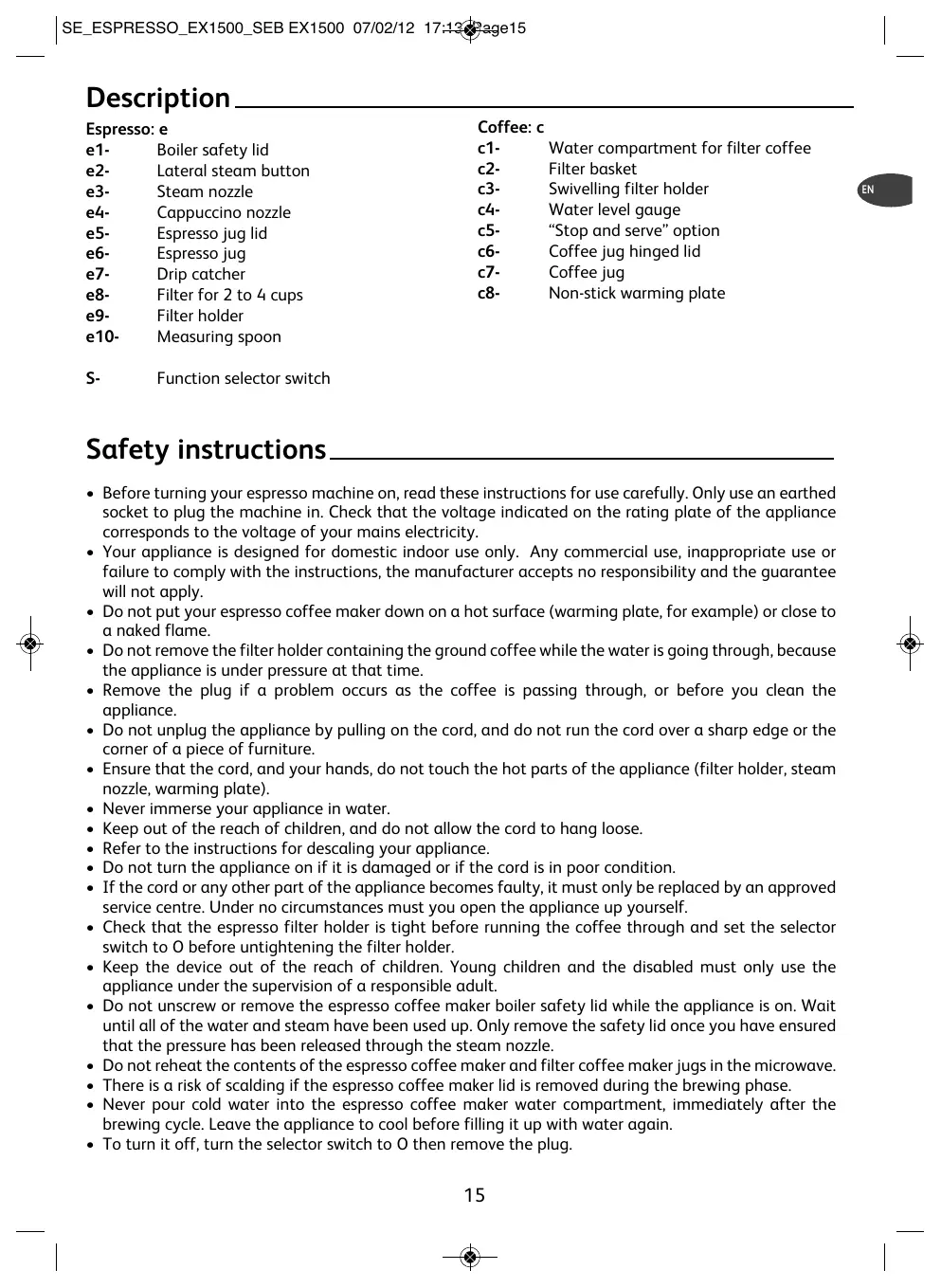
- Before turning your espresso machine on, read these instructions for use carefully. Only use an earthed socket to plug the machine in. Check that the voltage indicated on the rating plate of the appliance corresponds to the voltage of your mains electricity.
- Your appliance is designed for domestic indoor use only. Any commercial use, inappropriate use or failure to comply with the instructions, the manufacturer accepts no responsibility and the guarantee will not apply.
- Do not put your espresso coffee maker down on a hot surface (warming plate, for example) or close to a naked flame.
- Do not remove the filter holder containing the ground coffee while the water is going through, because the appliance is under pressure at that time.
- Remove the plug if a problem occurs as the coffee is passing through, or before you clean the appliance.
- Do not unplug the appliance by pulling on the cord, and do not run the cord over a sharp edge or the corner of a piece of furniture.
- Ensure that the cord, and your hands, do not touch the hot parts of the appliance (filter holder, steam nozzle, warming plate).
- Never immerse your appliance in water.
- Keep out of the reach of children, and do not allow the cord to hang loose.
Refer to the instructions for descending your appliance. - Do not turn the appliance on if it is damaged or if the cord is in poor condition.
- If the cord or any other part of the appliance becomes faulty, it must only be replaced by an approved service centre. Under no circumstances must you open the appliance up yourself.
- Check that the espresso filter holder is tight before running the coffee through and set the selector switch to O before untightening the filter holder.
- Keep the device out of the reach of children. Young children and the disabled must only use the appliance under the supervision of a responsible adult.
- Do not unscrew or remove the espresso coffee maker boiler safety lid while the appliance is on. Wait until all of the water and steam have been used up. Only remove the safety lid once you have ensured that the pressure has been released through the steam nozzle.
- Do not reheat the contents of the espresso coffee maker and filter coffee maker jugs in the microwave.
- There is a risk of scalding if the espresso coffee maker lid is removed during the brewing phase.
- Never pour cold water into the espresso coffee maker water compartment, immediately after the brewing cycle. Leave the appliance to cool before filling it up with water again.
-
To turn it off, turn the selector switch to O then remove the plug.
-
Only use this appliance for its intended purpose.
- Be extremely careful when using the steam function.
- This appliance is not designed to be used by persons (including children) with reduced physical, sensorial or mental capacities or persons with no experience or knowledge unless they have been provided with suitable instructions concerning the use of the appliance from a person responsible for their safety. Children should be watched so that they do not play with the appliance.
- This appliance is intended to be used only in the household.
It is not intended to be used in the following applications, and the guarantee will not apply for:
- Staff kitchen areas in stores, offices and other working environments;
- Farm houses,
- By clients in hotels, motels and other residential type environments,
- Bed and breakfast type environments.
This product has been designed for domestic
Before using for the first time
It is recommended that you familiarise yourself with all the parts of the appliance before you use it for the first time. Insert the filter basket into the filter holder, place the filter holder inside the rings designed to that effect, remove and replace the boiler lid. Check the various position of the function selector switch. To eliminate any residues that may have been laid down during manufacture, it is recommended that you run water through the appliance (as described in the section "Making espresso coffee") once or twice, without any ground espresso coffee. Wash all the removable parts using soapy water, rinse well and dry.
Read all the instructions carefully, as well as all the warnings and other remarks, before you use the appliance.
ATTENTION - HIGH PRESSURE
Never remove the boiler safety lid (e1) or the filter holder (e9) while the appliance is in the "ON" position and while the boiler is under pressure.
Never move or remove the filter holder while the appliance is working and under pressure. Follow the instructions below to check whether the appliance is still under pressure. Respect these safety measures while the machine is working and for 10 to 15 minutes after it has been used.
- Turn the function selector switch (S) to "OFF".
- Carefully open the steam button (e2) by turning it anticlockwise. If steam comes out of the nozzle, the boiler is still under pressure. Close the steam button and follow the instructions below.
- Take a jug of cold water and place the steam nozzle inside it. Turn the steam button (e2) on by turning it anticlockwise. Leave the button open until there is no steam left. Stop the steam function by turning the button clockwise.
- Now remove the lid of the boiler and the filter holder.
A real espresso
Espresso is a coffee that is much richer and fuller-flavoured than ordinary filter coffee. It must be unctuous, dark and flavourful. Most people prefer to take it in small contents, because it is such a rich drink. It is for this reason that espresso coffee is usually served in small cups (60 to 80 ml) which are only half-filled.
When this appliance is used properly, you will get an espresso that is unctuous, dark and flavourful. All you need to do is follow the instructions and use well
ATTENTION - HOT
Do not touch the lid of the boiler (e1) during preparation. Before removing the lid, turn the machine off and leave it to cool down for 2 or 3 minutes. Let the pressure drop in the machine. See the section ATTENTION - PRESSURE.
roasted, pre-ground fresh espresso coffee.
Espresso or cappuccino are not made in the same way as ordinary filter coffee. One of the main differences is the fact that the water is brought to the boil before being forced through the ground coffee. This therefore means that the espresso coffee maker works under pressure and special care must be taken.
Making a perfect coffee
The perfect coffee depends on each person's individual taste. It is both an art and a science, and the taste of the coffee does not just depend on the kind of ground coffee used, but also on the machine itself. The water, the temperature of the water, the amount of contact between the water and the coffee, the kind of ground coffee, the type of filter - all of these elements play an important role in the final flavour of the coffee. Taking each of these aspects into account is part of the art of making the ideal coffee.
Here are the four basic principles:
1. The water
It is essential to use fresh water. Because coffee is made up of 98% water, any residual taste in the water will be transferred to the coffee. The better and tastier the water, the better the coffee.
2. The coffee
Use high quality coffee grains, to suit the taste of each individual. There are two main types of coffee: arabica and robusta. Arabica coffee beans have a very strong taste and contain less caffeine. Robusta grains have a high caffeine content, are more "full bodied" and are usually used in blends. The origin of the beans and the way they are roasted are all important in the flavour. Roasting goes from very light to very dark. Light roasting gives a more velvety, delicate and aromatic taste, whereas medium and medium dark roasts make the taste more marked, fuller, with more balance, and dark roasting leads to a very marked taste, with hints of smokiness.
3. The ground coffee
Grind the beans just before making the coffee, and ensure that the grind is very fine. Variations in the size of the grind depend on the type of filter used. It is best to use paper filters, because they enable you to use a finer grind, leading to fuller extraction of the coffee and a longer period of contact between the coffee and the water. Permanent filters require a slightly less fine grind, and as a result, the level of extraction is somewhat reduced.
To find out what kind of grind to use, use the following rule of thumb: the longer the infusion time used, the finer the ground coffee must be.
4. The proportions
It is recommended that you use 1 level spoon of ground coffee per cup and that you adjust the quantity to suit your own taste.
COFFEE
Making coffee
Before making your first jug of delicious coffee, it is recommended that you rinse the machine out by using it once without coffee. Do one or two full cycles, with water only (without any coffee in the filter basket). This will remove any dust that may have worked its way into the machine during its transport. Ensure that the water compartment is empty. Remove any document or anything else that may be in the water compartment.
- The jug lid must be on properly during the infusion cycle.
- To open the lid, press down on the flap that is located on top of the handle of the jug.
- Ensure that the swivelling filter is properly set in place during the infusion cycle. Press firmly until the handle comes into contact with the side of the appliance and the filter " clicks" into place.
Attention: If the swivelling filter is not in place, the "Stop and serve" function will not work. This can lead to hot water or hot coffee overflowing.
- The "Stop and serve" device will work for as long as the glass jug is inserted into the appliance and is set flat on the warming plate, and as long as the swivelling filter is properly installed. When making the coffee, ensure that the glass jug is in its proper place (see the section "Stop and serve").
Place the appliance close to a wall socket and use the length of cord necessary to plug it in (Figure 1).
To place the ground coffee in:
- Swivel the filter holder out (Figure 2) and place a paper filter in the basket. It is recommended that you use number 4 filters. When a paper filter is used, ensure that the seam is directed towards the base of the filter holder (figure 3). Using your fingers, push the filter in so that it follows the contours of the filter holder. This will improve the results.
- Place the ground coffee in the filter (figure 4). It is recommended that you use a level spoon of ground coffee per cup. After you have used it a number of times, you will be able to adjust the amount of coffee to your taste. It is not recommended that you use a grind that is too fine, such as one that has the texture of powder, because this prevents the water from going through the filter.
- Close the filter holder and ensure that it is properly in place (figure 5).

ATTENTION
Ensure that the paper filter does not fold over on itself when the filter holder is closed, because the water can flow between the filter and the filter holder, which leads to the coffee being extremely weak and tasteless.
Fill the water compartment
- Open the hinged lid (figure 6). Pour in the desired quantity of water (figure 7) and close the lid. After the infusion cycle, there will be less fresh coffee that there was water. This is because the ground coffee absorbs a certain amount of the water. To help you in making your coffee, the levels indicated on the machine and the glass jug take account of this absorption.
- Place the glass jug with its lid on the warming plate.
- Turn the selector switch (S) to "ON". The light comes on to indicate that the percolation cycle has started (figure 8).
- While the blue light is on, the coffee is kept hot.
"Stop and serve" function
The "Stop and serve" function is the answer that SEB has dreamt up for people who are impatient to drink their first cup of coffee! It is a little mechanism that automatically stops the coffee from flowing into the filter cone if the glass jug is taken off the warming plate during the infusion cycle. There can be a period of around 20 seconds between the moment the jug is taken off the warming plate and the moment it is put back in place.
The "Stop and serve" mechanism is so efficient that not a single drop of coffee falls onto the warming plate. Once the jug has been put back in place, the infusion cycle starts up again and the coffee starts dripping into the jug again.

ATTENTION
If a large amount of coffee flows onto the warming plate when the jug is removed, this usually means that the filter holder seal is missing or damaged. If this occurs, contact an authorised SEB service centre. It may also be that the paper filter contains too much ground coffee. This leads to the water dripping onto the coffee overflowing, and then dripping between the paper cone and the filter holder.
If there is a blockage that leads to an overflow, immediately remove the jug from the warming plate and leave the cycle to reach the end. Do not move the filter holder before the cycle has come to an end.
Clean the appliance
Always unplug the machine before cleaning it. Clean the filter holder, the jug and the lid using warm soapy water. These parts are dishwasher-proof; place them on the upper tray so that they are further away from the hot parts of the dishwasher.
- Never use scouring agents.
- Never plunge the device into water.
- To clean it, simply wipe it down with a damp, soft cloth.
- Never use a cloth to clean the inside of the water compartment because it may leave residues. Rinse the water compartment regularly using cold water.
Dscaling the machine
The limited warranty does not cover machines that have ceased to function or which function badly because they have not been properly descaled.
The machine must be descaled regularly. The frequency of this operation will depend on how hard your water is and how often you use it.
Here are a few indications that should tell you that you need to descale:
- increase in noise during the percolation cycle,
- it takes longer to make the coffee.
If you use the machine often, follow these directives for descending: - once a year if the water is soft,
- every three months if the water is moderately hard,
- once a month if the water is hard.
If you are uncertain of how hard your water is, check with your local water supplier.
Dissolve a sachet of descaler for coffee makers in 300ml of water or use 2 large cups of clear vinegar.
Pour this solution into the water compartment and pass it through the machine 2 or 3 times, in the same way as when making coffee, but without any ground coffee. Leave the hot descaling solution to cool down before passing it through the water compartment again. Then pass 2 full water compartments of clear water through in the same way.
ESPRESSO
Making espresso coffee
- Place the appliance close to a wall socket and release the length of cord necessary to plug it in (figure 1).
- Place the filter basket (e8) in the filter holder (e9) and swivel it around until it locks into place (figure 9).
- Fill with ground espresso coffee. The filter basket has a gauge for 2 or 4 cups. Press the coffee down gently and remove any residue from around the filter holder, in order to be able to set it in the percolation head properly (figure 10).
- To position the filter holder, move the handle to the left, life the filter holder in the percolation head and turn it to the right, until it blocks.
Do not pack the coffee down too much.
Do not go over the mark indicating 4 cups inside the filter basket. This could lead to a blockage in the machine or to water overflowing.

ATTENTION!
If the filter holder handle is not centred when it is in position, do not turn the machine on. Remove the filter holder and reinsert it as described above (figure 11).
You must observe these procedures to prevent the filter holder from being moved out of position under the pressure of the infusion cycle.
- Open the hinged lid and unscrew the boiler safety cap by turning it anticlockwise (Figures 12 and 13).
- Fill the boiler with cold water using the glass measuring jug (figure 14).
The glass jug has a gauge for 2 or 4 cups.
To foam the milk for the cappuccino, add the quantity of water that corresponds to the level of steam indicated on the jug.
The maximum capacity corresponds to the lower part of the metal ring around the glass jug, i.e. 4 cups of espresso plus the water necessary for making the steam that will produce the cappuccino foam.

ATTENTION
Never fill the boiler when the machine is "ON". Never pour more than 300 ml of water in the boiler.
Use the espresso jug to control the amount of water you are pouring in.
OBSERVATION
It is very important to pour only the amount of water that you need into the boiler, no more. The appliance will empty the contents of the boiler that is not used.
- Close the boiler lid by turning it clockwise (figure 15).
- Place the jug underneath the filter holder and ensure that the hole in the jug lid is directly under the filter holder nozzle (figure 16).
- Ensure that the side button (e2) is in the espresso coffee position. Turn the selector switch (S) to the left, to the "ON" position on the espresso side. The left-hand blue light comes on (figure 17).

ATTENTION
Never full the jug above the lower level of the metal ring!

ATTENTION
Ensure that the overflow tray (e7) in is place.
It takes around 2 minutes for the water to become hot enough. The water is then forced through the coffee, into the glass jug.
-
Wait until the water in the boiler has been fully used. Turn off the machine by turning the function selector switch (S) to its central position.
-
Do not unscrew the touch the lid of the boiler while the machine is on. Wait until the cycle has finished and until all of the water and steam have been used (see section "ATTENTION - PRESSURE").

ATTENTION
Remove the filter holder with care, because the metal parts may be very hot. Once the machine has been turned off, it is recommended that you wait for around 2 minutes before removing the filter holder. To do so, turn the filter holder towards the left, until it becomes detached from the machine.
CAPPUCCINO
It is said that the name "cappuccino" comes from the colour of the robes worn by the Capuchin monks, for whom this delicious drink, served with the dessert, was a great favourite. Cappuccino is traditionally made with 1/3 espresso coffee, 1/3 hot milk and 1/3 foamy milk, and it can be flavoured, depending on each individual's taste, with cinnamon, sugar, flakes of chocolate or even alcohol. Its very versatility has made it a hugely popular drink the world over.
Making cappuccino
If the cappuccino accessory is not in place, install it (figure 18).
- Pour 120 to 180ml of fresh cold milk into a small recipient. Do not use a recipient that has been
washed in hot water, if it is still hot. The recipient must be able to fit under the cappuccino accessory nozzle. It is recommended that you use semi-skimmed milk into order to obtain a foam that is both dense and firm. Full fat milk gives a creamier foam.
- Follow the directives in stages 1 and 2 from the section "Making espresso coffee".
- As soon as the first drops of coffee start to come through the filter holder, start foaming the milk.
Immerse the steam nozzle in the recipient with the milk, up to half of its length.
- a) Turn the steam button (e2) anticlockwise to release the steam (figure 19).
b) Tip the recipient to one side slightly so that you can see the position of the nozzle while the milk is foaming.
Always make sure that there is a space between the end of the nozzle and the bottom of the recipient, to let the steam out.
After a few seconds, the milk begins to foam up. As it is doing so, lower the recipient slowly so that the end of the nozzle is always just underneath the surface of the foam.
Remark: do not boil the milk (if large bubbles begin to appear at the surface of the milk, the milk is
starting to boil).
c) Once the foam is ready to serve, keep the end of the nozzle in the foam in order to prevent splashing and turn the steam button clockwise to stop the steam.
d) To make the foam a little firmer, leave it to set for one minute.
- Do not forget to put the end of the nozzle back in place and to screw it back firmly (figure 21).

ATTENTION:
Steam nozzle blocked
Milk residue may accumulate in the end of the steam nozzle. To prevent the nozzle from getting blocked, remove the cappuccino accessory's plastic base (figure 20) when the machine is cold, in order to make it easier to clean. Follow the steps for cleaning the steam nozzle described in the section "Cleaning the cappuccino accessory".
Foaming without making an espresso coffee (Steamplug)
- Fill the recipient with cold water.
- Prepare the recipient with the milk to foam or heat.
- Place the glass jug with its lid under the filter holder (figure 16). Ensure that the side button (e2) is in the espresso coffee position. Turn the selector switch (S) to the left, to the "ON" position on the espresso side. The left-hand blue light comes on (figure 17).
- Open the steam button immediately after having turned the machine on. Stay close to the machine and get ready to foam the milk.
It takes around 30 to 60 seconds for the steam to start coming out of the nozzle. Follow the stages 4.a) and 4.b) from the section "Making cappuccino".
- Once all the steam has escaped, close the button and turn the machine off.
Attention:
If the water is not completely used:
a) turn the machine off.
b) allow the rest of the steam to escape into another recipient.
Do not close the steam button before all of the steam has escaped or until the machine has been turned off. (See the section "ATTENTION - PRESSURE")

ATTENTION:
Ensure that the machine is cold and no longer under pressure (see the section "ATTENTION - PRESSURE").

ATTENTION:
To obtain steam only, do not fill the glass jug any higher than the 2-cup level. This quantity is enough to make the milk foam.

ATTENTION:
Do not leave the appliance unsupervised at this time.

ATTENTION!
The plastic part of the cappuccino nozzle (e4) has two little holes on the sides, which enable air to be injected into the milk.
If these holes are blocked, the milk will not foam up properly. Do not immerse the nozzle in the milk up to these holes, because it is likely that the milk will block them.
Cleaning the espresso and cappuccino maker
Before cleaning the appliance, turn it off, remove the plug and leave it to cool down.
The filter holder, the filter basket, the jug, the jug lid and the overflow tray cannot be washed in the dishwasher. Only use hot water and soapy water. Never use accessories or abrasive products.
The machine itself can be wiped down with a damp cloth. Never plunge the device into water or any other liquid. Clean the percolation head using a damp cloth to remove any residual ground coffee. If there is water left in the boiler, leave it to cool, take off all the removable parts and then empty the water out of the hole at the top by turning the machine upside down.
Cleaning the cappuccino nozzle
Clean the nozzle each time it is used with milk, otherwise the inside of the nozzle will block up and milk deposits dry on the surface and are rather difficult to clean later on.
- If the nozzle is blocked, remove the plastic base of the cappuccino nozzle (figure 20), once the machine is cold, and then unscrew the end of the nozzle (figure 21).
Use a needle to remove the particles of milk and rinse under the tap. Put the end of the nozzle back and ensure it is tightly screwed on. Wipe the outside of the nozzle with a damp cloth. Keep the cloth over the end of the nozzle, to cover it, and open the steam nozzle. Let the steam escape into the cloth for a second or two, then close the nozzle again. All the residual milk should now have been removed. Rinse the plastic base of the cappuccino nozzle in warm water. If the openings through which the air is drawn in are blocked up, you can use a little needle to clean them out.
Cleaning the drip tray
- The overflow tray and the grid over the top can be cleaned by removing the grid (figure 22).

ATTENTION
Do not attempt to open or dismantle the body of the machine.
Dscaling the espresso machine
The limited warranty does not cover machines that have ceased to function or which function badly because they have not been properly descaled.
Because of the acidic substances that are used for descaling, it is recommended that you protect your work surfaces and your sink during this operation, in particular if they are made of marble or stone. Put the machine on a towel, a tablecloth or a tray.
The machine must be descaled regularly. The frequency of this operation will depend on how hard your water is and how often you use it.
Before descending, you must first of all unscrew the grid inside the percolation head.
1. Remove the scale and the coffee residue from the grid and the percolation head.
2. Remove the plastic base of the cappuccino accessory (figure 20).
3. Dissolve a sachet of descaler solution in 300ml of warm water and pour into the boiler. Place a recipient under the percolation head and another under the steam nozzle. (Remark: do not use the filter holder during the descending).
4. Open the nozzle and turn the machine on. Let the descending solution drip through the percolation head and the nozzle.
5. Once the cycle has been completed, turn the machine off and leave it to cool down.
6. Repeat stages 4 and 5.
Fill the boiler up with fresh water and leave it to run through the system completely. Repeat this process.
Turn the machine off and leave it to cool down. Put the grid back in the percolation head and put the plastic base of the cappuccino accessory back in place.
(Always ensure that the machine is plugged in and that it is in the "ON" position).
Problem:
- The espresso flows over and around the filter holder.
Cause:
The filter holder is not in the right place.
The filter holder has not been pushed firmly into place.
The joint is dirty and needs cleaning.
The joint has lost its elasticity, replace it.
There is coffee residue around the filter holder.
Problem:
- The espresso coffee is not flowing through.
Cause:
There is no water in the boiler.
There is no coffee in the filter holder.
The filter is blocked because the coffee grind is too fine or because it has been packed down too hard.
Problem:
- The steam is not coming out of the nozzle.
Cause:
There is not enough water in the boiler.
The nozzle in blocked (see section "Cleaning the cappuccino accessory").
Problem:
- The milk does not foam up enough.
Cause:
The end of the nozzle is touching the bottom of the recipient.
The nozzle is blocked: the little holes on the upper part of the plastic base of the cappuccino accessory are blocked (see section "Cleaning the cappuccino accessory").
The milk is not creamy enough or not cold enough (over 8^ ).
For better results ...
...Always use cold, fresh water (hot water can be a little stale and contain deposits of minerals that affect the taste of the coffee).
...It is recommended that you grind the coffee yourself. Freshly ground coffee has a much richer flavour.
Use the SEB coffee bean spoon to measure the right amount of coffee per cup.
...Serve the coffee as soon as it is ready.
...Never reheat the coffee.

Environment protection first!
① Your appliance contains valuable materials which can be recovered or recycle.
Leave it at a local civic waste collection point.
HELPLINE:
If you have any product problems or queries, please contact our Customer Relations Team first for expert help and advice:
0845 602 1454 - UK
010 461 0390 - Ireland
or consult our website - www.krups.co.uk
Beschreibung
Espresso: e
- Before using for the first time
- ATTENTION - HIGH PRESSURE
- A real espresso
- ATTENTION - HOT
- Making a perfect coffee
- The water
- The coffee
- The ground coffee
- The proportions
- COFFEE
- Making coffee
- ATTENTION
- Fill the water compartment
- "Stop and serve" function
- Clean the appliance
- Dscaling the machine
- ESPRESSO
- Making espresso coffee
- ATTENTION!
- OBSERVATION
- CAPPUCCINO
- Making cappuccino
- ATTENTION:
- Foaming without making an espresso coffee (Steamplug)
- Cleaning the espresso and cappuccino maker
- Cleaning the cappuccino nozzle
- Cleaning the drip tray
- Dscaling the espresso machine
- Problem:
- Cause:
- For better results ...
- Environment protection first!
- Beschreibung
- Espresso: e
Brand : SEB
Model : ALLEGRO COMBI
Category : Coffee machine