
EOC3410AAX - Built-in oven ELECTROLUX - Free user manual and instructions
Find the device manual for free EOC3410AAX ELECTROLUX in PDF.



| Product type | Built-in oven |
| Brand | Electrolux |
| Model | EOC3410AAX |
| Dimensions (W x H x D) | Approximately 59.5 x 59.5 x 57 cm |
| Weight | Approximately 35 kg |
| Power supply | 230 V, 50 Hz, max power 2.8 kW |
| Number of shelf levels | 5 |
| Cooking functions | Natural convection, fan-assisted, grill, turbo grill, pizza, defrost (lamp), etc. |
| Interior lighting | Replaceable halogen bulb 300°C |
| Door | Removable double glazing for cleaning |
| Grill | Removable for ceiling cleaning |
| Included accessories | Metal rack, dripping pan |
| Cleaning | Manual cleaning with soft cloth and mild detergent |
| Safety feature | Safety thermostat, cooling fan |
| Repairability | Spare parts available: bulb, glass, heating elements, etc. |
| Energy class | Not specified (estimated A) |
Frequently Asked Questions - EOC3410AAX ELECTROLUX
User questions about EOC3410AAX ELECTROLUX
0 question about this device. Answer the ones you know or ask your own.
Ask a new question about this device
Download the instructions for your Built-in oven in PDF format for free! Find your manual EOC3410AAX - ELECTROLUX and take your electronic device back in hand. On this page are published all the documents necessary for the use of your device. EOC3410AAX by ELECTROLUX.
USER MANUAL EOC3410AAX ELECTROLUX
WE'RE THINKING OF YOU
Thank you for purchasing an Electrolux appliance. You've chosen a product that brings with it decades of professional experience and innovation. Ingenious and stylish, it has been designed with you in mind. So whenever you use it, you can be safe in the knowledge that you'll get great results every time.
Welcome to Electrolux.
Visit our website for:

Get usage advice, brochures, trouble shooter, service information: www.electrolux.com

Register your product for better service: www.electrolux.com/productregistration

Buy Accessories, Consumables and Original spare parts for your appliance: www.electrolux.com/shop
CUSTOMER CARE AND SERVICE
We recommend the use of original spare parts.
When contacting Service, ensure that you have the following data available. The information can be found on the rating plate. Model, PNC, Serial Numb

Warning / Caution-Safety information

General information and tips

Environmental information
Subject to change without notice.
1. SAFETY INFORMATION
Before the installation and use of the appliance, carefully read the supplied instructions. The manufacturer is not responsible if an incorrect installation and use causes injuries and damages. Always keep the instructions with the appliance for future reference.
1.1 Children and vulnerable people safety

WARNING!
Risk of suffocation, injury or permanent disability.
- This appliance can be used by children aged from 8 years and above and persons with reduced physical, sensory or mental capabilities or lack of experience and knowledge if they are supervised by an adult or a person who is responsible for their safety.
- Do not let children play with the appliance.
- Keep all packaging away from children.
- Keep children and pets away from the appliance when it operates or when it cools down. Accessible parts are hot.
- If the appliance has a child safety device, we recommend that you activate it.
- Cleaning and user maintenance shall not be made by children without supervision.
1.2 General Safety
- Internally the appliance becomes hot when in operation. Do not touch the heating elements that are in the appliance. Always use oven gloves to remove or put in accessories or ovenware.
- Do not use a steam cleaner to clean the appliance.
-
Before maintenance cut the power supply.
-
Do not use harsh abrasive cleaners or sharp metal scrapers to clean the glass door since they can scratch the surface, which may result in shattering of the glass.
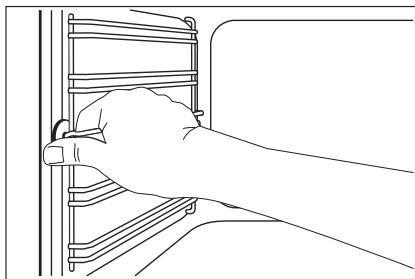
- To remove the shelf supports first pull the front of the shelf support and then the rear end away from the side walls. Install the shelf supports in the opposite sequence.
2. SAFETY INSTRUCTIONS
2.1 Installation

WARNING!
Only a qualified person must install this appliance.
- Remove all the packaging.
- Do not install or use a damaged appliance.
- Obey the installation instruction supplied with the appliance.
Always be careful when you move the appliance because it is heavy. Always wear safety gloves. - Do not pull the appliance by the handle.
- Keep the minimum distance from the other appliances and units.
- Make sure that the appliance is installed below and adjacent safe structures.
- The sides of the appliance must stay adjacent to appliances or to units with the same height.
Electrical connection

WARNING!
Risk of fire and electrical shock.
- All electrical connections should be made by a qualified electrician.
- The appliance must be earthed.
-
Make sure that the electrical information on the rating plate agrees with the power supply. If not, contact an electrician.
Always use a correctly installed shockproof socket. -
Do not use multi-plug adapters and extension cables.
- Make sure not to cause damage to the mains plug and to the mains cable. Contact the Service or an electrician to change a damaged mains cable.
- Do not let mains cables to come in touch with the appliance door, specially when the door is hot.
- The shock protection of live and insulated parts must be fastened in such a way that it cannot be removed without tools.
- Connect the mains plug to the mains socket only at the end of the installation. Make sure that there is access to the mains plug after the installation.
- If the mains socket is loose, do not connect the mains plug.
- Do not pull the mains cable to disconnect the appliance. Always pull the mains plug.
- Use only correct isolation devices: line protecting cut-outs, fuses (screw type fuses removed from the holder), earth leakage trips and contactors.
- The electrical installation must have an isolation device which lets you disconnect the appliance from the mains at all poles. The isolation device must have a contact opening width of minimum 3 mm.
2.2 Use

WARNING!
Risk of injury, burns or electric shock or explosion.
- Use this appliance in a household environment.
- Do not change the specification of this appliance.
- Make sure that the ventilation openings are not blocked.
- Do not let the appliance stay unattended during operation.
- Deactivate the appliance after each use.
- Internally the appliance becomes hot when in operation. Do not touch the heating elements that are in the appliance. Always use oven gloves to remove or put in accessories or ovenware.
- Be careful, when you open the appliance door while the appliance is in operation. Hot air can release.
- Do not operate the appliance with wet hands or when it has contact with water.
- Do not apply pressure on the open door.
- Do not use the appliance as a work surface or as a storage surface.
- Always keep the appliance door closed when the appliance is in operation.
- Open the appliance door carefully. The use of ingredients with alcohol can cause a mixture of alcohol and air.
- Do not let sparks or open flames to come in contact with the appliance when you open the door.
- Do not put flammable products or items that are wet with flammable products in, near or on the appliance.

WARNING!
Risk of damage to the appliance.
-
To prevent damage or discoloration to the enamel:
-
Do not put ovenware or other objects in the appliance directly on the bottom.
- Do not put aluminium foil directly on the bottom of the appliance.
- do not put water directly into the hot appliance.
-
do not keep moist dishes and food in the appliance after you finish the cooking.
-
be careful when you remove or install the accessories.
-
Discoloration of the enamel has no effect on the performance of the appliance. It is not a defect in the sense of the warranty law.
- Use a deep pan for moist cakes. Fruit juices cause stains that can be permanent.
2.3 Care and Cleaning

WARNING!
Risk of injury, fire or damage to the appliance.
- Before maintenance, deactivate the appliance and disconnect the mains plug from the mains socket.
- Make sure the appliance is cold. There is the risk that the glass panels can break.
- Replace immediately the door glass panels when they are damaged. Contact the Service.
- Be careful when you remove the door from the appliance. The door is heavy!
- Clean regularly the appliance to prevent the deterioration of the surface material.
- Remaining fat or food in the appliance can cause fire.
- Clean the appliance with a moist soft cloth. Only use neutral detergents. Do not use abrasive products, abrasive cleaning pads, solvents or metal objects.
- If you use an oven spray, obey the safety instructions on the packaging.
- Do not clean the catalytic enamel (if applicable) with any kind of detergent.
2.4 Internal light
- The type of light bulb or halogen lamp used for this appliance, is only for household appliances. Do not use it for house lighting.

WARNING!
Risk of electrical shock.
- Before replacing the lamp, disconnect the appliance from the power supply.
- Only use lamps with the same specifications.
2.5 Disposal

WARNING! Risk of injury or suffocation.
- Disconnect the appliance from the mains supply.
3.PRODUCT DESCRIPTION
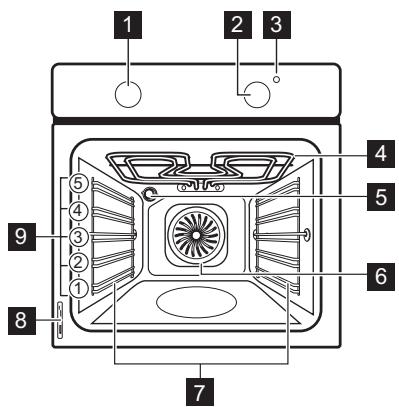
1 Knob for the oven functions
2 Knob for the temperature
- Cut off the mains cable and discard it.
- Remove the door catch to prevent children and pets to get closed in the appliance.
3 Temperature indicator
4 Grill
5 Oven lamp
6 Fan
7 Shelf support, removable
8 Rating plate
9 Shelf positions
3.1 Oven accessories
- Wire shelf
For cookware, cake tins, roasts.
- Combi pan
For cakes and biscuits. To bake and roast or as a pan to collect fat.
4. BEFORE FIRST USE

WARNING!
Refer to "Safety information" chapter.
4.1 Initial cleaning
- Remove all accessories and removable shelf supports (if applicable).
- Clean the appliance before first use.

Refer to the chapter "Care and cleaning".
4.2 Preheating
Preheat the empty appliance to burn off the remaining grease.
-
Set the function and the maximum temperature.
-
Let the appliance operate for one hour.
- Set the function and the maximum temperature.
- Let the appliance operate for ten minutes.
- Set the function and the maximum temperature.
- Let the appliance operate for ten minutes.
Accessories can become hotter than usually. The appliance can emit an odour and smoke. This is normal. Make sure that the airflow is sufficient.
5. DAILY USE

WARNING!
Refer to "Safety information" chapter.
5.1 Activating and deactivating the appliance
-
Turn the oven functions control knob to an oven function.
-
Turn the temperature control knob to a temperature.
The temperature indicator comes on while the temperature in the appliance increases.
- To deactivate the appliance, turn the oven functions control knob and the temperature control knob to the Off position.
5.2 Oven functions
| Oven function | Application | |
| 0 | Off position | The appliance is off. |
| Light | To activate the oven lamp without a cooking function. | |
| Conventional Cooking | To bake and roast on one oven level. The top and bottom heating elements operate at the same time. | |
| Top Heat | To finish cooked dishes. Only the top heating element operates. | |
| Bottom Heat | To bake cakes with crispy or crusty bottom. Only the bottom heating element operates. | |
| Grilling | To grill flat food items in small quantities in the middle of the shelf. To make toast. | |
| Fast Grilling | To grill flat food items in large quantities. To make toast. The full grill element operates. | |
| Turbo Grilling | To cook large pieces of meat. The grill element and the oven fan operate one after the other and circulate hot air around the food. | |
| True Fan Cooking | To roast or roast and bake food with the same cooking temperature, on more than one shelf, without flavour transference. | |
| Pizza Setting | To make pizza, quiche or pie. The grill and bottom element provide direct heat and the fan circulates the hot air to cook the pizza toppings or pie filling. | |
6. ADDITIONAL FUNCTIONS
6.1 Cooling fan
When the appliance operates, the cooling fan activates automatically to keep the surfaces of the appliance cool. If you de
activate the appliance, the cooling fan continues to operate until the temperature in the appliance cools down.
6.2 Safety thermostat
Incorrect operation of the appliance or defective components can cause dangerous overheating. To prevent this, the oven has
a safety thermostat which interrupts the power supply. The oven activates again automatically when the temperature drops.
7. HELPFUL HINTS AND TIPS
- The appliance has five shelf levels. Count the shelf levels from the bottom of the appliance floor.
- The appliance has a special system which circulates the air and constantly recycles the steam. With this system you can cook in a steamy environment and keep the food soft inside and crusty outside. It decreases the cooking time and energy consumption to a minimum.
- Moisture can condense in the appliance or on the door glass panels. This is normal. Always stand back from the appliance when you open the appliance door while cooking. To decrease the condensation, operate the appliance for 10 minutes before cooking.
- Clean the moisture after each use of the appliance.
- Do not put the objects directly on the appliance floor and do not put aluminium foil on the components when you cook. This can change the baking results and cause damage to the enamel.
7.1 Baking cakes
- Do not open the oven door before 3/4 of the set cooking time is up.
7.4 Baking and roasting table
CAKES
| TYPE OF DISH | Conventional Cooking | True Fan Cooking | Cooking time [min] | Notes | ||
| Shelf position | Temp [°C] | Shelf position | Temp [°C] | |||
| Whisked recipes | 2 | 170 | 3 (2 and 4) | 160 | 45 - 60 | In a cake mould |
| Shortbread dough | 2 | 170 | 3 (2 and 4) | 160 | 20 - 30 | In a cake mould |
- If you use two baking trays at the same time, keep one empty level between them.
7.2 Cooking meat and fish
- Use a deep pan for very fatty food to prevent the oven from stains that can be permanent.
- Leave the meat for approximately 15 minutes before carving so that the juice does not seep out.
- To prevent too much smoke in the oven during roasting, add some water into the deep pan. To prevent the smoke condensation, add water each time after it dries up.
7.3 Cooking times
Cooking times depend on the type of food, its consistency, and volume. Initially, monitor the performance when you cook. Find the best settings (heat setting, cooking time, etc.) for your cookware, recipes and quantities when you use this appliance.
| TYPE OF DISH | Conventional Cooking | True Fan Cooking | Cooking time [min] | Notes | ||
| Shelf position | Temp [°C] | Shelf position | Temp [°C] | |||
| Buttermilk cheesecake | 1 | 170 | 2 | 165 | 60 - 80 | In a 26 cm cake mould |
| Apple cake (Apple pie) | 2 | 170 | 2 (left and right) | 160 | 80 - 100 | In two 20 cm cake moulds on a wire shelf1) |
| Strudel | 3 | 175 | 2 | 150 | 60 - 80 | In a baking tray |
| Jam-tart | 2 | 170 | 2 (left and right) | 165 | 30 - 40 | In a 26 cm cake mould |
| Sponge cake | 2 | 170 | 2 | 160 | 50 - 60 | In a 26 cm cake mould |
| Christmas cake / Rich fruit cake | 2 | 160 | 2 | 150 | 90 - 120 | In a 20 cm cake mould1) |
| Plum cake | 1 | 175 | 2 | 160 | 50 - 60 | In a bread tin1) |
| Small cakes - one level | 3 | 170 | 3 | 140 - 150 | 20 - 30 | In a baking tray |
| Small cakes - two levels | - | - | 2 and 4 | 140 - 150 | 25 - 35 | In a baking tray |
| Small cakes - three levels | - | - | 1, 3 and 5 | 140 - 150 | 30 - 45 | In a baking tray |
| Biscuits / pastry stripes - one level | 3 | 140 | 3 | 140 - 150 | 30 - 35 | In a baking tray |
| Biscuits / pastry stripes - two levels | - | - | 2 and 4 | 140 - 150 | 35 - 40 | In a baking tray |
| Biscuits / pastry stripes - three levels | - | - | 1, 3 and 5 | 140 - 150 | 35 - 45 | In a baking tray |
| Meringues - one level | 3 | 120 | 3 | 120 | 80 - 100 | In a baking tray |
| Meringues-two levels | - | - | 2 and 4 | 120 | 80 - 100 | In a baking tray1) |
| Buns | 3 | 190 | 3 | 190 | 12 - 20 | In a baking tray¹) |
| Eclairs - one level | 3 | 190 | 3 | 170 | 25 - 35 | In a baking tray |
| Eclairs - two levels | - | - | 2 and 4 | 170 | 35 - 45 | In a baking tray |
| Plate tarts | 2 | 180 | 2 | 170 | 45 - 70 | In a 20 cm cake mould |
| Rich fruit cake | 1 | 160 | 2 | 150 | 110 - 120 | In a 24 cm cake mould |
| Victoria sandwich | 1 | 170 | 2 (left and right) | 160 | 50 - 60 | In a 20 cm cake mould |
1) Preheat for 10 minutes.
BREAD AND PIZZA
| TYPE OF DISH | Conventional Cooking | True Fan Cooking | Cooking time [min] | Notes | ||
| Shelf position | Temp [°C] | Shelf position | Temp [°C] | |||
| White bread | 1 | 190 | 1 | 190 | 60 - 70 | 1 - 2 pieces, 500 gr per piece1) |
| Rye bread | 1 | 190 | 1 | 180 | 30 - 45 | In a bread tin |
| Bread rolls | 2 | 190 | 2 (2 and 4) | 180 | 25 - 40 | 6 - 8 rolls in a baking tray1) |
| Pizza | 1 | 230 - 250 | 1 | 230 - 250 | 10 - 20 | In a baking tray or a deep pan1) |
| Scones | 3 | 200 | 3 | 190 | 10 - 20 | In a baking tray1) |
1) Preheat for 10 minutes.
FLANS
| TYPE OF DISH | Conventional Cooking | True Fan Cooking | Cooking time [min] | Notes | ||
| Shelf position | Temp [°C] | Shelf position | Temp [°C] | |||
| Pasta flan | 2 | 200 | 2 | 180 | 40 - 50 | In a mould |
| Vegetable flan | 2 | 200 | 2 | 175 | 45 - 60 | In a mould |
| Quiches | 1 | 180 | 1 | 180 | 50 - 60 | In a mould1) |
| Lasagne | 2 | 180 - 190 | 2 | 180 - 190 | 25 - 40 | In a mould1) |
| Cannelloni | 2 | 180 - 190 | 2 | 180 - 190 | 25 - 40 | In a mould1) |
1) Preheat for 10 minutes.
MEAT
| TYPE OF DISH | Conventional Cooking | True Fan Cooking | Cooking time [min] | Notes | ||
| Shelf position | Temp [°C] | Shelf position | Temp [°C] | |||
| Beef | 2 | 200 | 2 | 190 | 50 - 70 | On a wire shelf |
| Pork | 2 | 180 | 2 | 180 | 90 - 120 | On a wire shelf |
| Veal | 2 | 190 | 2 | 175 | 90 - 120 | On a wire shelf |
| English roast beef, rare | 2 | 210 | 2 | 200 | 50 - 60 | On a wire shelf |
| English roast beef, medium | 2 | 210 | 2 | 200 | 60 - 70 | On a wire shelf |
| English roast beef, well done | 2 | 210 | 2 | 200 | 70 - 75 | On a wire shelf |
| Shoulder of pork | 2 | 180 | 2 | 170 | 120 - 150 | With rind |
| Shin of pork | 2 | 180 | 2 | 160 | 100 - 120 | 2 pieces |
| Lamb | 2 | 190 | 2 | 175 | 110 - 130 | Leg |
| Chicken | 2 | 220 | 2 | 200 | 70 - 85 | Whole |
| Turkey | 2 | 180 | 2 | 160 | 210 - 240 | Whole |
| Duck | 2 | 175 | 2 | 220 | 120 - 150 | Whole |
| Goose | 2 | 175 | 1 | 160 | 150 - 200 | Whole |
| Rabbit | 2 | 190 | 2 | 175 | 60 - 80 | Cut in pieces |
| Hare | 2 | 190 | 2 | 175 | 150 - 200 | Cut in pieces |
| Pheasant | 2 | 190 | 2 | 175 | 90 - 120 | Whole |
FISH
| TYPE OF DISH | Conventional Cooking | True Fan Cooking | Cooking time [min] | Notes | ||
| Shelf position | Temp [°C] | Shelf position | Temp [°C] | |||
| Trout / Sea bream | 2 | 190 | 2 | 175 | 40 - 55 | 3 - 4 fish |
| Tuna fish / Salmon | 2 | 190 | 2 | 175 | 35 - 60 | 4 - 6 fillets |
7.5 Grilling

Preheat the empty oven for 10 minutes, before cooking.
| Quantity | Grilling | Cooking time [min] | ||||
| TYPE OF DISH | Pieces | [g] | Shelf po-sition | Temp [°C] | 1st side | 2nd side |
| Fillet steaks | 4 | 800 | 4 | max. | 12 - 15 | 12 - 14 |
| Beef steaks | 4 | 600 | 4 | max. | 10 - 12 | 6 - 8 |
| Sausages | 8 | - | 4 | max. | 12 - 15 | 10 - 12 |
| Pork chops | 4 | 600 | 4 | max. | 12 - 16 | 12 - 14 |
| Chicken (cut in 2) | 2 | 1000 | 4 | max. | 30 - 35 | 25 - 30 |
| Kebabs | 4 | - | 4 | max. | 10 - 15 | 10 - 12 |
| Breast of chick-en | 4 | 400 | 4 | max. | 12 - 15 | 12 - 14 |
| Hamburger | 6 | 600 | 4 | max. | 20 - 30 | - |
| Fish fillet | 4 | 400 | 4 | max. | 12 - 14 | 10 - 12 |
| Toasted sand-wiches | 4 - 6 | - | 4 | max. | 5 - 7 | - |
| Toast | 4 - 6 | - | 4 | max. | 2 - 4 | 2 - 3 |
7.6 Turbo Grilling
Beef
| TYPE OF DISH | Quantity | Shelf posi- tion | Tempera- ture [°C] | Time [min] |
| Roast beef or fil- let, rare | per cm of thickness | 1 | 190 - 200 1) | 5 - 6 |
| Roast beef or fil- let, medium | per cm of thickness | 1 | 180 - 190 1) | 6 - 8 |
| Roast beef or fil- let, well done | per cm of thickness | 1 | 170 - 180 1) | 8 - 10 |
1) Preheat the oven.
Pork
| TYPE OF DISH | Quantity | Shelf posi- tion | Tempera- ture [°C] | Time [min] |
| Shoulder, neck, ham joint | 1 - 1.5 kg | 1 | 160 - 180 | 90 - 120 |
| Chop, spare rib | 1 - 1.5 kg | 1 | 170 - 180 | 60 - 90 |
| Meat loaf | 750 g - 1 kg | 1 | 160 - 170 | 50 - 60 |
| Pork knuckle (precooked) | 750 g - 1 kg | 1 | 150 - 170 | 90 - 120 |
Veal
| TYPE OF DISH | Quantity | Shelf position | Temperature [°C] | Time [min] |
| Roast veal | 1 kg | 1 | 160 - 180 | 90 - 120 |
| Knuckle of veal | 1.5 - 2 kg | 1 | 160 - 180 | 120 - 150 |
Lamb
| TYPE OF DISH | Quantity | Shelf posi- tion | Temperature [°C] | Time [min] |
| Leg of lamb, roast lamb | 1 - 1.5 kg | 1 | 150 - 170 | 100 - 120 |
| Saddle of lamb | 1 - 1.5 kg | 1 | 160 - 180 | 40 - 60 |
Poultry
| TYPE OF DISH | Quantity | Shelf position | Temperature [°C] | Time [min] |
| Poultry portions | 200 - 250 g each | 1 | 200 - 220 | 30 - 50 |
| TYPE OF DISH | Quantity | Shelf posi- tion | Temperature [°C] | Time [min] |
| Chicken, half | 400 - 500 g each | 1 | 190 - 210 | 35 - 50 |
| Chicken, pou- lard | 1 - 1.5 kg | 1 | 190 - 210 | 50 - 70 |
| Duck | 1.5 - 2 kg | 1 | 180 - 200 | 80 - 100 |
| Goose | 3.5 - 5 kg | 1 | 160 - 180 | 120 - 180 |
| Turkey | 2.5 - 3.5 kg | 1 | 160 - 180 | 120 - 150 |
| Turkey | 4 - 6 kg | 1 | 140 - 160 | 150 - 240 |
Fish (steamed)
| TYPE OF DISH | Quantity | Shelf position | Temperature [°C] | Time [min] |
| Whole fish | 1 - 1.5 kg | 1 | 210 - 220 | 40 - 60 |
7.7 Drying - True Fan Cooking
Cover the oven shelves with baking parchment.
VEGETABLES
| TYPE OF DISH | Shelf position | Temperature [°C] | Time [hr] | |
| 1 level | 2 levels | |||
| Beans | 3 | 1/4 | 60 - 70 | 6 - 8 |
| Peppers | 3 | 1/4 | 60 - 70 | 5 - 6 |
| Vegetables for soup | 3 | 1/4 | 60 - 70 | 5 - 6 |
| Mushrooms | 3 | 1/4 | 50 - 60 | 6 - 8 |
| Herbs | 3 | 1/4 | 40 - 50 | 2 - 3 |
FRUIT
| TYPE OF DISH | Shelf position | Temperature [°C] | Time [hr] | |
| 1 level | 2 levels | |||
| Plums | 3 | 1/4 | 60 - 70 | 8 - 10 |
| Apricots | 3 | 1/4 | 60 - 70 | 8 - 10 |
| Apple slices | 3 | 1/4 | 60 - 70 | 6 - 8 |
| Pears | 3 | 1/4 | 60 - 70 | 6 - 9 |
Information on acrylamides
Important! According to the newest scientific knowledge, if you brown food (specially the one which contains starch),
acrylamides can pose a health risk. Thus, we recommend that you cook at the lowest temperatures and do not brown food too much.
8. CARE AND CLEANING

WARNING!
Refer to "Safety information" chapter.
- Clean the front of the appliance with a soft cloth with warm water and a cleaning agent.
- To clean metal surfaces use a usual cleaning agent.
- Clean the oven interior after each use. Then you can remove dirt more easily and it does not burn on.
- Clean stubborn dirt with a special oven cleaner.
- Clean all oven accessories after each use and let them dry. Use a soft cloth with warm water and a cleaning agent.
- If you have nonstick accessories, do not clean them using aggressive agents, sharp-edged objects or a dishwasher. It can destroy nonstick coating.

Stainless steel or aluminium appliances:
Clean the oven door with a wet sponge only. Dry it with a soft cloth.
Do not use steel wool, acids or abrasive materials, as they can cause damage to the oven surface. Clean the oven control panel with the same precautions.
Removing the shelf supports
8.1 Cleaning the door gasket
- Regularly do a check of the door gasket. The door gasket is around the frame of the oven cavity. Do not use the appliance if the door gasket is damaged. Contact the Service Centre.
- To clean the door gasket, refer to the general information about cleaning.
8.2 Shelf supports
You can remove the shelf supports to clean the side walls.
- Pull the front of the shelf support away from the side wall.
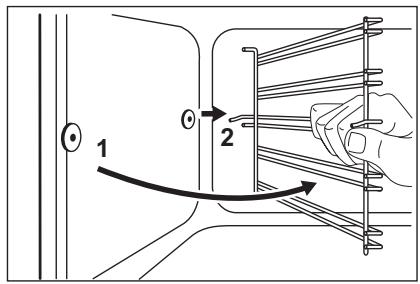
Installing the shelf supports
Install the shelf supports in the opposite sequence.

The rounded ends of the shelf supports must point to the front.
8.3 Oven ceiling
You can remove the grill to clean the oven ceiling more easily.

WARNING!
Deactivate the appliance before you remove the grill. Make sure that the appliance is cold. There is a risk of burns.
- Remove the screw which holds the grill. For the first time, use a screwdriver.
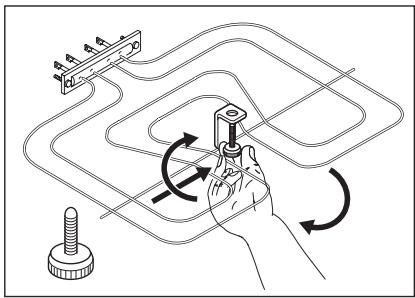
- Carefully pull the grill down.
- Clean the oven ceiling with a soft cloth with warm water and a cleaning agent, and let it dry.
- Install the grill in the opposite sequence.

WARNING!
Make sure that the grill is correctly installed and that it does not fall down.
- Pull the rear end of the shelf support away from the side wall and remove it.
8.4 Oven lamp

WARNING!
Be careful when you change the oven lamp. There is a risk of electrical shock.
Before you change the oven lamp:
- Deactivate the oven.
- Remove the fuses in the fuse box or deactivate the circuit breaker.

Put a cloth on the bottom of the oven to prevent damage to the oven light and glass cover. Always hold the halogen lamp with a cloth to prevent grease residue from burning on the lamp.
- Turn the glass cover counterclockwise to remove it.
- Clean the glass cover.
- Replace the oven light bulb with an applicable 300°C heat-resistant oven light bulb. Use the same oven lamp type.
- Install the glass cover.
8.5 Cleaning the oven door
The oven door has two glass panels. You can remove the oven door and the internal glass panel to clean it.

The oven door can close if you try to remove the internal glass panel before you remove the oven door.
Removing the oven door and the glass panel
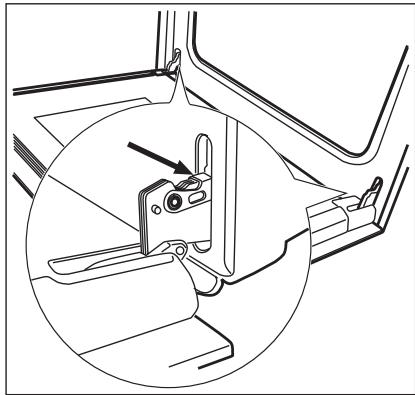
- Open the door fully and hold the two door hinges.
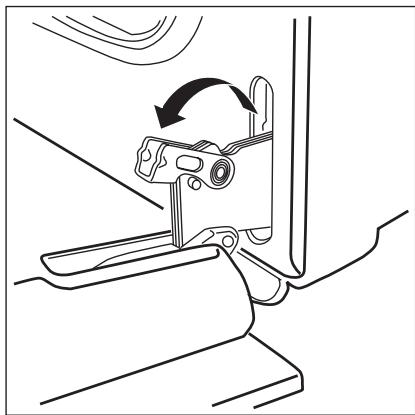
- Lift and turn the levers on the two hinges.
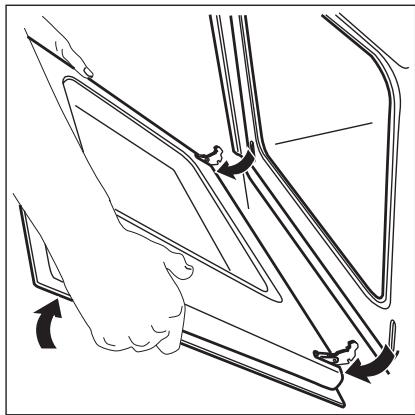
- Close the oven door to the first opening position (halfway). Then pull forward and remove the door from its seat.
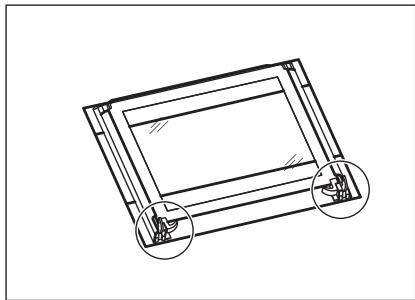
- Put the door on a soft cloth on a stable surface.
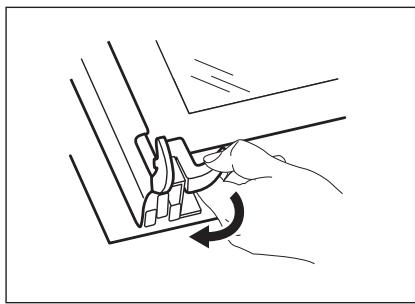
- Release the locking system to remove the internal glass panel.
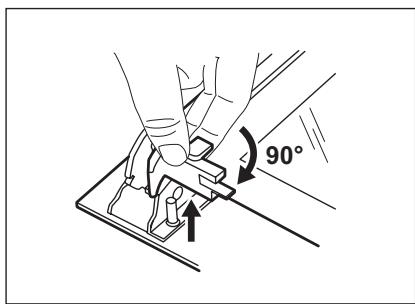
- Turn the two fasteners by 90° and remove them from their seats.
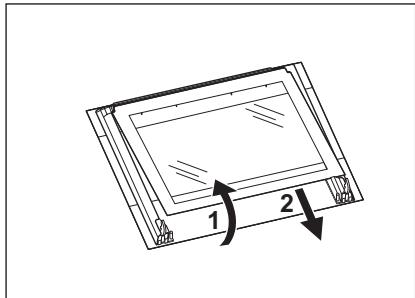
- Carefully lift (step 1) and remove (step 2) the glass panel.
- Clean the glass panel with water and soap. Dry the glass panel carefully.
Installing the door and the glass panel
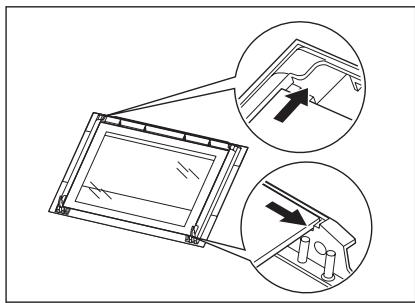
When the cleaning is completed, install the glass panel and the oven door. Do the above steps in the opposite sequence. The screen-printing zone must face the inner side of the door. Make sure that after the installation the surface of the glass panel frame on the screen-printing zones is not rough when you touch it. Make sure that you install the internal glass panel in the seats correctly. Refer to the illustration.
9. WHAT TO DO IF...

WARNING!
Refer to "Safety information" chapter.
| Problem | Possible cause | Remedy |
| The appliance does not operate. | The appliance is not activated. | Activate the appliance. Refer to the chapter "Dai-ly Use". |
| The appliance does not operate. | The fuse in the fuse box is released. | Do a check of the fuse. If the fuse is released more than one time, contact a qualified electrician. |
| The oven lamp does not operate. | The oven lamp is defective. | Replace the oven lamp. |
| Steam and condensation collect on the food and in the oven. | You left the dish in the oven for too long. | Do not keep the dishes in the oven for longer than 15 - 20 minutes after the cooking ends. |
| If you cannot find a solution to the problem yourself, contact your dealer or the service centre. | The necessary data for the service centre is on the rating plate. The rating plate is on the front frame of the appliance cavity. | |
| We recommend that you write the data here: Model (MOD.) Product number (PNC) Serial number (S.N.) | ............ ............ ............ ............ | |
10. INSTALLATION

WARNING!
Refer to "Safety information" chapter.
10.1 Building In
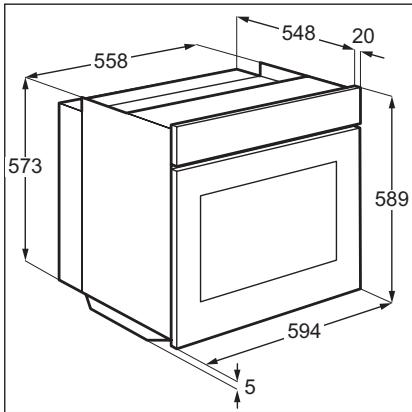
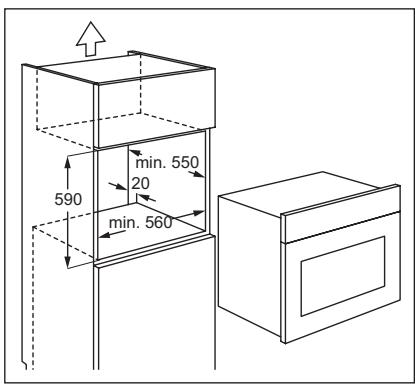
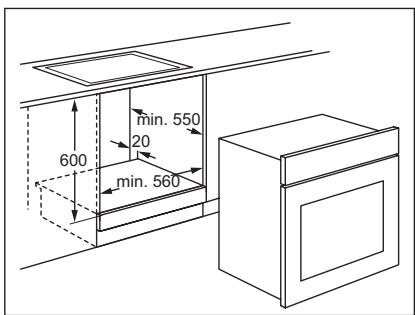
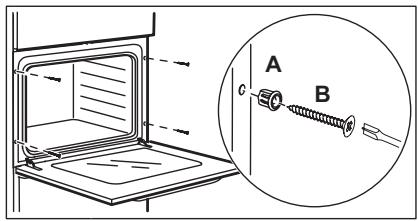
10.2 Electrical installation

WARNING!
Only a qualified person must do the electrical installation.

The manufacturer is not responsible if you do not follow the safety precautions from the chapter "Safety Information".
This appliance is supplied with a main plug and a main cable.
10.3 Cable
Cable types applicable for installation or replacement: H07 RN-F, H05 RN-F, H05 RRF, H05 VV-F, H05 V2V2-F (T90), H05 BB-F. For the section of the cable refer to the total power (on the rating plate) and to the table:
| Total power | Section of the cable |
| maximum 1380 W | 3 x 0.75 mm² |
| maximum 2300 W | 3 x 1 mm² |
| maximum 3680 W | 3 x 1.5 mm² |
The hearth cord (green / yellow cable) must be 2 cm longer than phase and neutral cables (blue and brown cables).
11. ENVIRONMENT CONCERNS
Recycle the materials with the symbol
. Put the packaging in applicable containers to recycle it.
Help protect the environment and human health and to recycle waste of electrical
and electronic appliances. Do not dispose appliances marked with the symbol
with the household waste. Return the product to your local recycling facility or contact your municipal office.
INHALT


- WE'RE THINKING OF YOU
- VISIT OUR WEBSITE FOR
- CUSTOMER CARE AND SERVICE
- SAFETY INFORMATION
- CHILDREN AND VULNERABLE PEOPLE SAFETY
- WARNING
- GENERAL SAFETY
- SAFETY INSTRUCTIONS
- INSTALLATION
- ELECTRICAL CONNECTION
- USE
- CARE AND CLEANING
- INTERNAL LIGHT
- DISPOSAL
- WARNING! RISK OF INJURY OR SUFFOCATION
- PRODUCT DESCRIPTION
- OVEN ACCESSORIES
- WIRE SHELF
- COMBI PAN
- BEFORE FIRST USE
- INITIAL CLEANING
- PREHEATING
- DAILY USE
- ACTIVATING AND DEACTIVATING THE APPLIANCE
- OVEN FUNCTIONS
- ADDITIONAL FUNCTIONS
- COOLING FAN
- SAFETY THERMOSTAT
- HELPFUL HINTS AND TIPS
- BAKING CAKES
- BAKING AND ROASTING TABLE
- COOKING MEAT AND FISH
- COOKING TIMES
- GRILLING
- TURBO GRILLING
- DRYING - TRUE FAN COOKING
- INFORMATION ON ACRYLAMIDES
- STAINLESS STEEL OR ALUMINIUM APPLIANCES
- REMOVING THE SHELF SUPPORTS
- CLEANING THE DOOR GASKET
- SHELF SUPPORTS
- INSTALLING THE SHELF SUPPORTS
- OVEN CEILING
- OVEN LAMP
- BEFORE YOU CHANGE THE OVEN LAMP
- CLEANING THE OVEN DOOR
- REMOVING THE OVEN DOOR AND THE GLASS PANEL
- INSTALLING THE DOOR AND THE GLASS PANEL
- WHAT TO DO IF
- BUILDING IN
- ELECTRICAL INSTALLATION
- CABLE
- ENVIRONMENT CONCERNS
- INHALT
Brand : ELECTROLUX
Model : EOC3410AAX
Category : Built-in oven