
SBS 578 WD F DX180C - Refrigerator-freezer VALBERG - Free user manual and instructions
Find the device manual for free SBS 578 WD F DX180C VALBERG in PDF.



| Product Type | Side-by-Side Refrigerator-Freezer |
| Brand | VALBERG |
| Model | SBS 578 WD F DX180C |
| Width (mm) | 908 |
| Depth (mm) | 600 |
| Refrigerator Volume | Not specified, but compartment suitable for fresh food |
| Freezer Volume | Not specified, but compartment suitable for frozen food |
| Climate Class | SN, N, ST, T (multi-class) |
| Main Functions | Super Cool, Super Freeze, Holiday Mode, Door Alarm, Ice Maker, Water Dispenser, LED Display |
| Lighting | LED (replacement by customer service) |
| Refrigerator Temperature Setting | 2°C to 8°C (in increments, digital display) |
| Freezer Temperature Setting | -15°C to -25°C (in increments, digital display) |
| Water Dispenser | Integrated in door, max capacity 4 liters |
| Ice Maker | Removable accessory |
| Cleaning and Maintenance | Regular cleaning with mild detergent; auto defrost; do not use sharp objects |
| Safety | Key lock, door alarm, temperature alarm |
| Spare Parts and Repairability | LED bulb not user-replaceable; contact customer service |
| Warranty | 2 years (upon presentation of receipt) |
| General Information | Adjustable feet, front/rear wheels, removable door gaskets for cleaning |
Frequently Asked Questions - SBS 578 WD F DX180C VALBERG
User questions about SBS 578 WD F DX180C VALBERG
0 question about this device. Answer the ones you know or ask your own.
Ask a new question about this device
Download the instructions for your Refrigerator-freezer in PDF format for free! Find your manual SBS 578 WD F DX180C - VALBERG and take your electronic device back in hand. On this page are published all the documents necessary for the use of your device. SBS 578 WD F DX180C by VALBERG.
USER MANUAL SBS 578 WD F DX180C VALBERG
WARRANTY CONDITIONS
This product is guaranteed for a period of 2 years from the date of purchase* against any failure resulting from a manufacturing or material defect. This warranty does not cover defects or damage resulting from incorrect installation, improper use or abnormal wear of the product.
*as shown on the sales receipt.
WARRANTY CONDITIONS
Thank you for choosing this VALBERG product. Chosen, tested and recommended by ELECTRO DEPOT, the products of the VALBERG brand are easy to use, reliable and of an impeccable standard. Thanks to this appliance, you can be sure that each use will bring you satisfaction.
Welcome to ELECTRO DEPOT.
Visit our website: www.electrodepot.fr www.electrodepot.be
| A Preview of the appliance | Recommended ambient temperature range Temperature control adjustment Description of the appliance |
| B Using the appliance | Installing your new appliance Display controls Using your appliance |
| C Useful information | Helpful hints and tips Cleaning and care Troubleshooting Disposal of the appliance |
Recommended ambient temperature range
Respect the climatic classes indicated in the product information on the appliance's nameplate. You can use this to check the recommended temperature range of the room where the appliance is located:
SN: Between 10 and 32°C - N: Between 16 and 32°C ST: Between 16 and 38°C - T: Between 16 and 43°C
A multi-class appliance can handle the lowest and highest temperature of all classes covered. Using the appliance outside of the ambient temperature range will result in inferior performance and premature ageing.
Temperature control adjustment
For optimal use and energy savings, adjust the temperature control(s) of the appliance according to the ambient temperature of the room, in which it is being used, and respect the climatic class.
Refer to the product sheet to find out the climatic class associated with the minimum and maximum recommended ambient temperatures for the appliance as well as the temperature setting recommended for storing food under optimal conditions.
The ambient temperatures in °C are given as a rough guide.
The set positions can be affected by the location of the appliance in the room, how often the door is opened or the load of food inside.
The temperature control position(s) may need to be changed to compensate for these factors.
Examples of locations:
- Unheated room in winter like a garage in a cold region.
- Living room with normal heating like a kitchen
- Non-air-conditioned room in summer in a hot region
Description of the appliance
1 Freezer zone LED light 2 Wind channel cover in freezer 3 Freezer door rack Freezer shelf 5 Ice-maker (optional) Freezer door gasket 7 Freezer drawer Freezer door rack (two-star zone) 9 Adjustable feet
10 Fresh zone LED light 11 Wind channel cover in fresh Water tank 13 Multifunctional drawer 14 Fresh shelf 15 Fresh door rack 16 Fruit and vegetables crisp 17 Fresh door gasket 13 Bottle holder
NOTE: Due to our continuous product updates, your refrigerator may be slightly different from this Instruction Manual but its functions and instructions for use remain the same.
NOTE: To optimise the energy efficiency of this product, please place all shelves and drawers in their original position as shown in the illustration above.
Installing your new appliance
Before using the appliance for the first time, your should consider the following guidance
Ventilation of the appliance
WARNING: In order to improve the efficiency of the cooling system and save energy, it is necessary to maintain good ventilation around the appliance for the dissipation of heat. For this reason, sufficient clear space should be available around the refrigerator. It is recommended to leave 50-70mm of space between the back of the unit and the wall, at least 100mm from its top, at least 100mm between its side and the wall, and a clear space at the front to allow the doors to open 130° and the refrigerator door to open 135°. See diagrams below. Please refer to the diagrams below.


Relevant information (constant / mm)
| W | W1 | W2 | D | D1 |
| 908 | 417.5 | 277 | 600 | 1142.5 |
NOTE: This appliance performs well in the climate class below. It may not work properly if left at a temperature above or below the indicated range for a long period.
- Stand your appliance in a dry place to avoid high moisture levels.
- Keep the appliance out of direct sunlight, rain, or frost. Stand the appliance away from heat sources such as stoves, fires, or heaters.
Levelling of the appliance
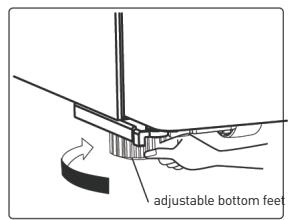
- To allow for sufficient levelling and air circulation in the lower rear section of the appliance, the bottom feet may need to be adjusted. A suitable spanner should be used for this purpose.
- To allow the doors to self-close, tilt the top backwards by around 15mm or 0.5° by turning the adjustable feet.
- If you wish to move the appliance, remember to turn the feet upwards again so that the appliance can roll freely. Reinstall the appliance when relocating.
WARNING: For proper installation, this refrigerator must be placed on a level surface made from hard material that is the same height as the rest of the flooring. This surface should be strong enough to support a fully loaded refrigerator. The rollers, which are not castors, should be only used for forward or backward movement. Moving the refrigerator sideways may damage your floor and the rollers.

Before you use the product, please check the handle of the refrigerator. If the handle is loose, you can repair it by turning the hexagonal screwdriver in a clockwise direction so that it can be used normally.
View of the appliance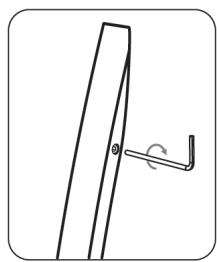
Display controls
Use your appliance according to the following control guidelines. Your appliance has functions and modes corresponding to the control panels shown in the pictures below. When the appliance is powered on for the first time, the backlighting of the icons on the display panel is activated. If no buttons have been pressed and the doors are closed, the backlighting will turn off after 60 seconds. The control panel consists of 2 areas showing temperature, 5 icons showing mode, and 4 control buttons.

Controlling the temperature
For optimum food preservation,
We recommend setting the refrigerator temperature to 5°C and the freezer to -18°C when you start your refrigerator for the first time. If you want to change the temperature, follow the instructions below.
WARNING: When you set a temperature, you set an average temperature for the whole refrigerator cabinet. Temperatures inside each compartment may vary from the temperatures displayed on the panel, depending on how much food you store and where you place it. High or low room temperature may also affect the actual temperature inside the appliance.
1. Unlock 3s
All the buttons are locked if the icon "D" is illuminated. You can press the "unlock 3s" button for 3 seconds to unlock them. You can press the "unlock 3s" button for 3 seconds to lock all the buttons when you finish temperature setting.
2. Refrigerator
After the refrigerator temperature setting has been activated, press "Refrigerator" button to set the refrigerator to 2°C as needed. The control panel will display the corresponding value according to the following sequence.

3. Freezer
After the freezer temperature setting has been activated, press "Freezer" button to set freezer temperature between -15°C and -25°C as needed. The control panel will display the corresponding value according to the following sequence.

4. Mode
You can select different modes by pressing the "Mode" button. The control panel will display the corresponding mode according to the following sequence. When a certain mode has been selected, wait for the corresponding icon to flash for 10 seconds. A buzzer will then sound twice and the icon will be illuminated, which means that the setting is complete.

Super Cool can refrigerate your food much faster, keeping food fresh for a longer period. When the function is on, the "•" icon will be illuminated.
You can switch off the Super Cool function by pressing the "Refrigerator" or "Freezer" button and the refrigerator temperature setting will revert back to its previous setting.
Super Freeze will quickly lower the temperature inside the freezer so that food will freeze faster. This can lock in the vitamins and nutrients of fresh food and keep food fresh longer.
- When the Super Freeze function is on, the “×” icon will be illuminated.
- When cooling a full freezer of unfrozen food, the Super Freeze function will take around 24 hours to freeze all food items completely.
- If the freezing capacity according to the rating plate is to be used, switch on Super Freeze before placing fresh products in the freezer compartment.
- Super Freeze automatically switches off after 26 hours, and the freezer temperature setting displays -25°C.
- When the Super Freeze function is on, you can switch it off by pressing the "Refrigerator" or "Freezer" button, and the freezer temperature setting will revert to its previous setting. The holiday function is the best option if you are going to be away for a long period of time.
- When the holiday function is on, the “•” icon will be illuminated.
- When the holiday function is activated, the temperature of the refrigerator is automatically switched to 15°C to minimize energy consumption.
- Important! Do not store any food in the refrigerator during this time.
- When the holiday function is on, you can switch it off by pressing the "Refrigerator" or "Freezer" button, and the freezer temperature setting will revert to its previous setting.
5. Alarm
If an alarm is activated, the "品" icon will be on and a buzzer will sound.
Door Alarm
- If the door of the refrigerator or freezer is left open for more than 2 minutes, the door alarm will sound. If the door alarm is activated, the buzzer will sound 3 times every minute and will automatically stop 10 minutes later.
To save energy, do not leave the door open for long periods when using the appliance. The door alarm can be deactivated by closing the door.
NOTE: A high temperature setting will accelerate food waste.
Using your appliance
This section tells you how to use most of the useful features. We recommend that you read through them carefully before using the appliance.
1. Using your refrigerator compartment
The refrigerator compartment is suitable for storing meat, vegetables and fruit. Food should be packed in sealed containers or wrapped in polythene food wrap to avoid losing moisture or allowing flavours to mix.
WARNING: Never close the refrigerator door while the shelves, crisper and/or telescopic slides are extended. This could damage these items as well as the refrigerator.
Glass shelves and door racks
The refrigerator compartment is provided with 5 glass shelves and several different door racks, which are suitable for the storage of eggs, canned liquid, bottled drinks and packaged food. They can be placed at different heights according to your needs. Before removing the door shelves, please remove all food items to avoid spillage.
- When removing the shelves, gently pull them forwards until they are dislodged from the shelf guides.
- When replacing the shelves, make sure that there are no obstacles behind them and gently push back into position.
Crispers
The crisper, which is mounted on telescopic extension slides, is used for storing fruit and vegetables. When removing the crisper, pull it forwards and lift off the sliders.
Remember to remove all food first.
Once you have removed the drawers, make sure that the slides have been pushed back fully.
Bottle holder use
The bottle holder can be used to hold bottles, cans and tall containers in place.
It can be used on the middle and lower door racks and may be moved side to side as required.
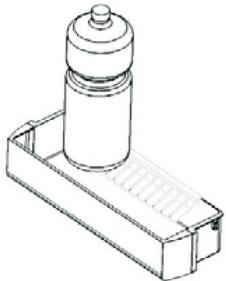
NOTE: All the door racks and covers are fully removable for cleaning.
2. Using your freezer compartment
The freezer compartment is suitable for the storage of foods which need to be frozen, such as meat, ice cream, etc.
WARNING: Ensure that bottles are not left in the freezer for longer than needed as freezing may cause the bottle to break.
3. Using your ice box
The ice box is used to make ice and store ice cubes. It is a removable accessory which can be taken out to save space. An ice maker cover is provided to keep the ice maker clean.
NOTE: The ice maker should be cleaned before use if it is being used for the first time or has not been used for a long time.
- Ice-making process.
- Place the integrated ice maker on a level surface and remove the cover.
- Pour water into the ice trays making sure that the water level does not exceed the top line as shown in the picture below.
- Place the ice maker in its original position. When ice cubes form, you can remove them for immediate use or transfer them to the ice storing box for future use.

Drawers
The drawers, which are mounted on telescopic extension slides, can be used to store large quantities of frozen food.
The drawers are removed in the same way as the crisper in the refrigerator chamber.
3. Water Dispenser
The water dispenser located in the refrigerator door is for storing drinking water. This appliance allows you to obtain chilled water easily without opening the refrigerator. You should bear the following tips in mind.
Before using
The following steps should be taken before using this appliance for the first time.
- Hold one side of the bottom of the water tank with one hand and lift up the opposite side with the other. When the water tank slot has been removed from the guide, change hands and repeat these steps.
- Hold both sides of the water tank tightly, lift and remove the water tank.
- Unscrew the head and clean the head, lids and water tank.
WARNING: Drain the water tank before removing it.
Assembling
After cleaning, assemble the parts including the head, water tank and lids as follows:
- Install the seal ring first (the seal ring must not face upwards), then insert the head into the hole.
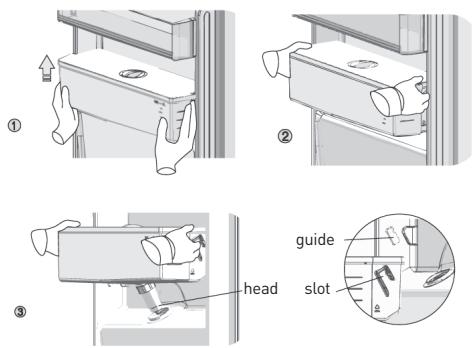
- Hold both sides of the water tank tightly, fit the water tank along the guides on the door.
- Push both sides of the water tank downwards as shown in the picture.
- Installation is complete when you hear clicks on both sides and at the same time both sides of the water tank are close to the door liner.

Filling with water
Before filling the water tank with drinking water, ensure that the water tank is steady and in the correct position.

WARNING:
- Fill with water up to 4l (as suggested) and not above the level. Otherwise, it may overflow when the lid is closed. We recommend that you fill the tank as follows. Remove the small lid and pour water in through the inlet of the larger lid. Remove the cover of the tank and pour the water straight into the tank.
- Do not touch the other parts of the appliance when filling with water as this may cause water leakage.
Dispensing water
- Make sure that the cover of the water tank is fitted on.
- Close the refrigerator door and check the dispenser.
Water dispenser
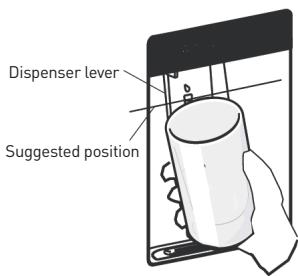
Collecting water
You should use the correct cups to collect water underneath the water dispenser.
WARNING: Do not push the dispenser lever forward without a cup as this may cause water to leak from the dispenser.
Cleaning
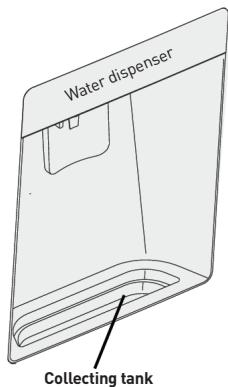
- Carefully remove the water tank from the door and then wash the tank, lid, and head lightly in water.
- Dry the appliance thoroughly after cleaning. The collecting tank should also be emptied regularly to avoid spillage.
Helpful hints and tips
Energy saving tips
We recommend that you follow the tips below to save energy.
Try to avoid keeping the door open for long periods in order to conserve energy. - Make sure that the appliance is away from any sources of heat. (Direct sunlight, electric oven or cooker, etc.) - Do not set the temperature colder than necessary. - Do not store warm food or evaporating liquid in the appliance. - Place the appliance in a well-ventilated, humidity-free room. Please refer to the chapter on installing your new appliance. - The diagram shows the correct combination for the drawers, crisper and shelves. Do not adjust the combination as this is designed to be the most energy-efficient configuration.
Hints for fresh food refrigeration
- Do not place hot food directly into the refrigerator; the internal temperature will increase resulting in the compressor having to work harder and this will consume more energy. Cover or wrap food, particularly if it has a strong flavour. Position food properly so that air can circulate freely around it.
Hints for refrigeration
- Wrap meat (all types) in polythene: wrap and place on the glass shelf above the vegetable drawer. Always follow food storage times and use-by dates suggested by manufacturers. Cooked food, cold dishes, etc.: These should be covered and may be placed on any shelf.
- Fruit and vegetables: These should be stored in the special drawer provided. Butter and cheese: Should be wrapped in airtight foil or plastic film wrap.
- Milk bottles: Should have a lid and be stored in the door racks.
Hints for freezing
- When first starting-up the appliance or after an idle period, allow it to run for at least 2 hours on the higher settings before putting food into the compartment. Prepare food in small portions so that it can quickly be completely frozen and only the quantity required can subsequently be thawed when needed.
- Wrap food in aluminium foil or airtight polyethylene food wraps.
- Do not allow fresh, unfrozen food to touch food which is already frozen to prevent frozen food from being partially thawed.
- Sliced products, if consumed immediately after removal from the freezer compartment, will probably cause frost burns to the skin. It is advisable to label and date each frozen package in order to keep track of the storage time.
Hints for the storage of frozen food
- Ensure that frozen food has been stored correctly by the food retailer.
- Once defrosted, food will deteriorate rapidly and should not be re-frozen. Do not exceed the storage period indicated by the food manufacturer.
Switching off your appliance
If the appliance needs to be switched off for an extended period, the following steps should be taken to prevent mould from forming on the appliance.
- Remove all food.
- Remove the power plug from the mains socket.
- Clean and dry the interior thoroughly.
- Ensure that all the doors are wedged open slightly to allow air to circulate.
Cleaning and care
For hygiene reasons, the appliance (including exterior and interior accessories) should be cleaned regularly at least every two months.
WARNING: The appliance must not be connected to the mains during cleaning. Danger of electrical shock! Before cleaning, switch the appliance off and remove the plug from the mains socket.
Exterior cleaning
You should clean your appliance regularly to maintain a good appearance.
- Wipe the digital panel and display panel with a clean, soft cloth. - Spray water onto the cleaning cloth instead of spraying directly on the surface of the appliance. This helps to ensure that moisture is distributed evenly over the surface. - Clean the doors, handles and cabinet surfaces with a mild detergent and then wipe dry with a soft cloth.
WARNING:
- Do not use sharp objects as they are likely to scratch the surface.
- Do not use thinner, car detergent, Clorox, ethereal oil, abrasive cleansers or organic solvent such as benzene for cleaning. They may damage the surface of the appliance and could cause a fire.
Interior cleaning
You should clean the appliance interior regularly. It will be easier to clean when food stocks are low.
- Wipe the inside of the fridge-freezer with a weak solution of bicarbonate of soda and then rinse with warm water using a wrung-out sponge or cloth.
- Wipe completely dry before replacing the shelves and baskets. Thoroughly dry all surfaces and removable parts.
Although this appliance defrosts automatically, a layer of ice may form on the refrigerator's interior walls if the door is opened frequently or kept open for too long. If the ice is too thick, wait until food stocks are low and proceed as follows:
- Remove existing food and accessory baskets, unplug the appliance from the mains power and leave the doors open. Ventilate the room thoroughly to accelerate the thawing process.
- When defrosting is complete, clean your freezer as described above.
WARNING: Do not use sharp objects to remove ice from the refrigerator. Only after the interior is completely dry should the appliance be switched back on and plugged back into the mains socket.
Door seal cleaning
Take care to keep door seals clean. Sticky food and drinks can cause seals to stick to the cabinet and tear when you open the door. Wash seal with a mild detergent and warm water. Rinse and dry thoroughly after cleaning.
WARNING: Only after the door seals are completely dry should the appliance be powered on.
Replacing the LED light
Warning: The LED light should not be replaced by the user. If the LED light is faulty, contact the customer helpline for assistance. Proceed as follows to replace the LED light:
- Unplug your appliance.
- Remove light cover by pushing it up and out.
- Hold the LED cover with one hand and pull it with the other hand while pressing the connector latch.
- Replace LED light and snap it correctly in to place.
Troubleshooting
If you experience a problem with your appliance or are concerned that the appliance is not functioning correctly, you can carry out some simple checks before calling for assistance (see below). You can carry out some simple checks as outlined in this section before calling for assistance.
WARNING: Do not try to repair the appliance yourself. If the problem persists after you have carried out the checks outlined below, contact a qualified electrician, authorised service engineer or the shop from which you purchased the product.
| Problem | Possible cause & solution |
| Appliance is not working correctly | Check whether the power cord is plugged into the power outlet properly. |
| Check the fuse or circuit of your power supply and replace if necessary. | |
| The ambient temperature is too low. Try setting the chamber temperature to a colder level to solve this problem. | |
| It is normal that the refrigerator does not operate during the automatic defrost cycle, or for a short time after the appliance is switched on to protect the compressor. | |
| Odours from compartments | The interior may need to be cleaned. |
| Odours can stem from certain foods, containers or wrapping. | |
| Sounds from the appliance | The sounds below are completely normal: · Compressor running sounds. · Air movement sounds from the small fan motor in the refrigerator compartment or other compartments. · Gurgling sounds similar to water boiling. · Popping sounds during automatic defrosting. · Clicking sounds before the compressor starts. |
| Other unusual sounds can be due to the reasons below and may need to be checked so that action can be taken: · The cabinet is not level. · The back of appliance touches the wall. · Bottles or containers have fallen over or are rolling. | |
| The motor is running continuously | It is normal to frequently hear the sound of the motor; it will need to run more in following circumstances: · Temperature setting is set colder than necessary · A large quantity of warm food has recently been stored in the appliance. · The temperature outside the appliance is too high. · Doors are kept open too long or too often. · After installing the appliance or if it has been switched off for a long time. |
| A layer of ice forms in the compartment | Check that the air outlets are not blocked by food and ensure that food is placed in the appliance in a way which allows for sufficient ventilation. Ensure that the door is fully closed. See the chapter on cleaning and care for guidance on removing the ice. |
| Temperature inside is too warm | You may have left the doors open too long or too frequently; or the doors are kept open by an obstruction; or the appliance is positioned with insufficient space at the sides, back or top. |
Disposal of the appliance
This appliance must not be disposed of as household waste.
Packaging materials
Packaging materials displaying the recycle symbol are recyclable. Dispose of the packaging in a suitable waste collection container for recycling.
Before disposing of the appliance
Pull the mains plug out of the mains socket.
Cut off the power cord and discard with the mains plug.
WARNING: Refrigerators contain refrigerant and gases in the insulation. Refrigerant and gases must be disposed of professionally as they may cause eye injuries or ignition. Ensure that tubing from the refrigerant circuit is not damaged prior to proper disposal.
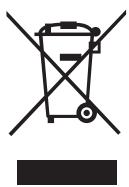
Correct disposal of this product
This marking indicates that this product should not be disposed with other household wastes throughout the EU. To prevent possible harm to the environment or human health from uncontrolled waste disposal, the product should be recycled responsibly to promote the sustainable reuse of material resources. To return your used device, please use the return and collection systems or contact the retailer from whom the product was purchased. They will collect the product for environmentally-safe recycling.
The instructions below should be followed to avoid food contamination:
- Opening the door for long periods can cause a significant temperature increase in the compartments of the appliance.
- Regularly clean surfaces that can come into contact with food and accessible drainage systems.
- Store raw meat and fish in suitable containers in the refrigerator so that they do not come into contact with or drip onto other food.
- Two-star frozen-food compartments are suitable for storing pre-frozen food, storing or making ice-cream and making ice cubes. One, two and three-star compartments are not suitable for the freezing of fresh food.
| Order | Compartment TYPE | Target storage temp.[℃] | Suitable food |
| 1 | Refrigerator | +2 ~ +8 | Eggs, cooked food, packaged food, fruit and vegetables, dairy products, cakes, drinks and other foods which are not suitable for freezing. |
| 2 | [***]*-Freezer | <-18 | Seafood (fish, shrimps, shellfish), freshwater aquatic products and meat products [recommended period of 3 months - nutritional values and flavours decrease over time], suitable for frozen fresh food. |
| 3 | ***-Freezer | <-18 | Seafood (fish, shrimps, shellfish), freshwater aquatic products and meat products [recommended period of 3 months - nutritional values and flavours decrease over time]. Not suitable for freezing fresh food. |
| 4 | **-Freezer | <-12 | Seafood (fish, shrimps, shellfish), freshwater aquatic products and meat products [recommended period of 2 months - nutritional values and flavours decrease over time]. Not suitable for freezing fresh food. |
| 5 | *-Freezer | <-6 | Seafood (fish, shrimp, shellfish), freshwater aquatic products and meat products [recommended period of 1 month - nutritional values and flavours decrease over time]. Not suitable for freezing fresh food. |
| 6 | 0-star | -6 ~ 0 | Partially packed/wrapped, encapsulated processed foods (non-freezable foods) |
| 7 | Chill | -2~ +3 | Fresh/frozen pork, beef, chicken, freshwater aquatic products, etc. (7 days below 0 C and above 0 C is recommended for consumption on the same day, preferably no more than 2 days). Seafood (below 0 for 15 days, should not be stored above 0 C) |
| 8 | Fresh food | 0 ~ +4 | Fresh pork, beef, fish, chicken, cooked food, etc. (Should be eaten on the same day, preferably no more than 3 days) |
| 9 | Wine | +5 ~ +20 | Red wine, white wine,sparkling wine etc. |
NOTE: different foods should be stored in the relevant compartments and at the target storage temperature of your purchased products.
- If the refrigerating appliance is left empty for long periods, switch off, defrost, clean, dry and leave the door open to prevent mould from developing inside the appliance.
Cleaning the water dispenser (specifically for water dispenser products):
- Clean water tanks if they have not been used for 48 hours; flush the water system connected to a water supply if water has not been used for 5 days.
WARNING: Food needs to be packed in bags before being put in the refrigerator and liquids need to be in bottles or capped containers to avoid problems associated with products which are difficult to clean due to their design.
Thank you!
3. "Freezer"
- WARRANTY CONDITIONS
- RECOMMENDED AMBIENT TEMPERATURE RANGE
- TEMPERATURE CONTROL ADJUSTMENT
- DESCRIPTION OF THE APPLIANCE
- INSTALLING YOUR NEW APPLIANCE
- VENTILATION OF THE APPLIANCE
- LEVELLING OF THE APPLIANCE
- DISPLAY CONTROLS
- CONTROLLING THE TEMPERATURE
- UNLOCK 3S
- REFRIGERATOR
- FREEZER
- MODE
- ALARM
- DOOR ALARM
- USING YOUR APPLIANCE
- USING YOUR REFRIGERATOR COMPARTMENT
- GLASS SHELVES AND DOOR RACKS
- CRISPERS
- BOTTLE HOLDER USE
- USING YOUR FREEZER COMPARTMENT
- USING YOUR ICE BOX
- DRAWERS
- WATER DISPENSER
- BEFORE USING
- ASSEMBLING
- FILLING WITH WATER
- WARNING
- DISPENSING WATER
- COLLECTING WATER
- CLEANING
- HELPFUL HINTS AND TIPS
- ENERGY SAVING TIPS
- HINTS FOR FRESH FOOD REFRIGERATION
- HINTS FOR REFRIGERATION
- HINTS FOR FREEZING
- HINTS FOR THE STORAGE OF FROZEN FOOD
- SWITCHING OFF YOUR APPLIANCE
- CLEANING AND CARE
- EXTERIOR CLEANING
- INTERIOR CLEANING
- DOOR SEAL CLEANING
- REPLACING THE LED LIGHT
- TROUBLESHOOTING
- DISPOSAL OF THE APPLIANCE
- PACKAGING MATERIALS
- BEFORE DISPOSING OF THE APPLIANCE
- CORRECT DISPOSAL OF THIS PRODUCT
- CLEANING THE WATER DISPENSER (SPECIFICALLY FOR WATER DISPENSER PRODUCTS)
- THANK YOU
Brand : VALBERG
Model : SBS 578 WD F DX180C
Category : Refrigerator-freezer