
N300 - Wireless Router LINKSYS - Free user manual and instructions
Find the device manual for free N300 LINKSYS in PDF.


| Product Type | N300 Wireless Router |
| Brand | Linksys |
| Model | N300 |
| Dimensions (without antennas) | 246 x 194 x 52 mm |
| Weight | 1.040 kg |
| Power Supply | 12 V DC, 4 A |
| Frequency Bands | 2.4 GHz and 5 GHz |
| Wireless Standards | 802.11a/b/g/n/ac |
| Number of Antennas | 4 adjustable external antennas |
| Ethernet Ports | 4 Gigabit ports (10/100/1000) + 1 Gigabit Internet port |
| USB Ports | 1 x USB 3.0, 1 x combined USB 2.0/eSATA |
| Security Features | WEP, WPA2, RADIUS, 128-bit encryption, SPI firewall, MAC filtering |
| Parental Controls | Yes (scheduled access restrictions and website blocking) |
| Guest Network | Yes (password-protected, internet access only) |
| External Storage | File sharing via USB, media server, FTP server |
| VPN Passthrough | IPSec, PPTP, L2TP |
| Remote Management | Via Linksys Smart Wi-Fi (online account) |
| Wall Mounting | Yes (mounting holes, distance 105 mm or 211 mm) |
| Care and Cleaning | Clean with a dry, soft cloth. Avoid moisture and chemicals. |
| Operating Temperature | 0 to 40 °C |
Frequently Asked Questions - N300 LINKSYS
User questions about N300 LINKSYS
0 question about this device. Answer the ones you know or ask your own.
Ask a new question about this device
Download the instructions for your Wireless Router in PDF format for free! Find your manual N300 - LINKSYS and take your electronic device back in hand. On this page are published all the documents necessary for the use of your device. N300 by LINKSYS.
USER MANUAL N300 LINKSYS
text_image
LINKSYS INTERNET 2.4 GHz 5 GHz eSATA USB 1 USB 2USER GUIDE
WRT 1900 AC
DUAL BAND GIGABIT
Wi-Fi ROUTER
LINKSYS
PERFORMANCE PERFECTED
PRODUCT OVERVIEW
1 WRT1900AC
3 Wall-mounting placement
SETTING UP: BASICS
5 How to create a home network
5 What is a network?
5 How to set up a home network
5 Where to find more help
6 How to install your router
7 How to configure your router
7 How to connect to Linksys Smart Wi-Fi
7 How to disable remote access
8 How to connect directly to your router
8 How to improve your wireless connection speed
8 How to change your network's name and password
9 How to change your router's local access password
9 How to change your router's time zone
10 How to test your Internet connection speed
10 How to connect devices to your network
10 How to connect a computer to your network
10 How to connect a USB printer
11 How to connect other devices
12 How to view device details
13 How to set up parental controls
14 How to configure your guest network
15 How to back up your router configuration
15 How to customize Linksys Smart Wi-Fi
15 Using widgets
15 Customizing the Network Map
USING AN EXTERNAL DRIVE
16 Overview
16 How to attach a USB drive
16 How to use secured folder access
17 How to set up authorized users and shared folders
18 How to access shared folders
18 How to set up your router as a media server
19 How to connect your UPnP device to the media server
20 How to remotely access storage
SETTING UP: ADVANCED
21 How to manually set up your router
21 How to manually set up your Internet connection
22 How to associate a router with your Linksys Smart Wi-Fi account
22 How to get the most out of your dual-band router
24 How to control access to your network
25 How to improve security using the built-in firewall
26 Changing IPV6 firewall settings
27 How to set up the DHCP server on your router
27 How to set up DHCP reservation
28 How to access your network on the Internet
29 How to clone a MAC address
30 How to connect to your corporate office using a VPN
31 How to optimize your router for gaming and voice
32 How to enable Voice over IP on your network
33 How to configure UPnP
34 How to use a router as an access point
35 How to put your new router behind an existing router
35 How to add your router to an existing router or gateway
36 How to share an Internet connection
37 How to extend your network
37 How to expose a device to the Internet
PORT FORWARDING AND PORT TRIGGERING
39 How to set up port forwarding
39 How to set up port forwarding for a single port
39 How to set up port forwarding for multiple ports
40 How to set up port forwarding for a range of ports
40 How to set up port range triggering for online gaming
MAINTAINING AND MONITORING
42 How to back up and restore your router configuration
43 How to upgrade the router's firmware
43 How to restore factory defaults
44 How to check the status of your router
44 How to disable the Ethernet port status lights
44 How to test your Internet connection
45 How to configure and use logs
TROUBLESHOOTING
46 Your router was not successfully set up
46 Windows XP Service Pack update
46 Your Internet cable is not plugged in message
47 Cannot access your router message
48 After setup
48 The Internet appears to be unavailable
48 Rebooting your router
49 Linksys Smart Wi-Fi does not open in your web browser
49 You cannot access Linksys Smart Wi-Fi
49 All other troubleshooting has been unsuccessful
SPECIFICATIONS
50 Linksys WRT1900AC
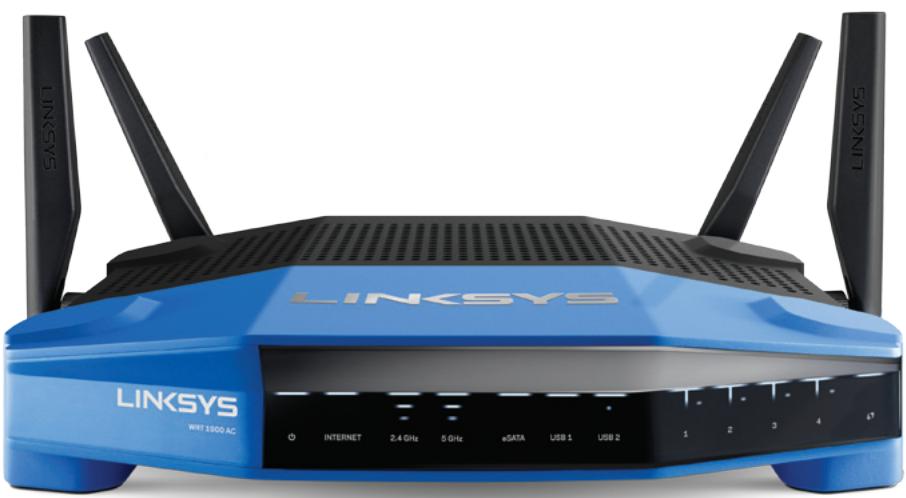
WRT 1900AC
natural_image
Blue LINKSYS WRT 1000 AC wireless router with black ventilation slots and control buttons (no visible text beyond branding)Front View
text_image
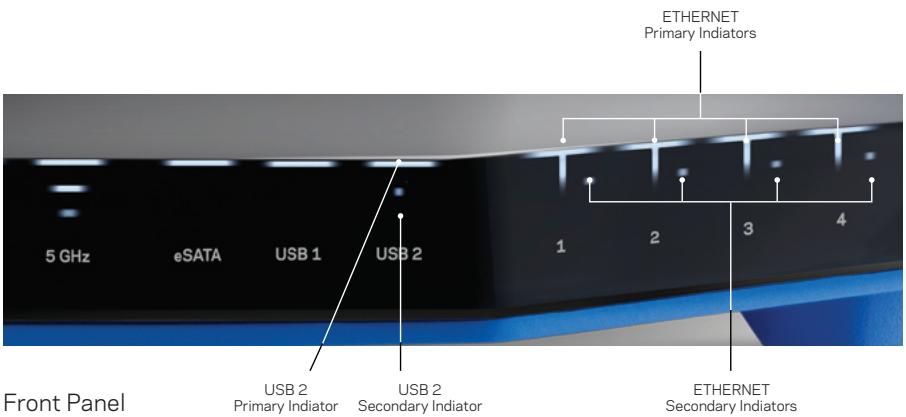
ETHERNET Primary Indiators 5 GHz eSATA USB 1 USB 2 1 2 3 4 USB 2 Primary Indiator USB 2 Secondary Indiator ETHERNET Secondary Indiators Front PanelFRONT PANEL INDICATORS

(White) The icon LED is solid white while the router is powered on. It will blink when the router goes through its self-diagnostic mode during every boot-up.
Internet
(White/Amber) The Internet LED is solid white when connected to the Internet. It blinks white while the router works to establish a connection. A solid amber LED indicates the connection is down due to configuration issues. Amber blinking indicates that the connection is down due to hardware issues.
2.4 GHz
(White) The Wireless LED is solid white when one or more clients are connected to the 2.4 GHz network. If the LED is blinking white, the router is sending or receiving data over the 2.4 GHz network.
5 GHz
(White) The Wireless LED is solid white when one or more clients are connected to the 5GHz network. If the LED is blinking white, the router is sending or receiving data over the 5 GHz network.
eSATA
(White) When off, the USB/eSATA port is off or a USB device is connected. The LED is solid white when an eSATA device is connected. A blinking white LED indicates activity through the eSATA port.
USB 1
(White) When off, the USB /eSATA port is off or an eSATA device is connected. The LED is solid white when a USB device is connected. A blinking white LED indicates activity on the port.
USB2 Primary
(White) When off, the USB 3.0 port is off. The LED is solid white when a USB device is connected. A blinking white indicates activity on the port
USB2 Secondary
(White) When off, a USB 1.0 or USB 2.0 device is connected. A solid white LED indicates a USB 3.0 device is connected.
ETHERNET 1 thru 4 (Primary)
(White) These numbered LEDs correspond with the numbered ports on the router's back panel. If the white LED is solid, the router is connected to a device through that port. A flashing white LED indicates network activity over that port.
ETHERNET 1 thru 4 (Secondary)
(White)If the white LED is off, the router is successfully connected to a device through that port at 10/100 Mbps. A solid white LED indicates that the router is successfully connected to a device at 1000 Mbps.

(White/Amber) The LED blinks slowly for two minutes during Wi-Fi Protected Setup. It will be solid white for five seconds to indicate a successful connection The LED blinks amber if the he Wi-Fi Protected Setup process fails. Make sure the client device supports Wi-Fi Protected Setup. Wait until the LED is off, and then try again. The router supports one session at a time.
text_image
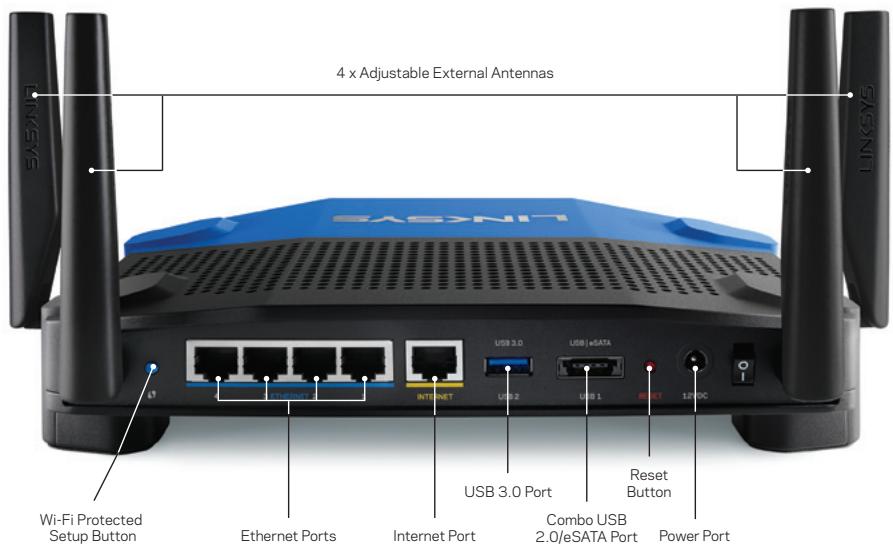
4 x Adjustable External Antennas WISNIT LINKSYS USB 3.0 USB /eSATA USB 2 USB 1 RESET 1/2/DC Wi-Fi Protected Setup Button Ethernet Ports Internet Port USB 3.0 Port Reset Button Combo USB 2.0/eSATA Port Power PortBack View
Adjustable External Antennas
This router ships with four adjustable external antennas that should be connected to the router before powering it on. To connect the antennas, twist the antenna connector clockwise onto the antenna port on the router.
Note:
For best performance, position the side antennas vertically as shown in the picture.
Wi-Fi Protected Setup button
Press to easily configure wireless security on Wi-Fi Protected Setup-enabled network devices.
Ethernet Ports
Connect Ethernet cables to these blue gigabit 10/100/1000) ports, and to wired devices on your network.
Note:
For best performance, use CAT5E or higher rated cables on the Ethernet ports.
Internet Port
Connect an Ethernet cable to this yellow gigabit (10/100/1000) port, and to a broadband Internet cable/DSL or fiber modem.
Note:
For best performance, use CAT5E or higher rated cables on the Ethernet ports.
USB 3.0 Port
Connect and share a USB or eSATA drive on your network or on the Internet.
USB 2.0/eSATA Combo Port
Connect and share a USB or eSATA drive on your network or on the Internet. You can also connect a USB printer and share it across your network.
Reset Button
Press and hold for 10 seconds (until the power LED starts flashing) to reset the router to factory settings. You can also restore the factory settings using Linksys Smart Wi-Fi on the Internet or mobile app.
Power Port
Connect the included AC power adapter.
Power Button
Press to turn on the router.
Wall-Mounting Placement
The router has wall-mount slots on the bottom of each foot for flexibility in mounting the router on the wall. The distance between the slots on the short side is 105 mm. The distance between the slots on the longer side is 211 mm. Two screws are needed to mount the router.
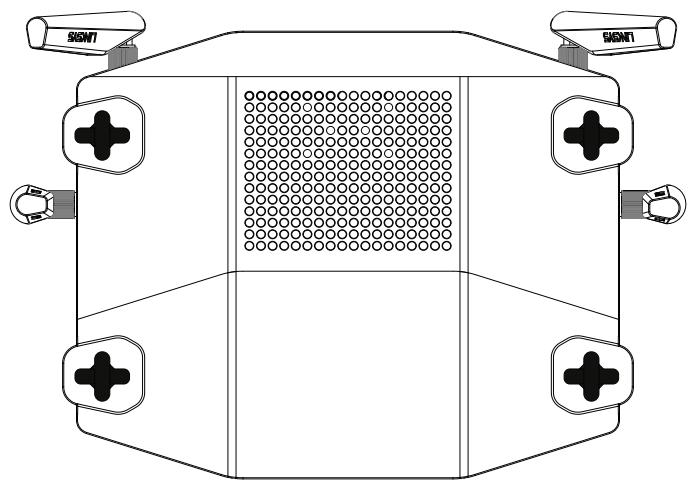
natural_image
Top-down schematic of a vehicle or vehicle chassis with four labeled sensors (no text or symbols present)Suggested Mounting Hardware
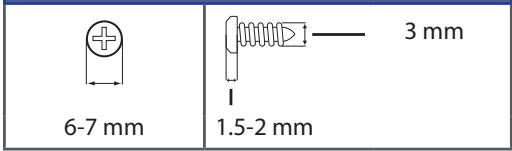
text_image
6-7 mm 1.5-2 mm 3 mmNote:
Linksys is not responsible for damages incurred by unsecured wall-mounting hardware.
Mounting Instructions
- Determine where you want to mount the router and which side you should use to mount it. Make sure that the wall you use is smooth, flat, dry, and sturdy. Make sure the location is within reach of an electrical outlet.
- Before drilling holes, choose the template (short side or long side) that fits your installation. Drill the holes using the correct template.
- Insert a screw into each hole and leave 8 mm of its head exposed.
- Position the router so the wall-mount slots line up with the two screws.
- Place the wall-mount slots over the screws and slide the router down until the screws fit snugly into the wall-mount slots.
Wall-Mounting Template (Short Side)
Print this page at 100% size.
Cut along the dotted line, and place on the wall to ensure precise spacing of holes.
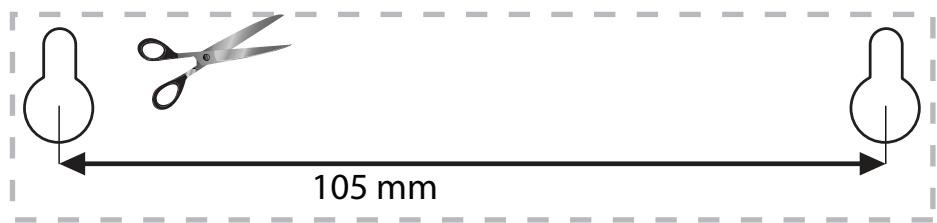
text_image
105 mmWall-Mounting Template (Long Side)
Print this page at 100% size.
Cut along the dotted line, and place on the wall to ensure precise spacing of holes.

text_image
211 mmHOW TO CREATE A HOME NETWORK
What is a network?
A network is any group of devices that can communicate with each other. A home network can also include Internet access, which requires a router like this one.
A typical home network may include multiple computers, a printer, a modem, and a router. A large home network may also have a switch, additional routers, access points, and many Internet-capable media devices such as TVs, game consoles, and web cameras.
Modem Connects a computer or a router to your ISP (Internet Service Provider). Your ISP may have provided one. The modem is a device that connects to a phone jack or your cable TV outlet.
Router Connects your wireless and wired network devices to each other and to the modem (and to your ISP).
Switch Allows you to connect several wired network devices to your home network. Your router has a built-in network switch (the Ethernet ports). If you have more wired network devices than available Ethernet ports on your router, you will need an additional switch to consolidate the wired connections.
How to set up a home network:
Purchase the proper equipment. For a network that includes Internet access, you'll need:
- Computers with an Ethernet port or wireless networking capabilities
- A modem for connecting to your ISP (typically supplied by your ISP)
- A router to connect your computers with each other and to the modem
- Internet service to your home, provided by an ISP (Internet Service Provider)
- Make sure that your modem is working. Your ISP can help you set up your modem and verify that it's working correctly.
- Set up your router. See "How to install your router" on page 6.
- To connect a computer or other network device to the network, see "How to connect a computer to your network" on page 10 and "How to connect other devices" on page 11.
WHERE TO FIND MORE HELP
In addition to this User Guide, you can find help at these locations:
- Linksys.com/support (documentation, downloads, FAQs, technical support, live chat, forums)
- Linksys Smart Wi-Fi help (connect to Linksys Smart Wi-Fi, then click Help at the top of the screen)
Help
Using Linksys Smart Wi-Fi
Linksys Smart Wi-Fi allows you to access all of your router's features and settings. Simply click on a feature or widget you want to open.
You can use Linksys Smart Wi-Fi to:
• See what's currently connected to your network, and connect more computers and devices.
- Access router settings from anywhere using any browser, even when you're away from home. You you can personalize your router and change settings for wireless access; Internet, gaming, local network, and more. You can even access router settings for multiple routers, which is helpful if you set up and manage more than one router.
- Allow guests in your home to use the internet without giving them access to your network. While on the guest network, users can surf the net, but won't be able to access your printers, other computers, or devices on your network.
Help Categories
Linksys Smart Wi-Fi
Device List
Guest Access
Parental Controls
Media Prioritization
Speed Test
USB Storage
HOW TO INSTALL YOUR ROUTER
To Install Your Router:
- If replacing an existing router, disconnect it. Power on your new router.
- Connect the Internet cable from your modem to the yellow INTERNET port on your router. Wait until the power light on the front of the router is solid.
- Connect to the secure wireless name shown in the Quick Start Guide that came with your router. (You can change the network name and password later.) If you need help connecting to the network, refer to your device documentation. Note: You will not have Internet access until router setup is complete.
- Open a web browser and follow the instructions to complete setup. If instructions do not appear in the web browser, type "linksyssmartwifi.com" in the address bar.
- At the end of setup, follow the on-screen instructions to set up your Linksys Smart Wi-Fi account. Use Linksys Smart Wi-Fi configure your router from any computer with an Internet connection.
Manage Your Router's Settings:
- Change your router's name and password
- Set up guest access
- Configure parental controls
- Connect devices to your network
- Test your Internet connection speed
Note:
As part of the router setup process, you will be sent a verification e-mail. From your home network, click the link in the e-mail to associate your router with the Linksys Smart Wi-Fi account.
If you cannot click the link while behind your new Linksys router, log into Linksys Smart Wi-Fi while behind the router and add your router there. For more information, see "How to associate a router with your Linksys Smart Wi-Fi account" on page 22.
Tip:
Print this page, then record your router and account settings in the table below as a reference. Store your notes in a safe place. Setup also saves your setup information as a file to your computer desktop.
| Network Name (SSID) | |
| Network Password | |
| Router Password | |
| Guest Network Name | |
| Guest Network Password | |
| Linksys Smart Wi-Fi Username | |
| Linksys Smart Wi-Fi Password |
HOW TO CONFIGURE YOUR ROUTER
You can change router settings to make your network more secure or to work better with a device or game. Being able to adjust the settings while you're away from home can help make router administration easier. You can configure your router from anywhere in the world by using Linksys Smart Wi-Fi, but you can also configure your router directly from your home network.
Linksys Smart Wi-Fi may be available for your mobile device, as well. See your device's app store for information.
HOW TO CONNECT TO LINKSYS SMART WI-FI
- To connect to Linksys Smart Wi-Fi:
- Open your computer's web browser.
- Go to www.linksyssmartwifi.com and log into your account
- If you can't remember your password, click Forgot your password? and follow the on-screen instructions to recover it.
Linksys Smart Wi-Fi Sign In
If you have not yet created a Linksys Smart Wi-Fi account, click the 'Create Account' button in the upper right corner of the page.
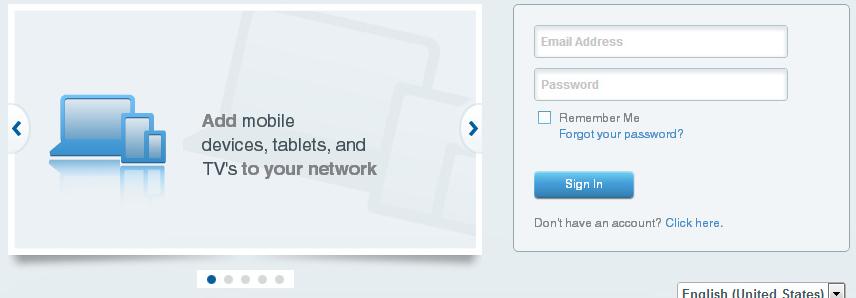
text_image
Add mobile devices, tablets, and TVs to your network Email Address Password Remember Me Forgot your password? Sign In Don't have an account? Click here. English (United States)Use your Linksys Smart Wi-Fi account to access your home network from anywhere, at any time, even from your mobile device. Easily connect new devices, set parental controls, get access to Smart Wi-Fi mobile Apps, and more. For more information click here
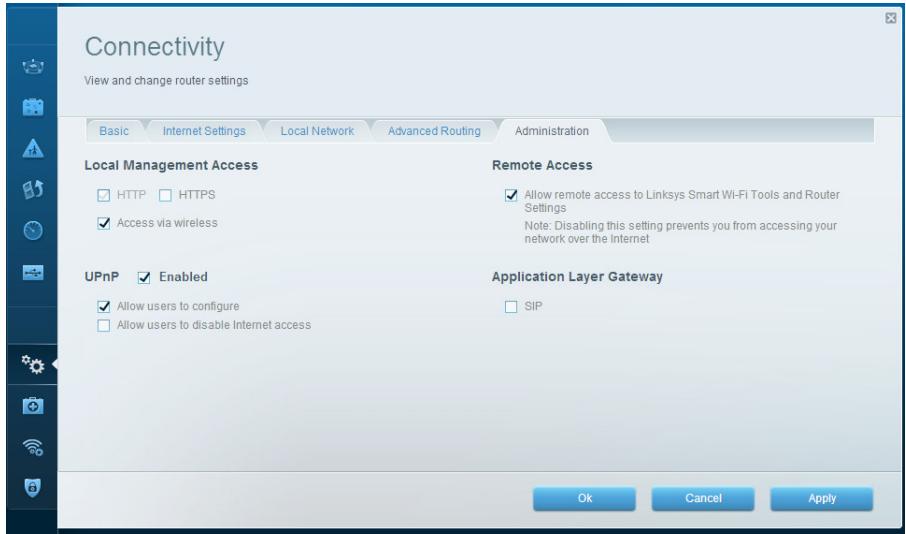
HOW TO DISABLE REMOTE ACCESS
If you want to configure your router only while you are on your home network, you should disable remote access.
To disable remote access:
- Log in to Linksys Smart Wi-Fi.
- Under Router Settings, click Connectivity.
- Click the Administration tab, then deselect Allow remote access to Linksys Smart Wi-Fi.
- Click OK.
text_image
Connectivity View and change router settings Basic Internet Settings Local Network Advanced Routing Administration Local Management Access ✓ HTTP ✓ HTTPS ✓ Access via wireless Remote Access ✓ Allow remote access to Linksys Smart Wi-Fi Tools and Router Settings Note: Disabling this setting prevents you from accessing your network over the Internet UPnP ✓ Enabled ✓ Allow users to configure ✓ Allow users to disable Internet access Application Layer Gateway ✓ SIP OK Cancel ApplyHOW TO CONNECT DIRECTLY TO YOUR ROUTER
You can configure your router by directly accessing it on your home network instead of through the Internet-based Linksys Smart Wi-Fi.
To connect to your router while you are on your home network:
- Open your computer's web browser.
- Go to www.linksyssmartwifi.com and log into your router using the router password you created when you installed your router. (When there is no Internet connection, this address re-routes directly to your router.)
HOW TO IMPROVE YOUR WIRELESS CONNECTION SPEED
Make sure that your router is in a good location:
- For the widest coverage area, install your router near the center of your home, and near the ceiling, if possible.
- Avoid placing the router on or near metal objects (file cabinets and metal furniture), reflective surfaces (glass or mirrors), or masonry walls.
- Any obstruction can weaken the wireless signal (even non-metallic objects), so the fewer obstructions between the router and the wireless device, the better.
- Place the router in a location away from other electronics, motors, and fluorescent lighting.
- Many environmental variables can affect the router's performance, so if your wireless signal is weak, place the router in several locations and test the signal strength to determine the ideal position.
- If possible, upgrade wireless network interfaces such as wireless network cards in computers from older wireless standards to 802.11n. If a wirelessly networked device uses an older standard, the performance of the entire wireless network may be slower.
- If your router is a dual-band router, split your network traffic so the high-bandwidth traffic uses the 5 GHz band. For more information, see “How to get the most out of your dual-band router” on page 22.
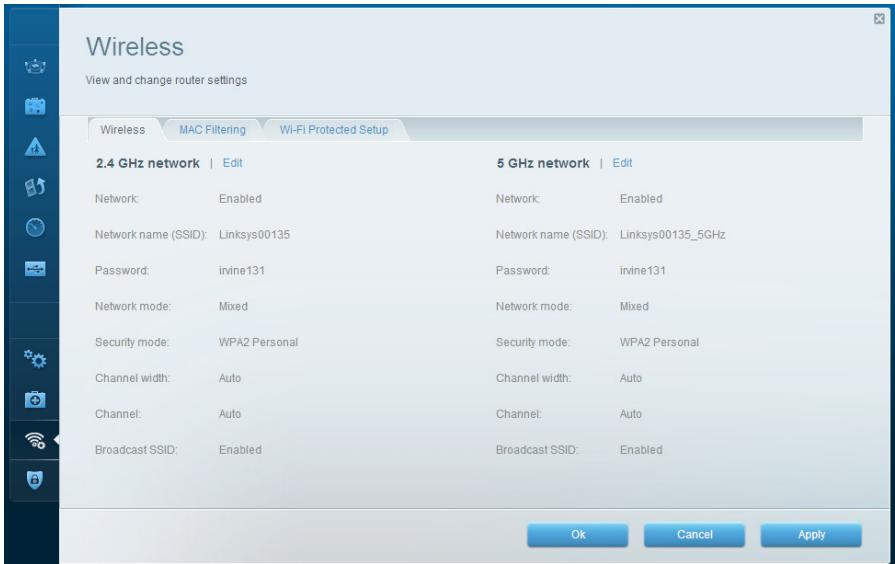
HOW TO CHANGE YOUR NETWORK'S NAME AND PASSWORD
You can change the name (SSID) and password of your network, but if you do so, all wireless devices connected to your router will lose their Internet connection until you reconnect them using the new network name and password.
To change your router's name and password:
- Log into Linksys Smart Wi-Fi. (See "How to connect to Linksys Smart Wi-Fi" on page 7.)
■ Under Router Settings, click Wireless. - Click the Wireless tab, then click Edit.
To change the network name, type a new name in the Network name (SSID) box. To change the network password, type a new password in the Password box.
- Click OK to apply your changes.
text_image
Wireless View and change router settings Wireless MAC Filtering Wi-Fi Protected Setup 2.4 GHz network Edit 5 GHz network Edit Network: Enabled Network: Enabled Network name (SSID): Linksys00135 Network name (SSID): Linksys00135_5GHz Password: Irvine131 Password: Irvine131 Network mode: Mixed Network mode: Mixed Security mode: WPA2 Personal Security mode: WPA2 Personal Channel width: Auto Channel width: Auto Channel: Auto Channel: Auto Broadcast SSID: Enabled Broadcast SSID: Enabled Ok Cancel ApplyHOW TO CHANGE YOUR ROUTER'S LOCAL ACCESS PASSWORD
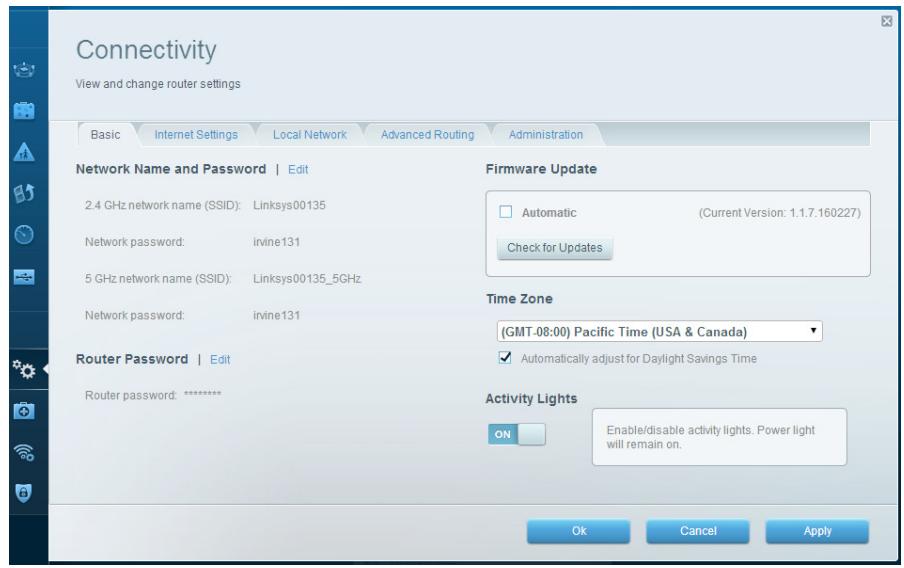
Your router's local access password was set when you ran the router's setup software, but you can change it at any time. You need the router password to change router settings when you don't have an Internet connection. When you do have an Internet connection, log into your Linksys Smart Wi-Fi account by following the directions under "How to connect to Linksys Smart Wi-Fi" on page 7.
To change your router's local access password:
- Log into Linksys Smart Wi-Fi. (See "How to connect to Linksys Smart Wi-Fi" on page 7.)
- Click Connectivity under Router Settings.
- Click the Basic tab.
- Under Router Password, type the new password, then click OK.
text_image
Connectivity View and change router settings Basic Internet Settings Local Network Advanced Routing Administration Network Name and Password | Edit 2.4 GHz network name (SSID): Linksys00135 Network password: ivine131 5 GHz network name (SSID): Linksys00135_5GHz Network password: ivine131 Router Password | Edit Router password: ***** Firmware Update Automatic (Current Version: 1.1.7.160227) Check for Updates Time Zone (GMT-08:00) Pacific Time (USA & Canada) ✓ Automatically adjust for Daylight Savings Time Activity Lights ON Enable/disable activity lights. Power light will remain on. Ok Cancel ApplyHOW TO CHANGE YOUR ROUTER'S TIME ZONE
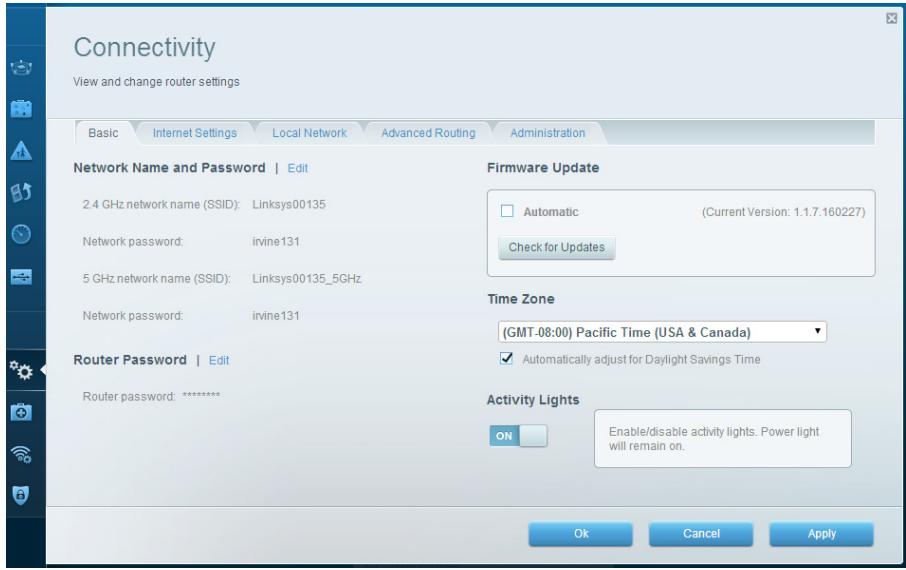
Your router's time zone should be set to your local time zone.
To set your router's time zone:
- Log into Linksys Smart Wi-Fi. (See "How to connect to Linksys Smart Wi-Fi" on page 7.)
- Click Connectivity under Router Settings.
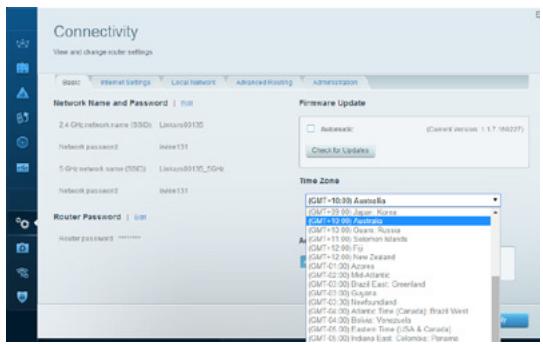
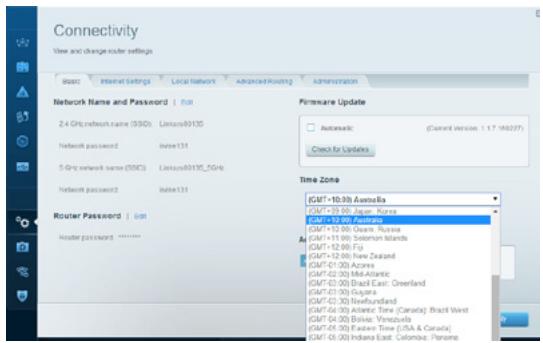
- Click the Basic tab, then select your time zone in the Time Zone drop-down list and click OK.
text_image
Connectivity View and change router settings Basic Internet Settings Local Network Advanced Routing Administration Network Name and Password | Edit 2.4 GHz network name (SSID): Linksys00135 Network password: irvine131 5 GHz network name (SSID): Linksys00135_5GHz Network password: irvine131 Router Password | Edit Router password: ***** Firmware Update Automatic (Current Version: 1.1.7.160227) Check for Updates Time Zone (GMT-08:00) Pacific Time (USA & Canada) ✓ Automatically adjust for Daylight Savings Time Activity Lights ON Enable/disable activity lights. Power light will remain on. Ok Cancel ApplyHOW TO TEST YOUR INTERNET CONNECTION SPEED
Note:
To run the speed test, you must be accessing the Internet by using the router you are testing. You cannot run the speed test remotely.
To test your Internet connection speed:
- Log into Linksys Smart Wi-Fi. (See “How to connect to Linksys Smart Wi-Fi” on page 7.)
- Click Speed Test under Apps. The Speed Test screen opens.
text_image
Connectivity View and change router settings Basic Internet Settings Local Network Advanced Routing Administration Network Name and Password | Edit 2.4 GHz networking name (SSO): Linkosv00105 Network password Inlet 131 5 GHz networking name (SSO): Linkosv00105_7GHz Network password Inlet 131 Router Password | Edit Router password ............" Firmware Update Automatic (Current versions 1.6.7 -166227) Check for Updates Time Zone CMT-10:39 Axono8a CMT-29:00 Japan Korea CMT-10:29 Axono8a CMT-43:00 Guangzhou CMT-11:00 Saitomo Islands CMT-12:00 Fiy CMT-12:00 Have Zealand CMT-20: Azores CMT-22:30 M& Atlantic CMT-23:30 Brazil East: Greenland CMT-23:30 Guyana CMT-23:30 Newfoundland CMT-54:30 Atlantic Time (Canada) Brazil West CMT-54:30 Beijing: Yunnabeta CMT-55:30 Eastern Time (USA & Canada) CMT-55:30 Indiana East: Colombia: ParameClick Begin Test. The test measures your download and upload speeds.
text_image
Connectivity View and change router settings Basic Internet Settings Local Network Advanced Routing Administration Network Name and Password | Edit 2.4 GHz/Network name (SSO): Linux:00105 Network password Inlet 131 5 GHz/Network name (SSO): Linux:00105_7G/Hc Network password Inlet 131 Router Password | Edit Router password ............" Firmware Update Automatic (Current versions 1.6.7.160227) Check for Updates Time Zone (CMT-10:39) Amazon8a (CMT-29:00) Japan Korea (CMT-10:00) Australia (CMT-03:00) Canadian States (CMT-11:00) Boston Islands (CMT-12:00) Fiji (CMT-12:00) New Zealand (CMT-01:00) Azores (CMT-02:00) Mid-Atlantic (CMT-02:00) Brazil East: Ontario (CMT-03:00) Guyana (CMT-03:00) Newfoundland (CMT-04:00) Atlantic Time (Canada) Brazil West (CMT-04:00) Brivia Venezuela (CMT-05:00) Eastern Time (USA & Canada) (CMT-05:00) Indiana East: Colombia, Parameo- Click Restart Test to run it again, and click Show History to display the results of past tests.
Note:
Internet connection speeds are determined by a variety of factors, including ISP account type, local and worldwide Internet traffic, and number of devices in your home that are sharing the Internet connection.
HOW TO CONNECT DEVICES TO YOUR NETWORK
Your Linksys router is the nerve center of your home network. Your router safely opens the Internet to your network, and all of your computers and network devices rely on your router to pass files, media, and network commands in an organized, error-free way. Whether connected wirelessly or with cables, each part of your network needs the router in order to work reliably with the other parts of your network.
How to connect a computer to your network
At the computer you want to connect, enter your network's connection information into your wireless manager.
After that computer connects to your network, log in to Linksys Smart Wi-Fi, then click Network Map to confirm that your router recognizes the new computer. You can use the Network Map to monitor all network-attached devices.
How to connect a USB printer
When you set up a wireless printer make sure that it supports the WPA/WPA2 wireless encryption standard.
If your wireless printer supports Wi-Fi Protected Setup, you should use Wi-Fi Protected Setup to connect the printer to your network. See "How to connect a network device using Wi-Fi Protected Setup" on page 16.
To connect a USB printer to your network through the router's USB port:
- Log into Linksys Smart Wi-Fi. (See "How to connect to Linksys Smart Wi-Fi" on page 7.)
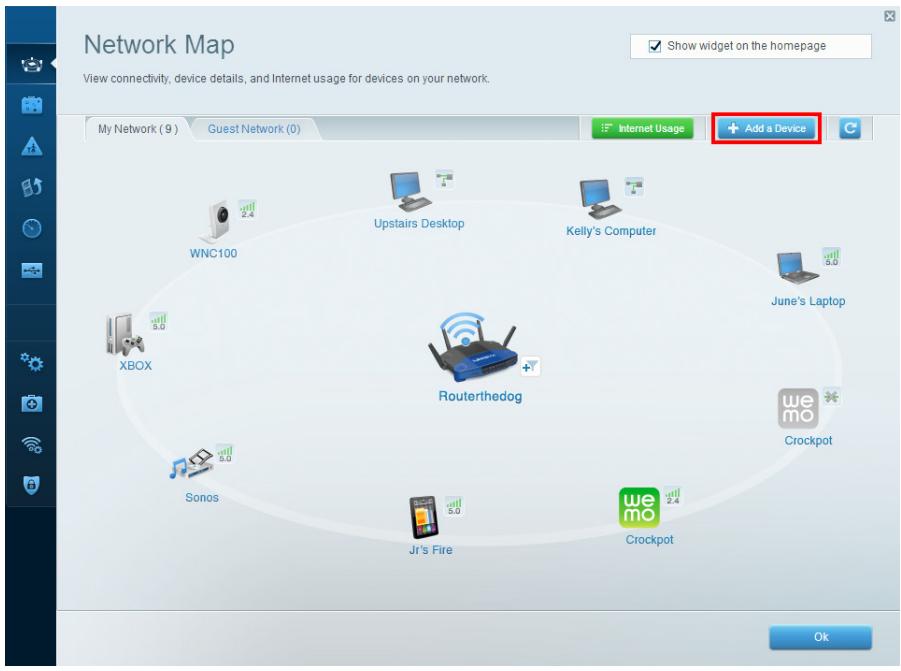
- Click Network Map, then click Add a Device.
text_image
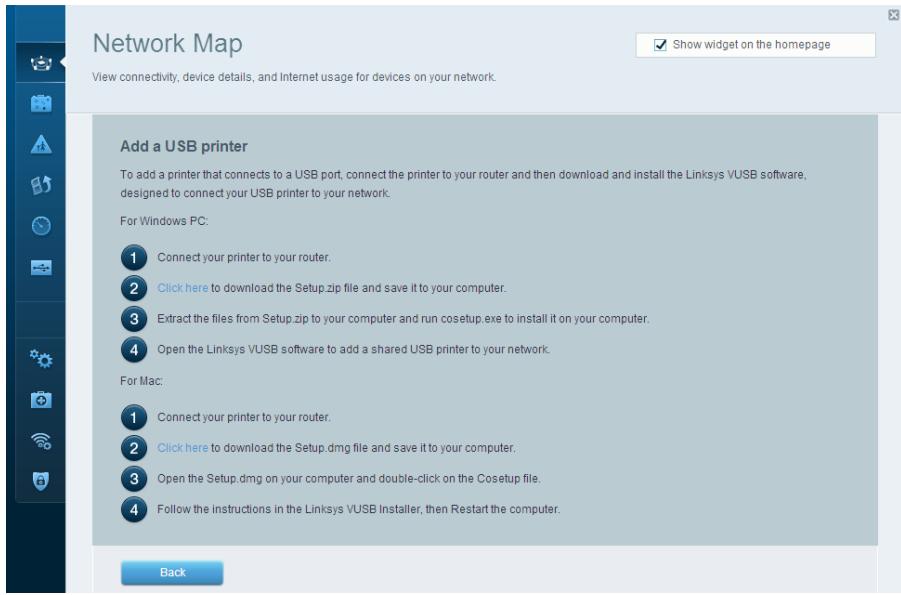
Network Map View connectivity, device details, and Internet usage for devices on your network. Show widget on the homepage My Network (9) Guest Network (0) Internet Usage Add a Device WNC100 Upstairs Desktop Kelly's Computer June's Laptop XBOX Routerthedog Crockpot Sonos Jr's Fire Crockpot we mo- Under Select the type of device to add to your network, click USB Printer. The Add a USB printer screen opens.
text_image
Network Map View connectivity, device details, and Internet usage for devices on your network. Show widget on the homepage Add a USB printer To add a printer that connects to a USB port, connect the printer to your router and then download and install the Linksys VUSB software, designed to connect your USB printer to your network. For Windows PC: 1 Connect your printer to your router. 2 Click here to download the Setup.zip file and save it to your computer. 3 Extract the files from Setup.zip to your computer and run cosetup.exe to install it on your computer. 4 Open the Linksys VUSB software to add a shared USB printer to your network. For Mac: 1 Connect your printer to your router. 2 Click here to download the Setup.dmg file and save it to your computer. 3 Open the Setup.dmg on your computer and double-click on the Cosetup file. 4 Follow the instructions in the Linksys VUSB Installer, then Restart the computer. Back- Follow the on-screen instructions for downloading and installing the VUSB (virtual USB) software for your computer.
To connect a wireless printer to your network:
Follow the printer's instructions to connect it to your network. Use the connection information available in Linksys Smart Wi-Fi or saved to your computer desktop.
After that printer connects to your network, log into Linksys Smart Wi-Fi, then click Network Map to confirm that your router recognizes the new printer.
How to connect other devices
Many other types of wireless network devices can connect to your home network, including:
- Game consoles
- Internet-capable TVs and media players
- Digital music players
- Smart phones
Because of the wide variety of devices and methods of connecting, you must manually enter network information into the devices for a successful network connection.
Tip:
For more instructions on connecting a game console to your network, see also:
"How to optimize your router for gaming and voice" on page 31
"How to set up port forwarding" on page 39
"How to set up port range triggering for online gaming" on page 40
HOW TO MANUALLY CONNECT A NETWORK DEVICE
To manually connect a device to your network:
Follow the device's instructions to connect it to your network. Use the connection information available in Linksys Smart Wi-Fi or saved to your computer desktop.
After the device connects to your network, log into Linksys Smart Wi-Fi, then click Network Map to confirm that your router recognizes the new device.
HOW TO CONNECT A NETWORK DEVICE USING Wi-Fi PROTECTED SETUP
To connect a device using Wi-Fi Protected Setup™
- Plug in and turn on the network device.
- Under Wireless, click the Wi-Fi Protected Setup tab.
- Use one of the following methods to complete the setup:
- If the device has a Wi-Fi Protected Setup button, press that button, then click the Wi-Fi Protected Setup button in Linksys Smart Wi-Fi or press the button on the back of your router.
- If the device has a Wi-Fi Protected Setup PIN, type that number into the Device PIN box in Linksys Smart Wi-Fi, then click Register.
- If the device's own setup asks for the router's Wi-Fi Protected Setup PIN, enter the number that appears under Router PIN in Linksys Smart Wi-Fi.
HOW TO VIEW DEVICE DETAILS
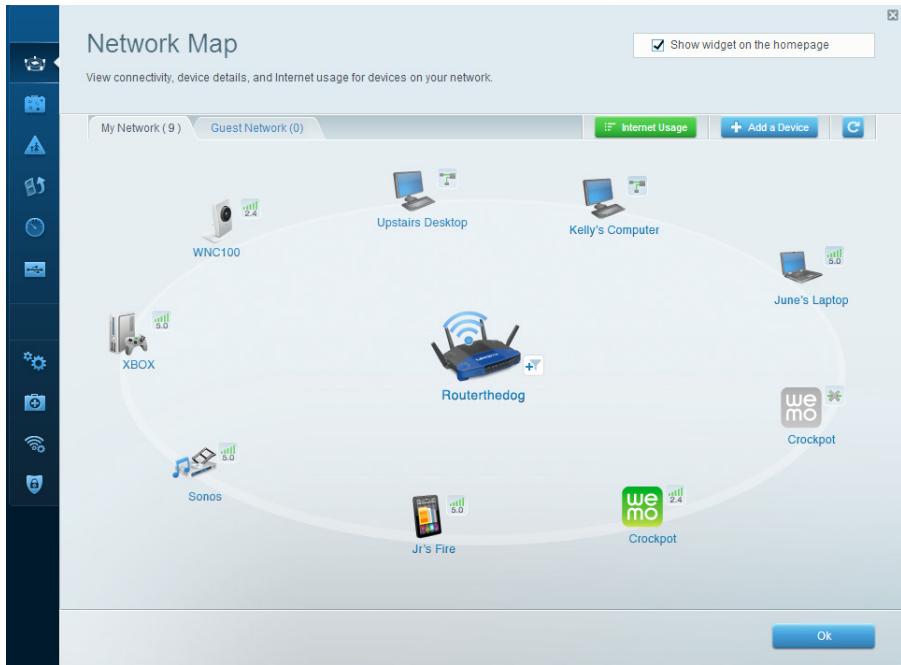
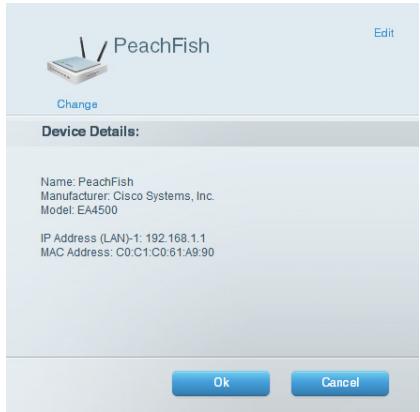
You can use Linksys Smart Wi-Fi to view any network device's network information.
To view network device details:
Log in to Linksys Smart Wi-Fi. (See "How to connect to Linksys Smart Wi-Fi" on page 7.
Under Apps, click Network Map. The Network Map screen opens.
text_image
Network Map View connectivity, device details, and Internet usage for devices on your network. Show widget on the homepage My Network ( 9 ) Guest Network ( 0 ) Internet Usage Add a Device WNC100 Upstairs Desktop Kelly's Computer June's Laptop XBOX Routerthedog Crockpot Sonos Jr's Fire Crockpot we mo 2.4 2.0 2.0 2.4 we mo 2.4 OKClick the Wi-Fi icon to the right of the device.
text_image
PeachFish Change Edit Device Details: Name: PeachFish Manufacturer: Cisco Systems, Inc. Model: EA4500 IP Address (LAN)-1: 192.168.1.1 MAC Address: C0:C1:C0:61:A9:90 Ok CancelClick OK.
HOW TO SET UP PARENTAL CONTROLS
With your router, you can use parental controls to:
- Set the times that Internet access is allowed.
- Block websites that you specify, or based on their content.
- Set the above restrictions for specific computers.
Tip:
When someone tries to open a blocked website, a Linksys Smart Wi-Fi login page appears. To view the blocked content, you must log in to your Linksys Smart Wi-Fi account and change the parental control restrictions.
HOW TO SET PARENTAL CONTROLS
Log in to Linksys Smart Wi-Fi. (See "How to connect to Linksys Smart Wi-Fi" on page 7.)
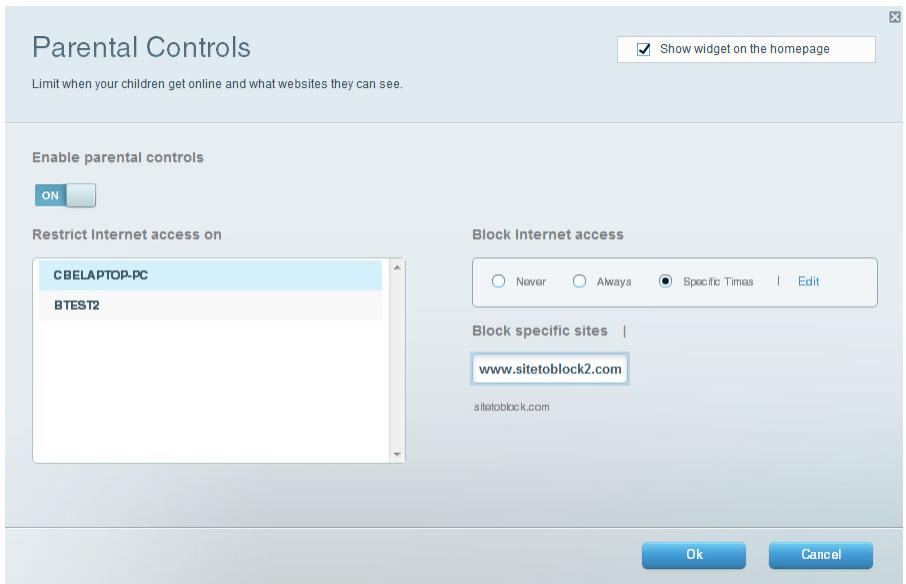
Under Apps, click Parental Controls. The Parental Controls screen opens.
text_image
Parental Controls Show widget on the homepage Limit when your children get online and what websites they can see. Enable parental controls ON Restrict Internet access on CBELAPTOP-PC BTEST2 Block Internet access Never Always Specific Times Edit Block specific sites | www.sitetoblock2.com sitatoblock.com Ok CancelTo turn on parental controls, slide the Enable parental controls switch so that "ON" is displayed.
Tip:
It's not necessary to set parental controls over each computer on your home network. You can set the controls on only those computers that children can access.
To select a computer to apply parental controls to, click the name of the computer in the Restrict Internet access on list.
To block Internet access on the selected computer(s), under Block Internet access:
- Click Never to allow Internet access.
- Click Always to always block Internet access.
- Click Specific Times to set the times when Internet access is allowed.
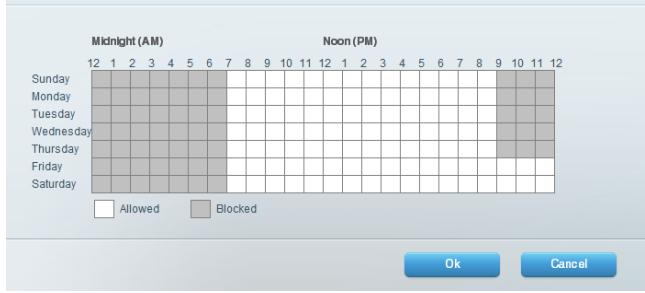
- Click Edit to change the Internet access schedule. You can click and drag to select or deselect a block of time.
Block Internet access
Manually select the times and days to block internet access
heatmap
| Day | Midnight (AM) | Noon (PM) | |---|---|---| | Sunday | 12 | 12 | | Monday | 12 | 12 | | Tuesday | 12 | 12 | | Wednesday | 12 | 12 | | Thursday | 12 | 12 | | Friday | 12 | 12 | | Saturday | 12 | 12 |To block specific websites:
Under Block specific sites, click Add.
Type the web address (URL) of the website to block, then click OK. You can block up to 10 websites.
Tip:
It's easier to copy and paste a web address than it is to type it in. Copy the address from your browser's web address box, then paste it into an available box in the Block Specific Sites screen of Linksys Smart Wi-Fi.
Click OK to apply your changes.
HOW TO CONFIGURE YOUR GUEST NETWORK
You can use your router's guest network to provide your guests with access to the Internet, while restricting their access to other resources on your local network. To prevent unauthorized users from using your Internet access, your guest network requires that a password be entered for Internet access. The guest network is enabled by default.
Your wireless network's guest network and password were set when you ran the router's setup software, but you can change them at any time.
To set up guest access to your network:
Log into Linksys Smart Wi-Fi. (See “How to connect to Linksys Smart Wi-Fi” on page 7.)
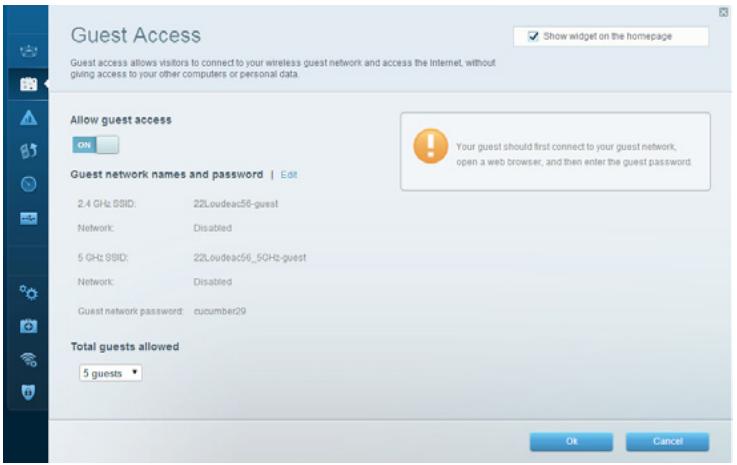
Under Apps, click Guest Access. Your guest network, which was set up during your router installation, is displayed.
text_image
Guest Access Show widget on the homepage Guest access allows visitors to connect to your wireless guest network and access the Internet, without giving access to your other computers or personal data. Allow guest access ON Guest network names and password | Edit 2.4 GHz SSID: 22Loudeac56-guest Network: Disabled 5 GHz SSID: 22Loudeac56_5GHz-guest Network: Disabled Guest network password: cucumber29 Total guests allowed 5 guests Your guest should first connect to your guest network, open a web browser, and then enter the guest password. OK CancelTo turn guest access on or off, toggle the Allow guest access switch.
The guest network name is based on your 2.4 GHz network name and is automatically generated.
To change the guest network password, click in the box next to Guest network password, then type the new password.
To change the number of simultaneous guest network users you want to allow, click the drop-down box under Total guests allowed, then click the number that you want.
Tip:
To keep your guest network secure, click Change to change the guest password when the guest no longer needs access to the account.
Click OK to apply your changes.
Tip:
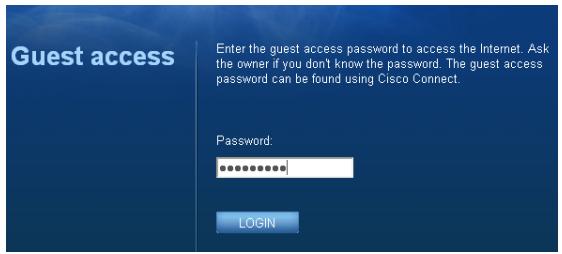
The first time your guest tries to access the Internet through a web browser, they will see the Guest access screen. To continue, they must enter the password you provided in the Password field, then click LOGIN.
text_image
Guest access Enter the guest access password to access the Internet. Ask the owner if you don't know the password. The guest access password can be found using Cisco Connect. Password: LOGINWhen you are done setting up your router, you should back up its settings so that you can restore them later if necessary. For instructions, see "How to back up and restore your router configuration" on page 42.
HOW TO CUSTOMIZE LINKSYS SMART Wi-Fi
You can customize your Linksys Smart Wi-Fi home page by adding or removing widgets. Widgets are miniature versions of menus that let you change basic settings or check the status of your network.
USING WIDGETS
To add a widget:
- Log into Linksys Smart Wi-Fi. (See "How to connect to Linksys Smart Wi-Fi" on page 7.)
- Open a menu, then select Show widget on the homepage in the upper-right corner.
To remove a widget:
- On the home page, click the x in the upper-right corner of the widget you want to remove.
CUSTOMIZING THE NETWORK MAP
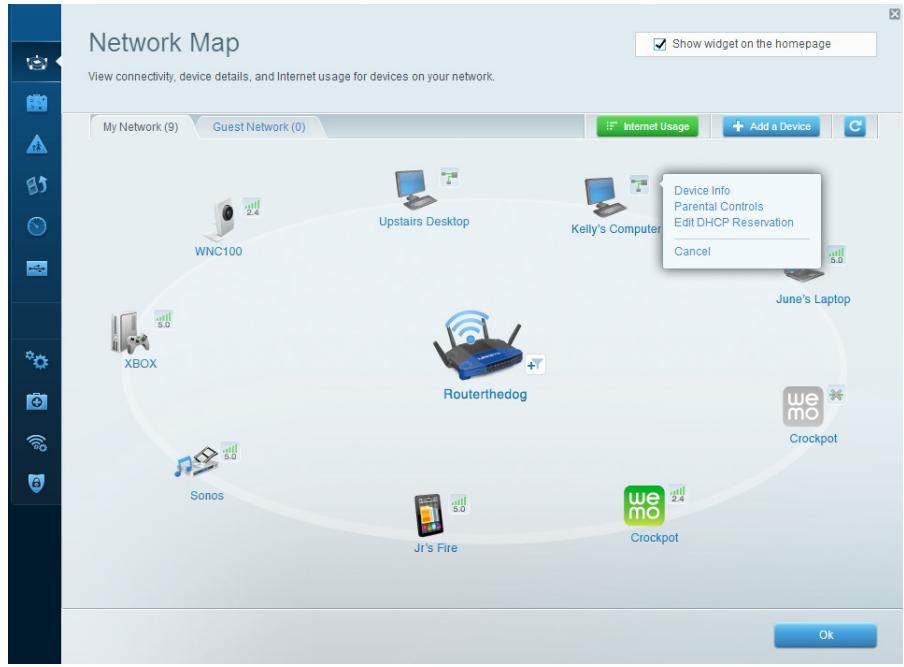
You can change the icon and name of each device on your network.
text_image
Network Map View connectivity, device details, and Internet usage for devices on your network. Show widget on the homepage My Network (9) Guest Network (0) Internet Usage Add a Device WNC100 Upstairs Desktop Kelly's Computer June's Laptop XBOX Routerthedog Crockpot we mo Crockpot Sonos Jr's Fire we mo OK1. To change the name
a. Click on the device.
b. Click on Device Info in the pop-up window
c. Click on Edit in the upper right corner
d. Type in a new name
2. To change the icon
a. Click on the device
b. Click on Device Info in the pop-up window
c. Click on Change under the current icon
d. Choose a new icon from the available options
OVERVIEW
You can attach most USB drives (including a thumb drive or a high-capacity external drive) to the USB port on your router. You can then use the drive as networked storage, as a media server (for media-enabled devices such as a networked TV), and as an FTP (File Transfer Protocol) server. You can also specify which users can access the content on the drive. Menus are subject to change.
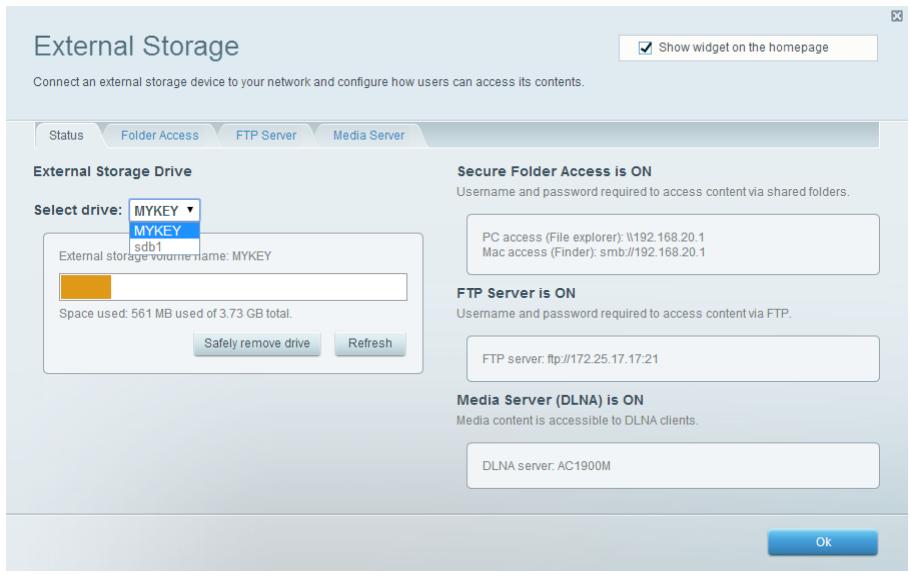
To view the status and settings of your attached drive:
- Log into Linksys Smart Wi-Fi. (See "How to connect to Linksys Smart Wi-Fi" on page 7.)
- Click External Storage under Apps. The Status tab displays information such as the following:
Drive capacity and use
Secured folder access status
Addresses for accessing shared folders, the FTP server, and media server.
text_image
External Storage Connect an external storage device to your network and configure how users can access its contents. Show widget on the homepage Status Folder Access FTP Server Media Server External Storage Drive Select drive: MYKEY sdb1 External storage volume name: MYKEY Space used: 561 MB used of 3.73 GB total. Safely remove drive Refresh Secure Folder Access is ON Username and password required to access content via shared folders. PC access (File explorer): \\192.168.20.1 Mac access (Finder): smb://192.168.20.1 FTP Server is ON Username and password required to access content via FTP. FTP server: ftp://172.25.17.17:21 Media Server (DLNA) is ON Media content is accessible to DLNA clients. DLNA server: AC1900M OkHOW TO ATTACH A USB DRIVE
If a USB drive is already connected to the router, and you want to attach a different drive to that USB port, you should safely disconnect the old drive first.
To safely remove a USB drive from the router:
- Log into Linksys Smart Wi-Fi, then click External Storage under Apps.
- In the Status tab, click Safely remove drive.
- Disconnect the old drive from the router.
To attach a USB drive to the router:
- Connect the USB drive to an available USB port on the back of your router. Your router will detect the drive.
- To update the External Storage screen, you may need to click Refresh.
HOW TO USE SECURED FOLDER ACCESS
Why would I need to use secured folder access?
By default, when you connect a USB drive to your router, the entire contents of the drive are available for read and write access to anyone on your local network (no login credentials are required). However, you can also make the drive and its folders secure, so that only authorized users can access the drive's contents.
Tip:
When Secure Folder Access is on, the entire USB drive is secured.
HOW TO SET UP AUTHORIZED USERS AND SHARED FOLDERS
To enable access to shared folders:
- Log in to Linksys Smart Wi-Fi. (See "How to connect to Linksys Smart Wi-Fi" on page 7.)
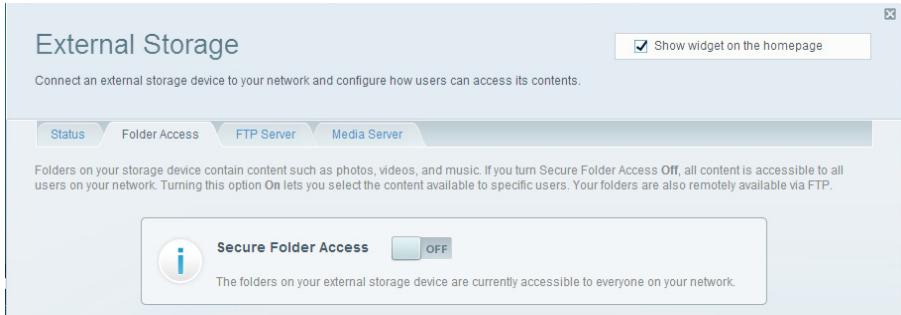
- Click External Storage under Apps, then click the Folder Access tab.
text_image
External Storage Connect an external storage device to your network and configure how users can access its contents. Show widget on the homepage Status Folder Access FTP Server Media Server Folders on your storage device contain content such as photos, videos, and music. If you turn Secure Folder Access Off, all content is accessible to all users on your network. Turning this option On lets you select the content available to specific users. Your folders are also remotely available via FTP. Secure Folder Access OFF The folders on your external storage device are currently accessible to everyone on your network.- Click the setting for Secure Folder Access to turn it on.
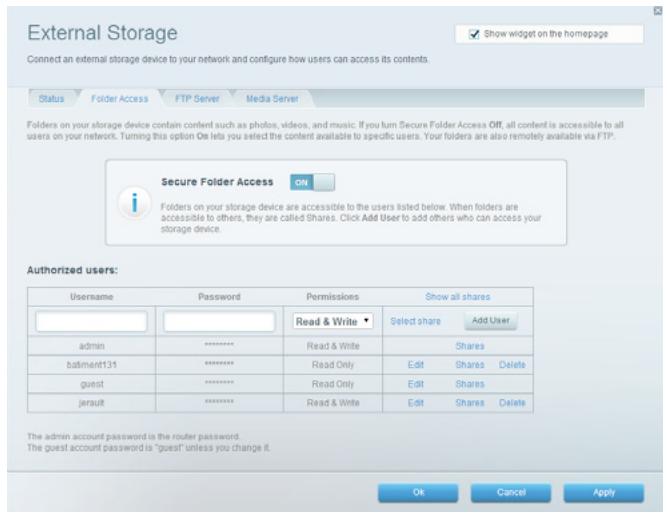
- The Authorized users list appears.
- In the Authorized users list, type a Username and Password for each new user.
text_image
External Storage Connect an external storage device to your network and configure how users can access its contents. Status Folder Access FTP Server Media Server Show widget on the homepage Secure Folder Access ON Folders on your storage device contain content such as photos, videos, and music. If you turn Secure Folder Access Off, all content is accessible to all users on your network. Turning this option On lets you select the content available to specific users. Your folders are also remotely available via FTP. Folders on your storage device are accessible to the users listed below. When folders are accessible to others, they are called Shares. Click Add User to add others who can access your storage device. Authorized users: Username Password Permissions Show all shares Read & Write Select share Add User admin ******** Read & Write Shares batiment131 ******** Read Only Edit Shares Delete guest ******** Read Only Edit Shares Delete jerault ******** Read & Write Edit Shares Delete The admin account password is the router password. The guest account password is "guest" unless you change it. Ok Cancel ApplyTip:
Two accounts, Admin and Guest, are already set up and cannot be deleted.
- Select the permissions to give the user.
- Read Only lets the user read (open) the file.
- Read & Write lets the user read, rename, overwrite, or delete the file. The user can also save new files to the folder.
- Click Select Share. The Select Existing Share dialog box opens.
If you already have the shared folder set up:
- Select the check box next to each share you want to grant access to, then click OK.
If you need to set up the shared folder:
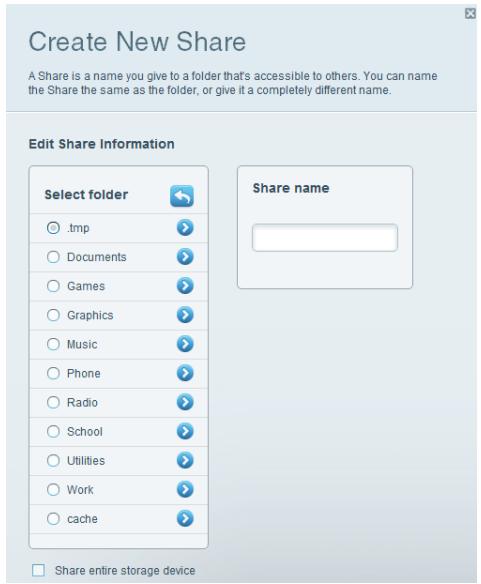
- Click Create new share. The Create New Share dialog box opens.
text_image
Create New Share A Share is a name you give to a folder that's accessible to others. You can name the Share the same as the folder, or give it a completely different name. Edit Share Information Select folder ○ .tmp ○ Documents ○ Games ○ Graphics ○ Music ○ Phone ○ Radio ○ School ○ Utilities ○ Work ○ cache Share name Share entire storage deviceClick the button next to the folder that you want to share.
- To view subfolders, click the icon next to the folder name.
- To return to a parent folder, click the icon at the top of the list.
- To select the entire drive, select Share entire storage device.
Tips:
The share name automatically changes to the name of the folder you selected.
You cannot select more than one folder for each share.
- To use a different share name, type the name in the Share name field.
- Click OK.
- Select the check box next to each share you want to grant access to, then click OK.
- Click Add User.
In the Authorized users list, you can also:
- Click Edit to change a user's credentials.
- Click Shares to change the shares that a user can access.
- Click Delete to delete the user account.
HOW TO ACCESS SHARED FOLDERS
To access shared folders while on your network:
- While in Linksys Smart Wi-Fi, click External Storage under Apps.
- In the Status tab, note the information under Folder Access. This is the address you will need to access the shared folders from a file manager.
- Enter the access address into your file manager.
Tip:
You can also usually locate the folder by browsing through your computer's file manager.
- Enter your user account name and password. The drive's contents (files and folders) appear in a window.
- Use the file manager to open, copy, or view the folder's contents.
Tips:
File managers display content in many ways, but you can usually use these common actions to navigate through folders:
Click or double-click a folder name to open it.
Click, double-click, or right-click a file to open, copy, or view it.
Drag a file from another window and drop it into the shared folder's window to copy it to the shared folder. (To copy a file to the shared folder, your user account must have write access.)
HOW TO SET UP YOUR ROUTER AS A MEDIA SERVER
A media server lets you share media content across your network. Your router can act as a media server if it has a USB drive attached and if you have UPnP AV (Audio and Video)-enabled or DLNA (Digital Living Network Alliance)-certified devices in your home. Examples of UPnP AV-enabled devices include digital media players, gaming consoles with a built-in media player, and digital picture frames.
For example, if you have a digital media adapter that sends content to your entertainment system, and if your router's set up as a media server, then the digital media adapter can access your router's attached USB drive.
You can specify which folders are used by the media server, add and delete folders, and specify how often the folders are scanned for new content.
Note:
The EA3500 does not support the media server feature.
To configure your router as a media server:
- Log in to Linksys Smart Wi-Fi. (See "How to connect to Linksys Smart Wi-Fi" on page 7.
- Click External Storage under Apps. The External Storage screen opens.
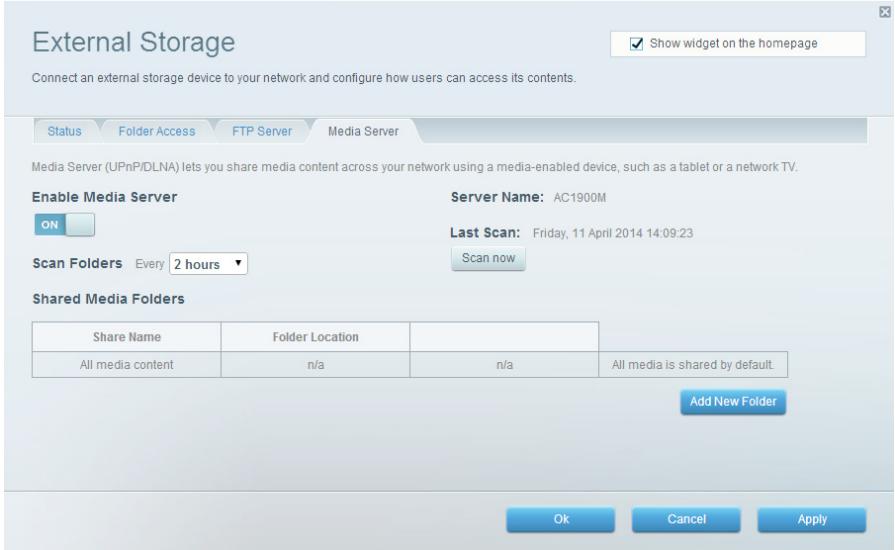
- Click the Media Access tab.
text_image
External Storage Connect an external storage device to your network and configure how users can access its contents. Show widget on the homepage Status Folder Access FTP Server Media Server Media Server (UPnP/DLNA) lets you share media content across your network using a media-enabled device, such as a tablet or a network TV. Enable Media Server Server Name: AC1900M Last Scan: Friday, 11 April 2014 14:09:23 Scan Folders Every 2 hours Scan now Shared Media Folders Share Name Folder Location All media content n/a n/a All media is shared by default. Add New Folder Ok Cancel Apply- Toggle the switch for Enable Media Server to turn it on.
- Click Add New Folder. The Add a new folder dialog box opens.
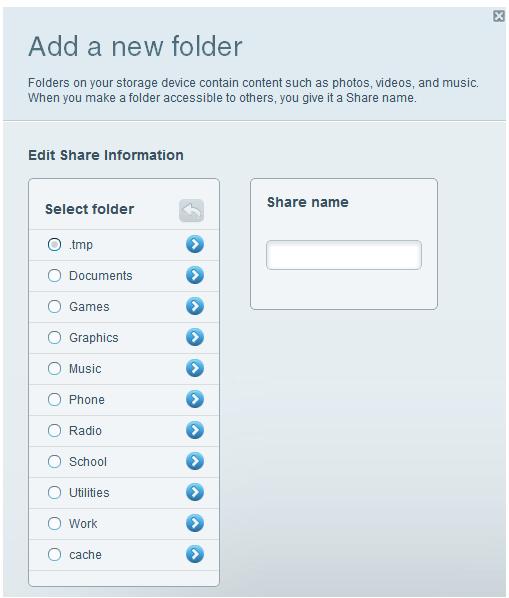
text_image
Add a new folder Folders on your storage device contain content such as photos, videos, and music. When you make a folder accessible to others, you give it a Share name. Edit Share Information Select folder ○ .tmp ○ Documents ○ Games ○ Graphics ○ Music ○ Phone ○ Radio ○ School ○ Utilities ○ Work ○ cache Share name- Click the button next to the folder that you want to share, then click OK.
- To view subfolders, click the icon next to the folder name.
- To return to a parent folder, click the icon at the top of the list.
Tips:
The share name automatically changes to the name of the folder you selected.
You cannot select more than one folder at a time.
- Click OK again to save changes.
HOW TO CONNECT YOUR UPnP DEVICE TO THE MEDIA SERVER
After you set up your router's media server, you need to connect an UPnP-compatible device (such as an UPnP-compatible game console or digital media player) to the network so that you can play the media server's content.
To connect an UPnP device to your router's media server:
- Connect your UPnP device to your home network with wired (Ethernet cable) or wireless networking. If you are connecting wirelessly, you need to know your network's name and password. See your device's documentation for help.
- On your UPnP device, change the media source to the media server name you specified on your router. (See "How to set up your router as a media server" on page 18.)
- See your UPnP device's documentation for help with playing media on the device.
HOW TO REMOTELY ACCESS STORAGE
After you enable the router's FTP (File Transfer Protocol) server, you can access the attached drive's files from anywhere by using either a web browser or FTP software.
To set up the FTP server:
- Log in to Linksys Smart Wi-Fi. (See "How to connect to Linksys Smart Wi-Fi" on page 7.)
- Click External Storage under Apps. The External Storage screen opens.
- Click the FTP Server tab.
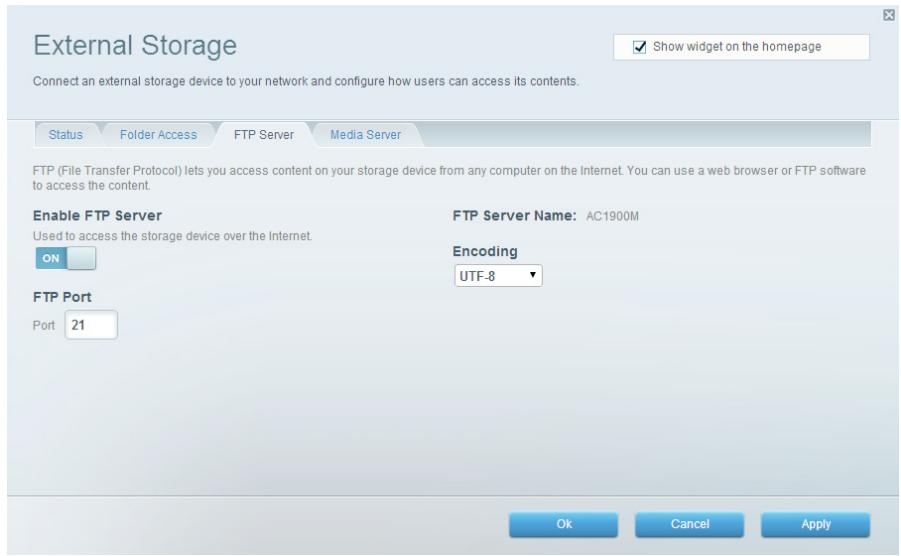
text_image
External Storage Connect an external storage device to your network and configure how users can access its contents. Show widget on the homepage Status Folder Access FTP Server Media Server FTP (File Transfer Protocol) lets you access content on your storage device from any computer on the Internet. You can use a web browser or FTP software to access the content. Enable FTP Server Used to access the storage device over the Internet. FTP Server Name: AC1900M Encoding UTF-8 FTP Port Port 21 Ok Cancel Apply- Toggle the switch for Enable FTP Server to turn it on.
- We recommend that you keep the default settings for FTP Port and Encoding, unless you are an advanced user and have reason to change them.
- Click OK.
- Click the Status tab.
Note the information under FTP Server. This is the information you will need to access the attached storage remotely.
To access the attached storage using a web browser:
- Open a web browser.
- In the browser's address or URL field, type the address that was provided on the Status tab above, starting with ftp://... If you have DDNS (Dynamic Domain Name Service), you can use your router's domain name instead.
- Enter your Username and password. This is the same Username and Password that were set up in the shared folders Authorized users list. See "How to set up authorized users and shared folders" on page 17.
The drive's contents (files and folders) appear in a browser window.
- Click a file to download it to your computer, or click and drag a file from your computer's file manager to the browser window to upload a file (only if you have read and write access).
To access the attached storage using FTP client software:
- Run your FTP client software.
- Refer to the software's help to determine how to connect to an FTP site with the following information:
- The address that was provided on the Status tab above, starting with ftp://... If you have DDNS (Dynamic Domain Name Service), you can use your router's domain name instead.
- The Username and Password that were set up in the shared folders Authorized users list. See "How to set up authorized users and shared folders" on page 17.
- The port and encoding specified during your FTP server setup (usually port 21, and UTF-8 encoding)
- Refer to the software's help to determine how to download and upload files.
Tips:
FTP software and web browsers display FTP content in many ways, but you can usually use these common actions to navigate through FTP folders:
Click a folder name to open it.
Click a double period (..) or Up to a higher level directory to open a parent folder.
Click or right-click a file to download or view it.
Drag a file from another window and drop it into the FTP window to upload it. (To upload a file, your user account must have write access.)
HOW TO MANUALLY SET UP YOUR ROUTER
Although running your router's setup software is the easiest way to set up and maintain your router, advanced users may want to manually configure their router. Be careful when changing settings using this method.
To manually set up your router:
- Plug in your router.
To connect to your router with a cable:
- Connect an Ethernet cable to the computer and to an available numbered Ethernet (blue) port on the back of your router.
- Disconnect the cable from the router's Internet port.
To connect to your router wirelessly:
- Make sure that your computer's wireless networking is turned on.
- Connect to the secure wireless name shown in the Quick Start Guide that came with your router. (You can change the network name and password later.) If you need help connecting to the network, refer to your device documentation.
- Open a web browser on the computer, and go to 192.168.1.1 or myrouter.local. (This address will open your router's firmware when there is no Internet connection.)
- Click I have read and accepted the License Terms for using this software, read the license agreement, then select the checkbox.
- Select I want to skip Setup and configure my router manually, and click Next.
- If you have a Linksys Smart Wi-Fi account, enter your credentials. Create an account if you haven't already done so. Click Sign In.
- Enter your router admin password. The default is "admin." Click Sign In and configure your router settings.
- After you finish changing settings, click Save and close the browser window.
Tip:
For descriptions of the settings, click Help at the top of the screen.
HOW TO MANUALLY SET UP YOUR INTERNET CONNECTION
Running Setup configures your router's Internet connection. However, for some ISPs (Internet Service Providers), especially those outside of the United States, you may need to manually configure your router's Internet connection.
How to configure basic Internet connection settings:
- Connect to your router and log in using the instructions under "How to manually set up your router" on this page.
- Under Router Settings, click Connectivity. The Connectivity page will open to the Basic tab.
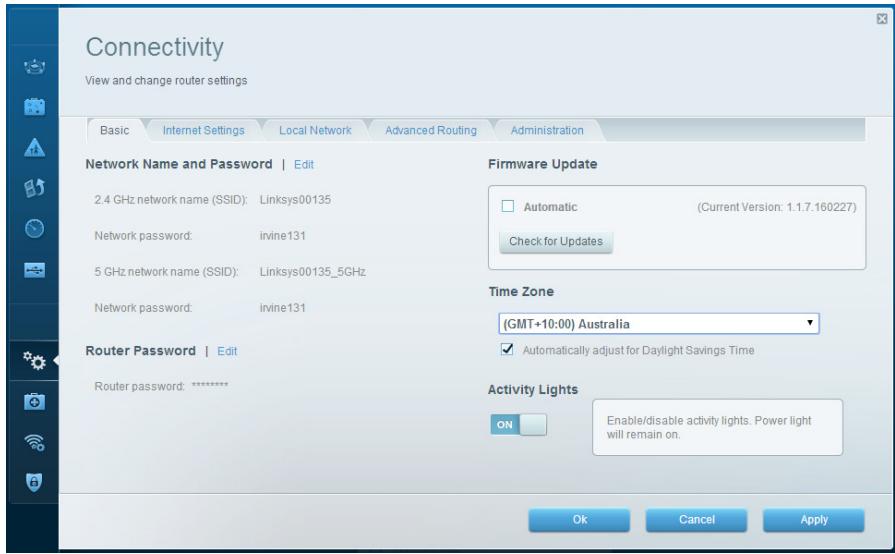
text_image
Connectivity View and change router settings Basic Internet Settings Local Network Advanced Routing Administration Network Name and Password | Edit 2.4 GHz network name (SSID): Linksys00135 Network password: ivine131 5 GHz network name (SSID): Linksys00135_5GHz Network password: ivine131 Router Password | Edit Router password: ***** Firmware Update Automatic (Current Version: 1.1.7.160227) Check for Updates Time Zone (GMT+10:00) Australia ✓ Automatically adjust for Daylight Savings Time Activity Lights ON Enable/disable activity lights. Power light will remain on. Ok Cancel Apply- Next to Type of Internet Connection, click Edit.
- Select your ISP's Internet connection type from the drop-down list. Complete the Optional Settings only if required by your ISP.
Tip:
For field descriptions, click Help at the top of the screen.
- Click OK.
IPv6 Internet connection settings
IPv6 is a new IP protocol that uses simplified packet headers and requires IPSec. It also has improved support for mobile IP and computing devices.
Note:
To use your router's IPv6 Internet connection settings, IPv6 service from your ISP (Internet service provider) is required. For more information on this service, ask your ISP.
To manually configure your router's IPv6 settings:
- Use an Ethernet cable to connect your router to your computer.
- Log in to Linksys Smart Wi-Fi. (See "How to connect to Linksys Smart Wi-Fi" on page 7.)
- Under Router Settings, click Connectivity. The Connectivity page opens.
- Click the Internet Settings tab, and click IPV6.
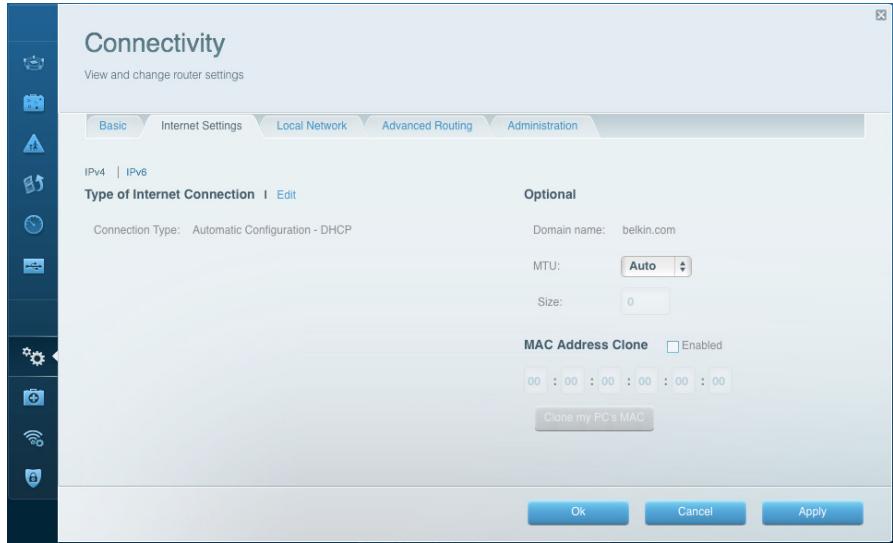
text_image
Connectivity View and change router settings Basic Internet Settings Local Network Advanced Routing Administration IPv4 | IPv6 Type of Internet Connection | Edit Connection Type: Automatic Configuration - DHCP Optional Domain name: belkin.com MTU: Auto Size: 0 MAC Address Clone Enabled 00 : 00 : 00 : 00 : 00 : 00 Clone my PC's MAC Ok Cancel ApplyClick Edit. You can now change the following settings:
- IPv6 - Automatic — Select Enabled to use IPv6 for all network addressing.
-
DUID (device user ID) — Used by DHCP to identify network clients.
-
6rd Tunnel — Allows your router to send IPv6 IP addresses over IPv4 networks. To enable this option, IPv6 - Automatic must be unselected. To let your router handle the 6rd Tunnel settings (such as prefixes and address masks), change the 6rd tunnel setting to Automatic. Select Manual to change these settings manually.
- Prefix — Enter the prefix address used for the tunnel provided by your ISP.
- Prefix Length — Enter the prefix length used for the tunnel provided by your ISP.
- Border Relay — Enter the border relay address used for the tunnel provided by your ISP.
- IPv4 mask length — Enter the IPv4 address mask length used for the tunnel provided by your ISP.
Click OK.
HOW TO ASSOCIATE A ROUTER WITH YOUR LINKSYS SMART Wi-Fi ACCOUNT
To associate an additional router to your Linksys Smart Wi-Fi account:
- Run Setup for the additional router. When Setup is complete, you will be prompted to create a new Linksys Smart Wi-Fi account.
- Instead of creating a new account, click Login at the top of the screen. You are prompted to enter your account username (e-mail address) and password.
- Enter your original Linksys Smart Wi-Fi account username and password, and click Log in. The router will be added to your Linksys Smart Wi-Fi account.
- To configure the new router, log in to Linksys Smart Wi-Fi, then select the router's SSID (network name) from the drop-down list at the top of the screen.
HOW TO GET THE MOST OUT OF YOUR DUAL-BAND ROUTER
The most common reason people purchase dual-band routers is to ensure available bandwidth for streaming high-definition video. Users also want to make sure that their video streams won't be interrupted by other wireless network traffic. To get the most out of your dual-band router, you should upgrade your wireless clients and split your traffic.
Upgrade your wireless clients
If you have network adapters that support only legacy wireless network standards such as 802.11b, you should consider upgrading them with Wireless-N (802.11n) network adapters. Wireless-B (802.11b) devices can slow your entire wireless network. For the best performance, all of your wireless devices should support Wireless-N. You can then select Wireless-N Only as your Network Mode below.
Note:
If you select Wireless-N Only, you may need to temporarily change your network settings to Mixed to provide access to guests without Wireless-N networking.
Split your traffic
The best way to improve your multimedia wireless performance is to split your wireless traffic between your router's bands (ranges of radio frequencies). Your router supports the 2.4 GHz band and the 5 GHz band, and handles the two bands as two separate wireless networks to manage the traffic.
The most common way to split wireless traffic is to use the 2.4 GHz band for basic Internet tasks such as web browsing, email, and downloads, and use the 5 GHz band for streaming multimedia.
Although the 2.4 GHz band may be more crowded with wireless traffic from your neighbors, it's fine for basic Internet traffic that is not time-sensitive such as e-mail. Even though you are connected to your own wireless network, you are still sharing air time with nearby networks. The 5 GHz band is much less crowded than the 2.4 GHz band, so it's ideal for streaming multimedia. The 5 GHz band has more available channels, so it is more likely that you will have your own, interference-free channel for your wireless network.
By default, your dual-band router uses the same network name on both the 2.4 GHz band and the 5 GHz band. The easiest way to segment your traffic is to rename one of your wireless networks. With a separate, descriptive name, it will be easy to connect to the right network.
Reconfigure your wireless network:
- Log in to Linksys Smart Wi-Fi. (See "How to connect to Linksys Smart Wi-Fi" on page 7.)
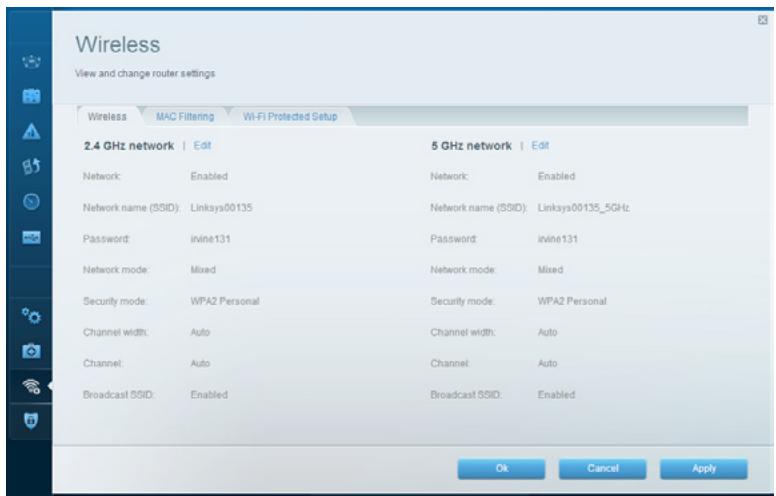
- Under Router Settings, click Wireless. The Wireless page opens to the Wireless tab.
text_image
Wireless View and change router settings Wireless MAC Filtering Wi-Fi Protected Setup 2.4 GHz network Edit 5 GHz network Edit Network: Enabled Network: Enabled Network name (SSID): Linksys00135 Network name (SSID): Linksys00135_5GHz Password: invine131 Password: invine131 Network mode: Mixed Network mode: Mixed Security mode: WPA2 Personal Security mode: WPA2 Personal Channel width: Auto Channel width: Auto Channel: Auto Channel: Auto Broadcast SSID: Enabled Broadcast SSID: Enabled Ok Cancel ApplyClick Edit next to the network band you want to modify. Change any of the settings.
■ Enabled — Deselect to disable the network band.
- Network name (SSID) — You can provide a unique SSID for each band of your network. The name must not exceed 32 characters.
- Password — You can provide a unique password for each band of your network.
- Network mode — Your choice depends upon the clients that will connect to your network. If all of your devices are Wireless-N capable, you can select Wireless-N Only for either or both bands.
On the 2.4 GHz band, you can select from the following:
- Mixed
- Wireless-B/G/N Only
- Wireless-B/G Only
- Wireless-N Only
- Wireless-G Only
- Wireless-B Only
On the 5 GHz band, you can select from the following:
- Mixed (default), which accepts connections from 802.11a or 802.11n clients
■ Wireless-N Only (802.11n only) - Wireless-A/N Only
- Wireless-A Only
Security mode — You can set up different security options for the 2.4 GHz and 5 GHz networks. If the security mode you select requires a passphrase, a Password field appears, and you must enter a password. You can select:
- None (no security)
■ WEP
WPA Personal
WPA Enterprise
WPA2 Personal - WPA2 Enterprise
■ WPA2/WPA Mixed Personal
■ WPA2/WPA Mixed Enterprise
Tip:
Wireless-N networks should use the WPA2-Personal security mode for best performance.
Channel width — We recommend that you keep the default (Auto) setting for each band. In Auto mode, the router and the network clients automatically switch to the 40 MHz mode if the following happens:
Your wireless clients support the 40 MHz mode (sometimes called Bonded mode) in which two 20 MHz channels are bonded together for better performance.
There is no adjacent interference.
With more available channels and less chance of interference on the 5 GHz band, you have the option to force the 40 MHz mode.
On the 2.4 GHz band, you can select from the following:
■ Auto (20 MHz or 40 Mhz)
- 20 MHz Only
On the 5 GHz band, you can select:
- Auto (automatically selects from the options below)
- 20 MHz Only
40 MHz Only
Channel—Choose the operating channel for each band. Your router will automatically select the channel with the least amount of interference if you leave the default Auto setting. We recommend keeping the default settings for both bands.
To save your changes, click OK.
HOW TO CONTROL ACCESS TO YOUR NETWORK
By default, setup enables industry-standard WPA (Wi-Fi Protected Access) security using WPA2/WPA mixed mode. If you set up your wireless network manually and have not enabled wireless security, your wireless network will be an open network that almost anyone nearby with a Wi-Fi-enabled device could access.
If you choose not to use the built-in security features of your router, you can still control access to your wireless network using MAC filtering. Every network device has a unique, 12-digit MAC (Media Access Control) address. Using MAC filtering, you can allow only known MAC addresses, and therefore known devices, onto your network. You can also exclude specific MAC addresses, denying them access to your network.
Tip:
MAC filtering is not strong security. The best way to secure your network is to use the router's WPA2 security setting.
Example: Because each MAC filtering configuration is unique, this simplified example shows how to set up MAC filtering to allow only one device access to the network.
Tip:
It is easier to select Allow to permit only known devices than to try to Deny (exclude) unknown devices.
To set up MAC filtering to allow one device access to your network:
- Log in to Linksys Smart Wi-Fi. (See "How to connect to Linksys Smart Wi-Fi" on page 7.)
- Under Router Settings, click Wireless. The Wireless page will open.
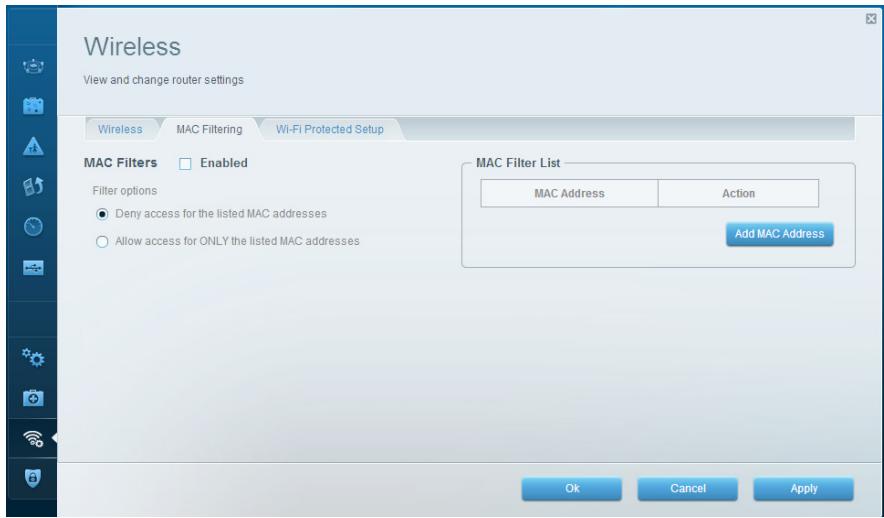
- Click the MAC Filtering tab.
text_image
Wireless View and change router settings Wireless MAC Filtering Wi-Fi Protected Setup MAC Filters Enabled Filter options ● Deny access for the listed MAC addresses ○ Allow access for ONLY the listed MAC addresses MAC Filter List MAC Address Action Add MAC Address Ok Cancel Apply- Select Enabled next to MAC Filters, and select Allow access for ONLY the listed MAC addresses.
- Click Add MAC Address. Enter the MAC address into the MAC Filter List and click Save.
HOW TO IMPROVE SECURITY USING THE BUILT-IN FIREWALL
By default, the firewall settings in your router work well in most home environments. You don't need to make changes. The SPI (Stateful Packet Inspection) firewall is enabled by default, and anonymous Internet requests and IDENT requests are filtered by default. All web filters are disabled, because enabling them may cause problems for sites that depend on ActiveX controls, Java, or cookies.
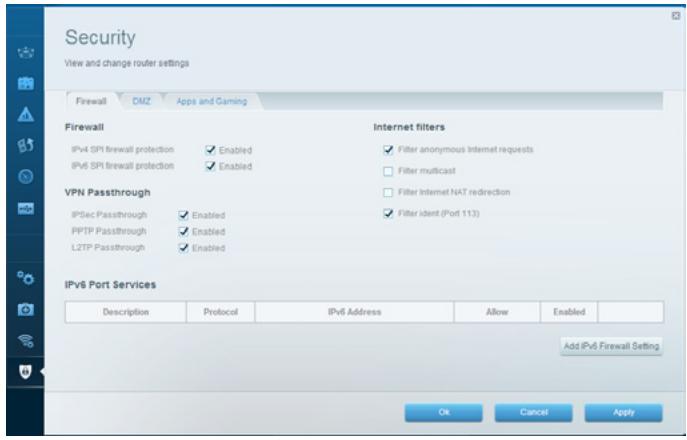
If you decide to change your firewall settings, log in to Linksys Smart Wi-Fi. (See "How to connect to Linksys Smart Wi-Fi" on page 7.) Under Router Settings, click Security. The Security page will open to the Firewall tab.
text_image
Security View and change router settings Firewall DMZ Apps and Gaming Firewall IPv4 SPI firewall protection Enabled IPv6 SPI firewall protection Enabled VPN Passthrough IPSec Passthrough Enabled PPTP Passthrough Enabled L2TP Passthrough Enabled Internet filters Filter anonymous Internet requests Filter multicast Filter Internet NAT redirection Filter ident (Port 113) IPv6 Port Services Description Protocol IPv6 Address Allow Enabled Add IPv6 Firewall Setting Ok Cancel ApplyYou can now change the following settings:
Tip:
For more descriptions of each setting, click Help at the top of the screen.
Firewall:
- SPI firewall protection — This helps protect your local network from Internet threats. This option is enabled by default. On some router models, this setting is separated into IPv6 and IPv4 options so that each can be handled separately.
Caution:
To help protect your network, you should keep this option enabled.
VPN Passthrough:
- IPSec Passthrough — IPSec (Internet Protocol Security) is a suite of protocols used to implement secure exchange of packets at the IP layer. The VPN clients on the local network can establish an IPSec VPN tunnel through the router. This option is enabled by default.
- PPTP Passthrough — PPTP (Point-to-Point Tunneling Protocol) allows the PPP (Point-to-Point Protocol) to be tunneled through an IP network. The VPN clients on the local network can establish a PPTP VPN tunnel through the router. This option is enabled by default.
- L2TP Passthrough — L2TP (Layer 2 Tunneling Protocol) enables point-to-point sessions using the Internet on the Layer 2 level. The VPN clients on the local network can establish an L2TP VPN tunnel through the router. This option is enabled by default.
Internet filters:
Filter anonymous Internet requests — This filter blocks Internet requests from unknown sources such as ping requests. This option is enabled by default.
- Filter multicast — Multicasting allows a single transmission to simultaneously reach specific recipients within your local network. Select this option to block multicasting. This option is disabled by default.
- Filter Internet NAT redirection — This filter prevents a local computer from using a URL or Internet IP address to access the local server. Select this option to enable the filter. This option is disabled by default. On some router models, this setting applies to IPv4 Internet only.
- Filter ident (Port 133) — This filter prevents port 133 from being scanned by devices from the Internet. This option is enabled by default.
Click Save.
CHANGING IPV6 FIREWALL SETTINGS
On some router models, the IPv6 firewall lets you customize IPv6 port services for applications. When users send these types of requests to your network via the Internet, the router will allow those requests to the appropriate computers.
Note:
To use your router's IPv6 Internet connection settings, IPv6 service from your ISP (Internet service provider) is required. For more information on this service, ask your ISP.
To set IPv6 firewall settings, do the following:
- Log in to Linksys Smart Wi-Fi. (See "How to connect to Linksys Smart Wi-Fi" on page 7.
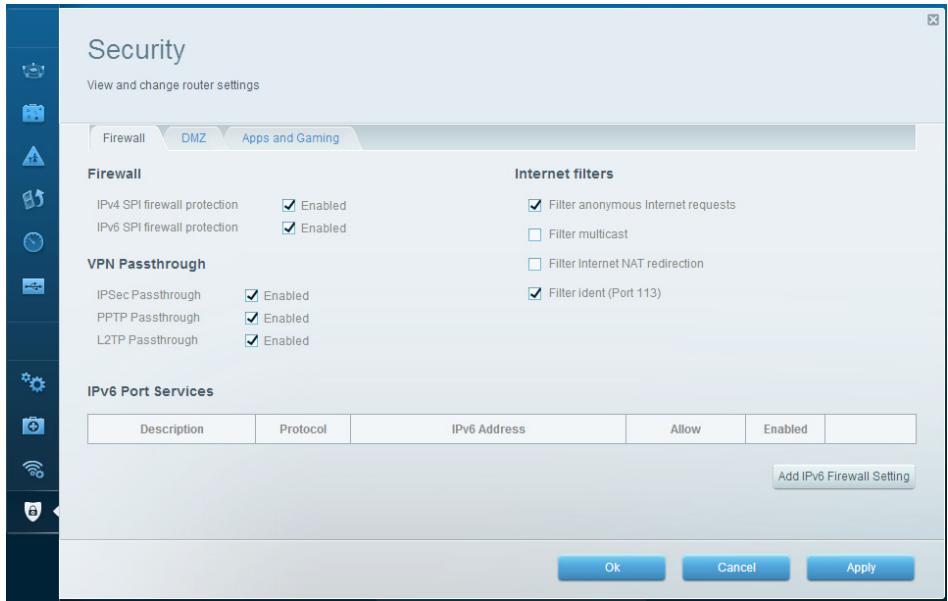
- Under Router Settings, click Security. The Security page opens to the Firewall tab.
text_image
Security View and change router settings Firewall DMZ Apps and Gaming Firewall Internet filters IPv4 SPI firewall protection Enabled Filter anonymous Internet requests IPv6 SPI firewall protection Enabled Filter multicast VPN Passthrough Filter Internet NAT redirection IPSec Passthrough Enabled Filter ident (Port 113) PPTP Passthrough Enabled L2TP Passthrough Enabled IPv6 Port Services Description Protocol IPv6 Address Allow Enabled Add IPv6 Firewall Setting Ok Cancel ApplyClick Add IPv6 Firewall Setting. You can now change the following fields:
■ Description — Enter a description of the application.
- Protocol — Select TCP, UDP, or Both (default).
- IPv6 Address — Enter the IPv6 address of the computer that should receive the traffic.
- Allow — Select the range of port(s) used by incoming traffic.
Click Save. The list will update to show the new settings:
- To change a saved setting, click Edit next to the setting.
- To delete a saved setting, click Remove next to the setting.
HOW TO SET UP THE DHCP SERVER ON YOUR ROUTER
Your router can be used as a DHCP (Dynamic Host Configuration Protocol) server to automatically assign an IP address to each computer or device on your network. The DHCP server is enabled by default. If you already have a DHCP server on your network, or if you do not want to use your router as a DHCP server, you should disable this setting.
To configure your router's DHCP server settings do the following:
Log in to Linksys Smart Wi-Fi. (See "How to connect to Linksys Smart Wi-Fi" on page 7.)
Under Router Settings, click Connectivity.
Click the Local Network tab.
To disable the DHCP server, deselect the Enabled checkbox.
Leave the Enabled checkbox selected to edit the following settings:
- Start IP address
■ Maximum number of users
■ IP address range (not editable) - Client lease time
- Static DNS values
WINS
Click OK.
HOW TO SET UP DHCP RESERVATION
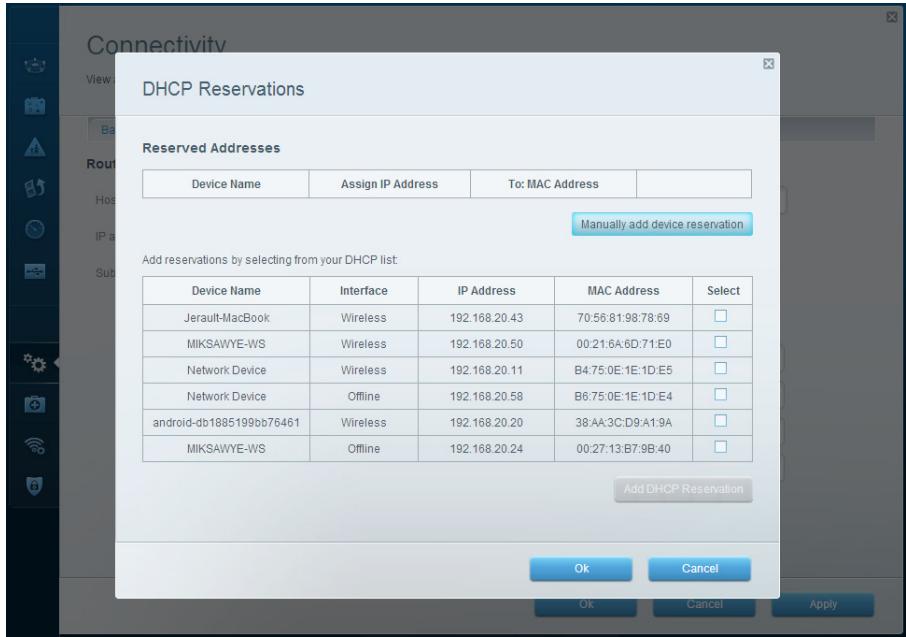
DHCP reservation allows you to assign a unique, fixed IP address to a specific device on your network. Assigning a fixed IP address is a good way to manage devices such as print servers, web cameras, network printers, and game consoles. A fixed IP address is also recommended if you want to use port forwarding for devices that need to receive inbound traffic from the Internet ("How to set up port forwarding" on page 39).
To configure DHCP reservation do the following:
Log in to Linksys Smart Wi-Fi. (See "How to connect to Linksys Smart Wi-Fi" on page 7.)
Under Router Settings, click Connectivity.
Click the Local Network tab, and click DHCP Reservations. The DHCP Reservations list opens, which lists attached network devices and current DHCP reservations.
text_image
DHCP Reservations Reserved Addresses Device Name Assign IP Address To: MAC Address Manually add device reservation Add reservations by selecting from your DHCP list Device Name Interface IP Address MAC Address Select Jerault-MacBook Wireless 192.168.20.43 70:56:81:98:78:69 MIKSAWYE-WS Wireless 192.168.20.50 00:21:6A:6D:71:E0 Network Device Wireless 192.168.20.11 B4:75:0E:1E:1D:E5 Network Device Offline 192.168.20.58 B6:75:0E:1E:1D:E4 android-db1885199bb76461 Wireless 192.168.20.20 38:AA:3C:D9:A1:9A MIKSAWYE-WS Offline 192.168.20.24 00:27:13:B7:9B:40 Add DHCP Reservation Ok Cancel OK Cancel ApplyClick the Select checkbox next to the device you want to reserve, and click Add DHCP Reservation.
Click Edit to change the reservation details, or click Delete to delete the reservation.
Tip:
For field descriptions, click Help at the top of the screen.
HOW TO ACCESS YOUR NETWORK ON THE INTERNET
If you want to remotely access a drive attached to your router or view a web camera on your home network, you need to be able to easily enter your network's address into a web browser.
Working with a DDNS (Dynamic Domain Name System) service provider, your router's DDNS feature lets you configure a domain name for your network, which you can then use to easily find your network on the Internet. If your ISP changes your network's IP address (which can happen frequently), the DDNS service providers detect the address change and continue to route your domain name to that address.
Tip:
Before you configure DDNS on your router, you must sign up for DDNS service from a DDNS service provider that's supported by your router.
To set up DDNS:
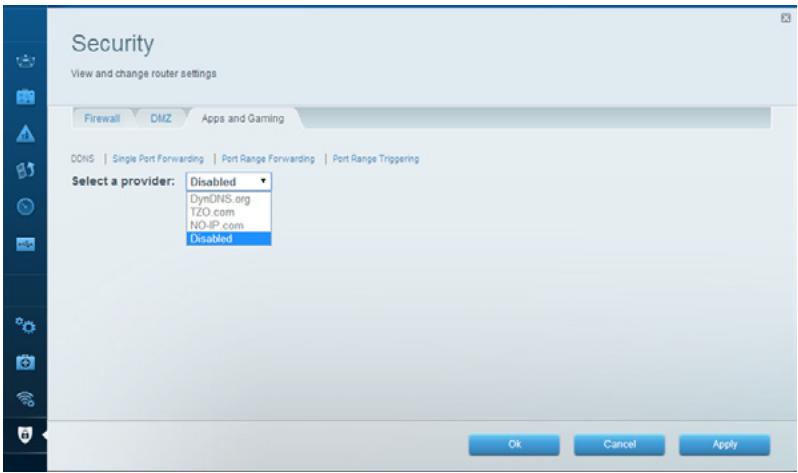
Sign up for DDNS service at either www.dyndns.org or www.tzo.com. Note all of the information provided to you by the DDNS provider.
Log in to Linksys Smart Wi-Fi. (See "How to connect to Linksys Smart Wi-Fi" on page 7.)
Under Router Settings, click Security, then click the Apps and Gaming tab. The DDNS screen opens.
In the DDNS Service drop-down list (the list that has Disabled selected by default), select your DDNS service provider.
text_image
Security View and change router settings Firewall DMZ Apps and Gaming DONS | Single Port Forwarding | Port Range Forwarding | Port Range Triggering Select a provider: Disabled DynDNS.org T2O.com NO-IP.com Disabled Ok Cancel ApplyComplete the fields with information provided by your DDNS provider, then click OK.
To access the network from the Internet, enter the domain name provided by the DDNS service provider.
To access one of your network devices on the Internet, do the following:
- Configure the router to use port forwarding for the device (see "How to set up port forwarding for a single port" on page 39). Note the port number used for the device.
- Enter the domain name for your network followed by a colon and the port number. For example, if the domain name registered with your DDNS provider is HappyBunny.linksysnet.com, and your Internet camera has been configured to use port 1024, you would enter:
HappyBunny.linksysnet.com:1024
HOW TO CLONE A MAC ADDRESS
On any home network, each network device has a unique MAC (Media Access Control) address. Some ISPs register the MAC address of the device (usually a router or a computer) connected directly to the modem. If your computer's MAC address is registered with your ISP and you do not want to re-register the MAC address, then you can clone the address (assign the registered MAC address of your previous device to your new router). If you want to use the MAC address from an old router that you are replacing with your new router, you should first determine the MAC address of your old router, then manually enter it into your new router.
Note:
For many ISPs that provide dynamic IP addresses automatically, the stored MAC address in the modem is reset each time you reset the modem. If you are installing this router for the first time, reset your modem before connecting the router to your modem. To reset your modem, disconnect power for about one minute, and reconnect power.
To clone a MAC address from your computer, do the following:
- Log into Linksys Smart Wi-Fi. (See "How to connect to Linksys Smart Wi-Fi" on page 7.)
- Under Router Settings, click Connectivity. The Connectivity page opens.
- Click the Internet Settings tab.
- Under MAC Address Clone, click Enabled.
- Enter the 12-digit MAC address of your old router, then click OK.
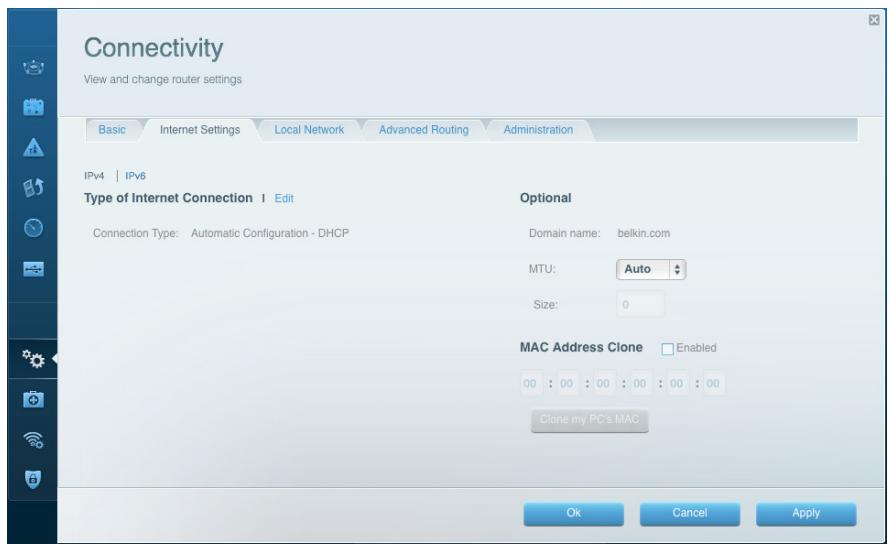
text_image
Connectivity View and change router settings Basic Internet Settings Local Network Advanced Routing Administration IPv4 | IPv6 Type of Internet Connection | Edit Connection Type: Automatic Configuration - DHCP Optional Domain name: belkin.com MTU: Auto Size: 0 MAC Address Clone Enabled 00 : 00 : 00 : 00 : 00 : 00 Clone my PC's MAC Ok Cancel ApplyHOW TO CONNECT TO YOUR CORPORATE OFFICE USING A VPN
A VPN (Virtual Private Network) uses a public network such as the Internet to provide secure communications between a remote computer and another network. Corporations often provide VPN access to their networks to enable employees to work from remote offices or while traveling. Most corporate VPNs use the Internet to provide connectivity between remote employees and the corporate network.
For a typical VPN, the corporation installs a VPN gateway on their corporate network. Employees authorized to work remotely connect to the VPN gateway through the Internet using VPN software and security methods provided by their employers. Security and authentication requirements ensure a secure connection and access by only authorized users.
The default VPN settings in your router have been configured to pass through (allow) the most common types of VPN protocols. Usually, no changes are needed.
To change your VPN passthrough settings, do the following:
- Log into Linksys Smart Wi-Fi. (See "How to connect to Linksys Smart Wi-Fi" on page 7.)
- Under Router Settings, click Security. The Security page opens to the Firewall tab.
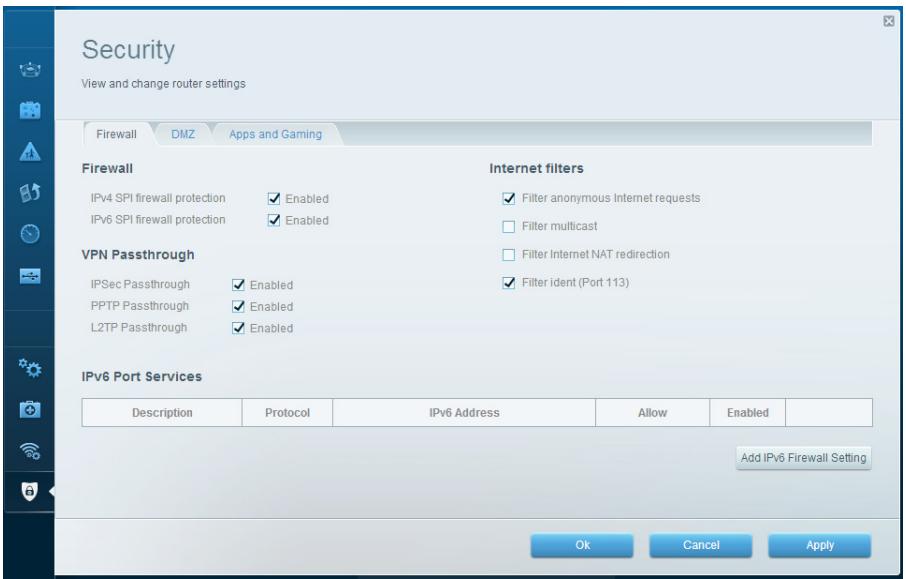
text_image
Security View and change router settings Firewall DMZ Apps and Gaming Firewall Internet filters IPv4 SPI firewall protection Enabled Filter anonymous Internet requests IPv6 SPI firewall protection Enabled Filter multicast VPN Passthrough Filter Internet NAT redirection IPSec Passthrough Enabled Filter ident (Port 113) PPTP Passthrough Enabled L2TP Passthrough Enabled IPv6 Port Services Description Protocol IPv6 Address Allow Enabled Add IPv6 Firewall Setting Ok Cancel ApplyEnable each setting that you want to change:
- IPSec Passthrough — IPSec (Internet Protocol Security) is a suite of protocols used to implement secure exchange of packets at the IP layer. The VPN clients on the local network can establish an IPSec VPN tunnel through the router. This option is enabled by default.
- PPTP Passthrough — PPTP (Point-to-Point Tunneling Protocol) allows the PPP (Point-to-Point Protocol) to be tunneled through an IP network. The VPN clients on the local network can establish a PPTP VPN tunnel through the router. This option is enabled by default.
- L2TP Passthrough — L2TP (Layer 2 Tunneling Protocol) enables point-to-point sessions using the Internet on the Layer 2 level. The VPN clients on the local network can establish an L2TP VPN tunnel through the router. This option is enabled by default.
Click OK to save your changes.
HOW TO OPTIMIZE YOUR ROUTER FOR GAMING AND VOICE
Your router can prioritize traffic between your network and the Internet. Performance for demanding, real-time applications, such as online gaming, VoIP calls, video streaming, and videoconferencing, can be improved by configuring media prioritization.
Prioritization settings are applied only to traffic that is uploaded to the Internet. The router cannot control the quality of the traffic after it reaches the Internet.
Tip:
For more information on optimizing your router for online gaming, see "Port Forwarding and Port Triggering" on page 40.
To configure media prioritization, do the following:
- Log in to Linksys Smart Wi-Fi. (See "How to connect to Linksys Smart Wi-Fi" on page 7.)
- Under Smart Wi-Fi Tools, click Media Prioritization. The Media Prioritization screen opens.
- Turn on Prioritization if it is not already on.
- Click and drag high-priority devices from the Normal Priority list to the High Priority list.
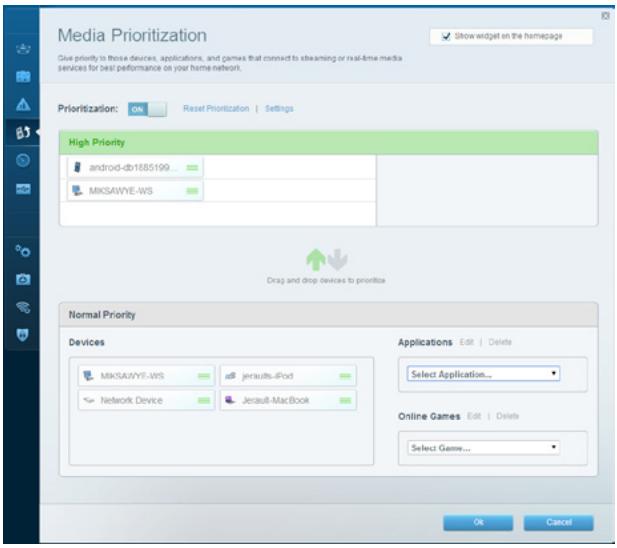
text_image
Media Prioritization Give priority to those devices, applications, and games that connect to streaming or real-time media services for best performance on your home network. Prioritization: On Reset Prioritization | Settings High Priority android-db1685199 MKSAVYE-WS Drag and drop devices to priorities Normal Priority Devices MKSAVYE-WS jeraults-iPod Network Device Jerault-MacBook Applications Edit Delete Select Application... Online Games Edit Delete Select Game... OK Cancel- To prioritize an application or game, select the name in the drop-down list, then click and drag the icon next to the name to the High Priority list.
text_image
Media Prioritization Give priority to those devices, applications, and games that connect to streaming or real-time media services for best performance on your home network. Show widget on the homepage Prioritization: ON Reset Prioritization | Settings High Priority android-db1885100... MIKSAWYE-WS Drag and drop devices to prioritize Normal Priority Devices MIKSAWYE-WS jeraults-iPod Network Device Jerault-MacBook Applications Edit Delete Select Application... Online Games Edit Delete Select Game... OK Cancel- If the application name isn't listed, click Edit and add the name.
Tip:
If you want to add a new application or game, you need to know its port and protocol information (see the application or game's documentation for help).
- Click Settings. The Settings screen opens.
- Set the maximum Downstream Bandwidth. If you set the bandwidth lower than the actual bandwidth of your router, performance may be limited.
- Set the maximum Upstream Bandwidth.
- To help manage traffic priority with devices that support WMM, turn on WMM Support.
- To have the router resend data if an error occurs, turn off No Acknowledgement.
- Click OK.
Tip:
WMM (Wi-Fi MultiMedia) Support is a wireless feature based on the IEEE 802.11e standard. WMM improves quality for audio, video, and voice applications by prioritizing wireless traffic. This feature requires that the wireless client devices in your network also support WMM.
Caution:
If you specify a maximum bandwidth that is too high, the router cannot apply priorities correctly, and prioritization problems may result.
HOW TO ENABLE VOICE OVER IP ON YOUR NETWORK
VoIP (Voice over Internet Protocol) is a technology for using the Internet as an interface for telephone communications. To use VoIP, you need to get an account with a VoIP service provider. The VoIP service provider typically provides you with a telephone adapter that connects to your network. If you do not use your network to make phone calls, you don't need to change the default settings.
The Application Layer Gateway SIP (Session Initiation Protocol) allows SIP packets, used by some VOIP service providers, to get through your router's firewall.
To configure the router for VoIP, do the following:
- Log in to Linksys Smart Wi-Fi. (See "How to connect to Linksys Smart Wi-Fi" on page 7.)
- Under Router Settings, click Connectivity, then click the Administration tab.
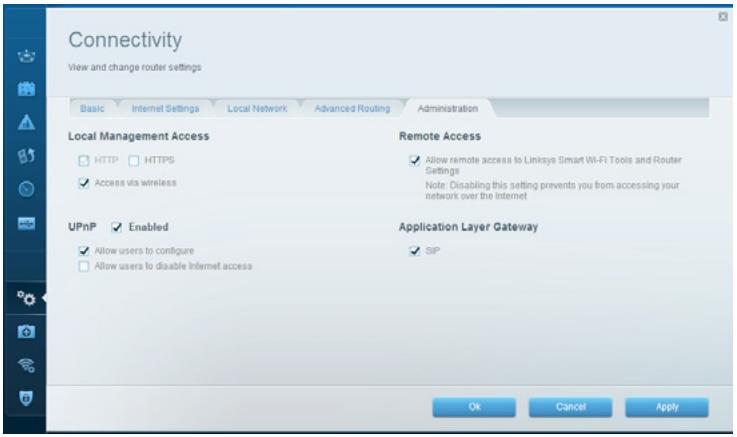
text_image
Connectivity View and change router settings Basic Internet Settings Local Network Advanced Routing Administration Local Management Access HTTP HTTPS ✓ Access via wireless Remote Access ✓ Allow remote access to Linksys Smart Wi-Fi Tools and Router Settings Note: Disabling this setting prevents you from accessing your network over the Internet UPnP ✓ Enabled ✓ Allow users to configure ✓ Allow users to disable Internet access Application Layer Gateway ✓ SIP Ok Cancel ApplyIf your VoIP service uses SIP, select the SIP checkbox under Application Layer Gateway.
- OR -
If your VoIP service uses other NAT traversal solutions such as STUN (Session Traversal Utilities for NAT), TURN (Traversal Using Relay NAT), or ICE (Interactive Connectivity Establishment), deselect the SIP checkbox.
Note:
You may need to contact your VoIP service provider to determine the type of NAT traversal configuration they use.
HOW TO CONFIGURE UPnP
UPnP (Universal Plug and Play) allows devices connected to a network to discover each other and automatically create working configurations. Examples of UPnP-capable devices include web cameras, online gaming applications, and VoIP devices. UPnP is enabled by default.
To configure UPnP, do the following:
- Log in to Linksys Smart Wi-Fi. (See "How to connect to Linksys Smart Wi-Fi" on page 7.)
- Under Router Settings, click Connectivity, then click the Administration tab.
text_image
Connectivity View and change router settings Basic Internet Settings Local Network Advanced Routing Administration Local Management Access HTTP HTTPS Access via wireless UPnP Enabled Allow users to configure Allow users to disable Internet access Remote Access Allow remote access to Linksys Smart Wi-Fi Tools and Router Settings Note: Disabling this setting prevents you from accessing your network over the internet Application Layer Gateway SP OK Cancel Apply- To use UPnP, select Enabled (default) next to UPnP.
- To allow changing router settings while using UPnP, select Allow Users to Configure.
- To prevent local network users from disabling your Internet connection through UPnP, deselect the Allow users to disable Internet access checkbox.
- Click OK.
HOW TO USE A ROUTER AS AN ACCESS POINT
If you have a large area to cover with your wireless signal, or if part of your home has weak signals due to interference, you can use this router to extend the range of your old router's wireless network.
To set up your new router as an access point, do the following:
- Use a network cable to connect this router's Internet port to the Ethernet or LAN port on the router that is connected to your modem.
- Log in to Linksys Smart Wi-Fi. (See "How to connect to Linksys Smart Wi-Fi" on page 7.)
- Under Router Settings, click Connectivity, then click the Internet Settings tab.
- Click IPv4.
- For Type of Internet Connection, select Bridge Mode.
- Click Obtain an IPv4 address automatically, then click OK. The new router's LAN IP address will be changed and obtained from the router that is connected to your modem.
If you have a large area to cover with your wireless signal, or if part of your home has weak signals due to interference, you can use your old router to extend the range of your wireless network. This is a complex process, so this procedure assumes that you have some networking knowledge.
Tip:
Check the documentation for your old router. Some brands of routers include either a switch on the outside of the case or a software option to convert it to an access point. If either of these options is available, follow your old router's instructions to convert it to an access point.
You need to take note of your new router's settings, and apply some of those settings to the old router so it can work as an access point.
To view your new router's settings, do the following:
- Make sure that your new router is connected to the Internet.
- Log in to Linksys Smart Wi-Fi. (See "How to connect to Linksys Smart Wi-Fi" on page 7.)
- Under Router Settings click Wireless. Take note of the Network name (SSID), Password, Security mode, and Channel.
- Under Router Settings, click Connectivity, then click the Local Network tab. Take note of the DHCP server's IP address range (192.168.1.100 to 192.168.1.149 by default).
To use your old router as an access point, do the following:
- With your computer connected to your old router, log into its browser-based administration utility.
Note:
Save your changes after finishing each step below.
- Open the setup page for the local network (LAN).
- In the Router IP address field, enter an unused IP address for the LAN network of your new router.
For example, if your new router has an IP address of 192.168.1.1, you should choose an IP address on the 192.168.1.0 network. You can choose any address within the range of 192.168.1.2 to 192.168.1.254. You should exclude addresses in the range that will be used by the DHCP Server of your new router (192.168.1.100 to 192.168.1.149). A safe choice might be 192.168.1.250. Take note of this address, because this will be the address that you will use to manage your old router in the future.
- In the Subnet Mask field, enter "255.255.255.0" or, if available, select that subnet mask from a drop-down list.
Disable the DHCP server on your old router. (Because your old router will be operating as an access point instead of a router, you don't want it to distribute IP addresses. There should be only one active DHCP server on your network, and that should be your new router.)
To reconfigure the wireless network on your old router, do the following:
- Open the wireless network setup page.
- Change the network name (SSID) to match the name of your new network. Having the same network name and security settings enables you to seamlessly roam between your new router and your old router.
- Change the security mode to match the security mode on your new router.
- Change the password (sometimes called the pre-shared key) on your old router to match the password on your new router.
- Change the wireless channel to a non-conflicting channel. Some manufacturers have an Auto function for channel selection that automatically selects a wireless channel that does not interfere with other nearby wireless networks. If your old router supports an Auto function, select that. Otherwise, you may need to manually select the wireless operating channel on your old router. In the 2.4 GHz wireless spectrum, there are only three non-overlapping channels: 1, 6, and 11. Pick a channel that does not overlap the operating channel of your new router. For example, if your new router is operating on channel 11, configure your old router for either channel 1 or channel 6.
- Connect an Ethernet network cable to one of the LAN/Ethernet ports on your old router and an Ethernet port on your new router.
Caution:
Do not connect the cable to the Internet port on your old router. If you do, you may not be able to set up the router as an access point on the current network.
HOW TO PUT YOUR NEW ROUTER BEHIND AN EXISTING ROUTER
There are several reasons you might want to use your new router "behind" another router:
- You might be in an environment that shares the landlord's Internet connection with all tenants. In this case, you should put your own router behind the landlord's router in order to create your own private network and to isolate computers on your network from the rest of the building.
- You are sharing an office building Internet connection, and you want to control Internet access or the content viewed by your employees.
- You already have an existing network and you want to extend the network's range or add wireless capabilities to your network.
- You want to separate older, less secure network devices from the rest of the network.
TO ADD YOUR ROUTER TO AN EXISTING ROUTER OR GATEWAY
In most cases, you can easily add your router to an existing wireless network by running Linksys Smart Wi-Fi. If you are unable to set up the additional router using the instructions below, see "To share an Internet connection" on page 36 or "To extend your network" on page 37.
To add your router to your existing wireless network, do the following:
- Connect your router's Internet port to the LAN/Ethernet port on your existing (upstream) router or gateway.
- Connect to the secure wireless name shown in the Quick Start Guide that came with your router. (You can change the network name and password later during router setup.) If you need help connecting to the network, refer to your device documentation. Note: You will not have Internet access until router setup is complete.
- Open a web browser and follow the instructions to complete your router's setup. If instructions do not appear in the web browser, enter linksyssmartwifi.com in the browser's address bar.
- At the end of setup, follow the on-screen instructions to set up your Linksys Smart Wi-Fi account.
Note:
As part of the router setup process, you will be sent a verification email. From your home network, click the link in the email to associate your router with the Linksys Smart Wi-Fi account. Make sure that the link opens in a supported web browser, such as Internet Explorer 8 or higher, Firefox 8 or higher, Google Chrome 10 or higher, and Safari 5 (for Mac) or higher.
TO SHARE AN INTERNET CONNECTION
Note:
This is a complex process, so this procedure assumes that you have some networking knowledge.
To add another router to share an Internet connection, do the following:
This topic covers cases one and two above
- Determine the IP address range for your upstream (office or building) network.
- To determine the address range by using a Windows computer:
- Connect your computer to your upstream network's router.
- Click Start, Run, type CMD, then click OK. The command prompt window appears.
- Type "ipconfig," then press Enter.
Tip:
Although you can determine your computer's IP address in many ways, this method is quick and relatively easy.
- Take note of the IP address. In this example, the IP address is 192.168.100.192.
- To determine the address range by using a Mac computer:
- Connect your computer to your upstream network's router.
- From the Dock, click System preferences, click Network, then click Ethernet in the window to the left. A network status window opens.
- Take note of the IP address. In this example, the IP address is 192.168.100.139.
- Example: The above examples show that upstream IP addresses are on the 192.168.100.0 network. (The "O" indicates the entire network.) Your upstream network's address may be different. The default address of your new Linksys router is 192.168.1.1. In setting up one router behind another, you must make sure that the local network on your new router is different than the network of your upstream router. In the above example, because the default local network on your Linksys router 192.168.1.0 is on a different subnet than the office network's 192.168.100.0, you will be able to place your Linksys router behind the other router.
- Connect an Ethernet network cable to a LAN/Ethernet port on your upstream network to the yellow Internet port on your router.
Caution:
Connect the upstream network to your router's yellow Internet port, not one of the blue Ethernet ports. If you connect to an Ethernet port, you create IP addressing problems for the office network.
Tips:
An office network often has a wall plate with an Ethernet port that you can connect to.
If you are doing this in a home environment (without wall ports), connect an Ethernet network cable between a LAN port on your upstream router and the Internet port on your Linksys router.
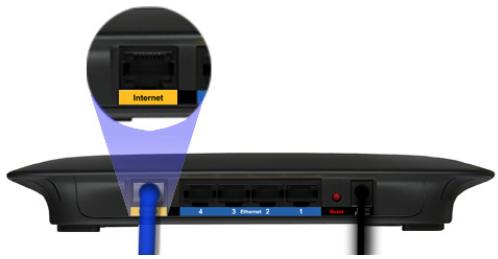
text_image
Internet 4 3 Ethernet 2 1Run your router's setup CD on each computer that you want to connect to the Linksys router. Each computer needs either a wired or wireless connection to the Linksys router. For more information, see "How to connect a computer to your network" on page 10.
The computers that are connected to the Linksys router are now on the same network, and are isolated from the upstream network. However, you will still have access to the Internet through the upstream router (by way of your Linksys router). Because two routers are between your computer and the Internet, Internet traffic undergoes two network address translations. This is sometimes referred to as Double NAT.
Your computers can also use the built-in capabilities of your Linksys router, such as parental controls. If you need further control over the type of content your employees or family access, you can create an account with an Internet filtering site such as www.opendns.com or www.bsecure.com. After you create an account with them, use their DNS in place of your ISP's DNS.
To use their DNS:
- Log into Linksys Smart Wi-Fi. (See "How to connect to Linksys Smart Wi-Fi" on page 7.)
■ Under Router Settings, click Connectivity. - Click the Local Network tab.
- Complete the Static DNS fields with the information provided by your content filtering provider.
- Click OK.
TO EXTEND YOUR NETWORK
This topic covers cases three and four above.
Note:
This is a complex process, so this procedure assumes that you have some networking knowledge.
To extend your network or add wireless capabilities, do the following:
- If you want to extend your network, you may also follow the instructions above. One example of this might be to provide a separate wireless network for your children to keep their wireless network traffic separate from your wireless network. You might also want to isolate one network from another network so that network shares aren't visible across networks. In this case, use an Ethernet cable to connect the Internet port of the downstream router to one of the LAN ports of the upstream router. Make sure that the local network subnets on the two routers are different.
- OR -
- You can extend your network by turning the downstream router into an access point. (See "How to use a router as an access point" on page 34.) When you use a router as an access point, computers connected to the access point are on the same IP subnet as all other devices connected to the router. File, printer, and media sharing is much easier if all devices are on the same subnet.
HOW TO EXPOSE A DEVICE TO THE INTERNET
If you are operating a Web server, a mail server, or a Web camera, you may want to expose that device to the Internet so anybody can access it. Your router includes a DMZ (Demilitarized Zone) feature that forwards all inbound ports presented on the WAN interface, except those that are specifically forwarded, to an individual IP address or MAC address. This feature is normally not used, because it presents significant security risks to the device that you designate for the DMZ. The DMZ device is not protected by the built-in firewalls, Internet filters, or router Web filters, and is open to attacks from hackers.
A much safer way of exposing devices to the Internet would be to use port forwarding. See "How to set up port forwarding" on page 39.
To set up a device in the DMZ, do the following:
- Configure your device with a static IP address. See your device's documentation for help with setting a static IP address or use DHCP reservation (see "How to set up the DHCP server on your router" on page 27).
- Log in to Linksys Smart Wi-Fi. (See "How to connect to Linksys Smart Wi-Fi" on page 7.)
- Under Router Settings, click Security, then click the DMZ tab.
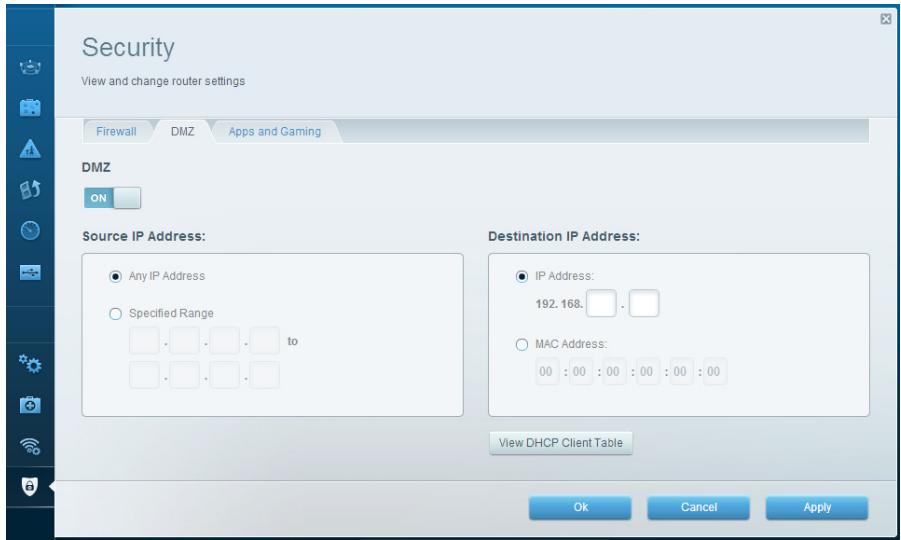
text_image
Security View and change router settings Firewall DMZ Apps and Gaming DMZ ON Source IP Address: Any IP Address Specified Range to Destination IP Address: IP Address: 192.168. MAC Address: 00 : 00 : 00 : 00 : 00 : 00 View DHCP Client Table Ok Cancel Apply- Click the setting for DMZ to turn it on.
- In the Source IP Address section, select Any IP Address to allow access to your DMZ device from the entire Internet, or select the alternate button and enter a range of allowed source addresses.
- In the Destination IP Address section, enter the last three digits of the IP address of the device that will be in the DMZ. The rest of the IP address is already completed.
- OR -
If you want to specify the 12-digit MAC address of the device instead of setting up a DHCP address reservation, you can replace Step 6 with the following steps:
- In the Destination IP Address section, select MAC Address, then click View DHCP Client Table. The DHCP Client Table screen opens.
text_image
Security View DHCP Client Table Select A Device Client Name Interface IP Address BIAC Address MKSAYNE-R/S Wireless 192.168.20.50 39 21:54:0D 71 9:9 Select Network Device Wireless 192.168.20.11 04:75:0E:1E:1D:05 Select Refresh Close View DHCP Client Table OK Cancel Apply- Click Select next to the device that you want to place in the DMZ, then click Close. The corresponding MAC address is copied into the MAC Address field.
- Click OK.
HOW TO SET UP PORT FORWARDING
Why would I use port forwarding? Port forwarding is a feature that forwards inbound traffic from the Internet on a specific port or ports to a specific device or port on your local network. You can set up port forwarding for the following:
- A single port (see "How to set up port forwarding for a single port" below)
- Multiple ports (see "How to set up port forwarding for multiple ports" on page 39)
- A range of ports (see "How to set up port forwarding for a range of ports" on page 40)
HOW TO SET UP PORT FORWARDING FOR A SINGLE PORT
Single port forwarding forwards inbound traffic from the Internet on a specific port to a single device on your local network. An example of single port forwarding would be sending inbound Web requests, typically on port 80, to a Web server.
Tip: See the device's documentation for port and protocol information.
To set up single port forwarding, do the following:
- Follow your device's instructions for configuring it with a static IP address or use DHCP reservation to assign it a permanent address (see "How to set up the DHCP server on your router" on page 27).
- Log in to Linksys Smart Wi-Fi. (See "How to connect to Linksys Smart Wi-Fi" on page 7.)
■ Under Router Settings, click Security. - Click the Apps and Gaming tab.
- Click Single Port Forwarding. The Single Port Forwarding screen opens.
- Click Add a new Single Port Forwarding.
- In the Application name field, enter a descriptive name.
- In the External Port field, type the external port number (not always required).
- In the Internal Port field, type the internal port number (not always required).
- In the Protocol drop-down list, select TCP, UDP, or Both (default).
- In the Device IP# field, enter the last three digits of the IP address you have reserved for the computer you want to forward Internet traffic to. The rest of the IP address has already been completed for you.
- Select Enabled, then click Save. If you don't want to use port forwarding but want to keep the information in the table, unselect the checkbox.
HOW TO SET UP PORT FORWARDING FOR MULTIPLE PORTS
Some applications require forwarding of multiple ports. VNC (Virtual Network Computing) software that allows you to operate your computer remotely from anywhere on the Internet is an example of an application that requires multiple ports to be forwarded. To forward to multiple ports, create additional entries to forward additional ports to the same IP address.
Example: You want to set up your computer so you can remotely access it using VNC software. By default, VNC uses TCP ports 5800 and 5900.
To set up single port forwarding for multiple ports, do the following:
Make sure that the software you want to use has been installed on a networked computer.
- Log in to Linksys Smart Wi-Fi. (See "How to connect to Linksys Smart Wi-Fi" on page 7.)
- Set up DHCP reservation for the IP address of the computer on which you installed the software. (See "How to set up the DHCP server on your router" on page 27.)
■ Under Router Settings, click Security. - Click the Apps and Gaming tab.
- Click Single Port Forwarding. The Single Port Forwarding screen opens.
- Click Add a new Single Port Forwarding.
- In the Application name field, enter a descriptive name.
- Enter in the same port number for the External Port and the Internal Port.
- In the Protocol drop-down list, select TCP, UDP, or Both (default).
- In the Device IP# field, enter the last three digits of the IP address you have reserved for the computer you want to forward Internet traffic to. The rest of the IP address has already been completed for you.
- Select Enabled, then click Save. If you don't want to use port forwarding but want to keep the information in the table, deselect the checkbox.
Note:
If you want to use software such as VNC on multiple computers, you will need to reconfigure the default ports that VNC uses on each additional computer. Then, create additional port forwarding entries for each additional computer. See your software's documentation for help..
HOW TO SET UP PORT FORWARDING FOR A RANGE OF PORTS
Some applications require forwarding to a range of ports.
Example: You want to set up your computer so you can use BitTorrent, a popular peer-to-peer file sharing application. BitTorrent uses port 6881 by default. If that port is busy, the requesting BitTorrent client tries the next port in sequence. The most common configuration for home routers with a single BitTorrent computer is to set up port forwarding using a range of ports starting with 6881 and ending with port 6889.
To set up port range forwarding, do the following:
- Log in to Linksys Smart Wi-Fi. (See "How to connect to Linksys Smart Wi-Fi" on page 7.)
- Set up a DHCP reservation for the IP address of the computer on which you installed the software. (See "How to set up the DHCP server on your router" on page 27.) In this example, the IP address of the desktop computer with BitTorrent installed is 192.168.1.140.
■ Under Router Settings, click Security. - Click the Apps and Gaming tab.
- Click Port Range Forwarding. The Port Range Forwarding screen opens.
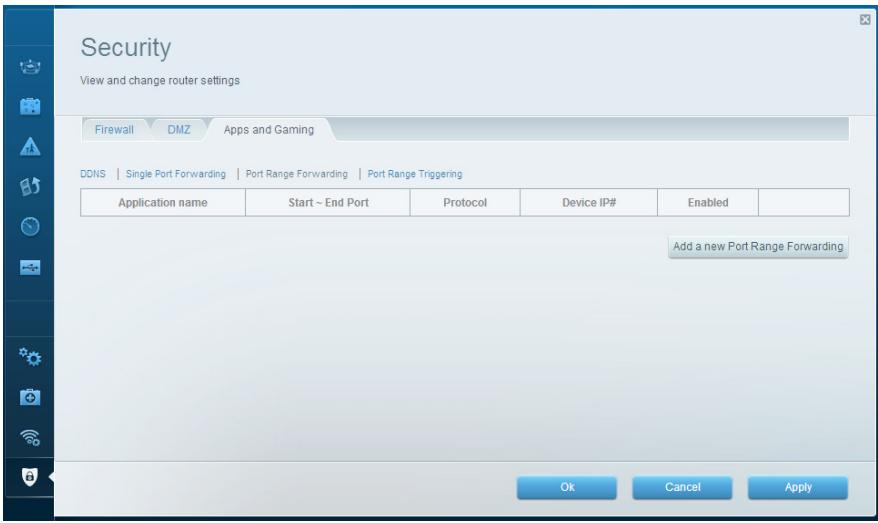
text_image
Security View and change router settings Firewall DMZ Apps and Gaming DDNS | Single Port Forwarding | Port Range Forwarding | Port Range Triggering Application name Start ~ End Port Protocol Device IP# Enabled Add a new Port Range Forwarding Ok Cancel Apply- Click Add a new Port Range Forwarding.
- In the Application name field, enter a descriptive name.
- In the Start \~ End Port fields, enter the range or ports. In this example, the range is "6881 - 6889".
- Select TCP as the protocol.
- In the Device IP# field, enter the last 3 digits of the IP address of the device running the software. The rest of the IP address fields already completed. In this example, you would enter "140".
- Select Enabled, then click Save. If you don't want to use port range forwarding but want to keep the information in the table, deselect the checkbox.
Tips:
To use software like BitTorrent on multiple computers on your network, create additional entries with a unique range of ports as shown above. BitTorrent works only with ports between 6881 and 6999.
Depending on your computer's firewall software, you may need to open a range of ports in your firewall to enable software that uses port range forwarding
HOW TO SET UP PORT RANGE TRIGGERING FOR ONLINE GAMING
Port range triggering allows the router to watch outgoing data for specific port numbers. The IP address of the computer that sends the matching data is remembered by the router, so that when the requested data returns through the router, the data is routed back to the proper computer. An example of port range triggering would be to enable a USB or Bluetooth headset for online chat and gaming.
To set up port range triggering for multiple entries, do the following:
- See your device documentation for information on the ports that the device uses.
- Log in to Linksys Smart Wi-Fi. (See "How to connect to Linksys Smart Wi-Fi" on page 7.)
■ Under Router Settings, click Security. - Click the Apps and Gaming tab.
- Click Port Range Triggering. The Port Range Triggering screen opens.
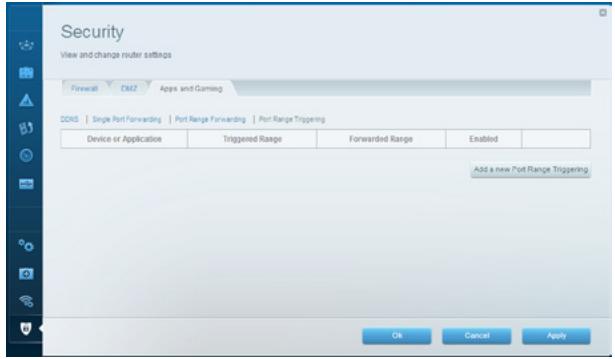
text_image
Security View and change router settings Firewall DMZ Apps and Gaming DDIS Single Port Forwarding Port Range Forwarding Port Range Triggering Device or Application Triggered Range Forwarded Range Enabled Add a new Port Range Triggering OK Cancel Apply- Click Add a new Port Range Triggering.
- In the Device or Application field, enter a descriptive name (such as "PS3 Headset").
- For single ports, enter the same port number in each Triggered range and Forwarded range field.
- For port ranges, enter the same number ranges in each set of Triggered Range and Forwarded Range fields.
- Select Enabled, then click Save. If you don't want to use port range triggering but want to keep the information in the table, deselect the checkbox.
HOW TO BACK UP AND RESTORE YOUR ROUTER CONFIGURATION
As with any valuable data, you should back up your router configuration. Your router might contain many customized settings. Those settings would be lost if you reset your router to its factory defaults, and you would need to re-enter all of them manually. If you back up your router configuration, restoring settings is easy.
Note:
You can only back up the router configuration locally (not remotely).
To back up your router configuration, do the following:
- Log in to Linksys Smart Wi-Fi. (See "How to connect to Linksys Smart Wi-Fi" on page 7.)
- Under Router Settings, click Troubleshooting.
- Click the Diagnostics tab.
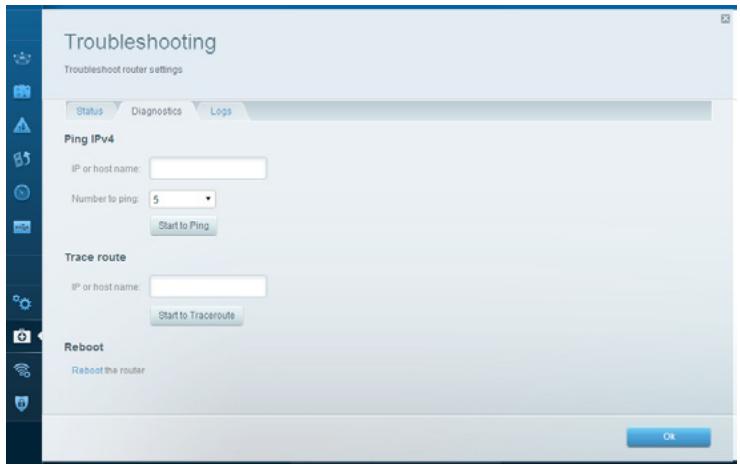
text_image
Troubleshooting Troubleshoot router settings Status Diagnostics Logs Ping IPv4 IP or host name: Number to ping: 5 Start to Ping Trace route IP or host name: Start to Traceroute Reboot Reboot the router OK- Under Router configuration, click Backup. You are prompted to save the file.
- Specify a file location, then click Save.
Tip:
For save multiple backup files, include the backup date in the filename as you save.
To restore your router configuration:
- Log in to Linksys Smart Wi-Fi. (See "How to connect to Linksys Smart Wi-Fi" on page 7.)
■ Under Router Settings, click Troubleshooting. - Click the Diagnostics tab.
- Under Router configuration, click Restore. The Restore Router Configuration dialog box opens.
- Click Choose File to navigate to the location of your configuration file, then select the file and click Open.
- To restore the configuration, click Start to Restore.
HOW TO UPGRADE THE ROUTER'S FIRMWARE
Linksys may periodically publish a firmware upgrade either to fix a problem or to add features to your router.
Important:
Do not interrupt the upgrade process. You should not turn off the router or press the Reset button during the upgrade. Doing so may permanently disable the router.
Tip:
Your router automatically checks for available updates and installs them by default. Use the following instructions only if the automatic firmware update has been turned off.
To upgrade the router's firmware, do the following:
- Log in to Linksys Smart Wi-Fi. (See "How to connect to Linksys Smart Wi-Fi" on page 7.)
■ Under Router Settings, click Connectivity. - Click the Basic tab.
- Under Firmware Update, click Check for Updates.
- If an available update is found, follow the on-screen instructions to install it.
Tip:
To have your router automatically check for updates and install them, select Automatic under Firmware Update.
HOW TO RESTORE FACTORY DEFAULTS
If you've tried previous troubleshooting steps and your network still doesn't work, you may need to restore your router's factory defaults. To restore your router to factory defaults, you can use the Reset button on the router or use Linksys Smart Wi-Fi.
To reset your router using the reset button:
Caution:
Whenever you restart the router, all logs that are not saved will be lost.
With your router connected to power and turned on, press and hold the Reset button on the back of your router for about 10 seconds (until the power indicator flashes).
To reset your router to factory defaults using Linksys Smart Wi-Fi, do the following:
- Log in to Linksys Smart Wi-Fi. (See "How to connect to Linksys Smart Wi-Fi" on page 7.)
- Under Router Settings, click Troubleshooting.
- Click the Diagnostics tab.
■ Under Factory reset, click Reset. - A confirmation screen opens.
- Click Yes to confirm. All settings and logs will be deleted, and your router will return to its factory default settings.

Important
Factory reset router
When you reset your router, it reboots, disconnects from the Internet and clears all current settings. All devices connected to the router will also be disconnected. When the reset completes, the router will need to be set up again and then all devices will have to reconnect using the new settings.
Do you want to continue?
Yes
No
HOW TO CHECK THE STATUS OF YOUR ROUTER
Your router status tells you whether you have a secure Internet connection and informs you about the status of your network-connected devices.
To check your router status, do the following:
- Log in to Linksys Smart Wi-Fi. (See "How to connect to Linksys Smart Wi-Fi" on page 7.)
- Under Router Settings, click Troubleshooting.
- Click the Status tab. Detailed information about your router status is displayed.
Tip: For field descriptions, click Help at the top of the screen.
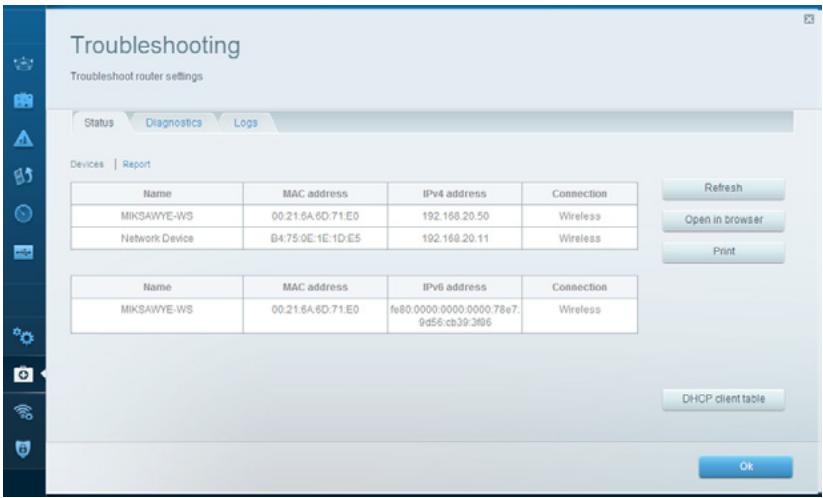
text_image
Troubleshooting Troubleshoot router settings Status Diagnostics Logs Devices | Report Name MAC address IPv4 address Connection MIKSAWYE-WS 00:21:6A.6D:71:E0 192.168.20.50 Wireless Network Device B4:75:0E:1E:1D:E5 192.168.20.11 Wireless Name MAC address IPv6 address Connection MIKSAWYE-WS 00:21:6A.6D:71:E0 fe80.0000.0000.0000.78e7:9d56:cb39:3f86 Wireless Refresh Open in browser Print DHCP client table Ok- To view a list of connected network devices, click Devices. To view a full report of your router status, click Report.
- Click OK to close the screen.
HOW TO DISABLE THE ETHERNET PORT STATUS LIGHTS
Depending on the placement of the router in a home, you might find the lights distracting. You can easily disable the lights using Linksys Smart Wi-Fi.
To disable the lights, do the follow:
- Log in to Linksys Smart Wi-Fi. (See "How to connect to Linksys Smart Wi-Fi" on page 7.)
- Under Router Settings, click Connectivity.
- Click the Basic tab.
- Under Port Lights, click the ON/OFF button.
HOW TO TEST YOUR INTERNET CONNECTION
Your router includes two diagnostic tests, Ping and Trace route, that let you check network connections, including network devices and your Internet connection.
To diagnose your Internet connection, do the following:
- Log in to Linksys Smart Wi-Fi. (See "How to connect to Linksys Smart Wi-Fi" on page 7.)
- Under Router Settings, click Troubleshooting.
- Click the Diagnostics tab.
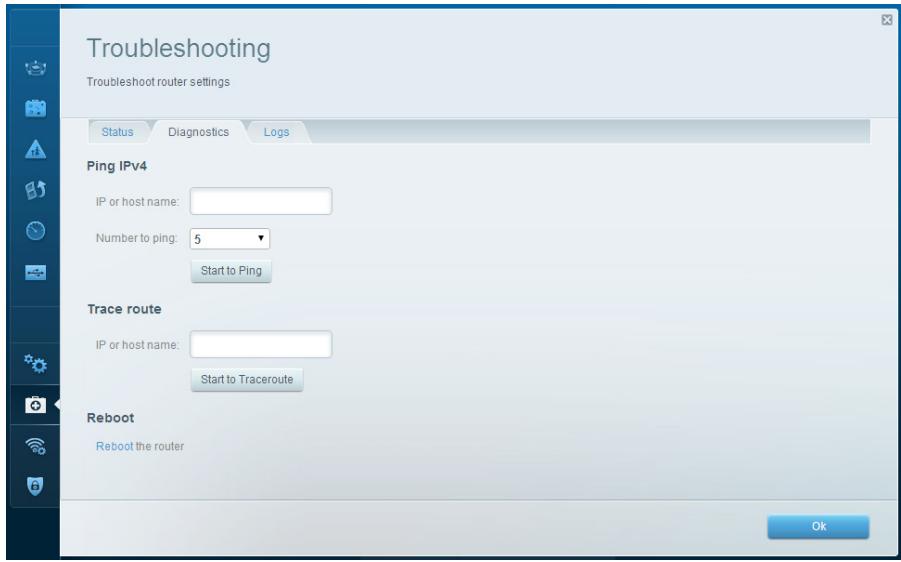
text_image
Troubleshooting Troubleshoot router settings Status Diagnostics Logs Ping IPv4 IP or host name: Number to ping: 5 Start to Ping Trace route IP or host name: Start to Traceroute Reboot Reboot the router OkTo check whether an address can be reached:
- Under Ping IPv4, enter an IP address or URL into the IP or host name field.
- Select a number of times to ping from the Number to ping drop-down list.
- Click Start to Ping. A window will open showing the ping test results. You will see a response for each successful ping.
Notes:
If an Internet URL fails to respond to ping, it doesn't necessarily mean that the site is down. For security reasons, some sites are configured to not respond to ping requests.
To trace the route that packets take between your router and a specific address:
- Under Trace route, enter an address in the IP or host name field.
- Click Start to Trace route. A window will open with the test results.
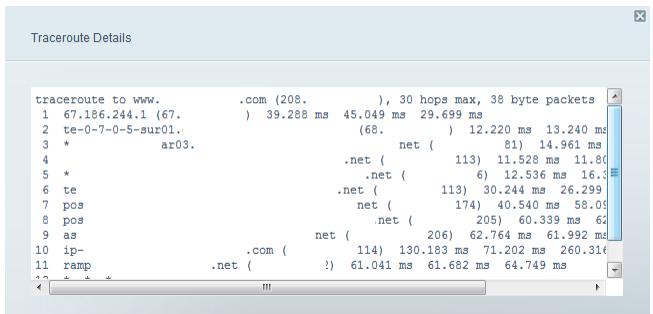
text_image
traceroute to www. .com (208. ), 30 hops max, 38 byte packets 1 67.186.244.1 (67. ) 39.288 ms 45.049 ms 29.699 ms 2 te-0-7-0-5-sur01. (68. ) 12.220 ms 13.240 ms 3 * ar03. .net ( 81) 14.961 ms 4 .net ( 113) 11.528 ms 11.80 5 * .net ( 6) 12.536 ms 16.5 6 te .net ( 113) 30.244 ms 26.299 7 pos .net ( 174) 40.540 ms 58.09 8 pos .net ( 205) 60.339 ms 62 9 as .net ( 206) 62.764 ms 61.992 ms 10 ip-. .com ( 114) 130.183 ms 71.202 ms 260.316 11 ramp .net ( :) 61.041 ms 61.682 ms 64.749 msHOW TO CONFIGURE AND USE LOGS
Your router can track all traffic for your Internet connection and record that information in a log.
To enable and view logs, do the following:
- Log in to Linksys Smart Wi-Fi. (See "How to connect to Linksys Smart Wi-Fi" on page 7.)
- Under Router Settings, click Troubleshooting.
- Click the Logs tab.
- To enable logs, click the Enable Logs button so that ON is displayed.
- You can view the logs directly in the list, open the logs in a separate browser window, or print the logs.
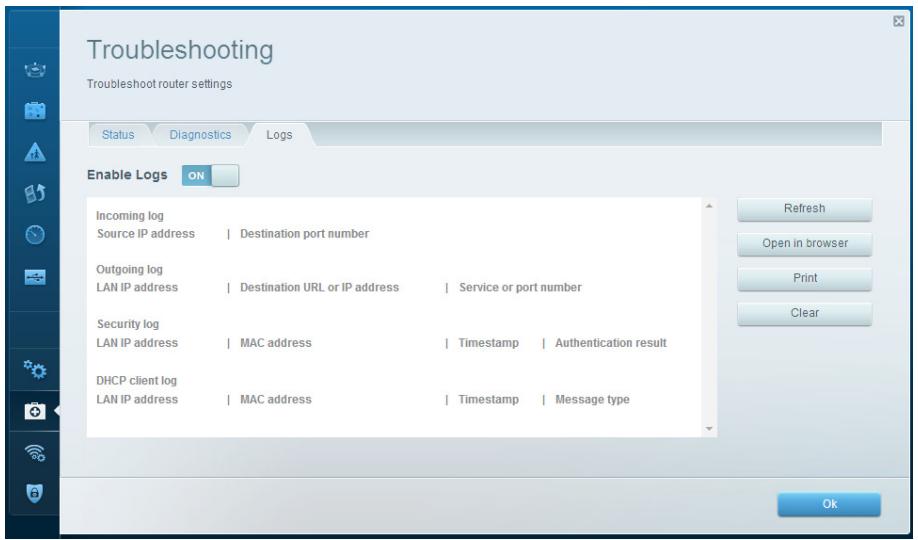
text_image
Troubleshooting Troubleshoot router settings Status Diagnostics Logs Enable Logs ON Incoming log Source IP address | Destination port number Outgoing log LAN IP address | Destination URL or IP address | Service or port number Security log LAN IP address | MAC address | Timestamp | Authentication result DHCP client log LAN IP address | MAC address | Timestamp | Message type Refresh Open in browser Print Clear OkTroubleshooting
This chapter can help you solve common setup issues and connect to the Internet. You can find more help from our award-winning customer support at linksys.com/support.
YOUR ROUTER WAS NOT SUCCESSFULLY SET UP
If Linksys Smart Wi-Fi did not complete the setup, you can try the following:
- Press and hold the Reset button on your router with a paperclip or pin until the LED starts blinking (about 10 seconds). Install the router again.
Your router's appearance may vary
- Temporarily disable your computer's firewall (see the security software's instructions for help). Install the router again.
- If you have another computer, use that computer to install the router again.
WINDOWS XP SERVICE PACK UPDATE
On Windows XP computers, Linksys Smart Wi-Fi requires Service Pack 3. If the currently installed Service Pack is older than version 3, download and install Service Pack 3.
Tip:
To temporarily connect to the Internet and download the required Service Pack, you can use the included Ethernet cable to connect your computer directly to your modem.
To install Service Pack 3:
- Connect to the Microsoft Update website (update.microsoft.com/windowsupdate).
- Follow the instructions on the website or contact Microsoft if you need further help.
- After downloading and installing Service Pack 3, install the router again.
YOUR INTERNET CABLE IS NOT PLUGGED IN MESSAGE
If you get a "Your Internet cable is not plugged in" message when trying to set up your router, follow these troubleshooting steps.
To fix the problem:
- Make sure that an Ethernet or Internet cable (or a cable like the one supplied with your router) is securely connected to the yellow Internet port on the back of the router and to the appropriate port on your modem. This port on the modem is usually labeled Ethernet, but may be named Internet or WAN.
Back view of router
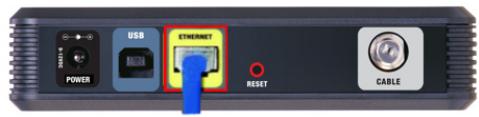
text_image
POWER USB ETHERNET RESET CABLEBack view of cable modem
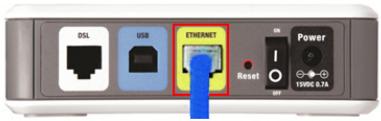
text_image
DSL USB ETHERNET Reset OK Power 13VDC 0.7ABack view of DSL modem
- Make sure that your modem is connected to power and is turned on. If it has a power switch, make sure that it is set to the ON or I (as opposed to O) position.
- If your Internet service is cable, verify that the cable modem's CABLE port is connected to the coaxial cable provided by your ISP.
- Or, if your Internet service is DSL, make sure that the DSL phone line is connected to the modem's DSL port.
- If your computer was previously connected to your modem with a USB cable, disconnect the USB cable.
- Install the router again.
CANNOT ACCESS YOUR ROUTER MESSAGE
If you cannot access your router because your computer is not connected to your network, follow these steps.
To access your router, you must be connected to your own network. If you currently have wireless Internet access, the problem may be that you have accidentally connected to a different wireless network.
To fix the problem on Windows computers, do the following:
- On your Windows desktop right-click the wireless icon in the system tray.
- Click View Available Wireless Networks. A list of available networks will appear.
- Click your own network name. Click Connect. In the example below, the computer was connected to another wireless network named JimsRouter. The name of the Linksys E-Series network, BronzeEagle in this example, is shown selected.
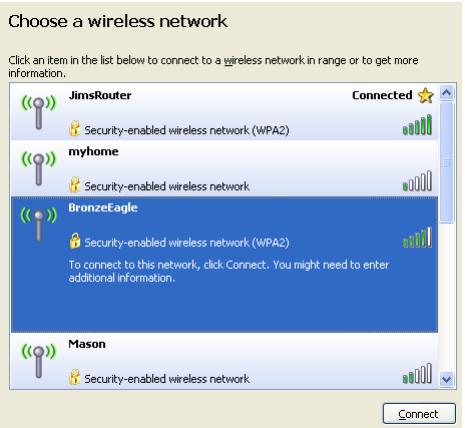
text_image
Choose a wireless network Click an item in the list below to connect to a wireless network in range or to get more information. JimsRouter Connected Security-enabled wireless network (WPA2) myhome Security-enabled wireless network BronzeEagle Security-enabled wireless network (WPA2) To connect to this network, click Connect. You might need to enter additional information. Mason Security-enabled wireless network Connect- If you are prompted to enter a network key, type your password (Security Key) into the Network key and Confirm network key fields. Click Connect.
- Your computer connects to the network, and you should now be able to access the router.
*Depending on your version of Windows, there could be some differences in wording or icons in these steps.
To fix the problem on Mac computers, do the following:
- In the menu bar across the top of the screen, click the Wi-Fi icon. A list of wireless networks will appear. Linksys Smart Wi-Fi has automatically assigned your network a name.
- In the example below, the computer was connected to another wireless network named JimsRouter. The name of the Linksys E-Series network, BronzeEagle in this example, is shown selected.
- Click the wireless network name of your Linksys E-Series router (BronzeEagle in the example).
- Type your wireless network password (Security Key) into the Password field. Click OK.
AFTER SETUP
The Internet appears to be unavailable
If the Internet has difficulty communicating with your router, the problem may appear as a “Cannot find [Internet address]” message in your Web browser. If you know that the Internet address is correct, and if you’ve tried several valid Internet addresses with the same result, the message could mean that there’s a problem with your ISP or modem communicating with your router.
Try the following:
- Make sure that the network and power cables are securely connected.
- Make sure that the power outlet that your router is connected to has power.
- Reboot your router.
- Contact your ISP and ask about outages in your area.
The most common method of troubleshooting your router is to turn it off then back on again. Your router can then reload its custom settings, and other devices (such as the modem) will be able to rediscover the router and communicate with it. This process is called rebooting.
REBOOTING YOUR ROUTER
To reboot your router using the power cord, do the following:
- Disconnect the power cord from the router and the modem.
- Wait 10 seconds, and reconnect the power cord to the modem. Make sure it has power.
- Wait until the modem's online indicator has stopped blinking, or two minutes. Reconnect the power cord to the router.
Wait until the power indicator stops blinking. Wait two minutes before trying to connect to the Internet from a computer.
To reboot your router using Linksys Smart Wi-Fi, do the following:
- Log in to Linksys Smart Wi-Fi. (See "How to connect to Linksys Smart Wi-Fi" on page 11.)
■ Under Router Settings, click Troubleshooting. - Click the Diagnostics tab.
Under Reboot, click Reboot.
A confirmation screen opens.

Important
Rebooting the router
Rebooting the router disconnects it from the Internet, causing all connected devices to lose Internet connectivity. When the reboot completes, the router and all devices will be reconnected.
Do you want to continue?
Yes
No
Click Yes. The router will reboot. While the router is rebooting, all connected devices will lose their Internet connection.
LINKSYS SMART Wi-Fi DOES NOT OPEN IN YOUR WEB BROWSER
The latest versions of the most common Web browsers work with Linksys Smart Wi-Fi.
- Internet Explorer 8 or higher
- Firefox 8 or higher
■ Google Chrome 10 or higher
■ Safari 5 (for Mac) or higher
YOU CANNOT ACCESS LINKSYS SMART Wi-Fi
To access your router directly, see "How to manually set up your router" on page 21.
ALL OTHER TROUBLESHOOTING HAS BEEN UNSUCCESSFUL
- If you tried previous troubleshooting steps and your network still doesn't work, you may need to restore your router's factory defaults.
- When all other troubleshooting has failed, you may want to restore the router to its basic factory settings, which are the most common settings used in home networks. Resetting the router erases your custom settings, so you must restore the settings after. We recommend that you back up your configuration before resetting your router to factory defaults. See "How to back up and restore your router configuration" on page 42.
- To restore your router to factory defaults, you can use the Reset button on the router or use Linksys Smart Wi-Fi. For instructions, see "How to restore factory defaults" on page 43.
LINKSYS WRT1900AC
| Model Name | Linksys Smart Wi-Fi Router AC 1900 |
| Description | Dual-Band AC Router with gigabit and 2xUSB |
| Model Number | WRT1900AC |
| Switch Port Speed | 10/100/1000 Mbps (gigabit Ethernet) |
| Radio Frequency | 2.4 GHz and 5 GHz |
| # of Antennas | 4 external adjustable antennas |
| Ports | Power, 1 x USB 3.0, 1 x combo USB 2.0/eSATA, Internet, Ethernet (1-4), R-SMA (4) |
| Buttons | Reset, Wi-Fi Protected Setup, Power |
| Front Panel Indicators | POWER, INTERNET, 2.4 GHz, 5GHz, eSATA, USB1, USB2, Ethernet (1-4), Wi-Fi Protected Setup |
| UPnP | Supported |
| Security Features | WEP, WPA2, RADIUS |
| Security Key Bits | Up to 128-bit encryption |
| Storage File System Support | FAT, NTFS, and HFS+ |
| Browser Support | Internet Explorer 8 or higher, Firefox 4 or higher, Google Chrome 10 or higher, and Safari 4 or higher |
Environmental
| Dimensions | 9.68" x 7.64" x 2.05" without antennas(246 x 194 x 52 mm) |
| Unit Weight | 36.68 oz (1.040 Kg) |
| Power | 12V, 4A |
| Certifications | FCC, IC, CE, Wi-Fi a/b/g/n/draft ac, Windows 7,Windows 8, DLNA |
| Operating Temp. | 32 to 104°F (0 to 40°C) |
| Storage Temp. | -4 to 140°F (-20 to 60°C) |
| Operating Humidity | 10 to 80% relative humidity, non-condensing |
| Storage Humidity | 5 to 90% non-condensing |
Note:
For regulatory, warranty, and safety information, see the CD that came with your router or go to Linksys.com/support.
Specifications are subject to change without notice.
Maximum performance derived from IEEE Standard 802.11 specifications. Actual performance can vary, including lower wireless network capacity, data throughput rate, range and coverage. Performance depends on many factors, conditions and variables, including distance from the access point, volume of network traffic, building materials and construction, operating system used, mix of wireless products used, interference and other adverse conditions.
Visit linksys.com/support for award-winning technical support
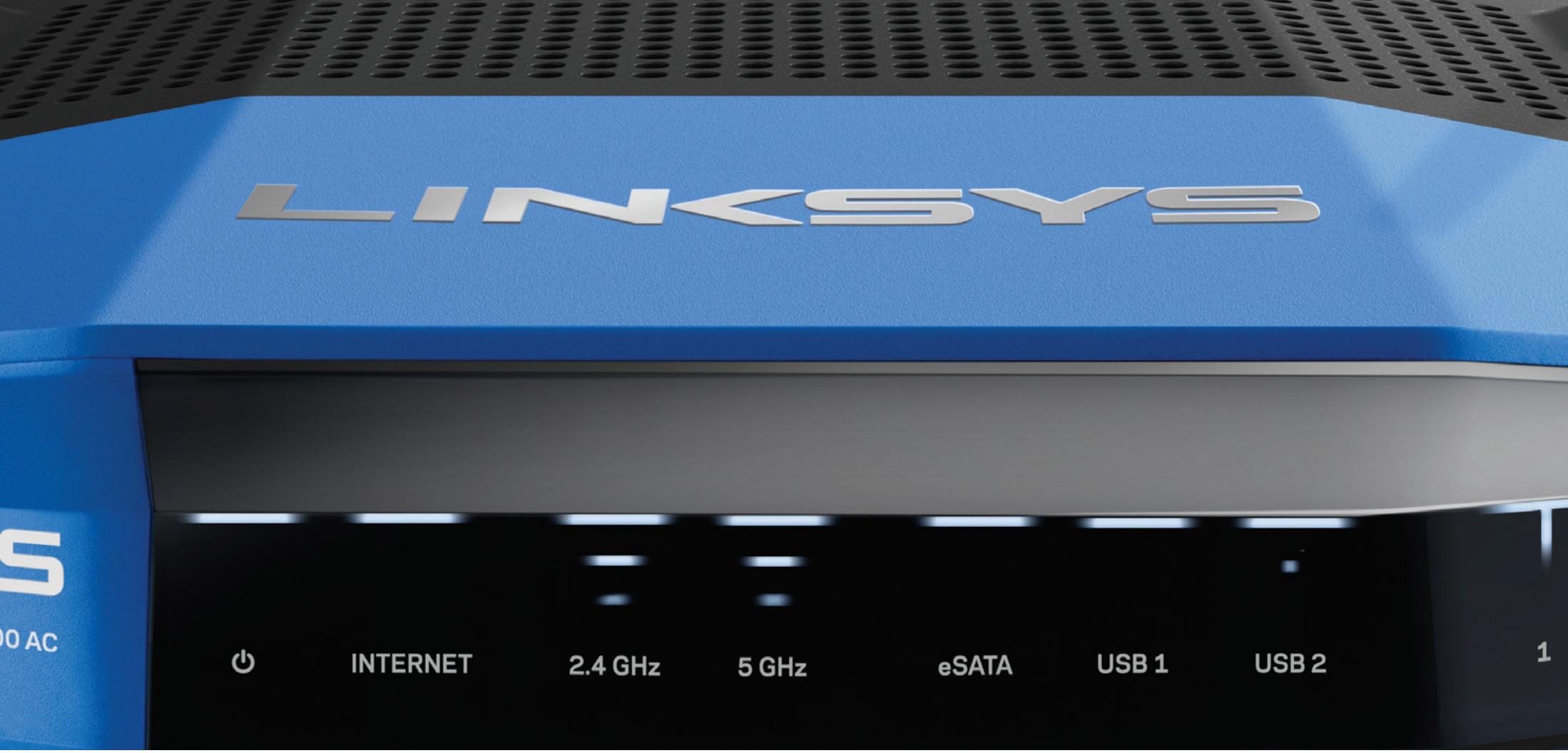
text_image
LINKSYS INTERNET 2.4 GHz 5 GHz eSATA USB 1 USB 2GUIDE DE
L'UTILISATEUR
WRT 1900 AC
ROUTEUR SANS FIL
DOUBLE BANDE GIGABIT
LINKSYS™
DES PERFORMANCES OPTIMISÉES
VUE D'ENSEMBLE DU PRODUIT
1 WRT1900AC
3 Montage mural
CONFIGURATION : FONCTIONS DE BASE
natural_image
Blue LINKSYS WRT 1000 AC wireless router with black ventilation slots and control buttons (no visible text beyond branding)Vue avant
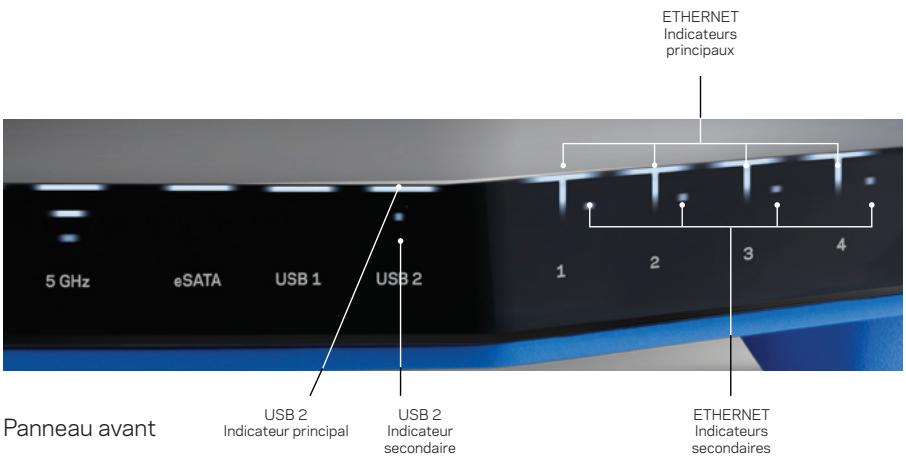
Bouton Wi-Fi Protected Setup
natural_image
Top-down schematic of a vehicle or vehicle chassis with four labeled sensors (no text or symbols present)text_image
6-7 mm 1,5-2 mm 3 mmRemarque :
Linksys Smart Wi-Fi allows you to access all of your router's features and settings. Simply click on a feature or widget you want to open.
You can use Linksys Smart Wi-Fi to:
• See what's currently connected to your network, and connect more computers and devices.
- Access router settings from anywhere using any browser, even when you're away from home. You can personalize your router and change settings for wireless access, Internet, gaming, local network, and more. You can even access router settings for multiple routers, which is helpful if you set up and manage more than one router.
- Allow guests in your home to use the internet without giving them access to your network. While on the guest network, users can surf the net, but won't be able to access your printers, other computers, or devices on your network.
Help Categories
Linksys Smart Wi-Fi
Device List
Guest Access
Parental Controls
Media Prioritization
Speed Test
USB Storage
INSTALLATION DE VOTRE ROUTEUR
If you have not yet created a Linksys Smart Wi-Fi account, click the 'Create Account' button in the upper right corner of the page.
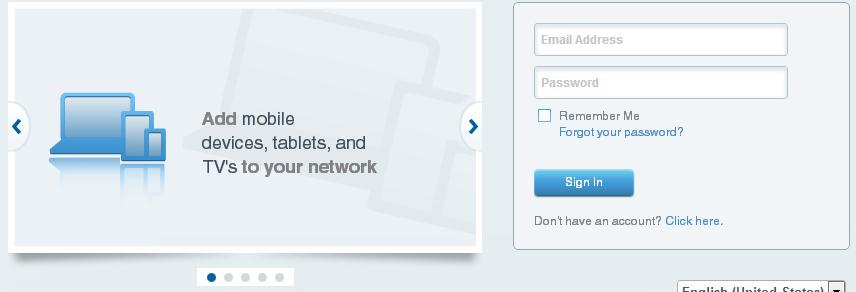
text_image
Add mobile devices, tablets, and TVs to your network Email Address Password Remember Me Forgot your password? Sign In Don't have an account? Click here. English (United States)Use your Linksys Smart Wi-Fi account to access your home network from anywhere, at any time, even from your mobile device. Easily connect new devices, set parental controls, get access to Smart Wi-Fi mobile Apps, and more.
For more information click here
DÉSACTIVATION DE L'ACCÈS DISTANT
text_image
Connectivity View and change router settings Basic Internet Settings Local Network Advanced Routing Administration Local Management Access ✓ HTTP ✓ HTTPS ✓ Access via wireless Remote Access ✓ Allow remote access to Linksys Smart Wi-Fi Tools and Router Settings Note: Disabling this setting prevents you from accessing your network over the Internet UPnP ✓ Enabled ✓ Allow users to configure ✓ Allow users to disable Internet access Application Layer Gateway ✓ SIP OK Cancel ApplyCONNEXION DIRECTE À VOTRE ROUTEUR
text_image
Wireless View and change router settings Wireless MAC Filtering Wi-Fi Protected Setup 2.4 GHz network | Edit 5 GHz network | Edit Network: Enabled Network: Enabled Network name (SSID): Linksys00135 Network name (SSID): Linksys00135_5GHz Password: Irvine131 Password: Irvine131 Network mode: Mixed Network mode: Mixed Security mode: WPA2 Personal Security mode: WPA2 Personal Channel width: Auto Channel width: Auto Channel: Auto Channel: Auto Broadcast SSID: Enabled Broadcast SSID: Enabled Ok Cancel ApplyMODIFICATION DU MOT DE PASSE DE L'ACCÈS LOCAL AU ROUTEUR
text_image
Connectivity View and change router settings Basic Internet Settings Local Network Advanced Routing Administration Network Name and Password | Edit 2.4 GHz network name (SSID): Linksys00135 Network password: irvine131 5 GHz network name (SSID): Linksys00135_5GHz Network password: irvine131 Router Password | Edit Router password: ***** Firmware Update Automatic (Current Version: 1.1.7.160227) Check for Updates Time Zone (GMT-08:00) Pacific Time (USA & Canada) ✓ Automatically adjust for Daylight Savings Time Activity Lights ON Enable/disable activity lights. Power light will remain on. OK Cancel Applycliquez sur OK.
CHANGEMENT DE FUSEAU HORAIRE SUR VOTRE ROUTEUR
text_image
Connectivity View and change router settings Basic Internet Settings Local Network Advanced Routing Administration Network Name and Password | Edit 2.4 GHz network name (SSID): Linksys00135 Network password: irvine131 5 GHz network name (SSID): Linksys00135_5GHz Network password: irvine131 Router Password | Edit Router password: ***** Firmware Update Automatic (Current Version: 1.1.7.160227) Check for Updates Time Zone (GMT-08:00) Pacific Time (USA & Canada) ✓ Automatically adjust for Daylight Savings Time Activity Lights ON Enable/disable activity lights. Power light will remain on. Ok Cancel Applytext_image
Connectivity View and change router settings Basic Internet Settings Local Network Advanced Routing Administration Network Name and Password Edit 2.4 GHz network name (500C) Linkless/135 Network password: Inve 131 5 GHz network name (500C) Linkless/130, 5GHz Network password: Inve 131 Router Password Edit Router password :****** Firmware Update Automatic (Current Version 1.1.7.168227) Check for Updates Time Zone (CMT-10:00) Australia (CMT-09:00) Japan Korea (CMT-13:00) Australia (CMT-01:00) Guam Tunisia (CMT-11:00) Solomon Islands (CMT-12:00) Ky (CMT-12:00) New Zealand (CMT-01:00) Australia (CMT-05:00) Mid-Atlantic (CMT-05:00) Alaska East Greenland (CMT-05:00) Guyana (CMT-05:30) Newfoundland (CMT-04:00) Alaska Time (Canada) Pacific West (CMT-04:00) Siberia Venezuela (CMT-05:30) Eastern Time (USA & Canada) (CMT-05:30) Indiana East Colombia Panamatext_image
Connectivity View and change router settings Basic Internet Settings Local Network Advanced Routing Administration Network Name and Password | Edit 7.4 GHz network name (500C) Linksys20135 Network password: Inve 131 5 GHz network name (500C) Linksys20135, 5GHz Network password: Inve 131 Router Password | Edit Router password :****** Firmware Update Automatic (Current Version 1.1.7.168227) Check For Updates Time Zone CMT-10.00 Australia CMT-09.00 Japan Korea CMT-13.00 Australia CMT-13.00 Guangdong CMT-11.00 Solomon Islands CMT-12.00 Fiji CMT-12.00 New Zealand CMT-01.00 Australia CMT-05.00 Mac-Olearia CMT-05.00 Brazil East Greenland CMT-02.00 Guyana CMT-03.00 Frankfurtand CMT-04.00 Atlanta Time (Canada) (Brazil West CMT-04.00 Sulven Venezuela CMT-05.00 Eastern Time (USA & Canada) CMT-06.00 Indiana East Colombia Panamatext_image
Network Map View connectivity, device details, and Internet usage for devices on your network: Show widget on the homepage My Network ( 9 ) Guest Network ( 0 ) Internet Usage Add a Device WNC100 Upstairs Desktop Kelly's Computer June's Laptop XBOX Routerthedog Crockpot Sonos Jr's Fire Crockpot we motext_image
Network Map View connectivity, device details, and internet usage for devices on your network. Add a USB printer To add a printer that connects to a USB port, connect the printer to your router and then download and install the Linksys VUSB software, designed to connect your USB printer to your network. For Windows PC: 1 Connect your printer to your router. 2 Click here to download the Setup.zip file and save it to your computer. 3 Extract the files from Setup.zip to your computer and run cosetup exe to install it on your computer. 4 Open the Linksys VUSB software to add a shared USB printer to your network. For Mac: 1 Connect your printer to your router. 2 Click here to download the Setup.dmg file and save it to your computer. 3 Open the Setup.dmg on your computer and double-click on the Cosetup file. 4 Follow the instructions in the Linksys VUSB Installer, then Restart the computer.text_image
Network Map View connectivity, device details, and Internet usage for devices on your network. Show widget on the homepage My Network (9) Guest Network (0) Internet Usage Add a Device WNC100 Upstairs Desktop Kelly's Computer June's Laptop XBOX Routerthedog Crockpot we mo Sonos Jr's Fire Crockpot Ok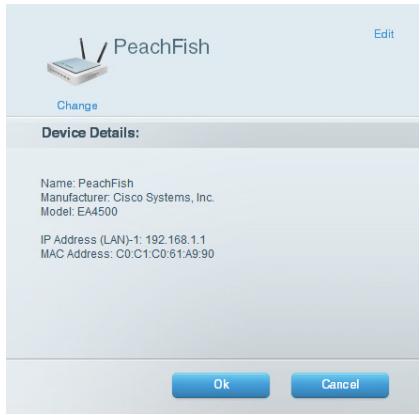
text_image
PeachFish Change Edit Device Details: Name: PeachFish Manufacturer: Cisco Systems, Inc. Model: EA4500 IP Address (LAN)-1: 192.168.1.1 MAC Address: C0:C1:C0:61:A9:90 Ok CancelCliquez sur OK.
CONFIGURATION DU CONTRÔLE PARENTAL
text_image
Parental Controls Show widget on the homepage Limit when your children get online and what websites they can see. Enable parental controls ON Restrict Internet access on CBELAPTOP-PC BTEST2 Block Internet access Never Always Specific Times Edit Block specific sites | www.sitetoblock2.com sitetoblock.com Ok Cancelbar
Block Internet access Manually select the times and days to block internet access | Day | Midnight (AM) | Noon (PM) | |---|---|---| | Sunday | 12 | 12 | | Monday | 1 | 12 | | Tuesday | 1 | 12 | | Wednesday | 1 | 12 | | Thursday | 1 | 12 | | Friday | 1 | 12 | | Saturday | 1 | 12 | | Day | Allowed | Blocked | |---|---|---| | Sunday | 12 | 12 | | Monday | 1 | 12 | | Tuesday | 1 | 12 | | Wednesday | 1 | 12 | | Thursday | 1 | 12 | | Friday | 1 | 12 | | Saturday | 1 | 12 | | Noon (PM) | Allowed | Blocked | | :--- | :--- | :--- | | 12 | 12 | 12 | | Noon (PM) | Allowed | Blocked | | :--- | :--- | :--- | | 8 | 9 | 9 | | 9 | 10 | 9 | | 10 | 11 | 8 | | 11 | 12 | 7 | | 12 | 1 | 7 | | 1 | 2 | 3 | | 2 | 3 | 4 | | 3 | 4 | 5 | | 4 | 5 | 6 | | 5 | 6 | 7 | | 6 | 7 | 8 | | 7 | 8 | 9 | | 8 | 9 | 8 | | 9 | 10 | 7 | | 10 | 11 | 6 | | 11 | 12 | 5 | | 12 | 10 | 4 | Ok Canceltext_image
Guest Access Show widget on the homepage Guest access allows visitors to connect to your wireless guest network and access the Internet, without giving access to your other computers or personal data. Allow guest access ON Guest network names and password | Edit 2.4 GHz SSD: 22Loudeac56-guest Network: Disabled 5 GHz SSD: 22Loudeac56_5GHz-guest Network: Disabled Guest network password: cucumber29 Total guests allowed 5 guests Your guest should first connect to your guest network, open a web browser, and then enter the guest password. Ok Canceltext_image
Guest access Enter the guest access password to access the Internet. Ask the owner if you don't know the password. The guest access password can be found using Cisco Connect. Password: LOGINSAUVEGARDE DE LA CONFIGURATION DE VOTRE ROUTEUR
text_image
Network Map View connectivity, device details, and Internet usage for devices on your network. Show widget on the homepage My Network (9) Guest Network (0) Internet Usage Add a Device WNC100 Upstairs Desktop Kelly's Computer June's Laptop XBOX Routerthedog Crockpot we mo Crockpot Jr's Fire we mo Sonos- Pour changer le nom
text_image
External Storage Connect an external storage device to your network and configure how users can access its contents. Show widget on the homepage Status Folder Access FTP Server Media Server External Storage Drive Select drive: MYKEY sdb1 MYKEY External storage volume name: MYKEY Space used: 561 MB used of 3.73 GB total. Safely remove drive Refresh Secure Folder Access is ON Username and password required to access content via shared folders. PC access (File explorer): \\192.168.20.1 Mac access (Finder): smb://192.168.20.1 FTP Server is ON Username and password required to access content via FTP. FTP server: ftp://172.25.17.17:21 Media Server (DLNA) is ON Media content is accessible to DLNA clients. DLNA server: AC1900M OkRACCORDEMENT D'UN LECTEUR USB
text_image
External Storage Connect an external storage device to your network and configure how users can access its contents. Show widget on the homepage Status Folder Access FTP Server Media Server Folders on your storage device contain content such as photos, videos, and music. If you turn Secure Folder Access Off, all content is accessible to all users on your network. Turning this option On lets you select the content available to specific users. Your folders are also remotely available via FTP. Secure Folder Access OFF The folders on your external storage device are currently accessible to everyone on your network.text_image
External Storage Connect as external storage device to your network and configure how users can access its contents. Status Folder Access FTP Server Media Server Folders on your storage device contain content such as photos, videos, and music. If you turn Secure Folder Access OR, all content is accessible to all users on your network. Turning this option. Do let you select the content analyze to specific users. Your folders are also remotely available via FTP. Secure Folder Access On Folders on your storage device are accessible to the users listed below. When folders are accessible to others, they are called shares. Click Add Share to add others who can access your storage device. Authorized users: Username Password Permissives Show all shares admin ******** Read & Write Select share Add User bailment131 ******** Read Only Edit Shares Delete guest ******** Read Only Edit Shares Delete jenault ******** Read & Write Edit Shares Delete The admin account passwords in the router password. The guest account password is "guest" unless you change it. OK Cancel ApplyConseil :
text_image
Create New Share A Share is a name you give to a folder that's accessible to others. You can name the Share the same as the folder, or give it a completely different name. Edit Share Information Select folder Imp Documents Games Graphics Music Phone Radio School Utilities Work cache Share name Share entire storage devicetext_image
External Storage Connect an external storage device to your network and configure how users can access its contents. Show widget on the homepage Status Folder Access FTP Server Media Server Media Server (UPnP/DLNA) lets you share media content across your network using a media-enabled device, such as a tablet or a network TV. Enable Media Server Server Name: AC1900M ON Last Scan: Friday, 11 April 2014 14:09:23 Scan Folders Every 2 hours Scan now Shared Media Folders Share Name Folder Location All media content n/a n/a All media is shared by default. Add New Folder Ok Cancel Applytext_image
Add a new folder Folders on your storage device contain content such as photos, videos, and music. When you make a folder accessible to others, you give it a Share name. Edit Share Information Select folder tmp Documents Games Graphics Music Phone Radio School Utilities Work cache Share nametext_image
External Storage Connect an external storage device to your network and configure how users can access its contents. Show widget on the homepage Status Folder Access FTP Server Media Server FTP (File Transfer Protocol) lets you access content on your storage device from any computer on the Internet. You can use a web browser or FTP software to access the content. Enable FTP Server Used to access the storage device over the Internet. FTP Server Name: AC1900M Encoding UTF-8 FTP Port Port 21 Ok Cancel Applytext_image
Connectivity View and change router settings Basic Internet Settings Local Network Advanced Routing Administration Network Name and Password | Edit 2.4 GHz network name (SSID): Linksys00135 Network password: irvine131 5 GHz network name (SSID): Linksys00135_5GHz Network password: irvine131 Router Password | Edit Router password: ***** Firmware Update Automatic (Current Version: 1.1.7.160227) Check for Updates Time Zone (GMT+10:00) Australia ✓ Automatically adjust for Daylight Savings Time Activity Lights Enable/disable activity lights. Power light will remain on. OK Cancel Applytext_image
Connectivity View and change router settings Basic Internet Settings Local Network Advanced Routing Administration IPv4 | IPv6 Type of Internet Connection | Edit Connection Type: Automatic Configuration - DHCP Optional Domain name: belkin.com MTU: Auto Size: 0 MAC Address Clone Enabled 00 : 00 : 00 : 00 : 00 : 00 Clone my PC's MAC Ok Cancel Applytext_image
Wireless View and change router settings Wireless MAC Filtering Wi-Fi Protected Setup 2.4 GHz network Edit 5 GHz network Edit Network: Enabled Network: Enabled Network name (SSID): Linksys00135 Network name (SSID): Linksys00135_5GHz Password: invine 131 Password: invine 131 Network mode: Mixed Network mode: Mixed Security mode: WPA2 Personal Security mode: WPA2 Personal Channel width: Auto Channel width: Auto Channel: Auto Channel: Auto Broadcast SSID: Enabled Broadcast SSID: Enabled Ok Cancel Applytext_image
Wireless View and change router settings Wireless MAC Filtering Wi-Fi Protected Setup MAC Filters Enabled Filter options ● Deny access for the listed MAC addresses ○ Allow access for ONLY the listed MAC addresses MAC Filter List MAC Address Action Add MAC Address Ok Cancel Applytext_image
DHCP Reservations Reserved Addresses Device Name Assign IP Address To: MAC Address Manually add device reservation Add reservations by selecting from your DHCP list Device Name Interface IP Address MAC Address Select Jerault-MacBook Wireless 192.168.20.43 70:56:81:98:78:69 MIKSAWYE-WS Wireless 192.168.20.50 00:21:6A:6D:71:E0 Network Device Wireless 192.168.20.11 B4:75:0E:1E:1D:E5 Network Device Offline 192.168.20.58 B6:75:0E:1E:1D:E4 android-db1885199bb76461 Wireless 192.168.20.20 38:AA:3C:D9:A1:9A MIKSAWYE-WS Offline 192.168.20.24 00:27:13:B7:9B:40 Add DHCP Reservation Ok Cancel OK Cancel Applytext_image
Security View and change router settings Firewall DMZ Apps and Gaming DDNS | Single Port Forwarding | Port Range Forwarding | Port Range Triggering Select a provider: Disabled DynDNS.org T2O.com NOMP.com Disabled Ok Cancel Applytext_image
Connectivity View and change router settings Basic Internet Settings Local Network Advanced Routing Administration IPv4 | IPv6 Type of Internet Connection | Edit Connection Type: Automatic Configuration - DHCP Optional Domain name: belkin.com MTU: Auto Size: 0 MAC Address Clone Enabled 00 : 00 : 00 : 00 : 00 : 00 Clone my PC's MAC Ok Cancel ApplyRACCORDEMENT DE VOTRE BUREAU D'ENTREPRISE AU MOYEN D'UN RÉSEAU VIRTUEL PRIVÉ (RVP)
text_image
Media Prioritization Give priority to those devices, applicators, and games that connect to streaming or real-time media services for best performance on your home network. Show widget on the homepage Prioritization: On Reset Prioritization | Settings High Priority Android-01585199 MSKSAWYE-W3 Drag and drop devices to promise Normal Priority Devices MSKSAWYE-W3 Jensault-iPxd Network Device Jensault-MacBook Applications Edit Delete Select Application... Online Games Edit Delete Select Game... OK Canceltext_image
Media Prioritization Give priority to those devices, applications, and games that connect to streaming or real-time media services for best performance on your home network. Show widget on the homepage Prioritization: On Ravel Prioritization | Settings High Priority android-db1685199 = MIKSAWYE-WS = Drag and drop devices to prioritize Normal Priority Devices MKSAWYE-WS = jenaults-iPod = Network Device = jenault-MacBook = Applications Edit Delete Select Application... Online Games Edit Delete Select Game... OK Canceltext_image
Connectivity View and change router settings Basic Internet Settings Local Network Advanced Routing Administration Local Management Access HTTP HTTPS Access via wireless UFP Enabled Allow users to configure Allow users to double internet access Remote Access Allow remote access to Linkages Smart WiFi Tools and Router Settings Note: Disabling this setting prevents you from accessing your network over the Internet Application Layer Gateway SP OK Cancel Applytext_image
Connectivity View and change router settings Basic Internet Settings Local Network Advanced Routing Administration Local Management Access Remote Access ✓ HTTP HTTPS ✓ Allow remote access to Linksys Smart Wi-Fi Tools and Router Settings ✓ Access via wireless Note: Disabling this setting prevents you from accessing your network over the Internet UPnP ✓ Enabled Application Layer Gateway ✓ Allow users to configure ✓ SIP ✓ Allow users to disable Internet access OK Cancel Applytext_image
Security View and change router settings Firewall DMZ Apps and Gaming DMZ ON Source IP Address: Any IP Address Specified Range to Destination IP Address: IP Address: 192.168. MAC Address: 00 : 00 : 00 : 00 : 00 : 00 View DHCP Client Table Ok Cancel Applytext_image
DHCP Client Table Select A Device Client Name Interface IP Address MAC Address MIKSAWYE-WS Wireless 192.168.20.50 00:21:6A:6D:71:E0 Select Network Device Wireless 192.168.20.11 B4:75:0E:1E:1D:E5 Select Refresh Close 00 : 00 : 00 : 00 : 00 : 00 View DHCP Client Table OK Cancel Applytext_image
Security View and change router settings Firewall DMZ Apps and Gaming DDNS | Single Port Forwarding | Port Range Forwarding | Port Range Triggering Application name Start ~ End Port Protocol Device IP# Enabled Add a new Port Range Forwarding Ok Cancel Applytext_image
Security View and change router settings Firewall DMZ Apps and Gaming DDNS | Single Port Forwarding | Port Range Forwarding | Port Range Triggering Device or Application Triggered Range Forwarded Range Enabled Add a new Port Range Triggering Ok Cancel Applytext_image
Troubleshooting Troubleshoot router settings Status Diagnostics Logs Ping IPv4 IP or host name: Number to ping: 5 Start to Ping Trace route IP or host name: Start to Traceroute Reboot Reboot the router OkFactory reset router
When you reset your router, it reboots, disconnects from the Internet and clears all current settings. All devices connected to the router will also be disconnected. When the reset completes, the router will need to be set up again and then all devices will have to reconnect using the new settings.
Do you want to continue?
Yes
No
VÉRIFICATION DE L'ÉTAT DE VOTRE ROUTEUR
text_image
Troubleshooting Troubleshoot router settings Status Diagnostics Logs Devices | Report Name MAC address IPv4 address Connection MIKSAWYE-WS 00:21:6A:6D:71:E0 192.168.20.50 Wireless Network Device B4:75:0E:1E:1D:E5 192.168.20.11 Wireless Name MAC address IPv6 address Connection MIKSAWYE-WS 00:21:6A:6D:71:E0 1e80:0000:0000:0000:78e7:9db6.c539.3886 Wireless Refresh Open in browser Print DHCP client table Oktext_image
Troubleshooting Troubleshoot router settings Status Diagnostics Logs Ping IPv4 IP or host name: Number to ping: 5 Start to Ping Router configuration Backup Restore Internet Address: IPv4: 67.5 Release and Renew Trace route IP or host name: Start to Traceroute Reboot Reboot the router Factory reset Reset to factory default settingstext_image
Troubleshooting Troubleshoot router settings Status Diagnostics Logs Ping IPv4 IP or host name: Number to ping: 5 Start to Ping Trace route IP or host name: Start to Traceroute Reboot Reboot the router Oktext_image
Choose a wireless network Click an item in the list below to connect to a wireless network in range or to get more information. JimsRouter Connected Security-enabled wireless network (WPA2) myhome Security-enabled wireless network BronzeEagle Security-enabled wireless network (WPA2) To connect to this network, click Connect. You might need to enter additional information. Mason Security-enabled wireless network Connect:Rebooting the router disconnects it from the Internet, causing all connected devices to lose Internet connectivity. When the reboot completes, the router and all devices will be reconnected.
Do you want to continue?
Yes
No