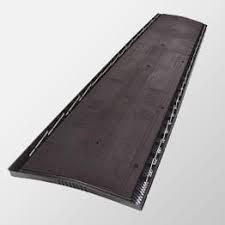
TRUSLATE RIDGE VENT ATTIC EXHAUST VENTILATION - Roof ventilation GAF - Free user manual and instructions
Find the device manual for free TRUSLATE RIDGE VENT ATTIC EXHAUST VENTILATION GAF in PDF.


| Product Type | Ridge Vent for Attic Ventilation |
| Brand | GAF |
| Model | TruSlate Ridge Vent Attic Exhaust Ventilation |
| Use | Attic exhaust ventilation, to be installed on the roof ridge |
| Compatible Roof Pitches | 4/12 to 16/12 |
| Recommended Slot Opening (without ridge board) | 22 mm (7/8 in) on each side of the ridge |
| Recommended Slot Opening (with ridge board) | 41 mm (1-5/8 in) on each side of the ridge |
| Maximum Slot Opening Width | 83 mm (3 1/4 in) |
| Finish Slate Overlap Length | 152 mm (6 in) |
| EasyTear Break Points Spacing | 76 mm (3 in) |
| Fastening | Roofing nails at least 44 mm (1 3/4 in) long, 76 mm (3 in) ring-shank nails recommended |
| Material | Weather-resistant composite plastic |
| Weather Resistance | Installation with leak barrier and silicone sealant recommended |
| Included Accessories | Male/female connectors, pre-molded end cap |
| Maintenance | Periodically check for obstructions (debris, snow) and clean if necessary |
| Safety and Restrictions | Do not install on hips; use only on pitches 4/12 to 16/12; comply with local codes |
| Replacement Parts | Contact GAF for replacement parts |
| General Information | Designed for balanced ventilation with soffit intakes; do not use with other exhaust vents |
Frequently Asked Questions - TRUSLATE RIDGE VENT ATTIC EXHAUST VENTILATION GAF
User questions about TRUSLATE RIDGE VENT ATTIC EXHAUST VENTILATION GAF
0 question about this device. Answer the ones you know or ask your own.
Ask a new question about this device
Download the instructions for your Roof ventilation in PDF format for free! Find your manual TRUSLATE RIDGE VENT ATTIC EXHAUST VENTILATION - GAF and take your electronic device back in hand. On this page are published all the documents necessary for the use of your device. TRUSLATE RIDGE VENT ATTIC EXHAUST VENTILATION by GAF.
USER MANUAL TRUSLATE RIDGE VENT ATTIC EXHAUST VENTILATION GAF
TruSlate™ Ridge Vent Attic Exhaust Ventilation
Application Instructions
Updated: 9/10
TruSlate Ridge Vent
GAF ELK
"Quality You Can Trust Since 1886...From North America's Largest Roofing Manufacturer"
Roof Deck: Use only over a well-seasoned, supported wood deck, tightly constructed with maximum 6" (152mm) wide lumber, having adequate nail-holding capacity. OSB or Plywood decking as recommended by The Engineered Wood Association is acceptable.
For ridge vent to function properly, it must be the only exhaust vent for the vented attic space. Do not use with gable-end louvers, turbines, roof vents, or power vents.
Slope Restrictions:
Use only on slopes between 4/12 and 16/12
Do NOT install on hips.
NOTE: Install TruSlate™ Ridge Vent BEFORE installing the field slates. This will ensure that a full course of TruSlate™ slates can be installed adjacent to the ridge vent.
STEP1
Calculations for a Balanced Ventilation System
To achieve a "balanced system" with ridge vents, there must be an air intake system (i.e., soffits or underevea vents). For proper ventilation, the amount of underevea ventilation must equal the amount of ventilation at the ridge.
NOTE: In no case should the amount of exhaust ventilation exceed the amount of intake ventilation.
To determine the minimum square feet of net free ventilating area (NFVA) needed for a balanced ventilation system, use the following formula:
$$ \frac {\text {S q . f t . o f a t t i c f l o o r s p a c e}}{3 0 0} = \frac {\text {M i n . S q . f t . o f}}{\text {N F V A n e e d}} $$
TruSlate™ Ridge Vent has 18 square inches of NFVA per lineal foot. To determine how many feet of TruSlate™ Ridge Vent is needed, use the following formula:
1/2 x (Min. sq. ft. of NFVA needed) x 144/18 = Min. lineal feet of ridge vent needed
To determine the amount of underave vent required, use the following formula:
X = NFVA (sq. in. per lin. ft.) of the undereave vent or intake vent system selected 1/2 × (min. sq. ft. of NFVA needed) x 144 / X = Min . lineal feet of undereave vent needed
NOTE: Consult local building codes for other ventilation requirements.
STEP 2
Instruction For Slots
- After calculating the total length of TruSlate™ Ridge Vent needed, determine the necessary slot opening required.
Roofs without a ridge board: Cut a 7/8 (22mm) opening along the ridge on each side (Figure A). Roofs with a ridge board: cut a 15/8 (41mm) opening along the ridge on each side (Figure B).
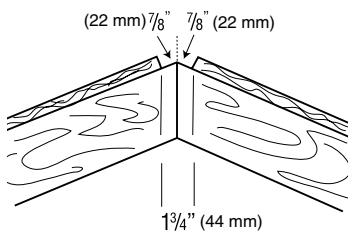
Fig. A
No Ridge Board
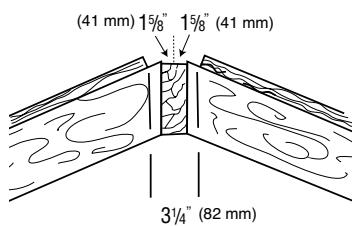
Fig. B
With Ridge Board
NOTE: The total maximum slot opening is 314 (83mm) wide.
- Mark off and cut the slot opening, making sure that the ends of the opening stop at least 6" from any end walls and at least 12" (30mm) from hip and ridge intersections or chimneys. (Figure C)
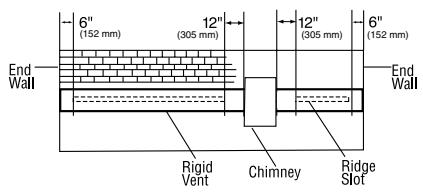
Fig. C
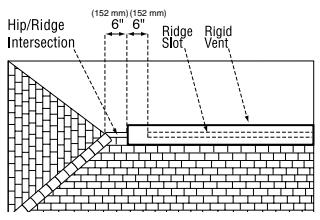
Where short ridges (dormers, ridge intersections) are used, mark and cut the slot and make sure that the end of the opening stops at least 12" (305mm) from the ridge intersection (Figure D).
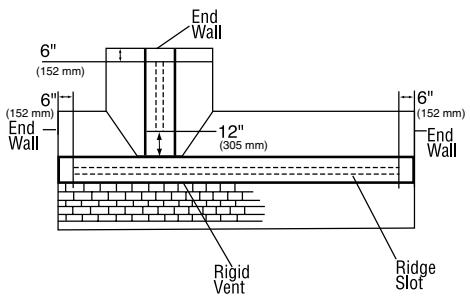
Fig. D
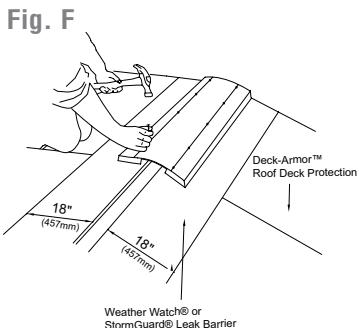
- Install an 18^ (459mm) wide piece of peel and stick leak barrier, such as GAF-Elk Weather Watch® or StormGuard® Leak Barrier, from the edge of the ridge slot extending down towards the roof deck.
STEP 3
Ridge Vent Installation
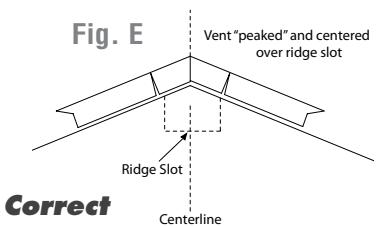
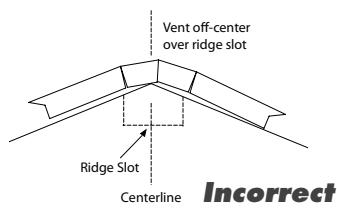
- Place the TruSlate™ Ridge Vent over the ridge slot. The ridge vent must always be "peaked" and centered over the ridge slot. The top panel on each side of the ridge vent must be parallel to the roof deck below to avoid sizing problems when installing trim slates (Figure E).
-
Attach the vent section using minimum 13/4 (44mm) roofing nails through pre-molded nail holes on the vent (Figure F).
-
Fasteners must always penetrate through plywood decks or at least 3/4 (19mm) into wood planks. 3 (76mm) ring shank nails are recommended for increased uplift resistance.
-
Apply the subsequent ridge vent sections over the length of the ridge utilizing male/female connectors on each vent. Cover all of the exposed nail heads on the vent with silicone caulk.
NOTE: If desired, for further resistance against weather infiltration, cover the joint between vent sections with a 4^ (102mm) wide piece of leak barrier. For installations in cold weather, leave 1/8" (3mm) gap between each vent section to allow for expansion.
- Install the final section of TruSlate™ Ridge Vent at the end of the ridge. Be sure the finished end having the pre-molded end cap is installed to the outside edge to prevent any possible weather infiltration.
Please Note The Following...For a uniform appearance, install TruSlate™ Ridge Vent over the entire length of the ridge, making sure that the vent extends past the slot opening by at least 6".
When venting vaulted and cathedral ceilings, each joist/rafter cavity must be ventilated on both ends and have at least 2^ (51mm) clearance.
Do NOT install on hips.
Using The EasyTear™ System
At the end of the ridge, it may be possible to use the EasyTear™ sizing system to create a custom length part to fit.
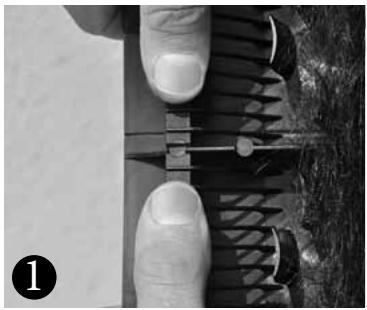
- With the underside of the vent facing towards you, locate the EasyTear™ break points nearest to where you would like to size the vent. The break points are located at 3” intervals on the support rails. Proceed with snapping the support rail at the EasyTear™ break points on both sides of the underside of the vent.
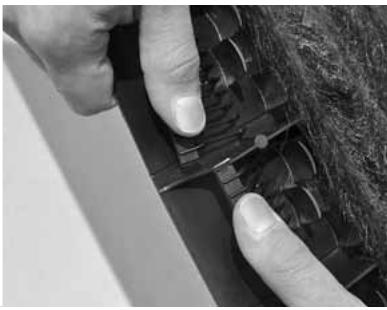
- With both support rails snapped, grasp the top of the vent and fold the top portion of the vent away from you. The vent should now crack at the tear line.
- Next, tear the vent along the tear line for your custom size part. If necessary, use a utility knife to cut away any of the excess snow filter.
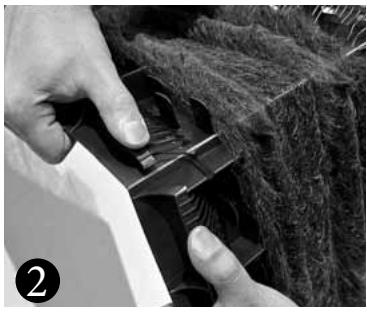
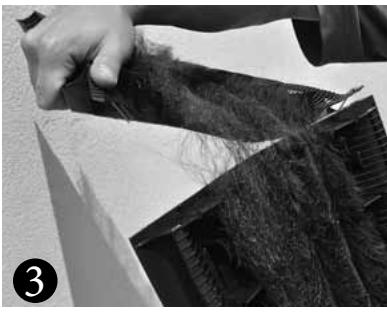
- Finally, install the newly cut overlap edge over the end of the previous vent section and nail in place.
If final vent section cannot be completed using the EasyTear™ system, cut the vent section to desired length. Butt the cut end to the last section installed and caulk the joint. Be sure the finished end is installed to the outside to prevent weather infiltration.
Install Top Course of Field Slates
- With the ridge vent installed, proceed with installing the top course of slates adjacent to the TruSlate™ Ridge Vent.
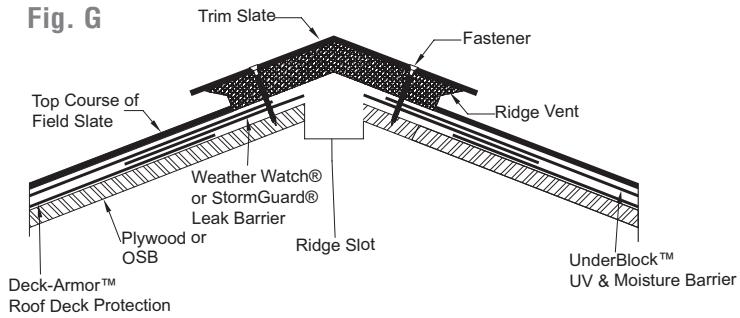
- For GAF-Elk TruSlate™ systems, the UnderBlock™ UV and Moisture Barrier should always extend at least 3/4 (25mm) above the top course of slate.
This portion of the UnderBlock™ UV and Moisture Barrier should be tucked securely under the TruSlate™ Ridge Vent to ensure weathertight protection at the junction of the slates and ridge vent.
- With the UnderBlock™ UV and Moisture Barrier in place, butt the top course of slates firmly up against the ridge vent. There should be no space between the top of the slates and the ridge vent (Figure G).
NOTE: In order to install a full course of slates adjacent to the ridge vent with the TruSlate™ system, it may be necessary to adjust lower courses of hangers and battens up to 1/4 ” (6mm) up or down.
STEP 5
Trim Slate Installation
-
Fasten trim slates directly to the vent, using minimum 2 1/2 (64mm) stainless steel nails, copper slater's nails or coated decking screws. Do not over-fasten the trim slates. Fasten securely, while allowing the trim slates "wiggle" room.
-
Fasteners must be of sufficient length to penetrate through plywood decks or at least 3/4 (19mm) into wood planks. 3" (76mm) ring shank nails are recommended for increased uplift resistance.
NOTE: GAF-Elk TruSlate™ trim slates come with pre-punched holes for easy installation.
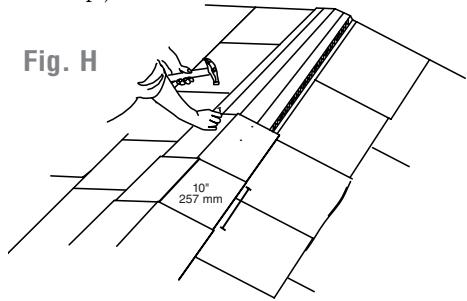
- When joining the top butt edge of trim slates from alternate sides of the ridge, always make sure the top butt edge of both trim slates is centered along the ridge. Join these trim slates so that one trim slate slightly overlaps the other trim slate. This will help to provide a clean and uniform junction.
- Install TruSlate™ trim slates on top of the ridge vent so they overhang the top course of field slates by at least 3/4 (25mm). This will help to lock in the top course of field slates into place.
- When working down the ridge, succeeding TruSlate™ trim slates should cover the previous trim slate by 6" (152mm), resulting in a finished exposure for each trim slate of 10" (254mm) (Figure H).
NOTE: If desired, a weatherproof caulk of a color matching the slate may be applied to the top joint of the trim slates.
NOTE: For further details on slate or synthetic slate products and/or installations, consult your specific slate or synthetic slate's manufacturer.