USER MANUAL CMG 200 S CANDY
Read these instructions carefully before using your microwave oven, and keep it carefully.
If you follow the instructions, your oven will provide you with many years of good service.
SAVE THESE INSTRUCTIONS CAREFULLY
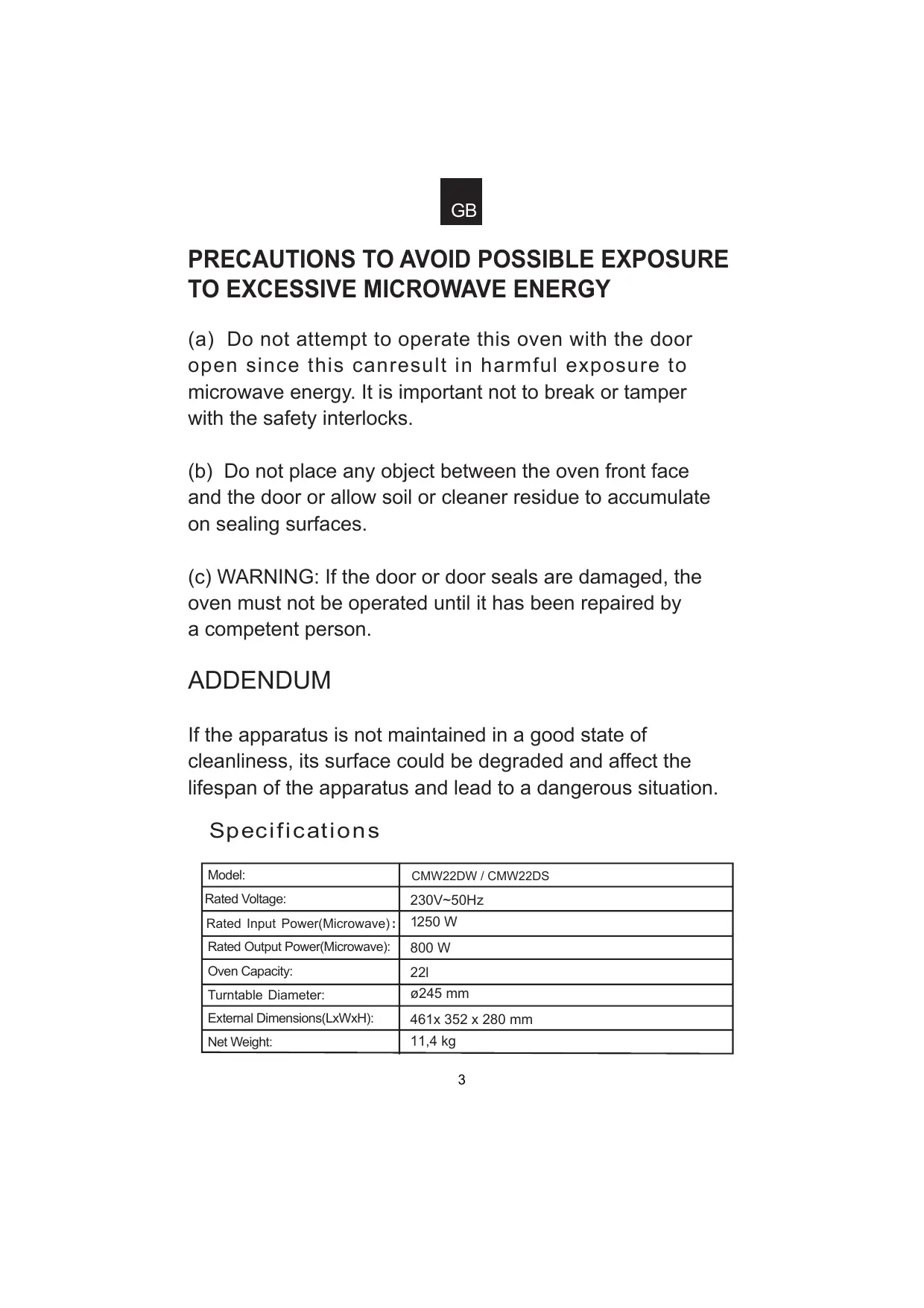
PRECAUTIONS TO AVOID POSSIBLE EXPOSURE TO EXCESSIVE MICROWAVE ENERGY
(a) Do not attempt to operate this oven with the door open since this can result in harmful exposure to microwave energy. It is important not to break or tamper with the safety interlocks.
(b) Do not place any object between the oven front face and the door or allow soil or cleaner residue to accumulate on sealing surfaces.
(c) WARNING: If the door or door seals are damaged, the oven must not be operated until it has been repaired by a competent person.
ADDENDUM
If the apparatus is not maintained in a good state of cleanliness, its surface could be degraded and affect the lifespan of the apparatus and lead to a dangerous situation.
Specifications
| Model: | CMW22DW / CMW22DS |
| Rated Voltage: | 230V~50Hz |
| Rated Input Power(Microwave): | 1250 W |
| Rated Output Power(Microwave): | 800 W |
| Oven Capacity: | 22l |
| Turntable Diameter: | ø245 mm |
| External Dimensions(LxWxH): | 461x 352 x 280 mm |
| Net Weight: | 11,4 kg |
IMPORTANT SAFETY INSTRUCTIONS WARNING
To reduce the risk of fire, electric shock, injury to personor exposure to excessive microwave oven energy when using your appliance, follow basic precautions, including he following:
- Warning: Liquids and other foods must not be heated in sealed containers since they are liable to explode.
- Warning: It is hazardous for anyone other than a competent person to carry out any service or repair operation that involves the removal of a cover which gives protection against exposure to microwave energy.
- This appliance can be used by children aged from 8 years and above and persons with reduced physical, sensory or mental capabilities or lack of experience and knowledge if they have been givensupervision or instruction concerning useof the appliance in a safe way andunderstand the hazards involved.Children shall not play with the appliance.Cleaning and user maintenance shallnot be made by children unless they are older than 8 and supervised.
- Keep the appliance and its cord out of reach of children less than 8 years.
- Only use utensils suitable for use in microwave ovens.
- The oven should be cleaned regularly and any food deposits should be removed.
- Read and follow the specific:"PRECAU-TIONS TO AVOID POSSIBLE EXPOSURE TO EXCESSIVE MICROWAVE ENERGY".
-
When heating food in plastic or paper containers, keep an eye on the oven due to the possibility of ignition.
-
If smoke is emitted, switch off or unplug the appliance and keep the door closed in order to stifle any flames.
- Do not overcook food.
- Do not use the oven cavity for storage purposes.
Do not store items, such as bread, cookies, etc. inside the oven.
- Remove wire twist-ties and metal handles from paper or plastic containers/bags before placing them in the oven.
- Install or locate this oven only in accordance with the installation instructions provided.
- Eggs in the shell and whole hard-boiled eggs should not be heated in microwave ovens since they may explode, even after microwave heating has ended.
-
This appliance is intended to be used in household and similar applications such as:
-
staff kitchen areas in shops, offices and other working environments;
-by clients in hotels, motels and other residential type environments;
-farm houses;
-bed and breakfast type environments.
- If the supply cord is damaged, it must be replaced by the manufacturer, its service agent or similarly qualified persons in order to avoid a hazard.
- Do not store or use this appliance outdoors.
- Do not use this oven near water, in a wet basement or near a swimming pool.
-
The temperature of accessible surfaces may be high when the appliance is operating. The surfaces are liable to get hot during use. Keep cord away from heated surface, and do not cover any vents on the oven.
-
Do not let cord hang over edge of table or counter.
- Failure to maintain the oven in a clean condition could lead to deterioration of the surface that could adversely affect the life of the appliance and possibly result in a hazardous situation.
- The contents of feeding bottles and baby food jars shall be stirred or shaken and the temperature checked before consumption, in order to avoid burns.
- Microwave heating of beverages can result in delayed eruptive boiling, therefore care must be taken when handling the container.
- The appliance is not intended for use by persons (including children) with reduced physical, sensory or mental capabilities, or lack of experience and knowledge, unless they have been given supervision or instruction concerning use of the appliance by a person responsible for their safety.
- Children should be supervised to ensure that they do not play with the appliance.
- The appliances are not intended to be operated by means of an external timer or separate remote-control system.
- Accessible parts may become hot during use. Young children should be kept away.
- Steam cleaner is not to be used.
- During use the appliance becomes hot. Care should be taken to avoid touching heating elements inside the oven.
-
Only use the temperature probe recommended for this oven.(for ovens provided with a facility to use a temperature-sensing probe.)
-
WARNING: The appliance and its accessible parts become hot during use. Care should be taken to avoid touching heating elements. Children less than 8 years of age shall be kept away unless continuously supervised.
-
The microwave oven must be operated with the decorative door open.(for ovens with a decorative door.)
- The rear surface of appliance shall be placed against a wall.
- The microwave oven shall not be placed in a cabinet unless it has been tested in a cabinet.
READ CAREFULLY AND KEEP FOR FUTURE REFERENCE
To Reduce the Risk of Injury to Persons Grounding Installation
DANGER
Electric Shock Hazard Touching some of the internal componentscan cause serious personal injury or death.Do not disassemble this appliance.
WARNING
Electric Shock HazardImproper use of the grounding can result inelectric shock. Do not plug into an outlet untilappliance is properly installed and grounded.
This appliance must be grounded. In the event of an electrical short circuit, grounding reduces the risk of electricshock by providing an escape wire forthe electric current. This appliance isequipped with a cord having a groundingwire with a grounding plug. The plug mustbe plugged into an outlet that is properly installed and grounded.
Consult a qualified electrician orserviceman if the grounding instruction are not completely understood or if doubtexists as to whether the appliance isproperly grounded. If it is necessary tosean extension cord , use only a 3-wire
- A short power-supply cord is provided to reduce the risks resulting from becoming entangled in or tripping over a longer cord.2. If a long cord set or extension cord is used:
1) The marked electrical rating of the cordset or extension cord should be at least as great as the electrical rating of the appliance.
2)The extension cord must be a grounding-type 3-wire cord.
3)The long cord should be arranged so that it will not drape over the counter top or tabletop where it can be pulled on bychildren or tripped over unintentionally.
CLEANING
Be sure to unplug the appliance from the power supply.
- Clean the cavity of the oven after using with a slightly damp cloth.
- Clean the accessories in the usual way in soapy water.
- The door frame and seal and neighbouring parts must be cleaned carefully with a damp cloth when they are dirty.
- Do not use harsh abrasive cleaners or sharp metal scrapers to clean the oven door glass since they can scratch the surface, which may result in shattering of the glass.
- Cleaning Tip---For easier cleaning of the cavity walls that the food cooked can touch: Place half a lemon in a bowl, add 300ml (1/2 pint) water and heat on 100% microwave power for 10 minutes. Wipe the oven clean using a soft, dry cloth.
UTENSILS
CAUTION Personal Injury Hazard
It is hazardous for anyone other than a competent person to carry out any service or repairo peration that involves the removal of a cover which gives protection against exposure to microwave energy.
See the instructions on "Materials you can use in microwave oven or to be avoided in microwave oven." There may be certain non-metallic utensils that are not safe to use for microwaving. If in doubt, you can test the utensil in question following the procedure below.
Utensil Test:
- Fill a microwave-safe container with 1 cup of cold water (250ml) along with the utensil in question.
- Cook on maximum power for 1 minute.
- Carefully feel the utensil. If the empty utensil is warm, do not use it for microwave cooking.
- Do not exceed 1 minute cooking time.
Materials you can use in microwave oven
Utensils
Remarks
| Aluminum foil | Shielding only. Small smooth pieces can be used to cover thin parts of meat or poultry to prevent overcooking. Arcing can occur if foil is too close to oven walls. The foil should be at least 1 inch (2.5cm) away from oven walls. |
| Browning dish | Follow manufacturer's instructions. The bottom of browning dish must be at least 3/16 inch (5mm) above the turntable. Incorrect usage may cause the turntable to break. |
| Dinnerware | Microwave-safe only. Follow manufacturer's instructions. Do not use cracked or chipped dishes. |
| Glass jars | Always remove lid. Use only to heat food until just warm. Most glass jars are not heat resistant and may break. |
| Glassware | Heat-resistant oven glassware only. Make sure there is no metallic trim. Do not use cracked or chipped dishes. |
| Oven cooking bags | Follow manufacturer's instructions. Do not close with metal tie. Make slits to allow steam to escape. |
| Paper plates and cups | Use for short-term cooking/warming only. Do not leave oven unattended while cooking. |
| Paper towels | Use to cover food for reheating and absorbing fat. Use with supervision for a short-term cooking only. |
| Parchment paper | Use as a cover to prevent splattering or a wrap for steaming. |
| Plastic | Microwave-safe only. Follow the manufacturer's instructions. Should be labeled "Microwave Safe". Some plastic containers soften, as the food inside gets hot. "Boiling bags" and tightly closed plastic bags should be slit, pierced or vented as directed by package. |
| Plastic wrap | Microwave-safe only. Use to cover food during cooking to retain moisture. Do not allow plastic wrap to touch food. |
| Thermometers | Microwave-safe only (meat and candy thermometers). |
| Wax paper | Use as a cover to prevent splattering and retain moisture. |
Materials to be avoided in microwave oven
Utensils
Remarks
| Aluminum tray | May cause arcing. Transfer food into microwave-safe dish. |
| Food carton with metal handle | May cause arcing. Transfer food into microwave-safe dish. |
| Metal or metal-trimmed utensils | Metal shields the food from microwave energy. Metal trim may cause arcing. |
| Metal twist ties | May cause arcing and could cause a fire in the oven. |
| Paper bags | May cause a fire in the oven. |
| Plastic foam | Plastic foam may melt or contaminate the liquid inside when exposed to high temperature. |
| Wood | Wood will dry out when used in the microwave oven and may split or crack. |
SETTING UP YOUR OVEN
Names of Oven Parts and Accessories
Remove the oven and all materials from the carton and oven cavity. Your oven comes with the following accessories:
Glass tray 1
Turntable ring assembly 1
Instruction Manual 1
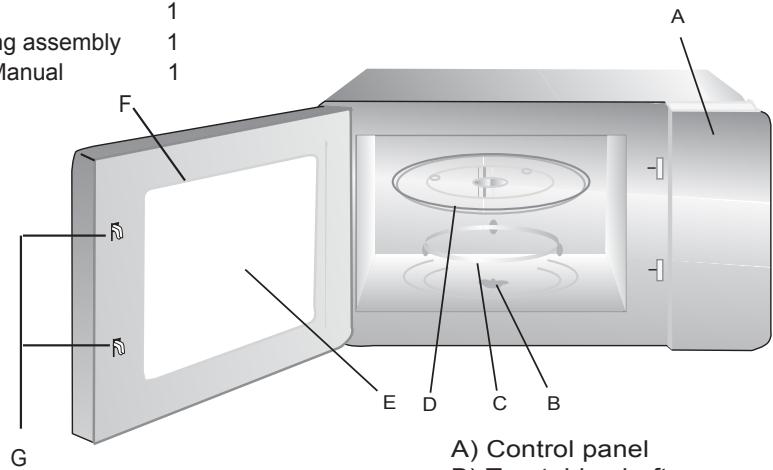
A) Control panel
B) Turntable shaft
C) Turntable ring assembly
D) Glass tray
E) Observation window
F) Door assembly
G) Safety interlock system
Shut off oven power if the door is opened during operation.
Turntable Installation
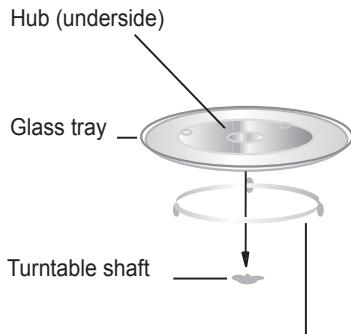
Turntable ring assembly
a. Never place the glass tray upside down. The glass tray should never be restricted.
b. Both glass tray and turntable ring assembly must always be used during cooking.
c. All food and containers of food are always placed on the glass tray for cooking.
d. If glass tray or turntable ring assembly cracks or breaks, contact your nearest authorized service center.
Countertop Installation
Remove all packing material and accessories. Examine the oven for any damage such as dents or broken door. Do not install if oven is damaged.
Cabinet: Remove any protective film found on the microwave oven cabinet surface.
Do not remove the light brown Mica cover that is attached to the oven cavity to protect the magnetron.
Installation
- Select a level surface that provideenough open space for the intake and/or outlet vents.
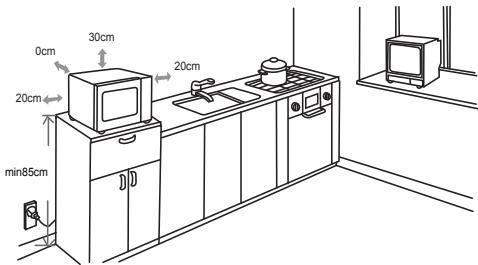
(1) The minimum installation height is 85cm.
(2) The rear surface of appliance shall be placed against a wall.
Leave a minimum clearance of 30cm above the oven, a minimum clearance of 20cm is required between the oven and any adjacent walls.
(3) Do not remove the legs from the bottom of the oven.
(4) Blocking the intake and/or outlet openings can damage the oven.
(5) Place the oven as far away from radios and TV as possible. Operation of microwave oven may cause interference to your radio or TV reception.
2. Plug your oven into a standard household outlet. Be sure the voltage and the frequency is the same as the voltage and the frequency on the rating label.
WARNING: Do not install oven over arange cooktop or other heat-producing appliance. If installed near or over a heatsource, the oven could be damaged and the warranty would be void.
The accessible surfacemay be hot duringoper
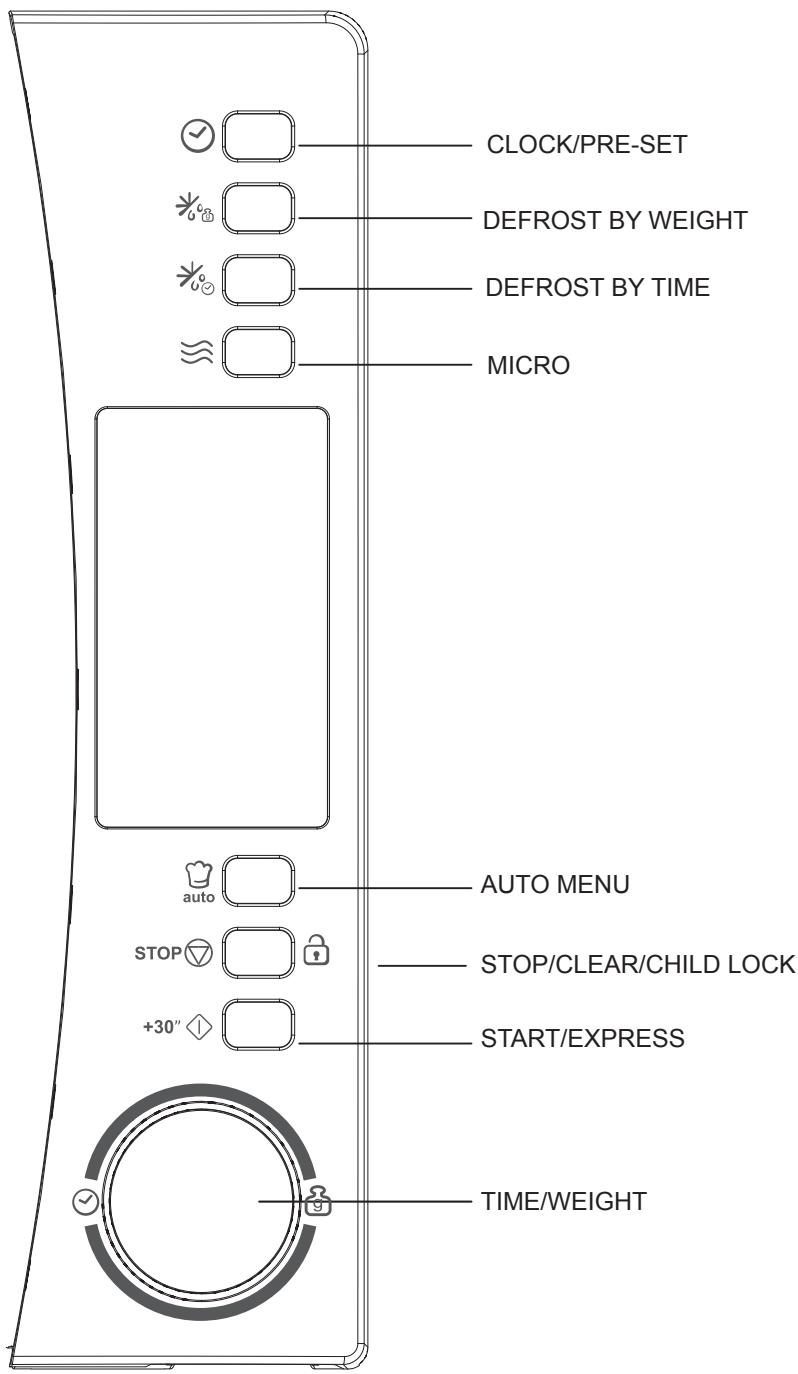
This microwave oven uses modern electronic control to adjust cooking parameters to meet your needs better for cooking.
1.Clock Setting
When the microwave oven is electrified, the oven will display "0:00", buzzer will ring once.
1) Press " ", the hour figures will flah.
88:88
2) Turn " to adjust the hour figures, the input time should be within 0--23.
8888
3) Press " ", the minute figures will flash.
88:88
4) Turn "0--59." to adjust the minute figures, the input time should be within 0--59.
88:88
5) Press " " to finish clock setting. :will flash.
88:88
Note: 1) If the clock is not set, it would not function when powered.
2) During the process of clock setting, if you press " STOP " or no operation in one minute, the oven will exit the setting.
2. Microwave Cooking
Press " ≈" several times to select the function you want. Turn " √" to adjust the cooking time. Press "+"30" ⋅" to start cooking.
Example: If you want to use 80% power to cook for 20 minutes, you can operate the oven as the following steps.
1) Press " ≈ " once, the LED will display "P100", "and" indicator will be lighted.
8888
2) Press " ≈" once again to choose 80% power, the LED will display "P80".
8888
3) Turn " " to adjust the cooking time until the oven display"20:00"(The maximum cooking time is 95 minutes.)
28:88
4) Press " + 30" to start cooking, ".: will light and the indicator will flash (Buzzer will sound five times after finishing).
NOTE: the step quantities for the adjustment time of the coding switch are as follow:
Microwave Power Chart
| Press | Once | Twice | Thrice | 4 times | 5 times |
| Microwave Power | 100% | 80% | 50% | 30% | 10% |
3. Speedy Cooking
When the oven is in the waiting states, Press " +30" " key to start cooking food with full microwave power for 30 seconds. The cooking time will add 30 seconds by every press on " +30" " key, and the maximum setting time is 95 minutes.
Note: Be invalidation under other program during cooking.
4. Defrost by Weight
1) Press " pad once, the LED will display "dEF1".
8888:
2) Turn " Ⓞ" to select the weight of food. At the same time, "g" will light. The weight should be 100-2000g.
8888:
3) Press " + 30" 1 " key to start defrosting
" " and " " indicators will flash and "g" indicator will go out.
5. Defrost By Time
1) Press " 12_0^0u_ " key once, the LED will display "dEF2".
8888
2) Turn " " to select the cooking time. At the same time, " " and " " will be lighted. The time setting is from 00:05 to 95:00.
88:08
3) The default microwave power is P30. It cannot be adjustable.
4) Press " + 30" 1 " key to start defrosting. " 2 " and " 3 " indicators will flash.
1). In waiting states, press "auto" to choose the menu you need. "A-1", "A-2".... "A-8" will display in order.
8888:
2). Turn " to select the weight or portion of the menu.
3) Press " + 30" [1] " to start cooking.
When cooking finish, buzzer will sound five times. If the clock has been set before, the current time will be displayed, otherwise, 0:00 will be displayed.
For Example: to cook the pasta of 150g.
1) Press "auto" for three times, "A-3" displays and pasta menu is selected.
" " and " AUTO indicator will light.
2). Turn " _h " to select the weight of the menu. Stop turning when "150" displays.
3) Press " + 30" 1 " to start cooking.
When cooking finish, buzzer will sound five times. Then turn back to waiting states.
7. Multi-Stage Cooking
Two stages of cooking can be maximumly set. If one stages is defrosting, it should be put in the first stage. The buzzer will ring once after each stage and the next stage will begin.
Note: Auto menu cannot be set as one of the multi-stage.
Example: if you want to defrost the food of 500g + 80% microwave power for 5 minutes.
The steps are as following:
1) Press " 光 _ 6 ^ 包 ", "dEF1" displays;
8888
2) Turn " " to adjust the weight of the food. Stop turning when "500" displays;
3) Press" ≈ "twice to choose 80% microwave power;
4) Turn " " to adjust the cooking time of 5 minutes;
88:88:
88:88:
5) Press " + 30" 1 " to start cooking.
Note: When the first stage finish, buzzer sounds once then the second stage begins.
When all of them finish, buzzer sounds five times and the unit turn back to the waiting states.
8. Pre-set Function
1) Set the clock first. (Consult the instruction of clock setting.)
2) Input the cooking program. Two stages can be set at most. Defrosting should not be set here.
3) Press " ". The current clock is displayed. The hour figure flash;
4) Turn " to adjust the hour figures, the input time should be within 0-23.
5) Press " ", the minute figures will flash.
6) Turn " " to adjust the minute figures, the input time should be within 0--59.
7) Press " + 30" ◆ to finish setting.": will light, buzzer will ring twice when the time arrives, then cooking will start automatically.
Note: 1) Clock must be set first. Otherwise, pre-set function will not work.
2) If the pre-set program has been set without the cooking program, the whole setting will be used as an alarm clock. That means when pre-set time arrives, buzzer will sound five times only.
- Inquiring Function
(1) In cooking state, press " ≈ ≈ ", the current microwave power will be displayed for 3 seconds.
(2) In pre-set state, press "☑" to inquire the time for delay start cooking. The pre-set time will flash for 3 seconds, then the oven will turn back to the clock display.
(3) During cooking state, press "☑" to check the current time. It will be displayed for 3 seconds.
- Lock-out Function for Children
Lock: In waiting state, press " STOP 空 " for 3 seconds, there will be a long "beep" denoting entering into the children-lock state and LED will display " 空 " and " 空 " will light.
Lock quitting: In locked state, press "STOP" for 3 seconds, there will be a long "beep" denoting that the lock is released, and LED will turn back to the clock stae, "..." will go out.
- Protection of Fan
When the microwave or combination cooking works over 5 minutes, it stops working at the last 15 seconds, only fan runs.
- Protection Function of Magnetron Control Pipe
When the unit runs for 30 minutes with high power level, it will adjust to 80% microwave power to protect the magnetron control pipe.
This function works under multi-stage and other states.
- Automatic Going Out Function
When the door is kept open for 10 minutes, the oven light will be off. Press any key after opening the door, time will count down again. The oven lamp will light.
- Specification
(1) The buzzer will sound once when turning the knob at the beginning;
(2) '' + 30 '' '' must be pressed to continue cooking if the door is opened during cooking;
(3) Once the cooking programme has been set, " + 30" ◆ " is not pressed in 1 minute. The current time will be displayed. The setting will be cancelled.
(4) The buzzer sounds once by efficient press, inefficient press will be no response.
Auto menu Chart
| Menu | Weight(g) | Display | Power |
| A-1 AUTO REHEAT | 150 | 150 | 100% |
| 250 | 250 |
| 350 | 350 |
| 400 | 400 |
| A-2 VEGETABLE | 150 | 150 | 100% |
| 350 | 350 |
| 500 | 500 |
| A-3 PASTA | 50(with water 450ml) | 50 | 80% |
| 100(with water 800ml) | 100 |
| 150(with water 1200ml) | 150 |
| A-4 MEAT | 150 | 150 | 100% |
| 300 | 300 |
| 450 | 450 |
| 600 | 600 |
| A-5 PIZZA | 1(About 80g) | 1 | 100% |
| 2(About 160g) | 2 |
| 3(About 250g) | 3 |
| A-6 POTATO | 1(About 200g) | 1 | 100% |
| 2(About 400g) | 2 |
| 3(About 600g) | 3 |
| A-7 FISH | 150 | 150 | 80% |
| 250 | 250 |
| 350 | 350 |
| 400 | 400 |
| 450 | 450 |
| A-8 SOUP | 500 | 500 | 80% |
| 750 | 750 |
| 1000 | 1000 |
Trouble shooting
| Normal |
| Microwave oven interfering TV reception | Radio and TV reception may be interfered when microwave oven operating. It is similar to the interference of small electrical appliances, like mixer, vacuum cleaner, and electric fan. It is normal. |
| Dim oven light | In low power microwave cooking, oven light may become dim. It is normal. |
| Steam accumulating on door, hot air out of vents | In cooking, steam may come out of food. Most will get out from vents. But some may accumulate on cool place like oven door. It is normal. |
| Oven started accidentally with no food in. | It is forbidden to run the unit without any food inside. It is very dangerous. |
| Trouble | Possible Cause | Remedy |
| Oven can not be started. | (1) Power cord not plugged in tightly. | Unplug. Then plug again after 10 seconds. |
| (2) Fuse blowing or circuit breaker works. | Replace fuse or reset circuit breaker (repaired by professional personnel of our company) |
| (3) Trouble with outlet. | Test outlet with other electrical appliances. |
| Oven does not heat. | (4) Door not closed well. | Close door well. |
| Glass turntable makes noise when microwave oven operates | (5) Dirty roller rest and oven bottom. | Refer to "Maintenance of Microwave" to clean dirty parts. |
CUSTOMER ASSISTANCE SERVICE
If you cannot identify the cause of the operating anomaly: switch off the appliance (do not subject it to rough treatment) and contact the Assistance Service.
PRODUCT SERIAL NUMBER. Where can I find it?
It is important that you to inform the Assistance Service of your product code and its serial number (a 16 character code which begins with the number 3); this can be found on the guarantee certificate or on the data plate located on the appliance.
It will help to avoid wasted journeyes to technicians, thereby (and most significantly) saving the corresponding callout charges.
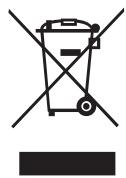
This appliance is marked according to the European directive 2002/96/EC on Waste Electrical and Electronic Equipment (WEEE). By ensuring this product is disposed of correctly, you will help prevent potential negative consequences for the environment and human health, which could otherwise be caused by inappropriate waste handling of this product.
The symbol on the product indicates that this product may not be treated as household waste. Instead it shall be handed over to the
applicable collection point for the recycling of electrical and electronic equipment
Disposal must be carried out in accordance with local environmental regulations for waste disposal.
For more detailed information about treatment, recovery and recycling of this product, please contact your local city office, your household waste disposal service or the shop where you purchased the product.
Cooking Guide
MICROWAVES
Microwave energy actually penetrates food, attracted and absorbed by its water, fat and sugar content.
The microwaves cause the molecules in the food to move rapidly. The rapid movement of these molecules creates friction and the resulting heat cooks the food.
COOKING
Cookware for microwave cooking:
Cookware must allow microwave energy to pass through it for maximum efficiency. Microwaves can penetrate through ceramic, glass, porcelain and plastic as well as paper and wood, but they are reflected by metal, such as stainless steel, aluminium and copper. So food must never be cooked in metal containers.
Foods suitable for microwave cooking:
Many kinds of food are suitable for microwave cooking, including fresh or frozen vegetables, fruit, pasta, rice, grains, beans, fish, and meat. Sauces, custard, soups, steamed puddings, preserves, and chutneys can also be cooked in a microwave oven. Generally speaking, microwave cooking is ideal for any food that would normally be prepared on a hob.
Covering during cooking
To cover the food during cooking is very important, as the evaporated water rises as steam and contributes to cooking process. Food can be covered in different ways: e.g. with a ceramic plate, plastic cover or microwave suitable cling film.
Standing times
After cooking is over food the standing time is important to allow the temperature to even out within the food.
Cooking Guide
Cooking Guide for frozen vegetables
Use a suitable glass pyrex bowl with lid. Cook covered for the minimum time - see table. Continue cooking to get the result you prefer.
Stir twice during cooking and once after cooking. Add salt, herbs or butter after cooking. Cover during standing time..
| Food | Portion | Power | Time (min.) | Standing Time (min.) | Instructions |
| Spinach | 150g | P80 | 5-6 | 2-3 | Add 15 ml (1 tablespoon) cold water. |
| Broccoli | 300g | P80 | 8-9 | 2-3 | Add 30 ml (2 tbsp.) cold water. |
| Peas | 300g | P80 | 7-8 | 2-3 | Add 15 ml (1 tbsp.) cold water. |
| Green Beans | 300g | P80 | 7½-8½ | 2-3 | Add 30 ml (2 tbsp.) cold water. |
| Mixed Vegetables (carrots/peas/corn) | 300g | P80 | 7-8 | 2-3 | Add 15 ml (1 tbsp.) cold water. |
| Mixed Vegetables (Chinese style) | 300g | P80 | 7½-8½ | 2-3 | Add 15 ml (1 tbsp.) cold water. |
Cooking Guide
Cooking Guide for fresh vegetables
Use a suitable glass pyrex bowl with lid. Add 30-45 ml cold water (2-3 tbsp.) for every 250 g unless another water quantity is recommended - see table. Cook covered for the minimum time - see table. Continue cooking to get the result you prefer. Stir once during and once after cooking. Add salt, herbs or butter after cooking. Cover during a standing time of 3 minutes.
Hint: Cut the fresh vegetables into even sized pieces. The smaller they are cut, the quicker they will cook.
All fresh vegetables should be cooked using full microwave power (P100).
| Food | Portion | Time (min.) | Standing Time (min.) | Instructions |
| Broccoli | 250g | 3½-4 | 3 | Prepare even sized florets. Arrange the stems to the centre. |
| 500g | 6-7 |
| Brussels Sprouts | 250g | 5-5½ | 3 | Add 60-75 ml (5-6 tbsp.) water. |
| Carrots | 250g | 3½-4 | 3 | Cut carrots into even sized slices. |
| Cauliflower | 250g | 4-4½ | 3 | Prepare even sized florets. Cut big florets into halves. Arrange stems to the centre. |
| 500g | 6½-7½ |
| Courgettes | 250g | 3-3½ | 3 | Cut courgettes into slices. Add 30 ml (2 tbsp.) water or a knob of butter. Cook until just tender. |
| Egg Plants | 250g | 2½-3 | 3 | Cut egg plants into small slices and sprinkle with 1 tablespoon lemon juice. |
| Leeks | 250g | 3-3½ | 3 | Cut leeks into thick slices. |
| Mushrooms | 125g | 1-1½ | 3 | Prepare small whole or sliced mushrooms. Do not add any water. Sprinkle with lemon juice. Spice with salt and pepper. Drain before serving. |
| 250g | 2-2½ |
| Onions | 250g | 4-4½ | 3 | Cut onions into slices or halves. Add only 15 ml (1 tbsp.) water. |
| Pepper | 250g | 3½-4 | 3 | Cut pepper into small slices. |
| Potatoes | 250g | 3-4 | 3 | Weigh the peeled potatoes and cut them into similar sized halves or quarters. |
| 500g | 6-7 |
| Turnip Cabbage | 250g | 4½-5 | 3 | Cut turnip cabbage into small cubes. |
Cooking Guide
Cooking Guide for rice and pasta
Rice: Use a large glass pyrex bowl with lid - rice doubles in volume during cooking. Cook covered.
After the cooking time is over, stir before standing time and salt or add herbs and butter.
Remark: the rice may not have absorbed all water after the cooking time is finished.
Pasta: Use a large glass pyrex bowl. Add boiling water, a pinch of salt and stir well. Cook uncovered.
Stir occasionally during and after cooking. Cover during standing time and drain thoroughly afterwards.
| Food | Portion | Power | Time (min.) | Standing Time (min.) | Instructions |
| White Rice (parboiled) | 250g | P100 | 15-16 | 5 | Add 500 ml cold water. |
| 375g | 17½-18½ | Add 750 ml cold water. |
| Brown Rice (parboiled) | 250g | P100 | 20-21 | 5 | Add 500 ml cold water. |
| 375g | 22-23 | Add 750 ml cold water. |
| Mixed Rice (rice + wild rice) | 250g | P100 | 16-17 | 5 | Add 500 ml cold water. |
| Mixed Corn (rice + grain) | 250g | P100 | 17-18 | 5 | Add 400 ml cold water. |
| Pasta | 250g | P100 | 10-11 | 5 | Add 1000 ml hot water. |
REHEATING
Your microwave oven will reheat food in a fraction of the time that conventional ovens hobs normally take.
Use the power levels and reheating times in the following chart as a guide. The times in the chart consider liquids with a room temperature of about +18 to +20^ or a chilled food with a temperature of about +5 to +7^ .
Arranging and covering
Avoid reheating large items such as joint of meat - they tend to overcook and dry out before the centre is piping hot. Reheating small pieces will be more successful.
Power levels and stirring
Some foods can be reheated using maximum power while others should be reheated using lower power.
Check the tables for guidance. In general, it is better to reheat food using a lower power level, if the food is delicate, in large quantities, or if it is likely to heat up very quickly (mince pies, for example).
Stir well or turn food over during reheating for best results. When possible, stir again before serving.
Cooking Guide
Take particular care when heating liquids and baby foods. To prevent eruptive boiling of liquids and possible scalding, stir before, during and after heating. Keep them in the microwave oven during standing time. We recommend putting a plastic spoon or glass stick into the liquids. Avoid overheating (and therefore spoiling) the food.
It is preferable to underestimate cooking time and add extra heating time, if necessary.
Heating and standing times
When reheating food for the first time, it is helpful to make a note of the time taken - for future reference.
Always make sure that the reheated food is piping hot throughout.
Allow food to stand for a short time after reheating - to let the temperature even out. The recommended standing time after reheating is 2-4 minutes, unless another time is recommended in the chart..
Take particular care when heating liquids and baby food. See also the chapter with the safety precautions.
REHEATING LIQUIDS
Always allow a standing time of at least 20 seconds after the oven has been switched off to allow the temperature to even out. Stir during heating, if necessary, and ALWAYS stir after heating. To prevent eruptive boiling and possible scalding, you should put a spoon or glass stick into the beverages and stir before, during and after heating.
REHEATING BABY FOOD
BABY FOOD:
Empty into a deep ceramic plate. Cover with plastic lid. Stir well after reheating! Let stand for 2-3 minutes before serving. Stir again and check the temperature. Recommended serving temperature: between 30 - 40^ .
BABY MILK:
Pour milk into a sterilised glass bottle. Reheat uncovered. Never heat a baby's bottle with teat on, as the bottle may explode if overheated. Shake well before standing time and again before serving! Always carefully check the temperature of baby milk or food before giving it to the baby. Recommended serving temperature: ca. 37^ .
Baby food particularly needs to be checked carefully before serving to prevent burns.
Use the power levels and times in the next table as a guide lines for reheating.
Cooking Guide
Reheating Liquids and Food
Use the power levels and times in this table as a guide lines for reheating.
| Food | Portion | Power | Time (min.) | Standing Time (min.) | Instructions |
| Drinks (coffee, milk, tea, water with room temperature) | 150 ml (1cup) | P100 | 1-1½ | 1-2 | Pour into a ceramic cup and reheat uncovered. Place 1 cup in the centre, 2 opposite of each other and 3 or 4 in a circle. Stir carefully before and after standing time, be careful while taking them out of oven. |
| 300 ml (2cups) | 1½-2 |
| 450 ml (3cups) | 2½-3 |
| 600 ml (4cups) | 3-3½ |
| Soup (chilled) | 250g | P100 | 2-2½ | 2-3 | Pour into a deep ceramic plate or deep ceramic bowl. Cover with plastic lid. Stir well after reheating. Stir again before serving. |
| 350g | 2½-3 |
| 450g | 3-3½ |
| 550g | 3½-4 |
| Stew (chilled) | 350g | P80 | 4½-5½ | 2-3 | Put stew in a deep ceramic plate. Cover with plastic lid. Stir occasionally during reheating and again before standing and serving. |
| 350g | 3½-4½ |
| Pasta with sauce (chilled) | 350g | P80 | 3½-4½ | 3 | Put pasta (e.g. spaghetti or egg noodles) on a flat ceramic plate. Cover with microwave cling film. Stir before serving. |
| 350g | 4-5 |
| Filled pasta with sauce (chilled) | 350g | P80 | 4-5 | 3 | Put filled pasta (e.g. ravioli, tortellini) in a deep ceramic plate. Cover with plastic lid. Stir occasionally during reheating and again before standing and serving. |
| 350g | 5-6 |
| 450g | 5½-6½ |
| Plated Meal (chilled) | 350g | P80 | 4½-5½ | 3 | Plate a meal of 2-3 chilled components on a ceramic dish. Cover with microwave cling-film. |
| 450g | 5-6 |
| 550g | 5½-6½ |
Cooking Guide
Reheating Baby Food and Milk
Use the power levels and times in this table as guide lines for reheating.
| Food | Portion | Power | Time | Standing Time (min.) | Instructions |
| Baby food (vegetables + meat) | 190g | P80 | 30sec. | 2-3 | Empty into ceramic deep plate. Cook covered. Stir after cooking time. Stand for 2-3 minutes. Before serving, stir well and check the tem- perature carefully. |
| Baby porridge (grain + milk + fruit) | 190g | P80 | 20sec. | 2-3 | Empty into ceramic deep plate. Cook covered. Stir after cooking time. Stand for 2-3 minutes. Before serving, stir well and check the tem- perature carefully. |
| Baby milk | 100ml | P30 | 30-40 sec. | 2-3 | Stir or shake well and pour into a sterilised glass bottle. Place into the centre of turntable. Cook uncovered. Shake well and stand for at least 3 minutes. Before serving, shake well and check the tempera- ture carefully. |
| 200ml | 1 min. to 1 min. 10 sec. |
CANDY
Forno a microonde
7. Cotture in sequenza