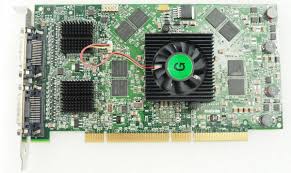
QID, QID PRO - Graphic card MATROX - Free user manual and instructions
Find the device manual for free QID, QID PRO MATROX in PDF.

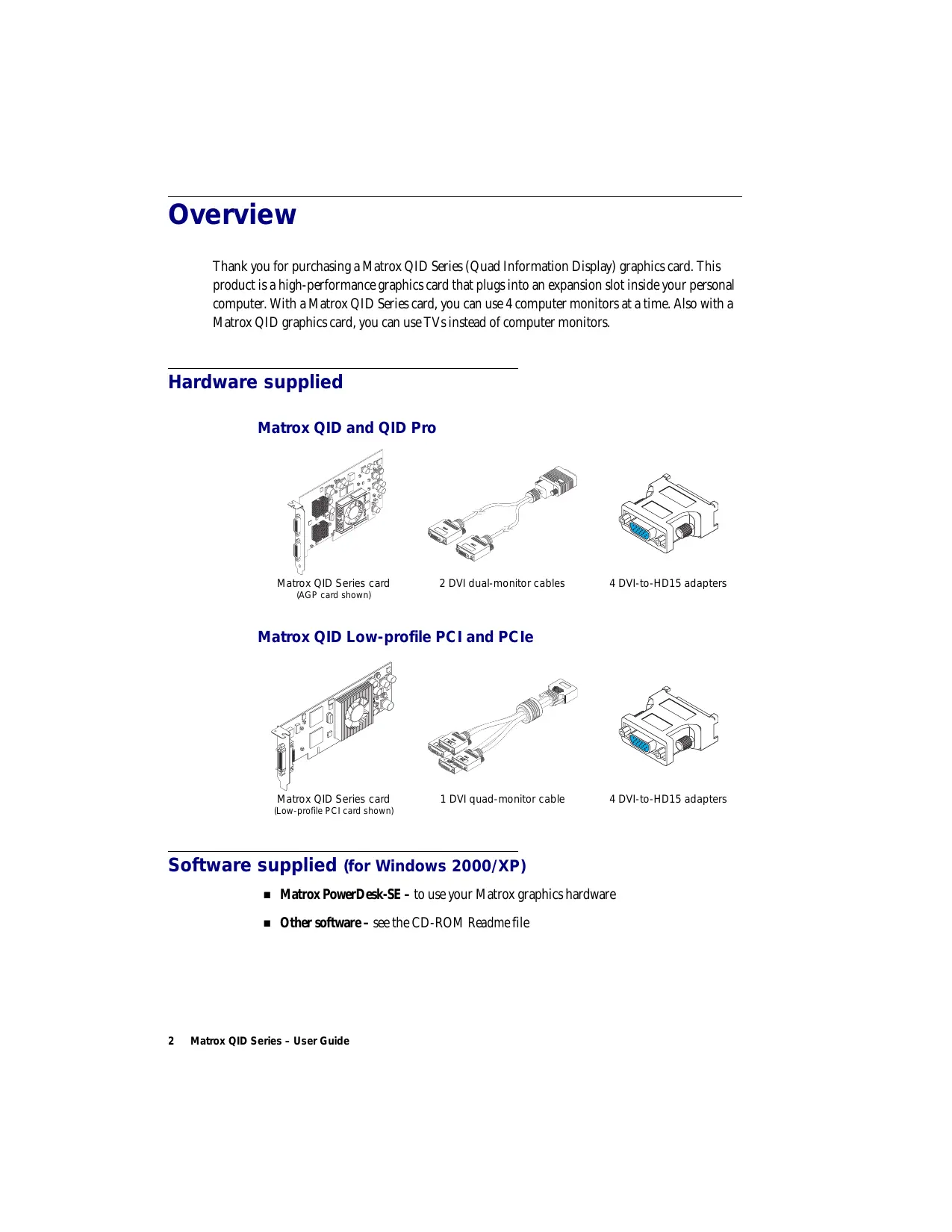

| Product Type | Professional multi-monitor graphics card |
| Model | QID / QID PRO |
| Brand | Matrox |
| Form Factor | Half-height, low-profile |
| Dimensions (approximate) | 167 mm x 68 mm |
| Weight (approximate) | 100 g |
| Interface | PCI Express (x16) |
| Video Outputs | 4 x DVI (or VGA depending on model) |
| Maximum resolution per output | 1920 x 1200 pixels (or higher) |
| Video Memory | 256 MB to 512 MB (depending on version) |
| Required Power | Power through PCIe slot, no additional connector |
| Power Consumption | Approximately 25 W |
| Supported Operating Systems | Windows 7/8/10, Linux |
| Main Functions | Quad display, clone, extended, rotation, multi-monitor support |
| Certifications | CE, FCC Class A, WEEE Directive |
| Maintenance and Cleaning | Unplug the device, use a soft dry cloth. Do not use liquids or sprays. |
| Safety Precautions | Avoid electrostatic discharge, do not expose to moisture, observe operating temperatures (0-40°C). |
| Spare Parts and Repairability | No user-serviceable parts. In case of problem, contact technical support. |
| General Information | Designed for professional applications requiring multiple screens (trading, control, design). |
Frequently Asked Questions - QID, QID PRO MATROX
User questions about QID, QID PRO MATROX
0 question about this device. Answer the ones you know or ask your own.
Ask a new question about this device
Download the instructions for your Graphic card in PDF format for free! Find your manual QID, QID PRO - MATROX and take your electronic device back in hand. On this page are published all the documents necessary for the use of your device. QID, QID PRO by MATROX.
USER MANUAL QID, QID PRO MATROX
Graphics Solutions for Professionals
matrox QID Series
QID • QID Pro • QID Low-profile
User Guide
10876-301-0221
2008.01.11
Overview
Thank you for purchasing a Matrox QID Series (Quad Information Display) graphics card. This product is a high-performance graphics card that plugs into an expansion slot inside your personal computer. With a Matrox QID Series card, you can use 4 computer monitors at a time. Also with a Matrox QID graphics card, you can use TVs instead of computer monitors.
Hardware supplied
Matrox QID and QID Pro
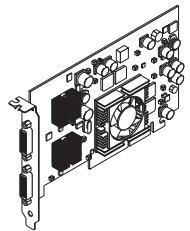
Matrox QID Series card (AGP card shown)
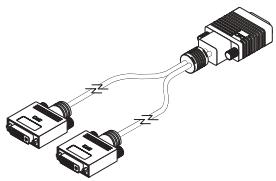
2 DVI dual-monitor cables
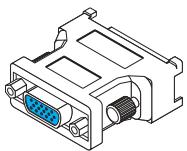
4 DVI-to-HD15 adapters
Matrox QID Low-profile PCI and PCIe
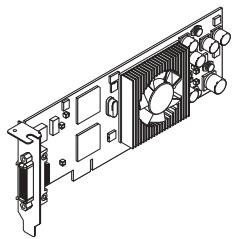
Matrox QID Series card (Low-profile PCI card shown)
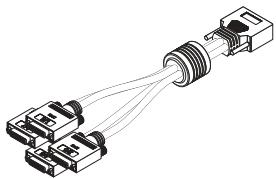
1 DVI quad-monitor cable
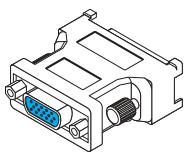
4 DVI-to-HD15 adapters
Software supplied (for Windows 2000/XP)
- Matrox PowerDesk-SE - to use your Matrox graphics hardware
Other software - see the CD-ROM Readme file
Installation overview

Note: If your Matrox product is already partially or fully installed on your computer, some or all the installation information in this guide may not apply to you. However, this information may be useful if you need to reinstall your Matrox product.
To install your Matrox product:
1 Install the Matrox card - see "Hardware installation", page 4.
2 Connect your monitors - see "Connection setup", page 7.
3 Install the software - see "Software setup", page 10.
Hardware installation
This section describes how to install your Matrox card. For information specific to your computer, like how to remove its cover, see your system manual.

WARNING: To avoid personal injury and to prevent damage to your computer or Matrox hardware, turn off your computer, unplug it, and then wait for it to cool before you install your Matrox product and touch any of the internal parts of your computer.
While your computer is turned off but still plugged in, some electrical current is supplied to the motherboard. This current may prevent newly installed hardware from working properly.
Also, static electricity can severely damage electronic parts. Before touching any electronic parts, drain static electricity from your body (for example, by touching the metal frame of your computer). When handling a card, carefully hold it by its edges and avoid touching its circuitry.

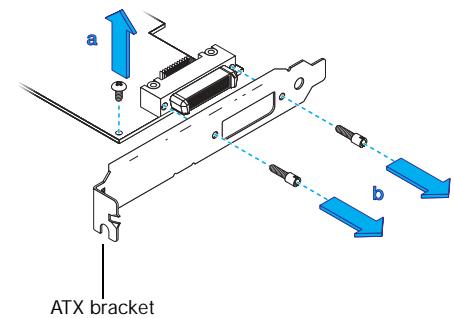
Note: Most Matrox low-profile graphics cards ship with standard (ATX) brackets compatible with most systems. If you have a low-profile system, you may need to change the standard bracket on your graphics card to a low-profile bracket. For more information, see "Replacing brackets on a low-profile graphics card", page 6.
1 Open your computer and remove your existing graphics card*
If a graphics card isn't already installed in your computer, skip to step 2.
a Using Add/Remove Programs in the Windows Control Panel, remove any currently installed display drivers. Restart your computer for the changes to take effect.
After your computer restarts, you're prompted to install drivers for the new graphics hardware detected. Click Cancel.
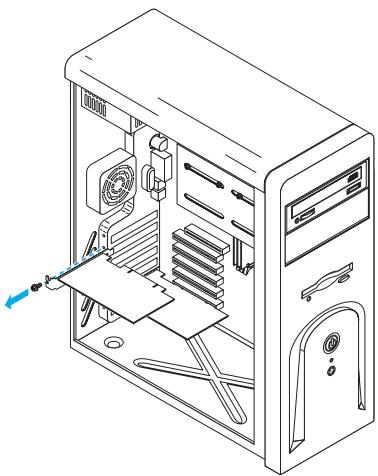
b Turn off your computer and all peripherals such as your monitor or printer.
c Open the computer and remove your existing graphics card (if any). (If graphics hardware is built into the motherboard of your computer, you may need to disable it manually. For more information, see your system manual.)
2 Choose an expansion slot
Most computers have different types of expansion slots. Choose an AGP, PCI, or PCI Express × 16 (PCIe) slot, depending on the type of Matrox card you have. If you have a PCI card, your card supports both 64-bit and 32-bit PCI slots. Your system manual should identify the location of each type of expansion slot in your computer.
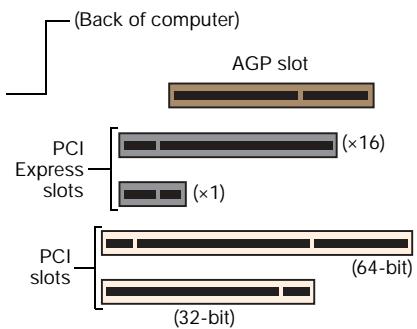

Note: If you're using a PCI graphics card in a PCI 64-bit compatible slot, your choice of PCI slot may affect your card or system performance. For more information, see your computer manual.

WARNING: Inserting your Matrox card into the wrong type of slot could damage your card, your computer, or both.
If you have a PCI card and the versions (32- or 64-bit) of your card and PCI expansion slot are different, only part of the card's edge connector (the part closest to the bracket) or expansion slot (the part closest to the back of the computer) should be used.
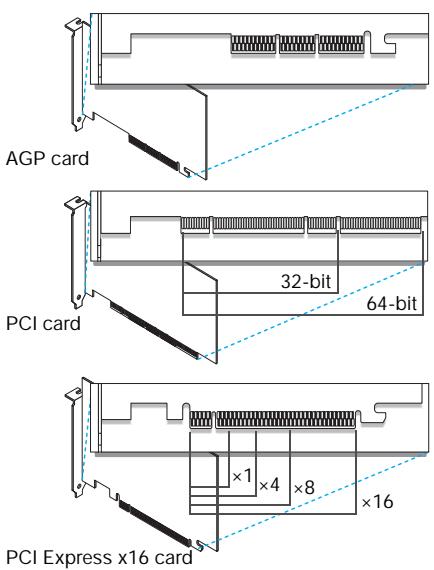
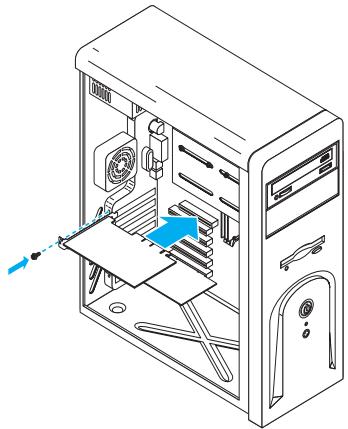
3 Insert your Matrox card
a Position your Matrox card over the expansion slot you've chosen.
b Push the card in firmly and evenly until it's fully seated in the slot.
c Secure the bracket of your Matrox card to the computer frame.
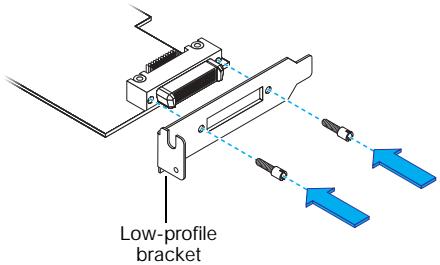
Replacing brackets on a low-profile graphics card
Most Matrox low-profile graphics cards ship with ATX brackets compatible with most systems. The following explains how to change brackets on your Matrox product.
1 Remove the current bracket from your Matrox graphics card by removing the screw (a) on top of the graphics card, then the nuts (b) on either side of the monitor connector.
2 Attach and fasten the new bracket with the two nuts you just removed.
Connection setup
This section describes how to connect computer monitors to your Matrox product.

Note: Windows 2000/XP and DOS – If you want to use TV output with your Matrox product, you need dual-TV-output cables. For more information, see "TV output", page 13.
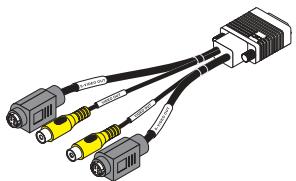
Dual-TV-output cable
To use 4 computer monitors at a time, make sure your monitors support the same monitor settings (such as display resolution and refresh rates). All your monitors must be of the same type, either analog or digital.
While using 4 monitors at the same time, certain limitations may apply. For more information, see "Display information", page 34.
1 Connect your dual-monitor cables or quad-monitor cable
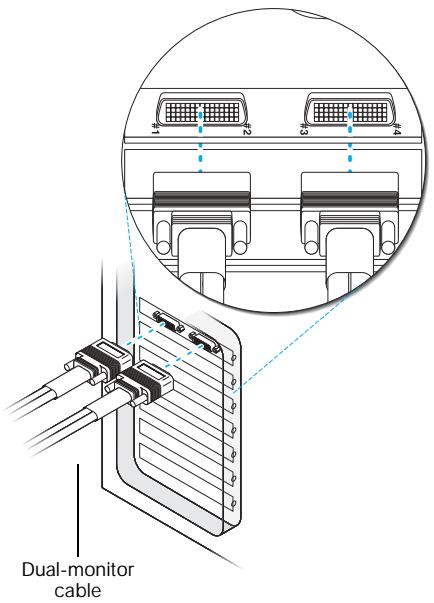
QID and QID Pro - Attach your Matrox dual-monitor cables to the connectors on the bracket of your Matrox card. Make sure the connectors are properly fastened.

WARNING: To avoid damaging the LFH-60 connector on your dual-monitor cable or on your graphics card,
carefully insert the connector on your dual-monitor cable as straight as possible into the connector on your graphics card. Specifically, inserting the connectors into each other at an angle is likely to bend and damage the pins on the connector of the dual-monitor cable.
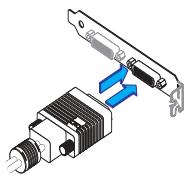
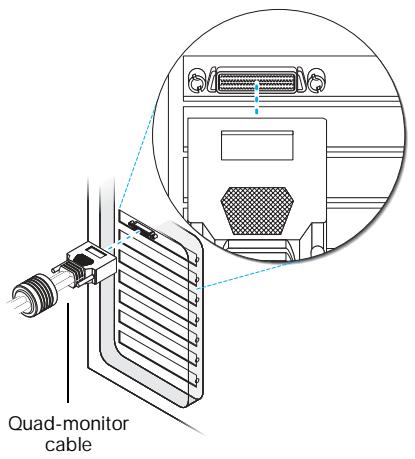
QID Low-profile PCI and PCIe - Attach your quad-monitor cable to the connector on the bracket of your Matrox card. Make sure the connectors are properly fastened.
2 Connect your monitors
If your monitor has an HD-15 connector, use a DVI-to-HD15 adapter included with your product to connect your monitor cable to your dual-monitor cable.
If your monitor has a DVI connector, connect your monitor cable directly to the dual-monitor cable without using a DVI-to-HD15 adapter.
Make sure all connectors are properly fastened.
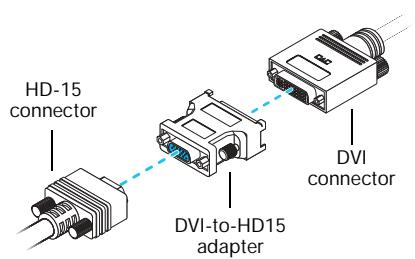
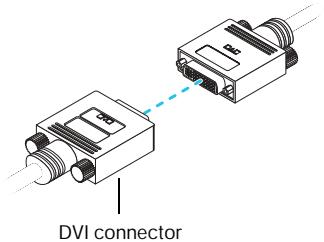

Note: Monitors are numbered consecutively based on which connector each is attached to. Numbering starts with the primary display – the one that first displays information when you restart your computer. If another graphics card is installed in your computer, display numbering may be different.
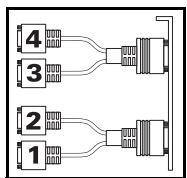
QID and QID Pro
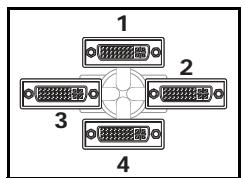
QID Low-profile PCI and PCIe

Note: To connect a digital monitor (a monitor that uses digital input, usually a flat panel monitor) to your Matrox product, your monitor must have a DVI connector.
Some monitors with DVI connectors support both digital and analog input. If you're using one of these monitors with
your Matrox product, make sure it's configured to use the correct type of input. For more information, see your monitor documentation.
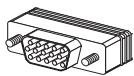
HD-15 connector (analog)
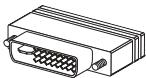
DVI connector (DVI-D: digital)
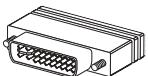
DVI connector (DVI-I: analog/digital)
Your Matrox card is now installed. Restart your computer and install your Matrox software (see "Software setup", page 10).
Software setup

Note: This guide has references that are specific to the Matrox installation CD-ROM. If your Matrox product wasn't packaged by Matrox (for example, if it was included with your computer), your product may not include this CD-ROM.
If you don't have this CD-ROM, certain references in this guide may not reflect the software you have. For more information, see other software documentation provided by your system vendor.
This section describes how to install Matrox software for Windows 2000/XP.
You may need administrator rights to install certain software. For more information, see Windows documentation or contact your system administrator.

1 Install display driver

Note: Windows XP SP2 (Service Pack 2) – Windows may install a Matrox display driver unsupported by your product when your Matrox product is detected as new hardware. If you aren't prompted to install a display driver, DON'T RESTART your system. Install the display driver on your Matrox installation CD-ROM before you restart.
If you do restart your computer, see page 18 for more information on reinstalling your display driver.
Windows detects new hardware when you restart. If Matrox display drivers haven't been previously installed, Windows prompts you to install a display driver. Follow the on-screen instructions. There are two display driver versions available for your Matrox QID Series product:
- Version 1.x (SE): Supports multi-display with 4 displays in stretched mode only with a maximum single display resolution of 1600 × 1200 . This version also supports TV output for all Matrox QID Series graphics cards.
- Version 2.x (SE): Supports multi-display with up to 4 displays in stretched and independent modes with a maximum display resolution of 1600 × 1200 . This version doesn't support TV output.
(The Matrox Windows 2000/XP display drivers are respectively in the Win2kXP_1x and Win2kXP_2x folders of your Matrox installation CD-ROM.)
2 Install optional software
After your computer has restarted, insert (or insert) the Matrox installation CD-ROM in your CD-ROM drive – the CD-ROM installation program automatically starts. * This program shows you a list of items you can install and information you can access. Follow the on-screen instructions.
3 Configure your monitor settings
To take full advantage of your graphics card, make sure the monitor settings for the main monitor are supported by all 4 monitors (or TVs) connected to your graphics card:
a Right-click your Windows desktop background, then click Properties Settings Advanced Monitor.
b If "Hide modes that this monitor cannot display" is available, make sure it's enabled. Under Screen refresh rate, select the highest refresh rate listed.
c Click OK OK.
For more information on Windows monitor settings, see Windows documentation.

WARNING: If incorrect software monitor settings are applied, some monitors can be permanently damaged. For more information, see your monitor manual.
4 Set up your display software
Use Matrox PowerDesk software to change certain display settings or access Matrox features. To access PowerDesk, double-click its icon ( ) on your Windows taskbar. To see the PowerDesk icon in Windows XP, you may need to click the Show hidden icons button ( ) on your Windows taskbar. For more information on how to use Matrox PowerDesk, see the online help.
5 Adjust your display resolution
Depending on the version of your display driver, your multi-display setup changes when using a low display resolution (for example, 800 × 600 ) in stretched mode.
- Version 1.x (SE): While using a low display resolution, this version uses clone mode (instead of stretched mode) for all your displays.
- Version 2.x (SE): While using a low display resolution, this version uses single display mode (instead of stretched mode) for your main display.
To set your display resolution:
a Right-click your Windows desktop background, then click Properties Settings.
b Move the Screen area (Windows 2000) or Screen resolution (Windows XP) slider.
c Click OK or Apply for your changes to take effect.

Note: For the latest display driver and user guide for your product, check the Matrox Technical Support Web site (www.matrox.com/graphics/support). A more recent display driver may support more features and may offer increased capabilities (such as higher display resolutions).
TV output
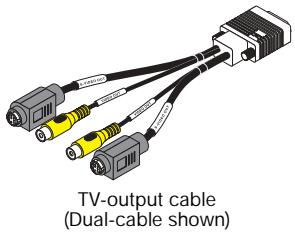
With your Matrox product, you can use TV-output cables (sold separately) instead of multi-monitor cables to view or record your displays with TVs or video recorders. If you have a regular Matrox product, you need dual-TV-output cables. If you have a low-profile product, you need a quad-TV-output cable. To purchase Matrox TV-output cables for your product, see the Matrox online store (http://shopmatrox.com). This section describes how to use the TV output feature.
Connection setup
1 Turn off computer
Windows 2000/XP - To shut down your computer, click Start Shut Down Shut down OK, then turn off your computer.

WARNING: Don't change monitor connections while your computer is turned on. While your computer is turned on, it may be using monitor settings that are specific to the current monitor connections.
If a display device (monitor, TV or video recorder) is connected while your computer is using settings intended for another display device, the display of the new device may be garbled or unusable. Some devices may be permanently damaged if incorrect settings are used.
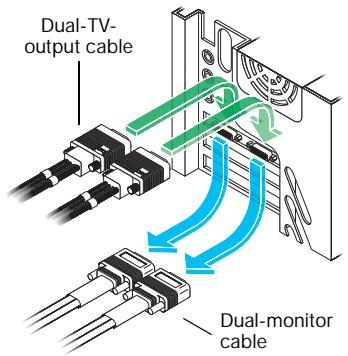
2 Replace your multi-monitor cables
a Disconnect any computer monitor connected to your dual-monitor cables or to your quad-monitor cable.
b Detach any multi-monitor cable from your Matrox card.
c Attach your dual-TV-output cables or quad-TV-output cable to your Matrox graphics card.
3 Connect video output
To connect to a TV or a video recorder, you'll need a composite video (RCA) or S-video cable.
If your video device (a TV or a video recorder) didn't come with one of these cables, these types of cable are available at most electronics stores. The type of cable you use depends on what your video device supports. Many video devices support composite video connections, and some higher-quality video devices support S-video connections.
For each TV or video recorder, you want to connect to your Matrox product:
a Attach one end of your composite video or S-video cable to the appropriate connector on your TV-output cable.
b Attach the other end to theVIDEO IN* connector on your TV† or video recorder.
TV or video recorder using composite video
TV or video recorder using S-video
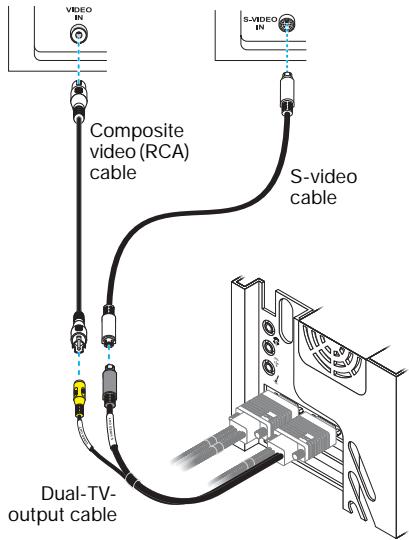
(Note: Using the Matrox composite video and S-video connectors at the same time is optional.)
c Before viewing or recording video output directly from your computer, make sure your TV or video recorder is set up to use line input. For example, if your TV has a TV/VIDEO switch, set it to VIDEO; or if your video recorder has a TUNER/LINE switch, set it to LINE.
Optionally, if you use the composite video and S-video connectors on your TV-output cable, you can directly connect two different video devices at the same time.
To view and record output from the same Matrox video connector, you can connect it to a video recorder and connect the video recorder to a TV. For more information, see your video recorder and TV manuals.
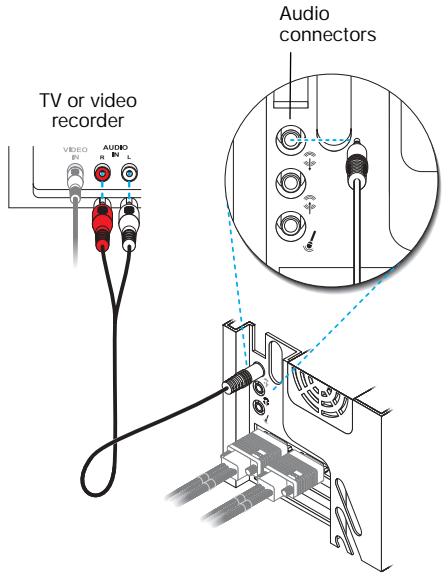
4 Connect audio output
Typically, the audio output from a computer comes from speakers connected to your computer. If you prefer, you can hear or record the sound output from your computer using the same TV or video recorder you connect to your graphics card. To do this, you need an audio cable with a stereo jack on one end and two RCA connectors on the other end. If you don't have this type of cable, you can buy one at most consumer electronics stores.
a Plug the stereo-jack end of the audio cable into the LINE OUT* ( 念 ) connector on your computer.
b Plug the other end of the cable into the left (L) and right (R) AUDIO IN connectors of your video device. For more information, see your sound card manual.
SCART information
Some video devices in Europe only have SCART connectors. This type of connector includes video and audio, whereas composite or S-video connectors include only video.
If your video devices only have SCART connectors, you need SCART cables to connect to your Matrox product. If you want to use SCART cables, contact your Matrox representative.
Software setup
If a TV or video recorder is connected to your Matrox product, you can use TV output mode to view or record your display on your TV or video recorder. (To connect video devices to your computer, see page 13.)
TV settings have lower resolutions and refresh rates than typical computer monitor settings. Lower refresh rates may result in more noticeable flicker.

Note: Two TV standards are supported for TV output. The NTSC standard is used in North America and Japan, among other places. The PAL standard is used in most of Western Europe and in China, among other places.
If an incorrect TV standard is selected in Matrox software, the output from your computer may not appear or record properly on your TV or your video recorder. To find out what standard your TV or video recorder supports, see its documentation.
Windows 2000/XP - To adjust TV settings, access the Multi-Display Setup dialog box for your Matrox product (see "Set up your display software", page 11).
DOS - To change TV standard, insert your Matrox installation CD-ROM. Run the PBIOSWin program from the Sysutils folder on your Matrox CD-ROM. Click Change TV Standard and select the correct TV standard, then click OK. For more information on how to use this program, see the Readme file in the Sysutils folder.
Troubleshooting
Basic procedures
This section explains basic procedures that are referred to by some troubleshooting items in this guide.
Restarting in VGA mode
Windows 2000/XP - What follows is information on how to restart your computer in VGA mode.
1 Click Start Shut Down Restart OK* to restart your computer. (* Depending on your version and configuration of Windows, this part of the step may not be necessary.) If your primary monitor is unusable, see your system manual for information on how to restart your computer using a hardware control.
2 Before Windows starts, press [F8] for the Windows startup menu to appear. (If [F8] doesn't work, instead try pressing and holding [Ctrl] before Windows starts.)
3 Select "VGA mode", then press [Enter].
Graphics - Main troubleshooting
This section addresses possible problems that could prevent you from using your computer.
Problem Computer doesn't display information or boot after Matrox card is installed
Cause Your Matrox card may not be properly installed.
Solution Make sure your Matrox card is properly installed. Specifically, make sure the card is firmly inserted in its expansion slot and that all connections to it are firmly in place. For more information, see "Hardware installation", page 4.
Cause There may be unsupported graphics hardware in your computer.
Solution If an unsupported graphics card is plugged into an expansion slot, remove it.
Solution If graphics hardware is built into your computer motherboard, your system may not have automatically disabled it when you inserted your Matrox card. Check your system manual for instructions on how to disable your computer built-in graphics hardware.
Cause Your computer BIOS (Basic Input/Output System) may not be up to date. For more information on your computer BIOS, see your system manual.
Solution Reinstall your previous graphics card and, if possible, update your computer BIOS. This can usually be done with software from the manufacturer of your computer. Contact your system vendor or manufacturer to get a BIOS update for your computer.
To get the correct BIOS update, you may need to know the serial number your computer displays when it restarts. (This number is usually in the lower-left corner of the display.)
Problem Wrong color balance, screen image off-center, or no picture at all
Cause Windows XP Service Pack 2 - Windows Service Pack 2 has installed a version of the Matrox display driver that doesn't support your Matrox product.
Solution You need to install a display driver that supports your Matrox product. To reinstall the display driver, you first need to restart your computer in VGA mode (see "Restarting in VGA mode", page 17). While in VGA mode, install the Matrox display driver on the installation CD-ROM provided with your product. If no CD was provided with your product, see the Matrox Technical Support Web site (www.matrox.com/graphics/support) to download a display driver.
Cause Your monitor video controls may be improperly set.
Solution Adjust your monitor controls (brightness, contrast, and so on). For more information, see your monitor manual.
Cause Your monitor may not be properly connected.
Solution Make sure your monitor is properly connected to the correct connector on your Matrox graphics card (see "Connect your dual-monitor cables or quad-monitor cable", page 7).
Solution Make sure the monitor power cable is firmly in place.
Cause If display problems occur after the startup screen of your operating system, your software monitor settings may be incorrect.
Solution Make sure correct software monitor settings are selected.
If your primary display is still usable, see "Configure your monitor settings", page 11. Otherwise, see the next troubleshooting item.
Problem After the startup screen, or after display settings are changed, the screen image is garbled or unusable
(blank screen, rolling or overlapping screen images)
Cause Analog monitors only - The Matrox display driver may be trying to use settings your monitor doesn't support. This can happen if a monitor was never selected in the software and the display resolution was changed to one your monitor doesn't support, or if the monitor connected to your computer was changed without it being changed in the software. One of your monitors may not support the monitor settings of the main monitor.

WARNING: If incorrect software monitor settings are applied, some monitors can be permanently damaged. For more information, see your monitor manual.
Solution Make sure the correct monitor is selected in Windows.
Windows 2000/XP -
1 If your primary display is unusable, restart your computer in VGA mode (see "Restarting in VGA mode", page 17).
2 Right-click your Windows desktop background, then click Properties Settings.
3 Move the Screen area (Windows 2000) or Screen resolution (Windows XP) slider down to its lowest setting, then click OK.
4 Restart your computer normally.
5 Make sure the correct monitor is selected in Windows (see "Configure your monitor settings", page 11).
6 If necessary, restore your original display settings (see steps 2 and 3).

Note: In multi-display mode, all the monitors connected to your graphics card use the monitor settings of the main monitor (the monitor connected to connector #1 of your Matrox product). Make sure you're using monitor settings supported by all your monitors.
Cause Files on your system may have been deleted or corrupted.
Solution Remove, then reinstall Matrox software:

Note: Before removing software, make sure you have all the necessary files to reinstall software that may still be needed. Also, make sure the display driver you reinstall supports all Matrox products in your computer.
Windows 2000/XP -
1 If your primary display is currently unusable, restart your computer in safe mode or VGA mode (see "Restarting in VGA mode", page 17).
2 To remove Matrox software:
a Click Start Settings* Control Panel Add/Remove Programs (double-click*) Matrox PowerDesk-HF and Driver Change/Remove Yes. (* Depending on your version and configuration of Windows, this part of the step may not be necessary.)
b Click No if you're asked to restart your computer.
c Click Matrox PowerDesk-SE Change/Remove Yes.
3 Restart your computer.
4 After removing Matrox software, install the latest display driver for your Matrox graphics card. You may also need to reinstall other Matrox software.

Note: Windows 2000/XP - You may need administrator rights to remove certain software. For more information, see Windows documentation.
Graphics - Extra troubleshooting
The following are extra troubleshooting items related to graphics hardware.
Problem Can't use Windows, Windows reports a configuration error, and/or can't install or uninstall display driver

Note: Windows 2000/XP - You may need administrator rights to install certain software. For more information, see Windows documentation.
Cause The problem may be specific to the motherboard in your computer.
Solution There may be a software update available for your motherboard. To find out what motherboard model your computer is using, see your system manual. For more information, contact the maker of your motherboard or computer. Many motherboard or computer manufacturers have software updates available on their Web site.
Cause Files on your system may have been deleted or corrupted.
Solution Remove, then reinstall Matrox software. For more information, see page 19.
Problem Monitor settings aren't automatically detected

WARNING: If incorrect software monitor settings are used, your display may become unusable and some monitors can be permanently damaged. For more information, see your monitor manual.

Note: Windows 2000/XP - To check if your monitor settings are properly selected:
1 Right-click your Windows desktop background, then click Properties Settings Advanced Monitor. If you're using multi-display mode, select a display before clicking Advanced.
2 If you see the name of your monitor or "Plug-and-Play", your monitor settings are properly selected. If you see the wrong monitor name or Default monitor, your monitor settings aren't properly selected.
Cause
Your monitor may not be Plug-and-Play. Most new monitors are Plug-and-Play but many older ones aren't. Software can't automatically detect settings for monitors that aren't Plug-and-Play.
Solution
Manually select your monitor settings in the software. For Windows 2000/XP, see "Configure your monitor settings", page 11.
Cause
If a monitor was changed or added while Windows was running, the new monitor may not be detected by the software.
Solution
Restart your computer. If your monitor is a Plug-and-Play (DDC) monitor, it should be automatically detected by the software.
Problem Built-in network card doesn't work after multi-monitor graphics card is installed
Cause
The installation of a multi-monitor graphics card may have caused your computer to reallocate system resources.
Solution
Try reinstalling your network drivers.
Solution
Try moving your Matrox multi-monitor graphics card to another PCI slot in your computer.
Problem 3D and video programs don't work
Note: OpenGL acceleration is only available on the Matrox QID Pro.
Cause Your Matrox card may be in a "slave" expansion slot on a computer that makes a distinction between bus mastering and slave slots.
Solution Change slots - Shut down your computer, disconnect it from the power supply, remove your Matrox card and then insert it into a different PCI expansion slot. For instructions on how to safely install your Matrox card, see "Hardware installation", page 4.
Solution Change settings in your computer BIOS setup utility.
If your computer has the options of enabling Plug-and-Play detection, or assigning an IRQ to a VGA adapter, make sure they're enabled. If your computer doesn't have these options, you may be able to manually assign an IRQ to your graphics card using the BIOS setup utility.
For more information on the BIOS setup utility of your computer, see your system manual or contact your system manufacturer.
Cause Your computer's other BIOS settings may be incorrect.
Solution Reset your computer BIOS settings to the factory defaults using your computer's built-in BIOS setup utility. The factory defaults are usually the "safest" settings. Check your system manual for more information.
Problem After game for Windows 2000/XP starts, monitor doesn't display properly
(blank screen, rolling or overlapping screen images)
Cause If your game uses a low-resolution (640× 480 and below), full-screen display mode, your monitor may not support the refresh rate the Matrox driver is using.
Solution Windows 2000/XP -
1 If the game is still running in full-screen mode and your monitor is unusable, exit the game. To do this, press [Alt] + [Tab] once, right-click the name of the game on the Windows taskbar, then click Close.
2 Make sure the correct monitor is selected in Windows (see "Configure your monitor settings", page 11).
Problem Using multiple displays under Windows 2000/XP, program doesn't work with main graphics card
Cause Your main graphics card may not be controlling your primary display. The graphics card that controls your primary display is the one that first displays information when you restart your computer.
A program that doesn't recognize multiple displays may not work with a graphics card unless it's controlling your primary display.
Your computer BIOS (Basic Input/Output System) and the slot type (AGP, PCI, or PCIe - see "Choose an expansion slot", page 5) of each graphics card help determine which graphics card controls your primary display.
Solution If you're having problems with a program that can be moved on your Windows desktop, run this program on your primary display. Make sure the program window doesn't overlap any other display. If the program doesn't work with the graphics card controlling your primary display, or you want your main graphics card to control your primary display, see the other solutions.
Solution Change the configuration of your computer BIOS so that the slot type of your main graphics card has priority for becoming the primary display. For information on how to change your computer BIOS settings, see your system manual.
If your computer BIOS doesn't let you select which slot type has priority for becoming the primary display, a BIOS update may be available to let you do this. (The BIOS of most computers can be updated with software.) For a possible BIOS update for your computer, contact your system vendor.
Solution If there's a graphics controller built into the motherboard of your computer, by changing your computer BIOS settings, you may be able to change which device controls your primary display. For more information, see your system manual.
Solution If you don't need to use the graphics card that's controlling your primary display, remove it from your computer. If your primary display is controlled by the motherboard of your computer, see your system manual for information on how to disable this graphics controller.
Cause The program you're using may not work properly with systems using more than one display at a time.
Solution An update may be available for the program you're using. This update may fix problems this program has with multi-display systems. For more information, contact the software distributor for the program you're using.
Solution Windows 2000/XP - For advanced users - To use a program that doesn't support multi-display systems, you can disable all displays other than your primary display:
1 Restart your computer in "VGA" mode (see "Restarting in VGA mode", page 17).
2 Click Start Settings* Control Panel Performance and Maintenance* System (double-click*) Hardware Device Manager. (* Depending on your version and configuration of Windows, this part of the step may not be necessary.)
3 Click the plus sign to the left of the Display adapters.
4 For each display adapter, except for the one controlling your primary display, right-click the name of a display adapter, then click Disable Yes.

Note: Your primary display can't be disabled.
5 Restart your computer for changes to take effect.

Note: To restore display adapters, repeat steps 2-5, but click Enable in step 4.
Problem Not all graphics cards in the computer are fully supported (Software doesn't work with a certain graphics card, or another graphics card doesn't work at all)
Cause If you have different models of graphics cards in your computer, your Matrox display driver may not support all the graphics cards in your computer.
Under Windows 2000/XP, a display driver may support one or more graphics cards. If a display driver doesn't support a certain card, a different display driver must be used for that card. Software that depends on a certain display driver may not work with a graphics card that's not using the same display driver.

Note: If your Matrox product was provided by the manufacturer of your computer, check the Web site of that manufacturer for the latest display driver. A display driver provided by the manufacturer of your computer is more likely to be tested with your computer model.
Solution If a graphics card isn't supported, you may need to remove it. If there's graphics hardware built into the motherboard of your computer that's not supported by your software, see your system manual for information on how to disable this graphics hardware.
Cause Windows 2000/XP - If the Windows method for display driver installation was used (instead of running the setup program included with your Matrox display driver), the driver may not be installed for all the graphics cards it supports.
Solution Run the setup program included with the Matrox display driver. The setup program automatically installs the display driver for each Matrox graphics card it supports.
Problem In multi-display mode, displays aren't numbered consecutively
Cause If you have more than one graphics card in your computer, the display numbering may not be consecutive for the displays of a multiple-display card. Display numbering depends on the types

of expansion slots used in your computer (AGP and PCI) and the BIOS settings of your computer.
Solution Windows 2000/XP - Move the displays in Windows.
1 Right-click your Windows desktop background, then click Properties Settings.
2 Select a display and move it according to the physical position of the monitor it's associated with.
Problem Screen image defects appear, program doesn't run properly, or Windows doesn't work properly (example: mouse pointer not drawn properly)
Cause Some programs may not work properly with some acceleration.
Solution Windows 2000/XP - Disable Windows effects: Windows 2000 -
1 Right-click your Windows desktop background, then click Properties Effects.
2 Disable one or more features under Visual effects.
Windows XP -
1 Right-click your Windows desktop background, then click Properties Appearance Effects.
2 Disable one or more features.
Solution If possible, update your Matrox display driver. Matrox makes new display drivers available on the Matrox Technical Support Web site (www.matrox.com/graphics/support).

Note: If your Matrox product was provided by the manufacturer of your computer, check the Web site of that manufacturer for the latest display driver. A display driver provided by the manufacturer of your computer is more likely to be tested with your computer model.
Solution Windows 2000/XP - Disable Matrox hardware acceleration:
1 Right-click your Windows desktop background, then click Properties Settings Advanced Troubleshooting (or Troubleshoot).
2 Move the Hardware acceleration slider to None.
3 Click OK OK to accept the changes.

Note: If you identify a program that doesn't work well with Matrox acceleration, please contact Matrox technical support (see page 41) and describe the problem. This information may help us come up with a fix or work-around in a future driver release.
Problem Program window or dialog box doesn't appear on screen
Cause Another window or dialog box may be covering the window or dialog box you want to see.
Solution Move, close, or minimize any window or dialog box that may be covering the window or dialog box you want to see.
Cause If you're using multi-display mode, the program window or dialog box may be in a display or on a monitor that's unusable. (For example, your monitor may not be properly connected or configured.)
Solution Make sure all the displays and monitors you want to use are usable. For more information, see other troubleshooting items in this guide.
Cause The software may be using a display you didn't intend to use or the software may be configured to use more displays than the actual number of monitors you have.
Solution Windows 2000/XP - Disable the display:
1 Right-click your Windows desktop background, then click Properties Settings.
2 Select the display you want to disable, then clear the Extend my Windows desktop onto this monitor check box.
Cause The program window or dialog box may be somewhere off-screen.
Solution If the program window you want to see is named on the Windows taskbar, right-click on it and select Maximize. (If you click Restore the program window goes back to its previous position. To fix this problem, see the other solutions.)
Solution Manually move the program window or dialog box:
1 Press [Alt] + [Space].
2 If you see a pop-up menu, click Move. If you don't see a pop-up menu, press [M] (for Move).
3 Press on one of the arrow keys once and move your mouse pointer to where you want the window or dialog box to appear, then click. The program window or dialog box should appear where you clicked.
Solution Windows 2000/XP -
1 Click the Matrox PowerDesk icon ( ) on your Windows taskbar, then click Desktop Management.
2 Enable one or more of the following features:
- Open program windows
- Center dialog boxes and message boxes
3 Choose where you want the program window or dialog box to appear.
For more information, see Matrox PowerDesk help.
Problem Display on digital monitor appears blurry or uses only a portion of the screen
Cause You may be using a lower display resolution than what your digital monitor supports. If your monitor supports display scaling, the image on your screen may appear blurry. If display scaling isn't supported, the display may use only a portion of your screen.
Solution Select the highest display resolution available. This generally results in better image quality.
Problem Windows elements and text appear too small on screen
Cause When using a high display resolution, you may be using too small a font size.
Solution Increase the DPI settings of your Windows desktop. Right-click your Windows desktop then click Properties Settings Advanced. Under DPI setting, select Large size (120 dpi) or select Custom Settings to manually adjust your DPI setting. You may need to restart your computer for the changes to take effect.
Problem Can't select one or more display resolutions supported by your monitor
Cause Windows 2000/XP - Windows may be disabling display resolutions that it can't detect as supported by your monitor.
Solution Install the latest monitor software from your monitor manufacturer.
Solution Change Windows monitor settings:
1 Right-click your Windows desktop background, then click Properties Settings.
2 If you're using a multi-display desktop, select a display.
Video
The following troubleshooting items address problems related to video files.
Problem Video file playback is jerky (skipping frames)

Note: Jerky video file playback may be the result of slow playback or recording. Slow recording causes frames to be dropped (frames aren't recorded). If jerky video is caused by frames that were dropped during recording, the problem can only be fixed by recapturing the video under better conditions.
Cause Your hard disk may be too slow.
Solution Try defragmenting your hard disk.
Windows 2000/XP - To defragment a hard disk, click Start Programs (or All Programs) Accessories System Tools Disk Defragmenter.
Solution If possible, try using a faster disk.

Tip: If your computer has more than one hard disk, you may get better results if you play back or capture video files with a disk other than the one where the Windows swap file is stored. The Windows swap file is usually stored on drive "C".
Solution Make sure the drive you're using (a hard disk or DVD drive) is using DMA (if your drive supports DMA transfers). To use DMA:

WARNING: Not all drives support DMA well. For more information, see the documentation that came with your hard disk.
Windows 2000/XP -
1 Click Start Settings* Control Panel Performance and Maintenance* System (double-click*) Hardware Device Manager. (* Depending on your version and configuration of Windows, this part of the step may not be necessary.)
2 Double-click the IDE ATA/ATAPI controllers list item to expand it, then double-click the name of the appropriate controller.
3 Change each Transfer Mode setting to "DMA if available".
4 Click OK to accept the changes.
Cause Too many programs may be running (using up computer resources).
Solution Close other programs, including memory-resident programs like System Agent.
Cause Your display settings may be too high. As a result, video file playback may not be fully supported by your Matrox hardware.
Solution Try lowering your display settings (resolution, color palette, and/or refresh rate).
Windows 2000/XP - To access display settings, right-click your Windows desktop background, then click Properties Settings.
Cause Your Matrox graphics card may be sharing an IRQ (interrupt request) with another PCI card in your computer (for example, a network card).
Solution Try moving the other PCI card to another PCI slot in your computer. For more information, see the documentation for this card or see your system manual.
Solution Try moving your Matrox graphics card to another PCI slot in your computer.
Problem Mouse pointer flickers or disappears when it's over a video window
Cause You may be using a customized mouse pointer. Windows draws customized mouse pointers in a way that may cause them to flicker or disappear while they're over a video window.
Solution Windows 2000/XP - Use default Windows mouse pointers:
1 Click Start Settings ^ Control Panel Printers and Other Hardware ^ Mouse (double-click ^ ). ( Depending on your version and configuration of Windows, this part of the step may not be necessary.)
2 Click the Pointers tab.
3 In the Scheme box, select (or reselect) "(None)", then click OK.
Problem Can't view video
Cause Your display settings may be too high.
Solution Try lowering your display settings (resolution, color palette, and/or refresh rate).
Windows 2000/XP - To access display settings, right-click your Windows desktop background, then click Properties Settings.
TV output
The following troubleshooting items are related to TV output support (see "TV output", page 13).
| Problem | TV image is garbled or unusable (a blank screen, or rolling or overlapping screen images) |
| Cause | Your TV or video recorder may not be properly connected. |
| Solution | Make sure your TV or video recorder is properly connected. For more information, see “Connection setup”, page 13. |
| Cause | Your TV or video recorder may not be properly set up. |
| Solution | If a TV is connected to your Matrox graphics card and the TV has a TV/VIDEO switch, set it to VIDEO. For more information, see your TV manual. |
| Solution | If a video recorder is connected to your Matrox graphics card and the video recorder has a TUNER/LINE switch, set it to LINE. For more information, see your video recorder manual. |
| Cause | Matrox software may not be set up for TV output. Particularly, the TV standard selected may not be correct. |
| Solution | Windows 2000/XP – See “Software setup”, page 16. |
| Cause | TV output isn’t supported with full-screen DOS display modes (for example, the information you see before Windows starts) or with standard VGA mode (for example, when you restart Windows in “VGA mode”). Older programs may use these display modes. While one of these display modes is in use, your TV displays nothing (black). |
| Solution | View the program you’re using with your computer monitor instead of your TV. |
| Problem | Computer text is hard to read with a TV |
| Cause | The resolution of a TV is lower than a typical computer display. As a result, some text may be harder to read with a TV than with a computer monitor. |
| Solution | Lower your computer display resolution: |
| Windows 2000/XP – | |
| 1 Right-click your Windows desktop background, then click Properties → Settings. | |
| 2 Move the Screen area (Windows 2000) or Screen Resolution (Windows XP) slider to a lower setting. |
3 Click OK to close the dialog box and apply changes.
Solution
If you're using a display area larger than 640 × 480 , you can use larger system fonts to make some text more readable:
Windows 2000/XP -
1 Right-click your Windows desktop background, then click Properties Settings Advanced General.
2 Under Font size, select Large Fonts.
3 Click OK to close the dialog box and apply changes.
Problem Poor TV or video recorder image quality
Cause Your software TV settings may need adjusting.
Solution See "Software setup", page 16.
Cause There may be too many video devices between your video source and destination, or one or more of the video devices may be degrading the quality of the video signal. Demodulators, long cables, cable extensions and improper connections can all affect video signal quality.
Solution If your video equipment supports it, use S-video connections. For more information, see "Connection setup", page 13.
Solution Try changing one or more video devices.
Solution If possible, use fewer connections. For example, don't use cable extensions.
Cause The image settings on your TV may need adjusting.
Solution Some TVs have an aperture control sometimes called PICTURE. Lowering this setting may reduce this problem. Reducing your TV's brightness setting may also improve image quality. For more information, see your TV manual.
Problem Can't record video with a video recorder
Cause The video source may be copy protected. Your Matrox product may not let you make copies of copy-protected video. (Some video sources let you make a copy of a video, but you may not be able to make a copy of that copy.)
Solution To get copies of a copy-protected video, contact the vendor of the video.
Sound
The following troubleshooting items address problems related to the audio output of your computer.
Problem Sound doesn't record, video files play back with no sound, or sound output is distorted or too loud
Cause If the sound problem is with a particular device (for example, TV or speaker), the volume control on the device itself may need adjusting.
Solution Adjust the volume control on the device itself.
Cause Audio cables may be loose or incorrectly wired.
Solution Make sure your audio cables are properly connected.
Cause Windows audio settings may be incorrect. Specifically, input or output may be disabled, or volume levels may be too low or too high.
Solution Windows 2000/XP - Make sure your Windows audio settings are correct:
1 Double-click the speaker icon (or on the Windows taskbar.
If you don't see the speaker icon:
Windows 2000 -
a Click Start Settings Control Panel.
b Double-click the Multimedia or Sounds and Multimedia icon.
c Enable the "Show volume control on the taskbar" check box.
d Click OK.
e Double-click the speaker icon on the taskbar.
Windows XP -
a Click Start Settings* Control Panel Sound, Speech, and Audio Devices* Sounds and Audio Devices. (* Depending on your configuration of Windows, this part of the step may not be necessary.)
b Enable the "Place volume icon in the taskbar" check box.
c Click OK.
d Double-click the speaker icon on the taskbar.
2 Click Options Properties.
3 Click the Recording button, enable all check boxes in the list box, then click OK.
4 For the Line In and/or Microphone controls, make sure the Volume slider levels are okay (if you're not sure, try half level), and the appropriate Select check box is enabled.
5 Click Options Properties.
6 Click the Playback button, enable all check boxes in the list box, then click OK.
7 For the Master, Line, and/or Wave controls, make sure the Volume sliders are at one-quarter to one-half levels (if you're not sure, try half level), and the Mute check boxes are cleared.
8 Close the dialog box.

Note: Depending on your sound driver, certain labels may be different. For example, Line In may be labeled Line.
Cause The problem may be specific to the audio hardware of your computer.
Solution For more information, see the documentation for the audio hardware of your computer.
Display information

Note: For the latest display driver and user guide for your product, check the Matrox Technical Support Web site (www.matrox.com/graphics/support). A more recent display driver may support more features and may offer increased capabilities (such as higher display resolutions).
- Your Matrox graphics card is 100% VGA compatible and supports all VESA standards: VBE 2.0 (Super VGA modes), DPMS (energy saving), and DDC-2B (Plug-and-Play monitor).
- To get the most of your Matrox product, we recommend using the highest color palette setting (a 32-bit color palette) for all your displays.
- Matrox QID Pro - 3D hardware acceleration is only available with a 16- or 32-bit color palette.
- The display resolutions and refresh rates available depend on your Matrox graphics card display driver, software monitor settings, and monitor. For information on the capabilities of your monitor, see your monitor documentation.
- While using 4 displays at a time, your Matrox graphics card supports display resolutions up to 1600 × 1200 for each display ( 6400 × 1200 or 3200 × 2400 ) with a vertical refresh rate up to 60Hz .
- Matrox QID Pro - While using a 4 × 1 multi-display setup, 3D hardware acceleration is supported to a maximum display resolution of 1024 × 768 for each display ( 4096 × 768 ). While using a 2 × 2 multi-display setup, 3D hardware acceleration is supported to a maximum display resolution of 1600 × 1200 for each display ( 3200 × 2400 ).
If you're using multiple monitors or TVs, Matrox PowerDesk determines the display resolution and monitor settings for your devices.
Supported VESA modes (main display)
In the table below, VESA modes supported by your Matrox graphics card are indicated by a VESA mode number. Many Super VGA DOS programs use VESA modes.
| Display resolution | 16 colors | 256 colors | 32 K colors | 64 K colors | 16 M colors |
| 640 × 400 | — | 100 | — | — | — |
| 640 × 480 | (VGA) | 101 | 110 | 111 | 112 |
| 800 × 600 | 102 | 103 | 113 | 114 | 115 |
| 1024 × 768 | — | 105 | 116 | 117 | 118 |
| 1280 × 1024 | — | 107 | 119 | 11A | 11B |
| 1600 × 1200 | — | 11C | 11D | 11E | 11F |
| Rows | |||||
| Columns | 25 | 43 | 50 | 60 | |
| 80 | — | — | — | 108 | |
| 132 | 109 | 10A | 10B | 10C | |
Hardware information
Features
| Matrox QID | Matrox QID Low-profile PCI | Matrox QID Low-profile PCIe | Matrox QID Pro | |
| Digital monitor support | DVI | DVI | DVI | DVI |
| TV output Requires a dual- or quad- TV-output cable | Composite and S-video | Composite and S-video | Composite and S-video | Composite and S-video |
| Memory | 128 MB | 128 MB | 128 MB | 256 MB |
| Card type | AGP 2×, 4×, 8× compatible | PCI (32-bit, 66 MHz) | PCIe ×16 | PCI (64-bit, 66 MHz) |
| Form factor | ATX | Low-profile | Low-profile | ATX |
| # of displays supported | 4 | 4 | 4 | 4 |
| # of dual-monitor cables | 2 | — | — | 2 |
| # of quad-monitor cables | — | 1 | 1 | — |
| # of DVI-to-HD15 adapters | 4 | 4 | 4 | 4 |
| Connectors | 2× LFH-60 | 1× KX20 | 1× KX20 | 2× LFH-60 |
Environmental specifications
Minimum/maximum ambient operating temperatures: 0 to 55^
Minimum/maximum storage temperature: -40 to 75^
Maximum altitude for operation: 3,000 meters
Maximum altitude for transport: 12,000 meters
Operating humidity: 20 to 80% relative humidity (non-condensing)
Storage humidity: 5 to 95% relative humidity (non-condensing)
Digital flat panel information
TMDS (Transition Minimized Differential Signaling) encoding based on the Silicon Image PanelLink standard
- DDWG (Digital Display Working Group) compliant DVI connector
EDID (Extended Display Identification Data) 1.2 and 2.0 support
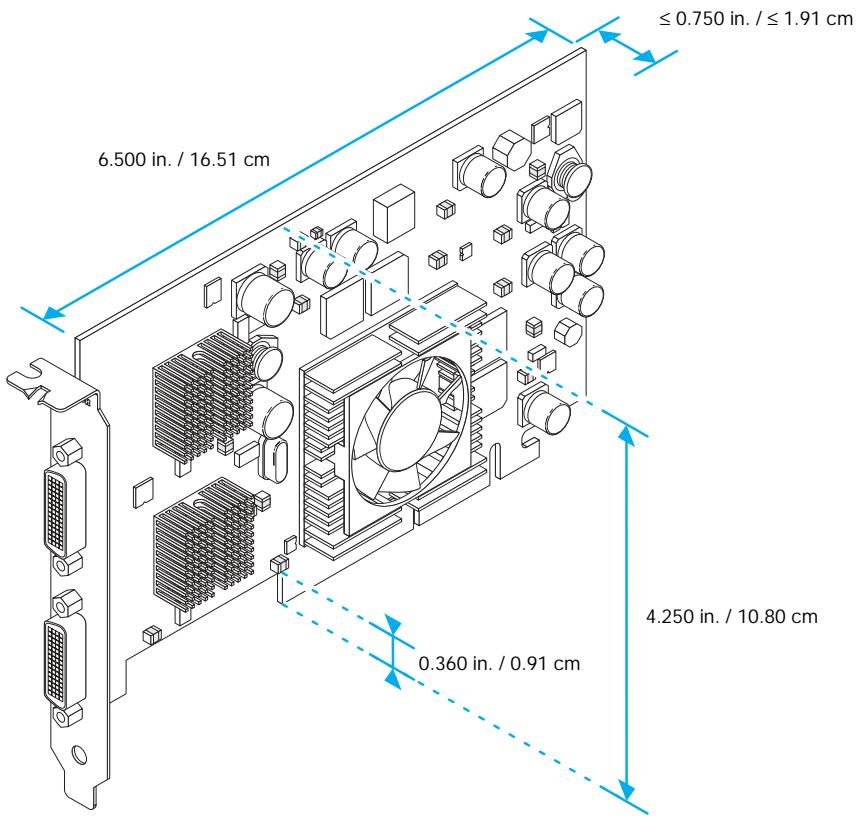
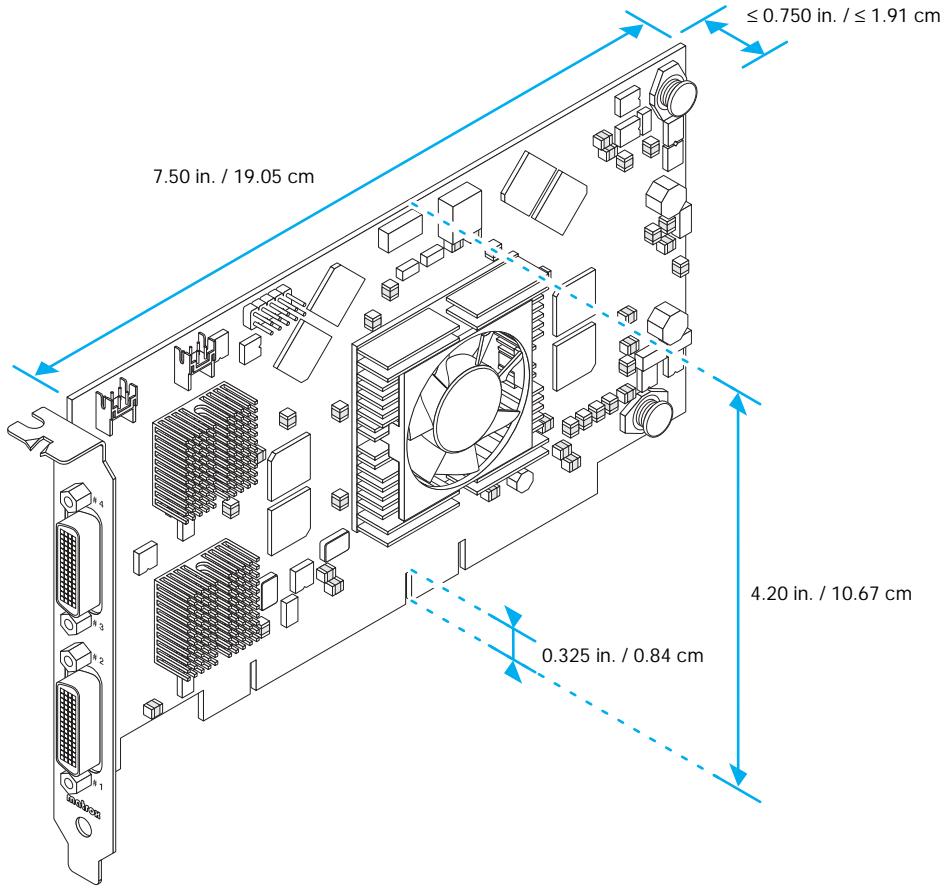
Maximum card dimensions - QID AGP
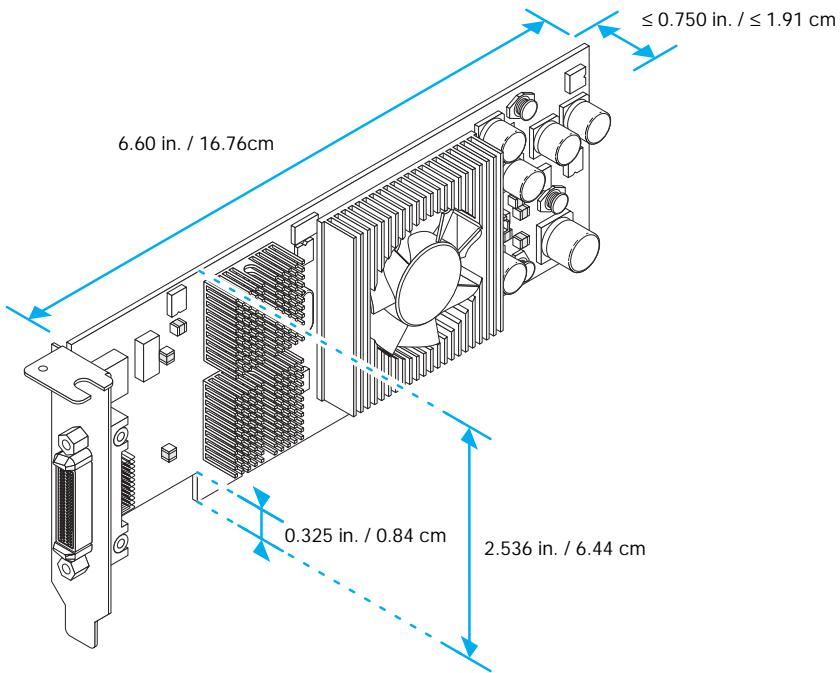
Maximum card dimensions - QID Low-profile PCI
Maximum card dimensions - QID Low-profile PCIe
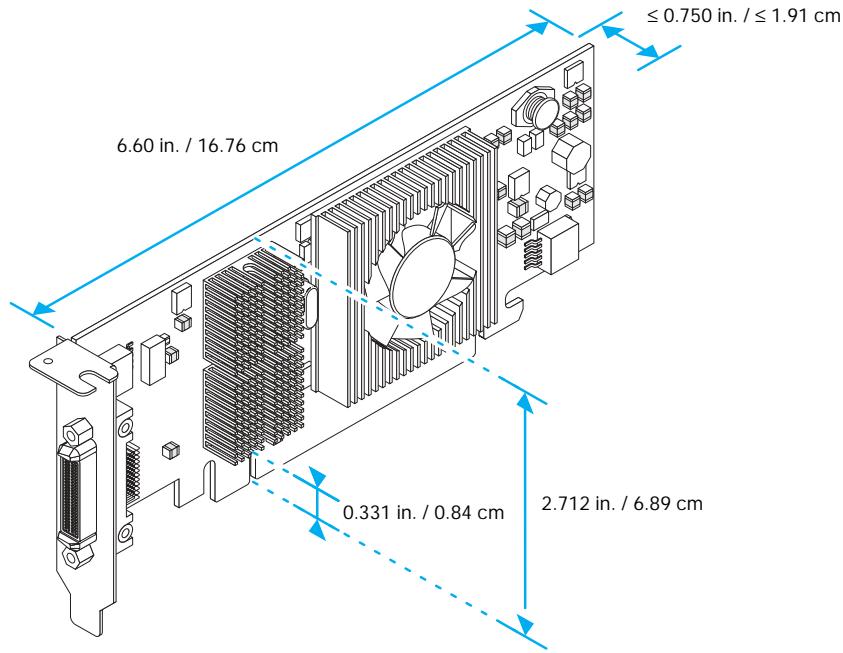
Maximum card dimensions - QID Pro
Customer support
Matrox Web
Matrox is on the Internet with a World Wide Web (WWW) site. Our Web site has product literature, press releases, technical material, a sales office list, trade show information, and other relevant material.
- Visit the Matrox Graphics Web site at www.matrox.com/graphics.
E-mail questions or comments regarding the site to webmaster@matrox.com.
If you have a problem
Matrox values your business and offers professional support for your Matrox product. For product support, contact your Matrox representative or visit our technical support Web site at www.matrox.com/graphics/support/.
Information we need
Please give a complete description of the problem, and include:
- Matrox card serial number, model number, revision number, BIOS number, driver type and version, and memory address at which the Matrox card is installed.
Computer brand and model name.
Monitor brand and model name. - Operating system, version, and service pack.
- Brand and model of any other cards and devices installed on your system.
Program specific problems
If a problem appears with a specific program, please give us the following information:
- Display settings (color palette, display resolution, and so on) applied when the problem occurs.
If possible, take note of the file and segment address that caused the problem.
Detailed steps known to cause the bug, so we can reproduce it.
Where to get information
For system information:
Windows 2000 - Right-click the My Computer icon on your Windows desktop background, then click Properties.
Windows 2000/XP - Click Start Programs (or All programs) Accessories System Tools System Information.
- Windows XP - Click Start Settings* Control Panel Performance and Maintenance* System (double-click*). (* Depending on your configuration of Windows, this part of the step may not be necessary.)
Warranty
A. Limited Warranty Statement
- Matrox Graphics Inc. ("Matrox") warrants to the end-user customer, who provides adequate proof of purchase that Matrox hardware products purchased from Matrox authorized dealers will be free from defects in materials and workmanship for a period of three (3) years from the date of purchase. This warranty applies only to the original end-user purchaser and is non-transferable. Conditions and limitations of Matrox's warranty are stated below.
- Matrox's limited warranty covers only those defects which arise as a result of normal use of the hardware and does not apply to any:
a. improper or inadequate maintenance;
b. incompatibilities due to the user's hardware or software applications with or in which the Matrox product interfaces;
c. product of a special or custom-made nature;
d. unauthorized modification or misuse;
e. improper installation, misapplication or negligence;
f. operation outside the product's environmental specifications;
g. improper site preparation or maintenance;
h.software;
i. other causes that do not relate to a product defect;
j. defects or damage suffered as a result of force majeure (including theft);
k. defects or damage suffered as a result of normal wear and tear, and/or
I. stolen goods.
- If Matrox receives, during the applicable warranty period, notice of a defect in a warranted hardware product and the defective Matrox product in question, Matrox shall at its sole option, either repair or replace the product, and shall return the repaired product or a replacement product within a reasonable delay. The replacement product may not be new, provided that it has functionality at least equal to that of the product being replaced.
- This warranty is valid in any country where Matrox hardware products are distributed by Matrox or its authorized dealers.
- This Limited Warranty Statement gives the customer specific legal rights. The customer may also have other rights which vary from state to state in the United States, from province to province in Canada, and from country to country elsewhere in the world.
B. Limitations of Warranty
- NEITHER MATROX NOR ANY OF ITS THIRD PARTY SUPPLIERS MAKES ANY OTHER WARRANTY OF ANY KIND, WHETHER EXPRESSED OR IMPLIED, WITH RESPECT TO MATROX PRODUCTS. MATROX SPECIFICALLY DISCLAIMS (and the customer, by accepting the Matrox product, specifically accepts such disclaimer and waivers) ALL OTHER WARRANTYES, EITHER EXPRESSED OR IMPLIED, INCLUDING BUT NOT LIMITED TO THE IMPLIED WARRANTY OF MERCHANTABILITY AND FITNESS FOR A PARTICULAR OR INTENDED PURPOSE OR USE AND THE WARRANTY AGAINST LATENT DEFECTS, WITH RESPECT TO THE HARDWARE AND/OR SOFTWARE. MATROX FURTHER DISCLAIMS ANY WARRANTY THAT MATROX PRODUCTS, IN WHOLE OR IN PART, WILL BE FREE FROM INFRINGEMENT OF ANY THIRD PARTY INTELLECTUAL PROPERTY OR PROPRIETARY RIGHTS.
- To the extent that this Limited Warranty Statement is inconsistent with the law of the locality where the customer purchases the Matrox product, this Limited Warranty Statement shall be deemed modified to be consistent with such local law. Under such local law, certain limitations of this Limited Warranty Statement may not apply to the consumer.
- To the extent allowed by local law, the remedies provided in this Limited Warranty Statement are the customer's sole and exclusive remedies.
C. Limitations of Liability
- EXCEPT FOR THE OBLIGATIONS SPECIFICALLY SET FORTH IN THE LIMITED WARRANTY STATEMENT, IN NO EVENT SHALL MATROX BE LIABLE FOR:
a. any direct, indirect, special, incidental, consequential, foreseeable or unforeseeable, or punitive damages, whether based on contract, tort, delict or any other legal theory and whether advised of the possibility of such damages, and/or
b. damages arising from the loss of use, data, production revenue and/or profit of in connection with the Matrox product or any business interruption.
- Without prejudice to the foregoing, any liability of Matrox for any breach of warranty shall be limited to the amount paid by the customer for the defective hardware in question.
- To the extent allowed by local law, Matrox's entire liability and the customer's exclusive remedy shall be the repair or replacement of any defective product during the warranty period. Matrox does not offer any other warranty with respect to Matrox hardware or software or any other hardware or software.
- Customer shall be responsible for all applicable taxes, duties and customs fees on any replacement unit, as well as all transport, insurance, storage and other charges incurred on all returned products.
D. Obtaining Service
- Verify that your Matrox product was installed and configured according to the information in its accompanying documentation.
- Read the "Troubleshooting" information included with the Matrox product to see if you can solve the problem yourself.
- If you are still experiencing difficulties, please contact your dealer where you purchased your Matrox product.
- If you must return a Matrox product, leave the configuration as it was when you were using it, and leave all identification stickers on the product. Pack the product in its original box and return to your Matrox dealer where the product was purchased, together with your proof of purchase. Your Matrox dealer will return the product for you. Alternatively, if this first option is unavailable to you, you may contact the Matrox Technical Support group who will issue an Return Merchandise Authorization (RMA) number, upon receipt of adequate proof of purchase, and inform you of shipping instructions. DO NOT RETURN THE PRODUCT TO MATROX WITHOUT MATROX'S RMA NUMBER AND EXPRESS AUTHORIZATION.
E. General
This limited warranty shall be governed by the laws of the Province of Quebec, Canada and the federal laws of Canada applicable therein and the courts of the Province of Quebec shall have exclusive jurisdiction to hear and decide any dispute instituted by the customer in connection with this limited warranty; the customer waivers, by accepting the product, its rights to institute proceedings in connection with this warranty against Matrox in any jurisdiction other than Quebec.
Software license agreement
Single User Products This Matrox software (the "Software") is copyrighted by Matrox Graphics Inc. All rights are reserved. The purchaser is granted a license to use the software only, subject to the following restrictions and limitations:
- The license is for the original purchaser only, and is not transferable without written permission of Matrox.
- The original purchaser may use the Software on a single computer owned or leased by the original purchaser. You may not use the Software on more than a single computer, even if you own or lease more than one computer, without written consent of Matrox.
- The original purchaser may make back-up copies of the Software for his or her own use only, subject to the use limitations of this license.
- The original purchaser may not engage in, nor permit third parties to engage in, any of the following:
Providing or disclosing the Software to third parties.
- Providing use of the Software in a computer service business, network, time-sharing, multiple CPU or multi-user arrangement to users who are not individually licensed by Matrox.
- Making alterations or copies of any kind in the Software (except as specifically permitted above).
- Attempting to unassemble, de-compile or reverse engineer the Software in any way.
- Granting sublicenses, leases, or other rights in the Software to others.
- Making copies, or verbal or media translations, of the user's guide.
- Making telecommunication data transmissions of the Software.
Matrox reserves the right to terminate this license if there is a violation of its term or default by the Original Purchaser. Upon termination, for any reason, all copies of the Software must be immediately returned to Matrox, and the Original Purchaser shall be liable to Matrox for any and all damages suffered as a result of the violation or default.
Limited warranty Matrox warrants to you, for a period of 90 days normal use from your date of purchase, that:
- The CD/disks on which the software is furnished and the documentation are not defective.
- The Software is properly recorded upon the CD/disks included.
- The documentation is substantially complete and contains all the information Matrox deems necessary to use the software.
- The Software functions substantially as described in the documentation.
Matrox's entire liability and your exclusive remedy shall be the replacement of any CD/Disks or documentation not meeting these warranties, which is returned to Matrox or an authorized dealer, together with a copy of your paid receipt. The above is the only warranty of any kind, either express or implied, including, but not limited to the implied warranties of merchantability and fitness for a particular use that is made by Matrox on this Licensed Software. In no event shall Matrox be liable to you or to any third party for consequential, special, indirect or incidental damages which you may incur as a result of using the licensed software, including, but not limited to, loss of data, or information of any kind which you may experience.
Index
A
AGP 5
B
BIOS 18,22,23
C
Connector
DVI 8
HD-15 8
LFH-60 7
Customer support 41-42
D
Display information 34-35
E
Expansion slots 5,17,22
G
Graphics
Troubleshooting 17-27
H
Hardware
Acceleration 25
Information 2,36-40
Installation 4-9
1
Installation
Hardware 4-9
Overview 3
M
Monitor
Settings 18-19,22
Multi-display mode 25
P
PCI 5,22
PCI Express 5
PowerDesk 11
Primary display 23
s
Software
Setup 10-12
Sound
Output 15
Troubleshooting 32-33
T
Troubleshooting 17-20
Extra 20-33
Graphics 17-27
Sound 32-33
TV output 30-31
Video 28-29
TV output
Connection setup 13-15
Display modes 30
Software setup 16
Troubleshooting 30-31
V
VESA 34, 35
VGA 34, 35
Video
Troubleshooting 28-29
W
Warning 4,5,7,11,13,19,21
28
Warranty 43-44
Web, Matrox 41
Thank you for choosing Matrox
Please register online (http://www.matrixx.com/graphics/registration) to be eligible for customer support, new product announcements, and information on special offers and upcoming events.
FCC Compliance Statement
Remark for the Matrox hardware products supported by this guide This equipment has been tested and found to comply with the limits for a Class A digital device, pursuant to Part 15 of the FCC Rules. These limits are designed to provide reasonable protection against harmful interference when the equipment is operated in a commercial environment. This equipment generates, uses, and can radiate radio frequency energy and, if not installed and used in accordance with the instructions manual, may cause harmful interference to radio communications. Operation of this equipment in a residential area is likely to cause harmful interference in which case the user will be required to correct the interference at his own expense.
WARNING Changes or modifications to this unit not expressly approved by the party responsible for the compliance could void the user's authority to operate this equipment. The use of shielded cables for connection of the monitor to the card is required to meet FCC requirements.
CANADA
(English) Industry Canada Compliance Statement
Remark for the Matrox hardware products supported by this guide These digital apparatus does not exceed the Class A limits for radio noise emission from digital devices set out in the Radio Interference Regulation of Industry Canada.
VCCI Compliance Statement
Remark for the Matrox hardware products supported by this guide This is a Class A product based on the standard of the Voluntary Control Council for Interference by Information Technology Equipment (VCCI). If this equipment is used in a domestic environment, radio disturbance may occur, in which case, the user may be required to take corrective actions.
(English) European user's information - Declaration of Conformity
Remark for the Matrox hardware products supported by this guide These devices comply with EC

Directive 89/336/EEC for a Class A digital device. They have been tested and found to comply with
EN55022/CISPR22 and EN55024/CISPR24. In a domestic environment these products may cause radio interference in which case the user may be required to take adequate measures. To meet EC requirements, shielded cables must be used to connect the monitor and other peripherals to the card. These products have been tested in a typical class A compliant host system. It is assumed that these products will also achieve compliance in any class A compliant system.
(English) European user's information - Directive on Waste Electrical and Electronic Equipment (WEEE)
Please refer to the Matrox Web site (www.matrox.com/environment/wee) for recycling information.

(English) A. Apparatus claims of US patent numbers 4,631,603, 4,577,216, 4,819,098, and 4,907,093 licensed for limited viewing uses only. B. This product incorporates copyright protection technology that is protected by method claims of certain U.S. patents and other intellectual property rights owned by Macrovision Corporation and other rights owners. Use of this copyright protection technology must be authorized by Macrovision Corporation, and is intended for home and other limited viewing uses only unless otherwise authorized by Macrovision Corporation. Reverse engineering or disassembly is prohibited.
(English) Disclaimer
THE INFORMATION IN THIS GUIDE IS SUBJECT TO CHANGE AT ANY TIME AND WITHOUT NOTICE.
Matrox Graphics Inc. reserves the right to make changes in specifications at any time and without notice. The information provided by this document is believed to be accurate and reliable. However, no responsibility is assumed by Matrox Graphics Inc. for its use; nor for any infringements of patents or other rights of third parties resulting from its use. No license is granted under any patents or patent rights of Matrox Graphics Inc.
Dorval, Quebec, Canada H9P 2T4
North America: 1-800-361-1408
International: (514) 822-6000
Email: graphics@matrox.com
Web site: www.matrixx.com/graphics
Technical support:
www.matrox.com/graphics/support
To locate the sales office nearest you, visit
www.matrox.com/graphics/contact

- matrox QID Series
- QID • QID Pro • QID Low-profile
- Overview
- Hardware supplied
- Matrox QID and QID Pro
- Matrox QID Low-profile PCI and PCIe
- Software supplied (for Windows 2000/XP)
- Installation overview
- Hardware installation
- Open your computer and remove your existing graphics card*
- Choose an expansion slot
- Insert your Matrox card
- Replacing brackets on a low-profile graphics card
- Connection setup
- Connect your dual-monitor cables or quad-monitor cable
- Connect your monitors
- Software setup
- This section describes how to install Matrox software for Windows 2000/XP.
- Install display driver
- Install optional software
- Configure your monitor settings
- Set up your display software
- Adjust your display resolution
- TV output
- Turn off computer
- Replace your multi-monitor cables
- Connect video output
- Connect audio output
- SCART information
- Troubleshooting
- Basic procedures
- Restarting in VGA mode
- Graphics - Main troubleshooting
- Problem Computer doesn't display information or boot after Matrox card is installed
- Problem Wrong color balance, screen image off-center, or no picture at all
- Problem After the startup screen, or after display settings are changed, the screen image is garbled or unusable
- Windows 2000/XP -
- Graphics - Extra troubleshooting
- Problem Can't use Windows, Windows reports a configuration error, and/or can't install or uninstall display driver
- Problem Monitor settings aren't automatically detected
- Cause
- Solution
- Problem Built-in network card doesn't work after multi-monitor graphics card is installed
- Problem 3D and video programs don't work
- Problem After game for Windows 2000/XP starts, monitor doesn't display properly
- Problem Using multiple displays under Windows 2000/XP, program doesn't work with main graphics card
- Problem Not all graphics cards in the computer are fully supported (Software doesn't work with a certain graphics card, or another graphics card doesn't work at all)
- Problem In multi-display mode, displays aren't numbered consecutively
- Problem Screen image defects appear, program doesn't run properly, or Windows doesn't work properly (example: mouse pointer not drawn properly)
- Windows XP -
- Problem Program window or dialog box doesn't appear on screen
- Solution Windows 2000/XP -
- Problem Display on digital monitor appears blurry or uses only a portion of the screen
- Problem Windows elements and text appear too small on screen
- Problem Can't select one or more display resolutions supported by your monitor
- Video
- Problem Video file playback is jerky (skipping frames)
- Problem Mouse pointer flickers or disappears when it's over a video window
- Problem Can't view video
- Problem Poor TV or video recorder image quality
- Problem Can't record video with a video recorder
- Sound
- Problem Sound doesn't record, video files play back with no sound, or sound output is distorted or too loud
- Display information
- Supported VESA modes (main display)
- Hardware information
- Features
- Environmental specifications
- Digital flat panel information
- Maximum card dimensions - QID Low-profile PCIe
- Maximum card dimensions - QID Pro
- Customer support
- Matrox Web
- If you have a problem
- Information we need
- Program specific problems
- Where to get information
- Warranty
- Limited Warranty Statement
- Limitations of Warranty
- Limitations of Liability
- Obtaining Service
- General
- Software license agreement
- Index
- Thank you for choosing Matrox
- FCC Compliance Statement
- CANADA
- (English) Industry Canada Compliance Statement
- VCCI Compliance Statement
- (English) European user's information - Declaration of Conformity
- (English) European user's information - Directive on Waste Electrical and Electronic Equipment (WEEE)
- (English) Disclaimer
Brand : MATROX
Model : QID, QID PRO
Category : Graphic card