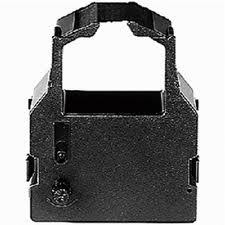
LC-240 - Printer STAR - Free user manual and instructions
Find the device manual for free LC-240 STAR in PDF.


| Product Type | Serial impact dot matrix printer |
| Model | STAR LC-240 |
| Print head | 24 pins, lifespan 100 million dots per pin |
| Print speed (Draft) | 160 cps at 10 cpi, 192 cps at 12 cpi |
| Print speed (LQ) | 53 cps at 10 cpi, 64 cps at 12 cpi |
| Graphic resolution | Up to 360 dpi (bidirectional or unidirectional) |
| Paper formats | Single sheets (A4, Letter) and fanfold paper |
| Paper tray capacity | Approximately 55 sheets (64 g/m²) |
| Paper width (sheet) | 178 to 267 mm |
| Paper length (sheet) | 140 to 356 mm |
| Paper thickness | 0.07 to 0.12 mm (sheet), up to 0.21 mm for forms |
| Power supply | Standard mains (rated voltage indicated on device) |
| Power consumption | Sleep mode reduces consumption by about 20% |
| Interface | Centronics parallel (cable not supplied), serial option via SPC-8K converter |
| Emulations | Standard and IBM (selectable via configuration utility) |
| TrueType fonts | Supplied with configuration utility, installable under Windows |
| Operating environment | Temperature 10-35°C, humidity 30-80% |
| Maintenance | External cleaning with a soft cloth; replacement of the ribbon cartridge |
| Safety | Do not expose to direct sunlight, heat sources, moisture; use a stable power outlet |
| Spare parts / Options | Ribbon cartridges (color or monochrome), PT-10Y tractor unit, SPC-8K serial/parallel converter |
Frequently Asked Questions - LC-240 STAR
User questions about LC-240 STAR
0 question about this device. Answer the ones you know or ask your own.
Ask a new question about this device
Download the instructions for your Printer in PDF format for free! Find your manual LC-240 - STAR and take your electronic device back in hand. On this page are published all the documents necessary for the use of your device. LC-240 by STAR.
USER MANUAL LC-240 STAR
This device carries the VDE RFI protection mark to certify that it meets the radio interference requirements of the Postal Ordinance No. 243/1991. The additional marking "Vfg. 243/P" expresses in short form that this is a peripheral device (not operable alone) which only individually meets the Class B RFI requirements in accordance with the DIN VDE 0878 part 3/11.89 and the Postal Ordinance 243/1991.
If this device is operated in conjunction with other devices within a set-up, in order to take advantage of a "General (Operating) Authorization" in accordance with the Postal Ordinance 243/1991, the complete set-up must comply with the Class B limits in accordance with the DIN VDE 0878 part 3/11.89, as well as satisfy the preconditions in accordance with §2 and the prerequisites in accordance with §3 of the Postal Ordinance 243/1991.
As a rule, this is only fulfilled when the device is operated in a set-up which has been type-tested and provided with a VDE RFI protection mark with the additional marking "Vfg 243".
Machine Noise Information Ordinance 3. GSGV, January 18, 1991: The sound pressure level at the operator position is equal or less than 70dB(A) according to ISO 7779.
The above statement applies only to printers marketed in Germany.
Trademark acknowledgments
LC-240C, LC-240, LC24-30, NX-2450, PT-10Y, SPC-8K: Star Micronics Co. Ltd.
LQ850, LQ860, LQ1050, LQ1060: Seiko Epson Corporation
IBM PC, IBM Proprimer X24E, IBM Proprimer XL24E, IBM Proprimer X24, IBM Proprimer XL24: International Business Machines Corporation.
TrueType: Apple Computer Inc.
MS-DOS, Microsoft Windows, Windows 3.1: Microsoft Corporation
Notice
- All rights reserved. Reproduction of any part of this manual in any form whatsoever, without STAR's express permission, is strictly forbidden.
The contents of this manual are subject to change without notice. - All efforts have been made to ensure the accuracy of the contents of this manual at the time of printing. However, should any errors be found, STAR would greatly appreciate being informed of them.
- The above notwithstanding, STAR can assume no responsibility for any errors in this manual.
© Copyright 1994 Star Micronics Co., Ltd
LC-240C, LC-240, LC24-30, NX-2450, PT-10Y, SPC-8K: Star Micronics Co. Ltd.
LQ850, LQ860, LQ1050, LQ1060: Seiko Epson Corporation
IBM PC, IBM Proprinter X24E, IBM Proprinter XL24E, IBM Proprinter X24, IBM Proprinter XL24: International Business Machines Corporation.
TrueType: Apple Computer Inc.
MS-DOS, Microsoft Windows, Windows 3.1: Microsoft Corporation
Avis
LC-240C, LC-240, LC24-30, NX-2450, PT-10Y, SPC-8K: Star Micronics Co. Ltd.
LQ850, LQ860, LQ1050, LQ1060: Seiko Epson Corporation
IBM PC, IBM Proprinter X24E, IBM Proprinter XL24E, IBM Proprinter X24, IBM Proprinter XL24: International Business Machines Corporation.
TrueType: Apple Computer Inc.
MS-DOS, Microsoft Windows, Windows 3.1: Microsoft Corporation
Hinweis
LC-240C, LC-240, LC24-30, NX-2450, PT-10Y, SPC-8K: Star Micronics Co. Ltd.
LQ850, LQ860, LQ1050, LQ1060: Seiko Epson Corporation
IBM PC, IBM Proprimer X24E, IBM Proprimer XL24E, IBM Proprimer X24, IBM Proprimer XL24: International Business Machines Corporation.
TrueType: Apple Computer Inc.
MS-DOS, Microsoft Windows, Windows 3.1: Microsoft Corporation
Avvertenze
This manual describes how to set up, use, and care for the Star LC-240C color printer, and the LC-240 monochrome printer. All of the operations contained in this manual apply to all of these models, except where specifically noted otherwise.
The following is a list of what you can expect to find in each chapter.
Chapter 1 Choosing a place for your printer, unpacking and setup, ribbon cassette installation, loading paper, connecting to your printer
Chapter 2 Installing and starting up, and using User Setup Utility
Chapter 3 How to set up for printing with Microsoft Windows 3.1, how to prepare for printing, how to print a document, how to install TrueType fonts, how to select fonts from within an application
Chapter 4 How to use the control panel
Chapter 5 Selecting the best type of paper, adjusting for paper thickness, manual sheet feeding, clearing paper jams
Chapter 6 How to set up for printing with MS-DOS, how to select fonts from within an application
Chapter 7 How to pause printing, paper feed operations, form feeding
Appendix A How to deal with printing problems
Appendix B Specifications
Appendix C Interface information
Appendix D Character sets
Appendix E Printer control codes
Chapter 1: Printer Setup 1
Choosing a place for the printer 1
Unpacking the printer 3
General guide 3
Opening the front cover 5
Removing the print head protector (LC-240C only) 5
About ribbon cartridges 5
Installing the ribbon cartridge 7
Installing the paper support 9
Connecting to your computer 9
Connecting to a power outlet 11
Loading paper 13
Detaching the automatic sheet feeder 17
Re-installing the automatic sheet feeder 19
Chapter 2:User Setup Utility 21
Installing the User Setup Utility 21
Starting up the User Setup Utility 25
Changing User Setup Utility parameter settings 27
Using the General window 29
Using the Font window 33
Using the Paper window 37
Adjusting the printer's vertical alignment 39
Changing the printer port 43
Saving setup data as a new configuration file 43
Saving changed setup data in the current configuration file 45
Importing setup data from a configuration file 45
Returning to default settings 47
Exiting the User Setup Utility 47
Using the Help window 49
Chapter 3: Using the Printer with Windows 3.1 51
Setting up for printing with Microsoft Windows 3.1 51
Getting ready to print 55
Printing a document 59
Installing TrueType fonts 61
Selecting fonts in Windows applications 63
Chapter 4: Control Panel Operations 65
To enter the Sleep Mode 65
To restore full power from the Sleep Mode 65
To switch between the Ready and Not-Ready Modes 67
To feed single-sheet paper into the printer 67
To eject single-sheet paper from the printer 67
To advance paper 67
Errors 67
Chapter 5: Paper Handling 69
Selecting paper types 69
Adjusting for paper thickness 71
Automatic sheet feeding 71
Manual sheet feeding 73
Clearing paper jams 73
Chapter 6: Using the Printer with MS-DOS 75
Setting up for printing with MS-DOS 75
Selecting fonts in MS-DOS applications 77
Chapter 7: Other Printing Features 79
How to pause printing 79
Line feed 79
Form feed 79
Appendix A: Troubleshooting 81
Testing the printer 81
Troubleshooting guide 87
Checking system software settings in Windows 101
Checking system software settings in MS-DOS 103
Checking the port settings in the User Setup Utility 103
Appendix B: Specifications 105
Appendix C: Interface Pin Outs 109
Appendix D: Character Sets 110
Appendix E: Printer Control Codes 113
This chapter contains important information on setting up your printer. Be sure to read this chapter carefully before using the printer for the first time. In this chapter you will learn about:
□ Choosing a place for the printer
Unpacking and setting up the printer
□ Installing the ribbon cassette
Loading paper
- Connecting to your computer
Choosing a place for the printer
Before actually unpacking the printer, you should take a few minutes to think about where you plan to use it. Remember the following points when doing this.
Choose a firm, level surface where the printer will not be exposed to vibration.
- The power outlet you plan to connect to for power should be nearby and unobstructed.
Make sure that the printer is close enough to your computer for you to connect the two with your printer cable.
Allow six inches (15 centimeters) of free space on either side of the printer. If you are going to use fanfold paper, make sure that there is adequate space for paper behind the printer.
Make sure that the printer is not exposed to direct sunlight.
Make sure that the printer is well away from heaters.
Make sure that the surrounding area is clean, dry, and free of dust.
Make sure that the printer is connected to a reliable power outlet. It should not be on the same electric circuit as copiers, refrigerators, or other appliances that cause power spikes.
Use a power outlet that matches the power rating noted on the label affixed to the bottom of your printer.
Make sure that the room where you are using the printer is not too humid.
Unpacking the printer
Check to make sure that the carton contains each of the items shown in the following illustration.
If anything is missing, contact the store where you bought the printer and ask them to supply the missing part.
A push tractor unit (PT-10Y) and a Serial-To-Parallel Interface Converter (SPC-8K) are also available as options. Consult with your dealer for details on these options.
Note:
It is a good idea to keep the original box and all the packing materials just in case you later need to pack the printer up again and send it somewhere at a later date.
General guide
The following illustrations show the major component parts of the your printer.
Opening the front cover
Hook your fingers under the two small tabs on either side of the front cover and pull upwards to swing the front cover open.
Note:
You can completely remove the front cover from the printer. However, we recommend that you normally leave it in place. The cover protects against objects getting into the printer, and it cuts down on printer noise.
Removing the print head protector (LC-240C only)
If your printer is a color model, its print head will be enclosed in a protector that guards against damage during shipping. Before using the printer, you must remove the print head protector as shown in the following illustration.
About ribbon cartridges
The type of ribbon cartridge that comes with your printer depends on whether it is a color printer or a monochrome printer. Monochrome printer models come with a monochrome ribbon cartridge with a built-in print head shield, while color printer models come with a color cartridge without a print head shield (this is because the color printer has its own print head shield). In addition, monochrome ribbon cartridges for use on a color printer model are available as an option.
Installing the ribbon cartridge
- Rotate the knob on the cartridge clockwise to take up any slack in the ribbon.
- Carefully push the cartridge holder by hand all the way to the left side as far as it will go.
Important!
Never try to move the print head while the printer is plugged in. Doing so can damage the printer. If you have just used the printer, let the print head cool for a few minutes before you touch it.
- Carefully place the cartridge onto the cartridge holder making sure that the spindle of the holder fits into the socket on the bottom of the cartridge.
Print head shield
If you have a color printer model, be sure to carefully position the ribbon between the print head and the print head shield as shown in the illustration.
Press down gently but firmly on the cartridge to make sure that it is securely in place. The cartridge should move slightly (about 1/10 or 2.5mm ) when you press down on it.
- Rotate the knob on the cartridge again to take up any slack.
Important!
If you have a color printer model, be sure to double check that the ribbon is properly positioned between the print head and print head shield. If it isn't, you may get poor print quality or even end up damaging the ribbon.
- Replace the front cover of the printer. Press down on the raised parts at the back of the cover until it snaps securely shut.
Installing the paper support
- Insert the ends of the paper support into the slots on the printer as shown in the following illustration.
Connecting to your computer
The computer sends data to the printer through a cable. This printer does not come with a cable, so you must purchase one of your own. You will probably want to use a standard parallel cable for connection, but note that you can also use an optional Serial-To-Parallel Interface Converter (SPC-8K).
Important!
The following instructions apply to the Centronics parallel cable that is used with an IBM-compatible personal computer. Note that they do not apply to all types of computers and cables. If you are unsure about what type of cable you should use to connect with your computer, consult with your dealer.
For an IBM-compatible personal computer:
Use a standard 36-pin Centronics parallel cable.
- The parallel cable should be no longer than six feet (two meters). Longer cables can result in poor transfer of information.
Important!
Make sure that the printer is unplugged from the AC outlet and that the computer is switched off before connecting them.
Installation du support papier
Plug one end of the parallel cable into the parallel port of your computer. The parallel port should be labelled "Printer", "Parallel", "PRN", "LPT1", or something similar.
Plug the other end of the parallel cable into the socket on the side of the printer and secure it in place with the clips.
Note:
Consult with your dealer for details on how to set up your computer when using the optional SPC-8K Serial-To-Parallel Interface Converter.
Connecting to a power outlet
Plug the power cord of the printer into a standard power outlet whose voltage matches the power rating noted on the label affixed to the bottom of your printer.
Note that the printer does not have a power switch to turn power on and off. Instead, its Sleep Mode automatically reduces power consumption whenever you leave the printer unattended. For full details about the Sleep Mode, see "Sleep" on page 33 of this manual.
Important!
We recommend that you unplug the printer from the power outlet whenever you do not plan to use it for long periods. Because of this, you should locate the printer so that the power outlet it is plugged into is nearby and easy to access.
This section tells you how to load single-sheet A4 or Letter paper into the printer's built-in automatic sheet feeder. Note that you can also use fanfold paper and multi-page form paper. For details on using other types of paper, see "Paper Handling" on page 69 of this manual.
Important!
The automatic sheet feeder is designed to easily detach from the printer when clearing paper jams or when installing the optional push tractor feeder. If the automatic sheet feeder accidentally becomes detached, see "Re-installing the automatic sheet feeder" on page 19 for details on how to re-install it correctly.
Pull the paper tray cover of the automatic sheet feeder forward.
- Slide the left-hand paper guide all the way to the left.
Pick up the stack of paper with both hands, and fan through the paper with your thumb. This prevents paper from sticking together when it is fed by the automatic feeder.
Note:
The automatic sheet feeder can hold about 55 sheets of paper at one time.
Make sure that all four edges of the stack are smooth and even. Tap the edges on the top of a table or a desk to even them out.
- Carefully place the paper into the paper tray against the right-hand stationary paper guide. Make sure that the left and right edges of the paper stack are under the retaining clips inside the tray.
- Slide the left-hand paper guide to the right so that the stack of paper now sits snugly between the two guides. The paper should be able to slide freely into the printer, but it should not be able to move from side to side.
Push the paper tray cover of the automatic sheet feeder closed.
The following procedure describes how to detach the automatic sheet feeder (to clear a paper jam or to attach the optional push tractor unit) and how to reinstall it. Be sure to follow the following instructions carefully to ensure proper operation of the printer.
Important!
Always handle the automatic sheet feeder carefully, and put it somewhere safe whenever it is detached from the printer.
Open the front cover of the printer.
Grasp the automatic sheet feeder and pull it gently towards the front of the printer until it stops.
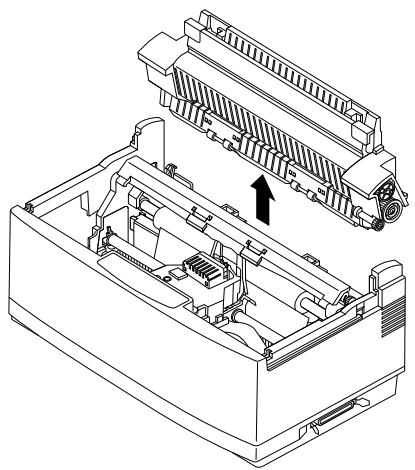
- Lift the automatic sheet feeder straight up.
Re-installing the automatic sheet feeder
Open the front cover of the printer.
- Carefully lower the automatic sheet feeder into the printer, making sure that the two round tabs on either end of it enter into the corresponding slots inside the printer. You should have the automatic sheet feeder angled towards the front of the printer (at about the same angle that it was when you pulled the feeder forward while detaching it).
Lower the automatic feeder all the way down. When you do, it should naturally slip into place, with the part that holds the paper angled slightly towards the back of the printer.
- Close the front cover of the printer.
Chapter 2: User Setup Utility
In addition to the Windows 3.1 driver, the 3.5" floppy disk that comes with this printer also contains a User Setup Utility that gives you total control over a variety of printing features and functions. In this chapter you will learn about:
□ Installing the User Setup Utility
Starting up the User Setup Utility
□ Editing setup data
Saving and loading setup data
- Exiting the User Setup Utility and sending the settings to the printer
Important!
All the procedures in this chapter assume that you are using a mouse and that you are familiar with common mouse operations like click and double-click. If you need information on mouse operations, see your computer manual. If you want to operate the User Setup Utility without using a mouse (using function keys, arrow keys, and the tab key) refer to the key function explanations at the bottom of each User Setup Utility screen.
Installing the User Setup Utility
- Insert the disk that contains the User Setup Utility into one of your computer's disk drives. This explanation assumes you are using the A: drive, but you could use any drive. Just remember to change the "A:" drive name specifications in the following steps to the name of the drive you are using.
Important!
Note that you cannot use a mouse to navigate inside the User Setup Utility installation screens. Instead, you must use the arrow, Enter, backspace, and Delete keys as noted on the installation screens and in the following procedures.
Capitolo 2: II programming User Setup Utility
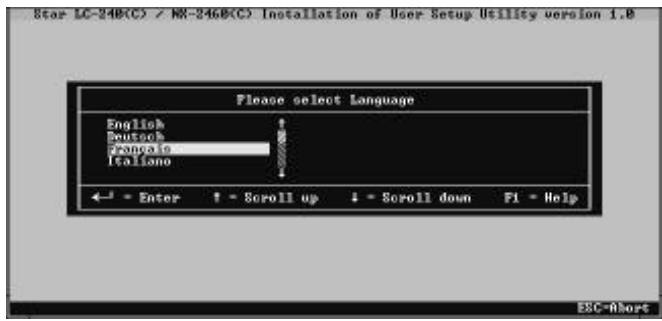
Execute the command that installs the User Setup Utility: A:>SETUP
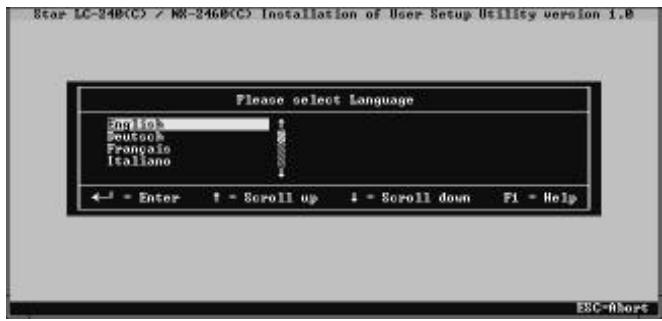
- Select the language you want to use and then press Enter.
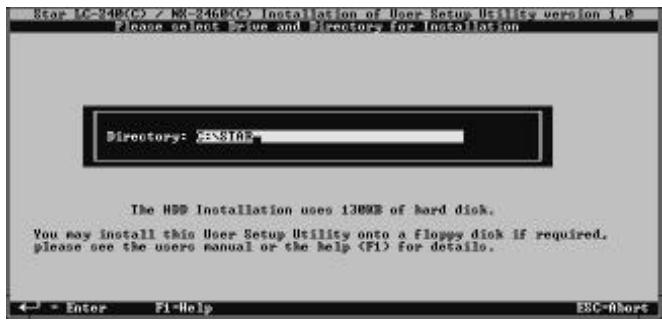
The above screen appears in the language that you selected in the previous step.
Input the drive and directory names where you want the User Setup Utility stored. The following is the default directory name that creates a directory named "star" on your hard disk (drive C:) to store the User Setup Utility. C:\star
You can use the left and right arrows, Delete and Back space when making changes in the box that contains the drive and directory names. If you require assistance while this screen is shown, press F1 for help.
-
After you specify drive and directory names, press Enter. The User Setup Utility program is started up as soon as you press Enter, so you can use the pull-down menus to make the setup changes you want.
-
Executeur la commande d'installation de l'utilitaire de configuration : A:>SETUP
Starting up the User Setup Utility
To start up the User Setup Utility, move to the directory you specified under "Installing the User Setup Utility" on page 21. If you want to move to the directory we named "star" in our example in the previous section, you would input the following:
C:>cd star
Next, input the command to launch the User Setup Utility:
STARSET
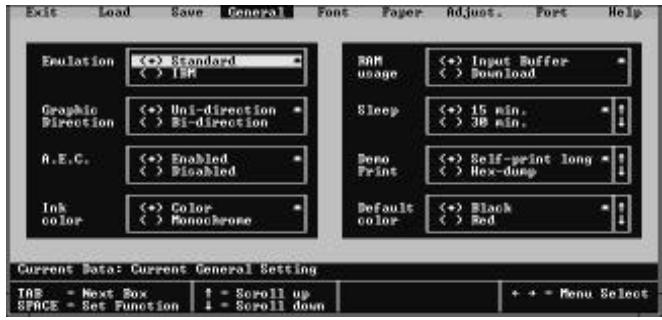
When you start the User Setup Utility, it reads and displays the printer's current settings.
Now you can use the pull-down menus described below to make the setup changes you want.
If the printer is not connected to your computer or if the power of the printer is switched off, the following message appears on the display when you start up the User Setup Utility.
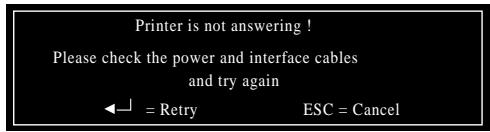
Check the connection between the computer and the printer, and check the power. After correcting the problem, press Enter to continue.
The above message also appears when your computer and printer are connected through an optional Serial-to-Parallel Interface Converter or when using a non conforming parallel cable. In such a case, simply press the computer's ESC key to clear the message.
Your printer cannot read the settings if your computer and printer are connected through an optional Serial-To-Parallel Interface Converter. In such a case, you can still use the User Setup Utility to send settings to the printer, but you cannot read the printer's current settings.
Changing User Setup Utility parameter settings
Changing User Setup Utility parameter settings is quite easy, regardless of whether you are using a mouse or the keyboard. The following are basic operations that you can use to change parameters in the General, Font, Paper, Adjust., and Port windows.
To select a window
- Highlight the name of the window you want to display by clicking on it in the menu bar, or by using the left and right arrow keys.
To select a parameter box
- Select the parameter box that you want by clicking inside the box with the mouse or by moving to the box using the keyboard's Tab key.
Parameters are grouped inside of boxes on the screen. When you first display a window, the current setting of the parameter in the first (upper left) box in the window is highlighted to indicate that it is selected. When you select a parameter box, the parameter's current selection is highlighted.
About parameter boxes
Note that there are two types of parameter boxes. Some have up and down arrows on the right side, which indicates that there are more than two possible settings for these particular parameters.

After you select such a box (by clicking inside it with the mouse or by moving to it by pressing Tab), use the mouse to click on the up and down buttons to scroll through the available settings. You can also use the up and down arrow keys to scroll through available settings.
Important!
The other type of parameter box are "toggle" type, which means that you select one setting or the other.

Note that with both types of parameter boxes, the currently selected setting is indicated by a ball inside the parentheses on the left of the setting.
Asterisks to the right of the parameters indicate default settings.
To change a parameter setting
- Select the parameter box (by clicking inside it with the mouse or by moving to it by pressing Tab) that contains the setting you want to change.
- Highlight the setting you require by clicking on it with the mouse, or by using the up and down arrows. Then select that setting by clicking the mouse or by pressing the space bar.
A setting is selected when there is a ball inside the parentheses on the left of the setting. Remember that if the parameter box has up and down arrows on the right side, you may have to scroll through the settings in order to display the one that you want before you can select it.
Using the General window
While in the User Setup Utility, select General from the menu bar.
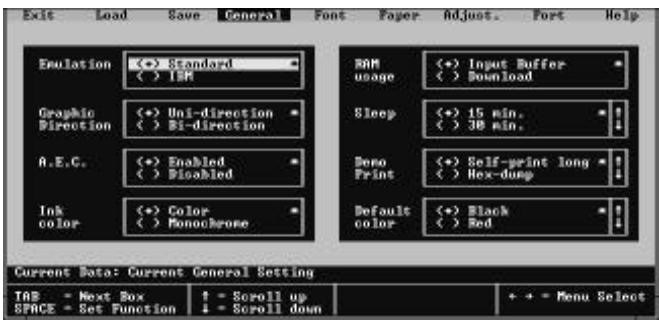
The following describes the various settings that are available for each parameter on this screen.
- Select either standard emulation or IBM emulation.
Note that the emulation you choose determines the character set and printer control commands that are applied for printing. See "Character Sets" on page 110 for the character sets used by each type of emulation. See "Printer Control Codes" on page 113 for details on printer control commands.
Unless you specifically need the IBM character set, we recommend that you normally use Standard emulation. If you select IBM emulation, you will also need to select an IBM printer driver.
Graphic Direction
- Select either unidirectional (Uni-direction) or bidirectional (Bi-direction) printing for graphics.
Bidirectional printing is faster, while unidirectional printing generally provides better print quality.
A.E.C.
Switch A.E.C. on (Enabled) or off (Disabled).
The letters A.E.C. stand for Automatic Emulation Change. As its name suggests, enabling this feature tells the printer to automatically select the proper emulation mode (standard or IBM) to match the printer driver selected in the application you are using.
Ink color
- Specify use of either a color ink ribbon (Color) or monochrome ink ribbon (Monochrome).
Always use the correct setting. Selecting Monochrome when using a monochrome ink ribbon provides longer ribbon life.
Note that this option does not appear or its selection may be disabled if the printer you are using is not a color printer.
RAM usage
- Specify whether RAM should be used as an input buffer or as a download buffer. Selecting Input Buffer tells the printer to use available RAM to store data it receives from the computer. This speeds up the printing operation, but it also means that RAM cannot be used to store character patterns used to define down loaded characters.
Selecting Download tells the printer to use available RAM to store character patterns you define using the download character control codes (page 113).
Emulation
- Specify how long the printer should wait until entering the Sleep Mode. The Sleep Mode is entered automatically whenever no printer operation is performed for the amount of time that you specify here. Note the following characteristics about the Sleep Mode:
Power consumption is reduced by about 20% of normal.
Any data stored in the printer's buffer is cleared.
The Sleep Mode is exited when the computer sends data to the printer or when you press the Power button.
Demo Print
- Specify the type of printout to be produced when the demo print operation is performed.
See "Testing the printer" on page 81 for details on the demo print operation.
Default color
- Specify the color to use for printing when color is not specified by the application.
Note that this option does not appear or its selection may be disabled if the printer you are using is not a color printer.
Using the Font window
While in the User Setup Utility, select Font from the menu bar.
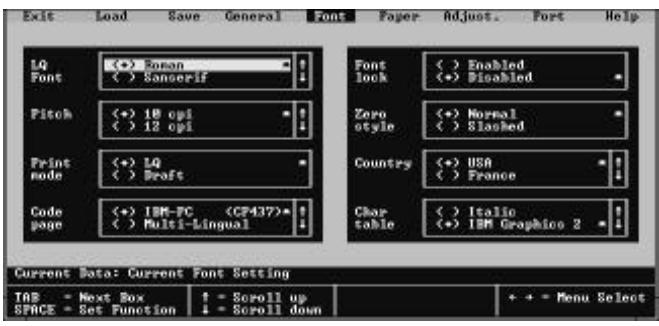
The following describes the various settings that are available for each parameter on this screen.
Mode veille
- Select the font that you want to use as the printer's default letter-quality font.
Pitch
Select the print pitch (character spacing) you want to use for printing.
Print mode
- Select the print mode you want to use.
Selecting LQ provides letter quality output, while selecting Draft provides draft quality. Draft quality printing may be less attractive than letter quality, but the printing operation is faster.
Code page
- Select the code page you want to use for printing.
For details on what characters are included in each code page, see "Character Sets" on page 110 of this manual.
Font lock
Switch the font lock on (Enabled) or off (Disabled).
When font lock is enabled, the printer will not allow the font to be changed by the software application you are using. When disabled, the application software can control the fonts used for printing.
Zero style
- Select the type of zero you want to use.
Selecting Normal prints zeros without lines running through them, while Slashed prints zeros with a diagonal slash running through them.
Country
- Select the international character set you want to use for printing.
The international character sets you can select in this menu are: U.S.A., France, Germany, England, Denmark-1, Sweden, Italy, Spain-1, Japan, Norway, Denmark-2, Spain-2, Latin America, Korea, Irish, Legal.
For details on what characters are included in these character sets, see "Character Sets" on page 110 of this manual.
Char table
- Select the character table you want to use for printing.
For details on what characters are included in these character tables, see "Character Sets" on page 110 of this manual.
Police LQ
Using the Paper window
While in the User Setup Utility, select Paper from the menu bar.
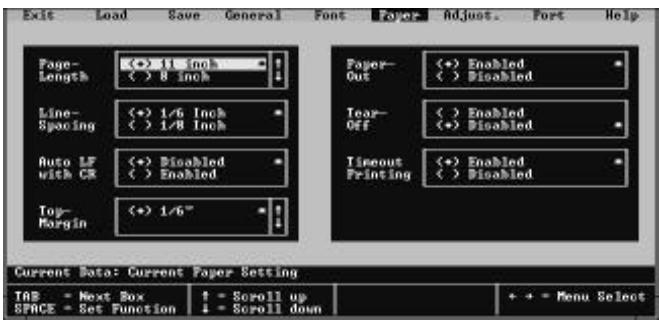
The following describes the various settings that are available for each parameter on this screen.
Page Length
Specify the length of the paper you are using.
Line Spacing
Select the line spacing you want to use.
Auto LF with CR
Switch auto LF with CR on (Enabled) or off (Disabled).
When auto LF (line feed) with CR (carriage return) is disabled, the computer must send both a line feed code and a carriage return code at the end of each line. Most applications do this automatically. When auto LF with CR is enabled, the printer automatically performs a line feed whenever it receives a carriage return from the computer.
Note the following check points when trying to figure out which setting to use here:
√ If you find that your output is double-spaced when it should not be, change this setting to Disabled.
√ If you find that lines are printing over each other, change this setting to Enabled.
- Select the spacing from the top of the paper to the first line of printing.
Paper Out
- Switch the paper out detect function on (Enabled) or off (Disabled).
When paper out detection is enabled, the printer automatically stops printing whenever it senses there is no more paper. When disabled, the printer continues printing as long as there is data. Disabling this function makes it possible to print right up to the bottom of a page, but it also creates the danger or printing when there is no paper loaded in the printer, which can damage the print head and platen.
Tear Off
- Switch the tear-off function on (Enabled) or off (Disabled).
This function controls a feature of the optional PT-10Y Push Tractor Unit. For details on this feature, see the Users Manual that comes with the Push Tractor Unit.
Timeout Printing
Switch time-out printing on (Enabled) or off (Disabled).
When time-out printing is enabled and paper is loaded in the Auto Sheet Feeder, the printer waits for 30 seconds after printing. If no further data is received within 30 seconds, the printer ejects the current page. The page is not ejected automatically when time-out printing is disabled.
Adjusting the printer's vertical alignment
While in the User Setup Utility, select Adjust. from the menu bar.
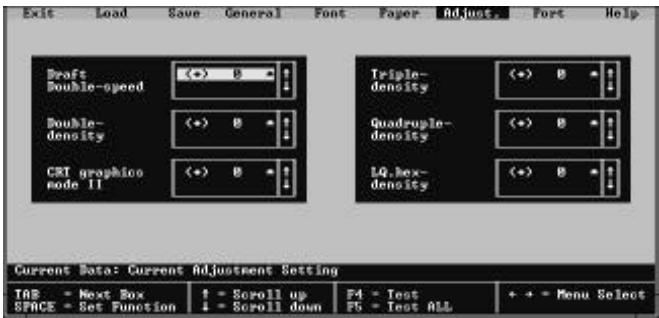
Marge Haute
The above window is used to test and adjust the vertical alignment of the printer in each printing mode. You may never have to use the procedure described in this section, but after you have been using your printer for some time you may find that the dots of some graphics do not align correctly. For example, what should look like:

may come out looking like one of the following:

or like this:

This is caused when mechanical parts of the printer get out of alignment. This happens only rarely and you may never experience it at all throughout the life of the printer. If you do have problems, use the following procedure to correct it.
- Select the box for the mode you want to adjust (by clicking inside it with the mouse or by moving to it by pressing Tab).
Press your computer's F4 function key to produce a test printing for that mode, or press function key F5 to produce a test of all the printing modes.
The printer will print something that looks like the following and feed the paper so you can see the printout clearly.
Double-density
-2:

If you see that your printer requires adjustment, select the box for the mode you want to adjust (by clicking inside it with the mouse or by moving to it by pressing Tab).
Next, select a negative value to shift the lower row left, or a positive value to shift the lines right. The extent of the shift is indicated by the size of the value.
Use the same procedures as you do for other parameters to scroll through the list of settings and select the one you want (see "Changing User Setup Utility parameter settings" on page 27).
After you make an adjustment, you can check its affect on printing by printing a test again.
Repeat the above steps for each mode, if necessary
Changing the printer port
The following operation is used to supply printer port information to the computer.
While in the User Setup Utility, select Port from the menu bar.
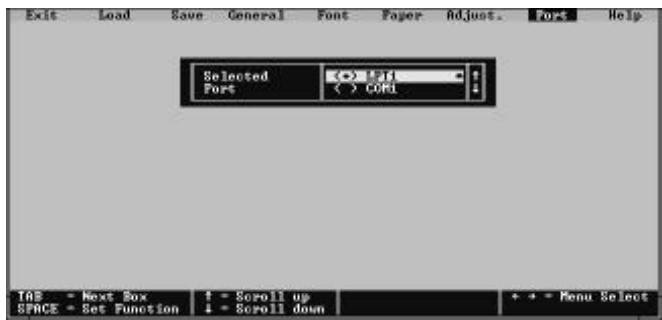
- Select the port name you want to use from the list on the display.
If you are using a parallel cable, you will probably be using LPT1. If you are using the optional Serial-To-Parallel Interface Converter, you should normally be using COM1 or COM2.
Saving setup data as a new configuration file
Use the following procedure to save the current User Setup Utility settings as a configuration file.
While in the User Setup Utility, select the Save item from the menu bar.
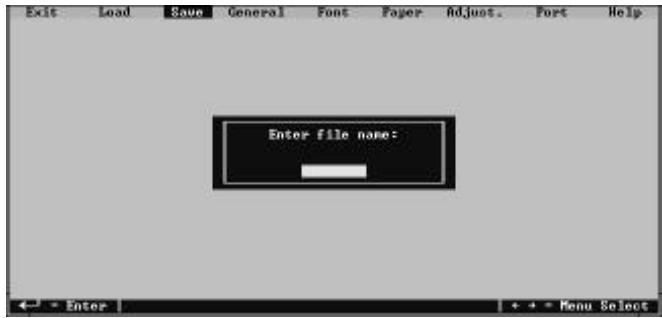
Input the name that you want to assign to the configuration and press Enter.
The displayed configuration is automatically stored in the directory you specified under "Installing the User Setup Utility" on page 21. It is given the name you specify above, with the extension ".cfg" added automatically.
Saving changed setup data in the current configuration file
Use the procedure under "Saving setup data as a new configuration file" on page 43 to load the configuration file that you want to change.
□ After making the changes that you want, select the Save item from the menu bar.
Input the same name as the configuration file whose setup data you imported in the first step of this procedure and press Enter.
The new data is saved under the configuration file name you specify, overwriting the existing file with the same name.
Important!
Remember that changing User Setup Utility settings on the computer screen does not directly change them in the printer. To change the printer settings to those shown on the screen, you must specify "Exit and send the settings to the printer" when exiting the User Setup Utility (page 47).
Importing setup data from a configuration file
Use the following procedure to load setup data from a previously saved configuration file.
While in the User Setup Utility, select the Load item from the menu bar.
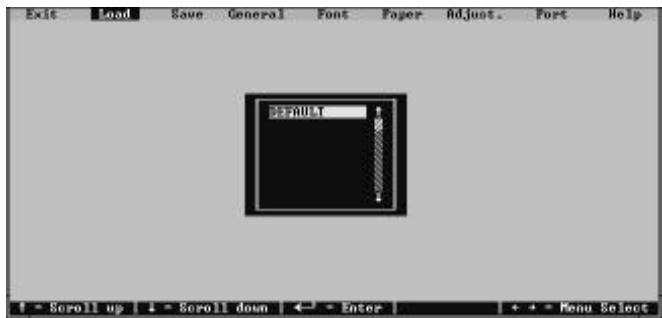
The currently selected configuration file is the one that is highlighted in the list that appears on the display.
- Click on the up and down arrows of the scroll bar at the right side of the list or use the keyboard's up and down arrow keys to move the highlighting up and down until the name of the configuration file you want to use is selected (highlighted).
After selecting the configuration file you want, press Enter.
Returning to default settings
To make all settings revert to their defaults (original settings), select the Load item from the menu bar, highlight DEFAULT in the list of files, and press Enter.
Exiting the User Setup Utility
While in the User Setup Utility, select the Exit item from the menu bar.
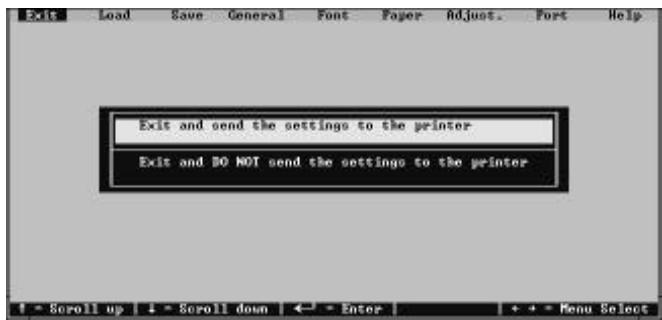
- Specify whether or not you want to send the settings to the printer by clicking on the corresponding item on the screen. Or you can use the up and down arrow keys to highlight the selection you want and then press Enter to execute.
Using the Help window
While in the User Setup Utility, select Help from the menu bar.
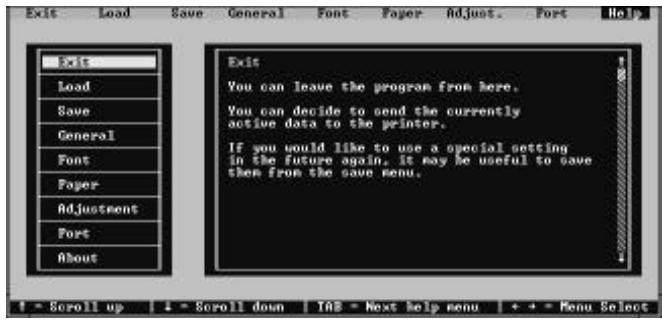
- Select the item you want help on from the list on the right side of the screen. You can select an item either by clicking on it with the mouse or by scrolling through the items with the keyboard's up down arrow keys.
Chapter 3: Using the Printer with Windows 3.1
This chapter contains specific information you need to know when using the printer with Microsoft Windows 3.1. It also tells you how to install the printer driver on your computer so that it can control the printer correctly. In this chapter, you will learn about:
How to set up for printing with Microsoft Windows 3.1
How to prepare for printing
How to print a document
How to install TrueType fonts
How to select fonts from within an application
Setting up for printing with Microsoft Windows 3.1
This printer is designed to work best with computers running Microsoft Windows 3.1. If you are running an earlier version of Windows, we recommend that you upgrade to 3.1.
Before you can use the printer with Windows, you must first use the procedure outlined below to install the printer driver that is supplied on the 3.5" floppy disk that comes with the printer. This procedure assumes that you are using a mouse and that you are familiar with common mouse operations like click and double-click. If you need information on mouse operations or if you want to install the printer driver without using a mouse, refer to your Microsoft Windows User's Guide.
- Insert the disk that contains the printer driver into one of your computer's disk drives. This explanation assumes you are using a drive named "A:", but you could use any drive. Just remember to change the "A:" in the following steps to the name of the drive you are using.
In the Windows Program Manager, choose Run from the File menu.
Type the following line into the command line box: A:\INSTALL
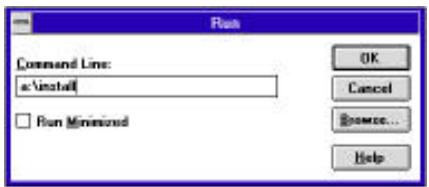
You can also accomplish the same result by clicking on Browse... and selecting the drive where the driver floppy is loaded. Next you should select INSTALL. EXE and click OK.
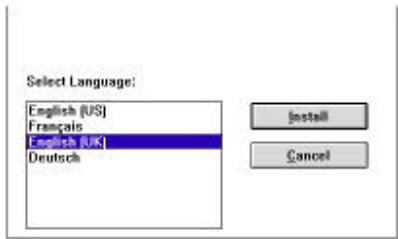
- Click on the language that you want to use and then click on Install to start the installation.
- Click the name of your printer in the list that appears on the display to highlight it.
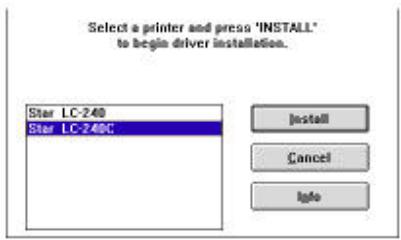
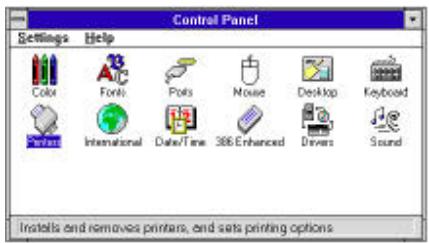
- Click on Install, and the Control Panel window appears. Double-click on the Printers icon in the Control Panel window.
Double click on the name of the printer model you selected above to select it as the default printer.
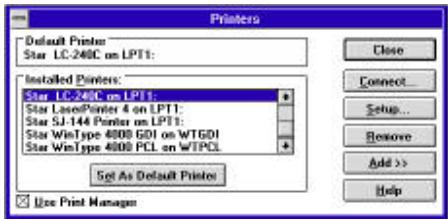
- Click on Close to clear the Printers window.
Note:
Windows applications automatically print on the currently selected default printer. If you want to print on a different printer, you must first select it.
See "Installing TrueType fonts" on page 61 for information of how to install the TrueType fonts that are supplied on the 3.5" floppy disk that comes with the printer.
Getting ready to print
Before printing, there are a number of things you must first do to set up the printer. You must select the printer driver, and the paper source, size, and orientation. Use the following procedure to make these selections.
Note:
You do not need to perform printer driver and paper selections mentioned above each time you print, but only if there are any changes to the last selections you made.
In the Windows Program Manager, open the Main group by clicking on its icon.
Double click on the Control Panel icon.
Double-click on the Printers icon in the Control Panel window.
Double-click on the name of the printer model you selected above to select it as the default printer.
From this window you select buttons that let you control a wide variety of printer setup parameters. This manual does not include any information about how to do this because everything you need to know is included in an on-line manual that tells you how to use all the buttons and menus that appear. To view the on-line manual, click on Help button.
Note:
The Paper Source pull down menu in the above window gives lets you choose between Auto Sheet Feeder and Manual Feed. If you are using the optional push tractor unit, you must use the Paper Source menu to specify the push tractor unit as the paper source. To do this, click on the Options button in the above window to display the options window. Next, pull down the Feeder menu and select Tractor. Click on the OK button to complete the operation.
After the printer is setup the way you want it, click on OK.
- Click on the Close button in the Printers window to save your setup and return to the Program Manager.
Note:
Depending on the application software you are using, settings similar to those in the above procedure can be made using the Print Setup command of the File menu instead of the Control Panel.
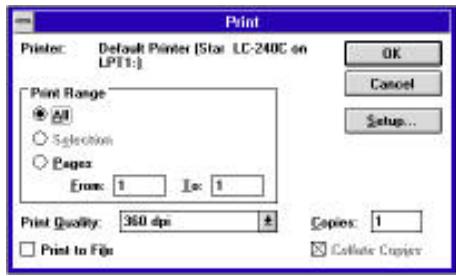
The following Print window appears when you select the Print command of the File menu of your Windows application.
Note:
The actual appearance of the Print window that appears may differ somewhat depending on the application you are using.
Use this window to specify the range of the pages to be printed, the quality of the printing (in dots per inch), and the number of copies you want to print. Note also that there are boxes that you can select to specify printing to a file or collating (printing from back to front).
You can change the printer setup by clicking on the Setup button. When you do, the following window for setting up your printer appears on the display.
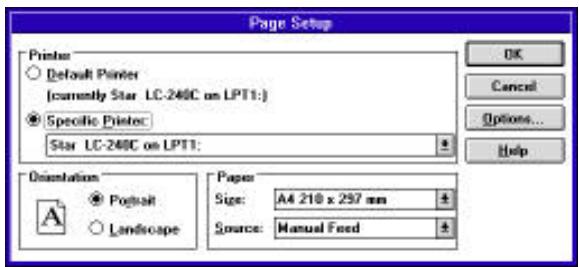
Make any changes that you want by clicking on the appropriate radio button or highlighting your selection on the appropriate pull-down menu. Clicking on the Options button displays the following window.
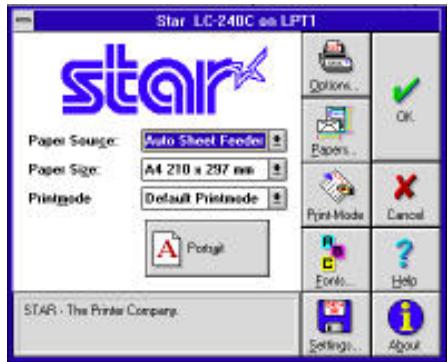
See "Getting ready to print" on page 55 for details on using this window.
Installing TrueType fonts
The TrueType fonts that are supplied on the 3.5" floppy disk that comes with the printer can be used only when you are running Windows 3.1 or later. Use the following procedure to install the fonts.
Launch Windows.
Open the Windows Control Panel.
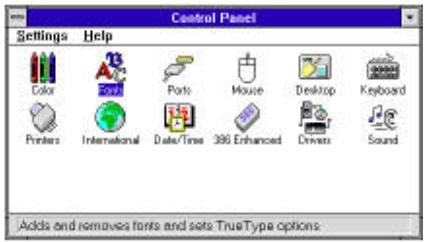
Double-click the Fonts icon and the Fonts dialog box appears.
Click Add and the Add Fonts dialog box appears.
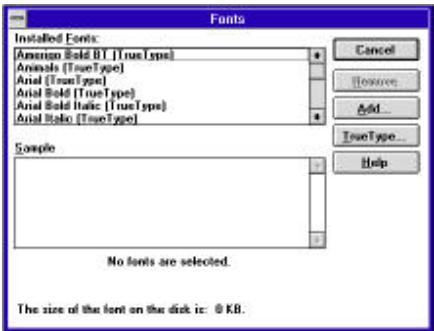
- Insert the disk that contains the fonts into one of your computer's disk drives. This explanation assumes you are using a drive named "A:", but you could use any drive. Just remember to change the "A:" in the following steps to the name of the drive you are using.
Select the letter that represents the drive where the floppy disk is installed. When you do, the names of all the fonts on the disk appear in the List of Fonts window. Select the fonts you want to install by clicking on their names. If you want to install all of the fonts, click Select All.
- Click OK. The Fonts dialog box appears and installation is performed. The names of the newly installed fonts are automatically added to the Installed Fonts list.
- While in the application program you are using, select Printer Setup from the application's File menu, and reselect the printer. After that, the application can display on-screen text and print text on the printer using the newly installed fonts.
Selecting fonts in Windows applications
Refer to the manual of the application you are using for details on how to select fonts within that application.
In addition to the Windows fonts, you can also use the TrueType fonts that come with this printer.
Chapter 4: Control Panel Operations
The control panel gives you push-button control over the printer's power and paper feed operations. It also includes an indicator light that tells you the current status of the printer at a glance.
Note:
For full details on paper handling, see page 69 of this manual.
To enter the Sleep Mode
Hold down Power for a few seconds. The printer beeps when it enters the Sleep Mode.
For details about the Sleep Mode, see page 33 of this manual.
Important!
We recommend that you unplug the printer from the power outlet whenever you do not plan to use it for long periods. Because of this, you should locate the printer so that the power outlet it is plugged into is nearby and easy to access.
To restore full power from the Sleep Mode
Press Power.
Important!
The printer automatically enters the Sleep Mode when you plug it in to an AC outlet. Be sure to press Power to power up the printer after plugging it in.
To switch between the Ready and Not-Ready Modes
Press Power to switch the computer between being the Ready and Not-Ready Modes.
- When the printer is in the Ready Mode, the READY indicator is lit and the printer can receive data from the computer. This means that you should make sure that the printer is in the Ready Mode whenever you are trying to print.
- When the printer is in the Not-Ready Mode, the READY indicator flashes slowly, which means that the printer cannot receive any data.
To feed single-sheet paper into the printer
□ When there is no paper in the printer, press PAPER to feed paper in.
Press PAPER once to manually feed a sheet of paper (page 71), bypassing the automatic sheet feeder. To feed paper from the automatic sheet feeder, press PAPER twice.
To eject single-sheet paper from the printer
- When the printer is in Ready Mode (so the READY indicator is lit), press PAPER once to eject the paper from the printer.
- When the printer is in Not-Ready Mode (so the READY indicator is bit lit), hold down PAPER to eject the paper from the printer.
To advance paper
While there is paper already in the printer, use Power to put the printer into the Not-Ready Mode (so the READY indicator is flashing slowly).
Press PAPER once to feed the paper one line.
To continuously feed the paper, hold down PAPER.
Errors
Whenever the READY indicator flashes at high speed, it means that an error has occurred. To clear the error condition, hold down Power for a few seconds to enter the Sleep Mode. After a few seconds, press Power again so the READY indicator lights. See "Troubleshooting" on page 81 of this manual for other information on how to deal with problems. In the case of paper jams, see "Clearing paper jams" on page 73.
Your printer is designed to print on a variety of different paper types. This chapter tells you everything you need to know about paper, and how to set the printer up for automatic paper feed and manual paper feed. In this chapter, you will learn about:
□ Selecting the best type of paper to use
Adjusting for paper thickness
Manual sheet feeding
Clearing paper jams
Selecting paper types
Use the following information when selecting paper.
Single-Sheet Paper (Manual Sheet Feeding)
Width: 7.0^ to 10.5^ / 178 to 267mm
Length: 5.5^ to 14^ / 140 to 356mm
Thickness: 0.00276'' to 0.00472'' / 0.07 to 0.12mm
Weight: 52 to 90g / m^2 /45 to 77kg / 14 to 24 lbs
Single-Sheet Paper (Automatic Sheet Feeding)
Width: A4 and Letter
Thickness: 0.00315'' to 0.00472'' / 0.08 to 0.12mm
Weight: 60 to 90g / m^2 /52 to 77kg /16 to 24 lbs
Input: 55 sheets of 64g / m^2
Output: 10 sheets
Note:
You can make certain paper type settings using the User Setup Utility. See "User Setup Utility" on page 21 of this manual for details.
Adjusting for paper thickness
Paper comes in different weights, normally expressed as gsm (grams per square meter) or lbs (pounds). Some form paper also has multiple pages that make them quite thick. Use the following procedure to change the gap between the print head and the platen and adjust for paper thickness.
- Move the adjustment lever on the right side of the platen to one of its four settings. The adjustment lever position that is nearest to the back of the printer is Position 1 (minimum gap), while the position at the opposite extreme is Position 4 (maximum gap). Position 2, which is marked with a dot, is most suitable for single-sheet paper.
The following table provides a general guide for setting the adjustment lever. Experiment with different settings until you find the one that gives you the print quality you want.
| Paper Type | Weight Per Sheet | Thickness | Recommended Position |
| Single-sheet | 14 to 24 lbs (52 to 90 gsm) | 0.07 to 0.12 mm | 2 or 3 |
| Fanfold 1-ply | 14 to 24 lbs (52 to 90 gsm) | 0.07 to 0.12 mm | 3 |
| Fanfold 2 or 3-ply | 11 to 14 lbs (40 to 52 gsm) | 0.13 to 0.21 mm | 4 |
Important!
Continuous use of the wrong adjustment lever setting can drastically reduce print head life!
Automatic sheet feeding
Your printer comes with a built-in automatic sheet feeder that can hold up to 55 sheets of paper. See page 13 of this manual for details on using the auto sheet feeder.
To feed paper into the printer, press the control panel's PAPER button twice.
You can use the following procedure to manually feed single sheets of paper into the printer, even while different paper is loaded in the automatic sheet feeder.
Insert the sheet of paper into the printer, in front of the paper tray cover.
Press the control panel's PAPER button once.
Note:
If you are manually inserting letterhead paper, insert the sheet so that it is face down with the letterhead portion down.
Clearing paper jams
Use the following procedure to clear paper jams from the printer.
Unplug the printer from its AC power outlet.
Open the front cover of the printer.
Pull the front of the automatic sheet feeder forward.
- Remove any paper that is still in the feeder.
- Carefully try to pull the jammed paper from the printer.
If the paper is so badly jammed that you cannot easily pull it out, detach the automatic sheet feeder from the printer (see "Detaching the automatic sheet feeder" on page 17).
Lifting up on the two paper release levers on the back of the printer, pull the jammed paper out.
After you clear the jam, replace the automatic sheet feeder (see, "Re-installing the automatic sheet feeder" on page 19).
- Reload paper into the automatic feeder.
- Close the front cover of the printer.
Alimentation manuelle
Chapter 6: Using the Printer with MS-DOS
This chapter contains information about how to use the printer with applications software running under MS-DOS. In this chapter, you will learn about:
How to set up for printing with MS-DOS
How to select fonts from within an application
Setting up for printing with MS-DOS
To print from an application running under MS-DOS, you must first select the printer from within the application. Typically, the program will feature an INSTALL or SETUP command for selection of printers. Refer to the manual for the application you are using for details on how to select a printer for it.
Note:
Remember that you must select a printer for each individual application before you can print from it.
The following procedure describes the basics of selecting a printer.
Start up the application and use the correct procedure for that application to select a printer. The following is a list of printers that can be used. If your application lists more than one of these, select the printer that is nearest to the top of this list. Use User Setup Utility to select Standard emulation (page 31).
| Star LC-240C |
| Star LC-240 |
| Star LC24-30 |
| Epson LQ-860/1060 |
| Epson LQ-850/1050 |
The shaded printers are not color printers, so you will not be able to print in color if you select one of them.
If none of the printers listed above is available in the application, choose one of the following. Once again, you should choose the one that is nearest to the top in the following list. Use User Setup Utility to select IBM emulation (page 31).
IBM ProPrinter X24E/XL24E
IBM ProPrinter X24/XL24
The above two printers are shaded because they are not color printers. This means that you will not be able to print in color if your select one of these.
Note:
You cannot print in color unless you select the name of a color printer.
To print, follow the instructions given in the manual of the application you are using. Typically, you would select the application's PRINT command, make any necessary changes in the window that appears (such as the number of copies to be printed), and then press the Enter key to start printing.
Selecting fonts in MS-DOS applications
Use the User Setup Utility to select a font when running an application under MS-DOS. For details on the fonts that are available and how to select them, see "LQ Font" on page 35 of this manual.
IBM ProPrinter X24E/XL24E
IBM ProPrinter X24/XL24
IBM ProPrinter X24E/XL24E
IBM ProPrinter X24/XL24
IBM ProPrinter X24E/XL24E
IBM ProPrinter X24/XL24
Chapter 7: Other Printing Features
This chapter details other features that you are sure to find helpful, no matter what kind of document you are printing. They provide you with the versatility to make your output look exactly as you want it. In this chapter, you will learn about:
How to pause printing
Feeding paper
Form feeding
How to pause printing
To temporarily interrupt printing, press the control panel's Power button to put the printer into the Not-Ready Mode.
To resume printing, press Power again to put the printer back into the Ready Mode.
Line feed
Use the following procedure to feed paper one line at a time.
Press the control panel's Power button to put the printer into the Not-Ready Mode.
Press the control panel's PAPER button to feed one line.
To print, press Power again to put the printer back into the Ready Mode.
Form feed
The form feed operation feeds paper through the printer so the print head is at the top of the next page to be printed. Use the following procedure to perform the form feed operation.
Press the control panel's Power button to put the printer into the Not-Ready Mode.
□ Holding down the control panel's PAPER button to perform the form feed operation.
To print, press Power again to put the printer back into the Ready Mode.
The appendix tells you what you need to know if you experience problems with your printer. It tells you how to test the printer, how to check system software settings, and how to adjust the vertical alignment. In addition, there is information on actions to take for specific problems, and on the meanings of printer beep tones.
Warning!
The printer uses high voltage. Do not attempt any other repair or maintenance except as expressly recommended in this appendix. Unauthorized repair and maintenance not only exposes you to the danger of electrical shock, it also may damage your printer and void your warranty.
Testing the printer
There are three different tests you can use: a short test, a long test and a hexadecimal dump. The same operation is used to perform all three tests, and the test print that is performed is controlled by the setting you make with the User Setup Utility. For details on selecting the test print type with the User Setup Utility, see "Demo Print" on page 33.
To perform the demo print selected by the User Setup Utility, hold down the control panel's Power button to enter the Sleep Mode.
□ Holding down the control panel's PAPER button, press the Power button and then release both buttons at the same time.
To stop demo printing hold down the Power button to enter the Sleep Mode.
Comment tester I'imprimante
The short test prints the version number of the software contained in the printer's ROM, followed by seven lines of text. If you are using a color ribbon, each line is printed using a different color.
Long test
A long test continually prints the version number of the software contained in the printer's ROM, followed by the current User Setup Utility settings, and the entire character set in each available font and pitch setting. This sequence is repeated until you stop it by holding down the control panel's Power button.
Since this test can generate many lines of text and graphics, it is a good idea to perform this test only when using continuous fanfold paper rather than single sheets.
Note:
Both the short test and the long test print across the entire width of the carriage. Make sure that the printer is loaded with the widest possible paper available in order to avoid damage to the print head and platen.
Hexadecimal dump
This test prints in hexadecimal format all codes (character codes and control codes) that are sent to the printer by the computer. The printer does not execute any control codes (such as 0A - linefeed), it just prints them out. The hexadecimal dump is useful when you are writing programs for printer control. Use the following procedure to perform a hexadecimal dump.
- Set up the printer for a test print as described under "Testing the printer" on page 81.
Test court
- Begin printing from your computer,
Instead of a normal printout, data will be printed in sixteen columns of hexadecimal numbers (two groups of eight numbers each). The equivalent printable characters (or dots in the case of unprintable codes) are printed to the right of each row of hexadecimal numbers.
After you start the hexadecimal dump (by using the procedure described above), you can switch it off (and return the printer to normal operation) by holding down the control panel's Power button.
Use the following table to help track down the causes of problems and to determine the best solution to deal with them.
| Problem | Possible Cause | Recommended Action |
| The READY indicator does not light or flash. | The printer is not receiving power. | Check whether the power cord is correctly plugged into the power outlet. |
| Check whether the power outlet is working by unplugging the printer and plugging in another device. | ||
| Printer sounds like it is printing, but it is not. Printing is weak. | The ribbon is jammed, twisted, or not set correctly between the print head and the print head shield. | Make sure that the ribbon cartridge is installed correctly. See “About ribbon cartridges” on page 5. |
| The printer is not set up correctly for the thickness of paper you are using. | Set up the printer for the paper thickness you are using. See “Adjusting for paper thickness” on page 71. | |
| Printer test works, but printer will not print out data from the attached computer. | The wrong emulation is selected. | Check the emulation selection and change if necessary. See “Emulation” on page 31. |
| Your application program's or system software's printer selection is wrong. | Check the printer selection of your application software. | |
| The computer's system software is not set up properly for the printer or for the type of interface cable you are using. | Check the system software settings. |
Guide de dépannage
Checking system software settings in Windows
Whenever you have problems printing from a Windows application, you should check the following three things:
Is the printer you are using set as the default printer?
Is the printer you are using correctly selected in your application?
Is the correct port selected?
You should also refer to your Microsoft Windows User's Guide for other information that might be helpful. If you still experience problems, consult with your software dealer.
To check the default printer selection
Double-click the Control Panel icon in the Main window.
Double-click the Printers icon.
Check to see that the name of your Star printer is the default printer. If it is not, double-click on the name of your printer in the list of installed printers.
- Click on Close to return to the Control Panel window.
To check the application printer selection
- Select Print from the application's File menu, and a window appears listing available printers.
Check to see that the name of your Star printer is selected. If it is not, select it and try printing from your application again.
To check the port
Double-click the Control Panel icon in the Main window.
Double-click the Printers icon.
Double-click on the name of your Star printer in the list of installed printers.
Click on Connect.
Make sure that your printer cable is connected to the port highlighted in the list of ports.
If you are using a parallel cable, you will probably be using LPT1. If you are using the optional Serial-To-Parallel Interface Converter, you should normally be using COM1 or COM2. Click on the correct port name.
Click OK.
- Click on Close to return to the Control Panel window.
Checking system software settings in MS-DOS
If you are using a parallel cable and cannot print a text file using the MS-DOS PRINT command, you may have a problem with your AUTOEXEC.BAT file. Open the file and look for the following line:
MODE LPT1: = COM1 or MODE LPT1: = COM2
These lines indicate printing you are using a serial cable connection, and so you should delete them, save the AUTOEXEC.BAT file, and try printing again.
Of course, if you are having problems printing with the optional Serial-To-Parallel Interface Converter, you should conversely check to make sure that one of the above lines is included in your AUTOEXEC.BAT file. The file must also contain information on parameter settings. For details, see the user's manual that comes with the optional Serial-to-Parallel Interface Converter.
If the above is not the problem or if you make the above changes and still experience problems printing using the MS-DOS PRINT command, refer to your MS-DOS Users' Guide or consult with your software dealer.
If you are successful in printing using MS-DOS PRINT command but cannot print from an application, check to see what printer driver is select in the application. See "Setting up for printing with MS-DOS" on page 75. If this does not help, consult with your software dealer.
Checking the port settings in the User Setup Utility
Start up the User Setup Utility (page 25).
- Select Port from the menu bar.
Make sure that your printer cable is connected to the port selected in the list of available ports.
If you are using a parallel cable, you will probably be using LPT1. If you are using the optional Serial-To-Parallel Interface Converter, you should normally be using COM1 or COM2.
- Exit the User Setup Utility and send the settings to the printer.
Appendix B: Specifications
| Printing System Printing Speed | Serial Impact Dot-Matrix | ||
| Pitch | Draft (cps/dpi) | LQ (cps/dpi) | |
| Pica (10 cpi) | 160/120H | 53/360H | |
| Elite (12 cpi) | 192/120H | 64/360H | |
| Semi-condensed (15 cpi (S)) | 240/120H | 80/360H | |
| Semi-condensed (15 cpi (I)) | 120/240H | 80/360H | |
| Condensed pica (17 cpi) | 136/240H | 91/360H | |
| Condensed elite (20 cpi) | 160/240H | 106/360H | |
| 24 cpi (I) | 192/240H | 127/360H | |
| H: half-dot(S): Standard mode only(I): IBM mode only | |||
| Print Direction | Draft: | Bi-directional logic seeking | |
| LQ: | Bi-directional logic seeking | ||
| Bit-Image: | Uni-directional or bi-directional logic seeking(selectable); Default: uni-directional | ||
| Print Head | Number of pins: | 24 | |
| Life: | 100 million dots/pin | ||
| Line Spacing | 1/6", 1/8", 7/60", n/180", n/360", 7/72", n/72", n/216" | ||
| Character Matrix | Pitch | Draft | LQ |
| Pica (10 cpi) | 24 × 9H | 24 × 31H | |
| Elite (12 cpi) | 24 × 9H | 24 × 27H | |
| Semi-condensed (15 cpi (S)) | 16 × 7H | 16 × 21H | |
| Semi-condensed (15 cpi (I)) | 24 × 9H | 24 × 16H | |
| Condensed pica (17 cpi) | 24 × 9H | 24 × 16H | |
| Condensed elite (20 cpi) | 24 × 9H | 24 × 16H | |
| 24 cpi (I) | 24 × 9H | 24 × 14H | |
| H: half-dot(S): Standard mode only(I): IBM mode only | |||
| Environment | Operating Temperature: | 50°F to 95°F (10°C to 35°C) | |
| Storage Temperature: | -22°F to 149°F (-30°C to 65°C) | ||
| Operating Humidity: | 30% to 80% (non-condensing) | ||
| Storage Humidity: | 20% to 90% (non-condensing) | ||
| Pin | Name | Function |
| 1 | STROBE | Goes low for ≥0.5μs when active. |
| 2 | DATA0 | High when active. |
| 3 | DATA1 | High when active. |
| 4 | DATA2 | High when active. |
| 5 | DATA3 | High when active. |
| 6 | DATA4 | High when active. |
| 7 | DATA5 | High when active. |
| 8 | DATA6 | High when active. |
| 9 | DATA7 | High when active. |
| 10 | ACK | 10μs low to acknowledge receipt of data. |
| 11 | BUSY | Printer sets line low when ready to receive data. |
| 12 | PAPER | High when paper runs out. Can be disabled with the User Setup Utility. |
| 13 | SELECT | High when printer is on-line. |
| 14 | AFXT | Normally high. |
| 15 | Not connected. | |
| 16 | SIGNAL GND | Signal ground |
| 17 | CHASSIS | Chassis ground (isolated from signal ground) |
| 18 | +5V | +5V DC output from printer |
| 19 - 30 | GND | Twisted pair ground return |
| 31 | RESET | Printer is reset when this signal goes low. |
| 32 | ERROR | Low when printing cannot continue due to error. |
| 33 | EXT GND | External ground |
| 34 - 35 | Not connected | |
| 36 | SELECT IN | Normally low. |
Optional Serial Interface
| Pin | Name | Function |
| 1 | GND | Printer chassis ground |
| 2 | TXD | Data from printer |
| 3 | RXD | Data to printer |
| 4 | RTS | Always low |
| 5 | CTS | Low when computer is ready to send data. Printer ignores this signal. |
| 6 | Not connected. | |
| 7 | GND | Signal ground |
| 8 - 10 | Not connected. | |
| 11 | RCH | Printer sets line low when ready to receive data. Same signal as Pin 20. |
| 12 - 19 | Not connected. | |
| 20 | DTR | Printer sets line low when ready to receive data. |
| 21 - 25 | Not connected. | |
Standard Character Set #2
| 0 | 1 | 2 | 3 | 4 | 5 | 6 | 7 | 8 | 9 | A | B | C | D | E | F | |
| 0 | <NUL> | 0 | @ | P | ` | p | à | S | 0 | @ | P | ` | p | |||
| 1 | <DCI> | ! | 1 | A | Q | a | q | è | β | ! | 1 | A | Q | a | q | |
| 2 | <DC2> | " | 2 | B | R | b | r | ù | AE | " | 2 | B | R | b | r | |
| 3 | <DC3> | # | 3 | C | S | c | s | ò | æ | # | 3 | C | S | c | s | |
| 4 | <DC4> | 4 | D | T | d | t | i | ∅ | 4 | D | T | d | t | |||
| 5 | % | 5 | E | U | e | u | ° | ø | % | 5 | E | U | e | u | ||
| 6 | & | 6 | F | V | f | v | £ | .. | & | 6 | F | V | f | v | ||
| 7 | <HEL> | ' | 7 | G | W | g | w | i | A | ' | 7 | G | W | g | w | |
| 8 | <BS> <CAN> | ( | 8 | H | X | h | x | ü | Ö | ( | 8 | H | X | h | x | |
| 9 | <HT> <EM> | ) | 9 | I | Y | i | y | ñ | ü | ) | 9 | I | Y | i | y | |
| A | <LF> | * | : | J | Z | j | z | ñ | ä | * | : | J | Z | j | z | |
| B | <VT> <ESC> | + | ; | K | { | k | { | ü | ö | + | ; | K | [ | k | { | |
| C | <PF> <PS> | , | < | L | \ | l | | | P | ü | , | < | L | \ | l | ' | |
| D | <CR> | - | = | M | ] | m | } | A | É | - | = | M | J | m | } | |
| E | <SO> | . | N | ^ | n | ~ | á | é | . | > | N | ^ | n | ~ | ||
| F | <SI> | / | ? | O | _ | o | <DEL> | ç | ¥ | / | ? | O | _ | o |
International Character Set
The character codes shown in the table are hexadecimal.
| Country | 23 | 24 | 40 | 58 | 5A | 5B | 5C | 5D | 5E | 60 | 7B | 7C | 7D | 7E |
| U.S.A. | # | X | Z | [ | \ | ] | ^ | ^ | { | | | } | ^ | ||
| FRANCE | # | A | X | Z | * | C | S | - | ^ | e | a | e | ^ | |
| GERMANY | # | X | Z | A | O | U | - | ^ | a | o | o | B | ||
| ENGLAND | £ | X | Z | [ | \ | ] | - | ^ | | | ^ | ||||
| DENMARK 1 | # | X | Z | A | O | A | - | ^ | m | g | A | ^ | ||
| SWEDEN | # | a | B | X | Z | A | O | A | O | e | s | o | A | U |
| ITALY | # | X | Z | - | \ | e | ^ | o | a | o | e | i | ||
| SPAIN 1 | £ | X | Z | I | R | z | - | ^ | ^ | n | ^ | |||
| JAPAN | # | X | Z | [ | ¥ | ] | - | ^ | | | ^ | ||||
| NORWAY | # | a | E | X | Z | A | O | A | O | e | x | φ | A | U |
| DENMARK 2 | # | E | X | Z | O | A | O | e | m | φ | A | U | ||
| SPAIN 2 | # | X | Z | ; | N | z | e | ^ | i | n | o | U | ||
| LATAMEMEA | # | X | Z | ; | N | z | e | u | i | n | o | u | ||
| KOREA | # | X | Z | [ | # | ] | - | ^ | | | ^ | ||||
| IRISH | # | 0 | - | [ | \ | ] | - | ^ | A | B | O | - | ||
| LEGAL | # | $ | X | Z | - | - | - | # | ^ | o | @ | + | m |
IBM Character Set #2, Code Page #437 (IBM-PC)
| 0 | 1 | 2 | 3 | 4 | 5 | 6 | 7 | 8 | 9 | A | B | C | D | E | F | |
| 0 | <\NUL> | 0 | @ | P | ` | p | C | é | á | L | ü | α | ≡ | |||
| 1 | <\DC1> | ! | 1 | A | Q | a | q | ü | æ | í | ⊥ | T | β | ± | ||
| 2 | <\DC2> | " | 2 | B | R | b | r | é | AE | ó | T | π | Γ | 2 | ||
| 3 | ♥ <\DC3> | # | 3 | C | S | c | s | á | ó | ú | | | U | π | ≤ | ||
| 4 | ♠ <\DC4> | $ | 4 | D | T | d | t | ä | ö | ñ | - | - | - | £ | Σ | ∫ |
| 5 | ♠ S | % | 5 | E | U | e | u | à | ó | Ñ | + | + | F | σ | J | |
| 6 | ♠ | & | 6 | F | V | f | v | á | ú | || | π | μ | ÷ | |||
| 7 | <\BEL> | ' | 7 | G | W | g | w | ç | ú | o | π | || | || | τ | ≈ | |
| 8 | <\BS> <\CAN> | ( | 8 | H | X | h | x | é | y | ü | ü | L | + | Φ | ° | |
| 9 | <\HT> <\BA> | ) | 9 | I | Y | i | y | é | ö | - | | | | | | | J | θ | • |
| A | <LF> | * | : | J | Z | j | z | è | ü | - | || | - | | | Ω | • | |
| B | <VT> <ESC> | + | ; | K | [ | k | { | ü | φ | ½ | ü | ü | ü | δ | √ | |
| C | <FF> <FS | , | < | L | \ | l | | | i | £ | ½ | ü | ü | ü | ∞ | n | |
| D | <CR> | - | = | M | ] | m | } | i | ¥ | i | ü | = | | | ∅ | 2 | |
| E | <SO> | . | > | N | ^ | n | ~ | A | Pt | « | ü | ü | | | € | ■ | |
| F | <SI> | / | ? | O | - | o | <\DEL> | A | f | » | - | ± | ■ | ∩ |
Code Page #850, Multi-lingual Other characters are the same as those for Code Page #437.
| 8 | 9 | A | B | C | D | E | F | |
| 0 | C | B | á | L | ð | ó | - | |
| 1 | ü | æ | í | ⊥ | D | β | ± | |
| 2 | é | A | ó | T | E | ð | = | |
| 3 | a | ô | ú | | | | | E | O | 34 |
| 4 | ä | ö | ñ | - | - | B | ō | ¶ |
| 5 | à | ò | N | A | + | I | ō | S |
| 6 | à | ú | æ | A | ā | f | μ | ÷ |
| 7 | c | ú | ø | A | A | I | p | . |
| 8 | è | y | ç | © | L | Y | P | ° |
| 9 | è | ö | ® | || | fr | J | ú | .. |
| A | è | ú | ¬ | || | ü | Γ | U | • |
| B | i | ø | ½ | ü | ü | ■ | U | 1 |
| C | i | £ | ¼ | ü | ü | ■ | y | 3 |
| D | i | Ø | i | φ | = | I | Y | 2 |
| E | A | × | « | ¥ | ü | I | - | ■ |
| F | A | f | » | ? | α | ■ | ' |
Code Page #852, Latin-2
Other characters are the same as those for Code Page #437.
| 8 | 9 | A | B | C | D | E | F | |
| 0 | C | E | á | L | d | O | - | |
| 1 | ü | L | í | ⊥ | D | β | " | |
| 2 | é | í | ó | T | D | O | . | |
| 3 | a | ô | ú | | | E | N | . | |
| 4 | ä | ö | A | - | - | d | n | . |
| 5 | ü | L | a | A | + | N | ñ | S |
| 6 | c | I | Z | A | A | f | S | ÷ |
| 7 | c | S | ž | E | ă | f | š | , |
| 8 | t | s | E | S | L | ē | R | ° |
| 9 | ë | ö | e | || | F | J | U | .. |
| A | Ö | Ü | || | ± | r | r | . | |
| B | ó | T | áz | π | π | ■ | U | ú |
| C | í | f | C | ü | || | ■ | y | R |
| D | Z | L | s | Z | = | T | Y | r |
| E | X | × | « | þ | μ | U | t | ■ |
| F | C | ç | » | j | α | ■ | ' |
Code Page #860
Portuguese
Other characters are the same as those for Code Page #437.
| 8 | 9 | A | B | C | D | E | F | |
| 0 | C | B | á | L | ü | α | ≡ | |
| 1 | ü | A | í | ⊥ | T | β | ± | |
| 2 | é | E | ó | T | π | Γ | 2 | |
| 3 | a | ó | ú | | | | | U | π | ≤ |
| 4 | ã | ö | ñ | + | - | £ | Σ | ∫ |
| 5 | à | ò | Ñ | + | + | F | σ | J |
| 6 | Á | Ü | æ | || | | | π | μ | ÷ |
| 7 | c | ù | o | π | || | H | τ | ≈ |
| 8 | è | I | ç | q | L | + | Φ | ° |
| 9 | è | Ö | ò | || | F | J | θ | · |
| A | è | Ü | ¬ | || | || | Γ | Ω | · |
| B | I | φ | ½ | η | π | ■ | δ | √ |
| C | ô | £ | ¼ | ü | || | ■ | ∞ | n |
| D | i | Ü | i | ü | = | ■ | ∅ | 2 |
| E | A | R | « | ‡ | || | ■ | € | ■ |
| F | A | ó | » | γ | ± | ■ | ∩ |
Code Page #863
Canadian French
Other characters are the same as those for Code Page #437.
| 8 | 9 | A | B | C | D | E | F | |
| 0 | C | E | I | II | L | U | α | ≡ |
| 1 | ü | E | ' | III | ⊥ | T | β | ± |
| 2 | é | E | ó | III | T | π | Γ | 2 |
| 3 | ã | ô | ú | | | | | U | π | ≤ |
| 4 | A | B | ... | - | - | E | Σ | ∫ |
| 5 | à | Y | . | + | + | F | σ | J |
| 6 | ¶ | ú | 3 | || | F | π | μ | ÷ |
| 7 | c | ü | - | π | || | H | τ | ≈ |
| 8 | è | α | I | ? | E | 卡 | Φ | ° |
| 9 | è | ô | - | || | F | J | θ | • |
| A | è | Ü | - | || | II | F | Ω | • |
| B | i | φ | ½ | ü | π | ■ | δ | √ |
| C | i | £ | ¼ | ü | II | ■ | ∞ | n |
| D | = | Ü | ¾ | ü | = | ■ | ∅ | 2 |
| E | A | Ü | « | - | II | ■ | € | ■ |
| F | S | f | » | - | ± | ■ | ∩ |
Code Page #861
Icelandic
Other characters are the same as those for Code Page #437.
| 8 | 9 | A | B | C | D | E | F | |
| 0 | C | E | á | L | ú | α | ≡ | |
| 1 | ü | æ | í | ⊥ | ¯ | β | ± | |
| 2 | é | æ | ó | T | π | Γ | 2 | |
| 3 | ã | ô | ú | | | u | π | £ | |
| 4 | ä | ö | A | - | - | t | Σ | ∫ |
| 5 | à | þ | ɪ | - | + | f | σ | J |
| 6 | à | ú | O | || | f | π | μ | ÷ |
| 7 | ç | Y | U | π | || | H | τ | ≈ |
| 8 | è | y | ü | ü | L | + | Φ | ° |
| 9 | è | ö | r | ü | f | J | θ | • |
| A | è | ü | ¬ | || | ü | - | Ω | • |
| B | D | ø | ½ | ü | ü | ■ | δ | √ |
| C | ð | £ | ¼ | ü | ü | ■ | ∞ | n |
| D | þ | ø | i | ü | = | ■ | ∅ | 2 |
| E | A | P | « | - | ü | ■ | € | ■ |
| F | A | f | » | - | ± | ■ | ∩ |
Code Page #865
Nordic
Other characters are the same as those for Code Page #437.
| 8 | 9 | A | B | C | D | E | F | |
| 0 | C | B | á | L | U | α | ≡ | |
| 1 | ü | æ | í | ⊥ | T | β | ± | |
| 2 | é | A | ó | T | π | Γ | 2 | |
| 3 | ã | ô | ú | | | F | U | π | ≤ |
| 4 | ä | ö | ñ | - | - | E | Σ | ∫ |
| 5 | à | ò | Ñ | + | + | F | σ | J |
| 6 | ã | ú | a | || | F | π | μ | ÷ |
| 7 | ç | ù | Ω | π | || | H | τ | ≈ |
| 8 | ê | ý | ü | - | L | + | Φ | ° |
| 9 | ë | ö | r | || | F | J | θ | • |
| A | è | Ü | ¬ | || | || | F | Ω | • |
| B | i | ø | ½ | π | π | ■ | δ | √ |
| C | i | £ | ¼ | ü | || | ■ | ∞ | n |
| D | i | Ø | i | ü | = | ■ | ∅ | 2 |
| E | A | P | « | - | || | ■ | € | ■ |
| F | A | f | α | - | ± | ■ | ∩ |
Code Page #866
Russian
Other characters are the same as those for Code Page #437.
Other characters are the same as those for Code Page #437.
Other characters are the same as those for Code Page #437.
Other characters are the same as those for Code Page #437.
| 8 | 9 | A | B | C | D | E | F | |
| 0 | C | E | Z | L | II | α | ≡ | |
| 1 | ü | e | Z | ⊥ | T | β | ± | |
| 2 | é | k | ó | T | π | Γ | 2 | |
| 3 | a | o | O | | | u | π | ≤ | |
| 4 | ä | ö | n | - | - | E | Σ | ∫ |
| 5 | à | C | N | + | + | F | σ | J |
| 6 | a | ü | z | F | π | μ | ÷ | |
| 7 | c | ü | z | π | H | τ | ≈ | |
| 8 | è | S | S | L | + | Φ | ° | |
| 9 | è | Ö | - | F | J | θ | · | |
| A | è | U | - | Ω | · | |||
| B | i | ž | ½ | δ | √ | |||
| C | i | L | ¼ | ∞ | n | |||
| D | ć | ¥ | i | II | = | ∅ | 2 | |
| E | A | s | « | - | € | ■ | ||
| F | A | f | » | - | ± | ■ | ∩ |
Other characters are the same as those for Code Page #437.
| 8 | 9 | A | B | C | D | E | F | |
| 0 | C | E | á | L | II | α | ≡ | |
| 1 | ü | ž | í | ⊥ | T | β | ± | |
| 2 | é | Z | ó | T | π | Γ | 2 | |
| 3 | d | ô | ú | | | | | U | π | ≤ |
| 4 | ä | ö | ñ | - | - | k | Σ | ∫ |
| 5 | D | ó | N | + | + | F | σ | J |
| 6 | T | ü | Ü | || | 卡 | π | μ | ÷ |
| 7 | c | ú | O | π | || | H | τ | ≈ |
| 8 | ë | y | s | q | L | ≠ | Φ | ° |
| 9 | E | ö | x̄ | || | F | J | θ | • |
| A | L | U | x̄ | || | == | Γ | Ω | • |
| B | I | S | R | π | π | ■ | δ | √ |
| C | I | L | 4 | || | || | ■ | ∞ | n |
| D | I | Y | S | u | = | ■ | ∅ | 2 |
| E | A | R | « | ± | || | ■ | € | ■ |
| F | A | f | » | ? | ± | ■ | ∩ |
Code Page #3846
Turkish
Other characters are the same as those for Code Page #437.
| 8 | 9 | A | B | C | D | E | F | |
| 0 | C | B | á | L | ü | α | ≡ | |
| 1 | ü | æ | í | ⊥ | T | β | ± | |
| 2 | é | A | ó | T | π | Γ | 2 | |
| 3 | a | ô | ú | | | f | u | π | ≤ |
| 4 | ä | ö | ñ | - | - | L | Σ | ∫ |
| 5 | à | ò | Ñ | + | + | F | σ | J |
| 6 | à | ú | G | || | f | π | μ | ÷ |
| 7 | c | ü | g | π | || | H | τ | ≈ |
| 8 | é | I | I | q | L | + | Φ | ° |
| 9 | è | ö | r | || | f | J | θ | • |
| A | è | Ü | ¬ | || | ü | √ | Ω | • |
| B | i | φ | ½ | η | T | ■ | δ | √ |
| C | i | £ | ¼ | ½ | || | ■ | ∞ | n |
| D | i | ¥ | i | ü | = | ■ | ∅ | 2 |
| E | A | S | « | J | II | ■ | € | ■ |
| F | A | S | » | J | ± | ■ | ∩ |
Hungarian
Other characters are the same as those for Code Page #437.
| 8 | 9 | A | B | C | D | E | F | |
| 0 | C | E | á | L | ü | α | ≡ | |
| 1 | ü | æ | í | ⊥ | T | β | ± | |
| 2 | é | A | ó | T | π | Γ | 2 | |
| 3 | a | ó | ú | | | - | ü | π | £ |
| 4 | ä | ö | ñ | + | - | E | Σ | ∫ |
| 5 | a | ó | ñ | + | + | F | σ | J |
| 6 | a | ü | a | || | = | π | μ | ÷ |
| 7 | c | ü | ö | π | || | || | τ | ≈ |
| 8 | e | ü | ü | ? | ü | + | Φ | ° |
| 9 | è | ö | - | || | ü | J | θ | • |
| A | è | ü | - | || | ü | - | Ω | • |
| B | i | φ | ½ | π | π | ■ | δ | √ |
| C | i | £ | ¼ | ü | || | ■ | ∞ | n |
| D | f | ¥ | i | ü | = | ■ | ∅ | 2 |
| E | A | P | « | - | || | ü | € | ■ |
| F | A | f | » | ? | ± | ■ | ∩ |
Code Page #3847
Brazil-ABNT
Other characters are the same as those for Code Page #437.
| 8 | 9 | A | B | C | D | E | F | |
| 0 | 。 | A | D | à | d | |||
| 1 | i | ± | Á | Ñ | á | ñ | ||
| 2 | φ | 2 | A | O | a | ó | ||
| 3 | £ | 3 | A | ó | ā | ó | ||
| 4 | α | ' | A | O | ä | ó | ||
| 5 | ¥ | μ | A | O | a | ó | ||
| 6 | ! | ¶ | E | Ö | æ | ö | ||
| 7 | S | • | C | c | ||||
| 8 | , | E | Ø | è | ø | |||
| 9 | ® | 1 | é | ú | é | ú | ||
| A | a | Ω | E | ú | è | ú | ||
| B | « | » | E | ú | è | ú | ||
| C | - | ¼ | I | ú | i | ü | ||
| D | - | ½ | I | Y | í | y | ||
| E | ® | ¾ | I | P | i | p | ||
| F | - | ½ | I | β | i |
Brazil-ABICOMP
The other characters are the same as in code page #437.
| 8 | 9 | A | B | C | D | E | F | |
| 0 | ò | i | ó | |||||
| 1 | A | ó | à | ó | ||||
| 2 | A | ó | á | ō | ||||
| 3 | A | ó | à | ō | ||||
| 4 | A | ö | ā | ö | ||||
| 5 | A | é | ä | æ | ||||
| 6 | C | ú | c | ú | ||||
| 7 | E | ú | è | ú | ||||
| 8 | E | ú | é | ú | ||||
| 9 | E | ü | ē | ü | ||||
| A | E | Y | ë | y | ||||
| B | I | i | β | |||||
| C | I | £ | í | a | ||||
| D | I | i | i | o | ||||
| E | Y | S | i | i | ||||
| F | N | ° | ñ | ± |
Character Set #1
Other characters are the same as those for Character Set #2.
| 0 1 | |
| 0 | <NUL> |
| 1 | <DC1> |
| 2 | <DC2> |
| 3 | <DC3> |
| 4 | <DC4> |
| 5 | |
| 6 | <SYN> |
| 7 | <BEL> |
| 8 | <BS ><CAN> |
| 9 | <HT ><EM> |
| A | <LF> |
| B | <VT><ESC> |
| C | <FF><FS> |
| D | <CR> |
| E | <SO> |
| F | <SI> |
The following characters can be printed using the ESC^ command.
This appendix lists the printer's control commands. It gives the name of each control command, along with the applicable emulation mode (Standard, IBM, or Both), and the applicable ASCII code.
Font and Character Set Control Commands
| Description | Mode | ASCII Code |
| Select italic | STD | ESC 4 |
| Cancel italic | STD | ESC 5 |
| Select Character Set #2 | Both | ESC 6 |
| Select Character Set #1 | Both | ESC 7 |
| Select Draft 10 CPI | IBM | ESC I00H |
| Select Draft 12 CPI | IBM | ESC I08H |
| Select Draft 17 CPI | IBM | ESC I10H |
| Select LQ 10 CPI | IBM | ESC I02H |
| Select LQ 12 CPI | IBM | ESC I0AH |
| Select LQ 17 CPI | IBM | ESC I12H |
| Select Proportional LQ | IBM | ESC I03H |
| Select international character set | STD | ESC Rn |
| Set Code Page | Both | ESC [T |
| Set print quality | IBM | ESC [d |
| Print characters from all character chart | IBM | ESC \n1 n2 |
| Print one character from all character chart | IBM | ESC ^n |
| Select Standard Character Table | Both | ESC t0 |
| Select IBM Character Table | Both | ESC t1 |
| Set download characters in “00H - 7FH” area to “80H - FFH.” | STD | ESC t2 |
| Select Draft Mode | STD | ESC x0 |
| Select LQ Mode | STD | ESC x1 |
Print Pitch Control Commands
| Description | Mode | ASCII Code |
| Select one line expanded print | Both | SO |
| Same as SO | Both | ESC SO |
| Select condensed print | Both | SI |
| Same as SI | Both | ESC SI |
| Cancel condensed print | STD | DC2 |
| Set print pitch to pica | IBM | DC2 |
| Cancel one-line expanded print | Both | DC4 |
| Set print pitch to elite | IBM | ESC : |
| Set print pitch to elite | STD | ESC M |
| Set print pitch to pica | STD | ESC P |
| Cancel proportional print | IBM | ESC P00H |
| Select proportional print | IBM | ESC P01H |
| Cancel expanded print | Both | ESC W0 |
| Select expanded print | Both | ESC W1 |
| Set print pitch to 15 CPI | STD | ESC g |
| Cancel proportional print | STD | ESC p0 |
| Select proportional print | STD | ESC p1 |
Top/Bottom Margin and Vertical Tab Commands
| Description | Mode | ASCII Code |
| Advance paper to next vertical tab position | Both | VT |
| Select VFU channels | STD | ESC /n |
| Set vertical tab positions | Both | ESC Bn...NULL |
| Set bottom margin | Both | ESC Nn |
| Cancel bottom margin | Both | ESC O |
| Set all tabs to power on defaults | IBM | ESC R |
| Set VFU in a channel | STD | ESC bm...NULL |
Special Print Mode Commands
| Description | Mode | ASCII Code |
| Set master print mode | STD | ESC ! |
| Cancel underlining | Both | ESC-0 |
| Select underlining | Both | ESC-1 |
| Select emphasized print | Both | ESC E |
| Cancel emphasized print | Both | ESC F |
| Select double-strike print | Both | ESC G |
| Cancel double-strike print | Both | ESC H |
| Select superscripts | Both | ESC S0 |
| Select subscripts | Both | ESC S1 |
| Cancel super/subscripts | Both | ESC T |
| Cancel upperlining | IBM | ESC _0 |
| Select upperlining | IBM | ESC _1 |
| Cancel character style mode | STD | ESC q0 |
| Select outline print | STD | ESC q1 |
| Select shadow print | STD | ESC q2 |
| Select outline and shadow print | STD | ESC q3 |
Bit Image Graphic Commands
| Description | Mode | ASCII Code |
| Select bit image mode | STD | ESC *m n1 n2 |
| Redefine bit image mode | STD | ESC ? |
| 8-pin single-density bit image | Both | ESC K n1 n2 |
| 8-pin double-density bit image | Both | ESC L n1 n2 |
| 8-pin double-density bit image, double-speed | Both | ESC Y n1 n2 |
| 8-pin quadruple density bit image | Both | ESC Z n1 n2 |
| Select graphic mode | IBM | ESC [g |
Line Spacing Commands
| Description | Mode | ASCII Code |
| Advance paper one line (line feed) | Both | LF |
| Reverse paper one line | STD | ESC LF |
| Set line spacing to 1/8" | Both | ESC 0 |
| Set line spacing to 7/72" | IBM | ESC 1 |
| Set line spacing to 1/6" | STD | ESC 2 |
| Execute ESC A | IBM | ESC 2 |
| Set line spacing to n/180" (STD/IBM), n/216" (IBM), or n/360" (IBM) | Both | ESC 3n |
| Set line spacing to n/360" | STD | ESC +n |
| Set line spacing to n/60" | STD | ESC An |
| Define line spacing to n/72" | IBM | ESC An |
| One time feed of n/180" (STD/IBM), n/216" (IBM), or n/360" (IBM) | Both | ESC Jn |
| Reverse line feed | IBM | ESC ] |
| One time reverse feed of n/180" | STD | ESC jn |
Form Feed and Related Commands
| Description | Mode | ASCII Code |
| Advance paper to top of next page (form feed) | Both | FF |
| Set top of form to current position | IBM | ESC 4 |
| Set page length to n inches | Both | ESC C 00H n |
| Set page length to n lines | Both | ESC Cn |
| Set base unit of line spacing (n/180", n/216", n/360") | IBM | ESC [ \ |
Download Character Commands
| Description | Mode | ASCII Code |
| Cancel download character set | STD | ESC %0 |
| Select download character set | STD | ESC %1 |
| Define download characters in RAM | STD | ESC &00H |
Horizontal Print Position Control Commands
| Description | Mode | ASCII Code |
| Move print head to next horizontal tab position | Both | HT |
| Return print head to left margin (carriage return) | Both | CR |
| Move print head to absolute horizontal position | STD | ESC $n1 n2 |
| Add n dot spaces between characters | STD | ESC SPn |
| Cancel automatic line feed | IBM | ESC 500H |
| Select automatic line feed | IBM | ESC 501H |
| Set horizontal tab positions | Both | ESC Dn...NULL |
| Set right margin | STD | ESC Qn |
| Set left and right margins | IBM | ESC x n1 n2 |
| Move print head to specified horizontal position | STD | ESC \ n1 n2 |
| Move print position to right | IBM | ESC d |
| Set left margin | STD | ESC l n |
Other Commands
| Description | Mode | ASCII Code |
| Sound printer bell | Both | BEL |
| Move printer head back one space (backspace) | Both | BS |
| Set printer on line | Both | DC1 |
| Set printer off line | STD | DC3 |
| Cancel line in print buffer | Both | CAN |
| Delete last character sent | STD | DEL |
| ASF control | Both | ESC EMn |
| Cancel MSB control | STD | ESC # |
| Select score | STD | ESC (- |
| One-line uni-directional printing | STD | ESC < |
| Set MSB to logical 0 | STD | ESC = |
| Set MSB to logical 1 | STD | ESC > |
| Initialize printer | Both | ESC @ |
| Deselect printer | IBM | ESC Qn |
Other Commands (Continued)
| Description | Mode | ASCII Code |
| Cancel uni-directional printing | Both | ESC U0 |
| Select uni-directional printing | Both | ESC U1 |
| Control character height, width, line spacing | IBM | ESC [@] |
| Set initial condition | IBM | ESC [K] |
| Ignored | STD | ESC hn |
| Stop printing | IBM | ESC j |
| Select printing color | Both | ESC rn |
| Cancel double-high mode | STD | ESC w0 |
| Select double-high mode | STD | ESC wl |
| Ignored | STD | ESC ~n |
NEC Commands
| Description | Mode | ASCII Code |
| Set line spacing to n/360" | STD | FS 3n |
| Initialize printer | STD | FS @ |
| Cancel expanded printing | STD | FS E0 |
| Select expanded printing | STD | FS E1 |
| Select expanded (triple-width) printing | STD | FS E2 |
| Select forward feed | STD | FS F |
| Select standard character table | STD | FS I0 |
| Select IBM character table | STD | FS I1 |
| Move download characters in 00H-7FH area to 80H-FFH | STD | FS I2 |
| Select reverse feed | STD | FS R |
| Cancel double-height mode | STD | FS V0 |
| Select double-height mode | STD | FS V1 |
| 24-pin hex density bit image | STD | FS Z |
| Print characters from all character chart | STD | FS \ |
| Print one character from all character chart | STD | FS ^ |
A
A.E.C. 31
adjustment lever 71
application printer selection 101
auto LF with CR 37
AUTOEXEC.BAT 103
Automatic Emulation Change 31
automatic sheet feeder 71
detaching 17
reinstalling 19
B
bidirectional printing 31
C
cable
parallel 9, 43, 101, 103
carton contents 3
char.table 35
character patterns 31
character set
IBM #2 110
international 110
standard 110
character sets 110
choosing a location 1
Code Page
Brazil-ABICOMP 112
Brazil-ABNT 112
Canadian French 111
CS2112
Gost-Russian 111
Hungarian 112
IBM-Russian 111
Icelandic 111
Latin-2 110
Multi-lingual 110
Nordic 111
Polish 111
Portuguese 111
Russian 111
Turkish 112
code page 35
color
default 33
color printer 7
connecting
to a power outlet 11
to computer 9
control panel
primer 65
country 35
D
default color 33
default printer 55
demo print 33
download buffer 31
E
emulation 31
errors 67
F
font cover opening 5
font lock 35
Font window 33
char.table35
code page 35
country 35
LQ Font 35
pitch 35
print mode 35
zero style 35
fonts
selecting in Windows 63
G
General window 29
A.E.C. 31
default color 33
A
A.E.C.31
AUTOEXEC.BAT 103
Ajustement vertical 39
Automatic Emulation Change, (A.E.C.) 32
Stampa in timeout 40
cartuccia nastro
demo print 33
emulation control 31
graphic direction 31
ink color 31
RAM usage 31
Sleep Mode 34
hic direction 31
H
Help window 49
hexadecimal dump 83
1
ink color 31 input buffer 31
L
line spacing 37
LQ font 35
M
manual sheet feeding 73
Microsoft Windows 51 setting up for 51
MS-DOS 75 selecting a printer 75 selecting fonts with 77 setting up for 75
N
Not-Ready 67
0
options 3
P
page length 37
paper
advancing 67
automatic feeding 71
ejecting 67
fanfold 1, 13
feeding 67
handling 69
length 37
letterhead 73
loading 13
manual feeding 73
multi-page form 13
selecting 69
thickness adjustment 71
paper jams 73
paper out 39
paper support 9
Paper window 37 auto LF with CR 37 line spacing 37 page length 37 paper out 39 tear-off 39 timeout printing 39 top margin 39
parallel cable 9 length 9
pitch 35 port
checking 101, 103
parallel 11
power switch 11
print head shield 5, 7
print mode 35
printer port
changing 43
printing getting ready 55
pausing 79 Windows 5
push tractor 57
push tractor unit 3
R
RAM Usage 31
Ready 67
ribbon cartridge installing 7
IBM-Russian 111
Icelandic 111
Latin 110 Multi-lingual 110
Nordic 111
Polish 111
Portuguese 111
Russian 111 Turkish 112
Pages de codes 35
Panneau de config imprimante 3
parallel 10, 44, 102, 104
L
"Graphic direction" 32
H
Aiuto, menu 50
1
serial-to-parallel converter 9, 11, 25
Sleep Mode 33
entering 65
precautions 33
system software settings
MS-DOS 103
Windows 101
T
tear-off 39
test
long 83
short 83
timeout printing 39
top margin 39
troubleshooting 87
TrueType fonts
installing 61
U
unidirectional printing 31
User Setup Utility
default settings 47
Exit 47
exiting 47
Font window 33
Importing setup data 45
installing 21
new configuration file 45
saving changes 45
starting up 25
V
vertical alignment 39
W
Windows 51
Z
zero style 35
Port
parallele 12
verification 101, 103
Port parallele
changement 43
Customer service information
If you experience any technical difficulties with your Star printer, please refer to Appendix A How to deal with printing problems. This chapter describes easy methods to diagnose and resolve some of the problems that you may encounter.
For further technical support, you should first contact your Authorized Star Dealer. If you require additional support, Star Micronics offers a wide variety of technical support services. Please use one of the telephone numbers listed below, depending on the country in which your Star printer was purchased.
Star Micronics Bulletin Board Service:
Requires a computer modem
United Kingdom: 44-1494-461395
France: 33-1-305807
Germany: 49-69-780929
Netherlands: 31-73-424485
Customer response
Star Micronics Co., Ltd. invites your suggestions and comments on your printer and this manual. Please address your correspondence to Attn: Product Manager
Worldwide Headquarters
STAR MICRONICS CO., LTD.
536 Nanatsushinya, Shimizu,
Shizuoka, 424, Japan
European Market
STAR MICRONICS DEUTSCHLAND GMBH
Westerbachstraße 59
D-60489 Frankfurt
F.R. of Germany
U.K. Market
STAR MICRONICS U.K. LTD.
Star House
Peregrine Business Park
Gomm Road, High Wycombe
Bucks. HP13 7DL, U.K.