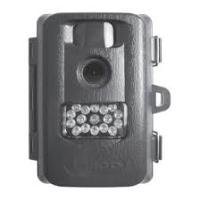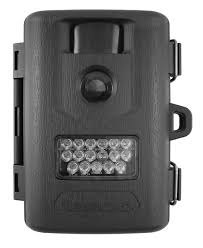
119215C - Digital Camera TASCO - Free user manual and instructions
Find the device manual for free 119215C TASCO in PDF.


User questions about 119215C TASCO
0 question about this device. Answer the ones you know or ask your own.
Ask a new question about this device
Download the instructions for your Digital Camera in PDF format for free! Find your manual 119215C - TASCO and take your electronic device back in hand. On this page are published all the documents necessary for the use of your device. 119215C by TASCO.
USER MANUAL 119215C TASCO
Digital Trail Camera
w/Night Vision
Introduction 5
Parts Identification 6
Battery and SD Card Installation 8
Camera Setup 9
Setting the Year, Date & Time 9
Setting Camera/Video Mode and Resolution 10
Setting the Delay Time 11
Checking the # of Stored Photo/Video Files 12
Formatting the SD Card 12
Camera Operation 13
Mount the Camera 13
Power on the Camera 13
Test the Coverage Area 14
Secure the Camera 14
Viewing the Photos and Videos 15
Glossary 16
Specifications 17
Troubleshooting/FAQ 18
IMPORTANT NOTE
Congratulations on your purchase of one of the best trail cameras on the market! Tasco is very proud of this little unit and we are sure you will be pleased with it as well. We appreciate your business and want to earn your trust. Please refer to the notes below and the instructions in this manual to ensure that you are completely satisfied with this product.
If your Tasco Trail Cam does not seem to be functioning properly or if you are having photo/video quality issues, please check the Troubleshooting/FAQ section on pages 18-21.
Problems are often due to something simple that was overlooked, or require only changing one setting to solve.
If your problem continues after trying the solutions in the Troubleshooting/FAQ section, please call Tasco Customer Service at (800) 423-3537. In Canada, call (800) 361-5702.
Tasco recommends using 4 Energizer® Lithium AA batteries in this Trail Cam to obtain maximum battery life.
Tasco recommends using SanDisk® SD and SDHC Cards (up to 16GB capacity) in this Trail Cam.
INTRODUCTION
Congratulations on your purchase of the Tasco 119215C digital trail camera. This trail camera is designed to record the activity of wildlife in the outdoors with its still image and movie modes and weatherproof, rugged construction. This trail cam model features a compact, portable size and an extra long battery life.
Main Features:
2.1MP digital sensor
- Compact Size (120mm94mm46mm)
- Long Battery Life (Up to 6 months)
Trigger Time=1 second
Automatic IR Filter
LCD Display
15 Night Vision LEDs
Adjustable Photo Delay: 5~59 second,1~10mins (default 10S)
Multiple Shot Mode (3 images per trigger)
640*480 at 30 FPS Videos
Supports up to 16 GB SD Card
- Date, Time & Moon Phase Imprint
Auto Exposure
Auto White Balance
Power Supply: 4 AA Cell batteries
Mounting Socket for Standard Tripods
- Weatherproof
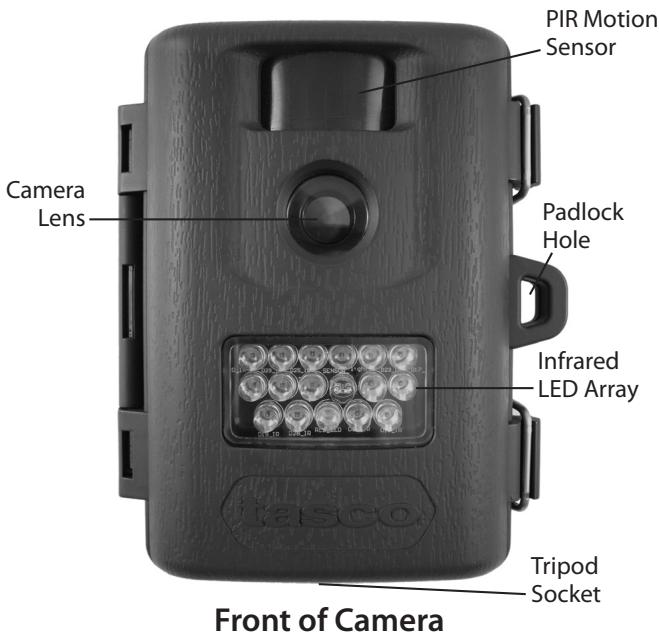
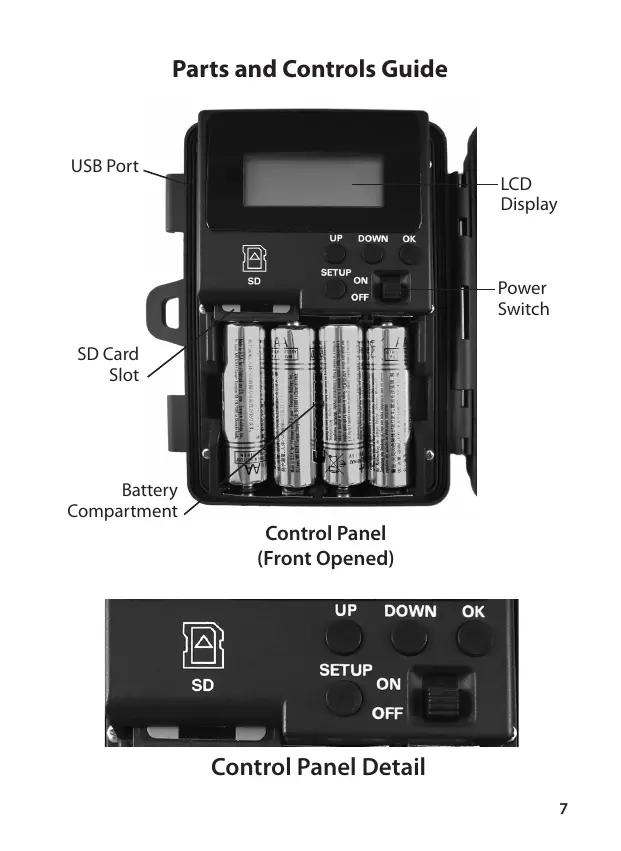
Parts and Controls Guide
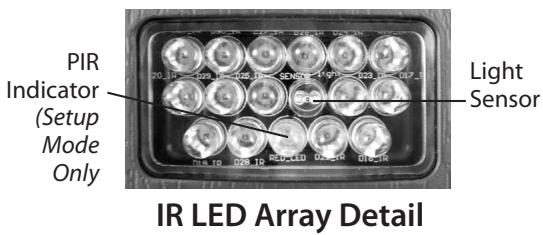
Parts and Controls Guide
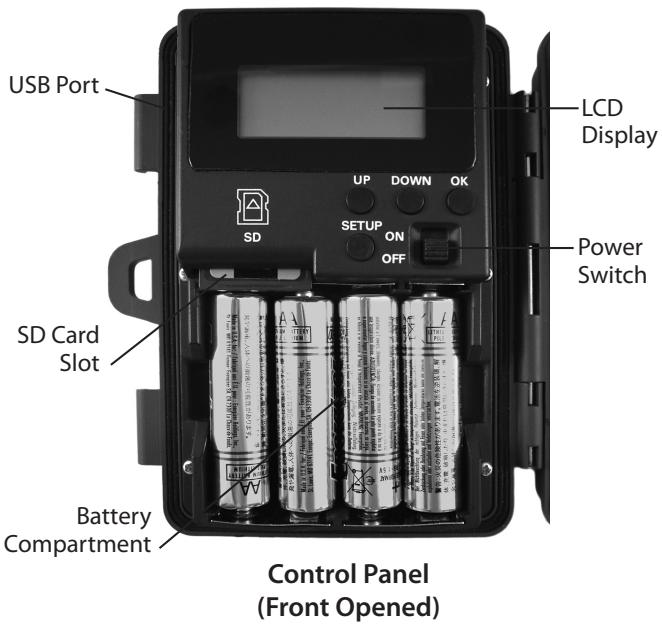
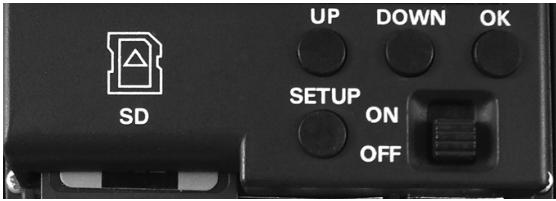
Control Panel Detail
BATTERY and SD CARD INSTALLATION
The Tasco 119215C Digital Scouting Camera is designed to operate using 4 AA batteries. We recommend using Lithium (for longest life) or Alkaline batteries.
NOTE: Always set the power switch to the OFF position when installing or removing batteries.
Please make sure the batteries are inserted correctly, as indicated inside the battery compartment. Incorrect voltage or polarity (+/-) will damage the camera.
Memory
Your 119215C Digital Scouting Camera has a memory card slot, to accept SD cards up to 16GB max. capacity (sold separately).
Inserting an SD card
Make sure camera is in the OFF position whenever adding or removing memory.
Insert an SD card into the card slot completely and oriented correctly as shown by the icon under the SETUP button (contacts facing up and notched corner on the left).
To remove the SD memory card, depress the SD card and pull out the card gently.
Using a new, blank SD card is recommended. If the SD card has been used in another device, please make sure to format using the Format option in the trail camera's Setup menu before you set the camera to capture photos/videos. New cards are ready to use straight from the package.
CAMERA SETUP
The initial setup process for your trail camera is very easy. Turn on the unit and then press the "SETUP" button. The display icons/indicators (shown below) will blink in turn to indicate which type of setting you are making, beginning with "DATE". Press "UP" or "DOWN" to go to the next setup item. Press the "OK" button to confirm a specific menu setting when it is blinking. After you have completed making the settings for all menu items (or after going back in to change a setting for just one item), press "SETUP" again to exit setup mode.
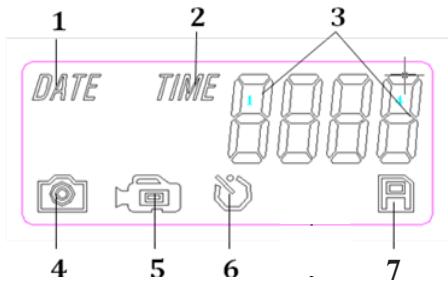
- Date
- Time
3.4 Digit Display - Still Photo Mode / Resolution
- Video Mode
- Delay Time
- SD Card
Setup Icons-Display Guide
1. Setting the Date, Year and Time
Follow the steps below to set the Date, Year and Time so they will be correct when they are imprinted on your photos:
Set Date and Year
- First, move the Power Switch to the "ON" position, and then press the "SETUP" button.
The "DATE" indicator (#1) will be blinking. Press "OK" to confirm you want to set it.
The first two digits of the 4 digit display (#3) indicate the month (MM) and the last two digits indicate the day (DD).
Press "UP" or "DOWN" to select the month between 01-12, Press "OK"
CAMERA SETUP (continued)
to confirm the month setting you've made. Next, set the Date:
- Press "UP" or "DOWN" to select a date between 01-31, Press "OK" to confirm. Next, set the Year:
- Press "UP" or "DOWN" to select a year between 10-30 (2010-2030), Press "OK" to confirm.
Set Time
The "TIME" indicator (#2) will blink next (after you confirm the DATE/ YEAR settings). Press "OK" to confirm you want to set it.
The first two digits of the 4 digit display indicate the hour (HH) and the last two digits indicate minutes (MM).
- Press "UP" or "DOWN" to select an hour between 00-23 (00= midnight, 12=noon, 23=11PM), Press "OK" to confirm. Next, you are ready to set the minutes.
- Press "UP" or "DOWN" to set the minutes between 00-59, Press "OK" to confirm.
Note: The Date & Time setting will normally be retained for a few minutes when the batteries are removed from the camera. However, you may need to reset the Date & Time after replacing the batteries, if they have been removed for a longer period of time.
2. Setting Camera/Video Mode and Resolution
This item allows you to select whether the camera takes still photos or shoots video clips when the PIR is triggered (Photo or Video Mode). You can also set the number of photos the camera takes for each PIR trigger (for Photo Mode only). Available settings are 1P, 3P, or video mode.
- The "PHOTO/VIDEO" indicators (#4 & #5) are now both blinking (alternating). Press "OK" to confirm you want to set the capture mode.
- Press the "UP" or "DOWN" button to select the Photo or Video mode icon (only the mode you select will be blinking).
CAMERA SETUP (continued)
If you select "Photo" mode icon (#4) then press "OK":
- The LCD will blink the alternating indicators "1P" (single photo taken per trigger event) and "3P" (sequence of 3 photos taken per trigger event). Press "UP" or "DOWN" to select the setting you prefer, then press "OK" to confirm.
Next, the LCD will display "LoHI" which sets the resolution for the still photos. "Lo" represents 3.0MP (the resolution of the sensor) and "HI" represents is 5.0MP (via software interpolation-the photo quality will be higher, but each file will use up more space on the SD card). Press "UP" or "DOWN" to select the resolution you prefer and press "OK" to confirm.
If you select the "Video" mode icon (#5) then press "OK":
- The movie length is preset at 15 seconds and cannot be changed. There are no additional settings or options for Video Mode.
After pressing "OK" (when you finish selecting the settings for one/three photos and resolution if you chose "Photo" Mode), the "Delay Time" icon (#6) will blink next.
3. Setting the Delay Time
The Delay Time menu item allows you to set the interval that the camera will sleep before accepting a new PIR trigger, in minutes and seconds. This setting ranges from 1 second to 10 minutes. The default delay time is 10 S.
While the Delay Time icon (#6) is blinking, press "OK" to confirm you want to set it.
The LCD will display "0010", with first the two digits indicating minutes and the last two digits indicating seconds.
While the first two digits are blinking, press "UP" or "DOWN" to change the minutes value (Range from 00-60 min.). Press "OK" to confirm the minutes setting.
CAMERA SETUP (continued)
(Only) if you selected "00" for the minutes setting, the last two digits will blink, and you can set a delay time in seconds (this is not available if you selected from "01" to "60" minutes).
- Press "UP" or "DOWN" to change the value (Range from 05-59 seconds), press "OK" to confirm.
Next (last item in the Setup menu), you will see the SD card icon (#7) blink. You can now check the number of files on your SD card, and format it if desired.
4. Checking the # of Stored Photo/Video Files
While the SD Card icon (#7) is blinking, the total number of files stored on the SD card will be seen on the 4 digit Display (#3). This allows you to confirm if this is a new card or one you have used previously (and may wish to format).
Press OK-this will take you to the "Format Card" menu item next.
5. Formatting the SD Card
- With the SD Card icon (#7) blinking (after pressing OK at the end of the previous Setup step), press "UP" or "DOWN" to select "FO" (Yes, Format) or "NO" (Do Not Format) then press "OK" to confirm your choice.
- Press "UP" or "DOWN" to select "Y" (Yes) or "N" (No), then press "OK" to confirm. This step provides an extra level of safety, to help prevent you from accidentally formatting a card with files you wanted to keep. If you select "FO" in the first step, then select "Y" and press "OK", the camera will format the SD card-all files on the card will be erased.
Exiting the Setup Menu
Once you have finished using the Setup menu, press "SETUP" to save all your settings, and exit the Setup menu. You are now ready to take your Trail Cam outside and begin using it to record wildlife activity.
CAMERA OPERATION
Once your camera has been setup, you are ready to begin using it to capture photos of wildlife activity in the area you choose to locate it. Just follow these steps:
1. Mount the Camera
It is recommended that you mount the camera about 4 or 5 feet (1.2~1.5 meters) off the ground, with the camera pointed at a slight downward angle. It's best to avoid mounting the camera facing east or west as the rising and setting of the sun could produce false triggers and overexposed images. Clear branches and other debris away from the front of the camera so as not to block the camera lens or PIR sensor.
To mount the camera in place, insert the strap through the strap slots on the rear housing. Wrap the strap around the mounting surface. Secure the strap and tighten the buckle in order to secure the camera.
Make sure that both door latches are securely locked in place, to ensure proper weather resistance.
2. Power On the Camera
The camera will be in "sleep" status after it has been powered on. When the PIR sensor is triggered, it will start to take photos immediately after the delay time (as set) has passed.
3. Test the Coverage Area
One of 119215C Trail Camera's most useful features is the ability to test the coverage area.
After mounting the camera, open the front housing and slide the "Power" switch to the "ON" position. Press the SETUP button to enter the MENU mode.
Adjust the PIR sensitivity dial to your preference based on conditions.
CAMERA OPERATION (continued)
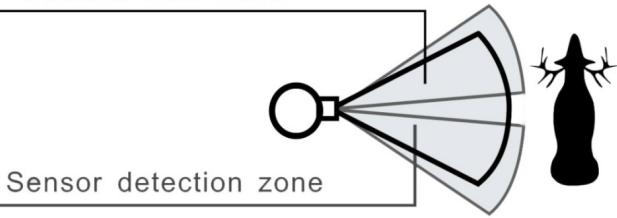
The PIR indicator light below the lens will blink when you have entered the coverage area.
Adjust the camera position as needed and repeat the test until the desired coverage area is achieved.
Press the SETUP button again when you are finished using the test mode—the camera will be "sleeping" and waiting for the PIR sensor to trigger the first photo or video capture.
Camera view zone
4. Secure the Camera
A standard padlock may be used in the camera's lock hole to secure it and prevent theft.
VIEWING THE PHOTOS and VIDEOS
After your camera has been operating for awhile, you will of course want to review the photos and/or videos it has been capturing. This can be done by either of two methods, according to your preference or the availability of accessory equipment:
Using an SD Card Reader
Push the SD card in slightly to release it then pull it out gently.
Put the SD card into any of the widely available SD card readers (either a dedicated SD card reader or "multi-card reader" that features slots for several different memory cards, including SD cards.
Follow the card reader supplier's directions to view or download the photo and/or video files on the SD card.
Connect the Camera to PC directly
Slide the "Power" switch to the "On" position, then press the "SETUP" button.
Connect your camera to a PC with the provided USB cable. The PC will recognize the camera as an external storage device, using the "USB Mass Storage" standard (no driver installation necessary-not compatible with Windows 98 or earlier). The PC will display a new disk symbol under "My Computer" or in Windows Explorer, and you will see a dialog window on your desktop with several options to view, move, or copy the photo and video files that are stored on the SD card. The camera's LCD will display "STO", meaning the camera is in mass storage mode.
GLOSSARY
PIR (Passive Infrared Sensor): Senses motion like a typical security motion detector. Requires infrared energy (heat) in addition to motion to trigger the sensor to help limit detection to live animals (rather than leaves, etc).
Camera Delay: Time elapsed between photos while events are sensed and recorded. You should set this based on wildlife activity in the area.
Moon Phase: The activity level of some animals seems to be related to the phases of the moon. The trail cam has a feature which imprints a moon phase stamp on each photo for reference.
IR Flash: Also called IR LED Array. This is a "night vision" feature, which emits a burst of infrared light, invisible to the human eye. Especially useful for night photos when a visible flash may be undesirable.
Battery Life: Time that camera will function in the field. Dependent on ambient temperature, number of images taken and number of times the IR flash fires. When the battery voltage drops below 4.5v, the IR flash stops firing. When battery voltage is below 3.5v, the camera stops working.
Burst: The number of pictures the camera takes per PIR trigger.
1P: Single image captured for each PIR trigger
3P: Three image sequence captured for each PIR trigger
FULL: When memory capacity is full, the LCD display indicates "FULL"
Mass Storage: Connect the USB cable to a computer, press the "SETUP" button, and the computer can access the contents of the SD card. The camera is automatically recognized as an "external drive", without the need to install special drivers. (Win 98 and older operating systems are not supported. Mac OS9 and OSX are also compatible-the camera will appear on your desktop as an external storage device or "disk").
Technical Specifications
| Model Number | 119215C |
| Image Sensor Type | 1/2 Inch CMOS |
| Effective Resolution | 2.1 Megapixels |
| Effective Focal Length | 7.6 mm |
| Lens Aperture | f/2.8 |
| IR Filter | Automatic IR Filter |
| Display | Backlit LCD |
| PIR Sensor | Yes |
| Trigger Speed | 1 second |
| Number of IR LED | 15 LEDs |
| Max Night Vision Lighting Distance | 30 feet (10 meters) |
| Storage | SD Card up to 16 GB Capacity |
| PIR Indicator | Yes (Setup mode only) |
| Adjustable Delay Time Range | 5~59 second, 1~10mins (default 10S) |
| Selectable Image Resolution | 2.1MP, 5.0MP |
| Multiple Image Mode | Yes-3 photos |
| Video Resolution | Movie: AVI 640 x 480 pixels @ 30 fps (15 seconds). |
| File Format (Image/Video) | JPEG/AVI |
| Date Time Imprint | Yes |
| Moon Phase Imprint | Yes |
| Exposure | Auto |
| White Balance Mode | Auto |
| Power Supply | 4 AA Cell batteries (alkaline, lithium or NiMh) |
| Water Resistant | Yes |
Troubleshooting / FAQ
Battery life is shorter than expected
- Battery life will vary with operating temperature and the number of images taken over time. Typically, the Trail Cam will be able to capture several thousand images before the batteries die.
- Check to make sure you have used new alkaline or lithium batteries. Tasco recommends using 4 Energizer® Lithium AA batteries in this Trail Cam to obtain maximum battery life.
- Make sure that the power switch was turned to the "On" position and that the camera was not left in "Setup" mode while in the field.
- Make sure that you are using a good quality name brand SD card in your camera. Tasco recommends SanDisk® brand SD Cards up to 16GB. Our experience indicates that poor quality SD cards can sometimes reduce your Trail Cam battery life.
Camera stops taking images or won't take images
- Please make sure that the SD card is not full. If the card is full, the camera will stop taking images.
- Check the batteries to make sure that they are new alkaline or lithium AA batteries. See note above about short battery life.
- Make sure that the camera power switch is in the "On" position and not in the "Off" position or in "Setup" mode.
- Make sure that you are using a good quality SD card in your camera. Tasco recommends SanDisk® SD Cards up to 16GB.
- If the SD card has its write protect switch in the lock position, the camera will not take images.
- If you have used an SD card in another device before inserting it in your Trail Cam, you might want to try formatting the card using the "Format" parameter in Setup mode (make sure you have backed up any important files first, as formatting will erase all previous files). In some cases, other devices may change the formatting of the SD card so that it will not work properly with the Trail Cam.
Troubleshooting / FAQ
Camera won't power up
- Make sure that you have installed all 4 batteries in the battery compartment. Tasco recommends using 4 Energizer® Lithium AA batteries in this Trail Cam.
- Make sure that the batteries are installed correctly, observing proper polarity. Always place the negative (flat) end of each battery in contact with the spring side of its slot inside the camera.
Still Photo and/or Video Quality Problems
1. Night photos or videos appear too dark
a. Try using a set of new batteries. The flash will stop operating near the end of the battery life.
b. You will get the best results when the subject is within the ideal flash range, no farther than 45^ (14m) from the camera. Subjects may appear too dark at greater distances.
c. Please note that when the Capture Number parameter is set higher than "1P", or with very short Time Delay settings, some images may appear darker than others due to the quick response and rapid retriggering of the camera, allowing less time for the flash to fully recharge before firing again.
2. Daytime photos or videos appear too dark
a. Make sure that the camera is not aimed at the sun or other light sources during the day, as this may cause the auto exposure to produce darker results.
3. Night photos or videos appear too bright
a. You will get the best results when the subject is within the ideal flash range, no closer than 10^ (3m) from the camera. Subjects may appear too light at closer distances.
4. Daytime photos or videos appear too bright
a. Make sure that the camera is not aimed at the sun or other light sources during the day.
Troubleshooting / FAQ
5. Photos with streaked subject
a. In some cases with low lighting conditions and fast moving subjects, the 7MP resolution setting may not perform as well as the 5MP setting.
b. If you have multiple images where fast moving subjects produce streaks on the photo, try the 5MP setting instead.
6. Red, green or blue color cast
a. Under certain lighting conditions, the sensor can become confused resulting in poor color images.
b. If this is seen on a consistent basis, then the sensor may need servicing. Please contact Tasco customer service.
7. Short video clips—not recording to the length set
a. Check to make sure that the SD card is not full.
b. Make sure that the camera has good batteries in it. Near the end of the battery life, the camera may choose to record shorter video clips to conserve power.
Photos Do Not Capture Subject of Interest
- Try to set your camera up in an area where there is not a heat source in the camera's line of sight.
- In some cases, setting the camera near water will make the camera take images with no subject in them. Try aiming the camera over ground.
- Try to avoid setting the camera up on small trees that are prone to being moved by strong winds.
- Remove any limbs which are right in front of the camera lens.
PIR Sensor LED Flashes/Doesn't Flash
- When the camera is in the "Setup" mode, the PIR Indicator LED on the front of the camera will flash when it senses motion. This is for setup purposes only and will help the user aim the camera.
- During use, the LED will not flash when the camera takes an image. This is to help keep the camera hidden from game.
Troubleshooting / FAQ
Camera won't retain settings
- Make sure that you have been saving the changes to any parameter settings that you made while in Setup mode, by pressing "OK" after changing the setting. If you don't save your new setting after changing it, the camera will continue to use the original default setting for that parameter.
| TWO-YEAR LIMITED WARRANTY Your Tasco® product is warranted to be free of defects in materials and workmanship for two years after the date of purchase. In the event of a defect under this warranty, we will, at our option, repair or replace the product, provided that you return the product postage prepaid. This warranty does not cover damages caused by misuse, improper handling, installation, or maintenance provided by someone other than a Tasco Authorized Service Department. Any return made under this warranty must be accompanied by the items listed below: 1) A check/money order in the amount of $10.00 to cover the cost of postage and handling 2) Name and address for product return 3) An explanation of the defect 4) Proof of Date Purchased 5) Product should be well packed in a sturdy outside shipping carton, to prevent damage in transit, with return postage prepaid to the address listed below: | |
| IN U.S.A. Send To: | IN CANADA Send To: |
| Tasco | Tasco |
| Attn.: Repairs | Attn.: Repairs |
| 8500 Marshall Drive | 25A East Pearce Street, Unit 1 |
| Lenexa, Kansas 66214 | Richmond Hill, Ontario L4B 2M9 |
| For products purchased outside the United States or Canada please contact your local dealer for applicable warranty information. In Europe you may also contact Tasco at: Tasco Germany GmbH European Service Centre Mathias-Brüggen-Str. 80 D-50827 Köln GERMANY Tel: +49 221 995568-0 Fax: +49 221 995568-20 | |
| This warranty gives you specific legal rights. You may have other rights which vary from country to country. ©2010 B.O.P.. | |
Specifications and designs are subject to change without any notice or obligation on the part of the manufacturer.
FCC Compliance Statement:
This equipment has been tested and found to comply with the limits for a Class B digital device, pursuant to part 15 of the FCC Rules. These limits are designed to provide reasonable protection against harmful interference in a residential installation.
Operation is subject to the following two conditions: (1) This device may not cause harmful interference, and (2) this device must accept any interference received, including interference that may cause undesired operation.
This equipment generates, uses and can radiate radio frequency energy and, if not installed and used in accordance with the instructions, may cause harmful interference to radio communications. However, there is no guarantee that interference will not occur in a particular installation. If this equipment does cause harmful interference to radio or television reception, which can be determined by turning the equipment off and on, the user is encouraged to try to correct the interference by one or more of the following measures:
Reorient or relocate the receiving antenna.
- Increase the separation between the equipment and receiver.
- Connect the equipment into an outlet on a circuit different from that to which the receiver is connected.
- Consult the dealer or an experienced radio/TV technician for help.
The device does not contain any user-serviceable parts. Repairs should only be made by an Authorized Tasco repair center. Unauthorized repairs or modifications could result in permanent damage to the equipment, and will void your warranty and your authority to operate this device under Part 15 regulations.
The shielded interface cable which is provided must be used with the equipment in order to comply with the limits for a digital device pursuant to Subpart B of Part 15 of FCC Rules.
Français
Table des matieres
Specifications techniques
25A East Pearce Street, Unit 1
Lenexa, Kansas 66214
Richmond Hill, Ontario L4B 2M9
European Service Centre
Mathias-Bruggen-Stt. 80
D-50827Koln
GERMANY
For further questions or additional information please contact: