
DYNABASS 200T - Bass Amplifier TRAYNOR - Free user manual and instructions
Find the device manual for free DYNABASS 200T TRAYNOR in PDF.


User questions about DYNABASS 200T TRAYNOR
0 question about this device. Answer the ones you know or ask your own.
Ask a new question about this device
Download the instructions for your Bass Amplifier in PDF format for free! Find your manual DYNABASS 200T - TRAYNOR and take your electronic device back in hand. On this page are published all the documents necessary for the use of your device. DYNABASS 200T by TRAYNOR.
USER MANUAL DYNABASS 200T TRAYNOR
B A S S G U I T A R A M P L I F I E R
IMPORTANT SAFETY INSTRUCTIONS

This lightning flash with arrowhead symbol, within an equilateral triangle, is intended to alert the user to the presence of uninsulated "dangerous voltage" within the product's enclosure.
that may be of sufficient magnitude to constitute a risk of electric shock to persons.
The exclamation point within an equilateral triangle is intended to alert the user to the presence of important operating and maintenance (servicing) instructions in the ccompanying the appliance.
Instructions pertaining to a risk of fire, electric shock, or injury to a person
CAUTION: TO REDUCE THE RISK OF ELECTRIC SHOCK,DO NOT REMOVE COVER (OR BACK).
NO USER SERVICEABLE PARTS INSIDE.
REFER SERVICING TO QUALIFIED SERVICE PERSONNEL.
Read Instructions: The Owner's Manual should be read and understood before operation of your unit. Please, save these instructions for future reference and heed all warnings.
Clean only with dry cloth.
Packaging: Keep the box and packaging materials, in case the unit needs to be returned for service.
Warning: To reduce the risk or fire or electric shock, do not expose this apparatus to rain or moisture. Do not use this apparatus near water!
Warning: When using electric products, basic precautions should always be followed, including the following:
Power Sources
Your unit should be connected to a power source only of the voltage specified in the owners manual or as marked on the unit. This unit has a polarized plug. Do not use with an extension cord or receptacle unless the plug can be fully inserted. Precautions should be taken so that the grounding scheme on the unit is not defeated.
Hazards
Do not place this product on an unstable cart, stand, tripod, bracket or table. The product may fall, causing serious personal injury and serious damage to the product. Use only with cart, stand, tripod, bracket, or table recommended by the manufacturer or sold with the product. Follow the manufacturer's instructions when installing the product and use mounting accessories recommended by the manufacturer.
The apparatus should not be exposed to dripping or splashing water; no objects filled with liquids should be placed on the apparatus.
Terminals marked with the "lightning bolt" are hazardous live; the external wiring connected to these terminals require installation by an instructed person or the use of ready made leads or cords.
Ensure that proper ventilation is provided around the appliance. Do not install near any heat sources such as radiators, heat registers, stoves, or other apparatus (including amplifiers) that produce heat.
No naked flame sources, such as lighted candles, should be placed on the apparatus.
Power Cord
Do not defeat the safety purpose of the polarized or grounding-type plug. A polarized plug has two blades with one wider than the other. A grounding type plug has two blades and a third grounding prong. The wide blade or the third prong are provided for your safety. If the provided plug does not fit into your outlet, consult an electrician for replacement of the obsolete outlet. The AC supply cord should be routed so that it is unlikely that it will be damaged. If the AC supply cord is damaged DO NOT OPERATE THE UNIT.
Unplug this apparatus during lightning storms or when unused for long periods of time.
Service
The unit should be serviced only by qualified service personnel.
SUIVEZ TOUTES LES INSTRUCTIONS
The Traynor DynaBass 200 and the 200T have been designed with the needs of professional bass guitar players in mind. We believe you will find your Traynor DynaBass 200 or 200T to be dependable and versatile for years to come.
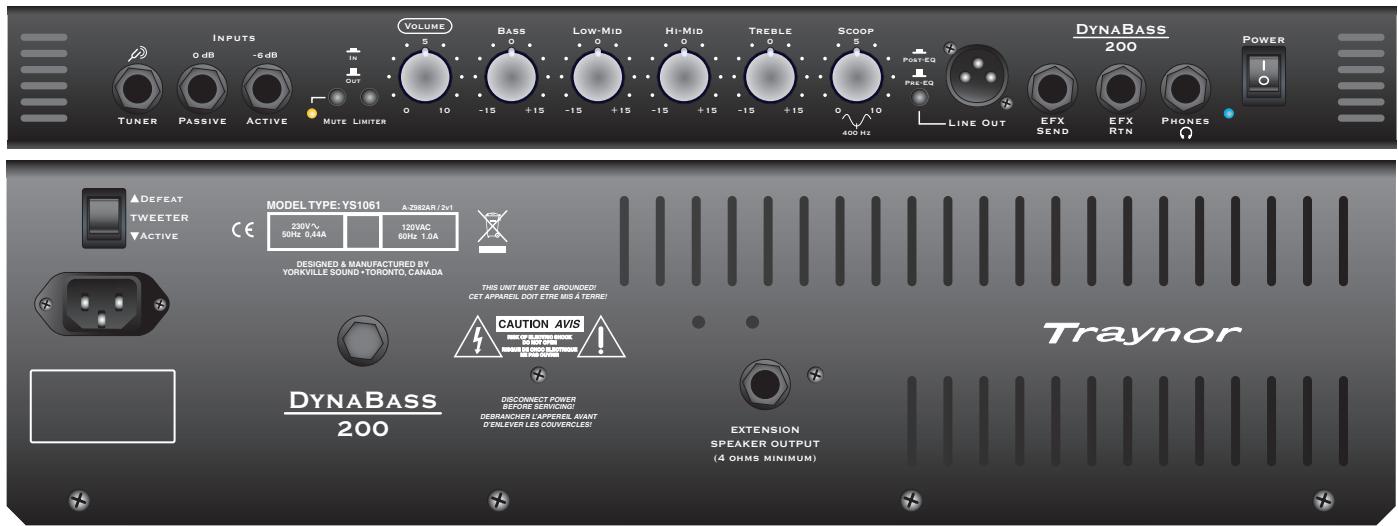
1. Tuner Jack
This is an instrument-level output ideal for connecting an electronic guitar/bass tuner.
2. 0dB / Passive and -6dB / Active Inputs
These are the instrument inputs. We suggest the following: use the 0dB/Passive input for bass guitars with passive electronics, like single-coil and humbucking pickups; use the -6dB/ Active input for active pickups (or extremely 'hot' pickups). However, you may prefer to run your active pickup bass guitar into the 0dB/Passive input for an intentional aggressive sound – you the artist are in control.

User Tip: Don't use both inputs at the same time as they are not intended for connecting more than one instrument at a time.
3. Mute Switch
The Mute button cuts off all audible signals to the speaker(s). For your convenience, your signal still runs to the Tuner jack. This enables you to tune your bass without having to adjust any settings on either the bass guitar or DynaBass 200 (and the audience will not be able to hear you tuning).
4. Limiter
When engaged, the DynaBass 200's Limiter prevents audible distortion due to power-amp clipping. Unlike some other input clip limiters, the DynaBass 200's does not affect the preamp stage at all. Instead, this Limiter ensures that output-stage clipping cannot endanger the speaker or tweeter.
Technically, the DynaBass 200's Limiter compares the amplifier's output to the available AC power (i.e., it reads the DC rail voltage) then, just before output stage clipping occurs, the Limiter reduces signal levels sufficiently to prevent power amp distortion. This permits the 200 to remain cleaner at higher output levels, even when the AC line sags below normal.
User Tip: With the Limiter engaged, the only way you can distort your DynaBass 200 is by overdriving the preamp, which is quite acceptable for certain playing styles. This will not harm the drivers as long as the Limiter remains engaged.

5. Volume
Set the Volume control for the level of sound desired. If unwanted distortion occurs, reduce the Volume setting and/or the tone control settings (especially Bass).
6. Tone Controls
Each tone control permits a wide range of adjustment. The four overlapping controls cover the entire audio spectrum. The Bass adjusts the level of the low frequency range, Low Mid the next range up, Hi Mid covers higher notes and middle harmonics and the Treble control regulates the upper harmonic range. The center setting on these tone controls is approximately neutral.
User Tip: When starting out, it's a good idea to center all tone controls. Then, while you play, adjust them for the desired sound.
7. Scoop
The Scoop control emphasizes lows and highs and reduces midrange to provide a flexible tone alternative. A setting of 0 provides no Scoop and a setting of 10 provides the maximum effect.
User Tip: You may find that for best results using the Scoop at higher settings, the tone controls should be set close to the center/neutral positions.
8. XLR Line Out
This is your conduit to the P.A. or recording console. Using an XLR mic cable or a shielded patch cord with a female XLR connector on one end (balanced or unbalanced, e.g. a high or low-impedance mic cable), connect the Line Out to the input of the mixer. Electronic balancing circuitry minimizes the possibility of hum or noise when the Line Out is connected to a mixer (even when the mixer does not have balanced inputs). Also, this output can be made Pre-EQ or Post-EQ according to the selector button which is described below.
Pre-EQ / Post-EQ Selector Switch
The Pre-EQ / Post-EQ selector switch enables you to configure the behavior of the Line Out XLR jack.

- In the Pre-EQ setting, the Line Out signal comes directly from the input section bypassing the Volume control, tone controls and EFX Send/Return circuitry. Use the Pre-EQ setting in a recording or P.A. situation where the mixing engineer requires a completely dry signal, as if it were a D.I. box (Direct from the Instrument).
- In the Post-EQ setting, the Line Out signal comes from the final preamp stage. The Volume control, tone controls and any connected effects all affect the signal directly. Use the Post-EQ setting when connecting the Line Out to the input of another amp (perhaps for added stage coverage) or to a recording or P.A. mixer where a dry signal is not required.
User Tip: For most club PA situations or for home recording, you would probably prefer the Post-EQ setting.
9. EFX Send / EFX Return Jacks
The line-level signal at the EFX Send jack is post-fader and post-EQ (it is affected by the Volume and all tone controls). The EFX Send would normally be connected to the input of the effects processor with a shielded patch cord. When a phone plug is inserted into the EFX Return jack, the signal goes directly to the 200's internal power amp. Technically, by inserting a 1/4 -inch phone plug into the EFX Return, you are disconnecting the internal preamp signal going to the power amplifier stage. As a result, the power amp can only receive signals routed through here (i.e. it isolates the power amp). Only use shielded patch cords for all interconnections.

User Tip: You can "slave" your DynaBass 200 to another amp. As an example, if you wanted to run two bass amps for a large gig, you can simply run a shielded patch cable from the line output of the other amp (possibly another 200) to the EFX Return of your DynaBass 200.
10. Phones
When a headphone plug is inserted into the Phones jack, both the built-in speaker and the Extension Speaker Output jack are disconnected. This permits silent practicing.
11. Power
The LED beside the Power switch will illuminate when the unit is on.
12. Tweeter Defeat / Active Switch
The Tweeter Defeat / Active toggle switch provides you the option of playing classic bass tones (tweeter defeated) or more modern full-range tones with increased high frequency definition (tweeter active). You be the judge of what sound you prefer!
13. Extension Speaker Output (rear panel)
One or two extension speakers can be connected via the Extension Speaker Output jack on the back panel. The minimum impedance of the external speaker load is 4-ohms (one 4-ohm or two 8-ohm extension speakers in parallel). The Extension Speaker jack is wired in parallel with the internal speaker so that the internal speaker (which is also 4-ohms) will continue to operate when an extension cabinet is used.

User:Tip: The power amplifier is electronically, and thermally, protected against unsafe loads and will shut down (rather than sustain damage) when the speaker load is too low. If a shutdown occurs, disconnect the extension speaker and switch the power off. The 200 will be capable of powering back up in a few minutes after it cools down.
Specifications
Power @ min. impedance (Watts) 200
Minimum Impedance (Ohms) 2
Burst Power - 2 cycle 250 Watts
Speaker Configuration - LF (Size / Power) Dy
DynaBass 200: 1x 15-inch;
Speaker Configuration - HF (Size / Power) Piezo Tweeter / 30 Watts
Input Channels 1
Channel 1 - inputs 2 (-6 dB and 0 dB)
Channel 1 - controls Volume, Bass, Low Mid, Hi Mid, Treble and Scoop
Channel 1 - switches Mute, Limiter, Line Out Select, Tweeter
Input Sensitivity (mV) <25
Line Out (type / configuration) Balanced XLR / Front
Line Out Sensitivity (Vrms) <1
Effects Loop / Location Yes / Front
Effects Return Sensitivity (Vrms) <1
LED Indicators P
Protection Th
Limiter / Switchable Yes/Yes
External speaker output / location Rear
Headphone Jack Yes
Dimensions (DWH, inches) DynaBass 200: 14.25 × 20.75 × 23.5 ;
DynaBass 200T:15.25x20.75x21
Dimensions (DWH, cm) DynaBass 200: 36.5 × 53 × 60 ;
DynaBass 200T:39x53x53.5
Weight (Ibs / kg) 60 / 27.25

① Tuner Jack - 1/4-inch phone jack.
② 0dB / Passive and -6dB / Active Input Jacks – 1/4 -inch phone jacks.
③ Mute Switch - LED indicator illuminates when active.
Limiter Switch
Volume Control
^6 Tone Controls – Bass, Low-Mid, Hi-Mid and Treble.
⑦ Scoop Control
Line Out XLR Jack and Selector Switch - Switch between Pre-EQ and Post-EQ settings.
EFX Send and EFX Return Jacks - 14 -inch TRS phone jacks.
10 Phones Jack - 1/4-inch TRS phone jack.
Power Switch - Turns the AC mains on and off, the LED indicator illuminates when active.
⑫ Tweeter Defeat / Active Switch - Enable / disable the internal DynaBass 200 tweeter.
External Speaker Output Jack - ¼-inch phone jack. Connect additional speakers. (4-ohms min.).
Volume, Bass, Low Mid, Hi Mid, Treble et Scoop
Mute, Limiter, Line Out Select, Tweeter
<25
Symétrique / Avant
<1
Oui / Avant
<1
Alimentation
Traynor Two Year Warranty
Unlimited Warranty
Your Traynor two year unlimited warranty on this product is transferable and does not require registration with Yorkville Sound or your dealer. If this product should fail for any reason within two years of the original purchase date, simply return it to your Traynor dealer with original proof of purchase and it will be repaired free of charge.
Freight charges, consequential damages, weather damage, damage as a result of improper installation, damages due to exposure to extreme humidity, accident or natural disaster are excluded under the terms of this warranty. Warranty does not cover consumables such as vacuum tubes, bulbs or batteries beyond 90 days of original purchase. See your Yorkville dealer for more details. Warranty valid only in Canada and the United States.
Garantie Illimitée
Voice: (905) 837-8481 Voice: (716) 297-2920
Fax: (905) 837-8746 Fax: (716) 297-3689

Yorkville
550 Granite Court 4625 Witmer Industrial Estate
Pickering, Ontario Niagara Falls, New York
L1W-3Y8 CANADA 14305 USA

WEB: www.yorkville.com
Niagara Falls, New York
14305 USA
Voice: (716) 297-2920
Fax: (716) 297-3689

Quality and Innovation Since 1963
Printed in Canada