EasyManual
CENTRO - Smartphone PALMONE - Free user manual and instructions
Find the device manual for free CENTRO PALMONE in PDF.


Download the instructions for your Smartphone in PDF format for free! Find your manual CENTRO - PALMONE and take your electronic device back in hand. On this page are published all the documents necessary for the use of your device. CENTRO by PALMONE.
USER MANUAL CENTRO PALMONE
© 2007 Palm, Inc. All rights reserved. Blazer, HotSync, Palm, Palm OS, Centro, VersaMail, and the Palm and Centro logos are among the trademarks or registered trademarks owned by or licensed to Palm, Inc. This product contains ACCESS Co., Ltd's NetFront 3.0 Internet browser software. © 1996-2005 ACCESS Co., Ltd. and ACCESS Systems America, Inc. NetFront is the trademark or registered trademark of ACCESS Co., Ltd. in Japan and in other countries except the United States of America. NetFront is a registered trademark of NetFront Communications, Inc. in the United States of America and is used under a license. A portion of this software includes software modules developed by the Independent JPEG group. Documents To Go is a trademark or registered trademark of DataViz, Inc. © All rights reserved. All other brand and product names are or may be trademarks of, and are used to identify products or services of, their respective owners.
This product is protected by one or more of the following United States patents:
7,007,239; 6,976,226; 6,975,304; 6,965,375; 6,961,567; 6,961,029; 6,957,397; 6,952,571; 6,950,988; 6,947,975; 6,947,017; 6,943,667; 6,940,490; 6,924,752; 6,907,233; 6,906,701; 6,906,741; 6,901,276; 6,850,780; 6,845,408; 6,842,628; 6,842,335; 6,831,662; 6,819,552; 6,804,699; 6,795,710; 6,788,285; 6,781,824; 6,781,575; 6,766,490; 6,745,047; 6,744,451; 6,738,852; 6,732,105; 6,724,720; 6,721,892; 6,712,638; 6,708,280; 6,697,639; 6,687,839; 6,685,328; 6,665,803; 6,618,044; 6,590,588; 6,539,476; 6,532,148; 6,523,124; 6,519,141; 6,516,202; 6,490,155; 6,480,146; 6,457,134; 6,456,247; 6,442,637; 6,441,824; 6,437,543; 6,429,625; 6,425,087; 6,389,572; 6,388,877; 6,381,650; 6,363,082; 6,344,848; 6,317,085; 6,241,537; 6,222,857; 6,185,423; 6,147,314; 6,115,248; 6,O64342D42125D42925D466128D478.091.Patent pending.
This product also is licensed under United States patent 6,058,304.
This product is protected by certain intellectual property rights of Microsoft. Use or distribution of such technology outside of this product is prohibited without a license from Microsoft.
Disclaimer and limitation of liability
Palm, Inc. and its suppliers assume no responsibility for any damage or loss resulting from the use of this guide. Palm, Inc. and its suppliers assume no responsibility for any loss or claims by third parties that may arise through the use of this software. Palm, Inc. and its suppliers assume no responsibility for any damage or loss caused by deletion of data as a result of malfunction, dead battery, or repairs. Be sure to make backup copies of all important data on other media to protect against data loss.
Palm Take Back and Recycling Program

This symbol indicates that Palm products should be recycled and not be disposed of in unsorted municipal waste. Palm products should be sent to a facility that properly recycles electrical and electronic equipment. For information on environmental programs visit: palm.com/environment.
As part of Palm's corporate commitment to be a good steward of the environment, we strive to use environmentally friendly materials, reduce waste, and develop the highest standards in electronics recycling. Our recycling program keeps Palm handheld devices, smartphones, and mobile companions out of landfills through evaluation and disposition for reuse and recycling.
Palm customers may participate in the recycling program free of charge. Visit palm.com/recycle or in the US call 877-869-7256 for additional details and information about how you can help reduce electronic waste.
Contents
Welcome. 7
What's in the box? 9
What do I need to get started? 10
Where to learn more 11
Setting up 13
Centro™ Overview. 15
Inserting the SIM card and battery 17
Charging the battery 19
Maximizing battery life 22
Making your first call 23
Setting up your computer for synchronization 25
Synchronizing information-the basics 30
Moving around on your Palm® Centro™ smartphone 33
Moving around the screen 35
Using the keyboard 39
Opening applications. 43
Your phone 47
Turning your Centro™ smartphone on and off 49
Making calls. 51
Receiving calls. 56
Using voicemail 57
What can I do when I'm on a call? 58
How many minutes have I used? 65
Entering names and phone numbers 65
Defining favorite buttons. 71
Using a hands-free device. 74
Customizing phone settings 78
What are all those icons? 84
Your email and other messages 87
Your email application 89
The VersaMail® application 90
107
Your connections to the web and wireless devices 119
Web browser 121
Connecting your computer to the Internet through your CentroTM 129
Connecting with Bluetooth devices 132
Your photos, videos, and music 137
Camera and Camcorder 139
Pictures & Videos 143
PocketTunesTM 148
Your personal information organizer 155
Calendar 157
WorldClock. 164
Tasks 166
Your memos and documents 171
Documents To Go Professional 173
Memos 174
Voice Memo 175
Your application and info management tools 177
Using Find 179
Viewing and using the alerts 179
Calculator. 180
Installing applications 182
Removing applications 184
Viewing application info. 186
Sending information with Bluetooth® wireless technology 186
Beaming information 189
Synchronizing information—advanced 191
Using expansion cards 197
Your personal settings. 203
System sound settings 205
Display and appearance settings 206
Applications settings 208
Locking your Centro and info 211
System settings 218
Connecting to a VPN 220
Common questions 221
Upgrading 223
Desktop software installation 225
Resetting your Centro 225
Replacing the battery 227
Screen 229
Synchronization 230
Phone 237
Hands-free devices 240
Email 241
Messaging. 241
Web. 242
Camera 245
Making room on your Centro 246
Third-party applications 247
Error messages 248
Terms 251
Important safety and legal information 255
Specifications 259
Index 263
Welcome
Congratulations on the purchase of your Palm® Centro™ smartphone!
Benefits
Make and receive phone calls
- Manage your contacts, calendar, and task list
Receive and send corporate and personal email messages
Browse the web
- Use a Bluetooth® headset (sold separately) for hands-free operation
In this chapter
What's in the box? 9
What do I need to get started? 10
Where to learn more 11
In one compact and indispensable device, you now have all of the following:
- Phone application for making and receiving calls
- Contacts application that stores the names, phone numbers, and even pictures of friends, family, business contacts—everyone you stay in touch with
- Email application for receiving and sending email (business and personal)
- Palm OS® by ACCESS personal info applications for storing your appointments, to-do lists, memos, and more
-
Expansion card slot that accepts microSD cards (sold separately) for storing music files, videos, dictionaries, games, and lots of other applications
An SXGA 1.3 megapixel (1280 x 1024) digital camera for snapping photos and capturing short videos
Text and multimedia messaging
MP3 player -
Applications for reading, creating, and editing Microsoft Office files and viewing PDF files
- Desktop synchronization software for entering names, addresses, and more on your computer, and then transferring them to your Centro with one press of a button
TIP LOOK HERE: Don't miss the helpful tips and cross-references given in these boxes.
What's in the box?
You should have received all the following items in the box:
Hardware
Centro
- SIM card (not included with all models; preinstalled in Centro on some models; see Inserting the SIM card and battery for details)
KEY TERM SIM (Subscriber Identity Module)
card The smartcard that you insert into your Centro and that identifies you to the mobile network. It contains your mobile account information, such as your phone number and the services to which you subscribe. Phone book entries and SMS messages can also be stored on the SIM card.
- Rechargeable battery
AC charger
USB sync cable - Headset
Documentation and software
Getting Started Guide
- Palm Software Installation CD, which includes the following:
- Palm® Desktop software
- Links to bonus software for your Centro
- User Guide: Your Palm® Centro™ Smartphone (this guide)
Palm warranty
What do I need to get started?
This guide helps you set up your Centro and quickly learn to use it. To get started, you need all the items that came in the Centro box (see What's in the box?), plus the following:
- Appropriate service contracts. Phone and text messaging services require a service contract with your carrier Web, email, and multimedia messaging services require a service contract and data services from your carrier. Be sure to sign up for a mobile account with data services. Data speeds vary based on network availability and capacity. Please contact your carrier for details about your data service options.
-
A SIM card. To use your Centro on your network, you must insert the SIM card into your Centro.
-
If your Centro box did not contain a SIM card, you need to contact your carrier to get one.
-
A location where you are within coverage of your network.
An electrical outlet. - The computer with which you want to synchronize your personal information.
Where to learn more
Whether you're on the go or at your computer, there are several ways to learn more about using your Palm® Centro™ smartphone.
For a quick introduction
Quick Tour: The Quick Tour introduces you to many of the features on your Centro. It is already installed on your Centro, and you can open it any time. Press
Applications ~一~ , and then select Quick Tour
Tutorial: The Palm Tutorial explains how to make calls, browse the web, and send and receive email. Find the tutorial on the web at go.palm.com/centro-gsm/.
While using your Centro
On-device User Guide: A copy of this guide is included on your Centro. The on-device guide is specially formatted for your Centro screen. To view the on-device guide, press Applications l , and then select My Centro
Tips: Many of the built-in applications include helpful tips for getting the most out of your Centro. To view these tips, open an application, press Menu , select Options, and then select Tips.
Many dialog boxes have a Tips icon in the upper-right corner. Select the Tips icon to learn about the tasks you can perform in that dialog box.
Online support from Palm: For up-to-date downloads, troubleshooting, and support information, go to go.palm.com/ centro-gsm/.
If you need more information
Books: Many books on Palm OS® devices are available in local or online book retailers (look in the computers section), or visit go.palm.com/centro-gsm/.
Online forums: Consult online user discussion groups to swap Centro information and learn about Centro topics you may find nowhere else. Visit go.palm.com/centro-gsm/ for details.
Setting up
You're about to discover the many things about your
Palm® Centro™ smartphone that will help you better manage your life and have fun, too. As you become more familiar with your Centro, you'll want to personalize the settings and add applications to make it uniquely yours.
But first, take the few easy steps in this chapter to set up your Centro and get it running.
Benefits
-
Know where your Centro controls are located
-
Start using your Centro right away
-
Establish a link between your Centro and your computer
In this chapter
Centro™ Overview. 15
Inserting the SIM card and battery. 17
Charging the battery. 19
Maximizing battery life 22
Making your first call 23
Setting up your computer for synchronization 25
Synchronizing information-the basics 30
Centro™ Overview
Front view
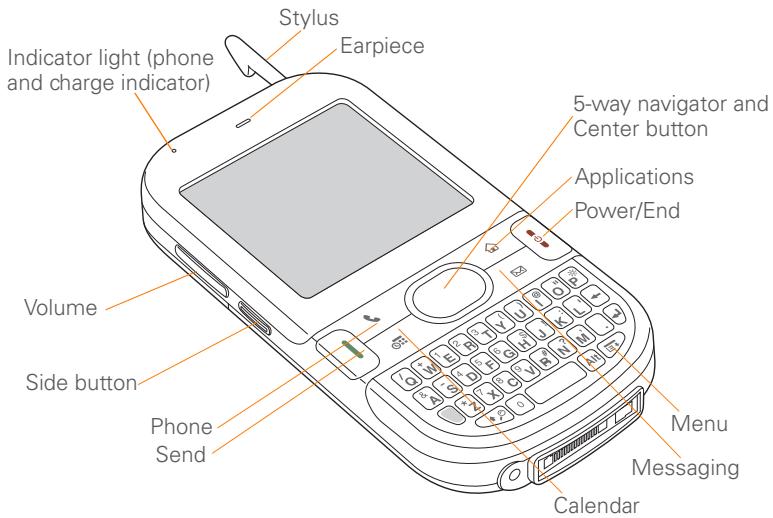
Tip Protect your screen. Be careful to store your Centro away from items that might scratch or crush the screen. Your Centro comes with a screen protector. Visit go.palm.com/centro-gsm/ to find carrying cases and other useful accessories.
DID YOU KNOW? When your Centro screen is on, you can change your button settings and select an application of your choice; see Reassigning buttons for details.
Back view
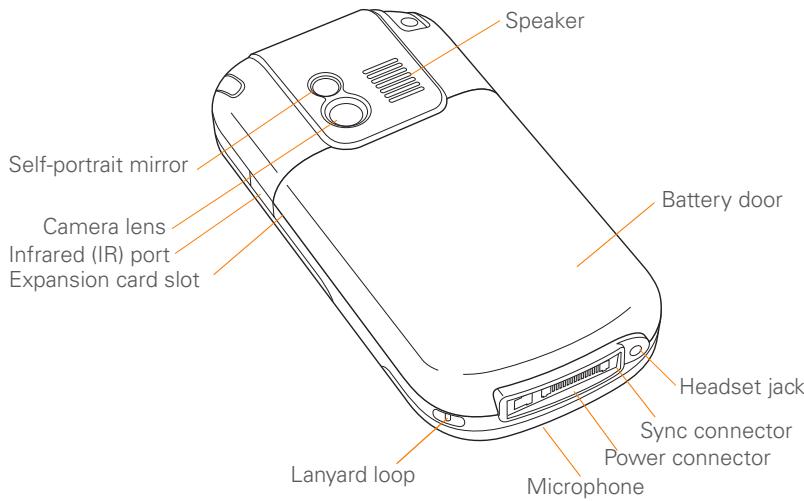
IMPORTANT The Centro speaker includes a large magnet, so be sure to keep your Centro away from credit cards or other items that could be demagnetized.
Top view
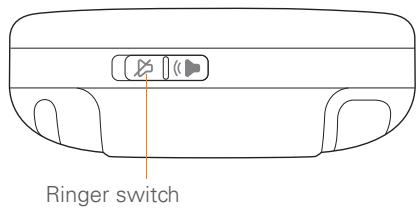
DID YOU KNOW? The Ringer switch silences all sounds at once. You don't need to hunt for Off buttons all over the device.
Inserting the SIM card and battery
Your SIM card contains account information such as your phone number and voicemail access number. To use the
phone, email, or web features, the SIM card must be inserted into your Centro.
NOTE Your SIM card may already be installed in your Centro. Follow steps 1 through 3 to check. If a SIM card did not come with your Centro, you may already have one. If the SIM card does not work, contact your network operator.
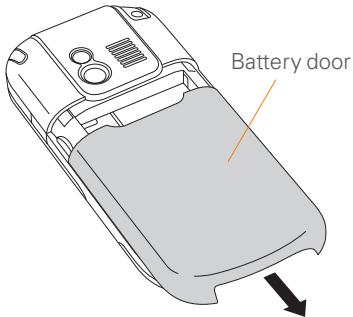
1 Press the battery door near the top and slide the battery door downward to remove it from your Centro.
2 If the battery is installed, remove it. (See Replacing the battery for details.)
3 If the SIM card is already installed, skip to step 7.
4 Remove the stylus to make insertion of the SIM card easier. Replace it when you finish these steps.
5 Align the notch on the SIM card with the right side of the SIM holder.
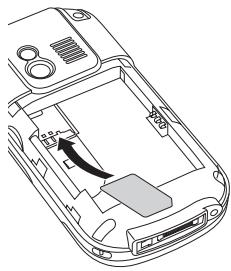
6 Insert the straight end of the SIM card into the SIM holder, and then push the SIM card forward until it fits into place.
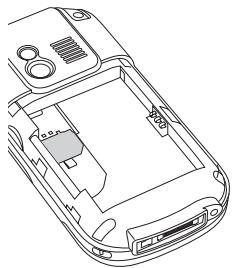
7 Align the metal contacts on the battery with the contacts inside the battery compartment, insert the battery into the compartment at a 45-degree angle, and then press it into place.
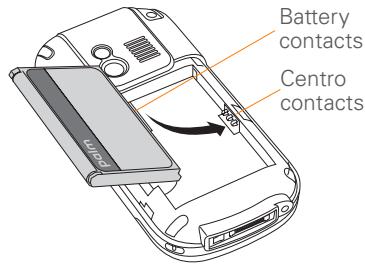
IMPORTANT Use the battery that came with your Centro. Do not use a battery from another Centro model in your Centro. Similarly, do not use the Centro battery in another Centro model. Using a battery that is designed for another Centro model can damage your Centro. For info on replacement batteries, see Replacing the battery.
NOTE Unauthorized batteries will not power your Centro. Only a Palm approved battery will wake up and power your Centro. If your Centro does not turn on, check to see whether an unauthorized battery has been inserted in your Centro.
8 Slide the battery door onto the back of the Centro until it clicks into place.
9 Your Centro screen wakes up and begins the setup process. When the language selection screen appears, select the language you want to use, and then follow the onscreen instructions to set up your Centro.
IMPORTANT Always use the same language for your Centro, your computer operating system, and your desktop
synchronization software. Otherwise, you may lose information or have difficulty with synchronization. Support is not provided for mismatched language setups.
NOTE If the correct battery is inserted and your Centro still does not turn on, you need to connect it to the AC charger. Make sure the AC charger is plugged in to a wall outlet. If your Centro still does not turn on after being connected to the AC charger for five minutes, do a soft reset. See Performing a soft reset.
Tip The power-saving feature turns off the Centro screen after a period of inactivity. To wake up the screen, press and release Power/End, and then press Center on the 5-way to turn off Keyguard.
Charging the battery
The battery comes with a sufficient charge to complete the setup process and activate your phone. After activation, we recommend charging your Centro for three hours (or until the indicator light is solid
green) to give it a full charge. See Maximizing battery life for tips on maximizing the life of your Centro battery.
Tip To avoid draining the battery, charge your Centro every day, especially if you use your phone often.
DID YOU KNOW? If your battery ever becomes fully drained, your info is still stored safely on your Centro until you connect it to a power source and charge the battery.
1 Plug the AC charger into a wall outlet.
2 Connect the charger cable to the bottom of your Centro. Make sure the arrow on the connector is facing up, toward the screen.
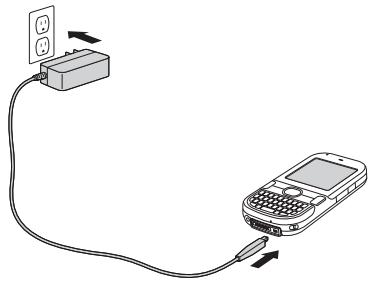
DID YOU KNOW? You can also trickle-charge your Centro without the AC charger by connecting it to your computer with the sync cable. Trickle-charging takes longer, however. Be sure to plug your computer into a power source, or your Centro could drain the computer's battery. For the quickest charge time, use the AC charger.
When trickle-charging your Centro with the sync cable, the indicator light may not turn on. To make sure the battery is being charged, check the onscreen battery indicator.
3 To confirm that your Centro is being charged, check the indicator light on your Centro.
- Solid red indicates that your Centro is being charged.
- Solid green indicates that your Centro is fully charged.
Indicator light
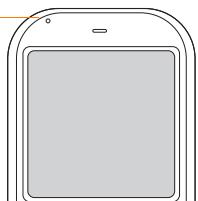
TIP If the battery is fully drained, it may take a few moments for the indicator light to turn on when you begin charging.
Tip If the indicator light does not turn on when you connect your Centro to the AC charger, double-check the cable connection and the electrical outlet to which it is connected.
When your Centro is on (see Turning your Centro™ smartphone on and off), the onscreen battery icon displays the charging status:

A red lightning bolt indicates that the battery is connected to an electrical outlet and is being charged.

A green lightning bolt indicates that the battery is connected to an electrical outlet and is fully charged.

A partial battery without a lightning bolt indicates that the battery is not connected to an electrical outlet and it has some power.

An almost empty battery that is red at the bottom indicates that you need to charge the battery immediately.
To see the remaining battery charge expressed as a percentage, tap the onscreen battery icon.
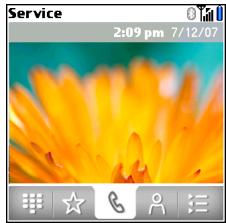
Battery icon
Maximizing battery life
Battery life depends on how you use your Centro. You can maximize the life of your battery by following a few easy guidelines:
IMPORTANT You must use the battery that came with your Centro or a Palm-approved replacement. For info on replacement batteries, see Replacing the battery.
Unauthorized batteries cannot power your Centro. Only a battery approved by Palm will wake up and power your Centro.
- You can buy an extra battery as a spare for long plane trips or periods of heavy use. To purchase batteries that are compatible with your Centro, go to go.palm.com/centro-gsm/.
-
Charge your Centro whenever you can. Charge it overnight. The battery has a much longer useful life when it is topped off frequently than when it is charged after it is fully drained.
-
The wireless features (phone, email, messaging, and web) and media features (camera, media players, eBooks, and games) of your Centro consume more power than its organizer features. Speakerphone usage also consumes more power than using the earpiece. If you use the wireless, speakerphone, and media features often, keep an eye on the battery icon and charge when necessary.
If you don't plan to use the wireless features on your Centro for a while, turn off your phone (see Turning your Centro™ smartphone on and off) and let all calls be picked up by voicemail. - As with any mobile phone, if you are in an area with no wireless coverage, your Centro searches for a signal, which consumes power. If you cannot move to an area of better coverage, temporarily turn off your phone. While your phone is off, you can continue to use the nonwireless features of your Centro.
- Turn down the screen brightness (see Adjusting the brightness).
Decrease the settings in Power Preferences and turn off Beam Receive (see Optimizing power settings).
- Turn off the Bluetooth® feature if you're not using it. See Connecting to a Bluetooth® hands-free device.
Making your first call
1 Press Phone
2 If prompted, press Center to turn off Keyguard (see Locking your keyboard (Keyguard) for more info).
- If Check SIM Card appears in the title bar, see Inserting the SIM card and battery.
- If a blank space appears in the title bar, the phone is either searching for a network or you're outside a wireless coverage area. It may take a few moments for the title bar to display a network name. If you believe you are in a wireless coverage area and this problem persists, contact your network operator for assistance.
3 Press Left to select the Dial Pad tab.
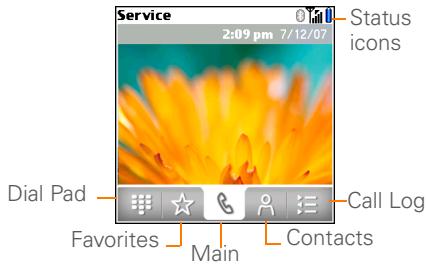
4 Tap the onscreen Dial Pad to enter the number you want to call.
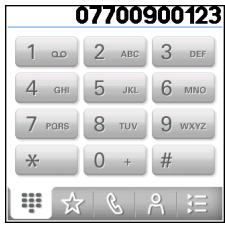
5 Press Send to dial the number.
6 If prompted, press Center to select Yes and turn on your phone.
TIP If you are inside a coverage area and cannot complete a call, contact your network operator for assistance.
7 After you finish the call, press Power/ End to end the call.
Adjusting call volume
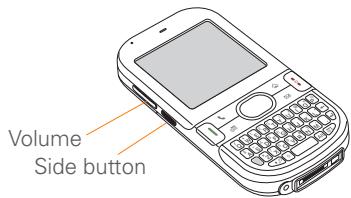
While a call is in progress, press the
Volume button on the side of your Centro to adjust the call volume.
To increase the volume, press the upper half of the Volume button.
To decrease the volume, press the lower half of the Volume button.
What's my phone number?
1 Make sure your phone is on (see Turning your phone on and off).
2 Press Phone
3 Press Menu
4 Select Options, and then select Phone Info.
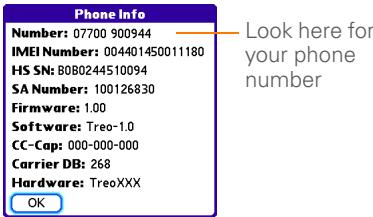
If your phone number doesn't appear in Phone Info, make sure your SIM card is properly inserted into your Centro. If your phone number still does not appear in Phone Info, look for the number on the plastic holder to which the SIM card was attached. If you still need assistance, please contact your network operator
Setting up your computer for synchronization
Before you can synchronize the info on your computer and the info on your Centro, you need to install the desktop synchronization software and connect the sync cable to your computer.
You can use either Palm® Desktop software (included) or Microsoft Outlook for Windows (sold separately) as your desktop software.
Not familiar with synchronization? See Synchronizing information—the basics.
System requirements
Your computer should meet the following minimum system profiles for Windows or Mac computers.
Windows XP Service Pack 2 (SP2), Windows Media Center Edition 2005, or Vista:
32MB of available memory (RAM)
170MB of free hard disk space
CD drive
Available USB port
Mac OS X version 10.3 to 10.5:
128MB of total memory (RAM)
190MB of free hard disk space
CD drive
Available USB port
Upgrading from another PalmOS® by ACCESS device
NOTE If you are setting up your first Palm OS® device, skip ahead to Installing the desktop synchronization software.
When you install the desktop software from the Palm Software Installation CD, some third-party applications may be quarantined because they are not compatible with the Palm OS software version 5.4.9 on your Centro. Quarantined files are not installed on your Centro, nor are they deleted. These files are placed in a new folder on your computer: C:\Program Files\Palm\
Incompatible Apps. (Can't find a Palm folder in Program Files? Then look for a folder labeled palmOne or Handspring instead. For more info, see I can't find my user folder.)
IMPORTANT Synchronize your Centro only with the version of Palm Desktop software included with your device. Older versions may not work correctly.
Tip We do not recommend using third-party utilities that back up your old device's information onto an expansion card and then transfer the info to your Centro. Such methods transfer all applications to your Centro, including those that are not designed to work with Palm OS version 5.4.9.
You can transfer all compatible applications and information from your previous Palm OS device—whether it's a handheld or a Treo—to your new Centro, so long as the space taken up by all the info you want to transfer is 64MB or less. This includes your calendar events, contacts, memos, and tasks, as well as your application settings and any compatible third-party applications and files.
1 Calculate how much space your apps and info occupy on your previous Palm OS device.
- In Applications View, open the menus.
- Select Info on the App menu.
- At the bottom of the screen, select Size.
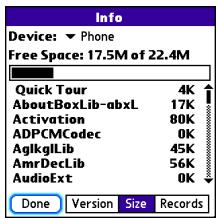
- Look at the numbers on the Free Space line and subtract the number on the left from the number on the right to calculate the space used. For example, on the device shown here, 22.4 - 17.5 = 4.9 . This means that 4.9MB of space is occupied on this device.
2 If the space occupied on your previous device is 64MB or less, go to step 3. If the space occupied is greater than 64MB, do any of the following to reduce
the storage space you're using before you go to the next step:
- Delete any third-party applications that you no longer use.
- Move large files, such as eBooks and images, to an expansion card.
- Move third-party applications to an expansion card.
- Purge old info in applications such as Calendar (Date Book), Tasks (To Do), and email. Refer to the documentation that came with your previous device for instructions on these items.
3 Synchronize your previous device with your previous desktop software to back up your information one last time.
4 Install the desktop synchronization software from your new Palm Software Installation CD (see Installing the desktop synchronization software).
5 During the installation process, sync your Centro with your new desktop software as instructed. When prompted, do the following:
- Connect your Centro to your computer (see Connecting your Centro to your computer).
- Indicate that you want to sync only the info in your PIM apps (Calendar, Contacts, Memos, and Tasks). This is strongly recommended to ensure an optimal upgrade experience. Or indicate that you want to sync all info and apps (excluding apps known to be incompatible).
- Select a device name for your Centro; be sure to select the same name that you used for your old device. (To locate this name, select the HotSync application on your old Palm device. The device name appears in the upper-right corner of the screen.)
6 MAC ONLY If you have pictures on your previous device, copy them from your previous device to an expansion card or beam them to your Centro.
7 If you plan to continue using your previous device, perform a hard reset on your previous device to remove its associated device name. (See the documentation that came with your previous device for instructions on
performing a hard reset.) Each device you synchronize with your computer must have a unique name. The next time you synchronize your previous device with your computer, be sure to assign it a new name.
If any third-party applications are quarantined during the installation, do not manually install them. Contact the third-party developer for software updates and info about compatibility with your Centro.
If you have trouble upgrading or finding.
quarantined files, see Upgrading.
Installing the desktop synchronization software
IMPORTANT Even if you already own a Palm OS device and have installed a previous version of the desktop software, you must install the software from the Palm Software Installation CD that came with your Centro.
BEFORE YOU BEGIN If you are installing on a computer at work, make sure your computer is configured to let you install new software. Contact your company's IT department for help.
TIP If you want to sync info with applications other than Palm Desktop or Microsoft Outlook, you need to purchase additional third-party sync software. This sync software is sometimes called a conduit.
1 Close any applications that are currently running on your computer, including those that are minimized. Your computer needs to have all its resources available to install the software.
2 Insert the Palm Software Installation CD into the CD drive on your computer.
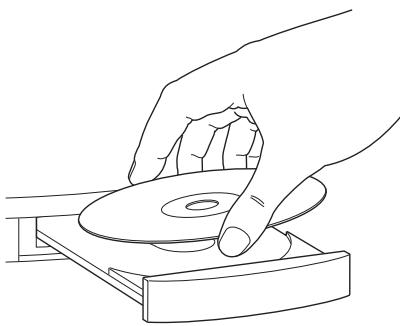
3 If you are installing on a Mac, double-click the CD icon on the desktop, and then double-click the Palm Software pkg icon.
4 When the installation wizard opens, follow the onscreen instructions. Note these important points about the installation.
- When the language selection screen appears, select the same language you selected on your Centro.
- WINDOWS ONLY You can choose which desktop software you want to use for synchronization:
Palm Desktop software or Microsoft Outlook.
NOTE Whether you select to synchronize with Microsoft Outlook or Palm Desktop software, Palm Desktop software is still installed on your computer. If you use Outlook as your desktop email application, select Outlook as your desktop synchronization software. Remember that when you enter information on your computer, you must enter it in the software you selected in this step.
- The installation process prompts you to connect your Centro to your computer. Go to the next section.
Connecting your Centro to your computer
After you install the desktop software (see Installing the desktop synchronization software), you're ready to connect your Centro to your computer.
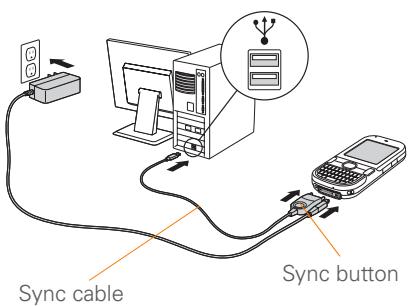
1 Plug the AC charger into a wall outlet.
2 Plug the USB sync cable into an available USB port or into a powered USB hub connected to your computer.
Tip For best performance, plug your sync cable directly into a USB port on your computer. If your computer has USB ports on both the front and back, we recommend using the back port; the front port is often a low-power port. If you use a USB hub, make sure the hub has its own power supply.
3 With the sync button facing up, connect the sync cable to the bottom of your Centro. Do not press the sync button until you are instructed to do so.
4 (Optional) Connect the charger cable to the bottom of your Centro.
You are now ready to synchronize; go to Synchronizing information—the basics.
Synchronizing information—the basics
Synchronizing means that info you enter or change in one place (your Centro or your computer) is automatically entered or changed in the other; so there's no need to enter the info twice. We strongly recommend that you sync your Centro with your computer or corporate server frequently to keep your info up-to-date (and backed up) in both locations.
The info from all the following applications is updated by default each time you sync your Centro with your desktop software:

Calendar

Contacts

Memo No.

Tasks

Pics&Videos
How each application syncs depends on your computer type and the desktop software you are using, as follows:
For more sync options, including which apps sync, see Synchronizing information—advanced.
BEFORE YOU BEGIN To sync your info, you must install Palm Desktop software from the Palm Software Installation CD that came with your Centro—even if you sync with Outlook or another third-party application. See Installing the desktop synchronization software for instructions.
1 Connect your Centro to your computer, as described in Connecting your Centro to your computer.
2 Press the sync button on the sync cable.
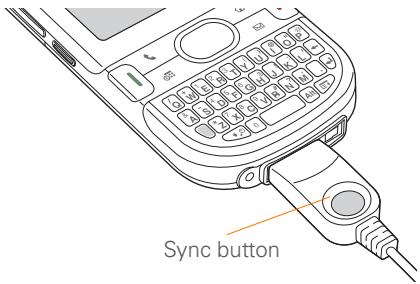
Messages on both your computer and your Centro indicate that synchronization is in progress.
3 Wait until you see the message on your Centro that the HotSync operation is complete; then disconnect the sync cable. Do not disconnect the sync cable until you see this message.
Problems synchronizing? See Synchronization for troubleshooting suggestions.
If you're finishing your initial setup, you now have the option to install bonus software. If you choose to install some of the bonus software, you need to sync again to install the software on your Centro. You can also install bonus software later; see Installing applications.
For info on locating your pictures and videos on your computer, see Viewing pictures and videos on your computer.
Where's my info stored?
When you synchronize your Centro, your info is stored on your computer in one of these locations:
Windows XP and earlier: Program Files > Palm > HotSyncUsername
Windows Vista:Username > Documents >Palm > HotSyncUsername
Moving around on your Palm® Centro™ smartphone
Have you ever been to a new city and felt a bit lost until you figured out that the numbered streets run north/south and the avenues run east/west? Learning to move around on your Centro is similar. Most applications on your smartphone use the same set of controls in the same way. So once you learn how to use these controls on your Palm® Centro™ smartphone, you'll be driving all over town and you won't even need a map.
Benefits
Find and open applications quickly
- Access extra features with menus
- Move around in applications with one hand, using the 5-way navigator
- Access many more characters and symbols than are displayed on the keyboard
In this chapter
Moving around the screen 35
Using the keyboard 39
Opening applications 43
Moving around the screen
To move around the Centro screen, you can use the 5-way navigator for one-handed navigation, or you can tap items on the screen with the stylus. With use, you will find your own favorite way to scroll, highlight, and select menu items.
TIP Some third-party applications may not work with the 5-way navigator, and you must use the stylus instead.
DID YOU KNOW? In this guide, we use arrow icons to indicate directions on the 5-way. These are different from any onscreen arrows that you tap with your stylus or select with the 5-way to display pick lists.
The 5-way includes the following buttons:
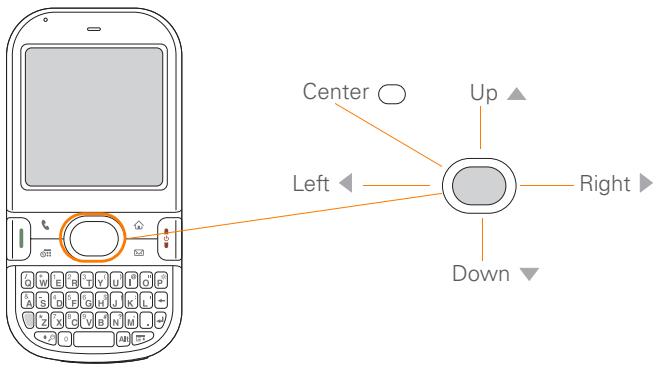
Highlighting and selecting items
On most screens, one item—a button, a list entry, or a check box—is highlighted by default. The highlight identifies which item is affected by your next action. Use Left , Right , Up , and Down on the 5-way to move the highlight from one item to another.
TIP If the item you want doesn't appear on the screen, try tapping the onscreen scroll arrows to view more info.
Learn to recognize the highlight. It can take two forms:
Border glow: When an entire screen, an onscreen button (such as Done, New, or OK) or a pick list is highlighted, a glow appears around its border. If an entire screen is highlighted, the glow appears at the top and bottom of the screen only.
TIP When a border appears at the top and bottom of a list screen, press Center on the 5-way to highlight the first item in the list.

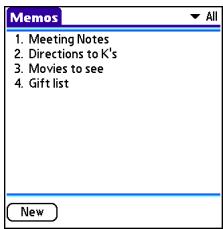
Colored background: When a phone number, text, an email address, a web link, or an item in a list is highlighted, the item is displayed as white text against a colored background. Examples of lists include the Contacts list, the Messaging Inbox, and the Tasks list.

After highlighting an item, you can select or activate it by pressing Center ,or by tapping the item with the stylus.
Tip After you open an application (see Opening applications), experiment with using the 5-way to highlight various screen elements.
Highlighting text
You can use the stylus to highlight text on the screen.
- Tap and drag the stylus across the text you want to highlight.
To highlight a word, double-tap it.
To highlight a paragraph, triple-tap it.
Accessing command buttons
In most applications, command buttons such as New, OK, and Details appear at the bottom of the screen. In many cases, you can jump directly to these buttons instead of scrolling to them.
From a list screen, such as the Memos list, press Right to jump to the first button.
From a screen where you create or edit entries, such as Contact Edit, press Center to jump to the first button.
From a dialog box, such as Edit Categories, press Up or Down to scroll to the buttons.
Selecting menu items
Many applications have menus to give you access to additional features. These menus are usually hidden from view, but they appear when you press Menu. To get the most out of your Centro, it's a good idea to familiarize yourself with the additional features available through the various application menus.
1 Press Menu to display an application's menus.
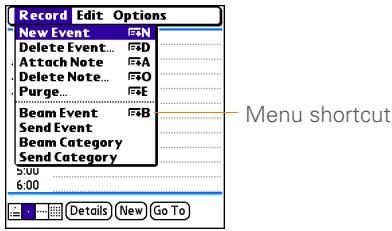
2 Press Right and Left to switch between menus.
3 Press Up and Down to highlight a menu item.
4 Press Center to select the menu item, or press Menu to close the menu and cancel your selection.
Tip Most menu items have menu shortcuts listed in the menu. To use a menu shortcut, press Menu plus the shortcut letter. You don't have to see the menu item to use the menu shortcut.
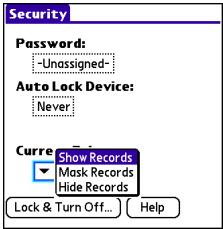
Selecting options in a pick list
A range of options is often presented in a type of menu called a pick list, which can be identified by a downward-pointing arrow. Pick lists are different from the application menus previously described. The application menus give you access to additional features, and pick lists let you select the contents for a particular field.
You can select items from a pick list with the 5-way or the stylus.
5-way: Use the 5-way to highlight the pick list, and then press Center to display the items in the list.
Press Up and Down to highlight the item you want.
- Press Center to select the highlighted item.
- To exit the pick list without making a selection, press Left or Right.
Stylus: Use your stylus to tap the pick list.
- Tap the item you want from the list.
- To exit the pick list without making a selection, tap outside the list.
Using the keyboard
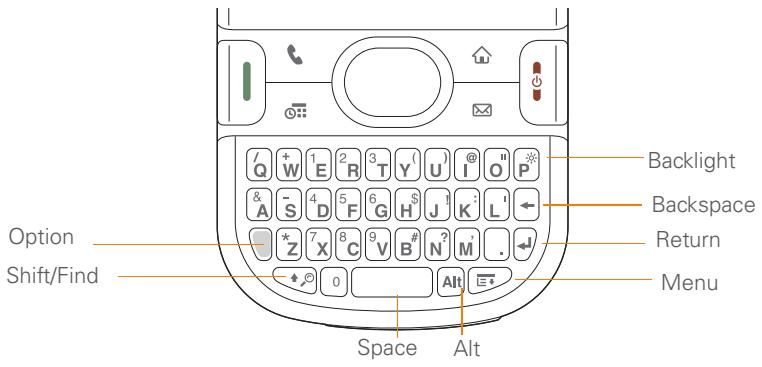
TIP When using the keyboard, most people find it easiest to hold the Centro with two hands and use the tips of both thumbs to press the keys.
DID YOU KNOW? The Centro includes a keyboard backlight that turns on and off when the screen turns on and off. The backlight also dims when an active call lasts longer than a specified period of time. See Optimizing power settings to adjust the automatic shut-off and dimming intervals.
Entering lowercase and uppercase letters
To enter lowercase letters, press the desired keys.
To enter an uppercase letter, press Shift/Find +2 and then press a letter key. You don't need to press and hold Shift/Find while entering a letter. When Shift is active, an up arrow appears in the lower-right corner of the screen.
To turn Caps Lock on, press Shift/ Find twice. To turn it off, press Shift/Find once. When Caps Lock is on, an underlined up arrow appears in the lower-right corner of the screen.
Entering numbers, punctuation, and symbols
Numbers, punctuation, and symbols appear above the letters on the keys. To enter these characters, do one of the following:

- Press Option , and then press the key with the desired character shown above the letter. You don't need to press and hold Option while pressing the second key. When Option is active, the symbol appears in the lower-right corner of the screen.
To turn Option Lock on, press Option twice. To turn it off, press Option once. When Option Lock is on, the symbol appears in the lower-right corner of the screen.
DID YOU KNOW? Some application views, such as the Dial Pad tab in the Phone application or the Calculator, automatically default to Option Lock. In this case, you do not need to press Option to enter numbers.
Entering other symbols and accented characters
Symbols and accented characters that do not appear on the keyboard are available when you use the Alt key.
1 Enter the character that corresponds to the symbol or accented character you want. See the table on the next page.
2 Press Alt Alt.
3 Press Up , Down , Right , or Left to highlight the desired character.
4 Press Center to insert the character.
DID YOU KNOW? Alternate characters are grouped by their similarity to the base key. For example, the alternate characters available from the E key are é, ð, ù, and ñ.
| Symbols and accented characters | |||||
| Enter... | Then press Alt to select... | Enter... | Then press Alt to select... | Enter... | Then press Alt to select... |
| a | á à ā a ā a ā | n | ñ | u | ú ù Ú |
| A | Á À A A A A A A E | N | Ñ | U | ú U Ú |
| b or B | β | o | ó ò ò ò ò | x or X | x a |
| c | ç φ © | O | Ó O ò ò ò ò | y | y y |
| C | ç φ © | p or P | ¶ | Y | Y Y |
| e | é e é e | r or R | ® | ! | i |
| E | É É E E | s | β š Å | ? | i |
| i | í iii i | S | β S Å | : | :-) :-(;-) |
| I | í iii i | t or T | TM | $ | € £ ¥ € |
| I or L | £ | ||||
| Press Alt by itself, after a space or at the beginning or end of a line, to select these characters: ; - • % = ° ÷ ∈ £ ¥ € [ ] { } < > « » © ® TM ~ ^ o | Å | |||||
Opening applications
When you open an application using a quick button or Applications View, you automatically close the app you were previously using.
Using the quick buttons
The front of the Centro has three quick buttons—Phone, Calendar, and Messaging—that open applications. The fourth button opens Applications View (see Using Applications View).
Tip You can customize the quick buttons yourself; see Reassigning buttons for details.
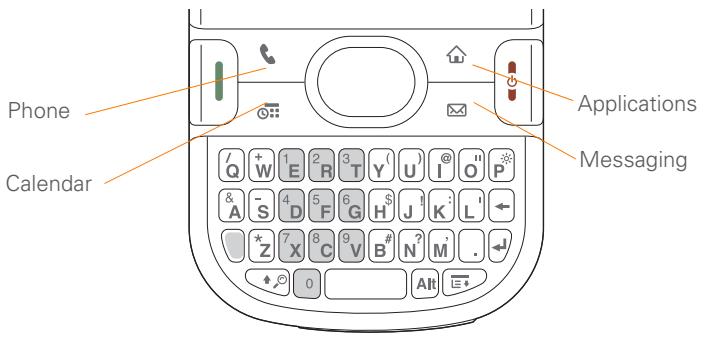
Each quick button opens two applications:
- To turn on your Centro and open a button's primary application, simply press the button.
| Button | Primary app |
| Phone | |
| Calendar | |
| Messaging |
After you turn on your Centro, open a button's secondary application by pressing Option and then pressing the quick button.
| Buttons | Secondary app |
| + | Web |
| + | Memos |
| + | Messaging |
DID YOU KNOW? Pressing Option + Menu dims your Centro screen.
Using Applications View
You can access all available applications through Applications View.
1 Press Applications
2 Press Center on the 5-way to turn off Keyguard (see Locking your keyboard (Keyguard) for more info).
3 Use the 5-way to highlight the application you want to use.
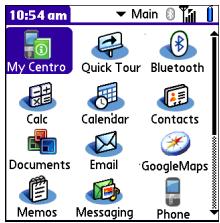
4 Press Center to open the selected application.
In Applications View, you can also do the following:
- Press Applications repeatedly to cycle through various categories of applications. See Applications settings for more info on categories.
- Enter the first few letters of the application's name to highlight it. For example, if you press P, it highlights Phone; if you then press R, it highlights Defaults. If you pause and then press R, it highlights the first application that starts with R.
Tip You can press and hold Applications from any screen on your Centro to select from a list of your most recently used applications.
Your phone
The Phone application is your home base for making and receiving calls and for storing info about the people you need to stay in touch with.
You can effectively manage multiple calls, such as swapping between calls, sending text messages to ignored calls, and creating conference calls with up to five callers. Your Palm® Centro™ smartphone helps you perform all these tasks with ease.
You can do more than manage your phone calls in the phone application. You can send text messages, open applications, go to your favorite web pages, see your upcoming appointments, and even find out how many unread email messages you have.
Benefits
- Stay in touch—you choose how
-
Save time with shortcuts to your favorite info
-
Have fun: add wallpaper and ringtones
Make or receive calls without taking your hands off the steering wheel
In this chapter
Turning your Centro™ smartphone on and off 49
Making calls 51
Receiving calls 56
Using voicemail 57
What can I do when I'm on a call? 58
How many minutes have I used? 65
Entering names and phone numbers 65
Defining favorite buttons 71
Using a hands-free device 74
Customizing phone settings. 78
What are all those icons? 84
Turning your Centro™ smartphone on and off
NOTE We use the term phone to describe the feature of your Centro that lets you connect to the network to make and receive calls and transmit data.
The phone and the screen of your Centro can be turned on and off separately. You can wake up the screen to use just the organizer and media applications of your Centro (such as Contacts, Calendar, Pocket Tunes™, and Pictures & Videos) without turning on the phone. Also, when the screen is turned off, the phone can be on and ready for you to receive and make calls.
Waking up the screen and turning it off
Wake up the screen and leave the phone turned off when you want to use only the organizer features of your Centro—for example, when you're on a plane and want to look at your calendar.
1 Press and release Power/End to wake up the screen.
Tip You can also press any of the quick buttons or the Applications button to wake up your Centro screen.
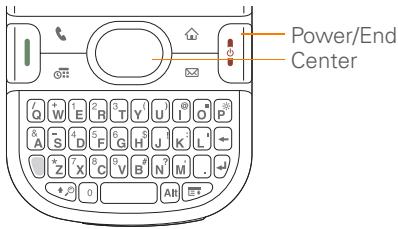
2 Press Center to turn off Keyguard. For more info about turning Keyguard on and off, see Locking your keyboard (Keyguard).
3 Press and release Power/End to turn off the screen and lock the keyboard.
Tip You can set how long the screen stays on. Press Applications, select Preferences, select Power, and then adjust the Auto-off after setting.
Turning your phone on and off
When your phone is on, it is connected to the network (provided you are in a coverage area) so that you can make and receive phone calls and use wireless services, such as email, messaging, and the web browser. During initial setup, your phone is automatically turned on, so you can use wireless services right away.
If you turn off your phone, you can still use the organizer features such as Calendar and Contacts, as well as the media features such as Pocket Tunes and Pictures & Videos. You might hear this referred to as flight mode because you must turn your phone off when you're on a plane.
1 Wake up the screen.
2 Press and hold Power/End to turn on your phone.
Tip If the Ringer switch is set to Sound On, you hear a series of tones when you turn your phone on and off (see Silencing sounds).
You know your phone is on and that you're inside a coverage area when you go to the Main tab of the Phone application and you see the Signal Strength icon at the top of the screen.
Tip If you're outside a coverage area, No Service appears in the upper-left corner and the indicator light flashes red.
3 Press and hold Power/End again to turn off your phone.
You know your phone is off when you go to the Main tab of the Phone application and you see Phone Off at the top of the screen.
Opening the Phone application
Press Phone to display the Main tab in the Phone application.
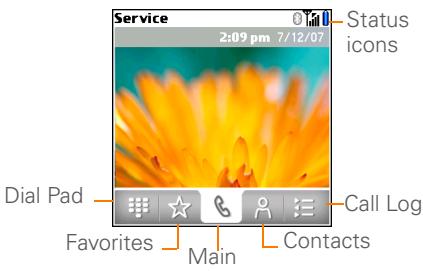
DID YOU KNOW? You can choose which tab appears when you press the Phone button. See Customizing the Main tab in the Phone application for details. If you change the default tab, you need to modify the steps in this chapter accordingly.
Making calls
There are several ways to make a call. Try them all to find out which way you like best.
Dialing using the onscreen Dial Pad
1 Press Phone
2 Select the Dial Pad tab.
3 Enter the phone number by tapping the onscreen Dial Pad with the stylus.
Tip Press Backspace to delete numbers you've entered. To cancel the call altogether, press Phone to return to the Main tab in the Phone application.
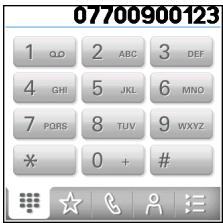
4 Press Send to make the call.
DID YOU KNOW? You can paste numbers directly into the Dial Pad. Copy a number from another application, press Phone, and select the Dial Pad tab. Open the Edit menu and select Paste. Press Send to dial the number.
Dialing using the keyboard
1 Press Phone
2 Press the numbered keys to enter the phone number. (You don't need to press Option.)
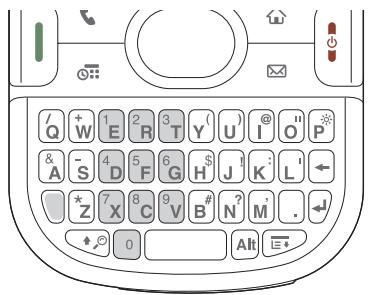
3 Press Send to make the call.
Tip After you enter a phone number, you can also press Center on the 5-way to select whether to make a phone call or send a text message to that number.
Dialing by contact name
You need to have names and numbers in your contact list before you can make a call by contact name or phone number. You can
add contacts directly into your Centro (see Adding a contact), but the fastest way to enter lots of contacts is to enter them in your desktop software and then synchronize to transfer them to your Centro (see Synchronizing information—the basics). You can also import contacts from your SIM card (see tips on Viewing your SIM Phonebook).
1 Press Phone
2 Select the Contacts tab.
3 Using the keyboard, start entering one of the following for the contact you want to call:
- First name (JOH for John)
- Last name (SMI for Smith)
- First initial and last name (JSM for John Smith)
- First few letters of first and last name (SM AN for Smilla Anderson)
For example, entering SM would display Smilla Anderson, John Smith, and Sally Martin. Entering JSM finds only John Smith.
Text appears here as you enter it
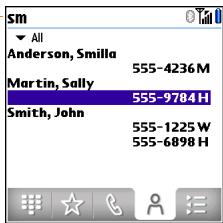
Tip To restart your search, press Backspace to delete letters or numbers you've entered. Or press Phone to return to the Main tab in the Phone application.
4 Highlight the number you want to dial.
5 Press Send to make the call.
Tip To see more info for a contact, highlight the name and press Center on the 5-way to view the address, company, and other details.
DID YOU KNOW? If you want to be able to dial a call from the Main tab in the Phone application by entering a name or a number, you can change a setting to do that (see Customizing phone settings).
Voice dialing
You can use the Voice Dialing application to call people in your Contacts list by saying their name or number. If the person you are calling has more than one phone number, you can specify which number to call.
1 Press Applications
2 Select Voice Dial
A voice prompts you to "say a command."
3 Do one of the following:
To call a person in your contact list by saying their name: For example, say, "Call John Doe." If a contact has multiple numbers, you can specify which number to call. For example, say, "Call John Doe Home."
To call a number by saying the individual digits: For example, say, "Call 408-555-1234."
DID YOU KNOW? You can press the button on your Bluetooth headset to voice-dial calls through your headset.
Dialing with a speed-dial favorite button
Your Centro comes with a few predefined speed-dial favorite buttons, but you can also create your own favorites. See Creating a speed-dial favorite button.
1 Press Phone
2 Select the Favorites tab.
3 Use the 5-way to highlight the speed-dial favorite you want.
Look for the icon to distinguish a speed-dial favorite from other types of favorites.
Tip To view more favorite buttons, repeatedly press Down on the 5-way.
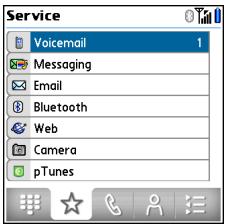
Tip You can see all the contact numbers for the selected person or business. Highlight a speed-dial favorite button and press Space on the keyboard to see alternate phone numbers if the speed-dial favorite was created from a contact.
4 Press Send or Center to make the call.
Dialing from a web page or message
Your Centro recognizes most phone numbers that appear on web pages or in text, email, or multimedia messages.
1 Select the phone number on the web page or in the message.
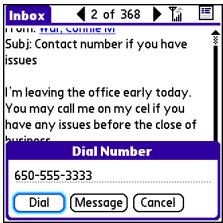
Tip If you can't use the 5-way or stylus to highlight and dial a phone number on a web page or in a message, it means that your Centro doesn't recognize the number as a phone number. You can still use the menus to copy and paste the number into the Dial Pad.
2 Press Center to open the Dial Number dialog box.
3 Select Dial to make the call.
Redialing a recently called number
To dial the last number: Select the Main tab, and then press and hold Send to dial the last number you called.
To select from your most recently dialed numbers: Select the Main tab, press Send to open the Redial list, highlight the number you want to call, and then press Send again to make the call.
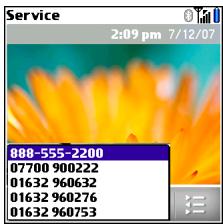
To select from your call history list:
Select the Call Log tab, highlight the number you want to call, and then press Send to dial the number.
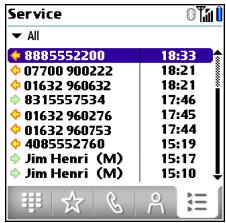
DID YOU KNOW? You can send a text message from Contacts or your Call Log by highlighting a number, pressing Center on the 5-way, and then selecting Message.
Receiving calls
To receive calls, your phone must be on. This is different from having only the screen turned on (see Turning your phone on and off). When your phone is off, your calls go to voicemail.
DID YOU KNOW? If you are playing music on your Centro and a call arrives, the music pauses automatically and resumes when you hang up or ignore the call.
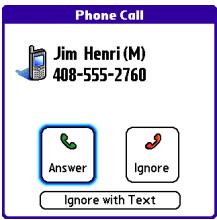
TIP See a photo of the person calling you! Learn how to assign a caller ID photo in Assigning a caller ID photo.
To answer a call, do one of the following:
Press Send
- Select Answer.
- Press the headset button (if the headset is attached).
Tip The headset button may work differently on headsets other than the one provided with your Centro.
NOTE Pressing Phone silences the ringer, but it does not answer the call.
To ignore a call, do one of the following:
Send the call to voicemail: Press Power/ End or select Ignore.
Send the caller a text message: Select Ignore with Text. This option sends the call to voicemail and opens a text message addressed to the caller.
NOTE Sending text messages to land-line phones may not be supported.
To silence the phone while it is ringing, do one of the following:
- Press any key on your Centro except Send, Power/End, or the 5-way.
- Slide the Ringer switch to Sound Off . This immediately silences all system sounds, including the ringer.
DID YOU KNOW? When you silence the ringer while it is ringing, you can either answer the call or let it ring through to voicemail.
Using voicemail
Your wireless service includes voicemail. Keep in mind that airtime and other charges may apply when you use voicemail from your phone.
Setting up voicemail
1 Press Phone
2 Press and hold 1 to dial your network operator's automated voicemail system.
3 Follow the voice prompts to set up your voicemail.
Voicemail notification
When you have a new voicemail message, you are notified with an Alert dialog box.
- To dismiss the Alert dialog box, select OK.
Tip To permanently dismiss the reminder, tap the blinking bell icon that appears in the upper-left corner of the screen. This opens the Alert dialog box and lets you dismiss the alert. See Viewing and using the alerts.
To play the message, select Listen.
When you have messages that you have not listened to, a Voicemail icon also appears in the title bar of the Phone application. You can also select this icon to listen to your voicemail.
Listening to voicemail messages
1 Press Phone
2 Press and hold 1 to dial the voicemail system.
Tip You can also select the Voicemail favorite button to dial the voicemail system.
3 Enter your voicemail password using the keyboard.
Tip You don't need to press Option to enter numbers, *, or # during a call.
NOTE If you defined Extra Digits for the Voicemail favorite button (see Editing a favorite button for details), you can select this button to enter your password.
What can I do when I'm on a call?
When you make or receive a call, Active Call View appears.
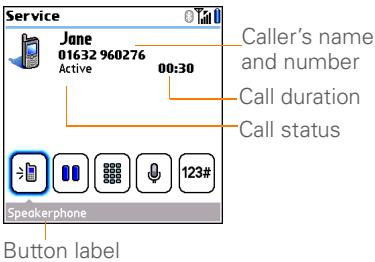
Tip If the screen dims during a call, press any key except Send or Power/End to restore the screen brightness.
DID YOU KNOW? You can set how long the screen stays at full brightness during phone calls. See Optimizing power settings for details.
Use the 5-way or the stylus to select the onscreen buttons. Here's what the buttons do:

Turns on the speakerphone, which means that you and everybody around you can hear the call. (The caller can hear you as well.) The advantage is that you can check your calendar, look up contact info, take notes, and use other features during a call. This button is not available when you use a headset.

Turns off the speakerphone when it is on.

Replaces the Speakerphone button when you use a Bluetooth® hands-free device. Select this button to stop using the hands-free device and switch to holding your Centro to your ear.

Puts a call on hold, and the call status changes to On Hold. To take the call off hold, select this button again.

Lets you make another call while the first call is on hold; see Making a second call for details. For info on handling a second incoming call, see Receiving a second call (call waiting).

Opens the Dial Pad so you can use it to dial additional numbers, such as an extension or a response to a voice prompt.

Dials any extra digits (such as a password or an extension) that you assigned to a speed-dial favorite button. See Defining favorite buttons for information on defining extra digits. This button disappears after you select it to dial the numbers.

Mutes the microphone so that you and the noise around you can't be heard on the other end. The call status changes to Muted. When you want to speak, be sure to select the Mute button again.
Tip Do you accidentally press onscreen buttons when you're on a call? You can disable the screen's touch-sensitive feature during phone calls; see Locking your screen.
Remember: To manage an active call when the touchscreen is disabled, use the hardware buttons on your Centro.
Ending a call
Do one of the following:
- Press Power/End
- Press the button on the headset (if the headset is attached).
Switching applications during a call
You can use your organizer apps and other applications while you're talking on the phone; so go ahead and check your calendar, or go to Memos and enter the driving directions your caller is giving you. You can even send text messages while you're on a call.
NOTE What you can't do, however, is make a data connection while on a call. This means that you can't browse the web or send or receive email or multimedia messages.
1 (Optional) If you want to continue talking while viewing another application, select Speakerphone or connect a headset (see Using a hands-free device).
2 Press Applications
3 Select the icon for the application you want to open.
4 When you're ready to leave the app, open another app or press Phone to return to Active Call View.
DID YOU KNOW? You can press Phone to toggle between Active Call View and the Main tab in the Phone app, so you can access other tabs, such as Contacts and Favorites, during a call.
Saving phone numbers
When you hang up a call with a number that is not in your Contacts list, you are prompted to add the number to your Contacts list.
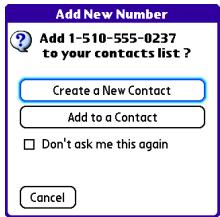
Tip You can turn the Add New Number prompt on and off. In Contacts, open the Options menu, and select Preferences. To turn this option on, check the Ask to add unknown phone numbers after calls box. To turn this option off, uncheck this box.
To create a new contact entry for this number, select Create a New Contact, and enter the contact's info.
- To add this number to an existing contact entry, select Add to a Contact.
To decline adding this number, select Cancel.
- To disable the Add New Number prompt, check the Don't ask me this again box, and then select Cancel.
If you don't add a number right away, follow these steps to add it later.
1 Press Phone
2 Select the Call Log tab.
3 Highlight the number you want to save.
4 Press Menu
5 Select Add Contact.
6 Select New to create a new contact, or select Add to add this number to an existing contact.
7 Enter the information for the entry, and then select Done.
Making a second call
You can make a second call while your first call is still active. You can then switch between two independent conversations, or you can join several calls in a conference. See Making a conference call.
1 Dial the first number and wait until the person answers.
2 Put the first call on hold by pressing Send or selecting Hold
3 Select Add Call
4 Dial the second number.
NOTE To dial the second number, you can use any of the methods described in Making calls.
5 When the Dial another call prompt appears, select Yes.
6 Select Swap to switch between the two calls.
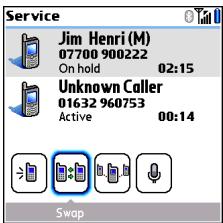
7 To end the active call, press Power/End
DID YOU KNOW? When you hang up one call, you can continue your conversation with the remaining call.
Receiving a second call (call waiting)
When you are on a call, you can receive a second call and have separate conversations with each caller. When the second call comes in, you hear a call waiting tone and the Call Waiting dialog box appears. You can do any of the following to handle the second call:
- To place the current call on hold and answer the new call, press Send or select Answer.
To send the new call to voicemail, select Ignore.
To send the new call to voicemail and send the caller a text message, select Ignore with Text.
NOTE Sending text messages to land-line phones may not be supported.
To hang up the current call and answer the new call, press Power/End 1 and then press Send 1 .
To switch between the original call and the second call you answered, select Swap or press Send.
Making a conference call
You can join a total of five other calls in a conference call, provided that your network and service plan include 6-way conferencing. Please contact your network operator for more information. Additional charges may apply and minutes in your mobile account may be deducted for each call included in the conference call.
1 While the first call is active, make a second call.
2 Select Conference. This joins you and the two calls in a conference call.
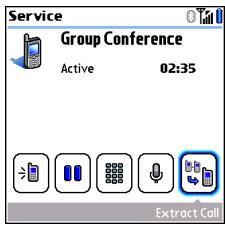
3 To add more calls to the conference, select Hold dial another number, and then select Conference to add the new call.
4 To end all the calls at once, make sure the conference is the active call, and then press Power/End.
Tip If you want to hold a separate, "sidebar" conversation with one of the people on a conference call, you can extract that call from the conference. Select Extract Call (the onscreen button on the far right), and when the list of callers appears, select the call you want to extract. The conference call remains on hold while you speak privately on the extracted call.
Forwarding all calls
You can forward all your calls to another telephone number. You can also selectively forward certain calls (see Forwarding calls under certain conditions). Please check with your network operator about availability and pricing of forwarded calls, as additional charges may apply.
1 Press Phone
2 Press Menu
3 Select Options, and then select Call Preferences.
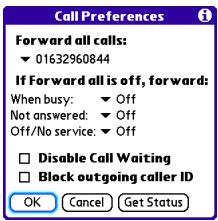
4 Select the Forward all calls pick list.
- If the forwarding number appears in the pick list, select the number.
- If the forwarding number does not appear in the pick list, select Edit Numbers, and then select New. Enter a forwarding number, including the area code and country code if they are different from your mobile phone number. Select OK.
5 Select the number you just entered, select OK, and then select OK again.
Tip After you set the number you want to forward all your calls to, the call forwarding icon appears in the title bar (see What are all those icons?). We also recommend that you call your Centro to confirm that your call forwarding settings work properly.
Tip To turn off forwarding for all calls, select Off from the Forward all calls pick list.
Forwarding calls under certain conditions
You can forward calls to another number when the line is busy, a call is unanswered, your Centro is off, or you are outside a coverage area.
1 Press Phone
2 Press Menu
3 Select Options, and then select Call Preferences.
4 Select the Forward all calls pick list and select Off.
5 Select any of the following pick lists: When busy: Forwards calls if the phone is busy.
Not answered: Forwards calls if you do not answer.
Off/No service: Forwards calls when your Centro is not connected to a mobile network.
6 If the forwarding number appears in the pick list, select the number. If the forwarding number does not appear in the pick list, select Edit Numbers and then select New. Enter a forwarding number, and select OK. Select the number you just entered.
7 Select OK, and then select OK again.
How many minutes have I used?
1 Press Phone
2 Select the Call Log tab.
3 Press Menu
4 Select Totals from the Record menu.
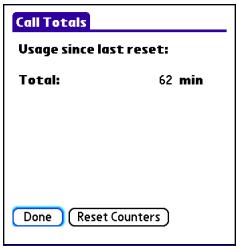
5 (Optional) To reset the counters to zero, select Reset Counters.
6 Select Done.
Entering names and phone numbers
Contacts is the application in which you enter information about the people you want to stay in contact with. You can get to this info from the Phone application, to dial phone numbers and create favorites, and from the Messaging and email applications, to send messages. When you
create a contact, you can also assign a photo and ringtone ID to that contact, so you know when they call you.
Adding a contact
1 Press Phone
2 Select the Contacts tab.
3 Press Menu
4 Select New Contact from the Record menu.
5 Use the 5-way to move between fields as you enter info.
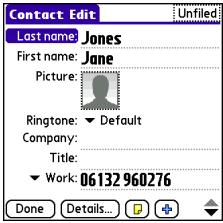
DID YOU KNOW? If you add a symbol at the beginning of a contact's last name, such as #Smith, the contact appears at the top of your contact list.
6 Do any of the following:
Add a caller ID photo: Select the Picture box. (See Assigning a caller ID photo for more info.)
Add a caller ID ringtone: Select the Ringtone pick list. (See Assigning a caller ID ringtone for more info.)
Insert a pause when dialing a number: Enter a comma ( , ) between digits in a phone number to insert a one-second pause. To add a two-second pause, enter a p.
Display a number pad that waits for you to enter a number: Enter a w between digits in a phone number, where you want the prompt to appear. When the number is dialed, the Extra Digits button appears in the active call screen. When you select this button, the digits following the w are automatically dialed.
For example, you can use this option if you want a number pad to automatically appear so that you can enter your voicemail password.
Place the entry in a category or mark it private: Select Details. (See Working with private entries for more info.)
Add a note to an entry: Select Note
Display additional fields for this contact: Select Plus
7 After you enter all the information, select Done.
Tip Import contacts from your SIM card quickly and easily. In the Contacts list, press Menu and then select Import from SIM from the Record menu.
Viewing or changing contact information
1 Press Phone
2 Select the Contacts tab.
3 Begin entering one of the following for the contact you want to view or edit:
- First name (JOH for John)
- Last name (SMI for Smith)
- First initial and last name (JSM for John Smith)
4 Select the name of the entry you want to open.
Tip To edit the entries on your SIM card, you must either import them into Contacts or press Applications, select SIM Book, and edit them in the phone book on your SIM card.
5 Select Edit, make changes to the entry as necessary, and then select Done.
Getting directions to a contact's address
If you have a data plan, you can get directions to a contact's address from Google Maps.
NOTE Google Maps may not yet be supported in all countries, but check frequently—new countries are added all the time.
1 Press Phone
2 Select the Contacts tab.
3 Begin entering one of the following for the contact you want to view or edit:
- First name (JOH for John)
- Last name (SMI for Smith)
-
First initial and last name (JSM for John Smith)
-
First few letters of first and last name (SM AN for Smilla Anderson)
4 Select the name of the entry you want to open.
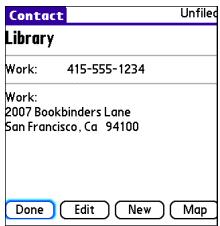
5 Select Map, and wait for Google Maps to locate matching items.
DID YOU KNOW? If no address has been entered for the contact, the Map button does not appear.
- Select an item, and select To to request directions to this location.
-
In the From location field, enter or select your starting location, and then select OK. When the route summary appears, select OK to view the first step in the directions.
-
Tap the forward and back buttons at the bottom of the screen to view the next or previous step in the directions.
6 Select Map, and wait for Google Maps to locate matching items.
- Select an item, and select From to request directions from this location.
- In the To location field, enter or select your destination, and then select OK. When the route summary appears, select OK to view the first step in the directions.
- Tap the forward and back buttons at the bottom of the screen to view the next and previous steps in the directions.
Assigning a caller ID photo
1 Press Phone
2 Select the Contacts tab.
3 Open the contact you want to add the photo to (see Viewing or changing contact information).
4 Select Edit.
5 Select the Picture box and do one of the following:
- Select Camera, take a photo, and then press Center to add the photo to this contact.
- Select Photos and select an existing photo that you want to assign to this contact.
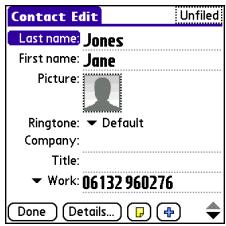
6 Select Done.
DID YOU KNOW? If you assign pictures to your contacts in Microsoft Outlook or Palm Desktop software and you install the desktop software from the Palm Software Installation CD, the pictures are automatically added to your contact entries on your Centro when you sync. If you use third-party synchronization software, picture sync may not be supported. Check with the software developer for information.
Assigning a caller ID ringtone
Caller ID ringtones can let you know who is calling before you even look at your Centro. This is a great way to identify calls from important people in your life and to screen calls that you'd prefer not to answer.
1 Press Phone
2 Select the Contacts tab.
3 To open the contact entry for editing, select the name of the contact to whom you want to give a caller ID ringtone (see Viewing or changing contact information).
4 Select Edit.
5 Select the Ringtone pick list and select a tone for this contact entry.
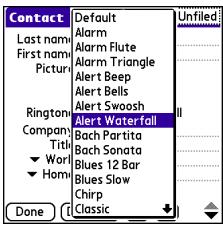
6 Select Done.
Tip You can assign a ringtone to an entire category of contacts. For example, use a special ringtone for categories such as Family, Work, or Golf Buddies. In the Contacts list, select the category pick list in the upper-left corner and select Edit Categories. Select the category, and then select Edit. Select the ringtone on the Edit Category screen.
Customizing Contacts
1 Press Phone
2 Select the Contacts tab.
3 Press Menu
4 Select Options, and then select Preferences.
5 Set any of the following options:
Remember Last Category: Sets whether Contacts opens to the last category you selected.
Show SIM Phonebook: Sets whether SIM Phonebook appears as an option in the category pick list. When you check this box, you can view entries in the phone book on your SIM card.
Ask to add unknown phone numbers after calls: Sets whether you are prompted to add phone numbers that are not in your Contacts list after a call. You can add unknown numbers to an existing contact or create a new contact entry.
List By: Sets whether the Contacts list is sorted by last name or company name.
Deleting a contact
1 Select the Contacts tab.
2 Highlight the contact you want to delete.
3 Press Menu
4 Select Delete Contact from the Record menu, and then select OK.
Creating a business card for beaming
1 Create a new contact and enter your own business card info.
2 Open the contact entry containing your business card info.
3 Press Menu
4 Select Business Card on the Record menu.
Tip After you create your business card, you can beam it to another device with an IR port-provided the device supports beaming with Palm OS® devices. Go to Contacts or to the Main tab in the Phone application, open the Record menu, and then select Beam Business Card.
Viewing your SIM Phonebook
1 Press Phone
2 Select the Contacts tab.
3 Press Menu
4 Select Options, and then select Preferences.
5 Make sure the Show SIM Phonebook box is checked.
6 Select OK.
7 In the Contacts list, select the category pick list at the top of the screen and select SIM Phonebook.
Tip If you imported contacts from your SIM card to Contacts, you may want to uncheck the Show SIM Phonebook box to avoid seeing duplicate entries.
Tip Need to copy a contact to your phone book on your SIM card? In Contacts, select the contact you want to copy, open the Record menu, and then select Export to SIM.
Defining favorite buttons
You can set an unlimited number of favorite buttons for quick access to the following common tasks:
- Dialog a phone number (speed-dial)
- Opening an application
- Accessing a web page
- Addressing a message (text, MMS, or email)
- Accessing voicemail (preset on your Centro)
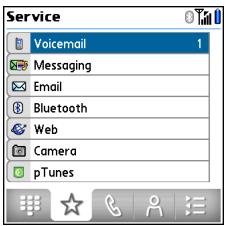
DID YOU KNOW? If you're upgrading from a Centro 600/650/680/700p/755p, most of your favorites should transfer from your old Centro along with your other info. However, you may need to rearrange the order in which your favorites appear by opening the Record menu and then selecting Organize Favorites. For more info about upgrading, see Upgrading from another PalmOS® by ACCESS device.
Creating a speed-dial favorite button
1 Press Phone
2 Select the Favorites tab.
3 Press Menu
4 Select New Favorite on the Record menu.
5 Enter a label for the favorite:
- If the entry is for an existing contact, select Lookup. Enter the last name of the contact. When the name appears, select the phone number you want. Select Add.
- If the entry is for a new contact, enter the label, press Down , and enter the number.
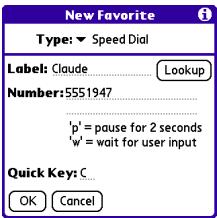
You can define additional digits to dial, such as a password or extension.
Insert a pause when dialing a number:
- Enter a comma (, ) between digits in a phone number to insert a one-second pause.
To add a two-second pause, enter a p.
To enter a pause for user input, enter a w followed by the extra digits you
want to dial. To dial these numbers, select the Extra Digits button that appears in Active Call View (see What can I do when I'm on a call?).
6 (Optional) Enter a Quick Key.
KEY TERM Quick Key A letter that you can press and hold to activate a favorite from any tab in the Phone app. For example, create a speed-dial button for your mother's number and enter the letter M for "Mom" as the Quick Key. Then when you want to call her, go to the Phone app and press and hold M. Your Centro dials the number.
7 Select OK.
DID YOU KNOW? You can assign a special ringtone for a contact. See Assigning a caller ID ringtone for details.
Creating other types of favorite buttons
1 Press Phone
2 Select the Favorites tab.
3 Press Menu
4 Select New Favorite on the Record menu.
5 Select the Type pick list and select Application, Message, Email, or Web Link.
6 Enter a label for the favorite and enter any other necessary information on the screen.
7 (Optional) Enter a Quick Key.
8 Select OK.
Tip When creating a Message or Email favorite, you can enter multiple addresses; simply separate each address with a comma. This is an easy way to send messages to a group of people.
Editing a favorite button
1 Press Phone
2 Select the Favorites tab.
3 Highlight the favorite button you want to edit.
4 Press Menu
5 Select Edit Favorite on the Record menu.
6 After you make your changes, select OK.
Tip To arrange your favorites, open the Record menu and select Organize Favorites.
Highlight the favorite you want to move, and then press and hold Option + Up or Down to move the button to another position. Select Done.
Deleting a favorite button
Tip Some favorites, such as voicemail, cannot be deleted. If a favorite can't be deleted, the Delete button does not appear on the screen.
1 Press Phone
2 Select the Favorites tab.
3 Highlight the favorite button you want to delete.
4 Press Menu
5 Select Edit Favorite on the Record menu.
6 Select Delete.
7 Select OK.
Using a hands-free device
If you need to use your phone while driving and this is safe and permitted in your area, use a phone headset (a wired headset is included with your Centro) or car kit (sold separately) for hands-free operation. Using a hands-free device also makes it easy to check your calendar, look up contact info, take notes, and use other features during a call. You can also listen to stereo music or audio on your stereo headset or car speakers.
In addition to the headset included with your Centro, your Centro is compatible with the following types of hands-free devices that are sold separately:
- Most wired headsets and car kits with a 2.5mm connector (3-pin or 4-pin)
- Wireless headsets and car kits enabled with Bluetooth® 1.1 or 1.2 wireless technology
Tip The headset designed for Centro 180/270/300 is not compatible with your Centro.
Check the specifications for your hands-free device to confirm compatibility. When in doubt, ask the manufacturer if the product is compatible with your Centro. To view a list of compatible Bluetooth hands-free devices, go to go.palm.com/ centro-gsm/.
Tip To listen to music in stereo, you can purchase the Palm 2-in-1 Stereo Headset. If you want to use a stereo headset with a 3.5mm connector, you need to purchase a stereo adapter. Visit go.palm.com/centro-gsm/ for more info on audio accessories.
Connecting to a Bluetooth® hands-free device
KEY TERM Partnership Two devices—for example, your Centro and a hands-free device—that can connect because each device finds the same passkey on the other device. Once you form a partnership with a device, you don't need to enter a passkey to connect with that device again. Partnership is also known as paired relationship, pairing, trusted device, and trusted pair.
Once you set up a partnership with a Bluetooth hands-free device, you can communicate with that device whenever it is turned on and within range. Bluetooth range is up to 9.144 meters in optimum environmental conditions. Performance and range may be reduced by physical obstacles, radio interference from nearby electronic equipment, and other factors.
Tip If you hear a headset buzz or experience poor microphone performance, your headset may be incompatible with your Centro.
BEFORE YOU BEGIN Prepare your hands-free device to accept a Bluetooth connection. See the documentation that came with your hands-free device for instructions.
1 Press Applications and select Bluetooth or tap the Bluetooth icon in the title bar.
2 Select Bluetooth On.
NOTE The Bluetooth icon changes from gray to blue to let you know that Bluetooth technology is turned on.
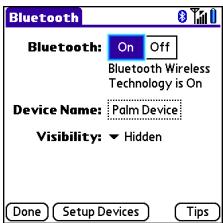
3 (Optional) Enter a device name that identifies your Centro when it is discovered by other Bluetooth devices.
NOTE Use the same device name for all your Bluetooth connections. If you change the device name, you need to recreate any partnerships you have already created.
4 Select Setup Devices.
5 Select Hands-free Setup.
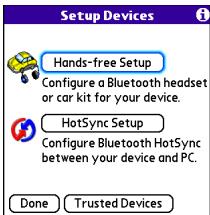
6 Follow the onscreen instructions to create a partnership with the specific hands-free device. When prompted, enter a passkey.
IMPORTANT Some hands-free devices have a predefined passkey. If your device has a predefined passkey, you can find it in the documentation for that device. Other devices provide a screen where you enter a passkey that you make up. In either case, you must use the same passkey on both your Centro and your hands-free device. We recommend that, where possible, you make up a passkey of 16 alphanumeric characters (letters and numerals only) to improve the security of your Centro. The longer the passkey, the more difficult it is for the passkey to be deciphered.
7 After you finish setting up the device, select Done to return to Trusted Devices View.
NOTE For some car kits, you need to initiate a Bluetooth connection from your Centro to complete the partnership process. To do this, highlight the car kit in Trusted Devices View, press Menu , and then select Connect.
8 (Optional) Enable advanced hands-free features by pressing the multifunction button (MFB) on the hands-free device.
You can tell that the connection is successful when you see a light-blue headset icon in the title bar of the Phone application. You can now use your Centro with the Bluetooth hands-free device.
Using a Bluetooth hands-free device
After you create a partnership with your Bluetooth hands-free device and you turn it on within range (up to 9.144 meters), the Centro automatically routes all calls to the hands-free device instead of to the earpiece on your Centro. When a call comes in, your Centro rings and the hands-free device beeps. Even if you answer the call on your Centro, the call goes to the hands-free device. If you prefer to route calls to the earpiece on your Centro, you can change the settings on your Centro to do this; see Customizing advanced settings for your hands-free device for details.
Tip If you're using a Bluetooth hands-free device and you want to return to the earpiece or a wired headset during a call, select Cancel Bluetooth in Active Call View. To return the call to the hands-free device, open the Options menu and select Connect Bluetooth.
The features of your hands-free device vary by model. Check the documentation for your hands-free device for details about these features. Your Centro can support the following actions, provided that your hands-free device also supports them:
- Dial a call
Answer an incoming call - Hang up a call and answer a call-waiting call
- Place a call on hold and answer a call-waiting call
Hang up a single call - Transfer an outgoing call from the earpiece on your Centro to the hands-free device
-
Ignore an incoming call
-
Redial the last number you called from the hands-free device
DID YOU KNOW? If you have more than one Bluetooth hands-free device, the last one you connected to becomes the active device. To switch between devices, turn off the active device before you try to connect to the other device.
Customizing advanced settings for your hands-free device
You can set whether your hands-free device automatically answers calls, provided the device supports this feature.
1 Press Applications and select Prefs
2 Select Hands-free.
3 Do one of the following: To send all calls to your hands-free device: Check the Always route calls to handsfree box. Select the Auto answer pick list and select whether you want your hands-free device to automatically answer incoming calls and how quickly it answers.
To choose between the earpiece on your Centro and your hands-free device on a call-by-call basis: Uncheck the Always route calls to handsfree box. When the phone rings, you can answer the call with your hands-free device by pressing the multifunction button on your hands-free device, or you can answer the call with the earpiece on your Centro by using the controls on your Centro (see Receiving calls).
4 Select Done.
Customizing phone settings
DID YOU KNOW? You can download any compatible ringtone directly to your Centro (see Downloading files from a web page). You can also download ringtones to your computer and then email them to your Centro.
Selecting ringtones
You can set various tones for various types of incoming calls.
1 Press Phone
2 Press Menu
3 Select Options, and then select Sound Preferences.
4 Select the Application pick list and select Ring Tones.
| Preferences | Sound & Alerts |
| Application: | Ring Tones |
| Volume: | 4 |
| Vibrate: | When Sound Off |
| Escalate ring tone volume | |
| Known Caller: | Treo |
| Unknown Caller: | Treo |
| Done | New Manage... Tips |
5 Select the Volume pick list and select the volume level.
6 Select the Vibrate pick list and select when you want your Centro to vibrate for an incoming call.
7 (Optional) Uncheck the Escalate ring tone volume box if you do not want the
ring to play softly and then increase to full volume the longer it rings.
8 Select a ringtone from the pick list to identify each of the following:
Known Caller: An incoming call from someone in your Contacts or Favorites.
Unknown Caller: An incoming call from someone identified by caller ID who is not in your Contacts or Favorites. This includes callers who have blocked their caller ID.
Roaming: A special tone for incoming calls when you're outside your home mobile network. This tone overrides all other ringtones, unless you select No Sound.
9 Select Done.
DID YOU KNOW? You can assign a ringtone to a contact or to an entire category of contacts.
Creating and managing ringtones
You can also record sounds and use them as ringtones.
1 Press Phone
2 Press Menu
3 Select Options, and then select Sound Preferences.
4 Select Manage.
5 Do one of the following:
- To record a sound, select New.
- To play a sound, select it with the 5-way .
- To delete a sound, highlight it and press Backspace l
To send a sound, highlight it and select Send.
6 Select Done twice.
Tip You can also create a new sound by selecting New in Sound & Alerts Preferences.
Selecting Phone alert tones
You can set various tones for various types of alerts.
1 Press Phone
2 Press Menu
3 Select Options, and then select Sound Preferences.
4 Select the Application pick list and select Phone Alerts.
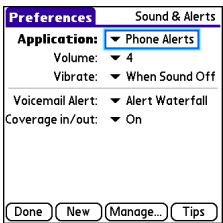
5 Select the Volume pick list and select the volume level.
6 Select the Vibrate pick list and select when you want your Centro to vibrate for a phone alert.
7 Select an alert tone from the pick list for each of the following:
Voicemail Alert: Plays when you have new voicemail.
Coverage in/out: Plays when you move into or out of a coverage area.
8 Select Done.
Adjusting the call volume
While a call is in progress, press the Volume button on the side of your Centro to adjust the call volume.
To increase the volume, press the upper half of the Volume button.
- To decrease the volume, press the lower half of the Volume button.
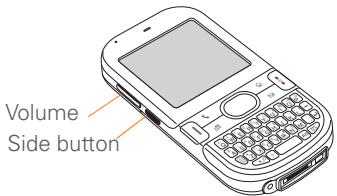
Adjusting ringer volume
When a call is not in progress and music is not playing, press the Volume button on the side of your Centro to adjust the ringer volume, and then press the Side button to confirm your selection.
Customizing the Main tab in the Phone application
Phone Display Options let you customize the appearance and entry mode of the Main tab in the Phone application.
1 Press Phone
2 Press Menu
3 Select Options, and then select Phone Display Options.
4 Set any of the following options:
- Wallpaper: Sets the wallpaper that appears on the Main tab in the Phone application. To change the wallpaper, select the thumbnail image and then select an image to use as wallpaper.
DID YOU KNOW? You can also set the background for Agenda View in Calendar. See Customizing display options for your calendar for details.
Fade: Adjusts the intensity level of the wallpaper image.
Typing....: Sets whether typing in the Main tab in the Phone app displays the Dial Pad and enters numbers you want to dial, or whether it displays the Contacts tab and starts a contacts search.
Tip If you select the Typing starts contacts search option, you can still enter a phone number from the Main tab in the Phone app. If you start typing digit keys that can be a phone number, the device automatically switches to the Dial Pad and looks for the phone number.
Show Calendar event: Sets whether the current event from the Calendar application appears in the Main tab in the Phone app. When this option is enabled, you can then select this event to jump to the Calendar app.
Default View: Sets the tab that appears when you press Phone
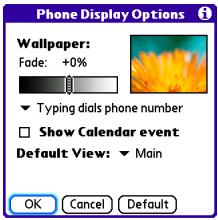
5 Select OK.
Setting your dialing preferences
Dialing preferences let you assign a prefix to your phone numbers. For example, you can automatically dial a 1 before all 10-digit phone numbers. You can add a different prefix based on the length of the phone number.
1 Press Phone
2 Press Menu
3 Select Options, and then select Dial Preferences.
4 Set any of the following options:
Dialing from North America: Formats phone numbers using North American conventions (XXX-XXX-XXXX).
Always dial +1 in front of the area code: Adds a +1 in front of 10-digit phone numbers. This option is available only when Dialing from North America is enabled.
To 7 digit numbers: Adds a prefix to 7-digit numbers. For example, enter your own area code to automatically add your area code when you dial local numbers.
To (6), (5), (4), digit numbers: Adds a prefix to numbers that are only six, five, or four numerals long. For example, if all the phone numbers in your office have the 408 area code and a 555 exchange, followed by a 4-digit extension, select 4 and enter the prefix 408555. To call a colleague, simply dial your colleague's 4-digit extension; your Centro automatically dials the rest and makes the call. You can also create contact entries with just the extension number and then dial the number from your Contacts list.
5 Select OK.
Manually selecting the wireless network
You may be able to search for other wireless network services in your current location.
1 Press Phone
2 Press Menu
3 From the Options menu, select Select Network.
4 Select another network, if available.
5 Select OK.
Using TTY
A TTY (also known as TDD or text telephone) is a telecommunications device that allows people who are deaf or hard of hearing, or who have speech or language disabilities, to communicate by telephone.
Your Centro is compatible with select TTY devices. You can connect a TTY/TDD machine to your Centro through the headset jack, but you cannot use your headset jack with a headset while this mode is enabled. Please check with the manufacturer of your TTY device for connectivity information and to ensure that the TTY device supports digital wireless transmission.
To use TTY, you may need to make additional arrangements with your network operator. Please contact your network operator's customer service department for more information.
1 Press Phone
2 Select the Dial Pad tab.
3 Enter #*889 (TTY).
4 Press Send
5 When a message appears indicating that TTY is enabled, select OK. To disable TTY, repeat these steps.
Tip A red T appears at the top of the Phone screen to indicate that TTY is enabled.
What are all those icons?
You can monitor the status of several items using icons in the title bar in the Phone application:
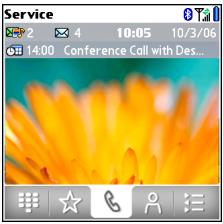
Service
Your phone is on and you are in a coverage area. If you are outside a coverage area, No Service appears instead. When you turn off your phone, Phone Off appears.

Call forwarding is active.

Your phone is on. The bars display the signal strength. The stronger the signal, the more bars that appear. If you are outside a coverage area, no bars appear.
Your phone is on and a GPRS or EDGE network is within range, but you are not actively transmitting data. You can still make and receive calls.

Your phone is on and a GPRS or EDGE data connection is active. You may not be able to receive calls when you are actively transmitting data. If you make a call, the data transmission is automatically interrupted, and you must manually resume the data connection when you end the call.

You have new voicemail messages. You can select this icon to retrieve your messages.

You have a new alert, such as a Calendar alarm or a new text message. To view the alert, press and hold Center or select the icon. See Viewing and using the alerts.

The Bluetooth wireless technology icon appears in gray when this feature is off, in blue when this feature is on, and in reverse blue when your Centro is communicating with another Bluetooth device.


This icon replaces the Bluetooth icon when your Centro is connected to a Bluetooth hands-free device. This icon appears in dark blue when a call is in progress and in light blue when a call is not in progress.
This icon replaces the Bluetooth icon when your Centro is connected to your computer using a dial-up networking (DUN) connection. See Connecting your computer to the Internet through your CentroTM.
Your battery is partially drained. When the battery drains to 20% of its capacity, the icon changes from blue to red. At 10% of its capacity, you begin to receive warning messages, and at 5% of its capacity, the Centro beeps (if the Ringer switch is set to Sound On) and the icon changes from red to clear.

Your battery is being charged.
The lightning bolt turns from red to green when the battery is fully charged and your Centro remains connected to the charger.

Your battery is fully charged and your Centro is not connected to the charger.

You have new text or multimedia messages. The number next to the icon indicates the number of unread messages in your Inbox. You can select this icon to retrieve your messages.

36
You have new email messages. The number next to the icon indicates the number of unread messages in your Inbox. If you set up multiple email accounts on your Centro, this number reflects only the account that you most recently accessed. You can select this icon to retrieve your messages.
KEY TERM GPRS (General Packet Radio Service) A mobile connectivity technology that provides persistent data connections. (Additional charges may apply.)
KEY TERM EDGE (Enhanced Data rate for GSM Evolution) An enhanced version of GPRS that delivers data speeds that are up to three times faster than standard GPRS connections. (Additional charges may apply.)
DID YOU KNOW? You can tap the Bluetooth icon to quickly turn Bluetooth wireless features on and off.
Tip To display the remaining battery power, tap the battery icon at the top of the screen.
Your email and other messages
You already know how efficient email and messaging are for staying in touch. Now your Palm® Centro™ smartphone brings you a new level of convenience: email on the go. Enjoy the ease and speed of communicating with friends, family, and colleagues anywhere you can access your data network. You can send and receive attachments as well. And keep the Messaging app in mind for when you need to send a short text message to a mobile phone number—especially handy when you're in a meeting that's running late.
Benefits
- Access email on the go
-
Send and receive photos, sound files, Word and Excel files, and more
-
Save messages from your computer to view at a convenient time
In this chapter
Your email application. 89
The VersaMail® application 90
Messaging 107
Your email application
Your Centro includes the VersaMail® application (called Email in Applications view). You can also access web-based email, like Yahoo! Mail or Hotmail, from the web browser on your Centro.
NOTE You must activate data services on your network operator account before you can use email on your Centro.
KEY TERM Email provider The service you use to send and receive email. Your email provider's name appears between the @ symbol and the dot in your email address. Gmail, for example, is an email provider; so are AOL and Earthlink.
KEY TERM Email application It's not an email provider, but an application on your Centro, that gives you a way to view and manage email. An email application just transfers messages from an account that you have already set up with a provider.
You can use the VersaMail application to do all of the following:
- Access an email account that's set up on your Mac computer.
- Check fee-based Internet mail, such as Yahoo! Mail Plus.
- Access email from an existing account without extra software or account sign-up.
- Access Contacts on your device to address email messages.
- Access email from up to eight email accounts.
- Work with email messages when you're not connected to the Internet (for example, when you're on a plane).
- Access your corporate directory to address email messages.
- Sync your email and organizer info with your company's Exchange server (using Microsoft Exchange ActiveSync®).
-
Push your email and organizer information from your company's Exchange server using Microsoft Exchange ActiveSync.
-
Sync your mail with your company's Domino server.
Use Secure Sockets Layer (SSL) while sending and receiving messages.
The VersaMail® application
Before you can use VersaMail, you need to enter your email account settings. If you have multiple email accounts, you must enter settings for each email account.
After you enter your email account settings, see the User Guide for the VersaMail Application on the Palm Software Installation CD for info on sending and receiving messages and customizing your VersaMail settings.
How do I get started?
1 If either of the following is true, read the User Guide for the VersaMail Application on the Palm Software Installation CD:
- You used the VersaMail application on your previous Palm OS® device, and you want to transfer those settings to your Centro.
- You plan to use VersaMail to access an email account on a Microsoft Exchange ActiveSync server, a Lotus Notes server, or a Microsoft MAPI server.
2 If your email provider is listed in the following table, skip to Setting up VersaMail to work with common providers.
Australia: Bigpond Mail and OptusNet.
Belgium: Scarlet, Skynet, Swing, and Tiscali Belgium.
Brazil:UOL.
Canada: Rogers High Speed and Sympatico.
Denmark: Cybercity, Sonofon, TDC, and Tiscali.
Finland: TeliaSonera.
France: 9 Telecom, Cegetel, Club-Internet, Free, Freesurf, La Poste,
Noos, Orange, SFR.net, Tele2, Tiscali, Wanahoo, and yahoo!.
Germany: debitel E-Mail, E-Plus imail, Freenet Email-Office, GMX eMail, T-online eMail, Vodafone eMail, and Web.de E-Mail.
Hong Kong: 1O1O, 3-DUALBAND-Netvigator (IMS), and One2Free.
Ireland: o2 Ireland and Vodafone Ireland.
Italy: interfree, kataweb, libero, Tim, tin.Itt, and Tiscali.
Malaysia: Jaring and Maxis Net.
Norway: Telenor and Netcom.
Philippines: GlobeQuest and Pacific Internet - PH.
Singapore: Pacific Internet, Singnet, and StarHub.
Spain: Movistar, Telefonica, Terra.es, Vodafone, and Wanahoo.
Sweden: Bredbandsbolaget, Chello, Com Hem, Tele2, TeliaSonera Mail, Vodafone Euromail, and yahoo!.
Switzerland: Bluewin, GMX, green.ch, Orange, Sunrise (my), Sunrise Freesurf, SwissOnline, Tiscali, and yahoo!.
Taiwan: HiNet Umail.
Thailand: AIS Mail.
United Kingdom: Blueyonder, BT Internet, BT Openworld, BT Yahoo!, Clara.net, Demon, Freeserve, Lycos, NTL, O2, Orange, Pipex, Tiscali, UK Online, Virgin, Vodafone, Wanaroo, and yahoo!.
United States: AOL, Apple.Mac, AT&T
Worldnet, Bell South, Cablevision, Charter, Comcast, CompuServe, EarthLink, Gmail, Mail.com, NetZero, Speakeasy, Verizon DSL, and Yahoo!.
3 If your email provider's name is not listed, you need to obtain the following info from your system administrator or ISP, and then skip to Setting up. VersaMail to work with other providers:
- Mail protocol: POP, IMAP, or Outlook Mail (EAS)
- Incoming and outgoing mail server names, such as mail.myisp.com
- Incoming and outgoing mail server port numbers, such as 110 (incoming POP), 143 (incoming IMAP), or 25 (outgoing POP or IMAP)
- (If necessary) Security settings: APOP, ESMTP, SSL
Setting up VersaMail to work with common providers
1 Press Applications and select Email
2 If this is the first time you are setting up VersaMail, you are asked if you want to continue with account setup after you open the application. Select Continue and go to step 5.
Initial Setup

VersaMail is about to perform initial setup.
If you have an existing handheld profile you would like to use on this device, you should HotSync it now.
HotSync
Continue
Cancel
3 Press Menu
4 Select Accounts, and then select Account Setup.
5 Select New.
6 Enter the email address for your email account. Your email address includes your username, which usually appears before the @ symbol in your email address.
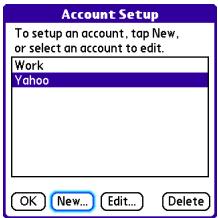
7 In the Password field, enter your email account password.
8 If the VersaMail application can obtain your email account settings based on your username and password, the Next button changes to Done. Select Done.
NOTE If the Next button does not change to Done, you need to follow the next procedure, Setting up VersaMail to work with other providers.
Tip To enter settings for another email account, open the Accounts menu and select Account Setup.
Setting up VersaMail to work with other providers
1 Press Applications and select Email
2 If this is the first time you are setting up VersaMail, you are asked if you want to continue with account setup after you open the application. Select Continue and go to step 5.
IMPORTANT Do not select HotSync on this screen. Doing so may prevent the VersaMail application from working correctly.
Initial Setup

VersaMail is about to perform initial setup.
If you have an existing handheld profile you would like to use on this device, you should HotSync it now.
HotSync
Continue
Cancel
3 Press Menu
4 Select Accounts, and then select Account Setup.
Account Setup
To setup an account, tap New, or select an account to edit.
Work
Yahoo
OK
New...
Edit...
Delete
5 Select New.
6 Enter the email address for your email account. Your email address includes your username, which usually appears before the @ symbol in your email address.
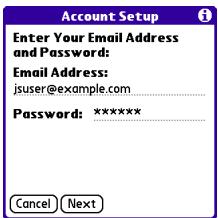
7 In the Password field, enter your email account password.
8 Select Next.
9 Select the Mail Type pick list, and then select POP, IMAP, or Outlook Mail (EAS) (based on the info you received from your system administrator or ISP).
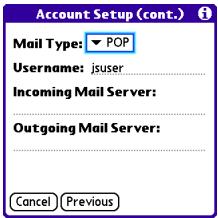
10 Enter the username you use to access your email.
Tip Your username can be either the part of your email address appearing before the @ symbol or your entire email address. Check with your email provider if you are not sure what username to enter.
11 Enter the names of your incoming and outgoing mail servers.
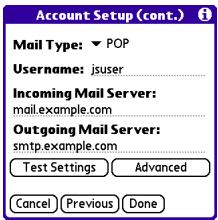
DID YOU KNOW? Your incoming mail server is also called your POP, IMAP, or Outlook Mail (EAS) server; your outgoing mail server is also called your SMTP server.
12 Do one of the following:
Finish setup: Select Done to finish the setup and go to the Inbox of the account you set up, where you can begin getting and sending email.
Test settings (POP and EAS accounts only): Select Test Settings to test settings for this account.
Set additional mail options: If your system administrator or ISP provided port numbers or security settings, select Advanced, and then enter those settings.
Tip You can also select Advanced to set more options for incoming and outgoing messages.
13 Select Done.
DID YOU KNOW? Advanced settings include the Reset Advanced Settings button. You can select this button to reset your advanced settings to their initial state. This is useful when you want to restore your initial settings but you can't remember what they were.
Creating and sending messages
1 From the Inbox, select New.
2 Begin entering one of the following for the addressee:
- Email address
- First name
- Last name
Tip If you enter address info that matches one or more of your contacts, VersaMail displays the matching contacts. To accept a suggestion, select the correct contact. To send to a different address, keep entering the email address or name.
3 Enter the subject and message text.
Tip To move between fields, press Up or Down on the 5-way.
4 Select one of the following:
Send: Connects and sends all messages immediately. If the message cannot be sent for any reason, the message is stored in your Outbox.
Outbox: Puts the message in the Outbox to send later.
Drafts: Saves the message so you can continue working on it at another time.
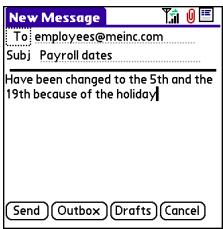
DID YOU KNOW? VersaMail makes up to five attempts to send a message; if it is still not successful, an alert message appears and you must try to manually send the message again.
Adding attachments to your messages
You can attach several types of files to your email messages.
Tip To remove an attachment, select the file in the Attachments box, and then select Delete.
Attaching photos and videos
1 Create the message to which you want to attach the photo or video.
2 On the New Message screen, select the red paper clip icon in the upper-right corner.
3 From the Type pick list, select Photo/ Video.
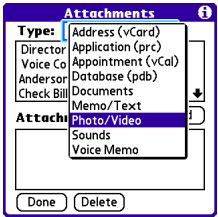
4 On the Select Media screen, select the Album pick list to go to the album containing the photo or video you want, and then check the box to the left of the photo or video.
5 Select Done.
Tip To attach more than one file to a message, repeat steps 3 and 4.
Attaching ringtones
1 Create the message to which you want to attach the ringtone.
2 On the New Message screen, select the red paper clip icon in the upper-right corner.
3 From the Type pick list, select Sounds.
TIP Ringtones that are copy-protected appear in the Sounds application with a lock icon. You can use these ringtones on your phone, but you cannot send them as attachments.
4 Select the ringtone you want, and then select Insert.
5 Select Done.
Attaching Word, Excel, PowerPoint, and PDF files
1 Create the message to which you want to attach the file.
2 On the New Message screen, select the red paper clip icon in the upper-right corner.
3 From the Type pick list, select Documents.
4 Select the file you want on the Documents screen.
5 Select Done.
Attaching other types of files
1 Create the message to which you want to attach the item.
2 On the New Message screen, select the red paper clip icon in the upper-right corner.
3 From the Type pick list, select the type of file to attach—for example, Address, Appointment, or Memo/Text.
4 Select the item you want from the list in the Type box.
5 Select Done.
Receiving and viewing messages
1 From any mailbox, select Get or Get & Send.
2 From the Inbox, select the message you want to view.
Tip A circular arrow in the lower-right corner of the Inbox revolves to indicate background activity, such as downloading messages.
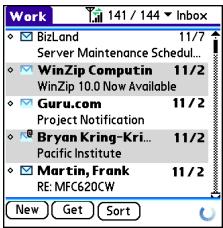
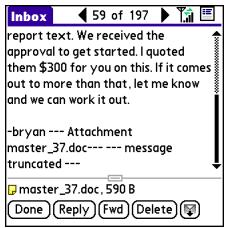
3 If a large incoming message is truncated, select More
TIP When viewing a message, tap the scroll arrows at the top of the screen to view the previous or next message.
4 Select Done.
Replying to or forwarding messages
When you respond to messages, you can select whether to include the original text (see Customizing your email settings).
DID YOU KNOW? The VersaMail application sends all messages as plain text only, with all HTML tags stripped, even if you are forwarding or replying to a message that was originally received as HTML.
1 From the Inbox or another folder, open the message you want to respond to.
2 In Message View, select Reply. Select whether to reply to just the sender or to reply to both the sender and all addressees on the message.
3 Enter your reply.
4 Select Send.
Viewing attachments
There are a number of attachment types you can open with the built-in software on your Centro (for example, Microsoft Word, Excel, PowerPoint, and PDF files; ringtones; and photos).
1 From any folder, open the message with the attachment you want to view. Messages with downloaded attachments appear with a paper clip icon to the left of the message icon.
Tip If an attachment is not downloaded because it is larger than your maximum message size, the paper clip icon does not appear, and the attachment is not displayed at the bottom of the message screen. Select More to download and display any attachments. However, if the attachment is larger than the limit set by IT or by the email provider, the attachment is not downloaded.
2 Select the attachment name at the bottom of the message screen to view it in the default viewer on your Centro.
Tip You can also select the folder icon to the left of the attachment name to open a menu of tasks you can do with the attachment, including View, Install, or Unzip, depending on the attachment file type; Save to card to save the attachment to an expansion card; or select Viewer to select the application you want to use to view the attachment.
3 When you finish with the attachment, select Done to return to the Attachments dialog box.
NOTE If there is no Done button, press Applications 空 and select Email to return to the account's Inbox.
Managing your messages
The status icons that appear near the messages in your Inbox indicate the following:

The message is unread when the subject appears in bold.

The message includes an attachment.

The message includes a meeting invitation.

This message has high priority.
You can rearrange the message list to make it easier to find and view messages.
In the Inbox, select Sort, and then select one of the following: By Subject, By Sender, By Size, or By Date.
To quickly switch between folders in list view, select the folder pick list at the top of the screen and select the desired folder.
Deleting selected messages from the Inbox
When you delete a message from the Inbox, it moves to the Trash folder.
1 Select the bullet next to the icon of each message that you want to delete. To select adjacent messages, drag the stylus so that it touches the bullet to the left of each message. Lift the stylus and drag again to select more adjacent messages.
2 Press Menu
3 Select Delete on the Message menu.
4 If a confirmation dialog box appears, select OK to confirm the deletion.
Tip To delete a single message, select the envelope icon next to the message, and then select Delete from the list.
Deleting messages by date
You can quickly delete a group of messages by selecting a range of dates.
1 Press Menu
2 Select Delete Old on the Message menu.
3 Select the folder and a date range for the messages you want to delete.
4 Select OK.
5 If a confirmation dialog box appears, select OK to confirm the deletion.
Tip To empty (or purge) the Trash folder, open the Message menu and select EmptyTrash.
Switching accounts
If you create more than one email account in VersaMail, you need to switch from account to account to get, send, and
otherwise manage the messages in each account.
1 Press Menu
2 Select Accounts, and then select an account.
DID YOU KNOW? If you assigned VersaMail to a quick button, you can press that button repeatedly to switch between your email accounts.
Customizing your email settings
You can customize the VersaMail settings for each individual email account on your Centro. The preferences you set apply only to the email account you are currently viewing. If you have multiple accounts, configure each account separately.
You can set up a schedule to automatically retrieve email messages; set preferences for how and when messages are retrieved; add a signature to an outgoing message; and more. For complete information on all the email settings you can customize, see the User Guide for the VersaMail Application on the Palm Software Installation CD.
Scheduling Auto Sync
You can set up VersaMail to automatically download new email messages to your Centro with the Auto Sync feature.
Tip You need to set up a separate Auto Sync schedule for each email account. This feature may not work with email accounts that require VPN connection.
1 Press Menu
2 Select Options, and then select Preferences.
3 Select Auto Sync.
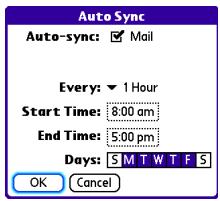
4 Check the Auto-sync box.
5 Select the Every pick list and select the time interval, from 5 minutes to 12 hours.
NOTE If you set a more frequent interval, you may need to recharge your Centro battery more often.
6 Select the Start Time and End Time boxes, and then select the hour, the minute, and AM or PM to enter the time for the first and last Auto Sync to take place. Select OK.
7 Select the days you want the schedule to be active. You can choose any number of days, but you can set up only one schedule for each email account.
8 Select OK, and then select Get Mail.
Tip After you set up a scheduled Auto Sync and select Get Mail, only new messages are retrieved during Auto Sync.
Viewing the Activity Log
The Activity Log lists ongoing and completed background transactions, such as downloading email, between the server and your email account.
1 From the Inbox, press Menu
2 Select Options, and then select View Activity Log.
3 Select a listed action.
4 Do either of the following:
- To cancel an ongoing action, select Stop. If the action has already been completed, Stop does not appear.
- To view the details of a completed action, select Details.
5 Select Done.
Selecting alert tones
When you schedule Auto Sync for a given account, you can choose a sound—such as a bird, a phone, or an alarm—to let you know when new email arrives.
1 From any mailbox screen, press Menu
2 Select Options, and then select Preferences.
3 Select Alerts.
4 Check the Alert me of new mail box.
5 Select the Alert Sound pick list, and then select a sound. Your Centro plays a brief demo of the sound.
6 Select OK.
Setting preferences for getting messages
1 From any mailbox screen, press Menu
2 Select Options, and then select Preferences.
3 Select Incoming.
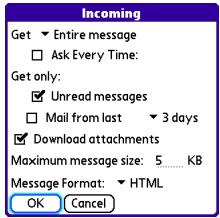
4 Set any of the following preferences, and then select OK.
Get: Indicates whether to get message subjects only or entire messages.
Ask Every Time: Indicates if you want to see a dialog box for selecting subjects only or entire messages each time you retrieve email. If the box is unchecked, messages are retrieved according to the option you select in the Get pick list.
Unread messages (IMAP accounts only): Downloads only unread mail to your Centro. If you don't check this box and you select Get & Send, all the messages on your mail server are downloaded to your Inbox, including messages you've read.
TIP The POP protocol does not support retrieval of unread mail only from the server. If you have a POP email account, VersaMail downloads all messages regardless of whether you have read them, and regardless of whether the Unread messages box is checked.
Mail from last: Gets messages sent within the number of days you specify.
Download attachments: Automatically downloads files attached to email, except for attachments that exceed the maximum message size.
Maximum message size: Sets the maximum size of an incoming email message. Enter the size in kilobytes (KB). The default is 5KB, but you can enter any size up to 2,048KB (approximately 2 megabytes [MB]),
including attachments. The maximum message size that you can retrieve is 60KB for the body text and approximately 5MB of total data for any attachments.
Message Format: Sets the format for messages you retrieve.
- HTML: Displays messages sent in HTML format with basic formatting, intact and displays other messages as plain text.
- Text: Displays all messages as plain text, regardless of the format in which they were sent.
Attaching a signature to a message
You can attach a personal signature, with info such as your company's address and phone numbers, to the bottom of all messages you send.
1 From any mailbox screen, press Menu
2 Select Options, and then select Preferences.
3 Select Signature.
4 Check the Attach Signature box.
5 Enter your signature information, and then select OK.
Working with Microsoft Exchange ActiveSync®
Microsoft Exchange ActiveSync® works with the VersaMail, Calendar, and Contacts apps on your Centro to directly access corporate groupware information on a Microsoft Exchange Server 2007 or Exchange Server 2003. You can synchronize business email, calendar, and contact info with the Exchange 2003 server from your Centro without using a desktop computer.
When you create a Microsoft Exchange ActiveSync account in the VersaMail application, your email, calendar, and contact info sync directly with the Exchange server; information does not sync with the desktop software application on your computer, such as Microsoft Outlook or Palm Desktop software. Other information that is stored on your computer, such as tasks and memos,
continues to synchronize with your desktop software.
The Exchange server pushes email messages, Calendar events, meeting invitations, and updated contact information it receives onto your Centro. Likewise, when you create an email message or event or you update a contact on your Centro, it can be pushed to the server.
DID YOU KNOW? Your Centro turns on and an alert appears whenever you receive a new message. To save battery life, you can turn alerts off for your Exchange ActiveSync account. Go to the account, press Menu, select Options, and then select Preferences. Select Alerts, and then uncheck the alert box.
Pushing email, events, and contacts
The Exchange server pushes email messages, Calendar events, meeting invitations, and updated contact information it receives onto your Centro.
NOTE Find out from your system administrator if your Exchange server supports push and has push turned on.
Likewise, when you create an email message or event or you update a contact on your Centro, it can be pushed to the server.
KEY TERM Push Technology in which a server automatically delivers new information (such as new email messages) to a device. The user does not need to do anything.
Push from server to Centro happens automatically as new or changed items arrive on the server. When you create a new message, appointment, or contact on your Centro, the new item is pushed from your Centro to the server at the following times:
- When a server-to-Centro push takes place
- When you select Sync in your Exchange ActiveSync account to manually retrieve information
- At a preset time interval, if neither of the preceding two events takes place during that interval—for example, if neither a server push nor a manual sync takes place for ten minutes
Tip When push is enabled, certain preferences change for your Microsoft Exchange ActiveSync account only. A new Auto Sync preference is created, including Auto Sync and Alerts options. The Advanced preferences, including Connection and Server options, are removed.
Turning off push
When push is enabled, you can turn it off—for example, to save battery life.
1 Open VersaMail and go to your Exchange ActiveSync account (this is typically your corporate email account).
2 Press Menu
3 Select Options, and then select Preferences.
4 Select Auto Sync, and then do one of the following:
- To switch from push to an Auto Sync schedule for email, calendar, or contacts, select the When pick list and then select any schedule option except As Items Arrive.
- To turn off push and manually retrieve information, uncheck the box next to the type of information you want to
get manually (Mail, Calendar, or Contacts).
Using Remote Address Lookup
Remote Address Lookup enables you to retrieve email addresses on your corporate Exchange server.
BEFORE YOU BEGIN Be sure your phone is on and you are within a coverage area.
1 Open VersaMail and go to your Exchange ActiveSync account.
2 Select New.
3 On the new message screen, begin addressing the message. If the name you want does not appear on the Smart Addressing list, press Menu , select Options, and then select Remote Lookup.
4 Enter text that you want to find on the server. For example, type "Ste" to search for a person named Steve.
5 Select Search. Any names or addresses on the server that match the characters you entered are displayed.
6 When the name you want appears, select it, and then select Add.
For complete info on using a Microsoft Exchange ActiveSync account, see the User Guide for the VersaMail Application on the Palm Software Installation CD.
Messaging
When your phone is on, icons appear in the title bar in the Main tab in the Phone application to indicate whether data services are available and whether a data connection is active. Make sure that either of the following icons appears in the title bar of the Main tab: Yal Yal. If you do not see either of these icons, data services are not available in your current location and you cannot exchange multimedia messages.
You can use the Messaging application to exchange brief text messages (SMS) and multimedia messages (MMS) with other devices and email addresses that support these forms of messaging. Before you use your Centro to send or receive messages, refer to your service plan for pricing and availability of messaging services.
DID YOU KNOW? You can address messages to multiple recipients by separating the addresses with a comma. If you address a single message to three people, you will be billed for three messages.
Creating and sending a text message
Each text message can have up to 160 characters. Messages with more than 160 characters are automatically split into several messages. (If you send a text message to an email address, the email address is deducted from the 160-character count.)
DID YOU KNOW? You can page someone to call you by sending them a blank text message.
1 Press Messaging
2 Select New.
3 Select the To field to address the message:
- Press Center . If the recipient's name appears in the list of recent addresses, select it from the list.
- If the recipient is in your Contacts list, enter the first initial and last name (no
spaces), and then select the recipient's phone number or email address, depending on where you want to send the message.
- If the recipient's name isn't in the list of recent addresses or your Contacts list, enter the phone number or email address.
Tip If you see numbers when you expect to see letters (or the other way around), you need to turn Option Lock on by pressing Option twice or turn it off by pressing Option once.
Tip Do you need to enter a short code that contains letters? Use the keyboard to enter it; just press the letter keys. For example, if the code is "win01," press W to enter w, I to enter i, and so on. No need to figure out the numbers that correspond to the letters
NOTE Sending text messages to land-line phones may not be supported.
4 Enter your message or select QuickText to insert predefined phrases. To insert emoticons, select
Tip To add a new QuickText phrase, select Edit QuickText from the list.
NOTE Some symbols can't be used in text messages. The Messaging application automatically replaces invalid characters.
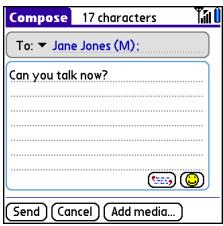
5 Select Send.
Tip Select Save as Draft to save a draft of the message without sending it. To access the draft, select the category pick list at the top of the screen and select Drafts.
Creating and sending a multimedia message
KEY TERM Slide A collection of text, pictures, videos, and sounds that are grouped together within a multimedia message. During playback, all the items within a particular slide appear on the same screen. If a multimedia message contains multiple slides, each slide can be viewed separately during playback.
Multimedia messages consist of text, photos, videos, and sounds presented as one or more slides. You can include any of the following items:
| Item | Supported File Types |
| Pictures | JPG, GIF, WBMP |
| Videos | MPEG4, 3GPP, 3GPP2 |
| Ringtones | MIDI, AAC, AAC+, MP3 |
| Sound clips | AMR, QCELP, MP3 |
1 Press Applications and select Messaging.
2 Select New.
3 Select Add Media.
4 Select the To field to address the message with up to 25 addresses:
- Press Center . If the recipient's name appears in the list of recent addresses, select it from the list.
- If the recipient is in your Contacts list, enter the first initial and last name (no spaces), and then select the recipient's phone number or email address.
- If the recipient's name is not in the list of recent addresses or your Contacts list, enter the phone number or email address.
5 Enter a subject.
6 Select the image placeholder, and then select one of the following:
Attach picture/video: Insert one photo or video from your Centro or an expansion card.
Take new picture: Take a picture with the built-in camera and add it to the message.
Take new video: Capture a short video with the built-in camcorder and add it to the message.
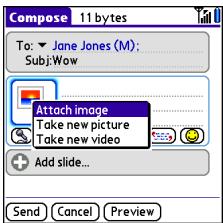
TIP When creating a message, you can preview or delete an item. Highlight the item, press Center on the 5-way, and then select Remove, View, or Play.
7 (Optional) Select Sound , and then select one of the following:
Record new: Record a sound clip of up to 1 minute.
Attach voice memo: Select a memo you recorded in the Voice Memo application.
Attach ringtone: Select a ringtone.
8 Enter a text message or caption.
9 Select Add slide to insert additional slides.
10 (Optional) Select Preview to view the message as the recipient will see it.
11 (Optional) Press Menu , and then select High Priority from the Composemenu to mark the message as urgent.
12 Select Send.
DID YOU KNOW? You can send a contact or calendar entry. Select the entry, open the Record menu, select Send, and then select Messaging.
Receiving messages
When your phone is turned on and is in an area of wireless coverage, you automatically receive new text messages. For multimedia messages, you can set your Centro to automatically download new messages or to notify you that a message is ready to be downloaded (see Customizing your Messaging settings). You can also configure how your Centro notifies you when a new message arrives (see Selecting Messaging alert tones).
The new message alert may include any of the following buttons:
OK: Dismisses the alert and places the message in your Inbox.
Reply: Opens Chat View, where you can reply with a text message. To send an MMS reply, select Add from Chat View.
Call Back: Dials the sender's phone number.
Go ToMsg: Opens the message so you can view its full contents.
Delete: Moves the message from your Inbox to the Deleted folder.
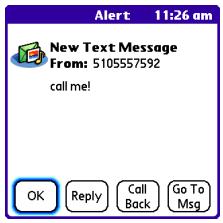
TIP When you receive a message, you can also press Send to call the sender.
Tip If you have multiple alerts, the Alert dialog box displays all your pending alerts. Select an item's description to jump to that item, or check the box to clear that item. To view all your pending alerts from any screen on your Centro, press and hold Center on the 5-way.
Using links in messages
When you receive a text message that contains a telephone number, email address, or URL, you can dial the number, send an email message, or go to the web page immediately.
1 Press Applications and select Messaging.
2 Select the message that contains the link you want to use.
3 Select the phone number, email address, or URL (appears as underlined blue text).
Your Centro automatically launches the appropriate application from the link.
Viewing/playing a multimedia message
1 Press Applications and select Messaging.
2 Select the message you want to view.
3 If there are sounds or multiple slides, playback begins immediately.
4 Do any of the following:
- Use the onscreen controls to scroll to other slides and messages.
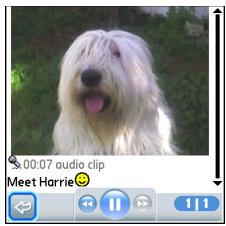
To save a sound, press Menu and select Save Sound from the Message menu. You can access saved sounds later by pressing Applications and selecting Sounds or Voice Memo
To save a picture, press Menu and select Save Picture from the Message menu. You can access saved pictures later by pressing Applications and selecting Pics&Videos
To copy the text, use the stylus to highlight the text, press Menu select Edit, and then select Copy.
- To stop playback of a message, select Play/Stop.
To view message details, press Menu and select Message Details from the Message menu.
To save a calendar or contact entry, open the message details. You can access saved entries later by pressing Applications and selecting Calendar or Contacts (depending on the type of entry you saved).
5 Select OK.
Arranging your messages
You can rearrange the messages in any folder by using the Sort command.
1 Press Applications and selectMessaging.
2 Select the folder list in the title bar and select the folder you want to sort.
3 Press Menu
4 Select View, and then select Sort by Name or Sort by Date.
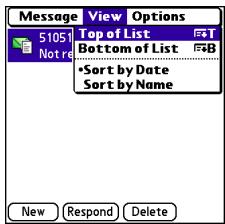
Deleting messages
You can delete several messages at once from any folder by using the Purge command.
Tip To delete an individual message, highlight it in the message list, and then select Delete.
1 Press Applications and select Messaging.
2 Select the folder list in the title bar and select the folder that contains the messages you want to delete.
3 Press Menu
4 Select Purge from the Message menu.
5 Select the Purge pick list, and then select an option.
6 Select OK.
Chatting with Messaging
DID YOU KNOW? You can send and receive text messages even while you are on a phone call. This is easiest when using a hands-free device or the speakerphone.
When you exchange more than one message with a single contact, the messages you exchange with that person are grouped into a chat session. When you select a chat session from your message list, the upper part of Chat View displays all messages you've exchanged with this contact, and the lower part provides an entry area.
You can carry on multiple chats at the same time and easily switch between them, using the pick list at the top of the screen.
TIP To find a chat you had with someone, open your Messaging Inbox and select a chat session.
1 Press Applications and select Messaging.
2 Do one of the following:
Start a new chat: Select a message and reply to it.
Continue an existing chat: Select a message that displays the Chat icon.
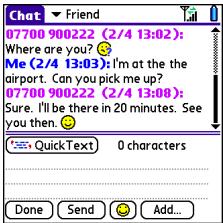
3 Enter your message.
Tip Pale gray text indicates that a message is pending or enroute.
4 Select Send.
Customizing your Messaging settings
1 Press Applications and selectMessaging.
2 Press Menu
3 From the Options menu, select Preferences.
4 On the Messages tab, set any of the following preferences for your individual messages:
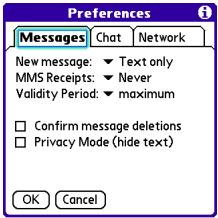
New message: Indicates whether text or multimedia messaging is the default format for a new message.
MMS Receipts: Indicates whether you want to receive a confirmation when an outgoing MMS message is delivered.
Validity Period: Indicates how long you want an outgoing message to be valid.
Confirm message deletions: Indicates whether you want deletion confirmation prompts to appear.
Privacy Mode (hide text): Indicates whether you want the body text to appear in the alert when you receive a new message, or whether you want the alert to hide the text and prompt you to go to the message.
5 Select the Chat tab and set any of the following preferences for chat sessions:
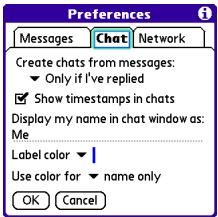
Create chats from messages: Indicate when you want to group messages from the same person into a chat.
Show timestamps in chats: Indicate whether you want to see the local date and time the message was sent next to each message.
Display my name in chat window as: Enter the name you want to use as the label for your messages in Chat View.
Label color: Select a color to differentiate your messages from the sender's messages while in Chat View.
Use color for: Indicate whether you want both your name and message text in the selected label color, or only your name.
6 Select the Network tab and set any of the following preferences for network connections.
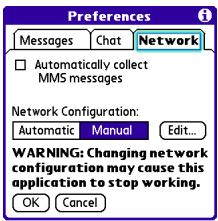
Automatically collect MMS
messages: Indicate whether you want to download multimedia messages automatically.
Network Configuration: Indicate if you want to use Automatic or Manual message retrieval. If you select Manual, select Edit and enter the network provider settings.
NOTE We recommend that you do not change the Network Configuration settings.
7 Select OK.
Selecting Messaging alert tones
DID YOU KNOW? Your Centro includes a silent alert that can vibrate even when the Ringer switch is set to Sound Off.
1 Press Applications and selectMessaging.
2 Press Menu
3 Select Options, and then select Alerts.
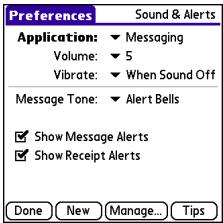
4 Select the Application pick list and select Messaging.
5 Select the Volume pick list and select the volume level.
6 Select the Vibrate pick list and select when you want your Centro to vibrate.
7 Select the Message Tone pick list and select a tone for incoming message alerts.
8 Check the boxes if you want to see onscreen alerts when a new message arrives and when a message you sent is received.
9 Select Done.
What are all those icons?
Tip By default, the Messaging app shows the Inbox folder. To view a different folder, select the folder list in the title bar and select a different folder from the list.
The message descriptions in the Inbox, Outbox, and Sent folders show the message status:
Unread messages appear in bold.
- Read messages appear in plain text.
- Urgent messages appear with a red exclamation point (!).
The following icons show the message type and additional status info:

A text message

A chat session

A multimedia message that is ready for you to download

A multimedia message that is fully downloaded

A multimedia message that is fully downloaded and contains sound

A message that is waiting to besent

A receipt, which you requested, confirming delivery of the message

An outgoing message with an error
DID YOU KNOW? If you are outside a coverage area or if your phone is turned off, outgoing messages go into the Outbox. When you return to a coverage area or turn your phone on, your pending messages are automatically sent and transferred to the Sent folder.
Your connections to the web and wireless devices
You use the web for many things: driving directions, shopping, news, web-based email. Now, with your network and the built-in web browser, you can take the web with you almost anywhere.
The built-in Bluetooth® feature of your Palm® Centro™ smartphone helps you easily set up wireless connections to a number of devices, so you can enjoy the convenience of cable-free connectivity. You can also use your Centro to connect your computer to the Internet and to share contacts or your favorite photos with other people.
Benefits
- Carry the web with you
-
Store web pages for offline viewing
-
Connect to Bluetooth headsets and car kits
- Connect your computer to the Internet through your Centro
In this chapter
Web browser 121
Connecting your computer to the Internet through your Centro™ . 129
Connecting with Bluetooth devices 132
Web browser
The web browser on your Centro provides quick and easy access to web pages. You can view most of the sites you use on your computer, including those with security and advanced features, such as JavaScript and frames. To browse the web, you must activate data services from your network operator.
DID YOU KNOW? The security certificates and 128-bit Secure Sockets Layer (SSL) encryption let you visit secure websites, like ones for banking and using email. Some secure sites also require specific browsers, so those may not work with your web browser.
DID YOU KNOW? The web browser supports JavaScript, SSL strong encryption, and cookies, but it does not support plug-ins (such as Flash or Shockwave) or Java applets.
Viewing a web page
To make viewing web pages on your Centro a better experience, the web browser reforms web pages into a single column and resize images. In this format—called Optimized Mode—you can see most of the content without scrolling left or right. You can also switch to Wide Page Mode if you like.
DID YOU KNOW? You can send email from a web page on your Centro. Email addresses appear as links on web pages. After you configure an email application on your Centro, you can select an email address link to create a message to the selected address.
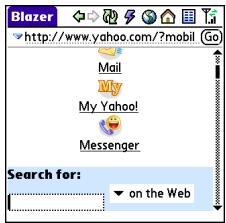
Optimized Mode
Wide Page Mode
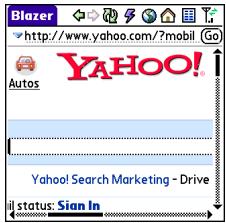
1 Press Applications l and select Web to open the web browser. If necessary, select Yes to turn on your phone, and Yes to connect to the Internet.
If you do not see either of these icons in the title bar, data services are not available in your current location and you cannot connect to the Internet.
2 Enter a web page address (URL) in the Address Bar and select Go.
NOTE If you browse to a secure web page, a lock icon appears in the Address Bar.
3 Do any of the following to navigate within the web page:
View a page in wide layout format (as on your computer): Press Menu , select Options, and then select Wide Page Mode.
Scroll through the page: In Optimized Mode (the default format) press Up ▲ or Down ▼. In Wide Page Mode, use all buttons on the 5-way to scroll in any direction.
Follow a link to another web page: In Optimized Mode, highlight the link by pressing Left or Right and then press Center to go to the selected page. In Wide Page Mode, use the stylus to select a link.
Submit a form: Enter the info and then select the onscreen button to submit the form. If the form doesn't have an onscreen button, press Return +
Tip To adjust the font size, open the Options menu and select Font. To fit more text on the screen, select Small. To make the text easier to read, select Large.
4 Use the 5-way to access any of the following icons in the title bar:

Goes to your home page.

Opens a dialog box where you can enter a web address or view a list of recently viewed web pages.

Goes back in order through pages you viewed.

Goes forward in order through pages you viewed.

Gets the latest version of the current web page. This is sometimes called refreshing the web page.

Opens a list where you can select Fast mode (no images or style sheets) or Normal mode (with images and style sheets).
Creating a bookmark
With bookmarks, you can instantly access a web page without entering the address every time. The web browser can store up to 100 bookmarks or saved pages, allowing you to open your favorite web pages
quickly. Note that a bookmark is different from a saved page and different from a favorite (see Defining favorite buttons).
DID YOU KNOW? The predefined bookmarks take you to pages that are optimized for your Centro.
1 Go to the page you want to bookmark.
2 Press Menu
3 Select AddBookmark from the Page menu.
4 Change the entries in the Name and Description fields.
5 Select OK, and then select OK again.
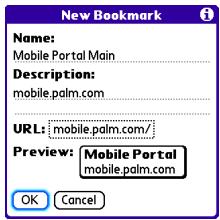
Saving a page
You can use the web browser to save a page for offline viewing, so you don't need a wireless connection to view it later.
1 Go to the page you want to save.
2 Press Menu
3 Select Save Page from the Page menu.
4 Select OK, and then select OK again.
Viewing bookmarks or saved pages
Bookmarks and saved pages both appear in Bookmarks View. Saved pages are indicated by a small triangle in the upper-right corner of the bookmark.
DID YOU KNOW? You can make Bookmarks View the default view when you open the browser. Open the Options menu and select Preferences. Select the Start With pick list and select Bookmarks.
1 Select the Bookmarks View icon in the web page toolbar.
2 Select the bookmark or saved page you want to view.
Tip To go back to the last web page you viewed without selecting a bookmark, select Page View.
Editing or deleting a bookmark or saved page
1 In Bookmarks View, press Menu E.
2 Select Edit Bookmarks from the Bookmarks menu.
3 Select the bookmark you want to edit or delete.
Tip If you can't edit, delete, or beam a bookmark, it is probably locked, and these actions are prohibited.
4 Enter the desired changes or select Delete.
5 Select OK.
Arranging bookmarks and saved pages
Bookmarks View has ten pages where you can store and arrange bookmarks and saved pages in a way that works for you. For example, you can store travel links on one bookmark page, stock links on another, and business links on a third page.
1 In Bookmarks View, press Menu
2 Select Edit Bookmarks from the Bookmarks menu.
3 Enter a title for this page of bookmarks.
4 Use the stylus to drag and drop a bookmark into the desired slot. You can move a bookmark within the current page or move it to a different bookmark page by dragging and dropping it on one of the bookmark Page icons at the bottom of the screen.
5 Select OK.
Downloading files from a web page
The web browser lets you download files that are recognized by one of the applications on your Centro. When you download a file, you can open it in the application that recognizes the file. For example, if you download an MP3 file, you can listen to it later in the Pocket Tunes™ application.
If a file is not recognized by any application on your Centro, you cannot open it on your Centro. You can, however, download the file to an expansion card, transfer it to your computer using an expansion card reader
(sold separately), and view it on your computer.
You can download files such as new applications and choose to play or save music and video files in many popular formats—provided that the website permits the downloading of files:
| Item | Supported File Types |
| Pictures | JPG, WBMP, GIF, PNG |
| Videos | MP4, 3G2, ASF, WMV |
| Ringtones | MIDI, AAC, AAC+, MP3 |
| Music | MP3, WMA |
TIP You can also access software and other downloads using the Downloads bookmark.
1 Go to the page with the link to the file you want to download.
2 Do one of the following:
- In Optimized Mode, press Left or Right to highlight the link to the file, and then press Center.
- In Wide Page Mode, tap the link with your stylus.
3 If prompted, select what you want to do with the file: Play, Save To Device, or Save To Card.
4 Select Yes.
Tip You can also save an image from a web page by tapping and holding it with the stylus.
Streaming files from a web page
The web browser lets you stream files that are recognized by one of the applications on your Centro. For example, you can choose to play music and video files in many popular formats (MP3, WMA, WMV).
1 When the web browser recognizes streamed content on a web page, it displays a Play icon. To view or listen to the streamed content, select Play .
Tip When the web browser recognizes streamed content that is not supported by any of the applications on your Centro, it displays a "Media type not supported" message.
2 Once streaming begins, playback starts automatically. Use the following controls when viewing or listening:
- Select to return to the web page containing the streamed content.
- Select or press Center to pause playback.
- Select or press Center to resume playback after pausing.
- A few seconds after playback begins, the toolbar is hidden and you can view the content on the full screen. Press Up or Down to display the toolbar; press Up or Down again to hide the toolbar again.
- Press the Volume button on the side of your Centro to adjust the volume.
Copying text from a web page
You can copy text from a web page and paste it into other applications.
1 Use the stylus to highlight the text you want to copy.
2 Press Menu
3 Select Edit, and then select Copy.
4 Go to the app in which you want to paste the text, and position the cursor where you want to paste the text.
5 Press Menu
6 Select Edit, and then select Paste.
DID YOU KNOW? If the web browser does not recognize a phone number as dialable, you can copy the phone number (as text) and paste it into the Dial Pad (see Dialing from a web page or message).
Returning to recently viewed pages
The History list stores the addresses of the last 100 pages you visited. Items in the History list are sorted chronologically.
1 In Page View, press Menu.
2 Select History from the Page menu.
3 Select the web page you want to load.
Finding text on a web page
1 In Page View, press Menu.
2 Select Find Text on Page from the Page menu.
3 Enter the text you want to find.
4 Check or uncheck the Wrap Search box to indicate whether you want the search to wrap from the end of the page to the beginning when the end is reached.
5 Select Find to start the search.
Customizing your web browser settings
1 In Page View, press Menu.
2 Select Options, and then select Preferences.
3 Select Page and set any of the following preferences:
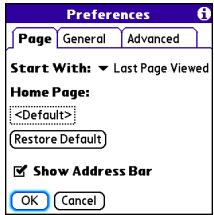
Start With: Determines which view appears when you open the browser.
Home Page: Sets the page that appears when you select
Restore Default: Selects the original home page, if you changed it.
Show Address Bar: Sets whether the web address appears in Page View. When it is visible, you can select the pick list to go to a previously viewed
page or enter a URL directly from Page View.
4 Select General and set any of the following preferences:
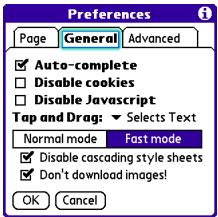
Auto-complete: Determines whether the web browser suggests text, based on your previous entries, when you begin entering info.
Disable cookies: Determines whether websites can store personalized info on your Centro. Some sites do not work properly if you select this option.
Disable JavaScript: Bypasses JavaScript elements on the web pages you view.
Tap and Drag: Determines whether dragging the stylus selects text or
scrolls through the contents of the page.
Normal mode/Fast mode: Determines whether a web page appears as designed (Normal mode) or with some of the items removed for faster display. Selecting Fast mode gives you the following options:
- Disable cascading style sheets:
Determines whether style sheets are applied when you load a web page. When style sheets are disabled, pages download faster, but you may lose some of the formatting.
KEY TERM Cascading Style Sheet (CSS)
A file that governs design elements of a web page, such as its fonts, colors, and layout.
- Don't download images!
Determines whether images appear when you load a web page. If you select not to view images, you can still see any image by selecting the placeholder box on the web page.
TIP Lots of pretty graphics slowing you down? Browse the web faster by enabling the Don't download images! option.
5 Select Advanced and set any of the following preferences:
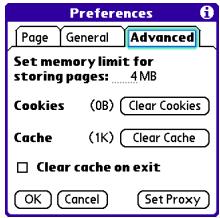
Set memory limit for storing pages: Sets the amount of memory used for your cache. Pages are cached so that they load faster the next time you view them.
Cookies: Indicates how much memory is being used by cookies. To free up this memory, select Clear Cookies.
Cache: Indicates how much memory is being used by your cache to store recent pages and history. To free up this memory, select Clear Cache.
Clear cache on exit: Determines whether the cache clears each time you exit the web browser.
Set Proxy: Sets up a proxy server to access the Internet. If your connection requires a proxy server, please contact your Internet service provider or IT administrator for this information.
6 Select OK.
Connecting your computer to the Internet through your Centro™
Dial-up networking (DUN) is the feature that converts your Centro into a modem so that you can access the Internet from your computer. If your computer is enabled with Bluetooth wireless technology, you can set up your Centro as a wireless modem using the built-in Bluetooth technology.
The following procedures describe the process of setting up your Centro as a wireless modem using the built-in Bluetooth technology.
Tip If your computer is not enabled with Bluetooth wireless technology, you need to purchase a wireless Bluetooth adapter accessory for your computer to use this feature.
Creating a partnership between your Centro and your computer
1 Make sure that your computer's Bluetooth setting is on and that your computer is ready to create a Bluetooth partnership. Check the documentation that came with your computer to find and change these settings.
2 On your Centro, press Applications and select Bluetooth
3 Select Bluetooth On if it is not already selected, and then select Setup Devices.
4 Select Trusted Devices.
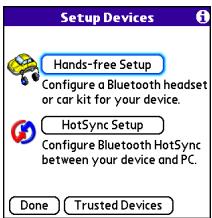
5 Select Add Device. The discovery icon appears, indicating that the discovery process is active.
6 Select your computer from the Trusted Devices list, and then select OK.
7 Make up a passkey, enter it on the Bluetooth Security screen, and then select OK. The passkey can be up to 16 numbers.
NOTE You need this passkey in the next step, so be sure to write it down exactly. We recommend that you use a passkey of 16 numbers, where possible, to improve the security of your Centro. The longer the passkey, the more difficult it is for the passkey to be deciphered.
8 Enter the same passkey on your computer when prompted.
9 Select Done, and then select Done again to return to the Bluetooth screen.
Setting up your computer for a Bluetooth® DUN connection
Follow the instructions from the manufacturer of your Bluetooth adapter to enable DUN.
Accessing the Internet using a Bluetooth DUN connection
The steps for accessing the Internet on your computer may vary depending on your operating system and how Bluetooth wireless technology is set up on your computer—for example, if it is built-in versus if you are using a Bluetooth adapter. If you need additional info, check your computer's documentation for how to set up Bluetooth technology to access the Internet using a DUN connection.
Tip You may need to use a virtual private network (VPN) to access corporate email. Check with your system administrator for more information.
BEFORE YOU BEGIN Verify that DUN is enabled on your computer. See the documentation that came with your computer for details.
1 Open the Bluetooth application on your computer and let it locate the Centro you paired it with in the previous procedure.
2 Double-click the icon or option representing your Centro. Your computer connects to your Centro and shows that DUN services are available.
3 Double-click the DUN icon.
4 Enter your wireless service provider's settings. Contact your wireless service provider if you don't have these settings.
5 Click Dial. Once the connection is successfully established, you can browse the Internet on your computer or download your email.
Tip If you get a message asking whether you want your computer to remember the dial text for this connection, we recommend that you select Yes. This avoids errors and the inconvenience of entering the dial text for every session.
6 Look for a network connection icon in the taskbar at the bottom of your computer screen to verify that you are connected.
DID YOU KNOW? You can check the status of the connection by right-clicking the Bluetooth network icon in the taskbar.
NOTE When a DUN connection is active, you cannot use data services on your Centro. For example, you cannot browse the Web, or send or receive email messages. Also, any scheduled automatic email retrievals do not take place.
Receiving or sending phone calls suspends the DUN session. The session resumes when the call is ended.
Terminating a Bluetooth DUN Internet session
It is important to end a Bluetooth DUN session after you finish using it. Ending the DUN session lets you use the wireless features of your Centro that require a data connection, it frees up the Bluetooth feature so that you can connect to other Bluetooth devices, and it optimizes battery life, too.
1 On your computer, right-click the icon or option representing your Centro.
2 Click Disconnect.
Connecting with Bluetooth devices
With the built-in Bluetooth wireless technology on your Centro, you can connect to a number of Bluetooth devices, including a hands-free device such as a headset or car kit, a printer, or a GPS receiver, as well as to other Centro smart devices and handhelds that are equipped with Bluetooth wireless technology. If your
computer is enabled with Bluetooth wireless technology, you can also synchronize wirelessly or use your phone to connect your computer to the Internet.
You can create a list of Bluetooth devices that you trust to communicate with your Centro. When communicating with trusted devices, your Centro skips the discovery process and creates a secure link as long as the device is within range. Bluetooth range is up to 30 feet depending on environmental conditions, including obstacles, radio interference from nearby electronic equipment, and other factors.
When you configure a hands-free device, as described previously in Connecting to a Bluetooth® hands-free device, the hands-free device automatically appears in your Trusted Devices list. Follow the steps in this section to add other devices to your Trusted Devices list, such as a friend's handheld.
Requesting a connection with another Bluetooth device
1 Press Applications and select Bluetooth
2 Select Bluetooth On.
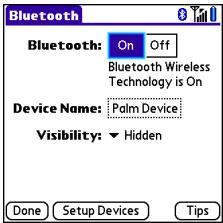
3 (Optional) Enter a device name that identifies your Centro when it is discovered by other Bluetooth devices.
NOTE Use the same device name for all your Bluetooth connections. If you change the device name, you need to re-create any partnerships you've already created.
4 Select Setup Devices.
5 Select Trusted Devices.
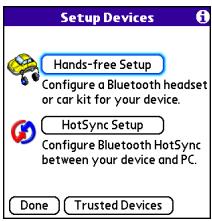
6 Select Add Device. The Discovery icon appears, indicating that the discovery process is active.
7 Select the Show pick list and select Nearby devices.
8 If the device you want to add doesn't appear on the Discovery Results list, make sure that the other device is ready to receive a connection request (see the device's documentation), and then select Find More on your Centro to search again.
9 Enter the same passkey on your Centro and on the Bluetooth device, and select OK.
IMPORTANT Some Bluetooth devices have a predefined passkey. If your device has a predefined passkey, you can find it in the documentation for that device. Other devices provide a screen where you enter a passkey that you make up. In either case, you must use the same passkey on both your Centro and the other Bluetooth device. We recommend that, where possible, you make up a passkey of 16 alphanumeric characters (letters and numerals only) to improve the security of your Centro. The longer the passkey, the more difficult it is for the passkey to be deciphered.
10 Select Done.
Accepting a connection from another Bluetooth device
Tip For the Centro to be visible to Bluetooth devices, the Bluetooth setting must be set to On and visibility must be set to Visible or Temporary.
1 Press Applications and select Bluetooth
2 Select Bluetooth On.
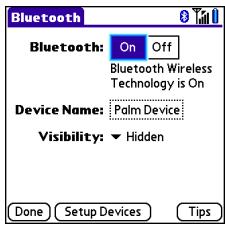
3 (Optional) Enter a device name that identifies your Centro when it is discovered by other Bluetooth devices.
NOTE Use the same device name for all your Bluetooth connections. If you change the device name, you need to re-create any partnerships you've already created.
4 Select the Visibility pick list and select one of the following:
Visible: Enables Bluetooth devices that are not on your Trusted Devices list to request a connection with your Centro. Your Centro remains accessible to other devices until you turn this option off.
After you've finished using this setting, remember to change it back to Hidden.
Tip Use the Visible option only when you need your Centro to be accessible for an extended period of time. For short-term accessibility, use the Temporary option.
Temporary: Enables Bluetooth devices that are not on your Trusted Devices list to request a connection with your Centro during the next two minutes. Your Centro reverts to the Hidden setting and becomes inaccessible to other devices after two minutes.
Hidden: Allows only devices with which you have previously formed a partnership to request a connection with your Centro. New devices cannot request a connection.
5 Enter the same passkey on your Centro and on the Bluetooth device.
IMPORTANT Some Bluetooth devices, such as headsets and GPS receivers, have a predefined passkey. If your device has a predefined passkey, you can find it in the documentation for that device. Other
devices provide a screen where you enter a passkey that you make up. In either case, you must use the same passkey on both your Centro and the other Bluetooth device. We recommend that, where possible, you make up a passkey of 16 alphanumeric characters (letters and numerals only) to improve the security of your Centro. The longer the passkey, the more difficult it is for the passkey to be deciphered.
6 (Optional) Check the Add to trusted device list box if you want to form a partnership with the requesting device.
7 Select OK.
Your photos, videos, and music
Do you have a wallet bulging with photos of friends, family, pets, and your most recent vacation?
Are you tired of carrying both your MP3 player and your phone?
Your Palm® Centro™ smartphone solves both problems. You can keep your favorite photos right on your Centro—videos, too. And there's no need to carry an expensive MP3 player; you can play music on your Centro. Simply transfer songs onto your Centro or an expansion card and then listen through your headphones (cards and headphones sold separately).
Benefits
- Never be far from your favorite people, places, and songs
-
Organize your photos, videos, and songs
-
No separate photo viewer, MP3, or CD player required
In this chapter
Camera and Camcorder 139
Pictures & Videos 143
PocketTunesTM 148
Camera and Camcorder
Your Centro comes with an easy-to-use, built-in, 1.3 Megapixel camera with 2x digital zoom. You can use the camera to take and view pictures and videos and send them to your friends and family. To add a personal touch to your Centro, use your pictures as your wallpaper for the Main tab in the Phone application and as caller ID images.
In addition to taking pictures and videos, you can receive and view pictures and videos, send pictures and videos as email attachments or multimedia messages (MMS), and use pictures to personalize your Centro (such as wallpaper or picture caller ID; see Assigning a caller ID photo for details). You can also move pictures and videos to a computer by synchronizing your Centro with your computer.
Taking a picture
You can store pictures on your Centro or on an expansion card.
1 Press Applications and select Camera
2 By default, the Camera application stores pictures you take in the PALM folder on your expansion card (if a card is inserted). Otherwise, Camera stores pictures in the PALM album on your Centro. To store a picture in a different location, select one of the following:
New Albums: Opens a dialog box where you can enter an album name and select the storage location (Centro or expansion card).
Tip The default camera resolution is SXGA (1280 x 1024). VGA (640 x 480) and QVGA (320 x 240) resolutions are also supported. To view these settings before you take a picture, press Menu.
3 Find your subject in the screen on your Centro (the lens is on the back of your Centro).
4 (Optional) To get a close-up of your subject, press Up to select 2x. Press Down to return to 1x.
5 Press Center to capture the picture.
6 Select any of the following icons:

Saves the picture in the location you selected in step 2.

Deletes the picture.

Opens a dialog box where you can select how you want to send the picture: Messaging, Bluetooth® wireless technology, or Email. The receiving device must support the method you select.

Lets you add a voice caption.
Tip To add an audio caption later, open the picture and then select Audio Caption from the Photo menu.
DID YOU KNOW? You can personalize a picture. Open the Photo menu, select Draw on, and then use the drawing tools to add your own personal touch. When you save the picture, you can replace the original or save a copy.
Recording a video
You can store videos on your Centro or on an expansion card.
1 Press Applications and select Camcorder
TIP The video recording screen displays the approximate recording time you have left based on the space available on your Centro or expansion card. Actual recording time may vary depending on how fast you are moving, how many colors you are recording, and so on.
2 By default, the Camcorder application stores videos you record in the PALM folder on your expansion card (if a card is inserted). Otherwise, Camcorder stores pictures in the PALM album on your Centro. To store a video in a different location, select one of the following:
New Albums: Opens a dialog box where you can enter an album name and select the storage location (Centro or expansion card).
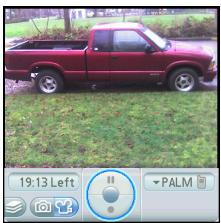
Tip The default camcorder resolution is CIF (352 x 288), and QCIF (176 x 144) is also supported. To view these settings before you capture a video, press Menu.
3 Find your subject in the screen on your Centro (the lens is on the back of your Centro).
4 Press Center to start recording.
5 After you finish recording, press Center again to stop.
6 Select any of the following:
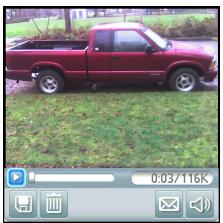

Plays the video, so you can review it.

Saves the video in the location you selected in step 2.

Deletes the video.

Opens a dialog box where you can select how you want to send the video: Messaging, Bluetooth, or Email. The receiving device must support the method you select and video messages.

Opens a dialog box where you can adjust the volume during playback.
TIP During playback, tap and drag the progress indicator bar to jump to a different section of the video. Select Pause to pause video playback.
Customizing your Camera settings
You can customize the built-in camera's settings for your Centro.
1 Press Applications and select Camera or Camcorder
2 Press Menu. If you are in Camera View, the Photo Settings screen appears. If you are in Camcorder View, the Video Settings screen appears.
3 Set any of the following preferences:
Effects: Sets the color palette for the current picture or video. You cannot change an item's palette after you take the picture or video.
Prompt sound: (Pictures only) Sets the sound that plays before you take the picture.
Shutter sound: Determines whether a sound plays when you take a picture.
Microphone: (Videos only) Turns the microphone on and off so that you can record videos with or without sound.
Resolution: Sets the default size for newly captured pictures or videos.
Date stamp: (Pictures only) Determines whether the date the picture is taken appears on your pictures.
Review photos/videos: Determines whether you can review pictures or videos before saving them and how quickly they are automatically saved.
Auto naming: Assigns a name to a series of pictures to be captured, such as Seattle001, Seattle002, and so on.
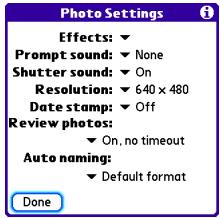
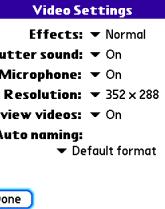
4 Select Done.
Pictures & Videos
Viewing a picture
In addition to viewing the pictures you capture with the built-in camera, you can view pictures captured on many popular digital cameras or downloaded from the Internet. Your Centro supports the following picture formats:
- JPG
TIF
BMP
GIF
1 Press Applications and select Pics&Videos
2 Select the album that contains the picture you want to see.
Tip To view an album from an expansion card, insert the card and select the album from the Album list. If the items on the card are not grouped into albums, select the card name from the list.
3 Select the picture you want to view.
4 Press Right or Left to scroll to the next item in the album.
DID YOU KNOW? To see the outer edges of a picture that may not be visible, use the stylus to tap and drag the picture in any direction.
5 If the picture has a voice caption, select to hear it.
6 Tap the picture or press Center to return to Thumbnail View.
TIP In Thumbnail View, you can group photos or videos to more easily locate them. Select one of the grouping options from the View menu.
Viewing a video
In addition to viewing the videos you capture with the built-in camcorder, you can view videos captured on many popular digital cameras. You can also play the audio portion of multimedia files. Your Centro supports the following types of video files:
3GP (with H.263 video and AMR audio)
3G2 (with MPEG-4 video and QCELP audio)
- MP4 (with MPEG-4/H.264 video and MP3/AAC/AAC+ audio)
MPG (with MPEG-1 video and MPEG-1 audio)
- M4V (with MPEG-4/H.264 video and MP3/AAC/AAC+ audio)
- ASF (with MPEG-4 video and IMA-ADPCM audio)
AVI (with MJPEG video and PCM audio)
1 Press Applications and select Pics&Videos
2 Select the album that contains the video you want to see.
3 Select the video you want to view. Playback begins automatically.
4 Hold down Right or Left to seek within the current video, or press Right or Left to scroll to the next item in the album.
5 Press Center to return to Thumbnail View.
DID YOU KNOW? If you pause video playback and then close the video, the video starts where you left off the next time you play it.
Viewing a slide show
1 Press Applications and select Pics&Videos
2 Select the album you want to view.
3 Press Menu, select Options, and then select Auto-hide Toolbar Off if you want to see the toolbar.
4 Press Space to start the slide show.
5 Press Center to return to the previous view.
Tip To set slide show options such as background music and transitions, open the Options menu and select Slideshow Setting. Keep in mind that background music overrides audio captions when you're running a slide show. Background music for a slide show also overrides any music that might be playing using the Pocket Tunes™ application on your Centro.
Sending pictures or videos
You can send pictures or videos to an email address or to other devices that support picture and video messaging.
1 From the Album list, select the album that contains the picture(s) or video(s) you want to send.
2 Select Send
3 Select the pictures or videos to send, or select Select All to send the entire album. (A plus sign [+ ] appears next to selected items.)
DID YOU KNOW? You cannot send copyrighted pictures or videos that appear with a Lock icon in Thumbsail View or in the Picture list.
4 Select Send.
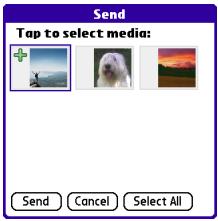
5 Select how you want to send the picture or video: Messaging, Bluetooth, or Email.
Copying a picture or video
You can copy pictures or videos into another album. You can also copy pictures and videos between your Centro and an expansion card.
1 From the Album list, select the album that contains the picture(s) or video(s) you want to copy.
2 Press Menu
3 Select Copy to from the Photo (or Video) menu.
4 Select the pictures or videos to copy, or select Select All to copy the entire
album. (A + appears next to selected items.)
5 Select Copy.
6 Select the Copy items to pick list and select whether you want to copy the selected items to your device or to an expansion card.
Indicates that a picture is selected
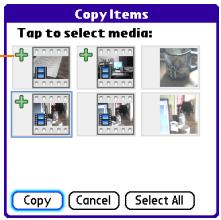
7 Select the Into album pick list and select the album you want to copy the selected items to.
8 Select Copy.
TIP You can also move pictures and videos between albums. Open the Photo (or Video) menu and select Move to. The remaining steps are the same as those for copying pictures, but use the Move commands instead of the Copy commands.
Organizing pictures and videos
1 Open the album you want to organize.
2 Press Menu
3 Select Album, and then select Add to album or Remove from album.
4 Select the pictures or videos to add or remove, or select Select All to add or remove the entire album. (A plus sign indicates that you want to add the item. An X indicates that you want to remove the item.)
5 Select Add or Remove.
DID YOU KNOW? You can also open the Album list from Camera View or Camcorder View by selecting the icon in the lower-left corner.
TIP Install the Palm Files application from the Palm Software Installation CD to easily browse and manage files on an expansion card.
Tip To change the name, add a caption, or view other picture or video information, highlight (or open) the item, open the Photo (or Video) menu, and select Details.
Saving a picture as wallpaper
You can select a picture to use as wallpaper for the Main tab in the Phone application.
1 Display the picture you want to save as wallpaper.
2 Press Menu
3 Select Options, and then select Save as Wallpaper.
4 When the confirmation message appears, confirm by selecting Yes, or decline by selecting No.
Adding a picture to a contact entry
1 Display the picture you want to add to a contact.
2 Press Menu
3 Select Options, and then select Save as Contact.
4 Select the contact you want to add this picture to.
Rotating a picture
1 Display the picture you want to rotate.
2 Press Menu
3 Select Rotate from the Photo menu.
4 Select the orientation.
Deleting a picture or video
1 Open the album that contains the picture(s) or video(s) you want to delete.
2 Press Menu
3 Select Delete from the Photo (or Video) menu.
4 Select the pictures or videos that you want to delete, or select Select All to delete the entire album. (An X appears next to selected items.)
5 Select Delete.
6 Select Delete to confirm the deletion.
Tip You can also highlight a picture or video in Thumbsail View, and then press Backspace to delete the highlighted item.
Viewing pictures and videos on your computer
When you synchronize your Centro, your pictures and videos are copied to your desktop computer. You can view pictures in JPG format and videos in MPEG-4 format (3G2 file extension). You can email them to
friends using your desktop email application.
BEFORE YOU BEGIN To use your computer to view and edit videos you captured on your Centro, you must first install QuickTime from the Palm Software Installation CD.
On a Windows computer, you can view and edit synchronized pictures and videos in the Palm Media desktop application. Open Palm Desktop software and click the Media icon. You can refer to the Palm Desktop Online Help for information about using the Palm Media desktop application.
Pocket Tunes™
You can listen to music through the speaker on the back of your Centro or through a stereo headset or headphones (stereo headphone adapter or 2.5mm stereo headphone or headset required, sold separately). To listen to music on your Centro, you need to convert the music files into MP3 format using Windows Media
Player (Windows computers) or iTunes (Mac computers), and then transfer the music files to your Centro or an expansion card. After you transfer the music files, you can play them using Pocket Tunes™ on your Centro.
DID YOU KNOW? If a call comes in when you're listening to music, you can take the call and the music pauses automatically. After you finish the call, the music starts again.
Setting up Windows Media Player for MP3
On a Windows computer, you need to set Windows Media Player to save your music files in MP3 format in order for the files to be compatible with Pocket Tunes.
1 Connect your Centro to your computer with the sync cable.
2 Press Applications and select iTunes
3 On your computer, open Windows Media Player, and then click the full-screen icon in the upper-right corner to maximize the window.
4 Click Tools, and then click Options.
5 Click the Rip Music tab, click the Format pick list, and then select mp3. Click OK.
6 Click Tools, and then click Options.
7 Click the Devices tab, select Palm Device from the Devices list, and then click Properties.
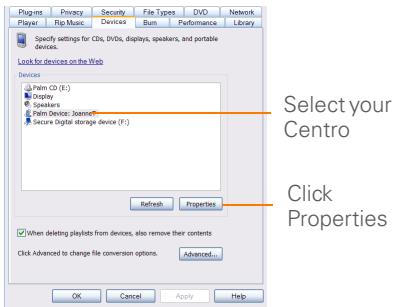
8 Click the Quality tab, uncheck the Convert files as required by this handheld (recommended) box. Click Apply.
9 Click OK.
You have now set up Windows Media Player to transfer MP3 files to the Pocket Tunes application on your Centro.
Setting up iTunes for MP3
On a Mac, use iTunes (included with OS X) to convert music from a CD to MP3 format. For more information on using the iTunes software, see the documentation that came with your Mac.
1 On your Mac, open iTunes.
2 Select Preferences.
3 Click the Advanced button at the top of the window, and then click Importing.
4 Click the Import Using pop-up menu and select MP3 Encoder.
5 Click the Setting pop-up menu and select Good Quality.
Tip Mac If you want greater control over the file size and sound quality of your MP3 files, select Custom from the Setting pop-up menu.
Transferring music files from your computer
If your MP3 files are already on your computer's hard drive, you just need to transfer them onto your Centro to listen to them with Pocket Tunes.
If an expansion card is inserted into the Centro, Windows Media Player copies the MP3 files to the expansion card. If you don't have an expansion card inserted, the MP3 files are copied to your Centro.
BEFORE YOU BEGIN On a Mac, you need a microSD expansion card (sold separately) to listen to music on your Centro. You cannot transfer MP3 files from your Mac directly onto your Centro.
1 Connect your Centro to your computer with the USB sync cable.
2 On your Centro, press Applications and select iTunes
3 If you are transferring MP3 files from a Mac, insert an expansion card into your Centro. This step is optional for Windows users.
4 Do one of the following: Windows: Open Windows Media Player on your computer. Select the Sync tab, and then select your Palm Device from the drop-down list, and select Start Sync.The files are transferred to your Centro.
NOTE Do not press the sync button on your cable. Windows Media Player transfers the files, so there's no need to do anything.
Mac: Drag and drop the MP3 files onto the Send To Handheld droplet in the Palm folder. Select your device name, the file name, and the destination (card). Click OK. Synchronize your Centro with your computer. Be patient; transferring music to an expansion card can take several minutes.

Tip You can also use a card reader accessory (sold separately) to transfer music files from your computer to your expansion card. Create a Music_Audio folder in the root directory of the card, and store your music files in this folder.
Transferring music from a CD to your Centro
If your songs are on a CD and you want to listen to them on your Centro, you need to convert them to MP3 format on your computer before you transfer the files to your Centro.
WINDOWS ONLY
1 On your computer, open Windows Media Player.
2 Insert the music CD into your computer's CD drive.
3 Select the Rip tab.
4 Select the tracks you want to convert to MP3.
5 Select Rip Music.
6 Transfer files to your Centro as described in Transferring music files from your computer.
MAC ONLY
1 On your Mac, open iTunes.
2 Insert the music CD into the CD drive on your Mac.
3 Check the boxes next to the tracks you want to convert to MP3.
4 Click the Import button in the upper-right corner of the iTunes window.
5 When the songs have been imported, click the Eject Disk button in the lower-right corner of the iTunes window.
6 Transfer the files to your Centro as described in Transferring music files from your computer.
Listening to music on your Centro
CAUTION Protect your hearing. Listening to this device at full volume for a long period of time can damage your hearing.
1 Make sure the Ringer switch is set to Sound On. See Silencing sounds for more information.
2 Press Applications and select iTunes
Tip You can change the settings on your Centro so that pressing and holding the Side button opens Pocket Tunes. See Reassigning buttons for details.
3 Use the 5-way to access any of the following icons:
Play: Plays or resumes playback of the current song.
Next song: Plays the next song.
Previous song: Plays the previous song.
Choose song: Displays a list of songs to choose from.
Pause: Pauses playback.
DID YOU KNOW? You can also press Space to pause and resume playback, as well as use the 5-way to navigate among songs or pause and resume playback.
NOTE To adjust the volume during playback, press the Volume button on the side of your Centro.
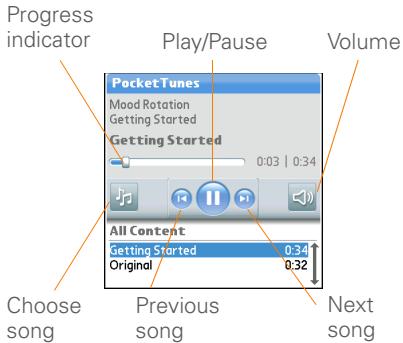
Pocket Tunes continues playing until it reaches the end of your list or until you select Pause Music continues to play even if you switch to another application or turn off your screen. If you want to stop playing music when you exit Pocket Tunes Deluxe, open the Background Defaults menu and uncheck the Enable background play box, and then select OK.
Creating a playlist
If you want to play a group of songs in a particular order, you can create a playlist.
1 Press Applications 和 and select pTunes
2 Press Menu
3 Select Actions, and then select Manage Playlists.
4 Select New, and then enter a name for the playlist.
5 Select Add Song. Select the songs you want to include on the playlist.
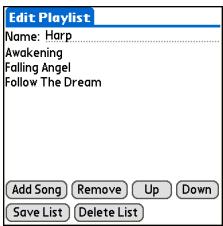
6 Select Save List.
TIP To play songs from a playlist, open Pocket Tunes, select Choose Songs, and then select Playlists. Select the playlist you want to play, and then select All.
Editing a playlist
1 Press Applications and select iTunes
2 Press Menu
3 Select Actions, and then select Manage Playlists.
4 Highlight a playlist, and then select Edit.
5 Do any of the following:
To delete a song from the playlist, select the song and then select Remove.
To add a song, select Add Song, select the songs you want to add, and then select OK.
- To move a song up or down one slot, select a song and then select Up or Down.
6 Select Save List.
Tip To delete a playlist, select Manage Playlists from the Actions menu, select the playlist, and then select Delete. Select Yes to confirm the deletion.
Your personal information organizer
Say good-bye to paper calendars and throw away those scribbled to-do lists. Your Palm® Centro™ smartphone is all you need to organize your personal information and keep it with you wherever you go.
You never lose your information, even if your battery is completely drained. All your personal info is backed up each time you synchronize, and your info is kept private when you use the security features on your Centro. Also, you can easily share info with others electronically.
Benefits
-
Track current, future, and past appointments
Make to-do lists that get done -
Set reminders for appointments, birthdays, important tasks, and more
Before you call your friend in London, check the time
In this chapter
Calendar 157
WorldClock 164
Tasks 166
Calendar
Calendar is a powerful organizer application that helps you manage your schedule. You can view your calendar by day, week, or month, or as an agenda list that combines your Tasks list and email notifications with your appointments. Schedule repeating meetings or a block of vacation time by creating an event that repeats at an interval you specify. Color-code your appointments by category and add notes with helpful information.
DID YOU KNOW? If your company uses Microsoft Exchange Server 2003, you may be able to wirelessly synchronize Calendar events directly with the server. See Working with Microsoft Exchange ActiveSync® for information.
Displaying your calendar
Press Calendar repeatedly to cycle through the various views:
Agenda View: Shows your daily schedule, the number of unread email messages, and any items on your Tasks list that are
overdue or due today. If there's room, Agenda View also lists events on future dates.
Day View: Shows your daily schedule one day at a time.
Week View: Shows your schedule for an entire week. The time frames are based on the Start Time and End Time settings in Calendar Preferences.
Month View: Shows your schedule for a whole month.
In most Calendar views, you can do the following:
-
Open the Options menu and select Year View to view a calendar for an entire year.
Use the 5-way to go to another day, week, month, or year—based on the current view. (Not available in Agenda View.) -
Select Go To, and then select a date from the calendar. (Not available in Agenda View.)
Creating an event
Tip If you have several appointments to enter, it's more efficient to use Palm® Desktop software or Microsoft Outlook on your computer and then synchronize your Centro with your computer. For more information, see Synchronizing information—the basics.
1 Press Calendar until Day View appears.
2 Select Go To and then select the desired day.
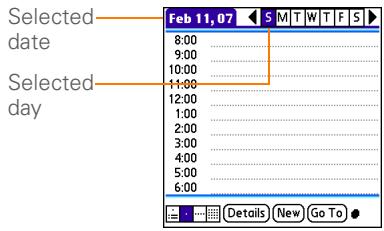
3 Select New.
4 Using the keyboard, enter a starting hour and minute for the event, such as 545 for 5:45.
5 Select the End Time box and enter the ending hour and minute for the event.
6 To assign a time zone to the event, select the Time Zone pick list and select a city in the time zone you want.
7 Select OK.
8 Enter a description for the event.
IMPORTANT If you use Palm Desktop software, do not add time zones to your events. Palm Desktop does not support time zones.
If you use Microsoft Outlook, you can use the time zone feature, but you must install the conduit that came with your Centro (or a subsequent update) on all the computers with which you sync your Centro. Chapura PocketMirror and other earlier Microsoft Outlook conduits do not support time zones.
Tip To automatically assign a time zone to your events, open the Options menu, select Preferences, and check the New events use time zones box. All your new events will be assigned to your local time zone (existing events aren't affected), and you can change the time zone setting for individual events.
Tip If you want your events with time zones to stay at the same time in Calendar, regardless of the time zone you are in, go to Date & Time Preferences, select the Automatically set pick list, and select Date and time. If you select Date, time and time zone, the event time shifts if you travel to a different time zone. See Setting the date and time for information.
Adding an alarm to an event
1 In Calendar, select the event.
2 Select Details.
3 Check the Alarm box and select the number of minutes, hours, or days before the event you would like to receive the alarm.
TIP The alarm for untimed events is defined by minutes, days, or hours before midnight of the date of the event.
4 Select OK.
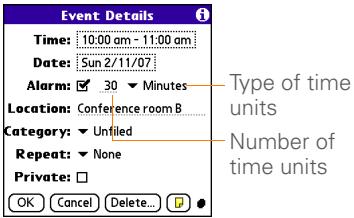
DID YOU KNOW? When an alarm occurs, the Alert dialog box displays all your pending alerts. Select an alert description to jump to that item, or check the box to clear that alert.
Creating an untimed event
An untimed event, such as a holiday or deadline, does not occur at a particular time.
1 Press Calendar until you are in Day View.
2 Press Left or Right to go to the date of the event.
3 Make sure no times are highlighted.
4 Enter a description for the event. A diamond appears next to the description of an untimed event.
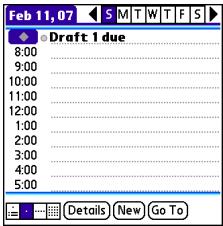
Scheduling a repeating event
Tip To enter a birthday or anniversary, add this info to the person's Contacts entry and it automatically appears in your Calendar.
Tip To enter a holiday, create an untimed event. Then, from the Details screen, select Every year as the repeat interval.
1 Create an event, and then select it.
2 Select Details.
3 Select the Repeat pick list, and then select a repeat interval. If the interval you need doesn't appear on the list,
select Other to define a custom interval.
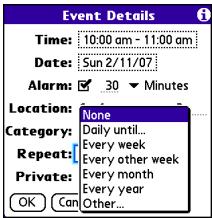
4 Select OK.
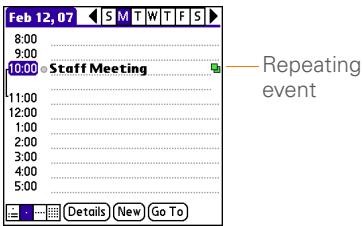
DID YOU KNOW? If you sync with Microsoft Outlook and your events include other people, a With field appears in the Details dialog box and your attendee info appears in this field after you sync.
Color-coding your schedule
Use color-coding to quickly spot various types of events. For example, make appointments with family green, co-workers blue, and friends red. Follow these steps to create a category and assign it a color code.
1 In Day View, select an event description or select an empty time slot.
2 Select Details.
3 Select the Category pick list and select Edit Categories.
4 Do one of the following:
- To create a new category, select New and then enter a category name.
- To add a color to an existing category, select a category and select Edit.
5 Select the color you want to give this category, and then select OK.
6 (Optional) Repeat steps 4 and 5 to add or edit more categories.
7 Select OK two more times.
Now that the categories are set up with colors, you can assign categories to your events to color-code them. See the next section for details.
Changing or deleting an event
1 Select the event you want to edit or delete.
2 Select Details.
3 In addition to the settings covered earlier in this chapter, you can also change any of the following settings:
Date and Time: Displays when the event takes place. Change these settings to reschedule the event.
Location: Provides a description of where the event takes place.
Category: Sets the color-coded category for this event.
Note: Provides space for you to enter additional text.
Delete: Removes the event from your calendar.
4 Select OK.
Tip To save memory, you can purge your old events. Open the Record menu and select Purge. Select the Delete events older than pick list and select a time frame. Select OK.
Customizing display options for your calendar
1 Press Menu
2 Select Options, and then select Display Options.
3 Select the Default View pick list and select the view you want to see when you open Calendar.
4 Select Agenda and set any of the following options:
Show Due Tasks: The tasks that are due today and the tasks that are overdue appear in Agenda View.
Show Messages: The number of read and unread email messages is displayed in Agenda View.
Background: A favorite photo becomes the Agenda View background. Check the Background box, select the image placeholder, and then select a photo. Adjust the fade setting so that the text is easy to read against the photo.
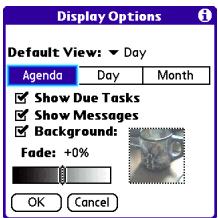
5 Select Day and set any of the following options:
Show Category List: The Category pick list appears in Day View.
Show Time Bars: The time bars appear in Day View to show the duration of an event and to illustrate event conflicts.
Compress Day View: When this box is unchecked, all time slots appear on the screen. When this box is checked, start and end times appear for each event, but blank time slots near the bottom of the screen disappear to minimize scrolling.
Show Category Column: The color-coded category marker appears between the time and the description to
indicate under which category the event is filed.
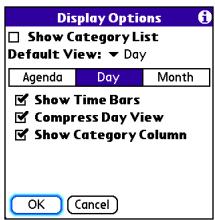
6 Select Month and set any of the following options:
Show Category List: The Category pick list appears in Month View.
Timed Events: The events that are scheduled for a specific time appear in Month View.
Untimed Events: The events that are scheduled for a specific date but not a specific time appear in Month View.
Daily Repeating Events: The events that repeat every day appear in Month View.
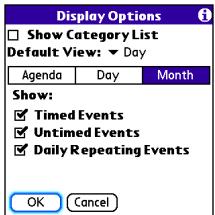
7 Select OK.
Tip You can customize your Centro to display the most current Calendar event in the Main tab in the Phone application. Press Phone, open the Options menu, and then select Phone Display Options. Check the Show Calendar event box.
Selecting alarm tones
1 Press Menu
2 Select Options, and then select Sound Preferences.
3 Select the Application pick list and select Calendar.
4 Select the Volume pick list and select the volume level.
5 Select the Vibrate pick list and select when you want your Centro to vibrate for an event alarm.
6 Select tones from any of the following pick lists:
Alarm Sound: The tone that plays the first time your alarm goes off.
Reminder Sound: The tone that plays if an alarm is not acknowledged and the alarm repeats itself.
Repeat: The number of times the alarm repeats itself if the alarm is not acknowledged.
Default Alarm: A default amount of time before the event for which the alarm goes off.
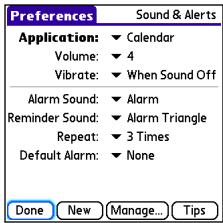
7 Select Done.
Tip You can also record sounds and use them as alarms. Select Manage on the Sound & Alerts Preferences screen.
To record a sound, select New.
- To play a sound, select it and press Center on the 5-way.
To delete a sound, select it and press Backspace.
To send a sound, select it and then select Send.
DID YOU KNOW? Your Centro includes a silent alarm that can vibrate even when the Ringer switch is set to Sound Off.
World Clock
World Clock displays the day and time in three cities anywhere around the globe. Whether you're traveling or staying home, it's easy to keep track of the best time to reach your business associates, friends, and family in faraway places.
Selecting cities
World Clock shows the system date and time above the world map. If you selected the option to get the date and time from the mobile network (see Setting the date and time), your network automatically updates the time display to match the local time when you travel.
TIP If you did not select the option to get the date and time from the mobile network, you can set the city at the top of the screen to a fixed location.
Below the world map, you can view the time in two other cities.
Tip If you travel a lot, you may want to select your home city as one of these two cities, so that you always know what time it is at home.
1 Press Applications and select World Clock
2 Select a City pick list, and select a city in the same time zone.
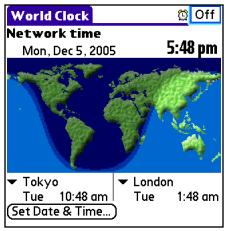
DID YOU KNOW? You can run your stylus over the map to see the time in other cities. The shadow over the map represents nighttime moving across the globe.
Tip World Clock does not automatically update the system time for daylight-saving time. To change the Daylight Savings Time setting, see Setting the date and time.
Adding cities
If the city you want to display is not in the predefined list, you can add it.
1 Select a City pick list and select Edit List.
2 Select Add.
3 Select a location in the same time zone as the city you want to add, and then select OK.
4 Enter the name of the city.
5 Select Location, select Map, select the location of the city, and then select OK.
6 If the city is not on daylight-saving time, uncheck this box. If daylight-saving time is observed, enter Start and End dates.
7 Select OK, and then select Done.
Setting an alarm
The next time you travel, don't rely on a hotel alarm clock to get you to that important meeting. Use your Centro instead. World Clock includes a built-in alarm feature that you can use as a travel alarm.
1 Select Off in the upper-right corner.
2 Select the time you want the alarm to sound.
3 Select OK.
Tip To customize the alarm sound and volume, open the Options menu and select Alarm Preferences.
TIP Make sure the Ringer switch is set to Sound On, so that you can hear the alarm.
Tasks
You can use Tasks to remind you of tasks you need to complete and to keep a record of when you finish tasks.
Adding a task
1 Press Applications and select Tasks
2 Select New to create a new task.
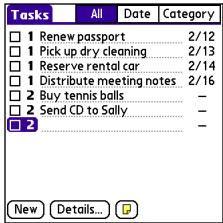
3 Enter a description of the task. The text can be longer than one line.
Setting task priority, due date, and other details
The Details dialog box enables you to assign a priority level, due date, category, privacy flag, and other details for each task.
1 Select the task to which you want to assign details.
2 Select Details.
3 Set any of the following:
Priority: Select the priority number for this task (1 is the most important). Later you can arrange your tasks based on the importance of each task.
TIP You can also select the priority from the Tasks list by selecting the number next to a task and then selecting a priority level.
Category: Assign the task to a specific category.
Due Date: Select the Due Date pick list and select a due date for the task.
Tip If you turn on the Show Due Dates option in the Tasks Preferences screen, you can select the due date in the Tasks list to set a new date.
Alarm: Set an alarm for this task.
Repeat: Indicate whether the task occurs at regular intervals and how often it repeats. When you check off a
repeating task, the next instance of this task automatically appears in your task list.
Private: Check this box to mark this task private. See Working with private entries for additional information.
: Select this button to enter additional text that you want to associate with the task.
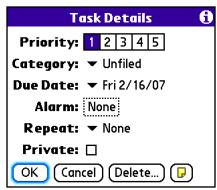
4 Select OK.
Tip Press Menu to access other features such as importing phone numbers into the Tasks list.
Checking off a task
1 Select the task you want to check off.
2 Press Center or tap in the box to check off the task.
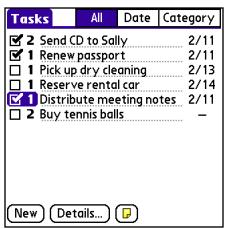
Tip If you accidentally check off a task and need to uncheck it, highlight the task again and press Center on the 5-way to uncheck it.
TIP You can set Tasks to record the date that you completed a task, and you can select to show or hide completed tasks. Completed tasks remain in the memory of your Centro until you purge them.
DID YOU KNOW? Overdue tasks have an exclamation point (!) next to the due date.
Organizing your tasks
In the Tasks list, select one of these options:
All: Displays all your tasks.
Date: Displays tasks that are due in a specific time frame. With Date selected, press Down to select the pick list, and then press Center to see the various options: Due Today, Last 7 Days, Next 7 Days, or Past Due.
Category: Displays tasks that are assigned to the selected category. Select the Category pick list to select a different category.
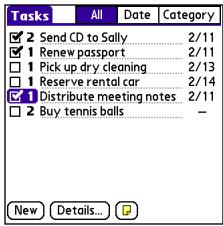
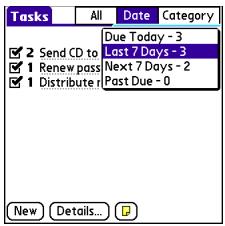
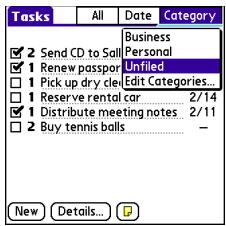
Deleting a task
1 Select the task you want to delete.
2 Press Menu
3 Select Delete Task from the Record menu.
4 Select OK.
Tip To save memory, you can purge all completed tasks. Open the Record menu and select Purge. Select OK.
Customizing Tasks
The Tasks Preferences screen enables you to control the appearance of the Tasks list screen.
1 In the Tasks list screen, press
Menu
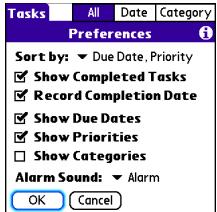
2 Select Options, and then select Preferences.
3 Set any of the following preferences:
Sort by: Indicates the order in which your tasks appear in the list.
Show Completed Tasks: Displays tasks you've checked off.
Record Completion Date: Replaces the due date with the completion date when you complete (check off) the task.
Show Due Dates: Displays task due dates and inserts an exclamation point (!) next to overdue tasks.
Show Priorities: Displays the priority setting for each task.
Show Categories: Displays the category for each task.
Alarm Sound: Sets the sound for the alarms you assign to your tasks.
4 Select OK.
DID YOU KNOW? You can display your tasks in your calendar. See Customizing display options for your calendar for details.
Your memos and documents
With its ability to store large amounts of important information, your Palm® Centro™ smartphone lets you take your office with you—including your Microsoft Office and PDF files. You can keep updated copies of the files on both your Centro and your computer so that you can work on them in the most convenient location any time.
Leave your note pad and voice recorder at home. Use Memos to type notes. Use Voice Memo to record notes, agenda items, and other important thoughts, and play them back, right on your Centro. You can even send your notes and voice memos to a friend or colleague by attaching them to an email or multimedia message.
Benefits
- Manage Word, Excel®, PowerPoint, and PDF files on your Centro
-
Improve productivity by taking important docs, spreadsheets, and presentations with you
-
Capture thoughts on the fly
In this chapter
Documents To Go® Professional 173
Memos. 174
Voice Memo. 175
Documents To Go® Professional
NOTE The Palm Software Installation CD includes the Documents To Go® desktop software. On your Centro, the companion for Documents To Go is named Documents and it's already installed on your Centro.
With the Documents application, you can take your important office info with you. You can carry, create, view, and edit Microsoft Word and Excel files directly on your Centro. You can also view, carry, and manage PowerPoint and PDF files. For example, you can open email attachments, files you download with the web browser, and files stored on an expansion card—as long as the files are in a supported format.
NOTE The version of Documents To Go that comes with your Centro supports viewing of Microsoft Office 2007 documents. To edit Office 2007 files on your Centro, you must save the files in Office 2003 format. For information about an upgrade that supports Office 2007, go to
dataviz.com/office2007 (additional fees may apply).
If you install the Documents To Go desktop software (from the Palm Software Installation CD), you can use Documents To Go to transfer files from your computer to your Centro when you synchronize.
Here are a few more examples of what you can do with Documents:
- Send and receive email attachments in Word, Excel, PowerPoint, and Acrobat file formats (DOC, XLS, PPT, and PDF).
View Word, Excel, PowerPoint, and Acrobat files (DOC, XLS, PPT, and PDF).
Create or edit a Word-compatible document or Excel-compatible spreadsheet on your Centro, and then save it in the native DOC or XLS format. - Create a PowerPoint presentation on your computer, use the Documents To Go desktop application to optimize the file for your Centro, and then sync the file onto your Centro to view it on the go.
NOTE The Documents application does not support some editing functions, such as multiple font sizes and spell checking.
Tip For more info on the Documents application on your Centro, go to dataviz.com. If you installed the desktop application from the Palm Software Installation CD, you can also click the Documents To Go icon on your computer, and then click Help.
Tip Install the Files application from the Palm Software Installation CD to easily browse and manage files on an expansion card.
Opening a document
In the Documents application, you can view and open any Word, Excel, PowerPoint, or Acrobat (PDF) file on your Centro or on an expansion card that is inserted into the expansion slot.
1 Press Applications and select Documents
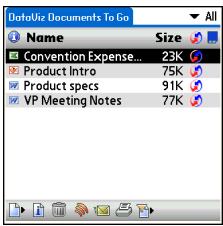
2 Select the document you want from the list.
Tip When you work on a file on your Centro, you can save it to your Centro or to an expansion card. Open the File menu, select Save As, and then select the location where you want to save the file.
Memo No. 10
Memos are a great way to store notes on your Centro.
DID YOU KNOW? Each memo can include 4,096 characters of text.
Creating a memo
1 Press Applications and select Memos
2 Enter the text you want to appear in the memo.
3 Select Done.
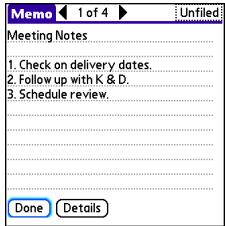
Tip You can assign categories to your memos. Open the memo you want to change, select the category pick list at the top of the screen, and select a category.
Deleting a memo
1 Open the memo you want to delete.
2 Press Menu
3 Select Delete Memo from the Record menu.
4 Select OK.
Voice Memo
Voice Memo provides a place for you to record and play back notes and other important thoughts directly on your Centro.
Creating a voice memo
When recording a voice memo, hold your Centro with the screen facing you while you're speaking.
1 Press and hold the Side button on your Centro while recording your memo.
After you finish recording, release the Side button.
The memo is automatically saved to your Centro.
2 (Optional) Enter a title for the memo.
Tip You can also access Voice Memo by pressing Applications and selecting Voice Memo.
Tip If you need to pause while recording, press and hold Center on the 5-way. Release the button to resume recording.
DID YOU KNOW? You can use a voice memo as a ringtone. Highlight the voice memo in the list, open the Voice Memo menu, and then select Copy to Ringtone.
Listening to a voice memo
1 Press Applications and select Voice Memo
2 In the Voice Memo list, navigate to the voice memo title and then press Center to select it. The voice memo begins to play.
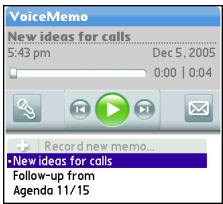
3 Press Center to pause or stop playback.
Tip To adjust the volume level, press the Volume button on the side of your Centro.
Tip To change a voice memo title, open the Voice Memo menu and select Rename Memo.
DID YOU KNOW? You can send a voice memo in an email or MMS message (see the documentation for your email application, or Creating and sending a multimedia message). You can also use Bluetooth® wireless technology to send a voice memo to a nearby Bluetooth device (see Sending info over a Bluetooth wireless connection).
Your application and info management tools
Synchronization is a great way to transfer, update, and back up info on your Palm® Centro™ smartphone. Synchronizing simply means that info you entered or updated in one place (your Centro or your computer) is automatically updated in the other. There's no need to enter info twice.
Expansion cards (sold separately) provide a compact and limitless storage solution. When one card becomes full, simply use another card to carry your extra music and video clips and to install and run games and other software, from dictionaries to travel guides.
Benefits
-
Locate info in your applications with the Find feature
Install applications, games, and other software -
Quickly enter, update, and protect your info on your computer and your Centro
- Store, carry, and exchange info
In this chapter
Using Find 179
Viewing and using the alerts 179
180
Installing applications 182
Removing applications 184
Viewing application info 186
Sending information with Bluetooth® wireless technology. 186
Beaming information 189
Synchronizing information—advanced 191
Using expansion cards 197
Using Find
The Find feature locates any text in the built-in applications and databases and in some third-party applications. The Find feature searches for the group of characters you specify, including characters that are part of a word. Find is not case-sensitive.
DID YOU KNOW? Find locates any word that begins with the text you enter. For example, entering "plane" finds "planet" but not "airplane."
1 Press Option, and then press Shift/ Find to open the Find dialog box.
2 Enter the text you want to find.
3 Select OK to start the search.
4 In the search results, select the text you want to review, or select Find More to continue the search.
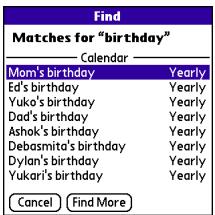
Viewing and using the alerts
The Alert dialog box on your Centro shows info about incoming items, such as new messages and Calendar events. An alert also notifies you when you miss a phone call.
To view the Alert dialog box, tap the blinking bell with your stylus when it appears in the upper-left corner of any screen, or press and hold Center when the blinking bell appears.
In the Alert dialog box, you can do any of the following:
- Check the box next to the alert to remove it from the list.
- Select the alert to open the corresponding application and view the alert item (message, event, missed call, and so on).
- Select Done to close the Alert dialog box. The alert remains active and the bell continues to blink in the upper-left corner of the screen.
- Select Clear All to delete all alerts in the Alert dialog box.
Calculator
Calculator includes a basic calculator, plus an advanced calculator with scientific, financial, and conversion functions.
Switching between Basic and Advanced Calculator Modes
1 Press Applications and select Calc
2 Press Menu
3 Select Options, and then select Advanced Mode or Basic Mode.
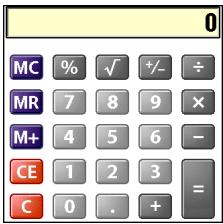
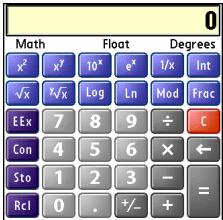
Tip In Basic Mode, you can also press Right on the 5-way to switch to Advanced Mode. In Advanced Mode, press Right on the 5-way to cycle between functions, and press Left on the 5-way to return to Basic Mode.
DID YOU KNOW? You can tap the onscreen number pad or use the keyboard to input numbers.
Selecting functions in Advanced Calculator Mode
1 Switch to Advanced Mode (see the preceding procedure).
2 Press Menu 5v .
3 Select Options, and then select the type of function you want to use:
Math: Advanced mathematical functions such as exponents, roots, and logarithms.
Trig: Trigonometric functions such as sine, cosine, tangent, and variants.
Finance: Financial calculator functions such as APR and amortization.
Logic:Hexadecimal characters in keypad,plus logic functions such as And,Not,Or,andXor.
Statistics: Statistical functions such as sum, factorial, and random number generator.
Weight/Tmp: Weight and temperature conversions for metric and English values.
Length: Length conversions for metric and English values.
Area: Area conversions for metric, traditional, and English values.
Volume: Volume conversions for metric and English values.
4 Press Menu
5 Select Pref, and then select the decimal display format: Float, Fixed(x), Sci(x), or Eng(x).
6 Press Menu
7 Select Pref, and then select the number display format: Degrees, Radians, or Grads.
Tip Select Sto to store a number in one of ten memory slots. Select Rcl to recall a stored number.
Tip Select Con to access a list of mathematical constants such as Avogadro's number or the speed of light.
Installing applications
Your Centro comes with several built-in and ready-to-use applications. You can also install additional applications, such as business software, games, and more. The Palm Software Installation CD includes several bonus software apps, and you can purchase other third-party Palm OS® by ACCESS apps as well.
NOTE The instructions in this section tell you how to install basic PRC (Palm OS application) and PDB (Palm OS database) files on your Centro. Some Palm OS software uses an installer or wizard to guide you through the process. For details, consult the documentation that came with the software.
Installing bonus software from My Centro on your device
My Centro lets you download and install software that you can use on your Centro. If the software has a desktop component in addition to a Centro component, you need to download the software to your computer first. See Installing bonus
software from My Palm on your computer for info on installing software that includes a desktop component.
1 Press Applications and select My Centro
2 Select the Bonus tab.
3 Select the Install link below the name of the application you want to install.
Repeat step 3 to install additional applications.
Installing applications from the Internet
You can use the web browser on your Centro to install Palm OS files (PRC or PDB) directly from the Internet. When you download a PRC or PDB file, it is automatically installed on your Centro. If a file is compressed (for example, as a ZIP or SIT file), you need to download it to your computer, expand the file, and then synchronize to transfer the expanded file to your Centro.
NOTE Make sure the application you download is compatible with your device.
1 Open the web browser (see Viewing a web page).
2 Go to the page that contains the link to the application you want to download.
3 Press Left or Right to highlight the link to the file, and then press Center to initiate the download process.
4 Follow the onscreen instructions to accept and install the application.
Installing bonus software from My Palm on your computer
1 On your computer, go to go.palm.com/ centro-gsm/.
2 Follow the onscreen instructions to download the application(s) you want to install.
3 When prompted to select either Save or Run, select Run to place the application(s) in the install queue.
4 Synchronize your Centro with your computer to install the application(s) on your Centro.
Installing other third-party applications from a computer
When you download an application to your computer, it is probably in a compressed format such as a ZIP or SIT file. If the file is compressed, you need to use a decompression utility on your computer, such as WinZip or Allume Stufffit Expander, before you install the application on your Centro.
BEFORE YOU BEGIN To install an app from your computer to your Centro, you must first install Palm® Desktop software on your computer (see Installing the desktop synchronization software).
1 Windows: Select Start > Programs > Palm > Install Tool, and then select Add to browse to the application you want to add.
Mac: Drag and drop the file(s) onto the Send To Device droplet in the Palm folder.

2 Select your device name from the User list, and then click OK.
3 Synchronize your Centro with your computer to install the application(s) on your Centro.
Installing third-party applications from a computer to an expansion card
You can install an application to an expansion card rather than to your Centro.
Windows:
1 Select Start > Programs > Palm > Install Tool.
2 Select your device name from the User list.
3 Select Add and browse to the application you want to add.
4 Select Change Destination and select the expansion card.
5 Select OK.
6 Synchronize your Centro with your computer to install the application(s) on your Centro.
Mac:
1 In the menu for Palm Desktop software, click HotSync.
2 Select Install Handheld files, and then select expansion card as the file's destination.
Getting help with third-party applications
If you encounter a problem (such as an error message) with a third-party application, contact the application's author or vendor. For general troubleshooting of third-party applications, see Third-party applications.
Removing applications
If you decide that you no longer need an application, or you want to free up memory, you can remove apps from your Centro or an expansion card (for more on expansion cards, see Inserting an expansion card). You can remove only apps, patches, and extensions that you
install; you cannot remove the built-in apps that reside in the ROM portion of your Centro.
DID YOU KNOW? Some applications are factory installed on your Centro and cannot be deleted. These are listed with a Lock icon next to them.
DID YOU KNOW? Applications deleted from your Centro are kept on your computer in the Archive folder of your user folder. If you have trouble locating your user folder, see I can't find my user folder.
1 Press Applications
2 If you want to remove an application from an expansion card, insert the card into your Centro.
3 Press Menu
4 Select Delete on the App menu.
5 Select the Delete From pick list and select the location of the application you want to remove: Phone or
6 Select the application that you want to remove.
7 Select Delete, and then select Yes to confirm deletion.
8 Synchronize to remove the application from the Backup subfolder on your computer.
Manually deleting applications
If an app you delete reappears on your Centro, you may need to manually delete the app from your computer.
1 Locate your Backup subfolder on your computer.
Windows: C:\Program
Files\Palm\
Mac: Mac
HD\Applications\Palm\Users
If you upgraded from a previous version of Palm Desktop, your Backup subfolder may be located in the palmOne or Handspring folder.
2 If you find a PRC or PDB file for the application you just removed, delete the file from the Backup subfolder.
3 Delete the file from your device again.
Viewing application info
The Info screens display basic statistics about the applications on your Centro.
1 Press Applications
2 Press Menu
3 Select Info on the App menu.
4 Select the Device pick list and select the location of the app you want to view info for: Phone or
5 At the bottom of the screen, select the type of information you want to view:
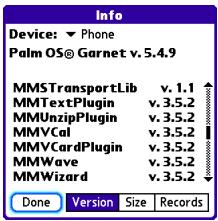
Version: The version numbers of applications on your Centro.
Size: The size (in kilobytes) of applications and information on your Centro.
Records: The number of entries in various applications on your Centro.
6 Scroll to the application you want to see info about.
7 Select Done.
Sending information with Bluetooth® wireless technology
The range of Bluetooth® wireless technology is up to 30 feet in optimum environmental conditions. Performance and range may be affected by physical obstacles, radio interference from nearby electronic equipment, and other factors.
TIP Check your battery level before establishing a Bluetooth wireless connection. If the battery level is very low, you can't make a Bluetooth wireless connection.
Sending info over a Bluetooth wireless connection
In most applications, you can send an individual entry or item such as a contact or a picture. You can also send all the entries in a category, such as all contacts in the Business category.
1 Press Applications and select Bluetooth
2 Select Bluetooth On.
3 Open an application.
4 Select the entry or category you want to send. You cannot send an item that has a lock next to it.
5 Press Menu
6 Select Send from the leftmost menu.
7 Select Bluetooth, and then select OK.
8 Select the receiving device(s) from the Discovery Results list, and then select OK.
9 Wait for a message to indicate that the transfer is complete before you continue using your Centro.
Sending an app over a Bluetooth wireless connection
1 Press Applications and select Bluetooth
2 Select Bluetooth On.
3 Press Applications
4 Press Menu
5 Select Send from the App menu.
6 Select the Send From pick list and select the location of the app you want to send: Phone or
7 Select the application you want to transfer. You cannot send an item that has a lock next to it.
8 Select Send.
9 Select Bluetooth, and then select OK.
10 Select the receiving device(s) from the Discovery Results list, and then select OK.
11 Wait for a message to indicate that the transfer is complete before you continue using your Centro.
Receiving info over a Bluetooth wireless connection
1 Press Applications and select Bluetooth
2 Select Bluetooth On.
3 Select the Visibility pick list and select one of the following:
Visible: Enables Bluetooth devices that are not on your Trusted Devices list to request a connection with your Centro. Your Centro remains accessible to other devices until you turn this option off. After you've finished using this setting, remember to change it back to Hidden.
Temporary: Enables Bluetooth devices that are not on your Trusted Devices list to request a connection with your Centro during the next two minutes. Your Centro reverts to the Hidden setting and becomes inaccessible to other devices after two minutes.
4 Use the other device to discover your Centro and send information to it:
- See the other device's documentation to learn how to discover and send information over a Bluetooth wireless connection.
- If the Ringer switch is set to Sound On, your Centro beeps to notify you of the connection and then prompts you to accept the info. Select a category or expansion card to file the item(s). If you don't select a category, the item(s) goes into the Unfiled category.
5 Select Yes to receive the information or No to refuse it.
Tip The Device Name in the Bluetooth app is the name other devices with Bluetooth wireless technology see when they connect to your Centro. The default name is the name you gave your device during setup. You can change this name if you want to.
DID YOU KNOW? When you receive an application over a Bluetooth connection, you can store the application on your Centro or send it to an expansion card inserted into the expansion card slot.
Beaming information
Your Centro is equipped with an IR (infrared) port so that you can beam information to another device with an IR port—provided the other device supports IR communications with Palm OS devices. The IR port is located on the side of your Centro, next to the expansion card slot, behind the small dark shield.
Tip For best results, the path between the two devices must be clear of obstacles, and both devices must be stationary. If you have difficulty beaming, shorten the distance and avoid bright sunlight.
Beaming an entry
You can beam an individual entry or item such as a contact or a picture. You can also beam all the entries in the selected category, such as all the contacts in the Business or Family category.
TIP Once you set up your business card, you can beam it in two key presses: From the Main tab in the Phone application, press Menu, and then press M.
1 Open the application that holds the entry you want to beam.
2 Select the entry or category you want to beam. You cannot beam an item that has a lock icon next to it.
3 Press Menu
4 Select Record, and then select one of the following:
Beam: Sends an individual record.
Beam Category: Sends all entries in the current category.
DID YOU KNOW? If you beam a bookmark or saved page from the web browser, it beams the URL, not the contents of that page.
5 When the Beam Status dialog box appears, point the IR port on your Centro directly at the IR port of the receiving device.
6 Wait for the Beam Status dialog box to indicate that the transfer is complete before you continue using your Centro.
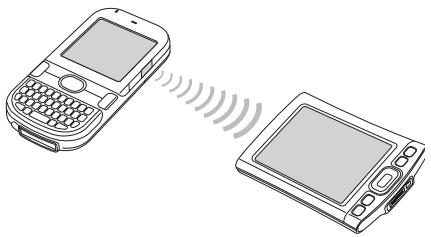
Beaming an application
Not all applications can be beamed. A lock icon appears on the Beam screen next to applications that cannot be beamed.
1 Press Applications
2 Press Menu
3 Select Beam from the App menu.
4 Select the Beam From pick list and select the location of the application you want to beam: Phone or
5 Select the application you want to transfer.
6 Select Beam.
7 When the Beam Status dialog box appears, point the IR port on your
Centro directly at the IR port of the receiving device.
8 Wait for the Beam Status dialog box to indicate that the transfer is complete before you continue using your Centro.
Receiving beamed information
BEFORE YOU BEGIN Make sure that the Beam Receive option in Power Preferences is set to On. See Optimizing power settings for details.
1 Turn on your screen.
2 Select the beam command on the transmitting device.
3 Point the IR port on your Centro directly at the IR port of the transmitting device to open the Beam Status dialog box.
4 When the Beam Status dialog box appears, select a category for the entry.
5 Select Yes to receive the information or No to refuse it.
Tip If you do not select a category when you receive a beamed item, the item is placed in the Unfiled category.
Tip If you can't receive beamed info, make sure that you are not running a third-party app that disables beaming. If you still can't receive a beam, try a soft reset (see Resetting your Centro).
DID YOU KNOW? You can store a beamed app on your Centro or send it to an expansion card inserted into the expansion card slot.
Synchronizing information—advanced
Changing which applications sync
By default, information from Calendar, Contacts, Memos, Pictures & Videos, and Tasks is updated each time you synchronize your Centro. You can change which applications synchronize. For example, if you don't use the Memos application and you want to speed up
synchronization, you can turn off synchronization for Memos.
Tip Windows If you set up your Centro to sync with Outlook, you can learn how to change which applications synchronize and change their synchronization settings by doing the following: Click the HotSync manager icon in the taskbar and select Custom. Select a conduit that syncs with Outlook, click Change, and then click Help.
WINDOWS ONLY
1 Click HotSync® manager in the taskbar in the lower-right corner of your screen.
2 Select Custom.
3 Select your device name from the User list at the top of the screen.
4 Select the application for which you want to turn synchronization on or off, and then click Change.
5 Select Synchronize the files to turn on synchronization for an app.
Select Do nothing to turn off synchronization for an app that currently synchronizes (for example, to turn off
synchronization for Memos if you do not use this app).
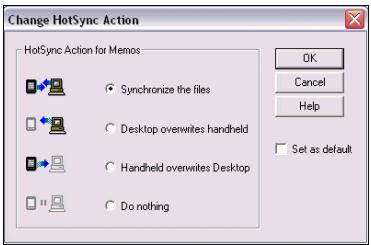
NOTE If you want the information in one location (on your Centro or on your computer) to completely replace the information in the other location for that app, select one of the two overwrite options. For example, if the Calendar info on your Centro is accurate but the info on your computer has become corrupted, select Handheld overwrites Desktop for the Calendar app to have your Centro info replace your computer info. Note that "handheld" refers to your Centro and "desktop" refers to your computer.
6 (Optional) If you want to make this change permanent, check the Set as default box. Otherwise, your change affects only one synchronization (the next one you do); thereafter, the synchronization action reverts to what it was before the change.
7 Click OK.
8 (Optional) To turn synchronization on or off for other apps, repeat steps 4, 5, 6, and 7 for each application you want to change.
9 Click Done.
MAC ONLY
1 Double-click the Palm Desktop icon in the Palm folder.
2 From the HotSync menu, select Conduit Settings.
3 From the User pop-up menu, select your device name.
4 Select the application for which you want to turn synchronization on or off, and then click Conduit Settings.
5 Select Synchronize the files to turn on synchronization for an app.
Select Do nothing to turn off synchronization for an app that currently synchronizes (for example, to turn off synchronization for Memos if you do not use this app).
HotSync action for: Photos

Synchronize the files

Macintosh overwrites handheld

Handheld overwrites Macintosh

Do Nothing
Default setting: Synchronize the files

Make Default
Cancel
OK
NOTE If you want the information in one location (Centro or computer) to completely replace the information in the other location for that app, select one of the two overwrite options. For example, if the Calendar info on your Centro is accurate but the info on your Mac has become corrupted, select Handheld overwrites Macintosh for the Calendar app to have your Centro info replace the info on your Mac. Note that "handheld" refers to your Centro.
6 (Optional) If you want to make this change permanent, click Make Default. Otherwise, your change affects only one synchronization (the next one you do); thereafter, the synchronization action reverts to what it was before the change.
7 Click OK.
8 (Optional) To turn synchronization on or off for other apps, repeat steps 4, 5, 6, and 7 for each application you want to change.
9 Close the Conduit Settings window.
Setting up a Bluetooth connection for synchronization
If your computer is enabled with Bluetooth wireless technology, you can synchronize wirelessly over a Bluetooth connection.
1 Press Applications and select Bluetooth
2 Select Bluetooth On.
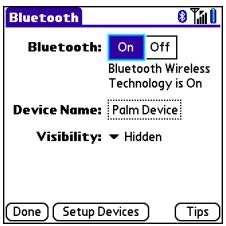
3 (Optional) Enter a device name that identifies your Centro when it is discovered by other Bluetooth devices.
TIP The device name you enter is the name other devices with Bluetooth wireless technology see when they connect to your Centro. The default name is the name you gave your device during setup. You can change this name if you want to.
NOTE Use the same device name for all your Bluetooth connections. If you change the device name, you need to re-create any partnerships you have already created.
4 Select the Visibility pick list and select Visible or Temporary.
Tip After you form a partnership with a device, you can change the Visibility setting back to Hidden. That way only devices with which you've already formed a partnership can find your Centro. New devices cannot request a connection.
5 Select Setup Devices.
6 Select HotSync Setup.
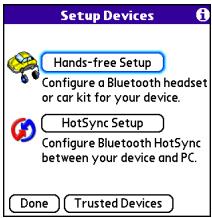
7 Follow the onscreen instructions to create a partnership between your Centro and your computer. In some cases you may need to perform setup steps on your computer before you can complete this step. Check your computer's documentation for specific setup instructions.
8 After you finish the HotSync setup, select Done to return to Applications View.
You're now ready to sync your Centro with your Bluetooth computer.
Synchronizing over a Bluetooth connection
When you synchronize using the Bluetooth wireless feature on your Centro, you don't need your sync cable. This is especially useful if you travel with a laptop enabled with Bluetooth wireless technology.
BEFORE YOU BEGIN Verify the following on your computer:
It includes built-in Bluetooth wireless technology or a Bluetooth adapter.
- Bluetooth is turned on.
- HotSync manager is active. On a Windows computer, you know HotSync manager is active when its icon appears in the lower-right corner of your screen.
9 Press Applications and select HotSync
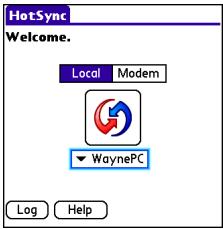
10 Select Local.
11 Select the pick list below the HotSync icon, and then select the name of the PC you set up for Bluetooth synchronization (see Setting up a Bluetooth connection for synchronization).
12 Select the HotSync icon on your Centro.
When synchronization is complete, a message appears at the top of your Centro screen. Be patient; synchronization may take a few minutes.
Synchronizing over an infrared connection
When you synchronize using the IR port on your Centro, you don't need your sync cable. This is especially useful if you travel with an IR-enabled laptop.
BEFORE YOU BEGIN Verify the following on your computer:
- It has an enabled IR port or an IR device attached to it. Check your computer's documentation to see if it supports IR communication.
- HotSync manager is active. On a Windows computer, you know HotSync manager is active when its icon appears in the lower-right corner of your screen.
WINDOWS ONLY
1 On your computer, click HotSync manager in the taskbar in the lower-right corner of your screen. Make sure that Infrared is selected.
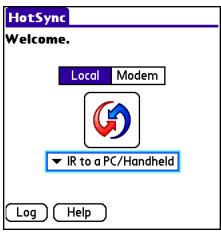
2 On your Centro, press Applications and select HotSync
3 Select Local.
4 Select the pick list below the HotSync icon and select IR to a PC/Handheld.
5 Position the IR port on your Centro within a few inches of your computer's IR port.
6 Select the HotSync icon on your Centro.
When synchronization is complete, a message appears at the top of your Centro screen. Be patient; synchronization may take a few minutes.
MAC ONLY
1 Double-click the HotSync manager icon in the Palm folder.
2 Click the HotSync Controls tab, and then select Enabled.
3 Click the Connection Settings tab, and then check the On box next to IR port.
4 Close the HotSync Software Setup window.
5 On your Centro, press Applications and select HotSync
6 Select Local.
7 Select the pick list below the HotSync icon and select IR to a PC/Handheld.
8 Position the IR port on your Centro within a few inches of your Mac's IR port.
9 Select the HotSync icon on your Centro.
When synchronization is complete, a message appears at the top of your Centro screen. Be patient; synchronization may take a few minutes.
Using expansion cards
The expansion card slot on your Centro enables you to add microSD cards to extend the storage capacity of your Centro (expansion cards sold separately). Here are some examples of what microSD expansion cards can store:
Photos
MP3 audio files
- Email attachments
Games
- eBooks
Microsoft Office files
Adobe Acrobat files
Applications
Databases
Inserting an expansion card
1 Remove the battery door.
2 Open the expansion slot door.
3 Hold your Centro with the screen facing you, and hold the card with the label
facing you. The notch on the card should be in the lower corner.
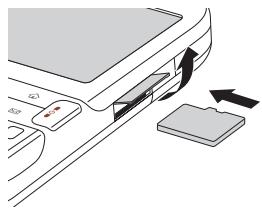
4 Insert the card into the expansion card slot until you feel it lock into place.
TIP The expansion card slot has a push-push mechanism: push in gently to insert a card; push in gently to remove it.
Tip If the Ringer switch is set to Sound On, you hear a confirmation tone when you insert or remove an expansion card.
5 Close the expansion slot door.
6 Replace the battery door.
Removing an expansion card
1 Remove the battery door.
2 Open the expansion slot door.
3 Press the card into the expansion slot to release it from the expansion slot.
4 After you feel the expansion card slot eject the card, remove the card from the slot.
5 Close the expansion slot door.
6 Replace the battery door.
Opening applications on an expansion card
After you insert an expansion card into the expansion card slot, you can open any of the applications stored on the expansion card.
1 Insert the expansion card into the expansion card slot. The Card category of Applications View automatically appears.
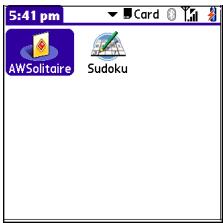
2 Select the icon for the application you want to open.
3 Press Center to open the application.
TIP Install the Files application from the Palm Software Installation CD to easily browse and manage files on an expansion card.
Accessing items stored on an expansion card
When an expansion card contains items such as pictures or songs, you can't view them directly from the Card category in Applications View. You must open the app that recognizes the item.
1 Insert the expansion card into the expansion card slot. The Card category of Applications View automatically appears.
2 Select the category pick list in the title bar, and select All.
3 Select the icon for the application in which you want to open the item. For example, to view a picture, select Pics&Videos.
Copying applications between an expansion card and your Centro
You can copy applications from your Centro to your expansion card and vice versa.
Tip Before you copy an application to an expansion card, make sure that it is compatible with Palm OS software version 5.4.5 or later. Some applications do not work with expansion cards and do not allow you to store files in a location that is separate from the application.
1 Press Applications
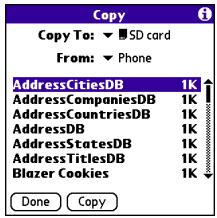
2 Press Menu
3 Select Copy from the App menu.
4 Select the Copy To pick list and select the destination: Phone or
5 Select the From pick list and select the location of the application you want to copy: Phone or
6 Highlight the application you want to copy.
7 Select Copy.
Viewing expansion card information
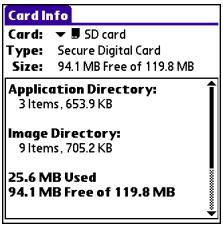
The Card Info application displays general information about the expansion card that is currently in the expansion slot, and it enables you to rename and format a card.
Press Applications and select Card Info
Renaming an expansion card
If you change the contents of an expansion card, you may at some point want to
rename the card to better match its contents.
1 Insert the expansion card into the expansion card slot.
2 Select the category pick list at the top of the screen and select All.
3 Select Card Info
4 Press Menu
5 Select Rename Card from the Card menu.
6 Enter a new name for the card.
7 Select OK.
Tip If you have trouble copying info to, renaming, or formatting an expansion card, make sure the card is not write-protected. Press Applications and select Card Info. If a "This card is read-only" message appears, the card is write-protected. See the instructions that came with your card for additional info.
Formatting an expansion card
Formatting an expansion card is similar to formatting a disk on a computer. When you format an expansion card, you erase all the information stored on the card.
Tip If you format a card, any photos or documents that were previously stored on the card are deleted from your desktop software the next time you sync. You can recover these files from the backup folder, or you can prevent the deletion by temporarily changing your sync settings for the affected application to Desktop overwrites handheld.
8 Insert the expansion card into the expansion card slot.
9 Select the category pick list at the top of the screen and select All.
10 Select Card Info
11 Press Menu
12 Select Format Card from the Card menu.
13 Enter a new name for the card.
14 Select OK.
Your personal settings
Customizing your Palm® Centro™ smartphone is a great way to make it match your lifestyle and work even harder for you.
On your Centro, you can easily customize the sounds, fonts, screen colors, and more. Take advantage of different levels of security. Prevent making an accidental (and expensive) phone call by locking the keyboard. Some settings can help extend the life of your Centro battery. There are lots of ways to make your Centro work better for you.
Benefits
- Access applications quickly
- Conserve power
Make your screen easy to read - Enjoy your Centro more
In this chapter
System sound settings. 205
Display and appearance settings 206
Applications settings 208
Locking your Centro and info 211
System settings 218
Connecting to a VPN 220
System sound settings
Silencing sounds
You can immediately silence all alerts, ringtones, music that plays through the built-in speaker, and system sounds by sliding the Ringer switch to Sound Off. This does not mute the audio during a phone call.
1 Slide the Ringer switch to Sound Off. Your Centro vibrates once to let you know that you've turned sounds off.
2 To hear all sounds again, slide the Ringer switch to Sound On
NOTE For info on setting the vibrate option, see the section on setting alert tones in the chapters that describe the individual applications.
Sliding the Ringer switch back to Sound On restores the previous sound settings.
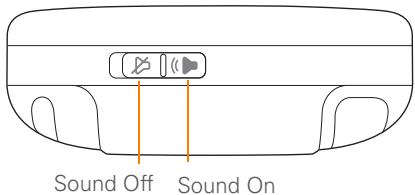
Setting system volume levels
You can set the volume level for system sounds, such as the tone that plays when you synchronize.
Tip If the Ringer switch is set to Sound Off, the ringer setting overrides the sound settings and all sounds are turned off.
1 Press Applications and select Sounds
2 Select the Application pick list and select System.
3 Select the System Volume and Game Volume pick lists and select the volume levels.
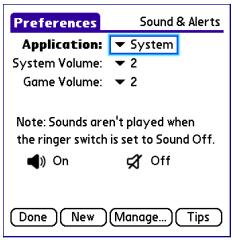
4 Select Done.
Display and appearance settings
Adjusting the brightness
Depending on the lighting conditions in which you're using your Centro, you may need to adjust the brightness of the screen.
1 Press Option , and then press Backlight P
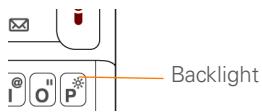
2 Press Left and Right to adjust the brightness.
3 Select Done.
Tip To temporarily set the backlight to the preset low setting, press Option + Menu.
Tip You can also adjust the backlight and set the brightness duration during a call in Power Preferences. See Optimizing power settings.
Changing the screen font
You can change the screen font in Calendar, Contacts, Memos, Messaging, Tasks, and Web. The font styles may vary between applications, and some applications may offer fewer choices.
1 Open the application in which you want to change the font.
2 Press Menu
3 Select Options, and then select Font.
4 Select a font style. (In the web browser, select the Font size pick list and select Large or Small.)
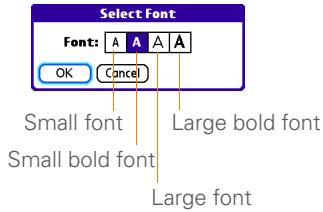
5 Select OK.
Setting display formats
Formats Preferences enable you to select number conventions based on geographic regions. For example, in the United Kingdom, time often is expressed using a 24-hour clock. In the United States, time is expressed using a 12-hour clock with an AM or a PM suffix. Many of the built-in applications on your Centro use the Formats Preferences settings.
1 Press Applications and select Prefs
2 Select Formats.
3 Set any of the following preferences:
Preset to: The standard number conventions for your country. When you select a country, the other Formats Preferences are automatically set to that country's conventions. You can also edit each option individually.
Time: The time format. Select HH:MM to display a 24-hour clock.
Date: The date format.
Week starts: The first day of the week (usually Sunday or Monday).
Numbers: The format for numbers with decimal points and commas.
4 Select Done.
Aligning the screen to correct tapping problems
Occasionally, the Centro touchscreen alignment may need to be readjusted. If this problem occurs, you may see the wrong feature being activated when you tap the screen. To fix the problem, you can align the screen at any time.
1 Press Applications and select Prefs
2 Select Touchscreen.
3 Follow the onscreen instructions and tap the screen where indicated.
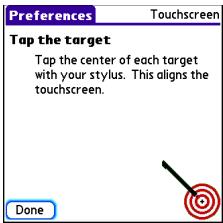
4 Select Done.
Changing the system color scheme
1 Press Applications and select Prefs
2 Select Color Theme.
3 Select a color scheme from the list.
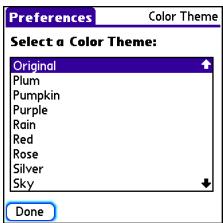
4 Select Done.
Tip You can also set the wallpaper for the Main tab in the Phone application (see Customizing the Main tab in the Phone application) and the background for Calendar Agenda View (see Customizing display options for your calendar).
Applications settings
You can change the Applications settings on your Centro so that you can easily access the applications you use most often. You can arrange and display your applications by category, reassign the buttons on your Centro, and select default applications for specific tasks.
Arranging applications by category
You can assign an application to a category and then display a specific category of applications in Applications View.
1 Press Applications
2 Press Menu
3 Select Category on the App menu.
4 Select the pick list next to each application and select a category.
5 Select Done.
Tip To create a new category, select the category pick list and select Edit Categories. Select New, and then enter the category name. Select OK to close the dialog box, and then select OK.
DID YOU KNOW? If there is an expansion card in the expansion slot, the card appears in the category pick list and is treated as a category when you press Applications repeatedly.
Displaying applications by category
Do one of the following:
-
Press Applications repeatedly to cycle through the categories.
-
Select the category pick list at the top of the screen and select a category. Select All to display all your applications.
Changing Applications View
By default, Applications View displays each application as an icon. As an alternative, you can view a list of applications. The list view is particularly useful when you have so many applications in a category that the applications fill up more than one screen.
1 Press Applications
2 Press Menu
3 Select Options, and then select Preferences.
4 Select the View By pick list and select List.
5 Select OK.
Reassigning buttons
With Buttons Preferences, you can select which applications are associated with the quick buttons and the Side button on your Centro. You can assign a primary and secondary application to each of the three quick buttons that open an application.
NOTE We recommend that you keep the primary button assignments on the factory settings until you become comfortable with the features of your Centro. If you do change the primary button assignments, remember that the instructions in this guide and in the other help features refer to the original button settings.
1 Press Applications and select Prefs
2 Select Buttons.
3 Select the pick list next to the item you want to reassign, and then select an application.
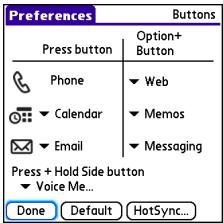
4 Select Done.
DID YOU KNOW? You can also choose an application to open with the sync button on the USB sync cable. To change this setting, select HotSync on the Buttons Preferences screen.
Tip To restore all the buttons and key combinations to their factory settings, select Default.
DID YOU KNOW?
Changing default applications
Sometimes one application looks for another application to handle information (for example, a mail application might open a browser when you select a link in an email message). Your Centro comes with a set of predefined applications to handle email, messaging, and browser requests from other applications. If you have more than one application to handle these requests on your Centro, you can specify which application you want to use for each function.
1 Press Applications and select Prefs
2 Select Default Apps.
3 Select each pick list and select the application you want to associate with that function.
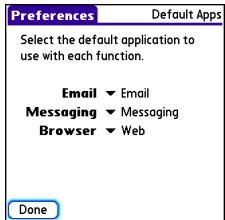
4 Select Done.
Locking your Centro and info
Your Centro includes several features that protect it from inadvertent use and keep your information private. You can lock any of the following features on your Centro:
Keyboard (Keyguard): You can use the Keyguard feature to disable the keyboard and all buttons to prevent accidental presses in your bag or pocket.
Screen: You can disable the screen's touch-sensitive feature during an active call or call alert.
Phone (Phone Lock): You can set your phone to require a password for making calls. The built-in security software lets you make emergency calls even if your phone is locked.
Centro: You can set your Centro to require a password for viewing any information on your Centro.
Entries: You can mask or hide entries marked as private and set your Centro to require a password for viewing them.
Locking your keyboard (Keyguard)
The Keyguard feature locks the keyboard so that you don't accidentally press buttons or activate items on the screen while your Centro is in a pocket or bag.
By default, Keyguard turns on whenever the screen is off. Each time you wake up the screen, you must turn off Keyguard to unlock the keyboard and use your Centro.
To turn off Keyguard, do the following:
1 When the screen is off, press Power/ End to wake up the screen.
2 Press Center to turn off Keyguard.
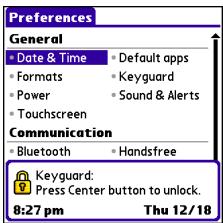
You can change how quickly Keyguard turns on, or you can disable this feature altogether. To change the Keyguard settings, do the following:
1 Press Applications and select Prefs
2 Select Keyguard.
3 Select the Auto-Keyguard pick list, and then do one of the following:
-
Select how quickly you want Keyguard to turn on: When power is turned off, 5 seconds after power off, or 30 seconds after power off.
-
Select Disable to completely disable the Keyguard feature until you turn it on again by pressing Option + Power/End when the screen is on.
4 Select Done.
Locking your screen
You can set your Centro to automatically lock the screen's touch-sensitive features in certain situations.
1 Press Applications and select Prefs
2 Select Keyguard.
3 Check any of the following boxes:
Incoming calls received: Disables the screen when the phone rings. You must use the 5-way to select the onscreen Answer and Ignore buttons, or press Send l to answer the call or Power/End l to ignore the call.
On a call: Disables the screen after you answer a call. You must use the 5-way to select the onscreen buttons during the call. Use this setting to avoid accidentally pressing onscreen buttons while you're holding your Centro near your ear to speak.
4 Select Done.
DID YOU KNOW? When you check the boxes to disable the touchscreen during a call, the touchscreen is automatically enabled again after you end the call.
Locking your phone (Phone Lock)
You can lock your SIM card to prevent unauthorized calls and use of other wireless features. When your SIM card is locked, you must enter the correct PIN code to unlock it, even if you move it to a different phone. You can still make emergency calls when your phone is locked, however.
IMPORTANT If your SIM card is locked and you enter the wrong PIN more than three times, you must call your network operator for your unique PIN unlock key (PUK) to unlock your SIM card.
TIP When Phone Lock is turned on, other people can still see the info on your Centro, but they cannot make or receive phone calls or use the other wireless features without your password.
1 Press Phone
2 Press Menu
3 Select Options, and then select Phone Lock.
4 Check the Lock SIM box.
5 When prompted, enter the current PIN and select OK. (Unless you changed your PIN, enter the default PIN, provided with your account materials.)
6 If you want to change the PIN, select Change PIN, enter a new PIN, and then select OK. Repeat this step to verify the new PIN.
7 If your SIM card supports fixed number dialing (FDN), select Advanced and check the Enable Fixed Number Dialing box to restrict dialing to the numbers in your FDN list. When prompted, enter your PIN2 and then select OK.
8 Turn your phone off to activate the phone lock feature.
9 To turn your phone on again, press and hold Power/End 1 , enter your PIN, and then select OK to unlock your Centro.
TIP To manage your FDN list, press
Applications, select SIM Book, press Menu, and then select Modify FDN from the Options menu.
Your SIM card locks again when you turn off your Centro and then turn it back on.
To disable the current Phone Lock settings:
1 Press Phone
2 Press Menu
3 Select Options, and then select Phone Lock.
4 Uncheck the Lock SIM box.
5 Enter your PIN code.
6 Select OK.
Locking your Centro
To protect your personal information, you can lock your Centro so that you need to enter your password to access any of your information or to use any of the features on your Centro, including the phone. You can, however, still make emergency calls when your Centro is locked.
IMPORTANT If you lock your Centro, you must enter the exact password to unlock it. If you forget the password, you need to perform a hard reset to resume using your Centro. Performing a hard reset while your Centro is password locked deletes all the entries in your Centro and completely reforms it. If you use password protection in Palm Desktop software, you must remember your password to restore your info. However, if you do not use password protection in Palm Desktop software, you can restore all previously synchronized info the next time you sync (see Synchronizing information—the basics).
1 Press Applications and select Security
2 Select the Password box.
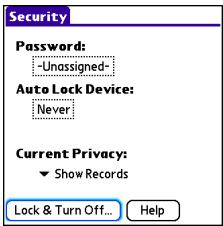
3 Assign a password and a password hint.
4 Select the Auto Lock Device box.
5 When prompted, enter your password and select OK.
6 Select one of the following options:
Never:Prevents your Centro from locking automatically.
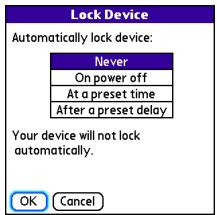
On power off: Locks your Centro when you turn off the screen, or when it shuts off with the Auto-off feature.
At a preset time: Locks your Centro at a specific time of day.
After a preset delay: Locks your Centro after a period of inactivity.
7 Select OK.
8 Do one of the following:
- Select Lock & Turn Off to lock your Centro immediately.
- Press Applications to accept your settings and continue using your Centro.
Tip After you create a password, you can lock your system manually. Press Applications and select Security. Select Lock & Turn Off, and then select Off & Lock.
Tip To change your password, select the Password box, enter your current password, and then enter the new password. To delete your password, select the Password box and then select Unassign.
Working with private entries
In most applications, you can mark individual entries as private. All private entries remain visible and accessible until you select the Security setting. You have three Security setting options:
Show Records: Private records are visible.
Hide Records: Private entries do not appear anywhere in the application.
Mask Records: Private entries are replaced with a gray bar that lets you know the entry is there but keeps it from being legible.
After you enable the mask or hide setting, any entries marked as private are immediately hidden or masked. If you define a password, you must enter it to display private entries. If you do not define a password, you (or anyone else) can reveal private entries without a password.
1 Open the entry that you want to mark private.
2 Select Details.
3 Check the Private box.
4 Select OK.
Hiding or masking all private entries
Make sure the entries you want to mask or hide are marked private.
1 Press Applications and select Security
2 Select the Current Privacy pick list and select either Hide Records or Mask Records.
3 If prompted for your password, enter it and then select OK.
Viewing all private records
You can reveal all the entries you've hidden or masked.
1 Press Applications and select Security
2 Select the Current Privacy pick list and select Show Records.
3 If prompted for your password, enter it and then select OK.
Viewing private entries in a specific application
1 Open the application that contains the private entries you want to see.
2 Press Menu
3 Select Options, and then select Security.
4 Select the Current Privacy pick list and select Show Records.
5 Select OK.
6 If prompted for your password, enter it and then select OK.
Security Password and Palm Desktop software (Windows)
You can set the Windows version of Palm Desktop software to observe the security password for your Centro. If you forget your password, you cannot view your information in Palm Desktop. If your Centro is unlocked, you can change your password on your Centro, but all entries marked as private are deleted. You can restore your private entries the next time you sync, and then create a new password.
Follow these steps to recover from a lost password:
1 Press Applications and select Security
2 Select the Password box.
3 Select Lost Password.
4 Select Yes.
Tip If you want additional security for Palm Desktop files, you may want to purchase a third-party solution.
Entering owner information
You can use Owner Preferences to record information that you want to associate with
your Centro, such as your name, company name, and home phone number. If you lock your Centro (see Locking your Centro), the Owner Preferences information appears on the screen that requests your password to unlock it, and you must also enter your password to change the Owner Preferences information.
1 Press Applications and select Prefs
2 Select Owner.
3 If you assigned a password with the Security application, select Unlock, enter your password, and then select OK to continue.
4 Enter the text that you want to appear in the Owner Preferences screen.
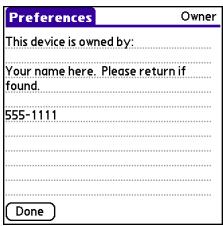
5 Select Done.
System settings
Setting the date and time
Date & Time Preferences enable you to manually set the date, time, and location (time zone) setting for your Centro.
1 Press Applications and select Prefs
2 Select Date & Time.
3 Select the Automatically set pick list and select one of the following settings:
NOTE The options that appear on the screen vary based on the setting you select in step 3.
Date, time and time zone: The date, time, and time zone are acquired from your network.
Date and time: Lets you set the time zone manually. The date and time are acquired from your network.
This setting is useful when you travel from one time zone to another. You can enter an appointment in your calendar and set no time zone. When you get to
your destination time zone, the appointment appears on your calendar at the correct local time.
Nothing: Lets you set the date, time, and time zone manually. No info is acquired from your network.
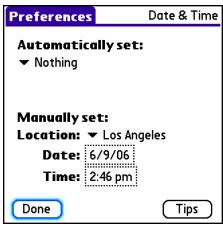
4 If the Location pick list appears, select it, and then select a city in your time zone.
Tip If a city in the same time zone is not on the list, select Edit List, select Add, select a city in your time zone, and then select OK. If necessary, modify any of the settings in the Edit Location dialog box, and then select OK.
5 If the Date and Time fields appear, select the Date field and select the
date, and then select the Time field and select the time.
6 Select Done.
Tip You can also set time zones for Calendar events. See Creating an event.
Optimizing power settings
Power Preferences enable you to adjust settings to maximize the battery's performance.
1 Press Applications and select Prefs
2 Select Power.
3 Set any of the following preferences: Brightness: Sets the intensity of the screen backlight. Drag the slider or press Left and Right to adjust the brightness level.
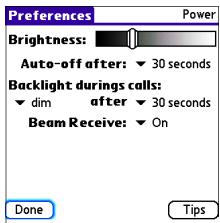
Auto-off after: Determines how long your screen stays on during a period of inactivity. When there is no interaction with the keyboard or screen for the specified time period, your Centro turns off automatically.
Backlight during calls: To preserve power during an active call, you can set the screen backlight either to dim or turn off after a specified amount of time. Turning off the backlight saves more power than dimming it. With the backlight turned off, you can still see a faint image on the screen and use any of the buttons on the screen. To return backlight brightness to normal, press any key or tap the screen. Be careful; pressing Power/End hangs up an active
call, and tapping an onscreen button activates that command.
Beam Receive: Determines whether your Centro is ready to receive information over an infrared beam. If you leave this option turned off, you must return to this screen to turn on this option the next time you want to receive a beamed item.
4 Select Done.
Tip You can also access the brightness setting by pressing Option + P. To temporarily set the backlight to the preset low setting, press Option + Menu.
Connecting to a VPN
If you want to use your Centro to access your corporate email account or other files on your corporate server, you may need to set up a virtual private network (VPN) on your Centro. A VPN enables you to log in to
your corporate server through the company's firewall (security layer). You need a VPN client on your Centro if your Centro and your company's server are located on opposite sides of the firewall.
Check with your company's system administrator to see if a VPN is required for accessing the corporate server. If a VPN is required, you must purchase and install a third-party VPN client on your Centro to use this feature.
TIP For information about third-party VPN client software, visit go.palm.com/ centro-gsm/.
1 Install your third-party VPN client. See Installing applications for details.
2 Press Applications and select Prefs
3 Select VPN.
4 Enter the settings provided by your corporate system administrator.
Common questions
Although we can't anticipate all the questions you might have, this chapter provides answers to some of the most commonly asked questions. For additional information and answers to other common questions, visit go.palm.com/centro-gsm/.
In this chapter
Upgrading. 223
Desktop software installation 225
Resetting your Centro 225
Replacing the battery 227
Screen 229
Synchronization 230
Phone 237
Hands-free devices 240
Email 241
Messaging 241
Web 242
Camera. 245
Making room on your Centro 246
Third-party applications 247
Error messages 248
Upgrading
If you experience problems with your Palm® Centro™ smartphone after performing the upgrade steps in this guide, you may have incompatible applications or settings that were not quarantined during the installation process. These incompatible applications or settings can lead to numerous issues, including system resets and freezes. If you experience a problem after upgrading, follow the steps in this section to remove the incompatible apps from your Centro and to transfer your other info to your new Centro.
NOTE If you have trouble installing a third-party application, contact the developer for assistance.
We recommend that you do not install apps that do any of the following:
Modify phone functions, such as ringtones, dialing, or caller ID
- Replace organizer features, such as Contacts or Calendar
- Set data connection features, such as activating or ending data connections
- Provide web-clipping features, such as PQA files
- Provide instant messaging features If you want to continue using these types of applications, please contact the third-party developer for software updates and for info about compatibility with your Centro.
WINDOWS ONLY
Use the following instructions to upgrade your Centro on a Windows XP computer.
1 On your computer, click Start > Programs > Palm > Safe HotSync.
2 Follow the instructions on the screen.
3 Locate the Old_Aps folder on your computer. This folder is usually located inside one of the following folders: C:\Program Files\PalmC:\Program Files\palmOneC:\Program Files\Handspring
4 To help you identify the app that is causing the problem, move one app at a time from the Old_Aps folder to the Backup folder, and then sync.
If the problem recurs, delete the last app you installed and report the problem to its developer.
5 Repeat step 4 for each of the apps in the Old_Aps folder.
NOTE If you have trouble moving apps from the Old_Aps folder to the Backup folder, or determining which files to move, try reinstalling the app using the original third-party developer files.
TIP Need more info on the Backup folder? See What is the backup folder?.
MAC ONLY
1 Locate your user folder on your computer.
NOTE Your user folder name is the same as your device name and is usually found in this location:
2 Select your user folder and Option-drag it to your Mac desktop to make a copy of that folder.
3 Confirm that your copy includes the Backup subfolder and that all the files in the original Backup subfolder are also in the copy of the Backup subfolder.
4 Delete all files from the original Backup subfolder.
5 Perform a hard reset on your Centro. See Resetting your Centro for instructions.
6 Sync your Centro with your new desktop software and be sure to select your existing device name from the User list.
7 To help you identify the app that is causing the problem, move one third-party app from the copy of the Backup subfolder to the original Backup subfolder, and then sync. If the problem recurs, delete the last app you installed and report the problem to its developer.
8 Repeat step 7 for each of the third-party apps in the copy of the Backup folder.
Desktop software installation
If you are having trouble installing the desktop software, you may have the wrong version of the software or some of your computer's resources may be unavailable.
Tip The Palm Software Installation CD installs software that lets you synchronize using Palm Desktop software or Microsoft Outlook for Windows. If you want to synchronize using a different personal information manager (PIM), you must install a third-party solution. Contact the PIM's author or vendor to learn if software is available for your Centro.
Follow these steps to retry the installation.
1 Make sure your computer profile includes administrator rights to install software. In large organizations, these are usually granted by the system administrator.
2 Restart your computer.
3 Quit any active applications, including virus scanners and Internet security applications.
4 Make sure you're installing the software from the Palm Software Installation CD that came with your new Centro. Other versions of the desktop software may not work with your Centro.
5 Insert the Palm Software Installation CD to restart the installation.
IMPORTANT Always use the same language for your Centro, your computer operating system, and your desktop software. Otherwise, you may lose information or have difficulty with synchronization. Support is not provided for mismatched language setups.
Resetting your Centro
Performing a soft reset
Performing a soft reset is similar to restarting a computer. If your Centro is not responding or you have trouble
synchronizing with your computer, a soft reset may help. All your info is retained when you perform a soft reset.
1 Remove the battery from your Centro, and then reinsert it. Don't know how? See Replacing the battery.
NOTE The reset begins when you reinsert the battery.
2 At the end of the soft reset, Date & Time Preferences appears. Select Done.
Performing a system reset
A system reset, also called a safe or warm reset, tells your Centro to stop what it's doing and start over again without loading any system extras. If your Centro loops or freezes during or after a soft reset, a system reset may help. Performing a system reset can release your Centro from an endless loop so that you can uninstall a third-party application that may be causing the looping.
1 Remove the battery from your Centro, and then reinsert it.
Don't know how? See Replacing the battery.
2 When the Palm logo appears, press and hold Up until the black status bar at the bottom of the screen fills and disappears, and then release Up .
3 Delete the third-party application that you suspect is causing the problem.
4 Perform a soft reset. The wireless features of your Centro are not available until you complete this step.
Performing a hard reset
A hard reset erases all information and third-party software on your Centro. Never perform a hard reset without first trying a soft reset and a system reset and trying to resolve third-party software issues. (See Third-party applications for suggestions on diagnosing third-party software issues.) After a hard reset, you can restore previously synchronized information the next time you sync.
IMPORTANT If you set a password on your Centro, performing a hard reset reforms your Centro. This is a more severe form of a hard reset, which
removes all your information, and restores your formats, preferences, and other settings to the factory default settings.
TIP Some third-party applications do not create a backup on your computer when you synchronize. If you perform a hard reset, you may lose data in these applications and you will need to reinstall the application after the hard reset. Please contact the application's developer to find out which data is backed up during synchronization.
1 Remove the battery from your Centro, and then reinsert it. Don't know how? See Replacing the battery.
2 When the Palm logo appears, press and hold Power/End until the black status bar at the bottom of the screen fills and disappears, and then release Power/End.
3 When the Erase all data? prompt appears, press Up ▲ to confirm the hard reset.
IMPORTANT If a Reformating in progress message appears, do not touch
your Centro until the process is complete. This may take up to 10 minutes.
4 When the language selection screen appears, select the same language you selected for your desktop software.
IMPORTANT Always use the same language for your Centro, your computer operating system, and your desktop software. Otherwise, you may lose information or have difficulty with synchronization. Support is not provided for mismatched language setups.
5 (Optional) If you want to confirm that the hard reset was successful, immediately afterward, press Applications and select HotSync. If your device name appears in the upper-right corner, the hard reset was not successful.
Replacing the battery
Your Centro comes with a replaceable battery. Be sure to use a replacement
battery that is recommended or sold by Palm and is compatible with the Centro.
CAUTION Failure to use the proper battery may result in a risk of personal injury or product damage, and it voids your Centro warranty.
1 Press Power/End to turn off the screen.
2 Press the Battery door near the top where the door and camera sections meet and slide it downward to remove it from your Centro.
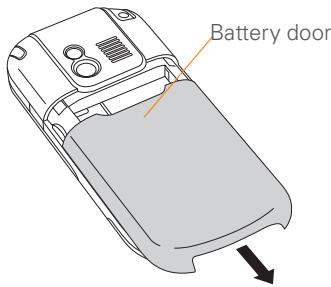
3 Place a finger in the notch next to the battery, and lift up the old battery at a 45-degree angle to remove it from the compartment.
4 Align the metal contacts on the new battery with the contacts inside the battery compartment, insert the new battery into the compartment at a 45-degree angle, and then press it into place.
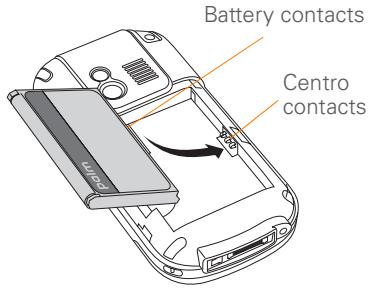
IMPORTANT Use the battery that came with your Centro. Do not use a battery from another Centro model in your Centro. Similarly, do not use the Centro battery in another Centro model. Using a battery that is designed for another Centro model can damage your Centro.
5 Slide the battery door onto the back of the Centro until it clicks into place.
6 Connect your Centro to the charger or sync cable to charge the new battery.
TIP Be sure to dispose of your old battery properly. In some areas, disposal in household or business trash is prohibited.
Screen
The screen appears blank
1 When a call lasts longer than the limit specified in Power Preferences, the screen dims automatically. In certain lighting conditions, the screen may appear blank when this occurs. Press any key except Power/End to restore the screen to normal brightness. Pressing Power/End hangs up the call. The screen backlight may also be set to dim or turn off after a specified amount of time (see Optimizing power settings).
2 When a period of inactivity lasts longer than the limit specified in Power Preferences, the screen turns off. Press and release Power/End to wake up the screen.
3 Look closely at the screen. If you can see a dim image, try adjusting the screen brightness (see Adjusting the brightness).
4 If the screen is still blank, perform a soft reset (see Performing a soft reset).
5 If the problem persists, connect your Centro to the charger (see Charging the battery) and perform a soft reset again.
6 If that doesn't work, perform a hard reset (see Performing a hard reset).
Tip To find carrying cases that protect the screen, and other useful accessories, visit go.palm.com/centro-gsm/.
The screen doesn't respond accurately to taps or it activates wrong features
1 Press Applications
2 Use the 5-way to select Prefix
3 Use the 5-way to select Touchscreen.
4 Follow the onscreen instructions to align the screen.
5 Select Done.
6 If the problem persists, check for dirt between the screen and the edge of the Centro.
7 If you're using a screen protector, make sure that it is properly installed.
There's a blinking bell in the upper-left corner
The blinking bell in the upper-left corner of the screen is the Alert icon. It appears when you have alarms or messages that you haven't acknowledged.
1 Press and hold Center or tap the blinking bell with your stylus.
2 When the list of pending alerts appears, do either of the following:
- Select the text of the alert to view the item. The item stays in the list.
- Check the box next to an alert to clear it from the list, and then select Done.
Synchronization
Synchronization backs up the informationfrom your Centro onto your computer and
vice versa. If you ever need to perform a hard reset or otherwise need to erase all your information on your Centro, you can synchronize your Centro with your computer to restore the info. Similarly, if your computer crashes and your Palm Desktop info is damaged, you can recover your info by synchronizing with your Centro. To make sure you always have an up-to-date backup of your info, synchronize frequently.
This section describes synchronization between your Centro and a desktop computer running Palm Desktop software. You can also synchronize the information on your Centro using third-party applications. See the documentation for the third-party application for information on features and configuration.
Before you attempt to synchronize, make sure you've installed the desktop synchronization software from the Palm Software Installation CD.
Tip Every device needs a unique name. Never synchronize more than one device to the same device name on your computer.
I can't find my user folder
Windows: If your device name is one word, your user folder name is the first six characters of your device name. If your device name is two words, your user folder name consists of the first six characters of the second word of your device name, followed by the first letter of the first word. For example, if your device name is John Smith, your user folder is named SmithJ. Your user folder is usually located inside one of the following folders:
C:\Program Files\Palm\
C:\Program Files\palmOne\
C:Program Files\Handspring\
Mac: Your user folder name is the same as your device name and is usually found in this location:
What is the backup folder?
The Backup folder is located inside your user folder (see I can't find my user folder). During synchronization, the HotSync manager puts a copy of most of your info and applications into the Backup folder. (Some third-party apps do not put a copy
into the Backup folder.) The next time you sync, the HotSync manager compares the contents of the Backup folder to the contents of your Centro, and then restores any missing info or applications.
If an app that you deleted reappears on your Centro, try deleting the app from your Backup folder.
Palm Desktop does not respond to a sync attempt
1 Make sure that the USB sync cable is securely connected to the USB port on your computer and on the bottom of your Centro (see Synchronizing information—the basics).
Tip If you're having trouble trying to sync using an IR or Bluetooth® wireless technology connection, try using the USB sync cable instead. If this solves the problem, check your IR or Bluetooth settings (see Synchronizing information—advanced).
2 Make sure that the HotSync manager is running:
Windows: Right-click HotSync manager in the taskbar in the
lower-right corner of your computer screen, and make sure that Local USB is checked. If you don't see the HotSync manager icon, click Start, select Programs, select Palm, and then select HotSync manager.

Mac: Find the Palm folder on your Mac hard drive. Double-click the HotSync manager icon in the Palm folder. In the Connection Settings panel, set the Local Setup port to Palm USB.
3 Synchronize. If the synchronization is successful, you do not need to complete the remaining steps.
4 Perform a soft reset (see Performing a soft reset).
5 Synchronize. If the synchronization is successful, you do not need to complete the remaining steps.
6 If problems persist and you're synchronizing through a USB hub, try connecting the sync cable to a different USB port or directly to your computer's built-in USB port.
7 Synchronize. If the synchronization is successful, you do not need to complete the remaining steps.
8 Check the multi-connector on the bottom of your Centro for debris or discoloration. Carefully clean the connector by dipping a cotton swab in some rubbing alcohol and gently wiping the metal contacts on the connector. Try to sync again.
9 Check the connector on the USB sync cable for integrity and cleanliness. Make sure the pins on the connector are straight, protruding, and not damaged. If the cable appears to be damaged, stop here and locate another USB sync cable.
10 WINDOWS ONLY Uninstall Palm Desktop software. Click Start, select Settings, select Control Panel, select Add or Remove Programs, select Palm Desktop software, and then click Change/Remove.
NOTE Mac computers do not provide an option for uninstalling Palm Desktop software. Contact Technical Support if the problem persists after you complete step 7.
11 Restart your computer.
12 Reinstall Palm Desktop software from the Palm Software Installation CD that came with your Centro.
Synchronization starts but stops without finishing
TIP The HotSync Log can give you information about your most recent synchronization.
Windows: Right-click the HotSync manager icon in the taskbar in the lower-right corner of your computer screen, and then select View Log.
Mac: Open Palm Desktop software. From the HotSync menu, select View Log.
If you upgraded from a previous Palm OS device or received a system error, such as Sys0505, there may be conflicts with software on your Centro.
1 Locate your Backup subfolder and rename the folder (for example, BackupOld).
Windows: C:\Program Files\Palm device name>
NOTE Can't find a Palm folder in Program Files? Then look for a palmOne or Handspring folder instead. For more info, see I can't find my user folder.
2 Synchronize.
3 If the problem is resolved, begin reinstalling your third-party applications one at a time by double-clicking a single file in the original Backup subfolder that you renamed, and sync after each application you install. If the problem recurs, delete the last application you installed and report the problem to its developer.
4 WINDOWS ONLY If the Windows New Hardware Wizard appears, the synchronization process may be timing out before the wizard completes its job.
Follow all instructions in the New Hardware Wizard, and then sync again.
5 WINDOWS ONLY Uninstall Palm Desktop software. Click Start, select Settings, select Control Panel, select Add or Remove Programs, select Palm Desktop software, and then click Change/Remove.
NOTE Mac computers do not provide an option for uninstalling Palm Desktop software. Contact Technical Support if the problem persists after you complete step 3.
6 Restart your computer.
7 Reinstall Palm Desktop software from the Palm Software Installation CD that came with your Centro.
Synchronization finishes but info doesn't appear where it should
1 Make sure you're synchronizing with the intended desktop personal information manager (PIM). The Palm Software Installation CD enables you to choose whether you want to synchronize with Palm Desktop software or Microsoft Outlook for
Windows. Reinsert the installation CD and select Change your synchronization method if necessary. If you use a different PIM, you need to install third-party software to synchronize. For more information, consult the company that makes the PIM.
2 If multiple Palm OS devices are synchronizing with your computer, make sure the name of the device you are synchronizing appears in the User field on the toolbar of Palm Desktop software.
3 Open HotSync manager on your computer, and make sure the necessary conduits are set to Synchronize the files.
Tip For more info on Outlook conduits, right-click the HotSync manager icon in the taskbar, select Custom, select an app with Outlook in its name, and then select Help.
NOTE If you need to change the setting to Synchronize the files, be sure to check the Set as default box as well.
4 WINDOWS ONLY Uninstall
Palm Desktop software. Click Start, select Settings, select Control Panel, select Add or Remove Programs, select Palm Desktop software, and then click Change/Remove.
MAC ONLY Mac computers do not provide an option for uninstalling Palm Desktop software. Contact Support if the problem persists after you complete step 3.
5 Restart your computer.
6 Reinstall Palm Desktop software from the Palm Software Installation CD that came with your Centro.
7 (Outlook only) If you're trying to synchronize offline, set your Outlook Calendar, Contacts, Notes, and Tasks to be available offline.
Tip Outlook sub folders and public folders are not accessible with the included software. You may want to use a third-party solution instead.
Tip (Outlook only) If you want to sync your info with a global Exchange Address Book, you must copy the addresses to your local Contacts list in Outlook (right-click the addresses and select Add to Personal Address Book).
I have duplicate entries in Microsoft Outlook after I sync
1 Open Microsoft Outlook and delete the duplicate entries.
2 On your computer, go to the application with duplicate entries and manually enter any info you added to your Centro since the last time you synchronized.
3 Right-click HotSync manager in the taskbar and select Custom.
4 Select an application that has duplicate entries and also has Outlook in its name.
5 Click Change.
6 Select Desktop overwrites handheld, and then click OK.
7 If more than one application has duplicate entries, repeat steps 4 through 6 for each application with duplicates.
8 Click Done.
9 Synchronize your Centro and your computer.
My appointments show up in the wrong time slot after I sync
If you create an appointment in the wrong time zone (that is, your desktop was set to the wrong time zone), it shows up in the wrong time zone on your Centro. To be safe, enable local network time and avoid assigning time zones to your appointments.
If you're using Microsoft Outlook:
1 Make sure that you installed the Microsoft Outlook conduit that came with your Centro. If you're not sure whether this software is installed, reinstall Palm Desktop software from the Palm Software Installation CD that came with your Centro.
2 Open Microsoft Outlook and correct the wrong entries.
3 On your computer, manually enter any Calendar info you added to your Centro since the last time you synchronized.
4 Click HotSync manager in the taskbar and select Custom.
5 Select an application that has both Calendar and Outlook in its name.
6 Click Change.
7 Select Desktop overwrites handheld, and then click OK.
8 Synchronize your Centro and your computer.
9 Repeat steps 4 through 6 to open the Calendar Change HotSync Action dialog box again.
10 Make sure Synchronize the files is selected and Set as default is checked, and then click OK.
You should now be able to assign time zones to your events without encountering this problem.
If you're using Palm Desktop software:
1 On your Centro, press Calendar
2 Press Menu
3 Select Options, and then select Preferences.
4 Uncheck the New events use time zones box (if it's checked).
5 On your computer, open Palm Desktop software and correct the wrong entries.
6 On your computer, manually enter any Calendar info you added to your Centro since the last time you synchronized.
7 Click HotSync manager in the taskbar and select Custom.
8 Select Calendar.
9 Click Change.
10 Select Desktop overwrites handheld, and then click OK.
11 Synchronize your Centro and your computer.
12 Repeat steps 7 through 9 to open the Calendar Change HotSync Action dialog box again.
13 Make sure Synchronize the files is selected and Set as default is checked, and then click OK.
You should now be able to assign time zones to your events without encountering this problem.
IMPORTANT To avoid this problem in the future, do not assign time zones to your events. Palm Desktop software does not support time zones.
The text of my memos is truncated after I sync
If you use your desktop software to create a memo that is longer than 4,096 characters, the excess characters are truncated when you transfer the memo to your Centro.
Phone
Signal strength is weak
Become familiar with low coverage areas where you live, commute, work, and play. Then you will know when to expect signal strength issues. You can check signal
strength by looking at the Signal Strength icon in the title bar of the Main tab in the Phone application. The stronger the signal, the more bars that appear. If you are outside a coverage area, no bars appear.
1 If you're standing, move about ten feet in any direction.
2 If you're in a building, move near a window. Open any metal blinds.
3 If you're in a building, move outdoors or to a more open area.
4 If you're outdoors, move away from large buildings, trees, or electrical wires.
5 If you're in a vehicle, move your Centro so that it's close to a window of your vehicle.
My Centro won't connect to the mobile network
1 Try the suggestions about signal strength described in Signal strength is weak.
2 Turn off your phone and turn it on again (see Turning your phone on and off).
3 Remove the SIM card (this causes a soft reset) and reinsert it (see Inserting the SIM card and battery).
The other person hears an echo
Try decreasing the volume on your Centro to avoid coupling or feedback on the other person's end. This applies to both the speakerphone and the earpiece.
- Position the earpiece closer to your ear to prevent sound leaking back to the microphone. Keep your hand away from the microphone hole, which is on the bottom right side of the Centro.
If you're using the speakerphone feature with your Centro lying on a flat surface, try turning the Centro face down (screen facing the surface).
I hear my own voice echo
Ask the person on the other end of the call to turn down the volume on his or her phone or to hold the phone closer to his or her ear.
My voice is too quiet on the other end
-
Be sure to place the bottom of the Centro, or the hands-free microphone, close to your mouth.
-
Check the Signal Strength _all icon in the title bar of the Main tab in the Phone application. If the signal is weak (few bars are displayed), try the suggestions about signal strength described in Signal strength is weak.
I hear static or interference
Check the Signal Strength Yull icon in the title bar of the Main tab in the Phone application. If the signal is weak (few bars are displayed), try the suggestions about signal strength described in Signal strength is weak.
If you're using a Bluetooth® hands-free device, see I hear static or interference when using my Bluetooth hands-free device.
My phone seems to turn off by itself
If a system error and reset occur, the Centro automatically turns the phone on if it was on before the reset. However, if the Centro can't determine if your phone was on before the reset, the phone does not
automatically turn on (see Turning your phone on and off). If the problem persists and you're using third-party applications, see Third-party applications for additional suggestions.
My Centro makes or answers calls when it's in a bag or pocket
Items in your bag or pocket may be pressing the onscreen Answer button or otherwise activating screen items. If this happens, be sure to press Power/End to turn off the screen before placing your Centro in a bag or pocket. You may also want to disable the screen's touch-sensitive feature during incoming calls (see Locking your screen).
Tip To find carrying cases that can help prevent your Centro from making calls, as well as other useful accessories, visit go.palm.com/centro-gsm/.
Hands-free devices
TIP Bluetooth range is up to 30 feet in optimum environmental conditions.
Performance and range may be affected by physical obstacles, radio interference from nearby electronic equipment, and other factors.
I can't make or receive calls using a Bluetooth® hands-free device
Confirm all the following:
- The Bluetooth device is compatible with your Centro. Go to go.palm.com/ centro-gsm/ for a list of compatible devices.
Press Applications and select Bluetooth .Make sure the Bluetooth setting is set to On. -
You have already formed a partnership between your Centro and your hands-free device, and the hands-free device appears in the Trusted Devices list. (See Connecting to a Bluetooth® hands-free device.)
-
Your hands-free device is charged and turned on.
- Your Centro is within range of the hands-free device.
If the problem persists, turn the Bluetooth setting to Off and then turn it on again. If it still persists, delete the partnership, and then create a new partnership with the hands-free device (see Connecting to a Bluetooth® hands-free device).
I hear static or interference when using my Bluetooth hands-free device
- Try moving your Centro closer to the hands-free device. Audio quality degrades as the distance between your Centro and hands-free device increases. The effective range for a device varies between manufacturers.
- Confirm that no obstructions, including your body, are between your Centro and your hands-free device.
- If the problem persists, turn the Bluetooth setting to Off and then turn it back on again. If it still persists, create a new partnership with the hands-free device (see Connecting to a Bluetooth® hands-free device).
TIP For best performance, keep your Bluetooth hands-free device and your phone on the same side of your body.
Some features of my Bluetooth hands-free device don't work with my Centro
- Check the Palm compatibility list at go.palm.com/centro-gsm/ to ensure that your device is compatible.
- Check the documentation that came with your device or the manufacturer's website for information specific to your device.
For troubleshooting info on the VersaMail® application, see the User Guide for the VersaMail Application on the Palm Software Installation CD.
Messaging
I can't send or receive text messages
Make sure your SIM card is inserted correctly (see Inserting the SIM card and battery) and your phone is turned on (see Turning your phone on and off).
- Contact your network operator to verify that your plan includes text messaging services, that these services have been correctly activated, and that they are available at your location. Your network operator should be able to tell you if text messaging services have been experiencing transmission delays. Delays can also occur between the time that a message is sent and the time it is received.
- Verify with the recipient that the receiving device can handle text messages.
If a text message arrives but does not display an alert, perform a soft reset (see Performing a soft reset).
I can't send or receive multimedia messages
Make sure your phone is turned on (see Turning your phone on and off).
- Contact your network operator to verify that your plan includes multimedia messaging services (MMS), that these services have been correctly activated, and that they are available at your location. Your network operator should be able to tell you if multimedia messaging services have been experiencing transmission delays. Delays can also occur between the time that a message is sent and the time it is received.
- Make sure that either of the following icons appears in the title bar of the Main tab: Y. If you do not see either of these icons, data services are not available in your current location and you cannot exchange multimedia messages.
- Verify with the recipient that the receiving device can handle multimedia messages.
If a message arrives but does not display an alert, perform a soft reset (see Performing a soft reset).
Web
I can't tell if data services are available
When your phone is on, icons appear in the title bar in the Main tab in the Phone application to indicate whether data services are available and whether a data connection is active. Make sure that either of the following icons appears in the title bar of the Main tab: Yai Yai. If you do not see either of these icons, data services are not available in your current location and you cannot connect to the Internet.
My Centro won't connect to the Internet
Your Centro supports GPRS and EDGE wireless data networks. To connect to the Internet, you must subscribe to and activate data services with your network operator, and you must be in a location with data coverage.
1 Press and hold Power/End to turn off your phone. Then press and hold the same button to turn it back on again.
2 Press Phone and look for either of the following icons in the title bar of the Main tab:
3 If you see these icons, you are in a data coverage area. Try connecting to the Internet again. If you do not see either of these icons, press Applications 口 , select Prefix 口 and continue with the following steps.
4 Select Network.
5 Select the Service pick list and select your wireless service provider's data service.
6 Select Connect.
7 If the connection is successful, go to the web browser. If you still can't make a connection, perform a soft reset (see Performing a soft reset).
8 If your phone did not turn on automatically after the soft reset, press and hold Power/End to turn on your phone, and try connecting to the Internet.
9 Contact your network operator to verify the following:
- Your subscription plan includes high-speed data services.
- Data services have been activated on your account.
Data coverage is available in your location.
- There are no data service outages in your location.
I can't access a web page
First, make sure you have Internet access: Open the web browser and try to view another web page you've loaded before. To ensure you're viewing the page directly from the Internet, press Menu + , select Go, and then select Refresh.
If you can view the other web page after you refresh it but you still can't access the page you were originally trying to view, the page may contain elements that are not supported by the web browser. These include Flash, Shockwave, VBScript, WMLScript, and other plug-ins.
Some websites use a redirects to their true home page. If the web browser on your Centro can't follow the redirects, try using a desktop browser to see the landing page of the redirects, and then enter that address in the web browser on your Centro.
TIP Your Centro can open your email application when you select an email address on a web page. If nothing happens when you select the link, make sure your email application is already set up.
It takes a long time for a web page to load
If it is taking longer than usual to load web pages, you may have traveled from an EDGE service area to a GPRS service area. Although GPRS data service is considered a high-speed data service, it seems slow if you are used to EDGE speed.
1 Press Phone and look for either of the following icons in the title bar of the Main tab to confirm that you have a data connection:
2 Try opening a different web page to see if the problem persists.
- If you can open a different web page, it is likely that the original website is experiencing problems, and the problem is not related to your Centro.
- If the problem persists on a different web page, you may have a problem with your connection to your network operator network.
3 To be sure there is not a problem with your connection to your network provider, press and hold Power/End to turn off your phone. Then press and hold the same button to turn it back on again.
4 Try opening the web page again to see if it loads faster.
An image or map is too small on my screen
The web browser has two modes: Optimized and Wide Page. Optimized Mode resizes all images and page elements to fit into a single column on the Centro screen. Switch to Wide Page Mode to see the full-size image (see Viewing a web page).
You may also be able to save the image on your Centro or an expansion card and then view the image later on your computer.
A secure site refuses to permit a transaction
Some websites don't support certain browsers for transactions. Please contact the site's webmaster to make sure the site
allows transactions using Blazer™ web browser from your Centro.
My Bluetooth DUN connection isn't working
Check all of the following:
Press Applications and select Bluetooth .Make sure the Bluetooth setting is set to On.
- You have already formed a partnership between your Centro and your computer (see Creating a partnership between your Centro and your computer).
- The Bluetooth feature on your computer is turned on.
- Your Centro is within 30 feet of your computer.
TIP Bluetooth range is up to 30 feet in optimum environmental conditions. Performance and range may be affected by physical obstacles, radio interference from nearby electronic equipment, and other factors.
If the problem persists, try the following:
- Turn the Bluetooth setting to Off and then turn it back on again.
Try moving your Centro closer to your computer. The effective range for a computer varies between manufacturers. - Confirm that no obstructions, including your body, are between your Centro and your computer.
If the problem persists, create a new partnership with your computer (see Creating a partnership between your Centro and your computer).
Camera
Here are some tips for taking good pictures with the built-in camera:
-
Clean the camera's lens with a soft, lint-free cloth.
Take pictures in bright lighting conditions. Low-light images may be grainy, due to the sensitivity of the camera. -
Hold the Centro as still as possible. Try supporting your picture-taking arm against your body or a stationary object (such as a wall).
- Keep the subject of the picture still. Exposure time is longer with lower light levels, so you may see a blur.
- For best results, verify that you have the brightest light source coming from behind you, lighting the subject's face. Avoid taking indoor pictures with the subject in front of a window or light.
Make sure the subject is at least 18 inches away from the camera to ensure good focus.
Remember that when you synchronize your Centro with your computer, your camera images are stored in the My Pictures/Palm Photos folder on your hard drive (see Viewing pictures and videos on your computer).
Making room on your Centro
Keep in mind that your Centro includes an expansion card slot, and that you can store applications and information on expansion cards (sold separately). However, you still need free memory on the Centro itself to run applications from an expansion card. For more info on using expansion cards, see Using expansion cards.
If you store a large number of records or install many third-party applications, the internal memory on your Centro may fill up. Here are some common ways to clear space:
- Email: Messages that have large attachments can quickly consume memory on your Centro. Delete messages with large attachments. If you have hundreds of messages with or without attachments, you may want to delete older messages to make room (see the User Guide for the VersaMail Application on the Palm Software Installation CD).
Pictures & Videos: Large images take up a lot of memory. Move images to an expansion card or synchronize them to your computer, and then delete the images from your Centro (see Viewing pictures and videos on your computer).
- Music: Music files often consume a lot of memory. Move music files to an expansion card, or delete large files from your Centro.
- Messaging: Multimedia content can also consume a lot of memory. Move multimedia content to an expansion card, or delete large files from your Centro (see Deleting messages).
- Internet: If you set a large web browser cache, you may want to use the web browser's advanced Memory Management settings to clear all recent pages (see Customizing your web browser settings).
- Third-party applications: You can delete infrequently used applications (see Removing applications) or move them to an expansion card (see Copying applications between an expansion card and your Centro).
Third-party applications
Some third-party applications can cause conflicts on your Centro. For example, third-party applications that were not written with the Centro keyboard and 5-way navigator in mind may cause strange behavior or errors when using the keyboard and 5-way navigator in these applications. Third-party applications that modify wireless features may require extra troubleshooting.
If you recently installed an application and your device seems to be stuck, try the following:
1 Perform a soft reset (see Performing a soft reset).
2 If the problem persists, perform a system reset (see Performing a system reset).
3 Delete the most recently installed application from your Centro (see Removing applications).
4 If the problem persists, perform another system reset.
5 If possible, synchronize your Centro with your computer to back up your most recent info.
6 If you're unable to perform the preceding steps or the problem persists, locate your Backup subfolder on your computer and rename the folder (for example, BackupOld).
Windows: C:\Program Files\Palm
NOTE Can't find a Palm folder in Program Files? Then look for a palmOne or Handspring folder instead. For more info, see I can't find my user folder.
7 Perform a hard reset (see Performing a hard reset).
8 Sync to restore your info in Calendar, Contacts, Tasks, Memos, and Pictures & Videos.
9 If the problem is resolved, begin reinstalling your third-party applications one at a time by double-clicking a single
file in the original Backup subfolder that you renamed, and sync after each application you install.
10 If the problem recurs, delete the last application you installed and report the problem to its developer.
I can't exit a game or third-party application
Press Option + Applications to return to Applications View.
Getting more help
Contact the author or vendor of the third-party software if you require further assistance.
Error messages
Your Centro is designed to minimize interruptions when a system error occurs. If your Centro encounters a system error, it automatically resets itself and resumes functioning as normal. If possible, it even turns the phone back on if it was on before the error occurred.
Sometimes you might want to know more about an error. Your Centro uses a special interface to show error messages in greater detail.
1 Press Phone
2 Enter #^*377 and then press Send 1.
3 Review the screen with details about the conditions that led up to the most recent automatic reset.
4 Select OK.
NOTE Third-party developers create their own error messages. If you do not understand an error message, please contact the developer of the application for help.
Terms
Alt (alternative) AN
A keyboard key. Enter a letter on the keyboard, and then press Alt to access variations such as international characters and symbols.
Applications View
The screen on your Palm® Centro™ smartphone from which you can open all applications.
Auto-off interval
The time of inactivity that passes before the screen on your Centro turns off. The wireless features on your Centro are unaffected by this setting.
Beam
The process of sending or receiving an entry or application using the infrared (IR) port on your Centro.
Bluetooth® wireless technology
Technology that enables devices such asthe Centro, mobile phones, and computersto connect wirelessly to each other so that
they can exchange information over short distances. For more info, visit www.bluetooth.com.
CSD (circuit-switched data)
A dial-up Internet connection. You pay for the connection time, not for how much information you transfer. Contrast with GPRS.
Device name
The name associated with your Centro and with the info in your desktop software. The device name (sometimes called the username) distinguishes your Centro from all other Palm OS® devices. When you first synchronize your Centro, you are asked to give it a device name. This name appears in the User list in Palm Desktop software. Every Palm OS device that is synchronized with the same computer must have a unique device name.
Dialog box
A set of options and command buttons that is enclosed by a border and that enables you to carry out a specific task.
EDGE (Enhanced Data rates for GSM Evolution)
An enhanced version of GPRS that delivers data speeds that are up to three times faster than standard GPRS connections. (Additional charges may apply.)
Favorite
A button that provides quick access to a phone number (speed-dial button) or commonly used application (such as Web or Messaging). You can define an unlimited number of favorite buttons in the Phone application.
GPRS (General Packet Radio Service)
A mobile Internet connectivity technology that allows persistent data connections. (Additional charges may apply.)
HotSync
The technology that synchronizes your Centro and your computer with the simple press of a button.
HotSync manager
The computer application that manages the synchronization of your Centro with your computer.
Infrared (IR)
A way of transmitting information using light waves; this is called beaming. The IR port on your Centro enables you to transfer information to other IR devices within a short radius.
Lithium ion (Li-ion)
The rechargeable battery technology used in the Centro.
MMS
An enhanced form of messaging that enables you to send pictures, videos, animations, sounds, and ringtones almost instantly.
Option key
The keyboard key that enables you to access the alternative feature that is indicated above the letter on each key.
Palm® Desktop software
A PIM application for computers that helps you manage your personal information and keep your personal information synchronized with your Centro.
Palm® OS by ACCESS
The operating system of your Centro. Palm OS is known for its simplicity of use and for the large number of compatible third-party applications that can be added to your Centro.
Palm™ Install Tool
The component on your Windows computer that enables you to install Palm OS applications and other information on your Centro.
Partnership
Two Bluetooth devices—for example, your Centro and a hands-free device—that can connect because each device finds the same passkey on the other device. Once you form a partnership with a device, you don't need to enter a passkey to connect with that device again. Partnership is also known as paired relationship, pairing, trusted device, and trusted pair on some devices.
Phone
The application on your Centro that enables you to make and receive phone calls.
PIM (personal information manager)
A genre of software that includes applications such as Palm Desktop software, Microsoft Outlook, Lotus Notes, and ACT!. PIMs generally store contacts, schedules, tasks, and memos.
PIN (personal identification number)
The four-digit password assigned to your SIM card by your carrier. Turning on the PIN lock secures your wireless account. See also PUK.
PIN2 (personal identification number 2)
A code that protects certain network settings such as call barring or fixed dialing.
PUK (PIN unlock key)
A special extended password assigned to your SIM card. If you enter the wrong PIN more than three times, your SIM card is blocked and you must call your carrier for the PUK.
Quick key
A letter that you can press and hold to activate a favorite app. For example, create a speed-dial button for your mother's number and enter the letter M for "Mom" as the Quick Key. Then when you want to
call her, press and hold M. Your Centro dials the number.
SIM (Subscriber Identity Module) card
The smartcard, inserted in your Centro, that contains your mobile account information, such as your phone number and the services to which you subscribe. Phonebook entries and SMS messages can also be stored on the SIM card.
Slide
A collection of text, pictures, videos, and sounds that are grouped together within a multimedia message created in the Messaging application. During playback, all the items within a particular slide appear on the same screen. If a multimedia message contains multiple slides, each slide can be viewed separately during playback.
SMS
The service that exchanges short text messages almost instantly. Text messages are typically sent to a mobile phone number, rather than to an email address (although this too is possible). These messages can usually include up to 160 characters; messages with more than 160 characters are automatically split into several messages. You can send and receive SMS messages while you are on a voice call.
Streaming
Technology that enables you to access media content—for example, watch video or listen to an audio program—directly from the Internet on your Centro without needing to download a file to save on your Centro.
User folder
The folder on your computer that contains the information you enter in Palm Desktop software and the information you enter on your Centro and synchronize with Palm Desktop software.
Important safety and legal information
FCC Notice
This equipment has been tested and found to comply with the limits for a Class B digital device, pursuant to part 15 of the FCC Rules. These limits are designed to provide reasonable protection against harmful interference in a residential installation. This equipment generates, uses and can radiate radio frequency energy and, if not installed and used in accordance with the instructions, may cause harmful interference to radio communications. However, there is no guarantee that interference will not occur in a particular installation. If this equipment does cause harmful interference to radio or television reception, which can be determined by turning the equipment off and on, the user is encouraged to try to correct the interference by one or more of the following measures:
Reorient or relocate the receiving antenna.
- Increase the separation between the equipment and receiver.
- Connect the equipment into an outlet on a circuit different from that to which the receiver is connected.
- Consult the dealer or an experienced radio/TV technician for help.
This device complies with part 15 of the FCC Rules. Operation is subject to the following two conditions:
1 This device may not cause harmful interference, and
2 This device must accept any interference received, including interference that may cause undesired operation.
Antenna Care/Unauthorized Modifications
Use only the supplied integral antenna. Unauthorized antenna modifications or attachments could damage the unit and may violate FCC regulations. Any changes or modifications not expressly approved by the party responsible for compliance could void the user's authority to operate the equipment.
FCC RF Safety Statement
In order to comply with FCC RF exposure safety guidelines, users MUST use one of the following types of bodyworn accessories.
- A Palm® brand-body-worn accessory that has been tested for SAR compliance and is intended for use with this product.
4 An accessory that contains NO metal (snaps, clips, etc.) and provides AT LEAST 1.5cm of separation between the users body and the unit.
Do NOT use the device in a manner such that it is in direct contact with the body (i.e., on the lap or in a breast pocket). Such use will likely exceed FCC RF safety exposure limits. See www.fcc.gov/oet/ rfsafety/ for more information on RF exposure safety.
To view the highest reported (FCC) specific absorption rates (SAR) values of the Palm® Centro™ smart device, visit www.palm.com/10120.
Declaration of Conformity
This device meets the FCC Radiofrequency Emission Guidelines and is certified with the FCC as.
FCC ID number: O8F-728.
Industry Canada ID number: 3905A-728
More information on the device's SAR can be found from the following FCC website: https://gulffoss2.fcc.gov/prod/oet/cf/ees/reports/GenericSearch.cfm.
Declaration of Conformity
We, Palm Inc., declare under sole responsibility that the product:
Model name: Centro
Description: PDA phone
Is in conformity with the following standards and/or other normative document:
ETSI EN 301 511
ETSI EN 301 908-1
ETSI EN 301 908-2
ETSI EN 300 328
ETSI EN 301 489-1/-7/-17/-24
EN60950-1
EN50360
We hereby declare that the above named product is in conformance to all essential requirements of the RTTE Directive 1999/5/EC.
The conformity assessment procedure referred to in Article 10 and detailed in Annex IV of directive 1999/5/EC has been related to Articles:
R&TTE Article 3.1 (a) Health and Safety
R&TTE Article 3.1 (b) EMC
R&TTE Article 3.2 Spectrum Usage
Identification mark: 0984 (Notified Body) CE.
This identification mark is permanently provided on the device label.
The technical documentation relevant to the above equipment will be held at:
Palm Inc.
950 W Maude Avenue
Sunnyvale, CA. 94085
U.S.A.
Person responsible for making this declaration:

David Woo/Sr Compliance Engineer
Sunnyvale/August 31, 2006
Bluetooth® Qualification Program
Information about this listing can be found at:
https://programs.bluetooth.org/tpg/listings.cfm
Bluetooth® QD ID: B013349
Static Electricity, ESD, and Your Palm® Device
Electrostatic discharge (ESD) can cause damage to electronic devices if discharged into the device, so you should take steps to avoid such an occurrence.
Description of ESD Static electricity is an electrical charge caused by the buildup of excess electrons on the surface of a material. To most people, static electricity and ESD are nothing more than annoyances. For example, after walking over a carpet while scuffing your feet, building up electrons on your body, you may get a shock—the discharge event—when you touch a metal doorknob. This little shock discharges the built-up static electricity.
ESD-susceptible equipment Even a small amount of ESD can harm circuitry, so when working with electronic devices, take measures to help protect your electronic devices, including your Palm® device, from ESD harm. While Palm has built protections against ESD into its products, ESD unfortunately exists and, unless neutralized, could build up to levels that could harm your equipment. Any electronic device that contains an external entry point for plugging in anything from cables to docking stations is susceptible to entry of ESD. Devices that you carry with you, such as your Palm device, build up ESD in a unique way because the static electricity that may have built up on your body is automatically passed to the device. Then, when the device is connected to another device such as a docking station, a discharge event can occur.
Precautions against ESD Make sure to discharge any built-up static electricity from yourself and your electronic devices before touching an electronic device or connecting one device to another. The recommendation from Palm is that you take this precaution before connecting your Palm device to your computer, placing a device in a cradle, or connecting it to any other device. You can do this in many ways, including the following:
Ground yourself when you're holding your device by simultaneously touching a metal surface that is at earth ground. For example, if your computer has a metal case and is plugged into a standard three-pronged grounded outlet, touching the case should discharge the ESD on your body.
- Increase the relative humidity of your environment.
- Install ESD-specific prevention items, such as grounding mats.
Conditions that enhance ESD occurrences Conditions that can contribute to the buildup of static electricity in the environment include the following:
Low relative humidity.
- Material type. (The type of material gathering the charge. For example, synthetics are more prone to static buildup than natural fibers like cotton.)
- The rapidity with which you touch, connect, or disconnect electronic devices.
While you should always take appropriate precautions to discharge static electricity, if you are in an environment where you notice ESD events, you may want to take extra precautions to protect your electronic equipment against ESD.
Battery safety information
- Do not disassemble or open, crush, bend or deform, puncture or shred.
- Do not modify or remanufacture, attempt to insert foreign objects into the battery, immerse or expose to water or other liquids, expose to fire, explosion or other hazard.
Only use the battery for the system for which it is specified. - Only use the battery with a charging system that has been qualified with the system per this standard. Use of an unqualified battery or charger may present a risk of fire, explosion, leakage, or other hazard.
- Do not short-circuit a battery or allow metallic conductive objects to contact battery terminals.
-
Replace the battery only with another battery that has been qualified with the system per this standard, IEEE-Std-1725-200x. Use of an unqualified battery may present a risk of fire, explosion, leakage or other hazard.
-
Promptly dispose of used batteries in accordance with local regulations.
Battery usage by children should be supervised. - Avoid dropping the phone or battery. If the phone or battery is dropped, especially on a hard surface, and the user suspects damage, take it to a service center for inspection.
- Improper battery use may result in a fire, explosion or other hazard.
Precaution against hearing loss Protect your hearing. Listening to this device at full volume for a long period of time can damage your hearing.
Usage Log Your smartphone includes a Usage Log that records software application launches and any device crashes or resets. A hard reset will not erase the Usage Log. We may, for diagnostic purposes, access the Usage Log in products returned to Palm.
Waste disposal Please recycle appropriately. For appropriate recycling and disposal instructions please visit: www.palm.com/ environment.

Specifications
| Radio | GSM 850/900/1800/1900 quad band world phone GPRS class 10, class B EDGE up to 59kbps per time slot Supports CSD (circuit-switched data) |
| Phone features | Speakerphone Hands-free headset jack (2.5mm, 4-barrel connector) Microphone mute option TTY/TDD compatible 3-way calling |
| Processor technology | Intel PXA270 Bulverde processor, 312MHz |
| Expansion | MicroSD card slot |
| Battery | 11850mAh, rechargeable lithium ion Removable for replacement |
| Palm OS® version | Palm OS 5.4.9 |
| Camera | 1.3 megapixel Still-image capture resolution (1280 x 1024) 2x digital zoom Video capture resolution (352 x 288) Automatic light balance |
| Size | 107.2 mm x 53.65 mm x 18.6 mm |
| Weight | 116.8 grams |
| Connectivity | • IR • Bluetooth® wireless technology (1.2 compliant) |
| Display | • Touch-sensitive LCD screen (includes stylus) • 65,536 colors (16-bit color) • User-adjustable brightness • 320 x 320 resolution |
| Keyboard | • Built-in QWERTY keyboard plus 5-way navigator • Backlight for low lighting conditions |
| Included software | • Phone (including Favorites and Dial Pad) • Pics & Videos (includes camera and camcorder) • Messaging (text and multimedia) • Blazer® web browser (Internet) • Pocket Tunes™ • VersaMail® (email) • Contacts • Calendar • Memos • Tasks • SIM Book • SIM Services | • Google Maps • Voice Dial • Voice Memo • Documents To Go Professional® • Calculator (Basic and Advanced) • World Clock • My Palm Centro • Palm® Desktop software and HotSync® manager • Quick Tour |
| System requirements | • Windows 2000, XP, or Vista with USB port • Mac OS 10.2-10.3 with USB port • Later versions may also be supported | |
| Operating and storage temperature range | • 32°F to 104°F (0°C to 40°C) • 5% to 90% relative humidity (RH) | |
Index
SYMBOLS
! in Tasks list 168
NUMERICS
24-hour clock 207
5-way navigator 35, 36
911 calls 213
A
AC charger 19
accented characters 41, 42
accessing
application menus 37
applications 44
command buttons 37
documentation 11
email 89,220
Palm online support 11
Quick Tour 11
web browser 44, 122
WorldClock165
accessories 16
Account Setup dialog 94
accounts
callforwardingand63
conference calls and 62
customer support for 11
email and. See email accounts
phone services and 10
text messages and 107
TTY connections and 83
voicemail and 57
Active Call View 58
active calls. See phone calls
Activity Log 102
AddBookmark command 123
Add Call button 61
Add Contact command 61
Add New Number dialog 60
Add New Number prompt 61
Add Song button 153
Add to album command 147
adding
accessories 16
bookmarks 123
caller IDs 68, 69, 70
captions to photos 140, 147
cities to World Clock 165
contacts 66
emoticons 108
events 158, 159
favorite buttons 71-73
partnerships 76, 130
passwords 215, 216
photos or videos toalbums 146
playlists 153, 154
private entries 215
QuickText phrases 108
signatures 104
tasks 166
wallpaper 147
addresses
addingrecipients73,107
entering web 122
getting maps to 67-68
highlighting 36
looking up 106
selecting 36, 121
sending messages and 92, 95, 107, 109, 111
synchronizing 235
viewing website 127
Advanced Mode (calculator)
180, 181
agenda lists 157
Agenda View 81, 157, 162
Alarm check box 159
alarm clock 166
alarm preferences 166
alarms adding calendar 159, 163 adding task 167, 169 recording tones for 164 selecting tones for 163, 164, 169
Album command 147
Album list 96, 144, 147
albums. See photo albums; video albums
alert buttons 111
Alert dialog box 57, 111, 179
Alert Sound pick list 102
alert tones 80, 102, 116
alerts
See also alarms
clearing 180
displaying 85, 179
downloading messagesand 102, 105, 111
hiding text in 115
receiving 57
responding to 111, 230
aligning the screen 207
Alt key 41, 251
alternate characters 41, 42
answering phone 56, 62, 78
antenna 255
applets 121
application categories 209
application list view 209
applications
See also specific built-in app; third-party apps
accessing menus in 37
beaming 190
changing default 210
closing 43, 248
copying 199
customizing 208-211
defining buttons for 73, 209
deleting 27, 184, 185
displaying 44, 45, 209
downloading 125, 183
getting help with 184
highlighting 44, 45
installing 182-184, 223
making phone calls and 60
moving around in 33
opening 43, 44, 198
playing music and 153
running on expansion cards 246
searching in 179
selecting 44
sending over Bluetooth devices 187
synchronizing 30, 191
transferring to device 26
troubleshooting 223
updating information in 30
upgrading and 27
viewing information about 11, 186
Applications button 43, 45
Applications View 44-45, 209, 251
appointments 158, 236
See also events
Archive folder 185
area codes 82
area conversions 181
arrow icons 35
Ask to add unknown phone numbers check box 70
Attach Signature option 104
attachments
adding 96-97
displaying 99, 173
downloading 99, 103
removing 96
storing large 246
supported formats for 173
attendance information 160
audio. See music; sounds; voice memos
audio adapters 75
Audio Caption command 140
Auto Lock Device option 215
Auto naming pick list 143
Auto Sync 101, 102
Auto-complete option 128
Auto-hide Toolbar option 145
Auto-Keyguard pick list 212
Auto-off After pick list 219
auto-off interval 251
B
back icon (browser) 123
Background check box 162
background music 145
backgrounds 81, 162
backing up info 26, 30, 227
backlight 39, 206
Backlight button 206
Backspace key 39
Backup folder 185, 224
Basic Mode (calculator) 180
battery
charging 19-21
conserving 22, 219
disposing of 229
inserting 18, 227-229
precautions for 19
removing 228
replacing 22, 227
viewingstatus20,21,86
battery door release 16
battery icons 21, 85
Beam Business Card
command 71
Beam Category command
189
Beam command 189, 190
Beam From pick list 190
Beam Receive pick list 220
Beam Status dialog 189, 190
beaming 189-190, 220, 251
bellicon85,230
blank screens 229
blank text messages 107
blank time slots 162
blinking bell 85, 230
Bluetooth adapters 130, 131
Bluetooth application 75
Bluetooth devices
connecting to 75, 132-136, 193
disabling 77, 188
enabling 77, 188
entering passkeys for 134, 135
optimal range for 75
receiving calls and 59,77, 239
receiving info over 188
sending over 187
switching between 78
synchronizing over 193, 195, 231
troubleshooting 240, 241, 245
visibility options for 134, 135, 188, 194
Bluetoothicon75,86
Bluetooth icons (Phone application) 85
Bluetooth technology 130, 186, 251
bonus software. See built-inapps
Bookmark Page icon 125
bookmarks 123-125, 189
Bookmarks View 124
Bookmarks View icon 124
border glow (highlight) 36
brightness (screen) 58, 206, 219
brightness duration
(backslight) 206, 220
Brightness slider 219
browsing files 199
built-in apps 11, 185, 261
See also applications; specific app
built-in camera. See camera
built-in security software 211
business cards 70
buttons
See also favorite buttons
accessing command 37
customizing 209
disabling 59, 212
navigating and 35, 36
opening apps and 43
restoring default 210
speed-dialing and 54, 72-73
web browsing and 123
Buttons Preferences screen 209
C
cache 129, 247
Calc button 180
calculating device space 26
calculator 41, 180
Calculator app 180-181
calculator modes 180
calendar
accessing 157
adding alarms 159, 163
adding events 158, 159, 160
color-coding events 161
customizing 162-163
deleting events 161
saving 112
viewing items on 82, 162
Calendar application
changing fonts for 206
changing views for 157
opening 44, 82
overview 157
setting default view 162
Calendar button 43, 44, 157
calendar views 157, 162
callforwarding63-65
callforwardingicon84
Call Log screen 55, 65
Call Log tab 23
Call Preferences dialog box 63,64
Call Totals dialog box 65
call waiting 62
Call Waiting dialog box 62
caller IDs 68, 69, 70
calls. See phone calls
camcorder resolution 141
Camcorder View 141, 142, 147
camera 139, 245, 259
camera buttons 140
Camera icon 139
camera lens 16
camera settings 142
Camera View 142, 147
cancelling menu selections 37
Caps Lock mode 40
captions. See voice captions
car kits 74
Card category 198
Card Info 200-201
Card Info button 200
card readers 151
carrying cases 239
cascading style sheets 123, 128
Category command 209
category marker 162
category names 209
Category pick list 162, 163, 168, 209
Category tab 168
CDs 151
Center button 15
Centro smart device connecting to PCs 29
Centro smartphone
adding security for 217
charging 19, 20, 22
compatible hands-free devices for 74
displaying space on 26
features described 15-17
freeing space on 26, 184, 246
getting help with 11, 221
installing third-party apps and 28, 247
locking 214, 215
naming 27, 230
not responding 225
personalizing 203
precautions for 255, 257
protecting 211-217
setting up 13
storing 16, 17
troubleshooting 11, 221
turning on and off 49
unlocking 213
unpacking 9
certificates 121
changing
bookmarks 124
contact information 67
default applications 210
email accounts 100
events 161
favorite buttons 73
owner information 217
passwords 215, 217
personal IDs 213
playlists 153
primary buttons 210
QuickText phrases 108
screen fonts 206
sync defaults191,192 193,201
sync method 234
web page layouts 122
character entry 40, 42
character limits
memos 174
text messages 107
character searches 179
chargeindicator15,20,21
charger cable 20
charging battery 19-21
charging device 19, 20, 22
chaticon114,117
chat sessions 113, 115
Chat View 111, 113
Choose song button 152
Choose Songs command 153
circuit-switched data
connections 251
city information 165, 218
City pick list 165
Clear Cache button 129
Clear Cookies button 129
clock 164, 207
See also World Clock
closing
application menus 37
applications 43, 248
pick lists 38
color palette 142
color preferences 115, 142, 208
color themes 208
color-coding events 161
colored backgrounds 36
command buttons 37
completed tasks 167, 168, 169
completion dates 169
Compress Day View check box 162
compressed files 182, 183
computers
connecting device to 29
creating partnerships for 130
installing from 183, 225
quarantined files on 223
setting up DUN connections for 131
synchronizing with 25-30, 31
transferring apps to 183
transferring media to 148
transferring music from 150, 151-152
Con button (calculator) 181
Conference button 63
conference calls 62-63
Confirm message deletion check box 115
conflicting apps 199, 223
conflicting events 162
Connect Bluetooth command 77
connection icons (phone) 84
connection icons (web) 122
connections
Bluetooth devices and 75, 132, 187, 188, 193
device to PCs 29
dial-up networking and 129, 132
75-78
messaging preferences for 115
restrictions for 60
synchronizing over Bluetooth 193, 195
synchronizing over infrared 196-197
troubleshooting 238, 242, 245
VPNs and 220
web services and 122, 129, 242
constants 181
Contact Edit dialog box 66 contact names 52
contacts
adding photos to 68, 147
adding ringtones for 69, 70
categorizing 67
changing info for 67
copying 71
creating 66
deleting 70
displaying 67
entering events for 160
entering phone numbers for 60, 65
getting directions for 67
importing 67
looking up 52, 81
marking as private 67
saving 112
setting preferences for 70
sorting 66, 70
viewing details about 53, 54
Contacts application 65, 70, 206
Contacts list 66, 70
Contacts tab 23
contracts 10
conversion functions
(calculator) 180, 181
cookies 121, 128, 129
Copy button 146, 200
Copy command 126, 199
Copy Items dialog box 146
Copy items to pick list 146
Copy to command 146
Copy To pick list 200
copying
applications 199
contact information 71
media files 150
messages 112
phone numbers 51, 127
photos or videos 146
text 126
copyrighted materials 145
corporate email accounts 220
corporate servers 220
country-specific preferences.
See language settings
coupling 238
coverage area 22, 50, 237
coverage area alerts 80
Coverage in/out pick list 80
crashes 230
Create chats from messages pick list 115
creating
application categories 209
bookmarks 123
business cards 70
contacts 66
email messages 10,95, 121
events 158, 159
multimedia messages 109-110
partnerships 76, 130
passwords 215, 216
playlists 153, 154
private entries 215
speed-dial buttons 72-73
text memos 175
text messages 107-108
voice captions 140, 147
voice memos 175
CSD (circuit-switched data)
connections 251
current date and time 164
current events 82
Current Privacy list 216
customer service 11
customizing
applications 208-211
buttons 209
calendar 162-163
chat sessions 115
email 101-104
hands-free devices 78
MMS messaging 114
system date and time 218
system sounds 205-206
tasks 169
web browser 127-129
D
d 121
daily events 163
data. See information
data service icons 122
data services 89, 121
databases 179
Date & Time Preferences
screen 159, 218
date formats 207
date preferences 218
Date stamp pick list 143
dates
See also calendar
adding to photos 143
changing event 161
completing tasks and 167, 168, 169
selecting 158
setting system 218
sorting on 113
viewing current 164
daylight savings 165, 166
decimal values 181, 207
decompression utilities 183
Default Alarm pick list 164
Default Apps Preferences screen 210
default settings 210
Default View pick list 82, 162
degrees 181
delays 215, 241, 242
Delete Contact command 70
Delete events older than pick list 161
Delete From pick list 185
Delete Memo command 175
Delete Task command 169
Deleted folder 111
deleting
albums 147, 148
errors 180
applications 27, 184, 185
attachments 96
bookmarks 124
contacts 70
cookies 129
device names 27
email 100,246
events 161
favorite buttons 74
files 247
memos 175
messages 111, 113, 115
music from playlists 154
passwords 215
photos 140, 147, 148
playlists 154
tasks 169
video clips 142, 147, 148
desktop software. See Palm
Desktop software
device
features described 9
getting help with 11
device names
Bluetooth devices and 76, 194
defined 251
selecting 230
selecting Centro 27
devices. See Bluetooth
devices; hands-free
devices; Centro smart
device
Dial another call prompt 61
Dial button 55
Dial Number dialog box 55
Dial Pad 23, 41, 51, 59
Dial Pad button 59
Dial Preferences screen 82
dial text message 132
dialog boxes 11, 37, 251
dial-up networking 85, 129-132, 245
digital cameras 143
See also camera
dimmed images 229
dimming backlight 206, 219
dimming the screen 44
Disable cookies box 128
Disable JavaScript box 128
disabling touch-sensitive features 212
discovery 133, 134, 188
Discovery icon 134
Discovery Results list 134, 187
discussion groups 12
display formats 207
Display my name in chat window as option 115
Display Options box 162
Display Options command 162
displaying
errors 179
application info 186
application menus 37
applications 44, 45, 209
attachments 99,173
bookmarks 124
connection info 122, 132
contact info 53, 54, 67
current date and time 164
due dates 168, 169
email messages 97, 98, 157, 162
error messages 249
event categories 162
events 82, 162, 163
favorite buttons 54
free space 26
items in pick lists 38
multimedia messages 111, 112
personal calendar 157
phone status 84
photos 143, 144, 148
private entries 216
signal strength 84
slide shows 145
tasks 157, 162, 168, 169
video clips 143, 144, 148
video recording time 141
web addresses 127
web pages 121, 123
documentation 10, 11, 35
Documents application
See also Documents To Go
Documents button 174
Documents To Go 173-174
downloading
applications 125, 183
attachments 99, 103
email messages 101
files 125, 143, 182
multimedia messages 110, 116
Palm info and updates 11
ringtones 78, 125
text messages 110
Downloads bookmark 125
drafts 95, 108
drained battery icon 21
draining the battery 20, 21
Draw on command 140
drivers 196
drop-down lists. See pick lists
Due Date pick list 167
due dates 167, 169
DUN connections 85, 129-132, 245
E
earpiece 15
echoes 238
EDGE connections 84, 242, 244, 252
EditBookmark List dialog box 125
Edit Bookmarks command 124, 125
Edit Categories option 161
Edit Category screen 70
Edit Favorite command 73
Edit Location dialog box 218
Edit Playlist dialog box 153, 154
edit screens 37
Effects pick list 142
See also attachments
accessing 89,220
adding signatures 104
addressing 73, 95
checking 86, 157, 162
creating 10,95,121
defining buttons for 73
deleting 100, 246
dialing from 54
forwarding 98
resending 96
restrictions for 60
retrieving 86, 97, 101
scrolling 98
selecting default
application for 210
sending 95, 105, 111, 121
setting alerts for 102
setting preferences for 101, 103
sorting 100
troubleshooting 241
viewing status of 99
email accounts
changing 100
setting up 90, 92, 93, 104
Email application. See
VersaMail application
email applications 65,89, 210,244
Email icon 92
email providers 89, 90
emergency calls 213
emoticons 108
empty battery icon 21
empty time slots 162
EmptyTrashcommand100
Enable background play check box 153
Enable Fixed Number Dialing check box 213
encryption 121
Eng(x) display format 181
engineering notation 181
Enhanced Data rates for GSM Evolution. See EDGE connections
envelope icon 100
errors 233, 239, 248
Escalate ring tone volume check box 79
event conflicts 162
Event Details dialog box 159, 160, 161
event preferences 159
events
adding alarms for 159, 163
categorizing 161
changing 161
color-coding 161
creating 158, 159
deleting 161
displaying 82, 162, 163
entering incorrect time zones and 236
scheduling repeating 160
synchronizing 157
troubleshooting 236-237
viewing duration of 162
Excel spreadsheets 97, 173
Exchange ActiveSync accounts 104, 106
Exchange Address Book 235
Exchange servers 104, 106, 157
exiting applications 248
expansion card slot 197, 198
expansion cards
accessing items on 199
caution for 199, 201
copying to 146, 199
deleting apps on 184
displaying photo or videoalbums on 144
downloading to 125
formatting 200, 201
inserting 197
managing files on 199
moving files to 27, 150
opening items on 174, 198, 246
removing 198
renaming 200
sending attachments to 99
storing information on 177, 197
transferring applications from 26, 199
troubleshooting 200
viewing information about 200
Export to SIM command 71
extensions (phone) 59, 72
Extra Digits button 59
Extract Call button 63
F
fade setting 162
Fast mode (browser) 128
Fast mode icon 123
favorite buttons 54, 71-74, 252
Favorite tab 23, 54
FDN list 214
features 9
feedback 238
files
See also specific type
accessing 173, 220
attaching to email 96, 97
browsing 199
checking size of 186
deleting 247
downloading 125, 143, 182
moving 27, 150, 247
opening 173, 174
saving 174
streaming 126
transferring to device 26, 173
Files application 199
financial calculator 180
financial functions 181
Find dialog box 179
Find Text on Page command 127
finding
chat sessions 114
contacts 52, 81
specific characters 179
text 127, 179
wireless services 83
firewalls 220
Fixed display format 181
fixed number dialing 213
flight mode 50
Float display format 181
folder pick list 100
folders
accessing 235
deleting messages in 113
locating 231
sorting messages in 112
switching between Inbox 100
Font command 122, 206
fonts 122, 206, 207
forgetting passwords 214, 217
Format Card command 201
format options (email) 104
Formats Preferences screen 207
formatting expansion cards 200, 201
forums 12
Forward all calls list 64
forward icon (browser) 123
forwarding
email 98
phone calls 63-65
Free Space information 26
freeing memory 129, 184, 246
freezes 226
full charge (battery) 19
G
Game Volume pick list 206
General Packet Radio Service technology. See GPRS connections
getting started 10, 11, 23
Glossary 251
Google Maps 67
GPRS connections 84, 242, 244, 252
GPS receivers 135
gradients 181
graphics. See images
groupware information 104
H
Handheld overwrites
Desktop option 192
Handheld overwrites
Macintosh option 193
hands-free devices
adding 74, 77
checking status of 85
connecting to 75-78, 132
customizing 78
disabling or enabling 59
entering passkeys for 76
finding compatible 75
troubleshooting 240-241
Hands-free Setup button 76
hanging up phone 60, 62, 63
hard resets 214, 226
hardware 9
headphones 75, 148
headset button 56, 59
headset jack 16
headsets 60, 74, 135
help 11,221,248
hexadecimal characters 181
Hide Records option 215
hiding
blank time slots 162
private entries 215, 216
toolbars 126, 145
highlight, moving 36
highlighting
applications 44, 45
items in pick lists 38
menu items 37
phone numbers 55
text 36, 37
web links 36, 122
Hints 215
History list 127
Hold button 59
holidays 160
home city 165
home page 123, 127
HotSyncicon191,232
HotSync Log 233
HotSync manager 195, 196, 252
HotSync operations. See synchronization
HotSync Setup button 194
HotSync technology 252
HTML messages 98, 104
hyper links. See web links
1
icons 209
image files 109, 125, 143
images
See also photos; pictures
dimmed 229
disabling web 123, 128
downloading 125
saving 126
selecting as wallpaper 81
sending 109
transferring to expansion
cards 27, 247
troubleshooting 244
importing
contact information 67
phone numbers 167
inactivity 215, 219, 229
Inbox 97, 99, 117
Incoming dialog box 103
incompatible applications
199,223
Incompatible Apps folder 26
indicator light 15, 20, 21
Info screens 186
information
backing up 26, 30, 227
beaming 189
entering 39-41
erasing all 230
losing 201, 214, 226, 227
marking private 215-216
masking 211, 216
protecting 211, 214
receiving 188, 190
sending over Bluetooth devices 187
storing 177, 197, 246
synchronizing 28, 30, 191
transferring 26, 189
updating 30, 177
upgrading and 27
infrared port. See IR port
Install Tool 253
installing
applications 182-184, 223
Palm software 25, 27, 183, 225
SIM cards 17-19
synch software 28-29
third-party applications 246
VPN client software 220
interference 239, 240
internal memory. See memory
international characters. See alternate characters
international clock. See
World Clock
international information. See language settings
Internet 119, 143, 182, 242
See also web browsing
Into album pick list 146
invalid characters 108
IR port
beaming from 189, 190
defined 252
synchronizing over 196, 231
iTunes 149, 150, 151
J
JavaScript elements 128
K
key terms. See Glossary
keyboard
dialing from 52
entering alternate
characters from 41, 42
enteringinfofrom39-41
locking 49, 211
restoring defaults for 210
searching from 82
keyboard backlight 39,206
Keyguard 49, 211-212
Known Caller pick list 79
L
Label color pick list 115
land-line phones 56
language settings 19, 207, 225
Lanyard loop 16
laptops 195, 196
LED light 15, 20, 21
length functions 181
lightning bolts 21, 86
links. See URLs; web links
List By option 70
list screens 36, 37
See also pick lists
list view (applications) 209
listening to
music 75, 148, 152
voice captions 144
voice memos 176
voicemail 57
location information 218
Lock & Turn Off option 215
lock codes 213
Lock Device dialog box 215
Lockicon122,145,189
Lock SIM check box 213
locking keyboard 49,211 phone 213-214 screen 212 smart device 214,215
logging in to corporate servers 220
logic functions 181
looping (device) 226
losing information 201, 214, 226, 227 passwords 214, 217
low coverage areas 237
lowercase letters 40
M
Mac systems installing from 29,183 removing apps and 185 requirements for 25 synchronizing and 192, 197,232
transferring music from 150, 151
uninstalling desktop software and 233
upgrading and 27, 224, 233
magnet 17
mail. See email
mail servers 94, 105
Mail Type pick list 94
Main tab 23, 50, 81
Manage Playlists command 153, 154
map (World Clock) 165
maps 67-68
marking information as private 215-216
masks 211, 216
mathematical functions 181
Media application 148
media features 22, 49
Media Player 149, 151
memory
freeing 129, 184, 246
running apps and 246
saving 161
storing web pages and 129
memory slots (calculator) 181
memos 175,237 See also notes; voice memos
Memos application changing fonts for 206
opening 44, 175
overview 171
Memos button 175
Menu icon 37
menu items 37
Menu key 15, 39
menu shortcuts 38
menus 37
message icons 117
Message Tone pick list 117 messages
See also email; multimedia and text messages defining buttons for 73 displaying status of 117 invalid characters in 108 retrieving voicemail 57, 85
saving as drafts 95, 108
selecting phone numbers in 54
setting color of 115 setting formats for 104
setting preferences for 114-117
setting priority for 110troubleshooting 241, 242
Messages tab 114
Messaging application changing fonts for 206
customizing 114
opening 44
overview 107
sorting options for 113
status icons for 117
viewing contacts and 65
messaging applications 210
Messaging button 15, 43, 44
messaging services 107
metric values 181
microphone 16, 59, 143
Microsoft Excel
spreadsheets 97, 173
Microsoft Exchange servers 104, 106, 157
Microsoft Office Manager See Documents To Go
Microsoft Outlook. See Outlook
Microsoft Windows. See Windows systems
Microsoft Word 97, 173
mirror 16
mismatched languages 225
MMS messaging 107, 252
MMS messaging services 10,242
MMS Receipts option 115 mobile networks 238
modems 130
Modify FDN command 214
Month View 157, 163
moving around device 33, 35
moving through web pages 122, 128
multimedia files 109, 143, 144, 247
multimedia icons 117
multimedia messages
adding voice memos 176
addressing 109
attaching photos or videos to 140, 142, 145
checking status of 86
copying 112
creating 109-110
deleting 111, 113, 115
dialing from 54
displaying 111, 112
downloading 110, 116
playing 112
previewing 110
prioritizing 110
restrictions for 60
retrieving 86
sending 107, 110
setting alert tones for 116
setting delivery
confirmation for 115
sorting 112
storing 247
troubleshooting 107, 242
viewing details of 112
multimedia messaging
services. See MMS
messaging services
music
adjusting volume 152
answering phone and 56
changing playlists for 153
converting 149, 150, 151
creating playlists for 153, 154
downloading 125
listening to 75, 148, 152
memory and 247
pausing 152
playing 126, 152, 153
selecting 152
stopping 153
uploading 150
music files 125, 150, 247
music player. See Pocket Tunes
Music_Audio folder 151
Mute button 59
My Centro icon 11
N
names
sorting on 113
synchronizing and 230, 251
naming
categories 209
device 27, 230
expansion cards 200
photo albums 139
photo groups 143
playlists 153
video albums 141
voice memos 176
navigator buttons 35, 36
network connection icon 132
Network tab 115
networks 83, 116, 238, 242
NewBookmark dialog 123
New Contact command 66
New Favorite command 72
New Favorites dialog 72, 73
New message option 114
New Message screen 95
Next Song button 152
Normal mode 123, 128
Note button 67
notes 67, 161, 167, 174
notifications 57
See also alerts
number formats 207
number pad 66
numbers 40, 180, 181
0
offline synchronization 235
offline viewing (web) 124
on-device documentation 11
online forums 12
online support (Palm) 11
opening
applications 43, 44, 198
Applications View 44
Call Log 55
Dial Pad 51, 59
email applications 244
files 173, 174
History list 127
HotSync manager 191
PocketTunes152
Quick Tour 11
Redial list 55
web browser 44, 122
WorldClock165
operatingsystems25,225 253
Optimized Mode 121, 122
Option key 39, 40, 44, 252
Option Lock mode 40, 108
Organize Favorites command 72, 74
organizer features 22, 49, 155
Outbox 95, 117
Outlook
adding caller IDs and 69
appointments and 158
duplicatentriesin235
synchronizing with 29, 235
time zones and 158, 236
Outlook folders 235
overdue tasks 157, 162, 168
owner information 217
Owner Preferences screen 217
P
Page View 124, 127
paging 107
pairing. See partnerships
Palm Desktop software
adding caller IDs and 69
appointments and 158
defined 252
installing 25, 27, 183, 225
password-protecting 217
reinstalling 235
synchronizing with 29, 231
time zones and 158, 237
troubleshooting 225, 231
uninstalling 233
viewing and editing media from 148
PALM folder 139, 141
Palm Install Tool See Install Tool
Palm online support 11
Palm OS (defined) 253
Palm OS application files 182
Palm OS database files 182
Palm OS devices 26, 233, 234
Palm Software Installation CD 10,225
paper clip icon 96, 99
partial battery icon 21
partnerships 76, 130, 253
passkeys 75, 76, 130, 134
Password box 214, 217
password hints 215
passwords
changing 215, 217
deleting 215
dialing 59, 72
email and 92
forgetting 214, 217
owner info and 217
private entries and 211, 216
requiring 214
unlocking Centro and 214
voicemail and 58
Paste command 127
pasting
phone numbers 51
text 126
Pause button 152
pausing
music 152
streamed content 126
video playback 142, 145
video recording 142
voice memos 176
PCs. See computers
PDF files 97, 173
pending alerts 111,230
pending messages 114, 117
personal identification numbers. See PINs
personal information 155, 211, 214, 217
personal information
managers 225, 253
personalizing device 203
phone
See also phone calls;
Centro smartphone
adding hands-free devices for 74, 77
adjusting volume 24, 80, 81
answering 56, 62, 78
conference calls and 62
dialing 51-55, 66, 72, 82
getting started with 23
hanging up 60, 62, 63
keyboard backlight and 39
listening to music and 56
locking 213-214
overview 58
receiving messages and 111
restrictions for 60
running apps and 60
searching for wirelessnetworks for 83
selecting tones for 79-80
service carrier for 10
setting preferences for 63, 64, 78
silencingringerfor57,205
troubleshooting 237-239
turning on and off 50
viewingusagefor55,65
Phone application
customizing 78-84
defined 253
displaying events in 163
opening 44, 50
overview 47
selecting wallpaper for 147
status icons for 84-86
phonebook67,70,71
Phone button 43, 44, 56, 60
Phone Call screen 56
phone calls
See also phone; phone numbers
adding a second 61
disabling screen for 212
driving and 74
forwarding 63-65
making 51-55, 59, 61, 82
muting 59
placing on hold 59, 61
receiving 56, 62
restricting 213
sending to voicemail 56
switching between 62
viewing details about 58
Phone Display Options
command 81
phone icons 84
phone indicator. See indicator light
Phone Info screen 24
Phone Lock 213, 214
phone numbers
adding for contacts 60, 65
adding pauses to 66, 72
adding prefixes to 82, 83
clearing 51
copying 51, 127
creating Quick Keys for 73
creating speed-dial buttons for 72- 73
dialing extra digits with 59, 72
dialing with voicecommands 53
entering 51, 52, 66
getting device 24
highlighting 36
importing 167
pasting into Dial Pad 51
redialing most recent 55
saving 60
selecting 54, 55, 127
Phone Off message 50
photo albums 96,139,144 146,147
Photo Settings screen 142
photos
See also pictures
adding captions 140
adding to albums 146, 147
adding to contacts 68, 147
copying 146
deleting 140, 147, 148
displayinginfoabout147
downloading 125
grouping 144
personalizing 140, 142
rotating 147
selecting as wallpaper 147
selecting background 162
sending 96, 109, 140, 145
setting default size 143
storing 137, 139
synchronizing 148
viewing 143, 144, 148
pick lists 36, 38
Pics & Videos app 143
Pics & Videos icon 144
picture formats 143
Picture list 145
pictures See also images; photos attaching to multimedia messages 109 saving 112, 140, 143 setting preferences for 142-143 synchronizing 69 taking 139-140, 245
PIMs 225, 253
PIN unlock key 253
PINs 213, 253
plain text formats 98, 104
Play button 152
Play icon (browser) 126
playing multimedia messages 11 music 126, 152, 153 streamed content 126 video clips 142, 144 voice captions 144 voice memos 176 voicemail messages 57
playlists 153
plug-ins 121, 243
Pocket Tunes 148, 152, 15
Pocket Tunes icons 152
POP protocols 103
power preferences 23, 219
Power/End button 49, 50
PowerPoint files 97, 173
preferences alarm tones 163 alert tones 80 applications 209, 210 buttons 209 calculator 181 camera 142 contact information 70 country-specific 207 email 101, 103 events 159 hands-free devices 78 Keyguard 212 messaging 114-117 owner information 217 phone 63, 64, 78 power settings 219 ringtones 79 system colors 208 system info 159, 218 system sounds 205 tasks 169 web browser 124 web pages 127-129
Prefs button 217
preinstalled apps 11, 185, 261 See a/so applications; specific application
preset delays 215
preset passkeys 76, 134, 135
pressing keyboard keys 39
pressing onscreen buttons 212
Previous Song button 152 primary applications 209 primary buttons 210 prioritizing messages 110 prioritizing tasks 167, 169 privacy flag 167 Privacy Mode check box 1 Private check box 216 private entries 211, 215-2 processor 259 programs. See applications software progress indicator (video) 142 Prompt sound pick list 142 protecting device 211-217 protecting personal information 211, 214 protecting the screen 16
proxy servers 129
pTunes icon 150
PUK (PIN unlock key) 253
Purge command 113, 161, 169
Purge pick list 113
purging information 27
push technology 105-106
0
quarantined files 25, 28, 223
quick buttons 43-44,209
Quick Keys 73,253
Quick Tour 11
QuickText phrases 108
R
radians 181
radio 259
random numbers 181
range (Bluetooth devices) 75
Rcl button (calculator) 181
receipts (messaging) 115
recently viewed web page icon 123
rechargeable battery. See battery
Record command 189
Record Completion Date check box 169
recorder 175
recording ringtones 79
sounds 164
videos 109, 140-141
voice memos 175
Records button 186
recovering information 230
recovering passwords 217
recurring events 160, 163
Redial list 55
redirector (websites) 243
refreshing web pages 123, 243
reinstalling Palm Desktop software 235
reinstalling third-party applications 223, 224, 227
Remember Last Category option 70
Reminder Sound pick list 164
reminders. See alarms; alerts
Remote Address Lookup 106
Remove from album command 147
removing. See deleting
Rename Card command 200
Rename Memo command 176
repeat intervals (events) 160
Repeat list 160, 164, 167
repeating alarms 164
repeating events 160, 163
repeating tasks 167
rescheduling events 161
Reset Counters button 65
resets 223, 225-227
caution for 214, 226
Resolution pick list 143
resolution settings 140, 141
restarting device. See resets
restoring factory defaults 210
Return key 39
Review photos/videos pick list 143
ringer 57, 81, 205
Ringer switch 17, 50
ringtone file types 109, 125
Ringtone pick list 69
ringtones
adding to caller IDs 69, 70
downloading 78, 125
recording 79
sending with messages
97, 109, 110
setting for phone 79-80 setting preferences for 79
Roaming pick list 79
rotating photos 147
S
Save As command 174
Save as Contact command 147
Save as Wallpaper command 147
Save List button 153
Save Page command 124
Save Picture command 112
Save Sound command 112
saved web page indicator 124
saving
calendars 112
contact information 112
files 174
images 126
messages 95, 108
phone numbers 60
pictures 112, 140, 143
playlists 153, 154
video clips 142, 143
web pages 124
scheduling events 158, 159, 160
Sci(x) display format 181
scientific calculator 180
scientific notation 181
screen
activating items on 36
activating wrong features 229
adjusting brightness 58, 206, 219
aligning 207
dimming 44
disabling 211, 213
highlighting items on 36
locking 212
moving around on 33, 35
protecting 16
selecting items on 36, 37, 38
troubleshooting 229-230, 239
turning on or off 49, 219, 239
waking up 49
screen fonts 206
screen protectors 230
scroll arrows 36,98
scrolling 122, 128
searching for
contacts 52, 53, 81
specific characters 179
text 127, 179
wireless services 83
secondary apps 209
secure websites 121, 122, 244
security 76, 211, 215, 217
Security button 214, 216
security certificates 121
Security command 216
Security screen 214
security software 211
Select Font dialog box 207
Select Media screen 96
Select Network command 83
self-portrait mirror 16
Send button 15
Send command 187
Send To Handheld droplet 151
sending
applications over
Bluetooth 187
calls to voicemail 56
email 95,105,111,121
multimedia messages 107
photos 96, 109, 140, 145
text messages 55, 56, 107
to chat rooms 114
video clips 142, 145
voice memos 176
Sent folder 117
servers 94,105,220
service contracts 10
settings (incompatible) 223
Setup Devices button 194
Setup Devices dialog box 76, 130, 133, 194
Shift/Find key 40,179
short text messaging. See SMS messaging
Show Address Bar option 127
Show Calendar event option 82,163
Show Categories option 169
Show Category Column option 162
Show Category List option 162, 163
Show Completed Tasks option 169
Show Due Dates option 167, 169
Show Due Tasks option 162
Show Messages option 162
Show Priorities option 169
Show Records option 215, 216
Show SIM Phonebook option 70, 71
Show Time Bars option 162
Show timestamps in chats option 115
Shutter sound pick list 142
Side button 15, 209
signal strength 84, 237
Signal Strength icon 238
signatures 104
silencing system sounds 57, 205
silencing the ringer 57
silent alarm 79, 80, 164, 205
silent alerts 116
SIM Book command 67
SIM cards 10, 17, 213, 254
SIT files 182, 183
size information 186
slide shows 145
slides 109,254
Slideshow Setting command 145
smartcards 254
SMS messaging 107, 254
soft resets 225
software
See also applications
accessing 10, 125
conflicts with 233
installing 235
troubleshooting 225
uninstalling 233
updating 223
Software Installation CD 10, 225
songlists. See playlists
songs. See music
Sort by check box 169
Sort by Date command 113
Sort by Name command 113
Sort command 112
sorting
contacts 66, 70
messages 100, 112
tasks 169
Sound & Alerts Preferences screen 163
sound clips 109, 110, 112
Sound Off position (ringer) 57, 205
Sound On position (ringer) 205
sounds 109, 163, 164, 205
Sounds button 205
space (device) 26, 246
Space key 39
speaker 16
speakerphone 22, 58, 238
Speakerphone button 58
special characters 40, 42, 108
speed-dial buttons 54, 72-73
speed-dial icon 54
spreadsheets 97, 173
starting chat sessions 114
static 239, 240
static electricity 256
statistical functions 181
statistical information 186
status icons 23,84-86,99
stereo adapters 75, 148
stereoheadsets75,148
Sto button (calculator) 181
storing
Centro 16, 17
information 177, 197, 246
music files 151
notes 174
photos 137, 139
videos 137, 141
streamingcontent126,254
style sheets 123, 128
stylus 35, 37, 38
support (Palm) 11
Swap button 61
SXGA digital camera. See camera
symbols 40, 42, 66, 108
sync. See synchronization
sync button 31, 151
sync cable 31
sync connector pin 16
synchronization
Bluetooth devices and 132, 193, 195
changing defaults for 191, 192, 193, 201
device names and 28
Exchange ActiveSync and 104
IR ports and 196-197
offline 235
Outlook and 235
overview 30, 177
precautions for 26
removing apps and 185
setting up device for 25- 30
starting 31
third-party applications and 69,225,227,230
troubleshooting 230-237
synchronization software 28-29, 210, 234
Synchronize the files setting 234
systemcolors208
system dates and time 165, 218
system errors 233, 239, 248
system requirements 25
system resets 223, 226
system sounds 57, 205-206
System Volume pick list 206
T
tabs 51, 60, 82
taking pictures 139-140, 245
Tap and Drag check box 128
tapping 35, 36, 38, 207
Task Details dialog 166, 167
tasks
See also events
adding alarms 167, 169
categorizing 167
completing 167, 169
creating 166
deleting 169
displaying 157, 162, 168
marking as private 167
prioritizing 167, 169
viewing attachments and 99
viewing due dates for 168, 169
Tasks application 166, 206
Tasks button 166
Tasks list 157, 167, 168, 169
Tasks Preferences screen 169
technical support (Palm) 11
telephone. See phone; phone calls
temperature conversions 181
text copying 126
displaying on backgrounds 162
entering 40, 175
finding 127, 179
highlighting 36, 37
resizing 122
selecting 37, 112, 128
truncated 237
text message icon 117
text messages
See also messages
addressing 107
checking status of 85, 86
creating 107-108
deleting 111, 113, 115
dialing from 54
downloading 110
making calls and 113
opening 111
retrieving 86
selecting links in 111
sending 55, 56, 107
setting alerts for 116
special characters and 108
troubleshooting 241
text messaging services 10, 241
third-party applications
5-way navigator and 35
adding caller IDs and 69
adding security and 217
backing up info and 26, 227
beaming and 191
caution for 223
compatibility with 25, 28
deleting 27, 247
getting help with 184
hard resets and 226
installing 223, 246
manually deleting 185
moving 27
reinstalling 223, 224, 227
searching in 179
synchronizing and 28
troubleshooting 247-248
uninstalling 184,226
VPN clients and 220
third-party software. See third-party applications
Thumbnail View 144, 145, 148
time
recording videos and 141
scheduling events and 158, 161
setting system 218
viewing 164
time bars 162
time formats 207
time preferences 218
time slots (calendar) 162
Time Zone pick list 158
time zones 159, 218, 236
Timed Events check box 163
timestamps 115
tips 9,11
Tips icon 11
to do items. See tasks
toolbars 126, 145
touchscreen. See screen
Touchscreen Preferences screen 208
touch-sensitive features 212
transactions 122, 244
transmission delays 241, 242
Trash folder 100
travel alarm 166
trickle-charging device 20
trigonometric functions 181
troubleshooting 11, 221
truncated text 237
Trusted Devices button 133
Trusted Devices list 130, 133, 135, 188
trusted pairs. See partnerships
TTY/TDD devices 83
tutorial 11
Typing starts search option 81
U
unauthorized users 211
Unfiled category 188
uninstalling
Palm software 233
third-partyapps184,226
Unknown Caller pick list 79
unlocking
smart device 213
the keyboard 211
unread messages 86, 103
117, 157, 162
untimed events 159, 160
163
updating
application software 223
information 30, 177
WorldClock165
upgrades 25, 72, 223, 233
uploading music files 150
uppercase characters 40
urgent messages 117
URLs 111, 122, 128, 189
See also web links
USB hubs 30, 232
USB ports 30
Use color for pick list 115
user discussion groups 12
user folders 224, 231, 254
User Guide 11
usernames 94
V
Validity Period option 115
VersaMail application
changing accounts for 100
customizing 101-104
documentation for 246
getting started with 90
opening 92
sending email and 89, 96, 98
setting up 92, 93, 104
troubleshooting 241
version numbers 186
Vibrate pick list 79,80,164
vibrating alarm 79, 80, 164, 205
video albums 141, 144, 146, 147
video files 109, 125, 144
video recording screen 141
Video Settings screen 142
videos
adding to albums 146, 147
adjusting volume for 142
attaching to messages 96, 109, 142
copying 146
deleting 142, 148
displaying info about 147
downloading 125
grouping 144
jumping to specificsections of 142
pausing 142, 145
playing 126, 142, 144
recording 109, 140-141
removing from albums 147, 148
saving 142, 143
sending 142, 145
setting default size 143
setting preferences 142
storing 137, 141
synchronizing 148
viewing 143, 144, 148
View Activity Log command 102
virtual private networks 220
Visibility pick list 135, 188
voice captions
adding 140, 147
overriding 145
playing 144
Voice Dialing application 53
Voice Memo application 171, 175-176
Voice Memo list 176
voice memos 110, 175, 176
voicemail
checking for 85
disabling alerts for 57
listening to 57
retrieving 57, 85
sending calls to 56
setting alert tones for 80
setting up 57
Voicemail Alert pick list 80
Voicemail icon 57, 85
volume
alarm tones 163
alert tones 80
music 152
phone 24, 80, 238
ringer 81
ringtones 79
video clips 142
voice memos 176
Volume button 24, 80
volume conversions
(calculator) 181
Volume pick list 79, 80
volume preferences 205
VPN client software 220
W
waking up screen 49
wallpaper 81, 147
warranty 228
web addresses 122, 123, 127
web browser
accessing email and 89
auto-completion options for 128
beaming from 189
connection status for 122
customizing 127-129
hiding toolbar in 126
opening 44, 122
overview 119, 121
restrictions for 121
setting default view 124, 127
setting home page 127
streaming and 126
unsupported items 243
web browser buttons 123
web browsing
See also web browser
DUN connections and
129, 132
from smartphone 121
memory and 247
restrictions for 60
secure sites and 121
setting default app for 210
troubleshooting 242-245
web forms 122
Webicon122
web links 36, 73, 121, 122
web pages
accessing 121, 123, 243
adding favorite buttons for 73
bookmarking 123-125
caching 129, 247
changing fonts for 206
changing layouts for 122
copying text from 126
dialing from 54, 127
disabling images 123, 128
displaying 121, 123
finding text on 127
opening 111, 128, 244
optimizing 244
redirecting 243
refreshing 123, 243
resizing text on 122
saving 124
scrolling 122, 128
selecting most recent 124
selecting text on 126, 128
sending email from 121
setting preferences for 127-129
viewing offline 124
web-based email 89
websites
See also web browsing
accessing secure 121, 122, 244
deleting cookies for 129
downloading from 125, 143
installing from 182
opening History list for 127
submitting transactions and 122, 244
Week View 157
weight conversions 181
Wide Page Mode 121, 122
Windows systems
installing from 183
removing apps and 185
requirements for 25
synchronizing and 29, 31, 191, 196, 231
transferring music from 149, 150, 151
upgrading and 223, 233
viewing multimedia on 148
reless accounts. See accounts
reless connections 119, 186, 188
reless features 22, 247
relessmodems130
reless networks 83
ord documents 97, 173
Orld Clock 164-166
Orld Clock icon 165
world map 165
rap Search check box 127
Y
Year View 157
Z
ZIP files 182, 183
zoom settings (camera) 140
Palm, Inc.
950 W. Maude Ave.
Sunnyvale, CA 94085-2801
United States of America