IRT 3020 CO - Medical thermometer KAZ - Free user manual and instructions
Find the device manual for free IRT 3020 CO KAZ in PDF.



| Product type | Infrared ear medical thermometer |
| Brand | KAZ |
| Model | IRT 3020 CO |
| Measurement technology | Infrared ear |
| Displayed temperature range | 34 °C – 42 °C (93.2 °F – 108 °F) |
| Accuracy | ± 0.2 °C between 35.5 °C and 42 °C, ± 0.3 °C outside |
| Clinical repeatability | ± 0.25 °C (± 0.45 °F) |
| Display resolution | 0.1 °C or °F |
| Operating ambient temperature | 10 °C – 40 °C (50 °F – 104 °F) |
| Maximum humidity | ≤ 95 % without condensation |
| Power supply | 1 AAA 1.5 V battery (LR03) |
| Battery life | Approximately 2 years / 1000 measurements |
| Display | Digital screen with last measurement memory |
| Automatic shut-off | After 60 seconds of inactivity |
| Main functions | Fast measurement in 1 second, beep, °C/°F change |
| Maintenance and cleaning | Clean the lens with an alcohol-moistened cotton after use without cap; screen and housing with a dry cloth |
| Safety | Cap limiting deep insertion; disposable cap detector; type BF |
| Spare parts and repairability | Disposable caps Braun ThermoScan LF40; replaceable AAA battery |
| General information | Compliant with DIN EN 60601-1, EN 12470-5, directive 93/42/EEC; manufacturing date indicated by LOT number |
Frequently Asked Questions - IRT 3020 CO KAZ
User questions about IRT 3020 CO KAZ
0 question about this device. Answer the ones you know or ask your own.
Ask a new question about this device
Download the instructions for your Medical thermometer in PDF format for free! Find your manual IRT 3020 CO - KAZ and take your electronic device back in hand. On this page are published all the documents necessary for the use of your device. IRT 3020 CO by KAZ.
USER MANUAL IRT 3020 CO KAZ
The Braun ThermoScan thermometer has been carefully developed for accurate, safe and fast temperature measurements in the ear. The shape of the thermometer probe prevents it from being inserted too far into the ear canal which can hurt the eardrum.
However, as with any thermometer, proper technique is critical to obtaining accurate temperatures. Therefore, read the use instructions carefully and thoroughly.

Important
- The operating ambient temperature range for this thermometer is 10 - 40^ (50 - 104 F).
- Do not expose the thermometer to temperature extremes (below -20^ / -4^ or over 50^ / 122^ ) or excessive humidity ( >95% RH).
This thermometer must only be used with genuine Braun ThermoScan Lens Filters. Other lens filters can lead to inaccuracy. - To avoid inaccurate measurements always use this thermometer with a new, clean lens filter.
- If the thermometer is accidentally used without a lens filter, clean the lens after use (see «Care and cleaning»).
- Keep lens filters out of reach of children.
- This thermometer is intended for household use only.
- Use of this thermometer is not intended as a substitute for consultation with your physician.
Body temperature
Normal body temperature is a range. The following table shows that this normal range also varies by site. Therefore, measurements from different sites should not be directly compared.
| Normal temperature ranges of different sites in the body: | |||
| Axillary1: | 34.7 – 37.3 °C | 94.5 – 99.1 °F | |
| Oral1: | 35.5 – 37.5 °C | 95.9 – 99.5 °F | |
| Rectal1: | 36.6 – 38.0 °C | 97.9 – 100.4 °F | |
| ThermoScan2: | 35.8 – 38.0 °C | 96.4 – 100.4 °F | |
- A person's normal temperature range tends to decrease with age. The following table shows normal ThermoScan ranges by age.
| Normal ThermoScan ranges by age2: | ||
| 0 - 2 years | 36.4 - 38.0 °C | 97.5 - 100.4 °F |
| 3 - 10 years | 36.1 - 37.8 °C | 97.0 - 100.0 °F |
| 11 - 65 years | 35.9 - 37.6 °C | 96.6 - 99.7 °F |
| > 65 years | 35.8 - 37.5 °C | 96.4 - 99.5 °F |
Everyone has their own normal temperature range, and this range also varies throughout the day. It is easy to determine normal temperature range using the Braun ThermoScan. Practice taking temperatures on yourself and healthy family members to determine your normal temperature ranges.
Note: When consulting your physician, communicate that the ThermoScan temperature is a temperature measured in the ear and if possible, quote the individual's normal ThermoScan temperature range as an additional reference.
- Chamberlain, J.M., Temdrup, T.E., New Light on Ear Thermometer Readings, Contemporary Pediatrics, March 1994.
- Chamberlain, J.M., et al., Determination of Normal Ear Temperature with an Infrared Emission Detection Thermometer, Annals of Emergency Medicine, January 1995.
Product description
1 Protective cap
2 Lens filter
3 Probe
4 «start» button
5 Lens filter detector
6 Display
7 Battery door
How to use your Braun ThermoScan
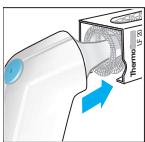
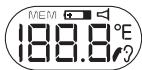
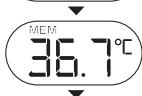
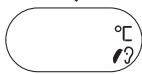
- To achieve accurate measurements, make sure a new, clean lens filter (2) is in place before each measurement.
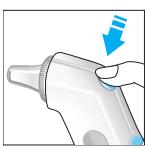
- To turn the thermometer on, push the «start» button (4).
During an internal self-check, the display shows all segments. Then the last temperature taken will be displayed together with «MEM».
As soon as this ready symbol appears, you can start the measuring process.
- Perform an ear tug to straighten the ear canal. This gives the thermometer a clear view of the eardrum.
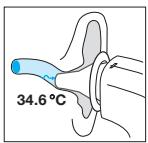
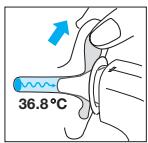
An ear tug is best performed by using your free hand to grasp the outer edge of the top half of the ear. To take your own temperature, wrap your free hand around the back of your head and tug your ear from behind.
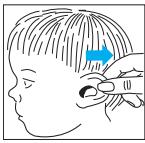

Children under 1 year: Pull the ear straight back.
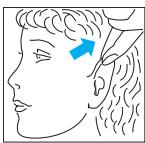
Children aged 1 year to adult: Pull the ear up and back.
- While tugging the ear, fit the probe (3) snugly into the ear canal, then push the «start» button (4). A short beep will signal the start of the measuring process.
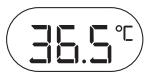
After one second a longer beep will signal the end of the measuring process. The result is shown on the display (6).
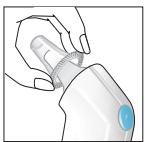
- For the next measurement, remove the used lens filter and put on a new, clean lens filter. Clear the display by pushing the "start" button once. Fit the probe snugly into the ear canal, then push the "start" button.
The Braun ThermoScan ear thermometer turns off automatically after 60 seconds of inactivity.
Temperature taking hints
- A measurement taken in the right ear may differ from the measurement taken in the left ear. Therefore, always take the temperature in the same ear.
- The ear must be free from obstructions or excess earwax build-up to take an accurate reading.
-
External factors may influence ear temperatures, including when an individual has:
-
been lying on one ear or the other
- had their ears covered
- been exposed to very hot or very cold temperatures, or
- been recently swimming or bathing.
In these cases, remove the individual from the situation and wait 20 minutes prior to taking a temperature.
- If ear drops or other ear medications have been placed in the ear canal of one ear, take the temperature in the untreated ear.
Care and cleaning
The probe tip is the most delicate part of the thermometer. It has to be clean and intact to ensure accurate readings.
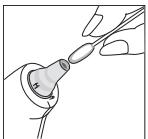
If the thermometer is accidentally used without a lens filter, clean the probe tip as follows:
Very gently wipe the surface with a cotton swab or soft cloth moistened with alcohol.
Once the alcohol has dried completely, a new lens filter can be put on and a temperature measurement taken. If the probe tip is damaged, contact Braun.
Use a soft, dry cloth to clean the thermometer display and product exterior. Do not use abrasive cleaners. Never submerge this thermometer in water or any other liquid.
Store the thermometer and lens filters in a dry location free from dust and contamination and away from direct sunlight.
Additional lens filters (LF 40) are available at most stores selling Braun ThermoScan.
Trouble-shooting
| Situation | Solution |
| No lens filter is attached. | Attach new, clean lens filter. |
| Ambient temperature is not within the allowed operating range (10-40 °C or 50-104 °F). | Allow the thermometer to remain for 30 minutes in a room where the temperature is between 10 and 40 °C or 50 and 104 °F. |
| HI LO = too high Temperature taken is not within typical human temperature range (34 - 42.2 °C or 93.2 - 108 °F). | Make sure the probe tip and lens are clean and a new, clean lens filter is attached. Make sure the thermometer is properly inserted. Then, take a new temperature. |
| System error If error persists, If error still persists, | Wait 1 minute until the thermometer turns off automatically, then turn on again. ... reset the thermometer by removing the battery and then replacing it again. ... call Braun Infoline (see page 2). |
| Battery is low, but thermometer will still operate correctly. | Insert new battery. |
| Battery is too low to take correct temperature measurement. | Insert new battery. |
| Do you have any further questions? | Call Braun Infoline (see page 2). |
Changing the temperature scale
Your Braun ThermoScan is delivered to you with the Celsius (^) temperature scale activated. If you wish to switch to Fahrenheit (^) , proceed as follows:
Make sure the thermometer is turned off. Press and hold down the «start» button. After about 8 seconds the display will show this sequence: «°C» / «F» / ...
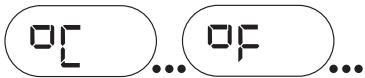
Release the «start» button when « F» is shown. There will be a short beep to confirm the new setting, the thermometer then turns off automatically.
Replacing the battery
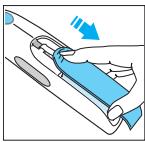
The thermometer is supplied with one 1.5 V type AAA (LR 03). For best performance, we recommend Duracell® alkaline batteries. Insert new battery when the battery symbol appears on the display.
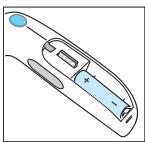
Open the battery compartment. Remove the battery and replace with new battery, making sure the poles are in the right direction. Slide battery door back until it snaps in place.

To protect the environment, dispose of empty batteries at appropriate collection sites according to national or local regulations.
Calibration
The thermometer is initially calibrated at the time of manufacture. If this thermometer is used according to the use instructions, periodic readjustment is not required. If at any time you question the accuracy of temperature measurements, please contact Braun Infoline (see page 2).
Manufacturing date is given by the LOT number located in the battery compartment. The first number after LOT represents the last digit of the year of manufacture.
The last two digits give the week of manufacture. An example: LOT 503 - this product has been manufactured in the week 03 of the year 2005.
Product specifications
Displayed temperature range:
34^ - 42.2^ (93.2°F-108°)
Operating ambient temperature range:
10^ - 40^ (50^ - 104^)
Display resolution:
0.1^ or ^ F
Accuracy for displayed temperature range:
± 0.2^ (35.5-42°C) (95.9-107.6°F)
± 0.3^ (outside this temperature range)
Clinical repeatability:
± 0.25^ ( ± 0.45^)
Humidity:
≤ 95% non-condensing
Battery life:
2 years / 1000 measurements
If device is not used within specified temperature and humidity ranges the technical accuracy can not be ensured.

Type BF equipment
Subject to change without notice.
This appliance conforms to the following standards:
DIN EN 60601-1:3/96 «Medical electrical
equipment» -
Part 1: General requirements for safety
DIN EN 12470-5: 2003 «Clinical thermometers» -
Part 5: Performance of infrared ear thermometers
(with maximum device)
This product conforms to the provisions of the EC directive 93/42/EEC (Medical Device Directive).

MEDICAL ELECTRICAL EQUIPMENT needs special precautions regarding EMC. For detailed description of EMC requirements please contact the Braun Infoline (see page 2).
Portable and mobile RF communications equipment can affect MEDICAL ELECTRICAL EQUIPMENT.
Please do not dispose of the product in the household waste at the end of its useful life. Disposal can take place at a Braun Service Centre or at appropriate collection points provided in your country.

François
Temperature with an Infrared Emission Detection Thermometer, Annals of Emergency Medicine, Janvier 1995.
Temperature with an Infrared Emission Detection Thermometer, Annals of Emergency Medicine, Enero 1995.
- Chamberlain, J.M., Terndrup, T.E., New Light on Ear Thermometer Readings, Contemporary Pediatrics, March 1994.
- Chamberlain, J.M., et al., Determination of Normal Ear
Temperature with an Infrared Emission Detection Thermometer, Annals of Emergency Medicine, January 1995.