
OVATOR S-600 - Speaker NAIM - Free user manual and instructions
Find the device manual for free OVATOR S-600 NAIM in PDF.



| Product Type | Floorstanding speaker |
| Brand | NAIM |
| Model | OVATOR S-600 |
| Dimensions (H x W x D) | 1168 mm x 401 mm x 434 mm (including spikes and grilles) |
| Weight | 61 kg per speaker |
| Frequency Response | 28 Hz - 35 kHz (in room) |
| Sensitivity | 88 dB @ 1 m for 2.83 V |
| Nominal Impedance | 4 Ohms (minimum 3.2 Ohms) |
| Recommended Amplifier | 25 - 150 W (into 8 Ohms) |
| Finish | Cherry, Maple, Zebrano, Rosewood |
| Driver Type | BMR (Balanced Mode Radiator) module with dual leaf spring suspension |
| Filtering | Passive, convertible to active with Naim active filters |
| Connectors | Special terminals for Naim connectors, compatible with 4 mm plugs |
| Recommended Cable | Naim speaker cable, identical length 3.5 to 20 m |
| Decoupling Spikes | 4 adjustable spikes with 4 mm Allen key and 13 mm lock nut |
| BMR Transport Screws | 2 screws to remove before use, 5 mm Allen key |
| Magnetic Shielding | Unshielded, keep away from CRT screens |
| Safety Standards | EN 60065 |
| EMC Standards | EN 55013 (emissions), EN 55020 (immunity) |
| European Compliance | 2006/95/EC, 2004/108/EC, 2002/95/EC (RoHS), 2002/96/EC (WEEE) |
Frequently Asked Questions - OVATOR S-600 NAIM
User questions about OVATOR S-600 NAIM
0 question about this device. Answer the ones you know or ask your own.
Ask a new question about this device
Download the instructions for your Speaker in PDF format for free! Find your manual OVATOR S-600 - NAIM and take your electronic device back in hand. On this page are published all the documents necessary for the use of your device. OVATOR S-600 by NAIM.
USER MANUAL OVATOR S-600 NAIM
OVATOR S-600 - English
Introduction and Unpacking
The Ovator S-600 is a very high performance product that will repay effort spent on installation. It is important that you read this manual before fully unpacking and installing your speakers. The manual begins with unpacking instructions. Ovator loudspeakers are extremely heavy and to minimise the risk of damage to the speaker or personal injury you should follow these instructions carefully. Unpacking and installing Ovator loudspeakers is a two-person task and should not be attempted alone.
1 Unpacking
It is important that Ovator loudspeakers are unpacked as described in the following paragraphs and illustrations.
They should be unpacked in the room in which they are to be used and close to their likely installed positions.
Having removed this manual proceed to unpack each Ovator following the steps below:
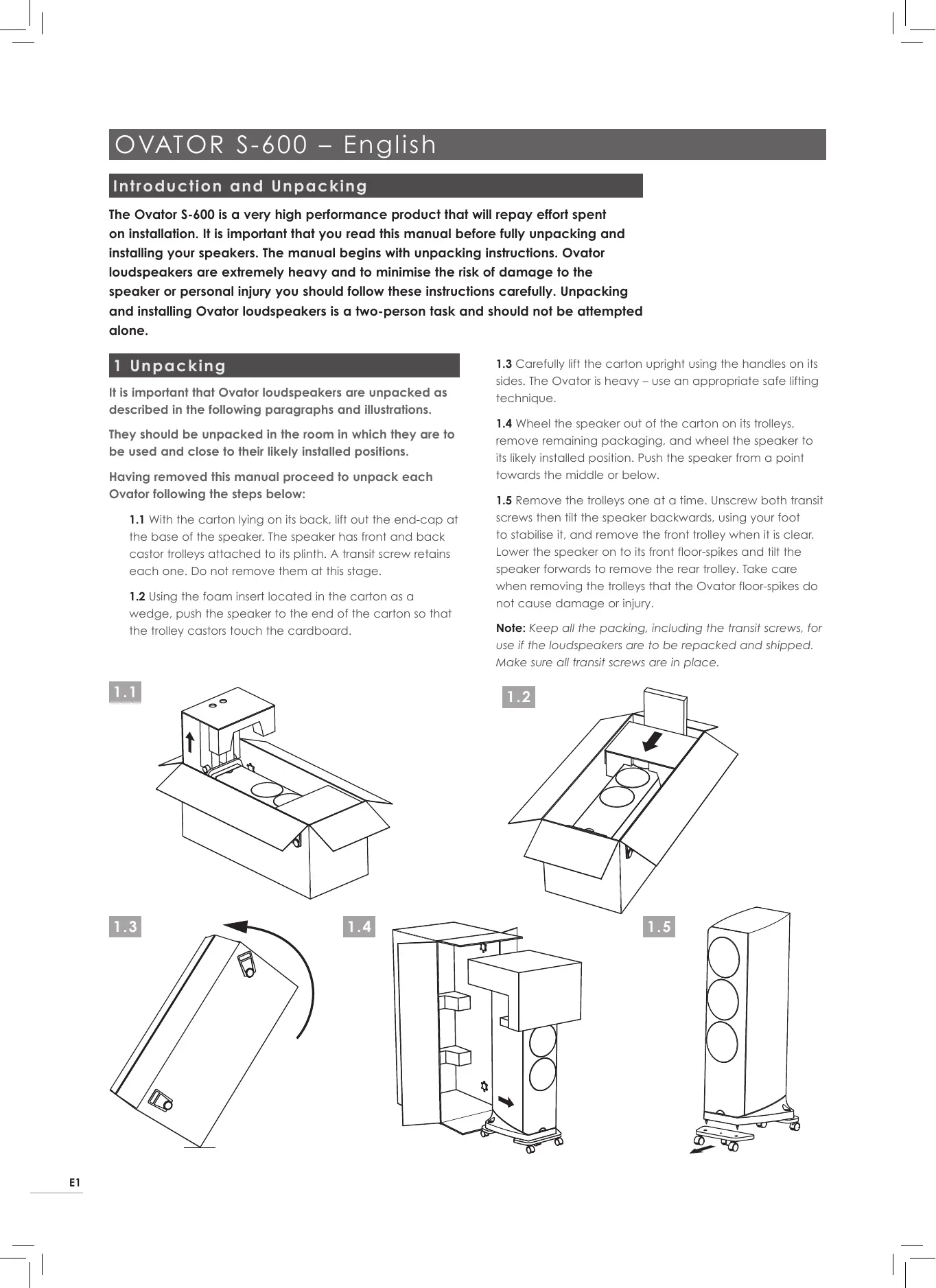
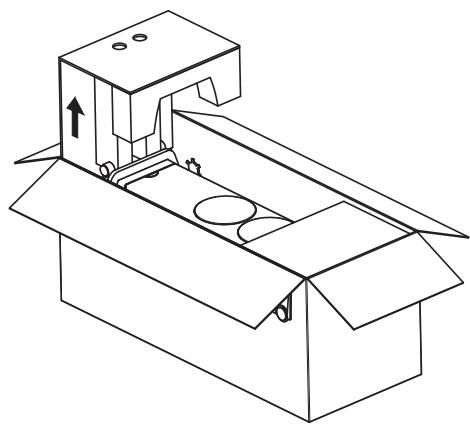
1.1 With the carton lying on its back, lift out the end-cap at the base of the speaker. The speaker has front and back castor trolleys attached to its plinth. A transit screw retains each one. Do not remove them at this stage.
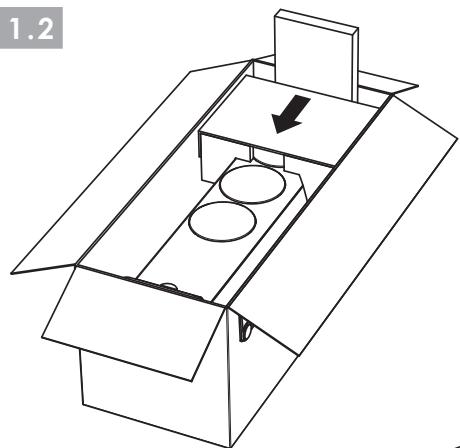
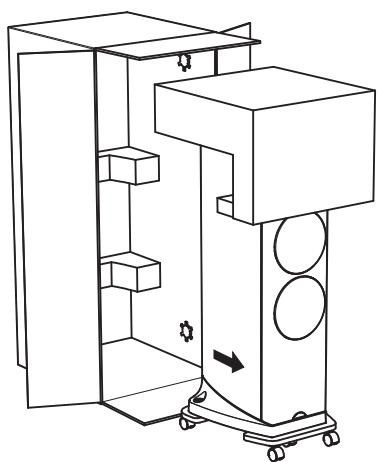
1.2 Using the foam insert located in the carton as a wedge, push the speaker to the end of the carton so that the trolley castors touch the cardboard.
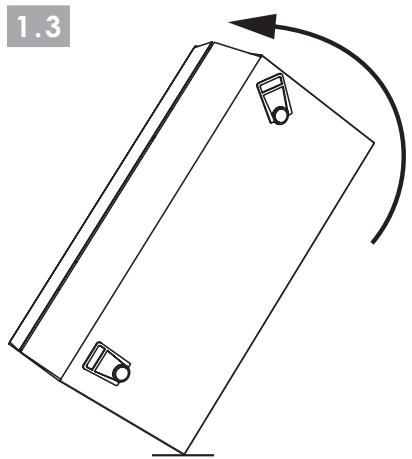
1.3 Carefully lift the carton upright using the handles on its sides. The Ovator is heavy - use an appropriate safe lifting technique.
1.4 Wheel the speaker out of the carton on its trolleys, remove remaining packaging, and wheel the speaker to its likely installed position. Push the speaker from a point towards the middle or below.
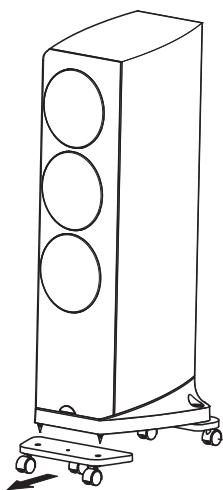
1.5 Remove the trolleys one at a time. Unscrew both transit screws then tilt the speaker backwards, using your foot to stabilise it, and remove the front trolley when it is clear. Lower the speaker on to its front floor-spikes and tilt the speaker forwards to remove the rear trolley. Take care when removing the trolleys that the Ovator floor-spikes do not cause damage or injury.
Note: Keep all the packing, including the transit screws, for use if the loudspeakers are to be repacked and shipped. Make sure all transit screws are in place.
1.1
1.2
1.3
1.4
1.5
OVATOR S-600 - English
2 Installation
Once the Ovator loudspeakers are fully unpacked they may be manoeuvred if necessary into their initial working positions. Take care when manoeuvring Ovator loudspeakers that the floor-spikes do not cause damage or personal injury. Do not remove the Ovator BMR transit screws until the speakers are installed in their final positions.
Positioning guidelines are provided in the following section but you should be prepared to make positioning adjustments as the speakers "run-in" and as you become more familiar with them.
The Ovator loudspeaker is not magnetically shielded and should be kept well away from CRT displays and other magnetically sensitive items.
2.1 Positioning
The performance of any loudspeaker will be influenced by the room and position in which it is located. Even small changes of loudspeaker position can significantly influence the sound. Changes of room contents, the introduction of significant piece of furniture for example, can also have an effect.
The following paragraphs constitute only a general guide to Ovator positioning. Every listening room is different and you may find an alternative positioning solution works best in yours.
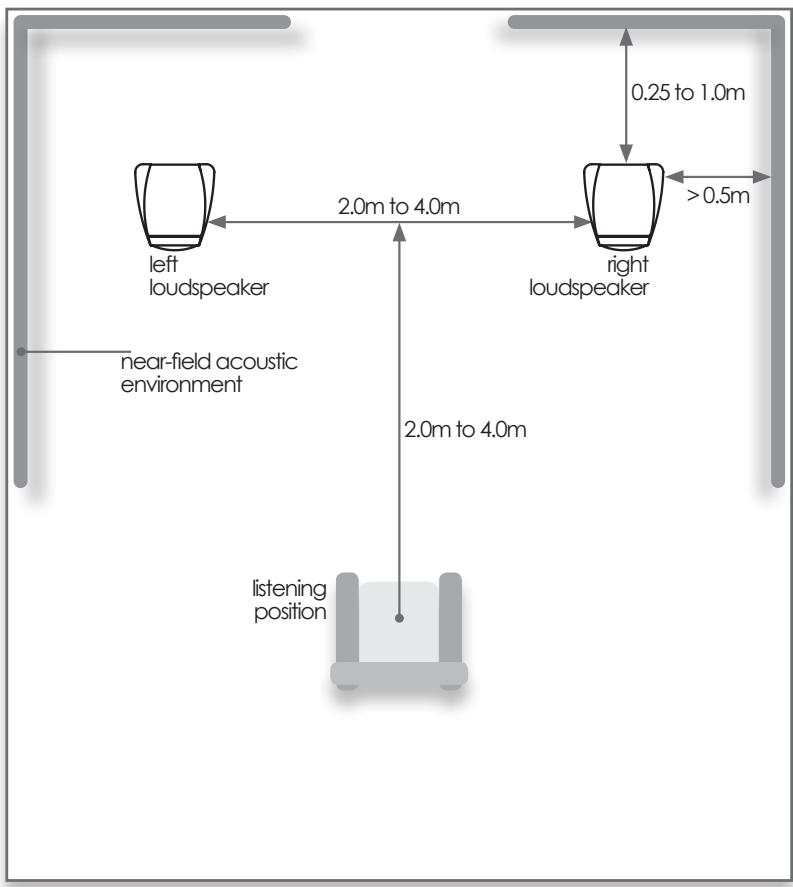
In general, try to choose a site for the Ovator loudspeakers where they are located between 2.0 metres and 4.0 metres apart, clear of room corners, and where each one is between 0.25 metres and 1.0 metre away from a solid rear wall. The distance between the speakers and the rear wall is the aspect of positioning most likely to require adjustment as the speakers run-in and you become familiar with their performance in your room.
If the Ovator is moved closer to the rear wall the low frequency elements of music will become more prominent. However this may be at the expense of bass clarity and timing.
Note: There is no need to angle the Ovator inwards towards the listening position but doing so may be a useful fine-tuning adjustment.
The primary listening position should be central between the loudspeakers approximately the same distance away as they are apart.
Try to position each Ovator within a similar "near-field" acoustic environment and with similar acoustic characteristics along the side walls towards the listening position.
Note: Different near-field acoustic environments and characteristics would be created by, for example, heavy curtains and glass windows, or a plasterboard wall with and without bookshelves.
Diagram 2.2 illustrates the positioning guidelines described above.
2.2 Room Layout
OVATOR S-600 - English
2.3 Using Floor-spikes
The Ovator is fitted with floor-spikes to define its mechanical interface with the structure of the listening room. The floor-spikes should be adjusted to ensure that the speakers are upright and do not rock.
All four floor-spikes are adjustable, however adjustment of the rear floor-spikes is easier thanks to the top access provided by the Ovator plinth design. To adjust a rear floor-spike first remove the locking set-screw with the 4mm Allen key supplied. Then insert the Allen key from above to turn the adjustment screw clockwise to lengthen the floor-spike
2.4 Adjusting Floor-spikes

and anti-clockwise to shorten the floor-spike. If necessary, to stop the floor-spike from turning when re-tightening the locking set-screw, insert the supplied tommy-bar in the floor-spike through-hole. Diagram 2.4 illustrates rear floor-spike adjustment.
Depending on the thickness of any carpet, the front floor-spikes may not need any adjustment. If adjustment is required however, loosen the lock nut using a 13mm spanner and turn the floor-spike as appropriate using the supplied tommy-bar inserted in the floor-spike through-hole. Re-tighten the lock-nut when adjustment is complete. Diagram 2.4 illustrates front floor-spike adjustment.
Note: If Ovator loudspeakers are to be installed on a non-carpeted floor, the floor-spikes should be used in conjunction with Naim Floor Protectors and adjusted so that the tip of the floor-spike extends just beyond the lock nut. Your Naim retailer or distributor will be able to supply Floor Protectors.
2.5 BMR Transit Screws
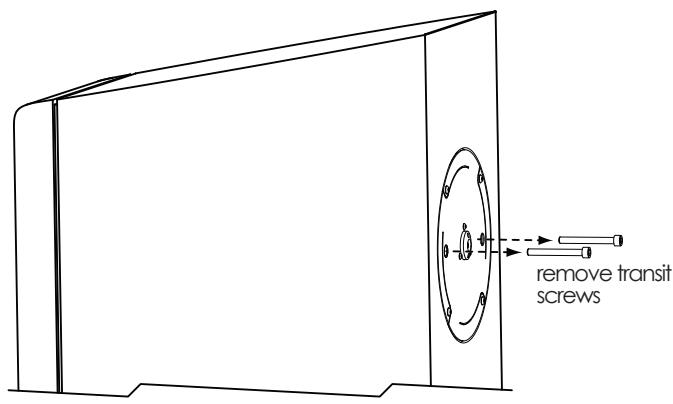
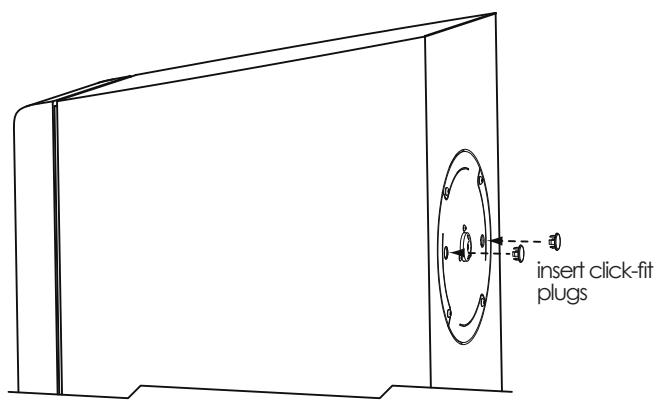
The Ovator BMR (balanced mode radiator) module is fitted with a twin leaf-spring suspension system. The suspension system is restrained during shipping by two transit screws that must be released before use. The transit screws are located on the rear face of the speaker directly behind the BMR.
Use the supplied 5mm Allen key to unscrew the transit screws. Remove the screws and store them safely. Two click-fit plastic plugs are supplied to cover the holes left once the screws have been removed. Diagram 2.6 illustrates removal of the transit screws.
Note: The transit screws must be replaced if the loudspeakers are to be repacked and shipped. Tighten the screws sufficiently to restrain the suspension system.
2.6 Transit Screw Removal
OVATOR S-600 - English
3 Connecting
Ovator loudspeakers incorporate a passive crossover but can be converted for use in active systems using the appropriate Naim active crossover and multiple amplifiers. Contact your local retailer or distributor for more information.
3.1 Cables and Connectors
If the Ovator is to be used with Naim amplification, Naim loudspeaker cable will produce the best results and is necessary with some amplifiers. Cable lengths to both loudspeakers should be equal and be between 3.5 metres and 20 metres. If the position of a speaker in relation to the amplifier results in spare cable do not coil the cable but lay it out back and forth between the amplifier and speaker.
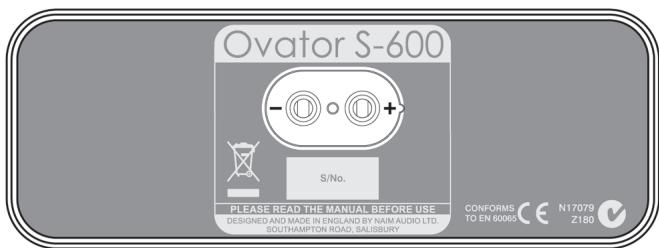
The Ovator connection terminals are designed to accept the custom-designed Ovator speaker connector. This connector is designed to provide the best possible performance. Other 4mm plugs can be used however the results will be unpredictable. Your retailer will be able to make up speaker cables terminated on one end by the Ovator connector and on the other end by a connector appropriate to the driving amplifier.
3.2 Connection Polarity
It is important that Ovator loudspeakers are connected with the correct polarity. Ensure that the positive terminal on the speaker (marked +) is connected to the positive output terminal on the amplifier and the negative terminal on the speaker (marked -) is connected to the negative output terminal on the amplifier. Diagram 3.3 illustrates the Ovator connection panel.
Note: Naim speaker cable has a rib running down one side to aid polarity identification. The positive side of Naim speaker plugs have a small protrusion for identification.
3.3 Ovator Connection Panel
4 Specifications
Frequency response: 28Hz - 35kHz (in room)
Sensitivity: 88dB @ 1m for 2.83V input
Nominal impedance: 4 Ohms (minimum impedance 3.2 Ohms)
Suggested power amplifier: 25 - 150W (8 Ohm rating)
Weight: 61 kg
Dimensions H x W x D: 1168mm x 401mm x 434mm (Including floor-spikes and grilles)
Finish options: Cherry, Maple, Zebrano, Rosewood
5 Conformance To Appropriate Standards
Manufacturer: Naim Audio Limited, Southampton Road, Salisbury, England, SP1 2LN
Product: Ovator S-600
Safety: EN 60065 - Audio, Video and similar electronic apparatus.
EMC Emissions: EN 55013 - Sound and television broadcast receivers and associated equipment - Radio disturbance characteristics - Limits and methods of measurements.
EMC Immunity: EN 55020 - Sound and television receivers and associated equipment - Immunity Characteristics - Limits and methods of measurement.
In accordance with European Directives: 2006/95/EC - Safety, 2004/108/EC - EMC, 2002/95/EC (RoHS), 2002/96/EC (WEEE)
OVATOR S-600 - Deutsch
Allgemeines
Fabricant : Naim Audio Limited, Southampton Road, Salisbury, England, SP1 2LN
Naim Audio Limited, Southampton Road, Salisbury, England, SP1 2LN
Prodotto:
Ovator S-600
Sicurezza:
2002/95/CE - (RoHS), 2002/96/CE - (WEEE)
- OVATOR S-600 - English
- Introduction and Unpacking
- Unpacking
- Installation
- Positioning
- Using Floor-spikes
- Adjusting Floor-spikes
- BMR Transit Screws
- Transit Screw Removal
- Connecting
- Cables and Connectors
- Connection Polarity
- Ovator Connection Panel
- Specifications
- Conformance To Appropriate Standards
- OVATOR S-600 - Deutsch
- Allgemeines
Brand : NAIM
Model : OVATOR S-600
Category : Speaker