
RMB-1066 - Audio Amplifier ROTEL - Free user manual and instructions
Find the device manual for free RMB-1066 ROTEL in PDF.


| Product Type | 6-Channel Power Amplifier |
| Brand | Rotel |
| Model | RMB-1066 |
| Dimensions (W x H x D) | 430 x 121 x 435 mm |
| Net Weight | 13.5 kg |
| Power Supply | 115 V/60 Hz or 230 V/50 Hz (depending on version) |
| Power Consumption | 700 W |
| Output Power (stereo mode, 8 Ω, 20-20 kHz, THD < 0.03 %) | 60 W per channel |
| Output Power (bridged mono mode, 8 Ω, 20-20 kHz, THD < 0.1 %) | 150 W per channel |
| Total Harmonic Distortion (20-20 kHz, 8 Ω) | < 0.03 % |
| Frequency Response (± 1 dB) | 15 Hz - 100 kHz |
| Damping Factor (20-20 kHz, 8 Ω) | 150 |
| Signal-to-Noise Ratio (A-weighted IHF) | 116 dB |
| Input Impedance | 22 kΩ |
| Input Sensitivity | 1.5 V |
| Speaker Impedance (stereo mode) | 4 Ω minimum |
| Speaker Impedance (bridged mono mode) | 8 Ω minimum |
| Main Features | 6-channel amplification, pair bridging, power mode selector (manual, signal sensing, 12 V trigger), input gain controls, protection indicators, signal loop output |
| Maintenance and Cleaning | Clean with a dry cloth or vacuum cleaner. Do not use liquids. |
| Safety | No user-serviceable parts inside. Do not block ventilation slots (minimum 10 cm clearance around). Avoid moisture and foreign objects. Disconnect during prolonged non-use. |
| Spare Parts and Repairability | Contact an authorized Rotel dealer for any service. Keep the original packaging for transport. |
| General Information | Amplifier designed for music and home theater. Balanced Design technology, toroidal transformers. Warranty and after-sales service by Rotel. |
Frequently Asked Questions - RMB-1066 ROTEL
User questions about RMB-1066 ROTEL
0 question about this device. Answer the ones you know or ask your own.
Ask a new question about this device
Download the instructions for your Audio Amplifier in PDF format for free! Find your manual RMB-1066 - ROTEL and take your electronic device back in hand. On this page are published all the documents necessary for the use of your device. RMB-1066 by ROTEL.
USER MANUAL RMB-1066 ROTEL
This symbol is to alert the user to the presence of uninsulated dangerous voltages inside the product's enclosure that may constitute a risk of electric shock.

This symbol is to alert the user to important operating and maintenance (service) instructions in this manual and literature accompanying the product.
WARNING: There are no user serviceable parts inside. Refer all servicing to qualified service personnel.
WARNING: To reduce the risk of fire or electric shock, do not expose the unit to moisture or water. Do not allow foreign objects to get into the enclosure. If the unit is exposed to moisture, or a foreign object gets into the enclosure, immediately disconnect the power cord from the wall. Take the unit to a qualified service person for inspection and necessary repairs.
Read all the instructions before connecting or operating the component. Keep this manual so you can refer to these safety instructions.
Heed all warnings and safety information in these instructions and on the product itself. Follow all operating instructions.
Clean the enclosure only with a dry cloth or a vacuum cleaner.
You must allow 10cm or 4 inches of unobstructed clearance around the unit. Do not place the unit on a bed, sofa, rug, or similar surface that could block the ventilation slots. If the component is placed in a bookcase or cabinet, there must be ventilation of the cabinet to allow proper cooling.
Keep the component away from radiators, heat registers, stoves, or any other appliance that produces heat.
The unit must be connected to a power supply only of the type and voltage specified on the rear panel of the unit.
Connect the component to the power outlet only with the supplied power supply cable or an exact equivalent. Do not modify the supplied cable in any way. Do not attempt to defeat grounding and/or polarization provisions. Do not use extension cords.
Do not route the power cord where it will be crushed, pinched, bent at severe angles, exposed to heat, or damaged in any way. Pay particular attention to the power cord at the plug and where it exits the back of the unit.
The power cord should be unplugged from the wall outlet if the unit is to be left unused for a long period of time.
Immediately stop using the component and have it inspected and/or serviced by a qualified service agency if:
- The power supply cord or plug has been damaged.
- Objects have fallen or liquid has been spilled into the unit.
The unit has been exposed to rain. - The unit shows signs of improper operation
- The unit has been dropped or damaged in any way
Place the unit on a fixed, level surface strong enough to support its weight. Do not place it on a moveable cart that could tip over.

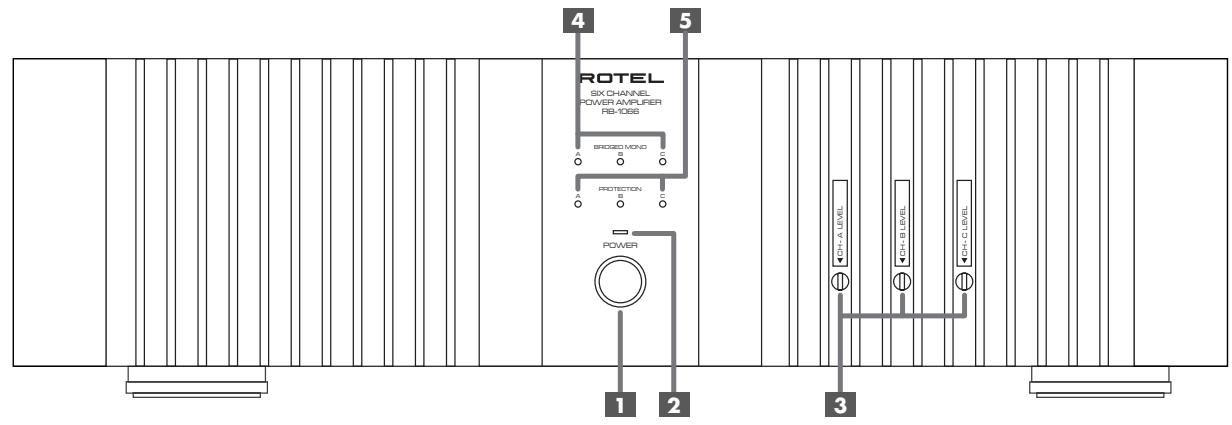
Figure 1: Controls and Connections
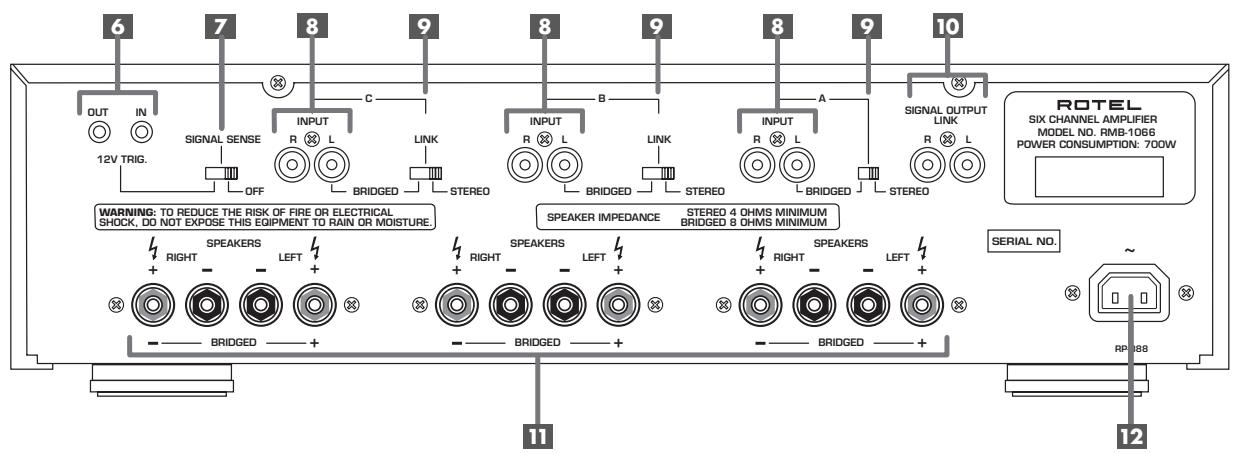
Figure 2: Stereo Connections
Branchements stereo
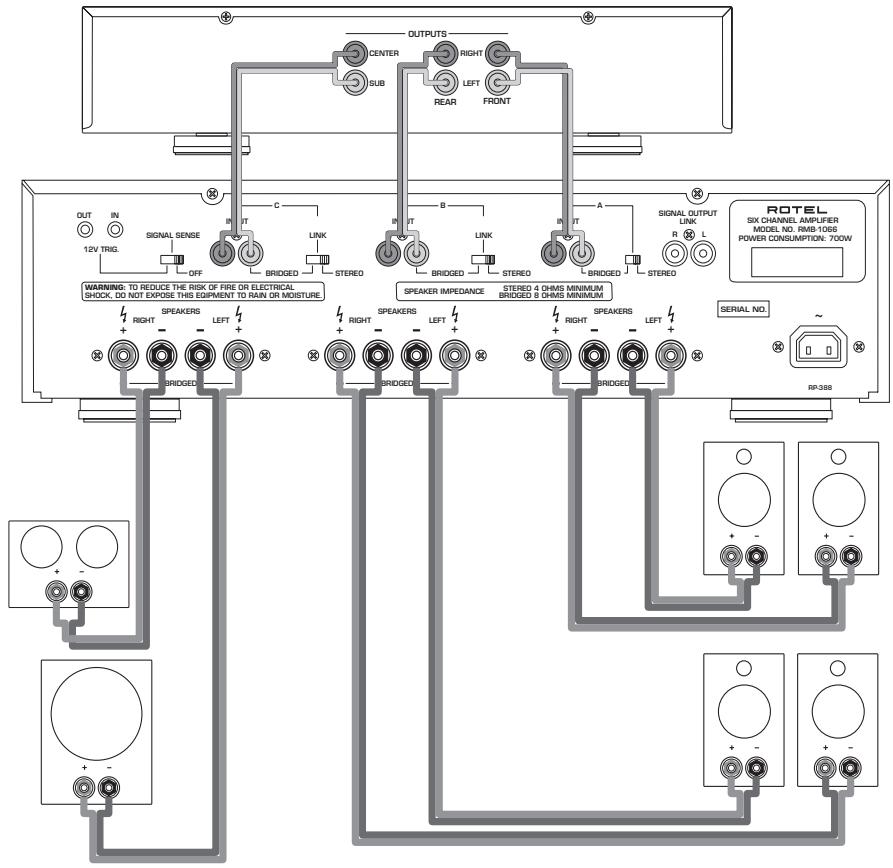
Figure 3: Bridged Connections
Figure 1: Controls and Connections 3
Figure 2: Stereo Connections 4
Figure 3: Bridged Connections 4
About Rotel 5
Getting Started 5
Operating Features 5
A Few Precautions 5
Placement 5
AC Power and Control 6
AC Power Input 12 6
Power Switch and Indicator 1 2
Auto Turn On/Off Mode Selector 6
+12V Trigger Input and Output 6
Protection Indicators 5 6
Stereo/Bridged Mono Mode Selection .... 7
Input Select Switches 9
Bridged Mono LEDs 4 7
Signal Connections 7
RCA Inputs 8 7
Input Level Controls 3 7
Signal Output Link 10 7
Speakers 7
Speaker Selection 7
Speaker Wire Selection 7
Polarity and Phasing 8
Speaker Connections 8
Troubleshooting 8
Front Panel Power Indicator Is Not Lit 8
No Sound 8
Protection Indicator Is Lit 8
Specifications 9
About Rotel
A family whose passionate interest in music led them to manufacture high fidelity components of uncompromising quality founded Rotel over 40 years ago. Over the years that passion has remained undiminished and the goal of providing exceptional value for audiophiles and music lovers regardless of their budget, is shared by all Rotel employees.
The engineers work as a close team, listening to, and fine tuning each new product until it reaches their exacting musical standards. They are free to choose components from around the world in order to make that product the best they can. You are likely to find capacitors from the United Kingdom and Germany, semiconductors from Japan or the United States, and toroidal power transformers manu-factured in Rotel's own factory.
Rotel's reputation for excellence has been earned through hundreds of good reviews and awards from the most respected reviewers in the industry, who listen to music every day. Their comments keep the company true to its goal - the pursuit of equipment that is musi cal, reliable and affordable.
All of us at Rotel thank you for buying this product and hope it will bring you many hours of enjoyment.
Getting Started
Thank you for purchasing the Rotel RMB-1066 Six-Channel Power Amplifier. When used in a high-quality music or home theater system, your Rotel amplifier will provide years of musical enjoyment.
The RMB-1066 is a sophisticated six-channel power amplifier. Discrete output devices, a massive power supply with toroidal transformer, premium components, and Rotel's Balanced Design ensure superb sound quality. High current capability allows the RMB-1066 to drive difficult speaker loads with ease.
Operating Features
- Three pair of amplifier channels, any of which can be bridged for mono operation (back panel switchable). Possible configurations: 6, 5, 4, or 3 channel operation.
- User selectable power on/off configuration: manual, automatic signal sensing, or controlled by remote 12 volt trigger signal.
- Front panel input level controls.
- Front panel LEDs indicate Bridged Mono mode for each pair of amplifier channels.
- Protection circuitry with front panel indicators.
- Signal link output to pass-through the input signal to another component.
A Few Precautions
Please read this manual carefully. In addition to installation and operating instructions, it provides information on various RMB-1066 system configurations. Please contact your authorized Rotel dealer for answers to any questions you might have. In addition, all of us at Rotel welcome your questions and comments.
Save the RMB-1066 shipping carton and packing material for future use. Shipping or moving the RMB-1066 in anything other than the original packing material may result in severe damage to your amplifier.
Be sure to keep the original sales receipt. It is your best record of the date of purchase, which you will need in the event warranty service is ever required.
Placement
The RMB-1066 generates heat as part of its normal operation. The heat sinks and ventilation openings in the amplifier are designed to dissipate this heat. The ventilation slots in the top cover must be unobstructed. There should be 10cm (4 inches) of clearance around the chassis, and reasonable airflow through the installation location, to prevent the amplifier from overheating. Likewise, remember the weight of the amplifier when you select an installation location. Make sure that the shelf or cabinet can support its weight.
AC Power and Control
AC Power Input 12
The RMB-1066 is supplied with the proper AC power cord. Use only this cord or an exact equivalent. Do not use an extension cord. A heavy duty multi-tap power outlet strip may be used, but only if it is rated to handle the current demand of the RMB-1066.
Be sure the Power Switch on the front panel of the RMB-1066 is turned off. Then, plug one end of the cord into the AC power connector 12 on the back panel of the amplifier. Plug the other end into an appropriate AC outlet.
Your RMB-1066 is configured at the factory for the proper AC line voltage in the country where you purchased it (USA: 115 volts/60 Hz, Europe: 230 volts/50 Hz). The AC line configuration is noted on a label on the back panel.
NOTE: Should you move your RMB-1066 to another country, it is possible to configure your amplifier for use on a different line voltage. Do not attempt to perform this conversion yourself. Opening the enclosure of the RMB-1066 exposes you to dangerous voltages. Consult a qualified technician or the Rotel factory service department for information.
If you are going to be away from home for an extended period of time, it is a sensible precaution to unplug your amplifier.
Power Switch and Indicator 1 2
The Power Switch is located on the front panel. To turn the amplifier on (or to activate either of the optional automatic power-on modes), push the switch in. The LED indicator above the switch will light, indicating that the amplifier is turned on. To turn the amplifier off, push the button again and return it to the out position.
Auto Turn On/Off Mode Selector 7
The RMB-1066 provides three options for manual or automatic power on/off operation. These modes are selectable using a three-position slide switch on the back panel:
- With the switch in the OFF position, the amplifier is turned on or off manually using the front panel power switch. Use this mode if you are using a switched AC outlet to control power to the amplifier.
- With the switch in the SIGNAL SENSING position, the amplifier turns on automatically when a signal is sensed at the inputs. The amplifier will go into standby mode after five minutes with no signal. The front panel power switch overrides this function. It must be ON for the signal sensing to work. Turning the switch OFF cuts power to the amplifier, regardless of whether or not a signal is present.
- With the switch in the +12VTRIG position, the amplifier is turned on automatically when a 12 volt trigger signal is applied to the 3.5mm Jack to the left of the switch. The amplifier will go into standby mode after 5 minutes with no signal if the +12V signal is not present. The front panel POWER SWITCH overrides this function. It must be ON for the +12V trigger to work. Turning the switch OFF cuts power to the amplifier, regardless of whether or not a trigger signal is present.
+12V Trigger Input and Output 6
The jack labeled IN is for connecting the 3.5mm Plug/Cable carrying a +12 volt trigger signal to turn the amplifier on and off. To use this feature the adjacent slide switch must be placed to the left position (see previous section). This input accepts any control signal (AC or DC) ranging from 3 volts to 30 volts.
The jack labeled OUT is for connecting another 3.5mm plug/cable to provide a 12V trigger signal to other components. The 12V output signal is available whenever a +12 volt trigger signal is applied to the IN connector.
Protection Indicators 5
Thermal and protection circuits protect the amplifier against potential damage in the event of extreme or faulty operating conditions. Unlike many designs, the RMB-1066's protection circuit is independent of the audio signal and has no impact on sonic performance. Instead, the protection circuit monitors the temperature of the output devices and shuts down the amplifier if safe limits are exceeded.
In addition, the RMB-1066 includes overcurrent protection which operates only when load impedances drop too low. This protection is independent for each of the three pair of channels with separate front panel PROTECTION LEDs for each.
Should a faulty condition arise, the amplifier will stop playing and one or more of the PROTECTION LEDs on the front panel will light.
If this happens, turn the amplifier off, let it cool down for several minutes, and attempt to identify and correct the problem. When you turn the amplifier back on, the protection circuit will automatically reset and the PROTECTION LEDs should go out.
In most cases, the protection circuitry activates because of a fault condition such as shorted speaker wires, or inadequate ventilation leading to an overheating condition. In very rare cases, highly reactive or extremely low impedance speaker loads could cause the protection circuit to engage.
Stereo/Bridged Mono Mode Selection
It is useful to think of the RMB-1066 as three stereo amplifiers in a single chassis. Each of the three pair of amplifier channels can be operated in Stereo or Bridged Mono mode.
- Stereo mode: Conventional 2-channel stereo operation for a pair of amplifier channels. Minimum speaker load: 4 ohms.
- Bridged Mono mode: Bridged Mono mode more than doubles the power into a single speaker. Minimum speaker load: 8 ohms.
The two modes are selected by three rear panel switches, one for each pair of channels. Stereo or Bridged Mono configuration is independent for each pair of channels. You can configure some pairs of channels in Stereo mode and others in Bridged Mono mode.
Input Select Switches 9 Bridged Mono LEDs 4
A rear panel switch adjacent to the inputs selects Stereo mode or Bridged Mono mode for each of the three pair of amplifier channels.
For Stereo mode: Slide the switch associated with the desired pair of amplifier channels to the right, use both LEFT and RIGHT input connectors, and connect one speaker to each pair of speaker connectors.
NOTE: For groups "B" and/or "C", you can also place the INPUT SELECT switch in the center LINK position for Stereo mode. This routes the input signals from the "A" group to the inputs for that pair of amplifier channels.
For Bridged Mono mode: Slide the switch to the left, use only the LEFT INPUT connection, and connect only one speaker to the two outer speaker connectors. The BRIDGED MONO LED will light to indicate Bridged Mono mode.
Signal Connections
The RMB-1066 provides standard conventional input connections — unbalanced RCA type connections as found on nearly all audio equipment.
There is also a pair of SIGNAL OUTPUT LINK connections for passing the input signal connected to the "A" pair of channels on to another audio component. Additionally, the input signal to the "A" pair of channels can be automatically linked to the inputs for the "B" and/or "C" channels, so that a separate input signal cable is not required for those channels, for example in large systems where the RMB-1066 is being used to drive multiple pairs of speakers in stereo mode.
RCA Inputs 8
See Figures 2 and 3
There are two RCA inputs for each of the three pair of amplifier channels. These RCA inputs accept audio signals from preamplifiers or surround sound processors. Use high quality audio interconnect cables for best performance.
NOTE: You can link the inputs for group "A" to groups "B" and/or "C" by placing the INPUT SELECT switch in the center LINK position. No input connection is required for that group. Placing the switch in this position leaves that pair of channels in Stereo mode.
For Bridged Mono operation, use only the LEFT INPUT for that pair of amplifier channels. Connect one output channel of your preamp to the LEFT INPUT on the RMB-1066. Make sure that the INPUT SELECT SWITCH selector switch is in the BRIDGED position.
Input Level Controls 3
Three controls on the front panel, one for each pair of amplifier channels, provide input level adjustments. These allow you to adjust the gain of the amplifiers to match other components in an elaborate system.
Use a small flat blade screwdriver to turn the control clockwise to increase gain. Turn the control counterclockwise to reduce gain.
Signal Output Link 10
This pair of RCA connections can be used to pass unprocessed input signals to another audio component, for example to "daisy-chain" an additional amplifier to drive a second set of speakers.
The input signals connected to the "A" inputs are always available at SIGNAL OUTPUT LINK connections. These input signals can also be linked to the "B" and/or "C" inputs by playing the INPUT SELECT switch associated with that pair of inputs in the LINK position.
Speakers
The RMB-1066 has three groups of speaker connectors, one for each pair of amplifier channels. These can be used to connect two loudspeakers in Stereo mode, or to connect one loudspeaker in Bridged Mono mode.
Speaker Selection
The nominal impedance of the loudspeaker(s) connected to the RMB-1066 in the various operating modes should be:
- Stereo mode: minimum 4 ohms
- Bridged Mono mode: minimum 8 ohms When driving multiple pairs of speakers connected in parallel to a single amplifier channel, the effective impedance the amplifier sees is cut in half. For example, when driving two 8 ohm speakers, the amplifier sees a 4 ohm load. When driving multiple speakers in parallel, select speakers with a nominal impedance of 8 ohms or higher.
Speaker Wire Selection
Use insulated two-conductor stranded wire to connect the RMB-1066 to the speakers. The size and quality of the wire can have an audible effect on the performance of the system. Standard speaker wire will work, but can result in lower output or diminished bass response, particularly over longer distances. In general, heavier wire will improve the sound. For best performance, you may want to consider special high-quality speaker cables. Your authorized Rotel dealer can help in the selection of appropriate cables for your system.
Polarity and Phasing
The polarity – the positive/negative orientation of the connections – for every speaker and amplifier connection must be consistent so all the speakers will be in phase. If the polarity of one connection is mistakenly reversed, bass output will be very weak and stereo imaging degraded. All wire is marked so you can identify the two conductors. There may be ribs or a stripe on the insulation of one conductor. The wire may have clear insulation with different color conductors (copper and silver). There may be polarity indications printed on the insulation. Identify the positive and negative conductors and be consistent with every speaker and amplifier connection.
Speaker Connections
See Figures 2 & 3
The RMB-1066 has two pair of color coded connections for each group of amplifier channels. Labels above the connectors show the proper connections for connecting speakers in Stereo mode. Labels below show the proper connections for Bridged Mono mode.
These speaker connectors accept bare wire, connector lugs, or "banana" type connectors (except in the European Community countries where their use is not permitted).
Route the wires from the RMB-1066 to the speakers. Give yourself enough slack so you can move the components to allow access to the speaker connectors.
If you are using banana plugs, connect them to the wires and then plug into the backs of the speaker connectors. The collars of the speaker connectors should be screwed in all the way (clockwise).
If you are using terminal lugs, connect them to the wires. If you are attaching bare wires directly to the speaker connectors, separate the wire conductors and strip back the insulation from the end of each conductor. Be careful not to cut into the wire strands. Unscrew (turn counterclockwise) the speaker connector collar. Place the connector lug around the shaft, or insert the bundled wire into the hole in the shaft. Turn the collars clockwise to clamp the connector lug or wire firmly in place.
NOTE: Be sure there are no loose wire strands that could touch adjacent wires or connectors.
In Stereo mode: Connect the left speaker to the pair of speaker connectors labeled LEFT. Connect the right speaker to the speaker connectors labeled RIGHT. Follow the labels printed above the connectors, observe correct polarity, and make sure the INPUT SELECT switch for that pair of amplifier channels is set to the STEREO position. (See Figure 2)
In Bridged Mono mode: Connect each speaker to the POSITIVE terminals of the LEFT and RIGHT speaker connections on the back of the RMB-1066. There are BRIDGED + and - labels printed below each group of speaker terminals to assist in maintaining proper polarity.
Connect the positive terminal of the speaker to the speaker connector labeled LEFT + or BRIDGED+. Connect the negative terminal of the speaker to the speaker connector labeled RIGHT + or BRIDGED -. Observe correct polarity, and make sure the INPUT SELECT switch is set to the BRIDGED position. (See Figure 3)
Troubleshooting
Most difficulties in audio systems are the result of poor or wrong connections, or improper control settings. If you encounter problems, isolate the area of the difficulty, check the control settings, determine the cause of the fault and make the necessary changes. If you are unable to get sound from the RMB-1066, refer to the suggestions for the following conditions:
Front Panel Power Indicator Is Not Lit
No main power to the RMB-1066. Check AC power connections at the amplifier and the AC outlet. Check the front panel power switch. Make sure that it is set to the ON position. If using signal sensing auto power-on, make sure that a signal is present at the inputs. If using 12V trigger power-on, make sure that a trigger signal is present at rear panel screw terminals.
No Sound
If the amp is getting AC power, but is producing no sound, check the PROTECTION INDICATORS on the front panel. If lit, see below. If not, check all of your connections and control settings on associated components. Make sure that your input connections and speaker connections match your selected stereo/mono configuration.
Protection Indicator Is Lit
The front panel PROTECTION INDICATORS light when the RMB-1066 protection circuits have shut off the amplifier. Typically, this occurs only when the ventilation openings are blocked, when there is faulty speaker wiring, or after a period of extreme use. Turn off the system and wait for the amp to cool. Then push the front panel power switch in and out to reset the protection devices. If the problem is not corrected or reoccurs, there is a problem with the system or the amplifier itself.
Specifications
Continuous Power Output Stereo Mode 60 watts/ch into 8 ohms
(20-20 kHz, < 0.03% THD)
Continuous Power Output Bridged Mono Mode (20-20 kHz, < 0.1% THD) 150 watts/ch into 8 ohms
Total Harmonic Distortion (20Hz-20kHz, 8 ohms)
Intermodulation Distortion (60 Hz: 7 kHz, 4:1)
Frequency Response (± 1 dB)
Damping Factor (20-20,000 Hz, 8 ohms)
Speaker Impedance (combined load)
Stereo mode: Bridged Mono mode:
Signal to Noise Ratio (IHFA network)
Input Impedance
Input Sensitivity
Auto Turn On Threshold Level (if activated)
Auto Turn Off Delay Time (if activated)
Power Requirements USA: Europe:
Power Consumption
Dimensions (W× H× D)
Weight (net)
All specifications are accurate at the time of printing. Rotel reserves the right to make improvements without notice.
<0.03%
<0.03%
15Hz-100kHz
150
4 ohms minimum
8 ohms minimum
116 dB
22 k ohms
1.5 volt
10 mV input signal
5 minutes with no signal
115 Volts, 60 Hz
230 Volts, 50 Hz
700 Watts
430× 121× 435mm
16^15 / 16 × 4^3 / 4 × 17^1 / 8 in
13.5 kg, 29.75 lb.
Signal Output Link 19
Laufsprecher 19
Signal Output Link 10
Lasustralian Design Guidelines Lassonian design guidelines for the Australian Design Guidelines. The guidelines are designed to guide designers in designing Australian designs.
Cajas Acústicas
North Reading, MA 01864-2699
USA
Phone: +1 978-664-3820
Fax: +1 978-664-4109
Rotel Europe
Meadow Road
Worthing, West Sussex BN11 2RX
England
Phone: +44 (0)1903 524 813
Fax: +44 (0)1903 524 831
Rotel Deutschland
Kleine Heide 12
- About Rotel
- Getting Started
- Operating Features
- A Few Precautions
- Placement
- AC Power and Control
- AC Power Input 12
- Power Switch and Indicator 1 2
- Auto Turn On/Off Mode Selector 7
- +12V Trigger Input and Output 6
- Protection Indicators 5
- Stereo/Bridged Mono Mode Selection
- Input Select Switches 9 Bridged Mono LEDs 4
- Signal Connections
- RCA Inputs 8
- Input Level Controls 3
- Signal Output Link 10
- Speakers
- Speaker Selection
- Speaker Wire Selection
- Polarity and Phasing
- Speaker Connections
- Troubleshooting
- Front Panel Power Indicator Is Not Lit
- No Sound
- Protection Indicator Is Lit
- Specifications
- Cajas Acústicas
Brand : ROTEL
Model : RMB-1066
Category : Audio Amplifier