
PSB 400 EBQ - Jigsaw FESTOOL - Free user manual and instructions
Find the device manual for free PSB 400 EBQ FESTOOL in PDF.


| Product type | Pendulum jigsaw |
| Brand | FESTOOL |
| Model | PSB 400 EBQ |
| Power consumption | 400 W |
| Stroke rate | 1,000 – 3,800 rpm (continuously adjustable) |
| Stroke length | 26 mm |
| Pendulum stroke | 4 stages (0-3) |
| Max. cutting depth (wood) | 120 mm |
| Max. cutting depth (aluminium) | 20 mm |
| Max. cutting depth (steel) | 10 mm |
| Weight | 1.9 kg |
| Supply voltage | 120 V (60 Hz) / 230 V (50 Hz) depending on version |
| Blade type | T-shank (single cam) |
| Max. tilt (with angle table WT-PS 400) | 45° on both sides |
| Light | LED (continuous up to 2100 rpm, stroboscopic above) |
| Dust extraction connection | Yes (diameter 27 mm) |
| Safety features | Start lock, anti-chip protection, emergency stop |
| Included accessories | Splinter guard, chip guard, dust extraction adapter |
| Maintenance | Regular cleaning of ventilation slots and base plate |
| Warranty | 3 years (1 year + 2 years free extension) |
Frequently Asked Questions - PSB 400 EBQ FESTOOL
User questions about PSB 400 EBQ FESTOOL
0 question about this device. Answer the ones you know or ask your own.
Ask a new question about this device
Download the instructions for your Jigsaw in PDF format for free! Find your manual PSB 400 EBQ - FESTOOL and take your electronic device back in hand. On this page are published all the documents necessary for the use of your device. PSB 400 EBQ by FESTOOL.
USER MANUAL PSB 400 EBQ FESTOOL
IMPORTANT: Read all instructions before using.
Guide d'utilisation
Page 18
Safety instructions 6
Technical data. 8
Functional description. 9
Intended use 9
Operation 9
Settings 10
Working with the machine 12
Accessories 13
Service and maintenance 16
Disposal 16
Warranty 16
Symbols
V volts
W watts
A amperes
Hz hertz
\~ alternating current
--- direct current
d.c.
no load speed

Class II Construction
.../min revolutions or reciprocation per minute
min-1
hour
min minutes
s seconds
kg kilograms

diameter

tip, hint

Warning of general danger

Risk of electric shock

Read the Operating Instructions/Notes!

Wear a dust mask.

Wear ear protection.

Wear protective goggles.

Wear protective gloves.
Safety instructions
General safety instructions
WARNING! Read all safety warnings and all instructions. Failure to follow the warnings and instructions may result in electric shock, fire and/or serious injury.
Save all warnings and instructions for future reference.
The term "power tool" in the warnings refers to your mains-operated (corded) power tool or battery-operated (cordless) power tool.
1 WORK AREA SAFETY
a) Keep work area clean and well lit. Cluttered and dark areas invite accidents.
b) Do not operate power tools in explosive atmospheres, such as in the presence of flammable
liquids, gases or dust. Power tools create sparks which may ignite the dust or fumes.
c) Keep children and bystanders away while operating a power tool. Distractions can cause you to lose control.
2 ELECTRICAL SAFETY
a) Power tool plugs must match the outlet. Never modify the plug in any way. Do not use any adapter plugs with earthed (grounded) power tools. Unmodified plugs and matching outlets will reduce risk of electric shock.
b] Avoid body contact with earthed or grounded surfaces, such as pipes, radiators, ranges and
refrigerators. There is an increased risk of electric shock if your body is earthed or grounded.
c) Do not expose power tools to rain or wet conditions. Water entering a power tool will increase the risk of electric shock.
d) Do not abuse the cord. Never use the cord for carrying, pulling or unplugging the power tool. Keep cord away from heat, oil, sharp edges or moving parts. Damaged or entangled cords increase the risk of electric shock.
e) When operating a power tool outdoors, use an extension cord suitable for outdoor use. Use of a cord suitable for outdoor use reduces the risk of electric shock.
f) If operating a power tool in a damp location is unavoidable, use a residual current device (RCD) protected supply. Use of an RCD reduces the risk of electric shock.
3 PERSONAL SAFETY
a) Stay alert, watch what you are doing and use common sense when operating a power tool. Do not use a power tool while you are tired or under the influence of drugs, alcohol or medication. A moment of inattention while operating power tools may result in serious personal injury.
b) Use personal protective equipment. Always wear eye protection. Protective equipment such as dust mask, non skid safety shoes, hard hat, or hearing protection used for appropriate conditions will reduce personal injuries.
c) Prevent unintentional starting. Ensure the switch is in the off-position before connecting to power source and/or battery pack, picking up or carrying the tool. Carrying power tools with your finger on the switch or energising power tools that have the switch on invites accidents.
d) Remove any adjusting key or wrench before turning the power tool on. A wrench or a key left attached to a rotating part of the power tool may result in personal injury.
e) Do not overreach. Keep proper footing and balance at all times. This enables better control of the power tool in unexpected situations.
f) Dress properly. Do not wear loose clothing or jewellery. Keep your hair, clothing and gloves away from moving parts. Loose clothes, jewellery or long hair can be caught in moving parts.
g) If devices are provided for the connection of dust extraction and collection facilities, ensure these are connected and properly used. Use of dust collection can reduce dust-related hazards.
4 POWER TOOL USE AND CARE
a) Do not force the power tool. Use the correct power tool for your application. The correct power tool will do the job better and safer at the rate for which it was designed.
b) Do not use the power tool if the switch does not turn it on and off. Any power tool that cannot be controlled with the switch is dangerous and must be repaired.
c) Disconnect the plug from the power source and/ or battery pack from the power tool before making any adjustments, changing accessories, or storing power tools. Such preventive safety measures reduce the risk of starting the power tool accidentally.
d) Store idle power tools out of the reach of children and do not allow persons unfamiliar with the power tool or these instructions to operate the power tool. Power tools are dangerous in the hands of untrained users.
e) Maintain power tools. Check for misalignment or binding of moving parts, breakage of parts and any other condition that may affect the power tool's operation. If damaged, have the power tool repaired before use. Many accidents are caused by poorly maintained power tools.
f) Keep cutting tools sharp and clean. Properly maintained cutting tools with sharp cutting edges are less likely to bind and are easier to control.
g) Use the power tool, accessories and tool bits etc. in accordance with these instructions taking into account the working conditions and the work to be performed. Use of the power tool for operations different from those intended could result in a hazardous situation.
h) Keep handles dry, clean and free from oil and grease. Slippery handles do not allow for safe handling and control of the tool in unexpected situations.
5 BATTERY TOOL USE AND CARE
a) Recharge only with the charger specified by the manufacturer. A charger that is suitable for one type of battery pack may create a risk of fire when used with another battery pack.
b) Use power tools only with specifically designated battery packs. Use of any other battery packs may create a risk of injury and fire.
c) When battery pack is not in use, keep it away from other metal objects like paper clips, coins, keys, nails, screws, or other small metal objects that can make a connection from one ter
minal to another. Shorting the battery terminals together may cause burns or a fire.
d) Under abusive conditions, liquid may be ejected from the battery; avoid contact. If contact accidentally occurs, flush with water. If liquid contacts eyes, additionally seek medical help. Liquid ejected from the battery may cause irritation or burns.
6 SERVICE
a) Have your power tool serviced by a qualified repair person using only identical replacement parts. This will ensure that the safety of the power tool is maintained.
Machine-related safety instructions
- Hold power tool by insulated gripping surfaces, when performing an operation where the cutting accessory may contact hidden wiring or its own cord. Cutting accessory contacting a "live" wire may make exposed metal parts of the power tool "live" and could give the operator an electric shock.
- Use clamps or another practical way to secure and support the workpiece to a stable platform. Holding the workpiece by hand or against your body leaves it unstable and may lead to loss of control.
- Stroboscopic light can cause epileptic seizures. Do not use this machine if you are susceptible to epileptic seizures.
Health hazard by dust

WARNING! Various dust created by power, sanding, sawing, grinding, drilling and other construction activities contains chemicals in (to the State of California) to cause cancer, defects or other reproductive harm. Some examples of these chemicals are:
- lead from lead-based paints,
crystalline silica from bricks and cement and other masonry products, and - arsenic and chromium from chemicallytreated lumber.
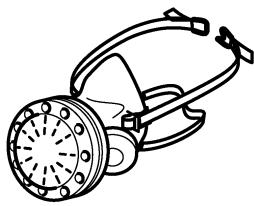
The risk from these exposures varies, depending on how often you do this type of work. To reduce your exposure to these chemicals: work in a well ventilated area, and work with ap
proved safety equipment, such as dust masks that are specially designed to filter out microscopic particles. Wash hands after handling.

WARNING
TO REDUCE THE RISK OF INJURY, USER MUST READ INSTRUCTION MANUAL.
Technical data
| Jigsaws | PS 400 EBQ | PSB 400 EBQ |
| Power | 400 W | |
| Stroke speed | 1500 - 3800 rpm | 1000 - 3800 rpm |
| Stroke length | 26 mm (1.02") | |
| Pendulum stroke | 4 steps | |
| max. inclination (only with accessory angle table WT-PS 400) | 45° to both sides | |
| max. cutting depth (depending on saw blade) | ||
| Wood | 120 mm (4.72") | |
| Aluminium | 20 mm (0.79") | |
| Steel | 10 mm (0.39") | |
| Weight | 1.9 kg (4.19 lb.) | |
Functional description
The pictures for the functional description are on a fold-out page at the beginning of the instruction manual. When reading of the manual you can fold out this page for having always an overview of the machine.
[1-1] Chip guard
[1-2] On/Off switch
[1-3] Variable speed trigger (only PSB 400 EBQ)
[1-4] Switch lock (only PSB 400 EBQ)
[1-5] Adjusting wheel for stroke speed control
[1-6] Swivel plug-it connection (only PS 400 EBQ)
[1-7] Mains power cable
[1-8] Extractor connector
[1-9] Saw table change lever
[1-10] Saw blade ejection
[1-11] Replaceable saw table
[1-12] Pendulum stroke switch
[1-13] Base runner
Intended use
Jigsaws are designed for sawing wood and similar materials similar to wood. With the special saw blades offered by Festool, these machines can also be used for sawing plastic, steel, aluminium, nonferrous metal and ceramic plates.
Festool electric power tools must only be installed on work tables provided by Festool for this purpose. If the tool is installed in another, or self-made, work table, it can become unstable and result in serious accidents.

WARNING
The user will be liable for damage due to improper use.
Operation

WARNING
Unauthorised voltage or frequency!
Risk of accident
The mains voltage and the frequency of the power source must correspond with the specifications on the machine's name plate.
In North America, only Festool machines with the voltage specifications 120V / 60Hz may be used.
Connecting and detaching the mains power cable [1-7] see Fig. [2].
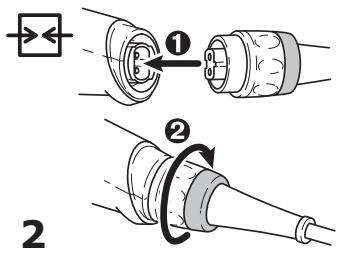
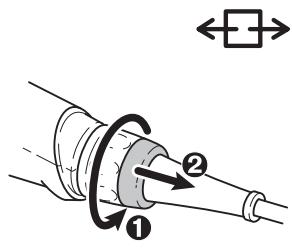
Insert the plug into a socket.
Extension Cord
If an extension cord is required, it must have sufficient cross-section to prevent an excessive drop in voltage or overheating. An excessive drop in voltage reduces the output and can lead to failure of the motor. The table below shows you the correct cord diameter as a function of the cord length for this tool.
| Total Extension Cord Lenght (feet) | 25 | 50 | 100 | 150 |
| Cable size (AWG) | 18 | 16 | 16 | 14 |
Use only U.L. and CSA listed extension cords.
Never use two extension cords together. Instead, use one long one.
(i) The lower the AWG number, the stronger the cord.
Consider the pictures on the fold-out page.

WARNING
Risk of injury, electric shock
Always pull the plug out of the socket before any type of work on the machine!
Stroke speed control
The number of strokes can be adjusted stepplessly with the adjusting wheel [1-5] between 1500 and 3800 rpm (PSB 400 EBQ: 1000 - 3800 rpm). This enables you to optimise the cutting speed to suit the respective material.
In position A, the automatic load detection is activated: The stroke speed is reduced in idling and is controlled to the highest value when the blade enters the workpiece.
Recommended stroke speed (position of the adjusting wheel)
Hard and soft wood, plywood board, ply- A wood, chip board
Hardboard 4-A
Plastic 3 - A
Ceramic, aluminium, non-ferrous metals 3 - 5
Steel 2-4
Adjusting the pendulum stroke
In order to process different materials with an optimum feed movement the pendulum jigsaws have an adjustable pendulum stroke. Select the desired setting with the pendulum stroke switch [1- 12]:
setting 0 = pendulum stroke off
setting 3 = maximum pendulum stroke
Recommended settings of the pendulum stroke
Hard and soft wood, chip board, wood fibre 1-3 board
Recommended settings of the pendulum stroke
Wood core plywood, plywood, plastics 1-2
Ceramic 0
Aluminium, NF metals 0 - 2
Steel 0-1
Using the chip guard
The chip guard [1-1] prevents chips flying away and improves the efficiency of the chip extraction system.
Using minimal pressure, push the chip guard [1-1] downwards.
Changing saw table
Open the change lever [1-9].
Removing the saw table downwards.
(1) Assembly is performed in reverse sequence to removal. Ensure that the saw table is firmly seated in the guide.
Instead of the saw table, the angle table WT-PS 400 or adaptation table ADT-PS 400 can be installed at the support.

Never saw without the saw table, or one of the other tables offered in the Festool accessories program.
Inserting splinterguard
The splinterguard makes cuts with splinter-free cutting edges possible, even on the exit side of the saw blade.
- With the machine switched off, push the splinterguard [3-1] onto the guide up to the saw blade [3-2],
switch on the jigsaw,
with the machine running (Speed range 5), push the splinterguard in on a flat plane until it is flush with the front edge of the saw table. This beds in the splinterguard.
3
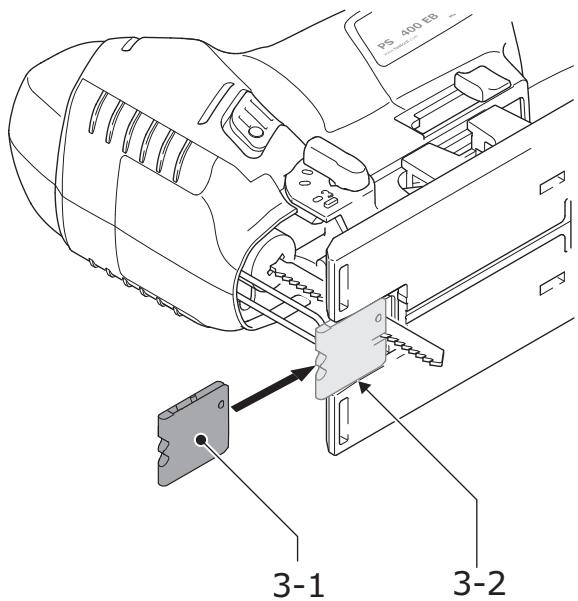
with worn splinterguard
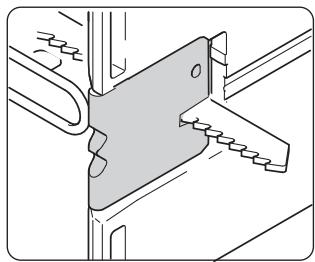
with new splinterguard
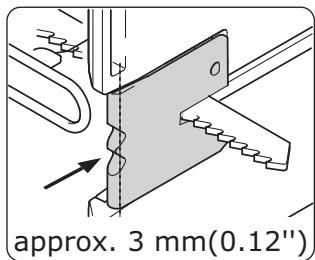
① When it is worn, push the splinterguard approx. 3 mm further to the rear and continue using it.
① To guarantee reliable operation of the splinterguard, it must seal tightly on both sides of the saw blade. For splinter-free cuts, therefore, a new splinterguard should also be used after every saw blade change.
Dust extraction

WARNING
Dust hazard
Dust can be hazardous to health. Always work with a dust extractor.
Always read applicable national regulations before extracting hazardous dust.
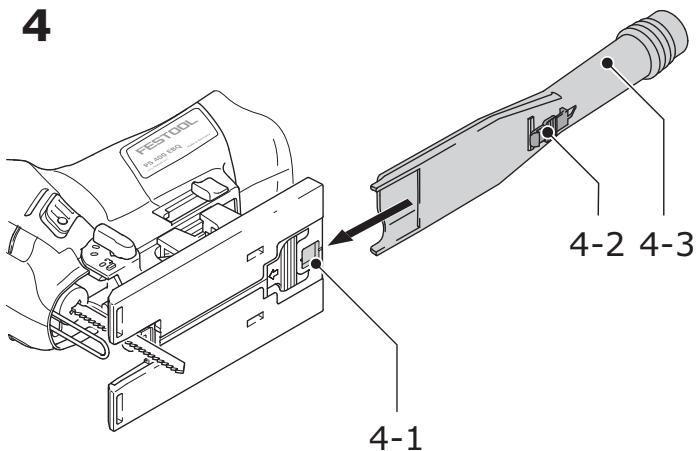
The extraction adapter [4-3] allows jigsaws to be connected to a dust extractor (hose diameter 27 mm).
Insert the extraction adapter into the rear opening of the saw table so that the hook [4-2] engages in the [4-1] recess.
To remove the extraction adapter, press the hook [4-2].
Changing tools


CAUTION
Hot and sharp tools
Risk of injury
Wear protective gloves!

Deformed or cracked saw blades and saw blades with blunt or broken cutting edges must not be used.
Selecting saw blade

Only use saw blades with a T-shank. The saw blade should not be longer than that required for the intended cut. To ensure safety, during the cut the saw blade should be at the bottom of the workpiece at every

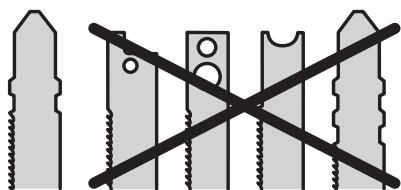
① Only use cross-set saw blades when using the angle and adapter table. We recommend Festool saw blade S 105/4 FSG.

WARNING
Risk of injury, electric shock
Always pull the plug out of the socket before any type of work on the machine!
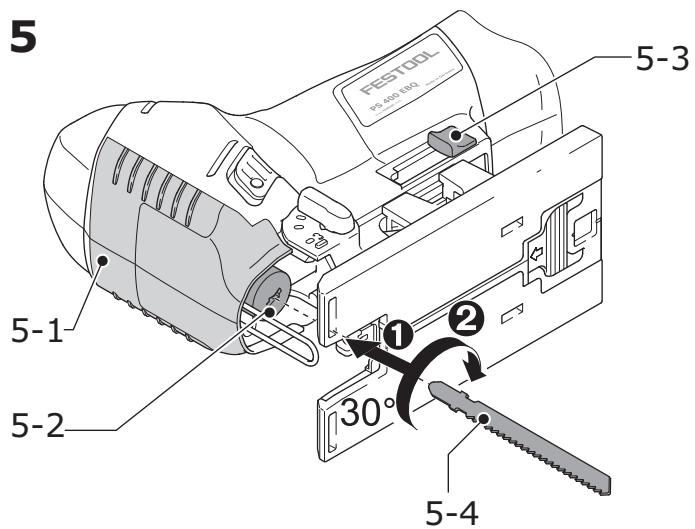
If necessary, push the chip guard [1-1] upwards.
Push the saw blade [5-4] into the opening as far as the stop with its teeth in cutting direction [5-2].
Turn the saw blade [5-4] approx. 30^ clockwise until it engages.
The guidance jaws adjust automatically to the saw blade used.

Check that the saw blade is secure. A loose saw blade can fall out and cause an injury.
① In the case of very short saw blades, it is advisable to remove the saw table (see chapter Changing saw table) before inserting the saw blade.
Ejecting saw blade
① When ejecting the saw blade, hold the electric power tool such that no persons or animals can be injured.
Push the saw blade ejection [5-3] forwards as far as the stop.
If the saw blade is not ejected: run jigsaw 3 - 10 seconds at a high speed. Actuate saw blade ejector mechanism [5-3] once again.
Working with the machine

CAUTION
Material with high dust generation (e.g. plasterboard)
Damage to machine through dust penetration, risk of injury
Do not work overhead!

WARNING
Risk of injury
With the tool switched off and unplugged, check for tight fit of the sawblade before starting to work
Always apply the pendulum jigsaw to the workpiece with the sawblade running.
- Wait until the power tool stops completely until placing it down. The tool can become entangled and lead to a loss of control of the power tool.
When working on small or thin workpieces, always use a stable base.
When working, hold the electric power tool by the handle and guide it along the desired cutting line. For precise cuts and smooth running, use two hands to guide the electric power tool.
Freely guided sawing along a scribe mark
The triangular shape of the splinterguard [3-1] points to the cutting line of the saw blade. This facilitates sawing along a scribe mark.
Switch on/off
The electric power tool has one button [1-2] on each side for switching on/off.
The PSB 400 EBQ also has a variable speed trigger [1-3] with switch lock [1-4]. For continuous operation, use the button [1-2].
Lighting

WARNING
The stroboscope light may make it difficult to determine the saw blade position
Risk of injury
Ensure the work area is well illuminated.

WARNING
Looking into the light source can damage your vision.
Do not look into the stroboscope light.
A continuous light or stroboscope is installed for illuminating the cutting line:
up to approx. 2100 rpm: continuous light
from approx. 2100 rpm: stroboscope light
(i) In overhead position (+/- 45^) , the lighting is switched off completely.
Metalworking

The following precautions are to be taken when processing metals for safety reasons:
- Pre-connect a residual current circuit-breaker (FI, PRCD).
- Connect the machine to a suitable dust extractor.
- Clean tool regularly of dust accumulations in the motor housing.

Wear protective goggles.
Accessories
Use only original Festool accessories and Festool consumable material intended for this machine because these components are designed specifically for the machine. Using accessories and consumable material from other suppliers will most likely affect the quality of your working results and limit any warranty claims. Machine wear or your own personal workload may increase depending on the application. Protect yourself and your machine, and preserve your warranty claims by always using original Festool accessories and Festool consumable material!
The order numbers of the accessories and tools can be found in the Festool catalogue or on the Internet under "www.festoolusa.com".
Saw blades, other accessories
In order to saw different materials quickly and cleanly, Festool offers saw blades for all applications that are specially designed for your Festool jigsaw.
Sawing with special base runners
The special base runners protect high-quality surfaces against scratches and scores.
Press in the base runner at position [6-1].
At the same time, push the base runner forwards.
- Mount another base runner and push it to the rear until it engages.
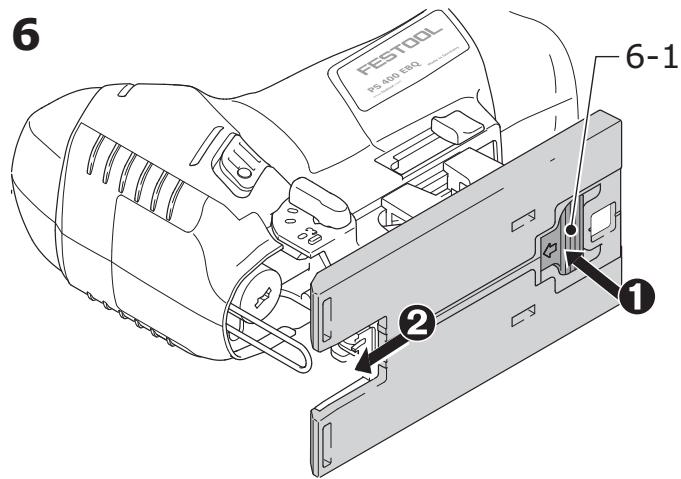

Sawing with the angle table
WARNING
Risk of injury
Always pull the plug out of the socket before installing the angle table!
The angle table WT-PS 400 is used for sawing interior and exterior angles up to 45^ and pipes.

Dust extraction is not possible when sawing with the angle table!
Installing the angle table
Remove the saw table [1-11], (see chapter Changing saw table).
Position the angle table against the saw table support.
Close the change lever [1-9].
Ensure that the angle table is firmly seated in the guide.
Setting the angle
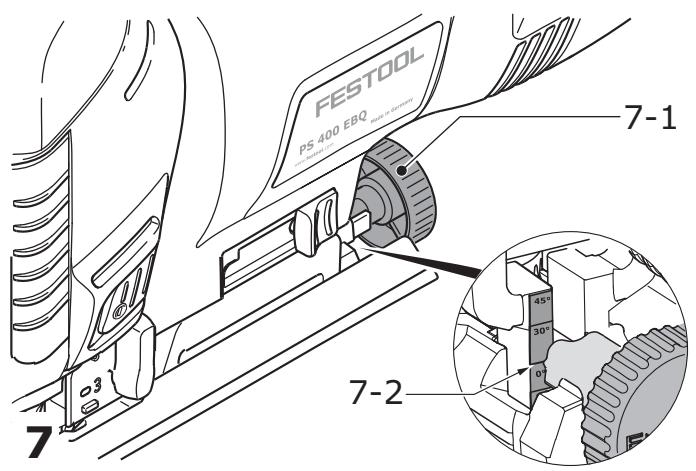
Turn the adjusting wheel [7-1] to set the desired angle.
At the scale [7-2], you can set the values -45^ , 0^ and +45^ .
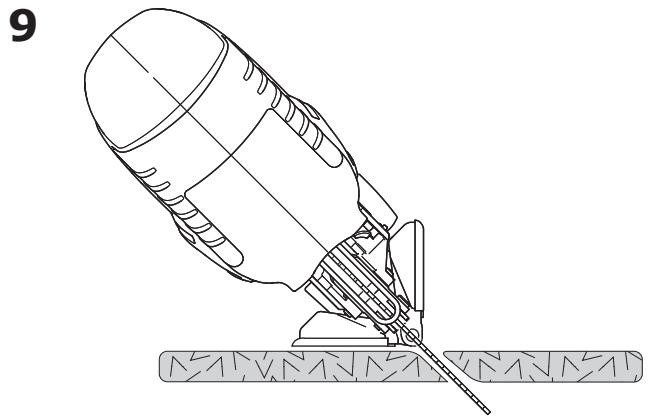
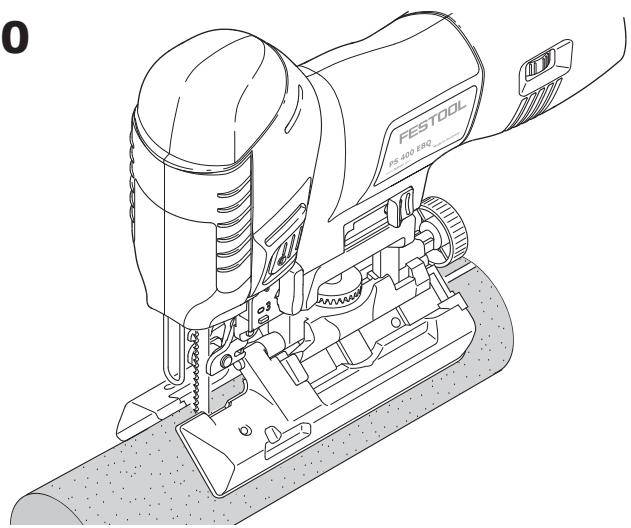
Angle table position Application
| Picture [8] | Angle, interior angle |
| Picture [9] | Angle |
| Picture [10] | Exterior angle, pipes |
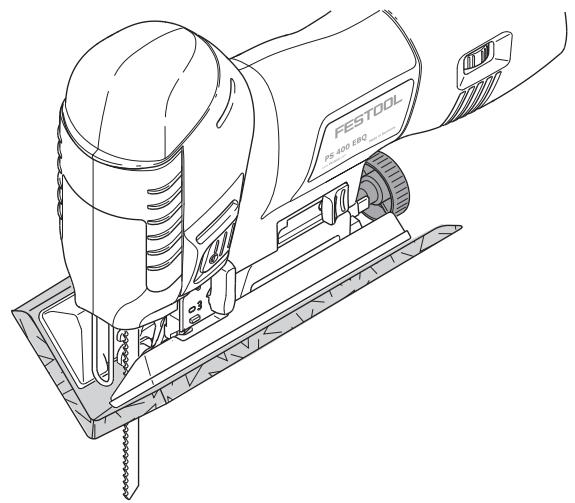
8
10

WARNING
Sawing cutting depths
Risk of injury
Select the saw blade length and cutting depth so that the saw blade always stays in the workpiece.
(1) For 90^ cuts, we recommend setting the angle table to a small negative degree value to guarantee stable running.
Sawing with the adaptation table

WARNING
Risk of injury
Always pull the plug out of the socket before installing the adaption table!
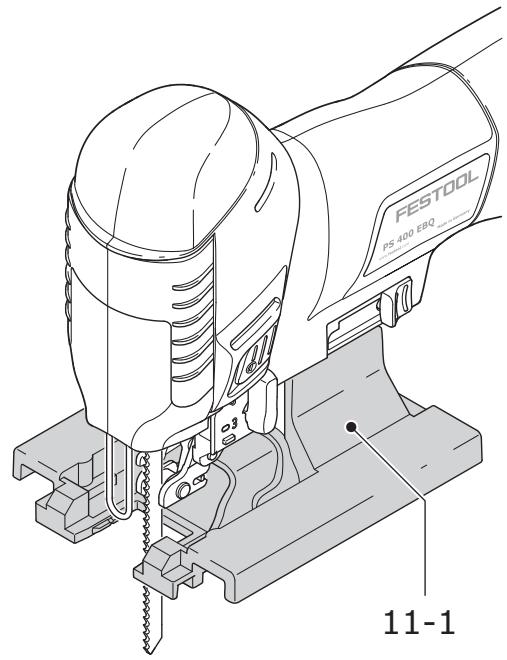
The adaptation table ADT-PS 400 is used for fitting your jigsaw on the Festool guide rail and the circle cutter KS-PS 400.
Installing the adaptation table
Remove the saw table [1-11], (see chapter).
- Mount the adaptation table [11-1] on the saw table support.
Close the change lever [1-9].
Ensure that the adaptation table is firmly seated in the guide.
(1) Use the extractor connector [1-8] also with the adaptation table.
11
Adaptation to the guide rail FS
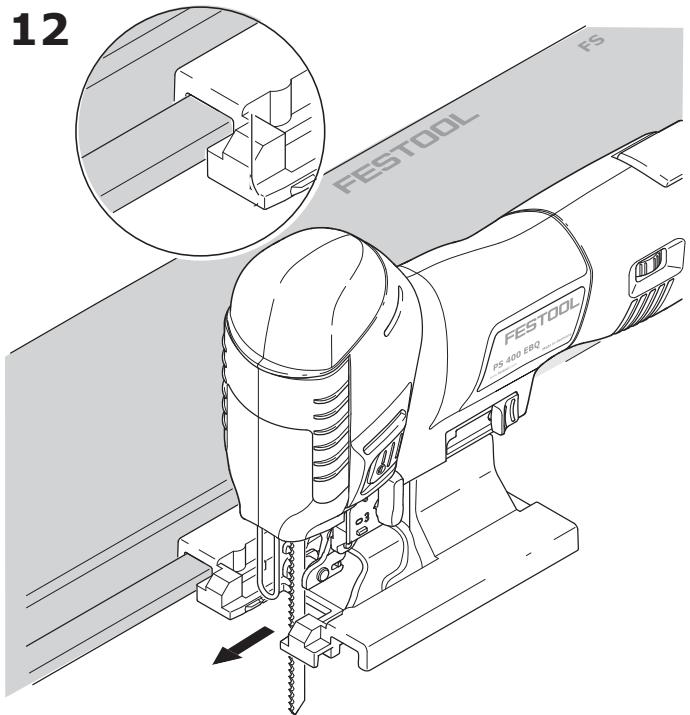
The use of the Festool guide system FS (Picture [12]) makes it easier to produce straight and precise cuts, in particular, with material thicknesses up to 20 ~mm .
Mount the jigsaw with installed adaptation table [11-1] on the guide rail.
Adaptation to the circle cutter
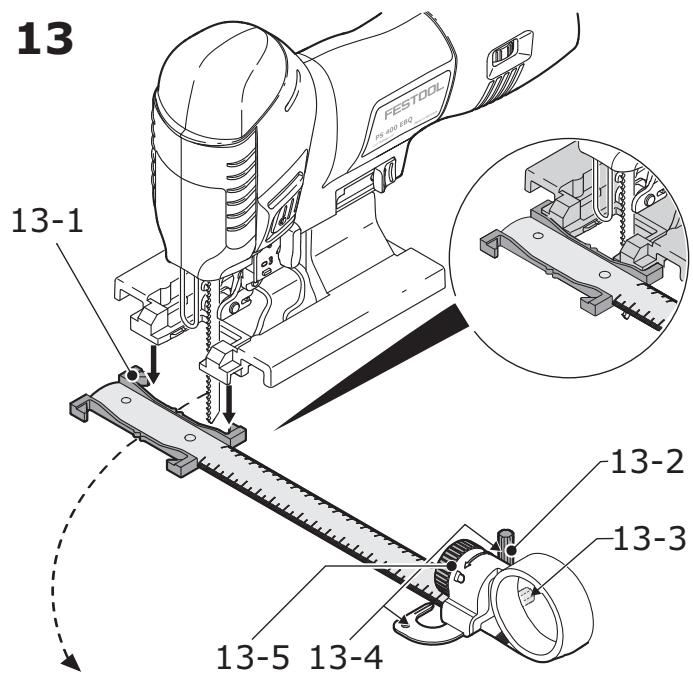
The circle cutter can be used to create circular cuts with a diameter between 120 and 3000 ~mm . The circle cutter can be installed from both sides on the adaptation table.
- Mount the jigsaw with adaptation table on the adapter [13-1] at the circle cutter.
Insert the centring mandrel [13-2] in the bore [13-4] of the circle cutter, which is aligned with the saw blade. - Clamp the measuring tape at the circle cutter with the rotary knob [13-5].
① Store the centring mandrel in the depot [13-3].
Systainer
Systainer
Many Festool products are shipped in a unique system container, called "Systainer". This provides protection and storage for the tool and accessories. The Systainers are stackable and can be interlocked together. They also can be interlocked atop Festool CT dust extractors.
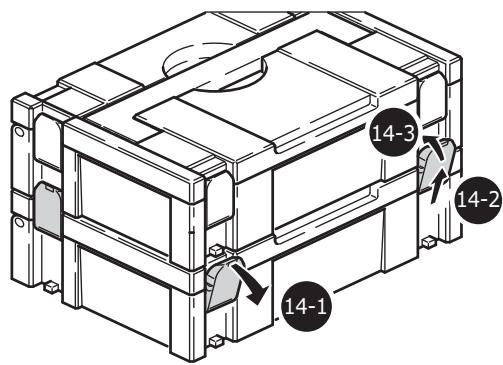
Place one systainer on top of the other.
Release all four latches on the lower systainer by pulling back at their top edges [14-1].
▶ Slide all four latches upward [14-2].
Snap all four latches back to their flat position [14-3] so they engage the stacking tabs of the upper systainer.
Service and maintenance

WARNING
Any maintenance or repair work that requires opening of the motor or gear housing should only be carried out by an authorised Customer Service Centre (name supplied by your dealer)!
- Maintenance or repair work carried out by an unauthorised person can lead to the wrong connection of the power leads or other components, which in turn can lead to accidents with serious consequences.

WARNING
Risk of injury, electric shock
Always pull the plug out of the socket before any maintenance or care work!
Damaged safety devices and components must be repaired or replaced in a recognised specialist workshop, unless otherwise indicated in the operating manual.
To ensure constant air circulation, always keep the cooling air openings in the motor housing clean and free of blockages.
- Check the guidance roller regularly for wear.
- Regularly remove dust deposits from the chip guard.
- Regularly clean the base runner to prevent scratches and cores on the surface.
Disposal
Do not throw the power tool in your household waste! Dispose of machines, accessories and
packaging at an environmentally responsible recycling centre. Observe the valid national regulations.
Warranty
Conditions of 1+2 Warranty
You are entitled to a free extended warranty (1 year + 2 years = 3 years) for your Festool power tool. Festool shall be responsible for all shipping costs during the first year of the warranty. During the second and third year of the warranty the customer is responsible for shipping the tool to Festool. Festool will pay for return shipping to the customer using UPS Ground Service. All warranty service is valid 3 years from the date of purchase on your receipt or invoice.
Festool Limited Warranty
This warranty is valid on the pre-condition that the tool is used and operated in compliance with the Festool operating instructions. Festool warrants, only to the original consumer purchaser, that the
specified tool will be free from defects in materials and workmanship for a term of one year from the date of procurement. Festool makes no other warranty, express or implied, for Festool portable power tools. No agent, representative, distributor, dealer or employee of Festool has the authority to increase or otherwise change the obligations or limitations of this warranty. The obligations of Festool in its sole discretion under this warranty shall be limited to the repair or replacement of any Festool portable power tool that is found to be defective as packaged with the User Manual.
Excluded from coverage under this warranty are: normal wear and tear; damages caused by misuse, abuse or neglect; damage caused by anything other than defects in material and workmanship. This warranty does not apply to accessory items such as
circular saw blades, drill bits, router bits, jigsaw blades, sanding belts, and grinding wheels. Also excluded are "wearing parts", such as carbon brushes, lamellas of air tools, rubber collars and seals, sanding discs and pads, and batteries.
Festool portable power tools requiring replacement or repair are to be returned with the receipt of purchase to Festool (go to www.festoolusa.com or call 888-337-8600 for address details).
IN NO EVENT SHALL FESTOOL BE LIABLE FOR ANY CONSEQUENTIAL OR INCIDENTAL DAMAGES FOR BREACH OF THIS OR ANY OTHER WARRANTY, EXPRESSED OR IMPLIED WHATSOEVER. ALL WARRANTYES IMPLIED BY STATE LAW, INCLUDING THE IMPLIED WARRANTYES OF MERCHANT
ABILITY AND FITNESS FOR A PARTICULAR PURPOSE, ARE HEREBY LIMITED TO THE DURATION OF THREE YEARS.
Some states in the U.S. and some Canadian provinces do not allow the limitations on how long an implied warranty lasts, so the above limitation may not apply to you. With the exception of any warranties implied by state or province law as hereby limited, the foregoing express limited warranty is exclusive and in lieu of all other warranties, guarantees, agreements and similar obligations of Festool.
This warranty gives you specific legal rights and you may also have other rights which vary from state to state in the U.S. and province to province in Canada.
Sommaire
Symboles 18