 ManualGo.com
C 535 EB - Microphone AKG - Free user manual and instructions
Find the device manual for free C 535 EB AKG in PDF.



Download the instructions for your Microphone in PDF format for free! Find your manual C 535 EB - AKG and take your electronic device back in hand. On this page are published all the documents necessary for the use of your device. C 535 EB by AKG.
USER MANUAL C 535 EB AKG
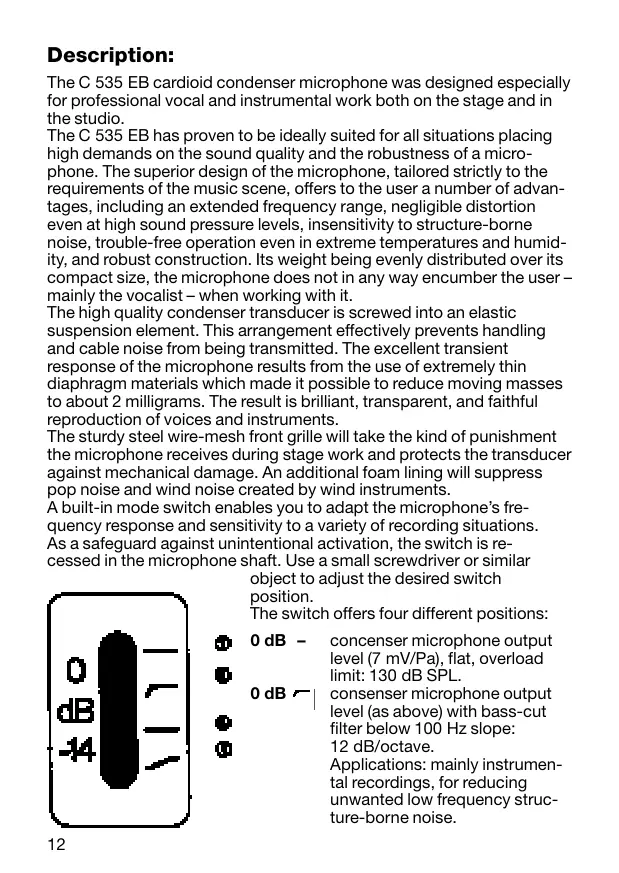
Description: The C 535 EB cardioid condenser microphone was designed especially for professional vocal and instrumental work both on the stage and in the studio. The C 535 EB has proven to be ideally suited for all situations placing high demands on the sound quality and the robustness of a microphone. The superior design of the microphone, tailored strictly to the requirements of the music scene, offers to the user a number of advantages, including an extended frequency range, negligible distortion even at high sound pressure levels, insensitivity to structure-borne noise, trouble-free operation even in extreme temperatures and humidity, and robust construction. Its weight being evenly distributed over its compact size, the microphone does not in any way encumber the user – mainly the vocalist – when working with it. The high quality condenser transducer is screwed into an elastic suspension element. This arrangement effectively prevents handling and cable noise from being transmitted. The excellent transient response of the microphone results from the use of extremely thin diaphragm materials which made it possible to reduce moving masses to about 2 milligrams. The result is brilliant, transparent, and faithful reproduction of voices and instruments. The sturdy steel wire-mesh front grille will take the kind of punishment the microphone receives during stage work and protects the transducer against mechanical damage. An additional foam lining will suppress pop noise and wind noise created by wind instruments. A built-in mode switch enables you to adapt the microphone’s frequency response and sensitivity to a variety of recording situations. As a safeguard against unintentional activation, the switch is recessed in the microphone shaft. Use a small screwdriver or similar object to adjust the desired switch position. The switch offers four different positions: 0 dB – 0 dB
concenser microphone output level (7 mV/Pa), flat, overload limit: 130 dB SPL. consenser microphone output level (as above) with bass-cut filter below 100 Hz slope: 12 dB/octave. Applications: mainly instrumental recordings, for reducing unwanted low frequency structure-borne noise. –14 dB – attenuation of –14 dB, dynamic microphone output level, flat, overload limit: 144 dB SPL. Applications: recording high sound level instruments, or prevention of overloading of mixer or amplifier inputs which are adjusted for dynamic microphones. –14 dB preattenuation of –14 dB (as above) with additional bass rolloff filter below 500, slope: 4 dB/octave. Applications: as above, mainly vocalist, but also instrumental recording, close-in miking in situations requiring effective suppression of proximity effect. The die-cast zinc alloy housing contains the preamplifier, d.c. voltage regulator circuit, impedance converter, output transformer, and the 3-pin standard XLR connector (male). Wiring: balanced, ungrounded. The surface of the C 535 EB is matte black; therefore, the microphone is highly inconspicuous which is a particular advantage in television and stage work. Strong spotlights will not cause irritating light reflections. The C 535 EB is designed for external universal phantom powering (9 … 52 volts, according to DIN 45596) and may be fed from mixers, tape recorders, battery, or mains operated power supply units. Current consumption is lower than 1 mA. Your C 535 EB carries its individual serial number and is packed in a solid case lined with a soft foam material, complete with a “Quick Release” stand adapter (SA 41/1).
Applications: We developed the C 535 EB to meet the musician’s demands. Recording fine vocal or instrumental music, the professional’s search for brilliant, transparent sound, pianissimo passages coming through as clearly as fortissimo passages do, expected pop noise problems with vocalists or wind noise from wind instruments: this is what the C 535 EB is really made for. On the basis of extensive testing done in cooperation with many fine musicians, on stages as well as in many studios, we recommend the C 535 EB particularly for the following applications. Vocals Soloist Choir Instruments Acoustic Guitar Clarinet Flute Trumpet Trombone HiHat Cymbals Snare Vocals In terms of sound generation, the human voice is a highly complex sound source. Our ears are, in a way, “trained” to recognize voices and are capable of detecting even minute deviations of timbre. Sounds generated by the human voice can be categorized as sibilants containing very high frequency components, explosives causing wind and pop noise, and vowels determining the timbre of a voice by certain formants (predominant frequency bands). The compass of the human voice extends from about 90 Hz to around 10 kHz (including fundamentals and harmonics). The reason why the C 535 EB is particularly suited for vocalist use is that it is the first condenser microphone to offer the required robustness and insensitivity to exication by structure-borne noise. Another important feature is the four-position mode switch recessed in the microphone shaft. It allows the user to adjust the microphone to the specific situation.
1. The sensitivity may be changed from about 7 mV/Pa, which is typical
of condenser microphones, to a value 14 dB lower (about 1/5th). Thus, the microphone may be connected to such devices as are designed to accept dynamic microphones.
2. A so-called low-cut filter serves to reduce low frequency noise
(like rumble, floor noise etc.) below 100 Hz with a slope of about 12 dB/octave.
3. A rolloff filter compensates the proximity effect (low frequency boost
when the microphone is closer than one foot to the sound source) typically experienced with single diaphragm systems. The elastic suspension of the microphone system eliminates unwanted handling noise. The built-in wind and pop screen inside the wiremesh front grille will suppress particularly accentuated explosives to such an extent as to avoid overloading the sound system in the low frequency region. Practice and experiment to find out how to use this high quality sound transducer to the best effect. Find out how you can actively change the sound by singing directly into the microphone or to the side of it, by holding it close to your mouth or a bit farther away and practice to create your own sound! Acoustic Guitar The sound of the acoustic guitar is very weak. Therefore, it is necessary in many cases to boost effectively the loudness of this instrument in relation to other instruments. Microphone placement depends primarily on the kind of guitar played and the playing technique used. Gut and nylon strings produce few harmonics. Bass is radiated mainly through the sound hole, treble by the top. Direct the C 535 EB toward a point on an imaginary line through the bridge, on the lower half of the body. Steel strings produce more overtones than gut or nylon strings. Direct the C 535 EB toward the sound hole rather than the top. Working distance should be about 8 inches depending, however, on the playing technique employed by the musician. Changing microphone orientation and/or distance will change the tone reproduced. Since it is necessary to place the microphone close to the instrument, the bass response will be exaggerated. This proximity effect may be compensated for by setting the mode switch to –14 dB . Bass boost may also be avoided by directing the C 535 EB toward fret no. 14, approximately where the neck joints the body. Steel-string guitars with built-in pickups inevitably produce a rather flat tone because magnetic pickups work well only in the midrange. Because of the radiation characteristics of acoustic guitars – high frequency components are radiated by the strings themselves, low frequencies being radiated through the sound hole – a well-balanced sound can be achieved by using an additional microphone.
Clarinet The C 535 EB is perfectly suited for miking up the clarinet. The flat frequency response with a slight treble boost of approximately 2 dB is ideal for reproducing the sound spectrum of this instrument. Frequency components between 800 Hz and 3 kHz are radiated exclusively from the keys. At higher frequencies, radiation shifts toward the bell. Frequencies above 5 kHz are radiated through the bell only. In order to attain a well-balanced tone, mount the C 535 EB on a floor stand (e.g. AKG St 200) and aim it at the conical portion of the clarinet, directing it roughly toward the lowest key. Flute Most of the flute sound is radiated in the blowing direction of the player. With frequencies higher than 3 kHz, preferred radiation shifts to the right, toward the end of the flute body. When miking up the flute, the position of the microphone depends primarily on which kind of music is performed. Depending on the desired tone color, the C 535 EB may be placed one to two inches, or 4 to 8 inches in front of the performer’s lips. It is advisable to blow to the side of the microphone, in order to avoid excessive wind noise. With extremely short working distances, it is best to blow below the microphone. During the actual performance, the position of the player’s lips relative to the microphone should, if possible, remain unchanged. If it is necessary to capture the high frequency components above 3 kHz, too, use an additional microphone, e.g. an AKG D 224 two-way microphone. Trumpet As opposed to other instruments, microphone placement for trumpets is easy because of the instrument’s radiation pattern: up to about 500 Hz the sound is evenly distributed in all directions. Midrange frequencies are radiated through the bell over a large angle in the playing direction, the angle narrowing with rising frequency. Above 5 kHz the radiation angle is about 30°. Mount the C 535 EB on a floor stand and place it one to two feet away from the instrument, at an acute angle with it. Thus, the trumpet player will not blow directly into the microphone so as to avoid wind noise, above all at high sound levels. Reduce the microphone level via the mode switch (position –14 dB flat), in order to prevent microphone overloading and distortion during passages of wide dynamic range.
Powering Technique: The AKG C 535 EB has been designed for phantom powering according to DIN 45596. These standards specify a positive voltage of 12, 24 or 48 volts on the audio lines versus the cable shield. Connection diagrams for balanced inputs: Input circuitry incorporating transformer with center tap (ungrounded). Input circuitry incorporating transformer without center tap (ungrounded).
The resistors 2 x Rv must have a tolerance not exceeding 0.5 % in order to satisfy the symmetry requirement. Standardized values for Rv and 2 x Rv: + UB 12 V ± 2 V 24 V ± 4 V 48 V ± 4 V
680 ohms 1200 ohms 3300 ohms 2 x Rv 330 ohms 680 ohms 6800 ohms Phantom powering with unbalanced inputs If only single ended (grounded) amplifier inputs or no input transformers are available, either capacitors or optional transformers must be wired into the audio lines to prevent leakage currents from entering the input stage. Specifications: Transducer Principle: Polar Pattern: Frequency Range: condenser transducer, prepolarized cardioid 20 … 20,000 Hz ±3 dB from published curve Sensitivity at 1,000 Hz: 7 mV/PaⳎ–0.7 mV/µbar (–63 dBV, re 1 µbar) Electrical Impedance: 200 ohms, ±20 % balanced Recommended Load Impedance: 600 ohms Hum Sensitivity (at 50 Hz): 4 µV/5 µT Equivalent Noise Level acc. to DIN 45412 (A-weighted): 21 dB-A
Maximum Sound Pressure (for 1 % T.H.D. at 1,000 Hz into 600-ohm load): with –14 dB attenuation: Climatic Conditions: Supply Voltage: Current Consumption: Connector Type: Housing Material: Finish: Dimensions: Net Weight: Shipping Weight: Included Accessories: Optional Accessories: 80 PaⳎ130 dBSPL 400 PaⳎ144 dBSPL temperature range: –20° C … +60° C rel. humidity at 20° C: 99 % 9 … 52 V (acc. to DIN 45596) approx. 1 mA 3-pin male standard XLR pin 1: ground, pin 2: audio inphase, pin 3: audio zinc alloy matte black head diameter: 46 mm (1 13/16 inch), length: 184 mm (7 1/4 inch) 300 grams (10.6 oz.) 800 grams (1.7 lb.) SA 41/1 stand adapter W 23 pop/windscreen N 62 E two-channel mains power supply unit N 66 E six-channel mains power supply unit B 18 battery power supply unit This product conforms to EN 50 082-1. Dimensional Drawing:
Circuit Diagram: Frequency Response:
Cleaning: All metal surfaces may be safely cleaned from time to time with (methylated) spirits or alcohol. Servicing: Transducer replacement is simply and does not require any tools.
1) Unscrew front grille counter-clockwise; the knurled screw base of the
elastic suspension with the built-in transducer is now visible. 2) Hold knurled screw base of elastic suspension firmly; unscrew transducer by turning brass ring of system counter-clockwise.
3) To install new transducer, follow above instructions in reverse order.
Note: Do not attempt to remove the elastic suspension from the microphone housing while replacing the transducer.
2 x Rv 330 ohms 680 ohms 6800 ohms Printed in Austria on recycled paper. AKG ACOUSTICS, U.S. 1449 Donelson Pike, Nashville, TN 37217, U.S.A. Tel: (615) 360-0499, Fax: (615) 360-0275 Erikson Pro Audio 620 McCaffrey, St-Laurent, Quebec, H4T 1N1, CANADA Tel: (514) 738-3000, Fax: (514) 737-5069 Internet: www.jam-ind.com/eriksonpro Arbiter Pro Audio Wilberforce Road, London NW9 6AX/ENGLAND Tel: (0181) 202 1199, Fax: (0181) 202 7076 Microphones · Headphones · Wireless Microphones · Wireless Headphones · Headsets · Electroacoustical Components Mikrofone