
PBK3360X - Built-in oven PROGRESS - Free user manual and instructions
Find the device manual for free PBK3360X PROGRESS in PDF.



| Product type | Built-in oven |
| Brand | PROGRESS |
| Model | PBK3360X |
| Power supply | 230 V ~ 50 Hz, 1875 W |
| Capacity | 53 L |
| Built-in dimensions (H x W x D) | 587 x 560 x 550 mm |
| Cavity dimensions (H x W x D) | 335 x 395 x 400 mm |
| Number of functions | 7 (convection, top/bottom heat, bottom heat, ventilated grill, grill + rotisserie, defrost, lighting) |
| Door type | Removable double glazing |
| Cleaning | Catalytic liners and manual cleaning |
| Interior lighting | Bulb 15-25 W, E14 socket, 230 V |
| Supplied accessories | Grid, drip tray, baking sheet, rotisserie with fork and handle |
| Safety | Safety thermostat, programmable automatic shut-off |
| Repairability | Spare parts available (bulb, door gasket, etc.) |
| General information | Manufacturer: Electrolux Home Products Italy S.p.A.; Compliant with EU directives |
Frequently Asked Questions - PBK3360X PROGRESS
User questions about PBK3360X PROGRESS
0 question about this device. Answer the ones you know or ask your own.
Ask a new question about this device
Download the instructions for your Built-in oven in PDF format for free! Find your manual PBK3360X - PROGRESS and take your electronic device back in hand. On this page are published all the documents necessary for the use of your device. PBK3360X by PROGRESS.
USER MANUAL PBK3360X PROGRESS
Inbouwoven Built-in oven
Inhoud
Warnings and important safety advice 32
Description of the appliance 34
Operation 35
Before using for the first time 36
Electronic timer 37
Using the oven 42
Baking charts 47
Cleaning and servicing 49
Troubleshooting 55
Technical data 56
Instructions for the installation engineer 57
Instructions for building in 58
Customer service 59
How to read the instruction book

Safety information

Step-by-step instructions

Hints and tips

Environmental information

This appliance conforms to the following EEC guidelines:
- 2006/95 (low voltage guidelines);
- 89/336 (EMC guidelines);
93/68 (General guidelines); and subsequent changes.
MANUFACTURER:
ELECTROLUX HOME PRODUCTS ITALYS.p.A.
VialeBologna,298
47100 FORLI (Italy)
Always keep these user instructions with the appliance. Should this appliance be given or sold to a third party, or in case you leave it behind when you move house, it is highly important that the new user has this user manual and advice at their disposal.
These warnings are provided for the safety of the users and those living with them. So read them carefully before connecting and/or using the appliance.
Installation
- Installation must be carried out by qualified technicians, whilst observing the prevailing guidelines. The individual operations for installing the appliance are described under the instructions for the installer.
- Leave installation and connection to an expert who has the expert knowledge to carry these out in accordance with known guidelines.
- Also ask an expert to make any necessary modifications to the electricity supply as a result of installation.
Operation
- This oven is intended for the preparation of food; never use it for other purposes.
- Beware hot air escaping from the oven if the oven door is opened during or after cooking.
- Operate the oven with utmost care. Shelves and other parts become very hot as a result of the intense heat from the heating elements.
- Should you, for whatever reason, use aluminium foil whilst cooking food in the oven, never let it come into direct contact with the bottom of the oven.
-
Proceed carefully when cleaning the oven: never spray anything onto the grease filter (if fitted), the heating elements and the thermostat sensor.
-
It is dangerous to make modifications of any type to this appliance or its properties.
- The oven window and surrounding appliance parts become hot during baking, roasting and grilling. Children should therefore be kept away from the appliance. Make sure that when connecting electrical appliances to sockets near to the oven, the electrical leads do not come into contact with hot cooking areas or become jammed in the hot oven door.
Always use oven gloves to remove hot heatproof dishes or pots from the oven. - Regular cleaning prevents deterioration of the surface materials.
- Before cleaning the oven, either switch off the electricity or pull out the mains plug.
- Make sure that the oven is switched off when it is not in use.
- This oven has been manufactured for use as a single appliance or a combination appliance with electric plates for single phase connection to 230 V.
- The appliance must not be cleaned with a steam cleaner or a steam jet cleaner.
- Do not use any abrasive cleaners or sharp metal scrapers. You could scratch the door glass and that could lead to cracking of the glass.
Personal safety
- This appliance is designed for use by adults. It is dangerous to allow children to use it or play with it.
- Keep children away whilst the oven is in use. Even after turning off the oven, the doors remain hot for a long time.
- This appliance is not intended for use by children or other persons whose physical, sensory or mental capabilities or lack of experience and knowledge prevents them from using the appliance safely without supervision or instruction by a responsible person to ensure that they can use the appliance safely.
Disposal

Packaging material
- The packaging materials are environmentally safe and can be reused. The plastic parts are labelled, e.g. >PE> , >PS< etc. Dispose of the packaging materials according to their label in communal disposal areas in the designated collection containers.

Old appliances
- The symbol on the product or its packaging indicates that this product cannot be handled like normal household rubbish, but that it must be taken to a collection point for the recycling or electrical and electronic appliances. Correct disposal of this appliance will help prevent possible negative consequences for the environment and the health of persons. Environment and health are endangered by incorrect disposal. Further information on recycling this product can be obtained from your town hall, your refuse collection service, or the shop from where you purchased it.

Warning: So that no more dangers can arise from the disused appliance, render it unusable before disposing of it.
Separate the appliance from the mains supply and remove the mains supply cable from it.
Customer service
Inspection and/or repairs must be carried out by the manufacturer's customer service or a customer service authorised by the manufacturer, and use only original replacement parts used.
- Do not try to repair malfunctions or damages yourself. Repairs carried out by untrained persons may cause damage or injury.
Description of the appliance
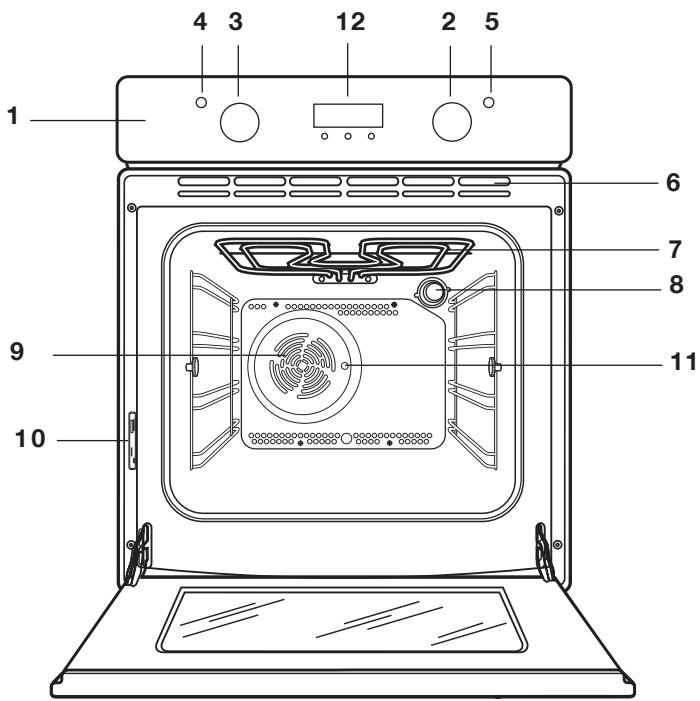
- Control panel
- Oven controller
- Temperature controller
- Temperature control - control indicator
- Power indicator
-
Vents for cooling fan
-
Grill
- Interior light
- Oven ventilator
- Rating plate
- Rotisserie opening
- Electronic timer
Accessories

Drip pan
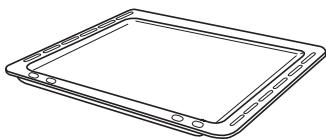
Baking tray

Shelf

Forks
Spit
Removable spit handle
Spit support
Rotisserie
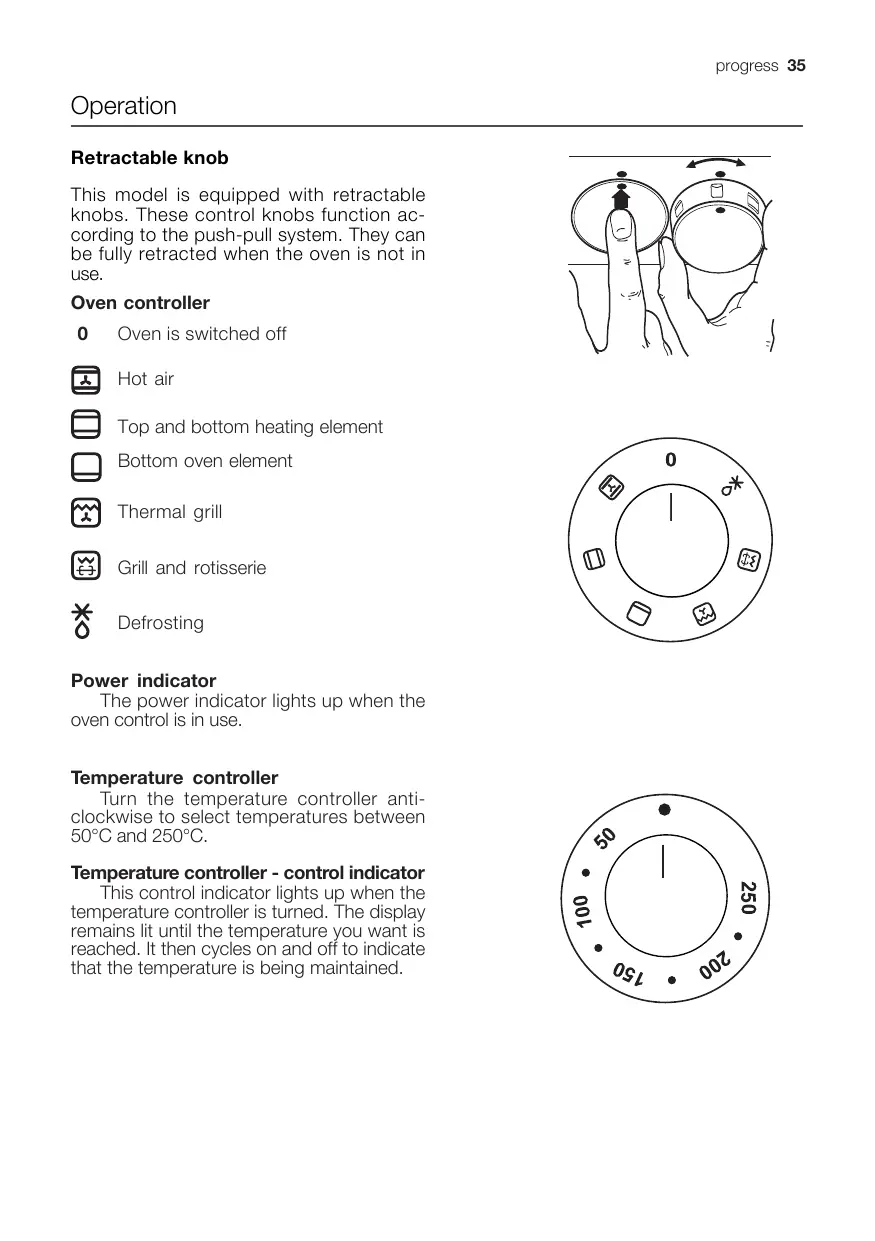
Retractable knob
This model is equipped with retractable knobs. These control knobs function according to the push-pull system. They can be fully retracted when the oven is not in use.
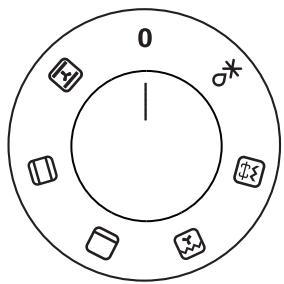
Oven controller
0 Oven is switched off

Hot air

Top and bottom heating element

Bottom oven element

Thermal grill

Grill and rotisserie

Defrosting
Power indicator
The power indicator lights up when the oven control is in use.
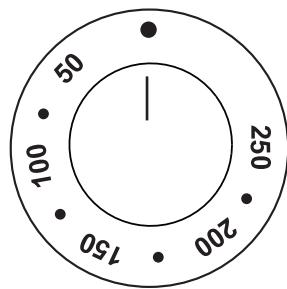
Temperature controller
Turn the temperature controller anticlockwise to select temperatures between 50^ and 250^ .
Temperature controller - control indicator
This control indicator lights up when the temperature controller is turned. The display remains lit until the temperature you want is reached. It then cycles on and off to indicate that the temperature is being maintained.

Safety Thermostat
To avoid dangerous overheating (through improper use of the appliance or defective components) the oven is fitted with a safety thermostat which breaks the electricity supply. The oven switches back on again automatically, when the temperature drops.
Should the safety thermostat react as a result of improper use of the appliance, just eliminate the cause of the defect once the oven is cooled. If the thermostat reacts because of a defective component, please contact customer services.
Cooling fan
The fan cools the oven and control panel. The fan switches on automatically after a few minutes of cooking. Hot air is extracted through the vents near the oven door handle. When the oven has been switched off, the fan may continue to run to cool the operating elements. This is absolutely normal.

The action of the cooling fan will depend on how long the oven has been used and at what temperature. It may not cut in at all at lower temperature settings or continue to run if the oven has only been used for a short time.
Before using for the first time

Remove all packaging materials in and outside the oven before use.
Before using for the first time, the empty oven should be heated up.
During this time, an unpleasant odour may be emitted. This is absolutely normal. It is caused by manufacturing residues.

The oven will only function when the clock has been set to the time of day.
Ensure that the kitchen is well ventilated.

-
Store the clock time in the electronic programme memory (see the chapter entitled "Electronic timer")
-
Turn the oven regulator to hot air
- Turn the temperature regulator to 250^ C .
- Open a window for ventilation.
- Allow the oven to run empty for approximately 45 minutes.
Repeat the procedure for top and bottom heating and thermal grill for about 5-10 minutes.

Then let the oven cool down. Now dampen a soft cloth with warm water and mild washing-up liquid and clean the oven cavity.

Before using for the first time, carefully wash the oven accessories as well.
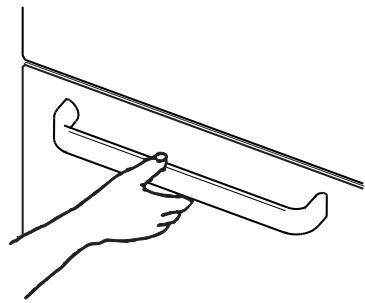

Always grasp the handle in the middle to open the door.
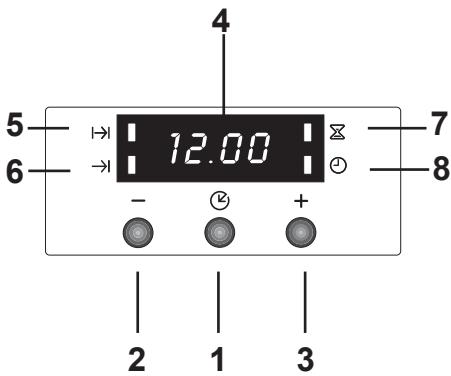

The oven will work only if the time of day has been set.
However, the oven can also be operated without any programme.
Setting the time
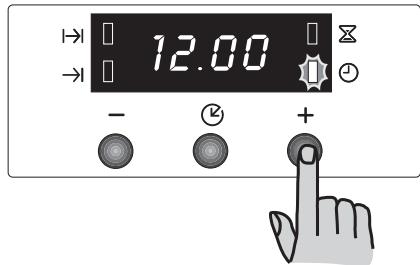
After the electricity supply has been switched on or if a power cut has occurred, the "Time" control light flashes on the display.
To enter the time:
- Press the button " + " or " - ".
- Wait for 5 seconds: the control light "Time" goes out and the input time is shown in the display. The appliance is ready for use.
To reset the correct time of day:
-
Press the button repeatedly in order to select the "Time" function. The relevant control light starts flashing. Then proceed as described above. The time can only be reset if no automatic functions (cooking time or cooking end time have been set.
-
Buttons for selecting functions
- Button"
- Button "+"
- Indicator Display
- "Cooking time" control light
- "Cooking end time" control light
- "Countdown" control light
- "Time" control light

During a power cut data will be erased and must be entered again. When the electricity supply returns, the function lights flash and you can reset the time.
Cooking time | |
This function allows the oven to automatically switch off at the end of a programmed cooking duration time. Put the food in the oven, select a cooking function, and set the cooking temperature you want.
Press the button repeatedly in order to select the "Cooking time" function. The relevant control light starts flashing. Then, proceed as follows:
To set the duration time:
- Press the button " + " or " "
- After you have made the setting, wait 5 seconds: the control light "Cooking time" lights up and the time is shown on the display again.
- When the programmed time is up, the oven switches itself off automatically. An audible signal sounds and the control light flashes. Turn the oven function and the temperature control knobs to zero. The signal sound can be turned off by pressing any button.
NOTE: By turning off the audible signal the oven is reset to manual operation. If the oven controller and the temperature controller are not turned to zero, the oven heats up again.
To cancel the programmed cooking time:
- Press the button repeatedly in order to select the "Cooking time" function. The relevant control light flashes and the remaining cooking time is shown on the display.
- Press the button "—" until "0.00" is shown in the display. After 5 seconds the control light goes out and the display reverts to the time of day.
End of cooking time
With this function, you can set the oven to switch off automatically when a programmed end of cooking time is over. Put the food in the oven, select a cooking function, and set the cooking temperature you want. Press the button 2 .

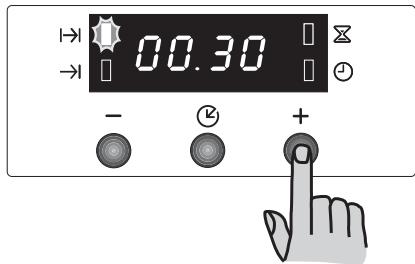
Press the button repeatedly to select the "Cooking end time" function. The relevant control light starts flashing. Then, proceed as follows:
To set the end of cooking time:
- Press the button "+" or -".
- After you have made the setting, wait 5 seconds: the control light "Cooking end time" lights up and the time is shown on the display again.
- When the programmed time is up, the oven switches itself off automatically. An audible signal sounds and the control light flashes. Turn the oven function and the temperature control knobs to zero. The signal sound can be turned off by pressing any button. NOTE: By turning off the audible signal the oven is reset to manual operation. If the oven controller and the temperature controller are not turned to zero, the oven heats up again.
To cancel the programmed end of cooking time:
- Press the button repeatedly to select the "Cooking end time" function. The relevant control light flashes and the programmed cooking end time is shown on the display.
- Press the button " _ _ _ _ _ _ until the time is shown in the display. The timer beeps and the indicator goes out.
Setting both "Cooking time" || and "Cooking end time"
The "Cooking time" and "Cooking end time" functions can be used simultaneously so that the oven can automatically be turned off and then on again at a later time.


- Set the cooking time with help from the "Cooking time" function (follow the procedure as explained in the relevant chapter for setting the cooking time). Then press the button 2 : the programmed adjustment is shown on the display.
- Set the "Cooking end time" by using the "Cooking end time" function (follow the procedure as explained in the chapter on setting the cooking end time). The relevant control lights come on and the display shows the time of day. The oven switches on and off according to the set programmes.
Countdown
The countdown signal sounds at the end of the set period of time; however, the oven remains on in case it needs to be used again.
To set the minute minder:
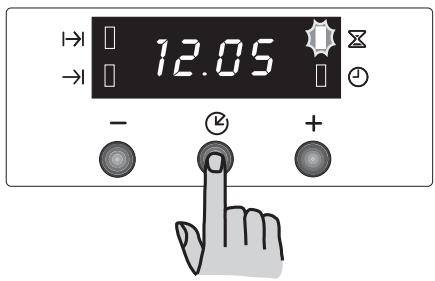
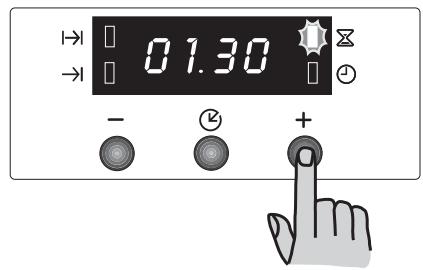
- Press the button repeatedly in order to select the "Countdown" function. The relevant control light starts flashing.
- Press the button " +1 or (longest time period: 2 hours, 30 minutes).
- After you have made the setting, wait 5 seconds: The "Countdown" control light lights up.
- If the end of the input time period has been reached, the control light begins to flash and an audible signal sounds. Press any button to cancel the signal.
To cancel the Minute Minder:
- Press the button repeatedly in order to select the "Countdown" function. The relevant control light flashes and the remaining time is shown on the display.
- Press the button " _ _ _ _ _ until "0.00" is shown in the display. After 5 seconds the control light goes out and the display reverts to the time of day.
How to switch off the display
- Press both the programme buttons simultaneously and hold them down for approx. 5 seconds. The display switches off.
- To switch the display on again, press any button.
The display can be switched off only if no other functions have been set.


Important! - Do not line the oven with aluminium foil and do not put a backing tray or similar on the bottom or else the oven enamel will be damaged as a result of the arising heat spots. Always place pots and pans, heat-resistant pots and pans as well as aluminium trays on the shelf which has been placed on one of the shelving rails. When heating food, steam is generated as in a kettle. When the steam comes into contact with the glass in the oven door, it condenses and creates water droplets.
To reduce condensation, always preheat the empty oven for 10 minutes.
We recommend you wipe the water droplets away after every cooking process.

The oven door must be closed during cooking. Open the oven door carefully. Do not let the door "fall open", but use the door handle until the door is fully open.
The oven has four shelf levels. The shelf positions are counted from the floor of the oven upwards, as shown in the figure.
The shelves must be absolutely correctly installed (see diagram).
Do not place crockery or pots directly on the bottom of the oven.

Hot air

Food is cooked by hot air, which is evenly distributed in the oven's interior by a fan on the oven's back wall.
- The heat reaches all areas of the oven quickly and evenly. This means that you can simultaneously bake, roast and braise different foods on several levels. Hot air cooking quickly removes moisture; the dry oven air prevents the different aromas and odours from one food transferring to another.
- The possibility of cooking on several levels means that you can cook different dishes at the same time and up to three cake tins or mini pizzas for consumption or freezing.
Naturally you can also use the oven with only one shelf. In this case you should use the lowest shelf so that you can better keep the oven mechanism in sight.
- Additionally the oven is especially suitable for sterilising canned goods, cooking -homemade jams and for drying mushrooms and fruit.
Grilling
Most foods should be placed on the rack in the grill pan in order to enable maximum air circulation and so the food does not lie in fat and its own juices. Fish, liver and kidneys can be placed directly in the grill pan if required.
- The foods should be as dry as possible before they are grilled in order to avoid splatter. Brush lean meat or fish lightly with oil or melted butter so that the food remains succulent whilst cooking.
- Accompanying vegetables such as tomatoes and mushrooms can be placed in the grill when cooking meat.
- Bread should be grilled on the uppermost shelf.
The food to be grilled should be turned from time to time.
Using the grill
The grill causes direct heat to gather quickly in the middle of the grill pan. For best results, grill food in small quantities. Energy can also be saved in this way.
- Turn the oven control in order to turn on the oven
- Turn the temperature control to the temperature you want.
- Choose the suitable shelf for the grill pan and grill according to whether or not the food to be grilled is thick or thin. Follow the instructions for grilling.
The grill element is controlled by the thermostat. During the grilling process the grill intermittently switches itself on and off in order to avoid overheating.
Bottom heat

This function is especially useful when blind-baking pastry. It can also be used for quiches or pies which have to have the pastry base baked through first.

The temperature controller's lamp lights up until the correct temperature is reached. It then cycles on and off to indicate that the temperature is being maintained.
Top and bottom heat

- The heat is best distributed around the middle shelf height. If the underside of the food should be more strongly browned, simply use a lower shelf height. If you want the top to brown more intensely, place the shelf in a higher position.
- The material and finish of the baking tray and dishes used affect base browning. Enamelled, dark, heavy or uncoated moulds and cooking appliances enable stronger browning on the underside, whilst moulds made of glass or glazed aluminium or polished steel trays reflect the heat and therefore only permit moderate browning.
Always place dishes centrally on the shelf to ensure even browning.
- Place the dish on an appropriately sized oven tray so that juices do not overflow onto the bottom of the oven. This also saves the effort of cleaning.
- Never place dishes, jars or oven trays directly on the bottom of the oven as this becomes very hot and could lead to damage. On this setting, the heat from the heating elements is generated above and below. Therefore you only need one shelf for this cooking method. This is especially suitable for dishes that must also be browned on the bottom, for example, quiches and pies.
Gratins, lasagne and other grilled dishes which are especially intended to be browned from above can also be cooked in this way.
So use heat from above and below:
- Turn the oven controller to the function
you want - Turn the temperature control to the temperature you want.
Defrosting

The fan runs without heat and circulates the air at room temperature in the oven.
Make sure that the temperature controller is in the OFF position.
Thermal grill


Set the Thermal grill at a maximum temperature of 200^ .
After that introduce alternating functions between the grill and ventilator (convection operation). This mode of operation means that the heat can penetrate the food evenly, without exposing the surface to the direct radiation of the grill for too long a time.
Rotisserie

Always keep the oven door closed.

Heed the following advice:
- Push the meat onto the rotisserie and fix it in the middle of the fork.
- Fit the spit on the support and slide the whole assembly in on the second level up.
- Insert the point of the spit in the rotisserie motor opening on the back wall of the oven.
- Unscrew the rotisserie handle.
- Fill the drip pan with approx. 1/2 litre of water and slide it in on the first level.
- Turn the function selector switch to the position 和 and set the temperature you want.

The rotisserie forks and spit are sharp and may cut (in case your appliance is fitted with a rotisserie). The rotisserie must be handled carefully to avoid injuries.
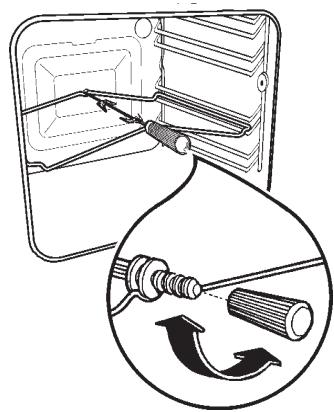

Roasting with the rotisserie


Timings do not include pre-heating. Always preheat the empty oven for 10 minutes.
| Type of food | Quantity (g.) | Level 4 3 2 1 | Temp. °C | Cooking time inminutes |
| Poultry | 1000 | 2 | 200 | 50/60 |
| Roast | 800 | 2 | 200 | 50/60 |

The temperatures quoted are guidelines. and must be adjusted to personal requirements where necessary.

Hints and tips
Baking:
Baked goods usually require a medium temperature (150°C - 200°C). Therefore the oven must be pre-heated for 10 minutes.
Do not open the oven door before 3/4 of the cooking time has passed.
Shortcrust pastry is baked in a springform tin or on a tray for up to 2/3 of the baking time and then garnished before being fully baked. This further baking time depends on the type and amount of topping or filling. Sponge mixtures must be thoroughly stirred with a spoon. The baking time would be unnecessarily extended by too much liquid.
If two baking trays with pastries or biscuits are inserted into the oven at the same time, a shelf level must be left free between the trays.
If two baking trays with pastries or biscuits are inserted into the oven at the same time, the trays must be swapped and turned around after approximately 2/3 of the baking time.
Roasting:
Do not roast any joints that weigh less than 1kg . Smaller pieces could dry out when roasting. Dark meat that is well-cooked on the outside but should remain medium to rare on the inside, must be roasted at a higher temperature (200^ - 250^) .
Light meat, poultry, and fish therefore require a lower temperature (150°C - 175°C). Only add sauce ingredients to the roasting pan at the beginning if the cooking time is short. Otherwise add them in the last half hour.
You can use a spoon to test whether the meat is cooked: if it cannot be depressed, it is cooked through. For medium/rare roast beef and fillet, roast at a higher temperature in a shorter time.
If cooking meat directly on the oven shelf, insert the roasting pan in the shelf level below to catch the juices.
Leave the roast to stand for at least 15 minutes before carving so that the meat juices cannot flow out.
To reduce the build up of smoke in the oven, it is recommended to pour a little water in the roasting pan. To prevent condensation forming, add water several times. The plates can be kept warm in the oven at minimum temperature until serving.

Important!
Do not line the oven with aluminium foil and do not place baking trays, pots, etc. on the oven floor, as the heat that builds up will damage the oven enamel.
Cooking times
Cooking times can vary according to the consistency, ingredients and amount of liquid in the individual foods.
Note the settings you used during your first attempts at cooking and roasting so that you can collect notes in case you want to prepare the same food again at a later date.
Based upon your own experiences you will be able to alter the values given in the charts.
Top and bottom heat and hot air

Timings do not include pre-heating.
Always pre-heat the empty oven for 10 minutes.
| TYPE OF DISH | Top and bottom heat | Hot air | Cooking time in minutes | INSTRUCTIONS | ||
| Level | Temp. (°C) | Level | Temp. (°C) | |||
| CAKES | ||||||
| Sponge mixture | 2 | 170 | 2 (1 and 3)* | 160 | 45-60 | Cake tin |
| Shortcrust pastry | 2 | 170 | 2 (1 and 3)* | 160 | 20-30 | Cake tin |
| Buttermilk cheesecakes | 1 | 175 | 2 | 165 | 60-80 | Cake tin |
| Apple cakes | 1 | 170 | 2 (1 and 3)* | 160 | 90-120 | Cake tin |
| Strudel | 2 | 180 | 2 | 160 | 60-80 | Baking tray |
| Jam tart | 2 | 190 | 2 (1 and 3)* | 180 | 40-45 | Cake tin |
| Sponge cakes | 2 | 170 | 2 | 150 | 60-70 | Cake tin |
| Biscuits | 1 | 170 | 2 (1 and 3)* | 165 | 30-40 | Cake tin |
| Stollen | 1 | 150 | 2 | 150 | 120-150 | Cake tin |
| Plum cakes | 1 | 175 | 2 | 160 | 50-60 | Bread tin |
| Small cakes | 3 | 170 | 2 | 160 | 20-35 | Baking tray |
| Biscuits | 2 | 160 | 2 (1 and 3)* | 150 | 20-30 | Baking tray |
| Meringue | 2 | 135 | 2 (1 and 3)* | 150 | 60-90 | Baking tray |
| Small raised pastries | 2 | 200 | 2 | 190 | 12~20 | Baking tray |
| Pastries: Choux pastry | 2 or 3 | 210 | 2 (1 and 3)* | 170 | 25-35 | On baking tray |
| Fairy cakes | 2 | 180 | 2 | 170 | 45-70 | In cake tin |
| BREAD AND PIZZA | ||||||
| White bread | 1 | 195 | 2 | 185 | 60-70 | |
| Rye bread | 1 | 190 | 1 | 180 | 30-45 | Bread tin |
| Rolls | 2 | 200 | 2 (1 and 3)* | 175 | 25-40 | Baking tray |
| Pizza | 2 | 200 | 2 | 200 | 20-30 | Baking tray |
| FLANS - soufflés | ||||||
| Pasta-Flan | 2 | 200 | 2 (1 and 3)* | 175 | 40-50 | Baking tin |
| Vegetable flan | 2 | 200 | 2 (1 and 3)* | 175 | 45-60 | Baking tin |
| Quiches | 1 | 210 | 1 | 190 | 30-40 | Baking tin |
| Lasagne | 2 | 200 | 2 | 200 | 25-35 | Baking tin |
| Cannelloni | 2 | 200 | 2 | 200 | 25-35 | Baking tin |
| MEAT | ||||||
| Beef | 2 | 190 | 2 | 175 | 50-70 | On shelf |
| Pork | 2 | 180 | 2 | 175 | 100-130 | On shelf |
| Veal | 2 | 190 | 2 | 175 | 90-120 | On shelf |
| Roast beef, medium rare | 2 | 210 | 2 | 200 | 50-60 | On shelf |
| medium | 2 | 210 | 2 | 200 | 60-70 | On shelf |
| well done | 2 | 210 | 2 | 200 | 70-80 | On shelf |
| Shoulder of pork | 2 | 180 | 2 | 170 | 120-150 | With rind |
| Knuckle of pork | 2 | 180 | 2 | 160 | 100-120 | 2 pieces |
| Lamb | 2 | 190 | 2 | 175 | 110-130 | Leg |
| Chicken | 2 | 190 | 2 | 200 | 70-85 | Whole |
| Turkey | 2 | 180 | 2 | 160 | 210-240 | Whole |
| Duck | 2 | 175 | 2 | 220 | 120-150 | whole |
| Goose | 2 | 175 | 1 | 160 | 150-200 | whole |
| Rabbit | 2 | 190 | 2 | 175 | 60-80 | In pieces |
| Hare | 2 | 190 | 2 | 175 | 150-200 | In pieces |
| Pheasant | 2 | 190 | 2 | 175 | 90-120 | whole |
| Meatloaf | 2 | 180 | 2 | 170 | insg.150 | Bread tin |
| FISH | ||||||
| Trout/porgy | 2 | 190 | 2 (1 and 3)* | 175 | 40-55 | 3-4 fish |
| Tuna/salmon | 2 | 190 | 2 (1 and 3)* | 175 | 35-60 | 4-6 fillets |
The temperatures quoted are guidelines. and must be adjusted to personal requirements where necessary.
(*) If you cook several dishes at the same time, we recommend that these are cut off at the levels given in brackets.
Grilling


Timings do not include pre-heating. Always pre-heat the empty oven for 10 minutes.
| TYPE OF DISH | Quantity | Grilling | Cooking time in minutes | Θ | ||
| Pieces | g. | Level | Temp. (℃) | First side | 2nd side | |
| Fillet steaks | 4 | 800 | 3 | 250 | 12~15 | 12~14 |
| Beef steaks | 4 | 600 | 3 | 250 | 10~12 | 6~8 |
| Grilled sausages | 8 | / | 3 | 250 | 12~15 | 10~12 |
| Pork cutlets | 4 | 600 | 3 | 250 | 12~16 | 12~14 |
| Chicken (in 2 halves) | 2 | 1000 | 3 | 250 | 30~35 | 25~30 |
| Kebabs | 4 | / | 3 | 250 | 10~15 | 10~12 |
| Chicken breast | 4 | 400 | 3 | 250 | 12~15 | 12~14 |
| Hamburger* | 6 | 600 | 2 | 250 | 20-30 | |
| *Pre-heat 5'00" | ||||||
| Fish fillet | 4 | 400 | 3 | 250 | 12~14 | 10~12 |
| Crispy toast | 4~6 | / | 3 | 250 | 5~7 | / |
| Slices of white bread | 4~6 | / | 3 | 250 | 2~4 | 2~3 |
Thermal grill


Set Thermal grill at a maximum temperature of 200^ .
| TYPE OF DISH | Quantity (gr.) | Level | Temp. °C | Cooking time in minutes | |
| below side | above side | ||||
| Rolled joints (turkey) | 1000 | 3 | 200 | 30 ~ 40 | 20 ~ 30 |
| Chicken (in 2 halves) | 1000 | 3 | 200 | 25 ~ 30 | 20 ~ 30 |
| Chicken drumsticks | - | 3 | 200 | 15 ~ 20 | 15 ~ 18 |
| Quails | 500 | 3 | 200 | 25 ~ 30 | 20 ~ 25 |
| Vegetable gratin | - | 3 | 200 | 20 ~ 25 | - |
| Pieces. Scallops | - | 3 | 200 | 15 ~ 20 | - |
| Mackerel | - | 3 | 200 | 15 ~ 20 | 10 ~ 15 |
| Fish slices | 800 | 3 | 200 | 12 ~ 15 | 8 ~ 10 |

The temperatures quoted are guidelines. and must be adjusted to personal requirements where necessary.
Cleaning and servicing

Before any cleaning switch the oven off and let it cool down.
The appliance must not be cleaned with a steam cleaner or a steam jet cleaner.
Important: Before carrying out any cleaning operation, the appliance must be disconnected from the power supply.
For a longer appliance life it is necessary to carry out the following cleaning operations regularly:
Only perform when the oven has cooled down.
- Clean the enamelled parts with soapy water.
- Do not use abrasive cleaners.
- Dry the stainless steel parts and glass with a soft cloth.
- If there are stubborn stains, use commercially available for stainless steel or warm vinegar.
The oven's enamel is extremely durable and highly impermeable. The effect of hot fruit acids (lemon, plum or similar) can however leave behind permanent, matte and rough stains on the enamel surfaces. However, such marks in the brightly polished surface of the enamel do not affect the operation of the oven. Clean the oven thoroughly after every use. This is the easiest way to clean dirt off. It prevents dirt being burnt on.
Cleaning materials
Before using cleaning materials, always check that these are suitable for your oven and recommended by the manufacturer.
Cleaners that contain bleach should NEVER be used as they may dull the surface finishes. Harsh abrasives should also be avoided.
External cleaning
Regularly wipe over the control panel, oven door and door seal using a soft cloth well wrung out in warm water to which a little liquid detergent has been added.
To avoid damage to the oven's glass door do not use the following under any circumstances:
Household cleaners and bleaching solution
- Coated cleaning sponges which are unsuitable for saucepans with non-stick coating
- Brillo/Ajax pads or steel wool pads
Chemical oven pads or aerosols
Rustremovers
- Stain removers for sinks/washing up
Clean the outer and inner door glass using warm soapy water. Should the inside of the glass door be heavily soiled, use cleaning products such as "Hob Brite". Do not use paint scrapers to remove dirt.
Oven cavity
The enamelled oven floor is best cleaned whilst the oven is still warm.
Wipe the oven with a soft cloth which is washed out in warm soapy water after every use. From time to time a more thorough cleaning is required. Use a commercially available oven cleaner for this.
Care of Catalytic Liners
As cooking produces oil, fats, splashes of food, etc., catalytic enamel destroys them. To aid this process it is a good idea to run the oven for an hour or two per week, without food, to ensure continued good performance from the catalytic liners.
To clean the oven cavity, proceed as follows:
-
remove the oven accessories, if present (e.g. pans, grids, baking tray, dripping pan, etc.). Do not leave anything inside the oven.
-
Turn the oven control to the hot air

- Turn the thermostat control to 250^ .
- Allow the oven to run empty for approximately 45 minutes.
- Open a window for ventilation.
Repeat this procedure with the "Grill and
rotisserie " function 水 for approximately 5 minutes.
If the oven cavity is cold, let the oven run for 60 minutes.

Do not attempt to clean catalytic enamel.
Hints and tips
- Manual cleaning of the catalytic liner is not recommended. Damage will occur if soap impregnated steel wool pads, aerosol cleaners and any other abrasives are used.
- Slight discolouration and polishing of the catalytic surface may occur in time. This does not affect the catalytic properties in any way.
- Follow the recommendations made in the chapter "How to avoid staining while cooking".
Cooking to reduce soilage
Cook at the recommended temperatures. Higher temperatures during roasting will increase soilage. Try to cook at a lower temperature for a longer time. That way you will save energy and the roast will be more tender.
Use minimal, if any, extra oil or fat when roasting meat; potatoes only require brushing with fat before cooking. Extra fat in the oven during roasting will increase splashing and soilage. It is NOT necessary to add water to the meat tin when roasting. Water and fat juices flow out of the roast during cooking and splatter excessively, even at normal temperatures. This also causes condensation. Covering joints during cooking will also prevent splashing onto the interior surfaces; removing the covering for the last 20-30 minutes will allow extra browning, if required. Some large joints and turkeys especially benefit by this method of cooking, allowing the joint to cook through before the outside is overbrowned.
Please use the roasting dish. During roasting, the fat from the joint will be contained beneath the roasting dish and therefore prevent it from splattering onto the ,catalytic' liner.
Telescopic Shelf Supports and Catalytic Panels
The shelf supports and the catalytic panels can be removed for easy cleaning.

Make sure the appliance is completely cooled before carrying out this operation.

Proceed as follows:
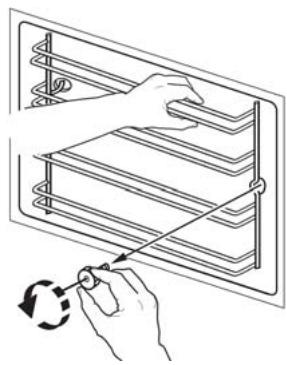
1) remove the front screw while keeping the shelf support and the catalytic panel in position with the other hand (see diagram 1);
2) keep the shelf support and the catalytic panel in position and lift them with a hand while disengaging the rear hook. Take off the shelf support and the catalytic panel (see diagram 2); Clean the telescopic shelf supports on the outside only with commercially available detergents.
Important: The telescopic shelf supports must not be cleaned in the dishwasher.
IMPORTANT: the rollers must not be greased.
3) Reattach the telescopic shelf supports and the catalytic panel after cleaning; proceed in reverse order.
Please, ensure the retaining nuts are secure when refitting the shelf support and the catalytic panel.
Changing the interior light

Separate the appliance from the power supply by switching off the fuse.
If the oven bulb needs replacing, the new bulb must have the following specifications:
- Electric power: 15 W / 25 W
- Electric rate: 230 V( 50 Hz)
- Heat resistance to 300^ C
- Connection type: E14
These replacement bulbs can be purchased from your dealer.
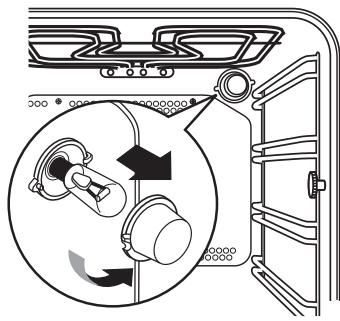
To change the oven bulb:
- Before proceeding ensure the oven is cool and is disconnected from the electricity supply.
- Twist the bulb's glass cover in an anticlockwise direction.
- Remove the burnt out bulb and replace it with a new one.
- Replace the glass cover and reconnect the oven to the electricity supply.
1

2
Oven door
The oven door comprises two glass panels. For easy cleaning, the oven door can be unhinged and the internal panels removed.

Caution: the oven door must be disassembled before cleaning. The oven door may suddenly slam shut if you attempt to remove the inner panels while the oven door is still in position.

To remove the door, proceed as follows:
- Open the door completely.
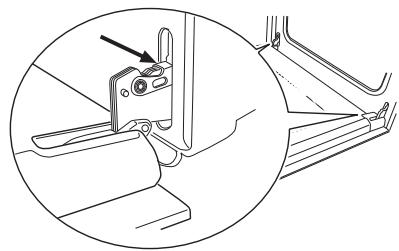
- Locate the two door hinges.
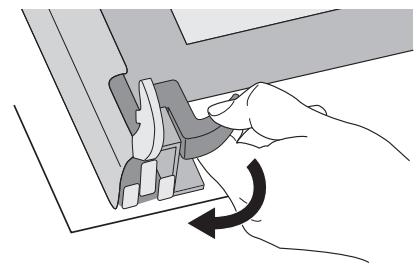
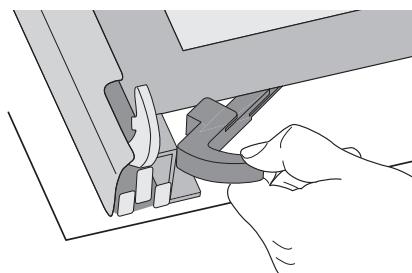
- Lift the levers on the hinges and fold them forwards.
- Hold the door by the two outside edges and close the door by about 45^ only.
- Pull the door forwards out of its seat.
- Lie the door on a firm surface and protect the surface of the handle with a soft cloth.


- Use the bolts to remove the inner panels.
- Turn both locking screws by 90^ and remove them.
- Carefully lift the top panel slightly and remove the panel which is framed on all 4 sides by an ornamental border.
Clean the oven door with luke-warm water and a soft cloth. Do not use metal pads, metal wool, abrasive pads or acids to clean the oven door as they will damage the special heat-reflective surfaces of the inner panels. After cleaning the inner panels, re-insert them in the door. Refit the oven door; to do so, repeat the above sequence in reverse. Ensure the panels are the right way round.

Then, proceed as follows:
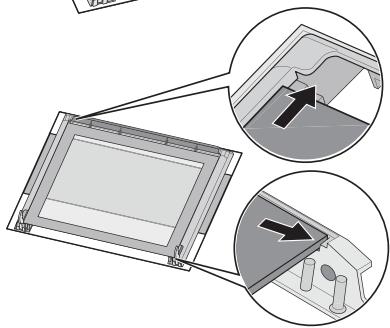
a) The inner panel with the frame on 4 sides must be inserted so that the printing on the screen is facing to the outside of the oven. You will know the panel is properly in place if, when you touch the visible surface with your fingers, it doesn't feel rough where the printing is.
The inner panel must be inserted in positionas shown in the diagram. After inserting the panel in the oven door, fix in position as described under point 8.

Never clean the oven door when it is warm as the panels might shatter. If you can see scratches or cracks in the glass panel, call your nearest service centre immediately to have the panel replaced.


Models in stainless steel or aluminium: Clean the oven door and operating panel in stainless steel or aluminium with a damp sponge and then dry carefully with a soft cloth. Never use metal pads, metal wool, acids or abrasives for cleaning because they may scratch the surfaces.
Cleaning the oven door seal
A seal is attached around the opening of the oven.

Regularly check the condition of the seal. Clean the seal if necessary without using any abrasive materials or objects. If you find that the seal is damaged, call your nearest service centre immediately. Do not use the oven until the seal has been changed.
Troubleshooting
If the appliance does not work properly, please check the following before calling an Electrolux Service Centre:
| PROBLEM | SOLUTION |
| ■ The oven does not switch on. | ◆ Check whether a cooking function and a temperature have been selected, or ◆ Check that the appliance is properly connected and the socket switch or the mains supply to the oven is on. |
| ■ The control light for the oven temperature does not come on. | ◆ Use the temperature controller to choose a temperature, or ◆ Use the oven controller to select a function. |
| ■ The oven's interior light does not come on. | ◆ Use the oven controller to select a function. or ◆ Check the light bulb and change it if necessary (see "Changing the interior light") |
| ■ Cooking the food takes too long or it cooks too fast. | ◆ Where required the temperature must be changed, or ◆ Refer to the contents of this user guide, in particular, the "Hints and Tips" chapter. |
| ■ Steam and condensation settles on the food and in the oven cavity. | ◆ Do not leave dishes in the oven after cooking for longer than 15-20 minutes. |
| ■ The fan is too loud. | ◆ Check that the shelves and the cookware do not knock the back of the oven and vibrate as a result. |
| ■ The display shows "12.00": | ◆ Set the clock (see the chapter "Setting the clock"). |
Technical data
Heating element ratings
Bottom oven element 1000 W
Top and bottom heating element 1800 W
Hot air 1825W
Thermal grill 1650 W
Grill and rotisserie 1650 W
Oven light 25 W
Total power requirement 1875 W
Operating voltage (50 Hz) 230 V
Dimensions of the recess
Height Under top edge 600 mm
In recess 587 mm
Width 560 mm
Depth 550 mm
Oven cavity
Height 335 mm
Width 395 mm
Depth 400 mm
Oven capacity 531

Installation and connection must be done in compliance with the regulations in force. All repairs may only be carried out once the appliance is turned off. Repairs must only be carried out by qualified service engineers.
The manufacturer denies all liability in cases where safety regulations have not been followed.
Connecting to the electrical supply
Please take note of the following requirements before connecting:
- The fuse or other protective device and the domestic electrical installation must be designed for the max. load of the appliance (see rating plate).
- The domestic electrical installation must be equipped with a proper earth connection in accordance with the regulations in force.
- The socket or multi-pole off switch must be easily accessible, even after completed installation of the appliance.
This appliance is supplied with a connection cable incorporating a standard plug, suitable for the total electric load shown on the rating plate. The plug is to be inserted into a suitable wall socket.
The following types of connection cable are suitable, considering the required rated cross-section for the given situation: H07 RN-F, H05 RN-F, H05 RR-F, H05 VV-F, H05 V2V2-F (T90), H05 BB-F.
With a direct connection between the oven and the electricity supply or if the socket is inaccessible, an all-pole circuit breaker with a minimal contact port of 3mm must be built in. The switch must not interrupt the protective conductor at any point. The earth wire must be 2-3 cm longer than the phaseto-neutral conductor.
The connection cable must in any case be laid out so that at no point does it reach 50^ (over room temperature).
Once successfully connected, check the heating elements after approx. 3 minutes of use.
Terminal block
The oven is equipped with an easily accessible terminal block, which is meant for operation with a single phase voltage of 230V .
Live terminal
N Neutral terminal

or E -
Earth terminal

Instructions for building in
To ensure trouble-free operation of the built-in appliance, the kitchen units or recess that the appliance is built into must have suitable dimensions.
According to current regulations all parts that ensure shock protection from live power and operation isolating components are attached in this way so that they cannot be removed without tools.
These also include the fixing of any end walls at the beginning or end of a line of built-in units.
In any case, the accidental contact protection must be ensured by the building in of the appliance.
The appliance can be positioned with its back or side wall against higher kitchen units, appliances or walls. However, only other appliances or units of the same height as the appliance can be placed against the other side wall.
Oven dimensions
Instructions for building in
To ensure trouble-free operation of the built-in appliance, the kitchen units or recess that the appliance is built into must have suitable dimensions.
Securing in the unit
1 Open the oven door.
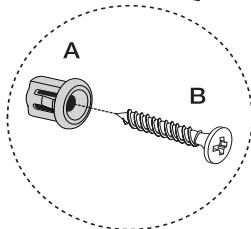
2 Secure the oven with the aid of the four separators in the unit (A). These fit exactly in the holes in the frame. Then tighten the four provided wood screws (B).


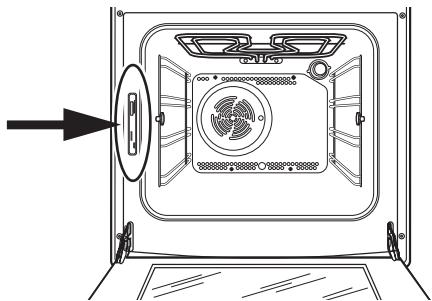
If following the described checks (see page 55) the problem cannot be solved, call the manufacturer's nearest customer service and give the type of defect, the applicance model (mod.) and the production number (prod. number) as well as the serial number (ser. number), which can be found on the oven's rating plate.
- Inhoud
- How to read the instruction book
- MANUFACTURER:
- Installation
- Operation
- Personal safety
- Disposal
- Packaging material
- Old appliances
- Customer service
- Description of the appliance
- Accessories
- Retractable knob
- Oven controller
- Power indicator
- Temperature controller
- Temperature controller - control indicator
- Safety Thermostat
- Cooling fan
- Before using for the first time
- The oven will only function when the clock has been set to the time of day.
- The oven will work only if the time of day has been set.
- Setting the time
- To enter the time:
- To reset the correct time of day:
- Cooking time |→ |
- To set the duration time:
- To cancel the programmed cooking time:
- End of cooking time →
- To set the end of cooking time:
- To cancel the programmed end of cooking time:
- Setting both "Cooking time" |→| and "Cooking end time" →
- Countdown
- To set the minute minder:
- To cancel the Minute Minder:
- How to switch off the display
- To reduce condensation, always preheat the empty oven for 10 minutes.
- Hot air
- Grilling
- Using the grill
- Bottom heat
- Top and bottom heat
- Defrosting
- Thermal grill
- Set the Thermal grill at a maximum temperature of 200°C .
- Rotisserie
- Always keep the oven door closed.
- Roasting with the rotisserie
- Hints and tips
- Baking:
- Roasting:
- Important!
- Cooking times
- Top and bottom heat and hot air
- Timings do not include pre-heating.
- Cleaning and servicing
- Before any cleaning switch the oven off and let it cool down.
- The appliance must not be cleaned with a steam cleaner or a steam jet cleaner.
- Cleaning materials
- External cleaning
- Oven cavity
- Care of Catalytic Liners
- Do not attempt to clean catalytic enamel.
- Cooking to reduce soilage
- Telescopic Shelf Supports and Catalytic Panels
- Make sure the appliance is completely cooled before carrying out this operation.
- Changing the interior light
- Separate the appliance from the power supply by switching off the fuse.
- Oven door
- Cleaning the oven door seal
- Troubleshooting
- Technical data
- Heating element ratings
- Dimensions of the recess
- Connecting to the electrical supply
- Terminal block
- Instructions for building in
- Oven dimensions
- Securing in the unit
Brand : PROGRESS
Model : PBK3360X
Category : Built-in oven