Solitaire CWT 1000 - 40 - Audio Amplifier T+A - Free user manual and instructions
Find the device manual for free Solitaire CWT 1000 - 40 T+A in PDF.


| Brand | T+A |
| Model | Solitaire CWT 1000 - 40 |
| Product Type | Floor-standing 3-way loudspeaker |
| Series | SOLITAIRE CWT |
| Acoustic Principle | Cylinder Wave Transducer (CWT) |
| Bass Section | Closed cabinet, symmetrically opposed bass drivers |
| Mid-range Driver | High transient response, low coloration |
| Treble Driver | Electrostatic driver with large membrane area |
| Cabinet Material | Multi-layer, extremely strong and rigid, resonance-resistant |
| Recommended Amplifier | Power amplifier designed for 4 Ohm load, high current capability (>10 Ampere) |
| Connection Options | Single-wiring, bi-wiring, bi-amping (horizontal or vertical) |
| Terminals | Bi-wiring terminals for Bass and Mid/High with link bridges |
| Level Adjustment | Switches for BASS, MID, TREBLE, each with +1.5 dB / LIN / -1.5 dB |
| Power Supply | Mains inlet with switch for electrostatic tweeter charging |
| Mode Switch | ON, AUTO, CTRL for automatic power on/off |
| Trigger Input | T+A RLINK control input/output (two equivalent sockets) |
| Power LED | Illuminated T+A logo indicates operation |
| Feet | Four spikes with lock nuts and floor contact plates |
| Safety | Contact guard grilles protect high-voltage electrostatic unit |
| Compliance | CE Marking, Low Voltage Directive, EMV Directive |
| Cleaning | Wipe with soft dry cloth; never use solvents |
| Setup | At least 0.5 m from side walls, listening distance > 3.5 m |
| Intended Use | Indoor dry rooms only |
Frequently Asked Questions - Solitaire CWT 1000 - 40 T+A
User questions about Solitaire CWT 1000 - 40 T+A
0 question about this device. Answer the ones you know or ask your own.
Ask a new question about this device
Download the instructions for your Audio Amplifier in PDF format for free! Find your manual Solitaire CWT 1000 - 40 - T+A and take your electronic device back in hand. On this page are published all the documents necessary for the use of your device. Solitaire CWT 1000 - 40 by T+A.
USER MANUAL Solitaire CWT 1000 - 40 T+A
Lieferumfang
Abb. 2

Anschluss


Power LED
We are delighted that you have decided to purchase a T+A product. With your new Solitaire CWT 1000-40 speakers you have acquired a reference class product which has been designed and developed with the wishes of the audiophile music lover as absolute top priority.
All these factors contribute to a piece of equipment which will satisfy your highest demands and your most searching requirements for a period of many years. All the components we use meet the German and European safety norms and standards which are currently valid. All the materials we use are subject to painstaking quality monitoring.
T+A have been manufacturing and developing the SOLITAIRE series of loudspeakers since 1984. CWT stands for Cylinder Wave Transducer. The SOLITAIRE CWT series has been developed without compromise. The primary aim was always this: musical reproduction to the highest possible standard of fidelity. The CWT 1000-40 are housed in extremely sophisticated cabinets made of multi-layer material which is extremely strong and rigid, and highly resistant to resonance. For the bass range we have chosen a large closed cabinet to get a low cut-off frequency and a perfect transient response. To avoid all acoustical resonances and to cancel all moving mass effects, the bass drivers are positioned symmetrically in opposite directions. For the mid-range we have developed a completely new driver, featuring incredible transient response and virtually complete freedom from coloration and distortion. For the treble range a completely new constructed electrostatic driver with a huge membrane area is used. It is an ideal driver for the whole treble range. All this technology is packed into cabinets of incomparable quality whose form follows the required function perfectly
Our range of accessories includes high-quality cables and connectors.
We would like to take this opportunity to thank you for the faith you have shown in our company by purchasing this product, and wish you many hours of enjoyment and sheer listening pleasure with your □ Solitaire CWT 1000-40 loudspeakers.
All the components we use meet the European safety norms and standards which are currently valid. The operation instructions, the connection guidance and the safety notes are for your own good - please read them carefully and observe them at all times.
This product complies with the Low Voltage Directive (2006/95/EEC), EMV Directive (2004/108//EEC) and CE Marking Directive (93/68/EEC).
Contents
Solitaire CWT 1000-40....20
Setting up the Loudspeakers
Hearing distance 21
Setting up.... 22
Fitting the spikes in detail.... 24
Level compensation 24
Connections 25
Level adjustment.... 28
Care and maintenance 28
Safety notes 29
Trouble shooting 31
Specifications 33
Symbols used in these instructions

Caution!
Text passages marked with this symbol contain important information which must be observed if the machine is to operate safely and without problems.

This symbol marks text passages which provide supplementary notes and background information; they are intended to help the user understand how to get the best out of the device.
Package contents
The package content consists of the following single parts:
• Solitaire CWT 1000-40 loudspeaker
- 1 mains cables
• 4 spikes (complete with counter nut, spike and floor contact plate)
• 1 User manual
Please store the original packaging materials in a safe place. The carton and packing materials have been specially designed for these loudspeakers. They form a safe container should you need to transport the speakers at any time, and they also help to maintain the speakers' second-hand value.
If you don't wish to keep the packaging, give the material back to your supplier for appropriate disposal.
Setting up the loudspeakers
Hearing distance
The loudspeakers are designed symmetrically. This means that there is a left and a right loudspeaker. To get the best possible sound quality the loudspeakers should be positioned with the electrostatic tweeters at the outward facing side of the speakers (see fig. 5).
It is also recommended to adjust the loudspeakers slightly angled inwards to your listening seat.
The new SOLITAIRE® loudspeakers are designed to act as Cylinder Wave Transducers (CWT). The mid-range drivers form what is known as a Line Array, and the electrostatic unit a Line - Source, with the net result that the sound field is concentrated in the area between the top and bottom edges of the loudspeaker. Above the cabinet and in the downward direction the effective radiation of the speaker's entire bass-mid-range and treble frequencies is low. This results in greatly reduced reflections from ceiling and floor, and the virtual elimination of the listening room's influence on the sound image and the speaker's imaging characteristics.
The CWT are inclined slightly to the rear, so that the cylinder wave rises as it moves into the listening space. The listener should therefore be positioned in the area in front of the speaker baffles, and certainly not higher than the cabinets.
The listening distance should be about 10% greater than the distance between the loudspeakers, and should be no less than 3.5 metres.
Please bear in mind that the bass level is increased by about 3 dB if you position the speakers against a wall, and by up to 6 dB if you place them in the corner of the room. To avoid excessive bass response it therefore makes sense to set up the speakers at least 0.5 metres from the side walls of the listening room; if at all possible they should be free-standing, i.e. unobstructed by other furniture etc. (see „Level adjustment“ section).
Hiding the loudspeakers behind furniture or curtains has a very marked adverse effect on their treble reproduction.
Position the speakers in such a way that the terminals cannot be touched when the speakers are operating - especially by children!

Fig. 2

The speaker is very heavy - be careful when unpacking and transporting it. Always lift and transport the speakers with 2 persons.
- First set up the speakers at their intended location. To determine the correct distances (walls, listening position, etc.) and placement angle to the listening position, the CWT 1000-40 can be easily moved and aligned with the pre-assembled furniture glides (Fig.3).
- Once the CWT 1000-40 is correctly aligned in its final position, the distances and angles should be noted or marked.

- Put the CWT 1000-40 aside and place the foam plate (56x70 cm) from the transport packaging in the previously determined position. Position the plate so that the front feet of the plinth plate protrude (see Fig. 4).
- Lift the CWT 1000-40 onto the foam plate and align the speaker so that it is back in the correct position.

Fig. 4
- Install the front spikes first. One person will slightly tilt the CWT 1000-40 backwards (Fig. 5), while another person will remove the furniture glides and attach the spikes as described in "Fitting the spikes in detail" (Fig. 7).
- After the spikes are mounted, the floor contact plates must be positioned under the spikes on the floor.
- Slowly lower the speaker until the spikes are on the floor contact plates. If necessary, correct the position of the floor contact plates again before completely removing the speakers.
The small recess in the floor contact plate centers the spike.

- In the second step the rear spikes are fitted (Fig. 6).
- The assembly is carried out as described above.
- Take special care that the CWT 1000-40 does not slip away on the floor contact plates. Tilt the speaker only so far that the spikes can be mounted.

Fig. 6
Fitting the spikes in detail
- First, screw the spike completely into the base plate from below.
- The next step is to screw the lock nut from above onto the thread of the spike.
- Place the speakers on the floor contact plate at the intended position in the room. The small recess in the base plate centers the spike (see also chapter "Installation").

The spikes have extremely sharp points which could cause injury; please handle them with great care, and keep them well away from children.
The spikes feature sharp points which may damage delicate surfaces (e.g. parquet flooring or tiles).

Abb. 7
Level compensation
The spikes can be turned in and out to achieve optimum height compensation on uneven surfaces.
The spikes must be adjusted in such a way that the loudspeaker has a solid contact to the ground and does not "tilt".

Connections


Power LED
| Terminals | The CWT 1000-40 are equipped with bi-wiring terminals which feature separate inputs for the bass range (Bass) and the mid-range/treble range (Mid / High). These terminals can be used for standard wiring arrangements, but also for the methods known as bi-wiring and bi-amping.(cp. wiring diagrams) |
| Trigger | Control input / output for T+A RLINK systems:Both sockets are equivalent – one is used as input, the other one serves as output towards other RLINK devices (loudspeaker). |
| Mode | The power supply of the electrostatic tweeter is equipped with an automatic switch-on circuit. The 'MODE' switch is used to set the operation mode.'ON' settingIf the switch is set to the 'ON' position, the power supply remains switched on permanently, regardless of the input signal.'AUTO' settingThe speaker switches on automatically as soon as a music signal is present and switches itself off if no signal is detected for about 5 minutes.'CTRL' settingThe speaker switches on automatically as soon as a RLINK switching signal from a T+A master device (e.g. Preamplifier) is present at the Trigger input. |
| Mains input | The foil membrane of electrostatic drive units needs to be charged up using a high voltage, and that is why the CWT 1000-40 feature a mains inlet and a mains switch. |
| Power ON LED(illuminated □ logo) | The illuminated T+A -logo on the speaker baffle is turned on to show that the speaker is now switched ON and ready for operation.If the speaker shuts down the □ logo will turn dark. |
| i We recommend that you should run-in the electrostatic drivers for about 3 minutes before listening to music, to give time for the electrostatic tweeters to charge up completely. |
Amplifier
The CWT 1000-40 can be connected to any amplifier designed for a 4 Ohm speaker load. However, if you wish to exploit the full sound potential of these speakers, we recommend power amplifiers which are capable stable of supplying high currents.>10 Ampere.

Loudspeaker binding posts and loudspeaker cables can carry dangerously high voltages. Be sure to switch off the amplifier before carrying out any wiring work.
Cable

The cables employed in any Hi-Fi system have a crucial influence on the sound of the system as a whole. For this reason □ has developed its own range of cables which includes the ideal type for every application. These cables are designed to match the special characteristics of our loudspeakers. Please note that all the cables used should be the same length!
Standard - connections
In the standard wiring arrangement only one speaker cable is required for each loudspeaker. The linking bridges between Bass and Mid / High must be left in place.


In bi-wiring and bi-amping arrangements the cables bridging of the woofer (Bass) and mid/high (Mid/High) input terminals must be removed!
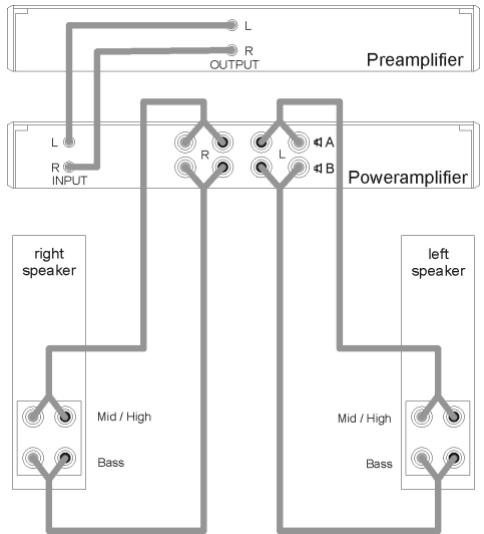
Bi - Wiring
Bi-wiring provides better sound by separating the bass (Bass) signal and mid-range/treble signals (Mid/High). Two speaker cables are required for each loudspeaker.
If your power amplifier has two loudspeaker outputs (A and B), the speakers are connected as shown in the illustration below; If the power amplifier has outputs for only one pair of loudspeakers, connect both cables to these outputs in parallel.
Bi – amping (horizontal)
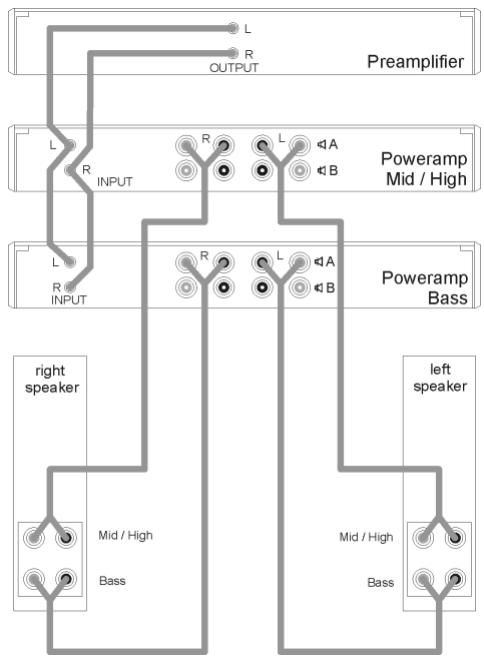
In a bi-amping arrangement the signal paths for the bass and mid-range/treble ranges are separated before they reach the power amplifiers.
In the horizontal bi-amping version, one stereo power amplifier is used to amplify the bass range for both channels, while a second stereo power amplifier drives the mid-range/treble range of both channels.
Advantage: symmetrical load on the power amplifier mains power supply for both channels.
Disadvantage: the power amplifier determines the channel separation.
Bi – Amping (vertical)
In the vertical bi-amping version the power amplifiers work in a strictly channel-separate arrangement.
One stereo power amplifier amplifies the signals for one loudspeaker: one channel drives the treble/mid-range, the other channel the bass range.
Advantage: maximum channel separation in the power amplifiers. Power amplifiers can be located close to the speakers, therefore short speaker leads can be used.
Disadvantage: asymmetrical load on the power amplifier mains power supplies due to bass processing on one side and mid-range/treble processing on the other.

Level adjustment
Level adjustment
The CWT 1000-40 loudspeakers can easily be adjusted to suit the acoustic qualities of the listening room, or to particular conditions and speaker positions.
For example, it may well be necessary to reduce the bass range if the speakers are set up close to a wall.
To facilitate these adjustments you will find three switches (marked BASS, MID and TREBLE) on the rear terminal of the speaker cabinet; each switch has three positions: +1.5 dB, LIN and -1.5 dB.
BASS
If the loudspeakers are set up in a listening room a considerable distance from the walls (> 1.5 m) we recommend setting the switch to +1.5 dB.
If the loudspeakers are set up in a listening room close to the walls, in our experience the best results in terms of sound are obtained with the switch set to 0 dB.
If the loudspeakers are set up in one corner of the room, the result can be excessive bass emphasis. The -1.5 dB setting compensates for this effect.
MID / TREBLE
On the rear of each speaker you will also find two additional switches for adjusting the treble and mid-range response to suit the listening room. The default position for both switches is 0 dB.
These switches enable you to adjust the level by +/- 1.5 dB, and the adjustment is designed to compensate for very „hard“ (highly reflective) or very „soft“ (highly damped) rooms. For rooms which tend to echo, we recommend the -1.5 dB setting.
In contrast, a lift of 1.5 dB may be helpful in rooms which tend to damp sound down.

Care and maintenance
Care of the loudspeakers
Always disconnect the loudspeakers from the mains supply before cleaning them.
Never use powerful cleaning agents or solvent cleaners!
The surface of the loudspeaker cabinets should be cleaned simply by wiping with a soft, dry cloth.
Safety notes
For your own safety please be sure to read right through these operating instructions before you use the system. It is especially important to observe the following safety notes.
The loudspeakers may only be operated in a dry indoor room.
If the unit gets very cold (e.g. when being transported), condensation may form inside it. Please do not switch it on until it has had plenty of time to warm up to room temperature, so that any condensation evaporates completely.
Like any other electrical apparatus, these loudspeakers should never be used without proper supervision.
If the speakers are not to be used for a long period, we recommend that you isolate them from the mains by pulling out the plug at the wall socket.
The power supply required for these loudspeakers is printed on the rear face of the cabinet. The speakers must never be connected to any other form of power supply.
Mains leads must be deployed in such a way that there is no danger of damage to them (e.g. through persons treading on them or from furniture). Take particular care with plugs, distribution panels and connections at the loudspeakers. Do not exert undue force on the mains connectors.
The loudspeakers must be set up in such a way that there is no chance of anyone - especially children - touching the electrical connections.
Do not place naked flame sources, such as candle lights on the device.
Protect the unit from drips and splashes of water; never place flower vases or fluid containers on the unit.
The electrostatic treble unit employed in the CWT, operate at very high voltage. All parts carrying high voltages are protected using contact guard grilles. These grilles must never be removed. Touching any internal parts of the electrostatic driver is highly dangerous, as the voltages present are capable of causing death.
You must never push any object through the grilles. Avoid fluids of any kind getting inside the treble units or the valve output stage at all costs. However, if foreign bodies or liquids should get into the treble units, disconnect the speaker from the mains immediately. The speaker must then be checked by an authorised □ service centre before being used again.
With the exception of the connections and procedures described in these instructions, no work of any kind may be carried out on the loudspeakers by the user.
The loudspeakers should only ever be opened by a qualified technician. Repairs and fuse replacements should be entrusted to an authorised □ specialist workshop.
If a speaker should be damaged, or if you suspect that it is not functioning correctly, immediately disconnect the mains plug at the wall socket and ask an authorised T+A specialist workshop to check the unit.


The device is extremely heavy - caution is required when unpacking and transporting it. Always lift and transport the device with two persons.
Legal requirements pertaining to the lifting of heavy loads prohibit the transport of the device by women.
Ensure that you have a firm, secure hold on the device. Do not let it fall. Wear safety footwear when moving the device. Take care not to stumble. Ensure an unobstructed area of movement by removing obstacles and possible hindrances from the route.
Take care when lowering the device! To avoid your fingers being crushed, ensure that they are not trapped between the device and the support surface.
Care of the loudspeakers
Always disconnect the loudspeakers from the mains supply before cleaning them.
Never use abrasive or solvent-based cleaning agents.
For polishing the cabinets use only the also delivered polish.
Before switching the loudspeakers on again, check carefully that no short-circuits exist at the terminals, and that you have not disturbed any connections.
Disposing of this product

The only permissible method of disposing of this product is to take it to your local collection centre for electrical waste.
Trouble shooting
Many problems have a simple cause and a correspondingly simple solution. The following section describes a few difficulties you may encounter, and the measures you need to take to cure them. If you find it impossible to solve a problem with the help of these notes please disconnect the unit from the mains and ask your authorised □ specialist dealer for advice.
| No output signal, or seriously distorted signal at the loudspeakers. | Cause:Short-circuit at the loudspeaker cables; e.g. through stray wire strands at the terminal clamps, or mechanical damage to the cables.Remedy:Check loudspeaker cables and terminals carefully, twist wire ends neatly (conductor sleeves can also be used); be sure to replace damaged cables! |
| Flat sound image, insufficient bass response. | Cause:The loudspeaker cables are connected with reversed polarity.Remedy:Check the speaker connections at the loudspeakers and at the amplifier's speaker terminals, referring to the wiring diagram; correct if necessary. |
| Excessive or booming bass response. | Cause:The loudspeaker is set up too close to the wall or in one corner of the room.Remedy:Maintain a minimum distance of 50 cm to the side walls, or change the setting of the „BASS“ switch on the back of the speaker. |
| No treble response | Cause:The high voltage for the electrostatic treble units is not present.Remedy:Move the mains switch on the back of the speaker to the „ON“ position. |
Notizen / Notes



- LIEFERUMFANG
- ANSCHLUSS
- CONTENTS
- SETTING UP THE LOUDSPEAKERS
- SYMBOLS USED IN THESE INSTRUCTIONS
- CAUTION
- PACKAGE CONTENTS
- FITTING THE SPIKES IN DETAIL
- LEVEL COMPENSATION
- CONNECTIONS
- AMPLIFIER
- CABLE
- STANDARD - CONNECTIONS
- BI - WIRING
- LEVEL ADJUSTMENT
- BASS
- MID / TREBLE
- CARE AND MAINTENANCE
- CARE OF THE LOUDSPEAKERS
- SAFETY NOTES
- DISPOSING OF THIS PRODUCT
- TROUBLE SHOOTING
- NOTIZEN / NOTES
Brand : T+A
Model : Solitaire CWT 1000 - 40
Category : Audio Amplifier