
QW 118P - Active subwoofer PEAVEY - Free user manual and instructions
Find the device manual for free QW 118P PEAVEY in PDF.


| Product Type | Powered Subwoofer |
| Brand | Peavey |
| Model | QW 118P |
| Frequency Response | 40 Hz to 120 Hz |
| Amplifier Power (Subwoofer) | 1000 Watts RMS, 1500 Watts Peak |
| Amplifier Power (Satellites) | 250 Watts RMS, 750 Watts Peak per channel |
| Speaker | 18 inch Low Rider® |
| Maximum Output Level | Over 130 dB |
| Inputs | Combo XLR/1/4" TRS balanced, RCA unbalanced |
| Outputs | XLR male Thru, filtered line outputs (XLR), amplified outputs (Speakon) |
| Built-in Active Crossover | Linkwitz-Riley 4th order at 120 Hz |
| Signal Processing | Kosmos® sub-harmonic, DDT™ compression, thermal protection |
| Power Supply | 120 VAC 60 Hz (US version) or 240 VAC 50 Hz (Europe), 1300 W |
| Fuse | 15 A, fast-blow type ABC |
| Dimensions (H x W x D) | 719 mm x 533 mm x 686 mm |
| Weight | 55 kg |
| Enclosure Material | High-quality plywood, black Hammer Head™ finish |
| Protective Grille | 16-gauge steel |
| Handles and Casters | Integrated side handles, locking rear casters |
| Pole Mount Adapter | Built-in, for satellite up to 30 kg / 75 cm |
| Maintenance | Clean with a dry cloth; do not expose to moisture or rain |
| Safety | Do not open (risk of electric shock); refer repairs to a Peavey authorized technician |
| Replacement Parts | Replacement fuse (same specifications); support pole #00326540 |
| Repairability | No user-serviceable parts; Peavey after-sales service only |
Frequently Asked Questions - QW 118P PEAVEY
User questions about QW 118P PEAVEY
0 question about this device. Answer the ones you know or ask your own.
Ask a new question about this device
Download the instructions for your Active subwoofer in PDF format for free! Find your manual QW 118P - PEAVEY and take your electronic device back in hand. On this page are published all the documents necessary for the use of your device. QW 118P by PEAVEY.
USER MANUAL QW 118P PEAVEY
natural_image
Exterior view of a black audio amplifier unit with grid-patterned grille and 'PENET' logo (no readable text or symbols beyond branding)
Intended to alert the user to the presence of uninsulated “dangerous voltage” within the product’s enclosure that may be of sufficient magnitude to constitute a risk of electric shock to persons.

Intended to alert the user of the presence of important operating and maintenance (servicing) instructions in the literature accompanying the product.
CAUTION: Risk of electrical shock — DO NOT OPEN!
CAUTION: To reduce the risk of electric shock, do not remove cover. No user serviceable parts inside.
Refer servicing to qualified service personnel.
WARNING: To prevent electrical shock or fire hazard, do not expose this appliance to rain or moisture. Before using this appliance, read the operating guide for further warnings.

WARNING: When using electrical products, basic cautions should always be followed, including the following:
- Read these instructions.
- Keep these instructions.
- Heed all warnings.
- Follow all instructions.
- Do not use this apparatus near water.
- Clean only with a dry cloth.
- Do not block any of the ventilation openings. Install in accordance with manufacturer's instructions.
- Do not install near any heat sources such as radiators, heat registers, stoves or other apparatus (including amplifiers) that produce heat.
- Do not defeat the safety purpose of the polarized or grounding-type plug. A polarized plug has two blades with one wider than the other. A grounding type plug has two blades and a third grounding plug. The wide blade or third prong is provided for your safety. If the provided plug does not fit into your outlet, consult an electrician for replacement of the obsolete outlet.
- Protect the power cord from being walked on or pinched, particularly at plugs, convenience receptacles, and the point they exit from the apparatus.
- Note for UK only: If the colors of the wires in the mains lead of this unit do not correspond with the terminals in your plug, proceed as follows:
a) The wire that is colored green and yellow must be connected to the terminal that is marked by the letter E, the earth symbol, colored green or colored green and yellow.
b) The wire that is colored blue must be connected to the terminal that is marked with the letter N or the color black.
c) The wire that is colored brown must be connected to the terminal that is marked with the letter L or the color red.
-
Only use attachments/accessories provided by the manufacturer.
-
Use only with a cart, stand, tripod, bracket, or table specified by the manufacturer, or sold with the apparatus. When a cart is used, use caution when moving the cart/apparatus combination to avoid injury from tip-over.
- Unplug this apparatus during lightning storms or when unused for long periods of time.
- Refer all servicing to qualified service personnel. Servicing is required when the apparatus has been damaged in any way, such as power-supply cord or plug is damaged, liquid has been spilled or objects have fallen into the apparatus, the apparatus has been exposed to rain or moisture, does not operate normally, or has been dropped.
- Never break off the ground pin. Write for our free booklet “Shock Hazard and Grounding.” Connect only to a power supply of the type marked on the unit adjacent to the power supply cord.
- If this product is to be mounted in an equipment rack, rear support should be provided.
- Exposure to extremely high noise levels may cause a permanent hearing loss. Individuals vary considerably in susceptibility to noise-induced hearing loss, but nearly everyone will lose some hearing if exposed to sufficiently intense noise for a sufficient time. The U.S. Government's Occupational Safety and Health Administration (OSHA) has specified the following permissible noise level exposures:
| Duration Per Day In Hours | Sound Level dBA, Slow Response |
| 8 | 90 |
| 6 | 92 |
| 4 | 95 |
| 3 | 97 |
| 2 | 100 |
| 112 | 102 |
| 1 | 105 |
| 12 | 110 |
| 14 or less | 115 |
According to OSHA, any exposure in excess of the above permissible limits could result in some hearing loss. Ear plugs or protectors to the ear canals or over the ears must be worn when operating this amplification system in order to prevent a permanent hearing loss, if exposure is in excess of the limits as set forth above. To ensure against potentially dangerous exposure to high sound pressure levels, it is recommended that all persons exposed to equipment capable of producing high sound pressure levels such as this amplification system be protected by hearing protectors while this unit is in operation.
SAVE THESE INSTRUCTIONS!
ENGLISH
QW™ 118P
Powered Subwoofer
Thank you for purchasing the QW™-118P, the powered version of the QW 118. The QW 118P is designed, from start to finish, with flexibility in mind. This QW delivers a whopping 1500 Watts of peak dynamic power to the sub, and another 750 Watts of peak dynamic power to the left or right speaker outputs, enough power to shake your teeth loose! Use the QW 118P strictly as a powered subwoofer with built-in electronic crossover filtering and a high pass, line-level output, or simultaneously drive a pair of full-range passive speakers from the left and right output jacks. Add Peavey's patented DDT™ compression, the award winning kosmos® and a super high-powered Low Rider® bass woofer, and you have one of the most powerful and flexible subwoofers on the planet.
It is very important that you ensure the QW 118P has the proper AC line voltage supplied. You can find the proper voltage for your QW 118P printed next to the IEC line power cord on the rear panel of the unit. Please read this guide carefully to ensure your personal safety as well as the safety of your equipment.
Features
- Powered system with 1000 Watts continuous power and 1500 Watts of peak dynamic power
- DDT compression
- Extra high-powered 18" Low Rider bass woofer
- Peak SPL In Excess of 130 dB
- kosmos sub-harmonic generator system with bypass switch (patent pending)
- Stand alone, electronic two-way or three-channel operation
- Left and right power amp outputs with high pass crossover
• Built-in electronic crossover with line-level high pass output - 1/4" TRS and female XLR line-level balanced inputs
• Male XLR thru output - Satellite pole tunnel for speaker stand use
- Compact dimensions, reasonable weight
• Heavy duty, inset handles on both sides - Rear casters
Description
The Peavey QW 118P is a powered, bridged, three-piece capable speaker system engineered to provide the highest levels of performance. The unit is loaded with the new extra high-power 18" Low Rider bass woofer. Capable of delivering over 130 dB peak SPL in the bass range, this system can pump out an incredible amount of low end. The QW 118P is constructed of premium .720" plywood and is covered with a tough, durable Hammer Head™ black, textured polyurea coating. A 16-gauge powder-coated, perforated metal grille covers the front of the system to protect the speakers from external damage. The QW 118P is designed with a built-in stand mount pole tunnel for speaker stand use.
Flexibility is designed into the QW 118P. The unit can be used strictly as a powered subwoofer, with built-in crossover filtering and high-pass, line-level output or with the option of driving full-range, passive speaker systems from the left and right output jacks.
Balanced inputs for each channel include one combo female XLR and 1/4" TRS phone jack, and one male XLR thru all connected in parallel. The power amplifiers provide bridged subwoofer output power to the subwoofer, and the left and right speaker outputs are low-distortion units that supply 1500 Watts of peak dynamic power to the subwoofer and 750 Watts peak dynamic power to the left or right speaker outputs. The amplifiers feature Peavey's patented DDT compression, which virtually eliminates power amplifier clipping. Metal handles on each side provide easy transport, while rear casters allow the unit to be flipped over and rolled around.
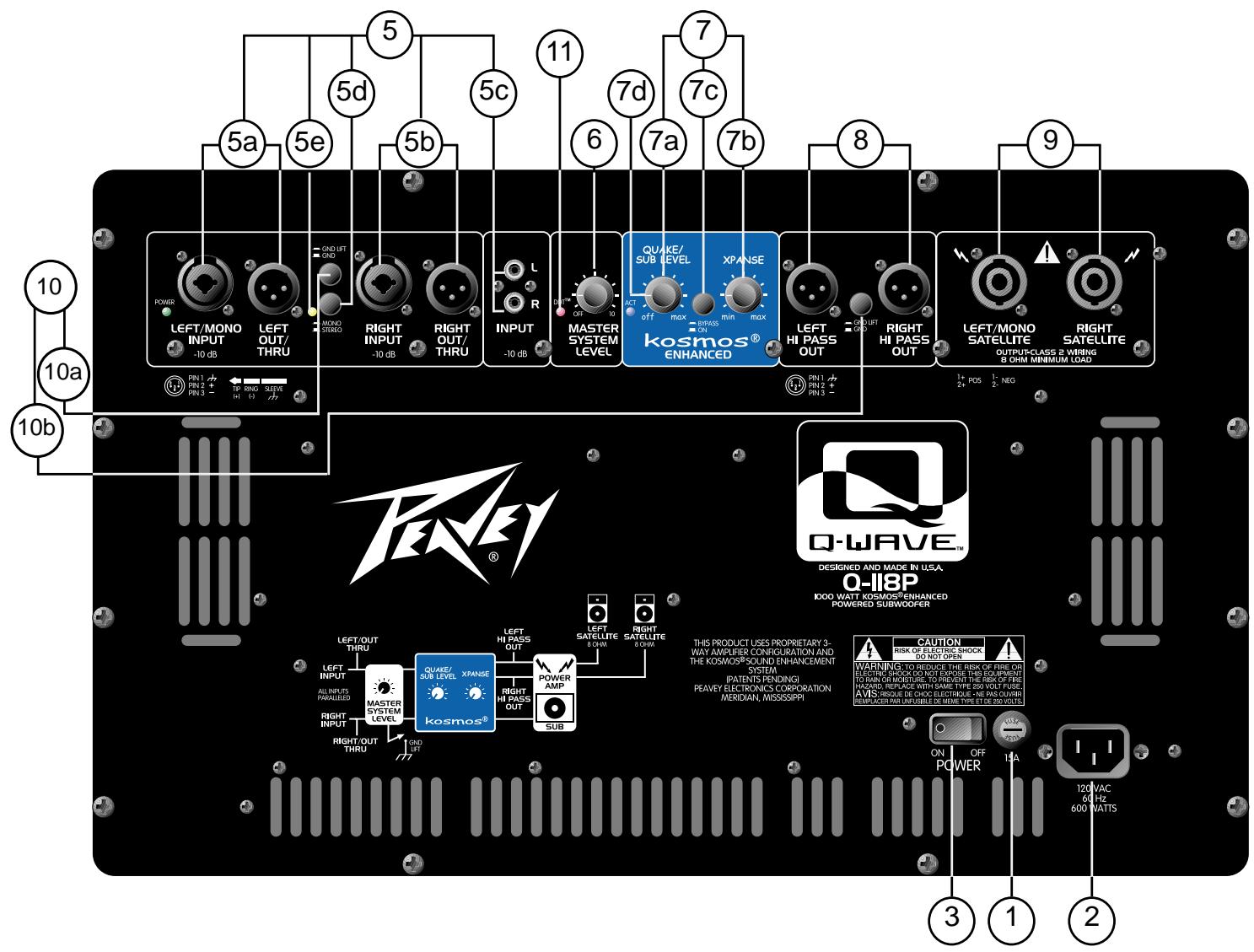
REAR PANEL DESCRIPTION
Fuse (1)
The unit is AC power line fuse protected from overload and fault conditions with an ABC-type, fast-blow 15 Amp fuse. This fuse is located within the cap of the fuse holder. If the fuse fails, THE FUSE MUST BE REPLACED WITH THE SAME TYPE AND VALUE IN ORDER TO AVOID DAMAGE TO THE EQUIPMENT AND TO PREVENT VOIDING THE WARRANTY. If the amp repeatedly blows fuses, it should be to a taken qualified service center for repair.
IEC Power Cord Connection (2)
This receptacle is for the IEC line cord (included) that provides AC power to the unit.
Never break off the ground pin on any equipment. It is provided for your safety. If the outlet used does not have a ground pin, a suitable grounding adapter should be used and the third wire should be grounded properly. To prevent the risk of shock or fire hazard, always be sure that the mixer and all other associated equipment are properly grounded.
Power Switch (3)
This rocker switch applies mains power to the QW 118P when in the ON position.
Power LED (4)
This LED illuminates when the preamp electronics receive power, when the power switch is ON.


Inputs (5)
The left (5a) and right (5b) channel input jack groups consist of a combo female XLR and 1/4" TRS connector and a male XLR in parallel. This arrangement allows the audio input signal to be daisy-chained. In other words, you could hook-up other power amps, powered speakers, more QW 118Ps or other devices. Unbalanced left and right RCA-type input jacks (5c) are also provided for CD players or similar units. A Mono switch (5d) feeds the left input to both channels when not running in stereo mode. The adjacent yellow LED (5e) lights when the unit is placed in mono mode.
Master System Level (6)
When used in conjunction with the kosmos ^® controls (7), this knob controls the overall system gain (volume) of the QW ^™ -118P system. The adjacent red LED (11) indicates activation of the built-in DDT ^™ compression. See #11 below for more details on DDT compression.
kosmos (7)
The kosmos is a low frequency energy and stereo imaging enhancement system that turns the minor shocks of an input signal into a sound that is off the Richter scale. And, it's included in the QW 118P. The Quake/Sub level knob (7a) sets the powered subwoofer output and simultaneously sets the amount of kosmos Quake function. The Xpanse knob (7b) controls the amount of high frequency expansion applied to the high pass outputs (8) or the Speaker Level Outputs (9). The bypass switch (7c) bypasses the kosmos entirely. When in bypass mode, the Quake/Sub Level knob (7a) sets the powered subwoofer level without any kosmos effect. The adjacent blue LED (7d) lights up when kosmos kicks in.
High Pass Output (8)
These left and right line-level, high-pass filtered outputs are also controlled by the Master System Level control (6). They provide a 120 Hz high pass output for a powered speaker system or a power amp and passively crossed over speaker system.
Speaker Level Powered Outputs (9)
The left and right speaker level outputs allow connection of a left and right, passive speaker system to provide a complete stereo sound reinforcement or DJ system. This signal is passively high-pass filtered to protect the speakers from excessively low bass.
Ground Lift Switches (10)
These switches provide for breaking ground loops on the input channels (10a) or the high pass outputs (10b). Leave these in the Normal position unless there is a need to break such a ground loop (i.e., unusual system hum or noise). They can be switched independently.
DDT LED (11)
This LED will light at the onset of clipping. If the LED is flashing quickly and intermittently, the unit is just reaching the clipping threshold. A steady bright glow means the unit is clip-limiting, or reducing gain to prevent severely clipped waveforms from reaching the speakers. During initial power-up, the DDT LED will light, indicating that the RampUp ^™ gain reduction circuitry has activated.

OPERATING INSTRUCTIONS
CAUTIONS
The heat sink on the back plate can become hot to the touch. Do not block or cover the heat sink from ventilation.
Ventilation: This unit must have at least 6" (15.5 cm) of clearance on all sides for proper ventilation. Please include the triangle/exclamation point symbol.
DO NOT connect the inputs of the QW ^™ -118P to the output of a power amplifier. The inputs are meant to be driven from a line-level strength signal.
DO NOT remove the protective metal grille.
DO NOT use the left input jack group or the right input jack group as mixers by running more than one signal source at a time into either channel group. The left input jack group and right input jack group (5) are hard-wired together to allow use of any of the connector types as an input, and to allow a further send or “daisy-chaining” of the input signal to some other audio device (such as another QW 118P). Attempting to run two different signals directly into the QW 118P left input jack group or right input jack group could damage the outputs of the source units. Use a mixer to combine two or more signals into a single channel.
WARNING: The QW 118P is extremely efficient and powerful! This sound system can permanently damage hearing! Use extreme care setting the overall maximum loudness! The apparent sound level of the QW 118P can be deceiving. Due to the clear, clean sound output of the Q-W 118P and the lack of distortion or obvious distress, the sound level seems much lower than it actually is. This system is capable of SPLs in excess of 130 dB at 1 meter from the speaker!
Using the Pole Stand Base
The built-in pole adapter allows for the use of the QW 118P as a base for a variety of passively crossed-over two-way speakers or powered speaker systems. These speakers should not exceed 34" in height or 100 lbs. in weight.
The accessory pole is designed to use is Peavey part #00326540. The pole used is 36-3/16" long and has a nominal diameter of 1-3/8". The stand pole must be seated firmly in the QW 118P pole tunnel before any speaker can be mounted on top of the pole.
AC Power
The QW 118P comes with an 8' IEC connection AC power cord. If you are using an extension cord or power strip with this powered speaker, make sure it is of good quality and of a sufficient current capacity to maintain safety and maximize the power output capability of the QW 118P. Do not connect an other device to the same extension cord that the QW 118P is connected to.
Getting a Signal to the QW 118P
There are a variety of ways to get a signal into the QW 118P. The balanced line-level input(s) allow the use of a 1/4" phone plug; either a standard, single-ended TS (tip-sleeve) plug; or a balanced TRS (tip-ring-sleeve) type plug. Or you may use either a male or female XLR plug. Do not connect cables to the jacks while the units are ON and the volume is turned up!
While the standard, single-ended 1/4" phone plug will work well and the balanced input circuitry will provide some interference rejection, a balanced cable using either the balanced TRS 1/4" phone plug or the XLR plug will provide superior performance. Plugging into the RCA jacks or plugging a mono, 1/4" plug into the combo jack will cause the thru jack to operate in unbalanced mode. Sometimes, with difficult interference problems, it will be helpful to lift the shield ground on a balanced cable at the QW 118P end only. This can be accomplished via the convenient ground lift switch (10a) found underneath the input jack group. Check any input changes carefully. Always turn the volume controls down before plugging and unplugging cables or switching the ground lift switches.
Use of high-quality premium cables is recommended for the QW 118P. These cables typically have better shielding and materials and will provide greater long-term reliability. It is also a good idea to leave some slack at each end of the cable connection and tape the cables down or run them under a cable guard to avoid accidents.
Volume Control Adjustment
The QW 118P is equipped with a Master System Level volume control (6). When the Master System Level volume control adjusted fully clockwise, gain is at maximum and the input sensitivity is 0.375 V RMS for full-rated output. When this control is set halfway up, gain is unity and 1.5 VRMS will drive the system to full power output. When driving the QW 118P from a mixer, it may be advantageous to reduce the input sensitivity by turning the volume control to the halfway point. At this setting, the QW 118P will more closely match a typical power amp input.
The amplifiers in the QW 118P are equipped with DDT ^™ . This unit also includes an LED (11) that illuminates when DDT is activated. This LED is located next to the Master System level. The DDT circuit will automatically reduce the channel gain to a level just slightly into clipping, guarding the speakers against the damaging high power continuous square waves that may be produced. Situations that may activate the DDT circuit include uncontrolled feedback, oscillations, improper equipment settings or malfunction upstream from the amplifier.
Always turn on any peripheral units before turning on the QW 118P. Also, make sure the Master System level is completely down (fully counterclockwise) before turning the unit ON.
Adjusting the kosmos® Processing Level
The amount of kosmos processing is controlled by the Master System Level knob. In order to achieve more subharmonic processing, turn the Master System Level (6) up, and the Level/Quake knob (7a) down.
When using the QW 118P with a passive, full-range speaker system, the relationship between the Master System Level and the Quake/Sub Level will determine the balance between the overall subwoofer output and the high frequencies that are sent to the left and right speaker outputs (9). The amount of kosmos processing that occurs will not be able to be controlled independently. It can, however, be bypassed using the Bypass switch (7c).
When using the QW 118P with a powered, full-range speaker system from the line-level high pass outputs (8), the powered full-range speaker system will usually have their own volume control. This will allow the high frequency level to be set independently. However, the kosmos Xpanse control (7b) for adjusting the stereo spread can only be adjusted at the QW 118P subwoofer.
High Pass Outputs
These are low impedance, filtered outputs provided to send the high frequencies to a powered speaker or a conventional power amp and speaker system. The output level is set by the Master System level control on the QW 118P.
The nominal polarity of these outputs is pin 2 positive and can be run directly into most full-range, powered speaker systems.
If you experience hum or related ground loop problems, it might help to lift the shield ground on the balanced XLR cable at the QW 118P end. This can be accomplished via the convenient ground lift switch (10b) located underneath the high pass output jack group. Check any input changes carefully. Always turning the Volume control down before plugging and unplugging cables or switching ground lift switches.
Left and Right Outputs
These outputs will supply a full-range, 8 Ohm minimum speaker system with a high-passed amplifier signal when using the QW 118P as a three-piece system. The Xpanse control (7b) will expand the stereo sound stage and add high frequency processing to these outputs.
QW 118P as a Subwoofer Only (Add-On Use)
When using the QW 118P as a powered subwoofer only, run a full-range stereo signal to the inputs (5) or plug a mono signal into the left Input (5a), and engage the Mono switch (5d). The subwoofer will reproduce frequencies from approximately 40 Hz to 120 Hz.
QW 118P: Subwoofer with Built-in Crossover
To fully utilize the built-in crossover, a line-level, high-pass signal is available at the high-pass output jacks (8). Use the left output to send the high-pass output to a powered, full-range speaker or to a power amp and full-range speaker. The full-range speakers will reproduce frequencies from 120 Hz and up. This can be repeated for each QW 118P connected in this manner.
QW 118P: 3-Channel Stereo System
A full-range stereo signal may be run to the left and right inputs (5). The Mono switch (5d) must be in the OFF position. Connect a full-range, 8 Ohm speaker system to the left and right output jacks (9). In this mode, the subwoofer will now reproduce frequencies from approximately 40 Hz to 120 Hz. The passively crossed-over, full-range left and right enclosures will cover from 120 Hz and up. This type of stereo connection will provide a mono subwoofer output with high-pass, crossed-over left and right stereo feeds. This setup will provide a very solid and punchy stereo playback system, and is especially well-suited for portable DJ use.
Two QW 118Ps with Two Passive Full-Range Enclosures
Connect a left channel, full-range stereo signal to the left inputs (5) of the first QW 118P. Ensure the Mono switch (5d), is in the ON position. Connect a full-range, 8 Ohm speaker to the left output jack (9). This will be the left channel of the total system. Connect a right channel, full-range stereo signal to the left input (5) of the second QW 118P. Ensure the Mono switch (5d), is in the ON position. Connect a full-range, 8 Ohm speaker system to the left output jack (9). This will become the right channel of the total system. Use of the left channel in and out on each of the QW 118P's assures proper overall system operation. This setup can be repeated for each QW 118P connected for any number of channels.
Multiple QW 118P's (or other powered products)
The QW 118P is designed with multiple, parallel inputs which allow daisy-chaining from one QW 118P to another. Connect the first cable from the mixer output to the first QW 118P. Then, connect a cable from the first QW 118P's thru jack to the second QW 118P's input. This connection can be continued for several units, depending on the total length and capacitance of the cables. With a low source impedance source output from a typical mixer and by using quality, balanced cables, several QW 118Ps can be daisy-chained from one output using 30' or 40' cables without obvious problems or distortion. Do not connect cables to the jacks while the units are ON and the volume is turned up.
Applications
The QW 118P can be used in a variety of applications such as sound reinforcement, public address or musical playback. DJ use is also supported when using in the three-channel stereo mode. Of course, using the QW 118P in the traditional role, strictly as a powered subwoofer, is also a great choice.
A typical signal source for the line-level inputs (5) of the QW 118P would be a sound reinforcement mixing console (mixer) or the output from a CD player, MiniDisc player or tape deck.
TROUBLESHOOTING
No Output
First, make sure the unit has AC power and is turned ON. Ensure the Power LED (4) is illuminated. If not, make certain the On/Off switch (3) is in the ON position and check the IEC power cord connection (2) to ensuring it is fully engaged and seated. Make certain the AC line cord is plugged into a working AC outlet. Finally, check the fuse (1). (see the Rear Panel: Fuse section for safety instructions).
Once assured your unit is getting AC power, check that the QW 118P is getting a signal. Disconnect the cable running to the QW 118P's inputs and connect it to some other device capable of reproducing the signal (i.e., a power amp and speaker). If this produces a signal, make sure the Master System level control has been turned up to a satisfactory (one-third to halfway).
If there is still no output, contact your authorized Peavey dealer or the Peavey International Service Center.
Hum or Buzz
If the QW 118P is producing a hum or buzz, this can be AC outlet-related. Try plugging the QW 118P into a different AC outlet. Sometimes, if a different circuit (breaker) is used for the mixer and the QW 118P, hum problems can occur.
Ensure that shielded cables have been used to route the signal to the QW 118P's inputs. If speaker cables with 1/4" plugs or XLR plugs are used as an input cable instead of a shielded cable, it will be very prone to hum.
Hum may also be ground loop-related. Two ground lift switches are provided on the QW 118P. One is located at the input jack group (10a) and the other at the high-pass output jacks (10b). Check any input changes carefully by turning down the volume control, plugging and unplugging cables or switching the ground lifts.
Check to make sure light dimmers are not on the same circuit as the QW 118P, the mixer or any source devices. If light dimmers are used, then it may be necessary to turn them full ON or full OFF to eliminate or reduce hum. This is a typical AC wiring/light dimmer interference problem, and not a design flaw of the QW 118P. The third wire ground plug on the AC plug should NEVER be removed or broken off.
Rattling or Buzzing
The QW 118P has an extremely high output capacity at very low frequencies. It is capable of vibrating objects in any room that are not solidly affixed or mounted. It can excite light fixtures, suspended ceilings, racks, shelves, tables, chairs, equipment cases, lift handles on equipment, casters, doors, windows, etc. Be sure to check where the sound is coming from, as it is likely coming from one of these sources and not of the unit.
Excessive High Frequency Output from the Subwoofer
Ensure the Mono button (5d) is switched to the ON position. This should eliminate any high frequency output from the subwoofer.
If the unit is being used in three-channel stereo mode, some high frequencies may be generated by the subwoofer when a high frequency signal is present only in one channel. This is normal and should not present a problem..
Male Vocals Sound Muddy or Boomy
The level of the subwoofer may be turned up too high. The kosmos ^® settings may be set too high. Reduce the subwoofer level by turning down the Quake/Sub Level control (7a) until the sound improves. To reduce the amount of kosmos processing without changing the subwoofer level, turn the Master System level control (6) down and the Quake/Sub level control (7a) up until the subwoofer is back at the previous level. With three-channel operation, turn the Quake/Sub Level control (7a) down.
Distorted or Fuzzy Sound
First, ensure the mixer (signal source) is not clipping or being overdriven. Make sure the Volume control (6) on the QW 118P has not been set too low. Remember, it takes a lot of signal to drive the unit to full power.
Check that the input plugs are fully seated in the input jacks (5) on the rear panel of the QW 118P. Ensure that the proper inputs are being used (5) for line-level signals and that a power amp has not been plugged into one of the input jacks of the QW 118P.
If an extension cord is being used to provide the AC power to the unit, ensure that it is of sufficient current capacity and that it is not also being used to supply power to any other device.
The QW 118P has built-in EQ to extend and smooth the natural response of the woofer in any system. Bass boost is applied and the system has a nominally flat response, and should require little, if any, additional EQ. If excessive bass boost has been added externally to the QW 118P, it could cause premature overload at very high SPLs. Reducing the amount of external (mixer, rack EQ) EQ should clear up any distortion. If the kosmos function switch (7c) has been engaged, try bypassing to see if that clears up the ditstortion.
If you are using additional speakers hooked up to the left and right outputs (9), ensure they are of an 8 Ohm minimum impedance. Remove the speakers temporarily to determine if this is the source of distortion. If the distortion is emanating from the left and right speakers, the total capacity of QW 118P, or the speakers has possibly been exceeded. Reduce the drive level and recheck the speakers for impedance (8 Ohms minimum).
Architectural & Engineering Specifications
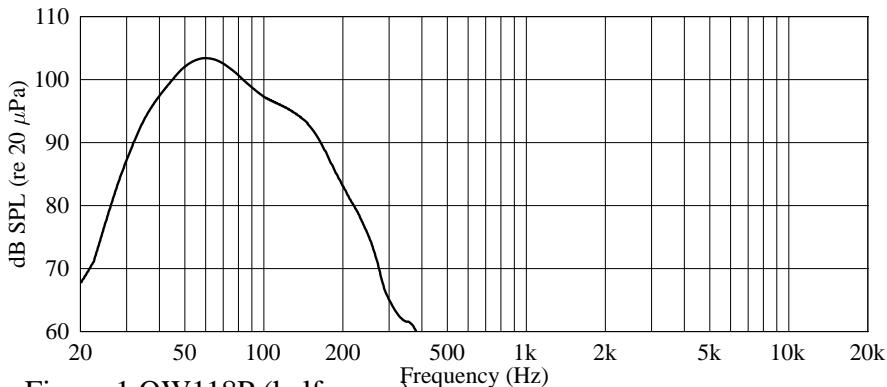
The powered subwoofer loudspeaker system shall have a frequency response from 40 Hz to 120 Hz for the subwoofer portion. The peak SPL with unnoticeable distortion shall reach 130 dB with music as a source, when measured at a distance of 1 meter and driven to full output capacity. The system shall utilize an 18" Low Rider® bass woofer.
The powered, bridged subwoofer system shall have a left and right group of medium impedance input connectors, consisting of one combo female XLR and 1/4" TRS phone jack and one male XLR per channel on the rear panel, all connected in parallel per channel. A set of left channel and right channel XLR high-pass output jacks shall be provided. A Master System level volume control will be located next to the input jack groups. left and right Speakon® outputs capable of driving an 8 Ohm speaker shall be provided.
The system power amplifiers shall have an unfiltered frequency response of 10 Hz to 30 kHz which deviates no more than +0, -1 dB up to rated power, a damping factor greater than 100 @ 1 kHz into 8 Ohms, hum and noise better than 90 dB below rated power, and THD and IMD of less than 0.3%. The bridged woofer connection shall be capable of up to 1000 Watts into a 8 Ohm nominal bridged load, and the left and right outputs shall be capable of up to 250 Watts output into a 8 Ohm load, and both shall incorporate DDT ^™ compression.
The input signal shall be electronically divided into high frequencies and low frequencies by a Linkwitz-Riley fourth order slope, line-level crossover at 120 Hz. The low frequencies shall have the option of being kosmos ^® processed to provide bass boost, and subsonic filtering and overall response shaping shall be applied. The high frequencies shall be high-pass filtered.
Premium 19 mm plywood with a scuff-resistant Hammer Head ^™ black cabinet finish shall be provided. A metal handle shall be placed on each side of the enclosure, and casters located on the rear to allow the unit to be flipped over and rolled around for transport.
A 16-gauge powder-coated, perforated metal grille shall be provided for woofer protection. The cabinet shall incorporate four tall sturdy rubber feet for floor standing use, and a pole stand tunnel on the top for stand mount use.
The outside dimensions shall be 28.312" tall by 21" wide by 27" deep, and the weight shall be 122 lbs. Power requirements shall be: 1300 Watts, 120 VAC, 60 Hz Domestic and 240 VAC, 50 Hz (European). The loudspeaker system shall be called a Peavey QW 118P.
HOOKUP DIAGRAMS
Live Application: Non-powered Mixer Three-channel Stereo
LIVE APPLICATION: NON-POWERED MIXER THREE CHANNEL STEREO SYSTEM
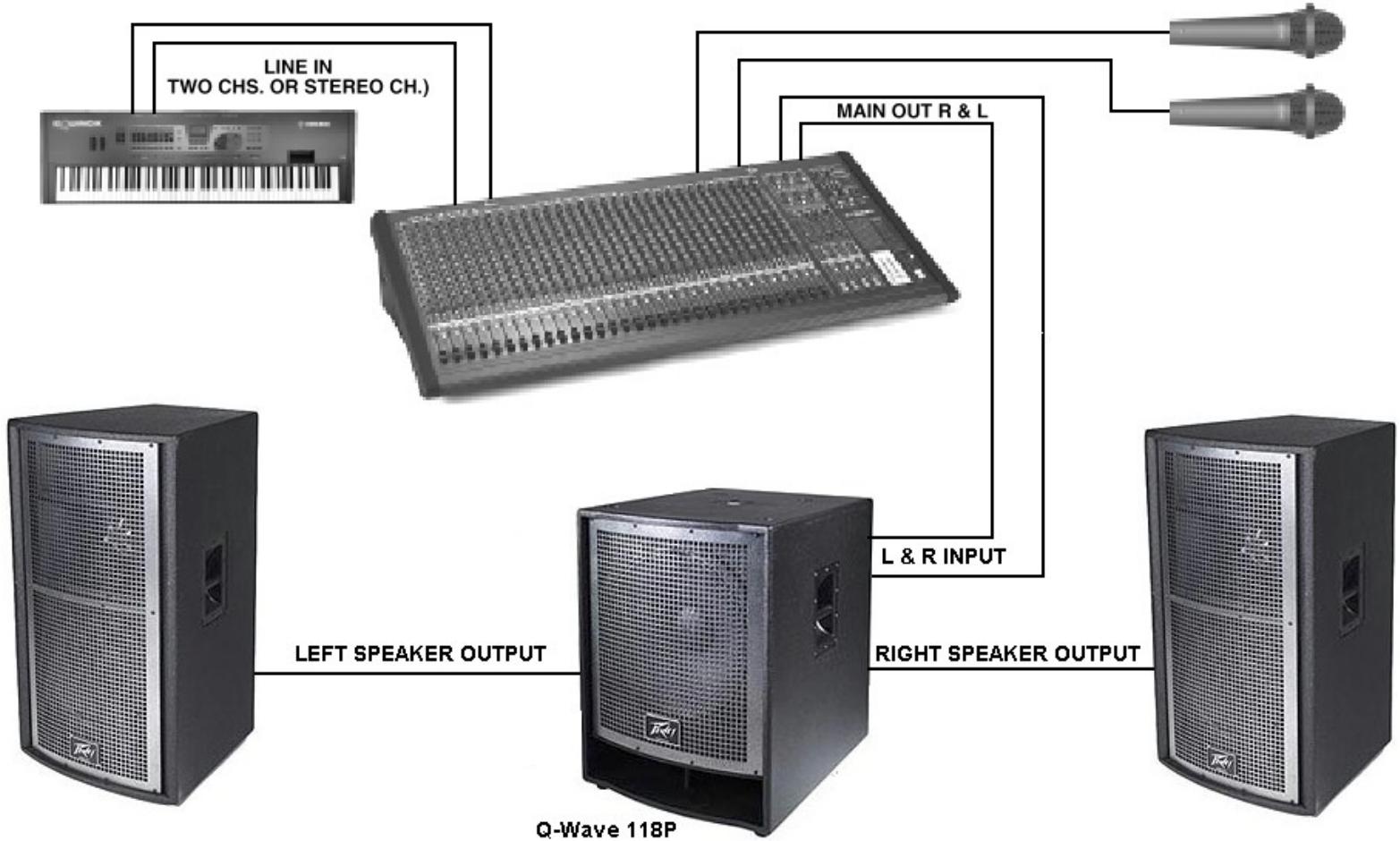
flowchart
graph TD
    A["Audio Input"] --> B["Main Output R & L"]
    C["Audio Receiver"] --> B
    D["Audio Speaker"] --> E["Q-Wave 118P"]
    B --> F["Left Speaker Output"]
    B --> G["Right Speaker Output"]
    E --> H["Output L & R Input"]
    style A fill:#f9f,stroke:#333
    style C fill:#ccf,stroke:#333
    style D fill:#cfc,stroke:#333
    style E fill:#fcc,stroke:#333
    style F fill:#ffc,stroke:#333
    style G fill:#fcc,stroke:#333
    style H fill:#ffc,stroke:#333
Live Application: Non-powered Mixer Add-on Use
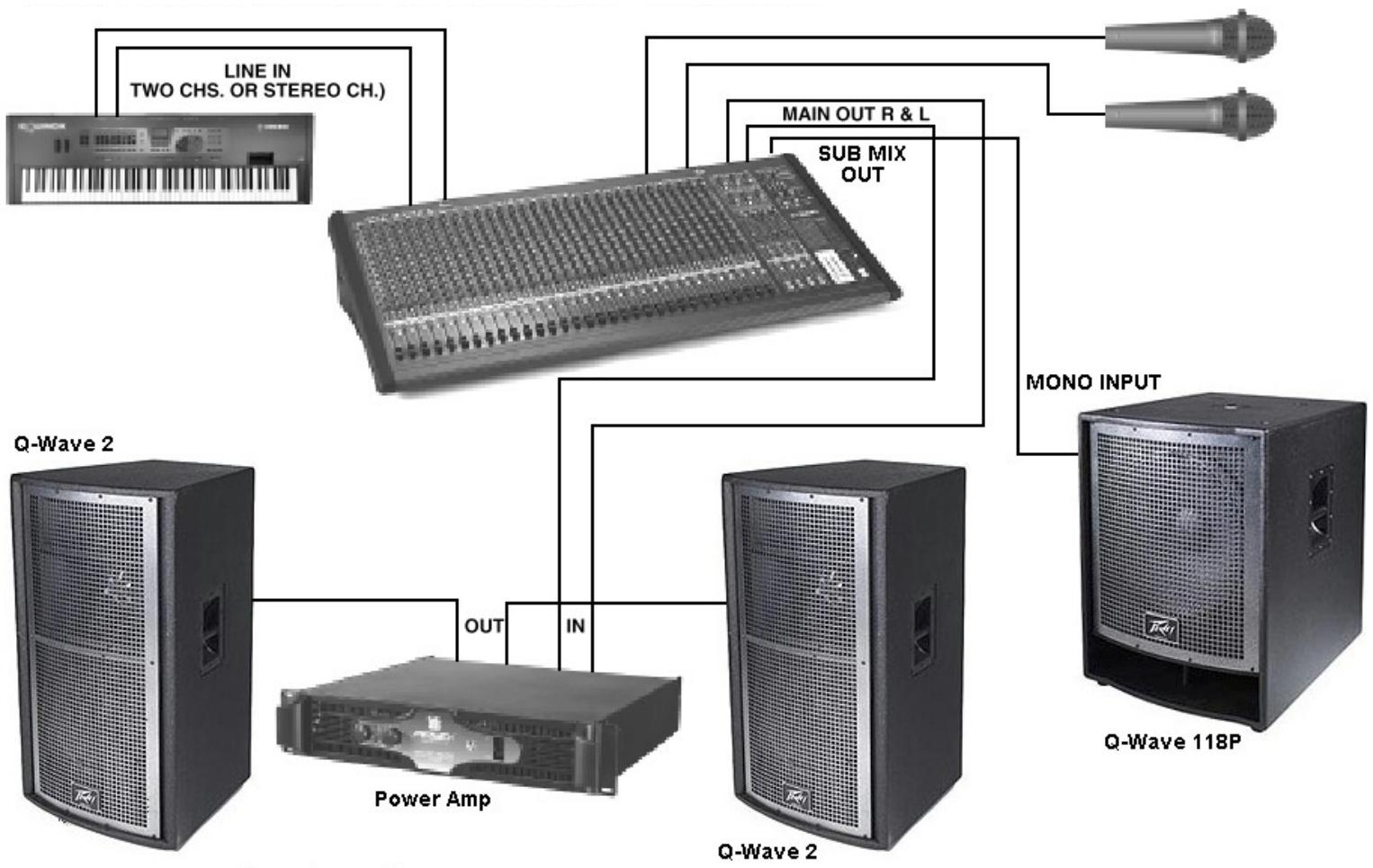
flowchart
graph TD
    A["Audio Input"] --> B["Line IN TWO CHS. OR STEREO CH."]
    B --> C["Main OUT R & L SUB MIX OUT"]
    C --> D["Q-Wave 2"]
    C --> E["Power Amp"]
    C --> F["Q-Wave 2"]
    C --> G["MONO INPUT"]
    G --> H["Q-Wave 118P"]
DJ Application Three-channel Stereo Operation
DJ USE THREE CHANNEL STEREO SYSTEM
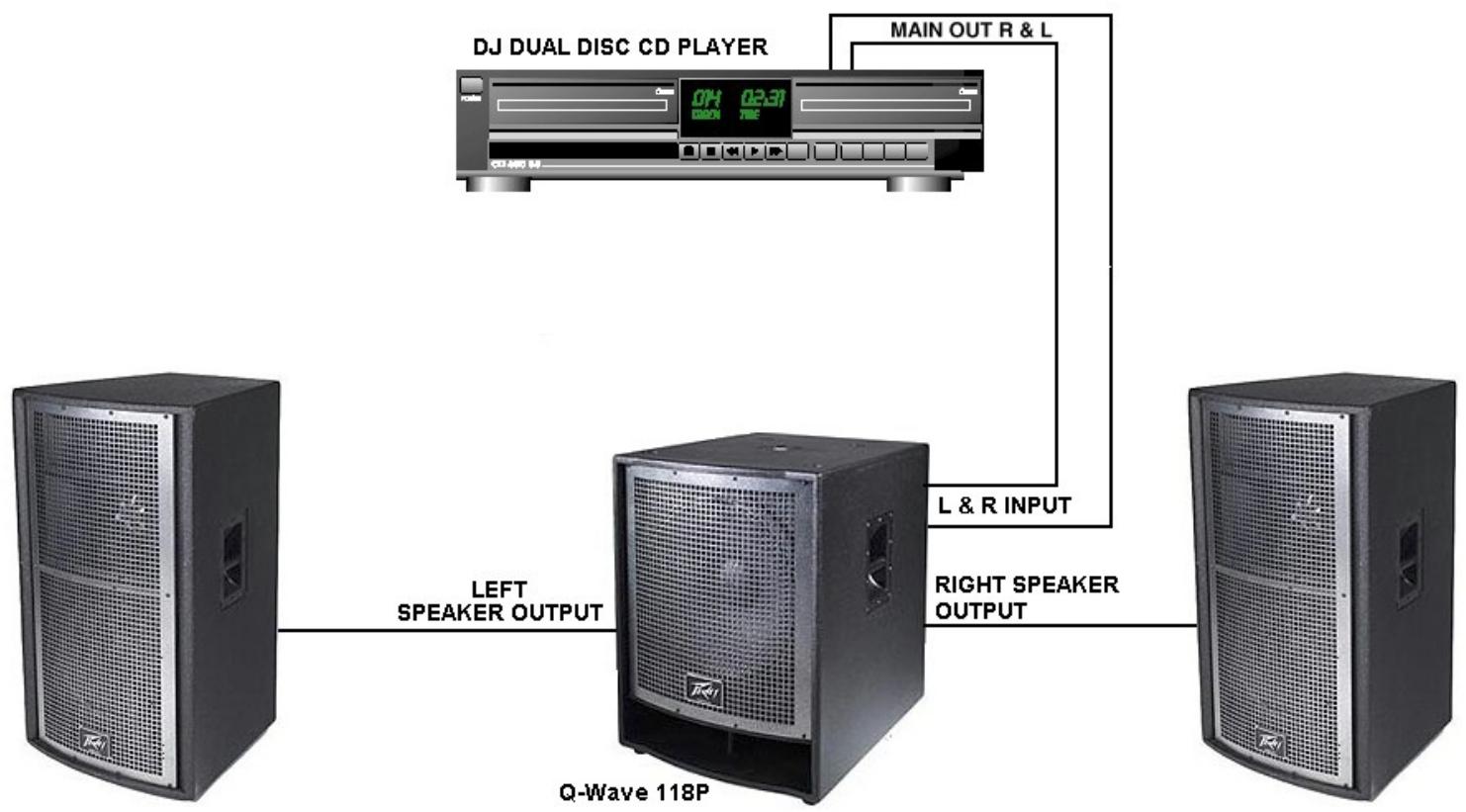
flowchart
graph TD
    A["Q-Wave 118P"] -->|LEFT SPEAKER OUTPUT| B["DJ DUAL DISC CD PLAYER"]
    A -->|RIGHT SPEAKER OUTPUT| C["DJ DUAL DISC CD PLAYER"]
    B -->|MAIN OUT R & L| C
Live Application: Non-powered Mixer Subwoofer with Built-in Crossover
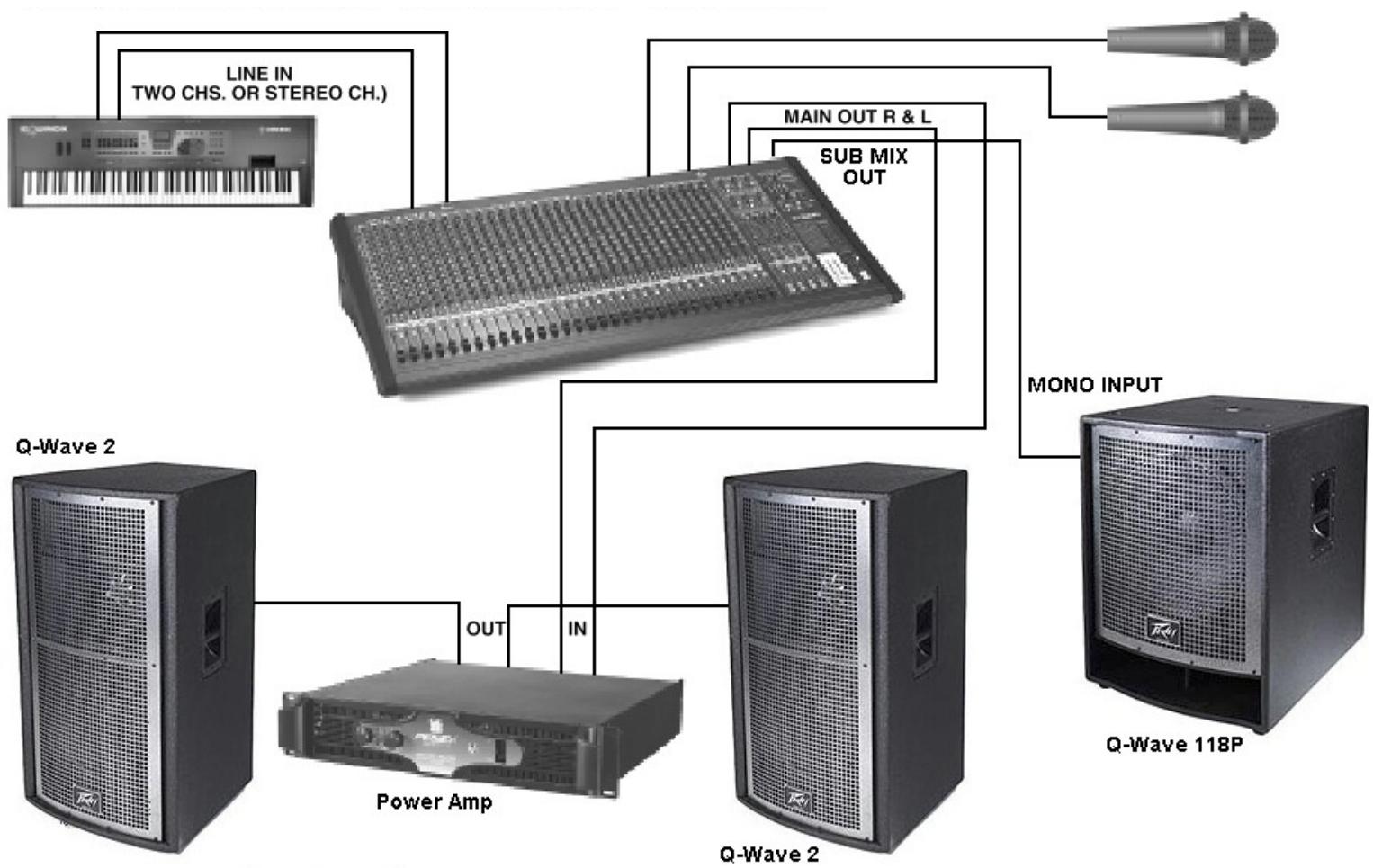
flowchart
graph TD
    A["Audio Input"] --> B["Line IN TWO CHS. OR STEREO CH."]
    B --> C["Sub Mix OUT"]
    C --> D["Q-Wave 2"]
    C --> E["Power Amp"]
    C --> F["Q-Wave 2"]
    C --> G["MONO INPUT"]
    G --> H["Q-Wave 118P"]
Amplitude Response (1m On-Axis)
line
| Frequency (Hz) | dB SPL (re 20 µPa) | | -------------- | ------------------ | | 20 | 68 | | 50 | 103 | | 100 | 98 | | 200 | 85 | | 500 | 65 | | 1k | 60 | | 2k | 60 | | 5k | 60 | | 10k | 60 | | 20k | 60 |Figure 1 QW118P (half space)
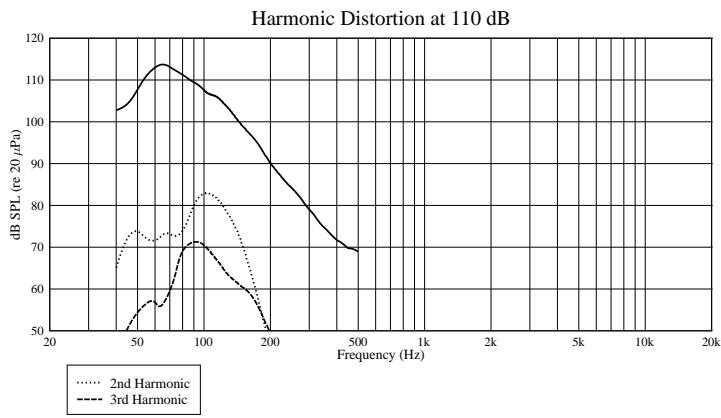
line
| Frequency (Hz) | 2nd Harmonic | 3rd Harmonic | | -------------- | ------------ | ------------ | | 20 | 65 | 50 | | 50 | 75 | 55 | | 100 | 85 | 70 | | 200 | 60 | 50 | | 500 | 70 | 70 | | 1k | 70 | 70 | | 2k | 70 | 70 | | 5k | 70 | 70 | | 10k | 70 | 70 | | 20k | 70 | 70 |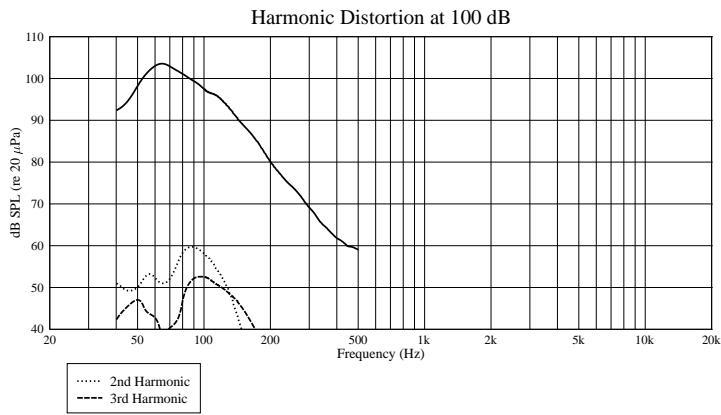
line
| Frequency (Hz) | 2nd Harmonic | 3rd Harmonic | | -------------- | ------------ | ------------ | | 20 | 40 | 40 | | 50 | 50 | 45 | | 100 | 60 | 55 | | 200 | 40 | 40 | | 500 | 60 | 60 | | 1k | 40 | 40 | | 2k | 40 | 40 | | 5k | 40 | 40 | | 10k | 40 | 40 | | 20k | 40 | 40 |QW™ 118P
SPECIFICATIONS
Enclosure:
QW 118P (domestic)
Frequency response:
40 Hz to 120 Hz
Low frequency limit (-3 dB point):
40 Hz
Useable low frequency limit:
(-10 dB point) 32 Hz
Internal power amplifier @ 120 VAC line):
Subwoofer section alone
1500 Watts peak dynamic power,
bridged
mode
1000 Watts continuous @ less than
0.3% distortion
L & R Output section alone:
750 Watts peak dynamic power either channel
All channels loaded full
Subwoofer section:
750 Watts peak dynamic power
500 Watts continuous
L & R Output section:
375 Watts peak dynamic power either channel
250 Watts continuous
Nominal sensitivity (1W @ 1M, swept sine input in anechoic environment):
97 dB
Maximum sound pressure level:
130 dB peak
Transducer compliment:
1808-8 HPS 18" Low Rider Bass woofer
Box tuning frequency (Fbox):
40 Hz
Electronic crossover frequency:
120 Hz
Crossover type:
Internal electronic two-way crossover with bass boost and 24 dB/octave subsonic filtering with active soft-knee limiter on level controlled low pass. Variable high pass output.
Crossover slopes:
24 dB/octave ( 4^th order) Linkwitz-Riley low pass and driver EQ. 24 dB/octave ( 4^th order) Linkwitz-Riley high pass.
Full range input connections:
One combo female XLR/ 1/4" phone jack providing balanced operation.
Full range output connection:
One male XLR balanced Thru connector.
High pass output connections:
One male XLR connector.
Left and right output connections:
One Neutrik ^® Speakon ^® 4-pin connector each. Minimum speaker impedance 8 Ohms each.
Enclosure materials and finish:
Premium 19 mm plywood, scuff-resistant Hammer Head™ polyurea cabinet finish, black.
Mounting:
This unit is NOT designed for over head suspension. Satellite stand mounting via built-in mount, and four large rubber feet for floor use.
Dimensions (H x W x D):
28.312" x 21" x 27.00"
(71.9 cm x 53.3 cm x 68.6 cm)
Net weight:
122 lbs.
Shipping weight:
133 lbs.
ELECTRONICS AND AMPLIFIER
SPECIFICATIONS:
Electronic input impedance (nominal):
Primary balanced input: 10 k Ohms unbalanced, 20 k Ohms balanced.
Infrasonic filter protection:
48 dB/octave roll-off with active soft-knee limiter.
Nominal amplifier frequency response:
+0, -1 dB from 10 Hz to 30 kHz
Hum and noise:
Greater than 90 dB below rated power.
Active low frequency limiter dynamic range:
Greater than 60 dB
DDT dynamic range:
Greater than 18 dB
THD and IM:
Typically less than 0.3 %
Damping factor:
Greater than 100 @ 1000 Hz, 8 Ohms.
Power requirements:
1300 Watts, 120VAC, 60 Hz
ESPAÑOL
QW™ 118P
Low frequency limit (-3 dB point):
40 Hz
Useable low frequency limit:
(-10 dB point) 32 Hz
Internal power amplifier @ 120 VAC line):
Subwoofer section alone
1500 Watts peak dynamic power,
bridged
mode
1000 Watts continuous @ less than
0.3% distortion
L & R Output section alone:
750 Watts peak dynamic power either channel
All channels loaded full
Subwoofer section:
750 Watts peak dynamic power
500 Watts continuous
L & R Output section:
375 Watts peak dynamic power either channel
250 Watts continuous
Nominal sensitivity (1W @ 1M, swept sine input in anechoic environment):
97 dB
Maximum sound pressure level:
130 dB peak
Transducer compliment:
1808-8 HPS 18" Low Rider Bass woofer
Box tuning frequency (Fbox):
40 Hz
Electronic crossover frequency:
120 Hz
Crossover type:
Internal electronic two-way crossover with bass boost and 24 dB/octave subsonic filtering with active soft-knee limiter on level controlled low pass. Variable high pass output.
Crossover slopes:
24 dB/octave ( 4^th order) Linkwitz-Riley low pass and driver EQ. 24 dB/octave ( 4^th order) Linkwitz-Riley high pass.
Full range input connections:
One combo female XLR/ 1/4" phone jack providing balanced operation.
Full range output connection:
One male XLR balanced Thru connector.
High pass output connections:
One male XLR connector.
Left and right output connections:
One Neutrik ^® Speakon ^® 4-pin connector each. Minimum speaker impedance 8 Ohms each.
Enclosure materials and finish:
Premium 19 mm plywood, scuff-resistant Hammer Head™ polyurea cabinet finish, black.
Mounting:
This unit is NOT designed for over head suspension. Satellite stand mounting via built-in mount, and four large rubber feet for floor use.
Dimensions (H x W x D):
28.312" x 21" x 27.00"
(71.9 cm × 53.3 cm × 68.6 cm)
Net weight:
122 lbs.
Shipping weight:
133 lbs.
ELECTRONICS AND AMPLIFIER
SPECIFICATIONS:
Electronic input impedance (nominal):
Primary balanced input: 10 k Ohms unbalanced, 20 k Ohms balanced.
Infrasonic filter protection:
48 dB/octave roll-off with active soft-knee limiter.
Nominal amplifier frequency response:
+0, -1 dB from 10 Hz to 30 kHz
Hum and noise:
Greater than 90 dB below rated power.
Active low frequency limiter dynamic range:
Greater than 60 dB
DDT dynamic range:
Greater than 18 dB
THD and IM:
Typically less than 0.3 %
Damping factor:
Greater than 100 @ 1000 Hz, 8 Ohms.
Power requirements:
1300 Watts, 120VAC, 60 Hz
FRANÇAIS
QW™ 118P
Low frequency limit (-3 dB point):
40 Hz
Useable low frequency limit:
(-10 dB point) 32 Hz
Internal power amplifier @ 120 VAC line):
Subwoofer section alone
1500 Watts peak dynamic power,
bridged
mode
1000 Watts continuous @ less than
0.3% distortion
L & R Output section alone:
750 Watts peak dynamic power either channel
All channels loaded full
Subwoofer section:
750 Watts peak dynamic power
500 Watts continuous
L & R Output section:
375 Watts peak dynamic power either channel
250 Watts continuous
Nominal sensitivity (1W @ 1M, swept sine input in anechoic environment):
97 dB
Maximum sound pressure level:
130 dB peak
Transducer compliment:
1808-8 HPS 18" Low Rider Bass woofer
Box tuning frequency (Fbox):
40 Hz
Electronic crossover frequency:
120 Hz
Crossover type:
Internal electronic two-way crossover with bass boost and 24 dB/octave subsonic filtering with active soft-knee limiter on level controlled low pass. Variable high pass output.
Crossover slopes:
24 dB/octave ( 4^th order) Linkwitz-Riley low pass and driver EQ. 24 dB/octave ( 4^th order) Linkwitz-Riley high pass.
Full range input connections:
One combo female XLR/ 1/4" phone jack providing balanced operation.
Full range output connection:
One male XLR balanced Thru connector.
High pass output connections:
One male XLR connector.
Left and right output connections:
One Neutrik ^® Speakon ^® 4-pin connector each. Minimum speaker impedance 8 Ohms each.
Enclosure materials and finish:
Premium 19 mm plywood, scuff-resistant Hammer Head™ polyurea cabinet finish, black.
Mounting:
This unit is NOT designed for over head suspension. Satellite stand mounting via built-in mount, and four large rubber feet for floor use.
Dimensions (H x W x D):
28.312" x 21" x 27.00"
(71.9 cm × 53.3 cm × 68.6 cm)
Net weight:
122 lbs.
Shipping weight:
133 lbs.
ELECTRONICS AND AMPLIFIER
SPECIFICATIONS:
Electronic input impedance (nominal):
Primary balanced input: 10 k Ohms unbalanced, 20 k Ohms balanced.
Infrasonic filter protection:
48 dB/octave roll-off with active soft-knee limiter.
Nominal amplifier frequency response:
+0, -1 dB from 10 Hz to 30 kHz
Hum and noise:
Greater than 90 dB below rated power.
Active low frequency limiter dynamic range:
Greater than 60 dB
DDT dynamic range:
Greater than 18 dB
THD and IM:
Typically less than 0.3 %
Damping factor:
Greater than 100 @ 1000 Hz, 8 Ohms.
Power requirements:
1300 Watts, 120VAC, 60 Hz
DEUTSCH
QW™ 118P
Power-Subwoofer
Master System Level (6)
High-Pass Output (8)
Speaker Level Powered Outputs (9)
Low frequency limit (-3 dB point):
40 Hz
Useable low frequency limit:
(-10 dB point) 32 Hz
Internal power amplifier @ 120 VAC line):
Subwoofer section alone
1500 Watts peak dynamic power,
bridged
mode
1000 Watts continuous @ less than
0.3% distortion
L & R Output section alone:
750 Watts peak dynamic power either channel
All channels loaded full
Subwoofer section:
750 Watts peak dynamic power
500 Watts continuous
L & R Output section:
375 Watts peak dynamic power either channel
250 Watts continuous
Nominal sensitivity (1W @ 1M, swept sine input in anechoic environment):
97 dB
Maximum sound pressure level:
130 dB peak
Transducer compliment:
1808-8 HPS 18" Low Rider Bass woofer
Box tuning frequency (Fbox):
40 Hz
Electronic crossover frequency:
120 Hz
Crossover type:
Internal electronic two-way crossover with bass boost and 24 dB/octave subsonic filtering with active soft-knee limiter on level controlled low pass. Variable high pass output.
Crossover slopes:
24 dB/octave ( 4^th order) Linkwitz-Riley low pass and driver EQ. 24 dB/octave ( 4^th order) Linkwitz-Riley high pass.
Full range input connections:
One combo female XLR/ 1/4" phone jack providing balanced operation.
Full range output connection:
One male XLR balanced Thru connector.
High pass output connections:
One male XLR connector.
Left and right output connections:
One Neutrik ^® Speakon ^® 4-pin connector each. Minimum speaker impedance 8 Ohms each.
Enclosure materials and finish:
Premium 19 mm plywood, scuff-resistant Hammer Head™ polyurea cabinet finish, black.
Mounting:
This unit is NOT designed for over head suspension. Satellite stand mounting via built-in mount, and four large rubber feet for floor use.
Dimensions (H x W x D):
28.312" x 21" x 27.00"
(71.9 cm x 53.3 cm x 68.6 cm)
Net weight:
122 lbs.
Shipping weight:
133 lbs.
ELECTRONICS AND AMPLIFIER
SPECIFICATIONS:
Electronic input impedance (nominal):
Primary balanced input: 10 k Ohms unbalanced, 20 k Ohms balanced.
Infrasonic filter protection:
48 dB/octave roll-off with active soft-knee limiter.
Nominal amplifier frequency response:
+0, -1 dB from 10 Hz to 30 kHz
Hum and noise:
Greater than 90 dB below rated power.
Active low frequency limiter dynamic range:
Greater than 60 dB
DDT dynamic range:
Greater than 18 dB
THD and IM:
Typically less than 0.3 %
Damping factor:
Greater than 100 @ 1000 Hz, 8 Ohms.
Power requirements:
1300 Watts, 120VAC, 60 Hz
PEAVEY ELECTRONICS CORPORATION LIMITED WARRANTY
EFFECTIVE DATE: JULY 1, 1998
What This Warranty Covers
Your Peavey Warranty covers defects in material and workmanship in Peavey products purchased and serviced in the U.S.A. and Canada.
What This Warranty Does Not Cover
The Warranty does not cover: (1) damage caused by accident, misuse, abuse, improper installation or operation, rental, product modification or neglect; (2) damage occurring during shipment; (3) damage caused by repair or service performed by persons not authorized by Peavey; (4) products on which the serial number has been altered, defaced or removed; (5) products not purchased from an Authorized Peavey Dealer.
Who This Warranty Protects
This Warranty protects only the original retail purchaser of the product.
How Long This Warranty Lasts
The Warranty begins on the date of purchase by the original retail purchaser. The duration of the Warranty is as follows:
| Product Category | Duration |
| Guitars/Basses, Amplifiers, Pre-Amplifiers, Mixers, Electronic Crossovers and Equalizers | 2 years *(+ 3 years) |
| Drums | 2 years *(+ 1 year) |
| Enclosures | 3 years *(+ 2 years) |
| Digital Effect Devices and Keyboard and MIDI Controllers | 1 year *(+ 1 year) |
| Microphones | 2 years |
| Speaker Components (incl. speakers, baskets, drivers, diaphragm replacement kits and passive crossovers) and all Accessories | 1 year |
| Tubes and Meters | 90 days |
[*Denotes additional warranty period applicable if optional Warranty Registration Card is completed and returned to Peavey by original retail purchaser within 90 days of purchase.]
What Peavey Will Do
We will repair or replace (at Peavey's discretion) products covered by warranty at no charge for labor or materials. If the product or component must be shipped to Peavey for warranty service, the consumer must pay initial shipping charges. If the repairs are covered by warranty, Peavey will pay the return shipping charges.
How To Get Warranty Service
(a) Take the defective item and your sales receipt or other proof of date of purchase to your Authorized Peavey Dealer or Authorized Peavey Service Center. OR
(2) Ship the defective item, prepaid, to Peavey Electronics Corporation, International Service Center, 412 Highway 11 & 80 East, Meridian, MS 39301 or Peavey Canada Ltd., 95 Shields Court, Markham, Ontario, Canada L3R 9T5. Include a detailed description of the problem, together with a copy of your sales receipt or other proof of date of purchase as evidence of warranty coverage. Also provide a complete return address.
Limitation of Implied Warranties
ANY IMPLIED WARRANTIES, INCLUDING WARRANTIES OF MERCHANTABILITY AND FITNESS FOR A PARTICULAR PURPOSE, ARE LIMITED IN DURATION TO THE LENGTH OF THIS WARRANTY.
Some states do not allow limitations on how long an implied warranty lasts, so the above limitation may not apply to you.
Exclusions of Damages
PEAVEY'S LIABILITY FOR ANY DEFECTIVE PRODUCT IS LIMITED TO THE REPAIR OR REPLACEMENT OF THE PRODUCT, AT PEAVEY'S OPTION. IF WE ELECT TO REPLACE THE PRODUCT, THE REPLACEMENT MAY BE A RECONDITIONED UNIT. PEAVEY SHALL NOT BE LIABLE FOR DAMAGES BASED ON INCONVENIENCE, LOSS OF USE, LOST PROFITS, LOST SAVINGS, DAMAGE TO ANY OTHER EQUIPMENT OR OTHER ITEMS AT THE SITE OF USE, OR ANY OTHER DAMAGES WHETHER INCIDENTAL, CONSEQUENTIAL OR OTHERWISE, EVEN IF PEAVEY HAS BEEN ADVISED OF THE POSSIBILITY OF SUCH DAMAGES.
Some states do not allow the exclusion or limitation of incidental or consequential damages, so the above limitation or exclusion may not apply to you.
This Warranty gives you specific legal rights, and you may also have other rights which vary from state to state.
If you have any questions about this warranty or service received or if you need assistance in locating an Authorized Service Center, please contact the Peavey International Service Center at (601) 483-5365 / Peavey Canada Ltd. at (905) 475-2578.
FEATURES AND SPECIFICATIONS SUBJECT TO CHANGE WITHOUT NOTICE.

Features and specifications subject to change without notice.
Peavey Electronics Corporation • 711 A Street • Meridian • MS • 39301
(601) 483-5365 • FAX (601) 486-1278 • www.peavey.com