
EVH WOLFGANG SPECIAL GUITAR - Electric guitar PEAVEY - Free user manual and instructions
Find the device manual for free EVH WOLFGANG SPECIAL GUITAR PEAVEY in PDF.


| Product type | Solid body electric guitar |
| Brand | Peavey |
| Model | EVH Wolfgang Special |
| Body | Basswood, single cutaway, sculpted top |
| Neck | Maple, oil finish, double graphite reinforcement, adjustable truss rod |
| Scale length | 25 1/2 inches (648 mm) |
| Frets | 22 jumbo frets, 15 inch radius |
| Headstock | 10 degree angle, 3+3 configuration |
| Pickups | 2 Peavey custom-wound humbuckers, double wax potting, direct mount |
| Controls | Master volume, 3-way switch (bridge, parallel, neck) |
| Output jack | Switchcraft® jack |
| Vibrato | Licensed Peavey/Floyd Rose®, brass inertia block, built-in D-Tuner |
| Nut | Locking, with tightening screws |
| Tuning machines | Precision, 3+3 configuration |
| Hardware | Chrome |
| Finish | Durable polyurethane |
| Dimensions (approx.) | Length approx. 100 cm, width approx. 35 cm |
| Weight (approx.) | Approx. 3.5 kg |
| Power | Passive, no battery |
| Maintenance | Clean with Peavey polish and soft cloth, change strings regularly |
| Safety | Use a shielded cable and quality strap, be careful of electric shocks |
| Spare parts | Available from Peavey dealers |
| General information | Made by Peavey (USA), designed with Edward Van Halen |
Frequently Asked Questions - EVH WOLFGANG SPECIAL GUITAR PEAVEY
User questions about EVH WOLFGANG SPECIAL GUITAR PEAVEY
0 question about this device. Answer the ones you know or ask your own.
Ask a new question about this device
Download the instructions for your Electric guitar in PDF format for free! Find your manual EVH WOLFGANG SPECIAL GUITAR - PEAVEY and take your electronic device back in hand. On this page are published all the documents necessary for the use of your device. EVH WOLFGANG SPECIAL GUITAR by PEAVEY.
USER MANUAL EVH WOLFGANG SPECIAL GUITAR PEAVEY

TM
wolfgang®
SPECIAL
GUITAR
PEAVEY®
OPERATING
GUIDE
Contents:
Introduction ...... 3
Features 4
Body 4
Electronics 4
Neck 4
Hardware.... 4
Construction 5
Body 5
Neck 5
Pickups 5
Controls....5
Pickup Selector Switch.... 5
Volume 6
Output Jack.... 6
Adjustments....6
Torsion Rod 6
Tremolo Bridge 7
String Retainer Bar 7
Locking Topnut 7
String Installation 8
D-Tuner Operation/Adjustment 8
Tremolo Bridge Height/Tension 9
Tremolo Arm 10
String Intonation 11
Care of Your Instrument 13
Temperature & Humidity 13
Strings.... 13
Finish 13
Accessories 13
5150 ® Stack/212 Combo Amps 14
Warnings 15
Español 14
Français 27
Deutsch 38
Warranty 53
For as long as I've been playing guitar, I've always been searching for a certain feel and tone...I've experimented by tearing apart and reassembling hundreds of guitars in different ways searching for these qualities. Although I've ruined a lot of great guitars by having done this, I have learned what it takes to make a truly great guitar. The Wolfgang ® , after years of trial and error, (for me) is that guitar.

Based on the familylike atmosphere, their commitment to quality and the camaraderie we established during the research and development process of the 5150 ® stack and combo amplifier projects, Peavey was my logical choice as the company to bring my ideas to life.
Our collective efforts in designing the Wolfgang guitar have resulted in a versatile, quality-crafted guitar that feels great, sounds great and is truly inspiring to play. I've already put mine to the test in the studio and on tour and now it's your turn.
Stay Tuned,

Thank you for buying a Peavey EVH Wolfgang Special guitar. This guitar was built by the most skilled craftsmen and made from the finest materials available. As with all of our musical equipment, we have built our guitars using a combination of leading-edge technology and traditional handcrafted methods. Ask your Peavey dealer for a full list of other Peavey musical equipment and accessories.
EVH Wolfgang Special Features
Body
- Solid basswood construction
- Unique offset cutaway design
Neck
- Hardrock maple neck and fingerboard, oil-finished
- Dual graphite reinforcements and adjustable torsion rod
- 25 1/2" scale length, 22 jumbo frets
- 15" fingerboard radius
- Straight headstock with 3+3 tuning machine configuration
- Bolt-on construction with contoured neck heel
Electronics
- Two custom-wound Peavey humbucking pickups
- Master volume control
- Switchcraft® 3-way toggle switch and output jack
Hardware
- Precision die-cast tuning machines
- Peavey/Floyd Rose ® licensed, double-locking tremolo assembly
• D-Tuner - Chrome-plated hardware finish
Construction
Body
The body of this instrument is constructed of select basswood chosen specifically for tonal qualities as well as for weight characteristics. The offset, asymmetrical body design offers comfort, proper balance and maximum playing ease.
Neck
The select hardrock maple neck is crafted to provide unmatched rigidity and freedom from warpage.
Additional strength is provided by the dual graphite reinforcement bars and an easy access, adjustable steel torsion rod. (See Adjustments–Torsion Rod for adjustment instructions.)
Pickups
The two Peavey humbucking pickups, custom-wound to Edward's specifications, supply optimal output and tonal response. A two-step wax dipping process is used to provide ultra-low noise operation and resistance to microphonic feedback. The pickups are mounted directly to the body, which further reduces feedback at high volume levels and offers enhanced tonal response.
Controls
Pickup Selector Switch (1)
This three-position switch allows selection of pickups in various combinations. The selection possibilities are as follows:
- Up = Bridge pickup
- Center = Both pickups
- Down = Neck pickup

Volume (2)
The volume knob controls the total signal delivered from both pickups. Rotating clockwise will increase volume; rotating counterclockwise will reduce volume.
Output Jack (3)
The output jack accepts standard guitar patch cords. (We recommend high-quality Peavey "shielded" patch cords.)
Adjustments
Your instrument has been carefully adjusted at the Peavey factory for accurate intonation and playing ease. However, your playing style and requirements may necessitate additional adjustments. These should be made by your authorized Peavey dealer; but with a little care and by closely adhering to the following instructions, you may attempt these adjustments yourself.
Please read the instructions thoroughly before attempting any adjustments.
Torsion Rod (1)
All guitar necks have a slight amount of bow to keep the strings from "buzzing" on the frets. This instrument features an easy access torsion rod adjustment wheel located at the end of the neck. This wheel can be adjusted with a hex wrench or small screwdriver. Just insert the tool into the adjustment wheel and rotate accordingly.
- Tune the instrument to standard (A-440) pitch.
-
Fret the sixth string (E) at the first and last frets.
-
Check for clearance between the string and the eighth fret.
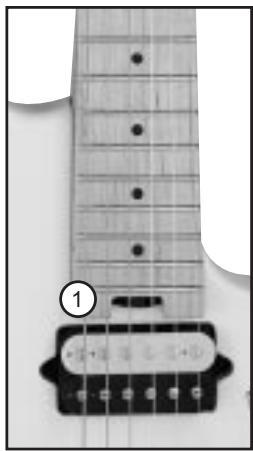
- Clearance should be no less than .005" and no more than .015".
- To increase clearance, loosen (counterclockwise) the torsion rod adjustment wheel.
Less clearance (straightening of the neck) is accomplished by tightening (clockwise) the torsion rod adjustment wheel.
- Retune the instrument and repeat steps 1-5 until proper clearance has been achieved.
Tremolo Bridge
The Peavey/Floyd Rose ® licensed, double-locking tremolo system features a locking topnut, locking bridge saddles and a steel bridge plate with a massive brass inertia block for maximum tuning stability, sustain and tonal response. This tremolo system has been carefully adjusted for accurate intonation, playing ease and pitch change. To adjust this unit properly, you must first understand the operating principle. The strings are clamped at the locking topnut and bridge areas, ensuring increased tuning stability during use.
Proper tremolo action is also a result of accurate balancing between string tension and tremolo spring tension. This instrument has been set up at the factory with high-quality Peavey EVH Wolfgang guitar strings. Should you desire a larger or smaller gauge of strings, the spring tension, as well as the intonation, must be adjusted. For string changes, and in case an adjustment needs to be made, read the instructions carefully.
String Retainer Bar (1)
The string retainer bar is used to provide the proper amount of downward string pressure over the locking topnut. This should be adjusted only low enough to keep the strings in contact with the surface of the locking topnut, which will prevent the strings from going sharp in pitch after tightening the locking topnut.
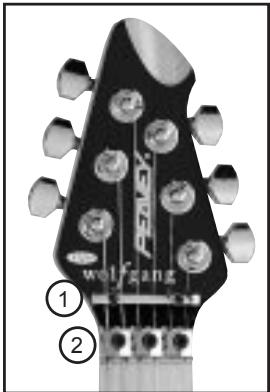
Locking Topnut (2) (at headstock)
With the supplied 3mm hex wrench, loosen the three locking
topnut screws to allow the strings to pass through the string slots. Tune to pitch and tighten locking topnut screws until snug. DO NOT OVERTIGHTEN SCREWS.
String Installation
After loosening topnut screws (at headstock), use tuning machines to remove string tension. Loosen string lock bolts at bridge approximately three turns using the 3mm hex wrench. Insert string end through tuning machines and locking topnut. Cut off excess string length approximately one inch past string of lock bolts. Insert string end into bridge saddle (between saddle housing and lock block) and tighten until snug. DO NOT OVERTIGHTEN.
Adjust fine tuning knobs to middle position. Stretch strings and tune to pitch. Tighten locking topnut, stretch string once more and fine-tune to pitch. (See D-Tuner Operation and Adjustment below.)
D-Tuner Operation and Adjustment
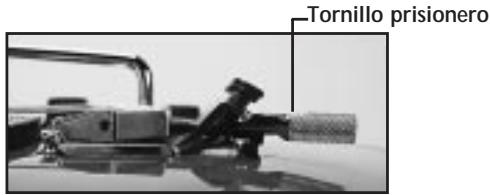
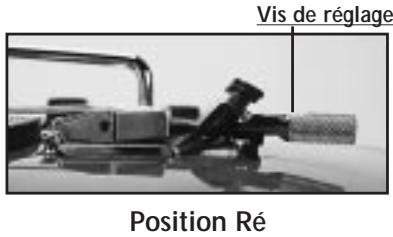
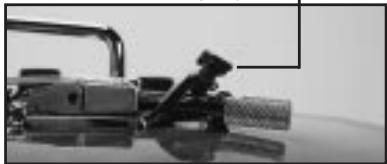
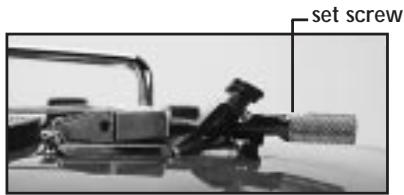
The D-Tuner is a unique pitch dropping device that offers instant "Drop-D" tuning by dropping the low-E string down to D. This is located on the low-E string lock bolt, and is actuated by simply sliding the mechanism in (for E) or out (for D). Please read the instructions carefully to understand the operation and adjustment of the D-Tuner.
fine-tuning adjustment screw
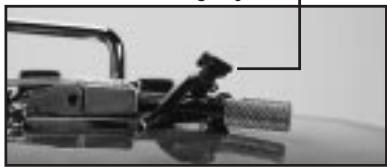
"E" position
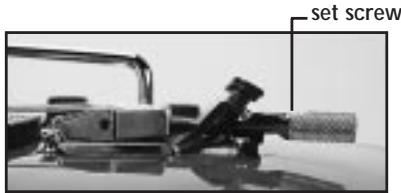
"D" position
- Loosen the locking topnut screw for the low-E string.
- Adjust the D-Tuner to the "D" position by pulling it back (away from the tremolo).
-
Turn the fine-tuning adjustment screw for the low-E string counterclockwise until it stops. Then, turn the fine-tuning adjustment screw clockwise approximately one full turn. This will allow proper travel for the D-Tuner.
-
Using the tuning machine, stretch and retune the low-E string to "D." Then, tighten the locking topnut screw and fine tune the "D" using the fine-tuning adjustment screw.
-
Slide the D-Tuner forward (toward the bridge) while applying slight downward pressure. The D-Tuner will now be in the "E" position. The fine-tuning screw will now be positioned on the top, flat surface of the D-Tuner.
-
Check the tuning of the low-E string.
-
If the low-E string is out of tune, use the supplied 1.5mm hex wrench to turn the set screw on the D-Tuner clockwise if the pitch is flat, or counterclockwise if the pitch is sharp.
-
Pull the D-Tuner back to the "D" position and check tuning. Push it back to the "E" position, check tuning and readjust the set screw if necessary.
-
Once the set screw on the D-Tuner is correctly adjusted, use only the fine-tuning screw for tuning. (The fine-tuning screw will simultaneously tune both notes in either position.)

Note
It is recommended that the D-Tuner, fine-tuning adjustment screw and bridge saddle be cleaned and lubricated to ensure smooth operation. The saddle should be allowed to pivot up and down freely to ensure proper operation of the D-Tuner.
Changing string gauges or deviation from proper pitch (A-440) will necessitate readjustment of the D-Tuner.
Tremolo Bridge Height
Bridge height may be adjusted by means of the bridge pivot bolts. Turn the pivot bolts clockwise to reduce bridge height. Turn the pivot bolts counterclockwise to increase bridge height.
tremolo Bridge Tension
The tension of the tremolo bridge is set by adjusting the spring tension screws which hold the spring claw in place. To gain access to the spring tension screws and spring claw, remove the spring cover on the back of the guitar.
Per Edward's specification, the tremolo system is adjusted to rest on the body surface for maximum sustain and tonality. This will only allow the strings to be dropped below pitch.
This also ensures tuning stability when using the D-Tuner or when a string breaks. The instrument is equipped with two springs, which allow proper tension for the string gauge supplied with the guitar. The extra spring is
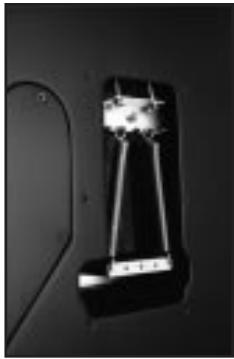
enclosed should you prefer to use a heavier string gauge.
Proper tremolo tension is achieved when the bottom of the tremolo bridge plate rests on the top surface of the guitar body without requiring excessive force to depress the tremolo arm.
The tremolo can be adjusted to operate as a floating style tremolo by loosening the spring tension. Turn the spring tension screws clockwise to increase the spring tension, and counterclockwise to decrease the spring tension.
This instrument should be tuned to proper pitch (A-440) before and after making adjustments.

Note
If the floating tremolo style is desired, it is recommended that you remove the D-Tuner, as its operation causes a change in string tension that will affect the tuning of the other strings. An extra string lock bolt is enclosed in the case, should the D-Tuner be removed.
CAUTION: Loosen all string tension before installing or removing tension springs. Tremolo springs are designed for high tension. Extreme care should be taken when installing and removing these springs.
Tremolo Arm
The tremolo arm is inserted and screwed into the tremolo arm socket on the bridge plate. This assembly can be adjusted to control the amount of torque required to rotate the tremolo arm. Some players prefer the tremolo arm to stay in place when used. This can be accomplished by using the supplied 12mm wrench to hold the top of the tremolo arm socket while screwing the tremolo arm firmly into place.
If you prefer to have the tremolo arm swing freely, loosen the nut on the bottom of the tremolo arm socket. This is accessible through the tremolo spring pocket. Edward prefers an extremely loose feel, allowing approximately one inch of play before the tremolo is actuated. This adjustment accommodates Edward's particular playing style. It allows him to hold onto the tremolo arm while picking without moving the tremolo until needed.
String Intonation
Accurate string intonation settings ensure that your instru-
ment will play in tune at any point on the neck. Although "perfect intonation" is an impossibility with a fretted instrument, the proper adjustments will maximize the accuracy of individual notes up and down the neck.
Intonation is set by comparing the pitch of an open string to the pitch of the same string when played
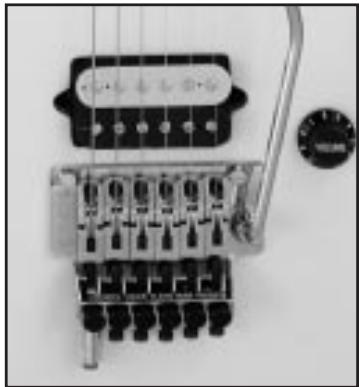
one octave higher at the 12th fret. The actual “vibrating length” of that string is varied until the notes are both at the correct pitch. The vibrating length of the string is altered by adjusting the individual saddles either forward or backward, depending on whether the fretted note is sharper or flatter in pitch than the open note.

This process should always be performed with new strings. Intonation problems can often result from worn strings. It is often difficult for the untrained ear to determine when the open note and the fretted note are at precisely the same pitch. Some players find that comparing the 12th fret harmonic of the string (rather than the open note) to the fretted note is much easier.
A harmonic is played by plucking the string with the right hand while touching the string with the left index finger (as lightly as possible) directly above the 12th fret. The left finger is drawn away as quickly as possible after the string is plucked, producing a “chime” effect. This chimed note is then compared to the fretted note. For greater ease and accuracy, we recommend one of the many types of electronic guitar tuners that are available from most music stores.
- Ensure that the torsion rod and string-height settings are accurate and the strings are new.
- Tune the instrument to standard (A-440) pitch.
- Hold the instrument in a normal playing position or place the guitar on a clean, flat surface so that the body is in contact with the work surface. Any pressure on the neck will affect intonation settings.
- Play the first (E) string open and compare it to the pitch of the same string when it is played at the 12th fret. These notes should sound the same (actually, there is an octave difference).
- Using a 2.5mm hex wrench for the tremolo, adjust the string saddle so that both the fretted and open notes are the same. If the fretted note is sharper than the open note, the vibrating length of the string must be increased. Move the bridge saddle to the rear-away from the pickups. If the fretted note is flat, the vibrating length must be shortened. Move the bridge saddle forward-toward the pickups-to shorten the length.

Note
It will often be necessary to return the open string to standard pitch after the bridge position is altered.
- Repeat steps 4 and 5 for the remaining strings.
- Repeat steps 1-6 until the intonation of all the strings is accurately adjusted.
Care of your Instrument
The EVH Wolfgang is a high-quality musical instrument constructed from the finest materials, using the most up-to-date production methods. With reasonable care, it should provide many years of service and outstanding playability.
Temperature and Humidity
It is important to protect your instrument from any extreme or sudden changes in temperature or humidity. You should store the instrument in its case when not using it.
Strings
Your instrument is equipped with high-quality Peavey EVH Wolfgang strings. String life may be greatly extended by frequent cleaning with string cleaner. Dirt and perspiration tend to build up on the underside of the strings, so it is often necessary to slide a rag between the strings and the fingerboard. Dirt-laden strings cause tuning and intonation problems, as well as rust and corrosion.
For optimum performance, strings should be changed approximately once a month, or after about every twenty-four hours of playing. Some players prefer to change strings more often.
Finish
Your instrument has a polyester/urethane finish that is both durable and weather-resistant, but requires care. Regular cleaning with Peavey guitar polish is recommended. Between polishes, the instrument should be wiped with a dry, soft cloth.
Accessories
Peavey offers a full line of accessories for your instruments. Cases, amplifiers, strings, polishes, straps and more are all available from a Peavey dealer near you.

WARNINGS
- All amplification accessories, microphones, mixers, etc., must be properly grounded and should be utilized with a 3-wire mains system in order to prevent electrical shock.
- Do not come into contact with other electrical apparatus when playing (or touching) your instrument. The metal parts of this instrument are grounded according to proper and accepted industry practice, but it is possible to encounter an electrical shock when coming into contact with another electrical apparatus if it has improper grounding facilities.
- Do not use improper or poorly designed guitar straps or other means of support. Possible injury could result if improper, inferior, ill-fitting, or worn out straps are used. The instrument could possibly fall, causing bodily injury or damage to the instrument or associated equipment if the holding devices fail for any reason.
- Guitar strings are made from very strong steel alloys and are under considerable tension when tuned to pitch. Exercise extreme care when tuning (especially above concert pitch) or when employing string bending or "popping" playing techniques. The possibility of string breakage and personal injury exists under these conditions.

Note
The patch cord between the guitar and the amplifier is an extremely important
link for optimum performance. A high-quality, well-shielded cord should be used in this application.
5150 ® is a registered trademark of Edward Van Halen.
Floyd Rose ® is a registered trademark of Floyd Rose Marketing, Inc.
Switchcraft ® is a registered trademark of Switchcraft, Inc.
ESPAÑOL
Volumen (2)
Posición "E"
Posición "D"

Nota
PRECAUCIONES

Note
ATTENTION
- Up = Bridge Pickup
• Center = beide Pickups - Down = Neck Pickup
Lautstärke (2)
Ausgangsbuchse (3)
fine-tuning adjustment screw
"E" position
"D" position
WARNUNGEN
The development of the 5150 212 Combo was no less
Intense than that of the stack. Numerous prototypes were built and tweaked until the final combo kicked and screamed with
fury only a stack could attain. At 60 watts, the all-tube 5150 212 Combo speaks through two of the same Sheffield™ 1200 speakers found only in the 5150 4 x 12 cabinets. The addition of reverb adds a new dimension to the 5150's exceptional tone.
The legendary 5150 ® sound of Edward Van Halen
is now available in both stack and combo. With Rhythm and Lead channels voiced personally by Edward Van Halen, the 5150 120 watt top features all-tube pre- and power amps. Combined with 5150 Straight and 5150 Slant cabinets, this stack supplies big, muscular tone at any volume level. Months of rigorous testing, many combinations of speaker voicing and cabinet construction were scrutinized and discarded before the ultimate combination emerged.
Now, the new 5150 212 Combo joins the 5150 amp stack, affording the recording guitarist or club player the same signature tone and drive in a compact, self-contained package.

5150® 212 Combo
Notes:
Notes:
Peavey Guitar One-Year Limited Warranty/Remedy
PEAVEY ELECTRONICS CORPORATION (“Peavey”) warrants this guitar to be free from defects in material and workmanship for a period of one year from date of purchase. PROVIDED, however, that this limited warranty is extended only to the original retail purchaser and is subject to the following conditions.
Conditions, Exclusions, and Limitations of Limited Warranty
This limited warranty shall be void and of NO EFFECT if:
- The first purchase of the product is for the purpose of resale; or
- The original retail purchase is not made from an AUTHORIZED PEAVEY DEALER; or
- The product has been damaged by accident or unreasonable use, neglect, improper service or maintenance, or other causes not arising out of defects in material or workmanship.
This Limited Warranty shall not extend to or cover guitar strings. Replacement of guitar strings is deemed to be reasonable and necessary maintenance.
Purchaser's exclusive remedy for breach of this limited warranty is repair of the defect or replacement of the guitar, at the option of Peavey. Service work may be performed by any Peavey Authorized Service Center or, if the service center is unable to provide the necessary warranty service, you will be directed to the nearest Peavey Authorized Service Center which can provide such service. Or... you may return the guitar, postage prepaid and insured, along with a description of the problem, proof of purchase, and a complete return address to:
PEAVEY ELECTRONICS CORPORATION
International Service Center
Hwy. 80 East
Meridian, MS 39301
If the defect is remedial under this warranty, and the other terms and conditions expressed herein have been complied with, Peavey will repair or replace the product and return it, freight collect, to the purchaser. Other than the postage and insurance requirement, no charge will be assessed for such repair or replacement.
The liability of Peavey to the purchaser for any cost whatsoever, and regardless of the form of action, whether in contract or in tort, including negligence, shall be limited to actual damages up to an amount equal to the purchase price of the product or \$500.00.
Under no circumstances will Peavey be liable for any lost profits, any incidental damages, or any consequential damages resulting from the use of or inability to use the guitar, even if Peavey has been advised of the possibility of such damages.
The foregoing limitation of remedy will not apply to the payment of cost and damage awards for personal injury or damage to real property or tangible personal property caused by negligence on the part of Peavey.
This limited warranty is in lieu of any and all warranties, expressed or implied, including but not limited to, implied warranties of merchantability and fitness for a particular use; provided, however, that if the other terms and conditions necessary to the existence of the expressed limited warranty, as hereinbefore stated, have been complied with, implied warranties are not disclaimed during the one-year period from date of purchase of this product.
Some states do not allow limitation on how long an implied warranty lasts, or the exclusion or limitation of incidental or consequential damages, so the above limitations or exclusions may not apply to you. This warranty gives you specific legal rights, and you may also have other rights which may vary from state to state.
This limited warranty is the only expressed warranty on this guitar, and no other statement, representation, warranty or agreement by any person shall be valid as to or binding upon Peavey.
The warranty registration card and a legible copy of the proof of purchase supplied to you by the authorized Peavey dealer in connection with your purchase of this guitar should be accurately completed, mailed to, and received by Peavey within fourteen (14) days from the date of your purchase.
Should notification become necessary for any condition that would require correction, the registration card will help ensure that you are contacted and properly notified.
If you move from the address shown on the warranty registration card, you should notify Peavey of the change of address to facilitate receipt of any bulletins or other forms of notification which may become necessary in connection with any condition that may require dissemination of information or correction.
The warranty of registration card and subsequent notices of change of address should be mailed to:
Peavey Electronics Corporation
P.O. Box 2898
Meridian, MS 39302-2898
In the event of any modification of disclaimer of expressed or implied warranties or any limitation of remedies contained herein conflicts with applicable law, then such modification, disclaimer or limitation, as the case may be, shall be deemed to be modified to the extent necessary to comply with such law.
The limited warranty is given by Peavey Electronics Corporation with respect to equipment purchased in the United States of America.
Look for our other
EVH
wolfgang
products and Accessories
at your local
Peavey dealer.


PEAVEY®
PEAVEY ELECTRONICS CORPORATION
7 1 1 A Street · Meridian, MS 39301 · USA
phone: (601)483-5365 · fax: (601)486-1278
- WOLFGANG®
- SPECIAL
- GUITAR
- CONTENTS
- INTRODUCTION ...... 3
- FEATURES 4
- CONSTRUCTION 5
- CONTROLS....5
- ADJUSTMENTS....6
- STRING INTONATION 11
- CARE OF YOUR INSTRUMENT 13
- 5150 ® STACK/212 COMBO AMPS 14
- WARNINGS 15
- ESPAÑOL 14
- FRANÇAIS 27
- DEUTSCH 38
- WARRANTY 53
- EVH WOLFGANG SPECIAL FEATURES
- BODY
- NECK
- ELECTRONICS
- HARDWARE
- CONSTRUCTION
- PICKUPS
- CONTROLS
- PICKUP SELECTOR SWITCH (1)
- VOLUME (2)
- OUTPUT JACK (3)
- ADJUSTMENTS
- TORSION ROD (1)
- TREMOLO BRIDGE
- STRING RETAINER BAR (1)
- LOCKING TOPNUT (2) (AT HEADSTOCK)
- STRING INSTALLATION
- D-TUNER OPERATION AND ADJUSTMENT
- NOTE
- TREMOLO BRIDGE HEIGHT
- TREMOLO BRIDGE TENSION
- TREMOLO ARM
- STRING INTONATION
- IT WILL OFTEN BE NECESSARY TO RETURN THE OPEN STRING TO STANDARD PITCH AFTER THE BRIDGE POSITION IS ALTERED
- CARE OF YOUR INSTRUMENT
- TEMPERATURE AND HUMIDITY
- STRINGS
- FINISH
- ACCESSORIES
- WARNINGS
- ESPAÑOL
- VOLUMEN (2)
- NOTA
- PRECAUCIONES
- ATTENTION
- LAUTSTÄRKE (2)
- AUSGANGSBUCHSE (3)
- WARNUNGEN
- THE LEGENDARY 5150 ® SOUND OF EDWARD VAN HALEN
- PEAVEY GUITAR ONE-YEAR LIMITED WARRANTY/REMEDY
- CONDITIONS, EXCLUSIONS, AND LIMITATIONS OF LIMITED WARRANTY
- WOLFGANG
- PEAVEY®
Brand : PEAVEY
Model : EVH WOLFGANG SPECIAL GUITAR
Category : Electric guitar