
MECABLITZ 45 CL-1 - Camera Flash METZ - Free user manual and instructions
Find the device manual for free MECABLITZ 45 CL-1 METZ in PDF.


| Product type | Flash photo |
| Brand | METZ |
| Model | MECABLITZ 45 CL-1 |
| Dimensions (W x H x D) | 92 x 247 x 102 mm |
| Weight (without power source) | 680 g |
| Power supply | Alkaline LR6 (AA) batteries or NiCd battery pack 45-40 |
| Guide number (ISO 100/21°, m) | 45 |
| Operating modes | Non-TTL automatic (5 apertures) and manual |
| Flash duration | Approx. 1/200 to 1/20,000 s (auto mode); 1/300 s at full manual power |
| Color temperature | 5600 K |
| Film speed | ISO 25 to 3200 |
| Recycling time (manual mode) | 7 s (NiCd) to 13 s (alkaline); up to 0.3 s in auto mode |
| Reflector tilt/swivel | Vertical: click stops at 15°, 30°, 45°, 60°, 75°, 90°; Horizontal: 90° and 180° left/right |
| Wide-angle diffuser | Included, widens angle to 65° horizontal, 60° vertical |
| Good exposure indicator | Yes (LED o.k.) |
| Sensor measuring angle | Approx. 25° |
| Synchronization | Low-voltage thyristor trigger, X contact |
| Supplied accessories | Bracket, sync cable, wide-angle diffuser, battery magazine (BAT version) or NiCd battery + charger (NC version) |
| Maintenance | Clean with a soft dry cloth or silicone cloth. Power on for 10 min every 3 months to preserve capacitor |
| Safety | Do not expose to water, flammable gases, excessive heat. Do not disassemble (high voltage). Use only approved power sources |
Frequently Asked Questions - MECABLITZ 45 CL-1 METZ
User questions about MECABLITZ 45 CL-1 METZ
0 question about this device. Answer the ones you know or ask your own.
Ask a new question about this device
Download the instructions for your Camera Flash in PDF format for free! Find your manual MECABLITZ 45 CL-1 - METZ and take your electronic device back in hand. On this page are published all the documents necessary for the use of your device. MECABLITZ 45 CL-1 by METZ.
USER MANUAL MECABLITZ 45 CL-1 METZ
natural_image
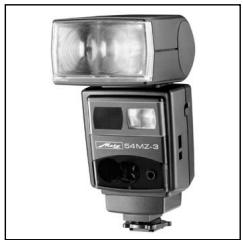
Black and white photo of a 45 CL-1 camera flash unit (no visible text or symbols on body)
MECABLITZ 45 CL-1
Bedienungsanleitung
Gebruiksaanwijzing
Manuale istruzioni
Mode d'emploi
Operating instruction
Abmaße ca. in mm (B x H x T)
Blitzgerät 92 x 247 x 102
Gewicht:
Points worth knowing....29
-
Safety instructions....30
-
Preparing the flashgun for use. 30
2.1 Attaching the flashgun to a camera....30
2.2 Power supply 31
2.3 Battery replacement....31
2.3.1 Exchanging the batteries 31
2.3.2 Operation with the battery pack 31
2.3.3 Operation with the mains unit. 31
2.4 Switching the flashgun on and off....31
-
Automatic flash mode 32
-
Manual flash mode....32
-
Bounced flash....33
5.1 Bounced flash in automatic and TTL flash modes ..... 33
5.2 Bounced flash in manual flash mode....33
- Fill-in flash in daylight....33
Fill-in flash in automatic mode 33
-
Auto-check display 34
-
Illumination and wide-angle diffuser ..... 34
-
Exposure corrections....34
9.1 Exposure correction in automatic flash mode ..... 34
-
Care and maintenance 35
-
Technical data....35
-
Optional accessories....36
Points worth knowing
Congratulations on purchasing this METZ flashgun, and thank you for your confidence in METZ equipment.
It is only natural that you should want to use your flashgun straight away. However, it will be well worth your while to study these Operating Instructions carefully beforehand to ensure that you can operate the flashgun effectively and without any problems.
Please also oppen the back cover page with the illustrations.
This flashgun can be used with:
- All cameras with a hot shoe in conjunction with the synch cable 45-54 (optional accessory)
- All cameras with synch connection in conjunction with the supplied synch cable
- System cameras
Brief survey of the operating functions:
Configuration
Operating modes possible
• 45 CL-1 with synch cable:
Automatic flash mode, Ch. 3, page 32
Manual flash mode, Ch. 4, page 32
The mecablitz 45 CL-1 is available in two versions:
- The mecablitz 45 CL-1-NC with NiCad battery and battery charger. The NC version can be expanded to alkaline manganese battery operation by way of the battery holder 45-39 (available as an optional extra).
- The mecablitz 45 CL-1-BAT (for operation with alkaline manganese batteries; (batteries are not included).
The battery version can be upgraded to rechargeable NiCad battery operation by adding the B 45 charger set (= NiCad battery and battery charger).
The mecablitz 45 CL-1 is a powerful flashgun based on the most modern technology.
Outstanding features:
- Universal, swivelling quadrolight reflector for bounced flash without having to forgo the benefits of automatic exposure control.
- Wide-angle diffuser.
- Automatic exposure control with a selection of 5 working apertures to easily resolve the problems associated with depth-of-field and to offer greater creative scope regarding camera settings.
- Power-saving thyristor light output control, particularly in the close-up range, for shorter recycle times and a higher number of flashes from just one battery charge.
- Correct exposure confirmation (auto check).
- Convenient calculator dial for all settings.
- Manual mode.
1. Safety instructions
- The flash unit is exclusively intended and approved for photographic use!
- Never fire a flash in the vicinity of flammable gases or liquids (petrol, solvents, etc.) - DANGER OF EXPLOSION!
- Never take flash shots of car, bus or train drivers, or of motorcycle and bicycle riders, whilst they are travelling. They could be blinded by the light and cause an accident!
- Never fire a flash in the immediate vicinity of the eyes! Flash fired directly in front of the eyes of a person or animal can damage the retina and lead to severe visual disorders - even blindness!
- Only use the approved power sources listed in the Operating Instructions!
- Do not expose batteries to excessive heat, sunshine, fire and the like!
-
Never throw exhausted batteries on to a fire!
-
Exhausted batteries should be immediately removed from the flash unit! Lye leaking out of spent batteries will damage the unit.
- Never recharge dry-cell batteries!
- Do not expose the flash unit or battery charger to dripping or splashing water!
- Protect the flash unit from excessive heat and humidity! Do not store the flash unit in the glove compartment of a car!
- Never place material that is impervious to light in front of, or directly on, the reflector screen. The reflector screen must be perfectly clean when a flash is fired. The high energy of the flash light will burn the material or damage the reflector screen if this is not observed.
- Do not touch the reflector screen after a series of flash shots. Danger of burns!
- Never disassemble the flashgun! DANGER: HIGH VOLTAGE!
- There are no components inside the flashgun that can be repaired by a layperson.
2. Preparing the flashgun for use
2.1 Attaching the flashgun to a camera
The macablitz must always be connected to the X contact on the camera or the synchronization selector must be set to X.
Always switch off the camera and the flashgun before mounting or removing the flashgun.
Mounting the flashgun:
- Fasten the camera bracket with the bracket screw to the camera's tripod bush. For medium- and large-format cameras we recommend the use of the 70-35 bracket (optional accessory).
- Insert the camera bracket into the rapid-action catch of the holder block until it is audibly engaged.
- Secure the camera bracket with the locking screw.
- Connect the synch cable to the flashgun and camera.
2.2 Power supply
The flashgun can be operated with:
- Alkaline manganese batteries, size IEC LR 6 (AA-type) (only with BAT-version, otherwise optional extra)
- Metz NiCad battery pack 45-40 (only if NiCad is featured; otherwise available as an optional accessory). A charger (see table 2, page 59) is included with the flashgun if NiCad is featured).
• Power Pack P 50 (optional accessory)
2.3 Battery replacement
Press the two locking keys of the battery housing, and pull out of the flashgun (fig. 4a). To return the battery housing press the two locking keys together and press into the handle-mount grip of the flashgun until it audibly engages.
2.3.1 Exchanging the batteries
Press together the smooth locking keys of the dismantled battery housing (only with BAT-version, otherwise optional extra) and remove the lid (fig. 4b). Insert new batteries in conformity with the polarity symbols indicated in the base of the housing. Return the lid and lock in again.
Spent batteries must not be thrown into the domestic waste! Help keep the environment clean and discard spent batteries at corresponding collecting points!

The battery housing must not be fitted with NiCad batteries! The contacts of the battery housing are only intended for alkaline manganese batteries.
The lower resistance of NiCad batteries means that more current can flow, and this can damage the flashgun. The NiCad Battery Pack 45-40 has special contacts which do not allow the flow of high currents.
2.3.2 Operation with the battery pack (only with NC-version, otherwise optional extra)
The NiCad battery should be charged for 5 hours before it is used for the first time. The NiCad battery can be charged within the flashgun or externally.
Warning: The flashgun must NOT be switched on while the battery is being charged within the flashgun!
The NiCad battery is discharged if the recycle time after a flash exceeds 60 seconds.
Adjust the correct mains voltage on the charger prior to charging. The voltage selector (fig. 5a) is located next to the plug and can be adjusted with a small screwdriver.
The connection for the charger (fig. 5b) is in the base of the NiCad battery. The adjoining pilot lamp lights up while charging is in progress.
The charging time for a completely exhausted NiCad battery is 5 hours. A partly discharged NiCad battery requires a correspondingly diminished charging time.
To identify an exhausted battery: Push the knurled slide in the battery lid to the black mark.
To identify a charged battery: Push the knurled slide in the battery lid to the white mark.
2.4 Switching the flashgun on and off
The flashgun is switched on with the main switch ⑧ (fig. 2). The flashgun is permanently switched on when the switch is pushed to the top position, and the operating light shines. Push the main switch to the bottom position to switch off the flashgun.
3. Automatik Flash Mode
In the automatic flash mode the photosensor measures the light reflected from the subject. The flash is cut off as soon as sufficient light has been emitted for correct exposure.
In this manner there is no need to calculate and set a new aperture when the distance is changed, provided that the subject remains within the indicated automatic flash range.
The photosensor of the flashgun must be directed at the subject, regardless of the direction at which the main reflector is pointing. The photosensor has a measuring angle of approx. 25irc , and it only measures the actual amount of light emitted by the flashgun.
Six working apertures are available in the automatic flash mode.
Adjusting procedure for the automatic flash mode:
Example:
Flash-to-subject distance: 5 m
Film speed: ISO 100/21°
- Adjust the camera according to the manufacturer's operating instructions.
- Switch on the flashgun with the main switch ⑧ (fig. 2).
- Turn the adjusting knob for film speed ⑫ (fig. 3) until the marker is positioned opposite the ISO film speed.
Under due consideration of the maximum flash range, a distance of 5 m permits selection of the auto apertures f/8, f/5.6, f/4 and f/2.8.
- Set the selector dial to one of the auto apertures. The frame for preselection ⑪ (fig. 3) assigns the adjusted f-stop with the corresponding maximum flash range on the distance scale. The minimum flash-to-subject distance is approx. 10% of the maximum flash range.
- Adjust the same aperture on the flashgun and the camera. To achieve the shortest possible depth-of-field (as required in portraiture) we recommend an aperture of f/2.8. For group shots where there can be several rows of people behind each other, we recommend an aperture of f/8.
- Wait for flash readiness - the green LED lights up.
The subject should be within the middle third of the distance range. This gives the electronic control sufficient scope for compensation should this be necessary.
There is a certain measure of overlap between the individual automatic apertures. As a result of this overlap it is always possible to place the subject within the middle third of the range.
CAUTION with zoom lenses!
Due to their design they can cause a loss of light in the order of up to one f-stop. Furthermore, the effective aperture can also vary, depending upon the adjusted focal length. This must be compensated by manually correcting the aperture setting on the flashgun!
4. Manual Flash Mode
In this mode the flashgun will emit its full power. The flashgun can be adapted to the actual picture shooting situation by setting the corresponding aperture on the camera.
If the displayed value does not coincide with the actual distance, then the aperture and/or partial light output level have to be changed accordingly.
The decisive points for partial light output are:
- The distance to the subject
- The required aperture
- The ISO film speed
Adjusting procedure for the manual flash mode:
Example:
Flash-to-subject distance: 5 m
Film speed: ISO 100/21°
- Adjust the camera according to the manufacturer's operating instructions.
- Switch on the flashgun with the main switch ⑧ (fig. 2).
- Turn the adjusting knob for film speed ⑫ (fig. 3) until the marker is positio-
ned opposite the ISO film speed.
- Set the selector dial ⑪ (fig. 3) to M.
The aperture to be adjusted is indicated on the scale above the given flash-to-subject distance.
At a flash-to-subject distance of 5 m (as in our example), an aperture of f/8 has to be set on the camera.
The adjusted aperture must be corrected when the wide-angle diffuser is used.
5. Bounced Flash
Photos shot with full frontal flash are easily recognizable by their harsh, dense shadows. This is often associated with a sharp drop of light from the foreground to the background.
This phenomenon can be avoided with bounced flash because the diffused light will produce a soft and uniform rendition of both the subject and the background. For this purpose the main reflector is turned in such a manner that the flash is bounced back from a suitable reflective surface (e.g. ceiling or walls of a room).
For this reason the main reflector can be turned vertically and horizontally. The following are the vertical lock-in positions for bounced flash:
- 15irc , 30irc , 45irc , 60irc , 75irc and 90irc (simply tilt the reflector to the required angle)
The head can be swivelled horizontally to the left and right by 180irc , and locks into position at 90irc and 180irc .
When swivelling the reflector vertically, it is essential to ensure that it is turned by a sufficiently wide angle so that direct light can no longer fall on the subject. Therefore, always tilt the reflector to at least the 60° lock-in position.
The diffused light bounced back from the reflective surfaces results in a soft illumination of the subject.
The reflecting surface must be white or a neutral colour, and it must not be structured (e.g. wooden beams in the ceiling) as this could cast shadows. For colour effects just select reflective surfaces in the required colour.
Use of the secondary reflector is advantageous to avoid disturbing dense shadows with bounced flash, for instance under the eyes and nose of portraits.
5.1 Bounced flash in automatic flash mode
It is advisable to check prior to the actual exposure whether the light is sufficient for the selected aperture. Please refer to Ch. 7, for the corresponding procedure.
5.2 Bounced flash in manual flash mode
The required camera aperture in the manual flash mode is best established with an exposure meter. Observe the following rule of thumb if an exposure meter is not available
Camera aperture = guide number light distance × 2
to establish the guide value for the aperture that can then be varied by +1 f-stop for the actual exposure.
6. Fill-in Flash in Daylight
The mecablitz can also be used for fill-in flash in daylight to soften harsh shadows and lower the contrast, thereby producing a more balanced exposure when shooting against the light. Various possibilities are open to the user for this purpose.
6.1 Fill-in flash in automatic mode
Use the camera, or a hand-held exposure meter, to establish the required aperture and shutter speed for a normal exposure. Ensure that the shutter speed either equals, or is slower than, the fastest flash synch speed (varies with the given camera model).
Example:
Established aperture = f/8; established shutter speed = 1/60 sec. Flash synch speed of the camera, e.g. 1/100 sec. (see operating instructions for the given camera).
The two established values for aperture and shutter speed can be set on the camera because the camera's shutter speed is slower than the camera's flash synch speed.
To maintain a balanced range of highlights, for instance in order to retain the character of the shadows, it is advisable to select the automatic aperture on the flashgun one setting lower than the aperture adjusted on the camera. In the above example the camera was adjusted to f/8. Consequently, we advise you to set an aperture of f/5.6 on the flashgun.
When shooting into the light, ensure that the backlight does not shine directly onto the sensor as this will confuse the flashgun's electronics!
7. Auto-Check Display
The auto-check signal o.k. lights up only when the frame will be, or was, correctly exposed in auto mode.
In this manner it is possible to manually fire a test flash while in auto mode so that the correct aperture can be established beforehand. This is particularly valuable with bounced (indirect) flash when reflection conditions are difficult to judge.
The test flash is triggered with the manual firing button ⑥ (fig. 2).
If the auto-check display o.k. remains dark after a test flash, then adjust the next wider aperture, or diminish the distance to the reflection surface of the subject, and then repeat the test flash.
The f-stop established in this manner must also be set on the camera.
Hold the camera and the flashgun with photosensor in the same manner as for the actual shot.
8. Illumination and Wide-Angle Diffuser
The wide-angle diffusor widens the horizontal lighting angle from 62irc to 65irc , and the vertical lighting angle from 42irc to 60irc .
The wide-angle diffusor is intended for use with focal lengths of less than 28 mm
(for 24 x 36 mm), and less than 70 mm (for 6 x 6 cm).
Mounting:
Slip the wide angel diffusor on the reflector and allow the two lateral catches to engage into the reflector slots.
For removal, slightly lift the diffusor laterally and pull it off toward the front.
When the wide angle diffusor is used, there is a loss in light of one stop value. The guide number and maximum range for computer operating are then reduced to about 70% of the value for use of flash without wide angle diffusor. With the wide angle diffusor used in the auto mode, the mark „W“ on the aperture calculator dial indicates the maximum operating range. For aperture settings, there is the mark „N“.
Shadows on the lower pictures edge are noticeable for exposure with short distance due to parallax between the camera lens and flash unit reflector.
This can be rectified by use of the wide angle diffusor or bracket adapter 45-35 or 60-28.
9. Exposure Corrections
The automatic exposure systems are based on a subject reflection factor of 25%, this being the average reflection factor for subjects shot with flash.
Dark backgrounds absorb a lot of light, while bright backgrounds reflect a great deal of light (e.g. backlit scenes), thereby resulting in subject overexposure or underexposure, respectively.
9.1 Exposure correction in automatic flash mode
To compensate the above mentioned effect, the exposure can be corrected by opening or stopping down the camera's aperture. With a bright background
the sensor of the flashgun cuts out the flash too soon with the result that the actual subject is too dark. With a dark background the flash is cut out too late so that the actual subject is too bright.
Bright background: Open the camera aperture by 1/2 to 1 f-stop (e.g. from f/5.6 to f/4).
Dark background: Close the aperture by 1/2 to 1 f-stop (e.g. from f/8 to f/11).
10. Care and Maintenance
Remove dust and grime with a soft dry cloth, or a silicon-treated cloth. Do not use detergents as these may damage the plastic parts.
Forming the flash capacitor
The flash capacitor incorporated in the flashgun undergoes a physical change when the flashgun is not switched on for prolonged periods. For this reason it is necessary to switch on the flashgun for approx. 10 minutes every 3 months. The battery must supply sufficient power to light up the flash-ready light within one minute after the flashgun was switched on.
11. Technical Data
Guide numbers at ISO 100/21°:
For meter systems: 45; for feet systems: 148
5 auto working apertures at ISO 100/21°:
f/2.8 - f/4 - f/5.6 - f/8 - f/11
Flash durations:
- approx. 1/300...1/20000 second
- In M mode approx. 1/300 second at full light output
Photosensor measuring angle: approx. 25°
Colour temperature: approx. 5600 K
Film speed: ISO 25 to ISO 1000 Synchronization: Low-voltage thyristor ignition
Number of flashes:
50*...2000 NiCad battery
100*...2600 with alkaline-manganese batteries
140*...3600 with high-capacity alkaline-manganese batteries
(*with full light output)
Recycling time:
7 sec. (in M mode)...0.3 with NiCad battery
13 sec. (in M mode)...0.3 sec. with alkaline-manganese batteries
11 sec. (in M mode)...0.3 sec. with high-capacity almn batteries
5 sec. (N 22)/18 sec. (N 23)...0.3 sec.
Swivelling range and locking positions of zoom reflector:
Upwards: 15irc 30irc 45irc 60irc 75irc 90irc
Anti-clockwise 90° 180°
Clockwise 90° 180°
Dimensions (w x h x d), approx.
Flashgun 92 x 247 x 102 mm
Weight:
Flashgun without power sources: approx. 680 g
Table 1: Guide numbers at maximum light output (Page 59)
Table 2: Chargers (Page 59)
Included:
Flashgun, camera bracket, battery housing 45-39 (only with BAT-version, otherwise optional extra), synch cable 45-47, wide-angle diffuser 45-41, Operating Instructions
(additionally with NiCad flashguns: NiCad battery pack 45-40 and battery charger, see table 2).
12. Optional Accessories
Malfunctions and damage caused to the mecablitz due to the use of accessories from other manufacturers are not covered by our guarantee!
- Bag 45-29 (Order No: 0004529) for telephoto attachment 45-33.
- Battery holder 45-39 For alkaline manganese batteries.
- Battery charger set B 45 (Order No: 0012045) NiCad battery and charger for subsequent conversion of the 45 CL-1 Battery model to NiCad battery operation.
- Bounce diffuser 60-33 (Order No: 0006033) To soften heavy shadows with reflected light.
- Bracket adapter 45-35 (Order No: 004535) For parallax correction of reflector and camera with close-ups and wide-angle shots.
- Bracket adapter 60-28 (Order No: 0006028) Similar to 45-35, except adjustable in height.
- Camera bracket 70-35 (Order No: 0007035) To attach the flashgun to the side of the camera.
- Camera cable release 45-26 (Order No: 0004526) The camera shutter can be tripped with the same hand that is holding the flashgun. This frees the other hand for focusing.
- Electric shutter release 45-25 (Order No: 0004525) As 45-26, except with switch for electric actuation.
- Ever-ready case 45-34 (Order No: 0004534) for flashgun and accessories.
- Filter set 45-32 (Order No: 0004532)
Consists of a set of 4 colour effects filters and 1 clear filter to hold any coloured foil.
• Light reducing filter set 45-28 (Order No: 0004528
Consists of three neutral density filters, and a transparent filter holder for coloured foils.
• Mecalux 11 (Order No: 0000011)
Slave triggering unit. For optical, delay-free remote triggering of slave flashguns by a camera-triggered flash. Responds also to infrared light beam. Does not require batteries.
- Mecalux Holder 60-26 (Order No: 0006026) To mount the Mecalux 11.
• Mecamat 45-46 (Order No: 0004546)
External sensor that significantly extends the application range of the mecablitz. 11 auto apertures are available. „MANUAL“ provides 7 coordinated light output levels with 7 fixed flash durations. Built-in viewfinder with parallax compensation for close-ups. Two measuring angles of 25irc and 12irc for optimal measurement.
- NiCad battery pack 45-40 (Order No: 0004540)
• Power Pack P 50 (Order No: 0012950)
For a high number of flashes and short recycling times (approx. 300 full-power flashes)
- Shoulder strap 50-31 (Order No: 0005031)
• Stabilizing set 30-28 (Order No: 0003028)
Ensures that the camera cannot be inadvertently turned on the bracket.
• Standard foot 301 (Order No: 0093014)
Used in conjunction with SCA 300 A for connection to camera hot shoe.
- Synch leads:
Coiled synch lead 45-49 (Order No: 0004549)
Coiled synch lead 45-54 for hot shoe (Order No: 0004554)
Synch lead 45-48, 1 m (Order No: 0004548)
Synch extension lead 60-54 (5 m) (Order No: 0006054)
• Telephoto attachment 45-33 (Order No: 0004533)
For flash shots with telelenses. Nearly doubles the guide number. Infrared shots are also possible.
Disposal of batteries
Do not dispose of spent batteries with domestic rubbish.
Please return spent batteries to collecting points should they exist in your country!
Please return only fully discharged batteries.
Normally, batteries are fully discharged if:
- the device they powered switches itself off and indicates "Spent Batteries".
- they no longer function properly after prolonged use.
To ensure short-circuit safety please cover the battery poles with adhesive tape.
Indice
Dimensioni appross. in mm (LxHxP)
Torcia flash 92 x 247 x 102
Peso
natural_image
Two black mechanical components with directional arrows indicating movement or assembly (no text or symbols visible)natural_image
Two black cylindrical batteries with internal components, shown from different angles (no text or symbols visible)Fig. 4b: Opening the battery housing
(only with BAT-version, otherwise optional extra)
Fig. 4b: Apertura del box portabatterie
natural_image
Close-up of a black industrial control box with two ports and a cable (no visible text or symbols)natural_image
Two black electronic components with visible leads and wiring, no text or symbols present.Bild 5b: Akku laden
Fig. 5b: Charging the battery
natural_image
Aerial view of an industrial complex with multiple factory buildings and surrounding farmland (no visible text or signage)natural_image
Exterior view of a modern office building (no signage)Consumer electronics
natural_image
Exterior view of a modern office building (no signage)Photoelectronics
natural_image
Close-up of a robotic arm connecting wires to a mechanical component (no visible text or symbols)Plastics technology
natural_image
Close-up of a robotic arm operating on a circuit board (no visible text or symbols)Industrial electronics
Metz. Always first class.
Cε
703 47 0130.A1
D F NL GB I E
- MECABLITZ 45 CL-1
- Gewicht:
- Points worth knowing
- Please also oppen the back cover page with the illustrations.
- Brief survey of the operating functions:
- Outstanding features:
- Safety instructions
- Preparing the flashgun for use
- Attaching the flashgun to a camera
- Power supply
- Battery replacement
- Exchanging the batteries
- Operation with the battery pack (only with NC-version, otherwise optional extra)
- Switching the flashgun on and off
- Automatik Flash Mode
- Adjusting procedure for the automatic flash mode:
- Example:
- Manual Flash Mode
- Adjusting procedure for the manual flash mode:
- Bounced Flash
- Bounced flash in automatic flash mode
- Bounced flash in manual flash mode
- Fill-in Flash in Daylight
- Fill-in flash in automatic mode
- Auto-Check Display
- Illumination and Wide-Angle Diffuser
- Mounting:
- Exposure Corrections
- Exposure correction in automatic flash mode
- Care and Maintenance
- Forming the flash capacitor
- Technical Data
- Recycling time:
- Included:
- Optional Accessories
- Disposal of batteries
- Indice
Brand : METZ
Model : MECABLITZ 45 CL-1
Category : Camera Flash