Bolero Coolmarket 2d 255 Nf E - Refrigerator CECOTEC - Free user manual and instructions
Find the device manual for free Bolero Coolmarket 2d 255 Nf E CECOTEC in PDF.


User questions about Bolero Coolmarket 2d 255 Nf E CECOTEC
0 question about this device. Answer the ones you know or ask your own.
Ask a new question about this device
Download the instructions for your Refrigerator in PDF format for free! Find your manual Bolero Coolmarket 2d 255 Nf E - CECOTEC and take your electronic device back in hand. On this page are published all the documents necessary for the use of your device. Bolero Coolmarket 2d 255 Nf E by CECOTEC.
USER MANUAL Bolero Coolmarket 2d 255 Nf E CECOTEC
bolero
Safety instructions 11
- Parts and components 81
- Before use 81
- Product installation 81
- Operation 85
- Instructions on food storage 87
- Cleaning and maintenance 90
- Troubleshooting 91
- Technical specifications 93
- Disposal of old electrical and electronic appliances 93
- Technical support and warranty 94
- Copyright 94
SOMMAIRE
Read these instructions thoroughly before using the appliance. Keep this instruction manual for future reference or new users.
- It is important to make sure all users are familiar with the operation and safety features of the appliance to prevent faults and unnecessary accidents.
- Make sure that the mains voltage in your house matches the voltage stated on the rating label of the appliance.
- This appliance can be used by children aged 8 years and above and people with reduced physical, sensory, or mental capabilities or lack of experience and knowledge if they have been given supervision or instruction concerning use of the appliance in a safe way and understand the hazards involved. Children must not play with the appliance. Cleaning and user maintenance should not be carried out by unsupervised children.
- Do not store explosive substances such as aerosol cans with flammable propellant in this appliance.
- This device is designed for domestic use only and is not intended for bars, restaurants, farmhouses, hotels, motels, and offices.
- To avoid food contamination, please follow the instructions below:
- Opening the door for a long period of time may cause a significant increase in temperature in the appliance's compartments.
- Regularly clean the surfaces that might be in contact with food and accessible evacuation systems.
-
If the freezer appliance remains empty for a long period of time, unplug it, defrost it, clean it, dry it, and leave the door open to prevent interior mould formation.
-
WARNING: when positioning the appliance, make sure the power cable does not get trapped or damaged. A crushed or damaged connector may heat up and cause a fire.
- Make sure the appliance plug is accessible after installation.
- WARNING: do not attach multi-socket adaptors or multiple power supplies to the rear part of the appliance.
- WARNING: keep the ventilation grilles on the enclosure of the appliance or the cabinet in which the appliance is located clear.
- WARNING: do not use mechanical appliances or other means to accelerate the defrosting process other than those recommended by Cecotec.
- WARNING: do not use electrical appliances inside the refrigerator.
- WARNING: do not damage the refrigeration circuit.
- If the cable is damaged, it must be replaced by the manufacturer, the supplier, or qualified personnel to avoid hazards.
- We recommend you check the power cable regularly to detect any sign of possible damage. Do not use the appliance if the cable is damaged.
- WARNING: to avoid any risk due to the instability of the refrigerator, you must install it according to the instructions.
- WARNING! It is dangerous for anyone other than authorised personnel to carry out maintenance or repairs involving the removal of covers. To prevent the electric shock risk do not attempt to repair the appliance yourself.
- Do not place carbonated beverages in the freezer compartment. Ice cream can cause “freezer burns”. This can happen if they are ingested after removal from the freezer.
- Do not remove items from the freezer with wet/moist hands, as this may cause skin abrasions or “frostbites”. Bottles and
cans should not be placed in the freezer, as they may burst when their contents freeze.
- Frozen food can cause ice burns if consumed right after removing it from the freezer compartment.
- See the storage times recommended by the manufacturer.
- Do not allow children to play with the controls or the freezer. The appliance is a heavy appliance. Caution must be taken when moving the appliance. It is dangerous to alter specifications or attempt to modify this appliance in any way.
- WARNING: doors or covers fitted with locks and keys must be kept out of the reach of children and not in the vicinity of the freezing appliance to prevent children from being locked inside.
- WARNING: the refrigerant used in your appliance and the insulation materials must be disposed of correctly.
- Keep the packaging material away from children, as there is a risk of suffocation.
- WARNING: if the interior light is damaged, contact the official Cecotec Technical Support Service. Do not try to repair it on your own.
- Make sure the appliance plug is accessible after installation.
- Do not place food directly against the air outlet on the interior of the appliance.
- Do not place hot food or drinks in the refrigerator, allow them to cool down to room temperature beforehand.
- This appliance has a built-in earthed plug. Make sure the power supply in your house is properly earthed.
- Keep the ventilation openings clear from obstructions.
-
Wait 5 minutes after a power failure before turning the appliance back on. Otherwise, the compressor may get damaged.
-
Do not place carbonated or fizzy drinks in the freezer compartment, as this creates pressure in the container, which could explode and damage the appliance.
- To avoid injuries or death caused by electric shock, do not use the appliance with your hands wet or over a wet surface.
- You should never use this refrigerator with an extension lead or a multi-socket adaptor. Make sure the appliance is plugged in directly to a power supply.
- When positioning the appliance, make sure there is enough free space at the rear, as it is the main heat outlet. This will allow for adequate ventilation.
- Do not place any other appliance on the refrigerator and do not wet it.
- This appliance is not intended to be operated by means of an external timer or separate remote-control system.
- It is advisable to wait for at least four hours before connecting the appliance to allow oil to flow through the compressor.
- Do not use the appliance outdoors or in damp environments.
- Always handle the appliance carefully to avoid any damage on it.
- Never use the base, drawers, or door as support.
- Do not overload the door shelves or place too much food on the drawers to prevent items from falling off and damaging the appliance.
- Store raw meat and fish in proper containers in the freezer, so they do not come into contact with or leak on other food.
- The two-star compartments are suitable for storing pre-frozen food, storing, or making ice cream, and making ice cubes.
-
Compartments with one, two, or three stars are not suitable for freezing fresh food.
-
Air must flow around the appliance. Lack of air leads to overheating. To achieve good ventilation, follow the installation instructions.
- Make sure the power cord is accessible after installation.
- All electrical work required to maintain this appliance must be carried out by a qualified electrician.
Temperature range
The appliance temperature range information can be found on its marking. Indicates the optimum room temperature for proper operation of the appliance.
| Climate range | Optimum room temperature |
| SN | From +10 °C to +32 °C |
| N | From +16 °C to +32 °C |
| ST | From +16 °C to +38 °C |
| T | From +16 °C to +43 °C |
WARNING: if the refrigerator is operated outside the climate class for which it is rated (SN/N/ST/T), it may not be able to maintain satisfactory internal temperatures.
Notes:
- Bearing in mind the limiting values of the room temperature range for the climates for which the cooling appliance is designed and that internal temperatures may be affected by factors such as the location of the cooling appliance, room temperature and frequency of door opening, it may be
necessary to modify the setting of any temperature-control device according to these factors.
- If the appliance is operated in an environment other than the specified climate type (i.e. beyond the rated ambient temperature range), it may not be able to maintain the desired compartment temperatures.
Refrigerant
- This refrigerator uses freon-free refrigerant (R600a) and foaming insulation material (cyclopentane), which are environmentally friendly, do not cause damage to the ozone layer, and have a very low impact on global warming. R600a is flammable and does not leak during normal use when sealed in a refrigeration system. In the event of refrigerant leakage due to damage to the refrigerant circuit, be sure to keep the appliance away from open flames and open the windows to ventilate as soon as possible.
- WARNING: the refrigerant and the insulator gas are flammable. When disposing of the appliance, only dispose of it at an authorised waste-disposal facility. Do not expose it to flames.
- WARNING: the appliance contains refrigerant and gases in the insulation. The appliance and gases must be disposed of professionally, as they may cause injuries to eyes or ignition. Make sure the refrigeration-circuit pipe is not damaged before disposing of it correctly.
- This symbol means: Warning: Risk of fire/flammable materials
- If the refrigeration circuit is damaged:
a. Avoid open flames and sources of ignition.
b. Completely air the room where the appliance is located.
INSTRUCTIONS DE SÉCURITÉ
- Freezer shelf
- Control panel
- Refrigerator shelf
- Crisper drawer cover
- Crisper drawer
- Feet
- Freezer door shelves
-
Refrigerator door shelves
-
Freezer-compartment temperature control knob
NOTE:
The graphics in this manual are schematic representations and may not exactly match the device.
2. BEFORE USE
- This appliance is packaged in a way as to protect it during transport. Take the appliance out of its box and remove all packaging materials. You can keep the original box and other packaging elements in a safe place. This will help you prevent damage to the appliance when transporting it in the future. In case the original packaging is disposed of, make sure all packaging materials are recycled accordingly.
- Make sure all parts and components are included and in good conditions. If there is any piece missing or in bad conditions, contact the official Cecotec Technical Support Service immediately.
Box content
- Refrigerator
- Instruction manual
3. PRODUCT INSTALLATION
Location
Cooling
- The location you choose to install the refrigerator should be well ventilated.
- Do not place the refrigerator near a heat source, such as a hob or cooker, or expose it to direct sunlight, to ensure the cooling effect and save on energy consumption.
ENGLISH
- Do not place the refrigerator in a damp place to avoid rust or loss of power.
- The result of dividing the total space of the room in which the refrigerator is installed by the amount of refrigerant load in the refrigerator must not be less than 8 g/m 3 .
Note: the amount of refrigerant used by the refrigerator is specified on the rating plate.
Heat dissipation space
- During operation, the refrigerator releases heat into the environment. Therefore, you should leave at least 30 mm of free space at the top chamber, more than 100 mm on both sides, and more than 50 mm at the rear of the refrigerator.
- Figure 2 shows the data and dimensions in mm given in the table below.
| Width | Height | A | B | C (°) | D | E | F |
| 540 | 1700 | 845 | 1095 | 125 ± 5 | 590 | 50 | 100 |
Note: figure 2 is only a schematic diagram of the space required for proper installation.
Flat surface
- Place the refrigerator on a solid, flat surface (the floor) to keep it stable, otherwise vibrations and noises will occur.
NOTE: when the refrigerator is placed on a carpet, straw mat, or polyvinyl chloride, solid support plates should be placed underneath the refrigerator to avoid colour change due to heat dissipation.
WARNING: the place where the refrigerator is installed must be well ventilated.
Preparation
Waiting time
Once the refrigerator is properly installed and cleaned, do not switch it on immediately. Wait at least one hour before switching it on to ensure normal operation.
Cleaning
Check that all refrigerator accessories are securely in place and wipe the inside with a soft cloth.
Switch on
Connect the plug into a power socket to switch on the compressor. After one hour, open the freezer door: if the temperature inside the freezer compartment has dropped, the cooling system is running normally.
Food storage
When the refrigerator has been in operation for a considerable period of time, you can adjust the internal temperature. Once the refrigerator has cooled down completely, put in the food. It will take 2 to 3 hours for the food to cool down. In summer, when the temperature is high, it may take more than 4 hours for food to cool down completely (try to open the refrigerator door as rarely as possible).

WARNINGS:
- If the refrigerator is installed in a wet place, be sure to check if the earth wire and the leakage circuit breaker are working normally.
- If vibration noises occur due to contact of the refrigerator with the wall or if the wall turns black due to air convection around the compressor, keep the refrigerator further away from the wall.
- The installation of the refrigerator may cause interference in mobile phones, landline phones, radio receivers, or televisions near the refrigerator, so in this case, keep the refrigerator as far away from these objects as possible.
Door reversal
- Make sure the refrigerator is unplugged.
- Lift up and remove the hinge cover, remove the three screws securing the top hinge to the door, then remove the hinge. Fig. 3
Fig. 3 key
- Hinge cover
- Screws
-
Top hinge
-
Remove the freezer door.
- Remove the two screws securing the centre hinge. Fig. 4
Fig. 4 key
- Refrigerator compartment door
- Centre hinge
-
Screws
-
Remove the refrigerator-compartment door.
- Remove the screws securing the bottom hinge on the right side of the refrigerator, then remove the hinge. Fig. 5
Fig. 5 key
- Bottom hinge
ENGLISH
2. Screws
- Remove the washer and nut securing the pin shaft from the right side hole in the bottom hinge, then remove the shaft. Fig. 6.
Fig. 6 key
-
Pin shaft
-
Insert the pin shaft into the left hole of the bottom hinge, then secure the shaft with the washer and nut. Fig. 7
-
Install the bottom hinge on the left side of the refrigerator.
-
Remove the screw that holds the door stop on the bottom right side of the refrigerator-compartment door and remove the door stop from the door. After that, install it in the bottom left side. Fig. 8
Fig. 8 key
-
Door stop
-
Refrigerator-compartment door
-
Remove the refrigerator-compartment door.
-
Move the freezer-compartment door bushing from the top right side to the top left side. Next, move the left hole cover to the right side. Fig. 9
Fig. 9 key
-
Door bushing
-
Hole cover
-
Remove the covers from the screw holes on the left side of the refrigerator and place them in the screw holes on the right side. Fig. 10
Fig. 10 key
-
Screw hole plugs
-
Install the centre hinge on the left side with the two screws removed before. Fig. 11
Fig. 11 key
-
Freezer-compartment door
-
Centre hinge
-
Door bushing
-
Screws
-
Remove the screw that holds the door stop on the bottom right side of the freezer-compartment door and remove the door stop from the door. After that, install them in the bottom left side. Fig. 12
Fig. 12 key
- Door stop
-
Freezer-compartment door
-
Fit the freezer door.
-
Move the freezer-compartment door bushing from the top right side to the top left side. Next, move the left hole cover to the right side. Fig. 13
Fig. 13 key
- Door bushing
-
Hole cover
-
Remove the cover from the hole in the top left side of the refrigerator and attach the cover to the top right side of the refrigerator. Fig. 14
Fig. 14 key
-
Hinge screw hole cover
-
Attach the top hinge to the top left side of the refrigerator with the three screws removed before. Before tightening the top hinge screws, make sure that the top of the door is level with the refrigerator and that the rubber gasket makes a good seal.
- Place the cover on top of the hinge on the top left side of the refrigerator. Fig. 15
Fig. 15 key
- Hinge cover
- Screws
- Top hinge
4. OPERATION
The internal temperature of the refrigerator is controlled through a potentiometer. It may vary depending on how often the door is opened, the room temperature and the location of the refrigerator.
When you connect the refrigerator to the mains for the first time, all indicator lights will light up for two seconds, after which time the default level 3 will be activated.
ENGLISH
Refrigerator control panel. Fig. 16
- SET button
- Temperature levels indicator lights
- Fast Cooling mode indicator light
Temperature settings
Refrigerator
- Press the SET button to adjust the temperature.
- The selection sequence of the temperature levels is as follows: 3-2-1-Fast Cooling-5-4-3.
NOTE: if, after selecting the desired level, 5 seconds elapse without any button being pressed, the setting is confirmed.
- For room temperature above 35 °C. it is recommended to select level 3.
- For room temperatures between 15 °C and -35 °C, it is recommended to select level 3.
- For room temperatures below 16 °C, select level 4.
Freezer
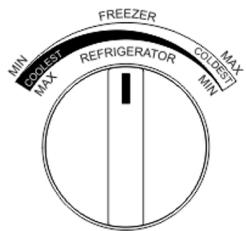
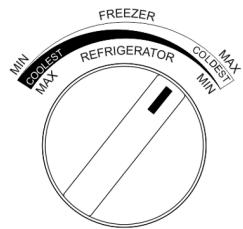
In order to be able to adjust the temperature in the freezer, set the knob as follows. Fig. 17
- Room temperature above 35 °C, knob set as shown in Fig. 17 A.
- Room temperature between 15 °C and -35 °C, knob set as shown in Fig. 17 B.
- Room temperature lower than 16 °C, knob set as shown in Fig. 17 C.
Fast Cooling
If you select Fast Cooling mode, the temperature in the refrigerator compartment and freezer compartment will drop rapidly, so that the stored food will remain fresh and retain all its nutrients. This mode will be activated for a maximum of 30 hours. After this time, it will be automatically deactivated, and the refrigerator will return to the previously selected mode.
Open door alarm
If the refrigerator door is left open for more than 3 minutes, an alarm will sound; to stop it, press the SET button. If the door is still open after 3 minutes, the alarm will sound again. The alarm sound will not stop until the door is closed.
Memory function
If there is a power failure, when the power is restored, the refrigerator will maintain the same settings as before.
Delay Start
If there is a power failure lasting less than 5 minutes, the refrigerator compressor will not start immediately after switching on to prevent damage to the compressor.
Fault warning
If the indicator light for temperature levels 5, 3 or 1 flashes continuously, there is a fault in the refrigerator. Contact the official Cecotec Technical Support Service.
Tips
- When the room temperature is above 35° C, do not set either the refrigerator compartment or the freezer compartment to the coldest mode.
- If you notice that the refrigerator temperature is not cold enough, set the refrigerator temperature and freezer temperature to the middle position.
Note: if there is a lot of humidity or if you open the door frequently, frost may occur in the freezer. If the temperature knob freezes, do not force it; warm a cloth or towel and place it on top until it thaws.
5. INSTRUCTIONS ON FOOD STORAGE
Use precautions
- If you select a low temperature, the food may defrost.
- Information on the temperature range can be found on the rating plate.
- Temperature may be affected by factors such as location, room temperature and how often the door is opened.
- Effervescent drinks should not be stored in the freezer, and some products such as ice cubes should not be consumed too cold.
Food location
- Due to the circulation of cold air in the refrigerator, the temperature in each zone is different, so food must be placed in different zones.
- The refrigerator compartment is suitable for storing food that does not need to be frozen, cooked food, beer, eggs, some seasonings that need to be kept cold, milk, fruit juice, etc. The crisper drawer is the best place to store these foods.
- The freezer compartment is suitable to store ice cream, frozen foods, and foods that need to be kept for a long time.
Use of the refrigerator compartment
- Shelves: to remove the shelves, first lift them up and then pull them out. To reposition them, place them in the guides and push them down.
ENGLISH
- When removing and fitting shelves, hold them firmly and handle them carefully to avoid damage.
- Crisper drawer: after using or cleaning the bottom shelf of the refrigerator compartment (the drawer cover), put it back in place so that the internal temperature of the drawer is not affected.
Using the ice cube tray
Place the ice cube tray in the top part of the freezer compartment so that it freezes as quickly as possible.
Tips for food storage
- Clean and dry food completely before storing it in the refrigerator. Before introducing food in the refrigerator, it is advisable to seal it to prevent water evaporation and thus keep fruit and vegetables fresh on the one hand, and to prevent odours on the other.
- Do not put too much or too heavy food in the refrigerator. Leave enough space between the food; if they are too close together, they will block the flow of cold air, which will affect the cooling effect. Do not store too much or too heavy food to prevent the shelves from bending. When storing food in the refrigerator compartment, do not stick it to any wall to prevent it from freezing.
- Place your most frequently consumed foods at the front of the shelves, so that you keep the door open as little as possible.
- Energy-saving tips: let hot food cool down to room temperature before putting it in the refrigerator. Place frozen food in the refrigerator compartment to defrost it. Frozen food helps to cool fresh food, which saves energy.
Storing fruits and vegetables
Store fruit and vegetables in the crisper drawer.
Use of the freezer
- Store food that you want to keep for a long period of time in the freezer drawers.
- Large fish and meat should be cut into small pieces and placed in freezer bags before placing them in the freezer-compartment drawers.
- Let hot food cool down to room temperature before putting it in the freezer compartment.
- Do not place liquids in glass or canned containers in the freezer compartment; if you do, they may explode.
- Divide food into small portions.
- It is best to package food before freezing. Make sure that the container to be used is dry. Food should be packed or covered with suitable materials that are firm, tasteless, impermeable to air and water, non-toxic, and non-polluting to avoid cross-contamination and odour transfer.
Tips for buying frozen food
- When buying frozen food, pay attention to the storage instructions on the package.
- Check the temperature of the freezer of the shop where you buy them.
- Make sure that the packaging of frozen food is in perfect condition.
- When you go to the supermarket, buy frozen products last.
- Try to keep frozen foods together while shopping and on the way home, as this will keep them fresher.
- Do not buy frozen foods unless you can freeze them immediately. Special insulated bags are available in most supermarkets and department stores. In them, frozen food is kept cold for a longer period of time.
- Some foods do not require defrosting before cooking. Vegetables and pasta can be added directly to boiling water or steamed. Frozen sauces and soups can be placed in a pan and heated gently until thawed.
- Use quality foods and alter them as little as possible. When food is frozen in small quantities, it takes less time to freeze and thaw.
- Calculate the amount of food to be frozen. When freezing large quantities of food, set the knob to a low temperature level. This way, food can be frozen quickly maintaining its freshness.
Other tips
Location
- Do not place the refrigerator near a heat source, e.g. a hob or radiator.
- Avoid direct sunlight.
Levelling
- Make sure that the refrigerator is level with the front feet. If it is not level, performance will be affected.
- After installing the refrigerator, wait four hours before using it to allow the refrigerant to stabilise.
Installation
- Do not cover or block ventilation grilles.
If you are not going to use the appliance for several months:
- Turn it off first and unplug it from the power socket.
- Remove all the food
- Clean and dry the interior completely. To avoid mould or unpleasant odours, leave the door slightly open.
- Keep the refrigerator clean in a dry, ventilated place away from heat sources. Do not place any objects on top.
- Keep the refrigerator out of the reach of children, so that they do not play with it.
ENGLISH
Note: before tightening the hinge screws, make sure that the rubber seals on both doors are correctly positioned.
6. CLEANING AND MAINTENANCE
- Before cleaning the appliance, disconnect it from the mains.
- Do not touch the plug with wet hands; doing so may result in electric shock.
- Avoid spilling water on the refrigerator, so that it does not rust or cause an accident.
- Do not reach into the bottom of the refrigerator, as this may cause damage.
Cleaning the interior and exterior
- Food residues in the refrigerator can cause undesired odours, so you should clean the refrigerator regularly. The refrigerator compartment should be cleaned once a month.
- Remove all shelves, the crisper drawer, etc., and clean them with a soft cloth or sponge dampened with lukewarm water. You can also use a little neutral detergent.
- Clean the dust that accumulates on the rear panel and side plates of the refrigerator regularly.
- If you have used detergent, be sure to rinse it off with clean water. Afterwards, dry with a dry cloth.
NOTE: do not use any corrosive materials or products to clean the refrigerator.
- Carefully dry the door gasket and clean the slot with a wooden stick wrapped with cotton. To refit the gasket after cleaning, first fix the four corners and then push it into the slot a little at a time.
Power failure or cooling system fault
- If the refrigerator stops operating for a prolonged period of time, the food may defrost.
- Try to open the refrigerator door as little as possible, so that you can keep food in good condition for hours, even in summer.
-
If you know that a power cut is going to occur in advance:
-
Set the thermostat to the highest setting one hour in advance, so that the food is completely frozen. Do not introduce new food. Set the temperature back to the original setting when the power supply returns to normal.
-
You can also make ice in an airtight container and place it on the top chamber of the freezer to extend the shelf life of fresh food.
Note: it is best not to interrupt the operation of the refrigerator; this could affect its lifespan.
Replacing the light bulb
- The freezer has a LED light with low consumption and a long shelf life.
- In case of any malfunction or anomaly, contact the official Cecotec Technical Support Service.
Note: if the power cord and plug are damaged or dusty, electric shock and fire may occur. If there is any malfunction, disconnect the cable and contact the official Cecotec Technical Support Service.
7. TROUBLESHOOTING
For the following minor malfunctions, please try to solve the problem yourself before contacting the official Cecotec Technical Support Service.
| Fault | Possible causes | Possible solutions |
| The refrigerator does not work | 1. It is not plugged into the mains.2. Circuit breakers or fuses are damaged.3. There is no electricity.4. The refrigerator is not installed in a suitable location. It cannot be placed on balconies, garages, storage rooms or any other place where the room temperature is below 10 °C. | 1. Plug the refrigerator into the mains.2. Open the door and check the light is on.3. There has been a power cut.4. Install the refrigerator in a place with a room temperature above 10 °C. |
| The refrigerator makes some noise | 1. The refrigerator is not stable.2. The refrigerator touches the wall. | 1. Adjust the feet.2. Separate the refrigerator from the wall. |
| The refrigerator has low cooling efficiency | 1. The food inside is hot or there is too much food.2. You open the door too often.3. The refrigerator receives direct sunlight or is close to a heat source.4. The place where the refrigerator is placed is not well ventilated.5. The selected temperature is too high.6. The door gasket has objects that do not allow to close it completely. | 1. Store food in the refrigerator when at room temperature.2. Keep the door closed.3. Remove the refrigerator from the heat source.4. Ventilate the room.5. Adjust the temperature. |
| Bad smells are produced in the refrigerator | 1. There is spoiled food inside.2. Clean the refrigerator.3. There is food with a strong odour inside. | 1. Dispose of food which is spoiled.2. Clean the refrigerator.3. Pack the strong smelling foods. |
| The LED light on the refrigerator does not switch on | 1. The open door alarm is beeping. The door has been open for more than 10 minutes. | 1. If the open door alarm is beeping, close the door, wait 5 seconds, and open it again. When doing so, check if the light switches on. |
Note: if none of these situations match your problem, do not attempt to disassemble, or repair the refrigerator yourself. All repairs must be carried out by qualified personnel.
Contact the official Cecotec Technical Support Service. Repairs must be carried out by an authorised technician and only original spare parts must be used.
When the refrigerator is not to be used for a long period of time, disconnect it from the mains, remove all food and clean it. Leave the door ajar to avoid unpleasant odours.
8. TECHNICAL SPECIFICATIONS
You can find more information on this model by scanning the QR code on the energy label.
| Product | Bolero CoolMarket 2D 255 NF White E |
| Reference | 02068 |
| QR code |  |
| Voltage | 220-240 V~ |
| Rated frequency | 50 Hz |
| Rated current | 1.27 A |
| Climate class | SN/N/ST/T* |
| Refrigerant | R600a/44 g |
| Base plate | Cyclopentane |
* Refrigerator intended for use at room temperatures between 10 °C and 43 °C. This product features a light source with a Class F energy efficiency.
Technical specifications may change without prior notification to improve product quality. Made in China | Designed in Spain
9. DISPOSAL OF OLD ELECTRICAL AND ELECTRONIC APPLIANCES

This symbol indicates that, according to the applicable regulations, the product and/or batteries must be disposed of separately from household waste. When this product reaches the end of its shelf life, you should dispose of the cells/batteries/accumulators and take them to a collection point designated by the local authorities.
ENGLISH
Consumers must contact their local authorities or retailer for information concerning the correct disposal of old appliances and/or their batteries.
Compliance with the above guidelines will help protecting the environment.
10. TECHNICAL SUPPORT AND WARRANTY
Cecotec shall be liable to the end user or consumer for any lack of conformity that exists at the time of delivery of the product under the terms, conditions, and deadlines established by the applicable regulations.
It is recommended that repairs be carried out by qualified personnel.
If at any moment you detect any problem with your product or have any doubt, do not hesitate to contact the official Cecotec Technical Support Service at +34 963 210 728.
11. COPYRIGHT
The intellectual property rights over the texts in this manual belong to CECOTEC INNOVACIONES, S.L. All rights reserved. The contents of this publication may not, in whole or in part, be reproduced, stored in a retrieval system, transmitted, or distributed by any means (electronic, mechanical, photocopying, recording or similar) without the prior authorization of CECOTEC INNOVACIONES, S.L.
1. PIÈCES ET COMPOSANTS
Image 1
3. INSTALLATION DU PRODUIT
Emplacement
Ventilation
3. INSTALLATIE VAN HET APPARAAT
Locatie
Ventilatie
7. PROBLEEMOPLOSSING
Fig./Img./Abb./Afb./Rys.1


Fig./Img./Abb./Afb./Rys. 2

Fig./Img./Abb./Afb./Rys. 3

Fig./Img./Abb./Afb./Rys. 4
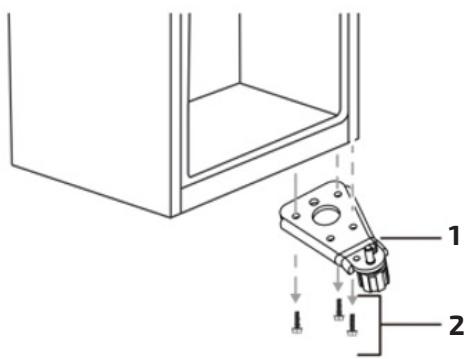
Fig./Img./Abb./Afb./Rys. 5

Fig./Img./Abb./Afb./Rys. 6
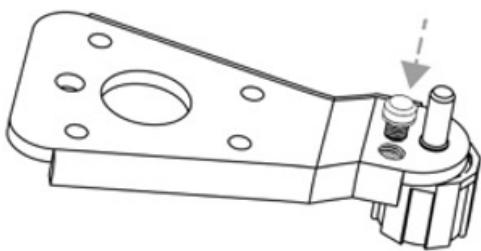
Fig./Img./Abb./Afb./Rys. 7

Fig./Img./Abb./Afb./Rys. 8
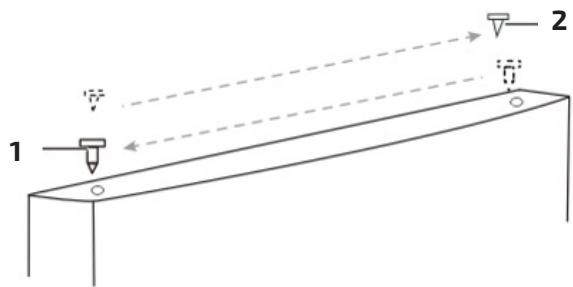
Fig./Img./Abb./Afb./Rys. 9
![graph TD A["Input Node 1"] --> B{Feedback Loop} B --> C["Output Node 1"] style A fill:#fff,stroke:#000 style C fill:#fff,stroke:#000](/content/2026/08/1600663/images/3e894a25cc8d2462626d635e4e6a1178c5bc042a6cd500e12f5896d739188eb1.jpg)
Fig./Img./Abb./Afb./Rys. 10

Fig./Img./Abb./Afb./Rys. 11

Fig./Img./Abb./Afb./Rys. 12

Fig./Img./Abb./Afb./Rys. 13

Fig./Img./Abb./Afb./Rys. 14

Fig./Img./Abb./Afb./Rys. 15

Fig./Img./Abb./Afb./Rys. 17

17A
17B
17C
Fig./Img./Abb./Afb./Rys. 17
www.cecotec.es
- SOMMAIRE
- TEMPERATURE RANGE
- NOTES
- REFRIGERANT
- INSTRUCTIONS DE SÉCURITÉ
- NOTE
- BEFORE USE
- BOX CONTENT
- PRODUCT INSTALLATION
- LOCATION
- COOLING
- ENGLISH
- HEAT DISSIPATION SPACE
- FLAT SURFACE
- PREPARATION
- WAITING TIME
- CLEANING
- SWITCH ON
- FOOD STORAGE
- WARNINGS
- DOOR REVERSAL
- FIG. 3 KEY
- FIG. 4 KEY
- FIG. 5 KEY
- SCREWS
- FIG. 6 KEY
- FIG. 8 KEY
- FIG. 9 KEY
- FIG. 10 KEY
- FIG. 11 KEY
- FIG. 12 KEY
- FIG. 13 KEY
- FIG. 14 KEY
- FIG. 15 KEY
- OPERATION
- REFRIGERATOR CONTROL PANEL. FIG. 16
- TEMPERATURE SETTINGS
- REFRIGERATOR
- FREEZER
- FAST COOLING
- OPEN DOOR ALARM
- MEMORY FUNCTION
- DELAY START
- FAULT WARNING
- TIPS
- INSTRUCTIONS ON FOOD STORAGE
- USE PRECAUTIONS
- FOOD LOCATION
- USE OF THE REFRIGERATOR COMPARTMENT
- USING THE ICE CUBE TRAY
- TIPS FOR FOOD STORAGE
- STORING FRUITS AND VEGETABLES
- USE OF THE FREEZER
- TIPS FOR BUYING FROZEN FOOD
- OTHER TIPS
- LEVELLING
- INSTALLATION
- CLEANING AND MAINTENANCE
- CLEANING THE INTERIOR AND EXTERIOR
- POWER FAILURE OR COOLING SYSTEM FAULT
- REPLACING THE LIGHT BULB
- TROUBLESHOOTING
- TECHNICAL SPECIFICATIONS
- DISPOSAL OF OLD ELECTRICAL AND ELECTRONIC APPLIANCES
- TECHNICAL SUPPORT AND WARRANTY
- COPYRIGHT
- PIÈCES ET COMPOSANTS
- IMAGE 1
- INSTALLATION DU PRODUIT
- EMPLACEMENT
- VENTILATION
- INSTALLATIE VAN HET APPARAAT
- LOCATIE
- VENTILATIE
- PROBLEEMOPLOSSING
Brand : CECOTEC
Model : Bolero Coolmarket 2d 255 Nf E
Category : Refrigerator