
ATTIX 995 H/M TYPE 22 - Industrial vacuum cleaner NILFISK - Free user manual and instructions
Find the device manual for free ATTIX 995 H/M TYPE 22 NILFISK in PDF.


| Product Type | Industrial vacuum cleaner |
| Brand | Nilfisk |
| Model | ATTIX 995 H/M Type 22 |
| Power supply | 220-240 V, 50/60 Hz |
| Nominal power | 1400 W |
| Max. airflow | 3900 l/min |
| Max. vacuum | 254 mbar |
| Tank capacity | 50 L |
| Filtration class | H (HEPA H14) / M (M class) |
| Features | Dry and liquid vacuuming, automatic filter cleaning |
| Dimensions (L x W x H) | 580 x 480 x 830 mm |
| Weight | 19 kg |
| Noise level | 62 dB(A) |
| Cable length | 10 m |
| Maintenance and cleaning | Emptying the tank, cleaning and replacing the filter, checking seals |
| Safety | Thermal circuit breaker, protection against hazardous dusts (H category) |
| Spare parts and repairability | Filters, bags, seals, belts available |
| Included accessories | Floor nozzle, crevice nozzle, 4 m hose, filters |
| General information | Professional use, compatible with centralized systems |
Frequently Asked Questions - ATTIX 995 H/M TYPE 22 NILFISK
User questions about ATTIX 995 H/M TYPE 22 NILFISK
0 question about this device. Answer the ones you know or ask your own.
Ask a new question about this device
Download the instructions for your Industrial vacuum cleaner in PDF format for free! Find your manual ATTIX 995 H/M TYPE 22 - NILFISK and take your electronic device back in hand. On this page are published all the documents necessary for the use of your device. ATTIX 995 H/M TYPE 22 by NILFISK.
USER MANUAL ATTIX 995 H/M TYPE 22 NILFISK
ATTIX 995-0H/M SD XC Type 22 Operating Instructions
NilfiskALTO
Why Compromise
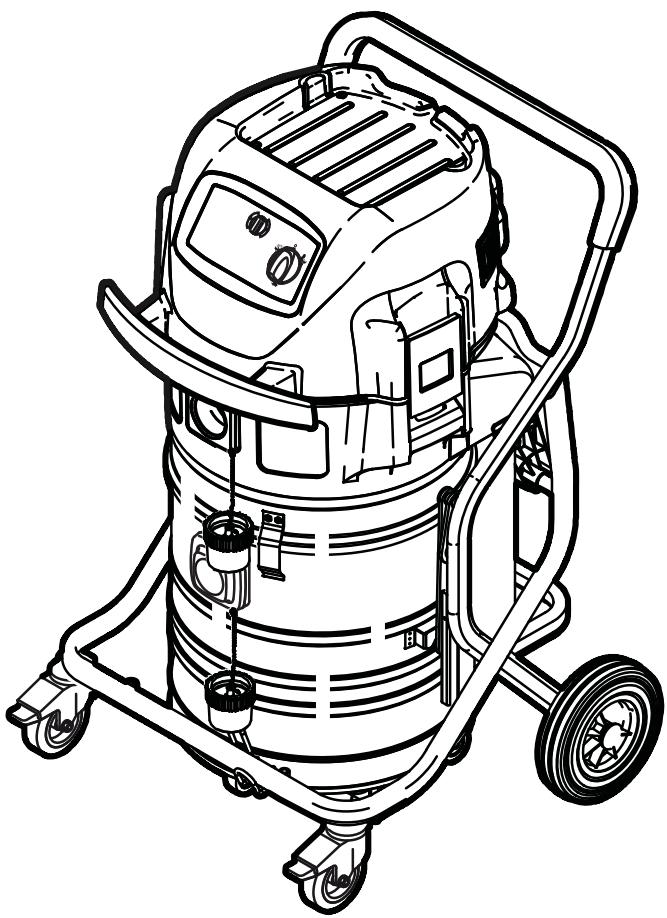
Contents
1 Important safety instructions
2 Description 2.1 Operating elements..9 2.2 Operating panel..10
3 Before starting the 3.1 Assembling the vacuum cleaner.. 11
3.1.1 Taking accessories out of the packaging.. 11
3.1.2 Before starting the cleaner 12
3.1.3 Inserting the safety filter bag 12
3.1.4 Inserting the disposal bag 14
4 Control / Operation 4.1 Connections 16
4.1.1 Electrical connection 16
4.2 Switching on the vacuum cleaner.. 16
4.2.1 Switch , I-0-II " 16
4.3 Check volume flow monitor 16
4.4 Acoustic warning 16
4.5 Cleaning the filter element 17
5 Applications and 5.1 Techniques 18
5.1.1 Picking up dry substances. 18
5.1.2 Picking up liquids 18
6 After using the cleaner 6.1 Switching the vacuum cleaner off and storage.. 19
7 Maintenance 7.1 Maintenance plan.. 20
7.2 Maintenance work 20
7.2.1 Check the antistatic clamps.. 20
7.2.2 Emptying the dirt tank 21
7.2.3 Replacing the disposal bag 22
7.2.4 Replacing the safety filter bag 23
7.2.5 Replacing the filter element "H" 24
7.2.6 Replacing the filter for air suppy to motor 25
8 Troubleshooting 26
9 Further information 9.1 Recycling the vacuum cleaner 27
9.2 Guarantee 27
9.3 Tests and approvals.. 27
9.4 EC declaration of conformity 27
9.5 Technical data 28
9.6 Optional accessories 28

1 Important safety instructions
Symbols used to mark instructions

Prior to using the appliance for the first time, be sure to read this document through and keep it ready to hand.
DANGER
Danger that leads directly to serious or irreversible injuries, or even death.

WARNING
Danger that can lead to serious injuries or even death.
CAUTION
Danger that can lead to minor injuries and damage.
The appliance must
- only be used by persons, who have been instructed in its correct usage and explicitly commissioned with the task of operating it
- only be operated under supervision
not be used by children
Before starting work, the operating staff must be informed on
- use of the vacuum cleaner
- risks associated with the material to be picked up
-
safe disposal of the picked up materia
-
Do not use any unsafe work techniques.
- Never use the vacuum cleaner without a filter.
-
Switch off the appliance and disconnect the mains plug in the following situations:
-
Prior to cleaning and servicing
- Prior to replacing components
- Prior to changing over the appliance
- If foam develops or liquid emerges
Besides the operating instructions and the binding accident prevention regulations valid in the country of use, observe recognised regulations for safety and proper use.
Purpose and intended use
Since 1997, there is a new division of hazardous dusts and their assigned vacuum machines. These are regulated by IEC 60335-2-69 (world wide) and by EN 60335-2-69 (European wide).
The safety label on the machine warns:
This appliance contains dust hazardous to health. Emptying and maintenance operations, including removal of the dust collecting means, must only be carried out by authorised personnel wearing suitable personal protection. Operate only after the full filtration system has been fitted and checked.

Dust Class M (medium). The dusts which belong to this class are: dusts with OEL values ^1) >0.1 mg/m^3 as well as saw dust. The machine is tested in its entirety by vacuums for this dust. The maximum degree of permeability is 0.1% and the dis- must be low dust.

Dust Class H (high). The dusts which belong to this class are: dusts with OEL values ^1) , all carcinogenic dusts and dusts which are mixed with pathogenic agents. Vacuums for Dust
Class H are tested in their entirety and have a maximum degree of permeability of 0.005% . The disposal must be dust free.
Machines to be used in Zone 22 are marked as Type 22 vacuums.

These machines may be used for picking up dust from dust class L, M or H.
Zone 22 is defined as environments where flammable dusts are present for short periods only (e.g. less than 10 hours per year).
Type 22 machines are suitable for use as dust extractors.
The air flow in safety vacuum systems has to be strictly controlled to achieve a minimum flow rate of V_ = 20 m/s in the suction hose.
The vacuum cleaner ATTIX 995-0H/M SD XC Type 22 is suitable for picking up:
Non flammable liquids (flashpoint 55^ or higher).
- Sawdust and dusts hazardous to health, including dusts with OEL values, carcinogenic dusts and dusts containing germs and pathogens.
- Flammable, dry dust in Zone 22.
Use the cleaner only if it is certain that no active sources of ignition can be sucked in.
Conductive extraction equipment, e.g. extraction hoods on machines and conductive parts of machining equipment (e.g. equipment in protective class II) that are not earthed through the cleaner, must be earthed in some other way to prevent electrostatic charges.
When picking up flammable dust in Zone 22, the dirt tank must be emptied as required, but always after use.
It must be assured that dust not accumulate on the appliance by regular cleaning.
The vacuum cleaner must be used only, if all filters, as well as the filter for the motor cooling air, are attached and without damage.
The cleaner is not suitable for extraction on machining equipment in operation that could produce sources of ignition.
When dust removers are used, the rate at which air is exchanged
in the room must be adequate if the exhaust air from the vacuum cleaner is blown into the room (please observe regulations valid in your country).
The appliance is suitable for commercial use, such as e.g. in
Hotels, Schools, Hospitals, Factories, Shops, Offices, Hire shops
Any other use is considered as improper use. The manufacturer accepts no liability for any damage resulting from such use. The risk for such use is borne solely by the user.
Proper use also includes proper operation, servicing and repairs as specified by the manufacturer.
Transport
- Before transporting the dirt tank, close all the locks.
- Make sure that both plugs are inserted in fittings.
- Do not tilt the cleaner if there is liquid in the dirt tank.
- Do not use a crane hook to lift the cleaner.
Storage
- Store the appliance in a dry place, protected from frost.
Electrical connection
- It is recommended that the vacuum cleaner should be connected via a residual current circuit breaker.
- When picking up flammable dust in zone 22, extension lines, couplings and adapters must not be used.
- Arrange the electrical parts (sockets, plugs and couplings) and lay down the extension lead so that the protection class is maintained.
- Connectors and couplings of power supply cords and extension leads must be watertight.
Extension lead
- As an extension lead, only use the version specified by the manufacturer or one of a higher quality.
- When using an extension lead, check the minimum cross-sections of the cable:
| Cable length | Cross section | |
| < 16 A | < 25 A | |
| up to 20 m | 1.5 mm² | 2.5 mm² |
| 20 to 50 m | 2.5 mm² | 4.0 mm² |
Maintenance, cleaning and repair
During the following work, ensure that dust is not unnecessarily spread around. Wear a P2 breathing mask.
Only carry out maintenance work described in the operating instructions.
Always pull out the mains plug before cleaning and maintenance of the vacuum cleaner.
During maintenance and cleaning, handle the vacuum cleaner in such a manner that there is no danger for maintenance staff or other persons.
In the maintenance area
- Use filtered compulsory ventilation
- Wear protective clothing
- Clean the maintenance are so that no harmful substances get into the surroundings.
Before removing the vacuum cleaner from the area contaminated with harmful substances:
- Clean the outside of the vacuum cleaner, wipe it clean or pack the vacuum cleaner in well sealed packaging
- and avoid spreading deposited harmful dust.
Warning: Do not reuse the essential filter element after removal out of the appliance (only for class H appliances).
During maintenance and repair work all contaminated parts that could not be cleaned satisfactorily must be:
- packed in well sealed bags
- disposed of in a manner that complies with valid regulations for such waste removal.
At least once a year, a Nilfisk-ALTO technician or an instructed person must perform a technical inspection including filters, air tightness and control mechanisms. According to AA.22.201.2 appliances in class H must have their filtration efficiency checked once a year. If the efficiency of the filter does not fulfil the requirements for dust class H, the filter must be replaced, and the new filter must be tested according to AA.22.201.2.
Electrical components
| DANGER | |
| Electric shock due to faulty mains connecting lead. | |
| Touching a faulty mains connecting lead can result in serious or even fatal injuries. | |
| 1. Do not damage the mains power lead (e.g. by driving over it, pulling or crushing it). | |
| 2. Regularly check whether the power cord is damaged or shows signs of ageing. | |
| 3. Have the faulty mains connecting lead replaced by your Nilfisk-Alto service representative or a qualified electrician prior to using the appliance again. |
| DANGER |
| The upper section of the vacuum cleaner contains live components.Contact with live components leads to serious or even fatal injuries.1. Never spray water on to the upper section of the vacuum cleaner. |
| CAUTION |
| Damage due to unsuitable mains voltage. |
| The appliance can be damaged as a result of being connected to an unsuitable mains voltage. |
| 1. Ensure that the voltage shown on the rating plate corresponds to the voltage of the local mains power supply. |
Picking up liquids
| ! | CAUTION |
| Picking up liquids.Due to their construction vacuum cleaners with a removable tank (SD) do not have an automatic level indicator. There is a risk of damage to the vacuum cleaner due to overfilling or of damage due to leakage of the picked up liquid. 1. Never pick up more than 40 litres at once. 2. Switch off the vacuum cleaner and empty the dirt tank. |
Hazardous materials
| 警告 | WARNING |
| Hazardous materials. | |
| Vacuuming up hazardous materials can lead to serious or even fatal injuries. | |
| 1. The following materials must not be picked up by the vacuum cleaner: - hot materials (burning cigarettes, hot ash, etc.) - flammable, explosive, aggressive liquids (e.g. petrol, solvents, acids, alkalis, etc.) - mixtures of flammable dusts with liquids - explosive substances or substances considered to be similar in §1 of the law on explosives - flammable dusts with an extremely low minimum ignition energy <1 mJ (also observe national regulations). - Highly reactive dusts or dusts with a high affinity to oxygen |
| 警告 | WARNING |
| For dusts like titanium and magnesium additional requirements apply, consult your national labour authorities or the manufacturer of the vacuum cleaner. |
| 警告 | WARNING |
| When the vacuum cleaner has been used with dust classified as “H”, it is necessary to clean the machine thoroughly before using the machine with dust classified as “M” or lower. |

Spare parts and accessories

CAUTION
Spare parts and accessories.
For picking up flammable dust in Zone 22: Only use accessories which are certified by the manufacturer of the Type 22 machine. The use of other accessories can cause danger of explosion.
The use of non-genuine spare parts and accessories can impair the safety of the appliance.
- Only use spare parts and accessories from Nilfisk-Alto.
- Use only the brushes supplied with the vacuum cleaner or specified in the operating manual.
Emptying dirt tank

CAUTION
Picking up environmentally hazardous materials.
Materials picked up can present a hazard to the environment.
- Dispose of the dirt in accordance with legal regulations.
2 Description

2.1 Operating elements
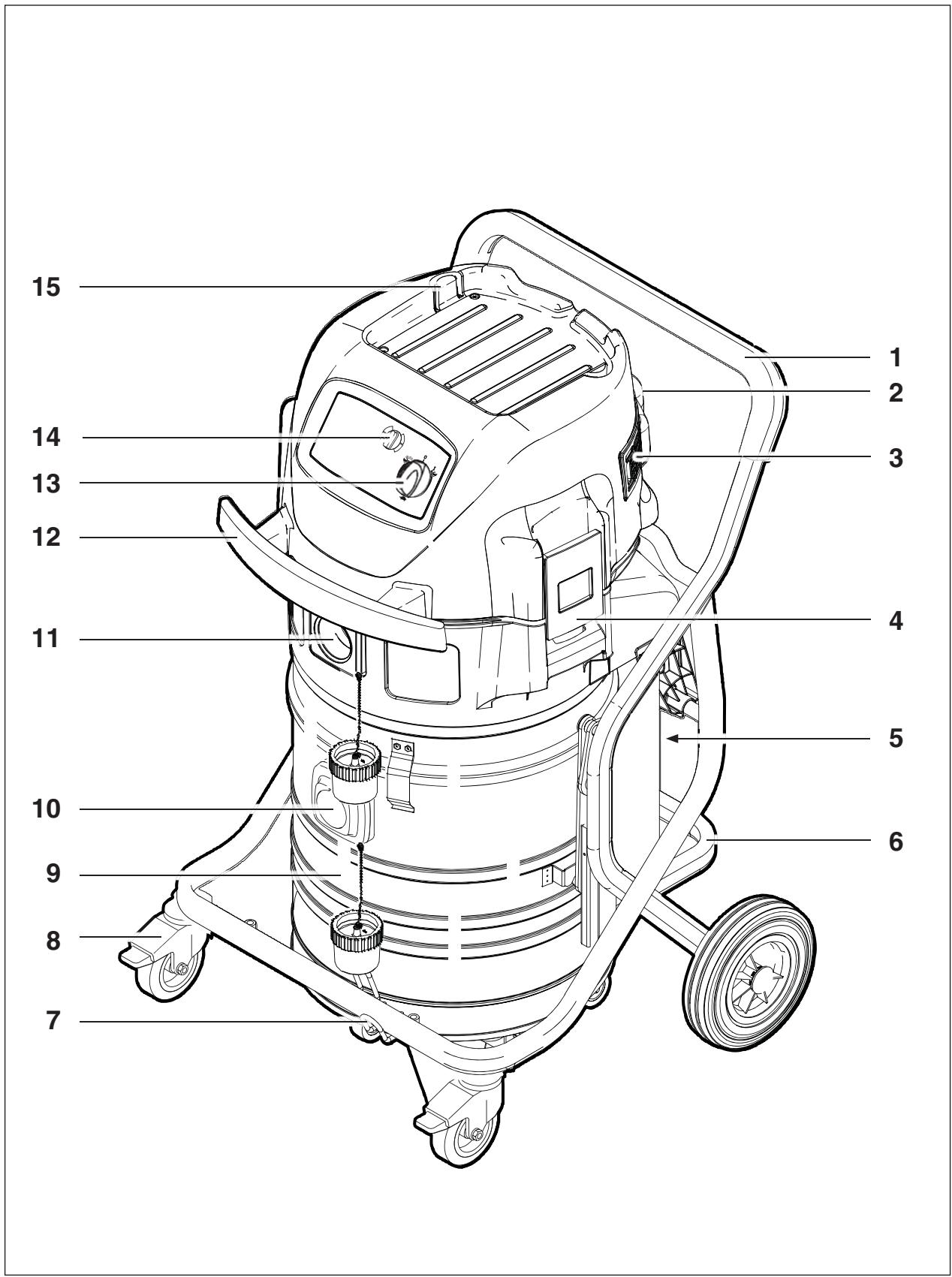

1 Handle
2 Outlet for waste air
3 Inlet for fresh air / Filter for air supply to motor
4 Retaining clamp
5 Grip to empty tank
6 Handle to remove dirt tank
7 Bracket for floor nozzle
8 Castor with brake
9 Dirt tank
10 Inlet fitting "H"
11 Inlet fitting "M"
12 Receptacle for electrical lead
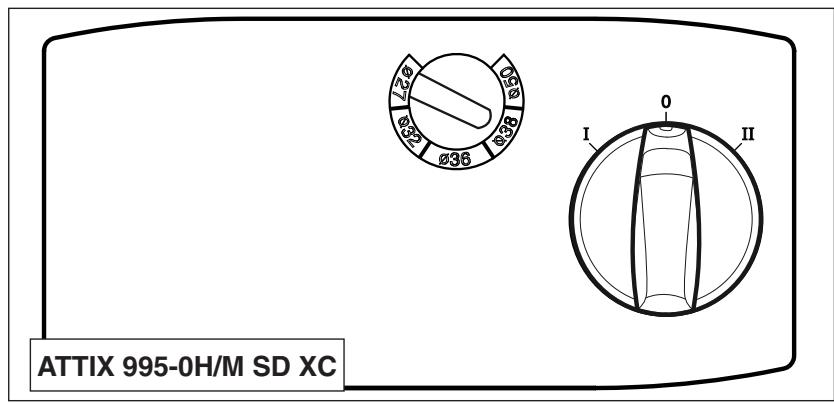
13 Applicance switch "I-0-II"
14 Hose diameter setting
15 Accessory holder
2.2 Operating panel
3 Before starting the cleaner

3.1 Assembling the vacuum cleaner
3.1.1 Taking accessories out of the packaging
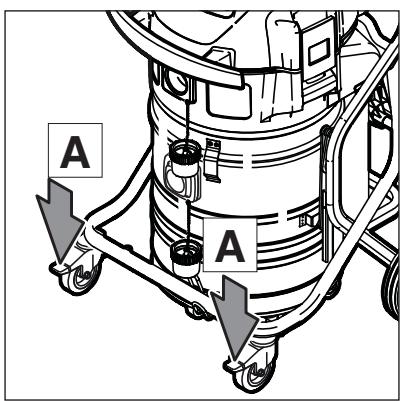
- Take vacuum cleaner and accessories out of the packaging.
- The mains plug should not yet be inserted into a socket.
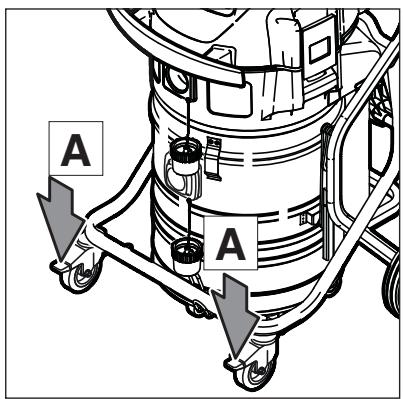
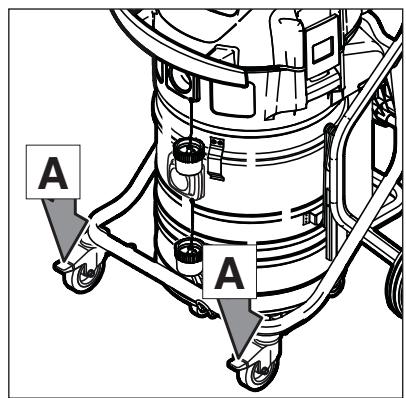
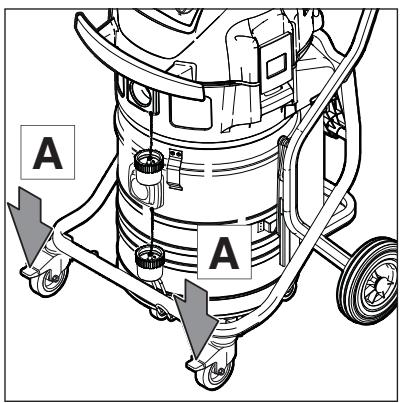
- Apply parking brakes (A) on both castors.
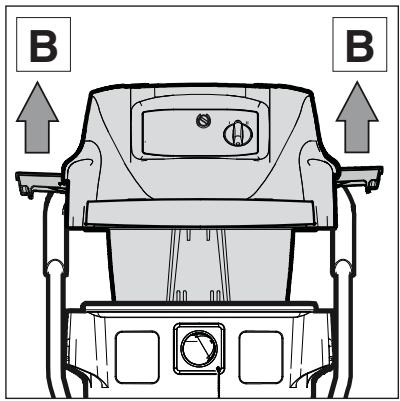
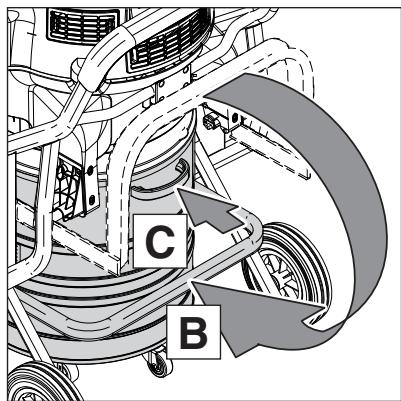
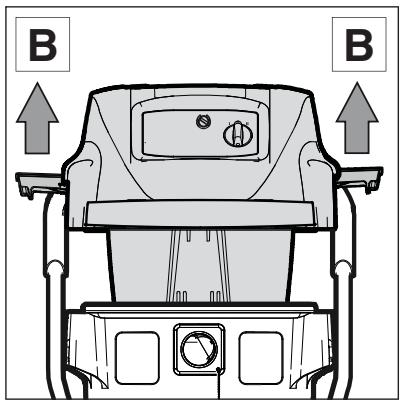
- Open the retaining clamps (B) and remove the upper section of the vacuum cleaner.
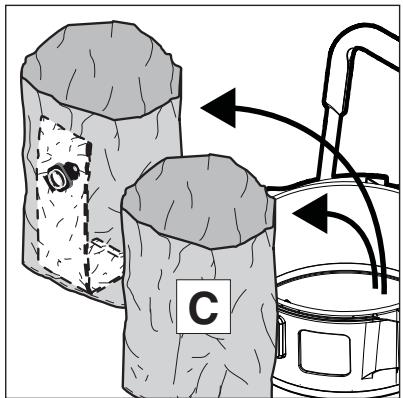
- Take the accessories (C) out of the dirt tank and the packaging.
3.1.2 Before starting the cleaner
Depending on how hazardous the dust is, the cleaner must be fitted with appropriate filters:
| Type of dust | Filter bag/waste bag | |
| ·Non-hazardous dust ·Non-carcinogenic dust with OEL values > 0.1 mg/m3 (observe any additional national regulations) ·Wood dust ·Explosive dust, dust explosion class St1, St2, St3 in Zone 22 | Waste bag (5 pcs.) Order No. 302001480 | |
| ·All dusts with OEL values ·Explosive dust, dust explosion class St1, St2, St3 in Zone 22 | Safety filter bag (5 pcs.) Order No. 302003473 | |
| ·All dusts with OEL values ·Explosive dust, dust explosion class St1, St2, St3 in Zone 22 | Filter element “H” Order No. 107400564 | |
| ·All dusts with OEL values ·Explosive dust, dust explosion class St1, St2, St3 in Zone 22 | Motor cooling filter “TYPE 22” Order No. 107400041 | |
Before picking up dust with occupational exposure limit values:
- Check that all the filters are present and properly fitted.
- Do not use the cleaner with damaged or missing antistatic clamp. Risk of explosion due to static discharge in explosive atmospheres.
- The hose diameter and the setting for the suction hose diameter must be the same.
- When the motor is running, hold the suction hose shut. For safety reasons, an acoustic warning sounds if the air speed in the suction hose drops to below 20m / s .
3.1.3 Inserting the safety filter bag
- The mains plug should not yet be inserted into a socket.
- Apply parking brakes (A) on both castors.
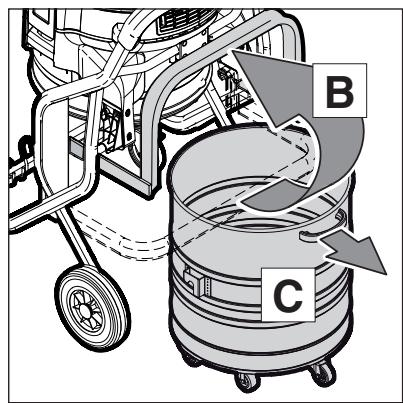
- Swing the bar (B) upwards.
-
Use the handle (C) to pull the dirt tank out of the vacuum cleaner.
-
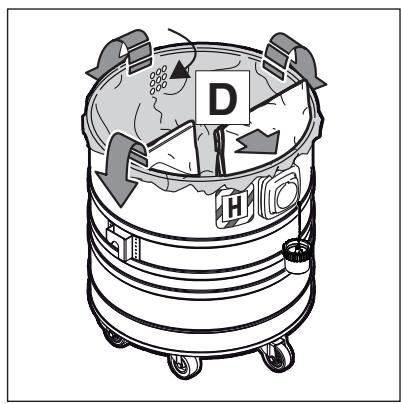
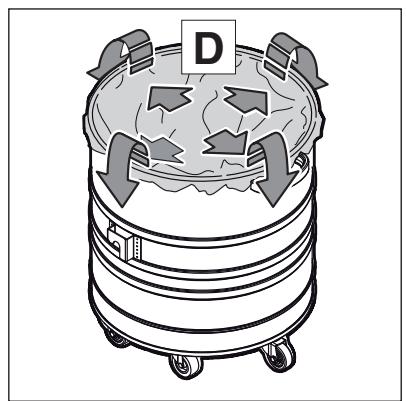
Insert the safety filter bag (D) in the dirt tank.
-
Fold the top edge of the disposal bag over the rim of the dirt tank.
-
Push the dirt tank as far as possible into the vacuum cleaner.
-
Swing the bar (B) downwards without forcing it.
-
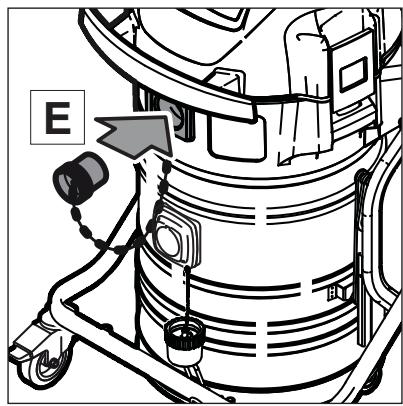
Close inlet fitting "M" (top) with plug (E).

3.1.4 Inserting the disposal bag
-
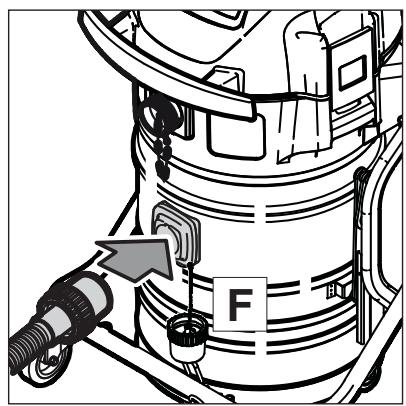
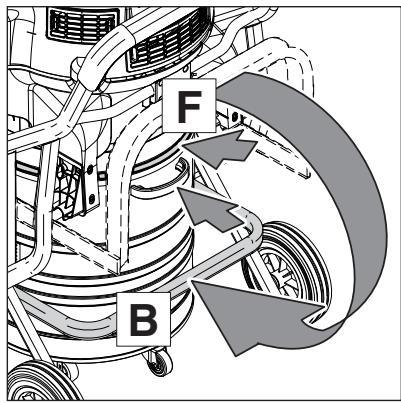
Connect suction hose to inlet fitting "H" (down) (F).
-
The mains plug should not yet be inserted into a socket.
-
Apply parking brakes (A) on both castors.
-
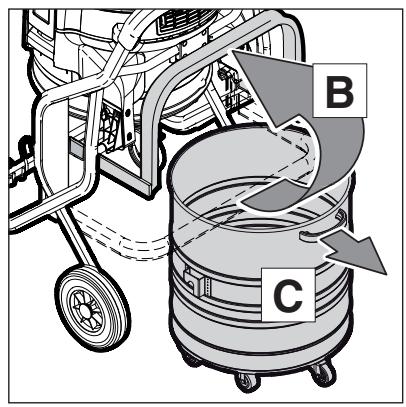
Swing the bar (B) upwards.
-
Use the handle (C) to pull the dirt tank out of the vacuum cleaner.
-
Insert the disposal bag (D) in the dirt tank.
- Fold the top edge of the disposal bag over the rim of the dirt tank.
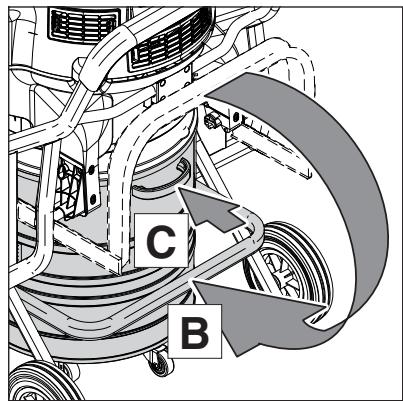
- Push the dirt tank as far as possible into the vacuum cleaner.
- Swing the bar (B) downwards without forcing it.
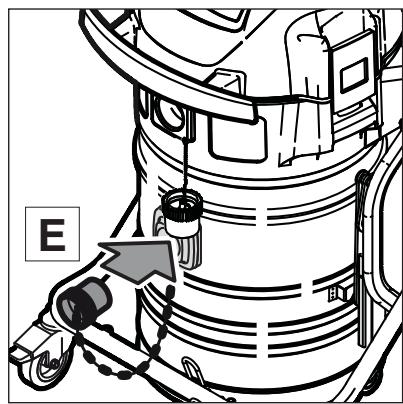
9.Close inlet fitting "H" (down) with plug (E).
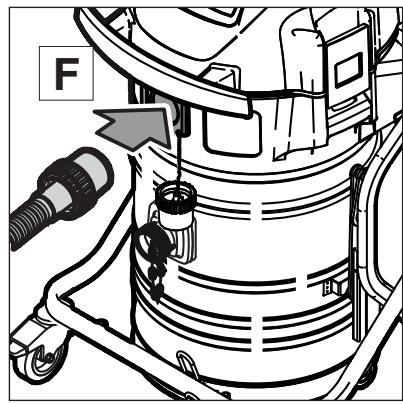
- Connect suction hose to inlet fitting "M" (top) (F).

4 Operation
4.1 Connections
4.1.1 Electrical connection
The operating voltage shown on the rating plate must correspond to the voltage of the mains power supply.

- Ensure that the cleaner is switched off.
- Insert the power cord into a properly installed and fused socket with earthing contact.
4.2 Switching on the vacuum cleaner
4.2.1 Switch , I-0-II “
The hose diameter and the setting for the suction hose diameter must correspond.
| Switch position | Function |
| I | Reduced suction |
| 0 | Off |
| II | Maximum suction |
4.3 Check volume flow monitor
Before picking up dust with maximum room concentration values:
- Check that all the filters, including the filter for supply air to the motor, are present, properly fitted and not damaged.
- When the motor is running, hold the suction hose shut. An acoustic warning sounds after approx. 1 second.
4.4 Acoustic warning
For safety reasons, an acoustic warning sounds if the air speed in the suction hose drops to below 20m / s . See section "Troubleshooting".
4.5 Cleaning the filter element
Only for vacuum cleaning without a cloth insert filter.
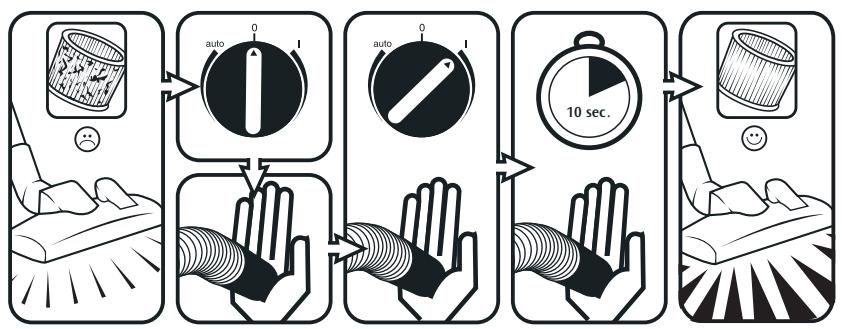
To ensure that suction performance is always at its best, the filter element is automatically cleaned during operation. We recommend complete cleaning if the filter element becomes extremely dirty.
- Switch off the vacuum cleaner
- Close the nozzles or suction hose opening with the palm of your hand.
- Turn the switch to position „l“ and let the cleaner operate for approx. 10 seconds with the suction hose opening closed.

5 Applications and techniques
5.1 Techniques
If used correctly, additional accessories, suction nozzles and suction hoses can enhance the cleaning action and reduce the cleaning effort.
Effective cleaning is achieved if you follow just a few guidelines in combination with your own practical experience in special fields.
Here are some basic tips.
5.1.1 Picking up dry substances
There must always be a safety filter bag in the tank before dry substances with maximum room concentration values are picked up. See section "Optional accessories" for ordering number.
To pick up harmless dust we recommend the use of a waste bag. See section "Optional accessories" for ordering number. Disposal of the picked up material is then simple and hygienic.
After picking up liquids, the filter element is wet. A damp filter element clogs more quickly when dry substances are picked up. For this reason the filter element should be washed and dried or replaced by a dry element before dry substances are picked up.
5.1.2 Picking up liquids
CAUTION!
Do not pick up flammable liquids.
Before liquids are picked up, always remove the filter bag/disposal bag.
The use of a separate filter element or filter screen is recommended.
If foam appears, stop work immediately and empty the tank.
To reduce the amount of foam, use foam killer Nilfisk-Alto Foam Stop (see section "Accessories" for order number).
6 After finishing work

6.1 Switching the vacuum cleaner off and storage
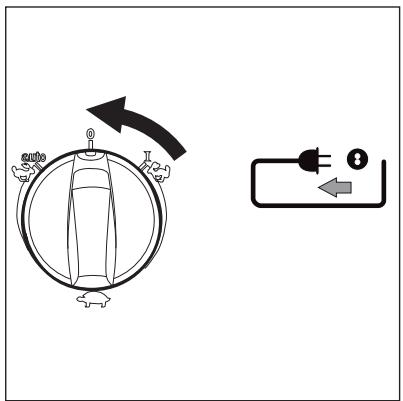
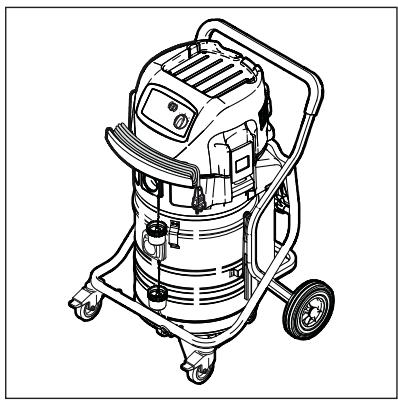
- After picking up hazardous dust, vacuum clean the outside of the cleaner.
- Switch off the vacuum cleaner and pull the mains plug out of the socket.
- Make sure that both plugs are inserted in fittings.
- Wind up the power cord and hang it on the handle.
- Empty the tank and clean the vacuum cleaner.
- After picking up liquids: Store the upper section of the cleaner separately so that the filter element can dry.
- Store the vacuum cleaner in a dry room where it is protected from unauthorized use.

7 Maintenance
7.1 Maintenance plan
| When replacing the filter bag, waste bag or filter element | After finishing work | When required | ||
| 7.2.1 | Check the antistatic clamps | ● | ||
| 7.2.2 | Emptying the dirt tank | ● | ||
| 7.2.3 | Replacing the disposal bag | ● | ||
| 7.2.4 | Replacing the safety filter bag | ● | ||
| 7.2.5 | Replacing the filter element "H" | ● | ||
| 7.2.6 | Replacing the filter for air supply to motor | ● |
7.2 Maintenance work
7.2.1 Check the antistatic clamps
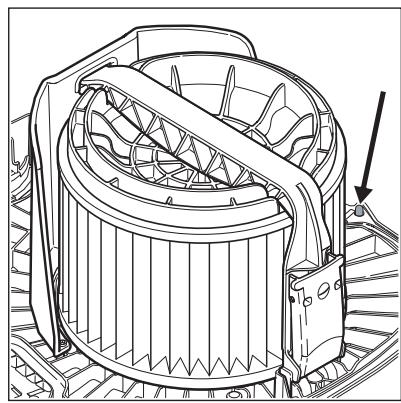
Do not use the cleaner with damaged or missing antistatic clamps. Risk of explosion due to static discharge in explosive atmospheres.
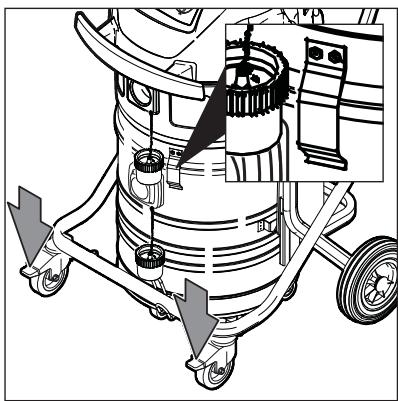
- Check the antistatic clamps for damage and have them replaced by Nilfisk-Alto Service if necessary.
7.2.2 Emptying the dirt tank
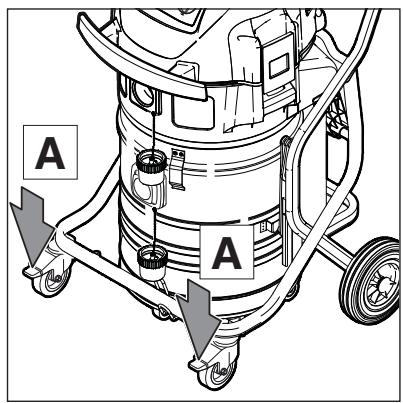

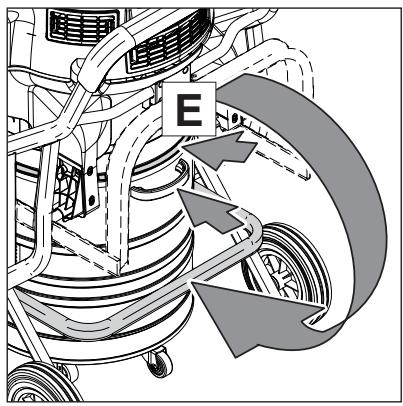
- Switch off the vacuum cleaner and pull the mains plug out of the socket.
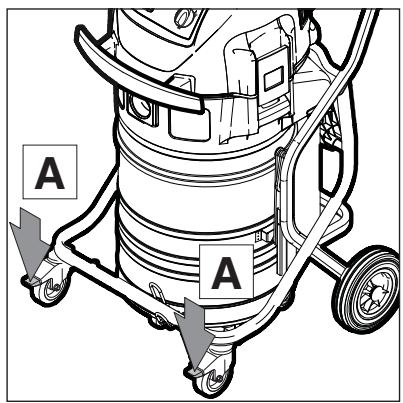
- Apply parking brakes (A) on both castors.
Removing the dirt tank:
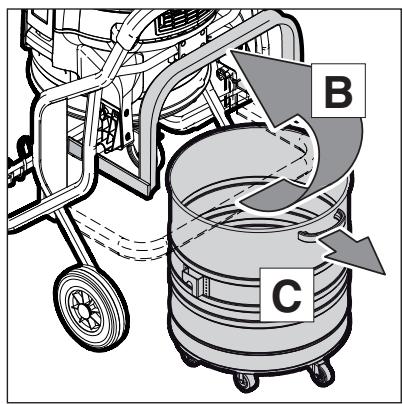
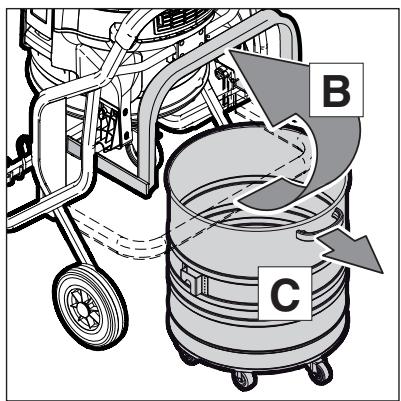
- Swing the bar (B) upwards.
- Use the handle (C) to pull the dirt tank out of the vacuum cleaner.
- Tipping out the collected dirt: WARNING!
If heavy dirt has been picked up, never lift the dirt tank alone. Use the FORKLIFT (D), which is available as an accessory.
- Use a crane or fork lift truck to position the FORKLIFT above the dirt tank.
- Attach the tank to the accessory.
- Dispose of the dirt in accordance with legal regulations.
Inserting the dirt tank:
-
Clean the dirt tank.
-
Check the seals (E) between the tank and the upper section of the vacuum cleaner.
11.Push the dirt tank as far as possible into the vacuum cleaner.
12.Swing the bar (B) downwards without forcing it.

7.2.3 Replacing the disposal bag
- Switch off the vacuum cleaner and pull the mains plug out of the socket.
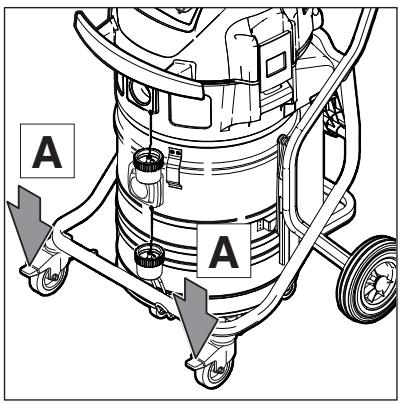
- Apply parking brakes (A) on both castors.
Removing the disposal bag:
- Swing the bar (B) upwards.
- Use the handle (C) to pull the dirt tank out of the vacuum cleaner.
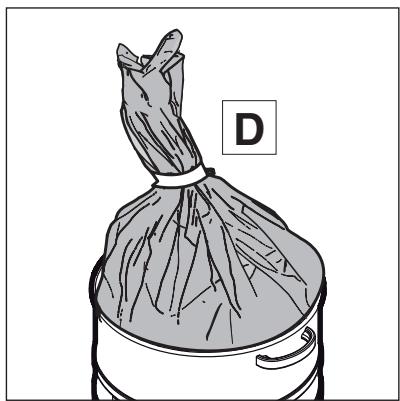
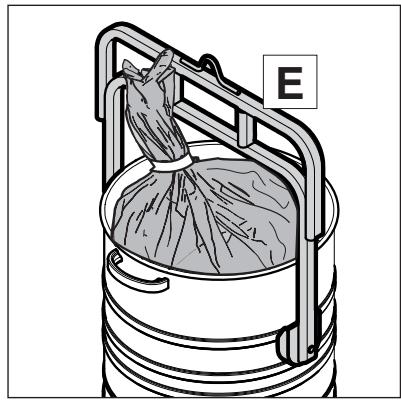
- Close the disposal bag with string (D) and remove it from the dirt tank.
WARNING!
If heavy dirt has been picked up, never lift the dirt tank alone. Use the FORKLIFT (E), which is available as an accessory.
- Use a crane or fork lift truck to position the FORKLIFT above the dirt tank.
- Attach the tank to the accessory.
- Dispose of the dirt in accordance with legal regulations.
Inserting the disposal bag:
-
Clean the dirt tank.
-
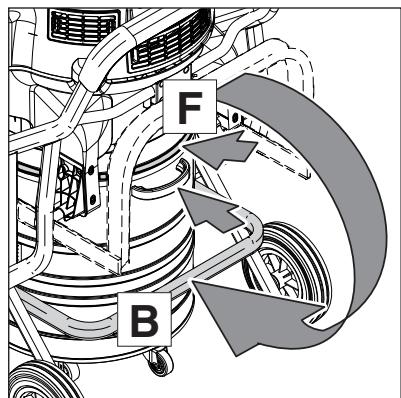
Check the seals (F) between the tank and the upper section of the vacuum cleaner.
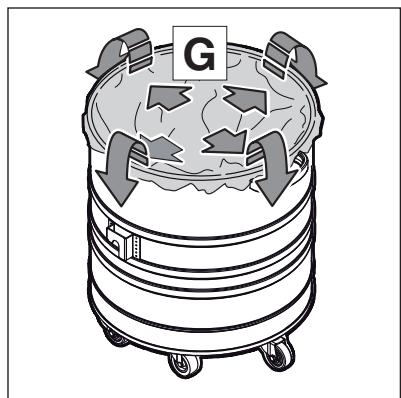
11.Insert the disposal bag (G) in the dirt tank.
12.Fold the top edge of the disposal bag over the rim of the dirt tank.
13.Push the dirt tank as far as possible into the vacuum cleaner. - Swing the bar (B) downwards without forcing it.
7.2.4 Replacing the safety filter bag
During the following work, ensure that dust is not unnecessarily spread around. Wear a P2 breathing mask.
Never use the vacuum cleaner without a filter.
- Switch off the vacuum cleaner and pull the mains plug out of the socket.
- Apply parking brakes (A) on both castors.
Removing the safety filter bag:
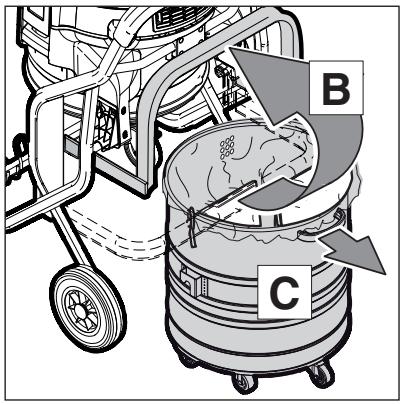
- Swing the bar (B) upwards.
- Use the handle (C) to pull the dirt tank out of the vacuum cleaner.
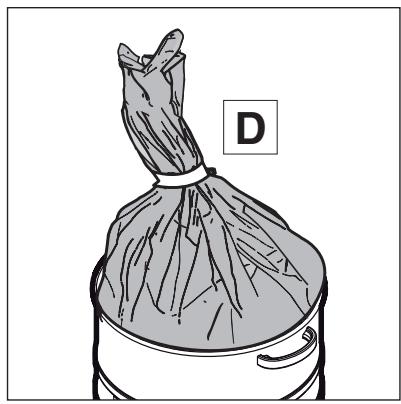
- Close the disposal bag with string (D) and remove it from the dirt tank.
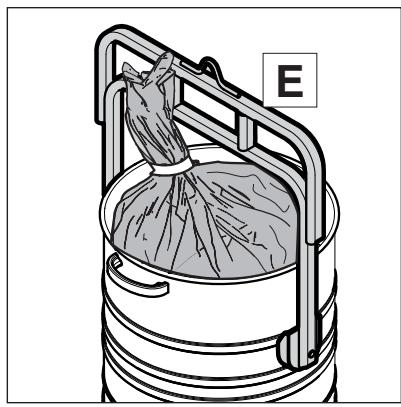
WARNING! If heavy dirt has been picked up, never lift the dirt tank alone. Use the FORKLIFT (E), which is available as an accessory.
- Use a crane or fork lift truck to position the FORKLIFT above the dirt tank.
- Attach the tank to the accessory.
- Dispose of the dirt in accordance with legal regulations.
Inserting the safety filter bag:
-
Clean the dirt tank.
-
Check the seals (F) between the tank and the upper section of the vacuum cleaner.
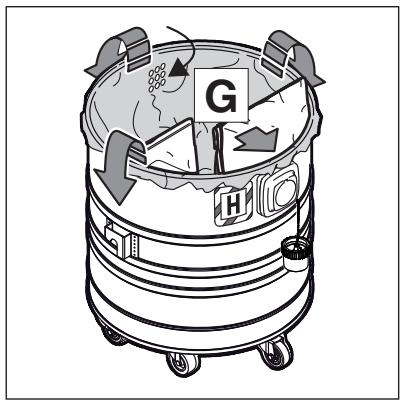
11.Insert the safety filter bag (G) in the dirt tank.
12.Fold the top edge of the disposal bag over the rim of the dirt tank.
13.Push the dirt tank as far as possible into the vacuum cleaner. - Swing the bar (B) downwards without forcing it.

7.2.5 Replacing the filter element "H"
During the following work, ensure that dust is not unnecessarily spread around. Wear a P2 breathing mask.
Never use the vacuum cleaner without a filter.
- Switch off the vacuum cleaner and pull the mains plug out of the socket.
-
Apply parking brakes (A) on both castors.
-
Open the retaining clamps (B) and remove the upper section of the vacuum cleaner.
Remove the filter element:
- Lay the upper section of the cleaner down with the filter element facing upwards.
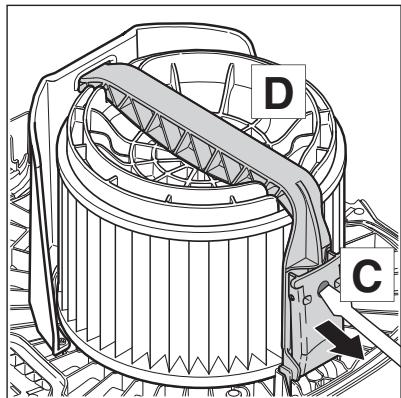
- Unscrew the screw (C), open the bar handle and remove it.
- Remove the filter holder (D).
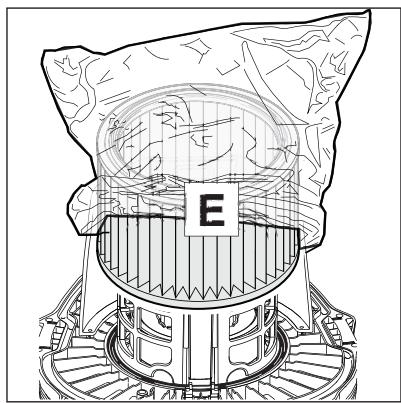
- Place the protective filter bag over the filter element.
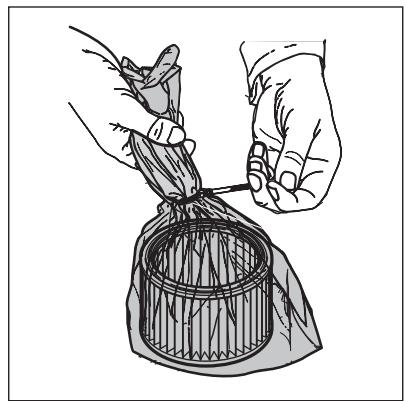
- Carefully remove the filter element and close the protective filter bag with a knot.
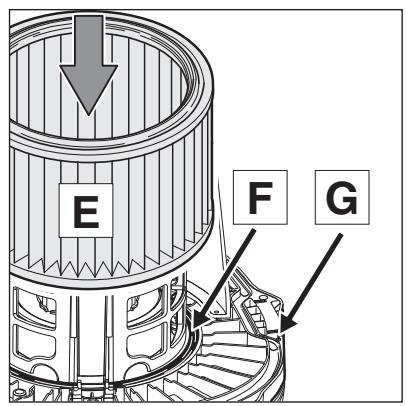
Inserting the filter element:
-
Clean the filter seal (F). Check it for damage and replace it if necessary.
-
Check the antistatic clamp (G) for damage and have it replaced by Nilfisk-Alto Service if necessary.
11.Fit a new filter element (E).
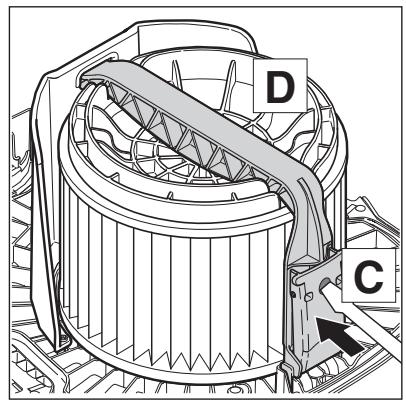
12.Fit the filter holder (D). Ensure that it is in the correct position.
13.Fit bar and close bar handle (C).
- Dispose of the used filter element in accordance with legal regulations.
7.2.6 Replacing the filter for air suppy to motor
During the following work, ensure that dust is not unnecessarily spread around. Wear a P2 breathing mask.
Never use the vacuum cleaner without a filter.
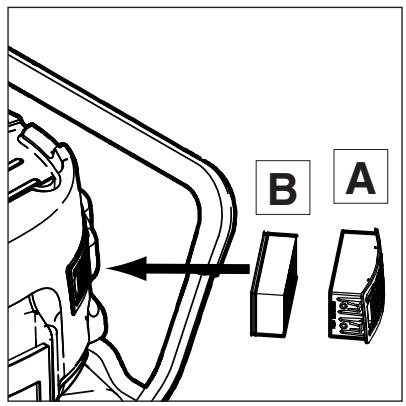
- Remove filter cassette (A).
- Remove filter element (B) from filter cassette.
- Dispose of the used filter element in accordance with legal regulations.
- Fit a new filter element.
- Attach the filter cartridge.
8 Troubleshooting
| Fault | Cause | Remedy |
| ‡ Motor does not start | > Fuse of the mains socket has blown. >Overload protection switch has tripped. >Motor is faulty. | •Connect mains fuse. •Switch off the vacuum cleaner and allow it to cool for approx. 5 minutes. If the cleaner cannot be started again, contact the Nilfisk-Alto service department. •Have motor changed by Nilfisk-Alto Service. |
| ‡ The acoustic warning sounds.(Reduced suction power) | >Hose diameter and switch position do not correspond. >Clogged suction hose/nozzle. Tank, disposal bag or safety filter bag is full. >Filter element is clogged. Cleaning mechanism is defective. | •Set correct switch position for hose diameter. •Clean suction hose/nozzle •See "Emptying tank" or "Replacing disposal bag, safety filter bag" sections. •See section „Cleaning filter element“ and „Replacing filter element“. •Contact Nilfisk-Alto Service. |
| ‡ No suction power during wet cleaning | >Tank is full. | •Switch off the cleaner. Empty the tank. |
| ‡ Voltage fluctuations | >Impedance of power supply is too high. | •Connect the cleaner to another socket closer to the fuse box. Voltage fluctuations over 7% should not occur if the impedance at the transfer point is ≤ 0.15 Ω. |
9 Further information
9.1 Recycling the vacuum cleaner
Make the old cleaner unusable immediately:
- Unplug the cleaner
- Cut the power cord.
- Do not discard of electrical appliances with household waste.

As specified in European Directive 2002/96/EC on old electrical and electronic appliances, used electrical goods must be collected separately and recycled ecologically.
Contact your local authorities or your nearest dealer for further information.
9.2 Guarantee
Our general conditions of business are applicable with regard to the guarantee.
Unauthorised modifications to the appliance, the use of incorrect brushes in addition to using the appliance in a way other than for the intended purpose exempt the manufacturer from any liability for the resulting damage.
9.3 Tests and approvals
Electrical tests must be performed in accordance with the provisions of safety regulations (VBG4) and to DIN VDE 0701 Part 1 and Part 3. In accordance with DIN VDE 0702 these tests must be performed at regular intervals and after repairs or modifications.
The vacuum cleaner has been approved in accordance with IEC/EN 60335-2-69.
Equally, the cleaners fulfil the requirements of the ATEX regulation 94/9/EG for use in zone 22.
9.4 EC declaration of conformity
| CE | EC conformity declaration |
| NILFISK-ADVANCE A/S Sognevej 25 DK-2605 Brøndby | |
| Product: | Vacuum cleaner for wet and dry operation |
| Model: | ATTIX 995-0H/M SD XC Type 22 |
| Description: | 230-240 V~, 50/60 Hz, 2x1100W Dust Class M and H ATEX Zone 22 E×II 3D Ex tD A22 T135 °C IP54 |
| The design of this appliance complies with the following provisions: | EC - Machinery Directive 2006/42/EC EC - Directive EMC 2004/108/EC EC - Explosive Atmosphere directive 94/9/EC „ATEX“ |
| Applied harmonized standards: | EN ISO 12100-1 (2004), EN ISO 12100-2 (2004), EN 55014-1 (2006), EN 55014-2 (2001), EN 61000-3-2 (2006), EN 1127-1 (2007), EN 61241-10 (2004) |
| Applied national standards and technical specifications: | EN 60335-2-69 (2009) IEC 60335-2-69 (2008) |
| Anton Sørensen General Manager EAPC Technical Operations | Brøndby, 01.06.2008 |
9.5 Technical data
| ATTIX | |||
| 995-0H/M SD XC Type 22 | |||
| EU | GB | ||
| Voltage | V | 230 | |
| Mains frequency | Hz | 50/60 | |
| Fuse | A | 16 | 13 |
| Power consumptionIEC | W | 2x1100 | |
| Total connected load | W | 2200 | |
| Air flow rate | m3/h | 2 x 216 | |
| l/min | 2 x 3600 | ||
| Vacuum | hPa/mbar | 230 | |
| kPa | 23 | ||
| Sound pressure level at a distance of 1 m, EN 60704-1 | dB(A) | 70 ± 2 | |
| Sound level | dB(A) | 67 ± 2 | |
| Power cord: Length | m | 10 | |
| Power cord: Type | H07RN-F3G1,5 mm² | H05RR-F3G1,5 mm² | |
| Protection class | I | ||
| Type of protection (splash water protected) | IP 54 | ||
| Radio interference level | EN 55014-1 | ||
| Tank volume | I | 50 | |
| Width | mm | 615 | |
| Depth | mm | 690 | |
| Height | mm | 990 | |
| Weight | kg | 45 | |
9.6 Optional accessories
| Description | Order No. |
| Safety filter bag (5 pcs.) | 302003473 |
| Disposal bag (5 pcs.) | 302001480 |
| Filter element “H” | 107400564 |
| Protective filter bag (10 pcs.) | 30082 |
| Filter screen | 302002885 |
| Nilfisk-Alto-Foam-Stop (6 x 1 l) | 8469 |
http://www.nilfisk-advance.com
HEAD QUARTER
DENMARK
Nilfisk-Advance Group
Sognevej 25
DK-2605 Brondby
Tel.: (+45) 4323 8100
E-mail: mail.com@nilfisk-advance.com
SALES COMPANIES
ARGENTINA
Nilfisk-Advance srl.
Edificio Central Park
Herrera 1855, Office 604
Riverside Business Park
Boulevard Internationalelaan 55
Building 18, Suchun Industrial Estate
Suzhou Industrial Park
215021 Suzhou
Tel.: (+86) 512 6265 2525
CZECH REPUBLIC
Nilfisk-Advance
31-39 Wo Tong Tsui Street
Kvai Chung
Tel.: (+852) 24 27 59 51
HUNGARY
Nilfisk-Advance Kereskedelmi Kft.
349, Business Point,
No 201,2nd floor, above Popular Car World,
Western Express High way, Andheri ( East),
Mumbai - 400 069
Tel.: (+91) 223 2174592
IRELAND
Nilfisk-Advance
1 Stokes Place
St. Stephen's Green
Dublin 2
Tel.: (+35) 312943838
ITALY
Nilfisk-Advance SpA
Sintra Business Park
Zona Industrial Da Abrunheira
Edificio 1, 1^ A
P2710-089 Sintra
Tel.: +35 121 911 2670
E-mail: mkt.pt@nilfisk-advance.com
RUSSIA
HnФнck-3ДВaHc
127015 MockBa
Barycka yI.27, cTp. 7
Pocsn
Tel.: (+7) 495 783 96 02
E-mail: info@nilfisk.ru
SINGAPORE
Nilfisk-Advance Pte. Ltd.
40 Loyang Drive
Singapore 508961
Tel.: (+65) 6759 9100
SPAIN
Nilfisk-Advance S.A.
Torre D'Ara
Paseo del Ringle, 5 Pl.10
08302 Mataró
Tel.: (+3) 4937412400
E-mail: mkt.es@nilfisk-dvance.com
SWEDEN
Nilfisk-Advance
Sjobjornsvagen 5
100 73 Stockholm
1F, No. 193, sec. 2, Xing Long Rd.
Taipei
Tel.: (+88) 6227 002 268
THAILAND
Nilfisk-Advance Co. Ltd.
89 Soi Chokechai-Ruammitr
Viphavadee-Rangsit Road
Ladyao, Jatuchak, Bangkok 10900
Tel.: (+66) 2 275 5630
TURKEY
Nilfisk-Advance Profesional Temizlik
Hillside Business Park
Kempson Way
Bury St. Edmunds
Suffolk IP32 7EA
Tel.: (+49) 01284 763163
E-mail: sales.uk@nilfisk-advance.com
UNITED ARAB EMIRATES
Nilfisk-Advance Middle East Branch
SAIF-Zone
P.O.Box 122298
Sharjal
Tel.: (+971) 553 2626 82
USA
Nilfisk-Advance Inc.
14600 21st Avenue North
Plymouth, MN 55447-3408
Nilfisk-Advance Representative Office
No. 51 Doc Ngu Str.
Ba Dinh Dist.
Hanoi
Tel.: (+04) 761 5642
E-mail: nilfisk@vnn.vn
- ATTIX 995-0H/M SD XC Type 22 Operating Instructions
- Contents
- Important safety instructions
- Symbols used to mark instructions
- DANGER
- WARNING
- CAUTION
- The appliance must
- Purpose and intended use
- Transport
- Storage
- Electrical connection
- Extension lead
- Maintenance, cleaning and repair
- In the maintenance area
- Electrical components
- Picking up liquids
- Hazardous materials
- Spare parts and accessories
- Emptying dirt tank
- Description
- Operating elements
- Operating panel
- Before starting the cleaner
- Before starting the cleaner
- Inserting the safety filter bag
- Operation
- Connections
- Electrical connection
- Switching on the vacuum cleaner
- Switch , I-0-II “
- Check volume flow monitor
- Acoustic warning
- Cleaning the filter element
- Applications and techniques
- Techniques
- Picking up dry substances
- Picking up liquids
- CAUTION!
- After finishing work
- Switching the vacuum cleaner off and storage
- Maintenance
- Maintenance work
- Check the antistatic clamps
- Emptying the dirt tank
- Removing the dirt tank:
- Inserting the dirt tank:
- Replacing the disposal bag
- Removing the disposal bag:
- WARNING!
- Inserting the disposal bag:
- Replacing the safety filter bag
- Removing the safety filter bag:
- Inserting the safety filter bag:
- Replacing the filter element "H"
- Remove the filter element:
- Inserting the filter element:
- Replacing the filter for air suppy to motor
- Troubleshooting
- Further information
- Recycling the vacuum cleaner
- Guarantee
- Tests and approvals
- EC declaration of conformity
- HEAD QUARTER
- DENMARK
- SALES COMPANIES
- ARGENTINA
- CZECH REPUBLIC
- HUNGARY
- IRELAND
- ITALY
- RUSSIA
- SINGAPORE
- SPAIN
- SWEDEN
- THAILAND
- TURKEY
- UNITED ARAB EMIRATES
- USA
Brand : NILFISK
Model : ATTIX 995 H/M TYPE 22
Category : Industrial vacuum cleaner