
MKH 80 - Microphone SENNHEISER - Free user manual and instructions
Find the device manual for free MKH 80 SENNHEISER in PDF.


| Product type | Studio HF electrostatic microphone with 5 switchable polar patterns |
| Brand | SENNHEISER |
| Model | MKH 80 |
| Polar patterns | Omnidirectional, wide cardioid, cardioid, supercardioid, figure-8 |
| Frequency response | 30 - 20,000 Hz |
| Sensitivity | 40 mV/Pa ± 1 dB |
| Output impedance | 150 Ω |
| Maximum sound pressure level | 136 dB SPL (CCIR) / 142 dB SPL (A-weighted) |
| Equivalent noise level | 20 dB SPL (CCIR) / 10 dB SPL (A-weighted) |
| Signal-to-noise ratio | 74 dB (CCIR) / 84 dB (A-weighted) |
| Dynamic range | 116 dB (CCIR) / 126 dB (A-weighted) |
| Switchable pre-attenuation | -6 dB / -12 dB |
| Bass cut at 50 Hz | -3 dB / -6 dB |
| High-frequency boost at 10 kHz | +3 dB / +6 dB |
| Power supply | 48 V phantom power per DIN 45596 |
| Connection | XLR-3 |
| Diameter | 26.5 mm |
| Length | 178 mm |
| Weight | 135 g |
| Included accessories | MZQ 80 stand mount |
| Maintenance and cleaning | Clean with a soft, dry cloth. Avoid moisture and solvents. |
| Safety | Use a compliant 48 V phantom power supply. Do not expose to shocks or moisture. |
| Spare parts and repairability | Available accessories: MZW 80-1 windscreen, MZS 80 elastic suspension, power supply, cables. |
Frequently Asked Questions - MKH 80 SENNHEISER
User questions about MKH 80 SENNHEISER
0 question about this device. Answer the ones you know or ask your own.
Ask a new question about this device
Download the instructions for your Microphone in PDF format for free! Find your manual MKH 80 - SENNHEISER and take your electronic device back in hand. On this page are published all the documents necessary for the use of your device. MKH 80 by SENNHEISER.
USER MANUAL MKH 80 SENNHEISER
Instructions for use
Brief description. 13
Connecting facilities / power supply 13
Stand mounting / acceptance angles 13
Application tips 15
Selection of pick-up patterns 16
Preattenuation / tone control 18
Accessories 19
Technical Data 20
Nominal frequency response with tolerance field / pick-up pattern. 53-57
Switchable filters: treble emphasis / bass attenuation 58
Brief description
The MKH 80 is a versatile studio condenser microphone with five different pick-up patterns. It incorporates a push-pull transducer featuring a high linearity.
- Extremely low inherent noise - no masking effects; the recording gets an extraordinary sense of space and depth
- Excellent sensitivity for interference-free sound reproduction and high signal strength. The inherent noise of following microphone amplifiers is negligible.
- The mic's frequency-independent directivity prevents coloration both in the near field and in the diffuse field.
- No negative acoustic effects caused by the housing or the sound inlet basket.
- The mic's slender design and small dimensions make it visually unobtrusive.
Connecting facilities/power supply
The MKH 80 is designed for 48V phantom powering as per DIN 45596. For power supply units and connecting cables please see "Accessories".
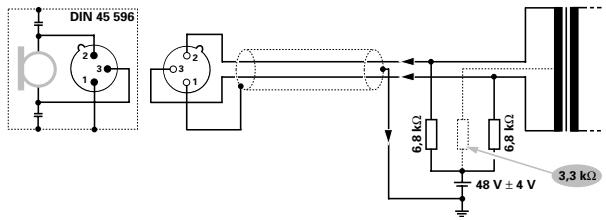
Note well:
The extension cable is to be put between the power supply unit and the mixing console. The total length of the cable shall not exceed 200m . For longer cables the line capacitance affects the frequency response of the microphone. Trebles are undesirably attenuated.
Stand mounting/acceptance angles
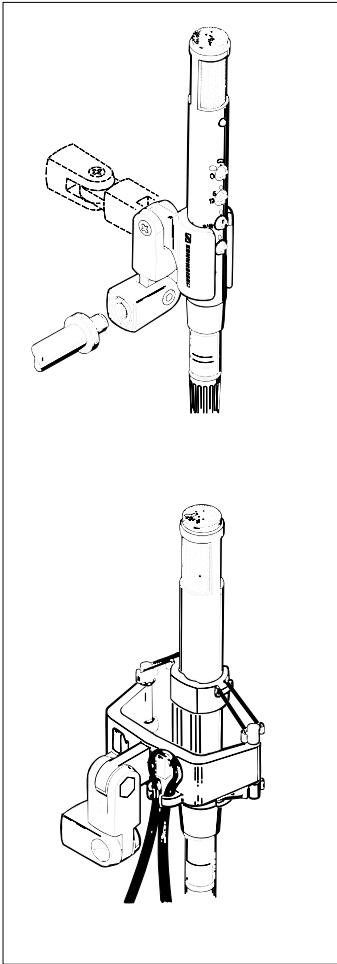
The MZQ 80 clamp (included) serves to fix the MKH 80 to a stand.
The proper acceptance angle is indicated by the red LED.
The MZS 80 shock mount provides better resistance to footfall (please see "Accessories").
Application tips
The MKH 80 is a versatile condenser microphone which is particularly well suited to applications in the studio recording environment.
- Its problem-free reproduction of high sound pressure levels makes it the perfect mic for soloist. It also works exceptionally well as a supporting mic.
- Its low inherent noise makes the MKH 80 the ideal principal microphone.
- If the microphone is set to the supercardioid pick-up pattern, the monitors in the studio need not be switched off in order to prevent feedback.
- The MZW 80-1 pop shield effectively suppresses pop noise during close miking. A special gauze pop shield is in preparation.
Selection of pick-up patterns
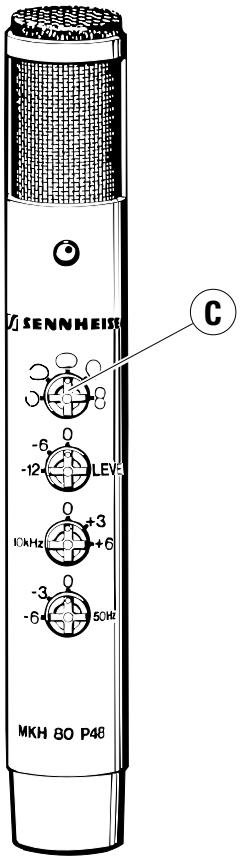
Switch C serves to set the mic to five different pick-up patterns:
Omnidirectional
The push-pull transducer incorporated into the MKH 80 reduces the mic's directivity to a minimum for high frequencies. The mic has a neutral response to direct and diffuse signals. This feature provides a sense of space and depth and allows large sound sources to be miked. For close-miking, sound reproduction does not become overbrilliant or shrill. No proximity effect.
Wide-angle cardioid
The wide-angle cardioid pick-up pattern is a combination of the omnidirectional and the cardioid pick-up pattern. A rear attenuation of 10 dB allows a moderate attenuation of diffuse signals from the rear and thus a good reverberation balance for longer distances to the sound source, even in rooms which are acoustically less perfect. Like the omnidirectional pick-up pattern, the wide-angle cardioid pick-up pattern is particularly well suited to mike large sound sources. For close-miking, the mic's bass emphasis is less high than with the cardioid pick-up pattern.
The cardioid pick-up pattern is acoustically neutral for large acceptance angles. Typical for the push-pull transducer is its high rear attenuation for low frequencies (typ. 30 dB), which allows signals from the rear to be effectively attenuated. The cardioid pick-up pattern is the most versatile characteristic. It is the ideal choice for speakers, soloists and smaller instrument groups.

Supercardioid
The supercardiod pick-up pattern features a higher directivity than the cardioid pick-up pattern, which results in efficient attenuation of diffuse signals and prevents feedback. Thanks to its good lateral attenuation (10 dB), the supercardiod pick-up pattern is particularly well suited to meke or support soloists in noisy environments, i.e. situations in which lateral sound is to be effectively suppressed. In this case, too, the transducer provides a frequency-independent directivity.

Figure-of-eight
The figure-of-eight pick-up pattern provides total attenuation of lateral sound, which makes it particularly well suited to separate or support adjacent sound sources such as single instruments or instrument groups in large orchestras. Annoying reflections from the floor and the resulting comb filter effects can be effectively reduced.
Preattenuation / tone control
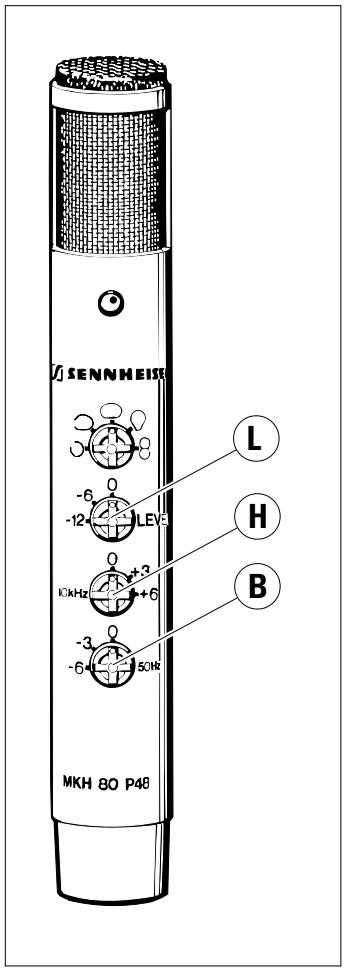
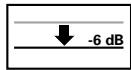
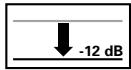
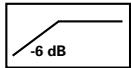
Switch L for preattenuation
If the output level of the MKH 80 is too high for the following mixing console, it can be reduced in two steps:
-6dB
or
-12dB
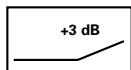
Switch H for treble emphasis
The treble emphasis can be adjusted in two steps. For 10kHz the increase amounts to:
+3dB
or
+6dB

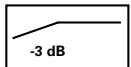
Switch B for bass attenuation
The bass response can be attenuated in two steps. For 50Hz the attenuation amounts to:
-3dB
or
-6dB
Accessories
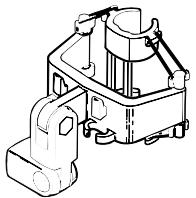
MZS 80
Shock mount
for the elastic suspension of the stand mounted mic. Effectively suppresses structure-borne noise.
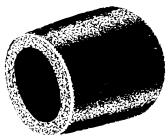
MZW 80-1
Foam wind-shield
functions as a close-miking and pop shield.
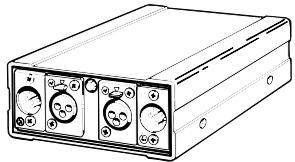
MZN 16 P 48 U
Power supply unit
for 48V phantom powering.
Allows two mics to be connected.
Required mains voltage:
95 - 265 V/50 - 60 Hz
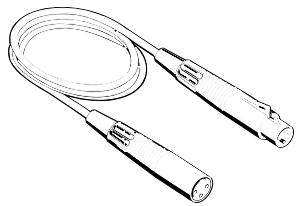
KA7U
XLR connecting cable
Three-core cable with XLR/XLR connector. Length: 7.5m Usable as a connecting cable or an extension cable.Preattenuation/tone control
Technical Data
| short description | high-frequency studio condenser microphone with 5 switchable directional characteristics |
| transducer type | double push-pull pressure-gradient transducer |
| directional characteristics | omnidirectional, wide-angle cardioid, cardioid, super cardioid, figure-8 |
| frequency range | 30 - 20000 Hz |
| sensitivity | 40 mV/Pa ± ldB (-28 dB re IV/Pa) |
| output impedance | 150 Ω |
| maximum SPL | 136 dB SPL (142 dB SPL with 6/12 dB preattenuation) |
| maximum output voltage | 5 V |
| equivalent SPL due to inherent noise | 20 dB SPL (CCIR-weighted) 10 dB SPL (A-weighted) |
| output voltage due to inherent noise | 8 μV (CCIR-weighted) 2.5 μV (A-weighted) |
| S/N ratio at 94 dB SPL (1 Pa) | 74 dB (CCIR-weighted) 84 dB (A-weighted) |
| dynamic range | 116 dB (CCIR-weighted) 126 dB (A-weighted) |
| switchable pre-attenuation | 6/12 dB (20/10 mV/Pa) |
| switchable bass roll-off | 3/6 dB at 50 Hz |
| switchable treble emphasis | 3/6 dB at 10 kHz |
| feeding | phantom feeding P48 |
| supply voltage / supply current | 48 ± 4 V / 3 mA |
| connector | XLR-3 |
| diameter | 26.5 mm |
| length | 178 mm |
| weight | 135 g |
Subject to alterations.
Soll-Frequenzgang mit Toleranzfeld / Polardiagramm Nominal frequency response with tolerance field / Pick-up pattern
Cable deraccordement XLR
Sousreservede modifications.
Soll-Frequenzgang mit Toleranzfeld / Polardiagramm Nominal frequency response with tolerance field / Pick-up pattern
Sennheiser electronic KG
D 3002 Wedemark
Printed in Germany
Publ. 48793
04/93
A 01