
CM643ET - Computer monitor HITACHI - Free user manual and instructions
Find the device manual for free CM643ET HITACHI in PDF.


User questions about CM643ET HITACHI
0 question about this device. Answer the ones you know or ask your own.
Ask a new question about this device
Download the instructions for your Computer monitor in PDF format for free! Find your manual CM643ET - HITACHI and take your electronic device back in hand. On this page are published all the documents necessary for the use of your device. CM643ET by HITACHI.
USER MANUAL CM643ET HITACHI
EasyMenu is HITACHI's On Screen Display function for easy operation.
READ THE INSTRUCTIONS INSIDE CAREFULLY. KEEP THIS USER MANUAL FOR FUTURE REFERENCE.
For future reference, record the serial number of your colour monitor.
SERIAL No.
The serial number is located on the rear of the monitor.
This monitor is ENERGY STAR® compliant when used with a computer equipped with VESA DPMS.
The ENERGY STAR® emblem does not represent EPA endorsement of any product or service.
As an ENERGY STAR® Partner, Hitachi,Ltd. has determined that this product meets the ENERGY STAR® guidelines for energy efficiency.



NOTE:
The information in this manual is subject to change without notice. The manufacturer assumes no responsibility for any errors that may appear in this manual.
TRADEMARK ACKNOWLEDGEMENT
VGA is a registered trademark of International Business Machines Corporation.
VESA is a trademark of a nonprofit organisation, Video Electronics Standard Association
ENERGY STAR@ is a trademark of Environmental Protection Agency (EPA).
HINWEIS:
The following features are provided by the Colour Monitor.
Sharpest Focus and Highest Contrast
Flat screen Enhanced Dot Pitch (EDP) CRT with FS double focus and AR-ASC coating gives the sharpest focus and highest contrast to minimise eye fatigue.
Wide-range Multi-Scanning
Automatic scanning and automatic adjustment to conform with a wide range of scanning frequencies and user requirements.
Digital Picture Control Function
Position, size, pincushion, trapezoid, parallelogram, pin balance and rotation are adjustable by digital controls.
Geometry setting can be stored for different H/V frequencies. Microprocessor-based preset functions can store 25 sets of geometry settings including the standard factory settings.
Digital Colour Control Function
Red, green, and blue colour balance is adjustable by digital control.
An adjusted colour setting can be stored and recalled by the colour select button.
Power Saving System
The Environmental Protection Agency (EPA) has established a voluntary program by which manufacturers enable computer products to go into low power states while not being used. This monitor has a low power "sleep" mode, which is compliant with the EPA requirements for the ENERGY
STAR^® program, and will assist you in conserving energy.
Please refer to the section of "POWER SAVING SYSTEM" for details.
EasyMenu
An On Screen Display function that allows direct access to adjust all operations from the front panel.
PLUG 8 PLAY
This monitor is VESA DDC1/2B compliant when used with a computer compliant with VESA DDC (Display Data Channel).

NEVER REMOVE THE REAR COVER!
The rear cover MUST be removed only by authorised service personnel. This colour monitor contains high voltage components.
THE POWER POINT SHOULD BE CLOSE TO THE MONITOR AND EASILY ACCESSIBLE!
INSTALL THE UNIT IN AN SUITABLE ENVIRONMENT!
DO NOT expose this monitor to rain or moisture to prevent electric shock or fire hazard. This unit is designed to be used in an office or business environment
DO NOT subject the unit to vibrations, dust, or corrosive gases.
- KEEP IN A WELL VENTILATED PLACE!
DO NOT cover this monitor or place anything against any sides (not only the top, right and left side but also the rear and bottom side) of unit. Ventilation holes are provided at all sides of the rear cover to prevent the temperature from rising.
- KEEP AWAY FROM HEAT SOURCES!
AVOID placing the unit in direct sunshine or near a heating appliance.
BE CAREFUL OF MAGNETIC FIELDS!
DO NOT place a magnet, loudspeaker system, floppy disk drive, printer, or anything which will generate magnetism near the unit. A magnetic field may cause blurred colours or distortion of the displayed pattern.
BE CAREFUL OF GENERATED MAGNETISM!
After the power has been turned on or "DEGAUSS" button has been pressed, the CRT is demagnetised for approximately 10 seconds. This generates a strong magnetic field around the front cover which may affect the data stored on magnetic tape or disks near the front cover. Place such magnetic recording equipment and tapes/disks away from this unit.
Avoid direct rays of the sun or room lighting onto the CRT screen in order to prevent eye fatigue
THE ENCLOSED POWER CORD MUST BE USED!
In Europe, a proper European standard approved power cord is to be used with this monitor. For a rated current up to 6 A, a type not lighter than H05VV-F 3G 0.75 mm² or H05VVH2-F 3G 0.75 mm² must be used.
In USA/Canada, use a UL LISTED/CSA LABELLED or CERTIFIED power cord set meeting the following specifications
Rating: min. 125V, 7A
Length: max. 3.1m
Type: SVT or SJT
Plug type: NEMA 5-15P figure, Parallel blade, Grounding type, 125V, 15A
Failure to do so may cause fire or electric shock hazard.
USE ONLY THE CORRECT VOLTAGE POWER OUTLET WITH SAFETY GROUND CONNECTION !
100 - 120 V for USA, Canada, etc.
200 - 240 V for Europe, etc.
(This monitor will automatically adjust to the input voltage 100 - 120 / 200 - 240V.)
CAUTION for 200 - 240V operation only
This equipment relies on the protective devices in the building installation for short-circuit and overcurrent protection. Refer to the following table for the suitable number and location of the protective devices which should be provided in the building installation.
Protective devices in single - phase equipment or sub - assemblies
| Protection against | Minimum number of fuses or circuit - breaker poles | Location | |
| Equipment to be connected to POWER SYSTEMS with earthed neutral reliably identified | Earth faults | 1 | Both conductors |
| Over-current | 1 | Either of the two conductors | |
| Equipment to be connected to any supply, including IT POWER SYSTEMS and supplies with reversible plugs | Earth faults | 2 | Both conductors |
| Over-current | 1 | Either of the two conductors |
Verify that the protective devices in the building installation meets the conditions in the table prior to installing the equipment.
BE CAREFUL OF POWER CORD CONNECTION!
Before inserting the plug of the power cord into a power point of the correct voltage, check that the connection portion of the power cord is clean (with no dust). Then, insert the plug of power cord to a power point firmly, otherwise it may cause electrical shock or fire.
■ REMOVE THE POWER CORD FOR COMPLETE SEPARATION!
For complete separation from the power source, remove the power cord from the monitor or from the wall outlet.
AVOID FREQUENT POWER ON-OFF SWITCHING!
DO NOT repeat OFF and ON in a short period. It may cause blurred colours or distortion of the displayed pattern,
BE CAREFUL OF STATIC ELECTRICITY ON CRT SURFACE!
To prevent electrical shock by the static electricity on the CRT surface, disconnect the power cord at least 30 SECONDS AFTER turning off the power.
ABOUT CLEANING
This monitor has a non-glare and anti-electrostatic treatment on the surface of the screen. Use water or alcoholic solvent with soft cloth like gauze to clean the surface of the screen.
NEVER use abrasive, glass cleaner containing highly concentrated ammonia and strong base chemicals since they damage the surface treatment.
Clean the cabinet and controls with a lightly moistened soft cloth.
DO NOT use aerosol sprays, solvents or abrasive cleaners.
Declaration of Conformity
According to 47CFR, Part 2 and 15 for
Class B Personal Computers and
Peripherals; and I or
CPU Boards and Power Supplies used
with Class B Personal Computers:
We: Nissci Sangyo America, Ltd.
Located at: 200 Lowder Brook Drive Suite 2200, Westwood, M.A. 020901124 U.S.A.
Declare under sole responsibility that the product identified herein, complies with 47CFR Part 2 and 15 of the FCC rules as a Class B digital device. Each product marketed, is identical to the representative unit tested and found to be compliant with the standards. Records maintained continue to reflect the equipment being produced can be expected to be within the variation accepted, due to quantity production and testing on a statistical basis as required by 47CFR § 2.909. Operation is subject to the following two conditions: (1) This device may not cause harmful interference, and (2) This device must accept any interference received, including interference that may cause undesired operation. The above named party is responsible for ensuring that the equipment complies with the standards of 47CFR § 15.101 to 15.109.
Trade name: Color Monitor
Model Number:CM643
Signature of Party Responsible:

Printed name of Party Responsible:
Saloshi Tanabe
Executed on (Date), at (Place):
January 25, 1999, MA., U.S.A.
FOR THE CUSTOMERS IN CANADA
NOTICE : This Class B digital apparatus meets all requirements of the Canadian Interference-Causing Equipment Regulations.
LOW-RADIATION CHARACTERISTICS
Complies with MPR- II and TCO specifications.
| MPR-II | TCO | ||
| Electrostatic ootential | < 500 v | < 500 V | |
| Alternating electric field | 5Hz - 2kHz | <25 V/m | < 10 V/m * |
| 2kHz - 400kHz | < 2.5 V/m | < 1.0 V/m * | |
| Magnetic field | 5Hz - 2kHz | < 250 nT | < 200 nT * |
| 2kHz - 400kHz | < 25 nT | < 25 nT | |
| Measurins distance | 50 cm around monitor | ||
(^* = 30~cm in front of screen)
TCO'95 STATEMENT

Congratulations!
You have just purchased a TC0'95 approved and labelled product! Your choice has provided you with a product developed for professional use. Your purchase has also contributed to reducing the burden on the environment and also, to the further development of environmentally adapted electronics products.

Why do we have environmentally labelled computers?
In many countries, environmental labelling has become an established method for encouraging the adaptation of goods and services to the environment. The main problem, as far as computers and other electronics equipment are concerned, is that environmentally harmful substances are used both in the products and during the manufacturing. Since it has not been possible for the majority of electronics equipment to be recycled in a satisfactory way, most of these potentially damaging substances sooner or later enter Nature.
There are also other characteristics of a computer, such as energy consumption levels, that are important from the viewpoints of both the work (internal) and natural (external) environments. Since all methods of conventional electricity generation have a negative effect on the environment (acidic and climate-influencing emissions, radioactive waste, etc.), it is vital to conserve energy. Electronics equipment in offices consume an enormous amount of energy since they are often left running continuously.
What does labelling involve?
This product meets the requirements for the TCO'95 scheme which provides for international and environmental labelling of personal computers. The labelling scheme was developed as a joint effort by the TCO (The Swedish Confederation of Professional Employees), Naturskyddsforeningen (The Swedish Society for Nature Conservation) and NUTEK (The National Board for industrial and Technical Development in Sweden).
The requirements cover a wide range of issues: environment, ergonomics, usability, emission of electrical and magnetic fields, energy consumption and electrical and fire safety.
The environmental demands concern restrictions on the presence and use of heavy metals, brominated and chlorinated flame retardants, CFCs (freons) and chlorinated solvents, among other things. The product must be prepared for recycling and the manufacturer is obliged to have an environmental plan which must be adhered to in each country where the company implements its operational policy.
The energy requirements include a demand that the computer and/or display, after a certain period of inactivity, shall reduce its power consumption to a lower level in one or more stages. The length of time to reactivate the computer shall be reasonable for the user.
Labelled products must meet strict environmental demands, for example, in respect of the reduction of electric and magnetic fields, physical and visual ergonomics and good usability.
On the back page of this folder, you will find a brief summary of the environmental requirements met by this product. The complete environmental criteria document may be ordered from:
TCO Development Unit
S-I 14 94 Stockholm
Sweden
Fax: +46 8 782 92 07
Email (Internet): development@tco.se
Current information regarding TCO'95 approved and labelled products may also be obtained via the Internet, using the address:
http://www.tco-info.com/
TCO'95 is a co-operative project between TCO (The Swedish Confederation of Professional Employees), Naturskyddsforeningen (The Swedish Society for Nature Conservation) and NUTEK (The National Board for Industrial and Technical Development in Sweden).
Environmental Requirements
Brominated flame retardants
Brominated flame retardants are present in printed circuit boards, cables, wires, casings and housings. In turn, they delay the spread of fire. Up to thirty percent of the plastic in a computer casing can consist of flame retardant substances. These are related to another group of environmental toxins, PCBs, which are suspected to give rise to similar harm, including reproductive damage in fisheating birds and mammals, due to the bio-accumulative') processes. Flame retardants have been found in human blood and researchers fear that disturbances in foetus development may occur.
TCO'95 demand requires that plastic components weighing more than 25 grams must not contain organically bound chlorine and bromine.
Lead2)
Lead can be found in picture tubes, display screens, solders and capacitors. Lead damages the nervous system and in higher doses, causes lead poisoning.
TCO'95 requirement permits the inclusion of lead since no replacement has yet been developed.
Cadmium')
Cadmium is present in rechargeable batteries and in the colour generating layers of certain computer displays. Cadmium damages the nervous system and is toxic in high doses.
TCO'95 requirement states that batteries may not contain more than 25 ppm (parts per million) of cadmium. The colour-generating layers of display screens must not contain any cadmium.
Mercury2)
Mercury is sometimes found in batteries, relays and switches. Mercury damages the nervous system and is toxic in high doses.
TCO'95 requirement states that batteries may not contain more than 25 ppm (parts per million) of mercury. It also demands that no mercury is present in any of the electrical or electronics components concerned with the display unit.
CFCs (freons)
CFCs (freons) are sometimes used for washing printed circuit boards and in the manufacturing of expanded foam for packaging. CFCs break down ozone and thereby damage the ozone layer in the stratosphere, causing increased reception on Earth of ultraviolet light with consequent increased risks of skin cancer (malignant melanoma).
The relevant TCO'95 requirement: Neither CFCs nor HCFCs may be used during the manufacturing of the product or its packaging.
FOR THE CUSTOMERS IN THE U.K.
THIS PRODUCT IS SUPPLIED WITH A TWO PIN MAINS PLUG FOR USE IN MAINLAND EUROPE. FOR THE U.K. PLEASE REFER TO THE NOTES ON THIS PAGE.
IMPORTANT FOR UNITED KINGDOM
WORDING FOR CLASS I EQUIPMENT INSTRUCTION BOOKS AND LABELS
The mains lead on this equipment is supplied with a moulded plug incorporating a fuse, the value of which is indicated on the pin face of the plug. Should the fuse need to be replaced, an ASTA or BSI approved BS 1362 fuse must be used of the same rating. If the fuse cover is detachable never use the plug with the cover omitted. If a replacement fuse cover is required, ensure it is of the same colour as that visible on the pin face of the plug. Fuse covers are available from your dealer.
DO NOT cut off the mains plug from this equipment. If the plug fitted is not suitable for the power points in your home or the cable is too short to reach a power point, then obtain an appropriate safety approved extension lead or consult your dealer.
Should it be necessary to change the mains plugs, this must be carried out by a competent person, preferably a qualified electrician.
If there is no alternative to cutting off the mains plug, ensure that you dispose of it immediately, having first removed the fuse, to avoid a possible shock hazard by inadvertent connection to the mains supply.
WARNING: THIS EQUIPMENT MUST BE EARTHED
IMPORTANT
The wires in the mains lead are coloured in accordance with the following code:
Green and Yellow = Earth, Blue = Neutral, Brown = Live.
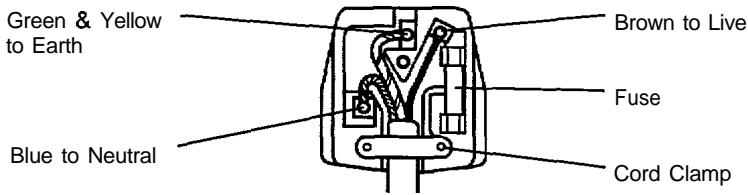
As these colours may not correspond with the coloured markings identifying the terminals in your plug, proceed as follows:
The wire which is coloured GREEN and YELLOW must be connected to the terminal in the plug which is marked with the letter E or by the earth symbol 12 or coloured GREEN or GREEN and YELLOW.
The wire coloured BLUE must be connected to the terminal marked with the letter N or coloured BLUE or BLACK. The wire coloured BROWN must be connected to the terminal marked with the letter L or coloured BROWN or RED.
install the monitor in the following way, taking care to maintain safety.
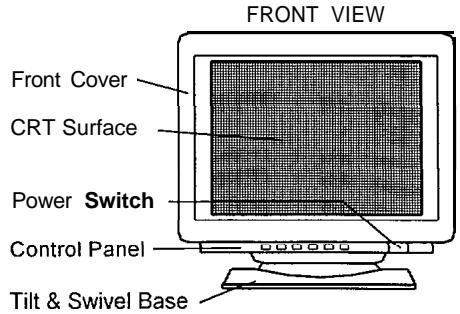
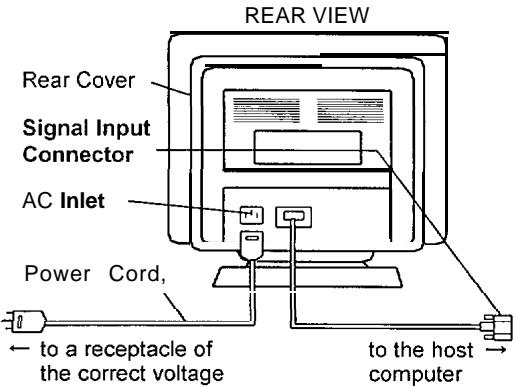
1. Installation
Install the monitor on a horizontal base.
2. Power Cord Connection
① Make sure of using the power cord meeting the safety standard of the country in which you are using the monitor.
② Insert the connector of a power cord to the AC Inlet of the monitor.
③ Insert the plug of the power cord to a power point of the correct voltage.
3. Signal Cable Connection
Insert the Signal Input Connector of the monitor to the host computer, with attention to its suitability, and secure the screws on the connector shell firmly.
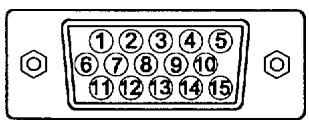
D-Sub Mini 15-pin Connector
| Pin No. | Signal |
| 1 | Red Video |
| 2 | Green Video (Sync. optional) |
| 3 | Blue Video |
| 4 | Ground |
| 5 | DDC Ground |
| 6 | Red Ground |
| 7 | Green Ground |
| 8 | Blue Ground |
| 9 | No connection |
| 10 | Ground |
| 11 | Ground |
| 12 | Bi-directional Data [SDA] |
| 13 | H.Sync. (or H/V) |
| 14 | V.Sync. [VCLK] |
| 15 | Data Clock [SCL] |
4. Power On
Turn on the Power Switch of the monitor first, then the computer.
Refer to Page 10 "POWER ON/OFF".

STANDARD SETTINGS
Microprocessor-based preset functions can store 25 sets of geometry settings including the standard settings. The following industrial standard settings have been pre-programmed by the factory.
| No. | Video Mode Name(with Resolution and Vertical Frequency) | HorizontalFrequency | VideoMode |
| 1 | VGA 640 × 400 - 70 Hz | 31.47 kHz | VGA |
| 2 | VESA 800 × 600 - 85 Hz | 53.67 kHz | VESA |
| 3 | VESA 1024 × 768 - 85 Hz | 68.68 kHz | VESA |
| 4 | VESA 1280 × 1024 - 85 Hz | 91.15 kHz | VESA |
| 5 | VESA 1600 × 1200 - 75 Hz | 93.75 kHz | VESA |

NOTE :
- Input signals with approximately the same frequencies may be regarded as the same signal.
The following horizontal timing conditions are recommended (at sync. H, V separate or H/V composite).
for 31kHz - 45kHz horizontal frequency: Horizontal front porch should be more than 0.1~ s . Horizontal sync. width should be within 1.0 - 3.8~ s . Horizontal back porch should be more than 1.2~ s . Horizontal blanking width should be more than 3.5~ s .
for 45kHz - 95kHz horizontal frequency: Horizontal front porch should be more than 0.1~ s . Horizontal sync. width should be within 1.0 - 3.0~ s . Horizontal back porch should be more than 1.1 s . Horizontal blanking width should be more than 3.0~ s .
The following vertical timing conditions are recommended. Vertical front porch should be more than 10~ s Vertical sync. width should be less than 200~ s Vertical back porch should be more than 400~ s Vertical blanking width should be more than 500~ s
In case the front or back porch is extremely long, or the data display time is extremely short, it may not be able to set the expected size and position.
Standard settings are subject to change without notice.
POWER ON/OFF
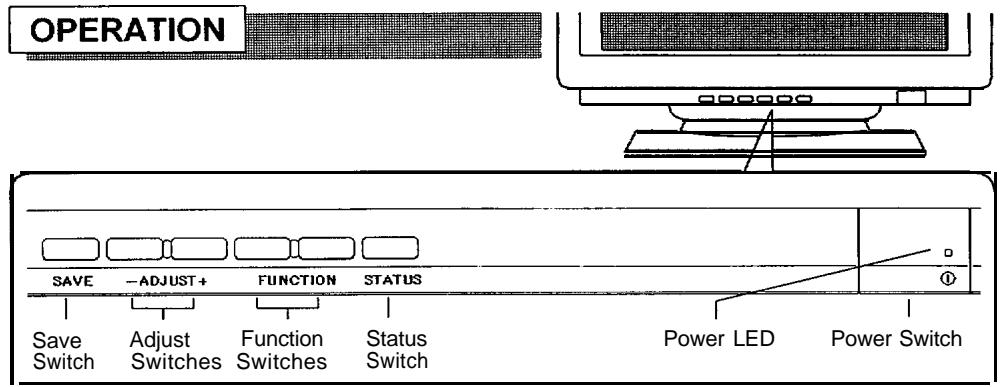
Press the Power switch, to switch the power ON or OFF.
When power is ON, the power LED lights.
■ After turning OFF the switch, wait at least 5 seconds before restarting the monitor. Otherwise the monitor may operate incorrectly.
If the picture doesn't appear, turn OFF the power switch, make sure of the following and wait at least 30 seconds before restarting the monitor. Make sure the power switch of the computer, power cord connection, signal cable connection and the input sync. signal are correct.
CONTROL
① Press the Status switch. The On Screen Display function of "EasyMenu" then shows the selected function, its condition, the function menu and the input signal frequencies.
■ You can select the EasyMenu language. Use the function "LANGUAGE SELECT".
② To select the function, use the Function switches.
③ To execute the selected function, use the Adjust Switches in the Table-1 overleaf.
You can save the your geometry and colour settings. Refer to "SAVE" below.
■ To clear the EasyMenu, either push the status switch again or wait for 10 seconds.
SAVE
Press the Save switch, to save your all geometry and colour settings. And then "SAVED!" will appear under the function menu.
If the function "AUTO SAVE" is ON, you can save automatically at clearing the EasyMenu.
Table-1
| Function | - | + | |
| CONTRAST | makes the Contrast intensity weaker. | makes the Contrast intensity stronger. | |
| BRIGHTNESS | makes Brightness darker. | makes Brightness brighter. | |
| H.SIZE | shrinks horizontally. | expands horizontally. | |
| H POSITION | moves the position to the left. | moves the position to the right. | |
| V.SIZE | shrinks vertically. | expands vertically. | |
| V.SIZE | moves the position down. | moves the position up. | |
| ROTATION | rotates counter clockwise. | rotates clockwise. | |
| PINCUSHION | curves the left/right sides inward. | curves the left/right sides outwards. | |
| TRAPEZOID | shrinks the top side, and expands the bottom side. | expands the top side, and shrinks the bottom side. | |
| PIN BALANCE | curves the left/right sides to the left. | curves the left/right sides to the right. | |
| PARALLELOGRAM | tilts to the right. | tilts to the left. | |
| RECALL | recalls the factory preset modes. (Refer to Page 9 "STANDARD SETTINGS".) | ||
| COLOR SELECT | changes the colour to the previous mode. USER→6500*K→9300*K | changes the colour to the next mode. 9300*K→6500*K→USER | |
| COLOR BALANCE | R | makes the Green and Blue stronger. When the Green or Blue reaches the upper limit, it makes the Red weaker. | makes the Red stronger. When the Red reaches the upper limit, it makes the Green and Blue weaker. |
| G | makes the Blue and Red stronger. When the Blue or Red the reaches the upper limit, it make the Green weaker. | makes the Green stronger. When the Green reaches the upper limit, it makes the Blue and Red weaker. | |
| B | makes the Red and Green stronger. When the Red or Green reaches the upper limit, it make the Blue weaker. | makes the Blue stronger. When the Blue reaches the upper limit, it makes the Red and Green weaker. | |
| Function | - | + | |
| LANGUAGE SELECT | changes the EasyMenu language to the previous mode. FRANÇAIS (French) 1 ITALIANO (Italian) 1 ESPANOL (Spanish) 1 DEUTSCH (German) 1 ENGLISH | changes the EasyMenu s language to the next mode. ENGLISH 1 DEUTSCH (German) ↓ ESPANOL (Spanish) 1 ITALIANO (Italian) ↓ FRANÇAIS (French) | |
| POWER MANAGEMENT | disables (OFF) the Power Saving System. Refer to Page 13 "POWER MANAGEMENT SYSTEM" | enables (ON) the Power Saving Systems. Refer to Page 13 "POWER MANAGEMENT SYSTEM". | |
| AUTO SAVE | disables (OFF) the Auto Save function. Refer to Page 10 "SAVE". | enables (ON) the Auto Save function. Refer to Page 10 "SAVE". | |
| DEGAUSS A | degauss. Use this function only when you see colour impurities on the screen after turning ON the monitor. Wait for about 10 minutes before repeating the function. Remember, the monitor is automatically degaussed during initial power on. | ||
| EXIT | quits the functions of EasyMenu. | ||
When the monitor has detected the change of the signal input condition, the monitor will indicate the condition automatically, as follows.
| Indication | Sample of EasyMenu | Condition |
| The EasyMenu indicates the horizontal frequency and vertical frequency. Precision frequency, Horizontal ±2kHz approx. Vertical ±2Hz approx. | - CONTRAST - - - - - - - - - - - - - - - - - - - - - - - - - - - - - - - - - - - - - - - - - - - - - - - - - - - - - - - - - - - - - - - - - - - - - - - - - - - - - - - - - - - - - - - - - - - - - - - - - - - - 60Hz - - - - - - - - - - - - - - - - - - - - - - - - - - - - - - - - - - - - - - - - - - - - - - - - - - - - - - - - - - - - - - - - - - - - - - - - - - - - - - - - - - - - - - - - - - - - - - - - - - - - 31.5kHz/ 60Hz - - - - - - - - - - - - - - - - - - - - - - - - - - - - - - - - - - - - - - - - - - - - - - - - - - - - - - - - - - - - - - - - - - - - - - - - - - - - - - - - - - - - - - - - - - - - - - - - NO SYNC.SIGNAL | The monitor detects proper signal. |
| The EasyMenu indicates the message "NO SYNC.SIGNAL". | - - - - - - - - - - - - - - - - - - - - - - - - - - - - - - - - - - - - - - - - - - - - - - - - - - - - - - - - - - - - - - - - - - - - - - - - - - - - - - - - - - - - - - - - - - - - - - - - - - - - - - - - - - - - - - - - - - - - - - - - - - - - - - - - - - - - - - - - - - - - - - - - - - - - - - - - - - - - - - - - - - - - - - - - - - - - - - - - - - - - - - - - - - - - - - - - - - - - - - - INVALID SCAN FREQ. | The monitor detects no sync. signal. |
| The EasyMenu indicates the message "INVALID SCAN FREQ." | - | The monitor detects a sync. signal which is out of specification, or unstable. |
| The Power LED lights orange. | - | The monitor is in OFF mode. Refer to "POWER MANAGEMENT SYSTEM" below. |
POWER MANAGEMENT SYSTEM
This monitor meets the ENERGY STAR*, VESA DPMS (Display Power Management Signaling) standard and NUTEK specifications. The monitor has a built-in power management system that automatically reduces power consumption when the PC is not in use. This power management system is effective only when used with VESA DPMS compliant PC or Video Card.
| APM State | Signal Requirement | Monitor Action | Power Consumption | Power LED |
| Standby | H.Sync. OFF | Switches to saving mode & screen darkens | 15W max. | Orange |
| Suspend | V.Sync. OFF | 15W max. | Orange | |
| Off | H.Sync. OFF and V.Sync. OFF | 5W max. | Orange |
Note the monitor receives the first signal from the PC and initiate the power management system.
PLUG & PLAY
This monitor complies with VESA DDC 1/2B specifications. Plug & Play is a system with computer, peripherals (including monitors), and operating system. It works when the monitor is connected to DDC ready computer that is running an operating system software that is capable for the plug & play.
CRT
17 inch picture tube,
0.22 mm horizontal dot pitch
(0.21 mm horizontal mask pitch)
90^ deflection, FS double focus, AR-ASC coating.
Input Signal
Video : 0.7 Vp-p, analog
Sync. : Separate H/V, TTL level
Composite H/V, TTL level
Synchronisation
Horizontal:31-95kHz
Vertical : 50 - 130 Hz
Resolution
Horizontal : 1600 dots (max.)
Vertical : 1200 lines (max.)
Video Clock frequency
150 MHz (typical)
Viewable Image Size
15.9 inches (404 mm), diagonal (typical)
Viewable Image Area
Horizontal : 325 mm (typical)
Vertical : 245 mm (typical)
Colour Temperature
9300°K : Standard colour balance, 9300°K
6500"K :Standard colour balance,6500"K
USER :Userdefined
Warm-up Time
30 minutes to reach optimum performance level.
Power Supply
AC 100 - 120 / 200 - 240 V (automatically selected)
50/60 Hz, 2.5 A (max.)
Power Consumption: 135 W (max.)
(provided with power save circuit.)
Dimensions
412(W) X 402(H) X 413.5 (D) mm
(including Tilt & Swivel Base)
Weight
17.0 kg (approx.)
(including Tilt & Swivel Base)
Environmental
Condition
Temperature
Humidity
Operation
5^ to 35^
10% to 80%
Storoe
-20°C to 60°C
10% to 90%
Specification and Design are subject to change without notice.