
CM821FET - Computer monitor HITACHI - Free user manual and instructions
Find the device manual for free CM821FET HITACHI in PDF.


| Product type | Computer monitor (CRT cathode ray tube) |
| Brand | HITACHI |
| Model | CM821FET |
| Screen size (diagonal) | 21 inches (53.3 cm) |
| Maximum resolution | 1600 x 1200 pixels |
| Refresh rate | 85 Hz (max) |
| Input connectors | VGA (D-Sub 15), BNC (optional) |
| Power supply | 100-240 V AC, 50/60 Hz |
| Power consumption (typical) | 120 W |
| Standby power consumption | Less than 5 W |
| Weight | 28 kg |
| Dimensions (W x H x D) | 495 x 500 x 490 mm |
| Display type | Cathode ray tube (CRT), anti-glare surface |
| Main features | OSD settings (brightness, contrast, geometry, color), degaussing, screen saver |
| Maintenance and cleaning | Clean the screen with a soft, dry cloth. Do not use abrasive products or solvents. |
| Safety | Do not open the casing (risk of electric shock). Use a grounded power outlet. |
| Spare parts and repairability | Parts available from HITACHI after-sales service. Repairability index: not communicated. |
| General information | User manual downloadable in PDF format. Support: france.consumateur@hitachi-eu.com |
Frequently Asked Questions - CM821FET HITACHI
User questions about CM821FET HITACHI
0 question about this device. Answer the ones you know or ask your own.
Ask a new question about this device
Download the instructions for your Computer monitor in PDF format for free! Find your manual CM821FET - HITACHI and take your electronic device back in hand. On this page are published all the documents necessary for the use of your device. CM821FET by HITACHI.
USER MANUAL CM821FET HITACHI
EasyMenu is HITACHI's On Screen Display function for easy operation.
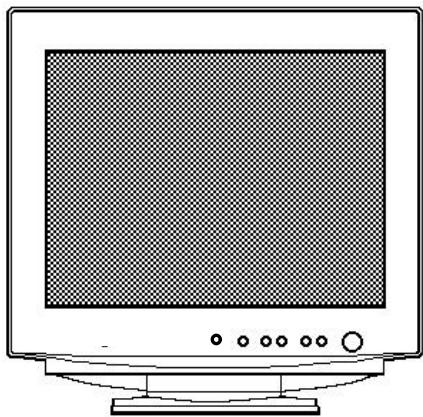
READ THE INSTRUCTIONS INSIDE CAREFULLY. KEEP THIS USER MANUAL FOR FUTURE REFERENCE.
For future reference, record the serial number of your colour monitor.
SERIAL No.
The serial number is located on the rear of the monitor.
This monitor is ENERGY STAR® compliant when used with a computer equipped with VESA DPMS.
The ENERGY STAR® emblem does not represent EPA endorsement of any product or service.
As an ENERGY STAR® Partner, Hitachi,Ltd. has determined that this product meets the ENERGY STAR® guidelines for energy efficiency.



Congratulations on your selection of a HITACHI Colour Monitor.
Read the instructions inside carefully, and keep this user manual for future reference.
NOTE:
The information in this manual is subject to change without notice.
- The manufacturer assumes no responsibility for any errors that may appear in this manual.
- The reproduction, transmission or use of this documents or contents is not permitted without express written authority.
TRADEMARK ACKNOWLEDGEMENT:
VGA is a registered trademark of International Business Machines Corporation.
VESA is a trademark of a nonprofit organization, Video Electronics Standard Association.
ENERGY STAR® is a trademark of Environmental Protection Agency (EPA).
CONTENTS
FEATURES 1-2
CAUTIONS 1-3
INSTALLATION 1-7
OPERATION 1-9
POWERSAVINGSYSTEM 1-16
PLUG & PLAY 1-16
SIGNAL CHECK 1-16
TROUBLESHOOTING 1-17
SPECIFICATIONS 1-18
Tables:
Table 1-1. Adjustment Table. 1 - 11
Table 1-2. Power Saving System 1 - 16
Table 1-3. Signal Check 1 - 16
Table 1-4. Troubleshooting 1 - 17
Table 1-5. Standard Settings 1 - 19
Table 1-6. Pin Assignment 1 - 20
This Colour monitor provides the following features.
Sharpest Focus and Highest Contrast
Flat screen Enhanced Dot Pitch (EDP) CRT with anti-glare, dynamic focus circuit, dark glass and an INVAR shadow mask gives the sharpest focus and highest contrast to minimize eye fatigue.
Wide-range Multi-Scanning
Automatic scanning and automatic adjustment to conform to a wide range of scanning frequencies and user requirements.
Digital Picture Control Function
Position, size, pincushion, trapezoid, parallelogram, etc. are adjustable through digital controls. Geometry settings can be stored for different H/V frequencies.
Microprocessor-based preset functions can store 37 sets of geometry settings, including the default factory settings.
Digital Colour Control Function
Red, green, and blue colour balance are adjustable through digital control. An adjusted colour setting can be stored and recalled through the colour select function.
Power Saving System
The Environmental Protection Agency (EPA) has established a voluntary program by which manufacturers enable computer products to go into low power states while not being used. This monitor has a low power "sleep" mode, which is compliant with the EPA requirements for the ENERGY STAR® program, and will assist you in conserving energy.
Please refer to the section of "POWER SAVING SYSTEM" for details.
EasyMenu
An On Screen Display function that allows easy access to adjust all operations from the front panel.
Plug & Play
This monitor is VESA DDC1/2B compliant when used with a computer compliant with VESA DDC (Display Data Channel).
Automatic colour purity correction
The monitor uses an advanced technology to detect magnetic fields (geomagnetism) and automatically adjusts the image to reduce colour purity distortions common with many monitors.
NOTE:
If as an advanced user, you decide to use an external degaussing coil (other than the degaussing function included in the digital controls of the monitor) it is strongly suggested that the monitor be turned off. If you leave the monitor on while using the external degaussing coil it may cause the monitor to produce uneven colour.

Discontinue Use if Abnormal Operation Occurs!
Abnormal operations such as smoke, burning smell, excessive sound, etc. could cause fire or electrical shock. If you observe any abnormal operation, you should turn off the monitor and disconnect the power plug from the power outlet. You should check for smoke or fire and contact your dealer.
Do not expose the monitor to physical impact!
Do not allow foreign objects (water, metal, etc.) inside!
Never remove the cover of the monitor!
This colour monitor contains high voltage components. Ask your dealer to repair or clean the inside if necessary
The power outlet should be close to the monitor and easily accessible!
Install the unit in an suitable environment!
Do not expose the monitor to rain, moisture, dust, corrosive gases, vibrations, etc. to prevent electrical shock or fire hazard.
Avoid placing the monitor in direct sunlight or near heating appliances.
Do not place the monitor on an unstable base.
Keep in a well ventilated area!
Do not cover this monitor, nor place anything against any of its sides (not only the top, but also including the right and left side of the monitor). The ventilation holes in the cover prevent excessive temperatures inside the monitor.
Beware of magnetic fields!
DO NOT place a magnet, loudspeaker system, floppy disk drive, printer, or any appliance which generates a magnetic field near the unit. A magnetic field may cause blurred colours or distortion of the displayed pattern.
Mind the ambient illumination!
Avoid direct sunlight or artificial light shining directly onto the CRT screen in order to prevent eye fatigue.
Enclosed power cord must be used!
Failure to do so may cause fire or electrical shock hazard.
Use only the correct voltage power outlet with grounded connection!
This monitor will automatically adjust to the input voltage 100 - 120 / 200 - 240V.
Beware of the power cord connection!
Before inserting the plug of the power cord into a power outlet of the correct voltage, check that the connection portion of the power cord is clean (with no dust). Then, insert the plug of power cord into a power outlet firmly to avoid electrical shock or fire hazard.
Remove the power cord for complete disconnection!
For complete disconnection from the power source, remove the power cord from either the monitor or wall socket.
CAUTION (for 200 - 240V operation only)
This equipment relies on the protective devices in the building installation for short-circuit and power surge protection. Refer to the following table for the suitable number and location of the protective devices which should be present in the building's installation.
Informative examples of protective devices in single - phase equipment or sub-assemblies
| Protection against | Minimum number of fuses or circuit - breaker poles | Location | |
| Case A: Equipment connected to POWER SYSTEMS with reliable identified grounded neutral, except for Case C below. | Grounding faults | 1 | Phase conductor |
| Power surge | 1 | Either of the two conductors | |
| Case B: Equipment that is connected to any power supply, including IT POWER SYSTEMS and supplies with reversible plugs, except for Case C below. | Grounding faults | 2 | Both conductors |
| Power surge | 1 | Either of the two conductors | |
| Case C: Equipment that is connected to 3-wire power systems with reliable identified grounded neutral. | Grounding faults | 2 | Each phase conductor |
| Power surge | 2 | Each phase conductor |
Verify that the protective devices in the building installation meet the conditions in the table prior to installing the equipment.
Be careful of static electricity on the CRT surface!
To prevent electrical shock through static electricity on the CRT surface, disconnect the power cord for at least 30 seconds after turning OFF the power before touching the monitor's surface.
Avoid frequent turning ON and OFF switching!
Do not repeatedly turn the monitor OFF and ON during a short period of time. This may cause blurred colours or distortion of the displayed patterns.
Beware of generated magnetism!
After the power has been turned ON, or when the degauss function has been manually engaged, the CRT will be demagnetized for approximately 7 seconds. This generates a strong magnetic field around the front cover which may affect data stored on magnetic tape or disks near this front cover. Move such magnetic recording equipment as well as tapes and disks away from this unit.
Cleaning the Monitor
Before cleaning, turn the monitor OFF and disconnect the plug from the power outlet. For the screen, use water with a lightly moistened soft cloth such as a gauze type material. For the cover, use water or a liquid (non-solvent) synthetic detergent, with a lightly moistened soft cloth. Do not clean the inside of monitor by yourself. Refer this to your dealer.
Do not use aerosol sprays, solvents or abrasive cleaners.
FCC Statement Warning
WARNING : This equipment has been tested and found to comply with the limits for a Class B digital device, pursuant to Part 15 of the FCC Rules. These limits are designed to provide reasonable protection against harmful interference in a residential installation. This equipment generates, uses, and can radiate radio frequency energy and, if not installed and used in accordance with the instructions, may cause harmful interference to radio communications. However, there is no guarantee that interference will not occur in a particular installation. If this equipment does cause harmful interference to radio or television reception, which can be determined by turning the equipment off and on, the user is encouraged to try to correct the interference by one or more of the following measures:
- Reorient or relocate the receiving antenna.
- Increase the separation between the equipment and receiver.
- Connect the equipment into an outlet on a circuit different from that to which the receiver is connected.
- Consult the dealer or an experienced radio / TV technician for help.
INSTRUCTIONS TO USERS : This equipment complies with the requirements of FCC (Federal Communication Commission) equipments provided that following conditions are met.
(1) Power cord: Unshielded power cord must be used.
(2) Video inputs: The input signal amplitude must not exceed the specified level.
CAUTION : Changes or modifications not expressly approved by the party responsible for compliance could void the user authority to operate the equipment.
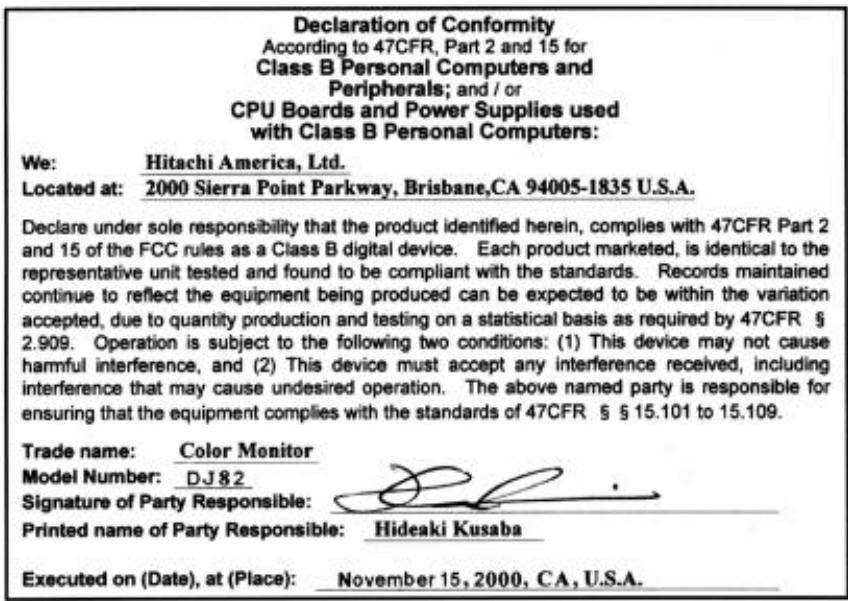
For Customers in CANADA
NOTICE : This Class B digital apparatus complies with Canadian ICES-003.
For the Customers in the UK
THIS PRODUCT IS SUPPLIED WITH A 2-PIN MAINS PLUG FOR USE ON MAINLAND EUROPE. FOR THE UK PLEASE REFER TO THE NOTES ON THIS PAGE.
IMPORTANT FOR UNITED KINGDOM
WORDING FOR CLASS EQUIPMENT INSTRUCTION BOOKS AND LABELS
The mains lead on this equipment is supplied with a molded plug incorporating a fuse, the value of which is indicated on the pin face of the plug. Should the fuse need to be replaced, an ASTA or BSI approved BS 1362 fuse of the same rating must be used. If the fuse cover is detachable, never use the plug with the cover omitted. If a replacement fuse cover is required, ensure it is of the same colour as visible on the pin face of the plug. Fuse covers are available from your dealer.
DO NOT cut off the mains plug from this equipment. If the plug fitted is not suitable for the power outlets in your home or the cable is too short to reach a power outlet, obtain an appropriate safety approved extension lead, or consult your dealer.
Changing the mains plug, if necessary, should be carried out by an qualified electrician.
If there is no alternative to cutting off the mains plug, ensure that you dispose of it immediately, having first removed the fuse, to avoid a possible shock hazard by inadvertent connection to the mains supply.
WARNING: THIS EQUIPMENT MUST BE GROUNDED
IMPORTANT
The wires in the mains lead are coloured in accordance with the following code:
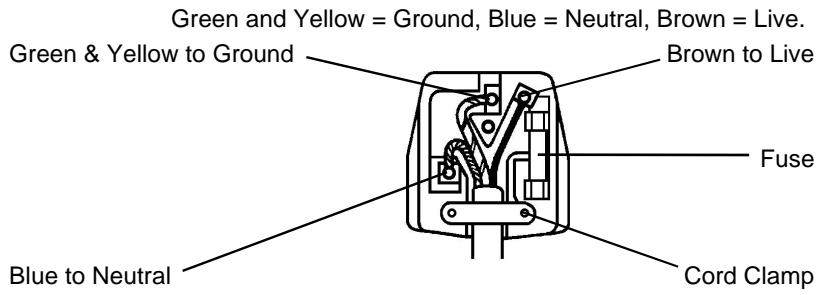
As these colours may not correspond with the coloured markings identifying the terminals in your plug, proceed as follows:
The wire which is coloured GREEN and YELLOW must be connected to the terminal in the plug which is marked with the letter E or by the earth symbol 山 or coloured GREEN or GREEN and YELLOW.
The BLUE coloured wire must be connected to either N-marked terminal or the BLUE or BLACK coloured terminal. The BROWN coloured wire must be connected to either L-marked terminal or the BROWN or RED coloured terminal.
Before installing, carefully read the chapter "CAUTIONS".
Checking the contents
Check whether the consignment agrees with the following packing list. Should you discover that the equipment has been damaged during transport, or that the consignment does not correspond with the delivery list, please notify your dealer immediately.
Delivery Note: one Monitor
one Power Cord
one Signal Cable
this User Manual
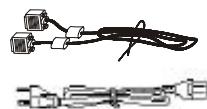
NOTE: Keep the original packing material as you will be required to use it for shipping if your monitor needs warranty service.
Connecting the monitor
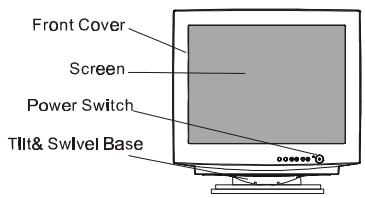
Front View
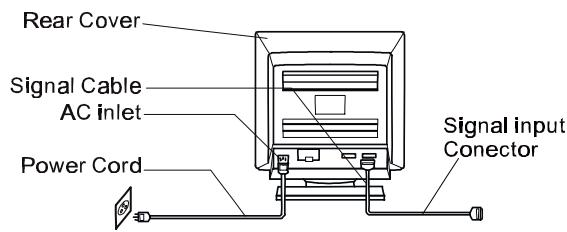
to the power outlet of the correct voltage

to the host computer
1. Installation
Install the monitor in a suitable environment.
Do not place the monitor on an unstable base.
Do not expose the monitor to rain, moisture, dust, corrosive gases, vibrations, etc. so as to prevent electrical shock or fire hazard.
Avoid placing the monitor in direct sunlight or near heating appliances.
2. Signal Cable Connection
(1) Use video signal cable which is included in the carton box. (Cable part number: DC190018510 )
(2) Insert the connector of a signal cable to the Signal Input Connector of the monitor, with attention to the suitability, and secure the screws on the connector shell firmly.
(3) Connect the other connector end of the signal cable to the host computer.
3. Power Cord Connection
(1) Make sure to use a power cord that meets the safety standard of the country in which you are using the monitor.
(2) Insert the connector of the power cord to the AC Input of the monitor.
(3) Insert the plug of the power cord into a power outlet of the correct voltage.
Before inserting the plug of the power cord into a power outlet of the correct voltage, check that the connection portion of the power cord is clean (with no dust).
Then firmly insert the plug of power cord into a power outlet to avoid an electrical shock or fire hazard.
Power ON/OFF
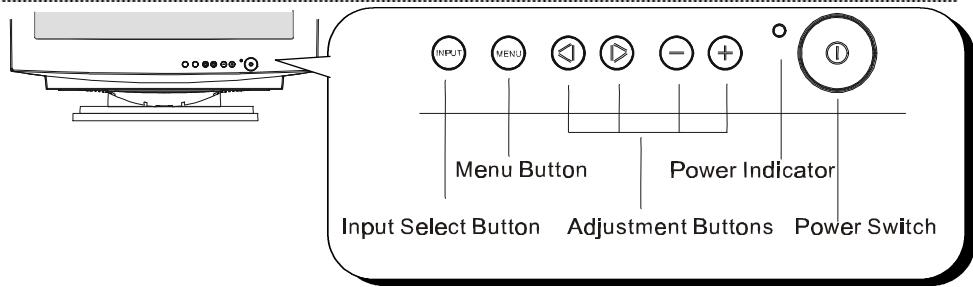
Press the power switch to switch the power ON or OFF. When the power is ON, the power indicator will light up.
NOTE:
- First turn on the monitor, then the computer.
After turning OFF the power switch, wait at least 5 seconds before restarting the monitor. If this 5 second delay is not observed, the monitor may operate incorrectly.
Input Select
This monitor has two input terminals, INPUT1 and INPUT2. This will let you connect two computers simultaneously. When two computers are active, you can switch the input signal by uses the Input Select Button. Every time this button is pushed, the monitor alternately uses the input signal from either INPUT1 and INPUT2 (computer 1 or 2).
NOTE:
- The Plug and Play function is only supported on INPUT1, and not supported INPUT2.
Brightness/Contrast Adjustment
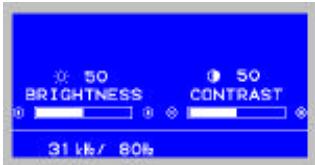
(1) Press one of the adjustment buttons when the OSD (On Screen Display) is not shown. The OSD function "EasyMenu" will then show the brightness and contrast settings.
(2) To adjust these settings, use the adjustment buttons ③ / ⑥ for brightness, and / for contrast.
Other Functions
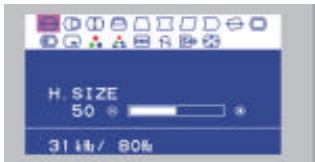
(1) Press the menu button when the OSD is not shown. The OSD function "EasyMenu" will then show the main menu. The EasyMenu has 4 submenus (Screen Menu, Recall Menu, OSD Menu and Colour Menu). You can call these up through the main menu functions.
(2) To select the menu function, use the adjustment buttons ① / ⑥ .
(3) To execute the selected function, use the adjustment buttons / as shown in Table 1-1.
Brightness/Contrast Menu
Main Menu
NOTE:
- You can select the OSD language by using the "LANGUAGE SELECT" function of the "OSD MENU".
To return to the main menu from any sub menu, simply press the menu button. - To clear the OSD, press the menu button at the main menu, then choose the "OSD EXIT" function, or wait for a few seconds, the menu window will disappear automatically.
- The adjusted settings will be stored automatically. The OSD might flicker and off for a short period while the OSD is displayed in certain screen settings. This phenomenon is not a failure. Simply move the OSD position a little up or down, and the OSD will become stable.
Table 1-1. Adjustment Table
| Item | Adjustment button | Function | ||
| BRIGHTNESS | ◎ | decreases the picture's brightness | ||
| ◎ | increases the picture's brightness | |||
| CONTRAST | ◎ | |||
| makes the picture's contrast darker (not including the background). | ||||
| makes the picture's contrast brighter (not including the background). | ||||
| MAIN MENU | ◎ | change to the previous mode.H. SIZE ZOOMOSD EXIT DEGAUSS DMSCOLOUR MENU? COLOUR SELECT OSD MENU? RECALL MENU? SCREEN MENU? ROTATIONPIN. BALANCE PARALLELOGRAM PINCUSHION TRAPEZOIDV. POSITION V. SIZEH. POSITION H. SIZE | ||
| ◎ | changes to the next mode.H. SIZE H. POSITIONV. SIZE V. POSITIONTRAPEZOID PINCUSHIONPARALLELOGRAM PIN. BALANCEROTATION SCREEN MENU?RECALL MENU? OSD MENU?COLOUR SELECT COLOUR MENU?DMS DEGAUSS OSD EXIT ZOOM H. SIZE | |||
| H. SIZE | ◎ | |||
| shrinks the picture horizontally. | ||||
| expands the picture horizontally. | ||||
| H. POSITION | ◎ | |||
| moves the picture position to the left. | ||||
| V. SIZE | ◎ | |||
| shrinks the picture vertically. | ||||
| expands the picture vertically. | ||||
| V. POSITION | ◎ | |||
| moves the picture position down. | ||||
| moves the picture position up. | ||||
| (MAIN MENU) | ||||
| TRAPEZOID | ◎ | shrinks the top side of the picture, and expands the bottom side of the picture. | ||
| expands the top side of the picture, and shrinks the bottom side of the picture. | ||||
| PINCUSHION | ◎ | curves the left and right side of the picture inward. | ||
| curves the left and right side the picture outwards. | ||||
| PARALLELOGRAM | ◎ | tilts the picture to the left. | ||
| tilts the picture to the right. | ||||
| PIN. BALANCE | ◎ | curves the left and right side of the picture to the left. | ||
| curves the left and right side of the picture to the right. | ||||
| ROTATION | ◎ | rotates the picture counter clockwise. | ||
| rotates the picture clockwise. | ||||
| SCREEN MENU? | ◎ | (no function) | ||
| Calls up the "SCREEN MENU". | ||||
| RECALL MENU? | ◎ | (no function) | ||
| Calls up the "RECALL MENU". | ||||
| OSD MENU? | ◎ | (no function) | ||
| Calls up the "OSD MENU". | ||||
| COLOUR SELECT | ◎ | changes the colour to the previous mode. DMS USER 5000 6500 9300 DMS | ||
| changes the colour to the next mode. DMS 9300 6500 5000 USER DMS | ||||
| COLOUR MENU? | ◎ | (no function) | ||
| Calls up the "COLOUR MENU". | ||||
| DMS | ◎ | cancels the DMS mode. (NO) | ||
| sets the DMS mode. (YES) It increases the brightness for the dynamic motion picture system. | ||||
| DEGAUSS | ◎ | (no function) | ||
| executes degaussing. (YES) | ||||
(Continued on the next page.)
Table 1-1. Adjustment Table (Continued)
| Item | Adjustment button | Function | |||
| (MAIN MENU) | |||||
| OSD EXIT | ◎ | (no function) | |||
| ⊕ | clears the OSD. (YES) | ||||
| ZOOM | ◎ | shrinks the picture horizontally and vertically. | |||
| ⊕ | expands the picture horizontally and vertically. | ||||
| SCREEN MENU | ◎ | changes to the previous mode.H. MOIRE HEMISPHEREV. LIN. BALANCEV. LINEARITYV. CONV.H. CONVBOTTOM CORNERTOP CORNERV. FOCUSH. FOCUSV. MOIRE H. MOIRE | |||
| ◎ | changes to the next mode.H. MOIRE V. MOIREH. FOCUSV. FOCUSTOP CORNERBOTTOM CORNERH. CONV.V. CONV.V. LINEARITYV. LIN. BALANCEHEMISPHERE H. MOIRE | ||||
| H. MOIRÉ | ◎ | makes the operation of the horizontal moiré changing circuit weaker. | |||
| ⊕ | makes the operation of the horizontal moiré changing circuit stronger. | ||||
| V. MOIRÉ | ◎ | makes the operation of the vertical moiré changing circuit weaker. | |||
| ⊕ | makes the operation of the vertical moiré changing circuit stronger. | ||||
(Continued on the next page.)
NOTE:
- Moiré may appear on the screen due to interference between CRT dot pitch and video signal due to the settings of video image, display size, display brightness, etc. Adjust the settings of the display size, display brightness, etc., before adjusting moiré.
- In some cases, this function may cause deterioration of the display quality, such as focus, jitter, etc.
- If as an advanced user, you decide to use an external degaussing coil (other than the degaussing function included in the digital controls of the monitor) it is strongly suggested that the monitor be turned off. If you leave the monitor on while using the external degaussing coil it may cause the monitor to produce uneven colour.
Table 1-1. Adjustment Table (Continued)
| Item | Adjustment button | Function | |||
| (SCREEN MENU) | |||||
| H. FOCUS | - | makes the horizontal dynamic focus weaker. | |||
| + | makes the horizontal dynamic focus stronger. | ||||
| V. FOCUS | - | makes the vertical dynamic focus weaker. | |||
| + | makes the vertical dynamic focus stronger. | ||||
| TOP CORNER | - | curves the left and right top corners of the picture inwards. | |||
| + | curves the left and right top corners of the picture outwards. | ||||
| BOTTOM CORNER | - | curves the left and right bottom corners of the picture inwards. | |||
| + | curves the left and right bottom corners of the picture outwards. | ||||
| H.CONV. | - | moves red to the left and blue to the right. | |||
| + | moves red to the right and blue to the left. | ||||
| V.CONV. | - | moves red down and blue up. | |||
| + | moves red up and blue down. | ||||
| V. LINEARITY | - | expands the top and the bottom of the picture vertically. | |||
| + | shrinks the top and the bottom of the picture vertically. | ||||
| V. LIN. BALANCE | - | shrinks the top and expands the bottom of the picture vertically. | |||
| + | expands the top and shrinks the bottom of the picture vertically. | ||||
| HEMISPHERE | - | set the northern hemisphere mode. (N) | |||
| + | set the southern hemisphere mode. (S) | ||||
| RECALL MENU | - | changes to the previous mode. TOTAL RESET SINGLE RECALL | |||
| - | changes to the next mode. SINGLE RECALL TOTAL RESET | ||||
| SINGLE RECALL | - | (unavailable) (NO) | |||
| + | recalls the default settings for the current signal mode only. (YES) | ||||
| TOTAL RESET | - | (unavailable) (NO) | |||
| + | recalls all factory settings and deletes the all user settings. (YES) To activate the TOTAL RESET command, you will begin by pressing the button +. At this time the OSD background will be red. To apply the TOTAL RESET, simply press the button + again and all user data will be erased. | ||||
| OSD MENU | ← | changes to the previous mode. OSD H. POS. LANGUAGE SELECT OSD V. POS. OSD H. POS. | |||
| ← | changes to the next mode. OSD H. POS. OSD V. POS. LANGUAGE SELECT OSD H. POS. | ||||
| OSD H. POS. | ← | moves the OSD to the left. | |||
| moves the OSD to the right. | |||||
| OSD V. POS. | ← | moves the OSD down. | |||
| moves the OSD up. | |||||
| LANGUAGE SELECT | ← | changes to the previous mode. ENGLISH FRANÇAIS (French) ITALIANO (Italian) ESPÁNOL (Spanish) DEUTSCH (German) ENGLISH | |||
| changes to the next mode. ENGLISH DEUTSCH (German) ESPÁNOL (Spanish) ITALIANO (Italian) FRANÇAIS (French) ENGLISH | |||||
| COLOUR MENU | ← | changes to the previous mode. R B G R | |||
| ← | changes to the next mode. R G B R | ||||
| R RED | ← | makes the Green and Blue stronger. When the Green or Blue reaches the upper limit, it makes the Red weaker. | |||
| makes the Red stronger. When the Red reaches the upper limit, it makes the Green and Blue weaker. | |||||
| G GREEN | ← | makes the Blue and Red stronger. When the Blue or Red reaches the upper limit, it makes the Green weaker. | |||
| makes the Green stronger. When the Green reaches the upper limit, it makes the Blue and Red weaker. | |||||
| B BLUE | ← | makes the Red and Green stronger. When the Red or Green reaches the upper limit, it makes the Blue weaker. | |||
| makes the Blue stronger. When the Blue reaches the upper limit, it makes the Red and Green weaker. | |||||
POWER SAVING SYSTEM
This monitor complies with VESA and ENERGY STAR® power saving requirements. The power saving system works only when used with VESA DPMS compliant PC's and/or graphic controllers.
Table 1-2. Power Saving System
| VESA DPMS | Power Saving States | ||||
| Power Saving Mode | Video | H. Sync. | V. Sync. | Power | Power Indicator LED |
| ON | Active | Yes | Yes | 120 W (typical) | Lights Green |
| Stand-by | Blanked | No | Yes | Less than 10 W | Lights Orange |
| Suspend | Blanked | Yes | No | ||
| Active OFF | Blanked | No | No | Less than 3 W | |
NOTE:
- When switching the power OFF when the monitor is in Active OFF mode, sometimes the power indicator LED continues to light for a few seconds.
PLUG & PLAY
This monitor complies with VESA DDC1/2B specifications. Plug & Play is a system, by which computer, peripherals (including monitors), and operating system manufacturers comply for this user-friendly function. This function works when the monitor is connected to a DDC enabled computer that is runs on an operating system that incorporates the Plug & Play function.
SIGNAL CHECK
Your monitor is equipped with an automatic Signal Verification System. Table 1-3 below outlines the operation of this system.
Table 1-3. Signal Check
| Signal Condition | Indication of OSD | Power Indicator State |
| Proper signal is detected by the monitor. | The OSD indicates the horizontal frequency and vertical frequency on the adjustment menu. | The power indicator LED lights green. |
| No Sync. Signal is detected by the monitor. | The OSD indicates the message “POWER SAVE” for 5 seconds after which time the unit will enter Power Saving Mode. | After 10 seconds, the colour of the power indicator LED will turn orange. |
| A video signal is applied to the monitor that is beyond the monitor scan range. | The OSD indicates the message “INVALID SCAN FREQ.”. | The power indicator LED will light solid green. |
The following Table 1-4 is provided to assist you with common installation issues.
Table 1-4. Troubleshooting
| Symptom | Solution |
| No power | Verify that the power cord is installed correctly. Press the power switch. |
| No picture | Increase Contrast and Brightness. Check Input Select status. |
| No picture and the power indicator lights orange | Check the Signal Cable Connection. Check the Power Connection to the computer. Check Input Select status. |
| “POWER SAVE” message appears | Check the Signal Cable Connection. Check the Power Connection to the computer. Check Input Select status. |
| “INVALID SCAN FREQ.” message appears | Check the Signal Cable Connection. Check the video input specification. |
| Wavy or elliptical (Moiré) pattern appears | Adjust the unit with the Moiré control as outlined in Table 1-1. |
| Colour is not uniform | Activate Degauss function. |
| Environmental influences | Check to see that no magnetic appliances such as telephones, subwoofer/speakers, fans, or fluorescent lighting are near the monitor. |
CRT
21 inch type picture tube, 0.21- 0.24 mm variable horizontal dot pitch, 0.20- 0.23 mm variable horizontal mask pitch, Invar shadow mask, Black matrix, Short persistence phosphors, Dark tint, Anti-Reflection coat.
Input Signal
Video 0.70 Vp-p, Analogue
Sync. Separate H/V, TTL level
Composite H/V, TTL level
Synchronization
Horizontal 31 - 107 kHz
Vertical 50 - 160 Hz
Resolution
Horizontal up to 1856 dots
Vertical up to 1392 lines
Viewable Image Size 20.0 inches (507 mm), diagonal (typical)
Viewable Image Area
Horizontal 406 mm (typical)
Vertical 305 mm (typical)
Colour Temperature
9300:Standard colour balance, 9300^
6500: Standard colour balance, 6500^
5000: Standard colour balance, 5000^
USER : User defined
DMS : Standard colour balance, 9300^ for the DMS mode
Power Supply AC 100 - 120 / 200 - 240 V (automatically selected)
Power Consumption 120 W (typical) (provided with power save circuit)
Warm-up Time 30 minutes to reach optimum performance level.
Dimensions 488 (W) x 482 (H) x 475 (D) mm (incl. Tilt & Swivel Base)
Weight 30.5 kg (approx.) (including Tilt & Swivel Base)
Environmental Condition
Operating Temperature 5^ to 35^
Operating Relative Humidity 10 to 80% without condensation
Storage Temperature -20°C to 60 °C
Storage Relative Humidity 10 to 90% without condensation
Standard Settings
Microprocessor-based user preset functions can store 32 sets of geometry settings. The following industrial standard settings have been pre- programmed by the factory.
Table 1-5. Standard Settings
| No. | Video Mode Name (with Resolution and Vertical Frequency) | Horizontal Frequency | |||
| 1 | VGA | 640 × | 400 | -70 Hz | 31.47 kHz |
| 2 | VESA | 800 × | 600 | -85 Hz | 53.67 kHz |
| 3 | VESA | 1024 × | 768 | -85 Hz | 68.68 kHz |
| 4 | VESA | 1152 × | 864 | -75 Hz | 67.50 kHz |
| 5 | Mac | 1152 × | 870 | -75 Hz | 68.68 kHz |
| 6 | VESA | 1280 × | 1024 | -85 Hz | 91.15 kHz |
| 7 | VESA | 1600 × | 1200 | -75 Hz | 93.75 kHz |
| 8 | VESA | 1600 × | 1200 | -85 Hz | 106.25 kHz |
| 9 | 1856 × | 1392 | -72 Hz | 102.95 kHz | |
NOTE:
- Input signals with approximately the same frequencies may be regarded as the same signal.
- The following horizontal timing conditions are recommended (at sync. H, V separate or H/V composite).
for 31 kHz - 55 kHz horizontal frequency: Horizontal front porch should be more than 0.1~ s Horizontal sync. width should be within 1.0 - 3.8 s Horizontal back porch should be more than 1.2~ s Horizontal blanking width should be more than 3.5~ s for 55 kHz - 107 kHz horizontal frequency: Horizontal front porch should be more than 0.1~ s Horizontal sync. width should be within 1.0 - 3.0 s Horizontal back porch should be more than 1.1~ s Horizontal blanking width should be more than 2.4~ s .
- The following vertical timing conditions are recommended. Vertical front porch should be more than 10~ s . Vertical sync. width should be less than 200~ s . Vertical back porch should be more than 400~ s . Vertical blanking width should be more than 450~ s .
- In case the front or back porch is extremely long, or the data display time is extremely short, it may not be able to set the expected size and position.
Pin Assignment
Signal Input Connector of the Monitor
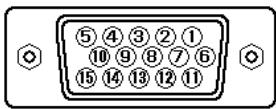
Table 1-6. Pin Assignment
| Pin No. | Input 1 | Input 2 |
| 1 | Red Video | Red Video |
| 2 | Green Video | Green Video |
| 3 | Blue Video | Blue Video |
| 4 | No pin | No pin |
| 5 | No connection | No connection |
| 6 | Red Ground | Red Ground |
| 7 | Green Ground | Green Ground |
| 8 | Blue Ground | Blue Ground |
| 9 | No connection | No connection |
| 10 | Ground | Ground |
| 11 | No connection | No connection |
| 12 | Bi-directional Data [SDA] | No connection |
| 13 | H-Sync. (or H/V) | H-Sync. (or H/V) |
| 14 | V-Sync. [VCLK] | V-Sync. |
| 15 | Data Clock [SCL] | No connection |
TCO'99 STATEMENT

Congratulations!
You have just purchased a TCO'99 approved and labelled product! Your choice has provided you with a product developed for professional use. Your purchase has also contributed to reducing the burden on the environment and also to the further development of environmentally adapted electronics products.
This product meets the requirements for the TCO'99 scheme which provides for an international environmental and quality labelling of personal computers. The labelling scheme was developed as a joint effort by the TCO (The Swedish Confederation of Professional Employees), Svenska Naturskyddsforeningen (The Swedish Society for Nature Conservation), Statens Energimyndighet (The Swedish National Energy Administration) and SEMKO AB.
The requirements cover a wide range of issues: environment, ergonomics, usability, reduction of electric and magnetic fields, energy consumption and electrical safety.
Why do we have environmentally labelled computers?
In many countries, environmental labelling has become an established method for encouraging the adaptation of goods and services to the environment. The main problem, as far as computers and other electronics equipment are concerned, is that environmentally harmful substances are used both in the products and during their manufacture. Since it is not so far possible to satisfactorily recycle the
majority of electronics equipment, most of these potentially damaging substances sooner or later enter nature.
There are also other characteristics of a computer, such as energy consumption levels, that are important from the viewpoints of both the work (internal) and natural (external) environments. Since all methods of electricity generation have a negative effect on the environment (e.g. acidic and climate-influencing emissions, radioactive waste), it is vital to save energy. Electronics equipment in offices is often left running continuously and thereby consumes a lot of energy.
What does the environmental labelling involve?
The environmental demands has been developed by Svenska Naturskyddsforeningen (The Swedish Society for Nature Conservation). These demands impose restrictions on the presence and use of heavy metals, brominated and chlorinated flame retardants, CFCs (freons) and chlorinated solvents, among other things. The product must be prepared for recycling and the manufacturer is obliged to have an environmental policy which must be adhered to in each country where the company implements its operational policy.
The energy requirements include a demand that the computer and/or display, after a certain period of inactivity, shall reduce its power consumption to a lower level in one or more stages. The length of time to reactivate the computer shall be reasonable for the user.
Below you will find a brief summary of the environmental requirements met by this product. The complete environmental criteria document may be ordered from:
TCO Development
SE-114 94 Stockholm, Sweden
Fax: +46 8 782 92 07
Email (Internet): development@tco.se
Current information regarding TCO'99 approved and labelled products may also be
obtained via the Internet, using the address: http://www.tco-info.com/
Environmental requirements
Flame retardants
Flame retardants are present in printed circuit boards, cables, wires, casings and housings. Their purpose is to prevent, or at least to delay the spread of fire. Up to 30% of the plastic in a computer casing can consist of flame retardant substances. Most flame retardants contain bromine or chloride, and those flame retardants are chemically related to another group of environmental toxins, PCBs. Both the flame retardants containing bromine or chloride and the PCBs are suspected of giving rise to severe health effects, including reproductive damage in fish-eating birds and mammals, due to the bio-accumulative processes. Flame retardants have been found in human blood and researchers fear that disturbances in foetus development may occur.
The relevant TCO'99 demand requires that plastic components weighing more than 25 grams must not contain flame retardants with organically bound bromine or chlorine. Flame retardants are allowed in the printed circuit boards since no substitutes are available.
Cadmium**
Cadmium is present in rechargeable batteries and in the colour-generating layers of certain computer displays. Cadmium damages the nervous system and is toxic in high doses. The relevant TCO'99 requirement states that batteries, the colour-generating layers of display screens and the electrical or electronics components must not contain any cadmium.
Mercury**
Mercury is sometimes found in batteries, relays and switches. It damages the nervous system and is toxic in high doses. The relevant TCO'99 requirement states that batteries may not contain any mercury. It also demands that mercury is not present in any of the electrical or electronics components associated with the labelled unit. There is however one exception. Mercury is, for the time being, permitted in the back light system of flat panel monitors as there today is no commercially available alternative. TCO aims on removing this exception when a mercury free alternative is available.
CFCs (freons)
The relevant TCO'99 requirement states that neither CFCs nor HCFCs may be used during the manufacture and assembly of the product. CFCs (freons) are sometimes used for washing printed circuit boards. CFCs break down ozone and thereby damage the ozone layer in the stratosphere, causing increased reception on earth of ultraviolet light with e.g. increased risks of skin cancer (malignant melanoma) as a consequence.
Lead**
Lead can be found in picture tubes, display screens, solders and capacitors. Lead damages the nervous system and in higher doses, causes lead poisoning. The relevant TCO'99 requirement permits the inclusion of lead since no replacement has yet been developed.
- Bio-accumulative is defined as substances which accumulate within living organisms
** Lead, Cadmium and Mercury are heavy metals which are Bio-accumulative.
HITACHI
Hitachi, Ltd. Tokyo, Japan
International Sales Division
THE HITACHI ATAGO BUILDING,
No. 15-12 Nishi Shinbashi, 2 - Chome, Minato - Ku, Tokyo 105-8430, Japan.
Tel: 03 35022111
HITACHI EUROPE LTD,
Whitebrook Park
Lower Cookham Road
Maidenhead
Berkshire
SL6 8YA
UNITED KINGDOM
Tel: 01628 643000
Fax: 01628 643400
Email: consumer-service@hitachi-eu.com
HITACHI EUROPE S.A.
364 Kifissias Ave. & 1, Delfon Str.
152 33 Chalandri
Athens
GREECE
Tel: 1-6837200
Fax: 1-6835964
Email: service.hellas@hitachi-eu.com
HITACHI EUROPE GmbH
Munich Office
Dornacher Strasse 3
Email: HSE-DUS.service@hitachi-eu.com
HITACHI EUROPE S.A.
Gran Via Carlos III, 101-1
08028 Barcelona
SPAIN
Tel: 93 409 2550
Fax: 934913513
Email: atencion.cliente@hitachi-eu.com
HITACHI EUROPE srl
Via Tommaso Gulli N.39, 20147
Milano, Italia
ITALY
Tel: +39 02 487861
Tel: +39 02 38073415 Servizio Clienti
Fax: +39 02 48786381/2
Email: customerservice.italy@hitachi-eu.com
HITACHI Europe AB
Box 77 S-164 94 Kista
SWEDEN
Tel: +46 (0) 856271100
Fax: +46 (0) 8562711 13
Email: csgswe@hitachi-eu.com
HITACHI EUROPE S.A.S
Lyon Office
B.P. 45, 69671 BRON CEDEX
FRANCE
Tel: 04 72 14 29 70
Fax: 04 72 14 29 99
HITACHI EUROPE LTD (Norway) AB
STRANDVEIEN 18
1366 Lysaker
NORWAY
Tel: 67 5190 30
Fax:67519032
Email: csgnor@hitachi-eu.com
HITACHI EUROPE AB
Egebakgard
Egebavej 98
DK-2850 Nauum
DENMARK
Tel: +45 43 43 6050
Fax: +45 43 60 51
Email: csgnor@hitachi-eu.com
HITACHI EUROPE AB
Neopoli / Niemenkatu 73
FIN-15140 Lahti
FINLAND
Tel: +358 3 8858 271
Fax: +358 3 8858 272
Email: csgnor@hitachi-eu.com
Hitachi Europe Ltd
Bergensesteenweg 421
1600 Sint-Pieters-Leeuw
BELGIUM
Tel: +32 2 363 99 01
Fax: +32 2 363 99 00
Email: sofie.van.bom@hitachi-eu.com
HITACHI EUROPE LTD
Na Sychrove 975/8
101 27 Praha 10 - Bohdalec
CZECH REPUBLIC
Tel: +420 267 212 383
Fax: +420 267 212 385
Email: csgnor@hitachi-eu.com
- READ THE INSTRUCTIONS INSIDE CAREFULLY. KEEP THIS USER MANUAL FOR FUTURE REFERENCE.
- NOTE:
- TRADEMARK ACKNOWLEDGEMENT:
- CONTENTS
- Tables:
- Sharpest Focus and Highest Contrast
- Wide-range Multi-Scanning
- Digital Picture Control Function
- Digital Colour Control Function
- Power Saving System
- EasyMenu
- Plug & Play
- Automatic colour purity correction
- Discontinue Use if Abnormal Operation Occurs!
- The power outlet should be close to the monitor and easily accessible!
- Install the unit in an suitable environment!
- Use only the correct voltage power outlet with grounded connection!
- CAUTION (for 200 - 240V operation only)
- Be careful of static electricity on the CRT surface!
- Avoid frequent turning ON and OFF switching!
- Beware of generated magnetism!
- Cleaning the Monitor
- FCC Statement Warning
- For Customers in CANADA
- For the Customers in the UK
- IMPORTANT FOR UNITED KINGDOM
- WORDING FOR CLASS EQUIPMENT INSTRUCTION BOOKS AND LABELS
- WARNING: THIS EQUIPMENT MUST BE GROUNDED
- IMPORTANT
- Checking the contents
- Connecting the monitor
- Installation
- Signal Cable Connection
- Power Cord Connection
- Power ON/OFF
- Input Select
- Brightness/Contrast Adjustment
- Other Functions
- SIGNAL CHECK
- CRT
- Input Signal
- Synchronization
- Resolution
- Viewable Image Area
- Colour Temperature
- Environmental Condition
- Standard Settings
- Pin Assignment
- TCO'99 STATEMENT
- Congratulations!
- Why do we have environmentally labelled computers?
- What does the environmental labelling involve?
- TCO Development
- Environmental requirements
- Flame retardants
- Cadmium**
- Mercury**
- CFCs (freons)
- Lead**
- HITACHI
Brand : HITACHI
Model : CM821FET
Category : Computer monitor