
KP312 - Electric planer MAKITA - Free user manual and instructions
Find the device manual for free KP312 MAKITA in PDF.


| Product Type | Electric Planer |
| Brand | MAKITA |
| Model | KP312 |
| Planing Width | 312 mm |
| Planing Depth | 0 - 3.5 mm |
| No-load Speed | 12,000 rpm |
| Overall Length | 551 mm |
| Net Weight | 18 kg |
| Double Insulation | Yes |
| Depth Adjustment | Continuous adjustment knob with graduated scale |
| Switch | Trigger with lock for continuous operation |
| Parallel Guide | Integrated, retractable, for uniform width cuts |
| Shoes | Adjustable front shoe, fixed rear shoe with blade protection |
| Front Roller | Yes, for quick tool return at end of pass |
| Blade Change | Using provided socket wrench, with height adjustment |
| Vacuum Connection | Via optional nozzle (not included) |
| Wrench Storage | Dedicated storage on the tool |
| Power Supply | 120 V ~ (North American model) or 230 V ~ depending on version |
Frequently Asked Questions - KP312 MAKITA
User questions about KP312 MAKITA
0 question about this device. Answer the ones you know or ask your own.
Ask a new question about this device
Download the instructions for your Electric planer in PDF format for free! Find your manual KP312 - MAKITA and take your electronic device back in hand. On this page are published all the documents necessary for the use of your device. KP312 by MAKITA.
USER MANUAL KP312 MAKITA
natural_image
Technical line drawing of a mechanical power tool assembly (no text or symbols)003868

DOUBLE
INSULATION
INSTRUCTION MANUAL
⚠ WARNING:
For your personal safety, READ and UNDERSTAND before using. SAVE THESE INSTRUCTIONS FOR FUTURE REFERENCE.
SPECIFICATIONS
| Model | KP312 |
| Planing width | 312 mm (12-1/4") |
| Planing depth | 0 - 3.5 mm (0 - 1/8") |
| No load speed (RPM) | 12,000/min. |
| Overall length | 551 mm (21- 3/4") |
| Net weight | 18 kg (39.7 lbs) |
- Manufacturer reserves the right to change specifications without notice.
- Specifications may differ from country to country.
GENERAL SAFETY RULES
USA002-2
(For All Tools)
WARNING:
Read and understand all instructions. Failure to follow all instructions listed below, may result in electric shock, fire and/or serious personal injury.
SAVE THESE INSTRUCTIONS
Work Area
- Keep your work area clean and well lit. Cluttered benches and dark areas invite accidents.
- Do not operate power tools in explosive atmospheres, such as in the presence of flammable liquids, gases, or dust. Power tools create sparks which may ignite the dust or fumes.
- Keep bystanders, children, and visitors away while operating a power tool. Distractions can cause you to lose control.
Electrical Safety
-
Double insulated tools are equipped with a polarized plug (one blade is wider than the other.) This plug will fit in a polarized outlet only one way. If the plug does not fit fully in the outlet, reverse the plug. If it still does not fit, contact a qualified electrician to install a polarized outlet. Do not change the plug in any way. Double insulation ☐ eliminates the need for the three wire grounded power cord and grounded power supply system.
-
Avoid body contact with grounded surfaces such as pipes, radiators, ranges and refrigerators. There is an increased risk of electric shock if your body is grounded.
- Do not expose power tools to rain or wet conditions. Water entering a power tool will increase the risk of electric shock.
- Do not abuse the cord. Never use the cord to carry the tools or pull the plug from an outlet. Keep cord away from heat, oil, sharp edges or moving parts. Replace damaged cords immediately. Damaged cords increase the risk of electric shock.
- When operating a power tool outside, use an outdoor extension cord marked "W-A" or "W". These cords are rated for outdoor use and reduce the risk of electric shock.
Personal Safety
- Stay alert, watch what you are doing and use common sense when operating a power tool. Do not use tool while tired or under the influence of drugs, alcohol, or medication. A moment of inattention while operating power tools may result in serious personal injury.
- Dress properly. Do not wear loose clothing or jewelry. Contain long hair. Keep your hair, clothing, and gloves away from moving parts. Loose clothes, jewelry, or long hair can be caught in moving parts.
- Avoid accidental starting. Be sure switch is off before plugging in. Carrying tools with your finger on the switch or plugging in tools that have the switch on invites accidents.
- Remove adjusting keys or wrenches before turning the tool on. A wrench or a key that is left attached to a rotating part of the tool may result in personal injury.
-
Do not overreach. Keep proper footing and balance at all times. Proper footing and balance enables better control of the tool in unexpected situations.
-
Use safety equipment. Always wear eye protection. Dust mask, non-skid safety shoes, hard hat, or hearing protection must be used for appropriate conditions. Ordinary eye or sun glasses are NOT eye protection.
Tool Use and Care
- Use clamps or other practical way to secure and support the workpiece to a stable platform. Holding the work by hand or against your body is unstable and may lead to loss of control.
- Do not force tool. Use the correct tool for your application. The correct tool will do the job better and safer at the rate for which it is designed.
- Do not use tool if switch does not turn it on or off. Any tool that cannot be controlled with the switch is dangerous and must be repaired.
- Disconnect the plug from the power source before making any adjustments, changing accessories, or storing the tool. Such preventive safety measures reduce the risk of starting the tool accidentally.
- Store idle tools out of reach of children and other untrained persons. Tools are dangerous in the hands of untrained users.
- Maintain tools with care. Keep cutting tools sharp and clean. Properly maintained tools with sharp cutting edges are less likely to bind and are easier to control.
- Check for misalignment or binding of moving parts, breakage of parts, and any other condition that may affect the tools operation. If damaged, have the tool serviced before using. Many accidents are caused by poorly maintained tools.
- Use only accessories that are recommended by the manufacturer for your model. Accessories that may be suitable for one tool, may become hazardous when used on another tool.
SERVICE
-
Tool service must be performed only by qualified repair personnel. Service or maintenance performed by unqualified personnel could result in a risk of injury.
-
When servicing a tool, use only identical replacement parts. Follow instructions in the Maintenance section of this manual. Use of unauthorized parts or failure to follow Maintenance instructions may create a risk of electric shock or injury.
USE PROPER EXTENSION CORD: Make sure your extension cord is in good condition. When using an extension cord, be sure to use one heavy enough to carry the current your product will draw. An undersized cord will cause a drop in line voltage resulting in loss of power and overheating. Table 1 shows the correct size to use depending on cord length and nameplate ampere rating. If in doubt, use the next heavier gage. The smaller the gage number, the heavier the cord.
Table 1: Minimum gage for cord
| Ampere Rating | Volts | Total length of cord in feet | ||||
| 120 V | 25 ft. | 50 ft. | 100 ft. | 150 ft. | ||
| More Than | Not More Than | AWG | ||||
| 0 | 6 | 18 | 16 | 16 | 14 | |
| 6 | 10 | 18 | 16 | 14 | 12 | |
| 10 | 12 | 16 | 16 | 14 | 12 | |
| 12 | 16 | 14 | 12 | Not Recommended | ||
SPECIFIC SAFETY RULES
USB042-2
DO NOT let comfort or familiarity with product (gained from repeated use) replace strict adherence to planer safety rules. If you use this tool unsafely or incorrectly, you can suffer serious personal injury.
- Rags, cloth, cord, string and the like should never be left around the work area.
- Avoid cutting nails. Inspect for and remove all nails from the workpiece before operation.
- Use only sharp blades. Handle the blades very carefully.
- Be sure the blade installation bolts are securely tightened before operation.
-
Hold the tool firmly with both hands.
-
Keep hands away from rotating parts.
- Before using the tool on an actual workpiece, let it run for a while. Watch for vibration or wobbling that could indicate poor installation or a poorly balanced blade.
- Make sure the blade is not contacting the workpiece before the switch is turned on.
-
Wait until the blade attains full speed before cutting.
-
Keep at least 200 mm (8") away from the tool at all times.
- Always switch off and wait for the blades to come to a complete stop before any adjusting.
- Never stick your finger into the chip chute. Chute may jam when cutting damp wood. Clean out chips with a stick.
- Do not leave the tool running. Operate the tool only when hand-held.
-
When leaving the planer, switch off and set it with the front base up on a wooden block, so that the blades do not contact anything.
-
Always change both blades or covers on the drum, otherwise the resulting imbalance will cause vibration and shorten tool life.
- Wait for complete run-down before putting the tool aside.
- Use only Makita blades specified in this manual.
- Some material contains chemicals which may be toxic. Take caution to prevent dust inhalation and skin contact. Follow material supplier safety data.
SAVE THESE INSTRUCTIONS
WARNING:
MISUSE or failure to follow the safety rules stated in this instruction manual may cause serious personal injury.
SYMBOLS
USD201-2
The followings show the symbols used for tool.
V ....volts
A ...... amperes
Hz ...... hertz
\~ ......alternating current
n。……no load speed
☐ Class II Construction
.../min......revolutions or reciprocation per minute
FUNCTIONAL DESCRIPTION
003869
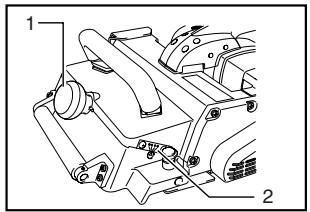
- Knob
- Scale plate
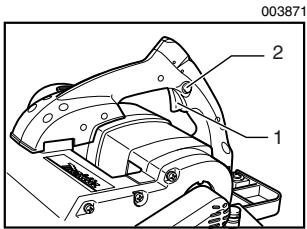
- Switch trigger
- Lock button
CAUTION:
- Always be sure that the tool is switched off and unplugged before adjusting or checking function on the tool.
Adjusting depth of cut
The depth of cut can be adjusted within a range of 0 - 3.5 mm (1/8"). Turn the knob on the front of the tool until the pointer is aligned with the desired cutting depth on the scale. Set the depth of a cut observing the maximum depth which is limited by width according to the following table.
003870
Correlation of width of cut and maximum depth of cut
| Width of cut | Maximum depth of cut |
| 0 - 150 mm (0 - 5-7/8") | 3.5 mm (1/8") |
| 150 - 240 mm (5-7/8" - 9-1/2") | 2 mm (3/32") |
| 240 - 312 mm (9-1/2" - 12-1/4") | 1.5 mm (1/16") |
Switch action
CAUTION:
- Before plugging in the tool, always check to see that the switch trigger actuates properly and returns to the "OFF" position when released.
- Switch can be locked in “ON” position for ease of operator comfort during extended use. Apply caution when locking tool in “ON” position and maintain firm grasp on tool.
To start the tool, simply pull the switch trigger. Release the switch trigger to stop.
For continuous operation, pull the switch trigger and then push in the lock button.
To stop the tool from the locked position, pull the switch trigger fully, then release it.
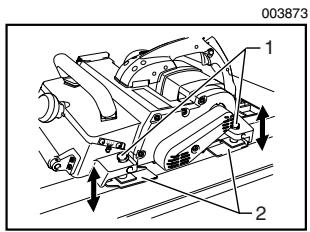
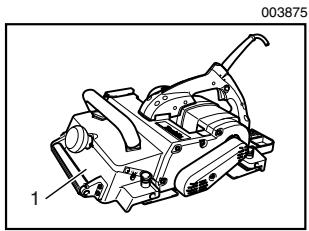
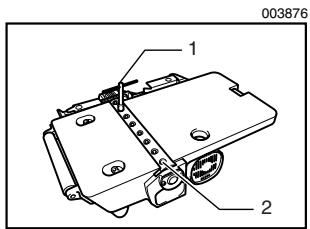
- Pins
- Edge fence (Guide rule)
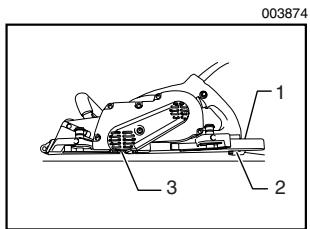
- Rear base
- Foot
- Planer blade
natural_image
Technical line drawing of a mechanical assembly with labeled component (no readable text or symbols)- Front base
Edge fence (Guide rule)
Edge fence is useful for minimizing a short run of cut by cutting in a uniform width. The edge fence (guide rule) is provided on the side of the tool. Press two pins for the edge fence (guide rule) so that the edge fence appears. Move the tool forward while keeping the flat surface of the edge fence in contact with the side of the workpiece.
To return the edge fence to an original position, push it upwards from its underside.
Foot
After a cutting operation, raise the back side of the tool and a foot comes under the level of the rear base. This prevents the tool blades to be damaged.
Guideline of cutting blade passage
Both ends of the front base are a guideline to show the ends of cutting blades passage.
ASSEMBLY
- Socket wrench
- Installation bolt
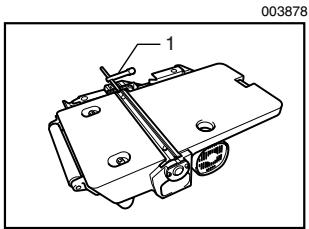
- Socket wrench
- Drum plate
- Installation bolt
- Set plate screw
- Set plate
- Planer blade
- Adjusting screw
- Drum
CAUTION:
- Always be sure that the tool is switched off and unplugged before carrying out any work on the tool.
Removing or installing planer blades
CAUTION:
- Tighten the blade installation bolts carefully when attaching the blades to the tool. A loose installation bolt can be dangerous. Always check to see they are tightened securely.
- Handle the blades very carefully. Use gloves or rags to protect your fingers or hands when removing or installing the blades.
- Use only the Makita wrench provided to remove or install the blades. Failure to do so may result in overtightening or insufficient tightening of the installation bolts. This could cause an injury.
To remove planer blades from the drum, loosen the eight installation bolts by only one full turn with the socket wrench. Then push and slide a planer blade sideways from the belt side using the helm of the socket wrench.
To remove another planer blade, follow the same procedure as above.
To install the blades, first clean out all chips or foreign matter adhering to the drum or blades.
natural_image
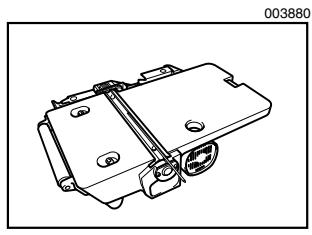
Technical line drawing of a mechanical component with mounting holes and a handle (no text or symbols)Insert the blade between the drum and the set plate from the nozzle extraction side so that the blade will be centered from both ends of the drum or set plate.
First tighten the eight installation bolts lightly and evenly shifting from the center bolts to the outward bolts with the socket wrench.
And then, tighten all of the installation bolts securely. Install another blade in the same manner as above.
For the correct planer blade setting
Your planing surface will end up rough and uneven, unless the blade is set properly and securely. The blade must be mounted so that the cutting edge is absolutely level, that is, parallel to the surface of the rear base.
Below are some examples of proper and improper settings.
EN0004-1
(A) Front base (Movable shoe)
(B) Rear base (Stationary shoe)
Correct setting
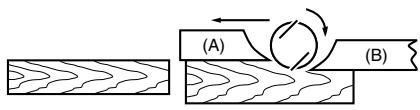
Although this side view cannot show it, the edges of the blades run perfectly parallel to the rear base surface.
Nicks in surface

natural_image
Abstract wavy contour pattern with no text or symbolsCause: One or both blades fails to have edge parallel to rear base line.
Gouging at start
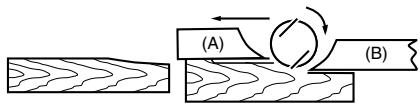
Cause: One or both blade edges fails to protrude enough in relation to rear base line.
Gouging at end
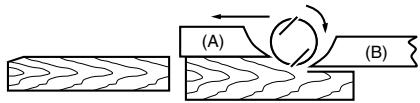
Cause: One or both blade edges protrudes too far in relation to rear base line.
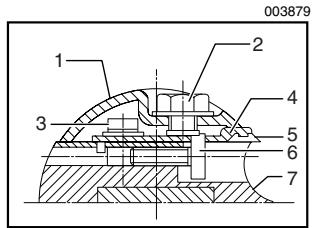
003879
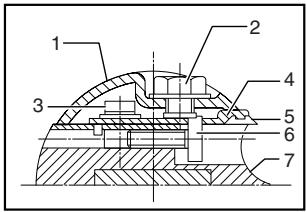
- Drum plate
- Installation bolt
- Set plate screw
- Set plate
- Planer blade
- Adjusting screw
- Drum
Blade height adjustment
Blade height adjustment is usually not necessary. However, if you notice that the blade edge is below the level of the rear base or protrudes too far from the rear base, proceed as follows.
Loosen the eight installation bolts and the set plate screws. Turn the adjusting screws clockwise to retract the blade or counterclockwise to protrude it. After adjusting the blade height, tighten the set plate screws and the eight installation bolts securely.
003882
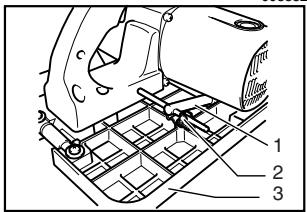
- Socket wrench
- Wrench holder
- Rear base
003884
natural_image
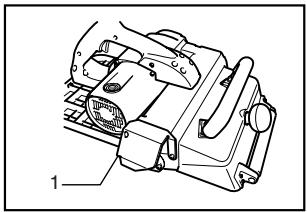
Technical line drawing of a mechanical component with no visible text or symbols- Chip guide
Socket wrench storage
When not in use, store the socket wrench as shown in the figure to keep it from being lost.
Nozzle assembly and joint (optional accessory)
Use of the special nozzle assembly and joint will minimize chip scatter, making for a cleaner work area.
The nozzle assembly and joint may be attached after the chip guide on the tool body is removed. Use the screws to fasten it in place.
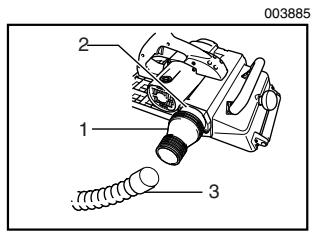
- Joint
- Nozzle assembly
- Hose
OPERATION
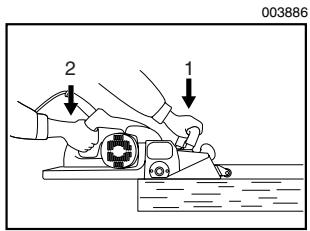
- At the start of planing
- At the end of planing
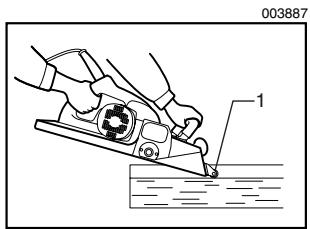
- Front roller
Connecting to vacuum cleaner
When you wish to perform cleaner operation, connect a vacuum cleaner to your tool. Connect a hose of vacuum cleaner to the joint.
Planing operation
First, rest the tool front base flat upon the workpiece surface without the blades making any contact. Switch on and wait until the blades attain full speed. Then move the tool gently forward. Apply pressure on the front of tool at the start of planing, and at the back at the end of planing.
The speed and depth of cut determine the kind of finish. The power planer keeps cutting at a speed that will not result in jamming by chips. For rough cutting, the depth of cut can be increased, while for a good finish you should reduce the depth of cut and advance the tool more slowly.
Front roller
When performing repeated cuts, the use of the front roller enables quick and effortless return of the tool toward an operator by raising the back end of the tool so that the tool blades do not contact a workpiece and then sliding tool on the front roller.
MAINTENANCE
CAUTION:
- Always be sure that the tool is switched off and unplugged before attempting to perform inspection or maintenance.
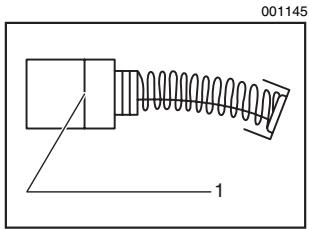
- Limit mark
Replacing carbon brushes
Remove and check the carbon brushes regularly. Replace when they wear down to the limit mark. Keep the carbon brushes clean and free to slip in the holders. Both carbon brushes should be replaced at the same time. Use only identical carbon brushes.
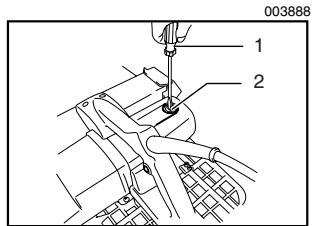
- Screwdriver
- Brush holder cap
Use a screwdriver to remove the brush holder caps. Take out the worn carbon brushes, insert the new ones and secure the brush holder caps.
To maintain product SAFETY and RELIABILITY, repairs, any other maintenance or adjustment should be performed by Makita Authorized or Factory Service Centers, always using Makita replacement parts.
ACCESSORIES
CAUTION:
- These accessories or attachments are recommended for use with your Makita tool specified in this manual. The use of any other accessories or attachments might present a risk of injury to persons. Only use accessory or attachment for its stated purpose.
If you need any assistance for more details regarding these accessories, ask your local Makita service center.
- Planer blade
- Triangular rule
- Nozzle assembly
- Joint
- Socket wrench

Makita Canada Inc. 1950 Forbes Street, Whitby, Ontario L1N 7B7
Stamp Timbre
Fold
Your answers to the following questions are appreciated.
1. This product was purchased from?
□ Hardware/lumber Store □ Industrial Supply
□ Tool Distributor □ Other ( )
3. How did you first learn of Makita Power Tools?
□ Magazine/Newspaper □ Catalog
□ From dealer □ Other ( )
Store display
2. Use of the product is intended for?
□ Construction trade □ Home maintenance
□ Industrial maintenance □ Other ( )
4. Most favored points are?
□ Design □ Makita Brand
□ Features □ Power
□ Size □ Other ( )
Price
5. Any comments?
Certificate of Warranty Mail to Makita
Date Purchased

Model No.
Serial No.
Initial Last Name
| Street Address | ||||||||||||||
| City | Province | |||||||||||||
Male Female Single Married
Postal Code
AGE:

Under 19

20-29

30-39

40-49

Over 50
Occupation:
Dealer's Name & Address:
Factory Service Centres
| Head Office: | 1950 Forbes St., Whitby, Ontario, L1N 7B7(905) 571 - 2200 | 1-800-263-3734 | |
| Regional Office: | 11771 Hammersmith Way, RichmondB.C. V7A 5H6 | (604) 272 - 3104 | 1-800-663-0909 |
| Regional Office:(Montreal) | 6389 boul, Couture, St. Leonard, QuebecH1P 3J5 | (514) 323 - 1223 | 1-800-361-7049 |
| Dartmouth: | 202 Brownlow AvenueDartmouth, N.S., B3B 1T5 | (902) 468 - 7064 | 1-888-625-4821 |
| Ville St. Laurent:(Montreal) | 1140 Rue Bégin, Ville St. Laurent, QuebecH4R 1X1 | (514) 745 - 5025 | 1-888-745-5025 |
| Les Saules:(Quebec) | 1200 St. Jean Baptiste, Unit 106, Les Saules,Quebec, G2E 5E8 | (418) 871 - 5720 | 1-800-663-5757 |
| Nepean:(Ottawa) | 203 Colonnade Road, Unit #6, Nepean,Ontario K2E 7K3 | (613) 224 - 5022 | 1-888-560-2214 |
| Whitby: | 1950 Forbes St., Whitby, Ontario, L1N 7B7(905) 571 - 2200 | 1-800-263-3734 | |
| London: | 317 Adelaide St. S., Unit 117, London,Ontario, N5Z 3L3 | (519) 686 - 3115 | 1-800-571-0899 |
| Mississauga: | 6350 Tomken Rd., Unit 8, Mississauga,Ontario, L5T 1Y3 | (905) 670 - 7255 | 1-800-221-9811 |
| Calgary: | #8-6115 Fourth St. S.E., CalgaryAlberta, T2H 2H9 | (403) 243 - 3995 | 1-800-267-0445 |
| Edmonton: | 11614-149 Street, Edmonton, Alberta,T5M 3R3 | (780) 455 - 6644 | 1-888-455-6644 |
| Richmond: | 11771 Hammersmith Way, Richmond, B.C.,V7A 5H6 | (604) 272 - 3104 | 1-800-663-0909 |
| Coquitlam: | 2131 Hartley Ave., #103Coquitlam, B.C. V3K 2Z3 | (604) 525 - 7434 | 1-800-266-7738 |
| Winnipeg: | 1670 St. James Street, Winnipeg, Manitoba,R3H 0L3 | (204) 694 - 0402 | 1-800-550-5073 |
| Saskatoon: | 206A-2750 Faithful Avenue Saskatoon,Saskatchewan, S7K 6M6 | (306) 931 - 0111 | 1-888-931-0111 |
For the authorized service centre nearest you please refer to the local yellow pages directory under “tools” or contact our customer service department (Tel) 1-800-263-3734
When you need service...
- Explain the problem in a letter
- Enclose the letter with the tool
- Package carefully and send prepaid to the nearest Makita factory or authorized service centre
CUSTOMER RECORD
DATE
PURCHASED:
DEALER'S NAME
& ADDRESS:
MODEL NO.:
SERIAL NO.:
MAKITA LIMITED ONE YEAR WARRANTY
Warranty Policy
Every Makita tool is thoroughly inspected and tested before leaving the factory. It is warranted to be free of defects from workmanship and materials for the period of ONE YEAR from the date of original purchase. Should any trouble develop during this one year period, return the COMPLETE tool, freight prepaid, to one of Makita's Factory or Authorized Service Centres. If inspection shows the trouble is caused by defective workmanship or material, Makita will repair (or at our option, replace) without charge.
This Warranty does not apply:
- where normal maintenance is required,
• repairs have been made or attempted by others, - the tool has been abused, misused or improperly maintained,
• alterations have been made to the tool.
IN NO EVENT SHALL MAKITA BE LIABLE FOR ANY INDIRECT, INCIDENTAL OR CONSEQUENTIAL DAMAGES FROM THE SALE OR USE OF THE PRODUCT. THIS DISCLAIMER APPLIES BOTH DURING AND AFTER THE TERM OF THIS WARRANTY.
"The Makita Warranty is the only and the entire written warranty given by Makita for the Makita tools. No dealer or his agent or employee is authorized to extend or enlarge upon this warranty by any verbal or written statement or advertisement."
MAKITA DISCLAIMS LIABILITY FOR ANY IMPLIED WARRANTIES INCLUDING IMPLIED WARRANTIES OF "MERCHANTABILITY" AND FITNESS FOR A SPECIFIC PURPOSE," AFTER THE ONE YEAR TERM OF THIS WARRANTY.
“This Warranty gives you specific rights. The provisions contained in this warranty are not intended to limit, modify, take away from, disclaim or exclude any warranties set forth in any provincial legislation. To the extent required by law, the provisions in any provincial or federal legislation with respect to warranties take precedence over the provisions in this warranty.”


- SPECIFICATIONS
- GENERAL SAFETY RULES
- WARNING:
- SAVE THESE INSTRUCTIONS
- Work Area
- Electrical Safety
- Personal Safety
- Tool Use and Care
- SERVICE
- SPECIFIC SAFETY RULES
- SYMBOLS
- FUNCTIONAL DESCRIPTION
- CAUTION:
- Adjusting depth of cut
- Switch action
- Edge fence (Guide rule)
- Foot
- Guideline of cutting blade passage
- ASSEMBLY
- Removing or installing planer blades
- For the correct planer blade setting
- Blade height adjustment
- Socket wrench storage
- Nozzle assembly and joint (optional accessory)
- OPERATION
- Connecting to vacuum cleaner
- Planing operation
- Front roller
- MAINTENANCE
- Replacing carbon brushes
- ACCESSORIES
- Your answers to the following questions are appreciated.
- This product was purchased from?
- How did you first learn of Makita Power Tools?
- Use of the product is intended for?
- Most favored points are?
- Any comments?
- Certificate of Warranty Mail to Makita
- Factory Service Centres
- When you need service...
- CUSTOMER RECORD
- MAKITA LIMITED ONE YEAR WARRANTY
- Warranty Policy
Brand : MAKITA
Model : KP312
Category : Electric planer