
KH 458 YOGHURT MAKER - Yogurt maker BIFINETT - Free user manual and instructions
Find the device manual for free KH 458 YOGHURT MAKER BIFINETT in PDF.


| Product type | Yogurt maker |
| Brand | BIFINETT |
| Model | KH 458 |
| Power supply | Mains 220-240 V, 50/60 Hz |
| Power | 20 W (estimated) |
| Capacity | 1 liter (7 glass jars of 150 ml each) |
| Functions | Adjustable timer (0-15 h), indicator light, automatic shut-off |
| Fermentation temperature | Approximately 40-45 °C |
| Fermentation time | 4 to 14 hours depending on milk temperature |
| Types of milk that can be used | Homogenized, pasteurized, or fresh milk (must be boiled first) |
| Included components | 7 glass jars with screw caps, thermometer, transparent lid, base with timer |
| Maintenance | Glass jars and lids hand washable; base wiped with a damp cloth; do not immerse |
| Safety | Do not immerse in water, unplug before cleaning, do not use outdoors, keep out of reach of children |
| Weight | Approximately 1.2 kg |
| Dimensions | 25 x 25 x 15 cm (estimated) |
| Additional accessories | Dedicated thermometer (from -50°C to +100°C) |
Frequently Asked Questions - KH 458 YOGHURT MAKER BIFINETT
User questions about KH 458 YOGHURT MAKER BIFINETT
0 question about this device. Answer the ones you know or ask your own.
Ask a new question about this device
Download the instructions for your Yogurt maker in PDF format for free! Find your manual KH 458 YOGHURT MAKER - BIFINETT and take your electronic device back in hand. On this page are published all the documents necessary for the use of your device. KH 458 YOGHURT MAKER by BIFINETT.
USER MANUAL KH 458 YOGHURT MAKER BIFINETT
Operating instructions
Seite 4-6
IMPORTANT SAFETY ADVICE

Please read these important safety advice notes carefully before you use your automatic yoghurt maker for the first time and, if necessary, pass them on to third parties.
This equipment is intended for use in the home and is not to be used outside.
The voltage used must be identical to that shown on the rating plate.
To avoid electric shock, fire, personal injury and other dangers, never immerse the yoghurt maker, the mains lead or the plug in water or other liquids, or hold them under running water.
Never use the equipment if it is damaged or not working properly. Pass the defective equipment over to a service centre for inspection and repair.
To avoid causing injuries and damage, ensure that defective mains leads are repaired by a competent tradesman. Never operate the equipment with a damaged mains lead or plug.
The manufacturer accepts no responsibility for damage caused by misuse of the equipment or the non-observation of these safety advice notes.
Never disconnect the yoghurt maker from the mains supply socket by pulling on its cable. Always use the plug.
Keep the equipment out of reach of children or the handicapped. Children or the handicapped should not use the yoghurt maker without supervision. Particular care is needed whenever the appliance is used by or near children.
Never let the mains lead come into contact with sharp objects. Do not use the mains lead to move or carry the yoghurt maker.
Keep the mains lead away from hot parts of the yoghurt maker.
Disconnect the yoghurt maker mains lead by pulling the plug out of the socket whenever:
- the unit is no longer being used
- the unit is defective
- the unit is to be cleaned.
Use the yoghurt maker for its intended purpose only, as described in these operating instructions.
The unit must always stand on a safe, level and smooth surface.
Never use the thermometer for liquids colder than -50^ or hotter than +100^ . It is intended specifically for use with your automatic yoghurt maker.
Sudden changes in temperature could shatter the glass tubs. Never take the tubs out of the refrigerator or out of cold water and place them immediately into e.g. hot water.
Before you switch the yoghurt maker off, please ensure that timer is turned anticlockwise into the "Off" position. When you switch the yoghurt maker on, the red indicator light shows after 1 - 2 seconds. Now you can set the desired time on the timer.
If you switch the unit off, please wait at least 2 - 3 seconds before you switch it on again.
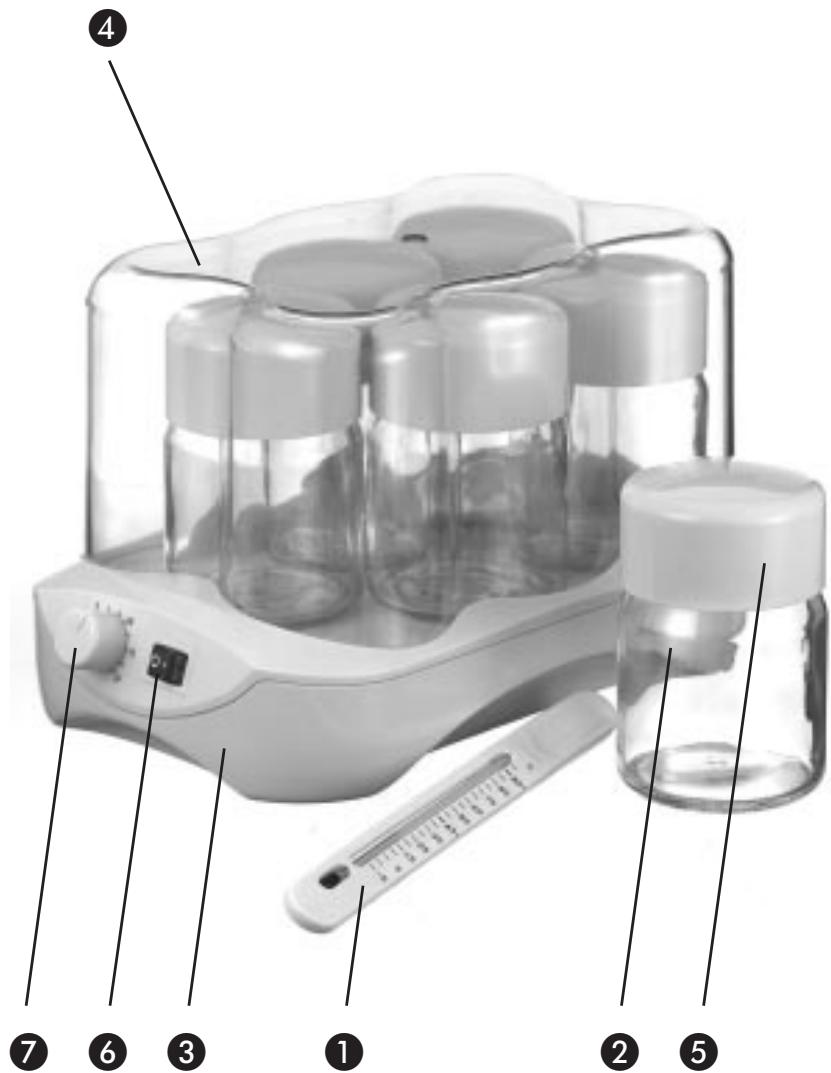
YOGHURT MAKER COMPONENTS
Thermometer
Tub
3 Base
4 Transparent cover
Screw-on lid for tub
On/off switch with indicator light
Timer
OPERATION
Before using your yoghurt maker for the first time, clean the glass tubs with a damp cloth and dry them thoroughly.
- Place the unit on a dry, level surface. Then plug the mains lead into the mains socket. The mains supply voltage must correspond with that shown on the rating plate.
Notes on ingredients:
- You can use homogenised milk, or pasteurised milk or fresh milk to make yoghurt. The milk is mixed with bio-yoghurt or ordinary natural yoghurt.
- Homogenised milk is the most suitable type for yoghurt making. This milk is already pasteurised and can be used for yoghurt making without any further treatment. Homogenised milk can be obtained with various fat contents.
Fresh milk
- Fresh milk must be heated before use in your yoghurt maker.
- Bring the milk almost to the boil (approx. 95^ ) and keep it at this temperature for three to five minutes.
- A thermometer is supplied to check the temperature.
-
Do not allow the milk to boil as otherwise the yoghurt loses its taste and does not set properly.
-
As an alternative to the bio-enzyme, you can use ordinary natural yoghurt or even yoghurt you have made yourself. The most important thing is to ensure that the yoghurt used is always fresh. The milk must have a fat content identical to that shown on the yoghurt maker cover, otherwise the yoghurt does not set and water gathers on its surface. Some types of manufactured yoghurt are heated twice in order to increase the shelf life by killing the yoghurt making organisms. You can only use fresh yoghurt. You can also use yoghurt you have made yourself for preparing further batches of yoghurt. A yoghurt culture can be used up to eight times.
Preparing yoghurt:
- Yoghurt can be prepared with cold or warm milk. The milk should not be warmer than 45 degrees, as otherwise the yoghurt culture is killed (prepare fresh milk beforehand as above).
Basic recipe
Stir a packet of bio-enzyme or a tub of natural yoghurt into a litre of milk. Then fill the glass tubs with the mixture of milk and enzyme and screw on the lids. Ensure that the timer is turned anticlockwise into the "Off" position. Place the tubs into your yoghurt maker and switch it on. After the red indicator light shows for 1 - 2 seconds, you can set the timer to the required time. The red signal light comes on.
The fermentation time required until the yoghurt is ready depends on the temperature of the mixture used, as is shown below:
- Milk at room temperature: 10 to 14 hours
- Warm milk (approx. 40^ ) 4 to 5 hours
The signal light shows during the whole fermentation process. Do not move the yoghurt during the fermentation process. Movement of the tubs or the yoghurt maker during the fermentation process adversely affects the setting of the yoghurt. When the yoghurt is ready, switch off the unit. The signal light goes out. Place the whole batch in the refrigerator to cool and to avoid any increase in acidity level.
Possible mistakes:
Lumpy
- Milk was too hot
- Not stirred enough
- Milk was "off".
Liquid on the surface
- Yoghurt was in the yoghurt maker too long
- Tubs were moved too early
- Not cooled enough
Too soft
- Yoghurt culture and milk used had different fat contents
- Fermentation time too short
- Yoghurt culture not fresh enough
CARE AND CLEANING
- Pull out the mains plug before cleaning the yoghurt maker. Never immerse the equipment - except for the glass tubs and their lids - in water, cleaning liquids or washing up water.
- Use a damp cloth to clean the yoghurt maker housing. Never use abrasive cleaning agents or harsh cleaning materials to clean the equipment.
STATEMENT OF CONFORMITY
We, Kompernaß Handelsgesellschaft mbH, Burgstr. 21, D-44867 Bochum, Germany, hereby declare that this product conforms with the following EC regulations:
EC low voltage regulations, Electromagnetic compatibility, Applicable harmonised standards.
Type: KH 458 Yoghurt maker
Bochum, 31.10.2002
Hans Kompernaß
- Managing Director -

bifinett
Brand : BIFINETT
Model : KH 458 YOGHURT MAKER
Category : Yogurt maker