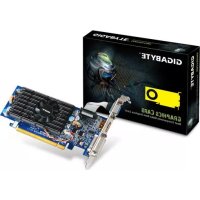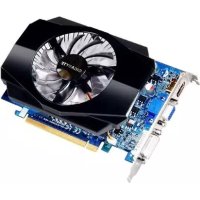
GV-R96128D - Graphic card GIGABYTE - Free user manual and instructions
Find the device manual for free GV-R96128D GIGABYTE in PDF.


User questions about GV-R96128D GIGABYTE
0 question about this device. Answer the ones you know or ask your own.
Ask a new question about this device
Download the instructions for your Graphic card in PDF format for free! Find your manual GV-R96128D - GIGABYTE and take your electronic device back in hand. On this page are published all the documents necessary for the use of your device. GV-R96128D by GIGABYTE.
USER MANUAL GV-R96128D GIGABYTE
Chapter 1 User's Manual
Copyright
Copyright by GIGA-BYTE TECHNOLOGY CO., LTD. ("GBT") No part of this manual may be reproduced or transmitted in any form without the expressed, written permission of GBT.
Trademarks
Third-party brands and names are the property of their respective owners.
Notice
Due to rapid change in technology, some of the specifications might be out of date before publication of this booklet.
The author assumes no responsibility for any errors or omissions which may appear in this document nor does it make a commitment to update the information contained herein.
Please do not remove any labels on VGA card, this may void the warranty of this VGA card.
This product incorporates copyright protection technology that is protected by method claims of certain U.S. patents and other intellectual property rights owned by Macrovision Corporation and other rights owners. Use of this copyright protection technology must be authorized by Macrovision Corporation, and is intended for home and other limited viewing uses only unless otherwise authorized by Macrovision Corporation. Reverse engineering or disassembly is prohibited.
Jule 21, 2003 Taipei, Taiwan
Table of Contents
- INTRODUCTION 4
1.1.PREFACE 4
1.2. KEY FEATURES 4
2.HARDWARE INSTALLATION 5
2.1.UNPACKING 5
2.2. BOARD LAYOUT 6
2.3.HARDWARE INSTALLATION 7
- SOFTWARE INSTALLATION 9
3.1. WINDOWS® 98/98SE / WINDOWS® ME / WINDOWS® XP DRIVER AND UTILITIES INSTALLATION
3.1.1. Operating system requirement 9
3.1.2.DirectX Installation 10
3.1.3.Driver Installation 12
3.1.4. Utilities on driver CD 15
3.1.5. Taskbar Icon 18
3.1.6. Display Properties pages 21
3.2.WINDOWS 2000 DRIVER INSTALLATION 29
3.3.BIOS FLASH UTILITY 29
- Troubleshooting Tips 30
- Appendix 31
5.1.How toreflash theBIOS 31
5.2. Resolutions and Color Depth Table (In Windows XP) 32
1. INTRODUCTION
1.1. PREFACE
GV-R96128D features 4-pipeline architecture for twice the rendering power, 128MB of memory to accelerate latest 3D games and new SMARTSHADER™ 2.1 technology supporting DirectX® 9.0 and the latest OpenGL® functionality to give developers the freedom to create more complicated and realistic visual effects than ever before. GV-R96128D supports the new AGP 8X standard, which allows large volumes of texture and vertex data to be transferred faster from system memory to the chip.
1.2. KEY FEATURES
Powered by RADEON™ 9600 Visual Processing Unit (VPU)
Fully support DirectX® 9.0
Supports the new AGP 8X standard
4-pixel pipeline architecture
All new 64-bit memory interface
128MB DDR memory accelerates the latest 3D games
First to use pixel shaders to accelerate video
DVI-I and TV-Out connector supported
2. HARDWARE INSTALLATION
2.1.UNPACKING
The GV-R96128D package contains the following:
The GV-R96128D graphics accelerator
- This USER'S MANUAL
The GV-R96128D Driver CD x 1
Power DVD CD x 1
Game CD x 1
One cable supports S-video and AV-Output; DVI-I to D-Sub connector

WARNING!
Expansion cards contain very delicate Integrated Circuit (IC) chips. To protect them against damage from static electricity, you should follow some precautions whenever you work on your computer.
- Turn off your computer and unplug power supply.
- Use a grounded wrist strap before handling computer components. If you do not have one, touch both of your hands to a safely grounded object or to a metal object, such as the power supply case.
- Place components on a grounded antistatic pad or on the bag that came with the components whenever the components are separated from the system.
The card contains sensitive electric components, which can be easily damaged by static electricity, so the card should be left in its original packing until it is installed.
Unpacking and installation should be done on a grounded anti-static mat. The operator should be wearing an anti-static wristband, grounded at the same point as the anti-static mat.
Inspect the card carton for obvious damage. Shipping and handling may cause damage to your card. Be sure there are no shipping and handling damages on the card before proceeding.
DO NOT APPLY POWER TO YOUR SYSTEM IF IT HAS BEEN DAMAGED ON THE CARD.
In order to ensure your graphics card working correctly, please use official Gigabyte BIOS only. Use none official gigabyte BIOS might cause problem on the graphics card.
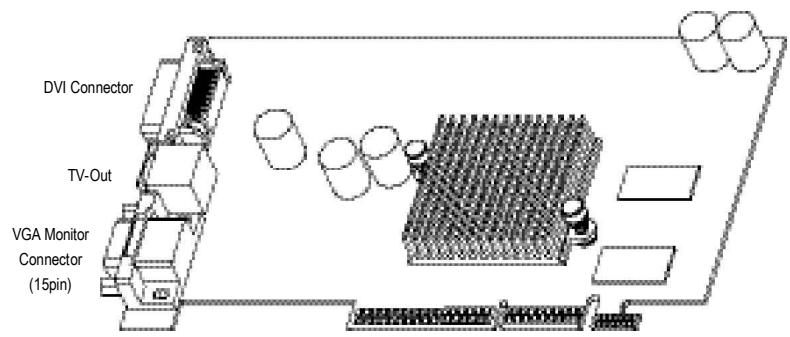
2.2. BOARD LAYOUT
1) GV-R96128D (128MB DDR)
2.3.HARDWARE INSTALLATION
Installing Your Graphics card.
Now that you have prepared your computer, you are ready to install your graphics accelerator card.
To install your graphics accelerator card:
- Power off the computer and monitor, then disconnect the display cable from the back of your computer.
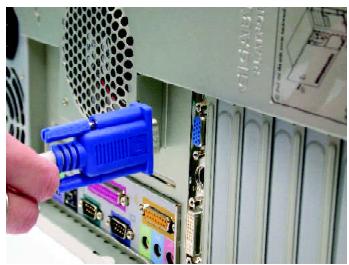
- Remove the computer cover. If necessary, consult your computer's manual for help in removing the cover.
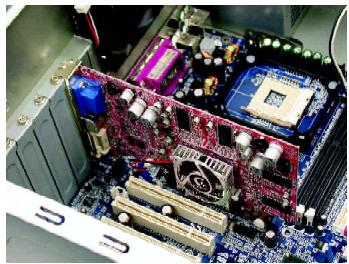
- Remove any existing graphics card from your computer.
Or, if your computer has any on-board graphics capability, you may need to disable it on the motherboard. For more information, see you computer documentation.
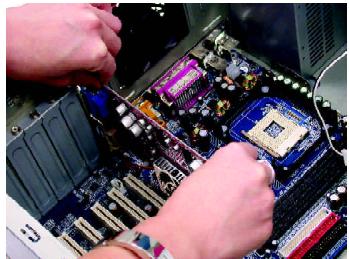
- Locate the AGP slot. If necessary, remove the metal cover from this slot; then align your Graphics card with the AGP slot, and press it in firmly until the card is fully eated.
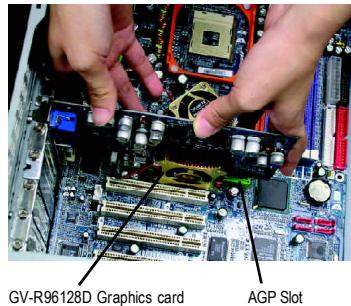
- Replace the screw to fasten the card in place, and replace the computer cover.
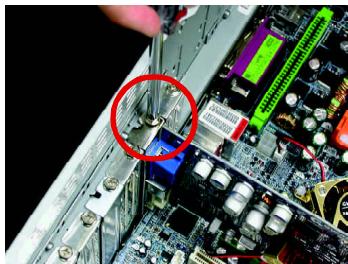
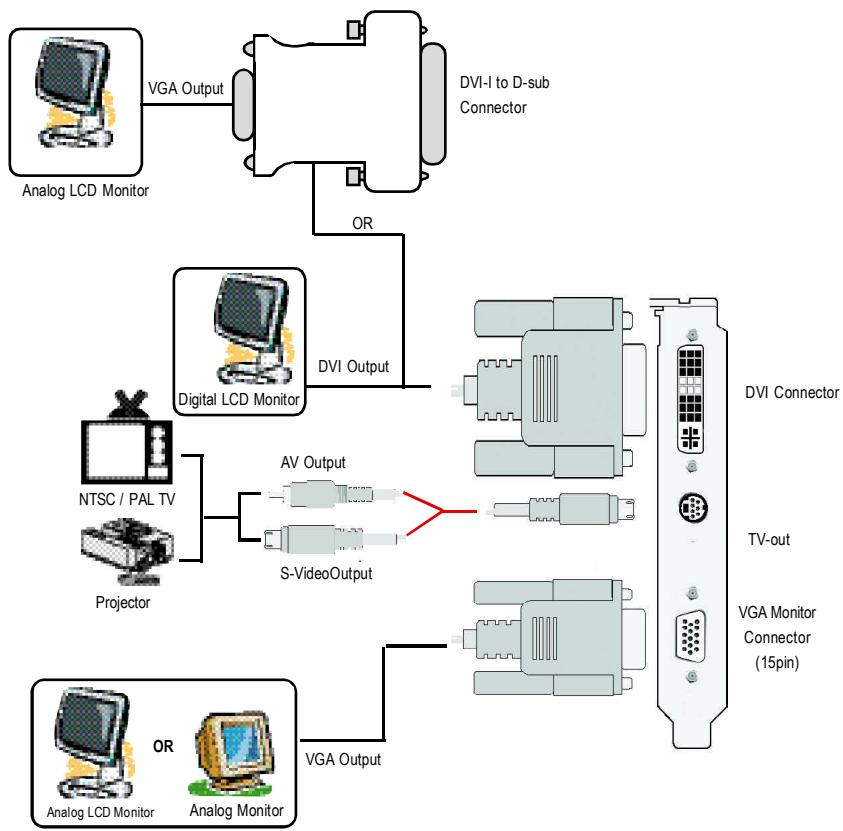
- Plug the display cable into your card; then turn on the computer and monitor. If your Graphics card came with a DVI connector, you can connect a flat panel display to the appropriate connector, as shown below...
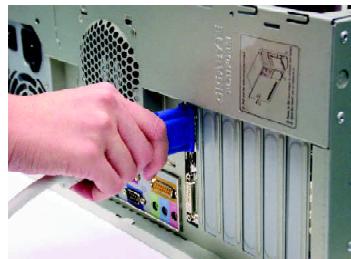

To Flat Panel Display

To VGA Monitor

To TV or VCR
You are now ready to proceed with the installation of the Graphics card driver. For detailed instructions, select your operating system from the list below.
3. SOFTWARE INSTALLATION
In this manual, we assume that your CD-ROM Drive letter to be Drive D:
3.1. WINDOWS® 98 /98SE / WINDOWS® ME / WINDOWS® XP DRIVER AND UTILITIES INSTALLATION
The installation of Win® 98/98SE / WINDOWS® 2000 / Win® ME / Win® XP drivers is very simple. When you insert the driver CD into your CD-ROM drive, you can see the AUTORUN window (if it does not show up, run "D:\setup.exe"). Then you can follow guides to setup your GV-R96128D driver (Please follow the subsection 3.1.3 "Step By Step Installation" to install the driver for your GV-R96128D graphics accelerator.
3.1.1. Operating system requirement
- If your OS is Microsoft Windows, when loading the GV-R96128D drivers for the system, please make sure your system (Windows 98/98SE, Windows2000 or Windows ME) has installed DirectX 9 or later version.
- If you install the GV-R96128D drivers for the motherboard, which consist of SIS, ALI or VIA chipsets, please install the appropriate Driver program for that motherboard. Or please contact your motherboard nearest dealer for M/B Driver.
3.1.2. DirectX Installation
Install Microsoft DirectX 9(or later version) to enable 3D hardware acceleration support for Windows® 98 / 98SE / Windows® 2000 / Windows® ME or Windows® XP to achieve better 3D performance.
Note: For software MPEG support in Windows® 98/ 98SE/ Windows® 2000/ Windows® ME or Windows® XP, you must install DirectX 9(or later version) first.
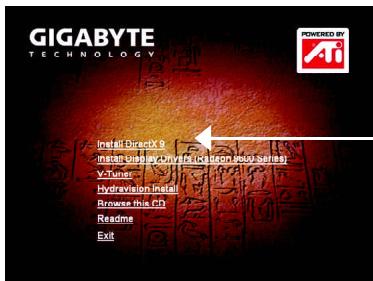
- Install DirectX Driver: Click "Install DirectX 9" Item.
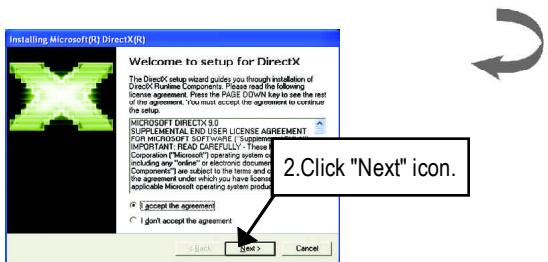

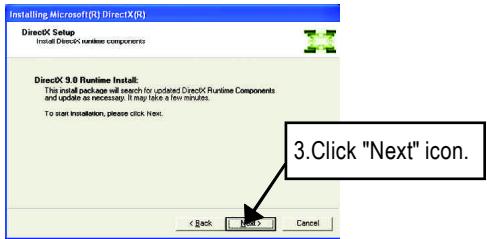
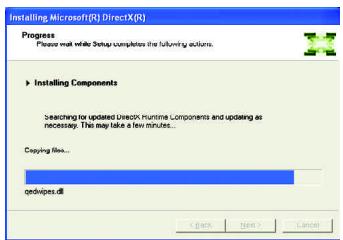

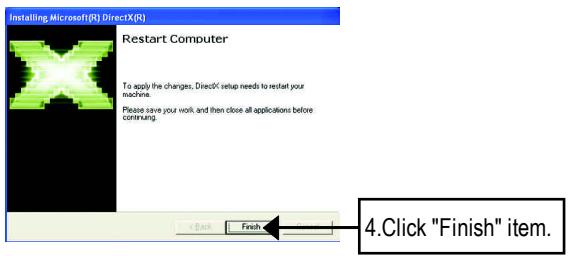
Then the DirectX 9 installation is completed.
3.1.3. Driver Installation
The following is the step-by-step installation guide.
Step 1: New Hardware Found
After GV-R96128D is inserted into your computer at the first time, the windows will automatically detect a new hardware in the system and pop out a "New Hardware Found" message. Please select "Do not install a driver" and press OK.
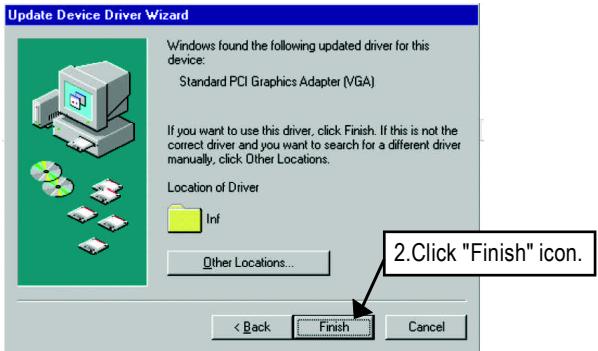
Step 2: Update Device Driver Wizard: Standard PCI Graphics Adapter(VGA)
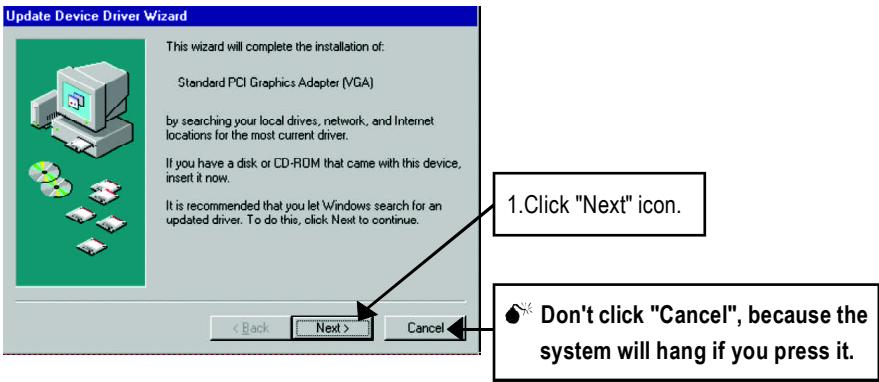
Step 3: Update Device Driver Wizard: Finish
At this time, system will ask for your Windows CD in order to complete the VGA driver installation.
If you don't have the CD, you can press C:\Windows\System directory.
Step 4: System Setting Change
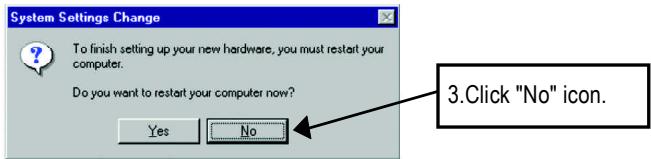
After the system has finished loading, insert the GV-R96128D driver CD disk into your CD-ROM, and then you can see the AUTORUN window. If it does not show up, please run "D:\setup.exe".
Step 5: Driver Setup
(Pictures below are shown in Windows XP)
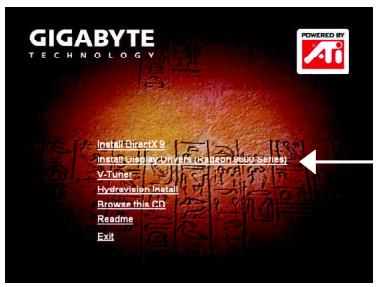
- Click "Install Display Drivers (Radeon 9600 Series)" item.
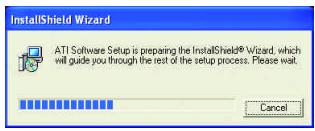


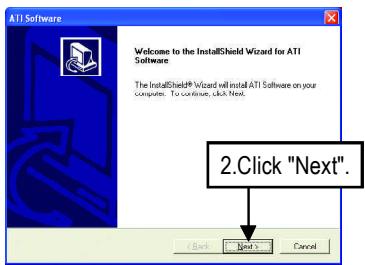
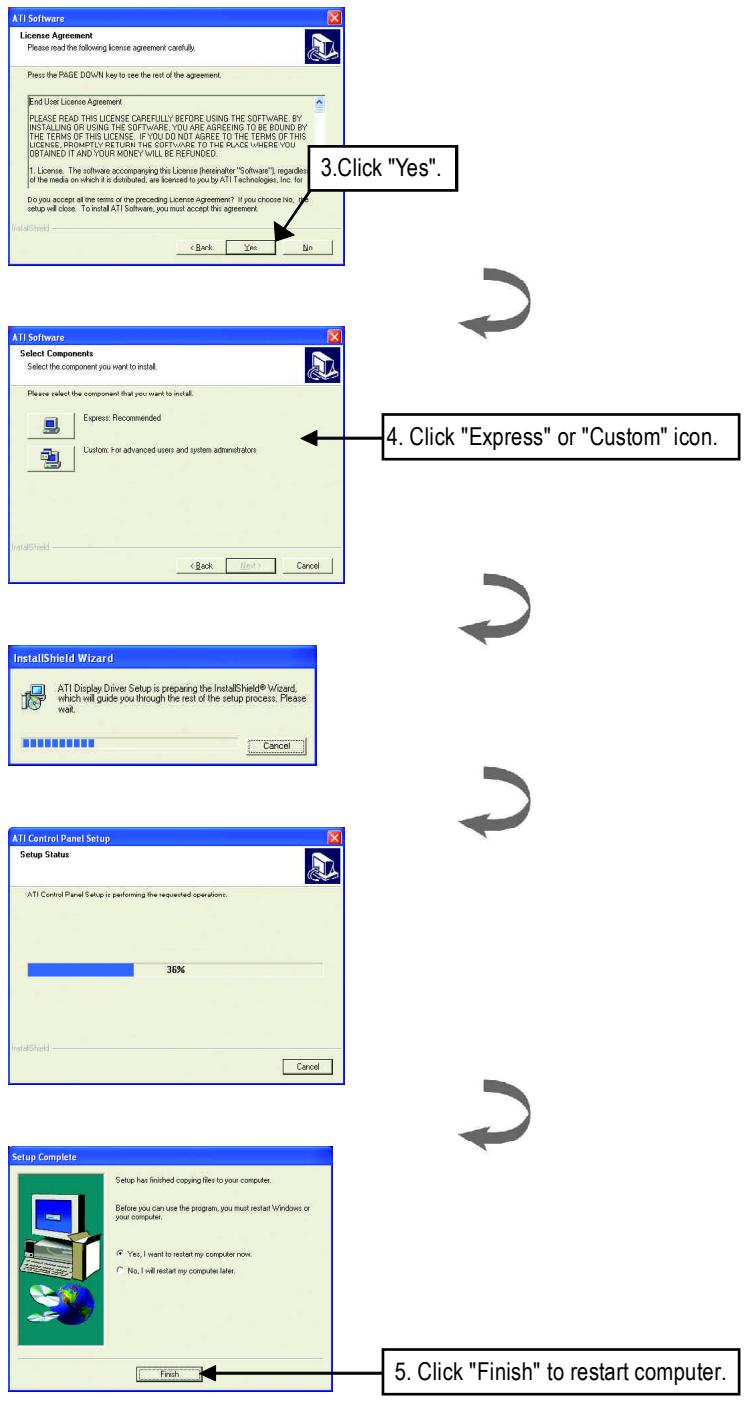
GV-R96128D Graphics Accelerator
3.1.4. Utilities on driver CD
The utilities include Display Driver and V-Tuner utilities. Please follow the steps.
Install V-Tuner:
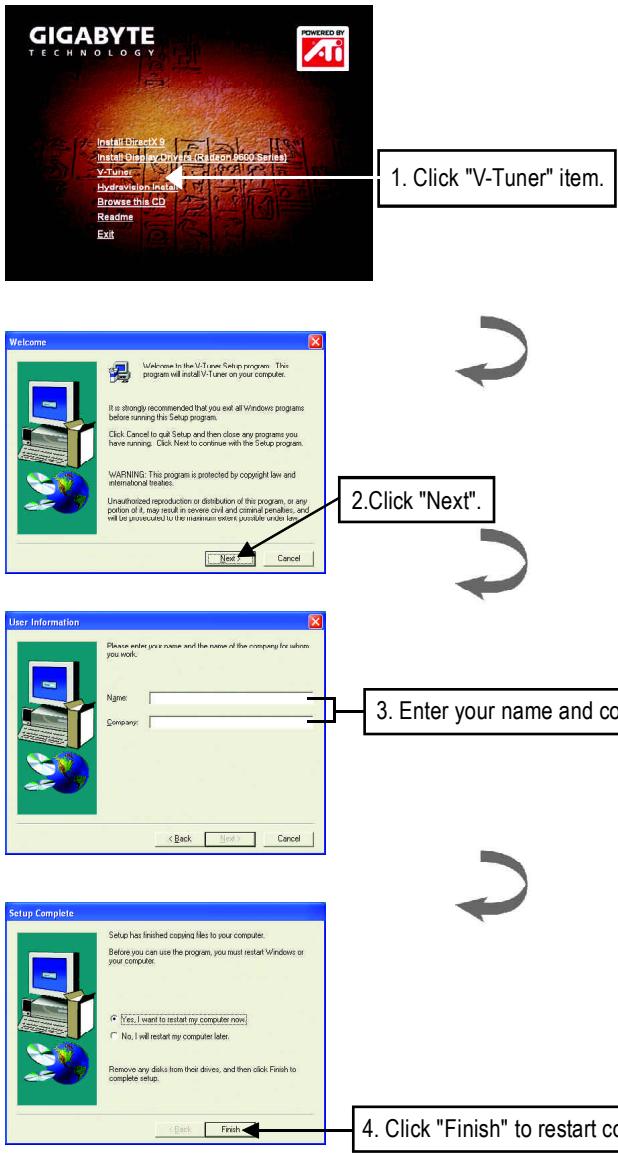
Install Hydravision :
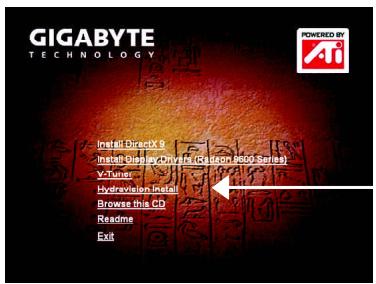
- Click "Hydravision Install" item.
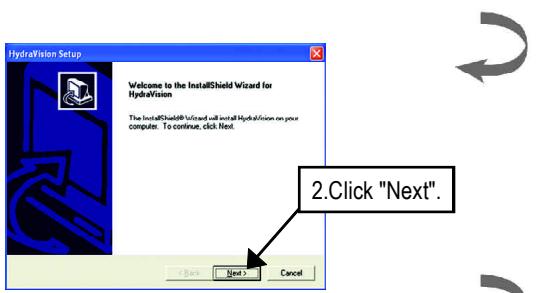
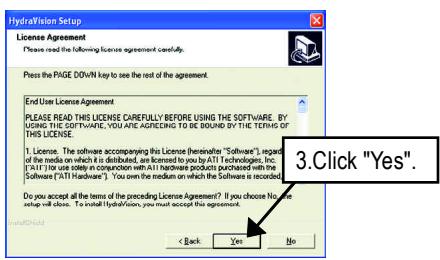

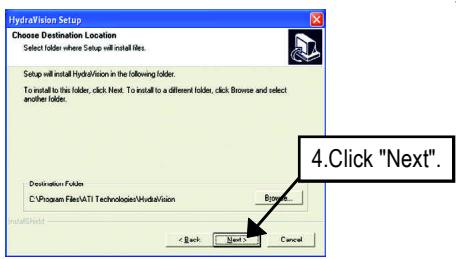
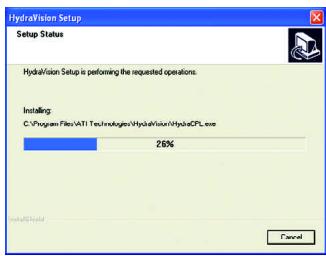

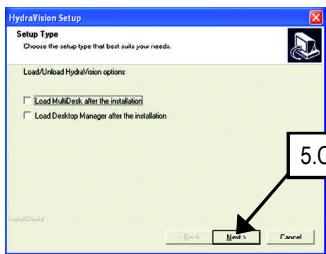

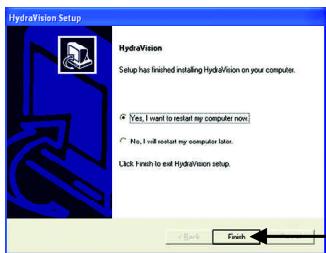
- Click "Finish" to restart computer.
3.1.5. Taskbar Icon
After installation of the display drivers, you will find an GBT icon on the taskbar's status area. Right-clicking this icon opens the GBT control panel, showing a menu composed of shortcut of the graphics card's enhanced and other functions.
You may click the "Display Properties" item, and then click Settings. Click "Advanced" after clickng Settings. Click the appropriate tab to change your display settings.
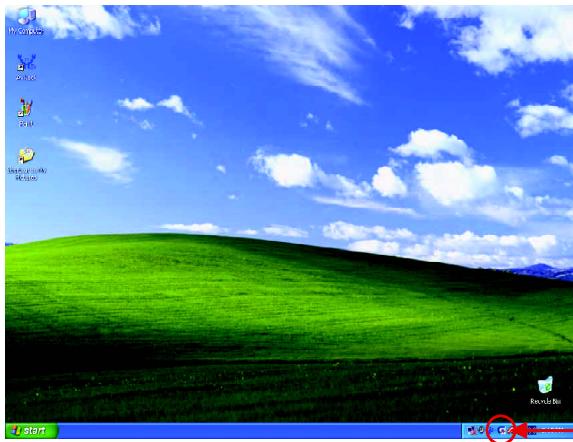
Right click the icon.
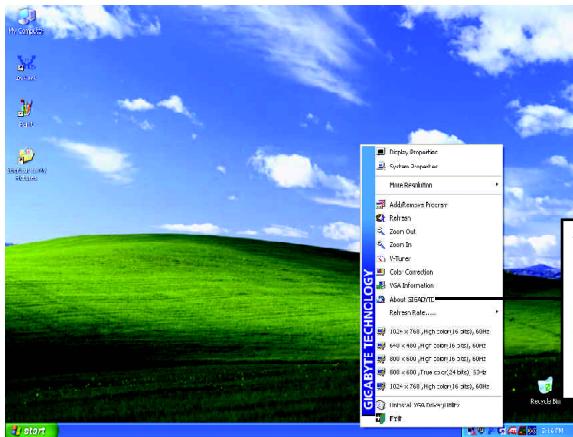
You can link to GBT website for updated information about the graphics card, latest drivers, and other information.
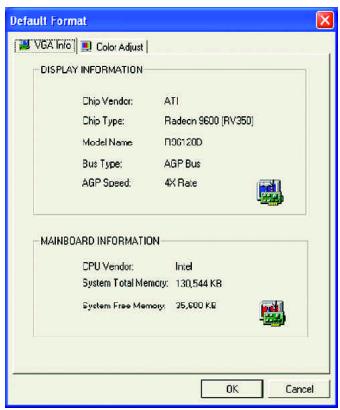
VGA Information
VGA Info lists the relevant information about your card.
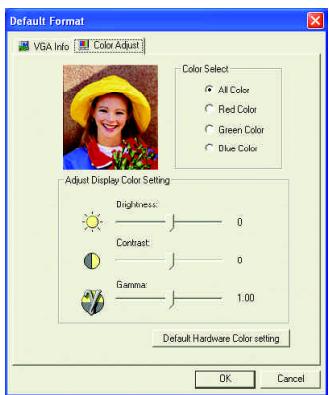
Color Adjust
Color Adjust allows you to make color adjustments, such as brightness, contrast and gamma values for each or all of RGB colors.
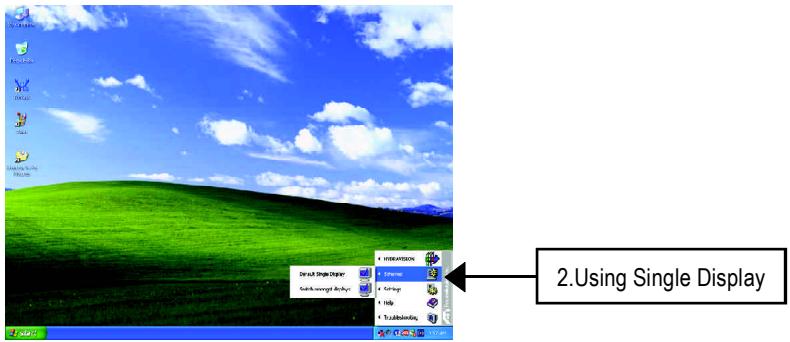
After installation of the display drivers, you will find an ATI icon on the taskbar's status area. Clicking this icon open the ATI control panel.
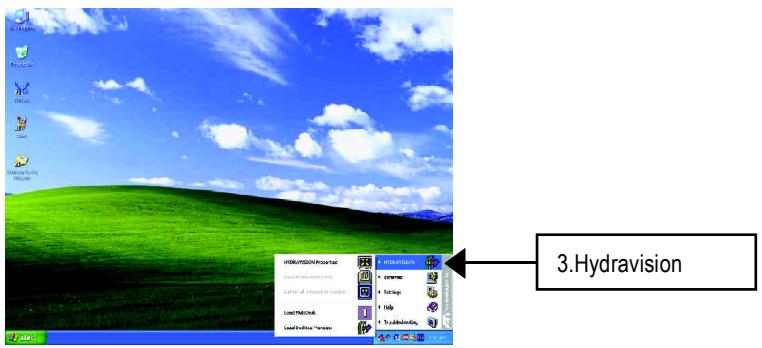
HYDRAVISION
HYDRAVISION™ and the Desktop Manager are activated whenever Windows® starts. Installing HYDRAVISION™ adds menu options to the ATI Icon.
Click on the ATI icon to access the application's features and help, or to unload the HYDRAVISION™ Desktop Manager.
HYDRAVISION™ is primarily software designed for multiple monitor settings. GV-R96128D graphic cards that have more than one display output can benefit fully from this software. A GV-R96128D with only one display output can still take advantage of the many features of HYDRAVISION™.
HYDRAVISION™ installation enables the Desktop Manager and creates a Windows® program group for HYDRAVISION™ display management software.
3.1.6. Display Properties pages
The screen shows the information of display adapter, color, the range of display area and the refresh rate.
Settings (Resolutions and Color depth for windows)
The Setting properties page allows you to adjust the Direct 3D settings.
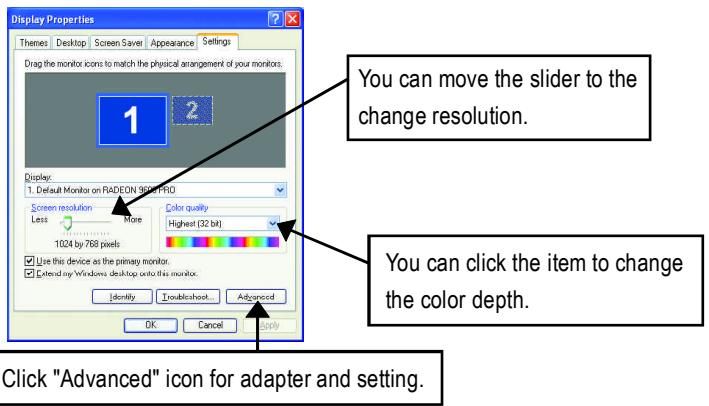
Click "Advanced", into details settings:
Options Properties
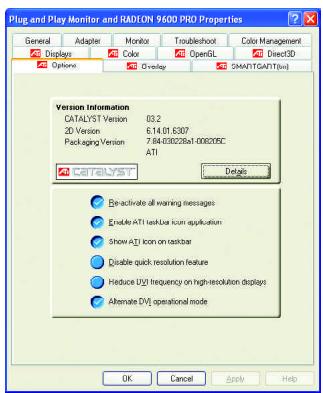
■ Version Information provides the Catalyst version number, 2D version number and the driver build information.
Details button access to the Details tab which lists the card's hardware details and driver information.
- Re-activate all warning messages allows you to reactivate any disabled graphics warning messages.
- Enable ATI taskbar icon application enables or disables the ATI taskbar icon. However, this feature must be enabled for ATI hotkey support.
Show ATI icon on taskbar adds or removes the ATI icon from the taskbar.
- Disable quick resolution feature is accessible by left-clicking the ATI icon in the taskbar.
- Reduce DVI frequency on high-resolution displays enables or disables to reduce the DVI frequency when using high-resolution.
Alternate DVI operational mode enables or disables alternate DVI operational mode.
OpenGL Properties:
The OpenGL properties page gives you complete control of the OpenGL settings.
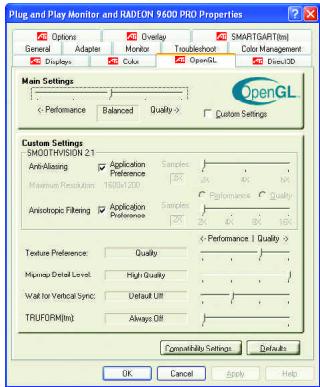
Main Settings slider
Moving the slider to the left will maximize application performance, while moving the slider to the right will provide excellent 3D image quality. Moving this slider from one position to the next changes the individual Custom Settings sliders found below.
- Custom Settings checkbox
When Custom Settings is checked, the Main Settings slider is disabled, allowing you to move each individual slider in the Custom Settings section below. Setting the individual sliders gives you complete control over your
application experience. Using Custom Settings is recommended for advanced users only.
SMOOTHVISION 2.1
- Anti-Aliasing checkbox improves image quality by removing jagged edges from 3D images, resulting in smoother, more natural looking objects.
- Anti-Aliasing slider can be applied using different sample patterns and sample points such as 2X, 4X, or 6X. Moving this slider to the right increases sampling to provide the most realistic 3D image.
- Anisotropic Filtering checkbox uses a texture filtering technique that blends multiple texture samples together. Selecting Application Preference will result in high quality textures, with a negligible reduction in the application's performance.
- Anisotropic Filtering slider By moving this slider to the right, as the number of samples taken increases, the quality of the final image increases significantly. 16X provides extremely detailed, crisp-looking images as a result of the largest number of texture samples possible.
Texture Preference slider
Selecting this decides whether your application should use high quality or high performance textures. Moving the slider to the right delivers the highest quality experience. Moving the slider to the left emphasizes a high performance solution while still providing good visuals.
Mipmap Detail Level slider
This will allow you to choose the texture quality of the mipmaps the application will use. Mipmaps are a collection of different sized textures of the same image. As the user moves closer to a 3D object the image quality should increase, requiring a higher quality texture of the same image. The base mipmap is the highest quality texture, and all subsequent mipmaps are smaller sized
textures of the same image. Moving the slider to the right selects a higher quality base mipmap, delivering the highest quality application experience. Moving the slider to the left selects a lower quality mipmap, delivering the highest application performance.
Wait for Vertical Sync
This will lower the frame rate of full screen games but reduce the image tearing that can occur with the higher frame rate. Selecting Application Preference allows the application to decide whether or not it should display its frames at the refresh rate of the monitor. Selecting Always Off allows the application to run at its highest possible frame rate, regardless of the monitor's refresh rate which is typically less than the frame rate at which the application will run.
TRUFORM makes the curved surfaces of 3D objects look smoother and more lifelike.
Compatibility Settings button
This button allows you to access advanced settings that can solve compatibility issues for a few specific OpenGL applications.
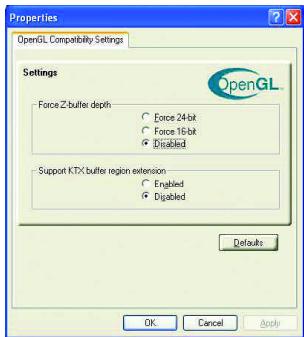
-
Force Z-buffer depth allows you to explicitly set the Z-Buffer depth. Most applications will work best when Disabled is selected.
-
Support KTX buffer region extension Enabling this feature allows rapid updates of those portions of your screen that have changed. Note that most applications will not be affected by activating this feature.
-
Defaults button allows you to reset the OpenGL Compatibility Settings to default values.
Defaults button
This button allows you to reset the OpenGL Settings to default values.
Direct 3D Properties:
The Direct 3D properties page allows you to adjust the Direct 3D settings.
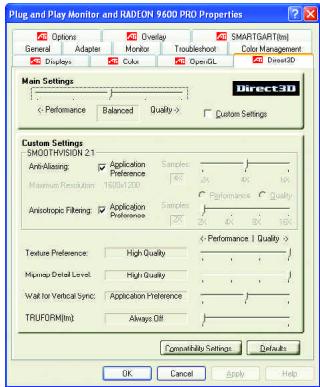
Main Settings slider
Moving the slider to the left will maximize application performance, while moving the slider to the right will provide excellent 3D image quality. Moving this slider from one position to the next changes the individual Custom Settings sliders found below.
- Custom Settings checkbox
When Custom Settings is checked, the Main Settings slider is disabled, allowing you to move each individual slider in the Custom Settings section below. Setting the individual sliders gives you complete control over your ap
plication experience. Using Custom Settings is recommended for advanced users only.
SMOOTHVISION 2.1
- Anti-Aliasing checkbox improves image quality by removing jagged edges from 3D images, resulting in smoother, more naturallooking objects. Selecting Application Preference will result in high quality images, with negligible reduction in the application's performance.
- Anti-Aliasing slider can be applied using different sample patterns and sample points such as 2X, 4X, or 6X. Moving this slider to the right increases sampling to provide the most realistic 3D image.
- Anisotropic Filtering checkbox uses a texture filtering technique that blends multiple texture samples together. Selecting Application Preference will result in high quality textures, with a negligible reduction in the application's performance.
- Anisotropic Filtering slider By moving this slider to the right, as the number of samples taken increases, the quality of the final image increases significantly. 16X provides extremely detailed, crisp-looking images as a result of the largest number of texture samples possible.
Texture Preference slider
Selecting this decides whether your application should use high quality or high performance textures. Moving the slider to the right delivers the highest quality experience. Moving the slider to the left emphasizes a high performance solution while still providing good visuals.
Mipmap Detail Level slider
This will allow you to choose the texture quality of the mipmaps the application will use. Mipmaps are a collection of different sized textures of the same image. As the user moves closer to a 3D object the image quality should increase, requiring a higher quality texture of the same image. The base mipmap is the highest quality texture, and all subsequent mipmaps are smaller sized
textures of the same image. Moving the slider to the right selects a higher quality base mipmap, delivering the highest quality application experience. Moving the slider to the left selects a lower quality mipmap, delivering the highest application performance.
Wait for Vertical Sync
This will lower the frame rate of full screen games but reduce the image tearing that can occur with the higher frame rate. Selecting Application Preference allows the application to decide whether or not it should display its frames at the refresh rate of the monitor. Selecting Always Off allows the application to run at its highest possible frame rate, regardless of the monitor's refresh rate which is typically less than the frame rate at which the application will run.
TRUFORM makes the curved surfaces of 3D objects look smoother and more lifelike.
Compatibility Settings button
This button allows you to access advanced settings that can solve compatibility issues for a few specific Direct 3D applications.
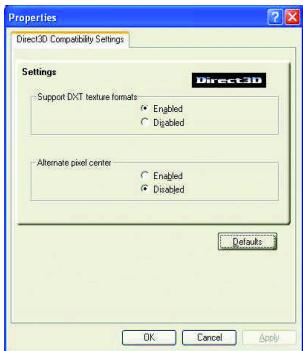
- Support DTX texture formats allows applications to use this kind of texture format. There are a few applications that can only support a limited number of texture formats. By selecting Disabled, the driver will not support DTX texture formats, thus reducing the number of texture formats supported.
- Alternate pixel center This may eliminate problems with some Direct 3D games which display vertical and horizontal lines around textures, or text that appears incorrect.
However, this setting should only be used if you are experiencing the symptoms mentioned, as it may cause problems with other games.
- Defaults button allows you to reset the Direct 3D Compatibility Settings to default values.
Defaults button
This button allows you to reset the Direct 3D Settings to default values.
Color Properties:
The Color Properties is used to adjust the color settings. It also allows gamma control for video playing of the Video Overlay. The color settings affect all display devices mapped to the view. You can change red, green, and blue display colors. Set Desktop and Video Overlay brightness (gamma) levels can also be changed.
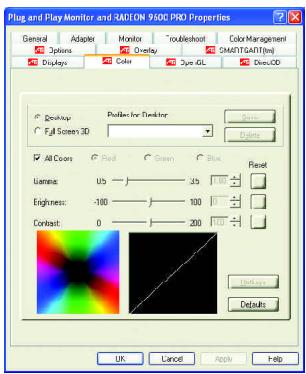
- Desktop increases or decreases the color brightness of your desktop. The higher the gamma value, the higher the brightness and contrast of your display.
All Colors checkbox adjust the RGB individually or adjust all three colors at the same time. - Gamma/Brightness/Contrast adjust the color by moving the slider with your mouse, to increase or decrease the color gamma/brightness/contrast of Direct 3D and OpenGL games played in fullscreen mode. (NOTE: Game Gamma is NOT supported in Windows NT4.0)
Default resets the desktop brightness and color settings to the default values.
Display Properties:
If your VGA card is equipped with a S-Video connector, you can use a second output device (e.q. a TV or a computer monitor) as part of your operating desktop extending your desktop to second device or copying your desktop on the second device.
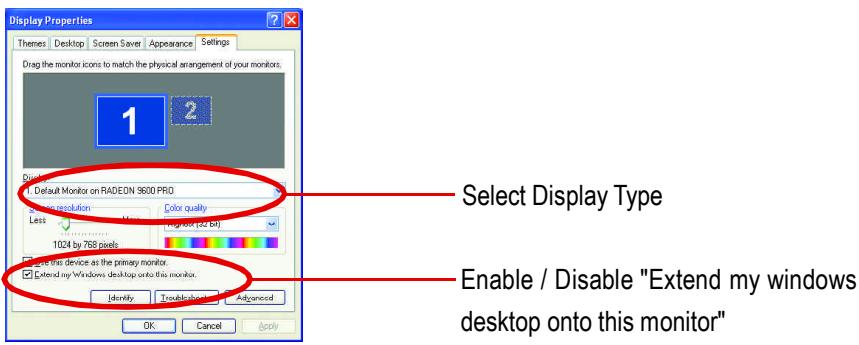
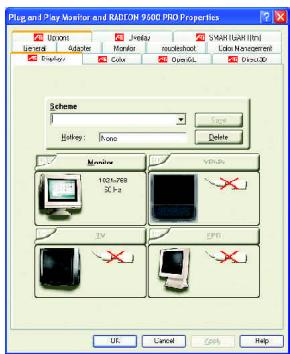
The Display tab provides the multi monitor features. Here you can enable/disable display devices and swap the assignment of Primary and Secondary displays.
Connecting your graphics card to a TV or VCR
To connect your graphics card to a TV (or VCR), use an S-Video cable. However, most TVs (and VCRs) have a Composite video input, in which case you can use the supplied S-Video-to-Composite video adapter.
- Turn off your computer and your television (or VCR).
- Ensure your graphics card was installed correctly. (For information about placing the card in your computer and installing the enhanced graphics driver, see the user's manual.)
- Determine if your television (or VCR) has an S-Video or Composite video connection.
- Looking at the back of your computer, locate your S-Video Out. Using an S-Video cable or the supplied adapter cable, attach one end of the cable to your graphics card and the other to your television (or VCR).
- Turn on your television (or VCR) then your computer.
Overlay Properties:
The Overlay Properties is used to adjust the Brightness / Contrast / Saturation / Hue / Gamma settings.
Overlay properties allows for the viewing of full-motion video on your PC. However, there is only one video overlay, which is only available on the Primary display. The video overlay controls are automatically activated during playback of any video file type that supports overlay adjustments.
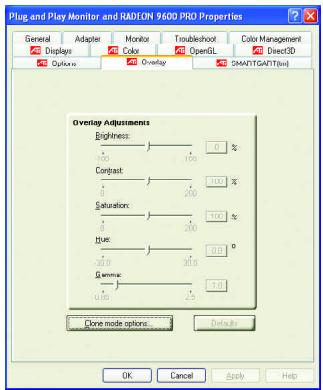
Overlay Adjustments
- Brightness allows you to adjust the brightness of the video image.
- Contrast allows you to adjust the contrast in the video image.
- Saturation allows you to adjust the vividness of the color. Sliding it all the way to the left removes all color and produces a black and white picture.
- Hue allows you to adjust the pureness or tint of the red, green and blue components of the color.
- Gamma allows you to adjust the overall intensity of the video image.
Defaults button allows you to reset the Overlay settings to default values.
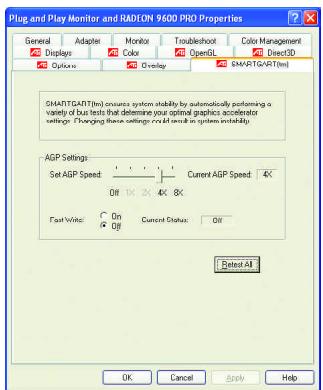
SMARTGART™ Properties:
The SMARTGART™ Properties ensures system stability by automatically performing a variety of bus tests that determine your optimal graphics accelerator settings. Changing these settings might result in system instability.
3.2. WINDOWS 2000 DRIVER INSTALLATION
Please make sure the Windows 2000 have installed Windows® 2000 Service Pack version 2 (or later) before installing the graphics accelerator driver.
With Windows® 2000 running on your computer, you need to install the GV-R96128D driver to take advantage of the higher performance, resolutions, and special graphic features of the Graphics card. To ensure you install the latest driver, use the Installation CD that shipped with your GV-R96128D Graphics card.
To install the GV-R96128D driver for Windows® 2000
- Insert the INSTALLATION CD into your CD-ROM drive. If Windows® runs the CD automatically.
- Click Start.
- Select Run.
- Type the following:
D:\SETUP
(If D is not your CD-ROM drive, substitute D with the correct drive letter.)
- Click "OK".
- Click on "Install Display Drivers(Radeon 9600 Series)" to begin the Installation Wizard.
- Click "Next".
- Click "Yes" to the license agreement.
- Follow the Wizard's on-screen instructions to complete the installation.
3.3. BIOS FLASH UTILITY
BIOS update procedure:
Note: Please download the newest BIOS from our website (www.gigabyte.com.tw) or contact your local dealer for the file.
If you want to realize the BIOS flash information, please refer to detail on page 31.
4. Troubleshooting Tips
The following troubleshooting tips may help if you experience problems. Contact your dealer or GBT for more advanced troubleshooting information.
Check that the card is seated properly in the AGP slot.
■ Ensure that the display cable is securely fastened to the card's display connector.
Make sure that the monitor and computer are plugged in and receiving power.
If necessary, disable any built-in graphics capabilities on your motherboard. For more information, consult your computer's manual or manufacturer.
(NOTE: Some manufacturers do not allow the built-in graphics to be disabled or to become the secondary display.)
- Make sure you selected the appropriate display device and graphics card when you installed the graphics driver.
If you have problems during bootup, start your computer in Safe Mode. In Windows® 98 SE and Windows® Me, press and hold the CTRL key until the Microsoft® Windows® Startup Menu appears on the screen. Then select the number for Safe Mode, and press Enter. (You can also use F8 to bring up the Microsoft Windows® Startup Menu.) In Safe Mode, bring up the Device Manager and check for duplicate display adapter and monitor entries if you are only using one graphics card.
For more assistance, use the Troubleshooting Guide located in the Windows® Help or contact your computer manufacturer.

If necessary, adjust your monitor's setting by monitor's adjust panel to make the screen looks focused, crisp, and sharp. (Please refer to the monitor's manual.)
5. Appendix
5.1. How to reflash the BIOS?

We use GV-AR64SH VGA card and Atiflash BIOS flash utility as example.
How to refresh the BIOS for your graphics card?
- Extract the Zip file to the drive C: or A:
- Restart your PC in MS-DOS mode
(This function only for Windows 98/98SE, If your OS is Windows 2000 / Windows Me / Windows XP. please use the bootable disk to MS-DOS mode)
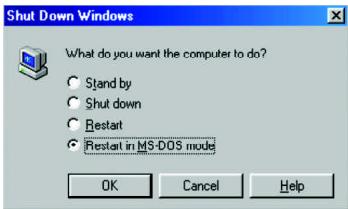
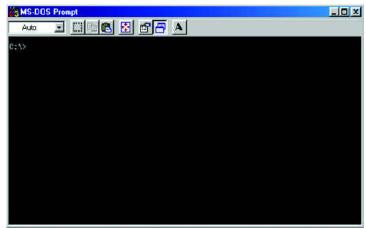
- Change the command path to the file location C:> or A:>
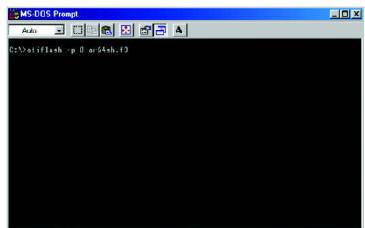
- Reflash BIOS command as below : C:> atiflash -p 0
- Reboot your PC when it's done.
5.2. Resolutions and Color Depth Table (In Windows® XP)
GV-R96128D 2D Single Display Modes
| Display | Refresh | Color Depth (bpp) | ||
| Screen | Rate | 8bpp(256 color) | 16bpp(65K color) | 32bpp(16.7M) |
| Resolution | (Hz) | Standard mode | High mode | True mode |
| 640 x 480 | 60 | ✓ | ✓ | ✓ |
| 72 | ✓ | ✓ | ✓ | |
| 75 | ✓ | ✓ | ✓ | |
| 85 | ✓ | ✓ | ✓ | |
| 90 | ✓ | ✓ | ✓ | |
| 100 | ✓ | ✓ | ✓ | |
| 120 | ✓ | ✓ | ✓ | |
| 160 | ✓ | ✓ | ✓ | |
| 200 | ✓ | ✓ | ✓ | |
| 800 x 600 | 47 | ✓ (interlaced) | ✓ (interlaced) | ✓ (interlaced) |
| 56 | ✓ | ✓ | ✓ | |
| 60 | ✓ | ✓ | ✓ | |
| 70 | ✓ | ✓ | ✓ | |
| 72 | ✓ | ✓ | ✓ | |
| 75 | ✓ | ✓ | ✓ | |
| 85 | ✓ | ✓ | ✓ | |
| 90 | ✓ | ✓ | ✓ | |
| 100 | ✓ | ✓ | ✓ | |
| 120 | ✓ | ✓ | ✓ | |
| 160 | ✓ | ✓ | ✓ | |
| 220 | ✓ | ✓ | ✓ | |
| 1024 x 768 | 43 | ✓ (interlaced) | ✓ (interlaced) | ✓ (interlaced) |
| 60 | ✓ | ✓ | ✓ | |
| 70 | ✓ | ✓ | ✓ | |
| 72 | ✓ | ✓ | ✓ | |
| 75 | ✓ | ✓ | ✓ | |
| 85 | ✓ | ✓ | ✓ | |
| 90 | ✓ | ✓ | ✓ | |
| 100 | ✓ | ✓ | ✓ | |
| 120 | ✓ | ✓ | ✓ |
To be continued...
| Display | Refresh | Color Depth (bpp) | ||
| Screen | Rate | 8bpp(256 color) | 16bpp(65K color) | 32bpp(16.7M) |
| Resolution | (Hz) | Standard mode | High mode | True mode |
| 1152 x 864 | 43 | ✓ (interlaced) | ✓ (interlaced) | ✓ (interlaced) |
| 47 | ✓ (interlaced) | ✓ (interlaced) | ✓ (interlaced) | |
| 60 | ✓ | ✓ | ✓ | |
| 70 | ✓ | ✓ | ✓ | |
| 75 | ✓ | ✓ | ✓ | |
| 85 | ✓ | ✓ | ✓ | |
| 100 | ✓ | ✓ | ✓ | |
| 1280 x 768 | 56 | ✓ | ✓ | ✓ |
| 60 | ✓ | ✓ | ✓ | |
| 75 | ✓ | ✓ | ✓ | |
| 85 | ✓ | ✓ | ✓ | |
| 1280 x 960 | 60 | ✓ | ✓ | ✓ |
| 70 | ✓ | ✓ | ✓ | |
| 72 | ✓ | ✓ | ✓ | |
| 75 | ✓ | ✓ | ✓ | |
| 85 | ✓ | ✓ | ✓ | |
| 100 | ✓ | ✓ | ✓ | |
| 120 | ✓ | ✓ | ✓ | |
| 160 | ✓ | ✓ | ✓ | |
| 1280 x 1024 | 43 | ✓ (interlaced) | ✓ (interlaced) | ✓ (interlaced) |
| 47 | ✓ (interlaced) | ✓ (interlaced) | ✓ (interlaced) | |
| 60 | ✓ | ✓ | ✓ | |
| 70 | ✓ | ✓ | ✓ | |
| 75 | ✓ | ✓ | ✓ | |
| 85 | ✓ | ✓ | ✓ | |
| 90 | ✓ | ✓ | ✓ | |
| 100 | ✓ | ✓ | ✓ | |
| 120 | ✓ | ✓ | ✓ | |
| 1600 x 1200 | 60 | ✓ | ✓ | ✓ |
| 70 | ✓ | ✓ | ✓ | |
| 75 | ✓ | ✓ | ✓ | |
| 85 | ✓ | ✓ | ✓ | |
| 100 | ✓ | ✓ | ✓ |
To be continued...
| Display | Refresh | Color Depth (bpp) | ||
| Screen | Rate | 8bpp(256 color) | 16bpp(65K color) | 32bpp(16.7M) |
| Resolution | (Hz) | Standard mode | High mode | True mode |
| 1792 x 1344 | 60 | ✓ | ✓ | ✓ |
| 75 | ✓ | ✓ | ✓ | |
| 85 | ✓ | ✓ | ✓ | |
| 1800 x 1440 | 60 | ✓ | ✓ | ✓ |
| 70 | ✓ | ✓ | ✓ | |
| 1856 x 1392 | 60 | ✓ | ✓ | ✓ |
| 72 | ✓ | ✓ | ✓ | |
| 75 | ✓ | ✓ | ✓ | |
| 1920 x 1080 | 60 | ✓ | ✓ | ✓ |
| 75 | ✓ | ✓ | ✓ | |
| 1920 x 1200 | 60 | ✓ | ✓ | ✓ |
| 75 | ✓ | ✓ | ✓ | |
| 85 | ✓ | ✓ | ✓ | |
| 1920 x 1440 | 60 | ✓ | ✓ | ✓ |
| 75 | ✓ | ✓ | ✓ | |
| 2048 x 1536 | 60 | ✓ | ✓ | ✓ |
| 66 | ✓ | ✓ | ✓ |
- Lower maximum refresh rates at some resolutions when using lower bandwidth memory configuration.